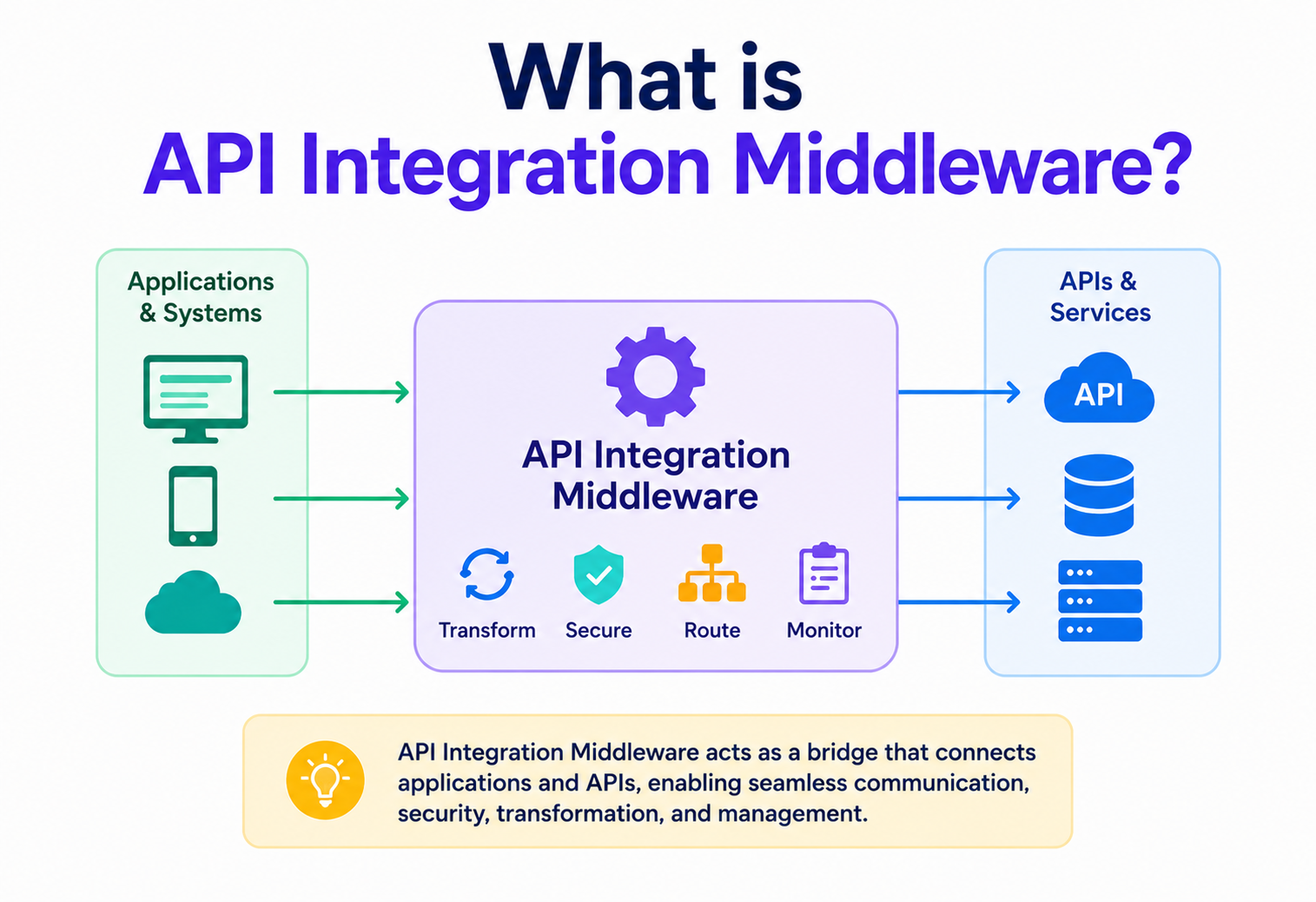
What is API Integration Middleware?
A complete, beginner-to-production guide to the software layer that connects your applications, APIs, and services together — what it is, why it exists, how it works internally, and how companies like Netflix, Amazon, and Uber use it at massive scale.
Introduction & History
The connective tissue of modern software — invisible to users, indispensable to engineers.
Imagine you run a business with three departments — Sales, Warehouse, and Billing — and each department speaks a different language and works on a different schedule. Every time Sales makes a deal, someone has to manually walk over to the Warehouse and Billing teams, translate the request into terms they understand, and make sure all three eventually agree on what happened. That “someone” who does the walking, translating, and coordinating is exactly what API integration middleware does for software systems.
In the simplest terms, API integration middleware is software that sits between two or more applications, APIs, or services and handles the work of connecting them — translating data formats, routing requests, managing protocols, handling errors, and making sure information flows reliably from one system to another. It is “middle” because it sits in the middle of the conversation, and it is “ware” (software) because it is a program, not a person.
Real-life analogy
Think of an international airport. Passengers arrive speaking different languages, carrying different currencies, and following different customs rules depending on where they’re from. The airport doesn’t ask every airline to solve this individually. Instead, there are customs officers, currency exchange counters, and interpreters — a whole layer of infrastructure whose only job is to make sure people, regardless of where they came from, can move smoothly through the system. Integration middleware plays that exact role for data moving between software systems.
1.1 · Where the idea came from
The term “middleware” itself dates back to the late 1960s and gained real traction in the 1980s, when enterprises started connecting mainframes to newer client-server applications. Early on, companies wrote thousands of lines of custom “glue code” for every single connection between two systems — if you had 10 applications that all needed to talk to each other, you could end up writing and maintaining up to 45 separate point-to-point integrations (that’s the classic N × (N - 1) / 2 problem).
By the 1990s, dedicated integration platforms emerged — Message Oriented Middleware (MOM) like IBM MQ, and later Enterprise Service Buses (ESBs) like MuleSoft, TIBCO, and webMethods — that centralised this connective logic into a single reusable layer. In the 2000s, as the web matured and REST APIs and JSON became the standard way for services to talk, middleware evolved again into what we now call API integration middleware or API management platforms — tools like Apigee, Kong, MuleSoft Anypoint, AWS API Gateway, and countless custom Spring Boot-based integration services built in-house.
Today, with the explosion of microservices, SaaS tools, mobile apps, IoT devices, and third-party APIs, integration middleware has become one of the most critical — and often invisible — layers of modern software architecture. It quietly powers checkout flows, banking apps, streaming services, food delivery apps, and virtually every enterprise workflow you can name.
Beginner takeaway
API integration middleware is the “connective tissue” of software systems. You rarely see it directly as a user, but almost every app you use — your bank’s mobile app, a food delivery service, an e-commerce checkout — relies on some form of middleware behind the scenes to stitch together dozens of internal and external systems.
The Problem & Motivation
Every good pattern starts from a genuine pain. Here is the pain middleware exists to remove.
To understand why middleware exists, it helps to look at what happens without it.
2.1 · The point-to-point nightmare
Suppose an e-commerce company has these systems: an Order Service, a Payment Gateway (like Stripe), an Inventory System, a Shipping Provider (like FedEx’s API), a CRM (like Salesforce), and an Email Service (like SendGrid). Without middleware, every system that needs to talk to another system needs its own custom-built connection — its own authentication logic, its own retry logic, its own data-format translation, and its own error handling.
If you have N systems that all need to exchange data, the number of point-to-point connections grows according to the formula N × (N - 1) / 2. With just 6 systems, that’s already 15 separate integrations. With 15 systems, it balloons to 105. Every new system added doesn’t just add one connection — it adds connections to every existing system it needs to talk to.
2.2 · Specific pain points that middleware solves
- Protocol mismatch: One system speaks REST/JSON, another uses SOAP/XML, and a legacy mainframe uses a fixed-width flat file over FTP.
- Data format mismatch: Your internal system calls it
customer_id, but the third-party CRM calls itContactID, and the shipping provider expects an entirely different schema. - Authentication chaos: Each external API has a different auth mechanism — API keys, OAuth2, mutual TLS, HMAC signatures.
- Rate limits and throttling: Third-party APIs often cap how many requests you can send per minute, and someone has to manage that centrally or every internal team re-solves the same problem.
- Failure handling: Networks fail, third-party APIs go down, and without a centralised retry / circuit-breaker strategy, every team reinvents (often badly) their own error handling.
- Change management: When a partner API changes its schema, you don’t want to hunt through 20 different codebases to fix it — you want one place to update.
The core motivation in one line
Integration middleware exists to turn an exponentially growing mess of custom, fragile, point-to-point connections into a small number of stable, centrally managed, reusable integration paths.
Core Concepts
The exact words you’ll hear in every architecture review, defined the way you would explain them to a newcomer.
3.1 · What “integration” actually means
Integration is the act of making two or more independently-built systems work together as if they were designed together. In software, this almost always means moving data (a request, an event, a file, a message) from a source system to a destination system, transforming it along the way so both sides understand it correctly.
3.2 · Middleware vs. a simple API call
A beginner might ask: “Isn’t calling an API already integration? Why do I need middleware on top of that?” The answer is that a direct API call is a single conversation between two parties with no safety net. Middleware adds the layer of intelligence around that conversation: translation, retries, security, logging, routing, and orchestration.
Direct API call
Your food delivery app directly calls a restaurant’s ordering API. If that API is down, your app crashes or the order silently fails. There’s no retry, no fallback, no translation if the restaurant changes its data format.
Same call through middleware
Your app calls your own internal middleware layer, which handles authentication with the restaurant API, retries on failure, transforms your app’s order format into the restaurant’s expected format, logs the transaction, and falls back to a backup delivery partner if the primary is unavailable.
3.3 · Key building-block concepts
| Concept | What it means | Simple example |
|---|---|---|
| Adapter | A small component that speaks one system’s “language” (protocol/format) and translates it to a common internal format | An adapter that converts SOAP/XML from a legacy mainframe into JSON |
| Transformation | Changing the shape or content of data as it passes through | Renaming cust_id to customerId, converting currency |
| Routing | Deciding which destination a message should go to based on its content or metadata | Sending orders above ₹50,000 to a fraud-review queue instead of directly to payment |
| Orchestration | Coordinating a multi-step business process across several services | Order → Inventory check → Payment → Shipping, all coordinated centrally |
| Message Queue | A buffer that holds messages so producer and consumer don’t need to be online at the same time | Kafka or RabbitMQ holding “order placed” events |
| Enrichment | Adding extra data to a message from another source before forwarding it | Adding customer loyalty tier to an order event by looking it up from a CRM |
3.4 · Synchronous vs. asynchronous integration
Middleware can connect systems in two fundamentally different styles. Synchronous integration means the caller waits for a response before continuing — like a phone call. Asynchronous integration means the caller sends a message and moves on, trusting the middleware to deliver it eventually — like sending a letter.
Beginner example
Checking if a credit card is valid before completing checkout needs to be synchronous — the customer is waiting right there. But sending a “thank you for your order” email can be asynchronous — nobody is staring at the screen waiting for that email to send, so it can go through a queue and be processed a few seconds later without anyone noticing.
3.5 · The main “flavours” of middleware
The word “middleware” is broader than just API integration middleware — it’s worth knowing the family it belongs to, because you’ll encounter these terms in job descriptions, vendor docs, and architecture discussions.
| Type | What it connects | Example technology |
|---|---|---|
| Message-Oriented Middleware (MOM) | Applications via asynchronous message queues | IBM MQ, RabbitMQ, ActiveMQ |
| RPC / Object Middleware | Remote procedure calls between distributed objects/services | gRPC, CORBA (legacy), Java RMI |
| Database Middleware | Applications and heterogeneous databases | ODBC, JDBC drivers |
| Transaction Processing Middleware | Coordinates distributed transactions across systems | CICS, Tuxedo |
| API Integration Middleware | APIs, applications, and services (the focus of this guide) | Apigee, Kong, MuleSoft, Spring Integration |
API integration middleware is the modern, dominant category for connecting web-based, cloud-native systems — but it usually incorporates elements of message-oriented middleware (queues) and RPC middleware (gRPC calls) underneath the hood.
3.6 · Canonical data models
A canonical data model is a single, shared, “neutral” representation of a business entity — like an Order or a Customer — that the middleware uses internally, regardless of how each individual source or destination system represents that same entity. Instead of writing N×(N−1) direct transformations between every pair of systems, each system only needs one transformation into the canonical model and one out of it — turning a quadratic problem back into a linear one.
Real-life analogy
Think of a canonical data model like a universal translator at the United Nations. Instead of hiring a translator for every possible pair of languages (French-to-Japanese, French-to-Hindi, Japanese-to-Hindi…), everyone translates into and out of a single shared reference language, dramatically cutting down the number of translators needed.
Architecture & Components
Middleware is rarely one thing — it’s a layered stack of components collaborating on every request.
Modern API integration middleware is rarely a single component — it’s a layered architecture. Here’s what a typical production-grade middleware layer looks like.
4.1 · API Gateway
The single front door for all incoming requests. It handles authentication, rate limiting, request validation, and routes traffic to the correct internal service or integration flow. Examples: Kong, AWS API Gateway, Apigee, Spring Cloud Gateway.
4.2 · Transformation / Mapping Engine
Converts data from one schema or format to another — JSON to XML, flat file to JSON, or renaming/restructuring fields between two systems’ data models.
4.3 · Router
Decides where a message goes next, often based on content (content-based routing), a fixed rule set, or the type of event.
4.4 · Orchestration Engine
Coordinates multi-step workflows that span several backend systems, keeping track of state and handling failures at each step (this overlaps heavily with the Saga pattern used in microservices).
4.5 · Message Broker / Queue
Provides asynchronous, durable delivery of messages between producer and consumer systems. Examples: Apache Kafka, RabbitMQ, AWS SQS/SNS, Azure Service Bus.
4.6 · Adapters / Connectors
Pre-built or custom components that know how to talk to a specific external system’s protocol — a Salesforce connector, an SAP connector, an FTP adapter, a Stripe SDK wrapper.
4.7 · Resilience Layer
Circuit breakers, retry policies, timeouts, and bulkheads that protect the whole system from a single failing dependency (covered in depth in section 9).
4.8 · Monitoring & Observability Layer
Centralised logging, tracing, and metrics collection across every integration flow, since a failure anywhere in this chain needs to be visible quickly.
4.9 · Choosing components for your architecture
Not every project needs every component described above. A small team connecting two or three internal services might only need a lightweight API Gateway and a simple transformation layer. A large enterprise connecting dozens of legacy systems, SaaS tools, and partner APIs typically needs the full stack — gateway, transformer, router, orchestrator, broker, and resilience layer working together.
| Scenario | Minimum viable components |
|---|---|
| Two internal microservices calling each other | Service mesh sidecar, or simple REST client with retry logic |
| Mobile app talking to several backend services | API Gateway + Backend-for-Frontend layer |
| Connecting to 3rd-party SaaS tools (CRM, email, payments) | API Gateway + Adapters + Transformation engine |
| Enterprise-wide integration across legacy and modern systems | Full stack: Gateway, Adapters, Transformer, Router, Orchestrator, Broker, Resilience layer, Observability |
Internal Working
Following a single order request all the way through the middleware, step by step.
Let’s walk through, step by step, what actually happens inside the middleware when a request flows through it — using a concrete example: a customer places an order on an e-commerce app, and that order needs to reach both the Payment service and a third-party Shipping partner.
5.1 · Step-by-step internal flow
Request received
The API Gateway receives the incoming HTTP POST request from the mobile app containing the order JSON payload.
Authentication & authorisation
The gateway validates the JWT token or API key, confirms the caller is allowed to place orders, and attaches identity metadata to the request context.
Validation
The payload is checked against a schema (e.g., JSON Schema) to ensure required fields like
customerId,items, andtotalAmountare present and correctly typed.Transformation
The internal order format is translated into whatever format the Payment service and Shipping partner expect — this might mean flattening nested objects, renaming fields, or converting currency codes.
Routing decision
Based on the order’s content (e.g., order value, region, product type), the router decides the exact sequence of downstream calls needed.
Orchestration
The orchestrator calls the Payment service synchronously (because the customer is waiting to know if payment succeeded) and publishes a “shipping requested” event to a queue asynchronously (because shipping confirmation isn’t needed immediately).
Resilience checks
If the Payment service is slow or returns errors, a circuit breaker may trip, a retry with exponential backoff may kick in, or a fallback (e.g., “queue for manual review”) may be triggered.
Response assembly
Once payment succeeds, the middleware assembles a unified response back to the mobile app — even though internally, two or three different systems were involved.
Logging & tracing
Every step above is logged with a shared correlation ID, so if something goes wrong, engineers can trace the exact path the order took across every system it touched.
@Service
public class OrderIntegrationService {

    private final PaymentClient paymentClient;
    private final ShippingEventPublisher shippingPublisher;
    private final OrderTransformer transformer;

    public OrderIntegrationService(PaymentClient paymentClient,
                                    ShippingEventPublisher shippingPublisher,
                                    OrderTransformer transformer) {
        this.paymentClient = paymentClient;
        this.shippingPublisher = shippingPublisher;
        this.transformer = transformer;
    }

    @CircuitBreaker(name = "paymentService", fallbackMethod = "fallbackPayment")
    @Retry(name = "paymentService")
    public OrderResponse processOrder(OrderRequest request) {

        // 1. Transform internal format into Payment service's expected schema
        PaymentRequest paymentPayload = transformer.toPaymentFormat(request);

        // 2. Synchronous call — customer is waiting for this result
        PaymentResult result = paymentClient.charge(paymentPayload);

        // 3. Asynchronous event — shipping doesn't need to block the response
        shippingPublisher.publish(transformer.toShippingEvent(request));

        // 4. Build a single unified response for the caller
        return new OrderResponse(request.getOrderId(), result.getStatus());
    }

    public OrderResponse fallbackPayment(OrderRequest request, Throwable t) {
        // Circuit is open or retries exhausted — queue for manual review
        return new OrderResponse(request.getOrderId(), "PENDING_REVIEW");
    }
}
Notice how the middleware code doesn’t just “call an API” — it transforms data, handles both sync and async paths, and gracefully degrades when a downstream dependency misbehaves. This is the essence of what integration middleware is responsible for.
Data Flow & Lifecycle
Every message that passes through the middleware has a lifecycle — from first byte to final acknowledgement.
Every message that passes through middleware has a lifecycle — from the moment it’s created to the moment it’s finally delivered (or discarded after failure).
6.1 · Lifecycle stages
- Ingestion: The message enters the middleware, typically via an API call, webhook, file drop, or event stream.
- Validation: Structural and business-rule checks reject malformed or unauthorised messages early, before they waste downstream resources.
- Transformation: The message is converted into a canonical internal format, and later into whatever format each destination expects.
- Routing: The middleware decides the destination(s) — sometimes one message fans out to five different systems.
- Delivery: The message is sent, either synchronously (wait for response) or asynchronously (fire into a queue).
- Acknowledgement: The destination confirms receipt/processing; without this, the middleware can’t safely consider the message “done.”
- Error handling / Dead-lettering: If delivery repeatedly fails, the message is moved to a Dead Letter Queue (DLQ) for manual inspection instead of being lost silently.
- Archival / Audit: Successfully processed messages are often logged or archived for compliance and debugging purposes.
Production example — Uber
When you request a ride, that single action triggers a cascade: matching you to a driver, calculating a price, checking driver availability, sending push notifications, and eventually billing. Uber’s internal integration layer is what choreographs dozens of microservices reacting to that one event, each with its own retry and failure-handling logic, all traceable back to a single trip ID.
6.2 · Schema versioning across the lifecycle
As business requirements evolve, the shape of the data flowing through middleware inevitably changes — a new field gets added, an old one gets deprecated. Well-designed middleware treats schemas as versioned contracts: a new version is introduced alongside the old one, consumers migrate on their own schedule, and the old version is only retired once nobody depends on it anymore. This is usually far safer than making a breaking change in place, which can silently corrupt data for every consumer that hasn’t updated yet. Many teams enforce this using a schema registry (a common pattern alongside Kafka) that rejects any producer trying to publish data that isn’t compatible with the agreed schema evolution rules.
Pros, Cons & Tradeoffs
Every architectural choice has two honest sides. Here they are, without spin.
Advantages
- Massively reduces the number of point-to-point connections to maintain
- Centralises cross-cutting concerns: auth, logging, retries, rate limiting
- Makes it easy to swap out a backend system without touching every consumer
- Enables asynchronous, resilient communication between systems
- Gives a single place to enforce governance, security, and compliance policies
- Speeds up onboarding of new partners/services (reuse existing adapters)
Disadvantages / Costs
- Adds a new layer of infrastructure that must itself be maintained and scaled
- Can become a single point of failure if not designed for high availability
- Introduces additional network hops, which can add latency
- Poorly governed middleware can turn into an unmanageable “black box”
- Debugging across an extra layer is harder without strong tracing in place
- Risk of becoming an organisational bottleneck if one team owns all integrations
7.1 · The key tradeoff — centralisation vs. autonomy
Centralising integration logic makes life easier for consumers of that logic, but it can also create a bottleneck — every team now depends on the middleware team to ship changes. This is exactly why many organisations moved from heavyweight, centrally-owned Enterprise Service Buses (ESBs) toward lighter-weight patterns where individual microservices own smaller pieces of integration logic themselves, using shared libraries and platforms rather than one monolithic middleware team controlling everything.
| Approach | Best for | Watch out for |
|---|---|---|
| Centralised ESB | Large enterprises with many legacy systems and strict governance needs | Becomes a bottleneck; single point of failure |
| API Gateway + lightweight middleware | Cloud-native, microservice-based companies | Requires strong platform/DevOps discipline |
| Event-driven middleware (Kafka-based) | High-throughput, real-time, loosely-coupled systems | Eventual consistency complexity, harder debugging |
| iPaaS (cloud integration platforms) | SaaS-heavy companies connecting many third-party tools | Vendor lock-in, per-transaction costs |
Most real-world architectures don’t pick just one row from this table — they blend approaches. A typical mid-size company might use an API Gateway for external partner traffic, Kafka-based event middleware for internal high-throughput flows between microservices, and an iPaaS tool for lower-volume SaaS integrations like syncing data into Salesforce or HubSpot, choosing the right tool for each specific integration’s volume, latency, and governance needs rather than forcing everything through a single technology.
Performance & Scalability
Because middleware sits on the critical path of nearly every request, its performance caps the whole system’s performance.
Because middleware sits on the critical path of nearly every request, its performance characteristics directly affect the performance of everything built on top of it.
8.1 · Latency budgets
Every hop through the middleware layer adds latency — authentication, transformation, routing, and any synchronous downstream calls all add up. Production systems typically define a latency budget per hop (e.g., “the gateway must add no more than 15 ms”) and monitor against it continuously.
8.2 · Horizontal scaling
Middleware components should be stateless wherever possible so that they can be scaled horizontally — simply adding more instances behind a load balancer — rather than needing bigger, more expensive machines (vertical scaling). API gateways, transformation services, and orchestrators are typically deployed as stateless, horizontally-scaled pods in Kubernetes.
8.3 · Backpressure and throttling
When downstream systems can’t keep up with the volume of incoming requests, middleware needs to apply backpressure — slowing down or rejecting excess traffic — rather than blindly forwarding everything and overwhelming a fragile backend. Rate limiting (e.g., token bucket or leaky bucket algorithms) is commonly implemented right at the API Gateway layer.
Beginner example
A toll booth (the middleware) can only let a certain number of cars through per minute without causing traffic to back up further down the highway (the backend service). Backpressure is the toll booth deliberately slowing entry so the highway doesn’t jam.
8.4 · Batching and bulk operations
For high-volume integrations (e.g., syncing 100,000 product records to a partner catalogue), middleware often batches many small operations into fewer, larger calls to reduce network overhead and respect third-party rate limits.
8.5 · Asynchronous processing at scale
Message queues (Kafka, RabbitMQ, SQS) allow middleware to absorb sudden traffic spikes by buffering messages, letting consumer services process them at a sustainable rate instead of being overwhelmed in real time — this is one of the most important scalability tools in an integration architect’s toolkit.
Production example — Netflix
Netflix processes trillions of events per day across its microservices ecosystem. Its internal event-streaming and integration platforms (built on Kafka and custom-built routing layers) are designed to gracefully absorb massive, unpredictable spikes — like millions of viewers hitting play at the same moment during a popular new release — without overwhelming any single downstream service.
8.6 · Concurrency inside the middleware
A single middleware instance typically handles thousands of concurrent requests. This is usually achieved through non-blocking, asynchronous I/O (event-loop based frameworks like Netty, or reactive programming models like Spring WebFlux / Project Reactor) rather than allocating one operating-system thread per request, which doesn’t scale well past a few thousand concurrent connections. Non-blocking I/O allows a small pool of threads to juggle many in-flight requests, parking a request while it waits on a slow downstream call instead of holding a thread hostage.
@GetMapping("/orders/{id}/status")
public Mono<OrderStatus> getStatus(@PathVariable String id) {
    return webClient.get()
        .uri("/partner-api/shipment/{id}", id)
        .retrieve()
        .bodyToMono(ShipmentStatus.class)
        .timeout(Duration.ofSeconds(3))
        .map(this::toOrderStatus)
        .onErrorReturn(OrderStatus.UNKNOWN);
}
8.7 · Consensus in distributed middleware clusters
When middleware components themselves run as a cluster (for example, a group of orchestrator nodes tracking the state of long-running workflows), they often need to agree on shared state — which node is the current leader, or which node owns processing a particular partition. This requires a consensus algorithm such as Raft or Paxos, commonly provided under the hood by coordination services like ZooKeeper or etcd, rather than being hand-rolled by application teams.
High Availability & Reliability
Middleware has to be more reliable than every system it connects — not less.
Because middleware often becomes the single path through which critical business transactions flow, it must be engineered to be more reliable than any individual system it connects — not less.
9.1 · Circuit breakers
A circuit breaker monitors calls to a downstream dependency. If failures cross a threshold, it “opens” the circuit and stops sending traffic to that dependency for a cooldown period, protecting both the failing service (giving it time to recover) and the calling system (preventing cascading failures and wasted resources).
resilience4j.circuitbreaker:
  instances:
    paymentService:
      slidingWindowSize: 20
      failureRateThreshold: 50
      waitDurationInOpenState: 15s
      permittedNumberOfCallsInHalfOpenState: 5
      registerHealthIndicator: true
9.2 · Retries with exponential backoff
Transient failures (a brief network blip, a momentary spike in downstream load) are often best handled by retrying — but retrying immediately and repeatedly can make things worse. Exponential backoff increases the wait time between each retry attempt (e.g., 1 s, 2 s, 4 s, 8 s), giving the failing system room to recover.
9.3 · Idempotency
Because retries can cause the same request to be sent more than once, middleware needs to ensure operations are idempotent — that processing the same request twice produces the same result as processing it once. This is usually done using an idempotency key attached to each request, checked against a store of recently-processed keys before acting.
9.4 · Dead Letter Queues (DLQ)
Messages that fail processing repeatedly, even after retries, are routed to a Dead Letter Queue rather than being lost or endlessly retried. Engineers can inspect the DLQ, fix the root cause, and replay the messages once resolved.
9.5 · Failover and redundancy
Production middleware is deployed across multiple availability zones (and often multiple regions) so that the failure of one data centre doesn’t take down the entire integration layer. Health checks continuously monitor each instance, and traffic is automatically rerouted away from unhealthy nodes.
9.6 · CAP theorem in integration middleware
The CAP theorem states that a distributed system can only fully guarantee two of the following three at the same time: Consistency (every read sees the latest write), Availability (every request gets a response), and Partition tolerance (the system keeps working despite network failures between nodes). Since network partitions are unavoidable in real distributed systems, middleware architects almost always must choose between prioritising consistency or availability during a partition.
Most API integration middleware favours availability and partition tolerance (AP) — it’s usually more important that the system keeps accepting and queuing orders during a partial outage than that every system agrees instantly on the exact state. This is why asynchronous, eventually-consistent integration patterns (queues, events) are so common in this space — they naturally align with an AP tradeoff.
Common misconception
Middleware being highly available does not mean every downstream system is guaranteed to have processed a message instantly. “Eventual consistency” is a deliberate, accepted tradeoff — not a bug — in most large-scale integration architectures.
9.7 · Replication for durability
Message brokers underlying the middleware layer (like Kafka) replicate every message across multiple broker nodes before acknowledging a write, so that the failure of a single node doesn’t lose data. A typical setup replicates each message to three nodes, and requires acknowledgement from a majority (a quorum) before considering the write durable — this is the same core idea behind database replication discussed in distributed systems more broadly.
9.8 · Failure recovery and replay
Because messages are persisted (not just passed through memory), a consumer that crashes can restart and resume exactly where it left off, using a stored offset or checkpoint. This “replay” capability is one of the most powerful reliability properties of queue-based middleware — if a bug caused a batch of messages to be processed incorrectly, engineers can often fix the bug and simply replay the affected messages from the log, rather than trying to manually repair inconsistent downstream data.
9.9 · Disaster recovery
For mission-critical integrations, middleware infrastructure is often mirrored across regions, with message brokers configured for cross-region replication. A well-tested disaster recovery plan defines a Recovery Time Objective (RTO — how quickly the system must be back up) and Recovery Point Objective (RPO — how much data loss, measured in time, is acceptable) specific to each integration flow, since not every integration carries the same business criticality.
Security
One of the highest-value surfaces in the architecture — every sensitive byte crosses through here.
Because middleware routes sensitive data between systems — and often between your company and external third parties — it is one of the highest-value security surfaces in your architecture.
10.1 · Authentication & Authorisation
- API Keys: Simple, but weak on their own — should always be paired with HTTPS and rate limiting.
- OAuth2 / OpenID Connect: Industry standard for delegated authorisation, especially for third-party integrations.
- Mutual TLS (mTLS): Both client and server present certificates, commonly used for service-to-service and partner-to-partner integrations requiring very high trust.
- JWT (JSON Web Tokens): Signed tokens carrying identity/claims, verified at the gateway without needing a database lookup on every request.
10.2 · Data protection
Data should be encrypted in transit (TLS 1.2+) and at rest wherever middleware persists messages (queues, logs, databases). Sensitive fields — card numbers, personal identifiers — are often tokenised or masked before being logged, so that logs never accidentally leak PII or payment data.
10.3 · Input validation and schema enforcement
Every message entering the middleware should be validated against a strict schema before processing. This blocks malformed payloads, injection attempts, and unexpected data that could crash downstream systems or be used maliciously.
10.4 · Rate limiting and abuse protection
Rate limiting at the gateway protects both your own systems and third-party partner APIs from being overwhelmed — accidentally by a buggy client, or intentionally by an attacker.
10.5 · Secrets management
API keys, certificates, and credentials used to talk to third-party systems must never be hardcoded. Production systems use secret managers (AWS Secrets Manager, HashiCorp Vault, Azure Key Vault) with automatic rotation.
Common mistake
Logging entire request/response payloads for debugging is a very common way sensitive data (credit card numbers, passwords, personal data) accidentally ends up in log files, which are often far less protected than the primary database. Always mask or exclude sensitive fields before logging.
10.6 · Common attack surfaces
Because middleware often exposes a public-facing entry point, it becomes a natural target for attackers. Some of the most common risks include:
- Injection attacks: Malicious payloads embedded in a request body that exploit poorly sanitised transformation or routing logic.
- Replay attacks: Capturing a legitimate request and resending it later — mitigated with timestamped, signed requests and idempotency keys.
- Man-in-the-middle attacks: Intercepting traffic between the middleware and a partner system — mitigated with TLS and certificate pinning for especially sensitive integrations.
- Credential leakage through misconfigured logs or error messages: Stack traces that accidentally include API keys or tokens in an error response.
10.7 · Compliance considerations
Middleware handling personal or financial data often needs to meet regulatory requirements — GDPR in Europe, India’s Digital Personal Data Protection (DPDP) Act, or PCI-DSS for payment card data. This typically shapes concrete engineering decisions: how long data can be retained in logs, whether data can be transmitted across certain geographic boundaries, and how access to sensitive integration flows is audited.
Monitoring, Logging & Metrics
A single transaction now touches many systems — observability is what turns that from a mystery into a story.
Because a single business transaction might touch five or six systems through the middleware layer, observability isn’t optional — without it, a failure becomes nearly impossible to diagnose.
11.1 · Correlation IDs and distributed tracing
Every incoming request is assigned a unique correlation ID (or trace ID) at the very first entry point. This ID is passed along with every downstream call, so that all logs and traces related to a single business transaction can be reassembled into one coherent story, even though the transaction touched multiple independent systems.
11.2 · Key metrics to track
| Metric | Why it matters |
|---|---|
| Request throughput (req/sec) | Detects traffic spikes and capacity limits |
| P50 / P95 / P99 latency | Reveals typical vs. worst-case response times, not just averages |
| Error rate by integration | Pinpoints which specific downstream system is failing |
| Circuit breaker state changes | Signals when a dependency is degrading before it fully fails |
| Queue depth / consumer lag | Shows whether consumers are keeping up with producers |
| DLQ message count | Surfaces messages that need manual investigation |
11.3 · Structured logging
Logs should be structured (JSON, not free text) so they can be indexed, searched, and correlated automatically by tools like the ELK stack (Elasticsearch, Logstash, Kibana) or Splunk. Every log line should include the correlation ID, timestamp, service name, and outcome.
11.4 · Alerting
Alerts should be based on symptoms that matter to the business (elevated error rate, growing queue backlog, rising latency) rather than arbitrary technical thresholds, and should route to the team that actually owns the affected integration. A well-tuned alerting strategy distinguishes between a page that needs someone woken up at 3 a.m. and a warning that can simply show up on a dashboard for the morning stand-up — alert fatigue from too many low-value pages is one of the fastest ways to make a team start ignoring real incidents.
Deployment & Cloud
Containerised, independently-scalable, and increasingly cloud-managed.
Modern API integration middleware is almost always deployed as a set of containerised, independently-scalable services rather than a single monolithic application.
12.1 · Containers and orchestration
Each middleware component (gateway, transformer, orchestrator) typically runs as a Docker container managed by Kubernetes, which handles scaling, self-healing (restarting failed containers), and rolling deployments with zero downtime.
12.2 · Managed cloud integration services
Rather than building everything from scratch, teams often combine managed cloud services:
- AWS: API Gateway, EventBridge, SQS/SNS, Step Functions (for orchestration), AppFlow
- Azure: API Management, Service Bus, Logic Apps, Event Grid
- GCP: Apigee, Pub/Sub, Cloud Workflows
- iPaaS platforms: MuleSoft Anypoint, Boomi, Workato — for companies that prefer low-code integration building
12.3 · CI/CD for integration flows
Integration logic, transformation mappings, and routing rules should be version-controlled and deployed through the same CI/CD pipelines as any other code — with automated tests validating that a schema change doesn’t silently break a downstream partner integration. Contract testing tools (like Pact) let a team verify that its service still satisfies the expectations of every consumer, without needing to spin up every consumer’s full environment during the build.
12.4 · Blue-green and canary deployments
Because middleware sits on the critical path for so many transactions, changes are typically rolled out gradually — a canary deployment sends a small percentage of traffic to the new version first, and only shifts more traffic over once metrics confirm it’s healthy.
Production example — Amazon
Amazon’s internal service-to-service communication famously runs through strict API contracts enforced at the platform level — a principle popularised by Jeff Bezos’s “API mandate” memo, which required every team to expose functionality only through well-defined service interfaces. This is integration middleware philosophy applied at an organisational scale.
Databases, Caching & Load Balancing
The supporting infrastructure that keeps middleware fast, fair, and remembered.
13.1 · Does middleware need its own database?
Often, yes. Middleware frequently needs to persist state — in-flight orchestration status, idempotency keys, DLQ contents, audit logs. This is typically a separate, purpose-built datastore rather than reusing a backend service’s primary database, to avoid tightly coupling the middleware’s lifecycle to any one system.
13.2 · Caching in the middleware layer
Caching dramatically reduces load on both the middleware and downstream systems:
- Response caching: Caching results of expensive or frequently-repeated calls to slow-changing external APIs (e.g., a currency exchange rate updated once per hour).
- Token caching: Caching OAuth2 access tokens until they expire, instead of re-authenticating on every single call.
- Configuration caching: Caching routing rules and transformation mappings in memory, refreshed periodically, to avoid a database round-trip on every request.
Redis is the most common choice for this layer, given its speed and support for TTL-based expiry, which naturally fits caching use cases.
13.3 · Load balancing
Incoming traffic to the middleware layer is distributed across many instances by a load balancer (e.g., NGINX, AWS ALB, Envoy) using strategies like round-robin, least-connections, or consistent hashing. Health checks continuously remove unhealthy instances from rotation.
13.4 · Partitioning and sharding for high-volume middleware
At very large scale, even the message queue layer may need to be partitioned — for example, Kafka topics are split into partitions so that different consumer instances can process different partitions in parallel, dramatically increasing throughput while preserving message ordering within each partition.
APIs & Microservices Integration
Microservices multiplied the connective work; middleware is what keeps it manageable.
14.1 · Middleware as the connective layer for microservices
In a microservices architecture, dozens or hundreds of small, independently-deployed services need to talk to each other. Integration middleware — in the form of API gateways, service meshes, and event buses — is what makes this manageable rather than chaotic.
14.2 · API Gateway pattern
Rather than exposing every microservice directly to external clients, a single API Gateway acts as the unified entry point, handling cross-cutting concerns (auth, rate limiting, request routing) so individual services can stay focused purely on business logic.
14.3 · Service mesh vs. traditional middleware
A service mesh (like Istio or Linkerd) is a more modern, infrastructure-level approach to service-to-service communication, handling retries, circuit breaking, load balancing, and mTLS transparently through sidecar proxies rather than application-level middleware code. Many organisations use both: an API Gateway for external (north-south) traffic, and a service mesh for internal (east-west) traffic between microservices.
14.4 · Backend-for-Frontend (BFF)
A specialised form of integration middleware where a thin layer is built specifically to aggregate and transform data from multiple backend services into the exact shape a particular frontend (mobile app vs. web app) needs, avoiding the frontend having to make and merge many separate calls itself.
14.5 · Webhooks as lightweight integration
Webhooks are a simple, common integration middleware pattern where an external system pushes an HTTP callback to notify your system of an event (e.g., “payment succeeded”), rather than your system having to repeatedly poll for status. Middleware typically receives these webhooks, verifies their authenticity (via signature checks), and routes the event internally.
Design Patterns & Anti-Patterns
A short catalogue of the moves that make integrations reliable — and the traps that make them brittle.
15.1 · Common integration patterns
| Pattern | What it solves |
|---|---|
| Adapter | Translates one system’s interface/protocol into another’s |
| Content-Based Router | Sends a message to different destinations based on its content |
| Message Translator | Converts data format/schema between systems |
| Aggregator | Combines multiple related messages into a single, unified response |
| Saga | Coordinates a multi-step transaction across services with compensating actions on failure |
| Outbox Pattern | Ensures a database write and an event publish happen reliably together |
| Dead Letter Channel | Isolates messages that repeatedly fail processing for manual review |
| Claim Check | Stores large payloads externally and passes only a reference through the message flow |
15.2 · Anti-patterns to avoid
The “God Middleware”
A single middleware service that knows too much business logic about every downstream system, becoming an unmaintainable bottleneck that every team fears touching.
Chatty Synchronous Chains
Building long chains of synchronous calls (A waits for B, which waits for C, which waits for D) — a single slow link makes the entire chain slow, and one failure cascades through all of them.
No idempotency
Retrying a failed request without idempotency protection can cause duplicate charges, duplicate emails, or duplicate orders.
Silent failure swallowing
Catching exceptions and logging them without alerting or retrying means failures pile up invisibly until a customer complains.
Best Practices & Common Mistakes
The habits that separate integrations that survive real traffic from those that quietly rot.
16.1 · Best practices
- Design for failure from day one — assume every downstream call can and will fail; build retries, circuit breakers, and fallbacks in from the start rather than bolting them on later.
- Keep transformations explicit and versioned — treat data mapping rules as code, reviewed and tested like any other logic.
- Use correlation IDs everywhere — without them, debugging a multi-system failure becomes guesswork.
- Favour asynchronous communication where the business allows it — it decouples systems and improves resilience.
- Enforce contracts with schema validation — catch bad data at the door, not three systems downstream.
- Automate testing of integration flows, including contract tests against third-party APIs where possible.
- Document every integration — what it does, who owns it, what happens if it fails — since integrations tend to outlive the people who built them.
16.2 · Common mistakes
- Treating middleware as an afterthought bolted on late in a project instead of designing it alongside the core architecture.
- Hardcoding credentials or endpoint URLs instead of using configuration and secrets management.
- Building tightly-coupled, synchronous chains where a single async event bus would be far more resilient.
- Ignoring backward compatibility when changing transformation logic, silently breaking every consumer at once.
- Under-investing in observability until a major incident makes the cost of that neglect painfully clear.
- Letting one team own “all integrations,” turning them into an organisational bottleneck.
16.3 · A simple checklist before shipping a new integration
Before a new integration flow goes to production, it’s worth running through a short checklist that catches the majority of real-world incidents:
Timeouts & retries
Does every downstream call have a sensible timeout, retry policy, and circuit breaker?
Idempotency
Is the operation idempotent, or protected by an idempotency key?
Correlation IDs
Is there a correlation ID propagated across every hop of the flow?
Poison messages
What happens to a message that fails permanently — is there a Dead Letter Queue and an alert?
Secrets hygiene
Are credentials pulled from a secrets manager rather than hardcoded or checked into source control?
Rollback plan
Is there a rollback plan if the new transformation logic turns out to be wrong in production?
Ownership & on-call
Who gets paged if this integration fails at 2 a.m., and do they have enough context to act quickly?
Teams that treat this checklist as a genuine gate — not just a formality — consistently ship integrations that survive real-world failure conditions far better than teams that skip straight from “it works on my machine” to production traffic.
Real-World & Industry Examples
The same fundamentals, dialled up to internet scale.
NetflixEvent-driven middleware at massive scale
Netflix relies heavily on Kafka-based event streaming as its integration backbone, allowing hundreds of microservices to react to events (a new title added, a user’s viewing progress) without being tightly coupled to each other, and absorbing enormous traffic spikes gracefully.
AmazonStrict API-first integration mandate
Amazon requires all internal teams to expose functionality exclusively through well-defined service interfaces rather than direct database access, effectively making API integration middleware principles a company-wide architectural law rather than just a technical tool.
UberOrchestrating dozens of services per trip
A single ride request triggers coordinated calls across matching, pricing, mapping, notifications, and payment services — all choreographed through Uber’s internal integration and orchestration layers, tied together by a single trip ID for full traceability.
Banking & FintechLegacy-to-modern bridging
Banks frequently use middleware (often ESB-style platforms) to bridge decades-old mainframe core banking systems with modern mobile apps and third-party fintech partners, translating ancient fixed-width file formats into modern REST/JSON APIs without ever touching the legacy core itself.
E-commerce & RetailMulti-marketplace order sync
Large retailers selling across their own website plus marketplaces like Amazon, Flipkart, and physical point-of-sale systems rely on integration middleware to keep inventory counts, pricing, and order status synchronised across every channel in near real time — so that a product sold out on Amazon is instantly reflected as unavailable everywhere else, preventing overselling.
FAQ, Summary & Key Takeaways
The questions that come up in every interview and every design review.
Is API integration middleware the same as an API Gateway?
Not exactly — an API Gateway is one specific component (usually the front door) of a broader integration middleware architecture, which may also include message queues, transformation engines, and orchestrators.
Do small applications need integration middleware?
Not always. If you only have two or three systems talking to each other with simple, stable data formats, a direct API call may be perfectly fine. Middleware earns its keep once the number of integrations, complexity, or reliability requirements grow.
What’s the difference between middleware and an ESB?
An Enterprise Service Bus (ESB) is a specific, often heavyweight, centralised style of middleware popular in the 2000s–2010s. Modern integration middleware tends to be lighter-weight and more distributed, favouring API gateways and event streaming over a single monolithic bus.
Can middleware become a bottleneck?
Yes — if a single team owns all integration logic, or if the middleware itself isn’t built for high availability and horizontal scaling, it can become both an organisational and technical bottleneck. Good middleware design actively guards against this.
Is Kafka itself “middleware”?
Kafka is a message broker — a core building block often used within an integration middleware architecture, but “middleware” refers more broadly to the whole layer of software (gateways, transformers, orchestrators, brokers) that connects systems together.
Should I build my own middleware or buy an iPaaS platform?
It depends on scale, budget, and how unique your integration needs are. Off-the-shelf iPaaS platforms (MuleSoft, Boomi, Workato) get you moving quickly with pre-built connectors and a visual builder, which is great for smaller teams or standard SaaS-to-SaaS integrations. Building your own (typically with Spring Boot, Kafka, and a gateway like Kong) gives full control, avoids per-transaction licensing costs at scale, and fits better when your integration logic is deeply tied to custom business rules — which is why most large tech companies eventually build custom in-house integration platforms.
How is API integration middleware different from an ETL pipeline?
ETL (Extract, Transform, Load) pipelines typically move large batches of data between systems on a schedule, often for analytics or reporting purposes. API integration middleware is usually more real-time and transactional, handling individual business events as they happen. The two overlap conceptually (both extract, transform, and deliver data) but serve different latency and use-case needs.
What skills does someone need to build integration middleware?
A solid grasp of distributed systems fundamentals (this is where concepts like CAP theorem, idempotency, and consensus come in), strong API design skills, familiarity with messaging systems like Kafka or RabbitMQ, and experience with a backend framework such as Spring Boot for building the orchestration and transformation logic itself.
Summary
API integration middleware is the software layer that sits between applications and services, handling translation, routing, orchestration, security, and resilience so that individual systems don’t each have to solve these problems independently. It emerged from decades of enterprises struggling with fragile, exponentially-growing point-to-point connections, and has evolved from heavyweight ESBs into today’s lighter, cloud-native combination of API gateways, service meshes, and event-streaming platforms.
Key Takeaways
- Middleware turns an unmanageable web of point-to-point integrations into a small set of centrally managed, reusable connections.
- Core responsibilities include transformation, routing, orchestration, security, and resilience (retries, circuit breakers, idempotency).
- Synchronous integration suits real-time, user-waiting scenarios; asynchronous integration suits everything else and improves resilience.
- CAP theorem tradeoffs matter — most integration middleware favours availability and partition tolerance over strict consistency.
- Observability (correlation IDs, distributed tracing, structured logs) is non-negotiable once a transaction spans multiple systems.
- Security must be built in from the start: strong auth, encryption, input validation, and careful secrets management.
- Watch for anti-patterns like the “God Middleware,” chatty synchronous chains, and silent failure swallowing.
- Companies like Netflix, Amazon, and Uber treat integration middleware not as an afterthought but as a first-class architectural discipline.
Whether you’re building your very first integration between two small services or designing the backbone that connects hundreds of microservices across a large organisation, the underlying principles stay the same: reduce coupling, plan for failure, make everything observable, and treat the data contract between systems as seriously as you’d treat any other piece of production code. Get those fundamentals right, and integration middleware quietly becomes one of the most valuable, invisible pieces of infrastructure your systems rely on every single day.