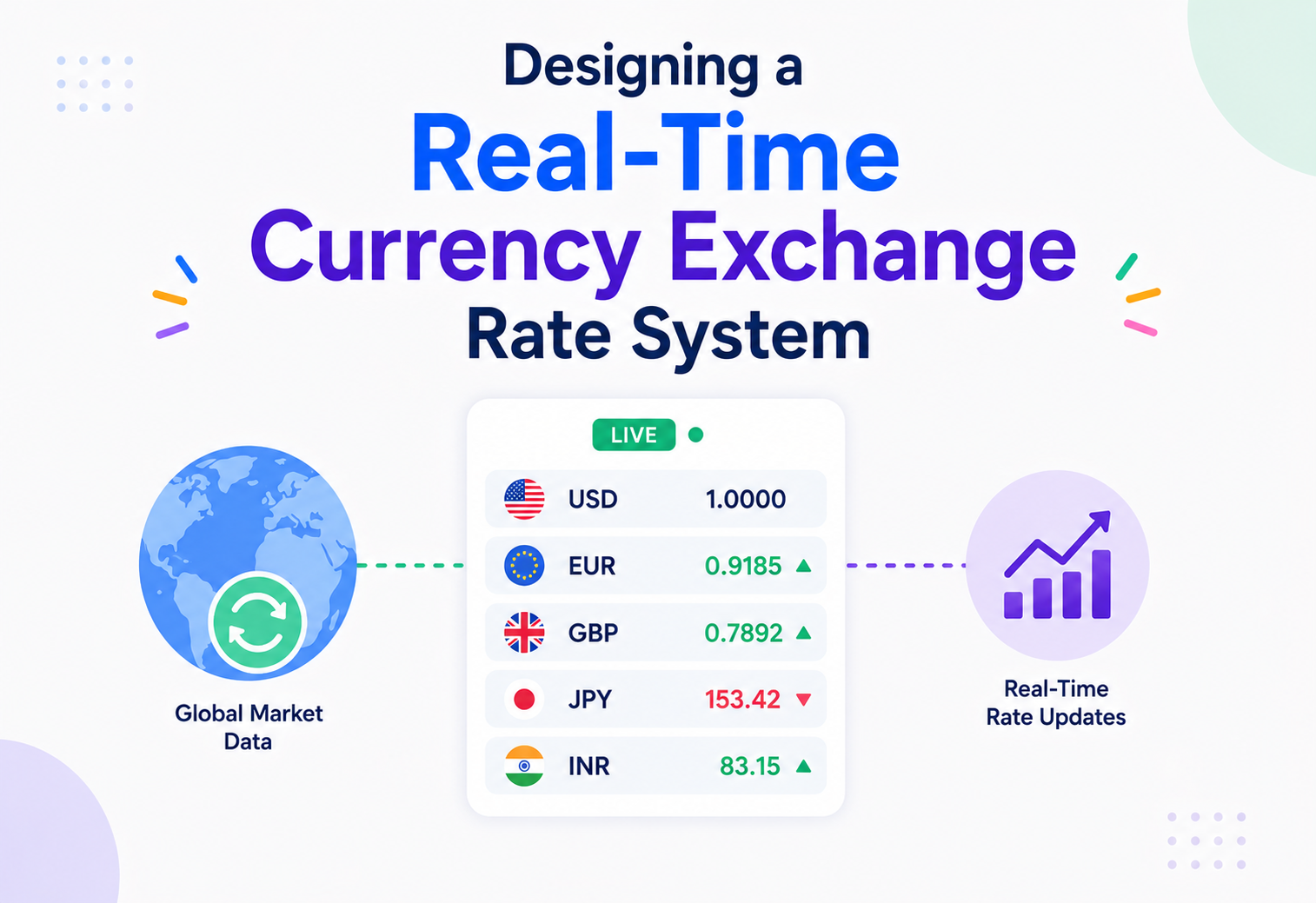
Designing a Real-Time Currency Exchange Rate System
A complete, interview-focused system design walkthrough: how to stream live foreign exchange (FX) rates to a multi-currency trading platform, keeping every rate no more than a few seconds old — even under millions of requests per minute, across millions of concurrent WebSocket clients, and while multiple external data sources come and go.
Introduction
Imagine you are using a trading app to buy US Dollars with Indian Rupees. The price you see on your screen — say, 1 USD = 83.12 INR — is not a fixed number. It moves constantly, sometimes several times a second, because currencies are traded around the clock across banks, exchanges, and financial institutions all over the world. If the price your app shows you is even a few seconds old, you could end up paying more than you should, or a trader could exploit the gap between the real price and the stale price you are seeing. This is why a real-time currency exchange rate system is one of the most demanding pieces of engineering in the entire financial technology (FinTech) world.
At its heart, this system has one job: take exchange rate information from many outside sources, clean it up, combine it into a single trustworthy number, and deliver that number to every connected user and internal service within a few seconds — and often within a few hundred milliseconds. It needs to do this for potentially millions of currency pairs and millions of connected clients at the same time, without ever showing two different users two different “current” prices for the same pair at the same moment.
Foreign exchange is the largest financial market in the world, with trillions of dollars traded every single day. Because so much money moves through it, even tiny delays or tiny errors in a displayed rate can cause real financial damage — a trader might buy at a rate that no longer exists, or a bank might settle a trade using a wrong number. This is why exchange rate systems are built with the same seriousness as systems that control airplanes or power grids: correctness and freshness of data are not “nice to have,” they are the entire point of the system.
This tutorial walks through how to design such a system from the ground up, the way a Software Architect would explain it in a real design interview or in a real engineering team’s planning meeting. We will explore where the data comes from, how it is validated and combined, how it is stored and cached, how it is pushed out to millions of clients with very low delay, and how the system keeps working even when parts of it fail. Every technical term will be explained in plain language the first time it appears, so no prior background in trading systems is required to follow along.
1.1 What “a Few Seconds Stale” Really Means
“Staleness” is simply how old a piece of data is compared to right now. If the true market rate changed at 10:00:00.000 and your system shows that new rate to a user at 10:00:02.500, the staleness at that moment is 2.5 seconds. For most retail trading apps, a staleness budget of two to five seconds is considered acceptable. For institutional trading desks and algorithmic trading systems, the budget can be as low as tens of milliseconds. Throughout this tutorial we will design for a staleness target of a few seconds end-to-end, while explaining how the same architecture can be tightened further for lower-latency use cases.
1.2 Why This Is a Hard Problem
Three forces pull against each other in this kind of system, and a good design has to balance all three at once:
- Freshness — the data must reflect the real market as closely as possible, which pushes you toward doing less processing and less buffering.
- Correctness — the data must be validated, deduplicated, and reconciled across multiple sources so a single bad data point from one feed does not cause a wrong trade, which pushes you toward doing more processing.
- Scale — the system must serve an enormous, unpredictable, and spiky number of concurrent users and internal consumers, which pushes you toward more caching and more asynchronous, decoupled components.
Getting this balance right is what makes this such a rich system design topic, and exactly why it is a favorite question in senior engineering interviews at trading platforms, banks, and payment companies.
1.3 A Short Timeline of Real-Time FX Rate Delivery
Voice & Telex Era — Manual Rate Sheets
Before electronic trading dominated, banks quoted FX rates by phone and telex, and internal rate sheets were updated only a few times per day. “Real-time” meant “within an hour or two of the market.”
1980s – Early 1990s — Screen-Based Terminals
Vendor terminals brought continuously updated on-screen prices to trading desks, but distribution was still limited to a small number of dedicated terminals per firm, with proprietary feed formats per vendor.
Late 1990s – 2000s — Electronic Trading & FIX
Electronic communication networks and the FIX protocol standardise how ticks are exchanged. Institutions begin building their own internal aggregation layers on top of multiple external feeds, laying the groundwork for the architecture this tutorial describes.
2010s — Retail & Mobile FX Everywhere
Smartphone trading apps, multi-currency wallets, and payment platforms bring real-time FX rates to hundreds of millions of everyday users, forcing the industry to solve for massive concurrent client fan-out on top of the already hard aggregation problem.
Today — Streaming Backbones, WebSockets, Multi-Region
Modern platforms combine durable streaming backbones (Kafka-class), in-memory hot caches (Redis-class), WebSocket fan-out at web scale, and multi-region active-active deployments — exactly the design walked through end to end in the rest of this tutorial.
Architecture and Components
Before looking at any diagram, it helps to think of the system as a relay race. Multiple runners (the outside data sources) each carry a baton (a price update) toward a finish line (the trader’s screen). Along the way, there are checkpoints that make sure the baton is genuine, combine information from multiple runners into one trustworthy reading, and then hand that reading to thousands of spectators (connected clients) at almost the same instant. Let us now name each checkpoint and explain exactly what it does.
2.1 High-Level Components
- Market Data Sources — external providers such as interbank liquidity venues, central bank feeds, and market data vendors (for example, Reuters or Bloomberg-style feeds) that publish raw price ticks.
- Rate Ingestion Gateway — the front door that receives raw data from every external source using protocols suited to each provider (FIX protocol, WebSocket, or proprietary binary feeds), and converts them into one internal format.
- Message Backbone (Event Streaming Layer) — a durable, high-throughput pipe (commonly built on a system like Apache Kafka) that moves every price tick from ingestion to every downstream consumer without losing data.
- Normalization & Validation Service — cleans each incoming tick: fixes formatting differences between vendors, checks the price is within a sane range, and rejects garbage data.
- Rate Aggregation Engine — the brain of the system. It combines ticks from multiple sources for the same currency pair into one “best” rate using a defined pricing strategy (for example, a volume-weighted mid-price).
- Anomaly & Outlier Detection Service — a safety net that watches for prices that jump too far, too fast, and flags or quarantines them before they reach traders.
- In-Memory Hot Cache — an extremely fast key-value store (commonly Redis or a similar in-memory store) that always holds the latest known rate for every currency pair, ready to be read in microseconds.
- Time-Series Database — a database purpose-built for storing sequences of timestamped data, used to keep the full history of rates for charts, audits, and back-testing.
- Rate Distribution / Publish-Subscribe Layer — pushes updates out to every interested consumer the moment the hot cache changes, instead of making consumers repeatedly ask “has it changed yet?”.
- WebSocket Gateway Cluster — manages millions of persistent, two-way connections with client applications (mobile apps, web dashboards, trading terminals) so new rates can be pushed instantly.
- REST / Snapshot API Layer — a simpler, request-response API for clients or internal services that just need the current rate once, without keeping an open connection.
- Load Balancer & API Gateway — the entry point for all client traffic, responsible for routing, authentication, and spreading load evenly across gateway servers.
- Rate Limiting & Throttling Service — protects the system from being overwhelmed by any single client or bot sending too many requests.
- Circuit Breaker & Fallback Service — detects when a data source or downstream dependency is unhealthy and automatically switches to a backup source or a “last known good” value.
- Configuration & Reference Data Service — stores which currency pairs are supported, which sources feed which pairs, and business rules like decimal precision per currency.
“Why do you need both a hot cache and a time-series database — is not that duplication?” A strong answer: the hot cache answers “what is the price right now” in microseconds and is optimized for a single latest value per key, while the time-series database answers “what was the price over the last hour” and is optimized for storing and querying long sequences of historical points. They serve different access patterns and different latency requirements, so combining them into one store would force a compromise on both.
2.2 Why a Streaming Backbone Instead of Direct Calls
A tempting but naive design would have the ingestion service call the aggregation service directly, which calls the cache directly, and so on. This works for a demo but collapses under real load, because every component becomes tightly coupled to the speed and availability of the next one. If the aggregation engine slows down for a moment, the ingestion gateway would start backing up and could drop incoming ticks. By placing a durable event streaming layer between every stage, each component can process at its own pace, can be scaled independently, and — critically — nothing is lost even if a downstream service briefly goes offline, because the events simply wait in the stream until the service catches up.
Internal Working
Now that we know the components, let us trace exactly what happens to a single price tick from the moment a bank publishes it to the moment a trader’s screen updates.
3.1 Step 1: Ingestion and Protocol Translation
Each external source speaks its own “language.” Some use the FIX protocol (a decades-old standard built specifically for financial trading messages), others push raw binary data over a persistent socket, and others expose a WebSocket feed. The Rate Ingestion Gateway maintains dedicated adapters for each source type and translates every incoming message into one common internal format containing the currency pair, the bid price (what buyers offer), the ask price (what sellers ask), the timestamp from the source, and the source’s identity.
3.2 Step 2: Publishing to the Backbone
The moment a tick is translated, it is published onto the event streaming backbone, organized into topics — for example, one topic per currency pair or one topic per source, depending on the desired parallelism. Publishing here rather than processing immediately in the gateway keeps the gateway extremely thin and fast, which matters because the gateway is the single narrowest point where every external byte of data must pass through.
3.3 Step 3: Normalization and Validation
A separate pool of workers consumes from the backbone and performs several checks: is the price a real, sane number (not zero, not negative, not absurdly far from the last known price); is the currency pair one the platform actually supports; is the timestamp recent enough to be trustworthy. Any tick that fails these checks is logged and dropped rather than passed downstream, because a single bad number reaching a trader could cause real financial harm.
3.4 Step 4: Anomaly Detection
Even a technically valid tick can be dangerous if it represents an implausible market move — for instance, a currency pair jumping five percent in one second almost never reflects a real, sustained market condition and is far more likely to be a data glitch or a “fat finger” error at the source. The anomaly detection service compares each new tick against a short rolling statistical window (recent average and recent volatility) for that pair and flags outliers for extra scrutiny or temporary quarantine, rather than letting them straight through.
3.5 Step 5: Aggregation into One “Best” Rate
Because the platform typically listens to several sources for the same currency pair (for redundancy and for better pricing), the aggregation engine must combine them into a single number the platform will actually quote. Common strategies include taking a volume-weighted average across sources, taking the median to reduce the effect of any single noisy source, or applying a configurable priority order where a primary source is used unless it goes stale, in which case a secondary source takes over. This aggregated rate, along with the sources that contributed to it, is what gets written forward.
3.6 Step 6: Writing to the Hot Cache and the History Store
The freshly aggregated rate is written to the in-memory hot cache, overwriting the previous value for that currency pair, and simultaneously appended to the time-series database for historical record-keeping. These two writes happen independently — the cache write is on the critical path for freshness, while the history write can tolerate a small amount of extra delay since nobody is staring at yesterday’s chart waiting for the exact millisecond it updates.

3.7 Step 7: Fan-Out to Millions of Clients
The moment the hot cache changes, a notification travels through the publish-subscribe layer to every gateway server holding an open connection to a client subscribed to that currency pair. Each gateway server pushes the new value down its open connections. Because this is a “push” model rather than clients repeatedly “pulling” (asking again and again), the delay between the cache updating and the client seeing the new number can be kept to well under a second even at very large scale.
Data Flow and Lifecycle
Let us visualize the complete lifecycle of one price update as a sequence of events over time, which is exactly how an interviewer would expect you to trace it on a whiteboard.
4.1 End-to-End Timing Budget
To keep the total staleness under a few seconds, each stage is given a strict time budget, and the system is instrumented to alert if any stage exceeds its budget. A realistic budget for a five-second staleness target might look like this:
| Stage | Typical Budget | Why |
|---|---|---|
| Ingestion & translation | < 50 ms | Minimal processing, just format translation |
| Backbone delivery | < 100 ms | Depends on partition load and consumer lag |
| Validation & anomaly check | < 150 ms | Lightweight statistical checks only |
| Aggregation | < 100 ms | In-memory computation across a few sources |
| Cache write & fan-out trigger | < 50 ms | Single key write plus event publish |
| WebSocket push to client | < 200 ms | Network delivery, varies by client location |
Adding these together leaves generous headroom under a five-second budget, which is intentional — real systems need slack for retries, network jitter, and momentary load spikes without breaching the freshness promise made to users.
4.2 Rate Lifecycle States
Every rate in the system moves through a small set of states worth naming explicitly, because interviewers often probe this: Received (raw tick has arrived at the gateway), Validated (passed sanity checks), Quarantined (failed anomaly checks and held for review), Aggregated (combined into the platform’s official rate), Published (written to cache and pushed to clients), and Archived (persisted into the time-series store for history). Thinking in these explicit states makes it much easier to reason about where a delay or a bug might be hiding.
“What happens if the aggregation engine is momentarily slow — do clients see a frozen price?” The honest answer: yes, briefly, and this is by design rather than a flaw. The hot cache always serves the last successfully aggregated rate, so a temporarily slow aggregation stage causes the displayed rate to simply stop updating for a moment rather than showing an incorrect one. The system should also expose a “rate age” indicator to clients so a trading application can visually warn the user if a price is older than expected, rather than silently trusting a possibly stale number.
Databases, Caching and Load Balancing
The read and write shapes in this system are so different that no single storage engine can serve them all well. The design deliberately uses three different stores, each purpose-built for one job.
5.1 Why an In-Memory Cache Is Non-Negotiable
A traditional relational database, even a fast one, typically answers a single read query in a few milliseconds under load, and that is simply too slow when millions of clients might be asking “what’s the current rate” many times per second in aggregate. An in-memory key-value store such as Redis keeps the entire “current rate” data set in RAM rather than on disk, and can answer a read in well under a millisecond. Since the total number of currency pairs the platform supports is small (typically a few hundred to a few thousand, even counting exotic pairs), the entire hot data set easily fits in memory on a modestly sized cluster.
5.2 Cache Design Choices
- Key structure — one key per currency pair, for example a key representing “USD to INR,” holding the latest bid, ask, mid-price, timestamp, and contributing source list as its value.
- Replication — the cache is run as a cluster with multiple replicas per shard, so a single node failure does not cause any currency pair to become unavailable.
- Write path — only the Rate Aggregation Engine is allowed to write to the cache, keeping a single, well-understood writer and avoiding race conditions between multiple writers disagreeing about the “true” current rate.
- No cache-aside pattern needed — unlike typical web applications where the cache is filled lazily on a cache miss, here the cache is proactively and continuously kept warm by the aggregation engine, since there is no concept of a “cold” currency pair that has not been priced yet.
5.3 The Role of the Time-Series Database
While the hot cache only ever holds the single latest value, traders and analysts also need to see how a rate moved over the last minute, hour, or year — for candlestick charts, for computing volatility, and for regulatory record-keeping. A time-series database is purpose-built to store an enormous number of timestamped data points efficiently and to answer range queries like “give me every USD to INR rate between 9:00 and 9:05” extremely quickly, using storage techniques such as time-based partitioning and downsampling (automatically compressing older, less-precision-critical data into coarser summaries to save space).
5.4 Reference and Configuration Data
A smaller, much less frequently changing relational database (or a configuration service) stores metadata: the list of supported currency pairs, which external sources feed which pairs, decimal precision rules per currency (some currencies are quoted to two decimal places, others to four or more), and business rules such as trading hours for certain markets. Because this data changes rarely, it can be cached aggressively in every service instance’s local memory and refreshed on a slow interval, removing it entirely from the hot path.
5.5 Load Balancing Strategy
Two very different kinds of traffic need two different load balancing strategies. REST snapshot requests are stateless and can be spread across any available server using standard round-robin or least-connections load balancing. WebSocket connections, however, are long-lived and stateful — once a client connects to a specific gateway server, that connection stays open for potentially hours, so the load balancer must support “sticky” routing at connection time and the platform must plan capacity per gateway node based on how many concurrent open connections it can hold, not just how many requests per second it can answer.
Large trading platforms commonly run their hot rate cache as a multi-node Redis Cluster deployed across multiple availability zones, with read replicas placed close to major user regions to shave network round-trip time off every read, while a separate purpose-built time-series database (of the kind used heavily in financial and IoT analytics) retains the full tick history for charting and compliance audits.
“Would you ever use the time-series database to serve the live price to a user interface?” A well-reasoned answer is no — even a well-tuned time-series database is optimized for accepting high write volume and answering range queries, not for sub-millisecond point lookups at massive read concurrency, which is exactly what an in-memory cache is optimized for. Using the wrong store for the wrong access pattern is a classic system design anti-pattern.
APIs and Microservices
The API surface intentionally exposes two very different interaction styles because clients themselves have two very different needs: some want a live, ticking stream, others want one quick answer and to move on.
6.1 Two Complementary API Styles
The system exposes two very different interaction styles because clients have very different needs. A trading dashboard that must show a live, constantly ticking price needs a persistent WebSocket connection so the server can push updates the instant they happen. A back-office reporting tool that just needs today’s opening rate once needs a simple REST endpoint it can call and forget. Building both styles on top of the same underlying hot cache and publish-subscribe layer avoids duplicating business logic while serving both needs well.
6.2 WebSocket Subscription Model
A client opens one WebSocket connection and then sends a subscription message listing the currency pairs it cares about — a mobile trading app might subscribe to only the five or six pairs the user actively trades, rather than every pair the platform supports, which dramatically reduces the amount of data pushed to that client and reduces server-side fan-out cost. The gateway keeps a subscription registry mapping each open connection to its list of subscribed pairs, and only forwards an update to connections that actually asked for that pair.
6.3 REST Snapshot Endpoint
The REST layer offers a straightforward request-response endpoint that returns the current rate (and its age) for one or more requested currency pairs directly from the hot cache, with no streaming involved. This endpoint is also what powers server-side services elsewhere in the platform — for example, a checkout service converting a price from one currency to another for display purposes does not need a live stream, just the freshest available number at the moment of the request.
6.4 Microservice Boundaries
Splitting the system into focused microservices — ingestion, normalization, anomaly detection, aggregation, and distribution — rather than one large monolith brings several benefits worth naming explicitly: each service can be scaled independently based on its own bottleneck (the WebSocket gateway needs far more instances than the aggregation engine, since connection count scales very differently from computation load); each service can be deployed and updated independently, so a bug fix in anomaly detection does not require redeploying the entire pricing pipeline; and a failure in one non-critical service, like a slow write to the time-series database, cannot block the critical path of getting a fresh rate to a trader.
6.5 Internal Service Communication
Services that must react to every single tick (normalization, anomaly detection, aggregation) communicate asynchronously through the event streaming backbone rather than through direct request-response calls, because this decouples their processing speeds from each other. Services that need to answer an occasional question (a client asking “what pairs do you support”) communicate through lightweight synchronous APIs, because there is no ongoing stream of events involved and a direct call is simpler and fast enough.
“How would you avoid a ‘thundering herd’ where a huge number of clients all reconnect at once, for example after a brief network blip, and overwhelm the gateway cluster?” A solid answer includes exponential backoff with random jitter on the client side (so reconnect attempts spread out over time instead of arriving simultaneously), connection rate limiting at the load balancer, and horizontal auto-scaling of the WebSocket gateway tier so it can absorb a temporary surge in connection attempts.
Performance and Scalability
The natural instinct is to worry about the aggregation math, but at this system’s real bottlenecks the CPU is barely working — the harder problems are connection count, fan-out amplification, and correlated spikes during market-moving news.
7.1 Where the Real Bottlenecks Are
It is tempting to assume the hardest part of this system is the raw computation of aggregating a few numbers together, but that computation is actually cheap. The real scaling challenges are elsewhere: handling the sheer number of simultaneous open WebSocket connections, handling fan-out (one rate change potentially needing to be pushed to millions of subscribed connections almost simultaneously), and handling bursty, unpredictable load during major market-moving events, such as a central bank announcement, when both the rate of incoming ticks and the intensity of client interest spike together within the same few seconds.
7.2 Horizontal Scaling of the WebSocket Tier
Because each WebSocket gateway node can only hold a limited number of concurrent open connections (bounded by available memory and file descriptors), the tier is scaled horizontally by adding more gateway nodes behind the load balancer, with each node handling a subset of total connections. The publish-subscribe layer is responsible for making sure a rate change reaches every gateway node that has at least one subscriber for that pair, regardless of which node the update originated near, which is why a proper pub-sub or streaming layer — rather than direct node-to-node calls — is essential at this scale.
7.3 Partitioning the Event Stream
The event streaming backbone is partitioned, commonly by currency pair, so that processing for different pairs can happen fully in parallel across many consumer instances. This also guarantees ordering is preserved for a single pair — a critical property, because if two updates for the same pair were processed out of order, a client could momentarily see a rate go “backwards in time,” which is confusing and can cause visibly incorrect price charts.
7.4 Handling Traffic Spikes
Major economic announcements can cause both the rate of incoming ticks and the number of active viewers to spike ten-fold or more within seconds. The system handles this through auto-scaling policies on the ingestion, normalization, and gateway tiers driven by real-time load metrics, combined with backpressure-aware consumers that can temporarily process from the event backbone slightly slower without losing any data, since the backbone durably retains events until they are consumed. A well-designed system treats a traffic spike as an expected operating condition to be absorbed gracefully, not an exceptional emergency.
7.5 Reducing Latency at the Network Edge
For clients spread across the globe, a large portion of end-to-end delay can simply be the physical time it takes data to travel over the network. Placing WebSocket gateway clusters in multiple geographic regions close to major concentrations of users, and routing each client to its nearest region, meaningfully reduces this network component of the total staleness budget, independent of anything happening inside the pricing pipeline itself.
retail target
connections at peak
during big announcements
“How would you scale this system to support ten times the current number of currency pairs, including many low-volume exotic pairs?” A thoughtful answer separates concerns: low-volume pairs update far less often, so the system should treat update frequency, not pair count, as the real scaling driver, and can use tiered infrastructure — dedicating more resources and tighter staleness budgets to the small number of high-volume major pairs, while serving the long tail of exotic pairs with a slightly relaxed freshness target and shared infrastructure.
High Availability and Reliability
Reliability here is not just about avoiding downtime — it is about the platform’s promise that the price on the screen can always be trusted. A quiet failure that silently freezes a price is worse than a loud failure that flashes a warning, so every reliability decision is shaped by that principle.
8.1 No Single Point of Failure
Every component in the architecture is deployed with redundancy: multiple ingestion gateway instances behind a load balancer, a multi-broker event streaming cluster that replicates every message across several machines, a multi-node cache cluster with replicas, and multiple instances of every processing service. The guiding principle is that the loss of any single machine, or even an entire availability zone, should never take the whole pricing pipeline down.
8.2 Source Redundancy and Failover
Relying on a single external market data provider is dangerous — if that provider has an outage, the platform would have no rates at all for however long the outage lasts. The system subscribes to multiple independent sources for the platform’s most important currency pairs, and the aggregation engine’s circuit breaker logic automatically down-weights or excludes a source that has stopped sending updates or started sending clearly bad data, falling back smoothly to the remaining healthy sources without any human intervention.
8.3 Graceful Degradation Instead of Total Outage
If every external source for a particular pair genuinely goes silent, the system should not simply return an error to every trader. Instead, it should continue serving the last known good rate along with a clearly marked “age” or “stale” indicator, allowing client applications to make an informed decision — for example, temporarily disabling new trades on that specific pair while still showing informational data. This kind of graceful degradation, doing something useful and honest rather than failing completely, is a hallmark of mature financial system design.
8.4 Disaster Recovery
The entire pipeline is typically deployed across at least two, and often three, geographically separate regions, with the event streaming backbone and cache cluster replicating data between them. If an entire region becomes unavailable due to a data center outage, traffic and processing fail over to a healthy region within a target recovery time, and the time-series database’s replicated backups ensure historical data is never permanently lost even in a worst-case regional disaster.
8.5 Idempotency and Exactly-Once Effects
Because network retries can cause the same tick to be delivered more than once, every processing stage is designed to be idempotent — processing the same tick twice should never corrupt the aggregated rate or double-count anything. This is commonly achieved by attaching a unique identifier to every tick at ingestion time and having downstream services recognize and skip duplicates they have already processed, which matters enormously in a financial system where a duplicated event could otherwise produce a visibly wrong price.
Global payment and trading platforms typically run active-active deployments across multiple cloud regions for exactly this kind of pricing infrastructure, so that a regional outage causes at most a brief, automatically-recovered blip rather than a full platform-wide halt to trading.
Security
Because the entire business depends on the trustworthiness of the numbers flowing through it, security here means two things at once: protecting the pipeline from tampering, and protecting users from being shown a manipulated or fabricated price.
9.1 Authenticating and Authorizing Data Sources
Every external market data source connection uses mutual authentication (both sides proving their identity, not just the client proving it to the server) and encrypted transport, so an attacker cannot impersonate a legitimate data provider and inject false prices into the pipeline. Incoming data is also cryptographically or structurally verified against the expected format for that specific source before it is trusted enough to be normalized.
9.2 Protecting Client Connections
All WebSocket and REST connections from client applications use encrypted transport, and every client must authenticate before subscribing to rate streams or requesting snapshots. Rate limiting and per-client connection caps prevent a single malicious or misbehaving client from opening an excessive number of connections or flooding the system with requests, which protects both system stability and fairness across all legitimate users.
9.3 Defending Against Data Manipulation
Because the entire business depends on the trustworthiness of the numbers flowing through it, the anomaly detection service doubles as a security control, not just a data-quality control — a sudden, implausible price movement could be an honest data glitch, or it could be an attempt to manipulate a source feed to trigger unfair trades. Any pair experiencing an implausible move is automatically quarantined and can trigger an alert for a human to review before it is trusted again.
9.4 Audit Trails and Non-Repudiation
Every rate that was ever shown to a trader, along with which sources contributed to it and exactly when it was computed, is permanently and immutably logged. This matters enormously for regulatory compliance and for resolving disputes — if a customer claims they were shown an incorrect price for a trade, the platform must be able to reconstruct precisely what rate existed at that exact moment and prove it.
9.5 Least Privilege Between Services
Each internal service is given only the specific permissions it needs — for example, only the aggregation engine has write access to the hot cache, while every other service has read-only access — so that a vulnerability or bug in one lower-trust service cannot be used to corrupt the platform’s official prices.
“How would you detect if one of your external data sources has been compromised and is feeding you subtly manipulated prices, rather than obviously wrong ones?” A strong answer discusses cross-source comparison: continuously comparing each source’s prices against the aggregated consensus from all other sources for the same pair, and alerting when one source consistently and gradually drifts away from the consensus, since subtle, sustained manipulation is much harder to spot with a simple one-shot sanity check than with an ongoing statistical comparison across sources.
Monitoring, Logging and Metrics
A system whose entire promise is freshness has to be watched for freshness specifically. Every other health metric can look green while the one metric that actually matters — end-to-end staleness — quietly drifts out of budget.
10.1 The Metric That Matters Most: Staleness
Since the entire promise of this system is freshness, the single most important metric tracked is end-to-end staleness — the time difference between when a price actually changed in the real market and when it became visible to a client — measured continuously per currency pair and alerted on the moment it crosses the agreed threshold. This is tracked separately from generic system health metrics because a system can look perfectly healthy by every conventional measure (low CPU, low error rate) while quietly serving stale prices due to a subtle bottleneck somewhere in the pipeline.
10.2 Pipeline Stage Latency
Each stage from the earlier data flow section — ingestion, backbone delivery, validation, aggregation, cache write, and client push — is individually timed and reported, so that when overall staleness rises, engineers can immediately see which specific stage is responsible rather than having to guess across the whole pipeline.
10.3 Consumer Lag
Because the event streaming backbone durably queues messages, “consumer lag” — how far behind a consuming service is from the latest published message — is a critical early-warning metric. Rising lag on the normalization or aggregation consumers is often the very first sign of trouble, appearing well before staleness or error rates become visibly bad to end users.
10.4 Business-Level Metrics
Beyond pure system health, the platform tracks business-relevant signals: how often each external source is actively contributing to the aggregated rate versus being excluded due to staleness or anomalies, how frequently the anomaly detector quarantines a tick (a rising trend here can indicate a source is degrading before it fails outright), and the total count of active WebSocket subscriptions per currency pair, which feeds directly into capacity planning.
10.5 Alerting Philosophy
Alerts are tiered by severity: a single source briefly going stale might only need a low-priority internal notification since redundancy handles it automatically, while every source for a widely-traded pair going stale simultaneously, or overall staleness breaching the customer-facing promise, triggers an immediate, high-priority page to on-call engineers, because that scenario directly threatens the core product guarantee.
10.6 Distributed Tracing
A unique trace identifier is attached to each tick at ingestion and carried through every subsequent processing stage and log line, allowing an engineer to pick any single price update and see its exact journey end to end — which is invaluable when investigating a specific customer complaint about a price they saw at a specific moment.
FinTech platforms commonly build dashboards that plot staleness as a live, per-currency-pair heat map, so an operations engineer can visually spot at a glance which specific pairs, if any, are currently running behind their freshness target, rather than having to check dozens of individual metrics one by one.
Deployment and Cloud
Deployment for this system is dominated by two properties of FX trading: it never sleeps, and any bug that changes a displayed price is instantly visible to end users. Both properties push the design toward multi-region, container-orchestrated, progressively delivered infrastructure.
11.1 Containerized Microservices
Each service — ingestion adapters, normalization, anomaly detection, aggregation, and the API gateways — is packaged as an independent container and deployed onto a container orchestration platform, which handles automatically restarting failed instances, scaling the number of running instances up or down based on load, and rolling out new versions without downtime.
11.2 Multi-Region Deployment
Given the round-the-clock, global nature of currency trading, the platform is deployed across multiple cloud regions rather than a single data center, with the event streaming backbone and cache layer configured for cross-region replication, so that the system continues operating even if an entire region experiences an outage, and so that clients in different parts of the world can connect to a nearby gateway for lower network latency.
11.3 Progressive Delivery for New Code
Given how directly a bug in this pipeline could impact real trades, new versions of any service are rolled out gradually — for example, first to a small percentage of production traffic (a canary release) while closely watching staleness and error metrics, and only promoted to full rollout once that canary period shows no regression. If a problem is detected, the deployment can be rolled back automatically and near-instantly, well before it affects the majority of users.
11.4 Infrastructure as Code
All infrastructure — the event streaming cluster configuration, the cache cluster topology, networking rules, and scaling policies — is defined in version-controlled configuration files rather than manually clicked together in a cloud console. This makes the entire environment reproducible, auditable, and quick to recreate in a new region during disaster recovery.
11.5 Cost Considerations
Keeping millions of WebSocket connections open around the clock, and running an always-warm in-memory cache cluster, are both meaningfully more expensive than typical stateless web workloads, so capacity planning deliberately separates infrastructure into tiers — always-on baseline capacity sized for typical daily load, plus auto-scaled burst capacity that only spins up (and only costs money) during known high-volatility periods such as major economic announcements.
Design Patterns and Anti-Patterns
The patterns below are not novel — they are the disciplined re-application of proven building blocks that real-time financial systems keep converging on, alongside the anti-patterns that keep sinking teams that try to skip them.
12.1 Patterns Used in This System
- Publish-Subscribe — decouples the component producing a rate change from the many components that need to react to it, allowing new consumers (like a new analytics service) to be added later without touching the producer at all.
- Circuit Breaker — automatically stops sending traffic to a failing or misbehaving data source, giving it time to recover and preventing its failure from cascading into the rest of the pipeline.
- Event Sourcing (partial) — because every tick is durably stored in the event streaming backbone in order, the full history of how the current rate was derived can always be replayed and audited, which is invaluable for both debugging and regulatory review.
- CQRS (Command Query Responsibility Segregation) — the path that writes new rates (the aggregation engine writing to the cache) is completely separate from the many paths that read rates (WebSocket pushes and REST snapshots), allowing each side to be optimized and scaled independently.
- Bulkhead — isolating resources per data source or per service, similar to watertight compartments on a ship, so a failure or slowdown in one compartment (say, one specific external source) cannot flood and sink the entire system.
12.2 Anti-Patterns to Avoid
- Polling for freshness — having every client repeatedly ask “has the price changed yet?” every few hundred milliseconds instead of using a push-based subscription wastes enormous server capacity and actually makes true real-time freshness harder to achieve, not easier.
- A single trusted source with no fallback — treating one external feed as infallible removes the very redundancy that real-time financial systems depend on, and turns any provider outage into a full platform outage.
- Synchronous chains of direct calls — chaining every processing stage together as direct, blocking calls (ingestion calls normalization calls aggregation, and so on) means the slowest stage sets the speed for the entire pipeline and a single stuck stage can back up and crash the whole system.
- Ignoring clock skew — trusting a timestamp from an external source without accounting for the possibility that the source’s clock is not perfectly synchronized can silently corrupt staleness measurements and ordering guarantees.
- Over-aggregating away useful signal — blending too many sources together with no way to see the individual contributing prices can hide the fact that one source has gone rogue, since it becomes invisible inside a single blended number.
“Why is CQRS a natural fit here rather than over-engineering?” The reasoning: read traffic (clients checking prices) and write traffic (new ticks arriving) have wildly different volumes, shapes, and latency requirements in this domain, so treating them as one unified path forces unnecessary compromises on both, whereas most simple CRUD applications do not have anywhere near this asymmetry and would find CQRS to be needless complexity.
Advantages, Disadvantages and Trade-offs
Every design choice below carries a specific cost as well as a benefit, and being explicit about them is what separates a defensible architecture from one that quietly falls over in production once the honeymoon of the launch demo is over.
13.1 Advantages of This Architecture
- Push-based delivery keeps staleness low without wasting resources on constant polling.
- Multi-source aggregation with anomaly detection protects the platform and its users from bad or manipulated data from any single provider.
- Decoupled, independently scalable microservices allow each part of the system to grow to meet its own specific bottleneck rather than over-provisioning everything uniformly.
- A durable event backbone means no price tick is silently lost even during a temporary downstream slowdown.
13.2 Disadvantages and Costs
- Significantly more operational complexity than a simple request-response API — there are many more moving parts to deploy, monitor, and reason about.
- Running an always-on, multi-region, in-memory cache and a large fleet of persistent WebSocket connections is meaningfully more expensive than typical stateless web infrastructure.
- Aggregating multiple sources introduces design decisions (which weighting strategy, how to handle disagreement between sources) that require ongoing tuning and carry real financial consequences if they are wrong.
13.3 Key Trade-offs
| Trade-off | Choosing Freshness | Choosing Safety / Correctness |
|---|---|---|
| Validation depth | Fewer checks, faster path to clients | More checks, slightly more delay but fewer bad prices reaching users |
| Source count | Fewer sources, simpler and faster aggregation | More sources, better resilience but more aggregation complexity |
| Cache consistency | Eventually consistent replicas for speed | Strongly consistent writes for absolute correctness, at some latency cost |
There is no universally “correct” answer to these trade-offs; the right choice depends on whether the platform serves retail users (who can tolerate slightly relaxed freshness in exchange for lower cost) or institutional, algorithmic traders (who demand the tightest possible freshness and are willing to pay for the infrastructure it requires).
Where This Design Shines
- Retail multi-currency wallets showing live conversion rates to millions of app users
- Institutional pricing engines that must survive individual data-source outages invisibly
- Regulated venues that require full replayability of every rate ever shown
- Global platforms where clients live in wildly different network geographies
Where It Is Overkill
- Once-a-day rate lookups by a batch accounting job
- Small internal tools where a nightly download of ECB reference rates suffices
- Very small user bases where a simple REST call per view would be cheaper end to end
- Prototypes still exploring product-market fit, before scale is a real concern
Best Practices and Common Mistakes
The best practices below are the ones experienced FinTech teams keep converging on, and the mistakes are the ones that keep appearing in post-incident reviews after a real customer saw a wrong price at the wrong moment.

14.1 Best Practices
- Always expose the age of a rate alongside the rate itself, so client applications and users can make informed decisions rather than blindly trusting a number that might be older than expected.
- Treat every incoming tick as untrusted until it passes validation — never let raw external data reach a trader’s screen unchecked, no matter how reputable the source.
- Design every processing stage to be idempotent from day one, rather than retrofitting duplicate-handling logic later once it becomes a painful, hard-to-trace production bug.
- Measure staleness as a first-class metric from the very first version of the system, not as an afterthought added once users start complaining.
- Keep the write path (aggregation writing to cache) as short and simple as possible, since every stage on that path directly adds to the freshness delay every single user experiences.
14.2 Common Mistakes
- Building the very first version around polling because it feels simpler, and only discovering the scaling wall it hits much later, after client applications have already been built assuming that model.
- Trusting a single external data source in production because it “seemed reliable in testing,” without planning for the day it inevitably has an outage or sends bad data.
- Coupling the historical data store and the hot cache into a single database to “save complexity,” which quietly degrades both the freshness of live reads and the efficiency of historical queries.
- Under-provisioning the WebSocket gateway tier for connection count while over-provisioning it for raw compute, forgetting that persistent connections consume memory and file descriptors even when idle.
- Not load-testing for the specific spike pattern of a real market-moving event (simultaneous surge in both tick volume and client interest), and only discovering the gap during an actual live incident.
14.3 A Pre-Launch Readiness Checklist
| Check | Question to Confirm Before Launch |
|---|---|
| Staleness SLO | Is end-to-end staleness measured per pair and alerted on before it becomes user-visible? |
| Source Failover | Have primary and secondary sources been drilled with a real failover, not just a config flag? |
| Spike Load Test | Has the system been tested against a realistic market-event spike, not just steady-state throughput? |
| Idempotency | Do downstream services truly ignore duplicate ticks, verified by injecting duplicates in staging? |
| Replayability | Can any past minute of history be replayed from the streaming backbone or the time-series store on demand? |
| Cost Guardrails | Is auto-scaling bounded by explicit cost ceilings so a runaway subscribe storm cannot silently blow the budget? |
Real-World Industry Examples
The design principles above are not theoretical — they show up, with minor variations, in the pricing infrastructures of every major payments, brokerage, and trading platform operating today.
Global Payment Platforms
Large payment companies that let users hold and convert balances across many currencies maintain internal, continuously updated exchange rate pipelines very similar in shape to the one described here, aggregating multiple market data sources and pushing fresh internal rates to checkout and conversion services so that a customer converting funds always sees a rate that reflects the current market, not a rate that was fetched minutes earlier from a slow, on-demand external call.
Retail Trading Applications
Consumer-facing trading and brokerage apps that let everyday users trade currency pairs or currency-denominated assets rely on exactly this kind of push-based WebSocket architecture to keep the ticking price on a user’s screen visually “alive” and current, rather than requiring the app to constantly refresh, which would drain battery life on mobile devices and still deliver a worse freshness guarantee.
Institutional and Algorithmic Trading Firms
Firms running automated trading strategies push the same architectural ideas to their extreme, often demanding single-digit-millisecond freshness, colocating their processing infrastructure physically close to exchange data centers to shave network transit time, and running far more aggressive anomaly detection because an automated strategy, unlike a human trader glancing at a screen, will act on a bad price instantly and without a sanity check.
Central Bank and Regulatory Reference Rates
Some institutions also need to record an official, less frequently updated “reference rate” (for example, a daily fixing used in accounting and legal contracts) alongside the live streaming rate used for actual trading — these two are computed from the same underlying tick history in the time-series store but serve very different purposes, which is a good illustration of why keeping full, durable, ordered history of every tick pays off well beyond just powering live charts.
Across these very different institutions, the underlying architectural pattern is remarkably consistent — where they differ is largely in the specific staleness budget, the specific choice of streaming backbone vendor, and how tightly they colocate infrastructure with exchange data centers, not in the shape of the pipeline itself.
Frequently Asked Questions
The most common questions that come up in interviews and design reviews for this class of system, each answered in the same language a Software Architect would use when talking to a room of mixed-experience engineers.
Calling out to an external provider on every single client request would multiply load on those providers enormously, would add significant per-request latency, and would tie the platform’s own availability directly to the availability of every external vendor. Caching a continuously updated internal rate and serving all reads from it decouples the platform’s performance from any single external dependency.
Pairs with high trading volume and high business importance (major currency pairs) typically warrant multiple redundant sources given how much financial exposure depends on their accuracy, while low-volume exotic pairs may reasonably rely on a single well-chosen source with a slightly relaxed freshness target, since the cost of full redundancy for every possible pair would be disproportionate to the actual usage.
The system tracks trading calendar and market-hours reference data, and for pairs whose relevant markets are closed, it can clearly mark the displayed rate as “indicative” or “last close” rather than implying it is a live, tradable price, which prevents clients from being misled into thinking a genuinely live price exists when the underlying market simply is not trading.
Yes — the same core shape (ingest from multiple sources, validate, aggregate, cache the latest value, and push to subscribers) applies broadly to any real-time market data problem, including equities, commodities, and cryptocurrency prices, with the specific validation rules and aggregation strategies adjusted for the particular asset class’s trading behavior.
Through dedicated load testing that simulates realistic tick volume alongside simultaneous simulated client surges, combined with chaos testing that deliberately kills individual services or data sources mid-test to confirm the failover and quarantine logic behaves correctly, rather than only testing the system’s behavior under calm, ideal conditions.
Summary and Key Takeaways
A compact summary of the design and the ideas most worth carrying forward into any conversation about real-time market data infrastructure — whether in a system design interview or in an engineering team’s planning meeting.
17.1 The Big Picture
A real-time currency exchange rate system is fundamentally a pipeline that continuously ingests raw price data from multiple external sources, validates and cleans it, combines it into one trustworthy number per currency pair, keeps that number always available in an ultra-fast in-memory cache, and pushes every change out to potentially millions of connected clients the instant it happens — rather than making clients repeatedly ask for updates. The entire design exists to serve one promise: the price a trader sees should almost never be more than a few seconds behind the true market.
Getting there requires balancing freshness, correctness, and scale at every layer: a durable, partitioned event streaming backbone that decouples every stage from the speed of the next; redundant multi-source aggregation with real anomaly detection so no single bad data point ever reaches a trader; an in-memory hot cache purpose-built for microsecond reads, paired with a separate time-series store purpose-built for historical range queries; a push-based publish-subscribe distribution layer serving both persistent WebSocket streams and simple REST snapshots; and thorough redundancy, graceful degradation, and staleness-focused monitoring so the system remains trustworthy even when individual parts of it fail.
Whether discussing this in an interview or actually building it, the strongest engineers are the ones who can explain not just what each component does, but why each specific trade-off — push versus pull, cache versus history store, redundant sources versus a single trusted feed — was made, and how those choices directly serve the system’s one true north-star requirement: a fresh, correct price, delivered fast, at massive scale.
Key Takeaways
- The single north-star requirement is freshness: every architectural choice is judged by whether it helps or hurts the end-to-end staleness budget.
- Use a durable streaming backbone between every stage so each component can process at its own pace and no tick is ever silently lost.
- Aggregate across multiple independent sources, with anomaly detection, so no single bad or compromised feed can move a customer-visible price.
- Serve reads from an in-memory hot cache; serve history from a time-series store; do not conflate the two into one database.
- Distribute updates push-first over WebSocket, not pull-first over polling — push is both cheaper and fresher at scale.
- Always expose rate age alongside the rate itself, so client apps and users can degrade gracefully instead of blindly trusting a possibly stale number.
- Design every stage to be idempotent and every dependency to have an explicit, tested fallback — the system must fail loudly, not silently.
- Measure staleness as a first-class metric from day one, per pair, and alert on it directly rather than inferring it from generic health metrics.
The best real-time pricing systems are not the ones that shave the last microsecond off aggregation math — they are the ones that stay honest about how fresh their numbers actually are, and that let clients, users, and operators see that honesty in a single glance. Freshness you can prove is worth more than freshness you can only claim.