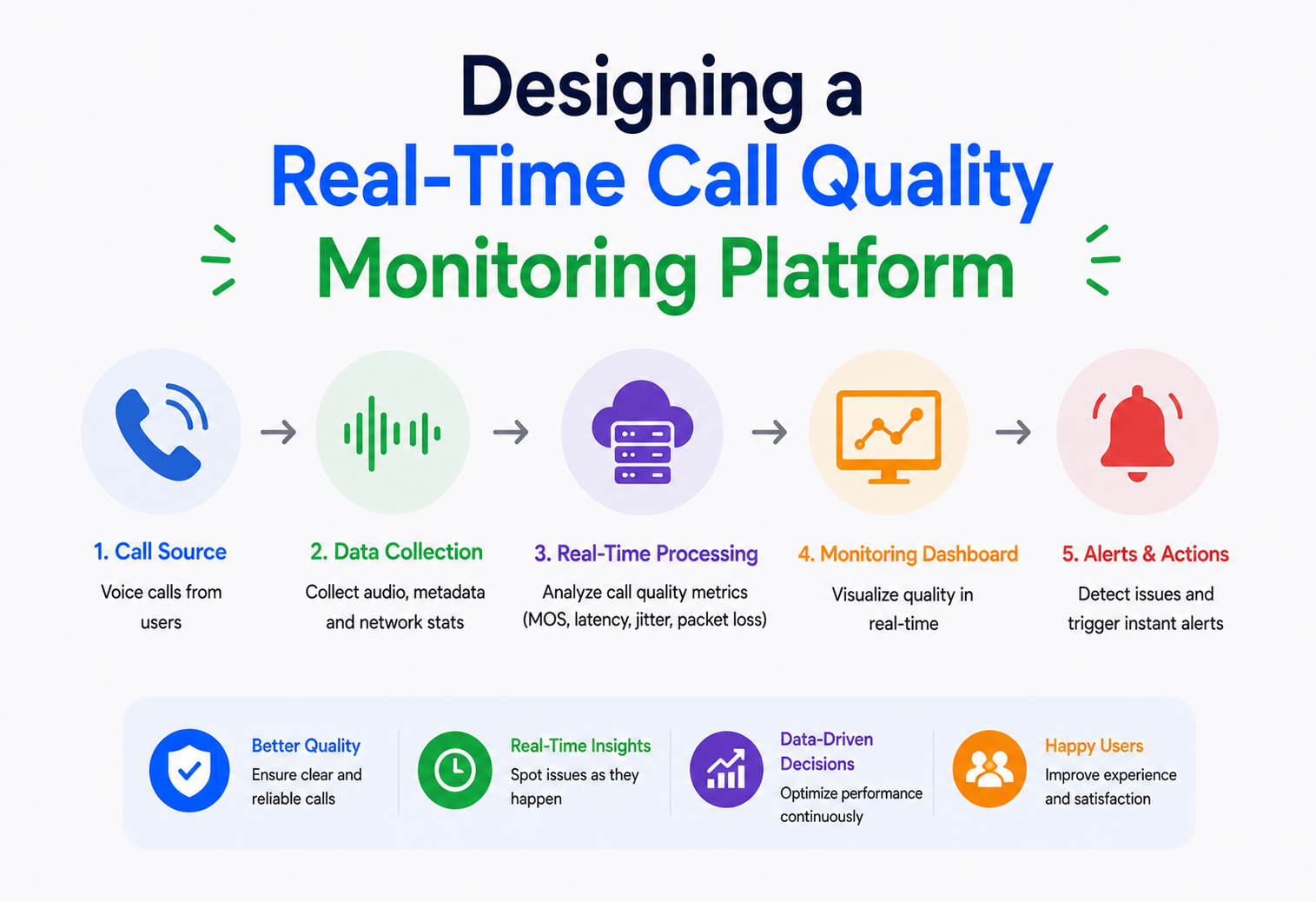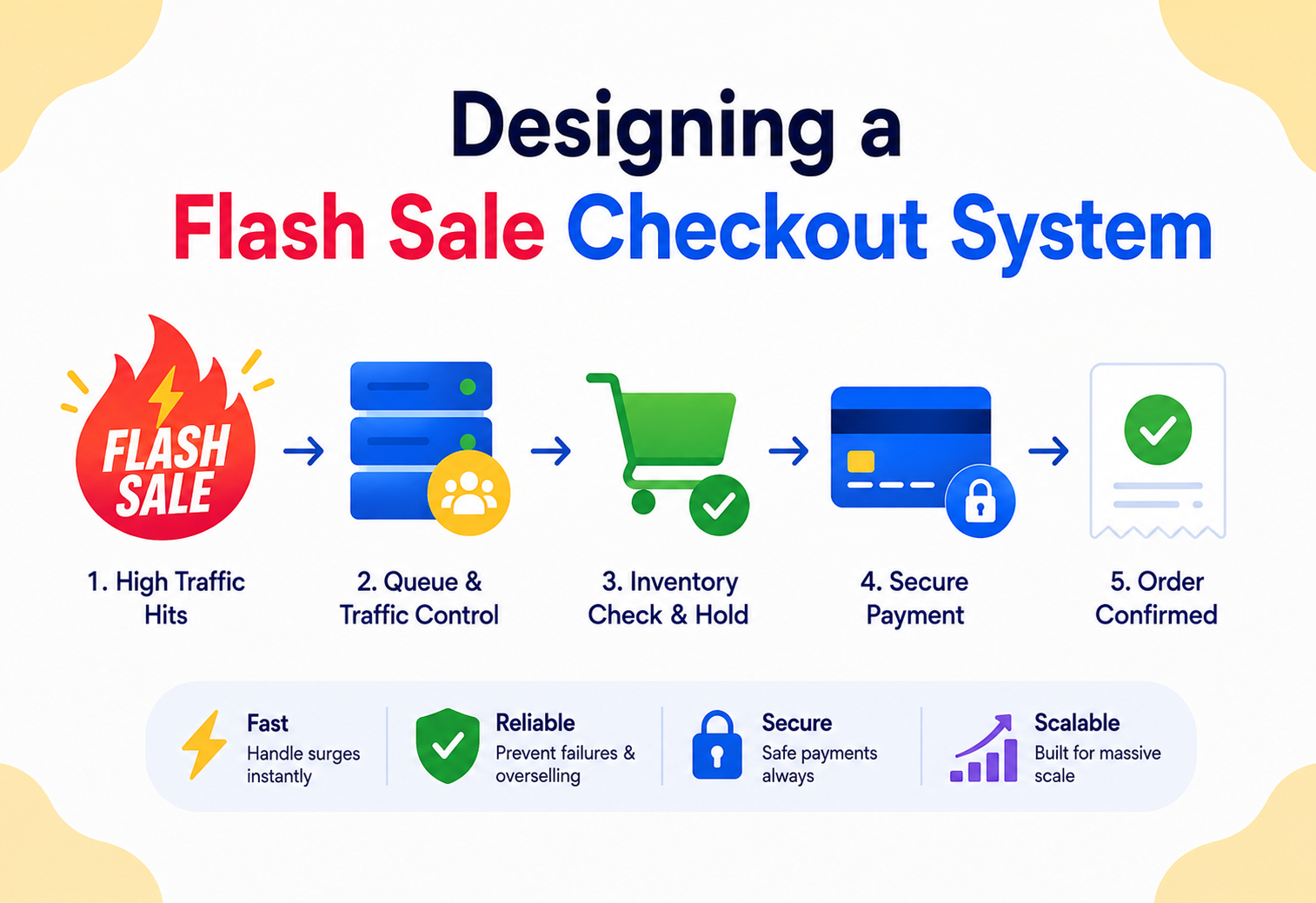
Designing a Flash Sale Checkout System
A complete architecture for a checkout system that can survive 50,000 concurrent buyers hammering “Buy Now” on a limited-stock item at the exact same second — and guarantee that not one single unit is ever oversold, without the system grinding to a halt under the load.
Introduction and History
Picture a shoe store with only 200 pairs of a rare sneaker, opening its doors at exactly 9:00 AM. If 10,000 people are standing outside, the shop can only let people in one at a time through the front door — the physical door itself limits how fast the crowd can enter, so at most a handful of people can even reach the shelf in the first few seconds. A website has no such door. When 50,000 people click “Buy Now” on a flash sale page at 9:00:00.000 AM, all 50,000 requests can arrive at the server within the same second, sometimes the same millisecond. This is the essential problem a flash sale checkout system exists to solve: reproducing the fairness and safety of a physical queue, in a world where there is no physical bottleneck slowing anyone down.
“Flash sale” style traffic bursts have existed since the early days of e-commerce — ticket sales for popular concerts, sneaker “drops,” and limited-edition product launches have repeatedly taken down poorly-prepared websites. Some of the most famous public failures in e-commerce history are flash-sale-related: ticketing sites collapsing under demand for a hugely popular concert, or a retailer’s site going down during a major holiday sale because their checkout system was not designed for a synchronized spike. These failures pushed the industry to develop a specific set of patterns — virtual waiting rooms, distributed atomic counters, queue-based order processing — purpose-built for this exact scenario, distinct from the patterns used for ordinary, steadily-distributed e-commerce traffic.
Imagine a single water tap and a bucket that holds exactly 200 cups of water. If 10,000 thirsty people all reach for the tap in the same instant, most systems would either let the tap dispense far more than 200 cups (because many hands are grabbing simultaneously and no one is counting correctly), or the pressure of everyone pushing at once would break the tap entirely. A well-designed flash sale system is like a mechanism that lets exactly 200 people draw one cup each, tells everyone else honestly and instantly “the bucket is empty,” and does this without the crowd ever damaging the tap.
The two things that make this problem genuinely hard, and genuinely interesting from a systems design point of view, are: first, the sheer synchronized concurrency (tens of thousands of requests, not spread over minutes, but compressed into seconds); and second, the zero-tolerance correctness requirement (selling 201 units of a 200-unit product is not a minor bug — it means broken promises, refunds, and real financial and reputational cost). In this tutorial, we design a checkout system, from the edge layer down to the database, that can safely and fairly handle exactly this scenario: 50,000 concurrent buyers, one limited-stock item, zero overselling. We will build it up layer by layer, starting with why ordinary e-commerce checkout patterns break down under this kind of synchronized demand, moving through the exact mechanics of atomic stock reservation, and finishing with the operational discipline — monitoring, deployment freezes, pre-warmed infrastructure — that experienced teams rely on to keep the whole system standing on the one day it absolutely has to.
Problem and Motivation
2.1 Why normal e-commerce checkout design fails here
A typical e-commerce checkout is designed assuming demand arrives gradually — a few hundred purchases per minute, spread across thousands of different products. A flash sale inverts every one of those assumptions: demand arrives in an enormous, synchronized burst, concentrated on one (or a handful of) products, over a window that can be shorter than a second for the item to sell out entirely.

| Normal Checkout | Flash Sale Checkout |
|---|---|
| Traffic spread across the day | Traffic compressed into seconds at a known start time |
| Demand spread across many SKUs | Demand concentrated on one or a few limited-stock SKUs |
| Stock typically lasts hours or days | Stock (e.g. 200 units) can sell out in under a second |
| A moderate error rate is tolerable | Any overselling is a hard failure, not a tolerable error rate |
| Database can comfortably serve as source of truth for every check | Database alone cannot handle 50,000 simultaneous stock checks on one row |
2.2 The core hard problems
Race condition / overselling
If 50,000 requests all read “stock = 200” before any of them writes a decrement, all 50,000 might believe they succeeded. Preventing this requires making “check stock and decrement” a single atomic, indivisible operation — not two separate steps that can interleave.
Thundering herd
All 50,000 requests hit the exact same URL, often the exact same backend row, in the same instant. Systems not designed for this concentrate all the load onto a single bottleneck resource (one database row, one lock) instead of spreading it out.
Honest and fast rejection
49,800 of the 50,000 buyers will not get the item. The system must tell them “sold out” quickly and clearly, rather than making them wait in a spinning loading state, retry repeatedly (worsening load), or — worse — show a false “success” that later has to be walked back.
Retry amplification
Impatient users (and buggy client code) retry failed or slow requests. Without safeguards, retries can multiply the effective load on the backend by several times the actual number of real buyers.
Bots and scalpers
Automated scripts routinely try to snipe limited-stock flash sale items faster than any human could click, which both worsens the load problem and undermines fairness for genuine customers.
A stadium selling 200 tickets for a sold-out reunion concert, announced simultaneously to a mailing list of 50,000 fans. A good box office doesn’t let all 50,000 people physically crowd the ticket window; it forms an orderly line (a queue), sells tickets from the front of the line one at a time, and puts up a clear “sold out” sign the instant the 200th ticket is gone — rather than letting a crush of people at the window all grab for the same stack of tickets at once.
2.3 Why “just add more servers” doesn’t solve this
It is tempting to think this is purely a scaling problem — add enough application servers and the load spreads out fine. But the fundamental bottleneck is not raw compute capacity; it is the single shared piece of state (the stock count) that every one of those 50,000 requests must correctly and safely modify. Adding a thousand application servers, each independently reading and writing the same database row without coordination, actually makes the race condition worse, not better, because there are now a thousand concurrent writers instead of one. The real solution requires careful coordination around that one shared piece of state, which is the heart of this entire design.
“If you just added a WHERE stock > 0 clause to your UPDATE statement, wouldn’t that prevent overselling?” This is actually a reasonable partial answer — a conditional update like UPDATE inventory SET stock = stock - 1 WHERE product_id = ? AND stock > 0 is atomic at the database level and does prevent overselling correctly. The follow-up the interviewer is really probing for: does this approach hold up at 50,000 requests per second against a single database row? The answer is that correctness isn’t the only requirement — throughput and latency under that specific contention pattern matter just as much, which is why we still need caching, sharding, and queueing layered on top, even though the conditional update itself is correct.
Requirements
3.1 Functional requirements
- Display a flash sale product with an accurate, near-real-time remaining stock count.
- Allow a buyer to attempt a purchase; instantly and correctly tell them whether they succeeded or the item is sold out.
- Never allow total successful purchases to exceed the configured stock count, under any level of concurrent load.
- Support a fair ordering mechanism (typically first-come-first-served) when demand exceeds supply.
- Limit purchase quantity per customer/account (e.g., max 1 unit) to spread stock across more genuine buyers.
- Integrate with payment processing, and cleanly roll back a reservation if payment fails.
- Provide the buyer clear order confirmation and, on failure, a clear “sold out” or “try again” message.
- Give operators real-time visibility into remaining stock, sale velocity, and system health during the event.
3.2 Non-functional requirements
| Requirement | Target | Why it matters |
|---|---|---|
| Overselling | Zero, under all conditions | Non-negotiable correctness guarantee; the entire point of the system |
| Concurrent buyers supported | 50,000+ simultaneous purchase attempts | Stated scale target for this design |
| Purchase attempt response time | < 200ms p99 | Must feel instant; slow responses cause retries that worsen load further |
| Availability during the sale window | 99.99% | A flash sale has a fixed, non-reschedulable start time; downtime directly costs revenue and trust |
| Fairness | First valid request wins, consistently enforced | Buyers must trust the process is not arbitrary or exploitable |
| Consistency for stock/orders | Strong consistency (ACID) | Financial and inventory correctness cannot be “eventually” correct |
| Bot/scalper resistance | Meaningfully raise the cost of automated abuse | Protects fairness for genuine human buyers |
3.3 Back-of-the-envelope scale estimation
- Peak concurrent buyers (given): 50,000, arriving within a window as short as 1–2 seconds around the sale start time.
- Peak requests per second at the “Buy Now” endpoint: potentially 25,000–50,000+ QPS in the first second, before tapering off sharply once stock is exhausted.
- Stock size (typical flash sale): anywhere from a few hundred to a few thousand units — meaning the overwhelming majority of the 50,000 requests must be rejected, correctly and quickly.
- Read traffic (page views, stock count polling) leading up to the sale: often 10–50x the actual purchase attempt volume, as buyers refresh the page waiting for the sale to open.
These numbers tell us immediately: a single database row cannot directly absorb tens of thousands of concurrent write attempts; we need an in-memory atomic layer in front of it. They also tell us that read traffic before the sale opens needs to be served almost entirely from cache, since it dwarfs the actual purchase volume.
Architecture and Components
The design philosophy here is simple to state and hard to execute: put as many layers as possible in front of the single shared stock counter, each layer filtering out load that the next layer doesn’t need to see, so that only genuinely necessary work ever reaches the correctness-critical core.
4.1 High-level architecture
Every box below is explicitly labeled with its component type, so the role of each piece in the request path is unambiguous.
Notice the shape of this diagram: five distinct filtering layers (CDN, WAF, Load Balancer, API Gateway, Waiting Room) all sit between the 50,000 buyers and the single atomic Reservation Service, and even after a successful reservation, the actual database write is handled asynchronously by a worker pool rather than synchronously in the request path. Let’s go through every component.
4.2 Edge and admission layer
CDN (Content Delivery Network)
What it is: a globally distributed network of edge servers caching static content close to each user. Why it exists: the flash sale product page, images, and price information are read constantly by buyers refreshing in anticipation of the sale, but change rarely in the seconds before it starts. Serving this from CDN edge caches means the vast majority of pre-sale read traffic never reaches our origin infrastructure at all.
WAF / DDoS protection layer
What it is: a Web Application Firewall and volumetric-attack mitigation layer sitting at the very edge of the network. Why it exists: flash sales are prime targets for bot traffic and, occasionally, malicious denial-of-service attempts. This layer filters out obviously malicious or malformed traffic before it consumes any application-level resources.
Load Balancer (Layer 7)
What it is: distributes incoming HTTP requests across many API Gateway instances, using application-level routing information. Why it exists: no single gateway instance can handle 50,000 simultaneous connections. The load balancer spreads requests evenly, performs health checks, and terminates TLS centrally.
API Gateway
What it is: the single entry point for client requests, handling authentication, per-user/per-IP rate limiting, and routing to backend services. Why it exists: centralizing authentication and rate limiting here means backend services never have to deal with raw, unauthenticated, unthrottled traffic. During a flash sale, the gateway’s rate limiter is the first real defense against a single user (or bot) submitting the same purchase request hundreds of times per second.
Virtual Waiting Room Service
What it is: a dedicated admission-control service that, when incoming demand vastly exceeds what the checkout core can safely process, holds buyers in a fair, ordered queue and only “admits” a controlled number of them into the actual checkout flow per second, each with a short-lived admission token. Why it exists: this is the single most important architectural decision in this design. Rather than letting all 50,000 requests hit the Reservation Service simultaneously, the waiting room deliberately throttles admission to a rate the downstream system can safely and correctly handle (say, 2,000 requests per second), turning an instantaneous, unmanageable spike into a smooth, manageable stream — at the cost of some buyers waiting a few extra seconds in a visible, honest queue instead of everyone hitting a broken or catastrophically slow checkout at once.
A nightclub bouncer at the door of a venue with limited capacity, letting people in one at a time as space frees up inside, instead of the entire waiting crowd being allowed to push through the door simultaneously and crush each other in the doorway.
4.3 Checkout core components
Reservation Service
What it is: a narrowly-scoped, highly optimized service whose only job is to atomically check and decrement the remaining stock count for a product, backed by the Redis cache cluster. Why it exists: this is the safety-critical heart of the whole system. Isolating it as its own service means it can be reasoned about, tested, and scaled independently, with the smallest possible surface area for bugs that could cause overselling. Every other requirement in this system (queueing, rate limiting, caching) ultimately exists to protect this one component from being overwhelmed.
Order Service
What it is: manages the order lifecycle — reserved, payment pending, confirmed, failed, cancelled — and orchestrates the sequence of steps between reservation and payment. Why it exists: a successful purchase spans the Reservation Service and the Payment Service with no shared database transaction between them. The Order Service coordinates this as a saga (Section 15), ensuring a payment failure after a successful reservation always cleanly releases the reserved unit back to available stock.
Payment Service
What it is: handles charging the buyer’s payment method by delegating to a PCI-compliant third-party processor, rather than handling raw card data directly. Why it exists: isolating payment logic shrinks the compliance boundary and lets this service be hardened and audited independently of the rest of the checkout flow.
The single teller at a bank counting out the last remaining stack of a rare limited-edition coin, one at a time, refusing to let any other hand touch the stack while they count — everything else in the branch (the queue, the security guard, the “take a number” machine) exists to keep that one counting process orderly and interruption-free.
4.4 Asynchronous order processing
Message Broker (Kafka)
What it is: a distributed event log that decouples the fast, synchronous reservation path from the slower, durable database write. Why it exists: writing a fully durable order record to a relational database, synchronously, for every one of potentially tens of thousands of reservations per second, would reintroduce exactly the database bottleneck we were trying to avoid. Instead, once a reservation succeeds and payment is authorized, the Order Service publishes an event to Kafka and immediately responds to the buyer — the actual durable persistence happens asynchronously, absorbed by Kafka’s buffering, without blocking the buyer’s response.
Order Worker Pool
What it is: a horizontally scalable pool of consumer processes that read order events from Kafka and persist them durably into the sharded Order Database. Why it exists: by decoupling “confirm the reservation instantly” from “durably record the order,” we let the database write happen at a controlled, sustainable rate (however fast the workers and database can safely process), while buyers still get their honest, correct “you got it” or “sold out” answer in milliseconds — the database catches up shortly after, not before, responding to the buyer.
A restaurant’s kitchen ticket rail. The waiter (the fast synchronous path) doesn’t wait at the stove for the dish to be cooked before serving the next table — they hand off a ticket to the rail, and the kitchen (asynchronous workers) cooks from that rail at its own sustainable pace, while the waiter keeps taking new orders.
4.5 Cache cluster (Redis)
What it is: an in-memory key-value store holding the live stock counter, per-user idempotency keys, and waiting-room admission tokens. Why it exists: Redis’s single-threaded command execution model makes it possible to perform tens of thousands of atomic check-and-decrement operations per second against a single counter, something a disk-based relational database simply cannot sustain at this contention level. This is explored in depth in Section 5.
4.6 Observability stack
What it is: metrics (Prometheus), dashboards (Grafana), distributed tracing (OpenTelemetry), and centralized logs (ELK stack), instrumented across every service in the request path. Why it exists: during a flash sale, engineers need real-time visibility into exactly where load is concentrating and whether any component is approaching its limits, with only seconds to react before the event’s fixed, non-reschedulable start time makes any last-minute fix impossible.
Internal Working
5.1 The purchase path, step by step
- Buyer clicks “Buy Now.” Request passes through CDN/WAF, hits the Load Balancer, then the API Gateway, which authenticates the user and applies rate limiting.
- The Gateway forwards the request to the Virtual Waiting Room Service, which either admits the request immediately (if under the configured admission rate) or issues a queue position and a polling token.
- Once admitted, the request reaches the Reservation Service, which performs an atomic check-and-decrement against the Redis stock counter for that product.
- If the decrement succeeds (stock was available), the Reservation Service creates a short-lived hold and hands off to the Order Service.
- The Order Service calls the Payment Service to charge the buyer.
- On payment success, the Order Service publishes an
OrderCreatedevent to Kafka and immediately returns a success response to the buyer — the buyer does not wait for the database write. - On payment failure, the Order Service releases the reservation (atomic increment back), freeing the unit for the next buyer in the queue.
- Asynchronously, the Order Worker Pool consumes the
OrderCreatedevent and durably persists the order into the sharded Order Database.
5.2 Solving the overselling problem: atomic reservation
As established in Section 2, the naive “read stock, check > 0, write stock – 1” pattern is a classic race condition under concurrency. The fix is to make the entire check-and-decrement a single atomic operation. We use a Redis Lua script, which Redis guarantees executes without any other command interleaving:
-- Redis Lua script: reserve-stock.lua
-- KEYS[1] = stock counter key, e.g. "stock:sale:flash2026:sku_501"
-- ARGV[1] = max units per buyer (e.g. "1")
-- Returns: 1 if reserved, 0 if sold out

local stock = tonumber(redis.call('GET', KEYS[1]))
if stock == nil then
    return -1  -- misconfigured / not loaded into cache
end
if stock > 0 then
    redis.call('DECR', KEYS[1])
    return 1
else
    return 0
end
The Java Reservation Service calling this script, with idempotency protection built in so a retried request can never double-reserve:
@Service
public class ReservationService {

    private final StringRedisTemplate redisTemplate;
    private final RedisScript<Long> reserveScript;
    private final KafkaTemplate<String, ReservationEvent> kafkaTemplate;

    public ReservationService(StringRedisTemplate redisTemplate,
                               KafkaTemplate<String, ReservationEvent> kafkaTemplate) {
        this.redisTemplate = redisTemplate;
        this.kafkaTemplate = kafkaTemplate;
        this.reserveScript = RedisScript.of(
            new ClassPathResource("scripts/reserve-stock.lua"), Long.class);
    }

    public ReservationResult reserve(String productId, String userId, String idempotencyKey) {

        // SETNX guarantees this exact request is only ever processed once,
        // even if the client retries after a timeout.
        String idemKey = "idem:" + idempotencyKey;
        Boolean firstAttempt = redisTemplate.opsForValue()
            .setIfAbsent(idemKey, "processing", Duration.ofMinutes(5));

        if (Boolean.FALSE.equals(firstAttempt)) {
            String cachedResult = redisTemplate.opsForValue().get(idemKey);
            return ReservationResult.fromCached(cachedResult);
        }

        String stockKey = "stock:" + productId;
        Long result = redisTemplate.execute(reserveScript, List.of(stockKey));

        ReservationResult outcome;
        if (result == null || result == -1L) {
            outcome = ReservationResult.SYSTEM_ERROR;
        } else if (result == 0L) {
            outcome = ReservationResult.SOLD_OUT;
        } else {
            outcome = ReservationResult.RESERVED;
            String holdKey = "hold:" + idempotencyKey;
            redisTemplate.opsForValue().set(holdKey, productId, Duration.ofMinutes(2));
            kafkaTemplate.send("reservation-events",
                new ReservationEvent(productId, userId, idempotencyKey, ReservationEventType.RESERVED));
        }

        // Cache outcome so a retry returns the same result.
        redisTemplate.opsForValue().set(idemKey, outcome.name(), Duration.ofMinutes(5));
        return outcome;
    }

    public void release(String idempotencyKey) {
        String holdKey = "hold:" + idempotencyKey;
        String productId = redisTemplate.opsForValue().get(holdKey);
        if (productId != null) {
            redisTemplate.opsForValue().increment("stock:" + productId);
            redisTemplate.delete(holdKey);
            kafkaTemplate.send("reservation-events",
                new ReservationEvent(productId, null, idempotencyKey, ReservationEventType.RELEASED));
        }
    }
}
Two mechanisms are working together here: the Lua script guarantees the stock check-and-decrement itself is race-free, and the idempotency key guarantees that a client’s retried request (common under high load, when a response is slow to arrive) can never cause a second, duplicate reservation for the same logical purchase attempt.

Implementing idempotency with a database unique constraint alone, checked after the fact. At 50,000 requests per second, that still allows a race between the check and the insert unless the constraint itself is enforced atomically at write time (which a unique index does), but relying solely on catching the resulting exception, without an upfront fast-fail idempotency guard, wastes enormous processing capacity on requests that were always going to be rejected as duplicates.
5.3 Why the waiting room matters even with atomic operations
A reasonable question: if Redis can safely handle the atomic decrement, why not let all 50,000 requests hit the Reservation Service directly? The answer is that atomicity guarantees correctness, not throughput or system stability. Even though Redis processes each command safely, 50,000 simultaneous requests still consume 50,000 concurrent connections, 50,000 sets of gateway/authentication overhead, and generate 49,800+ “sold out” responses that all still cost real compute and network resources to produce and deliver. The waiting room exists to smooth this curve — admitting requests at a rate the whole pipeline (not just Redis) can comfortably sustain, so no single layer becomes a bottleneck or falls over under connection or thread exhaustion.
@Service
public class WaitingRoomService {

    private final StringRedisTemplate redisTemplate;
    private static final int ADMISSION_RATE_PER_SECOND = 2000;

    // Token bucket implemented with a Redis sorted set as the queue.
    public QueueTicket enqueue(String userId, String saleId) {
        String queueKey = "waitqueue:" + saleId;
        double score = System.currentTimeMillis(); // FIFO ordering by arrival time
        redisTemplate.opsForZSet().add(queueKey, userId, score);
        Long position = redisTemplate.opsForZSet().rank(queueKey, userId);
        return new QueueTicket(userId, position, estimateWaitSeconds(position));
    }

    @Scheduled(fixedRate = 1000) // once per second
    public void admitNextBatch() {
        for (String saleId : activeSales()) {
            String queueKey = "waitqueue:" + saleId;
            Set<String> nextBatch = redisTemplate.opsForZSet()
                .range(queueKey, 0, ADMISSION_RATE_PER_SECOND - 1);
            for (String userId : nextBatch) {
                String admissionToken = tokenGenerator.generate(userId, saleId);
                redisTemplate.opsForValue().set(
                    "admitted:" + admissionToken, userId, Duration.ofSeconds(30));
                notifyClientAdmitted(userId, admissionToken); // via WebSocket or polling
                redisTemplate.opsForZSet().remove(queueKey, userId);
            }
        }
    }

    private long estimateWaitSeconds(Long position) {
        return position == null ? 0 : position / ADMISSION_RATE_PER_SECOND;
    }
}
Buyers waiting in the queue see an honest, continuously updating position and estimated wait time, which — beyond the technical load-leveling benefit — also meaningfully improves perceived fairness and trust compared to an unresponsive, spinning “Buy Now” button.
“Doesn’t the waiting room just move the bottleneck to itself — won’t 50,000 people also overwhelm the queue?” Good answer: enqueueing into a Redis sorted set (an O(log N) operation) is vastly cheaper than performing a payment-integrated checkout, so the waiting room can comfortably absorb far higher throughput than the checkout core; it exists specifically because appending to a queue is cheap while a full reservation-plus-payment flow is comparatively expensive, and deliberately trading the latter’s concurrency for the former’s is the whole point of the pattern.
Data Flow and Lifecycle
6.1 The rollback path (sold out or payment failure)
The two-minute hold TTL (Section 5.2) acts as an additional safety net: even if the Order Service crashes mid-flow before explicitly releasing, the Redis hold key expires automatically, and a background reconciliation job detects the orphaned hold and returns the unit to available stock, ensuring no crash can permanently “lose” inventory that was never actually sold.
6.2 Purchase attempt lifecycle
| State | Trigger | Buyer sees |
|---|---|---|
| Queued | Sale demand exceeds admission rate | Live queue position and estimated wait |
| Admitted | Waiting room grants a token | “You’re up! Complete your purchase” |
| Reserved | Atomic Redis decrement succeeds | Brief “processing payment” state |
| Confirmed | Payment succeeds, event published | Order confirmation screen |
| Sold Out | Atomic decrement returns zero stock | Immediate, clear “sold out” message |
| Released | Payment fails or hold expires unconfirmed | “Payment failed, item released” — unit returns to pool |
Advantages, Disadvantages and Trade-offs
7.1 Advantages
Guaranteed under extreme concurrency
The atomic reservation layer makes overselling structurally impossible, not just statistically unlikely.
Graceful behavior under overload
Rather than collapsing when demand exceeds capacity, the waiting room converts an unmanageable spike into a smooth, sustainable stream, keeping the whole system responsive.
Fast, honest feedback
Because the fast path returns a decision within milliseconds of admission, buyers get a clear answer quickly instead of an ambiguous, spinning state.
Decoupled durability
Separating “confirm the reservation” from “durably persist to the database” lets each happen at its own appropriate pace, without the slower step blocking the faster, buyer-facing one.
7.2 Disadvantages and costs
- Added user-facing complexity: a visible waiting room, queue positions, and admission tokens are more moving parts for the client experience than a simple, direct “Buy Now” button — and add real (if small) latency for admitted buyers even when the system has spare capacity.
- Operational overhead: running and tuning a dedicated waiting room service, correctly calibrating its admission rate, is nontrivial extra infrastructure that a low-traffic store would never need.
- Eventual durability window: because database persistence is asynchronous, there is a brief window (typically well under a second, but nonzero) where a confirmed order exists in Kafka and Redis but not yet in the durable database — this must be carefully handled by the reconciliation and monitoring strategy.
- Tuning risk: if the waiting room’s admission rate is set too conservatively, genuine capacity goes unused and buyers wait longer than necessary; set too aggressively, it fails to protect the downstream system, defeating its purpose.
7.3 Key trade-off decisions
| Decision | Chosen approach | Alternative | Why we chose this |
|---|---|---|---|
| Stock consistency | Strong consistency via atomic Redis operations | Eventually-consistent counters with periodic reconciliation | Overselling is a hard failure; correctness cannot be probabilistic here |
| Handling the traffic spike | Admission-controlled virtual waiting room | Let all requests hit the backend and rely purely on autoscaling | Autoscaling reacts on the order of tens of seconds to minutes; the spike itself lasts only seconds |
| Database write timing | Asynchronous, via Kafka + worker pool | Synchronous write in the request path | Keeps buyer-facing latency low; database becomes eventually consistent with the reservation, not a bottleneck for it |
| Fairness mechanism | Strict FIFO admission queue | Random lottery among all attempts | FIFO is simpler to reason about and explain to users, and rewards buyers who arrive earlier without requiring a separate draw process |
Performance and Scalability
8.1 Sharding the stock counter for extreme hot keys
Even a single Redis key can become a bottleneck at extreme scale, because commands against one key are serialized on one thread. For the very hottest single-SKU flash sales, the stock counter itself can be split into N sub-counters (for example, 10 counters of 20 units each for a 200-unit product), with incoming requests randomly assigned to one sub-counter. This spreads the atomic operations across multiple Redis slots/threads, at the cost of slightly uneven exhaustion (one sub-counter might empty a fraction of a second before another) — a small trade-off against a meaningful throughput gain.
@Service
public class ShardedReservationService {

    private static final int SHARD_COUNT = 10;
    private final StringRedisTemplate redisTemplate;
    private final RedisScript<Long> reserveScript;

    public ReservationResult reserve(String productId, String userId) {
        int shard = Math.abs(userId.hashCode()) % SHARD_COUNT;
        String shardKey = "stock:" + productId + ":shard:" + shard;

        Long result = redisTemplate.execute(reserveScript, List.of(shardKey));
        if (result != null && result == 1L) {
            return ReservationResult.RESERVED;
        }
        // Fall back to trying one alternate shard before declaring sold out.
        int fallbackShard = (shard + 1) % SHARD_COUNT;
        String fallbackKey = "stock:" + productId + ":shard:" + fallbackShard;
        Long fallbackResult = redisTemplate.execute(reserveScript, List.of(fallbackKey));
        return (fallbackResult != null && fallbackResult == 1L)
            ? ReservationResult.RESERVED : ReservationResult.SOLD_OUT;
    }
}
8.2 Tuning the waiting room’s admission rate
The admission rate should be set based on load testing the checkout core’s actual sustainable throughput (Reservation Service plus Order Service plus Payment Service, end to end), with meaningful headroom below the observed breaking point. Setting it too close to the measured limit leaves no margin for the natural variance in payment provider latency during the event itself.
8.3 Read scaling before the sale opens
- Aggressive CDN caching of the product page and a “sale starts in…” countdown, since this is read overwhelmingly more often than the checkout endpoint itself in the minutes before a sale.
- Client-side countdown synchronized to server time (not local device clock) to avoid a burst of requests arriving early due to client clock drift, which would otherwise create an artificial pre-spike.
- Serving live stock count from cache, not the authoritative counter directly, with a short refresh interval, so that displaying “347 left” to thousands of watching buyers doesn’t itself compete for capacity with the actual atomic reservation operations.
8.4 Capacity planning: working backward from the target
A useful exercise when designing for a stated target like 50,000 concurrent buyers is to work backward through every layer and ask, explicitly, “what is this layer’s actual job, and how much of the original 50,000 does it really need to handle?” This exercise is what justifies the layered filtering design from Section 4, rather than treating it as an arbitrary stack of technologies.
Absorbs pre-sale reads
Handles essentially all static page-load and pre-sale polling traffic, which can be many times larger than 50,000 given repeated page refreshes; this layer needs to comfortably handle hundreds of thousands of requests per second, but almost none of them touch application servers.
Sees all 50,000, cheaply
Sees the full 50,000 authenticated purchase attempts, but each request is cheap (auth check, rate limit check, forward) — this layer is sized for connection and throughput capacity, not computational cost.
Full spike, cheap ops
Also sees the full 50,000 enqueue requests, but each is a lightweight sorted-set insertion, and its job is explicitly to shrink what reaches the next layer down to a configured admission rate.
Only the trickle
By design, only receives the admitted trickle (for example, 2,000/second) rather than the full spike — this is the layer where correctness matters most and load has already been deliberately reduced to a manageable, testable rate.
Just the winners
Receives only successfully reserved-and-paid orders, a small fraction of the original 50,000 (bounded by actual stock count), decoupled further by the asynchronous queue so even that reduced load arrives at a controlled pace.
This backward pass makes explicit why the architecture is shaped the way it is: each layer is sized for the load it is actually responsible for handling, not for the full original spike, which is only ever fully absorbed by the cheapest, most horizontally scalable layers at the very edge.
8.5 Horizontal scaling and pre-warming
Because a flash sale has a known, fixed start time, the platform pre-scales the API Gateway, Waiting Room Service, Reservation Service, and Order Worker Pool ahead of the event, rather than relying on reactive autoscaling that may not react quickly enough for the first, most dangerous seconds of the spike. Redis and Kafka clusters are similarly provisioned with headroom in advance, and connection pools are pre-warmed so the very first wave of admitted requests doesn’t pay a cold-start latency penalty.
“What’s the very first thing that breaks if you skip the waiting room and just rely on autoscaling?” Typically: database connection pool exhaustion and/or Redis client connection limits are hit within the first fraction of a second, well before Kubernetes’ Horizontal Pod Autoscaler has even measured the spike, let alone spun up and warmed new replicas — reactive autoscaling operates on a timescale of many seconds to minutes, while the flash sale spike itself can be over in under a second.
High Availability and Reliability
9.1 Redundancy at every layer
| Layer | HA strategy |
|---|---|
| CDN / WAF | Globally distributed edge nodes with automatic failover |
| Load Balancer | Active-active pairs across availability zones |
| API Gateway / Waiting Room / Reservation / Order Services | Multiple stateless replicas per zone, pre-scaled ahead of the event, behind health-checked load balancing |
| Redis cache | Redis Cluster with primary-replica shards; automatic failover promotes a replica on primary failure |
| Kafka | Multi-broker cluster, replication factor 3, tolerating broker failures without event loss |
| Order DB | Primary with synchronous standby for zero data loss on failover, sharded for write scalability |
9.2 Handling Redis failover without losing correctness
A Redis primary failure mid-sale is a genuine risk that must be designed for explicitly, not assumed away. The approach: Redis Cluster is configured with at least one synchronous-enough replica (using WAIT or a similarly strict replication acknowledgment for the stock-counter keys specifically) so that a successful decrement is acknowledged by more than one node before being confirmed to the caller, minimizing — though not entirely eliminating — the risk of a lost decrement during an abrupt primary failure. This is combined with the database-level reconciliation job from Section 5, which detects any drift between the authoritative persisted order count and the Redis counter’s history after the fact.
Assuming an in-memory cache is “fast but eventually consistent, so a little data loss on failover is fine.” For a stock counter specifically, a lost decrement during failover could allow overselling — the very thing this entire architecture exists to prevent. This is why the design layers a reconciliation safety net on top of Redis’s own replication guarantees rather than trusting either mechanism alone.
9.3 Circuit breakers around the payment provider
@Service
public class PaymentClient {

    private final CircuitBreaker circuitBreaker;
    private final RestClient restClient;

    public PaymentClient(CircuitBreakerRegistry registry, RestClient restClient) {
        this.circuitBreaker = registry.circuitBreaker("payment-provider");
        this.restClient = restClient;
    }

    public PaymentResult charge(ChargeRequest request) {
        Supplier<PaymentResult> call = CircuitBreaker.decorateSupplier(
            circuitBreaker,
            () -> restClient.post().uri("/v1/charges").body(request)
                    .retrieve().body(PaymentResult.class));
        try {
            return call.get();
        } catch (CallNotPermittedException e) {
            // Provider is unhealthy - fail fast and release the reservation.
            return PaymentResult.temporarilyUnavailable();
        }
    }
}
If the payment provider degrades mid-sale, the circuit breaker trips after a threshold of failures, and the Order Service fails fast — immediately releasing the held reservation back to the pool (Section 5) rather than holding stock hostage against a doomed payment call, keeping inventory flowing to the next buyer in the queue.
9.4 Disaster recovery and graceful degradation
- Multi-region readiness for the stateless service tiers, with the primary Order DB and Redis cluster in one region and cross-region replicas for recovery, though most flash sales operate from a single primary region given the tight timing coordination required.
- Kill switches for non-essential features: live “X people are viewing this” counters, recommendation widgets, or marketing pixels can be disabled instantly under stress, protecting capacity for the core reserve-and-pay path.
- Game day rehearsals: teams simulate a Redis node failure, a Kafka broker outage, and a payment provider timeout during a rehearsal flash sale on staging before a real high-stakes event depends on the failover paths working correctly.
Security
10.1 Authentication and authorization
- OAuth2 / JWT-based authentication: validated once at the API Gateway, so downstream services trust the identity context passed to them rather than each re-verifying tokens independently.
- Per-user purchase limits: enforced atomically alongside the stock reservation (e.g., checking a per-user “already purchased” flag in the same Redis transaction) to prevent one account from buying more than the allowed quantity, even under retry storms.
10.2 Bot and scalper mitigation
Flash sales are a magnet for automated purchasing scripts trying to buy faster than any human can click, which both worsens system load and undermines fairness. Defenses include:
- Behavioral rate limiting and device fingerprinting at the API Gateway, flagging request patterns inconsistent with human interaction (e.g., requests arriving within milliseconds of the sale opening, from previously unseen accounts, in bulk from a narrow IP range).
- CAPTCHA or proof-of-work challenges triggered adaptively for suspicious traffic, adding friction that costs bots meaningfully more than genuine buyers.
- Waiting room entry requiring an authenticated, rate-limited enqueue request, rather than an open, unauthenticated endpoint, so bulk-account bot farms face the same per-account friction as legitimate purchases.
- Purchase limits enforced server-side, never trusting client-side quantity restrictions, since those are trivially bypassed by a script calling the API directly.
10.3 Payment security
As with any checkout system, raw card data is tokenized client-side by the payment processor’s SDK and never touches our servers directly, keeping the platform’s PCI-DSS compliance scope minimal. The Payment Service only ever handles opaque payment tokens.
10.4 Idempotency as a security boundary, not just a correctness tool
The idempotency mechanism from Section 5.2 also has a security dimension: without it, a malicious or buggy client could rapidly resubmit the same purchase request hoping to slip in an extra reservation during a race window, or to intentionally exhaust rate limit budgets for other users by flooding retries. Enforcing a strict, server-generated idempotency boundary closes this off.
10.5 Signals used to distinguish bots from genuine buyers
Effective bot mitigation for a flash sale usually combines several weaker signals into one stronger decision, rather than relying on any single check that a sophisticated script could trivially defeat on its own:
| Signal | What it catches |
|---|---|
| Request timing relative to sale start | Requests arriving within a few milliseconds of the announced start time, faster than realistic human reaction time |
| Account age and purchase history | Newly created accounts with no prior activity, common among freshly generated bot accounts |
| Behavioral biometrics (mouse movement, typing cadence, navigation pattern) | Scripted interactions that skip the natural variability of human input |
| Device fingerprint and IP reputation | Many accounts funneling through the same device or a narrow, suspicious IP range |
| Purchase-quantity and per-account limits | Doesn’t catch bots directly, but raises the number of distinct identities an automated operation needs to control to acquire meaningful volume |
No single signal above is reliable enough to act on alone without risking false positives against genuine, simply fast, eager buyers — the practical approach combines several signals into a risk score, applying friction (CAPTCHA, additional verification) proportional to that score rather than an all-or-nothing block.
10.6 Data protection
- TLS everywhere in transit, encryption at rest for the Order Database and any stored personal/shipping information.
- Strict data retention policies aligned with applicable privacy regulation (such as India’s DPDP Act or GDPR for European buyers), including timely honoring of deletion requests.
Relying only on client-side JavaScript to disable the “Buy Now” button after one click, as the sole defense against duplicate submissions. This is trivially bypassed by anyone calling the API directly. Idempotency and rate limiting must be enforced server-side, unconditionally.
Monitoring, Logging and Metrics
11.1 Metrics that matter during the sale window
| Metric | Why it matters | Tooling |
|---|---|---|
| Waiting room admission rate vs configured target | Confirms the load-leveling mechanism is actually throttling correctly | Custom application metrics, Prometheus |
| Reservation Service latency (p50/p95/p99) | Directly affects whether admitted buyers get a fast, decisive answer | Prometheus histograms, Grafana |
| Redis command latency and hot-key contention | Early warning of the single most critical bottleneck degrading | Redis INFO metrics, Prometheus Redis exporter |
| Kafka consumer lag (Order Worker Pool) | Growing lag means durable persistence is falling behind the confirmed-order rate | Kafka consumer group metrics |
| Payment provider success/error rate and latency | Spikes indicate a struggling external dependency, triggers circuit breaker review | Application metrics + provider status dashboards |
| Reservation-to-database reconciliation drift | Confirms zero overselling is actually being maintained in practice, not just in theory | Scheduled reconciliation job output, alerting |
11.2 Distributed tracing across the purchase path
@RestController
public class CheckoutController {

    private static final Tracer tracer =
        GlobalOpenTelemetry.getTracer("checkout-service");

    @PostMapping("/flash-sale/buy")
    public ResponseEntity<PurchaseResponse> buy(@RequestBody PurchaseRequest req) {
        Span span = tracer.spanBuilder("flashSalePurchase")
            .setAttribute("product.id", req.getProductId())
            .setAttribute("user.id", req.getUserId())
            .setAttribute("idempotency.key", req.getIdempotencyKey())
            .startSpan();

        try (Scope scope = span.makeCurrent()) {
            ReservationResult reservation = reservationService.reserve(
                req.getProductId(), req.getUserId(), req.getIdempotencyKey());
            span.setAttribute("reservation.result", reservation.name());

            if (reservation != ReservationResult.RESERVED) {
                span.setStatus(StatusCode.OK, "sold_out");
                return ResponseEntity.status(409).body(PurchaseResponse.soldOut());
            }

            PaymentResult payment = paymentClient.charge(req);
            span.setAttribute("payment.result", payment.name());
            return ResponseEntity.ok(PurchaseResponse.from(payment));
        } finally {
            span.end();
        }
    }
}
With trace context propagated across the Gateway, Waiting Room, Reservation, Order, and Payment services, an engineer investigating a specific buyer’s complaint can pull the exact trace for their request ID and see precisely which hop introduced delay or failure, instead of guessing across a dozen independently-logging services.
11.3 Real-time war room dashboard
Because a flash sale is a scheduled, high-stakes, time-boxed event, operators typically staff a live “war room” for its duration, watching a purpose-built dashboard showing: current queue depth, admission rate, remaining stock (aggregated across shards), reservation success/failure ratio, and payment provider health — all refreshed sub-second — with pre-agreed thresholds for manual intervention (such as pausing admission) if any metric crosses a danger line.
Deployment and Cloud
12.1 Pre-warmed, pre-scaled infrastructure
Unlike organic traffic growth, a flash sale’s start time is known precisely in advance. The deployment strategy leans heavily into this: services on the purchase path are scaled to their target sale-time capacity minutes before the event, rather than depending on reactive autoscaling that operates on a timescale far slower than the spike itself.
# Simplified HPA config for the Reservation Service, with a scheduled
# pre-scale step ahead of the known sale start time.
apiVersion: autoscaling/v2
kind: HorizontalPodAutoscaler
metadata:
  name: reservation-service-hpa
spec:
  scaleTargetRef:
    apiVersion: apps/v1
    kind: Deployment
    name: reservation-service
  minReplicas: 40      # pre-set high ahead of the sale, then lowered after
  maxReplicas: 300
  metrics:
    - type: Resource
      resource:
        name: cpu
        target:
          type: Utilization
          averageUtilization: 50
  behavior:
    scaleUp:
      stabilizationWindowSeconds: 0
      policies:
        - type: Percent
          value: 300
          periodSeconds: 15
An operational scheduler job raises minReplicas ahead of the sale start (a manual or automated pre-warm step) and lowers it again afterward, rather than relying purely on the HPA’s reactive scaling to catch up during the spike itself.
12.2 Deployment freeze windows
No code deployments, configuration changes, or infrastructure modifications are permitted to the checkout core during the active sale window, or in a defined freeze period immediately before it. This eliminates an entire class of self-inflicted incidents (a bad deploy, an unexpected config rollout) from ever coinciding with the platform’s highest-stakes, least-forgiving moment.
12.3 Progressive delivery for the reservation logic
Any change to the Reservation Service’s core logic — the single most safety-critical component in the system — goes through canary deployment well ahead of any live sale, receiving a small percentage of low-stakes traffic (regular, non-flash-sale checkout flows, if the same service handles both) and close monitoring before being trusted with an actual flash sale event, with automatic rollback on any detected regression in success rate or latency.
12.4 Multi-region considerations
Given the tight timing coordination a single atomic stock counter requires, most flash sale deployments keep the Redis cluster and Reservation Service within a single primary region for a given sale, rather than attempting active-active multi-region writes against the same counter (which would reintroduce exactly the distributed-coordination problem this design works to avoid). Stateless edge layers (CDN, WAF, Load Balancer, API Gateway) remain globally distributed as usual, routing buyers to the single active region for the checkout core.

Databases, Caching and Load Balancing
13.1 Choosing the right store for each job
| Data | Store | Why |
|---|---|---|
| Live stock counter, idempotency keys, waiting-room queue | Redis (in-memory) | Sub-millisecond atomic operations essential for the checkout critical path |
| Durable order records | Sharded PostgreSQL (relational) | ACID guarantees for the authoritative, permanent record of every sale |
| Product catalog (title, images, description) | Document store | Read-heavy, flexible schema, tolerant of brief staleness |
| Post-sale analytics and reporting | Cloud data warehouse | Optimized for large aggregation queries over historical event data, decoupled from live traffic |
13.2 Sharding the Order Database
The Order DB is sharded (for example, by user_id hash) so that the asynchronous write load from the Order Worker Pool spreads across multiple independent database instances rather than funneling into a single write bottleneck, even though the actual write rate here is far gentler than the reservation rate, thanks to the async decoupling from Section 4.4.
13.3 Caching strategy
- Write-through for the stock counter: unlike typical cache-aside patterns for read-heavy data, the stock counter is written to Redis first (the fast, atomic path) and reconciled to the database asynchronously afterward — a deliberate exception because raw atomic-write speed under contention is the overriding priority here.
- Cache-aside for product catalog data: standard read-through caching with a TTL, since catalog data changes far less frequently and tolerates brief staleness without any correctness risk.
- Pre-loading the stock counter into Redis ahead of the sale from the authoritative database value, with a verification step confirming the cached value matches the intended sale quantity before the sale opens — a critical pre-flight check, since an incorrectly loaded counter is itself a source of overselling or underselling.
13.4 Load balancing deep dive
| Load balancer type | Where used | Why |
|---|---|---|
| Layer 4 (transport-level) | In front of the Redis cluster | Very low overhead, connection-level routing appropriate for high-frequency, low-latency internal calls |
| Layer 7 (application-level) | In front of the API Gateway | Path-based routing, retries, TLS termination, and integration with authentication |
| Global/DNS-based load balancing | Routing buyers to the active primary region | Directs traffic to the region hosting the live sale’s checkout core |
13.5 Why a relational database, not a NoSQL store, for orders
Order records benefit strongly from ACID transactional guarantees, foreign-key relationships to customer and product data, and the ability to run complex, consistent queries for reconciliation and reporting — all of which a relational database provides naturally. A NoSQL document or key-value store could technically hold order records too, but would push consistency and referential-integrity responsibilities into application code, adding risk to exactly the part of the system where correctness matters most.
APIs and Microservices
14.1 Choosing protocols per interaction
| Interaction | Protocol | Why |
|---|---|---|
| Client to API Gateway (buy, queue status) | REST over HTTPS | Simple, universally supported, easy to rate-limit and cache at the edge |
| Queue position updates to waiting client | WebSocket or short-poll | Real-time position updates without the overhead of a persistent connection per waiting user, depending on scale; short-poll with backoff is often preferred at 50,000-scale to avoid holding that many open sockets just for a queue |
| Service-to-service calls (Order to Reservation, Order to Payment) | gRPC | Low-latency binary protocol with strongly typed contracts, suited to high-throughput internal calls on the critical path |
| Order confirmation to async workers | Kafka (event-driven) | Decouples the fast synchronous path from durable persistence, absorbing bursty write load |
14.2 Example REST contract: purchase attempt
POST /api/v1/flash-sale/buy
Headers: Authorization: Bearer <jwt>, Idempotency-Key: <uuid>
Body:
{
  "saleId": "sale_2026_sneaker_drop",
  "productId": "sku_501",
  "admissionToken": "tok_9f3a...",
  "paymentMethodToken": "tok_abc123"
}

Response 200 OK:
{
  "orderId": "ord_88214",
  "status": "CONFIRMED",
  "amount": 12999,
  "currency": "INR"
}

Response 409 Conflict:
{
  "error": "SOLD_OUT",
  "message": "This item just sold out."
}

Response 429 Too Many Requests:
{
  "error": "NOT_ADMITTED",
  "message": "Your queue position has not been reached yet."
}
14.3 Example gRPC contract: Reservation Service
syntax = "proto3";

service ReservationService {
  rpc Reserve (ReserveRequest) returns (ReserveResponse);
  rpc Release (ReleaseRequest) returns (ReleaseResponse);
  rpc GetRemainingStock (StockRequest) returns (StockResponse);
}

message ReserveRequest {
  string product_id = 1;
  string user_id = 2;
  string idempotency_key = 3;
}

message ReserveResponse {
  bool reserved = 1;
  int32 remaining_stock = 2;
}
14.4 Microservice boundaries: why split it this way?
The Waiting Room, Reservation, Order, and Payment services are split along distinctly different operational profiles: the Waiting Room is a high-throughput, low-cost admission gate; the Reservation Service is a narrow, extremely correctness-sensitive atomic operation; the Order Service is an orchestrator with more complex, evolving business logic; and Payment carries unique compliance requirements. Each boundary reflects a genuine difference in how the component needs to be scaled, tested, and hardened — the same principle of splitting along independent scaling and independent-risk lines used throughout well-designed distributed systems.
“Would you combine the Waiting Room and Reservation Service into one, since they’re both about controlling access to stock?” A thoughtful answer: they solve genuinely different problems — the Waiting Room throttles the rate of admission regardless of stock level (it would throttle even for an unlimited-stock item under enough concurrent load), while the Reservation Service enforces correctness of the stock count itself. Keeping them separate lets each be tuned, scaled, and even disabled independently — for instance, a sale with generous stock might skip the waiting room entirely while still requiring atomic reservation.
Design Patterns and Anti-Patterns
15.1 The Saga pattern for reserve-then-pay
An orchestration-based saga, with the Order Service explicitly coordinating each step and triggering the compensating “release” action on failure, keeps this critical, time-sensitive flow easy to reason about and debug — an important property when every millisecond and every edge case matters at 50,000-buyer scale.
15.2 Rate limiting patterns
Several rate limiting algorithms are relevant at different layers of this system:
| Algorithm | Used where | Why |
|---|---|---|
| Token bucket | Waiting Room admission control | Naturally models “admit up to N per second, with a small burst allowance,” matching the desired smoothing behavior |
| Fixed window / sliding window counter | API Gateway per-user rate limiting | Simple, cheap to compute per request, adequate for basic abuse prevention |
| Leaky bucket | Optional additional smoothing before the Order Worker Pool’s database writes | Ensures a steady, predictable write rate to the database regardless of upstream burstiness |
15.3 CQRS for stock visibility
The write path (atomic Redis decrement) and the read path (showing “347 left” to thousands of watching, non-purchasing visitors) have very different scaling needs. Following CQRS, the authoritative write-side counter is never read directly by the high-volume “how much is left” display — instead, a separately cached, slightly-delayed read model (updated via the reservation events) serves that traffic, keeping display reads from ever competing with the correctness-critical write path.
15.4 Anti-patterns to avoid
Relying solely on a database @Version column and retrying on conflict works fine at moderate concurrency, but at 50,000 simultaneous attempts against one row, the retry storm itself becomes a severe bottleneck — the vast majority of transactions would fail and retry repeatedly. Optimistic locking belongs as a backstop behind an atomic in-memory reservation layer, not as the sole mechanism.
Even with correct locking, funneling tens of thousands of concurrent requests directly at one database row creates lock contention and connection exhaustion that no amount of correct locking logic alone resolves — an in-memory atomic layer in front is required for throughput, not just correctness.
Disabling a button in JavaScript after one click provides no real protection, since it’s trivially bypassed by calling the API directly; idempotency must be enforced server-side.
Forcing every one of tens of thousands of reservations per second to wait on a durable database commit before responding to the buyer reintroduces the very bottleneck the atomic cache layer was designed to avoid — durability should be decoupled asynchronously wherever correctness allows it.
Layering an atomic Redis operation (fast, primary defense), a hold TTL with automatic expiry (safety net for crashes), a database optimistic-lock backstop (final correctness guard), and a periodic reconciliation job (detects any drift after the fact) together provides multiple independent layers of protection, so no single component’s failure alone can cause overselling.
Best Practices and Common Mistakes
16.1 Best practices
- Design and load-test for the peak second, not the average. Load tests should specifically simulate 50,000 near-simultaneous requests against one product, not a gradual ramp — a gradual ramp hides exactly the failure modes this design exists to prevent.
- Treat the stock counter as the single most protected piece of state in the system. Every architectural decision — caching, queueing, sharding — should be evaluated by whether it helps protect the correctness of that one number.
- Give buyers fast, honest, decisive feedback. A clear “sold out” in 100ms is far better UX (and far better for system load, since it doesn’t invite retries) than an ambiguous multi-second wait.
- Pre-warm and pre-scale ahead of the known sale time, rather than depending on reactive autoscaling that cannot react fast enough for a spike measured in single-digit seconds.
- Enforce every safety mechanism server-side. Rate limits, purchase quantity caps, and idempotency must never depend on client-side cooperation.
- Build a reconciliation job from day one, not as an afterthought. Verifying that the sum of confirmed orders never exceeds configured stock should be a standing, automated check, not something added only after an incident.
16.2 A pre-sale readiness checklist
Beyond individual technical practices, teams running a high-stakes flash sale benefit from a concrete, shared checklist to run through before the event, since the cost of discovering a gap during the live sale itself is far higher than discovering it a day earlier in rehearsal.
Multi-multiple load test
Load test at several multiples of the expected peak, not just the exact target number, since real traffic often exceeds projections, especially for a well-promoted event.
Verify starting stock value
Verify the stock counter’s starting value in Redis matches the intended sale quantity exactly, with an explicit pre-flight check, since a misloaded counter silently invalidates every other correctness guarantee in the system.
Rehearse circuit-breaker path
Rehearse the payment-provider circuit breaker path by deliberately injecting failures in a staging environment, confirming reservations are released correctly rather than assuming the logic works from a code review alone.
Enforced freeze window
Confirm the deployment freeze window (Section 12.2) is actually enforced by tooling, not just documented as a policy people are expected to remember.
Dashboards live and staffed
Validate that dashboards and alerts are live and staffed for the full duration of the sale window, with a clear escalation path if a threshold is crossed.
Reconciliation runs after close
Confirm the reconciliation job runs immediately after the sale closes, and that its output is reviewed before any public “we sold out” or fulfillment communication goes out, since this is the last line of defense for catching an undetected correctness issue.
16.3 Common mistakes
- Using a single global lock across all products instead of per-product (or per-shard) locking, which needlessly serializes unrelated purchases and creates an artificial bottleneck.
- Forgetting to release holds on abandoned checkouts, which without a TTL-based expiry can permanently lock away stock from buyers who never actually completed payment.
- Testing only the happy path, under-testing the payment-failure and reservation-rollback flows that are most likely to introduce subtle stock-drift bugs in production.
- Underestimating pre-sale read traffic, assuming the checkout endpoint is the only thing that needs to scale, when page-refresh traffic in the minutes before the sale can dwarf actual purchase attempt volume.
- Skipping a dedicated admission-control layer and assuming the atomic reservation operation alone is sufficient, which as discussed in Section 5.3 protects correctness but not overall system stability under raw connection and request volume.
Real-World Examples
The patterns in this tutorial are not theoretical — they are the same patterns real, large-scale retail and ticketing platforms rely on today.
17.1 Ticketing platforms and virtual queues
High-demand concert and event ticket sales are one of the clearest real-world proving grounds for the virtual waiting room pattern. When thousands of fans attempt to buy the same limited block of tickets at the same instant, uncontrolled access to the transactional database can allow race conditions that oversell inventory; a virtual queue mitigates this by strictly metering how many buyers reach the checkout flow at any given second, giving the system time to lock inventory, process payment, and update remaining capacity accurately before admitting the next batch. Purchase-quantity limits are commonly layered on top specifically to raise the cost of scalping, since a buyer limited to a small number of tickets forces automated resale operations to control many more accounts to acquire meaningful volume.
17.2 Retail flash sale failures illustrate the stakes
Real incidents show what happens when this architecture is missing or incomplete. Limited-edition retail collaborations have repeatedly crashed under launch-day demand, with shoppers who kept refreshing the page finding stock already gone and some units reappearing almost immediately on resale marketplaces — a visible symptom of exactly the synchronized-demand problem this tutorial addresses. Separately, major platform outages during peak sale events (such as authentication or point-of-sale disruptions reported during a recent Cyber Monday) are a reminder that flash-sale readiness has to extend beyond the customer-facing buy button to admin, fulfillment, and support tooling as well — the whole operational chain needs to hold up, not just the checkout path.
17.3 Sneaker drops and multi-channel inventory
In the sneaker resale and limited-drop ecosystem, sellers who list the same limited stock across multiple channels face steep real financial penalties for overselling when a sale on one channel isn’t instantly reflected everywhere else — a vivid illustration, at small scale, of exactly why a single, atomic, authoritative stock counter (rather than loosely-synced counts across channels) is the only reliable way to guarantee correctness.
17.4 The real cost when overselling happens anyway
It’s worth being concrete about why this problem receives so much engineering investment. When a flash sale oversells, the immediate customer-facing failure is usually a cancellation notice arriving after the buyer believed their purchase was complete — a materially worse experience than simply seeing the item marked unavailable from the start, because it involves a broken promise rather than a disappointment. Beyond the individual customer relationship, overselling incidents typically generate a disproportionate share of post-sale customer support volume, manual refund processing, and negative public reviews or social media attention, all concentrated in the days immediately following the event, precisely when the brand’s attention is also occupied by fulfilling the orders that were legitimate. Warehouse and fulfillment operations, often staffed for ordinary daily volume, face a simultaneous, synchronized backlog even without any overselling bug — pick-and-pack throughput has a hard ceiling regardless of how many orders arrive at once, meaning the operational strain from a successful flash sale event extends well past the moment the last unit sells, and the last thing that strained operation needs is a batch of orders that must be identified, apologized for, and unwound.
17.5 Convergent industry patterns
Across independent write-ups from engineers who have tackled this exact problem at very large scale (tens of millions of concurrent users, hundreds of thousands of limited units), the same core techniques recur consistently: pre-loading stock as an atomic in-memory counter rather than reading the database directly under load; admitting traffic through a queue rather than accepting it all at once; pushing the durable database write off the synchronous critical path via a message queue; and treating the sale product’s cache key as a “hot key” that may itself need sharding. This convergence across independently-built systems is a strong signal that these are not arbitrary choices but genuinely load-bearing patterns for this class of problem.
Whether the “limited stock” is a concert ticket, a sneaker, or a flash-sale gadget, and whether the buyer count is 50,000 or 10 million, the underlying shape of the solution is remarkably consistent: filter aggressively at the edge, admit traffic at a sustainable rate, protect one atomic source of truth for the count that matters, and keep the slow, durable work off the fast, buyer-facing path.
Frequently Asked Questions
What exactly stops two of the 50,000 buyers from both “winning” the very last unit?
The Redis Lua script in Section 5.2 executes as a single, indivisible operation — Redis processes commands against a given key one at a time, so even if two requests arrive within the same microsecond, one script execution fully completes (reading and decrementing) before the other begins. There is no window where both can read “1 remaining” and both succeed.
Why not simply rely on the database’s own row-level locking (SELECT … FOR UPDATE) instead of adding Redis at all?
Row-level locking is correct, but under 50,000 concurrent attempts against a single row, lock contention and connection pool exhaustion become severe throughput bottlenecks well before correctness is ever in doubt. Redis’s atomic in-memory operations sustain vastly higher throughput for this specific high-frequency counter pattern, which is why it serves as the fast path, with database-level locking retained only as a backstop.
What happens to a buyer’s queue position if their device loses connectivity mid-wait?
The waiting room’s admission token is tied to the user’s account, not the specific connection, and their queue position (stored in the Redis sorted set) persists independently of any single client connection. Reconnecting resumes polling or re-establishes the WebSocket and picks up their existing position rather than losing their place in line.
How do you prevent one determined bot from occupying many queue positions using fake accounts?
This is fundamentally an identity and abuse-detection problem layered on top of the architecture, not solved by the queue mechanism alone: behavioral fraud detection, device fingerprinting, CAPTCHA challenges, and requiring verified accounts with purchase history all raise the cost of operating many fake identities simultaneously, discussed further in Section 10.2.
If the database write happens asynchronously after confirming the order to the buyer, what if that write fails?
The Order Worker Pool retries failed writes with backoff, and Kafka’s durable, replicated log ensures the event itself is never lost even if a worker crashes mid-processing — another worker instance picks it up. The confirmation shown to the buyer is based on successful payment and reservation, both of which are already durably true at that point; the database write is a matter of when the record becomes durably queryable, not whether the sale itself was valid.
How would this design change for a sale with, say, 2 million units of stock instead of 200?
With that much stock relative to demand, contention on the counter is far lower, and the waiting room’s admission rate could likely be raised significantly or even bypassed for much of the sale, since the atomic reservation layer alone can comfortably absorb the load. The architecture doesn’t need to change structurally — the tuning parameters (admission rate, number of counter shards) simply shift, which is exactly the benefit of designing these as configurable knobs rather than hardcoded assumptions.
Summary and Key Takeaways
A flash sale checkout system that must survive 50,000 concurrent buyers without overselling a single unit is, at its core, a problem of protecting one small, critical piece of shared state — the stock counter — from an enormous, synchronized wave of contention, while still giving every buyer a fast, honest answer.
Key takeaways
- Atomic operations, not application-level check-then-write, are what actually prevent overselling under genuine concurrent load — this is the non-negotiable correctness core of the design.
- A virtual waiting room protects system stability, separately from correctness. Even a perfectly atomic counter can’t save a system whose connection pools, threads, or gateway capacity are overwhelmed by raw request volume.
- Decoupling durability from the buyer-facing response — confirming instantly while persisting asynchronously via a message queue — keeps the fast path fast without sacrificing eventual, reliable durability.
- Idempotency is not optional at this scale; retries are inevitable under load, and without server-side idempotency guarantees they directly threaten correctness.
- Because flash sales have a known start time, proactive pre-scaling beats purely reactive autoscaling for surviving the first, most dangerous seconds of the spike.
- Defense in depth matters: layering an atomic cache operation, a TTL-based hold, a database-level backstop, and ongoing reconciliation means no single component’s failure alone can cause overselling.
None of the individual building blocks — Redis, Kafka, a sharded relational database, a rate limiter — are exotic or new. What makes this a genuinely hard and interesting system design problem is the combination of extreme, synchronized concurrency with a zero-tolerance correctness requirement, forcing every layer of the system, from the CDN at the edge down to the database at the core, to be deliberately designed around protecting that one number that must never be wrong.
A great flash sale system is judged not by how many buyers hit “Buy Now” at once, but by how confidently the last unit’s sale ledger closes clean: 200 units in, 200 orders out, every rejection honest and instant, and no promise made that the platform can’t keep.