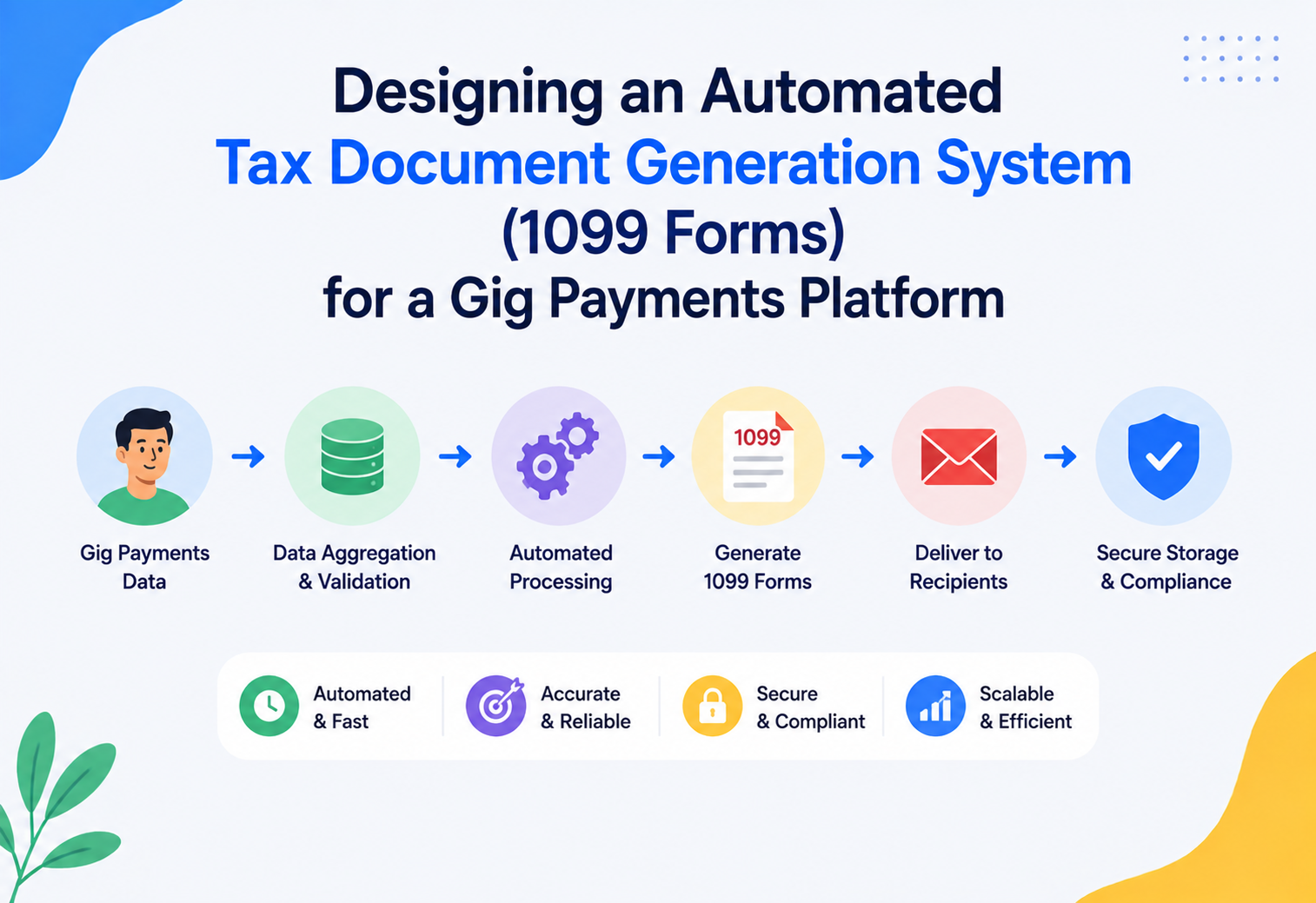
Designing an Automated Tax Document Generation System (1099 Forms) for a Gig Payments Platform
A production-grade system design walkthrough for engineers building compliant, scalable tax reporting infrastructure that must serve millions of independent contractors correctly, within a narrow, immovable January filing window.
Introduction & History
Every payments platform that pays independent contractors — ride-share drivers, delivery couriers, freelance marketplace sellers, creators receiving payouts — inherits a legal obligation that has nothing to do with product features and everything to do with government reporting.
In the United States, when a business pays a non-employee six hundred dollars or more in a calendar year, it generally must issue that worker a Form 1099 — commonly the 1099-NEC for non-employee compensation, or the 1099-K for third-party payment network transactions — and file a copy with the Internal Revenue Service. Miss the deadline, get a Taxpayer Identification Number wrong, or misclassify a payment, and the platform faces financial penalties, reputational damage, and angry contractors who cannot file their own personal taxes on time.
Historically, this was a manual accounting exercise. A company with a few dozen contractors could hand-generate paper forms in an afternoon. But gig and marketplace platforms changed the shape of the problem entirely. A platform paying five million contractors must generate, validate, and deliver five million individualized tax documents, each reflecting a person’s aggregated earnings across the year, each subject to strict formatting rules defined by the IRS, and all of it compressed into a narrow filing window that opens in early January and closes by January 31st for recipient copies, with IRS filing deadlines shortly after.
The system described in this article is not a reporting script — it is a distributed, stateful, highly regulated data pipeline that touches ledger systems, identity verification, document rendering, secure delivery, and direct government e-filing integration. It must be correct, because incorrect tax data creates legal liability for both the platform and the worker. It must be available under extreme seasonal load, because nearly the entire year’s volume of work happens in a four-to-six week window. And it must be auditable, because tax authorities and internal compliance teams need to reconstruct exactly how every number on every form was calculated, months or years later.
 You may likeDesigning a Photo-Sharing System That Serves Billions of Images in Under 100ms, Globally
A Short Timeline of Contractor Tax Reporting
Information reporting first codified
The IRS begins requiring payers to file information returns for certain payments, planting the seed for what will eventually become the modern 1099 family of forms.
1099 forms become standardized
Distinct 1099 variants emerge for different payment types — MISC, INT, DIV — each with specific box layouts and thresholds, all filed and mailed on paper by small numbers of business payers.
1099-K arrives for payment networks
A new form specifically covers third-party payment network transactions, aimed squarely at the marketplaces and payment platforms that had begun aggregating vast numbers of small transactions.
Gig economy explodes reporting volume
Ride-share, delivery, and freelance marketplaces each build up contractor bases in the millions, turning what had been a small-business paperwork task into a distributed-systems problem.
1099-NEC re-emerges as a separate form
Non-employee compensation is broken out from the general 1099-MISC into a dedicated 1099-NEC, adding a new form variant that every payer must simultaneously support alongside the existing ones.
IRIS replaces FIRE for e-filing
The IRS begins transitioning bulk information-return filing from the legacy FIRE system’s proprietary fixed-width format to the new IRIS platform’s XML-based schema, forcing platforms to maintain filing integrations against both simultaneously during the transition.
Imagine a giant, government-audited payroll department that only wakes up once a year, has to serve millions of “employees” it has never met in person, and has to get every single number right on the first try — because unlike a typical software bug, a tax-filing bug can cost a real person money, time, and stress during their own personal tax season. That is the system this article designs.
“Why can’t this just be a nightly batch job that queries the payments database and prints PDFs?” Be ready to explain that the complexity comes from three places: correctness under law (aggregation rules, withholding, corrections), scale under a hard seasonal deadline (not steady-state traffic), and multi-party trust (the worker, the platform, and the IRS all need to see consistent numbers, forever).
1.1 Why This Problem Is Fundamentally Distributed, Not Just Big
It is tempting to look at “generate five million PDFs in January” and reach for a bigger server. That framing misses the real difficulty. The forms depend on ledger data that lives in a separate system, on identity data verified against an external IRS service, on delivery consent that lives in a customer-preferences store, and on filing acknowledgments that arrive asynchronously from government back-ends over hours or days. Every one of those dependencies has its own availability profile, its own rate limits, and its own failure modes. Wiring them together into a system that reliably produces correct, legally binding documents at scale is a distributed-systems problem first, and a rendering problem a distant second.
Problem Statement & Requirements
We are designing the tax document generation subsystem for a payments platform that pays out to tens of millions of independent contractors annually, with a subset — typically 15 to 30 percent of the contractor base — crossing the reporting threshold and requiring a 1099 form each year.
2.1 Functional Requirements
Roll up earnings by box
Sum each contractor’s payments across the calendar year into the correct box on the correct form type (1099-NEC, 1099-K, 1099-MISC as applicable), broken out per IRS category.
Match TINs against IRS records
Validate and match each contractor’s Taxpayer Identification Number — SSN or EIN — against IRS records before filing, catching mismatches early enough to be resolved.
Apply backup withholding
When TIN validation fails or the number is missing, automatically enforce backup withholding on future payments and record the obligation in the ledger.
Produce IRS-compliant documents
Generate a legally compliant, human-readable PDF per contractor, matching IRS layout specifications exactly, alongside a machine-readable copy for filing.
Deliver electronically or by mail
Deliver the document electronically to contractors with valid e-consent, or trigger a physical mail fallback for the rest, tracking delivery outcome in either case.
File with the IRS and states
Electronically file aggregate data with the IRS via the FIRE or IRIS system, and with relevant state tax authorities under Combined Federal/State Filing.
Support corrections
Support corrections and amendments after original filing, including re-issuance to the contractor and re-filing with the IRS using the correction indicator.
Contractor portal
Give contractors self-serve access to download documents, view filing status, and update tax information through a W-9 equivalent, without contacting support.
Full audit trail
Maintain a complete audit trail: what number appeared on what document, generated from what source data, at what time, by what process version.
2.2 Non-Functional Requirements
Tens of millions of contractor-years
Multi-million-document generation runs must complete in days, not weeks, without ballooning cloud spend outside the seasonal window.
Extreme seasonal spike
The overwhelming majority of processing happens between early January and January 31st — an extremely predictable but extremely narrow seasonal spike that shapes every capacity decision.
Penny-accurate totals
Financial totals must be penny-accurate and reconcilable against the ledger of record at any point in the future, not just at the moment of generation.
IRS Pub. 1220 & 1075
Must satisfy IRS Publication 1220 (electronic filing specifications), Publication 1075 (safeguarding federal tax information), and relevant state equivalents.
Portal stays up during the crunch
The contractor-facing portal and document retrieval path must stay available through the filing-deadline crunch, when support-ticket volume and traffic both spike.
PII protected end to end
TINs, SSNs, and addresses are highly sensitive PII and must be encrypted at rest and in transit, access-controlled, and tokenized wherever possible.
Safe to re-run
Re-running generation for a contractor must never produce duplicate filings or inconsistent totals, no matter how many times a workflow retries.
Think of this system like a giant, government-audited payroll department that only wakes up once a year, has to serve millions of “employees” it has never met in person, and has to get every single number right the first time — because unlike a typical software bug, a tax filing bug can cost a real person money, time, and stress during their own personal tax season.
High-Level Architecture
At a high level, the system is organized as a pipeline with five broad stages: data aggregation, identity and eligibility resolution, document generation, distribution, and government filing — all wrapped in a compliance and audit layer that observes every stage.
Figure 1 — End-to-end architecture from ledger data to IRS filing and contractor delivery. Purple dashed lines show the compliance and audit layer observing every stage.
Every box in this diagram is a distinct, independently scalable service, not a monolithic script. The reason for this separation is that each stage has different scaling characteristics, different failure modes, and different compliance boundaries. The Earnings Aggregation Service, for instance, is read-heavy and can be horizontally scaled trivially. The IRS E-File Gateway, by contrast, must respect strict rate limits and file-size constraints imposed by the IRS itself, and therefore behaves more like a controlled batch exporter than an elastic service.
“Why split TIN validation and backup withholding into separate services from form generation?” The answer: TIN matching is a call to an external system (the IRS’s own TIN Matching Program) with its own latency, rate limits, and failure semantics. Coupling it tightly to form generation would mean a slow or unavailable IRS dependency stalls the entire pipeline. Decoupling lets you queue, retry, and batch TIN checks independently.
3.1 The Pipeline as a Set of Loosely Coupled Stages
Reading the diagram top to bottom, each arrow is intentionally an asynchronous queue rather than a synchronous call. This is what lets the pipeline absorb the January spike without every stage having to scale identically. The aggregation service can be running quietly through Q4 while TIN matching is chewing through a bulk file with the IRS, while rendering workers are dormant — then all three ramp up on their own schedules as their queues fill. If any single stage slows down, its inbox simply grows; nothing upstream fails, and nothing downstream sees corrupt data.

Core Components
Each service in the pipeline earns its keep by owning exactly one concern of the overall problem. Here is what each one does and why it exists as its own component.
Earnings Aggregation Service
Reads from the platform’s immutable ledger — the append-only, double-entry record of every payment made to every contractor — and rolls up transactions into annual totals, broken down by the IRS box categories relevant to each form type (nonemployee compensation, third-party network transactions, federal income tax withheld, and so on). Because the ledger is the single source of truth, this service never writes financial data; it only reads and aggregates, which keeps it safely re-runnable.
Eligibility & Threshold Engine
Not every contractor needs a 1099. This engine applies IRS threshold rules (the $600 threshold for 1099-NEC, and evolving thresholds for 1099-K driven by recent legislative changes) combined with platform-specific business rules — such as whether a contractor operates under a business entity exempt from certain reporting, or whether payments were routed through a different legal entity within the platform’s corporate structure.
TIN Validation Service
Before filing, every contractor’s name-and-TIN combination is checked against IRS records using the TIN Matching Program (an interactive or bulk service offered by the IRS to payers). A mismatch does not block filing outright, but it triggers backup withholding obligations and a “B-Notice” workflow requiring the platform to request corrected information from the contractor.
Form Generation Engine
The rules engine that maps aggregated, validated financial data into the exact field layout of a given IRS form. It must support multiple form types and multiple tax years simultaneously, since form layouts change year to year and a platform may need to generate corrected prior-year forms alongside current-year ones.
Document Rendering Service
Converts the structured form data into IRS-compliant printable output (PDF/A format is common for archival), applying the precise layout, scannable formatting for the machine-readable copies filed with the IRS, and the accessibility requirements for the contractor-facing copy.
Secure Document Store
An encrypted, access-controlled object store holding every generated document, versioned so that corrections do not overwrite history, with strict retention policies (the IRS generally expects records retained for several years, and many platforms retain longer).
Delivery Services
Handles electronic delivery (with legally required e-consent capture), contractor portal access, and a physical mail fallback for contractors who have not consented to electronic-only delivery — a legal requirement in the U.S. under IRS e-delivery consent rules.
IRS & State Filing Gateways
Batches validated forms into the file formats required for electronic submission — historically the IRS FIRE system’s proprietary fixed-width format, increasingly the newer IRIS platform’s XML-based schema — and manages submission, acknowledgment polling, and rejection handling.
Compliance & Audit Layer
A cross-cutting service (often implemented as an event-sourced log) that records every state transition, every value computed, and every external call made throughout the pipeline, so any single number on any single form can be explained and reproduced on demand — critical during an IRS audit or a contractor dispute.
Large payment processors that issue 1099-Ks — such as PayPal, Stripe, and Block — operate this exact class of pipeline at enormous scale, and each has publicly discussed the operational challenge of the January filing crunch, where document generation, TIN validation queues, and support volume all peak simultaneously.
4.10 Why Some Components That Look Optional Are Not
Newcomers to this problem often ask whether the Compliance and Audit Layer or the Correction and Amendment Service could be omitted for a first version. The answer is a firm no, for a specific reason: both exist to answer questions asked after the fact, sometimes years later, by parties with legal authority. An IRS auditor calling in year three about a form issued in year one is not interested in the fact that the audit trail was “planned for a later phase.” These components must be present from day one, even if their user-facing surface area is small, because reconstructing a missing audit trail after the fact is essentially impossible.
Internal Working: The Form Generation Engine
The form generation engine deserves a closer look because it is where business logic, tax law, and software architecture intersect most tightly. Internally, it is best modeled as a rules-driven, versioned transformation function: given a contractor’s aggregated earnings record, a tax year, and a form type, produce a structured form object.
5.1 Two Design Decisions That Do Most of the Work
Two design decisions matter enormously here. First, the engine must be declarative and version-controlled rather than hard-coded — tax rules change every year (box numbers get added or renamed, thresholds shift, new form variants appear), so the mapping from “aggregated earnings” to “form fields” should live in versioned configuration or a rules table, not scattered across imperative code. Second, the engine must be pure and deterministic: given the same input aggregation and the same rule version, it must always produce the exact same output. This determinism is what makes corrections and audits tractable — you can always regenerate a form from history and get byte-for-byte the same result unless the underlying data actually changed.
5.2 Stateless Workers on a Queue
Internally, the engine typically runs as a stateless worker fleet consuming from a queue of “ready to generate” contractor-year records. Each worker fetches the relevant rule version for the tax year, applies the mapping, performs internal validation (do the numbers balance against IRS cross-check rules — for example, does withheld tax not exceed gross compensation), and emits a structured form object to the next stage. Stateless, horizontally scalable workers are what let this stage absorb the January burst by simply adding more compute.
def generate_form(
    aggregation: EarningsAggregation,
    tax_year: int,
    form_type: FormType,
    rules_version: str,
) -> StructuredForm:
    rules = load_rules(form_type, tax_year, rules_version)

    fields = {}
    for box in rules.boxes:
        fields[box.code] = box.compute(aggregation)

    _internal_cross_check(fields, rules)
    return StructuredForm(
        contractor_id=aggregation.contractor_id,
        tax_year=tax_year,
        form_type=form_type,
        rules_version=rules_version,
        fields=fields,
    )
Notice how the function’s output depends only on its arguments. There are no clock reads, no lookups against “current” configuration, and no random identifiers. Two independent workers processing the same contractor-year with the same rules version will produce identical outputs, byte for byte, which is the property that makes idempotent retries and after-the-fact regeneration safe.
“How would you guarantee that regenerating a 2024 form in 2026 produces the same output?” The expected answer involves versioning: pin the rules-engine version and the input data snapshot (not a live query) used for original generation, store both, and always regenerate against that pinned combination rather than “current” logic and “current” data.
5.3 What Lives in the Rules Layer, and What Does Not
A useful discipline is to keep everything that changes by tax year or by jurisdiction inside the rules configuration, and everything that is core plumbing inside code. Box numbers, thresholds, cross-check formulas, and eligibility conditions belong in rules. Queue plumbing, worker orchestration, PDF library plumbing, and audit-event emission belong in code. When someone asks “what changed this tax year?” they should be able to answer it by diffing two rules-configuration versions, not by reading through service source code.
Data Flow & Lifecycle
Tracing a single contractor’s data through the system end to end clarifies how the pieces connect in practice.
Figure 2 — Lifecycle of a contractor’s earnings data from ledger to accepted IRS filing. Red arrows mark the failure/decline branches; green arrows mark the successful path.
6.1 Why the Cheap Decisions Come First
The two decision points early in the flow — threshold eligibility and TIN matching — are cheap to evaluate and are deliberately placed before the expensive rendering and filing stages. This ordering matters: it avoids doing unnecessary work for contractors who do not need a form at all, which in a platform with tens of millions of contractors can eliminate the majority of downstream volume. A dollar spent on early filtering is worth many dollars saved on PDF rendering, storage, and delivery for records that would eventually have been discarded anyway.
6.2 A Day in the Life of a Single Record
Consider a contractor who earned enough to receive a 1099-NEC. Their ledger entries have been accumulating throughout the year, aggregated nightly into a running per-contractor total. At year end, the eligibility engine sees that the total crossed the $600 threshold, so the record enters the TIN validation queue. The TIN matches, no backup withholding is needed, and the record enters the form-generation queue. A stateless worker picks it up, applies the current year’s rules to produce a structured form object, and passes it downstream. The rendering service produces a PDF and a machine-readable copy, both of which land in the secure document store. The contractor, who previously granted e-consent, receives a notification with an authenticated portal link. Meanwhile, the record joins a bulk filing batch, is submitted through the IRS gateway, and is acknowledged as accepted a few hours later. Every one of those transitions is written to the audit log, timestamped and correlated by contractor-year identifier.
Data Model & Storage
The data model separates three concerns that are tempting but dangerous to merge: the immutable financial source of truth, the derived aggregation, and the generated document.
| Entity | Purpose | Mutability | Typical Store |
|---|---|---|---|
| Ledger Entries | Raw, individual payment transactions | Append-only, immutable | Distributed ledger DB / event store |
| Contractor Tax Profile | Name, TIN (tokenized), address, entity type, e-consent status | Mutable, versioned | Relational DB with encryption |
| Annual Aggregation Record | Per-contractor, per-year, per-box totals | Recomputable, snapshot-versioned | Columnar / analytical store |
| Generated Form Object | Structured field values mapped to IRS layout | Immutable once filed; superseded by corrections | Document DB |
| Rendered Document | PDF / machine-readable file | Immutable, versioned | Encrypted object storage (e.g. S3-class) |
| Filing Submission Record | Batch sent to IRS/state, acknowledgment status | Append-only | Relational DB |
| Audit Event Log | Every state transition and computation | Append-only | Event-sourced log / immutable log store |
Because ledger entries are immutable and aggregation records are always recomputable from them, the system can treat aggregation as a cache: if a bug is found in the aggregation logic, the fix is to bump the rules version and recompute — never to hand-edit an aggregate.
Think of the ledger as the “raw video footage” and the aggregation record as the “highlight reel.” You never edit the highlight reel directly — you fix the editing process and re-cut it from the untouched footage. That way, you can always prove the highlight reel is a faithful summary of what actually happened.
7.1 Why the Contractor Tax Profile Is Versioned
The contractor tax profile deliberately keeps history, not just the current value. When a contractor moves and updates their address in July, the platform must still know which address was on file on the day of a payment or a filing, because both the contractor and the IRS could later dispute which address a document was sent to. Versioning the profile turns “what did we know when we filed?” into a straightforward point-in-time query, rather than an archaeological dig through service logs.
Document State Machine
Each generated tax document moves through a well-defined lifecycle. Modeling this explicitly as a state machine — rather than inferring status from scattered flags — makes the system’s behavior predictable and auditable, and it is a detail interviewers frequently probe.
Figure 3 — State machine governing a single contractor’s tax document lifecycle for a given tax year.
8.1 Why an Explicit State Machine Beats a Status String
An enforceable transition table prevents illegal jumps — say, from Pending straight to Filed — that would otherwise sneak in as buggy code paths get shipped over time. It also gives the audit log a natural hook point: every legitimate transition is an event, with a source state, a target state, a timestamp, and the actor (worker, service, human operator) that caused it. And it provides a clear place to hang retry and timeout logic per state: AwaitingTIN, for example, has different retry semantics than Filed, and encoding that per-state rather than sprinkling if statements around the codebase keeps behavior predictable.
“Why not just use a single ‘status’ string column and update it in place?” A proper state machine gives you an enforceable transition table (preventing illegal jumps like Pending straight to Filed), a natural hook point for the audit log (every transition is an event), and a clear place to implement retry and timeout logic per state.
TIN Matching & Backup Withholding
TIN validation is one of the trickiest integration points in the whole system because it depends on an external, rate-limited, and only intermittently real-time government service.
The IRS TIN Matching Program supports both interactive checks (good for onboarding, low volume) and bulk file submission (necessary for millions of contractors at once). A production system typically runs bulk TIN matching well before the filing deadline — often starting in Q4 of the tax year — so that mismatches can be resolved through contractor outreach before generation even begins.
When a mismatch occurs, the platform is legally required to send the contractor a “B-Notice” requesting a corrected W-9, and — if unresolved — to apply backup withholding (a flat percentage withheld from future payments and reported to the IRS) starting from the point of notification. This means the TIN Validation Service must not only check names against numbers, but also track notice history per contractor, because the required response differs depending on whether this is a first or second B-Notice within a set period.

9.1 The Interactive vs. Bulk Trade-off
Low-volume, real-time checks
Used at onboarding, when a new contractor submits their W-9. Result comes back within seconds, which lets the platform ask the contractor to fix a typo before they even leave the signup flow.
Large batch files ahead of season
Used across the entire contractor base, typically starting in Q4. Results arrive asynchronously, sometimes over hours. This is the mode that actually scales to millions of records, and its outputs drive the pre-January B-Notice outreach campaign.
Rate limits and quotas
The IRS imposes strict submission limits and requires enrolled participants. The TIN Validation Service must respect these limits, queue overflow, and treat “temporarily unavailable” as a normal, expected condition rather than an error.
Notice-history tracking
A first B-Notice and a second B-Notice within a defined period trigger different downstream obligations. The service therefore stores not just current match status but the full historical timeline per contractor.
Ride-share and delivery platforms that onboard large volumes of new contractors continuously (not just once a year) typically run TIN matching as part of the onboarding flow itself, catching mismatches early rather than discovering them for the first time during the January crunch.
9.2 What Backup Withholding Actually Means for the Ledger
Backup withholding is not an abstract flag on a profile. When it applies, every future payment to that contractor must be reduced by the withholding percentage, and the withheld amount must be recorded as a distinct ledger entry payable to the IRS. This means the payments and ledger systems have to consult the TIN validation state before every payout, not once per year, and it means the withheld amounts flow into their own aggregation stream that ultimately shows up on a distinct box on the 1099 as “federal income tax withheld.” The TIN Validation Service is therefore not a peripheral compliance component; its output directly changes numbers on real payments and on the final form.
Threshold Aggregation & Edge Cases
Aggregation sounds simple — sum a contractor’s payments for the year — but production systems must handle several edge cases correctly.
Multi-entity contractors
A single individual may receive payments from multiple legal entities under the same parent platform — for example, separate subsidiaries in different countries or product lines — each potentially requiring separate reporting under a distinct payer TIN.
Mid-year TIN changes
A contractor who converts from a sole proprietorship to an LLC mid-year may need earnings split across two TINs, each with its own form, matching what the IRS actually saw on the payer’s books during each portion of the year.
Refunds and chargebacks
Payments reversed after being paid out must reduce reportable income, but only if the reversal happened within the reporting rules’ timing window — timing that varies subtly between form types.
Currency and cross-border payments
International contractors are generally out of scope for U.S. 1099 reporting but may trigger different local reporting obligations, requiring the eligibility engine to be jurisdiction-aware rather than assuming everyone is a U.S. taxpayer.
Duplicate identity resolution
The same human may hold multiple contractor accounts (for example, separate profiles for driving and delivery services), and depending on legal entity structure, these may need to be aggregated together or kept separate.
Because these rules shift year to year and jurisdiction to jurisdiction, the aggregation logic is best expressed as a configurable rules layer sitting on top of the raw summation, reviewed by the compliance and legal team each tax season before the pipeline is unlocked for the year.
10.1 Reversal Timing, Explained
Refund and chargeback timing is subtle enough to deserve its own note. A reversal that lands in December of the same tax year clearly reduces that year’s reportable amount. A reversal that lands in February of the following year, however, may still be treated as reducing the prior year’s reportable amount if the reversal is tied to a payment originally made in the prior year and the timing falls within a defined grace window. The aggregation service must model these windows explicitly, or it will silently overreport for whichever set of edge cases it did not consider — and overreporting is itself a compliance issue, not just an inconvenience for the contractor.
Assuming an aggregation bug that overreports is “safe” because it errs on the conservative side. In tax reporting, both overreporting and underreporting are problems — the former creates real work for the contractor and their accountant, and can trigger IRS notices that the platform then has to explain.
Scalability & Seasonal Load
This system has an unusual scaling profile compared to most consumer-facing systems: instead of smooth, gradually growing traffic, it experiences an enormous, predictable, calendar-driven spike. The vast majority of document generation, rendering, and filing work happens in a roughly four-week window in January.
Stateless compute for generation and rendering
Since these stages are pure functions of input data, they scale horizontally by simply adding worker instances during the seasonal window and scaling back down afterward — a textbook use case for autoscaling worker pools or serverless batch compute.
Do the hard work before the deadline
Aggregation and TIN matching can run incrementally throughout the year (updated nightly), so that by January 1st, most of the expensive cross-system work is already done, and the January window is mostly rendering, delivery, and filing — not fresh computation.
Backpressure through durable queues
Every stage communicates via durable queues rather than synchronous calls, so a slowdown in one stage (say, the IRS filing gateway hitting a government-imposed rate limit) does not cascade into failures upstream — it simply grows a queue that drains once the bottleneck clears.
Priority tiering by delivery channel
Contractors who elected electronic delivery can often be processed first (cheaper, faster distribution), while paper-mail contractors are batched separately with enough lead time for print-and-mail vendor turnaround before the legal deadline.
11.1 What the Seasonal Curve Actually Looks Like
The consequence of this curve is that a naive “provision for peak” approach would leave massive infrastructure sitting idle for eleven months a year. This is precisely why the elastic-compute and pre-computation strategies above are not optional refinements — they are what makes the economics of the system work.

“How would you load-test a system whose real load only happens once a year?” Good answers mention synthetic load generation using replayed or scaled historical data, running full-scale rehearsal drills months in advance, and treating the seasonal cutover itself as a rehearsed ‘game day’ event with defined rollback and escalation procedures.
High Availability & Reliability
Because the entire year’s obligation is compressed into weeks, downtime during the filing window is far costlier than equivalent downtime at other times of year. The reliability strategy layers several techniques.
Idempotent processing at every stage
Every stage keys its work by a stable identifier (contractor ID, tax year, form type, rules version) so that retries after a crash never produce duplicate documents or double filings.
Multi-AZ and multi-region
Core services and data stores are deployed across multiple availability zones at minimum, with disaster-recovery replicas in a separate region for the document store and audit log, given how legally sensitive that data is.
Circuit breakers around external dependencies
Calls to the IRS TIN Matching service or FIRE/IRIS filing gateway are wrapped in circuit breakers with exponential backoff, so an outage on the government side degrades gracefully into queued retries rather than cascading failures internally.
Portal degradation modes
Even if generation pipelines are backed up, the portal degrades to showing “your form is being prepared, expected by [date]” rather than erroring, since contractor anxiety and support volume spike sharply around the deadline.
Blue-green and canary for rules changes
Since a bug in the form generation rules can affect millions of legally binding documents, changes are rolled out to a small percentage of contractor-year records first, verified against expected totals, before wide release.
Running this system without redundancy would be like an accounting firm having exactly one accountant who is also the only person who knows where the filing cabinet key is — during the one month a year everyone needs them most.
12.1 The Failure Modes That Actually Matter
Not every failure is equally dangerous. A brief blip in the notification service delays a contractor’s “your 1099 is ready” email by a few minutes, which is embarrassing but not compliance-breaking. A silent corruption of the rules engine that reduces every 1099-NEC by ten dollars, however, produces millions of legally binding wrong documents. Reliability engineering here means directing the most paranoid safeguards at the failure modes that would cause the second kind of problem: canary rollouts of the rules engine, continuous cross-checking of aggregation against the ledger, and slow, deliberate expansion of any change that touches a numeric field on a form.
Security & Compliance
Tax data sits at the intersection of financial and personally identifiable information, which places this system under some of the strictest handling requirements in the entire platform.
At rest and in transit
TINs, SSNs, and addresses are encrypted at rest using strong, regularly rotated keys, and encrypted in transit end to end, including internal service-to-service traffic.
Reference tokens over raw values
Wherever a downstream service needs to reference a contractor’s TIN without needing the raw value (for example, a monitoring dashboard), a tokenized reference is used instead, with raw value access restricted to a small number of vetted services.
Access control & JIT elevation
Human access to raw TINs or SSNs is tightly scoped, logged, and typically requires just-in-time elevated access with an approval workflow, rather than standing permissions.
Pub. 1075, SOC 2, state laws
The system is designed to satisfy IRS Publication 1075 (safeguards for federal tax information), SOC 2 Type II controls, and applicable state-level data protection laws.
Data minimization downstream
Services downstream of TIN validation generally operate on masked or partial identifiers (last four digits, for example) unless full values are strictly required for a specific legal function like filing.
Authenticated delivery only
Electronic document delivery uses authenticated, session-based access — not emailed PDF attachments containing SSNs — and physical mail vendors are contractually bound to equivalent data-handling standards.
“Would you ever email a 1099 as a PDF attachment?” No — sending an SSN-bearing document as an email attachment is both a security anti-pattern and, without proper e-consent and authentication, a compliance violation. The correct pattern is authenticated portal access or download links behind identity verification.
13.1 Why Tokenization Is Doing So Much Work Here
Tokenization is worth calling out on its own because it is what lets the rest of the platform interact with a “contractor” without ever needing to see a raw SSN. Analytics dashboards, support tools, reconciliation jobs, and even most parts of the generation pipeline can operate on a stable, non-sensitive token. Only the small handful of services that actually have to embed the SSN into a form or a filing (the rendering service and the filing gateway, essentially) ever detokenize, and those calls are heavily audited. This dramatically shrinks the surface area over which a security incident could ever expose actual TINs.
Monitoring, Logging & Metrics
Observability in this system serves two audiences: engineers keeping the pipeline healthy, and compliance and legal teams needing proof of correctness.
14.1 Key Signals to Track
Pipeline throughput and backlog depth
Tracked at each stage (aggregation, TIN matching, generation, rendering, delivery, filing) — critical during the January crunch to predict whether the deadline will be met.
Ledger vs. aggregation drift
Automated jobs compare aggregation totals against the ledger of record continuously, alerting on any drift, however small.
Mismatch and B-Notice rates
Tracked over time, both as an operational signal and a compliance reporting requirement.
Acceptance vs. rejection rates
From the IRS and state gateways, with rejection reason codes surfaced for rapid remediation.
Delivery confirmation rates
Opened, downloaded, mailed, returned-undeliverable — used to identify contractors at risk of not receiving their form in time.
End-to-end trace completeness
Every document should have an unbroken chain of events from ledger entry to final filing status; monitoring flags any document with a gap in its audit trail.
14.2 Distributed Tracing for Support
Distributed tracing — correlating a single contractor-year record across every microservice it touches — is especially valuable here, since a support agent fielding a contractor’s “where is my 1099” question needs to answer it in seconds, not by manually querying six different systems. A single trace ID, propagated from the aggregation step through generation, rendering, delivery, and filing, is what turns a multi-day investigation into a two-click dashboard lookup.
A contractor calls asking why their 1099 shows a different amount than they expected. A support agent enters the contractor ID, sees the trace showing which ledger entries were included, which rules version was applied, and which corrections (if any) were filed — and can answer with confidence, on the call, without escalating to engineering.
Deployment & Cloud Infrastructure
Given the seasonal spike, deployment strategy leans heavily on elasticity and strict change control during the critical window.
Containerized microservices
Orchestrated on a managed Kubernetes-style platform, allowing generation and rendering worker pools to scale from a small baseline to a large fleet within minutes as January volume ramps up.
Bursty batch functions
Serverless batch functions are a strong fit for embarrassingly parallel stages like PDF rendering, since cost is incurred only during the actual burst rather than year-round idle capacity.
Infrastructure as code everywhere
For every environment, so the entire pipeline can be reliably rehearsed in a staging environment months before the real filing season, using anonymized or synthetic prior-year data.
Peak-season change freeze
Many teams running systems like this impose a strict code-freeze on the core generation and filing paths during the peak filing weeks, allowing only critical, reviewed hotfixes.
Zero-downtime portal cutovers
Blue-green deployment for any service that must be updated during the season, ensuring zero-downtime cutovers for the contractor-facing portal.
15.1 Rehearsal as a First-Class Activity
Because the pipeline only truly runs at full scale once a year, teams that operate this kind of system treat rehearsal as a scheduled, staffed exercise, not a happy accident. A well-run rehearsal replays anonymized prior-year data through the current pipeline at production scale in a staging environment, times each stage, catches performance regressions before they matter, and validates the operational runbook — who is on call, what the escalation path is, and who has the authority to invoke rollback procedures if something goes wrong on the real day.
APIs & Microservices
Service boundaries are drawn along both technical and regulatory lines. A useful rule of thumb: any component with a distinct legal or compliance responsibility (TIN validation, backup withholding, filing) gets its own service boundary, even if it could technically be inlined elsewhere, because compliance boundaries need to be independently auditable and independently deployable.
| API / Service | Responsibility | Consumers |
|---|---|---|
| Aggregation API | Expose per-contractor annual totals | Eligibility engine, contractor portal, support tools |
| TIN Validation API | Submit and check TIN match status | Form generation engine, onboarding flow |
| Form Generation API | Produce structured form objects from validated inputs | Rendering service, correction service |
| Document Retrieval API | Authenticated fetch of a contractor’s documents | Contractor portal, mobile app |
| Filing Status API | Expose IRS/state acceptance status per document | Compliance dashboard, support tools |
| Correction API | Trigger and track amended filings | Support tools, compliance team |
16.1 Sync vs. Async, and Why It Matters Here
Internally, services communicate primarily through asynchronous, event-driven messaging — a contractor-year record moving through queues as it changes state — while contractor- and support-facing surfaces are exposed through synchronous REST or GraphQL APIs backed by read replicas, keeping the write-heavy pipeline isolated from read-heavy user-facing traffic. This separation is what lets the portal stay snappy for contractors even while the generation queue is chewing through millions of records in the background.
Headers:
  Authorization: Bearer <contractor-session-token>

Response Body (form ready):
{
  "documents": [
    {
      "documentId":   "DOC-2025-000123",
      "formType":     "1099-NEC",
      "taxYear":      2025,
      "status":       "FILED",
      "filedAt":      "2026-01-24T14:03:22Z",
      "downloadUrl":  "https://portal.example.com/download/DOC-2025-000123",
      "correctedBy":  null
    }
  ]
}
“Why is the download URL scoped and signed rather than pointing to the raw document store?” Because the raw document contains an SSN, and the object store must never be directly reachable from the internet; the API mints a short-lived, contractor-scoped signed URL that both authenticates the request and audits every download.
Design Patterns & Anti-Patterns
A short catalogue of the patterns that hold this system together, and the anti-patterns it deliberately refuses to use.
17.1 Patterns Worth Applying
Immutable audit trail
Event sourcing for the audit layer — every state change is an immutable event, letting you reconstruct the exact history of any document.
Multi-step workflow with compensation
Saga pattern for the multi-step generate-render-file workflow, ensuring that a failure partway through (say, filing succeeds but delivery fails) triggers well-defined compensating actions rather than leaving the record in an ambiguous state.
Per-form, per-year rule sets
Strategy pattern for form-type-specific and tax-year-specific rule sets, so adding a new form variant does not require touching the core pipeline.
Idempotency keys everywhere
On every write operation, especially filing submissions, to guard against duplicate submission during retries.
Isolate seasonal from steady-state
Bulkheads isolating the seasonal-burst workloads (generation, rendering) from steady-state services (contractor portal, support tools) so a surge in one does not starve the other.
17.2 Anti-Patterns to Avoid
- Mutable aggregate tables updated in place: Losing the ability to explain how a number was derived is a compliance risk, not just a technical debt item.
- Synchronous, blocking calls to the IRS TIN Matching or filing APIs in the hot path of document generation: External, rate-limited government systems must always be decoupled via queues.
- Hard-coding tax-year-specific logic directly into service code rather than versioned configuration — guarantees a scramble every January when rules change.
- Treating corrections as “just regenerate and overwrite”: Corrections must be versioned, and both the original and corrected documents retained, since the contractor and the IRS both need to see the correction lineage.
“Why is the saga pattern a better fit here than a distributed transaction spanning generation, filing, and delivery?” Because two of those three steps involve external systems (IRS, mail vendor) that the platform does not control and cannot enroll in a distributed transaction; the saga’s explicit compensating steps make the failure story realistic instead of pretending everything can be rolled back atomically.
Corrections & Amendments
Errors are inevitable at this scale — a late-arriving ledger adjustment, a corrected TIN, a duplicate account merge discovered after filing. The correction workflow must be a first-class citizen of the design, not an afterthought bolted on later.
Figure 4 — Correction and amendment workflow, preserving lineage between original and corrected filings.
Two details matter enormously in this workflow. First, the corrected document must carry a “corrected” indicator recognized by the IRS filing format, not simply replace the original silently. Second, both the original and corrected documents remain permanently retrievable in the audit trail — an IRS auditor or a contractor’s own accountant may need to see exactly what changed and why.
“What happens if a correction is needed after the IRS has already accepted the original filing?” This requires filing a formal correction with the IRS (not just updating internal records), typically within a defined window, and re-delivering a corrected copy to the contractor — the system needs both these downstream actions modeled as durable, retryable steps.
18.1 Lineage Is a Feature, Not a Byproduct
It is worth being explicit that lineage between an original and a corrected document is a product feature, visible to both the contractor and the IRS. The contractor’s accountant needs to see “this 1099-NEC supersedes the one issued on January 20th” in order to file the individual return correctly. The IRS needs the same information to reconcile its own records. A system that overwrote the original with the corrected version, even if internally more convenient, would break both of these downstream workflows.
Delivery & Distribution
Distribution is subject to specific legal constraints that shape the architecture. U.S. tax law permits electronic-only delivery of 1099 forms only if the recipient has given affirmative, verifiable electronic consent; absent that consent, a physical mailed copy is legally required regardless of whether the contractor also has portal access.
Timestamped, auditable e-consent
The contractor tax profile stores a timestamped, auditable consent record, separate from general marketing-communication preferences, since tax e-delivery consent has its own legal standard.
Authenticated self-service portal
Authenticated self-service access lets contractors view, download, and re-download prior years’ documents, reducing support load and eliminating the need to email documents.
Print-and-mail vendor integration
For non-consenting contractors, documents are batched and transmitted securely to a print-and-mail fulfillment partner, with delivery and return-to-sender tracking fed back into the system.
Multi-channel notification
Email and in-app notifications alert contractors when a new document is available, distinct from the document itself, which is never sent as an attachment.
19.1 Handling Return-to-Sender Gracefully
A mailed 1099 that comes back “return to sender” is a specific, recoverable failure mode the system has to model. When the print-and-mail vendor reports a returned envelope, the delivery record transitions to a “delivery failed” state that triggers an outreach workflow: prompt the contractor to confirm their address through the portal, mark the profile for follow-up, and re-mail once a corrected address is confirmed. Left unhandled, undeliverable mail turns into both a compliance record-keeping problem and an unhappy contractor who cannot file their own return.
Treating the e-consent flag as a general marketing opt-in. The two are legally distinct, and using a broad “email me stuff” toggle to justify skipping the paper 1099 is exactly the kind of shortcut that leads to compliance findings later.
Best Practices & Common Mistakes
The good news is that the discipline required here is small and well-defined; the bad news is that missing any single item on this list tends to fail loudly and expensively, in front of both real contractors and government auditors.
Best Practices
- Run TIN matching continuously throughout the year, not just in January, to minimize B-Notice backlog during the crunch.
- Treat every stage of the pipeline as independently re-runnable and idempotent, keyed by stable identifiers.
- Version tax rules explicitly per tax year, and never let “current” logic silently apply to prior-year regeneration.
- Reconcile aggregation totals against the ledger continuously, not just at generation time, to catch drift early.
- Rehearse the full pipeline end to end months before the real season using realistic synthetic volume.
- Build the correction workflow with the same rigor as the original generation workflow — it will be used, every year, at meaningful volume.
Common Mistakes
- Coupling document generation tightly to the IRS filing API’s synchronous availability, causing the entire pipeline to stall during a government-side outage.
- Storing raw TINs and SSNs in logs or non-tokenized analytics systems, creating unnecessary compliance exposure.
- Treating “regenerate the document” as equivalent to “the correction is complete,” without also handling re-filing and re-delivery.
- Underestimating print-and-mail vendor lead time, causing physical copies to arrive after the legal deadline.
- Failing to load-test for the true seasonal peak, only for steady-state average load.
20.1 A Pre-Season Readiness Checklist
Before the pipeline is unlocked for a given tax year, a well-run team confirms that the rules configuration for the new year has been reviewed and signed off by compliance and legal; that a full end-to-end rehearsal has run at production scale against anonymized prior-year data; that TIN validation queues have been drained and B-Notices delivered ahead of the season; that the print-and-mail vendor’s capacity has been contractually reserved with enough lead time for the deadline; and that the runbook, escalation contacts, and rollback procedures for the season have been reviewed by everyone on call.
Real-World Industry Examples
Large-scale payment platforms and gig marketplaces all operate systems conceptually similar to the one described here. Looking across the industry helps confirm which parts of the design are widely settled practice and which are still evolving.
Ride-share and delivery platforms
Companies such as Uber, DoorDash, and Instacart, for driver and courier payouts, operate at contractor bases in the millions and have publicly discussed the operational challenge of the January filing window — investing heavily in TIN-matching automation ahead of season and in self-serve portals to reduce support volume during the crunch.
Third-party settlement organizations
Payment processors like PayPal, Stripe, and Block issue enormous volumes of 1099-K forms and have navigated shifting regulatory thresholds in recent years, illustrating exactly why the eligibility engine must be reconfigurable rather than baked-in.
Dedicated compliance engineering
Common threads across the industry include dedicated compliance engineering teams that own the rules layer, increasing adoption of the IRS’s newer IRIS e-filing platform as it replaces the older FIRE system, and heavy investment in automated reconciliation that runs year-round rather than only in season.
Payroll and HR platforms (W-2)
Companies like Gusto and ADP serve a different worker classification (W-2 employees rather than 1099 contractors), but they face a structurally identical seasonal scaling and correctness problem, and many of the same architectural patterns — event-sourced audit trails, versioned rules engines, and strict change-freeze windows — appear across both employee and contractor tax reporting systems.
Payment platforms handling 1099-K reporting have publicly navigated a shifting regulatory threshold in recent years as U.S. lawmakers adjusted the reporting minimum for third-party payment networks — a good illustration of why the eligibility engine must be built as reconfigurable business logic rather than a fixed constant baked into code.
21.1 What Everyone Is Converging On
Across all of these examples, a few practices are becoming near-universal: TIN matching is treated as a year-round background activity rather than a January scramble, contractor self-serve portals are prioritized specifically to reduce support pressure during the season, and rules layers are pulled out of application code and into versioned configuration owned jointly by engineering and compliance. The organizations that get this right treat the tax pipeline as a first-class product with its own team, its own on-call rotation, and its own multi-year roadmap, not as an annual project that engineering leadership rediscovers every December.
FAQ & Key Takeaways
The questions candidates and new engineers on this system hear most often, followed by a compact recap of the ideas worth carrying forward.
22.1 Frequently Asked Questions
Why is this system architected around a narrow seasonal peak rather than steady-state load?
Because tax law imposes a hard calendar deadline (January 31st for recipient copies, with IRS filing deadlines shortly after), nearly all of the year’s document volume must be generated, rendered, and delivered within a few weeks, requiring elastic compute that can scale up sharply and back down afterward.
What is the difference between 1099-NEC and 1099-K, and why does it matter architecturally?
1099-NEC reports nonemployee compensation paid directly by a business, while 1099-K reports payments settled through third-party payment networks. A platform may need to issue either or both depending on how it structures payments, so the form generation engine must support multiple form types with different eligibility thresholds and box mappings simultaneously.
How does the system ensure a number on a filed form can always be explained later?
Through an event-sourced audit layer that records every computation and state transition, combined with versioned rules and immutable, snapshot-based aggregation, so any historical document can be traced back to its exact source data and rule version.
What happens when a contractor’s TIN does not match IRS records?
The platform sends a B-Notice requesting corrected information and, if unresolved, applies backup withholding on future payments, with both actions tracked per-contractor to determine whether subsequent mismatches trigger escalated notice requirements.
Can the same architecture serve W-2 employee tax reporting?
Structurally, yes — the seasonal-peak, versioned-rules, event-sourced-audit shape is essentially identical. The specific rule sets, thresholds, form layouts, and filing endpoints differ, which is exactly why keeping those in a configurable rules layer is such a productive investment.
What is the single most important property of the form generation engine?
Determinism. Given the same input aggregation and the same rules version, it must always produce byte-for-byte identical output. Without that property, corrections, audits, and even routine debugging become guessing games.
22.2 Key Takeaways
The five ideas worth remembering
- This is fundamentally a compliance-driven data pipeline, not a generic document-generation service — correctness and auditability outrank almost every other concern.
- The extreme seasonal load pattern demands elastic, stateless, horizontally scalable compute for generation and rendering, paired with incremental, year-round pre-computation for aggregation and TIN matching.
- Decoupling every stage through durable queues protects the pipeline from slow or rate-limited external dependencies, especially IRS systems.
- Explicit state machines and event-sourced audit trails turn a legally sensitive process into something provably correct and explainable, years after the fact.
- Corrections and amendments are not edge cases — they are a routine, expected part of the workflow and deserve equally rigorous engineering.
For anyone approaching this as a system design interview question, the strongest signal is recognizing that the shape of the problem — hard legal deadlines, external government dependencies, high-sensitivity PII, and permanent auditability — is what forces the specific architectural choices, rather than the choices being interesting in the abstract.
Correctness under compliance is ultimately not about heroic engineering during the season. It is about identifying, well in advance, exactly where the load-bearing guarantees need to live — in versioned rules, in idempotent stages, in immutable ledgers, in explicit state machines — and building everything else around those foundations. Once you see this pattern clearly here, you will start recognizing it in every other system that has to satisfy an external authority years after the fact: payroll, healthcare claims, regulated trading, and beyond.