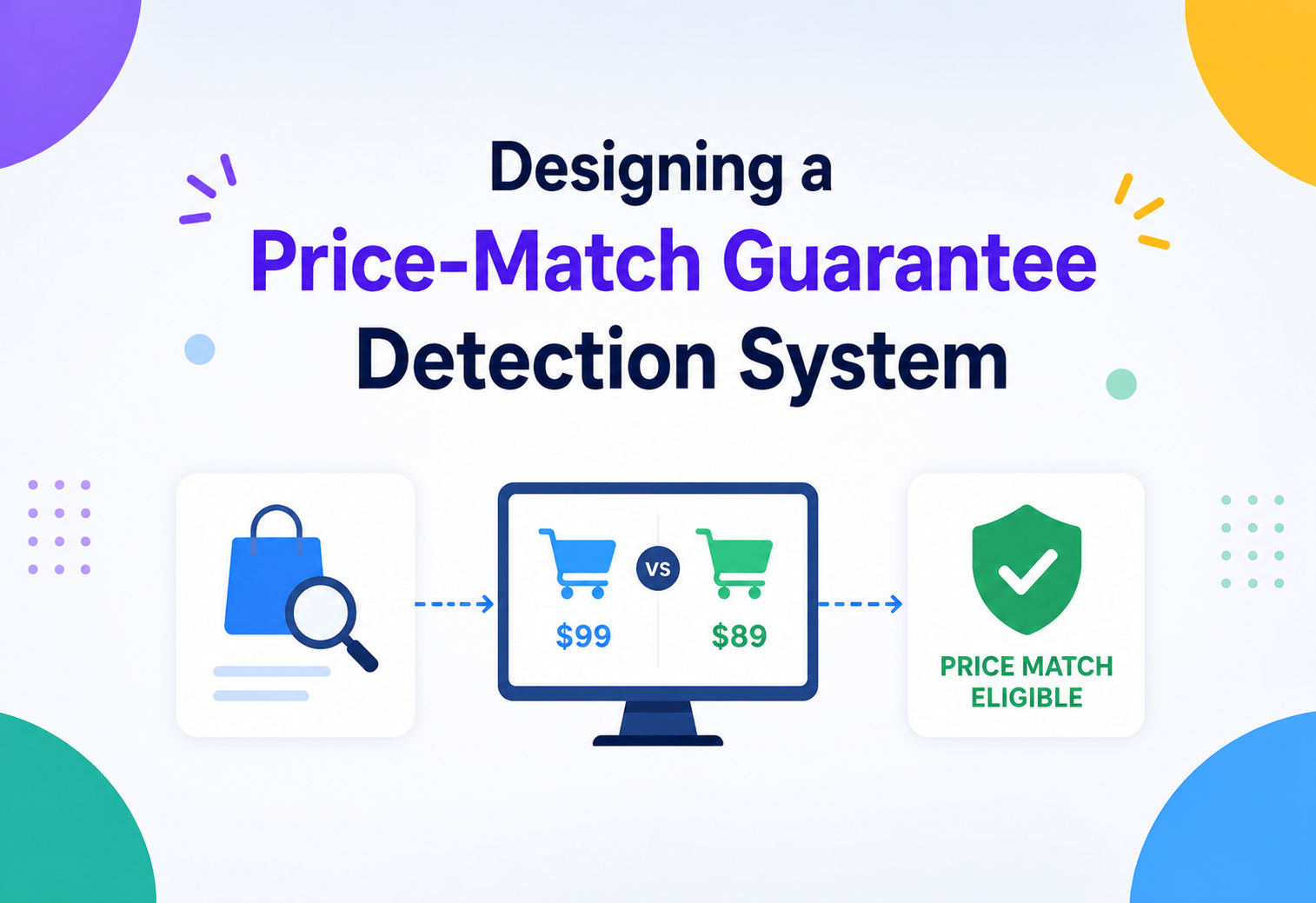
Designing a Price-Match Guarantee Detection System
How to build a system that watches competitor prices around the clock, matches products correctly, and automatically triggers a price match — at the scale of millions of SKUs and thousands of competitor sites.
Introduction & History
From printed flyers at a store counter to automated pipelines that watch millions of prices a day.
Imagine you buy a blender from an online store for $80. Three days later, you notice the exact same blender selling for $65 on a different website. Annoying, right? A “price-match guarantee” is a promise retailers make to their customers: “If you find the same product cheaper somewhere else, we’ll match that price — or even beat it — automatically or on request.” It is a trust-building feature. It tells the customer, “You don’t need to shop around. We already made sure you’re getting the best deal.”
Price matching is not a new idea. Brick-and-mortar retailers like electronics and home-improvement stores have offered manual price matching for decades — a customer would walk in with a printed flyer or a competitor’s ad, and a cashier would honor the lower price after a manual check. That process was slow, relied on human judgment, and only worked because a human employee compared two physical pieces of paper.
Online marketplaces changed the scale of this problem entirely. A large e-commerce platform can have tens of millions of products, sold by thousands of competing sellers and websites, with prices that can change dozens of times a day (a practice called dynamic pricing). Doing this manually is now completely impossible. This is why marketplaces began building automated price-match guarantee systems — software that continuously watches competitor prices, decides whether two products from two different stores are really “the same,” compares prices, and automatically triggers a refund, discount, or price adjustment when a lower price is found.
This tutorial walks through, from the ground up, how such a system is designed: how it discovers competitor prices, how it decides two listings are the same product (this is surprisingly the hardest part), how it stores and compares billions of price points a day, and how it stays reliable, fast, and fair even under massive scale.
1.1 A Short Timeline
In-store, paper-based matching. Big-box retailers accepted competitor flyers at the register. Every match required a human on both sides — the cashier verifying the ad and the customer producing it. Coverage was inherently narrow, limited by whatever a shopper physically remembered to bring.
Early e-commerce claim forms. Online stores began accepting price-match claims through web forms — still manually reviewed, but at least submitted digitally. Response times were measured in hours or days, and turned into a customer-service bottleneck.
Rise of price-intelligence vendors and dynamic pricing. Third-party services began selling continuous competitor-price data feeds. Retailers used them for their own repricing strategies first, and then bolted price-match guarantees on top of the same infrastructure. Entity-resolution across catalogs emerged as the hard, unsolved core.
ML-driven matching and automated refunds. Large marketplaces adopted embedding-based product matching, GPU-accelerated similarity search, and event-driven pipelines that can trigger a refund end-to-end within minutes of a competitor dropping a price — with no human in the loop for the confident cases.
“Why is price matching considered a hard system design problem, and not just a database lookup?” A strong answer touches on three separate hard problems bundled into one: (1) large-scale, continuous web data collection, (2) product identity matching across different catalogs (entity resolution), and (3) real-time decision-making with business-rule complexity, all under strict cost and legal constraints.
Problem & Motivation
Let’s break down why this is genuinely difficult, one layer at a time.
2.1 The Data Collection Problem
To know a competitor’s price, you first need to see it. Competitors do not usually hand you a clean feed of their prices. You either (a) have a data-sharing partnership, (b) subscribe to a third-party price-intelligence data provider, or (c) collect the data yourself through web scraping or APIs. Each competitor site has its own HTML structure, its own bot-detection defenses, its own rate limits, and its own habit of changing its page layout without warning. Multiply this by thousands of competitor domains and millions of product pages, and you have an enormous, constantly-shifting data pipeline problem.
2.2 The “Is This the Same Product?” Problem
This is the single hardest part of the whole system, and it’s worth pausing on. Suppose your marketplace sells “Sony WH-1000XM5 Wireless Noise-Canceling Headphones, Black.” A competitor’s site lists “Sony WH1000XM5 Headphones – Black (Renewed).” Are these the same product? The renewed (refurbished) unit is not the same as a new one, and matching them would mean giving customers a discount they should not get. Now imagine doing this comparison across millions of listings with typos, different bundle sizes (“2-pack” vs “1-pack”), regional variants, and marketing filler text. This is a classic entity resolution (also called record linkage or deduplication) problem, and it needs a mix of structured identifiers (like UPC/GTIN barcodes), machine learning text similarity, and image similarity to solve reliably.
2.3 The Business-Rules Problem
Even after you know Product A equals Product B, and Store X sells it cheaper, you still need to apply business logic: Does the price-match guarantee exclude marketplace/third-party sellers? Does it exclude flash sales or clearance items? Is there a minimum price difference threshold (e.g., match only if the difference is more than $1, to avoid matching on rounding noise)? Does the customer need to submit a claim, or is it automatic? These rules change often and must be configurable without a code deployment.
2.4 The Scale and Freshness Problem
Prices change constantly. A system that checks competitor prices once a week is nearly useless for high-velocity categories like electronics. But re-crawling every competitor page every minute for millions of SKUs is prohibitively expensive and will get your IP addresses blocked. The system has to be smart about which products to check more frequently (high-traffic, price-volatile products) versus less frequently (long-tail, stable-price products).
Think of this system like a group of secret shoppers hired by a supermarket. They can’t visit every competing store every hour — that would be too expensive. Instead, the store manager sends shoppers more often to check on the products that sell the most and whose prices tend to swing (milk, gas, seasonal toys), and less often for items that rarely change price (canned beans). When a shopper reports back a lower price somewhere else, the manager has to double check: “Is it really the same product, same size, same brand?” before authorizing a price cut.
2.5 Why This Cannot Just Be a SQL Join
A tempting first instinct is to imagine that if two retailers just published price feeds into a shared table, mutual matching would collapse into a straightforward join on a product identifier. This intuition fails on almost every axis at real scale. Competitor prices are not offered as clean feeds — they must be inferred from HTML pages that change layout without warning. Even when identifiers are available, they are frequently missing, wrong, or reused for different regional variants of the same product name. And even when identifiers agree, the comparison itself has to respect business rules, currency conversion, tax treatment, freshness windows, and per-domain politeness policies that a plain relational join has no vocabulary for. Recognizing that this is a distributed data-collection, entity-resolution, and rule-evaluation problem — not a lookup — is exactly the shift in framing the rest of this tutorial depends on.
Core Concepts
Before we look at the architecture, let’s define the vocabulary we’ll use throughout this tutorial.
| Term | Meaning (Plain English) |
|---|---|
| SKU (Stock Keeping Unit) | A unique internal code your marketplace uses to identify one exact sellable item (e.g., “Blue, Size M, 3-pack”). |
| GTIN / UPC / EAN | Global barcode-style identifiers that many manufacturers assign, useful as a strong “same product” signal across different stores. |
| Entity Resolution | The process of deciding that two different records (from two different sources) refer to the same real-world thing. |
| Price Crawler / Scraper | A program that automatically visits competitor web pages and extracts the price, availability, and product details. |
| Canonical Product Graph | An internal database that groups equivalent listings from different sellers/sites under one “canonical” (master) product. |
| Price Match Rule Engine | A configurable component that decides, given two matched prices, whether a match should trigger and what the resulting discount should be. |
| Change Data Capture (CDC) | A technique to stream every insert/update/delete from a database as an event, instead of polling for changes. |
| Rate Limiting / Politeness Policy | Rules that stop your crawler from hitting a competitor’s site too aggressively (both to be respectful and to avoid getting blocked). |
“How would you decide two product listings are the ‘same’ product when there’s no shared barcode?” Expect this question in almost every price-matching interview. The strong answer layers signals: exact identifier match (GTIN/UPC) first, then fuzzy text similarity on title + brand + attributes (using embeddings), then image similarity as a tiebreaker, and finally a human review queue for low-confidence matches, with feedback loops retraining the model over time.
3.1 A Closer Look: Why Entity Resolution Is Its Own Discipline
It’s worth slowing down here because this single concept quietly determines whether the entire feature is trustworthy or embarrassing. Think about how a ten-year-old would compare two toys in two different store catalogs. They’d look at the picture first (“does it look the same?”), then read the name (“does it say the same thing?”), and finally check the box for a serial number if there is one. That is, in essence, exactly the three-signal approach production entity-resolution systems use, just automated and made mathematically precise:
- Structured identifiers (strongest signal): A GTIN/UPC/EAN barcode, when present and correctly captured, is close to a guarantee that two listings are the same manufactured item. The catch is that a large fraction of listings, especially from smaller sellers, either omit this field or enter it incorrectly, so it can never be the only signal the system relies on.
- Textual similarity (medium-confidence signal): Product titles, brand names, and attribute fields (color, size, model number) are converted into numeric vector embeddings using a language model, and compared using cosine similarity. Two titles that use different wording for the same product (“Sony 65-inch 4K Smart TV” vs “Sony BRAVIA 65in Television, Smart, 4K”) will land close together in this embedding space even though they share almost no exact words.
- Image similarity (supporting signal, good tiebreaker): Product photos are embedded using a vision model and compared the same way. This catches cases where the text is ambiguous or sparse but the product photo is nearly identical, and also helps rule out false matches — for example, catching that a “renewed” or “refurbished” badge visible in one image but not the other likely means these are different SKUs even if the titles are very close.
None of these signals is perfect alone, which is exactly why the system combines them into a single confidence score, and why anything below a safe threshold gets routed to a human reviewer rather than auto-approved. This layered approach — cheap, precise checks first, expensive, fuzzy checks only when needed, and a human safety net for anything uncertain — is a recurring pattern you’ll see throughout large-scale matching and deduplication systems generally, not just in price matching.
Think of a librarian merging two donated boxes of books into a single catalog. If both boxes contain a book with the same ISBN printed on the back, that’s a certainty — same book. If two books have no ISBN visible but nearly identical titles, covers, and page counts, the librarian is very confident but still gives them a second glance. If two books share only a partial title, the librarian puts them aside for a slower, careful comparison. Entity resolution is exactly this triage, done at scale, by a machine.
Architecture & Components
Now let’s design the system end-to-end — a set of independent microservices, each owning one responsibility, connected through an API Gateway at the edge and a Load Balancer in front of every scalable service tier.
Every box below explicitly states which infrastructure component (API Gateway, Load Balancer, etc.) sits in front of or manages it, so you can see exactly how traffic and requests physically travel through the system.
4.1 API Gateway
The API Gateway is the single front door for all external traffic — mobile apps, web frontend, and partner integrations. It handles authentication (verifying who is calling), authorization (verifying what they’re allowed to do), request routing to the right internal service, and coarse-grained rate limiting to protect backend services from being overwhelmed. Every write path in this system (for example, a customer manually submitting a “I found it cheaper” claim) enters through this gateway.
4.2 Load Balancer
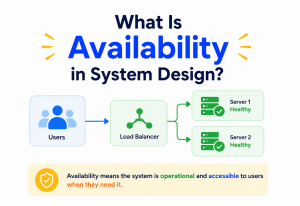
Every stateless service tier in this design — Catalog Service, Entity Resolution Service, Rule Engine, Trigger Service, Order Service, Notification Service — sits behind its own Load Balancer. This is deliberate: a Load Balancer distributes incoming requests evenly across many identical pods/instances of a service, so that if one instance is slow or crashes, traffic simply flows to the healthy ones. We use Layer 7 (application-aware) load balancing so that routing decisions can consider things like URL path and headers, not just IP and port.
4.3 Crawl Scheduler and Crawler Worker Pool
The Crawl Scheduler decides when to check each competitor product page next, based on a priority score (high-traffic SKUs, historically volatile prices, and categories close to a big sale event get checked more often). It pushes jobs into a priority queue, which is consumed by an autoscaled pool of Crawler Workers. These workers fetch pages (or call competitor/partner price-feed APIs where available), extract price and availability, and pass raw data downstream.
4.4 Proxy / IP Rotation Layer
To avoid overloading (and getting blocked by) competitor sites, requests go through a proxy pool that rotates IP addresses and respects each site’s rate limits — a “politeness policy.” This layer is itself load balanced across many proxy nodes.
4.5 Price Normalization Service
Raw scraped data is messy: “$1,299.00”, “1299”, “USD 1299”, “1299 kr” all mean different things. The Normalization Service converts every price into a single canonical format (currency, decimal precision, tax-inclusive vs exclusive) so downstream comparison is apples-to-apples.
4.6 Entity Resolution Service (Product Matching)
This service decides whether a competitor’s listing refers to the same product as one in our catalog. It uses a layered strategy: exact barcode match first, then a machine-learning text/image similarity model, then a confidence threshold that routes uncertain matches to a human review queue. Confirmed matches are written into the Canonical Product Graph.
4.7 Price Match Rule Engine
Given a confirmed match and a competitor price lower than ours, the Rule Engine applies business rules: minimum discount threshold, excluded categories, excluded sellers, geographic eligibility, and promotional exclusions. This is intentionally a separate, configurable service so that business/legal teams can update rules without redeploying code.
4.8 Price Match Trigger Service
Once a match passes all rules, this service orchestrates the actual outcome: adjusting the displayed price, issuing a refund on an existing order, or generating a coupon — depending on business configuration — and records everything to an immutable audit log for compliance.
“Why do you split Entity Resolution and Rule Engine into two separate services instead of one?” Good answer: they have very different scaling and change profiles. Entity resolution is compute-heavy (ML inference) and changes slowly (model retraining cycles). The rule engine is lightweight but changes frequently (business/legal rules, promotions). Separating them lets each scale and deploy independently — a classic microservices “bounded context” argument.
Internal Working
Let’s trace exactly what happens, step by step, inside the system when a competitor drops a price.
- Discovery: The Crawl Scheduler pulls the next batch of due jobs from its priority queue (backed by a min-heap keyed on “next check time”).
- Fetch: A Crawler Worker requests the competitor’s product page through the rotating proxy layer, respecting a per-domain rate limit (e.g., no more than 2 requests/second to a given competitor domain).
- Extraction: The worker parses the page (using CSS selectors or a trained extraction model for pages without clean structure) to pull out price, currency, availability, and product identifiers.
- Publish raw event: The worker publishes a
RawCompetitorPriceevent onto a Kafka topic. Publishing to a queue (rather than calling the next service directly) decouples the crawler’s throughput from downstream processing speed. - Normalize: A consumer service normalizes currency, computes a per-unit price (important for multi-packs), and forwards a clean
NormalizedPriceevent. - Match: The Entity Resolution Service looks up whether this competitor listing is already linked to a canonical product. If yes, skip straight to comparison. If no, run the matching pipeline (barcode → text embedding similarity → image similarity → confidence score).
- Compare: If matched with confidence above the auto-accept threshold, compare the normalized competitor price against our current price for that canonical product (fetched from a Redis cache of hot prices, falling back to the Catalog DB).
- Evaluate rules: If competitor price is lower by more than the configured threshold, the Rule Engine checks eligibility rules.
- Trigger: If all rules pass, the Trigger Service either updates the live price, generates a discount code, or issues an automatic refund against a recent order, and writes an audit record.
- Notify: The customer (if they had a pending claim, or if the marketplace auto-applies price protection to prior purchases) is notified.
A customer buys noise-canceling headphones for $299 on Monday. On Wednesday, a competitor drops the identical model to $259. The system’s crawler picks this up during its scheduled check (because this is a high-traffic SKU, it’s checked every 30 minutes), the Entity Resolution Service confirms it’s the same product via the shared UPC code, the Rule Engine confirms the item qualifies (no exclusions, price drop exceeds the $5 minimum threshold, and the order was placed within the 14-day price protection window), and the Trigger Service automatically issues a $40 refund to the customer’s original payment method — all without a human touching it.
5.1 What Happens When Confidence Is Uncertain
Not every case is as clean as the example above. Suppose the crawler finds a listing titled “Sony Wireless Headphones XM5 – Refurb, Black” at a much lower price. The text embedding similarity to our catalog’s “Sony WH-1000XM5 Wireless Noise-Canceling Headphones, Black” might score around 0.80 — high enough to suggest a possible match, but below the 0.92 auto-accept threshold, and the word “Refurb” is exactly the kind of detail that changes the correct answer. In this situation the event is routed to a human review queue instead of being auto-approved. A trained reviewer (or a specialized secondary, more expensive verification model) looks at both listings side by side, including the product images, and makes the final call. Their decision is recorded and fed back as labeled training data, so the primary matching model gradually gets better at recognizing this exact pattern — refurbished-vs-new language — without needing every future case to go through a human again. This human-in-the-loop feedback cycle is what allows the auto-accept threshold to be raised safely over time as the model’s real-world accuracy on hard cases improves.
Think of the matching pipeline like a bank teller processing checks. Machine-readable ones fly through automatically. Handwritten ones with clear signatures get processed in seconds. Anything with a signature that looks a little off, a strange endorsement, or an amount written ambiguously gets sent to a specialist for a manual look. Over time, the specialists’ decisions get folded into the training data used to update the machine’s judgment, and the borderline pile gets slowly, safely smaller.
Data Flow & Lifecycle
The lifecycle of a single price data point, from being scraped off a competitor’s page to potentially becoming a refund in the customer’s bank account.
Notice the feedback loop at the very end: the Trigger Service’s outcome feeds back into the Crawl Scheduler’s prioritization logic. If a SKU’s price frequently triggers a match, the scheduler increases its crawl frequency; if a SKU never changes, the scheduler backs off to save cost. This is a form of adaptive, self-tuning scheduling.
“Why use a message broker like Kafka between the crawler and the normalizer instead of a direct synchronous call?” The expected answer is about decoupling and backpressure: crawlers produce bursts of data unpredictably (a competitor site’s sale event can trigger thousands of price changes in minutes), while downstream ML-based matching is comparatively slow and expensive. A durable queue absorbs bursts, allows independent scaling of producers and consumers, and provides replay-ability if a downstream service needs to reprocess data after a bug fix.
6.1 Java Code Example: Publishing a Normalized Price Event
public class PriceNormalizer {

    private final KafkaProducer<String, NormalizedPriceEvent> producer;

    public PriceNormalizer(KafkaProducer<String, NormalizedPriceEvent> producer) {
        this.producer = producer;
    }

    // Converts raw scraped price data into a canonical form and publishes it
    public void normalizeAndPublish(RawCompetitorPrice raw) {
        BigDecimal amount = CurrencyUtil.toUsd(raw.getPrice(), raw.getCurrencyCode());
        BigDecimal perUnitPrice = amount.divide(
                BigDecimal.valueOf(raw.getPackQuantity()), 4, RoundingMode.HALF_UP);

        NormalizedPriceEvent event = NormalizedPriceEvent.builder()
                .competitorDomain(raw.getSourceDomain())
                .externalProductId(raw.getExternalProductId())
                .rawTitle(raw.getTitle())
                .normalizedPriceUsd(amount)
                .perUnitPriceUsd(perUnitPrice)
                .capturedAt(Instant.now())
                .build();

        // Keyed by external product id so all events for one listing land on the
        // same partition, preserving per-listing ordering
        producer.send(new ProducerRecord<>("normalized-competitor-prices",
                raw.getExternalProductId(), event));
    }
}
6.2 Java Code Example: Confidence-Based Entity Matching
public class EntityResolutionService {

    private final ProductGraphRepository graphRepository;
    private final EmbeddingClient embeddingClient;

    private static final double AUTO_ACCEPT_THRESHOLD = 0.92;
    private static final double REVIEW_THRESHOLD      = 0.70;

    public MatchResult resolve(NormalizedPriceEvent event) {
        // Step 1: strongest signal - exact barcode match
        Optional<CanonicalProduct> byBarcode =
                graphRepository.findByGtin(event.getGtin());
        if (byBarcode.isPresent()) {
            return MatchResult.confirmed(byBarcode.get(), 1.0);
        }

        // Step 2: text + image embedding similarity against candidate products
        float[] titleEmbedding = embeddingClient.embedText(event.getRawTitle());
        List<CandidateMatch> candidates =
                graphRepository.findNearestByEmbedding(titleEmbedding, 5);

        if (candidates.isEmpty()) {
            return MatchResult.noMatch();
        }

        CandidateMatch best = candidates.get(0);
        if (best.getSimilarityScore() >= AUTO_ACCEPT_THRESHOLD) {
            return MatchResult.confirmed(best.getProduct(), best.getSimilarityScore());
        } else if (best.getSimilarityScore() >= REVIEW_THRESHOLD) {
            return MatchResult.needsHumanReview(best.getProduct(), best.getSimilarityScore());
        }
        return MatchResult.noMatch();
    }
}
6.3 Java Code Example: Rule Engine Evaluation
public class PriceMatchRuleEngine {

    private final RuleConfigRepository ruleConfig;

    public RuleDecision evaluate(MatchedPriceEvent event, CatalogItem ourItem) {
        BigDecimal difference = ourItem.getCurrentPrice()
                .subtract(event.getCompetitorPriceUsd());

        RuleSet rules = ruleConfig.getActiveRuleSetFor(ourItem.getCategoryId());

        if (difference.compareTo(rules.getMinimumDifference()) <= 0) {
            return RuleDecision.reject("Difference below minimum threshold");
        }
        if (rules.getExcludedSellerIds().contains(event.getCompetitorSellerId())) {
            return RuleDecision.reject("Competitor seller excluded from guarantee");
        }
        if (!rules.isCategoryEligible(ourItem.getCategoryId())) {
            return RuleDecision.reject("Category not eligible for price match");
        }
        if (ourItem.isOnActivePromotion() && !rules.allowsDuringPromotion()) {
            return RuleDecision.reject("Item currently on promotion, excluded by policy");
        }
        return RuleDecision.approve(difference);
    }
}
Checkpoint: What We’ve Covered So Far
We’ve established why price matching is hard (data collection at scale, product identity resolution, and configurable business rules), and walked through a layered architecture where an API Gateway fronts all external traffic, dedicated Load Balancers sit in front of every scalable service tier, and Kafka topics decouple the crawling, matching, and rule-evaluation stages so each can scale independently. Next, we’ll dig into trade-offs, scaling, reliability, and security.
Advantages, Disadvantages & Trade-offs
Every design choice above trades something away — here they are, side by side.
| Aspect | Advantage | Disadvantage / Trade-off |
|---|---|---|
| Automation | No manual staff needed; instant customer trust and satisfaction | False matches can cause revenue loss if entity resolution is wrong |
| Crawl Frequency | Frequent checks catch price drops fast | Higher infrastructure and proxy costs; risk of being blocked |
| ML-Based Matching | Scales to millions of unmatched listings without manual curation | Requires ongoing model maintenance, labeled data, and human review queues |
| Event-Driven Pipeline | Elastic scaling, resilience to bursts, replayability | Adds operational complexity: more moving parts, eventual consistency |
| Configurable Rule Engine | Business teams can adjust rules without engineering deploys | Misconfigured rules can trigger unintended mass discounts |
✓ Event-Driven Pipeline
- Producers and consumers scale independently under load
- Kafka’s durability lets stages replay after bug fixes
- Bursty crawl output is absorbed without dropping data
✗ Event-Driven Pipeline
- More moving parts to operate and monitor
- Only eventual consistency between stages
- Debugging a single event requires distributed tracing
“What happens if your entity resolution model incorrectly matches two different products?” This tests whether you think about failure modes, not just the happy path. Good answers describe defense in depth: confidence thresholds with a human review lane for uncertain matches, a maximum auto-approved discount cap per event, real-time anomaly detection on sudden spikes in triggered matches (which could indicate a broken model or a data-quality bug), and the ability to instantly disable auto-matching for a category via a feature flag.
Performance & Scalability
At marketplace scale, the system may need to track tens of millions of SKUs against thousands of competitor domains, generating hundreds of millions of price observations per day. Here’s how each layer scales.
8.0 Back-of-the-Envelope Capacity Estimation
Before designing for scale, it helps to put rough numbers on the problem — this is also a very common thing interviewers want to see you do out loud. Let’s walk through a simplified estimate for a large marketplace.
- Catalog size: Assume 50 million actively-sold SKUs.
- Tiering: Using the tiered crawl strategy from section 8.3 — Tier 1 (5%) checked every 20 minutes, Tier 2 (25%) checked every 3 hours, Tier 3 (70%) checked once daily.
- Tier 1 crawl volume: 2.5 million SKUs times roughly 72 checks/day (every 20 minutes) is about 180 million crawl requests per day from this tier alone.
- Tier 2 crawl volume: 12.5 million SKUs times 8 checks/day (every 3 hours) is about 100 million requests per day.
- Tier 3 crawl volume: 35 million SKUs times 1 check/day is 35 million requests per day.
- Total: Roughly 315 million crawl requests per day, or about 3,650 requests/second sustained on average — though real traffic is bursty around sale events, so the system should be provisioned for several times that average as a peak, not just the average itself.
- Storage estimate: If each raw price observation is roughly 1 KB once serialized (price, currency, timestamp, source, listing id, raw title snippet), 315 million observations/day is about 315 GB/day of raw event data before compression, which is very manageable for a Kafka cluster with a short retention window (a few days) feeding into cheaper long-term columnar storage for analytics.
This kind of estimate immediately tells you two important things: the crawler tier needs to comfortably sustain several thousand requests per second at peak (driving the decision to horizontally autoscale the worker pool and spread load across a large proxy pool), and the event pipeline’s storage footprint, while large in absolute terms, is entirely tractable with standard stream-processing infrastructure as long as raw events are aged out of “hot” storage after a short window.
8.1 Horizontal Scaling of Crawlers
Crawler Workers are stateless and horizontally autoscaled based on queue depth (how many crawl jobs are waiting). If the queue backs up, Kubernetes’ Horizontal Pod Autoscaler spins up more worker pods, each pulling jobs independently.
8.2 Partitioning the Message Broker
Kafka topics are partitioned by product/SKU id, so all events for a given product land on the same partition and preserve order, while different products are processed fully in parallel across partitions.
8.3 Priority-Based Crawl Scheduling
Not all SKUs deserve equal crawl frequency. A tiered approach works well in practice:
| Tier | Criteria | Crawl Frequency |
|---|---|---|
| Tier 1 | Top 5% by traffic/revenue, high price volatility | Every 15–30 minutes |
| Tier 2 | Mid-traffic, moderate volatility | Every 2–4 hours |
| Tier 3 | Long-tail, stable pricing | Once daily or every 2–3 days |
8.4 Caching Hot Prices
The current “our price” lookup, done on every single comparison, is one of the hottest read paths in the system. Rather than hitting the Catalog Database each time, the Rule Engine reads from a Redis cache populated by Change Data Capture from the Catalog DB, giving sub-millisecond lookups for millions of comparisons per hour.
8.5 Batching ML Inference
The Entity Resolution Service batches embedding-generation requests (grouping many normalized events together before calling the model) to make efficient use of GPU/accelerator hardware, trading a small amount of added latency (tens of milliseconds) for a large throughput gain.
“How would you avoid overloading a competitor’s website while still checking prices frequently enough?” Look for: per-domain token-bucket rate limiting, distributing requests across a rotating proxy pool, respecting robots.txt and site-specific terms where applicable, caching responses to avoid duplicate fetches, and preferring official price-feed partnerships/APIs over scraping wherever they exist.
High Availability, CAP & Consensus
A price-match system touches money directly (refunds, discounts), so reliability and correctness matter enormously — a bug here has real financial consequences.
9.1 Idempotency
Every trigger event carries a unique idempotency key (e.g., a hash of order id + competitor listing id + captured timestamp bucket). The Trigger Service checks this key before acting, so retries from a crashed consumer never cause a duplicate refund.
9.2 At-Least-Once Delivery with Deduplication
Kafka consumers are configured for at-least-once delivery (safer to reprocess than to silently drop a price event), paired with a deduplication store (keyed on idempotency key, short TTL) downstream to guarantee exactly-once effects even though delivery itself may occasionally repeat.
9.3 Circuit Breakers on External Dependencies
Calls to competitor sites, third-party price-feed APIs, and the ML model-serving layer are all wrapped in circuit breakers. If a competitor site starts timing out heavily, the breaker trips, stops sending requests for a cool-down period, and the scheduler reroutes crawl budget elsewhere instead of piling up stuck threads.
9.4 Multi-Region Replication
The Canonical Product Graph and Catalog databases are replicated across regions. In case of a regional outage, traffic fails over to a secondary region using a Load Balancer configured with health-check-based failover.
9.5 Graceful Degradation
If the Entity Resolution Service is unavailable, the system does not crash the customer-facing price display. Instead it falls back to only using previously-confirmed canonical matches, pausing new match discovery until the service recovers — the guarantee still works for known products, just doesn’t grow with new ones temporarily.
“How do you guarantee a customer is never refunded twice for the same price-match event?” Expect a discussion of idempotency keys, a dedicated dedup table or cache with a TTL longer than the maximum possible retry window, and a database-level unique constraint on (order_id, competitor_event_id) as a last line of defense, in addition to application-level checks.
9.6 Advanced: Consistency, CAP Theorem & Consensus
It’s worth pausing on some deeper distributed-systems theory that directly shapes several decisions we’ve already made in this design.
9.6.1 CAP Theorem in This System
The CAP theorem says that in the presence of a network partition, a distributed system must choose between Consistency (every read sees the latest write) and Availability (every request gets a response, even if it might be slightly stale). This system deliberately makes different choices for different data:
- Current price cache (Redis): We choose Availability over strict Consistency. If the cache is a few seconds stale during a network blip, that’s an acceptable trade — the Rule Engine simply compares against a slightly outdated price, and the next comparison cycle will catch up.
- Order/Refund system: Here we lean toward Consistency for the specific write path that issues a refund — we would rather have that request fail and retry than risk issuing a refund based on stale, possibly-already-changed order state.
- Canonical Product Graph: Reads can tolerate eventual consistency (a newly confirmed match might take a few seconds to propagate to all replicas), but writes to the “confirmed match” relationship are funneled through a single writer per canonical product to avoid conflicting concurrent updates.
9.6.2 Consensus and Leader Election
Certain coordination tasks in this system need a single source of truth even across multiple replicas — for example, deciding which Crawl Scheduler instance is currently “active” so that duplicate schedulers don’t double-dispatch the same crawl jobs. This is solved using a consensus-based leader election mechanism (commonly implemented via Zookeeper, etcd, or a similar strongly-consistent coordination service using the Raft consensus algorithm). Only the elected leader dispatches jobs; if it crashes, the remaining nodes detect the missing heartbeat and elect a new leader within a bounded time window.
9.6.3 Data Structures & Algorithms Under the Hood
A few classic data structures and algorithms show up repeatedly in this design:
- Min-heap priority queue: The Crawl Scheduler’s “what to check next” logic is a textbook min-heap, keyed by next-due-time, giving O(log n) insert and O(log n) extract-min even with millions of scheduled SKUs.
- Token bucket algorithm: Per-domain rate limiting uses a token bucket (a counter that refills at a fixed rate and is decremented per request), which smooths out bursts while still allowing short spikes up to the bucket’s capacity.
- Approximate nearest-neighbor search (HNSW): Product embedding similarity search uses a Hierarchical Navigable Small World graph index, giving fast approximate search instead of a slow brute-force scan across hundreds of millions of vectors.
- Consistent hashing: Used to assign competitor domains to specific crawler worker groups, so that adding or removing workers only reshuffles a small fraction of domain assignments instead of all of them.
- Bloom filters: A lightweight, space-efficient probabilistic structure used by the Normalizer to quickly check “have I likely seen this exact raw price payload before?” before doing a full, expensive database dedup lookup — trading a small false-positive rate for huge memory savings.
9.6.4 Disaster Recovery, Backup & Cost Optimization
Because the audit log and order/refund data are financially and legally sensitive, they follow a stricter backup regime than, say, cached price data: point-in-time recovery snapshots, cross-region backup replication, and periodic restore drills to confirm backups actually work — a backup nobody has ever restored is not a real backup. For cost optimization, the tiered crawl-frequency strategy described earlier is itself the single biggest lever. The majority of SKUs are long-tail and don’t need minute-level freshness, so spending compute and proxy budget proportionally to a SKU’s revenue and volatility, rather than uniformly, can cut crawling costs dramatically while barely affecting the guarantee’s effectiveness where it matters most.
“Where in this system did you choose availability over consistency, and where did you choose the opposite, and why?” This is a direct CAP-theorem application question. A strong answer names specific components — price cache favors availability, refund issuance favors consistency — and explains the business reasoning behind each choice, rather than reciting the theorem abstractly.
Security
Because this system moves money, security is not optional polish — it’s core.
- Authentication & Authorization: The API Gateway enforces OAuth2/JWT-based authentication for all customer-facing claim submissions and mTLS between internal services.
- Rate Limiting and Abuse Detection: Customers submitting manual “I found it cheaper” claims are rate-limited and screened for fraud patterns (e.g., submitting fabricated competitor URLs, or repeatedly claiming against the same order).
- Input Validation on Scraped Data: Never trust data scraped from an external site. Prices, URLs, and titles are sanitized and validated before entering the pipeline, to prevent injection attacks or malformed data from corrupting the Product Graph.
- Least Privilege for Refund Triggering: The Trigger Service is granted narrow, specific permissions to the Order/Payment system (issue-refund-up-to-X-amount) rather than broad admin access, limiting blast radius if it is ever compromised.
- Audit Logging: Every triggered match is written to an append-only, tamper-evident audit log for compliance and dispute resolution.
- Encryption: All data in transit uses TLS; sensitive data (order/payment references) is encrypted at rest.
- Secrets management: Credentials for proxy providers, third-party price-feed partners, and internal service-to-service authentication tokens are stored in a dedicated secrets manager rather than embedded in configuration files or environment variables checked into source control, and are rotated on a regular schedule.
- Web Application Firewall (WAF): Sits in front of the API Gateway to filter out common attack patterns (SQL injection attempts, malformed payloads, known bad IP ranges) before they ever reach application code, adding a defense layer above and beyond application-level input validation.
Treating scraped competitor data as trusted input just because the source domain is on an approved list. The domain’s reputation says nothing about whether the specific bytes returned today are safe to embed in a downstream template, index, or database. Validate structure, type, and range at the boundary, always.
“A customer submits a fake screenshot claiming a competitor’s lower price that doesn’t actually exist. How do you defend against this?” Strong answers mention independent verification: the system should not blindly trust user-submitted screenshots. Instead, it should attempt to independently verify the claimed price by fetching the competitor URL itself (or checking if the automated crawler already observed that price around the same time), and flag mismatches for manual fraud review rather than auto-approving.
Monitoring, Logging & Metrics
Observability lets you know the system is behaving correctly, not just that it’s “up.”
| Metric | Why It Matters |
|---|---|
| Crawl success rate per domain | Detects when a competitor changes their page layout or starts blocking us |
| Match confidence distribution | Sudden shifts may indicate a model regression or data drift |
| Triggered matches per hour (by category) | Anomaly spikes can indicate a rule misconfiguration or a bug |
| End-to-end latency (crawl to trigger) | Measures how fast the guarantee actually reacts to real price drops |
| Queue lag (Kafka consumer lag) | Indicates whether downstream processing is keeping up with data volume |
| Refund dollar amount per hour | Direct financial exposure metric; alerts finance/fraud teams on spikes |
Distributed tracing (e.g., using OpenTelemetry with a trace id propagated from the Crawl Scheduler all the way through to the Trigger Service) lets engineers follow a single price event’s entire journey across services when debugging a specific customer complaint. Structured logs are shipped to a centralized log store, and dashboards visualize the metrics above with alerting thresholds (e.g., page on-call if triggered-match volume in any category exceeds 3x its 7-day average).
11.1 Designing Good Alerts, Not Just Dashboards
It’s a common mistake to build beautiful dashboards that nobody looks at until something has already gone wrong. A better approach is to invest specifically in a small number of high-signal, low-noise alerts tied directly to customer and business impact, rather than alerting on every possible metric:
- Financial guardrail alert: Total approved refund amount in any rolling 15-minute window exceeds a hard dollar ceiling — pages on-call immediately, since this is the single most direct signal that something is badly wrong (a bug, a bad rule deploy, or an attack).
- Pipeline health alert: Kafka consumer lag on any critical topic grows unbounded for more than a few minutes, indicating a downstream service is stuck or under-provisioned.
- Data quality alert: The proportion of crawl jobs failing to extract a valid price for a given competitor domain jumps sharply, indicating that domain’s page layout likely changed and the extraction logic needs updating.
- Model drift alert: The human-review override rate (how often a human reviewer disagrees with the model’s proposed match) crosses a threshold, indicating the entity-resolution model may need retraining sooner than its scheduled cadence.
Each of these alerts should route to the team that can actually act on it, and each should link directly to a relevant dashboard and a runbook describing the first diagnostic steps — an alert without a clear next action just trains people to ignore alerts.
“How would you detect that your entity resolution model has silently degraded in quality?” Look for: tracking the human-review-queue override rate (how often humans reject the model’s proposed match) as a leading indicator, monitoring the auto-accept rate over time for sudden shifts, and running periodic golden-set evaluations (a fixed labeled test set re-scored regularly) to catch drift before it affects production traffic.
Deployment & Cloud
This system is well suited to a containerized, cloud-native deployment.
- Kubernetes orchestrates all stateless service tiers (Catalog Service, Entity Resolution, Rule Engine, Trigger Service), each with its own Horizontal Pod Autoscaler tied to CPU, queue depth, or custom metrics.
- Managed Kafka (or an equivalent managed streaming service) handles the event backbone, avoiding the operational burden of running brokers manually.
- Managed relational/NoSQL databases with automated backups and cross-region read replicas back the Catalog and Product Graph stores.
- Serverless functions are a good fit for spiky, low-latency tasks like the Notification Service, since notification volume correlates directly with matched-event volume and can spike unpredictably.
- CI/CD pipelines deploy each microservice independently, using canary releases for the Rule Engine specifically (since a bad rule change has direct financial impact) — a small percentage of traffic sees the new rule set first, monitored closely before full rollout.
- Infrastructure as Code (e.g., Terraform) defines the entire environment, so proxy pool scaling, Kafka topic configuration, and autoscaling policies are version-controlled and reproducible across environments.
“Why use canary deployment specifically for the Rule Engine, more than for other services?” Because rule changes have an almost immediate and direct dollar impact — a bad regex or an inverted comparison operator could trigger thousands of unintended refunds within minutes. Canary rollout limits blast radius and gives time for anomaly-detection alerts to fire before the change reaches 100% of traffic.
Pair every canary rollout of the Rule Engine with an automatic rollback trigger on the financial guardrail alert. If the canary’s share of triggered refund dollars per unit of traffic diverges materially from the baseline’s share, the rollout stops itself — no human required, no waiting for the on-call engineer to react.
Databases, Caching & Load Balancing
Storage decisions for three very different data shapes: OLTP catalog, a canonical product graph with vector search, and a hot price cache.

13.1 Catalog Database
Stores our own product catalog: SKU, price, category, promotions. This is a classic OLTP workload — sharded by product/category id for write scalability, with read replicas fronted by a Load Balancer to absorb the heavy read traffic from the Rule Engine and customer-facing pages.
13.2 Canonical Product Graph Database
This is the trickiest data store in the system. It needs to support: fast exact lookup by barcode, nearest-neighbor vector search for embedding similarity, and graph-like relationships (one canonical product can link to many competitor listings). In practice, this is often implemented as a combination of a relational/document store for the canonical records plus a specialized vector database (or a vector index like HNSW built into the primary store) for similarity search.
13.3 Distributed Cache
A Redis cluster caches (a) our current price per SKU for fast Rule Engine lookups, and (b) recently resolved competitor-to-canonical-product mappings, so repeat sightings of the same competitor listing skip the expensive matching pipeline entirely.
13.3.1 Sharding and Replication Strategy in Detail
Let’s go one level deeper on how the Catalog Database and Canonical Product Graph are actually partitioned across machines, since this is a favorite interview follow-up.
- Catalog Database sharding key: Sharded by category id combined with a hash of the SKU id. Category-based sharding keeps related products physically close together (useful for category-wide analytics and bulk rule application), while the SKU hash component prevents any single mega-popular category from creating a “hot shard” that gets disproportionately more traffic than its neighbors.
- Canonical Product Graph sharding key: Sharded by canonical product id itself, generated as a new identifier the first time a product is confirmed. This keeps all of one product’s linked competitor listings and match history together on a single shard, so a full lookup (“give me every known competitor price for this product”) never has to fan out across multiple shards.
- Replication factor: Both stores run with at least three replicas per shard, spread across separate availability zones, using leader-follower replication. Writes go to the leader; reads can be served from followers for the majority of traffic (like the Rule Engine’s price lookups), reserving leader reads only for paths that need the absolute latest write (like right after a new match is confirmed).
- Rebalancing: As shards grow unevenly over time (some categories simply have far more SKUs and price history than others), an online resharding process — one that moves data between shards without taking the system offline — periodically rebalances hot shards, similar in spirit to how consistent hashing minimizes data movement when the crawler worker pool changes size.
13.4 Load Balancing Strategy
Every internal service tier is fronted by its own Load Balancer using health-check-based routing (unhealthy pods are automatically removed from rotation) and, where relevant, consistent hashing (for example, routing all requests for a given competitor domain to the same crawler worker group, to make local rate-limiting state easier to manage without needing a distributed lock).
“Why might you choose a vector database over a traditional relational database for part of the Product Graph?” Because fuzzy “is this the same product” matching fundamentally relies on nearest-neighbor search over high-dimensional embeddings, which relational indexes (B-trees) are not built for. A vector index (like HNSW or IVF) gives approximate nearest-neighbor search in milliseconds even over hundreds of millions of vectors, which is essential at marketplace scale.
APIs & Microservices
Representative API contracts for two key services on either side of the trust boundary.
14.1 Customer-Facing Claim Submission API
POST /v1/price-match/claims
Headers: Authorization: Bearer <jwt>
Body:
{
  "orderId": "ORD-88213",
  "competitorUrl": "https://competitor.example.com/product/9981",
  "claimedPriceUsd": 259.00
}

Response 202 Accepted:
{
  "claimId": "CLAIM-771102",
  "status": "PENDING_VERIFICATION",
  "estimatedResponseTime": "PT2H"
}
14.2 Internal Rule Engine Evaluation API
POST /internal/v1/rule-engine/evaluate
Body:
{
  "canonicalProductId": "CPG-554210",
  "ourCurrentPriceUsd": 299.00,
  "competitorPriceUsd": 259.00,
  "competitorSellerId": "SELLER-COMPETITOR-A",
  "matchConfidence": 0.97
}

Response 200 OK:
{
  "decision": "APPROVE",
  "priceDifferenceUsd": 40.00,
  "reasonCodes": []
}
Each microservice in this design owns its own data store (Catalog Service owns the Catalog DB, Entity Resolution owns the Product Graph) and communicates with others exclusively through well-defined APIs or asynchronous events — never by directly querying another service’s database. This keeps services independently deployable and lets teams evolve their internal schemas freely.
“Why is the claim submission API asynchronous (202 Accepted) instead of returning a final decision immediately?” Because verifying a customer’s claim may require an independent crawl of the competitor URL, which can take seconds and occasionally longer if the site is slow or blocked. Returning 202 with a claim id lets the client poll or receive a push notification later, rather than holding open a long synchronous request.
Design Patterns & Anti-Patterns
Patterns worth reusing, and mistakes worth naming so you can avoid them.
15.1 Patterns Used
Event Sourcing / Event-Driven Architecture
Kafka topics as the backbone connecting stages, enabling replay and independent scaling.
Strangler / Bounded Context Separation
Entity Resolution and Rule Engine are separate bounded contexts, each independently deployable.
Circuit Breaker
Protects against cascading failures from slow or blocked competitor sites and external services.
CQRS-like Read/Write Split
Reads of “our current price” go through a fast cache path, while writes go through the authoritative Catalog DB with CDC propagating changes to the cache.
Saga Pattern
The multi-step trigger process (update price, issue refund, notify, audit) is coordinated as a saga with compensating actions if a later step fails.
Adaptive Scheduling
Trigger outcomes feed back into the crawl scheduler’s priorities, so budget follows value automatically over time.
15.2 Anti-Patterns to Avoid
Tight Coupling to One Competitor’s HTML
Hardcoding scraping logic without an abstraction layer means every site redesign breaks the pipeline.
Auto-Approving All Matches
Skipping the human review lane for low-confidence matches leads to costly false positives.
Synchronous Chains Across Services
Calling Crawl → Normalize → Match → Rule → Trigger all synchronously in one request creates a fragile, slow, tightly-coupled system that fails entirely if any one step is slow.
Ignoring Per-Domain Politeness Policies
Aggressive, unthrottled crawling gets your IP ranges blocked and can raise legal/ethical concerns.
One Giant Shared Database
A single database across all services recreates a monolith’s coupling problems inside a “microservices” system.
“Why use the Saga pattern instead of a distributed transaction (two-phase commit) for the trigger workflow?” Because the trigger workflow spans multiple independently-owned services (Order/Refund, Notification, Audit) and possibly external payment providers — a true distributed transaction would require locking across all of them, hurting availability and scalability. A saga with compensating actions favors availability and eventual consistency, which fits this use case better.
15.3 Testing Strategy for a Money-Moving System
Because this system’s end effect can be an actual customer refund, testing needs to go beyond typical unit and integration tests. A few practices matter especially here:
- Shadow mode before launch: When first turning on auto-matching for a new category, run the full pipeline end-to-end but stop just short of the Trigger Service actually acting — instead log what would have happened. This lets the team compare the model’s proposed matches and rule outcomes against expected behavior over days or weeks of real traffic, with zero financial risk, before flipping it to fully live.
- Golden-set regression tests: A curated set of known tricky product pairs (same product different packaging, similar-but-different models, refurbished-vs-new) is re-run against the entity-resolution pipeline on every model or code change, catching regressions before they reach production.
- Chaos testing on the crawl and messaging layers: Deliberately killing crawler worker pods, injecting Kafka broker failures, and simulating competitor sites timing out in a staging environment verifies that circuit breakers, retries, and the scheduler’s rebalancing logic behave as designed under real failure conditions, not just in theory.
- Financial reconciliation jobs: A separate, independent batch job periodically re-checks that every entry in the audit log corresponds to an actual matching order/refund record, catching any silent inconsistency between the Trigger Service’s actions and the ground-truth financial systems.
Best Practices & Common Mistakes
Each row below pairs a habit worth building in with the failure mode it prevents.
| Best Practice | Common Mistake It Prevents |
|---|---|
| Always include a human review lane for low-confidence matches | Fully automated matching silently causing costly wrong discounts |
| Cap the maximum auto-approved refund amount per event | A single bad match or bug causing an enormous, unbounded financial loss |
| Version and canary business rule changes | An untested rule change instantly affecting all live traffic |
| Prefer official price-feed partnerships over scraping when available | Fragile pipelines that break every time a competitor redesigns their site |
| Track and alert on match/trigger rate anomalies | Silent, slow-building financial bleed going unnoticed for days |
| Make every downstream action idempotent | Duplicate refunds from retried or replayed events |
Assuming that because the average false-match rate is low, the tail is safe. A rare false match on a very expensive SKU can singlehandedly exceed the financial impact of thousands of small correct matches. Cap the per-event dollar impact explicitly, don’t rely on the average being kind.
Real-World / Industry Examples
The same skeleton appears in retail, marketplaces, and travel — a good sign it captures a genuinely reusable pattern.
Large electronics and general-merchandise retailers have historically offered formal price-match guarantees, evolving from purely manual, in-store processes toward automated online systems as e-commerce volume grew. Modern price-intelligence vendors now offer competitor price-tracking as a service, which many mid-size retailers integrate rather than building their own crawling infrastructure from scratch — illustrating the “buy vs. build” trade-off for the data-collection layer specifically. Large online marketplaces with massive third-party seller ecosystems face an even harder version of this problem internally: deciding which of many seller offers for the “same” product should win the featured placement (sometimes called a “buy box”), which relies on very similar entity-resolution and price-comparison technology to what’s described in this tutorial, just applied to their own internal sellers rather than external competitors.
Streaming and subscription businesses have also adopted lightweight versions of this idea (price-drop notifications and rebooking guarantees in travel booking are a close cousin), reusing the same core building blocks: continuous external monitoring, entity/itinerary matching, and a rules engine deciding when to notify or auto-refund a customer.
Travel booking platforms offer a particularly instructive variant of this same architecture: instead of matching physical products, they match itineraries (same flight number, same dates, same cabin class) and instead of comparing against an external competitor, they often compare a customer’s already-booked price against that same platform’s own price for the identical itinerary later in the booking window — effectively price-matching against their own future price drops. The underlying building blocks are nearly identical: a scheduler that decides which bookings to re-check and how often, an entity-matching layer that confirms “same flight, same fare class, same dates,” a rule engine that applies eligibility windows and blackout dates, and a trigger service that issues a travel credit or refund. Seeing the same architectural skeleton reappear across such different domains — physical retail and travel — is a good sign that the design captured here reflects genuinely reusable, fundamental patterns rather than being narrowly specific to one industry.
Grocery delivery and meal-kit companies have also experimented with automated price matching for staple goods, though they typically restrict it to a narrower set of well-identified, barcoded products (where the “same product” question is much easier to answer confidently), illustrating a practical lesson: many real production systems deliberately scope the entity-resolution problem down to the cases they can solve with very high confidence, and grow the scope over time as their matching technology and confidence calibration improve, rather than attempting perfect coverage from day one.
“How is the ‘buy box’ problem on a marketplace with many internal sellers similar to, and different from, external competitor price matching?” Similar: both need entity resolution and price comparison at scale. Different: buy-box decisions typically also weight seller reputation, shipping speed, and stock availability — not price alone — and operate on a marketplace’s own internal, structured seller data rather than noisy external scraped data, making the entity-resolution problem comparatively easier internally.
Frequently Asked Questions
Most competitors don’t expose a public pricing API to outside parties, since it would let others (including their own competitors) track their pricing strategy in real time. When such feeds do exist — often through paid data partnerships — they’re strongly preferred over scraping because they’re more reliable and don’t carry the legal/ethical questions of automated scraping.
Tier-1 SKUs are crawled frequently enough (every 15–30 minutes) to catch most flash sale windows, and the Rule Engine can apply a rule that ignores extremely short-lived price drops (below a configurable minimum duration) to avoid matching momentary pricing glitches or flash-sale-only pricing that doesn’t reflect the competitor’s real standing price.
The Rule Engine always compares against the single lowest verified competitor price for a canonical product at evaluation time, computed from all currently known, confidence-verified listings linked to that product.
It’s a hybrid: crawling and event processing are streaming/real-time (seconds to minutes of latency end-to-end), but analytics, model retraining, and long-tail SKU crawling run on batch/scheduled cadences to control cost.
By only trusting price observations from a curated list of vetted, well-known competitor domains (not arbitrary user-submitted URLs) for the automated path, and independently re-verifying any customer-submitted claim through the system’s own crawler before approving it.
Exact string matching fails constantly in practice because sellers word titles differently, include marketing filler, use different unit orderings, and sometimes contain typos. A small pilot might get away with rule-based fuzzy string matching (edit distance, token overlap) for a narrow catalog, but any marketplace with a broad catalog and many competitor sources will need embedding-based similarity to get acceptable precision and recall — the false-positive cost (wrongly matching two different products) is high enough that investing in a proper ML approach pays for itself quickly.
This depends on how much your catalog and competitor landscape shift, but a common cadence is a scheduled retrain (for example, monthly) combined with an event-driven retrain trigger whenever the human-review override rate crosses an alert threshold, since that’s a strong signal the model’s assumptions no longer match current data.
Dynamic repricing is when a seller automatically adjusts their own price continuously based on market conditions to stay competitive, purely as a pricing strategy — the customer is never directly compensated for a specific missed price drop. A price-match guarantee is customer-facing: it’s a promise that ties a concrete, verifiable competitor price observation to a concrete customer benefit (a refund, discount, or price adjustment), and it typically comes with published eligibility rules the customer can rely on. The two can share underlying infrastructure (both need competitor price monitoring) but serve different business purposes.
Both patterns exist in practice and solve different problems. A pre-checkout check (comparing live prices while the customer is still browsing) is typically a much simpler, synchronous, real-time price comparison against a small number of already-confirmed canonical matches, and is closer to a “price display” feature than the full guarantee. The retroactive, post-purchase guarantee described throughout this tutorial is the harder and more valuable version, because it protects the customer for a window of time after they’ve already committed to the purchase, which is exactly when new, previously-undiscovered competitor listings and price drops are most likely to surface through the full crawling and matching pipeline. Many production systems offer both: a lightweight real-time comparison at checkout, and the full asynchronous guarantee pipeline running continuously afterward for the eligibility window.
This is a sensitive topic in the sense that it touches customer money and trust directly — if you’re building something similar in production, involve your fraud, legal, and finance teams early when defining the rule engine’s default thresholds and auto-approval caps.
Summary & Key Takeaways
Key Takeaways
- A price-match guarantee system is really three hard problems stacked together: continuous external data collection, product entity resolution, and configurable business-rule evaluation.
- An API Gateway fronts all external traffic, and every scalable internal service tier — Catalog, Entity Resolution, Rule Engine, Trigger — sits behind its own Load Balancer for elasticity and fault isolation.
- Kafka-based event streaming decouples crawling from matching from rule evaluation, letting each stage scale and fail independently, and giving replayability for debugging and reprocessing.
- Entity resolution should be layered — exact identifiers first, ML similarity second, human review for anything uncertain — never fully automated with no safety net.
- Idempotency keys, refund caps, canary rule deployments, and anomaly-based alerting are non-negotiable given the direct financial impact of this system.
- Prefer official data partnerships over scraping wherever possible, and always respect per-domain rate limits when scraping is necessary.
- Treat this as a money-moving system from day one: build in refund caps, idempotency, canary rollouts for rule changes, and independent financial reconciliation, rather than bolting these on after an incident forces the issue.
Ultimately, this system is a useful case study precisely because it looks like a simple lookup on the surface and reveals, on closer inspection, nearly every major theme in distributed systems design at once: partitioning data across machines, choosing between consistency and availability under real failure conditions, picking the right algorithm and data structure for a genuinely fuzzy input (product identity), caching aggressively without sacrificing correctness on financially-sensitive edges, and building operational practices — monitoring, SLOs, chaos testing, financial reconciliation — that keep the whole thing healthy long after the initial launch. A candidate who can design this system well, end to end, has effectively demonstrated fluency in the core skills that large-scale backend engineering demands day to day.
“Match two prices” is easy. Deciding what counts as the “same” product, verifying that decision with confidence, applying business rules that change weekly, doing all of this hundreds of millions of times a day without blocking anyone’s website, and never issuing the same refund twice — that is the system. Everything in this guide is in service of doing that reliably at scale.