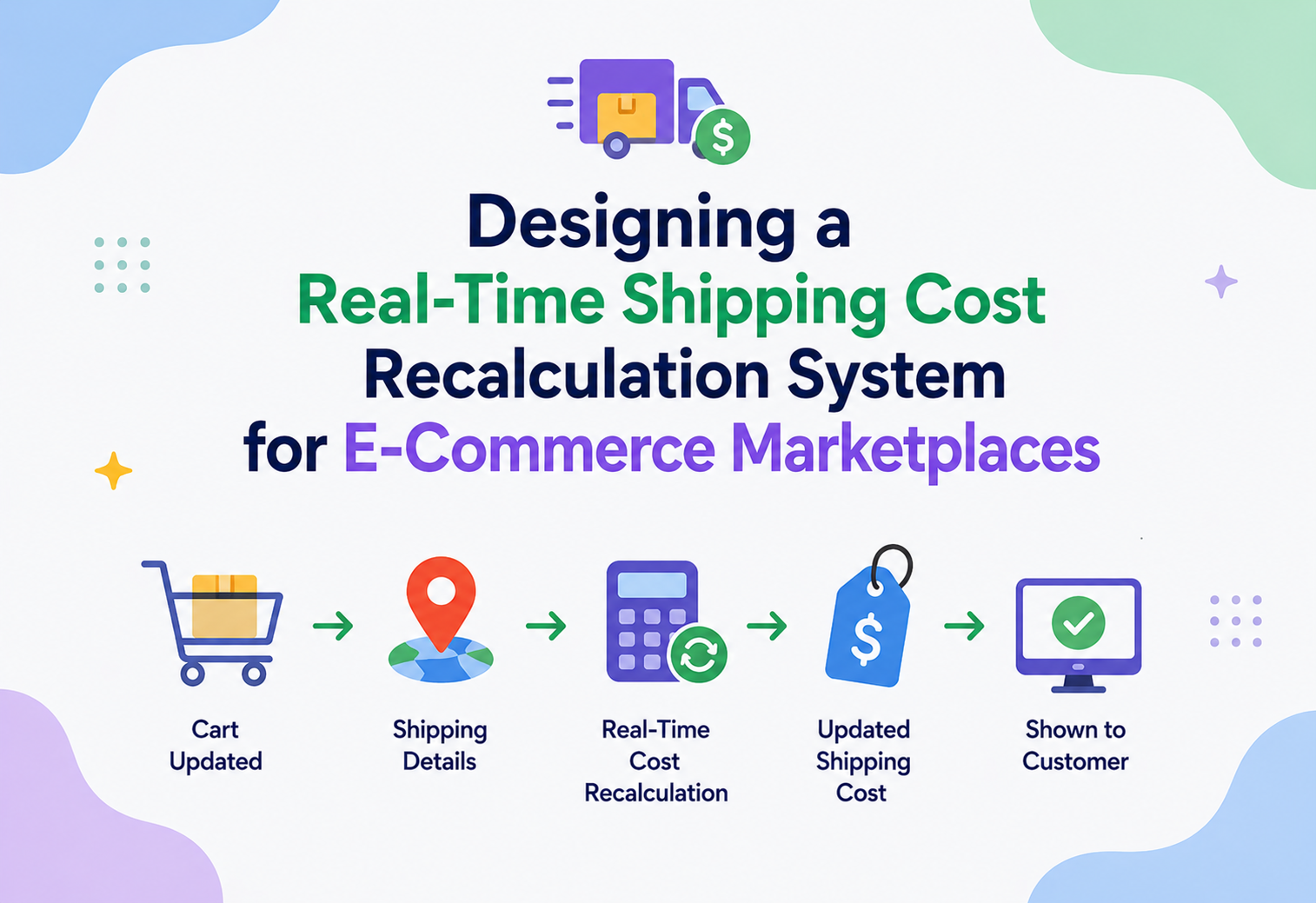
Designing a Real-Time Shipping Cost Recalculation System
How marketplaces instantly re-price shipping as a customer adds or removes items from a cart — factoring in weight, dimensions, and destination — at a scale of millions of requests per minute.
Introduction and History
A small, almost invisible moment on a shopping page — the shipping fee that changes the instant you add or remove an item — is one of the hardest real-time engineering problems in modern e-commerce.
Imagine you are shopping on a big online marketplace. You add a heavy dumbbell set to your cart. Instantly, the page shows an updated shipping fee. You remove the dumbbells and add a light phone case instead. The shipping fee drops again, instantly, without you clicking “refresh” or reloading the page. That barely noticeable smoothness hides an enormous amount of engineering underneath.
In the early days of online shopping, in the late 1990s and early 2000s, shipping cost was usually a flat fee, or it was calculated only once, at the very end of checkout, after a full page reload. Customers would fill their cart, click “Proceed to Checkout,” and only then find out how much shipping would cost. This caused a huge amount of frustration, and it is still one of the top reasons customers abandon their shopping carts today.
As marketplaces grew bigger — think Amazon, eBay, Flipkart, Etsy — and as they started selling all kinds of items with wildly different weights and sizes (a t-shirt versus a refrigerator versus a bag of cement), flat shipping rates stopped making sense. Shipping carriers like FedEx, UPS, DHL, and postal services charge based on actual weight, “dimensional weight” (a calculation based on the size of the box), and the distance to the destination. So marketplaces needed a way to calculate shipping cost dynamically, based on exactly what is in the cart and where it is going.
Over the last decade, as customer expectations moved toward instant, app-like experiences, marketplaces have pushed this calculation from “at checkout” to “as you shop.” Every time you add or remove an item, the system recalculates weight, size, and destination-based cost, and shows you the new total almost instantly — often in under 200 milliseconds. This tutorial walks through, piece by piece, how to design a system that can do this correctly and quickly, even when millions of customers are shopping at the same time, such as during a flash sale or a festival shopping season.

“Why can’t shipping cost just be calculated once at checkout instead of on every cart change?” A strong answer explains that showing cost early builds trust, reduces cart abandonment, and lets the customer make informed decisions (for example, choosing a cheaper item to avoid a higher shipping tier) before they commit to checkout.
1.1 How the Industry Got Here
It helps to see this as a series of small steps, each solving the pain point of the previous one. Step one was flat-rate shipping, simple but unfair, since a light item and a heavy item cost the seller very different amounts to ship. Step two was checkout-time calculation, where the system finally looked at the real cart, but only after the customer had already invested time filling it up, which is exactly when a shipping surprise causes the most frustration and abandonment. Step three, the one this tutorial focuses on, is continuous, live recalculation, where the system treats shipping cost as a first-class, always-current piece of information, updated the moment anything relevant changes.
- 1Flat-rate shipping (late 1990s): One price for the whole cart regardless of weight or destination — simple to implement, but structurally unfair to both light and heavy shoppers and expensive for the merchant to subsidize.
- 2Checkout-time calculation (2000s): The real cart is finally priced, but only after the customer has already invested effort — exactly when a shipping surprise triggers cart abandonment.
- 3Live recalculation (2010s and beyond): Shipping cost becomes a first-class, always-current piece of information, updated within milliseconds of any cart change, driven by expectations set by app-like shopping experiences.
This evolution mirrors a broader pattern seen across many areas of e-commerce and software engineering in general: moving computation earlier, closer to the user, and making it incremental rather than one large batch step at the very end. The same philosophy shows up in things like live search-as-you-type suggestions, live price updates during flash sales, and live inventory availability checks. Once you understand the shipping cost problem deeply, the same architectural toolkit — caching, precomputation, asynchronous events, graceful fallback — applies directly to these other “instant feedback” problems too.
Problem and Motivation
On the surface, it sounds simple: “Add up the weight of items, look at the destination, and calculate a price.” At real marketplace scale, several difficult sub-problems appear together.
2.1 The Core Problem
- Instant feedback expectation: Customers expect the shipping cost to update within a fraction of a second of clicking “Add to Cart” or “Remove,” similar to how a calculator app responds instantly to a button press.
- Complex pricing rules: Shipping cost depends on actual weight, volumetric or dimensional weight (length times width times height divided by a carrier-specific factor), the shipping zone (a grouping of destination postal codes by distance and cost), the carrier chosen, package consolidation rules (can multiple items ship in one box), and even promotional rules (free shipping over a certain amount).
- Massive read and write volume: A large marketplace during a big sale event can see millions of cart update events every minute. Each event may trigger a fresh shipping calculation.
- Data freshness versus speed trade-off: Carrier rates change periodically (fuel surcharges, seasonal rate changes). The system must balance using fast cached data against staying accurate with the latest rates.
- Multi-item, multi-seller carts: In a marketplace (as opposed to a single retailer), a cart may contain items from different sellers, each shipping from a different warehouse, each needing its own shipping calculation, which then needs to be combined into a single displayed total.
A customer adds a 2 kilogram book. The system quickly says “shipping: 40 rupees.” The customer then adds a 15 kilogram treadmill. Now the system must recalculate using the treadmill’s bulky dimensions, likely triggering a totally different pricing tier, perhaps 400 rupees, and it must do this before the customer’s finger has even left the mouse button.
Amazon shows shipping estimates that change live as you add items, and it also shows “Add X more to get FREE Delivery,” which requires the system to know, in real time, exactly how close the cart is to a free shipping threshold based on live weight and destination calculations.
2.2 Why Naive Approaches Fail
A naive design might call the shipping carrier’s live API (like the FedEx rate API) every single time a customer changes their cart. This fails badly at scale for three reasons. First, external carrier APIs have rate limits and can be slow, often 300 to 800 milliseconds per call, which is far too slow for an instant user experience. Second, calling an external API for every keystroke-like cart change would cost a huge amount of money in API fees. Third, external carrier systems could become a single point of failure — if FedEx’s API goes down, the marketplace’s entire shopping experience would break, which is unacceptable.
This tells us the real engineering challenge: we need to serve the vast majority of shipping cost requests from fast, local, precomputed, or cached data, and only fall back to slower, authoritative sources when absolutely necessary.
“How would you avoid hitting the carrier’s live API on every single cart change?” Expect this to lead into a discussion of caching, precomputed rate tables, and asynchronous rate refresh, all of which we cover in the architecture section below.
2.3 The Scale of the Challenge in Numbers
It is worth putting real numbers on the table before we design anything, because numbers change design decisions. A target of one million requests per minute works out to roughly 16,700 requests per second sustained, but real-world marketplace traffic is never smooth. During a flash sale launch or a festival shopping event, traffic can spike three to five times above the sustained average within seconds, meaning our system should be designed to comfortably absorb 50,000 to 80,000 requests per second at the very peak, for short bursts.
Assuming a healthy cache hit ratio of around 90 percent once the system is warmed up, that still leaves 5,000 to 8,000 requests per second at peak needing a genuine calculation through the Rules Engine and rate table lookup. And even if only a tiny fraction of those, say one in a thousand, require a live external carrier call, that is still potentially dozens of live external calls per second at peak, which is exactly the kind of number that will get a marketplace rate-limited or blocked by a carrier if not carefully managed with circuit breakers and hard caps.
These numbers are the reason this tutorial keeps returning to the same theme throughout every section: the system must be engineered so that the overwhelming majority of traffic is served from memory-speed caches and cheap, precomputed lookups, with slow, expensive, or fragile external dependencies reserved for a genuinely small minority of edge cases.
Architecture and Components
We build up from the customer’s device all the way down to the databases and external carrier integrations. Every box in our architecture explicitly names the type of component it represents, so you can see exactly what role each piece plays.
3.1 Component-by-Component Explanation
The web or mobile app. When a customer taps “Add to Cart” or “Remove,” the client sends an event to the backend and shows a lightweight loading indicator on just the shipping line, not the whole page, so the experience feels instant even while the network call is in flight.
A Content Delivery Network like Cloudflare or Akamai sits at the very edge, close to the customer. It caches static content and, importantly, can also cache non-personalized shipping zone lookup tables (for example, “which zone does postal code 400001 belong to”) so that the origin servers are not hit for pure lookups.
Using DNS-based Anycast routing (a technique where the same IP address is advertised from multiple locations and the network automatically routes the customer to the nearest one), requests land in the geographically closest data center or cloud region, cutting network latency significantly before any application logic even runs.
The API Gateway (commonly Kong, Envoy, or a cloud-native gateway like AWS API Gateway) is the single front door for all backend calls. It performs authentication, applies rate limiting per customer so one abusive script cannot overload the system, does request validation, and routes traffic to the correct backend service.
Inside each region, a Layer 7 load balancer (NGINX, HAProxy, or a cloud Application Load Balancer) spreads incoming requests evenly across many identical copies (replicas) of the Cart Service and Shipping Cost Orchestrator, so no single server becomes a bottleneck.
This stateless microservice owns the shopping cart itself: which items are in it, their quantities, and which seller each item belongs to. When the cart changes, it publishes an event and also directly triggers a call to the Shipping Cost Orchestrator.
This is the brain of our system. It receives “please recalculate shipping” requests, gathers everything it needs (item weight and size from the Catalog Service, the normalized destination from the Address Service), checks the cache first, and, only on a cache miss, invokes the Rules Engine to compute a fresh price.
A distributed Redis cluster stores the most recently and most frequently requested shipping quotes, keyed by a hash of (items, weight, dimensions, destination zone, carrier). Because most customers order similar combinations of common products to common destinations, cache hit rates are typically very high, often above 90 percent in a mature system.
Stores the physical attributes of every product: weight, length, width, height. This data almost never changes in real time, so it is heavily cached and can even be denormalized directly into the Cart Service for extremely fast reads.
Converts a raw address or postal code typed or selected by the customer into a normalized “shipping zone” — a standard grouping used by pricing tables (for example, “Zone 3” might represent all postal codes 300 to 600 kilometers from a given warehouse).
Applies the actual pricing logic: calculating dimensional weight, choosing the higher of actual weight or dimensional weight (a standard carrier practice), looking up the zone-based rate table, applying any active promotions, and combining costs for multi-seller carts.
An integration microservice that talks to external carriers (FedEx, UPS, DHL, national postal services) when a truly live, authoritative rate is required, for example for unusual package sizes or brand-new destinations not yet in the precomputed rate tables.
A Kafka cluster carries cart change events asynchronously to downstream systems: analytics, fraud detection, inventory reservation, and cache warming pipelines, decoupling these concerns from the main request path so they never slow down the customer-facing response.
A wide-column store like Cassandra (or DynamoDB) holds precomputed shipping rates per zone, weight bracket, and carrier. This table is refreshed periodically (for example, nightly, or whenever a carrier publishes new rates) rather than being queried live for every single request.
Prometheus scrapes metrics (latency, error rate, cache hit ratio) from every service, and Grafana visualizes them on dashboards, while alerting rules notify engineers the moment something looks unhealthy.
“Why split Cart Service and Shipping Cost Orchestrator into two separate services instead of one?” A good answer discusses single responsibility: the Cart Service is about cart state and correctness (never lose an item), while the Orchestrator is about speed and calculation, and they scale differently — the Orchestrator needs far more replicas under load because every cart change fans out into a calculation.
3.2 Why Not Just a Single Monolith
A reasonable early-stage question is whether all of this could just live inside one application, one codebase, one deployable unit, talking directly to one database, instead of many small services. For a small marketplace with modest traffic, this is actually a perfectly sensible starting point, and many successful companies begin exactly this way. A monolith is simpler to build, simpler to debug, and avoids the network overhead and operational complexity of many moving services.
The moment traffic grows toward the millions-of-requests-per-minute range described in this tutorial, though, a monolith starts to strain in specific, predictable ways. Different parts of the workload have very different scaling needs — shipping cost calculation might need to scale ten times more aggressively than, say, order history lookups — but in a monolith, you can only scale the whole application together, wasting resources on parts that do not need it. A single slow code path, such as a live carrier call, can also consume threads or connections shared by the entire application, risking a slowdown in one feature dragging down completely unrelated features. Splitting into focused microservices, each independently scalable and independently deployable, directly solves both problems, at the cost of additional operational complexity that must be managed with strong monitoring, tracing, and disciplined API contracts, as covered later in this tutorial.
Internal Working
What actually happens, step by step, inside the Shipping Cost Orchestrator when a customer adds an item to their cart?
4.1 The Cart Hash Key
To make caching effective, we build a deterministic key that represents the exact shipping-relevant state of the cart: the sorted list of product IDs and quantities, the destination zone, and the selected carrier or delivery speed. Two different customers who happen to have the identical combination of items going to the same zone will land on the same cache key and reuse the same computed price, dramatically increasing our cache hit rate.

4.2 Dimensional Weight Calculation
Carriers charge based on whichever is greater: the actual weight of the package, or its “dimensional weight,” a value calculated from the box’s volume. This matters because a large box of pillows might weigh very little but take up a lot of truck space, so carriers charge for the space it occupies.
public class DimensionalWeightCalculator {

    // Standard carrier divisor; varies by carrier and region.
    private static final double DIM_FACTOR = 5000.0;

    public double calculateBillableWeight(double actualWeightKg,
                                          double lengthCm,
                                          double widthCm,
                                          double heightCm) {
        double volume = lengthCm * widthCm * heightCm;
        double dimensionalWeight = volume / DIM_FACTOR;
        return Math.max(actualWeightKg, dimensionalWeight);
    }

    public double calculateCartBillableWeight(List<CartItem> items) {
        double total = 0.0;
        for (CartItem item : items) {
            double billable = calculateBillableWeight(
                item.getWeightKg(),
                item.getLengthCm(),
                item.getWidthCm(),
                item.getHeightCm()
            );
            total += billable * item.getQuantity();
        }
        return total;
    }
}
4.3 The Rules Engine Lookup
Once we know the combined billable weight and the destination zone, the Rules Engine looks up a rate table. This table is a simple, fast structure: a matrix of (zone, weight bracket) to price, refreshed periodically from the carrier’s published rate card.
public class ShippingRateResolver {

    private final RateTableRepository rateTableRepository;

    public ShippingRateResolver(RateTableRepository rateTableRepository) {
        this.rateTableRepository = rateTableRepository;
    }

    public ShippingQuote resolve(String zoneCode, double billableWeightKg,
                                 String carrierCode) {
        WeightBracket bracket = WeightBracket.forWeight(billableWeightKg);
        RateEntry entry = rateTableRepository.lookup(zoneCode, bracket, carrierCode);

        if (entry == null) {
            // No precomputed rate available; fall back to a live carrier call.
            return null;
        }

        double basePrice = entry.getBasePrice();
        double perKgSurcharge = entry.getPerKgRate()
            * Math.max(0, billableWeightKg - bracket.getMinWeight());

        double finalPrice = basePrice + perKgSurcharge;
        return new ShippingQuote(finalPrice, carrierCode, zoneCode, "RATE_TABLE");
    }
}
“What happens if two customers modify their cart at almost the exact same millisecond?” This is a good moment to discuss idempotent, stateless calculation: since the Orchestrator does not mutate shared state during calculation (it only reads catalog data and rate tables, and writes an immutable cache entry), concurrent requests do not conflict with each other; each one simply computes and possibly caches its own result independently.
4.4 Handling Multi-Seller Cart Consolidation
In a true marketplace, unlike a single retailer’s store, a cart very often contains items from several independent sellers, each shipping from a different warehouse. The Orchestrator cannot treat the cart as one single package in this case. Instead, it groups cart items by seller and warehouse of origin first, calculates a billable weight and shipping cost per group independently using the same dimensional weight and rate table logic already described, and then sums these into a final total, while also checking whether any marketplace-level promotion, such as free shipping above a combined order value, applies across the whole cart.
public class MultiSellerShippingCalculator {

    private final ShippingRateResolver rateResolver;
    private final DimensionalWeightCalculator weightCalculator;

    public MultiSellerShippingCalculator(ShippingRateResolver rateResolver,
                                         DimensionalWeightCalculator weightCalculator) {
        this.rateResolver = rateResolver;
        this.weightCalculator = weightCalculator;
    }

    public ShippingTotal calculate(List<CartItem> items, String destinationZone) {
        Map<String, List<CartItem>> itemsBySeller = items.stream()
            .collect(Collectors.groupingBy(CartItem::getSellerWarehouseId));

        double total = 0.0;
        List<ShippingLine> lines = new ArrayList<>();

        for (Map.Entry<String, List<CartItem>> entry : itemsBySeller.entrySet()) {
            double billableWeight = weightCalculator.calculateCartBillableWeight(entry.getValue());
            ShippingQuote quote = rateResolver.resolve(destinationZone, billableWeight, "STANDARD");
            lines.add(new ShippingLine(entry.getKey(), quote.getPrice()));
            total += quote.getPrice();
        }

        return new ShippingTotal(total, lines);
    }
}
This grouping approach means the calculation naturally parallelizes well too: each seller group’s rate lookup is independent of the others, so in a high-performance implementation these lookups can be fired off concurrently and joined together, rather than calculated one after another, further reducing the total time the customer waits.
Data Flow and Lifecycle
Let’s trace the full life of a single “add to cart” action, from the tap on the screen to the pixels updating.
- 1Client Event: Customer taps “Add to Cart” on a product. The client optimistically updates the cart item list in the UI immediately, without waiting for the server, to feel instant.
- 2Debounce Window: If the customer is rapidly changing quantities (for example, clicking the “+” button five times in two seconds), the client waits roughly 200 to 300 milliseconds after the last click before sending a single network request, rather than sending five separate requests.
- 3Request to Backend: The debounced request travels through the CDN, Global Load Balancer, API Gateway, and Regional Load Balancer, arriving at a Cart Service pod, which persists the updated cart state.
- 4Parallel Shipping Trigger: The Cart Service, after saving the update, calls the Shipping Cost Orchestrator (or publishes an event that the Orchestrator consumes) with the updated cart snapshot.
- 5Cache Lookup: The Orchestrator builds the cart hash key and checks the Redis cache. On a hit, roughly 90 percent or more of the time in a mature system, the cached price is returned in single-digit milliseconds.
- 6Cache Miss Path: On a miss, the Orchestrator gathers weight and dimension data from the Catalog Service (itself cached), resolves the destination zone from the Address Service, and asks the Rules Engine for a price using the precomputed rate table.
- 7Rare Live Carrier Call: Only for genuinely new combinations not covered by the rate table (a brand-new postal code, an oversized item) does the system fall back to a live carrier API call, which is slower but rare.
- 8Response and Cache Write: The final price is returned to the client and simultaneously written into the Redis cache with a time-to-live, typically minutes to hours, so the next customer with a similar cart benefits instantly.
- 9UI Update: The client receives the response and updates only the shipping cost line and order total, without a full page reload, giving the “instant” feeling the customer expects.
- 10Asynchronous Side Effects: In parallel, the cart change event flows through Kafka to analytics (to track cart abandonment patterns), to a cache-warming job (which can pre-populate likely future combinations), and to fraud detection systems.
A customer in Bengaluru adds a 3 kilogram backpack. The Address Service resolves Bengaluru’s postal code into “Zone 1 — South Metro.” The Rules Engine looks up the rate table entry for Zone 1 at the 3 kilogram bracket, finds 60 rupees, and this value is cached under a key like zone1:carrierA:sku12345:qty1. A different customer in the same city adding the exact same backpack a minute later gets an instant cache hit.
Advantages, Disadvantages and Trade-offs
Every design decision here has a cost. The point of this section is to make each trade-off explicit rather than leaving it as an unstated assumption.
| Aspect | Advantage | Disadvantage or Trade-off |
|---|---|---|
| Caching precomputed rates | Extremely fast, low cost, protects against carrier outages | Rates can be slightly stale until the next refresh cycle |
| Debouncing on the client | Reduces unnecessary backend load significantly | Adds a small artificial delay, typically 200 to 300 milliseconds |
| Precomputed zone rate tables | Predictable, fast lookups instead of complex live math | Requires a reliable, well-tested batch refresh pipeline |
| Falling back to live carrier APIs | Guarantees accuracy for edge cases | Slower, costs money per call, adds a dependency risk |
| Stateless orchestrator services | Very easy to scale horizontally under load spikes | Every instance needs fast access to shared cache and catalog data |
The central trade-off in this entire system is freshness versus speed. Perfectly fresh, always-live carrier rates would be the most accurate, but far too slow and fragile at scale. Perfectly cached, static rates would be blazing fast, but could drift out of date. The design above threads this needle by refreshing rate tables on a schedule, using short cache time-to-live values, and reserving live carrier calls only for the rare edge cases that truly need them.
Performance and Scalability
A target of millions of requests per minute. Let’s translate that into concrete numbers and design decisions.
One million requests per minute is roughly 16,700 requests per second on average, but real traffic is spiky — during a flash sale, the peak second could see three to five times the average, so the system should comfortably handle 50,000 to 80,000 requests per second at peak.
7.1 Horizontal Scaling
Every service in our architecture (Cart Service, Shipping Cost Orchestrator, Address Validation Service, Rules Engine) is stateless, meaning it keeps no important data in its own memory between requests. This is the single most important design decision for scalability, because it means we can run hundreds or thousands of identical copies (called replicas or pods) behind a load balancer, and simply add more copies when traffic grows, using an auto-scaler that watches CPU usage or request queue length.
7.2 Caching as the Primary Scaling Lever
At this scale, the database and even the Rules Engine’s computation would be overwhelmed if every single request required a fresh calculation. This is why the Redis rate cache is central to the design. With a 90 to 95 percent cache hit rate, only 5 to 10 percent of requests, roughly 2,500 to 8,000 requests per second at peak, ever reach the heavier calculation path, which is a very manageable load for a well-sized Rules Engine tier.
7.3 Multi-Layer Caching
We use a layered cache strategy, sometimes called “cache tiering”:
- L1 — In-process cache: A small, extremely fast local cache (using a library like Caffeine in Java) inside each Orchestrator instance, holding the most recently used shipping quotes for that instance’s traffic, avoiding even a network hop to Redis for the hottest items.
- L2 — Distributed cache: The Redis cluster, shared across all instances, sharded (split across multiple nodes by key) so no single Redis node becomes a bottleneck.
- L3 — Precomputed rate database: Cassandra, used when both caches miss, still much faster than a live carrier call.
7.4 Request Coalescing
During a flash sale, thousands of customers might be adding the exact same trending product to their cart at the same second, all going to similar destination zones. If many of these requests miss the cache at the exact same moment (a scenario called a “cache stampede” or “thundering herd”), they could all hit the Rules Engine and database simultaneously. We prevent this using request coalescing: the first request that misses the cache “locks” that key and computes the value, while other concurrent requests for the same key wait briefly and reuse the first result once it is ready, rather than each doing redundant work.
7.5 Asynchronous Rate Table Refresh
Rate tables are refreshed by offline batch jobs, not by live request traffic. This keeps the read path completely decoupled from the write-heavy job of ingesting new carrier rate cards, so a slow batch job never impacts customer-facing latency.
“How would you handle a sudden traffic spike ten times larger than normal, like a flash sale?” A strong answer covers auto-scaling policies with fast scale-up triggers, pre-warming caches with expected popular items before the sale starts, request coalescing to avoid cache stampedes, and graceful degradation (discussed in the next section) if capacity is still exceeded.
7.6 Latency Budget
| Stage | Typical Latency Budget |
|---|---|
| Network and CDN edge | 10–20 ms |
| API Gateway auth and routing | 5–10 ms |
| Cache hit path total | 15–30 ms |
| Cache miss, rate table path | 50–120 ms |
| Cache miss, live carrier fallback | 300–800 ms, rare |
7.7 Capacity Planning With Real Numbers
Let’s walk through a rough but useful capacity planning exercise, the kind an interviewer often wants to see, rather than just the final architecture. Suppose our peak load is 80,000 requests per second. If a single Shipping Cost Orchestrator instance, running on a modest cloud virtual machine, can comfortably handle around 800 requests per second at acceptable latency, we would need roughly 100 instances at peak just for this one service, which auto-scaling handles by gradually adding instances as observed load climbs, rather than provisioning all 100 permanently around the clock.
For the Redis cache layer, assuming an average cached shipping quote object is small, perhaps 200 bytes including the key, and we want to hold, say, 50 million distinct hot cart-and-destination combinations, that is roughly 10 gigabytes of data, comfortably fitting across a modestly sized Redis cluster with room to spare, especially once we remember that a short time-to-live keeps the working set naturally bounded rather than growing forever.
For the rate table database, the data itself is relatively small and slow-changing, perhaps a few million rows covering all zone, weight bracket, and carrier combinations, so the real design challenge there is not storage size but read throughput, which is why we lean on read replicas and the L1 and L2 cache layers in front of it, so the database itself rarely needs to sustain more than a few thousand reads per second even at overall system peak.
The overall lesson from this exercise is that at this scale, the compute layer, not the database, tends to be the largest cost and the primary scaling axis, precisely because caching has already absorbed the majority of the read pressure before it ever reaches persistent storage.
High Availability and Reliability
A shipping cost feature that is frequently broken is worse than one that does not exist, because it damages customer trust. The system must stay available even when individual pieces fail.
8.1 Redundancy at Every Layer
Every component runs as multiple replicas spread across multiple availability zones (physically separate data centers within a region), so the failure of one machine, rack, or even an entire data center does not take down the service. The Redis cache runs in a clustered, replicated mode, so losing one cache node does not lose all cached data.
8.2 Graceful Degradation
If the Rules Engine or rate database becomes slow or unavailable, the system should not simply show an error to the customer. Instead, it can fall back to a rougher, “good enough” estimate, for example a flat rate based purely on total cart weight bracket, clearly marked as an estimate, so the shopping experience is never completely blocked.
8.3 Circuit Breakers
When calling the external Carrier Rate Adapter, we wrap the call in a circuit breaker (using a library like Resilience4j in Java). If the carrier API starts failing repeatedly, the circuit breaker “opens” and stops sending requests to it for a cooldown period, immediately falling back to the cached or rate-table price instead of letting every request wait for a timeout.
@CircuitBreaker(name = "carrierRateApi", fallbackMethod = "fallbackToRateTable")
public ShippingQuote getLiveCarrierRate(ShippingRequest request) {
    return carrierClient.fetchRate(request);
}

public ShippingQuote fallbackToRateTable(ShippingRequest request, Throwable t) {
    return rateTableRepository.bestEffortLookup(request);
}
8.4 Timeouts and Retries
Every downstream call (to the catalog, address, or carrier service) has a strict timeout, typically 50 to 100 milliseconds for internal calls, so one slow dependency cannot cause the entire request chain to hang. Retries are used carefully, only for safe, read-only operations, with exponential backoff to avoid overwhelming an already struggling service.
8.5 Disaster Recovery
Rate table data is replicated across regions, and the entire stack can be deployed in an active-active configuration across at least two geographic regions, so that if an entire region experiences an outage (a rare but real event, such as a cloud provider regional failure), traffic is automatically rerouted to a healthy region by the Global Load Balancer.
“What is your fallback if the Redis cache cluster goes down entirely?” A good answer explains that requests would fall through to the rate table database directly, at higher latency but still correct, and that the system should have enough database capacity headroom to absorb this temporarily, combined with alerts that immediately notify the on-call engineer.
8.6 Testing Reliability on Purpose
Reliability is not something you get for free just by adding retries and circuit breakers on paper; it needs to be actively tested. Mature teams run controlled chaos engineering exercises, deliberately killing a Redis node, injecting artificial latency into the Carrier Rate Adapter, or blocking network access to one availability zone, during planned, low-risk time windows, to verify that the fallbacks described in this section actually work as designed rather than only in theory. Regular load testing that specifically targets the cache-miss path, not just the easy, cache-warm path, is equally important, since real incidents tend to happen exactly when caches are cold, such as right after a deployment or right at the very start of a big sale event.
Security
Even a feature as seemingly harmless as “show me shipping cost” needs careful security thinking, because it touches customer addresses, and it is a public-facing, high-traffic endpoint that could be targeted for abuse.
9.1 Rate Limiting and Abuse Prevention
The API Gateway enforces per-customer and per-IP rate limits, so a malicious script cannot hammer the shipping calculation endpoint thousands of times per second to run up carrier API costs or degrade service for real customers. A common, effective approach is the token bucket algorithm: each customer is allocated a bucket that refills with a fixed number of request tokens per second, and each request consumes one token, so short bursts (a customer quickly clicking through several products) are allowed, while sustained abuse is smoothly throttled once the bucket runs dry. This is generally preferred over a simple fixed-window counter, which can allow a burst of double the intended rate right at the boundary between two time windows.
9.2 Authentication and Authorization
Every request carries a signed session token, validated at the API Gateway, ensuring a customer can only fetch shipping costs for their own cart, and cannot query another customer’s cart contents or address by guessing identifiers.
9.3 Protecting Address Data
Destination addresses are personally identifiable information. The Address Validation Service should only pass around the minimum necessary data (a normalized zone code) to downstream services like the Rules Engine, rather than the full street address, following the principle of least privilege, so most internal services never even see sensitive address details.

9.4 Input Validation
Every incoming field — product IDs, quantities, postal codes — is strictly validated at the edge. Quantities are capped at sane maximums (nobody legitimately orders 100,000 units of a product through the consumer app), which also protects the Rules Engine from being asked to calculate wildly unrealistic values.
9.5 Securing the Carrier Integration
Credentials for external carrier APIs are stored in a secrets manager (such as HashiCorp Vault or a cloud-native secrets store), never hard-coded, and all traffic to carriers travels over encrypted TLS connections. The Carrier Rate Adapter runs in an isolated network segment with tightly scoped outbound access rules.
“Could this endpoint be abused to scrape a competitor’s product weight and dimension data indirectly through pricing?” This is a great sharp question. A thoughtful answer notes that responses should return only the final price, never raw internal weight or dimension figures, to avoid leaking catalog details through the shipping cost side channel.
9.6 Data Privacy and Compliance
Destination postal codes and addresses are regulated personal data in many jurisdictions, under frameworks such as GDPR in Europe or India’s data protection regulations. This means the system must be able to delete a customer’s stored address data on request, must not retain destination information longer than necessary for its stated purpose, and must log access to raw address data for audit purposes. Because our architecture already normalizes addresses down to an anonymous zone code as early as possible, most downstream services, including the Rules Engine and the Rate Cache, never store or process raw personal address data at all, which meaningfully reduces both the compliance burden and the potential impact of any future data breach.
Monitoring, Logging and Metrics
At this scale, engineers cannot manually watch every request. The system must tell us, automatically, when something is wrong.
10.1 Key Metrics to Track
- Request rate: Requests per second, sliced by region, to spot traffic spikes early.
- Latency percentiles: p50, p95, and p99 latency (the 99th percentile shows the experience of the slowest 1 percent of customers, which matters a lot at large scale).
- Cache hit ratio: A sudden drop signals a problem, such as a cache cluster issue or an unusual traffic pattern.
- Error rate: Percentage of requests failing, broken down by error type (timeout, validation failure, downstream failure).
- Circuit breaker state: How often the carrier API circuit breaker is open, indicating carrier reliability issues.
- Rate table freshness: Time since the last successful rate table refresh, alerting if a scheduled refresh job fails silently.
10.2 Distributed Tracing
Because a single customer request flows through many microservices (Gateway, Cart Service, Orchestrator, Catalog, Address, Rules Engine), we attach a unique trace ID to each request at the API Gateway and pass it through every downstream call. Tools like Jaeger or OpenTelemetry stitch these together into a single trace, letting engineers see exactly which hop added the most latency for any specific slow request.
10.3 Structured Logging
Every service emits structured, machine-readable logs (JSON format) including the trace ID, so logs from different services for the same request can be correlated and searched together in a centralized logging system such as the ELK stack (Elasticsearch, Logstash, Kibana) or a cloud-native equivalent.
10.4 Alerting
Prometheus alerting rules watch the key metrics above and page the on-call engineer through a tool like PagerDuty when, for example, p99 latency exceeds 500 milliseconds for more than two minutes, or the cache hit ratio drops below 80 percent, or the error rate crosses 1 percent.
“How would you detect that carrier rate data has silently gone stale?” A strong answer proposes an explicit freshness metric (time since last successful refresh) with an alert threshold, rather than relying on someone noticing wrong prices manually.
10.5 Service Level Objectives
Raw metrics only become useful once they are tied to a clear target, called a Service Level Objective, or SLO. For this system, a reasonable SLO might state that 99 percent of shipping estimate requests complete in under 200 milliseconds, measured over a rolling 30-day window, and that the service is available, meaning it returns a valid price rather than an error, at least 99.95 percent of the time. Teams track an “error budget,” the small allowed amount of failure implied by that 99.95 percent target, and use it to make deliberate trade-off decisions: if the error budget for the month is nearly exhausted, the team might delay a risky deployment, while if there is plenty of budget remaining, they can move faster and take more calculated risks with new releases.
Deployment and Cloud
All services are packaged as containers (using Docker) and orchestrated with Kubernetes, which handles scheduling containers onto machines, restarting failed containers automatically, and scaling the number of replicas up or down based on load.
11.1 Auto-Scaling
A Horizontal Pod Autoscaler watches CPU usage and request queue depth for the Shipping Cost Orchestrator and automatically adds more replicas as traffic climbs, and removes them as traffic falls, keeping cost efficient during quiet periods while staying ready for spikes.
11.2 Multi-Region Deployment
The entire stack is deployed in multiple geographic regions (for example, one in South Asia, one in Europe, one in North America), each capable of serving traffic independently. The Global Load Balancer routes each customer to their nearest healthy region, both for lower latency and for resilience against a single region’s outage.
11.3 Continuous Deployment
New versions of each microservice are rolled out using a “blue-green” or “canary” strategy: a new version is deployed alongside the old one and receives a small slice of real traffic first (for example, 5 percent), and is only rolled out fully once its error rate and latency look healthy, minimizing the blast radius of a bad deployment.
11.4 Infrastructure as Code
All infrastructure (Kubernetes clusters, Redis clusters, database clusters, networking rules) is defined in code using tools like Terraform, so environments are reproducible, reviewable, and version-controlled, rather than manually clicked together in a cloud console.
“How would you safely roll out a change to the dimensional weight formula used by millions of live carts?” A good answer discusses canary releases, feature flags to toggle the new formula for a small percentage of traffic first, and close monitoring of price distribution before and after the change to catch pricing bugs early.
Databases, Caching and Load Balancing
Polyglot persistence: different data has different access patterns and consistency needs, so we choose the right storage engine per use case rather than forcing everything into a single general-purpose database.
12.1 Choosing the Rate Table Database
We chose Cassandra, a wide-column NoSQL database, for the rate table because our access pattern is simple and predictable: look up a rate by (zone, weight bracket, carrier). Cassandra is built for exactly this kind of high-throughput, low-latency key-based lookup, and it scales horizontally very well by adding more nodes, which matters given our millions-of-requests-per-minute target. A traditional relational database could also work at smaller scale, but tends to need more careful sharding effort to reach the same throughput.

12.2 Cart Storage
Cart data itself, since it needs strong consistency (we never want to lose or duplicate a cart item) and is read and written frequently per user, is often stored in a fast key-value store like Redis or DynamoDB, keyed by customer or session ID, with the Cart Service as the only owner of this data.
12.3 Redis Cluster Design
The Redis rate cache is deployed as a cluster with multiple shards (splitting the key space across nodes for scale) and replicas for each shard (for high availability). Keys use a short time-to-live, typically 15 minutes to a few hours, balancing freshness against cache effectiveness, and are proactively invalidated whenever the underlying rate table is refreshed with new carrier rates.
12.4 Load Balancing Strategy
We use a two-tier load balancing approach. The Global Load Balancer routes at the DNS or Anycast level to the nearest region. Inside each region, the Regional Load Balancer uses a Layer 7 strategy such as “least connections” or “round robin with health checks,” so traffic is spread evenly and never sent to an unhealthy instance.
12.5 Read Replicas and CQRS Thinking
The Rate Table Database’s read traffic (millions of lookups) is far higher than its write traffic (periodic batch refreshes). We take advantage of this by running multiple read replicas that serve lookup traffic, while writes go only to a primary that then replicates out, a pattern related to CQRS (Command Query Responsibility Segregation), where reads and writes are optimized separately.
“Why not just use one big relational database for everything?” A thoughtful answer explains polyglot persistence: different data has different access patterns and consistency needs, so choosing the right storage engine per use case (Redis for hot cache, Cassandra for high-throughput rate lookups, a strongly consistent store for cart state) usually beats forcing everything into a single general-purpose database at this scale.
12.6 Partitioning the Rate Table
The rate table is partitioned, meaning it is deliberately split across database nodes, using the destination zone as the primary partition key, since most lookups filter by zone first. This keeps related rows physically close together on the same nodes, making the common lookup pattern, “give me all rates for this zone,” fast and localized rather than scattered across the entire cluster. Weight bracket and carrier become part of a compound key within each zone’s partition, so a full lookup remains a single, efficient operation rather than a broad, expensive scan across the whole dataset. As the marketplace expands into new geographic regions, new zones are simply added as new partitions, letting the rate table grow smoothly without requiring painful redesigns of the storage layer.
APIs and Microservices
The system exposes a small, focused set of APIs to the client, while internally splitting responsibility across microservices.
13.1 The Public Shipping Estimate API
POST /api/v1/cart/{cartId}/shipping-estimate
Request Body:
{
  "destinationPostalCode": "560001",
  "preferredCarrier": "STANDARD"
}

Response Body:
{
  "shippingCost": 149.00,
  "currency": "INR",
  "estimatedDeliveryDays": 3,
  "freeShippingRemaining": 0.00,
  "source": "CACHE"
}
13.2 Internal Service Contracts
Internal microservices communicate using lightweight, strongly typed contracts, often gRPC for internal service-to-service calls (chosen for its speed and compact binary format, important when a single customer request fans out into several internal calls) while the customer-facing API remains simple REST or GraphQL for easier client integration.
13.3 Why Microservices Fit This Problem
Splitting Cart, Catalog, Address, Rules Engine, and Carrier Adapter into separate microservices lets each one scale independently (the Orchestrator may need ten times more replicas than the Address Service), be owned by a different team, and be deployed on its own schedule without risking unrelated functionality. The trade-off is added operational complexity: more services to monitor, more network calls, and the need for solid tracing and timeout discipline, as discussed earlier.
13.4 API Versioning
The API path includes a version, /api/v1/, so that future changes to the response shape (for example, adding a new field for multi-package shipments) can be introduced in a /api/v2/ path without breaking older client app versions still in use by customers who have not updated their app.
“Would you use REST or GraphQL for the client-facing shipping API?” A balanced answer notes that REST is simple and cache-friendly for this specific, well-defined request shape, while GraphQL could help if the client needs to flexibly combine shipping cost with many other pieces of cart data in a single call — either is defensible with good reasoning.
13.5 Error Handling and Idempotency
Every response includes a clear, structured error format when something goes wrong, rather than a generic failure, so the client can decide how to react. For example, an invalid postal code returns a specific error code the client can use to prompt the customer to correct their address, while a temporary backend issue returns a different code that tells the client it is safe to silently retry. The shipping estimate endpoint is also designed to be naturally idempotent: calling it multiple times with the identical cart state and destination always returns the same price, which matters because client apps on flaky mobile networks will sometimes retry a request that actually succeeded on the server but whose response was lost in transit.
{
  "error": {
    "code": "INVALID_POSTAL_CODE",
    "message": "The provided postal code could not be validated",
    "retryable": false
  }
}
Design Patterns and Anti-patterns
Naming the patterns explicitly makes it much easier to reason about which pieces of the system belong together and which trade-offs each pattern implies.
14.1 Patterns Used
The Orchestrator checks the cache first, and only computes and writes back to the cache on a miss, rather than always writing through the cache on every update.
Protects the system from a failing or slow external carrier API, as shown earlier in the reliability section, so one bad dependency does not drag down every request behind it.
Different downstream calls (Catalog, Address, Carrier) use separate thread pools or connection pools, so a slowdown in one dependency cannot exhaust resources needed for calls to a different, healthy dependency.
Cart change events flow through Kafka to decouple side effects (analytics, fraud checks, cache warming) from the critical request path.
Separating the read-heavy rate lookup path from the write path that refreshes rate tables, as discussed in the databases section, so each side can be tuned independently.
14.2 Anti-patterns to Avoid
Anti-patterns to Avoid
- Synchronous chained calls without timeouts: Calling Catalog, then Address, then Rules Engine, then Carrier, one after another, without strict timeouts, can cause a single slow dependency to make every request painfully slow.
- Calling the live carrier API on every request: As discussed in the problem section, this does not scale and creates a fragile dependency on an external system for a core, high-frequency user experience.
- Storing full addresses in cache keys: This both leaks personally identifiable information into a shared cache and hurts the cache hit rate, since it prevents different customers with the same destination zone from sharing a cached result.
- Ignoring cache stampede risk: Not using request coalescing or jittered cache expiry times can cause many requests to miss the cache at exactly the same moment and overwhelm the database, especially right when a popular product goes viral.
- Tight coupling between Cart Service and Shipping logic: Embedding all shipping calculation logic directly inside the Cart Service makes it impossible to scale shipping calculation independently, which is often the higher-traffic, more compute-intensive part of the system.
“Where might a cache stampede actually happen in this system, concretely?” A strong answer gives a specific scenario: a viral product suddenly trending, causing thousands of customers to add it to a cart with a similar destination at the same moment, right as its cache entry naturally expires.
Best Practices and Common Mistakes
Concrete, hard-earned lessons for anyone actually building a system like this.
15.1 Best Practices
- Keep every request-path service stateless so it can be scaled horizontally without coordination.
- Set strict, tuned timeouts on every network call, internal and external, and always have a sane fallback.
- Use jittered cache expiry (adding a small random offset to time-to-live values) to avoid many keys expiring at the exact same instant.
- Precompute and batch-refresh anything that does not need to be truly live, such as rate tables.
- Debounce rapid client-side changes before sending network requests.
- Instrument everything with metrics and distributed tracing from day one, not as an afterthought.
- Design cache keys to maximize sharing across customers with similar carts and destinations.
15.2 Common Mistakes
- Treating the shipping estimate as “just a display value” and not testing it under real load, only to discover in production that it becomes the slowest part of the checkout flow.
- Forgetting to invalidate cached shipping quotes when carrier rates change, leading to customers seeing outdated prices for hours.
- Not accounting for multi-seller, multi-warehouse carts early in the design, then having to bolt on complex logic later.
- Under-provisioning the Rules Engine tier because “the cache will handle it,” and then getting paged during a flash sale when cache hit rates temporarily dip due to unusual traffic patterns.
- Not load-testing the cache-miss path specifically, since normal testing tends to naturally hit warm caches and hides how slow the cold path really is.
“If you could only fix one thing before a major sale event, what would it be?” There is no single right answer, but a strong candidate response is pre-warming the cache with expected high-traffic product and destination combinations ahead of time, since cold caches under sudden load are one of the most common causes of real production incidents.
15.3 A Pre-Launch Readiness Checklist
Before a major sale event, experienced teams walk through a short readiness checklist rather than trusting that everything will simply hold up. This typically includes confirming that auto-scaling limits have been raised well above normal peak, so the system is not artificially capped just as demand climbs; verifying that cache pre-warming jobs for known popular products have actually run successfully, not just scheduled; running a full load test that specifically exercises the cache-miss path at expected peak volume, since that path is the true bottleneck; double-checking that circuit breaker thresholds for the carrier integration are tuned correctly, neither so sensitive that they trip on normal jitter nor so loose that they fail to protect the system during a real carrier outage; and making sure the on-call rotation and alerting thresholds are fresh in everyone’s mind going into the event. None of these steps are individually complicated, but skipping even one of them is a common, avoidable cause of real incidents during exactly the moments when the business can least afford them.
Real-World Industry Examples
How do real marketplaces apply these exact principles at massive scale?

16.1 Amazon
Amazon calculates and displays shipping and delivery estimates live as items are added to the cart, and prominently shows progress toward free shipping thresholds, which requires exactly the kind of real-time, cached, weight-and-destination-aware calculation described in this tutorial, operating at a truly massive global scale.
16.2 Flipkart and Other Regional Marketplaces
Large regional marketplaces serving price-sensitive markets often show shipping cost changes live as items are added, especially around free shipping thresholds, because clearly showing “how much more to add for free delivery” is a proven way to increase average order value while keeping the shopping experience transparent.
16.3 Uber and On-Demand Delivery Platforms
While not a traditional marketplace, on-demand delivery platforms solve a closely related real-time pricing problem: recalculating a delivery fee instantly as distance, demand, and other factors change, using very similar architectural building blocks — caching, precomputed rate zones, and graceful fallbacks when live data sources are slow.
16.4 Etsy
As a marketplace connecting many independent small sellers, Etsy’s shipping calculation must combine rates across multiple, independently configured shops within a single cart, similar to the multi-seller consolidation challenge discussed in the problem section of this tutorial.
16.5 Walmart and Large Retail Platforms
Large omnichannel retailers, selling both their own inventory and third-party marketplace inventory side by side in the same cart, face an additional wrinkle: shipping cost calculation logic must sometimes differ between the retailer’s own fulfillment network, which may offer flat or subsidized rates, and third-party sellers, who follow the zone and weight based rules described throughout this tutorial. This typically means the Rules Engine supports multiple pricing strategies selected per item, based on which fulfillment path that specific item will take, a good illustration of how the clean architecture described here still needs to flex to real business complexity.
During major sale events, large marketplaces pre-warm their caches with popular product and destination combinations hours before the sale begins, specifically to avoid the cache stampede problem discussed earlier, when millions of customers rush to add the same trending items at the exact same moment.
FAQ, Summary and Key Takeaways
Direct answers to the questions this design most often raises, followed by a compact summary that captures the whole system in one place.
Frequently Asked Questions
Q: Why not calculate shipping cost purely on the client device, without any backend call?
A: Shipping pricing rules, carrier rates, and promotions change frequently and must remain a single source of truth on the server; trusting the client would also open the door to customers manipulating prices.
Q: How fresh does the shipping cache really need to be?
A: It needs to be fresh enough that customers never see a shipping cost that meaningfully differs from what they are actually charged at checkout; a cache time-to-live of minutes to a few hours, combined with active invalidation on rate changes, is usually sufficient.
Q: What happens if the customer’s cart has items from five different sellers shipping from five different warehouses?
A: The Rules Engine calculates a shipping cost per seller-warehouse combination and the Orchestrator combines them into a single displayed total, sometimes applying consolidation discounts if the marketplace supports combined shipments.
Q: Does this system need to be consistent, in the strict database sense, across replicas?
A: Not strongly. Shipping cost calculation is a read-heavy, largely idempotent computation; slight, brief staleness in cached prices is an acceptable trade-off for speed, as long as the final checkout confirmation always uses the most authoritative, freshly validated price.
Q: Should the final checkout step re-verify the shipping price shown during shopping?
A: Yes. The estimate shown while browsing the cart is optimized for speed and may rely on cached or precomputed data, but the final checkout confirmation step should perform one authoritative, final calculation, ideally still served primarily from fresh cache or rate-table data, to guarantee the customer is charged exactly what was most recently displayed to them.
Q: How do you handle a brand-new product with no historical weight or dimension data yet?
A: The Product Catalog Service requires weight and dimensions as mandatory fields at the time a seller lists a new product, often validated against category-based sanity ranges; if this data is ever missing, the system falls back to a conservative, category-average estimate rather than blocking the shipping calculation entirely.
Q: Why is client-side debouncing not enough on its own, without server-side caching?
A: Debouncing only reduces requests from a single customer rapidly clicking buttons; it does nothing to reduce the far larger volume of distinct customers, potentially millions, all requesting shipping estimates around the same time, which is the problem server-side caching and precomputation are specifically designed to solve.
Key Takeaways
- Real-time shipping cost recalculation is fundamentally a caching and precomputation problem, not a live-calculation problem, at true marketplace scale.
- Stateless microservices behind layered load balancers are what make horizontal scaling to millions of requests per minute possible.
- A multi-layer cache strategy (in-process, distributed, precomputed database) keeps the vast majority of requests fast and cheap.
- Live external carrier API calls should be a rare fallback, protected by circuit breakers, never the default path.
- Reliability patterns like graceful degradation, timeouts, and bulkheads matter as much as raw performance for a feature customers rely on constantly.
- Good monitoring, especially cache hit ratio and tail latency, is essential to catch problems before customers notice them.
This design gives a marketplace a shipping cost experience that feels instant, stays accurate, and holds up under enormous, unpredictable traffic, by leaning on caching and precomputation for the common case, and reserving expensive, slow, authoritative calculations for the rare exceptions that truly need them.
Whether you are preparing for a system design interview or actually building a feature like this for a real marketplace, the most valuable habit to take away is the discipline of separating what must be exact and live from what can be precomputed, cached, and served at memory speed, and then building deliberate, well-tested fallback paths for the moments when the fast path is not available. That single habit, applied consistently across every layer of this architecture, is what turns a seemingly simple feature request — “show shipping cost as the cart changes” — into a system that can reliably serve millions of customers at once without ever making them wait.