What Is a Distributed Transaction?
The all‑or‑nothing promise, scaled beyond one machine — explained from the ground up. Real diagrams, real Java code, and real‑world examples from Amazon, Netflix, Uber, and Google Spanner, with no prior distributed‑systems experience required.
Introduction & History
Imagine you are sending money to your friend using a mobile banking app. Your bank takes ₹500 out of your account, and your friend’s bank puts ₹500 into their account. This looks like one simple action — “send money” — but it is really two separate actions happening in two separate places: your bank’s database and your friend’s bank’s database.
Now here is the big question: what happens if your bank successfully removes the money, but your friend’s bank crashes right before it can add the money? Your ₹500 has vanished into thin air. This exact problem — keeping multiple, separate systems in agreement even when things go wrong — is what a distributed transaction is designed to solve.
A transaction is a group of operations that must all succeed together, or all fail together. There is no “half‑done” state allowed. Think of it as a single unbreakable promise made of smaller promises.
Think of a transaction like a wedding vow ceremony. Both the bride and groom say “I do” — but the marriage isn’t official until both have said it. If only one person says “I do” and the other stays silent, there is no wedding. It’s all or nothing.
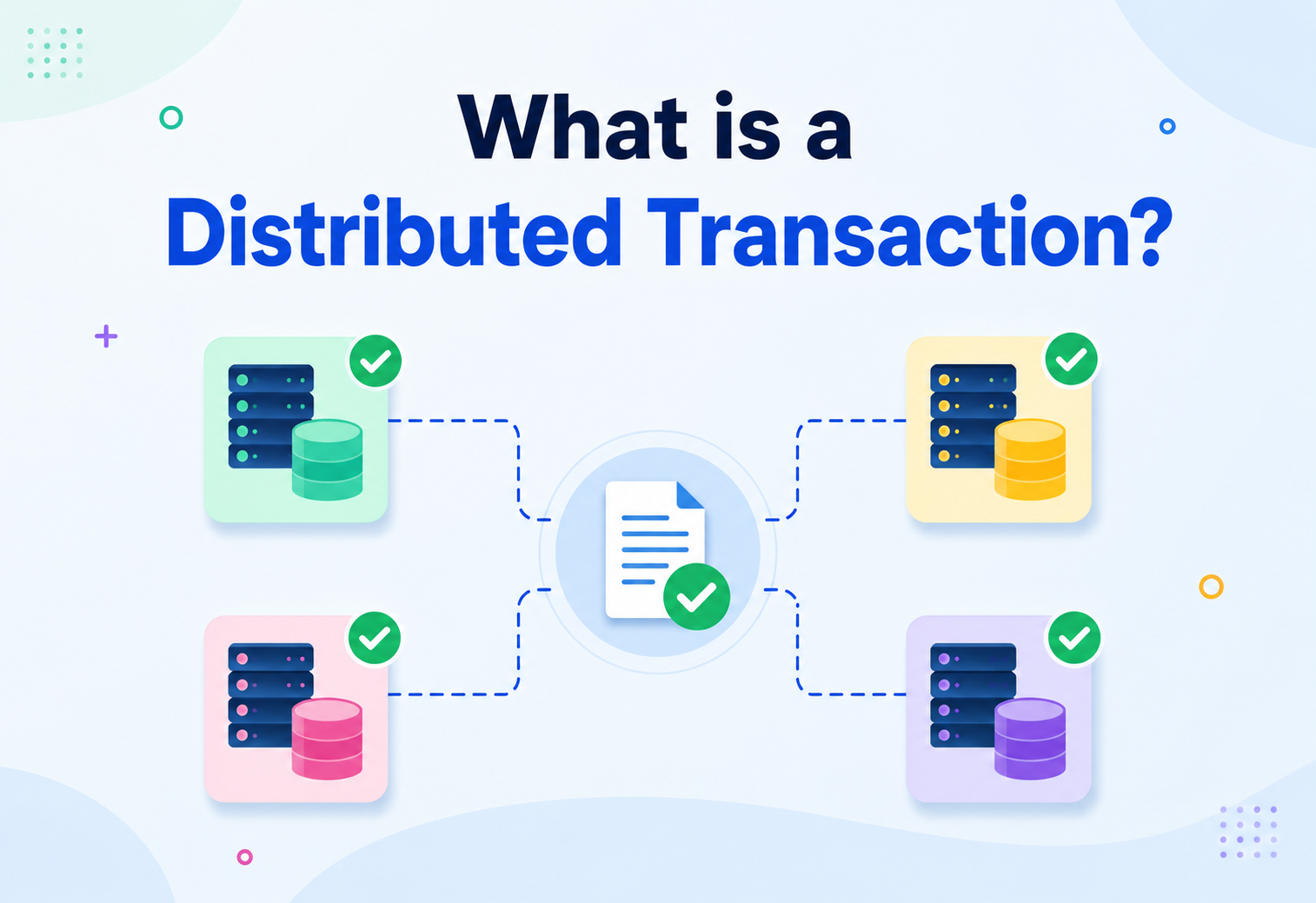
A distributed transaction simply means: this same “all or nothing” promise, but now the smaller promises are scattered across different computers, different databases, or even different companies, often connected only by a slow and unreliable network.
A Short History
In the early days of computing (1970s–1980s), almost all applications used a single database running on a single machine. Keeping data consistent was relatively easy because everything lived in one place, protected by one piece of software.
As companies grew, they started splitting their systems: one database for orders, one for payments, one for inventory — sometimes even in different countries. Researchers at IBM and other labs in the late 1970s designed a protocol called Two‑Phase Commit (2PC) to let multiple databases agree on a transaction together. This became part of a standard called X/Open XA in the early 1990s, which many enterprise databases and message queues still support today.
Then came the internet‑scale era: Amazon, Google, Netflix, and Uber began building systems so large that a single database could no longer handle the traffic. This gave birth to microservices — hundreds or thousands of small, independent services, each with its own database. Classic 2PC turned out to be too slow and too fragile for this new world, so engineers invented lighter‑weight patterns like Sagas, TCC (Try‑Confirm/Cancel), and modern consensus algorithms like Paxos and Raft. This tutorial will teach you all of these, from the ground up.
Fig 1.1 — How distributed‑transaction techniques evolved over 50 years.
Problem & Motivation
Why can’t we just use a normal, simple transaction for everything? Let’s understand the problem step by step, starting with what works well on a single machine.
2.1 The World Before Distribution: Local Transactions
When all your data lives in one database, that database gives you a beautiful guarantee called ACID:
| Letter | Property | Meaning in Plain English |
|---|---|---|
| A | Atomicity | All steps happen, or none happen. No partial work. |
| C | Consistency | The data always follows the rules (e.g. balance can never go negative). |
| I | Isolation | Two transactions running at the same time don’t mess up each other’s data. |
| D | Durability | Once done, the change survives even a power cut or crash. |
In a single MySQL database, transferring money between two accounts in the same bank is one transaction. The database engine locks both rows, updates them, and either commits both changes or rolls back both. This is fast, safe, and simple because everything is under one roof.
2.2 The World After Distribution: The Problem Appears
Now split your system into multiple services, each owning its own database:
- Order Service → Order Database
- Payment Service → Payment Database
- Inventory Service → Inventory Database
- Shipping Service → Shipping Database
Placing an order now requires four different databases, on four different machines, possibly in four different data centers, to all agree. A normal ACID transaction cannot span across separate databases or separate network machines — there’s no shared lock manager, no shared transaction log, and the network between them can fail, slow down, or get partitioned at any moment.
If we do nothing special, a network hiccup during checkout could mean: money is charged, but the order is never created. Or an item is reserved in inventory forever, even though the order failed. These are called data inconsistency bugs, and they are some of the most expensive and embarrassing bugs a company can ship.
2.3 The Core Challenges
1. Network Unreliability
Messages between services can be delayed, lost, duplicated, or arrive out of order. A “success” response might never reach the sender, even though the work was actually done.
2. Partial Failure
Service A can succeed while Service B crashes at the exact same moment. Unlike a single machine (which usually fails completely), distributed systems fail partially — the hardest kind of failure to handle.
3. No Global Clock
Different machines have slightly different clocks. You cannot simply say “this happened before that” using wall‑clock time across machines.
4. No Shared Memory
Services can’t just “share a lock” in memory. They must coordinate purely through message passing over the network, which is slow compared to memory access.
In 2015, Amazon documented publicly how their order pipeline evolved away from rigid distributed transactions toward asynchronous, event‑driven workflows precisely because strict two‑phase commit across dozens of services would have made checkout painfully slow and fragile during peak traffic like Prime Day or Black Friday.
This is exactly the motivation for distributed transactions: we need techniques and protocols that let independent systems, connected by an unreliable network, still reach agreement — either “everything succeeded” or “everything was undone” — without needing to be one giant database.
Core Concepts
Before we go deeper, let’s pin down the vocabulary that will show up in every remaining section.
3.1 What Exactly Is a Distributed Transaction?
A distributed transaction is a sequence of operations performed across two or more independent, networked resources (databases, message queues, services, or systems) that must be completed with the same all‑or‑nothing guarantee as a normal transaction — even though no single computer controls all the resources.
A distributed transaction is a unit of work spanning multiple network‑separated resource managers, coordinated so that either every participant permanently applies its part of the work (commit), or every participant discards its part of the work (abort/rollback), with no participant left in a state that disagrees with the others.
3.2 Key Vocabulary You Must Know
WhatA special component that oversees the whole transaction and tells every participant when to prepare, commit, or abort.
WhySomeone needs to be the “referee” who collects everyone’s vote and announces the final decision.
Where usedIn 2PC coordinators, Saga orchestrators, and workflow engines like Camunda or Temporal.
AnalogyLike a wedding officiant who asks both people “do you agree?” and only pronounces them married if both say yes.
WhatAny database, service, or system that takes part in the transaction and must obey the coordinator’s final decision.
WhyThese are the actual “doers” of the work — they hold the real data.
Where usedEvery microservice’s local database in a Saga; every XA‑compliant database in 2PC.
AnalogyThe bride and groom in the wedding — they do the actual “I do.”
WhatMaking a change permanent and visible.
WhyTo signal “this data is now final, no going back.”
AnalogySigning and stamping a legal document — once stamped, it’s official.
WhatUndoing changes so the system returns to how it was before the transaction started.
WhyIf even one participant cannot complete its part, everyone else must undo their work to avoid inconsistency.
AnalogyTearing up a contract before anyone signs it, because one party backed out.
WhatAn operation that produces the same result no matter how many times you repeat it.
WhyNetworks retry messages. If “charge ₹500” is not idempotent, a retried message could charge the customer twice.
AnalogyPressing an elevator button five times doesn’t call five elevators — one press is enough, and repeats don’t change the outcome.
ExamplePayment services attach a unique idempotency-key to every charge request so retries don’t double‑charge.
WhatA separate operation that reverses the effect of a previously completed step (since you can’t “rollback” work that’s already been committed and made visible to others).
WhyIn distributed systems, once a step commits, you often can’t undo it directly — you must take a new counteracting action.
AnalogyIf you’ve already mailed a wrong gift to someone, you can’t “un‑mail” it — you send a return‑pickup request instead.
Example“ReserveInventory” is compensated by “ReleaseInventory.”
3.3 ACID vs. BASE
Distributed systems often trade strict ACID guarantees for a looser, more available model called BASE.
| ACID | BASE |
|---|---|
| Atomicity — all or nothing, immediately | Basically Available — system responds even under failure |
| Consistency — always valid data | Soft state — data may be in flux temporarily |
| Isolation — no interference between transactions | Eventual consistency — data becomes consistent over time |
| Durability — permanent once committed |
ACID is like a strict teacher who checks every student’s homework before allowing anyone to leave the classroom — nobody moves until everyone is verified. BASE is like a teacher who lets students leave as they finish, trusting that any mistakes will be caught and corrected later during grading.
3.4 Types of Distributed Transactions
- Homogeneous: all participants use the same type of database (e.g. all MySQL databases replicated across regions).
- Heterogeneous: participants use different technologies (e.g. PostgreSQL + Kafka + a REST‑based payment gateway).
- Short‑lived (ACID‑style, 2PC): completes in milliseconds to seconds, holds locks the whole time.
- Long‑running (Saga‑style): can take minutes, hours, or days (e.g. a hotel booking that waits for hotel confirmation), and does not hold locks the whole time.
Architecture & Components
Let’s look at the actual building blocks that make a distributed transaction system work.
4.1 The Standard Components
| Component | Role |
|---|---|
| Transaction Coordinator / Orchestrator | Drives the transaction forward, tracks state, decides commit or rollback. |
| Participants / Resource Managers | Own the actual data; execute local operations and obey coordinator decisions. |
| Transaction Log (Write‑Ahead Log) | Durable record of every decision, so the coordinator can recover after a crash. |
| Message Broker (Kafka, RabbitMQ, SQS) | Carries events/commands reliably between services, often with retry and ordering guarantees. |
| Outbox Table | Local database table used to atomically store “events to be published” alongside business data. |
| Idempotency Store | Tracks which requests have already been processed, to safely handle retries. |
| Timeout / Retry Manager | Detects stuck transactions and triggers retries or compensations. |
Fig 4.1 — A typical distributed‑transaction architecture with a coordinator, participants, and an event backbone.
4.2 Why a Separate Coordinator?
You could try to make participants talk to each other directly without any coordinator (this is called choreography), but as the number of services grows, this becomes a tangled web that’s hard to reason about. A coordinator (orchestration) centralizes the decision‑making, making the flow easier to visualize, debug, and monitor — at the cost of a single component that must itself be made highly available.
Netflix’s internal workflow engine (and open‑source tools like Temporal, Camunda, and AWS Step Functions) act as orchestrators for exactly this reason — they give you a visual, replayable history of every step in a long business transaction.
Internal Working
Let’s go under the hood of the two most important mechanisms: Two‑Phase Commit and Sagas. We’ll cover more protocols in Section 7, but here we build the intuition first.
5.1 Two‑Phase Commit (2PC) — Step by Step
2PC works exactly like its name says: two phases.
- Phase 1 — Prepare (Voting): the coordinator asks every participant, “Can you commit your part?” Each participant does all the work needed, writes it to its own durable log, but does not make it permanently visible yet. It then replies “Yes, I’m ready” (Vote‑Commit) or “No, I can’t” (Vote‑Abort).
- Phase 2 — Commit/Abort (Decision): if all participants voted yes, the coordinator tells everyone to commit for real. If even one voted no, the coordinator tells everyone to abort/rollback.
Think of a group of five friends deciding on a restaurant. First, everyone privately says “yes, I can go” or “no, I can’t make it” (Phase 1: voting). Only if everyone says yes does the group leader announce “We’re going!” (Phase 2: commit). If even one person says no, the leader announces “Plan cancelled” and everyone stays home (Phase 2: abort).
Figs 5.1 & 5.2 — A successful Two‑Phase Commit where both participants vote yes, and the alternative abort path when any participant votes no.
5.2 The “Blocking Problem” in 2PC
2PC has a famous weakness: if the coordinator crashes right after Phase 1 (after collecting votes) but before sending the Phase 2 decision, every participant is stuck. They’ve already said “I’m ready” and locked their resources, but they don’t know whether to commit or abort — they must simply wait (block) until the coordinator recovers. This is why 2PC is called a blocking protocol.
While participants are blocked, they typically hold database locks, which can freeze other unrelated transactions too. This is one of the biggest reasons large internet companies moved away from synchronous 2PC across microservices.
5.3 Sagas — Step by Step
A Saga breaks a long transaction into a sequence of small, independent local transactions. Each local transaction commits immediately (no waiting, no locks held across services). If a later step fails, the Saga runs compensating transactions to undo the already‑completed steps, in reverse order.
Planning a trip: you book a flight, then a hotel, then a rental car — each booking is confirmed independently and immediately. If the rental car booking fails, you don’t magically “unbook” the flight — instead, you actively cancel the flight and hotel yourself. That act of active cancellation is the compensating transaction.
Fig 5.3 — A Saga that fails midway and compensates the earlier successful step.
Data Flow & Lifecycle
Every distributed transaction, regardless of protocol, moves through a predictable lifecycle. Understanding these states is critical for debugging and for interviews.
Fig 6.1 — The general lifecycle states of a distributed transaction.
6.1 Lifecycle Explained
- Initiated: a client request triggers the start of a transaction, and a unique transaction ID is generated. This ID is attached to every message so all services can correlate the work (essential for tracing, covered in Section 12).
- In Progress: the coordinator sends commands to participants one by one (Saga) or in parallel (2PC prepare phase).
- Preparing / Voting (2PC only): participants tentatively do the work and report readiness.
- Committing or Aborting: the final decision is made and broadcast.
- Compensating (Saga only): if something failed partway, previously completed steps are reversed via compensating actions.
- Terminal State: Committed, Aborted, or Compensated — the transaction record is archived, and the transaction log entry can eventually be cleaned up.
Uber’s trip‑and‑payment pipeline treats “trip completed” as an event that kicks off a Saga‑like flow: fare calculation → payment capture → driver payout → receipt email. Each step is its own local transaction with its own retry and compensation logic, and the whole flow is tracked using a correlation/trip ID visible in logs and dashboards.
Protocols: 2PC, 3PC, Saga, and TCC
Now let’s go deeper into the four most important protocols you’ll encounter in real systems and interviews.
7.1 Two‑Phase Commit (2PC) — Recap and Java Example
2PC is strongly consistent but blocking and synchronous. It works best for a small number of participants that are all reachable and fast (e.g. within one data center, using XA‑compliant resources like JDBC + JMS).
Java Example (using JTA‑style pseudocode with an XA‑like coordinator):
// A simplified illustration of how a Java Transaction API (JTA) style
// coordinator drives a Two-Phase Commit across two XA resources.

public class TwoPhaseCommitCoordinator {

    private final List<XAResourceParticipant> participants;

    public TwoPhaseCommitCoordinator(List<XAResourceParticipant> participants) {
        this.participants = participants;
    }

    public boolean executeTransaction() {
        List<XAResourceParticipant> prepared = new ArrayList<>();

        // PHASE 1: PREPARE
        for (XAResourceParticipant p : participants) {
            boolean voteCommit = p.prepare();     // does the work, writes to local log
            if (!voteCommit) {
                // Someone voted NO -> abort everyone that already prepared
                rollbackAll(prepared);
                return false;
            }
            prepared.add(p);
        }

        // PHASE 2: COMMIT (only reached if everyone voted YES)
        for (XAResourceParticipant p : participants) {
            p.commit();
        }
        return true;
    }

    private void rollbackAll(List<XAResourceParticipant> prepared) {
        for (XAResourceParticipant p : prepared) {
            p.rollback();
        }
    }
}

interface XAResourceParticipant {
    boolean prepare();   // returns true if this participant can safely commit
    void commit();
    void rollback();
}
Explanation: the coordinator first asks every participant to prepare(). Only if all return true does it call commit() on everyone; otherwise it calls rollback() on the ones that already prepared. This mirrors exactly what real JTA transaction managers (like Atomikos or Narayana) do internally.
7.2 Three‑Phase Commit (3PC)
3PC adds an extra step (“pre‑commit”) between voting and committing, along with timeouts, specifically to reduce the blocking problem of 2PC. If the coordinator crashes, participants that reached “pre‑commit” can safely assume the transaction was heading toward commit and can proceed without waiting forever.
3PC is mostly taught in academic settings. It assumes the network never partitions in certain ways, which isn’t realistic on the public internet. In real production systems, engineers prefer Sagas or consensus‑based systems (Raft/Paxos) over 3PC.
7.3 Saga Pattern — Orchestration vs. Choreography
There are two ways to implement a Saga:
| Style | How it works | Pros | Cons |
|---|---|---|---|
| Orchestration | A central orchestrator explicitly calls each service in order and handles failures. | Easy to visualize, centralized error handling, good tooling (Temporal, Camunda, Step Functions). | Orchestrator becomes a critical component; some central coupling. |
| Choreography | Each service listens for events and reacts, publishing its own events for the next service. | Fully decentralized, no single point of control, services stay decoupled. | Hard to see the “big picture,” debugging is harder, risk of event cycles. |
Fires an OrderCreated event when a new order is placed.
Listens for OrderCreated, charges the card, and emits PaymentCompleted.
Listens for PaymentCompleted, reserves stock, and emits ItemReserved.
Listens for ItemReserved and schedules delivery — no central controller in the middle.
Fig 7.1 — Choreography: services react to each other’s events with no central controller.
Java Example (Saga Orchestrator, simplified):
public class OrderSagaOrchestrator {

    private final InventoryClient inventoryClient;
    private final PaymentClient paymentClient;
    private final ShippingClient shippingClient;

    public SagaResult placeOrder(OrderRequest request) {
        String sagaId = UUID.randomUUID().toString();
        List<Runnable> compensations = new ArrayList<>();

        try {
            inventoryClient.reserveItem(sagaId, request.getItemId(), request.getQty());
            compensations.add(() -> inventoryClient.releaseItem(sagaId, request.getItemId()));

            paymentClient.charge(sagaId, request.getCustomerId(), request.getAmount());
            compensations.add(() -> paymentClient.refund(sagaId, request.getCustomerId()));

            shippingClient.scheduleDelivery(sagaId, request.getAddress());
            compensations.add(() -> shippingClient.cancelDelivery(sagaId));

            return SagaResult.success(sagaId);

        } catch (SagaStepException ex) {
            // Run compensations in reverse order
            Collections.reverse(compensations);
            for (Runnable compensate : compensations) {
                try {
                    compensate.run();
                } catch (Exception compEx) {
                    // Log and alert - compensation failures need human/automated retry
                    Alerting.raise("Compensation failed for saga " + sagaId, compEx);
                }
            }
            return SagaResult.failed(sagaId, ex.getMessage());
        }
    }
}
Explanation: every successful step pushes a matching compensation onto a stack‑like list. If a later step throws, we run compensations in reverse order — exactly like undoing a stack of actions. Note that compensation failures are logged for alerting, because compensations themselves can fail and need special handling (often a retry queue or manual intervention).
7.4 TCC — Try, Confirm, Cancel
TCC is a more structured variant of Saga, popular in the payments and e‑commerce world (used heavily by Alibaba’s Seata framework, for example). Every operation is split into three explicit phases:
- Try: reserve resources without finalizing (e.g. “hold” ₹500, don’t deduct it yet).
- Confirm: if all Try steps succeeded, actually finalize the reservation (deduct the held ₹500).
- Cancel: if any Try step failed, release the reservation (unhold the ₹500).
Booking a hotel room: “Try” is like putting a temporary hold on a room with your credit card. “Confirm” is checking in and being formally charged. “Cancel” is releasing the hold if you decide not to come.
Fig 7.2 — TCC pattern: reserve first, finalize (or cancel) second.
TCC gives stronger guarantees than a plain Saga (because resources are explicitly “held,” preventing others from using them mid‑transaction) but requires more implementation effort — every service must implement all three operations.
7.5 Comparing the Protocols
| Protocol | Consistency | Speed | Blocking? | Best For |
|---|---|---|---|---|
| 2PC | Strong | Slow (synchronous, holds locks) | Yes | Few participants, same data center, financial‑grade accuracy |
| 3PC | Strong (theoretically) | Slower than 2PC | Reduced, not eliminated | Mostly academic today |
| Saga | Eventual | Fast (async, no held locks) | No | Microservices, long‑running workflows |
| TCC | Near‑strong (via reservation) | Moderate | Partially (during Try) | Payments, e‑commerce checkouts |
Advantages, Disadvantages & Trade‑offs
Distributed transactions solve real, painful problems — but they are not free. Being honest about both sides will save you from a lot of pain later.

8.1 Advantages of Using Distributed Transactions
- Keeps data correct and trustworthy across independently owned systems.
- Prevents “half‑completed” business operations (e.g. charged but no order).
- Enables safe scaling — each service/database can grow independently while still cooperating correctly.
- Provides clear recovery semantics after crashes (via logs and compensations).
8.2 Disadvantages
- Complexity: significantly harder to design, test, and debug than local transactions.
- Latency: coordinating multiple network calls is inherently slower than one local commit.
- Availability trade‑off: strong protocols like 2PC reduce availability during coordinator failure.
- Operational burden: requires dedicated monitoring, dead‑letter queues, and compensation logic.
- Partial visibility: with Sagas, other parts of the system might briefly see “in‑progress” or inconsistent state (eventual consistency window).
8.3 Trade‑off Table
| Choice | You Gain | You Give Up |
|---|---|---|
| 2PC (strong consistency) | Immediate correctness, simpler mental model | Availability, throughput, low latency |
| Saga (eventual consistency) | High availability, better scalability, resilience | Instant consistency; must design compensations carefully |
| Synchronous coordination | Simpler debugging (linear flow) | Tight coupling between services, cascading failures |
| Asynchronous / event‑driven | Loose coupling, resilience to slow services | Harder tracing, eventual consistency, message ordering issues |
Choosing 2PC vs. Saga is like choosing between waiting for the whole family to arrive before starting dinner (2PC — nobody eats until everyone is ready) versus starting dinner as people arrive and keeping a plate warm for latecomers, with a plan to reheat or discard it if someone cancels (Saga — flexible, but requires a “Plan B”).
Performance & Scalability
Every additional participant adds another network hop and another opportunity for something to go wrong. That’s why performance work here starts with reducing coordination itself.
9.1 Why Distributed Transactions Are Slower
Every extra network round trip adds latency. If a 2PC transaction involves 4 participants, and each round trip takes ~20 ms, the Prepare phase alone can take 20–40 ms (parallel calls), plus the Commit phase another 20–40 ms — before we even count database work. Under load, holding locks during this window can drastically reduce throughput.
9.2 Techniques to Improve Performance
- Parallelize Prepare calls: send prepare requests to all participants simultaneously instead of one by one.
- Reduce participant count: design service boundaries so a single business transaction touches as few services as possible.
- Use async messaging (event‑driven Sagas): avoid holding connections/locks open while waiting for slow steps.
- Batching: group many small transactions into fewer, larger ones where correctness allows.
- Local‑first design (Outbox Pattern): write business data and the “event to send” in the same local database transaction, then publish asynchronously — avoiding a distributed transaction entirely for many cases.
WhatInstead of updating your database AND publishing a message to Kafka as two separate operations (risky!), you write the message into an “outbox” table inside the same local database transaction. A separate background process then reads the outbox and reliably publishes to Kafka.
WhyIt avoids needing a full distributed transaction between a database and a message broker — the local ACID transaction guarantees both the data change and the “intent to send” happen atomically.
AnalogyWriting both “pay the electricity bill” and “mark it as paid in my notebook” on the same page at the same time, so you can never forget you already did it.
ExampleDebezium (an open‑source Change Data Capture tool) is commonly used to read the outbox table’s changes and publish them to Kafka, a pattern widely used at companies like Shopify and Uber.
Fig 9.1 — Transactional Outbox Pattern avoids a distributed transaction between a DB and a message broker.
9.3 Scalability Considerations
As traffic grows, coordinators can become bottlenecks. Solutions include sharding the coordinator by transaction ID, using horizontally scalable workflow engines (like Temporal, which persists state and can run many worker processes), and preferring choreography for very high‑throughput flows where a central orchestrator would become a hotspot.
High Availability & Reliability
A distributed transaction system is only as available as its coordinator plus its logs. Everything in this section is about making sure a single failure never means “the whole thing is stuck.”
10.1 Making the Coordinator Highly Available
Since the coordinator is critical, it must never be a single point of failure. Common techniques:
- Persistent transaction log: every decision is written to durable storage (disk, or a replicated log like Kafka) before being sent to participants, so a crashed coordinator can recover its exact state on restart.
- Leader election: multiple coordinator instances run, but only one is “active” at a time, elected using a consensus algorithm like Raft (see Section 17).
- Idempotent participant operations: so that if the coordinator retries a command after recovering, it doesn’t cause duplicate side effects.
10.2 Timeouts and Retries
If a participant doesn’t respond within a set time, the coordinator must have a policy: retry, escalate to a human, or mark the transaction as “failed, needs compensation.” Exponential backoff (waiting longer between each retry) prevents overwhelming a struggling service.
WhatA special holding queue where messages that repeatedly fail to process are placed instead of being retried forever.
WhyPrevents “poison messages” from blocking the whole pipeline, while preserving them for investigation.
AnalogyA “returned mail” bin at the post office for letters that couldn’t be delivered after several attempts — someone reviews it later instead of the mail truck looping forever.
10.3 Circuit Breakers
When a participant service is consistently failing, a circuit breaker stops sending it new requests for a cooldown period, failing fast instead of piling up timeouts. This protects both the struggling service (giving it room to recover) and the overall system’s responsiveness.
Fig 10.1 — Circuit breaker states used to protect participants from cascading failure.
10.4 Disaster Recovery
Transaction logs should be replicated across availability zones (or regions for critical financial systems). Regular backups plus tested restore procedures (measured with RPO — Recovery Point Objective, and RTO — Recovery Time Objective) ensure that even a full data center outage doesn’t permanently corrupt transaction history.
Security
Every extra network hop is another surface an attacker can probe. Distributed‑transaction security is really about protecting the coordinator‑participant conversation from tampering, replay, and impersonation.
11.1 Key Security Concerns
- Authentication between services: every participant must verify that commands genuinely come from the real coordinator (e.g. using mutual TLS or signed service tokens like JWTs), preventing a malicious actor from injecting fake “commit” commands.
- Authorization: even a legitimate coordinator should only be allowed to trigger operations it’s permitted to (principle of least privilege) — a shipping‑related coordinator shouldn’t be able to directly modify payment records.
- Data‑in‑transit encryption: all coordinator‑participant communication should use TLS to prevent eavesdropping or tampering with transaction data (like amounts or account numbers).
- Replay attack protection: idempotency keys and nonces prevent an attacker from re‑sending an old, captured “commit” or “charge” message to cause duplicate effects.
- Audit logging: every state transition (prepared, committed, compensated) should be logged immutably for compliance (important in finance and healthcare under regulations like PCI‑DSS, SOX, HIPAA).
Payment processors like Stripe require an Idempotency-Key header on every charge API call specifically to defend against network retries or malicious replay causing a customer to be charged multiple times for one purchase.
11.2 Securing Compensations
Compensating actions (like refunds) are sensitive and must themselves be authenticated and rate‑limited — an attacker triggering fake compensations repeatedly could be used to drain a company’s funds or manipulate inventory counts.
Monitoring, Logging & Metrics
You cannot fix what you cannot see. In a world of many services and many messages, observability is the difference between a two‑minute incident and a two‑hour outage.
12.1 Distributed Tracing
Because a single business transaction spans many services, you need a way to see the whole journey. This is done using a trace ID (also called a correlation ID), generated once at the start and passed through every service call and every message.
WhatA technique to follow one request as it travels across many services, recording timing and outcome at each hop.
WhyWithout it, debugging “why did this order fail” means manually grepping through logs on ten different machines.
Where usedTools like Jaeger, Zipkin, and OpenTelemetry, often integrated with Grafana or Datadog dashboards.
AnalogyAttaching a tracking number to a package — you can see every checkpoint it passed through, from warehouse to doorstep.
Fig 12.1 — A trace timeline showing how long each service took within one transaction.
12.2 Key Metrics to Track
| Metric | Why it matters |
|---|---|
| Transaction success rate | Percentage of transactions that reach “Committed” without compensation. |
| Compensation rate | How often Sagas need to roll back — a high rate signals upstream problems. |
| Average / P99 transaction latency | Detects slow participants dragging down the whole flow. |
| Stuck / in‑progress transaction count | Transactions that haven’t reached a terminal state within expected time — early warning of a stuck coordinator or lost message. |
| Dead‑letter queue depth | Number of messages that failed permanently and need manual review. |
| Coordinator / orchestrator uptime | Availability of the most critical single component. |
12.3 Alerting & Dashboards
Set alerts on rising compensation rates, growing DLQ size, or transactions stuck longer than an expected SLA (e.g. “no order should stay ‘in‑progress’ for more than 5 minutes”). Structured logging (JSON logs with the trace ID as a field) makes it possible to query “show me every log line for trace‑id 8f21ac” instantly in tools like Elasticsearch/Kibana or Splunk.
Deployment & Cloud
Every major cloud offers building blocks for this problem — you rarely need to build a coordinator from scratch anymore.
13.1 Cloud‑Native Building Blocks
| Need | AWS | Azure | GCP |
|---|---|---|---|
| Workflow Orchestration | Step Functions | Durable Functions | Workflows |
| Message Broker | SQS / SNS / EventBridge | Service Bus / Event Grid | Pub/Sub |
| Distributed SQL Database | Aurora / DynamoDB Transactions | Cosmos DB | Spanner |
| Streaming / CDC | MSK (Kafka) + DMS | Event Hubs | Datastream + Pub/Sub |
13.2 Deployment Considerations
- Multi‑region deployments: coordinators and their logs should be replicated across regions for critical systems (e.g. global payment platforms), but cross‑region latency must be factored into timeout settings.
- Blue‑green / canary releases: when deploying a new version of a participant service, ensure it stays backward‑compatible with in‑flight transactions started by the old version.
- Schema evolution: event payloads (used in Sagas) should be versioned so old and new consumers can coexist during rollout.
- Cost optimization: frequent short‑lived distributed transactions can be expensive at scale (network egress, message broker throughput charges) — batching and outbox patterns help reduce cost.
Modern globally distributed databases like Google Spanner and CockroachDB use synchronized clocks (Spanner’s “TrueTime” API, using GPS and atomic clocks) combined with consensus protocols to offer strongly consistent distributed transactions across continents — something that was considered nearly impossible at global scale a decade earlier.
Databases, Caching & Load Balancing
The database is the ground truth. Your caching and load‑balancing decisions must respect its transactional boundary — not fight it.
14.1 Database Choices for Distributed Transactions
- XA‑compliant databases (Oracle, PostgreSQL, MySQL with XA support): support classic 2PC directly.
- NewSQL / Distributed SQL databases (Google Spanner, CockroachDB, YugabyteDB, TiDB): provide ACID transactions across nodes internally, using consensus protocols under the hood, so application developers get strong consistency without manually implementing 2PC.
- NoSQL databases (MongoDB, DynamoDB, Cassandra): traditionally favored availability and partition tolerance over strict cross‑document/cross‑partition transactions, though many now offer limited multi‑document ACID transactions (e.g. MongoDB since version 4.0).
14.2 Caching Considerations
Caches (like Redis) sit outside the transactional boundary, so a rollback of the underlying database won’t automatically undo a cache update. Strategies to handle this:
- Cache‑aside with short TTLs: accept brief staleness, but expire cache entries quickly.
- Invalidate‑on‑commit: only update/invalidate cache entries after the transaction reaches a terminal “Committed” state, never during “in‑progress.”
- Write‑through with compensation: if a compensating transaction runs, explicitly issue a matching cache invalidation as part of the compensation logic.
14.3 Load Balancing the Coordinator
Coordinator instances behind a load balancer must share transaction state (via a shared, replicated log or database) — a request to “check status of transaction X” must return the same answer no matter which coordinator instance handles it. This usually means the load balancer is stateless, and all coordinator instances read/write to a common, consistent transaction log store.
Fig 14.1 — Multiple coordinator instances sharing one consistent transaction log for high availability.
APIs & Microservices
The API you expose to callers largely decides how safe your service is inside a distributed transaction. A few small choices — idempotency keys, explicit states, matching compensations — save enormous pain later.
15.1 Designing APIs for Distributed Transactions
- Always accept an idempotency key in write APIs (e.g.
POST /paymentswith headerIdempotency-Key: abc-123). - Return explicit status, not just success/failure: APIs should support states like
PENDING,RESERVED,CONFIRMED,CANCELLEDso orchestrators can poll or react correctly. - Design compensating endpoints alongside the primary action: if you build
POST /reserve, also buildPOST /releasefrom day one. - Version your events: include a schema version field in event payloads so consumers can handle changes gracefully.
Java Example — A Spring‑style REST controller with idempotency support:
@RestController
@RequestMapping("/payments")
public class PaymentController {

    private final IdempotencyStore idempotencyStore;
    private final PaymentService paymentService;

    @PostMapping
    public ResponseEntity<PaymentResponse> charge(
            @RequestHeader("Idempotency-Key") String idempotencyKey,
            @RequestBody PaymentRequest request) {

        Optional<PaymentResponse> existing = idempotencyStore.get(idempotencyKey);
        if (existing.isPresent()) {
            // Same request seen before -> return the SAME result, don't charge again
            return ResponseEntity.ok(existing.get());
        }

        PaymentResponse response = paymentService.charge(request);
        idempotencyStore.save(idempotencyKey, response);
        return ResponseEntity.ok(response);
    }
}
Explanation: before doing any real work, the controller checks whether this exact Idempotency-Key has already been processed. If yes, it returns the cached result instead of charging the customer again — this single pattern prevents an enormous class of distributed‑transaction bugs caused by network retries.
15.2 Microservices Boundaries
Good microservice design tries to minimize the need for distributed transactions in the first place, by drawing service boundaries around business capabilities that naturally change together (a concept from Domain‑Driven Design called a “Bounded Context”). When a single business action genuinely needs multiple services, that’s when Sagas or TCC come in.
Design Patterns & Anti‑patterns
A short catalogue of patterns you should reach for, and anti‑patterns you should learn to spot in code reviews and design sessions.
16.1 Recommended Patterns
| Pattern | Purpose |
|---|---|
| Saga (Orchestration/Choreography) | Coordinate multi‑step business transactions without distributed locks. |
| TCC (Try‑Confirm‑Cancel) | Reserve‑then‑finalize pattern for stronger guarantees than plain Saga. |
| Transactional Outbox | Atomically persist data change + event intent using one local transaction. |
| Idempotency Key | Make retried operations safe to repeat. |
| Compensating Transaction | Undo the effect of an already‑committed step. |
| Event Sourcing | Store every state change as an immutable event, enabling replay and audit. |
| CQRS (Command Query Responsibility Segregation) | Separate write and read models, often paired with Sagas for eventual consistency. |
16.2 Common Anti‑patterns to Avoid
Using synchronous 2PC‑style calls between every microservice for every operation. This gives you all the deployment complexity of microservices with none of the resilience benefits, because every service becomes tightly coupled and must be available simultaneously.
Building the “happy path” of a Saga but never implementing or testing the compensating actions. In production, failures WILL happen, and untested compensation code often has more bugs than the main flow.
Automatically retrying a “charge card” call without an idempotency key, risking double‑charging customers.
Relying on “fire‑and‑forget” events without a dead‑letter queue or monitoring, so a dropped message quietly leaves the system inconsistent forever.
Designing a single business transaction that touches 15+ services. This dramatically increases the chance of partial failure and latency. Prefer to redesign service boundaries.
Advanced Topics: CAP, Consensus, Replication & Failure Recovery
Underneath every reliable distributed transaction system sits a handful of theoretical ideas. You don’t need to be an academic to use them, but knowing them makes system behaviour under stress much less mysterious.
17.1 The CAP Theorem
The CAP theorem, formulated by computer scientist Eric Brewer in 2000, states that a distributed data system can only guarantee two of these three properties at the same time, when a network partition happens:
- Consistency (C): every read receives the most recent write or an error.
- Availability (A): every request receives a (non‑error) response, even without the latest data.
- Partition Tolerance (P): the system keeps working even if network messages are lost or delayed between nodes.
Imagine two shopkeepers in different cities who must always agree on how many toys are left in stock. If the phone line between them goes dead (a network partition), one shopkeeper must choose: stop selling anything until the phone line is fixed (favor Consistency), or keep selling based on possibly outdated numbers (favor Availability). They cannot have perfectly accurate numbers AND keep serving customers during the outage — that’s the CAP trade‑off.
Since network partitions are unavoidable in real distributed systems (P is mandatory), the real‑world choice is between CP systems (like Google Spanner, HBase, MongoDB in certain configurations) and AP systems (like Cassandra, DynamoDB in default mode, Amazon S3 historically). This directly shapes distributed transaction design: strongly consistent protocols like 2PC lean CP; Sagas embrace an AP mindset with eventual consistency.
Fig 17.1 — CAP theorem: partition tolerance is mandatory, so real systems choose between CP and AP.
17.2 Consensus Algorithms: Paxos & Raft
Coordinators, leader elections, and distributed logs all rely on consensus algorithms — protocols that let a group of machines agree on a single value even if some of them crash or messages are lost.
WhatA method for multiple machines to agree on one shared truth (like “who is the leader” or “what is the next entry in the log”), even when some machines fail.
WhyWithout consensus, different nodes could disagree about critical facts, causing data corruption or split‑brain scenarios.
Where usedZooKeeper and etcd (used by Kubernetes) use variants of Paxos/Raft; CockroachDB and TiDB use Raft directly for data replication.
AnalogyA group of jury members must reach a unanimous (or majority) verdict before the judge can announce a decision — consensus algorithms are the formal rules for how that agreement is reached, even if a juror falls asleep or leaves the room.
Raft (designed in 2014 specifically to be easier to understand than Paxos) works by electing a leader among a cluster of nodes. The leader receives all writes, replicates them to a majority of follower nodes, and only considers a write “committed” once a majority acknowledges it. If the leader crashes, followers hold a new election.
Fig 17.2 — Raft consensus: a write is committed once a majority of nodes acknowledge it.
17.3 Replication Strategies
| Strategy | Description | Trade‑off |
|---|---|---|
| Synchronous Replication | Write is only acknowledged after replicas confirm receipt. | Strong durability, but higher write latency. |
| Asynchronous Replication | Write is acknowledged immediately; replicas catch up afterward. | Lower latency, but risk of data loss if the primary crashes before replicating. |
| Quorum‑based Replication | Write succeeds once a majority (quorum) of replicas confirm. | Balances consistency and availability; used in Raft/Paxos‑based systems. |
17.4 Partitioning (Sharding)
Large distributed systems split data into shards (partitions), each holding a subset of data (e.g. users A–M on shard 1, N–Z on shard 2). Distributed transactions that span multiple shards face the same coordination challenges as transactions spanning multiple services — this is why cross‑shard transactions are often deliberately avoided or handled with the same 2PC/Saga techniques discussed above.
17.5 Failure Recovery
Robust distributed transaction systems must handle every type of failure:
- Coordinator crash before decision: on restart, the coordinator reads its durable log to find any in‑doubt transactions and re‑asks participants or re‑sends the last known decision.
- Participant crash mid‑prepare: on restart, the participant checks its own local log; if it had voted “yes” but never received a final decision, it must contact the coordinator to find out the outcome (this is the “in‑doubt” state).
- Message loss: handled via retries with idempotency, and timeouts that eventually trigger compensation.
- Split‑brain (two nodes both think they’re the leader): prevented by quorum‑based consensus — a leader is only valid if it can prove it has a majority of votes.
Fig 17.3 — Coordinator recovery flow after a crash, using the durable transaction log.
Best Practices & Common Mistakes
These are the habits that separate teams who ship a distributed‑transaction system once and forget it, from teams who spend every Friday night firefighting.
18.1 Best Practices
- ProtocolPrefer Sagas over 2PC for cross‑microservice workflows unless you have a small, tightly‑coupled set of participants that truly need strong consistency.
- IdempotencyMake every write operation idempotent from day one — don’t bolt it on later.
- CompensationsAlways design and test compensating actions as rigorously as the main flow (write automated tests that simulate failures at every step).
- OutboxUse a transactional outbox instead of dual‑writing to a database and a message broker separately.
- TracingPropagate a trace/correlation ID through every service call and log line.
- TimeoutsSet clear timeouts for every step, and define what happens on timeout (retry? compensate? alert a human?).
- ScopeKeep the number of participants in any single distributed transaction as small as possible.
- ObservabilityBuild dashboards and alerts for compensation rate, stuck transactions, and DLQ depth before going to production, not after an incident.
18.2 Common Mistakes
Assuming the network is reliable — always design for messages being delayed, duplicated, or lost.
Treating eventual consistency windows as bugs — some staleness is expected and must be communicated clearly to users (e.g. “Your order is being processed”).
Not versioning event schemas, causing consumer crashes when producers change a field.
Using 2PC across a public internet connection with high, variable latency — this dramatically increases the blocking window and risk of stuck locks.
No idempotency key on payment or inventory APIs — a classic and costly bug.
Real‑world & Industry Examples
Everything you’ve seen so far already runs, at enormous scale, inside companies you use every day.
Amazon’s order processing pipeline is a textbook example of the Saga pattern at massive scale — order placement, inventory reservation, payment, and fulfillment are handled as a chain of asynchronous, independently‑retryable steps rather than one giant locked transaction, allowing the system to absorb huge traffic spikes during events like Prime Day.
Netflix popularized the “eventual consistency by design” philosophy across its microservices, using asynchronous messaging and idempotent operations extensively, and open‑sourced tools (like Conductor, a workflow orchestration engine) specifically to manage complex multi‑service business processes reliably.
Uber’s trip lifecycle (request → match → ride → payment → payout) is implemented as a long‑running, stateful workflow, historically built on internal orchestration systems and more recently on tools like Cadence/Temporal (which Uber itself originally created) to reliably manage steps that can take minutes to complete with automatic retries and compensation.
Google’s globally distributed database offers full ACID transactions across data centers on different continents by combining Paxos‑based consensus with a globally synchronized clock system (TrueTime), showing that with enough engineering investment, even 2PC‑like strong consistency can scale globally — though at real infrastructure cost.
Core banking systems handling inter‑bank transfers (like SWIFT or domestic real‑time settlement systems) often still rely on strongly consistent, carefully audited coordination protocols, because the cost of even rare inconsistency (money appearing or disappearing) is unacceptably high, and volumes/latency requirements are more forgiving than e‑commerce checkout flows.
Stripe and every serious payment API require an Idempotency-Key header on every mutating call — a real‑world illustration that idempotency is not an optional nicety but a baseline expectation for distributed writes.
FAQ, Summary & Key Takeaways
A quick refresher on the questions that come up most often, followed by a compact wrap‑up of everything you now know.
Frequently Asked Questions
Q1. Is a distributed transaction the same as a database transaction?
No. A database transaction happens inside one database engine. A distributed transaction spans multiple independent systems (databases, services, or queues) coordinated together, often without a shared lock manager.
Q2. Should I always use Sagas instead of 2PC?
Not always. Sagas fit most microservice, internet‑scale use cases well because they favor availability and don’t hold locks. But for a small number of tightly coupled resources needing immediate, strong consistency (like an internal accounting ledger across two databases in the same data center), 2PC or a distributed SQL database with built‑in consensus can still be the right choice.
Q3. What happens if a compensating transaction itself fails?
This is a real operational risk. Best practice is to retry compensations with backoff, and if they keep failing, route them to a dead‑letter queue with alerting so a human or automated recovery job can intervene — you never want a “silently stuck” compensation.
Q4. Can I avoid distributed transactions altogether?
Often yes — by redesigning service boundaries so related data lives together (fewer cross‑service transactions needed), or by using patterns like the Transactional Outbox and eventual consistency instead of forcing strict cross‑service atomicity.
Q5. How is this related to the CAP theorem?
Distributed transaction protocols are essentially applied answers to the CAP theorem’s trade‑off: 2PC leans toward Consistency (at the cost of Availability during failures), while Sagas lean toward Availability (accepting temporary inconsistency that resolves eventually).
Q6. What’s the difference between orchestration and choreography again?
Orchestration has one central component explicitly directing every step (like a conductor leading an orchestra). Choreography has each service independently reacting to events from others (like dancers who each know their own steps and cues, with no single director).
Summary
A distributed transaction is how independent, networked systems cooperate to make sure a business operation either fully succeeds or fully fails — never getting stuck halfway. We started with the simple guarantee of ACID transactions on a single machine, saw why that guarantee breaks down once data is split across services, and explored the two major families of solutions: strongly consistent, blocking protocols like Two‑Phase Commit and Three‑Phase Commit, and flexible, resilient patterns like Sagas and TCC that favor availability and eventual consistency. We covered the real components (coordinators, participants, transaction logs, outboxes), the full lifecycle from initiation to a terminal state, and dove into advanced foundations like the CAP theorem, consensus algorithms (Paxos/Raft), replication, and failure recovery — the same ideas that power globally distributed databases like Google Spanner. Finally, we looked at how real companies like Amazon, Netflix, and Uber apply these ideas at massive scale in production.
Key Takeaways
“A distributed transaction doesn’t promise nothing will fail — it promises that failure won’t leave your data in a half‑done state.”
With this foundation, you’re now equipped to design, build, and operate distributed transactions the way real production systems do — choosing the right protocol for the right situation, and building in the resilience that large‑scale systems demand. Everything else in this space — workflow engines, service meshes, outbox pipelines, event stores — is a specialised expression of the same core idea: describe your desired outcome, coordinate carefully, log everything, and always have a way to undo what you’ve already done.