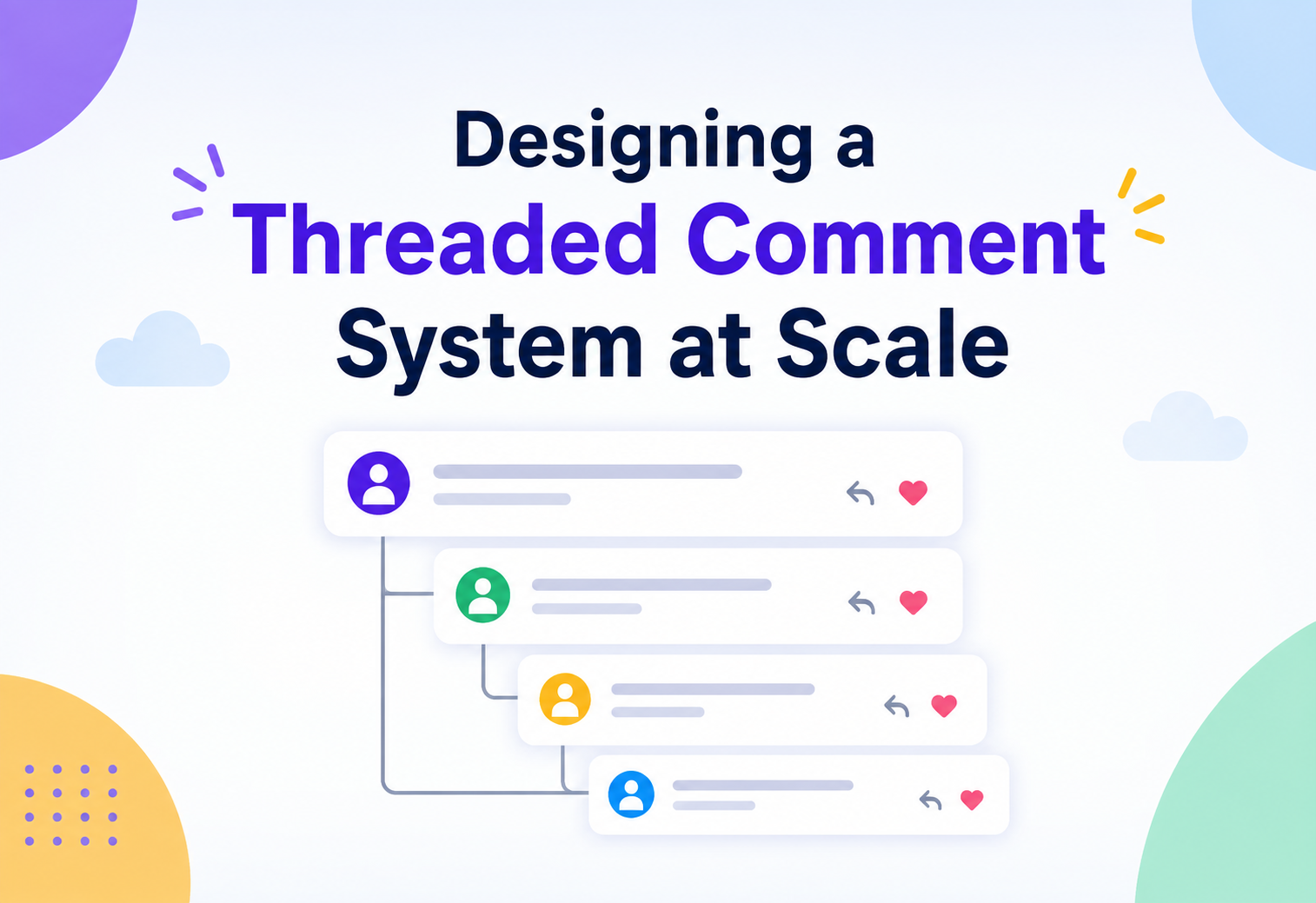
Designing a Threaded Comment System for Millions of Nested Replies
A complete, from-first-principles walkthrough of how to architect a comment platform that can host viral posts with millions of nested, threaded replies — covering data modeling, storage, caching, ranking, moderation, real-time delivery, and the trade-offs real companies make in production.
Introduction and History
Why “just add a comment box” turns into one of the trickiest problems in system design once the internet gets involved.
Every large content platform — Reddit, YouTube, Facebook, Hacker News, news sites, e-commerce review pages — eventually runs into the same problem: people want to talk about the thing they’re looking at, and they want to talk to each other, not just post one-line reactions into a void. That “talking to each other” is what turns a flat list of comments into a tree: a reply to a comment, a reply to that reply, and so on, sometimes ten or twenty levels deep, on a single post that might have five million comments attached to it.
A threaded comment system sounds simple at first glance — after all, it is “just” a discussion board bolted onto a post. But once you put it in front of the internet at scale, it becomes one of the trickiest data-modeling and infrastructure problems in system design. You are simultaneously building a write-heavy system (comments arrive in bursts, especially on trending posts), a read-heavy system (far more people read comments than write them), a real-time system (people expect new replies to appear live), a ranking system (the “best” comments must float to the top), and a moderation system (spam and abuse must be filtered before they reach millions of eyeballs) — all on top of a tree-shaped data structure that traditional relational databases were never designed to store efficiently.
This guide walks through the entire problem the way an experienced systems architect would approach it in a real design review: starting from first principles about what a comment tree actually is, working through the storage and ranking decisions that make or break performance at scale, and ending with the operational concerns — monitoring, security, deployment — that determine whether the system stays healthy once it’s live and being hammered by real, unpredictable human traffic. Along the way, every new idea is explained with a plain-English analogy first and a concrete, production-style example second, so the concepts build on each other rather than requiring prior distributed-systems background to follow. By the end, you should be able to reason confidently about why each design decision was made, not just what the final architecture looks like — which is exactly the kind of reasoning that separates a memorised diagram from a genuinely useful mental model you can apply to a different, unfamiliar system tomorrow.

Think of a comment section like a family reunion conversation happening in a single large room. Someone makes an announcement (the post). A few people respond loudly enough for the whole room to hear (top-level comments). Then small clusters form — three or four people huddled together, replying only to each other (threads). Some clusters grow so large they need their own corner of the room, and some conversations get so deep that new arrivals only skim the loudest voices near the door (the top-ranked comments) rather than following every side conversation to its end. A comment system’s entire engineering challenge is making that noisy room feel organised to every single person walking in, even when a million people are in it at once.
1.1 A Short History of Threaded Discussion
1980s–1990s — Usenet & Bulletin Board Systems
Threaded discussion existed long before the web — Usenet newsgroups used a “References” header to link a reply to its parent message, forming a tree that mail and newsreader clients rendered as indentation. This is the direct ancestor of every nested comment UI in use today.
2000s — Blog Comments & Early Forums
Platforms like phpBB and WordPress popularised flat or shallow-threaded comments stored directly in a relational database, usually with a simple parent_id column. This worked fine because volumes were small — hundreds, not millions, of comments per page.
2005–2010 — Reddit & Hacker News
Reddit popularised deep, algorithmically-ranked comment trees at internet scale, forcing engineers to solve tree storage, ranking (its “best” sort using a Wilson score interval), and collapsing/pagination of huge threads for the first time as first-class problems.
2010s — Disqus, Facebook Comments, YouTube
Third-party comment platforms like Disqus turned comment infrastructure into an embeddable product used by thousands of unrelated sites, requiring true multi-tenant scale. Facebook and YouTube built in-house systems that had to survive comment floods on posts read by hundreds of millions of people within hours.
Today — Real-Time, ML-Moderated, Globally Distributed
Modern comment systems combine real-time delivery (WebSockets/SSE), ML-based toxicity and spam detection, globally distributed caching, and elastic storage that can absorb a single post going viral without degrading the rest of the platform.
Problem and Motivation
Defining the problem precisely, the way you would in a design review before writing a single line of code.
Design a comment system for a content platform (think: a social feed, a video site, or a news site) where any post can receive comments, any comment can receive replies, replies can be nested to arbitrary depth, and a single popular post can accumulate millions of comments. The system must support posting, reading, editing, deleting, ranking/sorting, real-time updates, and moderation — all while staying fast and available under extremely uneven load (most posts get a handful of comments; a few posts get millions).
2.1 Why This Is Hard
If comment volume were small and uniform, you could store everything in one SQL table with a parent_id foreign key and call it done. The real difficulty comes from four forces pulling in different directions at once:
Skewed Load (“Hot Posts”)
99% of posts get a trivial number of comments. The 1% that go viral can receive more write traffic in an hour than the rest of the platform combined in a day. Your design must isolate that hotspot instead of letting it degrade everyone else.
Tree-Shaped Data on Row-Shaped Storage
Relational databases are extremely good at flat rows and joins between a bounded number of tables — they are not naturally good at “give me this entire subtree, sorted, five levels deep, in one fast query.”
Read:Write Ratio Is Extreme
For every person who writes a comment, thousands will read the thread. The system must be optimised overwhelmingly for read latency, not write latency — but writes still need to show up for the author instantly.
Ranking Changes Constantly
“Best” or “Top” comments are ranked by votes and recency, both of which change every second on a hot thread. Precomputing a sorted order that stays fresh without recalculating on every single read is a real engineering problem.
2.2 Non-Functional Requirements
| Requirement | Target | Why It Matters |
|---|---|---|
| Read latency (p99) | < 200 ms | Comment sections load alongside the main content; slow comments feel like a slow app. |
| Write latency (p99) | < 300 ms | Users expect their own comment to appear near-instantly after posting. |
| Availability | 99.95%+ | Comment outages are highly visible and erode trust even if the “core” product still works. |
| Consistency | Eventual, with read-your-own-write | A global “correct” vote count can lag by seconds; your own comment must never vanish after you post it. |
| Scale | Millions of comments per post, billions platform-wide | Defines the storage and indexing strategy from day one. |
“Before you design anything, what clarifying questions would you ask?” A strong answer: expected max nesting depth, expected max comments per post, read:write ratio, whether real-time delivery is required, whether ranking must be deterministic across page loads, and whether edits/deletes need to preserve thread structure. Asking these signals that you understand comment systems are shaped entirely by their load profile, not just their data model.
2.3 Back-of-the-Envelope Capacity Estimation
Before choosing any technology, it helps to put rough numbers on the problem — this is standard practice in real architecture reviews and a near-universal expectation in system design interviews. Let’s estimate for a platform with 500 million monthly active users, similar in order of magnitude to a large social or video platform.
| Assumption | Rough Number |
|---|---|
| Daily active users | ~150 million |
| % of DAU who read comments daily | ~40% → 60 million readers/day |
| % of DAU who post a comment daily | ~2% → 3 million writers/day |
| Average reads per reading session | ~10 comment-thread views |
| Resulting read QPS (spread over peak 12h) | ~14,000 reads/sec average, 5–10x at peak |
| Resulting write QPS | ~70–150 writes/sec average, spiking far higher during a single viral event |
| Average comment size (with metadata) | ~500 bytes |
| Daily storage growth | 3M comments/day × 500 bytes ≈ 1.5 GB/day of raw comment data, before indexes and replication overhead |
Two things fall out of this estimate immediately. First, the read:write ratio is roughly 100:1, confirming that every architectural decision should be biased toward cheap, fast reads even if it makes writes slightly more expensive. Second, while average QPS looks very manageable for modern hardware, the peak on a single viral post can be orders of magnitude above the platform-wide average — which is precisely why hot-post handling deserves its own dedicated design work rather than being treated as an edge case.
It’s also worth being explicit about what’s deliberately out of scope for this guide, since a comment system in a real company usually plugs into several adjacent systems this document treats only as external dependencies rather than designing from scratch: the identity and authentication system that establishes who a user is, the content-moderation policy and human review tooling that decides what counts as a violation in the first place (as opposed to the technical pipeline that enforces those decisions, which is covered here), and the broader recommendation or feed system that decides which posts a user sees in the first place. Treating these as clean external interfaces — rather than trying to design the entire platform at once — is itself a useful system design habit: knowing where your system’s boundary actually is, and designing clean, well-specified interfaces at that boundary, is often more valuable than trying to solve every adjacent problem inside a single design.
Core Concepts
Shared vocabulary. Every architecture decision later in this guide will refer back to these building blocks.
3.1 The Comment Tree
A comment tree is the hierarchical structure formed when comments reply to other comments instead of only to the original post. The post itself is the implicit root. Each comment has exactly one parent (either the post or another comment) and zero or more children. This is a classic tree data structure from computer science — but at internet scale, a single tree can have millions of nodes and depth of dozens of levels.
Imagine a family tree, but instead of parents and children being people, they are comments. “Comment A” is a top-level reply to the post. “Comment B” replies to Comment A, making B a child of A. “Comment C” replies to B, making C a grandchild of A. Rendering the thread means walking this tree and showing indentation for each generation — exactly like a genealogy chart.
3.2 Key Terms Explained
Adjacency List
The simplest tree representation: each row stores only its immediate parent_id. Cheap to write, expensive to read an entire subtree (requires recursive queries).
Materialized Path
Each comment stores the full path from root to itself as a string, e.g. 1/45/203. Lets you fetch an entire subtree with a single prefix match (LIKE '1/45/%'), at the cost of updating paths on rare structural changes.
Closure Table
A separate table storing every ancestor-descendant pair (not just direct parent-child), with a “depth” column. Makes arbitrary-depth subtree and ancestor queries a simple indexed join, at the cost of extra storage and write amplification.
Nested Set Model
Each node stores a “left” and “right” number that encodes its position in a depth-first traversal, so containment can be checked with a numeric range. Extremely fast reads, but every insert can require renumbering large parts of the tree — a poor fit for high-write comment systems.
Fan-out on Write vs Fan-out on Read
A caching/notification strategy choice: do you push new comment data into every relevant cache/feed the moment it’s written (fan-out on write), or do you compute the view fresh each time it’s requested (fan-out on read)? Comment systems typically mix both depending on post popularity.
Hot Partition / Hotspot
When a disproportionate share of traffic lands on one shard or key — like every comment write for a viral post hitting the same database partition — degrading performance for that specific resource while the rest of the system stays healthy.
Reddit’s own engineering blog has described using a hybrid: a fast key-value store for the raw comment tree structure combined with precomputed, cached “listings” (sorted comment orderings) that are only recomputed when they go stale — rather than recalculating the “best” sort from scratch on every page view of a thread with a million comments.
3.3 Algorithms and Data Structures Under the Hood
A few classic computer-science building blocks show up repeatedly once you look closely at how each piece of this system is actually implemented, and recognising them helps connect this domain back to fundamentals you may already know from algorithms coursework or interview preparation.
Trees & Tree Traversal
The comment tree itself is a general (non-binary) tree; rendering it in reading order is a depth-first traversal, while computing “total replies under this comment” is a classic subtree-aggregation problem solvable with a single post-order pass.
Priority Queues / Heaps
Merging sorted comment pages from multiple shards for a hot post is naturally solved with a k-way merge using a min-heap keyed on rank score — the same algorithm used to merge sorted external files or streaming search results.
Hash Tables
The cache layer is, at its core, a distributed hash table keyed by post ID, comment ID, or a composite cache key — understanding hash collisions and load factor is directly relevant to reasoning about cache eviction behaviour under memory pressure.
Bloom Filters
A space-efficient probabilistic structure useful for a “have we already seen this exact spam text before” pre-check ahead of the more expensive ML classifier — it can quickly and cheaply rule out definite non-matches, only forwarding uncertain cases to the heavier check.
Sliding Window Counters
Rate limiting (beyond the token-bucket example shown later) is frequently implemented as a sliding time-window counter, trading a small amount of memory for much smoother rate enforcement than a simple fixed-window reset would provide.
Trie / Prefix Structures
Materialised-path prefix lookups (path LIKE '501/A/%') are conceptually a trie traversal — some storage engines even implement prefix-indexed columns internally using a trie-like structure for exactly this reason.
None of these require reimplementing from scratch in application code — production systems lean on well-tested library and database-engine implementations — but recognising which classic structure underlies each component makes it far easier to reason about its performance characteristics and failure modes, and it’s exactly the kind of connection an interviewer is listening for when they ask “why is this fast?” rather than just “does this work?”
3.4 Consistency, Idempotency and Backpressure
Three more terms come up constantly once you move from “how is data shaped” to “how does data behave under load,” and it’s worth defining them precisely before we build the architecture around them.
Eventual Consistency
A guarantee that if no new writes happen, all replicas of a piece of data will eventually converge to the same value — but at any given instant, different readers might briefly see different values. Comment vote counts are a textbook example: acceptable to lag by a few seconds across regions.
Read-Your-Own-Writes
A stronger, narrower consistency guarantee: a specific user is guaranteed to see the effects of their own writes immediately, even while the broader system is still eventually consistent for everyone else. This is the one consistency guarantee a comment system cannot compromise on.
Idempotency
An operation is idempotent if performing it multiple times has the same effect as performing it once. Comment creation must be made idempotent via a client-generated request ID, so that a network timeout followed by an automatic client retry never creates a duplicate comment.
Backpressure
A mechanism for a system to signal “slow down” to its callers when it’s approaching capacity, rather than silently queuing requests until it falls over. Rate limiting at the API gateway is a form of backpressure applied to end users; queue-depth-aware consumer throttling is a form applied between internal services.
Architecture and Components
A small constellation of cooperating services, each with a narrow job — because separation is what lets a viral post’s comment storm be absorbed without taking down comment posting for everyone else.
Zooming out, a production-grade comment system is not one service — it’s a small constellation of cooperating services, each with a narrow job. This separation is what lets a viral post’s comment storm be absorbed without taking down comment posting for the rest of the platform.
4.1 Component Responsibilities
| Component | Responsibility |
|---|---|
| API Gateway | TLS termination, authentication, per-user rate limiting, request routing. |
| Comment Write Service | Validates and persists new comments/edits/deletes; assigns IDs; enqueues downstream events. |
| Comment Read Service | Serves paginated, sorted comment trees; reads from cache first, falls back to primary store. |
| Message Queue (Kafka) | Decouples write completion from slower asynchronous work (moderation, ranking, search, notifications). |
| Moderation Service | Runs spam heuristics and ML toxicity classifiers; can hide/flag a comment post-write. |
| Ranking Service | Computes and refreshes “best”/“top” ordering scores; writes precomputed sorted lists to cache. |
| Notification Service | Detects @mentions and reply events; pushes to the WebSocket gateway or a push-notification provider. |
| Search Indexer | Streams new/edited comments into a search index for in-thread and site-wide comment search. |
| Primary Data Store | Durable, horizontally-scalable storage for the comment tree and its metadata. |
| Cache Layer | Serves hot threads and precomputed sorted views without hitting the primary store. |
A lot of designs bolt moderation onto the synchronous write path (“check every comment for spam before it’s saved”). At scale this adds latency to every single comment for the benefit of catching a small minority of bad ones. The better pattern is: write immediately (optimistic visibility to the author and, if you have high confidence in cheap heuristics, to everyone), then run heavier asynchronous checks and retract/flag if needed — the same pattern email spam filters use.
4.2 Why a Message Queue Sits at the Center
It’s worth dwelling on why Kafka (or an equivalent durable log) occupies the center of this architecture rather than being just another integration detail. A comment write genuinely only needs two things to happen synchronously before the author gets a success response: the comment must be durably persisted, and it must be visible if the author immediately reloads the thread. Everything else — telling the moderation model about it, updating the ranking service’s precomputed scores, notifying anyone who’s watching the thread, indexing it for search — is work that benefits the broader system but does not need to block the person who just clicked “reply.” A durable queue is what lets those concerns be handled by entirely independent consumers, each scaling and failing independently, without the write service needing to know or care that five different downstream systems exist. If the search indexer falls over for an hour, comments keep posting normally and simply catch up in search once it recovers — that isolation is the entire point of the architecture, and it’s difficult to achieve with direct synchronous service-to-service calls.
4.3 Statelessness of the Service Layer
Every service in Figure 1 — write, read, moderation, ranking, notification — is designed to be stateless: any request can be handled by any instance, with all durable state living in the primary store, cache, or queue rather than in service memory. This is what makes horizontal auto-scaling straightforward: adding a new pod behind the load balancer requires no data migration or coordination, it simply starts accepting traffic. The one partial exception is the WebSocket gateway, which necessarily holds open connections in memory per instance; this is handled by having the gateway subscribe to a shared pub-sub topic per post rather than trying to keep connection state consistent across instances, so any gateway instance can still receive and forward events regardless of which instance a given client’s socket happens to be connected to.

Internal Working
The decisions that determine whether a comment section survives ten million comments or falls over at ten thousand.
5.1 How the Comment Tree Is Represented
The heart of the design is the tree representation. Most production systems don’t pick one representation — they use two together: an adjacency list for cheap writes, and a materialized path (or closure table) for cheap subtree reads.
| Representation | Write Cost | Read Cost (Subtree) | Typical Use |
|---|---|---|---|
Adjacency List (parent_id) | O(1) — single row insert | Recursive query, potentially O(depth × branching) | Source of truth for structure |
Materialized Path (path string) | O(1) insert + path computation from parent | Single prefix scan — extremely fast | Read-optimised secondary representation for full-thread fetches |
| Closure Table | O(depth) inserts per new comment | Single indexed join, arbitrary depth | Systems that need frequent ancestor/descendant queries at any depth |
path LIKE '501/1/%').The tension between these two representations — write-optimised adjacency vs. read-optimised path — is a specific instance of a much more general engineering principle worth naming: denormalisation for read speed at the cost of write complexity and storage. Every time you keep the same information in two shapes because one shape is fast to write and another is fast to read, you’re making the same trade-off. It shows up again with precomputed ranking scores, again with cached listings, and again with the search index — each one is a second, redundant view of the underlying comment data that exists purely because reads are so much more frequent than writes that the extra write work pays for itself many times over.
5.2 Java: Modeling a Comment
public class Comment {

    private final String commentId;    // globally unique, e.g. Snowflake-style
    private final String postId;       // owning post
    private final String parentId;     // null for top-level comments
    private final String path;         // materialized path, e.g. "501/1/3"
    private final String authorId;
    private final String body;

    private final Instant createdAt;
    private Instant editedAt;          // null if never edited

    private long upvotes;
    private long downvotes;

    private double rankScore;          // precomputed by the ranking service
    private CommentStatus status;      // VISIBLE, TOMBSTONED, HIDDEN_BY_MOD

    // constructor + getters/setters omitted for brevity
}
Two design decisions embedded in this class are worth calling out. First, rankScore is stored on the row itself, precomputed asynchronously, so reads never have to compute it on the fly. Second, deletion is represented as a status change (TOMBSTONED) rather than physically removing the row — because deleting a comment that has replies would either orphan the replies or force cascading deletes, both of which are worse than simply hiding the body.
5.3 Ranking: Why “Best” Isn’t Just Upvotes Minus Downvotes
Ranking comments by raw score (upvotes – downvotes) breaks down almost immediately: a comment with 100 upvotes and 0 downvotes gets ranked above a comment with 1,000 upvotes and 50 downvotes, even though the second comment is obviously the “better” one to most viewers. Reddit popularised solving this with the Wilson score confidence interval — a way of asking “given the votes we’ve seen, what’s the lower bound of the true approval rate?”
public class RankingService {

    // Wilson score lower bound of the "true" upvote fraction, 95% confidence.
    // Small vote counts get penalized; large ones converge to the raw ratio.
    public static double wilsonScore(long ups, long downs) {
        long n = ups + downs;
        if (n == 0) return 0.0;
        double z = 1.96;              // 95% confidence
        double p = (double) ups / n;
        double left  = p + z * z / (2 * n);
        double right = z * Math.sqrt((p * (1 - p) + z * z / (4 * n)) / n);
        double denom = 1 + z * z / n;
        return (left - right) / denom;
    }

    // Hacker News-style "hot" score: age-decayed engagement.
    public static double hotScore(long ups, long downs, Instant createdAt) {
        double score = Math.log10(Math.max(1, ups - downs));
        long ageSeconds = Duration.between(createdAt, Instant.now()).getSeconds();
        return score - ageSeconds / 45000.0; // decay over ~12 hours
    }
}
These scores are computed asynchronously by the Ranking Service, written back onto the comment row (or into a sorted set in Redis keyed by post ID), and then reads simply fetch the already-sorted result. This is a specific example of a general pattern: never compute on the hot read path what you can precompute on the write path.
“Why not just sort by upvotes at query time?” Two reasons: on a thread with a million comments it’s prohibitively expensive to re-sort on every request, and raw upvote sorting is statistically biased against comments with fewer total votes (small samples look artificially good or bad).
5.4 Concurrency: When Two People Reply at the Same Time
Two people replying to the same comment at the same time is not just possible — on a hot post it’s constant. The system must handle it without lost writes, without the tree becoming inconsistent, and without artificially blocking users on each other.
public class VoteService {

    // Atomic conditional increment: succeeds only if the user hasn't
    // already voted on this comment. Idempotent against retries.
    public boolean castUpvote(String commentId, String userId) {
        boolean firstVote = voteStore.insertIfAbsent(commentId, userId, VoteType.UP);
        if (firstVote) {
            counterStore.incrementBy(commentId, "upvotes", 1); // atomic increment
            eventBus.publish(new VoteCastEvent(commentId, userId, VoteType.UP));
            return true;
        }
        return false; // client can safely retry; no double-count risk
    }

    // Optimistic concurrency for edits: reject if the row changed underneath us
    public boolean editComment(String commentId, String userId, String newBody, long expectedVersion) {
        return commentStore.updateIfVersionMatches(commentId, userId, newBody, expectedVersion);
    }
}
The two techniques used above — atomic conditional writes for votes and optimistic concurrency control for edits — are far preferable to holding a lock across the read/modify/write cycle, because locks serialize otherwise-independent users and become a source of latency and deadlocks under load. The pattern of “let both writers try, let the storage layer arbitrate, retry the loser” is a recurring theme in high-throughput systems and is one of the more important habits to internalise from this design.
Data Flow and Lifecycle
How a single “Post comment” click travels through the system, from the tap on the phone to a live update reaching every other viewer.
6.1 Writing a New Comment (End-to-End)
6.2 Reading a Thread
- Read Service receives
GET /posts/{postId}/comments?sort=best&page=1. - It computes a cache key:
comments:{postId}:best:page1. - If the key hits, it returns immediately — typical latency: single-digit ms.
- If not, it queries the primary store for the top-N comments by
rankScorefor that post, denormalises them into the response shape, writes back to cache with a short TTL (say, 30–60 seconds), and returns. - Nested replies for each top-level comment are not eagerly fetched — they’re requested by the client lazily as the user expands each thread, so the initial page-load payload stays small even for enormous threads.
Trying to fetch and render the entire comment tree of a viral post in one request. Even at 500 bytes per comment, a million-comment thread is half a gigabyte of payload — long before it’s parsed on the client, the browser tab is unresponsive and the mobile app is out of memory. Pagination and lazy loading of children are not optimisations here, they are correctness requirements.
6.3 Editing and Deleting
- Edit: mutates the
bodyand stampseditedAt. Idempotency key on the client request ensures a retried edit doesn’t produce two versions. - Delete: sets
status = TOMBSTONED. The row remains so children still have a valid parent chain. UI renders the body as “[comment removed]”. - Both operations enqueue events so the ranking, search index, and any interested notification consumers can react — but neither blocks the user response on those consumers finishing.
6.4 Real-Time Delivery
Clients viewing a thread hold an open WebSocket (or SSE) connection to a subscription topic keyed by post ID. The notification service subscribes to the same message queue used for moderation and ranking, and pushes new comment events to that topic. This is what makes “new replies appear live without refresh” work.
public class RealtimeCommentPublisher {

    private final MessageBus bus;

    // Called by the Comment Write Service after a comment is committed.
    public void publishNewComment(Comment c) {
        NewCommentEvent event = NewCommentEvent.newBuilder()
            .setPostId(c.getPostId())
            .setCommentId(c.getCommentId())
            .setParentId(c.getParentId())
            .setAuthorId(c.getAuthorId())
            .setBody(c.getBody())
            .setCreatedAt(c.getCreatedAt().toEpochMilli())
            .build();

        bus.publish("comments." + c.getPostId(), event);
        // WebSocket gateways subscribed to this topic push to connected clients.
    }
}
6.5 Moderation Pipeline
Moderation runs after the write, in two tiers: a cheap heuristic pass (banned words, per-user post-rate anomalies, known spam patterns) that runs within milliseconds and can hide obviously-bad content near-instantly, and a heavier ML-based classification (toxicity, hate speech, off-topic) that runs within seconds and can flag or hide content post-hoc. This is a classic defense-in-depth pipeline: cheap-and-fast catches the majority quickly, expensive-and-accurate catches the rest.
To make this concrete: a comment saying “check out my crypto scheme at bit.ly/… !” posted by a two-day-old account might be caught by the cheap layer in under 50 ms because it matches a URL-shortener pattern from a low-reputation account, and hidden before it’s visible to any reader other than the author. A more subtly toxic comment — one requiring context to judge — might sail past the cheap layer, be visible for two to three seconds, and then be hidden once the ML classifier catches it. This tiered latency profile is a deliberate design choice, not a bug: the fast layer takes the easy 90% cheaply and instantly, and the slower layer takes the harder 10% with the accuracy that would be economically impossible to apply to every single comment synchronously.
Design Trade-offs
Every meaningful choice above trades one desirable property for another. Making these explicit is the difference between an architecture and a wish-list.
Pros of the Chosen Design
- Writes are fast because expensive work (moderation, ranking, indexing) is asynchronous.
- Reads are fast because ranking is precomputed and results are heavily cached.
- The system degrades gracefully — a failing search indexer or ranking service does not stop comments from being posted or read.
- Horizontal scalability is native at every layer: sharded storage, stateless services, and partitionable queues.
- Author’s own comment is visible to them immediately via read-your-own-write, keeping the perceived UX responsive even under eventual consistency elsewhere.
Cons and What They Cost
- Eventual consistency means vote counts and rankings can lag by a few seconds — unacceptable for financial systems, but expected and tolerable for comments.
- Precomputed rankings can be briefly stale after a spike of new votes until the next recompute.
- Storing the comment tree in two representations (adjacency + path) doubles some write cost and adds storage overhead.
- The asynchronous moderation window (typically a few seconds) means that occasionally, a policy-violating comment is visible for a brief moment before it’s hidden.
7.1 CAP in Practice for Comments
Comment systems overwhelmingly land on the AP corner of CAP (availability + partition tolerance, with eventual consistency). The rationale: users tolerate a slightly-stale vote count for a second or two; users do not tolerate “comments unavailable” on their favourite post. The one exception is the author’s own comment, which is served with read-your-own-write consistency by routing that specific user’s next read to the same primary region until replication catches up.
7.2 Ranking Freshness vs. Compute Cost
Precomputing ranking scores every few seconds keeps reads fast, but it’s a knob: too slow and users complain that new highly-upvoted comments don’t rise to the top quickly enough; too fast and the ranking service starts consuming a meaningful share of the platform’s compute budget. Most systems land on adaptive recomputation — hot, active threads get their ranking recomputed every few seconds, while cold threads get theirs recomputed only when a new vote or comment actually arrives.

7.3 Denormalisation vs. Storage Overhead
Storing the same comment in the primary store, a materialised path, a cache, and a search index is a lot of denormalisation. It roughly doubles the raw storage footprint after replication factors are included — but the alternative (recomputing rankings, walking the tree, and running full-text search on the hot path) would consume vastly more compute during read spikes, and would collapse under a truly hot post. Storage is far cheaper than a bad user experience.
Performance and Scalability
Scaling is not one problem — it’s three: scaling storage, scaling reads, and scaling the outliers that break the average.
8.1 Sharding Strategy
Comments should be sharded by postId so that all comments belonging to one post live on the same shard — this makes fetching a thread a single-shard operation rather than a scatter-gather across many shards. But sharding uniformly by postId alone creates a well-known problem: a single viral post can concentrate a disproportionate share of the platform’s comment traffic on one shard.
8.2 Composite Sharding for Hot Posts
The standard fix is a two-tier scheme: shard by postId normally, but when a post is detected as “hot” (comments-per-second above a threshold), its comment writes are further split by a secondary key such as hash(commentId) % N across additional sub-shards. The read layer knows about the sub-sharding and fans out reads across them, merging results. This trades a small amount of read complexity for the ability to absorb hot posts without a single shard becoming a bottleneck.
8.3 Caching Strategy
- Cache the whole first page of “best” sort for every post — that’s what nearly every reader sees.
- Cache each comment’s children list keyed by
commentId, so lazy expand is a cache hit. - Short TTL (30–60s) for hot threads so ranking updates propagate; longer TTL for cold ones.
- Write-through invalidation: when a new comment or vote lands, the specific keys it invalidates are proactively evicted, not just left to expire.
“What happens if the cache goes down entirely?” The read service must gracefully fall back to querying the primary store directly, with an internal circuit breaker so it doesn’t bury the primary in a stampede. Optionally, a small in-process second-level cache in the read service smooths the impact of losing the shared cache entirely.
8.4 Consistent Hashing at the Data Layer
Sharding by postId looks simple until the day you need to add or remove a shard: with a naive hash(postId) % N scheme, changing N reshuffles almost every post to a different shard, meaning most of the platform’s data has to migrate. Consistent hashing is the standard fix: it maps both shards and post IDs onto a ring, so that adding a shard only reassigns the small slice of posts that fall between the new shard’s position and its neighbour’s. The virtual-node refinement (each physical shard occupying many positions on the ring) also smooths out capacity even when the number of physical shards is small. The tuning knob involved — how many virtual nodes per physical shard, typically 100–200 in production — directly controls how evenly load is distributed and how expensive a shard change is, which is why it’s worth understanding rather than treating as a library default.
8.5 Networking Considerations
Two networking details show up repeatedly at scale and are worth calling out even though they aren’t comment-specific. First, HTTP/2 or HTTP/3 with connection multiplexing matters between the mobile app and the API gateway, because a thread render often triggers several concurrent requests (comments, replies, avatars, live subscription) and one connection per request rapidly exhausts mobile network resources. Second, keep-alive with connection pooling matters between internal services, because TLS handshake cost per request would otherwise dominate the latency budget of an already-fast internal RPC. These aren’t glamorous optimisations, but they’re the kind of thing that determines whether the same code path measures 20 ms or 60 ms in production for reasons that have nothing to do with the application logic.
8.6 Java: Connection Pool Tuning Sketch
public class DataSourceConfig {

    // Sized to expected concurrent DB-bound requests per service instance,
    // NOT to peak QPS. Oversizing here just moves the queue from the DB to
    // the pool and can mask real capacity problems.
    public HikariDataSource commentReadPool() {
        HikariConfig cfg = new HikariConfig();
        cfg.setMaximumPoolSize(50);      // per-instance
        cfg.setMinimumIdle(10);
        cfg.setConnectionTimeout(2_000); // fail fast under overload
        cfg.setIdleTimeout(60_000);
        cfg.setValidationTimeout(1_000);
        cfg.setLeakDetectionThreshold(10_000);
        return new HikariDataSource(cfg);
    }
}High Availability and Fault Tolerance
Availability isn’t an accident — it’s the sum of many small decisions to fail small, fail early, and never depend on the fragile thing.
9.1 Replication and Redundancy
Every stateful component in the architecture is replicated across at least three nodes / availability zones: the primary data store uses quorum writes and reads, the cache runs in cluster mode with primary+replica per shard, and the message queue partitions are replicated across brokers. There are no single-instance components on the critical path — if there were, they would define the availability of the entire system.
9.2 Failure Modes and How the System Absorbs Them
| Failure | Effect | Mitigation |
|---|---|---|
| Cache node lost | Read latency spikes on affected keys | Reads fall back to primary store; keys rebuild in cache within seconds; circuit breaker prevents thundering herd on primary |
| Primary shard replica lost | Reduced read capacity for that shard | Remaining replicas absorb load; automated re-replication onto a new node |
| Message queue broker lost | Producer briefly retries; consumers rebalance partitions | Replication factor ≥ 3 with in-sync-replica requirement means no committed messages are lost |
| Moderation service down | New comments visible without moderation for the outage window | Comments continue to post; backlog is drained on recovery; cheap heuristic layer still runs inline as safety net |
| Ranking service down | Sort orders freeze at their last precomputed state | Stale rankings are far better than no comments at all — degraded correctness, preserved availability |
| Entire region lost | Traffic fails over to another region | Multi-region active-active for reads, active-passive for writes with fast promotion; brief write-availability dip during promotion |
“Just replicate the primary database synchronously across regions.” Synchronous cross-region replication ties every write to the round-trip time between regions, which is fundamentally in the tens or hundreds of milliseconds. For a comment system that’s unacceptable — use asynchronous cross-region replication and accept a small eventual-consistency window across regions.
9.3 Graceful Degradation
Whenever a non-critical component degrades, the system falls back to a still-functional-but-less-fancy mode instead of failing hard: if ranking is stale, comments still show, just in slightly older order; if search is down, in-thread search returns “temporarily unavailable” but reading and posting still work; if the notification service is down, comments still appear on refresh but not live. This principle — “partial functionality is always better than a blank error page for a feature this visible” — is central to how large comment systems stay usable during partial outages.
9.4 Disaster Recovery
Regular snapshots of the primary store are shipped to object storage in a different region, with automated restore drills verifying the snapshots are actually restorable rather than trusting they’re valid because the backup job succeeded. A meaningful RPO (recovery point objective) and RTO (recovery time objective) for a comment system are usually on the order of a few minutes and a few hours respectively — comments are important, but they’re not payments, and paying for RPO-of-zero would be over-engineering.
9.5 Consensus and Replication Under the Hood
The “quorum writes and reads” phrase earlier is worth unpacking, because it’s where a comment system quietly relies on decades of distributed-systems theory. When the primary store is configured so that any write must be acknowledged by W of N replicas and any read must query R replicas with W + R > N, the system guarantees that any successful read will overlap with any previously successful write on at least one replica, which is what makes eventual consistency reliably converge instead of silently losing data. When stronger guarantees are needed — for example, on the metadata that describes which shard owns which range of posts — distributed consensus algorithms like Raft or Paxos are used to elect a single leader and agree on updates in a way that tolerates node failures without splitting into inconsistent halves. These algorithms are almost never something an application team implements themselves; they’re inherited from the database or coordination service (etcd, ZooKeeper, or the storage engine itself). But knowing they’re there is what lets you reason correctly about failure scenarios in a design review, rather than treating “the database handles it” as a magical black box.
“What’s the difference between replication and consensus, and why does a comment system need both?” Replication is about keeping copies of data so no single node loss is fatal; consensus is about several nodes agreeing on a single answer to a question (like “who is the current leader for this shard”) in the presence of failures. A comment system uses replication for scale and durability of the data itself, and consensus for the smaller set of metadata decisions that must not be resolved inconsistently across nodes.
Security
A comment system is arguably the largest, most public untrusted-input surface a platform exposes — the threat model must be built in from the start, not bolted on.
10.1 Threat Model
XSS via Comment Body
Attackers embedding HTML/JS in a comment attempting to execute in another user’s browser. Must be defended by strict sanitisation on output, allow-listing tags/attributes, and content security policy.
Spam / Abuse Floods
Bots hammering the write API. Defended by per-user and per-IP rate limits at the gateway, plus reputation-based scoring on new/low-karma accounts.
CSRF on Vote/Reply
Cross-site requests forging a user’s vote or comment. Defended by SameSite cookies plus signed request tokens (or an anti-CSRF header) on state-changing endpoints.
Auth Token Theft
Credentials leaked via device compromise or a related-service breach. Defended with short-lived access tokens, refresh tokens rotated on use, and mandatory reauth for account-level changes.
Vote Manipulation
Sock-puppet accounts or coordinated brigading to distort rankings. Defended by device/IP clustering, anomaly detection on vote velocity, and de-weighting suspicious signals in the ranking score.
PII in Comments
Users accidentally or maliciously posting others’ personal information. Requires a takedown pipeline, PII-detection heuristics, and a compliance workflow.
10.2 Java: HTML Sanitisation of Comment Bodies
public class CommentSanitizer {

    // Allow-list approach: reject anything not explicitly allowed.
    // Strong preference over trying to blocklist known-bad tags.
    private static final PolicyFactory POLICY = new HtmlPolicyBuilder()
        .allowElements("b", "i", "em", "strong", "code", "pre", "a", "br", "p", "ul", "ol", "li", "blockquote")
        .allowUrlProtocols("https", "http", "mailto")
        .allowAttributes("href").onElements("a")
        .requireRelNofollowOnLinks()
        .toFactory();

    public String sanitize(String rawUserInput) {
        // Applied on OUTPUT rendering as well, not only on input storage,
        // because sanitization rules evolve and stored content is long-lived.
        return POLICY.sanitize(rawUserInput);
    }
}“Where do you sanitise, on input or on output?” Both, but crucially: always on output. Sanitisation rules improve over time; comments live for years. A comment stored under an older rule set must still be safely rendered under today’s rules. Storing raw input and sanitising on render is safer than trusting historical sanitisation to still be adequate.
10.3 Java: Rate Limiting Per User
public class TokenBucketRateLimiter {

    // Simple in-memory sketch; production uses distributed limiter (Redis + Lua).
    private final double capacity;             // e.g. 5 comments
    private final double refillRatePerSec;     // e.g. 1 per second

    private double tokens;
    private long lastRefillTimestamp;

    public synchronized boolean allow() {
        refill();
        if (tokens >= 1.0) {
            tokens -= 1.0;
            return true;   // allowed — proceed to create the comment
        }
        return false;      // rate limited — return HTTP 429
    }

    private void refill() {
        long now = System.currentTimeMillis();
        double elapsedSeconds = (now - lastRefillTimestamp) / 1000.0;
        tokens = Math.min(capacity, tokens + elapsedSeconds * refillRatePerSec);
        lastRefillTimestamp = now;
    }
}
In production, this logic lives in a shared, distributed counter (typically Redis with an atomic Lua script) rather than in-process memory, since a user’s requests may be routed to any of dozens of gateway instances behind a load balancer — an in-process limiter would let them effectively multiply their allowance by the number of instances.
10.4 Privacy and Compliance
Beyond XSS and CSRF, comment systems that operate globally must account for data-protection regulations like GDPR (EU) and similar regimes elsewhere: honouring user erasure requests (which, as discussed earlier, typically means tombstoning rather than breaking thread structure), retaining an auditable log of moderation actions for transparency reporting, and being able to export a specific user’s comment history on request. These requirements should be designed in from the start — retrofitting erasure semantics onto a comment tree that was built assuming hard deletes are safe is a genuinely painful migration.
10.5 Coordinated Abuse Detection (“Brigading”)
Beyond individual bad actors, popular platforms have to defend against coordinated groups deliberately mass-downvoting or mass-flooding a specific comment or thread to manipulate its visibility — commonly called brigading. This is fundamentally different from single-account abuse and needs its own detection layer: looking for statistically unusual patterns like a burst of votes or comments arriving from accounts with little prior history, tightly correlated timing, or overlapping origin (same IP range, same referring external link), and applying a temporary confidence penalty to the ranking score of content receiving a suspicious engagement pattern until it can be reviewed. This is conceptually similar to fraud detection in payments — no single signal is proof by itself, but the combination of several weak signals arriving together is a strong indicator worth acting on defensively, even before a human moderator confirms it.

10.6 Defense in Depth for Authorisation
Every mutating endpoint — edit, delete, vote, moderate — should independently verify authorisation server-side rather than trusting any client-supplied identity claim, and this check should happen as close to the data-write as possible rather than only at the API gateway, so that a bug or bypass anywhere upstream can’t accidentally grant unintended access. Moderator-level actions (removing someone else’s comment, banning an account from a thread) should additionally be logged with the acting moderator’s identity attached, both for accountability and so that moderation-permission abuse is itself detectable through the same monitoring pipeline used for everything else in this system.
Monitoring, Logging and Metrics
You cannot operate a system you cannot see — and comment systems have several genuinely load-bearing metrics that determine whether the platform is trusted or not.
11.1 Key Metrics to Track
| Metric | Why |
|---|---|
| Write p50 / p95 / p99 latency | Detects degradation in the posting experience before users complain |
| Read cache hit ratio | A dropping hit ratio predicts an imminent primary-store load spike |
| Comments-per-second per post | Feeds the “is this post hot?” detector for adaptive sharding |
| Moderation queue lag | A growing lag means violating content is visible longer than intended |
| Error rate by endpoint | Standard SRE golden signal — surfaces regressions fast |
| Shard-level CPU / IOPS | Identifies hotspots before they cause visible latency |
11.2 Tracing and Debugging
Distributed tracing (e.g., OpenTelemetry) should follow a comment write end-to-end: gateway → write service → primary store → queue → moderation / ranking / search consumers, with a shared trace ID. This is essential for answering the very common production question, “why did this comment take 4 seconds to appear in search results / trigger a notification?” without manually correlating logs across six services.
An alert on “moderation queue lag > 60 seconds” is a genuinely load-bearing alert in production comment systems — a growing lag means content that violates policy stays visible to everyone longer, which is both a user-trust and, in some jurisdictions, a legal-compliance risk.
11.3 SLOs and Error Budgets
Rather than chasing “zero errors,” mature comment platforms define explicit Service Level Objectives — for example, “99.9% of comment reads complete within 200 ms over a rolling 30-day window” — and track an error budget: the small, deliberately allowed amount of failure the SLO permits. When the error budget is being consumed too quickly, that’s the trigger to slow down feature rollouts and prioritise reliability work; when the budget is healthy, teams can ship new ranking algorithms or UI changes with more confidence. This framing turns “is the system healthy” from a subjective debate into a measurable, pre-agreed threshold.
A typical on-call dashboard for this system surfaces, at a glance: current p99 read/write latency against SLO, cache hit ratio trend, moderation queue depth, top 10 posts by comments-per-second (to catch an emerging hot post before it causes problems), and error rate broken down by endpoint and region.
Deployment and Cloud
Deploying at scale is less about the individual pieces and more about how they scale, roll out, and recover independently of each other.
Each service in the architecture (write, read, moderation, ranking, notification, search indexer) is deployed independently as a containerised microservice, orchestrated with Kubernetes, so each can be scaled based on its own load profile — the read service, for instance, needs far more replicas than the moderation service under normal traffic.
Auto-scaling
Horizontal pod auto-scaling on the read and write services keyed on request rate and CPU, with more aggressive scale-up thresholds on the write path during detected traffic spikes.
Blue-Green / Canary Deploys
Schema or ranking-algorithm changes are rolled out to a small percentage of traffic first, monitored for regressions in engagement or error rate, then progressively expanded.
Infrastructure as Code
Shard topology, cache cluster sizing, and queue partition counts are defined declaratively (e.g., Terraform) so capacity changes are reviewable and reproducible across environments.
CDN for Static Assets
Comment UI assets (JS/CSS) are CDN-cached; the comment data itself is dynamic and served from the application tier, not the CDN.
12.1 Multi-Region Considerations
For a global platform, comments should be writable in the user’s nearest region with asynchronous cross-region replication, so a user in Tokyo isn’t paying round-trip latency to a US-based primary on every comment post. This reinforces the eventual-consistency choice made earlier — cross-region replication lag is simply a larger-scale version of the same trade-off.
12.2 Capacity Planning and Cost Optimisation
Because comment traffic is so heavily read-skewed and cache-friendly, cost optimisation here mostly comes down to maximising cache hit ratio (every cache miss that’s avoided is a database read that’s avoided) and right-sizing storage tiers. Cold, rarely-read comment threads (posts from years ago) can be moved to cheaper, slower storage classes, while hot and recent threads stay on fast, more expensive storage — a straightforward hot/cold data tiering strategy that meaningfully reduces steady-state infrastructure spend without touching the read/write architecture at all. Reserved or committed-use capacity for the predictable baseline load, combined with elastic auto-scaling for the unpredictable spikes described earlier, is the standard way to balance cost against the need to absorb a sudden viral event.
Databases, Caching and Load Balancing
The data layer is where the hot-post problem is actually contained — or not.
13.1 SQL vs NoSQL for Comment Storage
NoSQL (Cassandra / DynamoDB) — Common Choice
- Horizontal scalability is native, not bolted on — critical at millions-of-rows-per-post scale.
- Wide-column stores like Cassandra naturally model “all comments for post X” as a partition, which is exactly the access pattern comment reads need.
- Tunable consistency fits the AP trade-off comment systems want.
Relational (PostgreSQL / MySQL) — Still Viable at Moderate Scale
- Recursive CTEs make ad-hoc tree queries easier to write and debug during development.
- Strong consistency and transactions are simpler to reason about for smaller platforms.
- Sharding must be built manually (e.g., Vitess, Citus) once a single instance can’t keep up — a real operational cost at true internet scale.
13.2 Load Balancing
Standard L7 load balancing (round-robin or least-connections) distributes traffic across read/write service replicas. The more interesting load-balancing problem is at the data layer: consistent hashing across storage shards minimises data movement when shards are added or removed, which happens routinely as the platform scales or as adaptive sharding kicks in for hot posts.
13.3 Java: Cache-Aside Read Pattern
public class CommentReadService {

    private final RedisTemplate<String, List<String>> cache;
    private final CommentRepository repository;

    public List<Comment> getTopLevelComments(String postId, String sortOrder, int page) {
        String cacheKey = "comments:" + postId + ":" + sortOrder + ":page" + page;

        List<String> cachedIds = cache.opsForValue().get(cacheKey);
        if (cachedIds != null) {
            return repository.findByIds(cachedIds); // still a fast, indexed batch fetch
        }

        // Cache miss — query primary store using precomputed rankScore index
        List<Comment> comments = repository.findTopLevelByPostSorted(postId, sortOrder, page);

        List<String> ids = comments.stream().map(Comment::getCommentId).toList();
        cache.opsForValue().set(cacheKey, ids, Duration.ofSeconds(30)); // short TTL keeps rank fresh-ish

        return comments;
    }
}
13.4 Full-Text Search Over Comments
Neither the primary key-value / wide-column store nor the cache is well suited to “find comments containing this phrase” queries — that requires an inverted index, which is what dedicated search engines like Elasticsearch or OpenSearch provide. The search indexer consumer (introduced in Figure 1) streams every CommentCreated / CommentEdited / CommentDeleted event into the search index asynchronously, keeping it a few seconds behind the source of truth — acceptable, since search is inherently a secondary, non-authoritative view of the data, not something the write path should ever depend on.
13.5 Indexing Strategy for the Primary Store
Beyond the primary access pattern of “comments for post X,” a few composite indexes matter in practice: (post_id, parent_comment_id, rank_score DESC) supports the extremely common “children of this comment, sorted by score” query directly from an index scan with no extra sort step; (author_id, created_at DESC) supports “show a user’s own comment history”; and a separate index on materialized_path (or a prefix-searchable structure, depending on the store) supports whole-subtree fetches. Every additional index adds write overhead, so each one should map to a real, frequent query rather than being added speculatively.
APIs and Microservices
The contract at the edge of the system is where a lot of the design intent becomes visible — and where surprisingly many production bugs originate.

14.1 Representative REST API
| Endpoint | Method | Purpose |
|---|---|---|
| /posts/{postId}/comments?sort=best&page=1 | GET | Fetch paginated top-level comments |
| /comments/{commentId}/replies?page=1 | GET | Lazily fetch a comment’s direct children |
| /posts/{postId}/comments | POST | Create a top-level comment or reply (parentId in body) |
| /comments/{commentId} | PATCH | Edit a comment’s body |
| /comments/{commentId} | DELETE | Soft-delete (tombstone) a comment |
| /comments/{commentId}/votes | PUT | Upvote/downvote (idempotent — sets state, doesn’t toggle) |
| /ws/posts/{postId}/comments | WebSocket | Subscribe to real-time new-comment events |
14.2 Why Microservices Here (and Where Monoliths Are Fine)
Splitting write, read, moderation, ranking, notification, and search into separate services makes sense once each has meaningfully different scaling and reliability needs — which is true at internet scale. For a smaller platform (thousands, not millions, of comments), a well-structured modular monolith is a perfectly reasonable starting point; the microservice split earns its operational complexity only once independent scaling actually matters. This is a common, good-faith trade-off to raise proactively in an interview.
“Would you start with microservices on day one?” A strong answer pushes back gently: start with a modular monolith with clear internal boundaries (write logic, read logic, ranking logic kept separate even if co-deployed), and extract services only when a specific component’s scaling or reliability needs diverge from the rest — premature microservice adoption is itself a recognised anti-pattern.
14.3 Cursor-Based Pagination
Offset-based pagination (page=42) breaks down on a comment thread that’s actively receiving new comments — new insertions shift what “page 42” even means between one request and the next, causing duplicate or skipped comments as a user scrolls. Comment APIs should instead use cursor-based pagination: the response includes an opaque cursor (typically an encoded rank-score-plus-ID pair) pointing to the last item returned, and the next request asks for “N items after this cursor.” This remains stable even as new comments are inserted elsewhere in the thread, because the cursor is anchored to a specific item rather than a numeric position that shifts.
14.4 Operational Cost: Monolith vs Microservices at Different Scales
| Scale | Recommended Approach | Reasoning |
|---|---|---|
| Thousands of comments/day | Modular monolith, single database | Operational simplicity outweighs any scaling benefit that isn’t yet needed; one deployable unit is far easier to debug and reason about. |
| Hundreds of thousands/day | Monolith with async job queue for moderation/notifications | The read/write split still isn’t strictly necessary, but decoupling slow side-effects from the request path already pays off. |
| Millions/day, occasional viral spikes | Separated read/write services, dedicated cache tier | Read and write scaling needs have genuinely diverged; independent deployment and scaling of each starts to matter operationally. |
| Tens of millions/day, frequent viral spikes, global | Full microservice architecture as described in this guide, multi-region | Each concern (ranking, moderation, search, notifications) now has distinct enough scaling, latency, and failure characteristics to justify independent services and teams owning them. |
The lesson embedded in this table matters as much as the table itself: architecture should track actual, measured load — not anticipated load someone hopes to hit someday. Building the fully decomposed microservice version of this system for a platform doing a thousand comments a day adds real operational cost (more deployments to manage, more network calls that can fail, more infrastructure to monitor) in exchange for scalability headroom that won’t be used for years, if ever. The right move is almost always to build the simplest version that satisfies today’s actual requirements, with clean internal boundaries that make the eventual split straightforward once the numbers genuinely demand it.
14.5 REST vs GraphQL for This Domain
A tree-shaped, deeply-nested resource like a comment thread is one of the more compelling real-world cases for GraphQL: a client can request “this post’s top 20 comments, each with its first 3 replies, each with its first 2 replies” in a single round trip with a precisely shaped response, instead of either over-fetching a deep tree it doesn’t need or making many sequential REST calls to walk down the levels it does need. The trade-off is added complexity in query-cost analysis on the server (a malicious or naive client could otherwise request unbounded nesting depth in a single query) and less straightforward HTTP-layer caching than REST’s resource-based URLs provide. Many production systems land on a pragmatic middle ground: REST for the simple, cacheable top-level and lazy-load-children endpoints shown above, with depth explicitly capped per request regardless of which API style is chosen.
Design Patterns and Anti-patterns
Naming the patterns turns them into transferable tools; naming the anti-patterns turns them into things you catch in review before they cost you a weekend.
15.1 Patterns Used
CQRS
Separate models / services for writes and reads, since a comment system’s read and write scaling needs are wildly different.
Event Sourcing (partial)
Comment lifecycle events (created, edited, deleted, flagged) flow through a durable log, letting moderation, search, and notifications each build their own view independently.
Cache-Aside
Reads check cache first, populate on miss — simple and effective for the read-heavy access pattern here.
Bulkhead
Isolating moderation, ranking, and notification consumers from each other means a slow ML model doesn’t back up notification delivery.
Circuit Breaker
Protects the primary store from cascading overload if the cache layer degrades.
15.2 Anti-patterns to Avoid
Fetching an entire comment tree in one recursive query with no depth or size limit. On a million-comment post this can bring down the database with a single request. Always paginate and lazily load.
Having the write service call the moderation service and wait for a response before acknowledging the comment. This couples write latency to the slowest downstream service. Use the async queue pattern instead (Figure 3).
Rendering literally infinite indentation levels breaks mobile layouts and makes deep threads unreadable. Most production systems cap visual nesting (e.g., 8–10 levels) and “flatten” or continue deeper replies as a linked sub-thread.
15.3 Dead-Letter Queue for Failed Async Processing
One more pattern worth calling out on its own: when a moderation check, a search-index write, or a notification delivery repeatedly fails for a specific event (a malformed payload, a transient downstream outage), the consumer should not retry indefinitely and should not silently drop the event — both create real problems, one by potentially blocking the whole queue partition, the other by losing data invisibly. The standard fix is a dead-letter queue (DLQ): after a bounded number of retries with backoff, the failing event is moved to a separate queue for manual or automated investigation, while the main queue keeps flowing for everything else. This keeps one bad event from becoming an outage for unrelated comments.
Best Practices and Common Mistakes
A short, hard-earned list. Every item on both sides is on this list because it was a real incident somewhere.
✓ Best Practices
- Paginate top-level comments and lazily load replies — always.
- Precompute and cache ranking scores; never rank on the hot read path.
- Soft-delete to preserve thread structure.
- Detect and adaptively shard hot posts rather than sharding uniformly by ID alone.
- Sanitise on output, not just on input.
- Use idempotency keys on writes to survive client retries safely.
✗ Common Mistakes
- Hard-deleting comments with children, orphaning entire subtrees.
- Blocking comment writes on synchronous moderation calls.
- Using a single global counter for vote counts without eventual-consistency tolerance, creating a write hotspot.
- Ignoring the hot-post problem until it causes a real outage.
- Building the ranking algorithm without accounting for small-sample bias (naive upvote-minus-downvote sorting).
16.1 Internationalisation and Accessibility
A platform with a genuinely global user base needs the comment system to handle right-to-left scripts, locale-aware timestamp formatting (“3 hours ago” rendered correctly across languages), and Unicode text correctly end-to-end, including emoji and multi-byte characters in the sanitiser, the search indexer’s tokeniser, and any character-count-based validation rules — a validation rule written assuming one character equals one byte will silently misbehave for many non-Latin scripts. Accessibility matters just as much: nested, collapsible comment threads need proper semantic markup and keyboard navigation so screen-reader users can actually traverse a deep thread, and collapse / expand controls need clear, programmatically-associated labels rather than relying purely on a visual chevron icon. These aren’t cosmetic details bolted on at the end — decisions made early in the data model (like storing raw, unescaped Unicode text rather than assuming an ASCII-safe encoding) determine how expensive it is to get this right later.
16.2 Testing Strategy for a System Like This
Because so much of the complexity here lives in concurrency and eventual consistency, unit tests alone are not enough — they verify individual components but can’t catch the race conditions and ordering bugs that only appear under real concurrent load. A thorough test strategy layers several kinds of testing: unit tests for pure logic like the Wilson score calculation and path-building functions; integration tests against a real (or realistic test-double) database and cache to catch query-shape and index-usage bugs early; concurrency tests that fire many simultaneous votes or replies at the same comment and assert the final counts are exactly correct, specifically to catch the read-modify-write race condition discussed earlier before it reaches production; and load tests that simulate a hot-post traffic spike against a staging environment to validate that adaptive sharding and rate limiting actually kick in at the thresholds they’re configured for, rather than discovering that during a real incident.
Chaos engineering — deliberately injecting failures like killing a cache node or introducing artificial network latency between services in a controlled environment — is particularly valuable for this system because so many of its reliability guarantees (circuit breakers, fallback-to-primary-store, dead-letter queues) only prove themselves correct when something has actually gone wrong. A reliability mechanism that has never been exercised by a real or simulated failure is, in practice, unverified.
16.3 Handling the “Deleted Parent, Active Children” Edge Case
One specific edge case deserves its own callout because it trips up a surprising number of first-pass designs: what should the UI show when a comment three levels deep is still active, but its immediate parent was removed by moderation two levels up? The soft-delete approach already solves the data-integrity side of this — the tombstoned row still exists with its path and parent relationships intact — but the read service still needs explicit logic to render a placeholder (“[comment removed]”) in place of the deleted body while continuing to render every descendant beneath it normally. Skipping this and instead trying to hard-delete-and-reparent orphaned children onto their nearest surviving ancestor is tempting but almost always a mistake: it silently rewrites the actual conversation structure, which can be confusing or even misleading about who originally said what to whom.
Real-World / Industry Examples
The same core ideas show up in every large comment platform — not because they copy each other, but because the problem itself pushes everyone toward the same shape.
Popularised the Wilson-score “Best” ranking algorithm and pioneered handling comment trees with millions of nodes, using precomputed, cached listings rather than live recalculation.
YouTube
Handles enormous comment volume on viral videos with heavy caching and asynchronous, ML-driven moderation and spam filtering that runs after the comment is already visible to its author.
Facebook Comments
Used a plugin architecture embeddable across the web (similar in spirit to Disqus), requiring true multi-tenant scale and ranking that could weigh social-graph signals (friends’ comments surfaced higher).
Hacker News
A famously minimal but effective design: deliberately simple ranking and a strict, shallow UI depth cap, prioritising readability of deep technical discussions over infinite nesting.
Disqus
Built comment infrastructure as a standalone product embedded across thousands of unrelated third-party sites, forcing strong multi-tenancy and per-site rate limiting into the core design.
What’s striking when you compare these systems side by side is not how differently they solved the problem, but how convergent the solutions are despite very different products underneath. A short-form video platform, a link-aggregation forum, and an embeddable third-party widget have almost nothing in common at the product layer — yet all three independently arrived at asynchronous moderation, precomputed ranking, and aggressive read caching, simply because those are the load-bearing decisions any tree-shaped, read-heavy, abuse-prone system eventually needs regardless of what it’s attached to. That convergence is a useful signal in itself: when unrelated companies with unrelated products keep landing on the same architecture, it’s a strong hint that the architecture is being shaped by the problem’s fundamental structure rather than by any one company’s particular constraints.
There’s a practical lesson in this for a small team building a comment feature from scratch rather than at Reddit or YouTube’s scale: you don’t need to reinvent these decisions from zero, and you don’t need to build the fully decomposed version on day one either. The individual ideas — soft deletes instead of hard deletes, precomputed rather than live-computed ranking, asynchronous rather than synchronous moderation, cache-first reads — are each independently valuable and can be adopted incrementally, well before a team’s traffic justifies the full multi-service architecture described throughout this guide. Adopting the right idea early, even inside a much simpler deployment, is usually far cheaper than retrofitting it after the data model has calcified around the wrong assumption — hard deletes being the single most common example of a decision that’s nearly painless to get right from the start and genuinely painful to walk back later once real user data depends on it.
Frequently Asked Questions
The questions that come up in every design review of this system, with the answers that hold up in production.

Q1. Why not just use a recursive SQL query (CTE) for everything?
Recursive CTEs work well up to moderate scale and are great for development and debugging, but they don’t parallelise well and can become a major bottleneck once a single thread has hundreds of thousands of nodes — the query optimiser has to walk the tree level by level. Materialised paths or closure tables sidestep this by making subtree fetches a single indexed lookup.
Q2. How deep should comment nesting actually go?
Technically unlimited in the data model, but the UI should cap visual indentation (commonly 8–10 levels) both for readability and to avoid pathological rendering costs on deeply nested mobile layouts. Replies beyond the cap are still stored correctly; they’re just displayed as a continuation rather than further indentation.
Q3. How do you keep vote counts accurate under high concurrency?
Use atomic increment operations at the database / cache layer (not read-modify-write in application code) and enforce one-vote-per-user via a unique constraint, accepting brief eventual-consistency lag in the displayed total across regions.
Q4. What happens to replies when a parent comment is deleted?
The parent is soft-deleted (tombstoned) — its body is replaced with a placeholder, but the row remains so its children stay attached to the tree and remain fully readable.
Q5. How is real-time delivery of new comments implemented?
Typically via WebSockets or Server-Sent Events: clients viewing a thread subscribe to a topic for that post, and the notification service pushes new-comment events as they’re published to the queue — no polling required.
Q6. How would you migrate an existing comment system from SQL to a NoSQL wide-column store without downtime?
Run a dual-write phase where new writes go to both the old and new stores, backfill historical data into the new store with a batch job, verify the two stores agree via a reconciliation job comparing samples, then cut reads over gradually (e.g., 1% → 10% → 100% of traffic) with the ability to roll back at any stage, and only decommission the old store once the new one has run correctly under full production load for a meaningful period.
Q7. Should comment counts shown on a post preview (before opening the thread) be exact?
No — these are almost always served from the same short-TTL cached counter used elsewhere, and being off by a handful during a burst of concurrent activity is an acceptable trade-off for not adding load to the primary store on every feed render across millions of users.
Q8. How do you prevent a single user from spamming replies to artificially inflate a thread’s activity metrics?
Layer multiple signals: per-user rate limits, anomaly detection on posting velocity and pattern similarity across comments, and down-weighting or excluding suspected inauthentic engagement from the ranking score computation, similar in spirit to how ad platforms detect click fraud.
Q9. What’s the difference between “collapsed” and “hidden” comments in the UI?
Collapsed comments are still fully present in the data and reachable by the user (typically low-scoring or very deep replies, collapsed by default to reduce visual noise but expandable on click); hidden comments have been removed from default view by moderation and require an explicit “show removed comments” action, if shown at all, distinguishing a UX convenience from a moderation decision.
Q10. Is it ever correct to hard-delete a comment immediately, rather than tombstoning it first?
Rarely in the normal product flow — even for severe policy violations, most platforms tombstone first (removing visible content instantly while preserving the row for audit trails and appeals) and reserve true, permanent hard deletion for confirmed legal takedown orders or account-erasure requests, since those carry their own separate compliance timelines and record-keeping requirements distinct from routine moderation.
Summary and Key Takeaways
Zooming out one last time before the details fade.
Designing a threaded comment system that can survive a viral post is really an exercise in separating concerns: separate the fast, cheap write from the expensive, cacheable read; separate the synchronous “must happen now” path from the asynchronous “can happen a moment later” work like moderation and notifications; and separate the small number of hot posts from the long tail of ordinary ones, so extraordinary traffic never becomes everyone’s problem.
Key Takeaways
- Model the comment tree with an adjacency list for cheap writes, backed by a materialised path or closure table for cheap subtree reads.
- Never recompute ranking on the hot read path — precompute and cache it asynchronously.
- Choose availability and eventual consistency (AP) for votes and counts; guarantee read-your-own-write for the author’s own comment.
- Shard by post ID by default, and detect + adaptively re-shard hot posts rather than treating all posts uniformly.
- Moderate asynchronously after write, not synchronously before it, to keep posting latency low.
- Always paginate top-level comments and lazily load nested replies — never eager-fetch a full million-node tree.
- Soft-delete to preserve thread structure; reserve hard deletes for legal / compliance requirements.
None of these ideas are exotic in isolation — pagination, caching, async processing, and sharding are system design fundamentals you’ll reuse everywhere. What makes comment systems a genuinely interesting design problem is how tightly those fundamentals interact with a tree-shaped data model and wildly uneven load, forcing every decision — from ranking algorithm to delete semantics — to be made with both of those constraints in mind at once.
If you take one habit away from this guide beyond the specific architecture, let it be this: every design decision here traces back to a small number of first-principles questions — what is actually read far more often than it’s written, what can tolerate a few seconds of staleness versus what absolutely cannot, and what work genuinely has to finish before a user gets their response versus what can safely happen a moment later. Comment systems make those questions unusually visible because their load is so lopsided and their data so naturally tree-shaped, but the same three questions are exactly what you should be asking of almost any large-scale system you’re asked to design — a news feed, a messaging platform, a ride-sharing dispatch system — long after the specific details of comment trees and Wilson scores have faded. The architecture is the answer; the questions are the reusable skill.