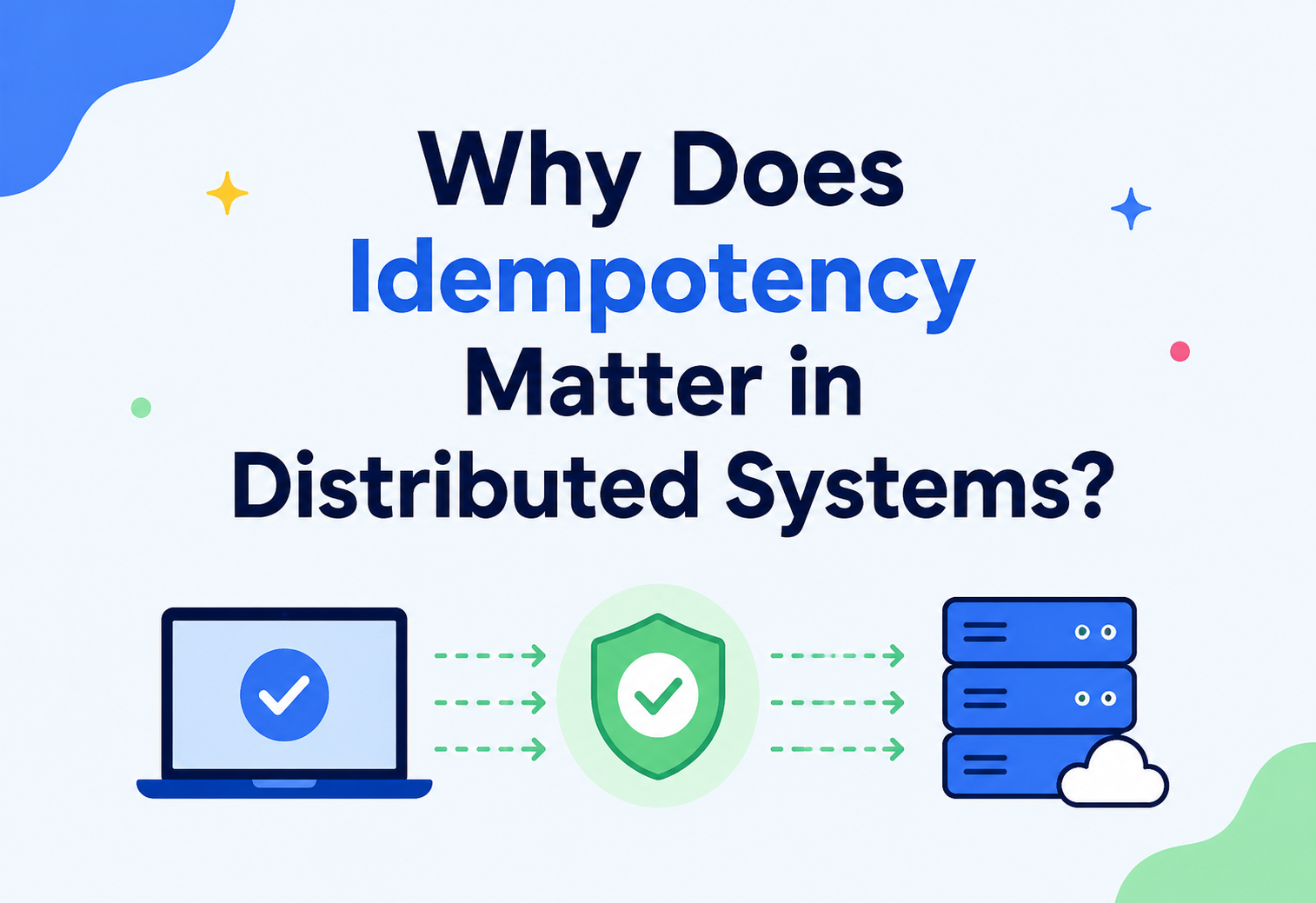
Why Does Idempotency Matter in Distributed Systems?
Some actions are naturally safe to repeat, and some are dangerously not. In the world of computers talking to other computers over shaky, unreliable networks, that single difference decides whether a system stays trustworthy or quietly starts overcharging, over‑creating, and duplicating things behind everyone’s back. This complete guide walks through what idempotency really is, why it matters so much, and how to design for it.
The Big Idea, in One Breath
Idempotency is the property of being like a light switch: repeatable, without ever compounding. Press it once, press it a hundred times — the outcome is exactly the same.
Think about a doorbell. You press it once, and somewhere inside the house, a bell rings. Now imagine you are not sure the bell actually rang — maybe you did not hear it, maybe the house is big — so you press the button again. And again. A well‑designed doorbell does not care how many times you press it; the outcome is exactly the same as pressing it once: a ring, and someone eventually answers the door. Pressing it five times does not make five people show up, and it does not make the house five times more “rung.”
Now imagine a different kind of button — one connected to a vending machine that drops a snack every single time it is pressed, no matter how many identical presses arrive in a row. If your finger slips and you press it three times because the machine looked like it had not responded, you now own three bags of chips and a much lighter wallet than you expected. That is the difference this whole topic is built around: some actions are naturally safe to repeat, and some are dangerously not — and in the world of computers talking to other computers over shaky, unreliable networks, that difference decides whether a system stays trustworthy or quietly starts overcharging, over‑creating, or duplicating things behind everyone’s back.
Picture a light switch on a wall. Flip it “on” once, and the light turns on. Flip that same switch to “on” a hundred more times — the light stays exactly as on as it was after the first flip. Nothing gets “more on.” Compare that to a birthday candle you re‑light every time it goes out — light it five times and you have genuinely used five matches, even if there is only ever one candle. Idempotency is the property of being like that light switch: repeatable, without ever compounding.
This distinction might sound almost too simple to matter, but it turns out to be one of the quiet dividing lines between software that behaves predictably under stress and software that quietly falls apart the moment something goes even slightly wrong. Real systems fail constantly, in small and large ways, every single day — a phone loses signal mid‑checkout, a server restarts at an inconvenient moment, a data centre briefly loses its connection to another. None of that is unusual or rare. What separates a resilient system from a fragile one is often nothing more dramatic than whether its most important operations were built like that light switch, or like that candle.
What Idempotency Really Is
Idempotency is the property of an operation where performing it once, or performing it many times in a row, always leaves the system in exactly the same final state.
The word itself comes from mathematics, built from “idem” (the same) and “potent” (having power or effect) — literally, “having the same effect.” Mathematicians used it long before computers existed, to describe operations like multiplying a number by zero: do it once, you get zero; do it fifty times in a row, you still just get zero. Nothing extra happens on the second, third, or fiftieth try.
In software, the same instinct applies to actions performed by an API, a database, or a message handler. An idempotent operation can be safely retried — deliberately or accidentally — without causing any unwanted side effects beyond what the very first successful attempt already caused. It is worth being precise about one subtlety here: idempotency is not a promise that an operation runs only once, and it is not a promise that the visible response looks identical every time. It is a promise about the end state — the thing actually stored, changed, or affected — staying the same, regardless of how many attempts it took to get there.
If someone asks “is this operation idempotent?”, they are really asking: “If this got accidentally run twice — or ten times — because of a retry, a glitch, or a double‑click, would anything bad actually happen?”
A helpful, precise way to picture this: imagine setting a whiteboard to say “the meeting is at 3 PM.” Writing that exact sentence on the board once, or wiping it and rewriting the identical sentence five times, leaves the board saying exactly one thing: “the meeting is at 3 PM.” Compare that to a different instruction — “add one more attendee to the meeting” — where writing that instruction and acting on it five times genuinely adds five attendees, one after another. The first instruction is idempotent. The second is not, unless something additional is done to protect it.
It also helps to separate idempotency from a nearby, easily confused idea: consistency. A system can be perfectly consistent — every replica agreeing on the same data at the same time — while still being wide open to duplicate‑execution bugs if none of its operations were designed with idempotency in mind. Consistency is about different copies of data agreeing with each other; idempotency is about a single operation behaving safely no matter how many times it is triggered. The two ideas support each other in a healthy distributed system, but neither one automatically provides the other.
Idempotent vs. Not: Seeing the Difference Clearly
The clearest way to build real intuition for idempotency is to look at a handful of everyday operations side by side, and simply ask: “if this happened five times instead of once, would the end result look any different?”
| Operation | Idempotent? | Why |
|---|---|---|
| Setting a value (“set status to shipped”) | Yes | The final value is the same no matter how many times it is set |
| Deleting a resource | Yes | Once gone, it stays gone — later attempts find nothing left to delete |
| Reading data | Yes | Looking at something does not change it, no matter how many times you look |
| Incrementing a counter (“add 1”) | No | Each repeat genuinely adds one more, compounding the effect |
| Creating a new record | No | Each call, by default, creates another separate record |
| Sending a notification email | No | Each call sends one more email to a real inbox |
Notice the pattern hiding underneath all of this: operations that set an absolute value tend to be naturally idempotent, while operations that change a value relative to what it already was tend not to be. “Set the price to $20” is safe to repeat. “Reduce the price by $5” is not — the second, third, and fourth repeats keep chipping away at the price each time, drifting further and further from what was actually intended.
This same “set versus adjust” lens turns out to be a remarkably useful design tool well beyond these simple examples. Whenever a new operation is being designed, it is worth explicitly asking whether it could be reframed as a “set” rather than an “adjust” — “set shipping status to delivered” instead of “advance shipping status by one step,” or “set the user’s loyalty tier to gold” instead of “add 100 loyalty points.” Not every operation can be reframed this way without losing important meaning, but a surprising number can, and each one reframed this way is one less operation that ever needs an idempotency key or any other extra protection at all.
Where the Idea Comes From
The word “idempotent” is far older than distributed computing — a settled mathematical term for over a century, borrowed by software just when the internet needed it most.
The word “idempotent” is far older than distributed computing. It was already a settled term in mathematics well over a century ago, describing operations that, once applied, produce no further change if applied again — the way multiplying any number by one leaves it unchanged, no matter how many times that multiplication is repeated. Mathematicians needed a precise word for “does nothing new after the first application,” and idempotent was born to fill that gap.
Software engineering borrowed the term as distributed systems themselves matured, in the era when websites and services stopped running on a single trusted machine and started spreading across many independent servers, communicating over networks that were never designed to be perfectly reliable. Early web standards, including the specifications behind HTTP, formally baked the idea into the definitions of methods like GET, PUT, and DELETE, precisely because browsers, proxies, and intermediate servers needed a clear, agreed‑upon signal for which requests were safe to automatically retry after a failure, and which were not.
As systems grew even larger — spanning multiple data centres, multiple cloud regions, and eventually multiple companies talking to each other’s APIs — the stakes around this idea grew with them. A single retried request inside one small application might cause a minor annoyance. A retried request inside a payment network processing millions of transactions a day can mean real, measurable financial damage if it is mishandled, which is exactly why idempotency evolved from a tidy mathematical curiosity into one of the load‑bearing principles of modern distributed‑systems engineering.
Why Retries Happen at All
None of this would matter if computers always talked to each other perfectly, instantly, and reliably. They do not — and in a distributed system, communication is genuinely uncertain in a way that is easy to underestimate.
Messages simply vanish
A request can leave a client and never arrive, or a response can be sent but never make it back, lost somewhere in the middle of the journey.
Silence is not failure
A client waiting too long for a reply often assumes the worst and retries — even though the original request may have quietly succeeded moments later.
Built into the plumbing
Load balancers, service meshes, and client libraries often retry failed calls automatically, entirely invisibly to the person who triggered the original action.
Double‑clicks and refreshes
A user staring at a frozen “Submit” button often clicks it again, or refreshes a slow‑loading page mid‑request, firing off a second identical attempt.
Here is the truly uncomfortable part, and the real heart of why idempotency exists at all: when a client does not get a response, it has absolutely no way of knowing whether the original request failed before doing anything, or whether it actually succeeded and only the confirmation got lost on the way back. From the client’s point of view, both situations look identical — silence. Retrying is the only reasonable move in either case, which means any system exposed to the outside world has to assume duplicate attempts are not a rare edge case, but a routine, expected part of daily operation.
This particular failure mode — sometimes described informally as the “two generals” problem in distributed‑systems circles — has no clean, universal fix at the communication layer itself. No amount of clever networking can guarantee both sides of a conversation always know exactly what the other side knows, when messages can be delayed or lost in either direction. Rather than chasing that unreachable guarantee, well‑designed distributed systems simply accept the uncertainty and build their operations so it stops mattering — which is precisely the role idempotency plays.
Why It Matters So Much
Once it is clear that retries are unavoidable, the real question becomes: what happens when one actually occurs? Without idempotency, the answer is often expensive, embarrassing, or both.
Idempotency turns retries from a source of anxiety into a source of safety. It is the single design decision that lets an engineer say, with real confidence, “if this fails partway through, just try it again” — without needing to first untangle whether the previous attempt half‑succeeded, fully succeeded, or failed outright. That confidence cascades outward into simpler code, simpler failure recovery, and dramatically calmer on‑call nights, since a whole category of “what if this ran twice” anxiety simply stops being a concern.
There is also a trust dimension that is easy to overlook. Systems that occasionally double‑charge or double‑book erode confidence fast, and that damage often outlasts the bug itself — a customer who was charged twice for one order may remain wary of that platform long after the underlying issue has been fixed. Idempotency, quietly working in the background, is part of what keeps a system trustworthy enough that people are willing to click “confirm” without a nagging fear of what happens if the page freezes for a second afterward.
Any operation reachable over a network — an API endpoint, a message queue consumer, a scheduled job — should be built with the assumption that it might, sooner or later, be triggered more than once for the exact same logical action.
There is a broader engineering philosophy tucked inside this too, one that experienced distributed‑systems architects tend to internalise deeply: rather than fighting to prevent every possible failure — an impossible goal in any system spanning multiple machines and networks — it is often far more productive to accept that failures will happen, and design operations so that the natural response to a failure (try again) is always safe. Idempotency is the clearest, most widely applicable expression of that philosophy, and it is part of why the concept shows up so consistently across payment systems, messaging platforms, cloud infrastructure, and everyday web APIs alike.
Idempotency and the HTTP Methods You Already Know
Anyone who has worked with web APIs has already brushed up against this idea, often without realising it, because the HTTP standard itself bakes idempotency into the meaning of its most common verbs.
| HTTP Method | Idempotent? | What It Typically Does |
|---|---|---|
| GET | Yes | Reads data without changing anything on the server |
| PUT | Yes | Sets a resource to an exact given state, replacing whatever was there |
| DELETE | Yes | Removes a resource — deleting an already‑deleted resource changes nothing further |
| HEAD | Yes | Like GET, but only fetches headers, not the actual content |
| POST | No, by default | Typically creates a new resource — repeating it usually creates another one |
| PATCH | No, by default | Applies a partial change, which may or may not be safe to repeat depending on what it does |
It is worth being precise about what “idempotent” means here, because it trips people up: a DELETE request is idempotent even though it clearly does something the first time — it removes a resource. What makes it idempotent is that the second, third, and hundredth DELETE calls leave the system in exactly the same state as the first one did, even if the actual response code changes (a “200 OK, deleted” the first time, and perhaps a “404, nothing here” on later calls). Idempotency is a promise about the underlying state, not about the response looking identical every single time.
POST is the interesting troublemaker in this list, precisely because it is the verb most commonly used for the riskiest operation of all: creating something new, like an order, a payment, or an account. Since POST is not idempotent by default, and yet POST requests are exactly the ones most likely to get retried after a timeout, the software industry developed a specific, deliberate pattern to bolt idempotency onto POST requests — which brings us to idempotency keys.
It is also worth knowing that the HTTP specification itself makes an important distinction between idempotent methods and what it calls “safe” methods — GET and HEAD are both idempotent and safe, meaning they are not supposed to change anything on the server at all. PUT and DELETE are idempotent but not safe, since they clearly do change server state; what makes them idempotent is only that repeating them does not change that state any further. This is a subtle but genuinely important distinction: safety is about having no effect at all, while idempotency is about having a stable, repeatable effect. Confusing the two is one of the more common misunderstandings engineers run into when first learning this material.

Delivery Guarantees: The Honest Menu of Options
Distributed systems, especially ones built around message queues and event streams, typically offer one of three delivery promises. Understanding the differences clears up exactly why idempotency ends up being unavoidable rather than optional.
At‑most‑once
A message is sent, and if it is lost along the way, nobody retries. Fast and simple, but messages can silently vanish — usually unacceptable for anything important.
At‑least‑once
The sender keeps retrying until it gets confirmation of delivery. Nothing gets silently lost — but the same message might arrive, and get processed, more than once.
Exactly‑once
The theoretical ideal: every message arrives, and is processed, precisely one time — no losses, no duplicates. Genuinely achieving this across an unreliable network is extraordinarily hard and expensive.
Here is the quiet, important truth that experienced distributed‑systems engineers eventually learn: true exactly‑once delivery, at the raw network and messaging level, is essentially impossible to guarantee in a general way. The far more practical and widely adopted approach is to embrace at‑least‑once delivery — accepting that duplicates will occasionally arrive — and then pair it with idempotent processing on the receiving end. The combination of “deliver it at least once” plus “processing it twice causes no harm” behaves, from the outside, exactly like exactly‑once delivery, without needing to solve the much harder underlying problem directly.
Systems do not actually need to guarantee a message arrives exactly once. They need to guarantee that processing it more than once feels exactly the same as processing it once. Idempotency is what quietly makes that substitution work.
It is worth appreciating why exactly‑once delivery is so hard to build directly, rather than simply taking it on faith. Guaranteeing it would require the sender and receiver to agree, with absolute certainty, on whether a message was received and processed — but that agreement itself has to travel over the same unreliable network that caused the original uncertainty in the first place. Every attempt to confirm delivery is itself just another message that can be lost, delayed, or duplicated, which is why chasing perfect exactly‑once semantics at the transport level tends to become an endless, recursive problem. Sidestepping it with at‑least‑once delivery plus idempotent processing is not a compromise born of laziness — it is widely regarded as the more honest, more achievable engineering solution.
Idempotency Keys, Step by Step
The most common, battle‑tested technique for making a naturally non‑idempotent operation — like creating a payment — safely repeatable is the idempotency key. The idea is refreshingly simple once it clicks.
Client generates a unique key
Before sending the request, the client creates a random, unique identifier — often a UUID — that represents this one specific logical attempt at the action.
Key travels with the request
The key is attached to the request, commonly as a header such as Idempotency-Key: 9d23a1f8-..., alongside the normal request body.
Server checks if it has seen this key before
Before doing any real work, the server looks up the key in its own storage to see whether this exact logical operation has already been handled.
New key: do the work, then remember it
If the key is new, the server performs the operation as normal, then stores the key together with the result, ready to be reused if the same key ever shows up again.
Repeated key: skip the work, return the same result
If the key has already been seen, the server does not repeat the underlying action at all — it simply hands back the exact result from the first successful attempt.
Two details matter enormously in making this reliable. First, checking the key and recording the fact that work is in progress needs to happen atomically — as one indivisible step — otherwise two nearly‑simultaneous retries can both slip past the check before either one finishes, both concluding “this key is new” and both charging the card. Second, the key itself has to genuinely represent one specific logical attempt, not the type of operation in general — a fresh checkout should always get a brand‑new key, while retries of that same checkout attempt should always reuse the identical key.
A subtlety worth mentioning: a well‑designed idempotency key implementation typically stores not just “this key was seen” but a fingerprint of the original request body alongside it. This protects against a rarer but genuinely dangerous mistake — a client accidentally reusing the same key for two different requests, say charging $20 the first time and $30 the second, both under the identical key. A careful server compares the incoming request against the stored fingerprint and rejects the mismatch outright, rather than silently returning the wrong cached result for a request that was never actually a true retry.
Other Techniques That Help
Idempotency keys are the most famous tool in the box, but they are far from the only one. Several complementary techniques show up constantly in real systems, often layered together.
Let the database say no
A unique constraint on an order number or transaction ID makes the database itself reject a duplicate insert, turning a potential double‑write into a clean, harmless error.
Update‑or‑insert in one move
An “upsert” (update if it exists, insert if it does not) naturally behaves like the “set balance to $500” example — safe to repeat by design, no separate check required.
Only act if nothing changed
Writing “update this row, but only if its version number is still 4” prevents a stale retry from overwriting work that already moved forward in the meantime.
Remember recent message IDs
A message consumer can keep a short‑term memory of recently processed message IDs, silently discarding anything it recognises as already handled.
It is worth noticing that these techniques solve overlapping but slightly different problems. Idempotency keys are best suited to client‑initiated actions, like a checkout button, where the client can generate and remember its own key. Unique constraints and conditional writes are better suited to protecting the data layer itself, regardless of where a duplicate request came from. Deduplication windows fit naturally into message‑queue consumers, where the “client” is really just a stream of events that might repeat. Mature systems typically combine two or three of these together, rather than leaning on just one.
Deduplication (spotting and discarding a repeat) is not quite the same thing as idempotency (the outcome staying the same no matter how many times it runs). Deduplication is one popular way of achieving idempotency, but true idempotency can also come from designing the underlying operation itself — like a “set” instead of an “add” — so that duplicates never even need to be detected in the first place.
Distributed locks and leader election mechanisms round out the toolkit for particularly tricky scenarios, where multiple instances of the same service might otherwise process overlapping work simultaneously. A lock ensures that only one instance is actively working on a given piece of data at any moment, reducing the chance of two processes racing to apply the same change at the same time. These are heavier, more operationally complex tools than a simple unique constraint, and they are typically reserved for situations where the lighter‑weight techniques genuinely are not enough — coordinating a distributed batch job across many workers, for instance, or managing exclusive access to a shared, expensive resource.
A Fully Worked Example: A Coffee Shop’s Payment System
Concepts land best with a concrete story, so imagine a small coffee shop app that lets customers pay from their phones. The payment button sends a request to a payment service, which then talks to a bank’s payment network to actually move the money.
// Without an idempotency key — the risky version
1. Customer taps "Pay $6.50"
2. App sends POST /charge  { amount: 650, currency: "USD" }
3. Payment service charges the card successfully
4. Response is lost on the way back to the phone (weak coffee‑shop wifi!)
5. App shows a spinner, times out, and — reasonably — retries
6. Payment service receives an *identical‑looking* new request
7. Without protection, it has no way to know this is a repeat
8. Customer is charged $6.50 twice for one cup of coffee
// With an idempotency key — the safe version
1. Customer taps "Pay $6.50"
2. App generates key: pay_7f43a9 and sends it with the request
3. Payment service checks: "have I seen pay_7f43a9 before?" → No
4. Charges the card, stores { pay_7f43a9 → success, $6.50 }
5. Response is lost again on the way back
6. App times out and retries, sending the *same* key: pay_7f43a9
7. Payment service checks: "have I seen pay_7f43a9 before?" → Yes
8. Returns the stored result immediately — card is NOT charged again
The customer walks away with exactly one $6.50 charge either way, and the app never needed to know whether the original request actually succeeded before the retry fired. That is the entire value of the pattern in one small, human‑scale story — the same story plays out identically whether the amount is $6.50 or $6.5 million, and whether the customer is one person or ten million people tapping “Pay” at the same time on a busy morning.
The customer never had to think about any of this. Good idempotency design is invisible by nature — the entire point is that retries just quietly work, without anyone downstream ever needing to notice or care that one happened.
A Second Example: A Message Queue Gone Wrong (and Right)
Payments are the classic example, but the same problem shows up just as often inside message‑driven systems, where a completely different kind of duplicate can sneak in — one caused not by a client’s retry, but by the messaging infrastructure itself.
// Without idempotent processing — the risky version
1. Order‑placed event is published to the queue
2. Inventory service picks it up and begins processing
3. It successfully reduces stock by 1 unit
4. Service crashes *before* sending acknowledgment back to the queue
5. Queue, following its at‑least‑once guarantee, redelivers the same event
6. A new instance of the service picks it up, with no memory of step 3
7. Stock is reduced by 1 unit *again* — inventory is now wrong by one unit
// With idempotent processing — the safe version
1. Order‑placed event carries a unique event ID: evt_44210
2. Inventory service checks a "processed events" table for evt_44210 → not found
3. In one atomic transaction: reduce stock by 1, AND record evt_44210 as processed
4. Service crashes before acknowledging the queue
5. Queue redelivers evt_44210
6. New instance checks the "processed events" table for evt_44210 → found!
7. Service skips the stock reduction entirely, simply acknowledges the message
The crucial design move in the safe version is combining the actual business change (reducing stock) and the record‑keeping (marking the event as processed) into a single atomic transaction. If those two things happened as separate steps instead, a crash landing precisely between them would recreate the very same bug the pattern was meant to prevent — the stock would be reduced, but the event would not be marked as handled, so a redelivery would reduce it again.
This is exactly why “do the work” and “remember that the work was done” must be treated as one indivisible unit, not two separate steps that hope to always happen together. Systems fail in the gaps between steps far more often than they fail during the steps themselves.
Where This Shows Up in Real Life
Idempotency is not a niche academic concern — it is quietly holding together a huge number of systems people rely on every single day.
Idempotency‑Key headers
Major payment processors expose an explicit idempotency key mechanism precisely because a doubled charge is one of the worst possible failures a payment system can have.
Uploading the same file twice
Object storage services are commonly built so that uploading a file with the same name and path simply overwrites it, rather than creating a confusing duplicate copy.
At‑least‑once by design
Popular messaging platforms openly guarantee at‑least‑once delivery, explicitly placing the responsibility of handling duplicates onto whoever consumes those messages.
Events resent on silence
Services sending webhook notifications typically resend an event if they do not receive a quick acknowledgment, expecting the receiving system to recognise and ignore repeats by event ID.
A particularly vivid real‑world scenario: imagine an online ticket‑booking platform during a hugely popular concert on‑sale moment, with a flaky mobile connection thrown into the mix. A fan taps “Buy 2 Tickets,” their connection stutters, and their phone silently retries the request twice more before finally showing a confirmation screen. Without idempotency protecting that booking endpoint, that one fan could easily end up holding six tickets and three separate charges instead of two tickets and one charge — a nightmare for the fan, for customer support, and for the platform’s reputation, especially multiplied across thousands of simultaneous buyers during that same rush.
Ride‑hailing and food‑delivery apps face a closely related version of the same problem: a rider tapping “Request Ride” on a spotty subway connection, or a diner tapping “Place Order” just as their phone briefly loses signal walking past a parking garage. In both cases, the app’s natural, reasonable response to an unclear network state is to retry — and in both cases, a platform without idempotency protection risks dispatching two drivers for one trip, or sending two identical meals to one address. The pattern repeats endlessly across industries precisely because the underlying cause — unreliable networks paired with reasonable retry behaviour — is universal to anything built on top of the internet.
The Advantages
Designing for idempotency pays off across several dimensions of a system at once, well beyond simply avoiding duplicate charges.
What You Gain
- Safe, worry‑free retries at every layer — client, network, and server.
- Dramatically simpler failure recovery, since “just try again” becomes a valid strategy.
- Protection against duplicate charges, duplicate orders, and duplicate side effects.
- Compatibility with at‑least‑once messaging systems, without needing true exactly‑once delivery.
- Easier testing, since re‑running an operation in tests does not corrupt state.
- Calmer incident response, since replaying a failed job is no longer a risky decision.
What It Costs You
- Extra design and implementation effort, especially for naturally non‑idempotent actions.
- Additional storage needed to track keys, states, or recently seen message IDs.
- A small amount of added latency for the “have I seen this before” lookup.
- Decisions to make about how long to remember keys, and when to safely forget them.
The honest way to frame this trade‑off: idempotency asks for a modest amount of upfront design discipline, in exchange for removing an entire category of subtle, expensive, trust‑damaging bugs that otherwise tend to surface at the worst possible moments — usually in production, usually under load, and usually involving real customer money.
There is a quieter organisational benefit too, worth naming explicitly: teams that build idempotency into their core operations from the start tend to develop a healthier overall relationship with failure. Instead of treating every timeout or crash as a fragile, delicate situation requiring careful manual investigation before anyone dares retry anything, engineers on these teams can lean on automated retries, circuit breakers, and self‑healing recovery scripts with genuine confidence — because the underlying operations were built to make repetition harmless in the first place. That shift, from fearing retries to trusting them, often changes how an entire engineering organisation approaches reliability.
Limitations and Honest Trade‑Offs
Idempotency is powerful, but it is not a universal fix. Understanding what it does not solve is just as important as understanding what it does.
It Does Not Solve Everything
Idempotency protects against duplicate execution of the same logical request — it does not, by itself, protect against two genuinely different, legitimate requests racing against each other. If two separate valid updates to the same record arrive at nearly the same instant, idempotency alone will not decide which one should win; that is a job for optimistic locking, versioning, or a consistent ordering mechanism layered on top.
State Has to Live Somewhere
Remembering which keys have already been seen requires storage, and that storage itself becomes a piece of critical infrastructure — it needs to be fast, reliable, and available even during the exact failure conditions that triggered the retry in the first place. An idempotency system built on a fragile, unreliable key store does not actually solve the underlying problem; it just moves it somewhere else. There is a slightly uncomfortable irony here worth sitting with: the very mechanism designed to protect a system from unreliable networks and unreliable infrastructure is itself a piece of infrastructure that has to be more reliable than everything around it, which is a genuinely nontrivial engineering bar to clear.
Retention Windows Are a Real Decision
Keeping every idempotency key forever is not practical at scale — storage costs grow without bound. But setting the retention window too short risks a genuinely late retry arriving after its key has already been forgotten, effectively treating a real duplicate as a brand‑new request. Choosing a sensible expiration time is a genuine design decision, not an afterthought. A useful way to reason about the right window is to ask: what is the longest realistic delay between an original attempt and a legitimate retry of it, given everything that could plausibly go wrong along the way — a mobile client stuck offline in a tunnel, a queue backed up during an outage, a background job paused and resumed hours later? The answer to that question, padded with a reasonable safety margin, is usually a far better guide than an arbitrary round number picked without any real justification.

Not Every Operation Needs It
Applying full idempotency machinery to every single low‑stakes operation in a system — logging a page view, for instance — adds real complexity for very little practical benefit. Idempotency earns its cost most clearly on operations with real consequences: money moving, resources being created, irreversible actions being taken.
It Adds a New Kind of Latency Trade‑Off
Checking an idempotency key store before doing real work introduces an extra round trip into the critical path of every single request, not just the retried ones. For most systems this cost is small and entirely worth paying, but for extremely latency‑sensitive operations, it is a real design consideration rather than something to add without a second thought.
Idempotency is a powerful, necessary tool for a specific class of problems — duplicate execution caused by retries. It is not a magic fix for every kind of distributed‑systems inconsistency, and treating it as one can create a false sense of safety around problems it was never designed to solve.
Common Pitfalls
A handful of specific mistakes come up again and again in idempotency implementations. Each one is worth naming plainly, so it can be spotted early — ideally before it ships.
Checking and Acting Non‑Atomically
Looking up whether a key exists, and then separately deciding to proceed, leaves a dangerous gap where two near‑simultaneous retries can both pass the check before either one finishes — resulting in exactly the duplicate the whole system was built to prevent. The check‑and‑reserve step needs to happen as one indivisible operation, typically enforced by a database’s own unique constraints rather than application code alone. This particular bug is especially sneaky because it can pass every manual test an engineer runs by hand — a human simply cannot click fast enough to reproduce a true race condition — and only reveals itself under genuine concurrent load, often for the first time in production.
Generating a New Key on Every Retry
If a client mistakenly generates a fresh idempotency key each time it retries — rather than reusing the original key for that logical attempt — the entire protection collapses, since the server now sees what looks like several completely different, legitimate requests.
Assuming the HTTP Method Guarantees Safety
Just because a method is labeled PUT or DELETE in an API does not automatically make the underlying implementation idempotent — that guarantee only holds if the actual business logic behind the endpoint was genuinely built to honour it. A poorly implemented PUT that quietly appends to a list instead of replacing it is not idempotent no matter what the HTTP verb suggests.
Forgetting About Partial Failures
An operation that touches multiple systems — charge a card, then update inventory, then send a confirmation email — can fail partway through, succeeding at some steps and not others. A naive retry that starts the whole sequence over from scratch, without checking what already completed, can end up double‑charging the card while still correctly avoiding a duplicate inventory update, creating a confusing, inconsistent mess that is hard to unwind later.
Treating the Idempotency Key Store as an Afterthought
Since the whole point of the key store is to protect against failure, it needs to be at least as reliable as the operation it is protecting — sometimes more so. A key store that itself becomes unavailable during a network partition can leave a system unable to tell genuine retries apart from brand‑new requests at exactly the moment that distinction matters most.
Before shipping any operation reachable over a network, it helps to ask plainly: “If this exact request arrived twice, thirty seconds apart, what would actually happen?” If the honest answer is uncomfortable, that is the signal to add protection before it ships, not after an incident.
Best Practices for Designing Idempotent Systems
A small set of grounded habits show up in almost every team that ships idempotency successfully. None are magic on their own, but together they turn the pattern from a source of bugs into a source of confidence.
Design for idempotency from the start
Retrofitting idempotency onto an already‑live system is far harder than building it in from day one, when the data model and API contracts are still flexible.
Prefer “set” operations over “adjust” operations
Where the business logic allows it, designing an operation to set an absolute end state avoids needing extra protection at all — it is naturally idempotent by construction.
Use idempotency keys for anything involving money or creation
Payments, orders, account creation, and resource provisioning are exactly the operations where a duplicate is most expensive — protect these first.
Enforce uniqueness at the database layer, not just in application code
A unique constraint is a much stronger guarantee than a check written in application logic, since it holds even under concurrent, simultaneous requests.
Choose a sensible key retention window
Balance storage cost against the realistic maximum delay a legitimate retry might experience, and document that window clearly for anyone integrating with the system.
Test retries deliberately
Include automated tests that deliberately send the same request twice, and assert that the system’s end state — not just the response — stays exactly the same.
It is also worth building a habit of thinking through multi‑step workflows in terms of individually idempotent steps, rather than one large idempotent block. Breaking “charge card, update inventory, send email” into three separately protected steps, each safely retryable on its own, tends to be far more resilient than trying to wrap the entire sequence in one big all‑or‑nothing guarantee, which is often much harder to achieve reliably across multiple independent systems.
Finally, it is worth documenting idempotency guarantees explicitly, the same way an API documents its authentication requirements or rate limits. A clear statement like “this endpoint is idempotent when the same Idempotency‑Key header is reused” removes ambiguity for every engineer who integrates with that endpoint later, including future versions of the very team that built it. Undocumented idempotency behaviour tends to get accidentally broken during a well‑intentioned refactor, precisely because nobody wrote down that the guarantee existed in the first place.
Frequently Asked Questions
A handful of questions come up almost every time someone new is introduced to idempotency — here are short, honest answers to the ones that surface most often.
Is idempotency the same thing as “no side effects”?
No, and this is a very common mix‑up. A DELETE request clearly has a side effect — it removes something. What makes it idempotent is not the absence of a side effect, but the fact that repeating it does not change the system any further beyond what the first successful attempt already did.
Does idempotency guarantee exactly‑once execution?
Not quite. The underlying action might genuinely run more than once behind the scenes — for example, a retried request might still reach the server and get processed internally — but idempotency ensures the observable end result is exactly as if it had only run once. The internal mechanics and the external guarantee are two different things.
Can a system be idempotent without using idempotency keys at all?
Absolutely. Many operations are naturally idempotent by design — setting a value, deleting a resource, or using an upsert — and need no extra key or tracking mechanism whatsoever. Idempotency keys are specifically for operations, like creating something new, that are not naturally idempotent on their own.
How long should an idempotency key be remembered?
There is no universal answer — it depends on how long a realistic retry might plausibly be delayed. Many payment systems use a window measured in hours to a couple of days, balancing genuine protection against unbounded storage growth.
Is idempotency only relevant to APIs?
Not at all. The same principle applies to message queue consumers, scheduled batch jobs, database migrations, and even simple scripts that might be accidentally run twice — anywhere an action might be repeated, idempotency is worth considering.
What is the single biggest sign a system needs idempotency protection?
Any operation with a real‑world consequence that would be embarrassing, costly, or hard to undo if it happened twice — charging money, sending a notification, provisioning a resource, or creating a permanent record — is exactly the kind of operation that deserves this protection first.
Do read operations ever need idempotency protection?
Pure reads, like fetching a record, are naturally idempotent on their own, since reading does not change anything. They generally do not need any extra protection. The concern is almost always about writes — anything that creates, updates, or deletes something.
Is it the client’s job or the server’s job to ensure idempotency?
It is genuinely a shared responsibility. The client is typically responsible for generating a stable, reusable key for each logical attempt and reusing it correctly across retries. The server is responsible for checking that key reliably, storing results, and enforcing the guarantee even under concurrent load.

Key Takeaways
If you remember nothing else from this guide, remember the seven ideas below — and the quiet habit of asking “what would happen if this ran twice?” before shipping anything reachable over a network.
Remember This
- Same end state, no matter how many attempts. Idempotency means performing an operation once, or many times, always leaves the system in the exact same final state.
- Networks are unreliable by nature. Timeouts, lost responses, automatic retries, and double‑clicks make repeated requests a routine reality, not a rare edge case.
- Some operations are safe by design; some are not. Actions like “set a value” or “delete” are naturally idempotent; actions like “add” or “create” are not, unless deliberately protected.
- At‑least‑once plus idempotent processing. This pairing is the practical, widely used substitute for the far harder problem of true exactly‑once delivery.
- Idempotency keys carry the heaviest load. They are the most common technique for protecting naturally non‑idempotent operations like payments and order creation.
- The data layer helps too. Unique database constraints, upserts, and conditional writes are equally valuable complementary tools, especially at the data layer.
- It is not a magic fix for everything. Idempotency solves duplicate execution — it does not replace proper handling of genuine concurrency conflicts between different, legitimate requests.
At its core, idempotency is a fairly humble promise dressed up in technical language: no matter how many times something gets tried, the outcome stays honest and predictable. That promise turns out to be one of the quiet load‑bearing walls of reliable software — invisible when everything works, and enormously appreciated the one time a network hiccup would otherwise have turned a single cup of coffee into three.
The next time a “please do not refresh this page” warning flashes on a checkout screen, it is worth recognising what that message is quietly admitting: somewhere behind the scenes, an engineer decided it was easier to ask the user for patience than to build the operation so a refresh could not possibly cause harm. Systems built with idempotency in mind rarely need to ask that favour at all — they simply absorb the retry, the refresh, or the double‑click, and quietly do the right thing anyway.