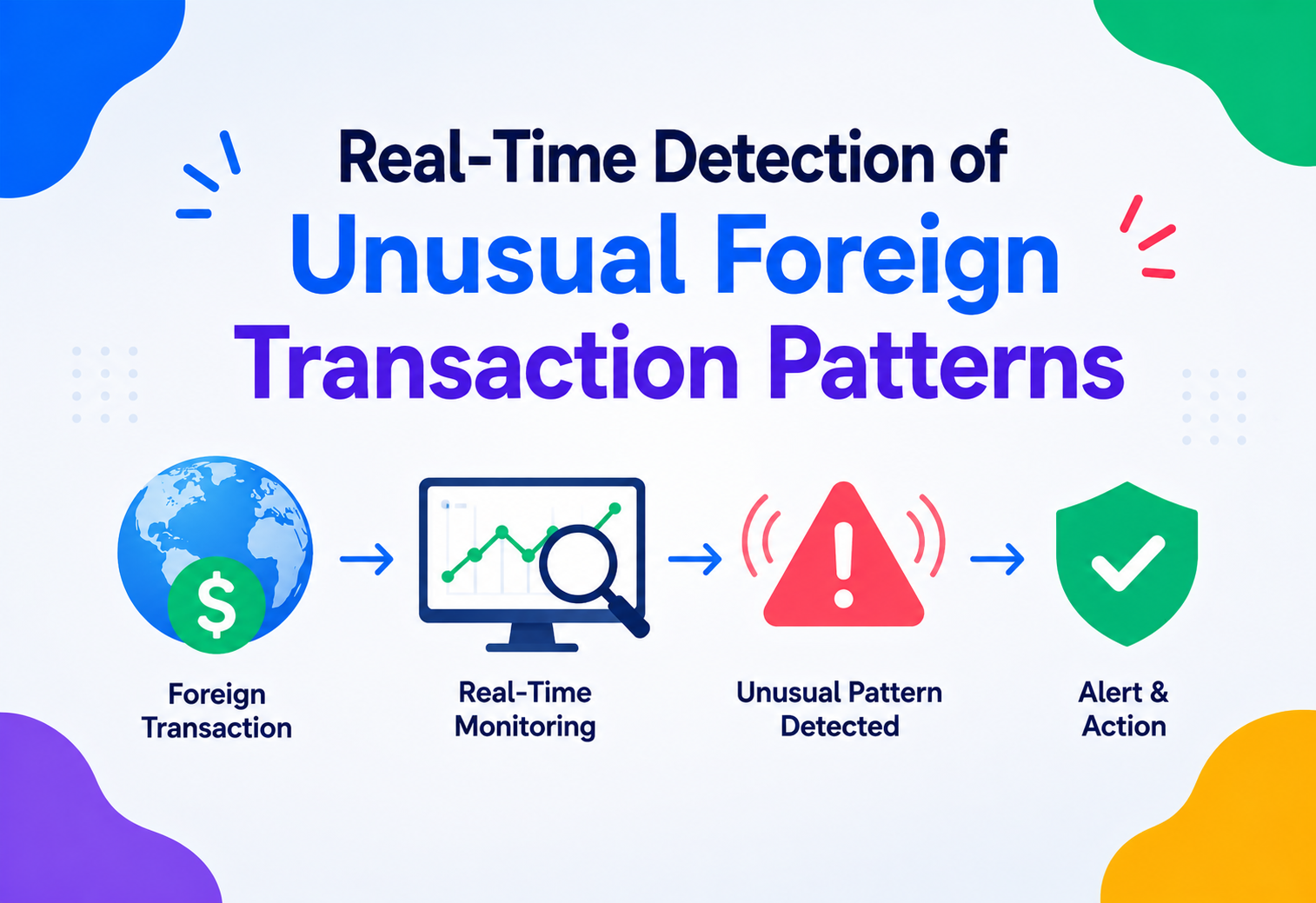
Real-Time Detection of Unusual Foreign Transaction Patterns
How card issuers catch a compromised card the moment its spending pattern stops looking like the actual cardholder travelling abroad — scored in real time, on every authorization, without freezing a genuine traveler’s card at passport control.
Introduction
A cardholder lands in Lisbon, taps their card for a coffee near the airport, checks into a hotel, and later that evening buys a train ticket. Every one of those transactions is legitimate. Now imagine that thirty minutes after the hotel check-in, the same card is used for a large electronics purchase in a city 400 kilometers away, followed ten minutes later by an online purchase billed to an address in a third country. No human being can be in three places at once.
This is the exact shape of the problem a foreign transaction anomaly detection system is built to catch: a card that was genuinely being used by its owner while traveling suddenly starts being used in a way that is physically or behaviorally inconsistent with that owner.
This problem sits at the intersection of two things issuers care about deeply and that pull in opposite directions. On one side, false declines are expensive and embarrassing — nothing damages customer trust faster than a card getting blocked while someone is stranded abroad trying to pay for a hotel room. On the other side, cards get skimmed, cloned, or phished constantly while people travel — unfamiliar ATMs, hotel point-of-sale terminals, public Wi-Fi networks, and unfamiliar merchants all raise the odds of compromise specifically during international travel, and a card compromised abroad can be drained within minutes if fraud goes undetected.
The system we design in this tutorial has to resolve that tension in real time, at the moment of authorization, using a combination of geographic velocity analysis, learned travel behavior patterns, explicit customer-provided travel signals, and machine learning trained on confirmed historical compromise cases — all within the tight latency window a card authorization allows.
We will design this system end to end: how the authorization request is enriched with location and behavioral history, how impossible-travel and channel-mismatch patterns are detected with precomputed reference data, how individual cardholder behavior is modeled and blended with population-level risk signals, how customers themselves become a real-time verification channel through push confirmation, and how all of this is delivered reliably at the scale of a large card issuer processing authorizations for millions of cardholders traveling simultaneously across the globe.

Every other real-time fraud domain gets to lean on the assumption that the customer is at home. This one has to distinguish “the customer, but abroad” from “the card, but not the customer” — without freezing the wrong one.
History & Evolution
The way issuers protect traveling cardholders has moved from paper-based “call your bank before you fly” workflows to real-time behavioral scoring inside the authorization message itself. Understanding that arc explains why the modern architecture looks the way it does.
Manual travel notifications (pre-2000s)
Cardholders were expected to phone their bank before traveling to place a travel notice on file. Anything outside the declared countries and dates risked automatic decline. Most customers simply forgot, leaving issuers to choose between blocking legitimate spend or accepting elevated risk with no real-time signal.
Static country-mismatch rules (2000s)
If a transaction’s merchant country did not match the card’s home country, apply extra scrutiny or a step-up challenge. This reduced blind exposure but produced enormous false-positive rates, since a huge fraction of cardholders travel internationally at any given time.
EMV chip & tokenized mobile wallets (2010s)
Chip cards and, later, tokenized mobile wallets made physical card cloning significantly harder than in the magnetic-stripe era. Fraud pressure shifted toward regions still relying on older terminal technology and toward card-not-present channels, where chip protections do not apply at all.
Velocity-based and behavioral detection (late 2010s)
Instead of asking “is this transaction outside the home country,” the system asks “is this transaction physically possible and behaviorally consistent, given everything else this card has done in the last several hours and days.”
Real-time push confirmation & device corroboration (2020s)
The mobile-first era gave issuers a new signal source: the customer themselves, reachable in a few seconds through the banking app. “Was this you?” push confirmation replaced the phone-call travel notice as the default resolution path for borderline transactions.
Anomaly detection systems had to evolve alongside these shifts, incorporating channel-specific risk weighting rather than treating all transaction types as equally protected or equally vulnerable. The effective fraud risk profile of “card-present in a country with strong chip terminal adoption” and “card-not-present anywhere” are quite different, even for the same cardholder on the same trip.
What Counts as an Anomaly While Traveling?
Designing this system correctly starts with being precise about what “unusual” means, because the naive definition — any transaction outside the home country — is far too broad to be useful. A useful anomaly definition combines several independent signals, none of which alone is conclusive.
Impossible travel
Two transactions occurring closer together in time than physical travel between their locations would allow — a card-present transaction in Tokyo followed forty minutes later by a card-present transaction in Toronto.
Behavioral discontinuity
A sudden shift in spending category, ticket size, or merchant type that breaks from the cardholder’s established pattern — even within a country the card is legitimately visiting.
Channel mismatch
A physically-present chip transaction in one country followed shortly by a card-not-present transaction that requires the full card number, expiry, and CVV — consistent with skimmed card data being used online by a third party while the genuine card is still in the traveler’s pocket.
Elevated merchant context
Transactions at merchant types statistically associated with higher skimming risk (unattended fuel pumps, certain ATM networks, specific hotel POS vendors) raise the baseline risk of the transactions that immediately follow them.
Think of this system like airport immigration matching a passport against a travel history. One stamp from a new country is expected and unremarkable. But a passport that shows an exit stamp from Tokyo and an entry stamp from Toronto forty minutes later is not a travel pattern — it is a sign that something about the document itself is wrong. Card transactions leave the same kind of trail, just in payment authorizations instead of passport stamps, and the system’s job is to notice when that trail stops making physical sense.
“Why not just decline every transaction outside the cardholder’s home country?” A large share of genuine spend happens exactly there — international travel is common, and blanket geography rules produce unacceptable false-decline rates that damage customer trust and push transaction volume to competing issuers. The system has to distinguish “traveling customer” from “compromised card used abroad,” which requires behavioral and velocity signals, not just a country match.
It is also worth being explicit about what this system is not trying to solve. It is not a general anti-money-laundering transaction monitoring system, and it is not trying to detect a cardholder’s own first-party fraud (a genuine cardholder disputing a purchase they actually made). Its scope is narrower and more specific: recognizing, at the moment of authorization, when the pattern of transactions attributed to a card no longer looks consistent with a single traveling person using their own card. That narrower scope is what allows the system to lean so heavily on physical and behavioral consistency signals — geography, timing, channel, and individual spending habits — rather than the broader financial-crime signal sets that AML systems rely on.
High-Level Architecture
The architecture mirrors the shape of any real-time authorization-time fraud system: ingest the authorization request, enrich it with the cardholder’s recent transaction history and travel context, score it against rules and a trained model, and return a decision within the issuer’s authorization latency budget — typically under 100 milliseconds end to end, since this sits directly in the card network’s authorization round trip.
One design detail that distinguishes this system from a general-purpose fraud platform is the medium-risk path: rather than only “approve” or “decline,” the orchestrator can route a transaction to real-time customer confirmation — a push notification asking “was this you?” — and use the customer’s near-instant response to finalize the decision. This is only viable because most cardholders now carry a smartphone with the issuer’s app installed, and it meaningfully reduces both fraud losses and false declines compared to a binary approve/decline system.
Major card issuers and networks now push real-time “was this you?” transaction alerts through their mobile apps specifically for transactions flagged as unusual, often triggered by exactly this kind of geo-behavioral scoring, rather than declining outright and forcing the customer to call a support line from a foreign country.
Internal Working: How a Decision Gets Made
Every authorization request carries a location signal (merchant country and city, and for card-present transactions, terminal-level location data), a channel signal (card-present chip/contactless vs. card-not-present online), and transaction attributes (amount, merchant category, time). The detection engine compares these against two reference points simultaneously: the cardholder’s own historical behavior profile, and the physical/temporal consistency of this transaction against the cardholder’s most recent prior transactions.
Three layers run in parallel for every authorization, the same pattern used across real-time fraud systems generally:
Deterministic rules
Fast, explainable geo-velocity and channel-mismatch checks computed directly from the last few transactions — e.g. “distance between this transaction and the prior transaction divided by elapsed time exceeds the maximum plausible travel speed for the transport modes available between those two points.”
Behavioral ML scoring
A model trained on the cardholder’s own historical spending pattern plus population-level features (is this merchant category, country, and channel combination statistically associated with historical compromise cases) produces a continuous risk score.
Context signals
Explicit travel notifications the customer has set, device and app location (if the issuer’s mobile app is installed and location-sharing is enabled), and recent card-present activity that independently corroborates the cardholder’s claimed location.
The Decision Orchestrator combines these into a risk tier using a configurable, auditable policy, exactly as in other real-time fraud systems, because the same tension between explainability, adaptability, and speed applies here too.
An important internal detail is how the “prior transaction” used for geo-velocity comparison is chosen. It is tempting to simply compare against the single most recent transaction, but this is fragile — a single mis-tagged merchant location (a common data-quality issue with merchant terminal geocoding) can produce a spurious impossible-travel flag. Production systems instead maintain a short rolling window of recent transaction locations and compute geo-velocity consistency against the whole window, using the most geographically coherent recent cluster of transactions as the reference point rather than any single most-recent point. This makes the check meaningfully more robust to the kind of location data noise that is common with real-world merchant terminal metadata, especially internationally, where geocoding quality varies significantly by country and payment processor.
“How do you avoid declining a transaction just because a customer forgot to set a travel notification?” Travel notifications should be treated as one corroborating signal among several, never a hard gate. A customer with no travel notification on file but a consistent, gradually-progressing travel pattern (flight-plausible location changes, matching hotel and local merchant spend) should score very differently from a customer whose card suddenly appears in a country with no plausible travel path from its last known location and no supporting device signal.
Data Flow & Lifecycle of a Transaction
Trace a single foreign authorization end-to-end — from a card tap at a merchant abroad, through parallel scoring and orchestration, to the optional real-time customer confirmation loop and back into the training pipeline.
The customer confirmation step (9) is time-boxed — the system waits only a few seconds for a response before falling back to a default policy (usually decline for high uncertainty, approve with continued monitoring for borderline cases), since the underlying card authorization itself is still bound by the network’s overall timeout. When the customer does respond, that response is one of the highest-quality labels the system can collect, because it is a direct, in-the-moment confirmation rather than a delayed dispute weeks later — which makes the feedback loop (step 11) unusually fast and reliable for this specific fraud type compared to fraud domains that rely solely on chargeback data.
Geo-Velocity & Impossible Travel Detection
The single most distinctive technique in this system, compared to general-purpose fraud detection, is geo-velocity analysis: calculating whether the physical distance between two consecutive transactions could plausibly be covered in the time elapsed between them, given realistic transport options.
A naive implementation simply computes great-circle distance divided by elapsed time and compares it against a fixed speed threshold (say, 900 km/h to account for flight). This catches obvious cases but performs poorly at the margins — a genuine traveler with a fast connecting flight can appear to violate a naive threshold, while a fraud ring using a cloned card in a city just a short drive from the genuine cardholder’s last known location can stay comfortably under it.
Production systems instead model plausible travel corridors: given two specific locations, what is the fastest realistic way to travel between them (direct flight, connecting flight, high-speed rail, driving), and is the elapsed time at least consistent with the fastest of those options plus a reasonable buffer for airport processes.
Card-present versus card-not-present status changes the calculation entirely. A card-present transaction anchors a hard physical location (the card had to physically be at that terminal), while a card-not-present transaction only anchors the billing or IP-inferred location, which is far weaker evidence and easier to spoof. This is why a card-present transaction in one city followed by a card-not-present transaction claiming to originate from a very distant location is treated with more suspicion than pure geo-velocity math alone would suggest — the pattern is consistent with the physical card being skimmed and its data being used online elsewhere while the genuine card stays with its owner.
It is also worth handling contactless mobile wallet transactions (Apple Pay, Google Pay, and similar) as a distinct sub-category within card-present, since they carry an additional layer of device-level authentication and tokenization that meaningfully lowers the odds that a wallet transaction represents a cloned card, compared to a magnetic-stripe or even standard chip transaction. Treating all card-present transactions as equally strong location evidence ignores this distinction; a system tuned with real production data typically discounts geo-velocity violations slightly when the flagged transaction is a tokenized mobile wallet payment, since the underlying token cannot be cloned the way a static card number can.
“How do you compute ‘fastest plausible travel time’ between two arbitrary locations efficiently, at scale, for every transaction pair?” Precompute and cache a distance-and-mode lookup keyed on location pairs at a coarsened granularity (city or airport level rather than exact GPS coordinates), refreshed periodically rather than calling a live routing API on every transaction, since a live external API call would blow the latency budget. Exact GPS-level precision is unnecessary — the decision only needs to be right at the resolution of “plausible” versus “impossible.”
A subtler challenge is border regions and densely connected metropolitan areas that span short international distances — parts of Europe, for instance, where two cities in different countries can be closer together than two cities within a single large country elsewhere in the world. A geo-velocity system tuned only on raw distance will misjudge these cases badly unless it accounts for actual transport infrastructure between specific location pairs rather than assuming distance alone predicts travel time. This is another reason the travel corridor reference data needs to be built from real transport network information rather than a simple distance-to-speed formula, and why coarsening to city or region-pair granularity, rather than trying to model every possible GPS coordinate pair, keeps the reference table both accurate enough and small enough to serve from a fast cache.
Machine Learning Scoring Engine
Geo-velocity rules catch the obvious cases, but a large share of real compromise events do not violate any hard physical constraint — a fraud ring may use stolen card data in the same city as the genuine cardholder, or wait until the cardholder has left a location before using cloned data there. The ML layer exists to catch these subtler cases by learning what “normal for this specific cardholder while traveling” looks like, rather than relying on universal physical constraints alone.
8.1 Cardholder Behavioral Profile Model
Built from each cardholder’s own transaction history: typical merchant categories, typical ticket size distribution, typical time-of-day pattern, and — critically for this use case — historical travel patterns (which countries this cardholder has visited before, how far in advance trips are typically preceded by travel-adjacent spend like airline tickets or airport parking). A transaction that would be unremarkable for one cardholder (a $2,000 hotel booking) can be a strong anomaly signal for another whose historical ticket sizes rarely exceed $150.
8.2 Population-Level Risk Model
Trained across all cardholders, this model captures which combinations of merchant category, country, channel, and recent-location-change patterns are statistically associated with confirmed compromise cases in the issuer’s historical data — for example, certain ATM network types in specific regions, or specific merchant categories known to be common skimming targets, carry elevated baseline risk regardless of the individual cardholder’s history.
These two models’ outputs are combined, typically through a gradient-boosted ensemble that takes both the individual behavioral deviation score and the population-level risk score as input features, alongside the geo-velocity and channel-mismatch signals from the rules layer. As with other real-time fraud systems, the model is kept compact enough (bounded tree depth and count) to serve inference within a few milliseconds, since it sits directly in the authorization latency path.
“How do you build a useful behavioral profile for a cardholder who travels rarely and has almost no international transaction history to learn from?” Fall back to population-level and cohort-level priors (e.g., typical first-time-traveler patterns, or patterns of cardholders with similar domestic spend profiles) when individual history is too sparse, and weight the individual profile more heavily as more of the cardholder’s own history accumulates — a classic cold-start problem solved with a Bayesian-style blending between a population prior and individual evidence.
8.3 Pre-Travel Signal Modeling
One feature family that is unusually predictive in this specific domain, and worth calling out separately, is pre-travel spend: airline ticket purchases, airport parking, currency exchange transactions, and travel insurance purchases in the days or weeks before a trip. A cardholder whose card shows this kind of pre-travel signature followed by a plausible, gradually progressing international transaction pattern is behaving exactly as a genuine traveler would.
The absence of any such signature, combined with a sudden appearance of transactions in an unfamiliar country with no prior indication of planned travel, is itself a mild risk signal worth folding into the model — not because travel without advance purchases is rare, but because its combination with other risk signals should shift the posterior probability of compromise somewhat higher than it would be for a cardholder with a clear pre-travel trail.
Rules Engine & Hybrid Decisioning
Rules remain essential here for the same reasons they matter across real-time fraud systems: instant reaction to newly identified compromise patterns (a specific skimming device model just discovered at a specific ATM network), regulatory and network mandates that certain conditions always trigger step-up authentication, and explainability for customer support agents who need to explain a decline to a stranded traveler.
| Rule type | Example | Typical action |
|---|---|---|
| Impossible Travel | Two card-present transactions in locations no transport mode could bridge within the elapsed time | Immediate decline, flag card for reissue |
| Channel Mismatch | Card-present transaction followed within minutes by a card-not-present transaction from a distant, unrelated location | Decline the card-not-present transaction, monitor closely |
| Known Compromise Hotspot | Transaction occurs at a merchant or ATM network recently associated with confirmed skimming reports | Step-up authentication or push alert |
| Sudden Category Shift Abroad | Cardholder with no history of high-value purchases attempts a large jewelry or electronics purchase shortly after arriving in a new country | Push “was this you?” alert |
As in other hybrid systems, some rules are hard stops that override the ML score entirely (impossible travel is about as close to deterministic proof of compromise as this domain gets), while others simply add weight to the aggregate risk tier and leave room for the ML model’s more nuanced view of the specific cardholder’s normal behavior to soften or sharpen the final decision.
Known compromise hotspots (a specific compromised ATM network, a specific hotel chain’s point-of-sale vendor found to be breached) tend to surface through external threat intelligence feeds and card network alerts rather than being discovered purely from the issuer’s own transaction data. The rules engine needs an operational path for risk analysts to rapidly add a merchant-network or terminal-level block or step-up rule the same day a compromise is publicly disclosed, without waiting for a full engineering deployment cycle — which is exactly why rules are interpreted from externally-editable configuration rather than hardcoded into the scoring service’s application logic.
Customer-Provided Travel Signals
Unlike most fraud domains, this system has access to a uniquely valuable signal source: the customer themselves, in real time, through the issuer’s mobile app. Three channels matter here.
Travel notifications
Customers can proactively declare upcoming trips (destination countries and date ranges) through the app. Treated as a strong but not absolute prior, since it reduces false positives for genuinely declared travel but must not become a blind trust signal a fraudster could exploit by setting a fake notification after stealing card credentials along with app access.
Device location
With explicit customer opt-in, the issuer’s mobile app can share coarse device location, which independently corroborates or contradicts a transaction’s claimed location without requiring the customer to do anything. A transaction occurring far from where the customer’s own phone currently is provides strong independent evidence of compromise.
Real-time confirmation
Medium-risk transactions can trigger an immediate push notification asking the customer to confirm or deny the transaction, with the response feeding directly back into the authorization decision within the latency window, and afterward into the training data.
This is similar to how a hotel concierge might quietly double-check with a guest before handing a spare room key to someone claiming to be them — rather than either blindly trusting the claim or refusing every such request outright, the concierge uses a fast, low-friction verification step exactly when something about the request seems slightly off, and moves on immediately once confirmed.
Many issuing banks now let customers set digital travel notices directly in their banking app and combine that with device-location corroboration and instant push-notification confirmation for borderline transactions, replacing the older phone-call-based travel notification process almost entirely.
There is a design tension worth naming directly: the more customer-provided signal the system leans on, the better its accuracy, but also the more it depends on app adoption, connectivity, and customer willingness to opt in to location sharing — none of which can be assumed universally. A well-designed system therefore treats every customer-provided signal as additive rather than required. A cardholder who has never installed the mobile app, never set a travel notification, and has no location sharing enabled should still receive reasonable protection from the geo-velocity and behavioral layers alone; the customer signals exist to sharpen decisions for that population, not to be a prerequisite for baseline protection.
APIs & Microservices Design
The synchronous authorization path is kept as narrow as possible — Fraud Scoring API and its direct dependencies only — while push notifications, case management, and card reissuance all run asynchronously off an event bus, so that the extremely tight authorization latency budget is never put at risk by slower, less time-critical workflows.
Fraud Scoring API
Called by the Authorization Decision Service on every foreign or geographically unusual transaction; must respond within a strict latency budget shared with the overall card network authorization timeout.
Feature Enrichment Service
Assembles the cardholder’s recent location history, behavior profile, and travel notification status from precomputed stores — no live aggregation over raw transaction history.
Travel Notification Service
Owns customer-declared travel plans; exposes both a customer-facing API (set/update notifications) and an internal read API consumed by enrichment.
Push Notification / Confirmation Service
Handles the real-time “was this you?” flow, including the short timeout and fallback policy if the customer does not respond in time.
Case Management Service
Owns the lifecycle of confirmed or suspected compromise cases, card reissuance workflows, and links back into the ML training pipeline — structurally similar to case management in other fraud domains, off the critical authorization path.
“The push notification confirmation step involves waiting on a human response inside a synchronous authorization flow — doesn’t that break the latency budget?” It is bounded with a short, hard timeout (typically a few seconds), and the authorization service treats “no response within the window” as a defined fallback outcome rather than blocking indefinitely — the overall card network authorization timeout still governs, and the system is designed so the confirmation step degrades to a safe default the moment that timeout approaches.
Databases, Caching & Storage Choices
As with other real-time fraud architectures, the guiding principle is that nothing expensive should be computed inside the authorization path. Every feature the scorer needs is precomputed by streaming and batch jobs and pushed into fast key-value stores, so the live scoring path only ever performs quick lookups and lightweight arithmetic — never a fresh aggregation over historical transactions.
| Store | Technology pattern | Used for |
|---|---|---|
| Location & Velocity Feature Store | In-memory key-value (Redis) | Sub-millisecond lookup of the cardholder’s most recent transaction locations and timestamps for geo-velocity checks |
| Cardholder Behavior Profile Store | In-memory key-value with periodic batch refresh | Precomputed spend pattern, ticket size distribution, and historical travel profile per cardholder |
| Travel Corridor Reference Data | Precomputed lookup table (Redis or embedded cache) | Fastest plausible travel time/mode between coarsened location pairs, refreshed periodically |
| Transaction Event Log | Distributed log (Kafka) | Durable, ordered, replayable stream of every authorization event, feeding both real-time enrichment and offline model training |
| Travel Notification DB | Relational (PostgreSQL) | Customer-declared travel plans with strong consistency and simple query patterns |
| Case Management DB | Document store or relational | Confirmed and suspected compromise case records, reissuance workflow state |
Kafka acts as both the durable source of truth for auditability and the pipeline that drives asynchronous behavior-profile refresh, so the online feature stores can be rebuilt by replay if a computation bug is discovered. This is a direct application of event sourcing: the log is authoritative, the caches are derived and disposable.
Load Balancing & Traffic Management
The Fraud Scoring API sits behind a layer-7 load balancer using consistent hashing on cardholder ID, which keeps repeated lookups for the same cardholder likely to hit warm caches on the same downstream instances during a single trip’s burst of transactions.
Every downstream dependency (feature store, behavior profile store, travel notification service) is wrapped in a circuit breaker, and a well-defined fallback policy governs what happens if any of them is slow or unavailable: fall back to a cached, slightly stale profile and a conservative default risk tier rather than blocking the authorization outright, since — exactly as in other payment-critical systems — the platform’s core promise of processing legitimate payments reliably takes priority over marginal detection improvements during a partial outage.

A traveling cardholder tends to generate a burst of transactions clustered in time (coffee, hotel check-in, dinner, train ticket). Consistent hashing on cardholder ID means their feature lookups repeatedly hit an instance whose local cache is already warm from prior transactions in the same burst, cutting effective p99 for the second-through-fifth transaction of the trip.
Performance & Scalability at Millions of Requests per Minute
Large issuers process authorization volumes in the millions per minute across peak periods (holiday travel seasons in particular spike both transaction volume and the proportion of that volume that is genuinely international), and the fraud scoring path must sustain that load with p99 latency safely inside the shared authorization budget.
The same core techniques used elsewhere apply here: feature computation is decoupled from feature serving, with streaming jobs continuously updating the location and behavior feature stores as new transactions arrive rather than recomputing from scratch per request; the ML model is served through a low-latency model server with horizontally scaled, stateless instances; and the travel corridor reference table is precomputed and cached rather than calling any live routing or mapping API during scoring.
Seasonal and geographic traffic skew deserves specific attention in capacity planning for this system — international travel spikes around holidays are predictable and concentrated in specific corridors (major outbound travel routes from large population centers), which makes it possible to pre-scale specific regional deployments ahead of known peak periods rather than relying purely on reactive autoscaling.
Data residency and cross-border processing latency also interact with scalability in a way this domain surfaces more sharply than most: a cardholder’s home region’s data center may not be the fastest path to serve a scoring request for a transaction physically occurring on the other side of the world. Some issuers address this by replicating the relevant slice of a traveling cardholder’s feature data to a geographically closer region temporarily during an active trip (detected from the travel notification or the earliest transactions of the trip itself), trading additional data movement complexity for materially better latency on exactly the population of transactions this system cares most about — those far from the cardholder’s home region.
“How would you handle a sudden surge of authorizations from a single cardholder in a very short window — say, a cardholder legitimately making ten small purchases in ten minutes at a foreign market?” Rate-based features (transaction count and total spend within short rolling windows) should be part of the model’s input, not a separate hard block, since legitimate rapid small-ticket spending is common while traveling. A hard velocity cap on transaction count alone would generate excessive false positives; it should combine with amount, merchant category diversity, and geo-consistency to distinguish genuine rapid spending from card testing or a compromise event.
High Availability & Reliability
Every stateful component is replicated across multiple availability zones, and the transaction event log runs with a replication factor of at least three, so that no single infrastructure failure can lose authorization events or the training data derived from them. The location and behavior feature stores run multi-AZ with automatic failover, and fraud scoring model servers are deployed statelessly so any instance can be replaced without loss.
Because this system sits directly in the card authorization path, graceful degradation is designed explicitly, layer by layer:
- If the ML scoring service is unavailable, fall back to rules-only geo-velocity and channel-mismatch checks, which alone still catch the most severe compromise patterns.
- If the travel notification service is unavailable, proceed without that corroborating signal rather than blocking.
- If the push notification confirmation channel is unavailable, fall back to a conservative default decision rather than waiting indefinitely.
The unifying principle, shared with other real-time payment-adjacent systems, is that a failure inside the risk subsystem should degrade detection quality, never block legitimate payment authorization outright, except in the narrow, highest-confidence cases like a confirmed impossible-travel violation.
Security
Security in this system spans two very different concerns: protecting the sensitive personal and financial data flowing through the pipeline, and hardening the customer-provided signals themselves against manipulation.
Encryption & tokenization
Location data, device identifiers, and transaction details encrypted at rest and in transit, with card numbers tokenized throughout the pipeline so raw PANs never appear in feature stores or logs.
Location data minimization
Device location from the mobile app is collected only with explicit customer opt-in, retained at a coarsened granularity sufficient for corroboration rather than precise tracking, and purged on a defined retention schedule — this is sensitive personal data with its own regulatory obligations distinct from transaction data.
Role-based access control
Restrict who can view a cardholder’s precise travel and location history, with all access to that data logged immutably for audit.
Hardening customer signals
Travel notifications and device location, since they influence risk scoring, must themselves be protected against manipulation. A fraudster with brief access to a compromised app session should not be able to set a fake travel notification that suppresses genuine anomaly detection.
Cross-border data residency
Location and transaction data about a cardholder can cross jurisdictions as they travel, requiring careful data architecture decisions about where feature stores and logs are physically located and processed.
“If a fraudster gains access to a customer’s banking app, could they set a fake travel notification to authorize fraudulent charges abroad?” This is exactly why travel notifications should never act as a hard override — they should only reduce the weight of the geo-mismatch signal, not eliminate scrutiny entirely, and app actions that change risk-relevant settings like travel notifications should require step-up authentication (biometric or one-time passcode) separate from ordinary app login.
Monitoring, Logging & Metrics
Observability for this system spans three distinct concerns: the platform’s technical health, the ML model’s decision quality, and the customer-experience outcomes that ultimately determine whether the design is doing its job.
17.1 System Health Metrics
p50/p95/p99 latency of the Fraud Scoring API, error rates, feature store cache hit ratio, and push-notification delivery and response-time distributions, tracked through Prometheus/Grafana with alerting on any latency budget breach given the shared authorization timeout constraint.
17.2 Model Quality Metrics
Precision and recall against confirmed outcomes (customer confirmations, later-reported fraud, chargebacks), tracked separately for the geo-velocity rules layer and the ML layer so degradation in either can be isolated quickly, along with feature drift monitoring, since global travel patterns shift with holidays, exchange rates, and geopolitical events in ways that can silently invalidate a stale model.
17.3 Business / Customer Experience Metrics
False decline rate specifically for genuinely traveling customers, average time from flagged transaction to customer confirmation, and card reissuance turnaround time for confirmed compromise cases — these customer-experience metrics matter as much as raw fraud-catch rate, since the entire design philosophy of this system is built around minimizing friction for legitimate travelers while still catching real compromise.
It is worth tracking these customer-experience metrics segmented by trip stage, not just in aggregate: false declines in the first hours of a trip (before the behavioral model has any fresh signal to anchor on) tend to be structurally more common than false declines later in a well-established trip pattern, and treating “day one of travel” as its own monitored cohort helps distinguish a genuine cold-start weakness in the model from a broader regression that would show up across the whole traveling population.
Deployment & Cloud Strategy
Deployment mirrors the low-latency, always-available requirements of card authorization infrastructure: multi-region active/standby, asynchronous cross-region replication, and disciplined shadow-mode rollout for every scoring model update.
The latency-critical scoring path runs on dedicated node pools with aggressive horizontal autoscaling ahead of predictable seasonal travel peaks, and every model update goes through shadow-mode evaluation — routed a slice of live shadow traffic and compared against the current production model’s predictions on the same transactions before being promoted — because a silent regression here directly translates into either a spike in false declines for real travelers or missed compromise cases, both with immediate, visible customer impact.
Context
A fraud scoring model that silently regresses in a subtle way (e.g., loses recall on a specific merchant category or misclassifies a specific channel) can look identical to the previous model on aggregate error metrics for hours, while producing a real burst of either false declines or missed compromise cases visible to customers immediately.
Decision
Every candidate model runs in shadow mode against production traffic for a minimum evaluation window before promotion, with per-cohort precision and recall compared against the current production model. Promotion requires no material regression on any tracked cohort, and any regression on the “traveling customers” and “first day of trip” cohorts specifically is a hard block regardless of aggregate improvement.
Consequences
Slightly slower model release cadence in exchange for eliminating the class of silent-regression incidents where the model looked healthy in aggregate but harmed a specific customer segment. Shadow evaluation runs on dedicated capacity so it never contests scoring latency in the live path.
Design Patterns & Anti-Patterns
The design leans on a small, well-worn set of patterns — and pointedly avoids a handful of anti-patterns that either destroy the latency budget or create exploitable weaknesses in the risk logic itself.
19.1 Patterns Applied
Split writes from reads
Writing authorization events (via Kafka) is separated from reading precomputed features for scoring (via the online feature store), letting each scale independently.
Log as source of truth
The transaction event log is the durable source of truth, letting behavior profiles and feature stores be rebuilt by replay if a computation bug is discovered.
Isolate downstream failures
Wraps every downstream dependency in the synchronous authorization path so a single struggling service cannot drag the scoring call down with it.
Bounded confirmation flow
The push-notification confirmation step is modeled as a short-lived saga with a defined compensating action (fallback decision) if the expected customer response does not arrive in time.
19.2 Anti-Patterns to Avoid
Treating any foreign transaction as inherently risky produces unacceptable false-decline rates and pushes legitimate customers toward competitors.
Using a customer-declared travel notice as a hard override rather than one corroborating signal creates an exploitable gap for fraudsters who compromise both card data and an app session.
Calling an external mapping/routing service synchronously for every transaction’s geo-velocity check destroys the latency budget; travel corridor data must be precomputed.
Letting the real-time “was this you?” flow block the authorization without a hard timeout risks breaching the overall card network authorization deadline.
Advantages, Disadvantages & Trade-offs
No design choice is free. This chapter names the trade-offs behind each pillar of the architecture explicitly, so the design is defensible in review.
| Aspect | Advantage | Trade-off / disadvantage |
|---|---|---|
| Geo-velocity rules | Fast, explainable, catches the clearest compromise signal (impossible travel) | Blind to compromise that does not violate physical travel constraints |
| Individual behavioral profiling | Adapts to each cardholder’s own normal, reducing false positives compared to universal rules | Cold-start problem for infrequent travelers with thin history |
| Real-time customer confirmation | Resolves ambiguous cases with high-quality, near-instant ground truth, reducing both fraud loss and false declines | Depends on app adoption and connectivity abroad; adds a bounded but real latency/complexity cost |
| Passive device location corroboration | Strong independent signal, low customer friction | Requires explicit opt-in and careful handling as sensitive personal data |
As with other real-time fraud systems, the central trade-off is precision versus recall versus latency versus customer friction, and this domain adds a distinctive twist: the cost of a false positive is unusually visible compared to many other fraud contexts, which pushes the system’s default tuning further toward minimizing false declines than a pure loss-minimization optimization would suggest on its own.

Best Practices & Common Mistakes
A distilled operational checklist for teams building or operating this kind of system — and the mistakes that most reliably show up in post-mortems.
Best practices
- Treat card-present location as strong evidence and card-not-present location as weak evidence; never weight them equally in geo-velocity logic.
- Precompute travel corridor and behavior profile data; the live scoring path should only perform lookups.
- Use real-time customer confirmation as a first-class decisioning input for medium-risk cases, not just a notification afterthought.
- Pre-scale infrastructure ahead of known seasonal international travel peaks rather than relying purely on reactive autoscaling.
- Version and audit every rule and model update, given how directly this system’s decisions affect customers in the middle of travel, often with no easy alternative payment method on hand.
Common mistakes
- Optimizing purely for fraud-catch rate without tracking false-decline impact on genuine travelers, which quietly erodes customer trust and card usage share over time.
- Treating travel notifications as an authoritative override rather than a corroborating signal, creating an exploitable weakness.
- Building geo-velocity checks on exact GPS coordinates and live routing calls instead of precomputed, coarsened corridor data, causing unacceptable latency.
- Failing to distinguish channel (card-present vs. card-not-present) in geo-velocity logic, missing the classic skimming pattern where the genuine card stays local while stolen data is used remotely online.
- Ignoring trip-stage effects and applying the same cold-start behavioral weighting throughout an entire trip, rather than recognizing that the first hours of travel structurally carry less individual signal.
A broader organizational lesson mirrors the one seen across real-time fraud systems generally: the acceptable balance between false declines and missed compromise is a policy decision with direct customer-experience and regulatory consequences, not a pure model-tuning exercise, and it works best when risk operations, customer experience, and engineering teams jointly own where that dial sits rather than leaving it as an implicit byproduct of whatever threshold happened to score best on a historical fraud dataset.
Real-World Industry Examples
Major card issuers and networks have converged on broadly this architecture. Visa and Mastercard both provide issuers with real-time scoring signals (such as Visa Advanced Authorization and Mastercard Decision Intelligence) that combine geographic velocity, behavioral profiling, and merchant risk context, delivered within the authorization message flow itself so issuers can act before settlement.
Visa & Mastercard scoring
Both networks provide issuers with real-time scoring signals combining geographic velocity, behavioral profiling, and merchant risk context, delivered within the authorization message flow itself so issuers can act before settlement.
In-app travel notices & confirmation
Large retail banks now offer in-app travel notifications combined with push-based “was this you?” confirmation for unusual transactions, replacing the older phone-call travel notice process. Several publicly discussed using device location (with consent) to reduce false declines for legitimately traveling customers.
Push-confirmation-first defaults
Digital-first and neobank card issuers, competing heavily on customer experience, have generally been the fastest to adopt real-time push confirmation as the default resolution path for medium-risk transactions rather than an outright decline — a meaningful competitive differentiator for frequent travelers.
Travel-focused multi-currency cards
Travel-focused fintech products — multi-currency cards and travel-specific spending accounts in particular — have pushed the industry toward richer real-time location corroboration, since their entire value proposition depends on international transactions being approved smoothly and quickly.
Traditional issuers with older core banking infrastructure have tended to adopt these capabilities more gradually, often layering a modern real-time scoring service in front of a legacy authorization system rather than rebuilding the core system outright, which is itself a useful case study in how a real-time fraud capability can be introduced incrementally around an existing, harder-to-change payments core rather than requiring a full replacement.
The specific architectural claims above reflect general, publicly-discussed industry patterns rather than verified citations to a specific paper or blog post — please independently verify any detail before relying on it for a specific claim.
Frequently Asked Questions
Questions that repeatedly come up when engineers first encounter this design, answered directly.
Does this system replace the need for EMV chip and contactless security features?
No — it is a complementary, behavior-and-pattern-based layer. EMV chip and tokenization reduce the odds a card can be cloned or skimmed in the first place; this system exists to catch compromise that gets through anyway, including card-not-present fraud using stolen card data that chip security does not directly prevent.
What happens if a customer travels somewhere with poor connectivity and cannot respond to a push confirmation?
The confirmation step has a bounded timeout and a defined fallback policy for exactly this case — typically defaulting to a more conservative decision when the risk score alone is borderline, since the system cannot assume connectivity will always be available, especially in the remote destinations where travel-related fraud risk can be highest.
Can this system distinguish a stolen physical card from a card whose data was skimmed but is still in the owner’s possession?
Indirectly, yes, through the channel-mismatch signal — a stolen physical card typically continues generating card-present transactions in a single consistent location (wherever the thief is), while a skimmed card generates card-present transactions with the genuine owner’s continuing travel pattern alongside separate card-not-present transactions elsewhere. The two patterns look different enough in the data for the model to weight them differently, though the underlying case management and reissuance response is often similar either way.
How does the system handle cardholders who frequently travel for work and have no single “home” pattern?
The behavioral profile is built to be adaptive rather than anchored to a single fixed home location — for frequent travelers, the model learns a broader, multi-location baseline (recognizing recurring business travel corridors, for instance) rather than treating every trip as equally novel, which naturally reduces false positives for this population without requiring separate manual handling.
Summary & Key Takeaways
Zoomed back out, this design is a bet on a specific instinct: precompute what the latency budget cannot afford to compute live, treat every hard rule as a last resort reserved for the clearest signals, and build a feedback loop that keeps the system honest as behavior and geography shift.
The traveler / thief ambiguity
A card that was genuinely being used by its traveling owner suddenly generates transactions that are physically or behaviorally inconsistent with that owner, signaling possible compromise.
Layered signal fusion
Combine geo-velocity physics, individual behavioral profiling, population-level risk patterns, and real-time customer confirmation — geography alone is far too blunt a signal on its own.
Precomputed features only
Scoring must fit inside the card network’s authorization timeout, forcing heavy reliance on precomputed location and behavior features rather than live computation or external routing calls.
“Was this you?” as architecture
Real-time push confirmation is a first-class architectural component unique to this domain, resolving ambiguous cases faster and more accurately than either a hard decline or a delayed dispute process ever could.
Key takeaways
- The traveler / thief ambiguity is the whole problem. Every design choice ultimately serves distinguishing “the customer, but abroad” from “the card, but not the customer.”
- Fast path, precomputed features. Live scoring performs lookups and lightweight arithmetic; no fresh aggregation over history, no external routing calls.
- Hybrid decisioning. Rules catch the clearest physical and channel violations; ML catches the subtler behavioral departures; customer confirmation resolves the ambiguous middle.
- False declines cost more than they look. A stranded traveler is a highly visible, reputationally damaging event; tuning skews toward false-negative tolerance in the medium-risk band, backed by the confirmation loop.
- Graceful degradation is non-negotiable. A failure inside the risk subsystem must degrade decision quality, never block legitimate payment authorization outright.
- The pattern generalizes. The same instincts — precompute what latency cannot afford, reserve hard rules for the clearest signals, build a fast feedback loop — carry directly to nearly every real-time risk system built on top of a payment authorization flow.
Designing a real-time foreign transaction anomaly detection system means balancing the same core forces as any real-time fraud platform — accuracy, latency, availability, explainability — with one added dimension that dominates the design: the unusually high visibility and cost of a false decline to a customer standing in a foreign country with no easy backup payment method. That constraint is what pushes this architecture toward precomputed geo-velocity corridors instead of blunt country rules, individually adaptive behavioral profiles instead of universal thresholds, and a real-time customer confirmation loop that turns an ambiguous decision into a fast, high-confidence one instead of a guess made in isolation.