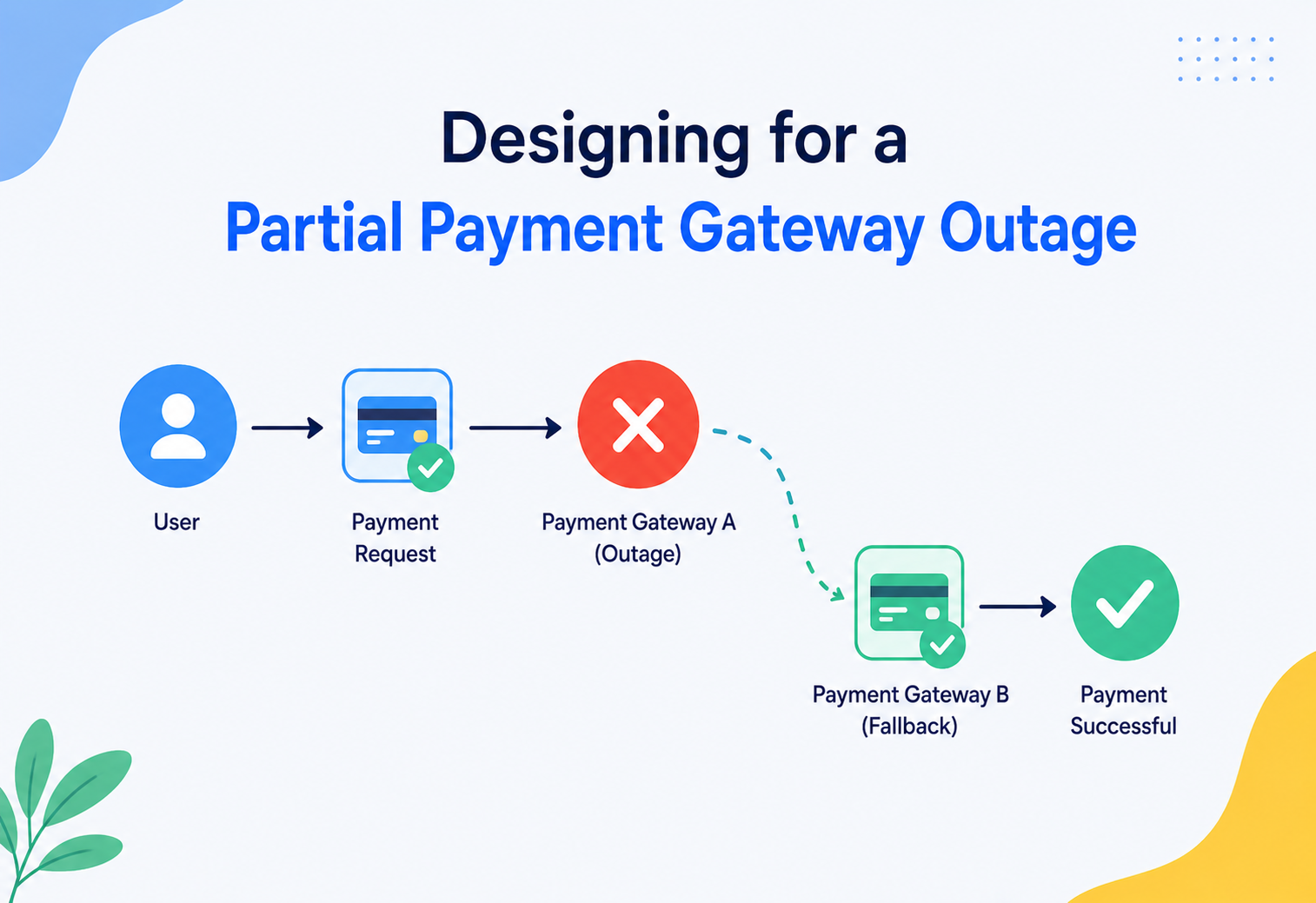
Designing for a Partial Payment Gateway Outage
How to keep a payment system trustworthy when the gateway you depend on breaks for only some transaction types — and stays half-working instead of fully down. A deep, interview-ready walkthrough of instrument-level health signals, fine-grained circuit breakers, bulkhead isolation, idempotency, transactional outbox, and the reconciliation discipline that turns a messy partial outage into a contained, mostly-invisible event.
Introduction & History
Most people, when they imagine an outage, imagine a light switch. The system is either on or off. A server room loses power, a database goes unreachable, and every request fails the same way. For a long time, that is also how engineers designed for failure — with binary thinking. A service was either healthy or unhealthy, and the fix was to fail over from one healthy replica to another.
Payment systems broke that assumption early, and they broke it hard. A payment gateway is not one machine doing one job. It is a federation of independent rails — card networks, UPI switches, netbanking gateways, wallet providers, buy-now-pay-later processors — each owned by a different company, running on different infrastructure, with different maintenance windows and different failure modes. When something goes wrong upstream, it almost never takes down all of these rails at once. A card network’s tokenization service can have an incident while UPI settlement keeps running perfectly. A netbanking partner can be doing scheduled maintenance while wallets and cards work fine. This is partial outage, and it is the normal operating condition of any payment system that has been in production for more than a year, not a rare edge case.
1.1 From binary outage thinking to portfolio thinking
Early e-commerce platforms in the 2000s did not plan for this nuance. Many integrated with a single payment processor and treated any error from that processor as a hard failure — the checkout page would simply show “payment failed, try again later,” regardless of whether the customer was trying to pay by card, wallet, or bank transfer. Around the mid-2010s, as digital payments in markets like India, Southeast Asia, and Africa exploded in volume and diversified across dozens of payment instruments, this became commercially unacceptable. A retailer could lose a very large share of a day’s revenue because one card acquiring bank had a two-hour blip, even though nine other payment methods were working perfectly.
The response from mature payment platforms — think of how Stripe, Razorpay, Adyen, or Amazon Pay operate today — was to stop treating “the payment gateway” as a single dependency and start treating it as a portfolio of independently failing capabilities. This tutorial builds that mental model from the ground up: how to detect degradation at the level of transaction type rather than at the level of the whole vendor, how to route around a broken slice of traffic without disturbing the healthy slice, and how to do all of this at a scale of millions of transactions a minute without losing a single rupee, dollar, or record of what happened.

1.2 The organizational history of payment resilience
There is also a quieter, organizational history worth understanding. Early payment integrations were often built by a single small team, bolted onto a checkout page as an afterthought once the “real” product was working. Reliability engineering for payments was reactive: an incident happened, a postmortem was written, one specific gap was patched, and the team moved on. Over time, as outage after outage revealed the same underlying pattern — one instrument breaking while the rest of the system stayed healthy, yet the whole checkout experience going dark anyway — the discipline matured into something proactive and structural. Today, at any company processing meaningful payment volume, “payment resilience” is treated as its own engineering specialty, with dedicated on-call rotations, dedicated dashboards, and design reviews that specifically interrogate how a new payment integration will behave when it is only half-working, not just when it is fully up or fully down.
This shift mirrors a broader trend across distributed systems engineering: the recognition that most real production incidents are not clean, total failures. They are messy, partial, and asymmetric. A network partition might allow reads but block writes. A downstream service might be fast for 95 percent of requests and catastrophically slow for the remaining 5 percent. A regional cloud outage might affect one availability zone but not its neighbors. Payments are simply one of the clearest, highest-stakes examples of this reality, which is exactly why the pattern is worth learning here in depth — the techniques transfer directly to shipping, notifications, search, and any other system built on top of multiple independently-operated external dependencies.
Think of a large airport’s security lanes. If one lane’s scanner breaks, they don’t close the whole terminal — they close that one lane, put up a sign, and redirect travelers to the others. Nobody standing in a working lane even notices the incident. A partial-outage-tolerant payment system does exactly that: silently reroutes the affected slice of traffic while leaving everyone else’s journey completely undisturbed.
“Why can’t you just treat any error from the payment gateway as ‘gateway down’ and show a generic retry message?” A strong answer explains that this destroys revenue and trust unnecessarily: if only card payments are affected, blocking UPI and wallet customers too is a self-inflicted outage. The interviewer is testing whether you default to coarse-grained thinking or reach for fine-grained health signals.
The Problem — A Half-Broken Gateway
Let’s define the scenario precisely, because “partial outage” can mean several different things, and the right design depends on which one you are facing.
Instrument-level partial outage
One payment method fails (say, credit cards) while others (UPI, wallets, netbanking) work. This is the most common real-world case and the one this tutorial focuses on.
Issuer-level partial outage
Cards work in general, but transactions from one specific issuing bank fail because that bank’s authorization system is down, while other banks’ cards succeed.
Region-level partial outage
The gateway’s data center in one geography is degraded, so transactions routed through that region fail while transactions in another region succeed.
Operation-level partial outage
Payments (debits) work fine, but refunds (credits) are failing, or vice versa, because the two flows hit different upstream services inside the gateway.
Latency-based partial outage
Nothing technically “fails,” but response times balloon from 300ms to 30 seconds for a subset of traffic, which functionally is a failure for a checkout flow with a customer waiting.
Notice that in every one of these cases, a naive health check — “can I connect to the gateway’s base URL?” — would report green. The gateway is up. It is answering. It is just answering wrong, or slow, or only for some requests. This is why partial outages are so much harder to design for than full outages: the failure signal is buried inside the response, not in the connection itself. You have to inspect outcomes at a fine grain — by transaction type, by issuer, by region, by operation — and build a system that can make routing decisions at that same grain.
The business requirement, stated simply, is this: when card payments break, customers paying by card should see a clear, fast, honest failure or be automatically routed to a working alternative — and every other customer should never know anything happened at all.
A single slow, half-failing dependency is more dangerous to a distributed system than a dependency that is completely down. A fully-down dependency fails fast, and callers can detect that quickly and route around it. A half-failing dependency can quietly consume threads, connection pool slots, and retry budget across your entire fleet, degrading services that have nothing to do with the broken transaction type. This is sometimes called a “gray failure,” and it is one of the leading causes of full-platform outages that started as partial ones.
2.1 How a partial outage becomes a full outage, if left unmanaged
It helps to trace the failure chain that an unprepared system follows, because it explains why so many of the design decisions in this tutorial exist. Imagine card payments begin failing at a 40 percent rate. Without instrument-aware routing, every card request still goes to the same worn-out gateway connection pool, and a share of those requests hang for the full timeout duration instead of failing instantly. Threads handling those requests are now occupied for seconds instead of milliseconds. As more card traffic arrives, more threads get tied up. Eventually, the thread pool that is shared across all payment types — because nobody thought to isolate it — runs out of capacity. At that point, a UPI transaction that would have completed in 200 milliseconds cannot even acquire a thread to start executing, and it too times out. The dashboard, which was only tracking an aggregate “payment success rate” metric, shows a sudden platform-wide collapse, even though the actual upstream problem was confined to one card issuer the entire time.
This chain — upstream slowness, shared resource exhaustion, unrelated traffic starvation, aggregate metrics hiding the true root cause — repeats across almost every large-scale outage retrospective in this space. Every architectural choice described later in this tutorial (bulkheads, fine-grained breakers, sliced metrics, bounded timeouts) exists specifically to break one link in that chain.
Architecture & Components
To survive partial outages, the payment layer needs to be built as a set of small, well-defined components, each with one job, rather than one large “payment service” that talks directly to the gateway. Here is the architecture, followed by an explanation of every box.
API Gateway
The entry point for every checkout and payment request. It terminates TLS, authenticates the caller, applies rate limiting so that one merchant or one buggy client cannot flood the system, and forwards the request to the orchestration service. In a partial outage, the API gateway’s job does not change — it is deliberately kept dumb about payment routing logic, because you want that logic in one auditable place, not scattered across edge infrastructure.
Payment Orchestration Service
The brain of the system. For every incoming transaction, it looks at the transaction type (card, UPI, wallet, netbanking), consults the Health Registry to see the current status of that specific instrument and issuer, and decides: route to primary gateway, route to a backup processor, queue for retry, or reject immediately with a clear customer-facing message. Stateless and horizontally scalable, because it sits on the hot path of every transaction.
Health Registry
A fast, in-memory (typically Redis-backed) store of live health state, keyed by dimensions like {gateway, instrument, issuer, region, operation}. Continuously updated by synthetic probes plus real-time signal extracted from actual production traffic (a rolling error-rate and latency window per key). This is what turns “the gateway is down” into “card payments from HDFC Bank in the Mumbai region are failing, but everything else is fine.”
Circuit Breaker Layer
Sitting between the orchestrator and each downstream rail, one circuit breaker instance per transaction-type-and-provider combination. When error rates for that specific combination cross a threshold, the breaker opens and stops sending traffic to that combination, giving it time to recover and protecting your own thread pools and connection pools from being consumed by a slow, failing dependency.
Transactional Outbox & Async Queue
Before any call leaves your system to an external gateway, the intent to make that call is durably written to your own database in the same transaction as the business state change. This outbox pattern guarantees that even if your process crashes right after accepting a payment request, the request is not lost — a background dispatcher will pick it up and retry it. The async queue (Kafka, SQS, or similar) decouples “accept the payment” from “settle the payment,” essential when a downstream rail is degraded and processing must slow down without losing requests.
Ledger Database
An append-only source of truth recording every transaction attempt, state transition, and outcome. It is never overwritten, only appended to — because in payments, you must always be able to reconstruct exactly what happened and when, for reconciliation, disputes, and audits.
Reconciliation Service
Runs continuously and periodically in batch, comparing what your ledger believes happened against what the gateway’s own settlement files and webhooks report. This is the safety net that catches the cases where a partial outage caused an ambiguous outcome — for example, your request timed out, but the gateway actually processed the charge.
“Why not just add retry logic inside the client SDK that calls the gateway, instead of building an orchestration service?” The expected answer: retries alone don’t help when the whole instrument is broken — you’ll just retry into failure repeatedly, burn latency budget, and potentially double-charge a customer. You need a decision layer with health awareness and idempotency, not blind retries at the network layer.
3.1 Why so many small services, instead of one payment service
A reasonable early question is why this architecture insists on splitting responsibilities across so many separate services rather than building one well-organized module inside a single payment application. The answer comes back to independent failure and independent scaling, the two themes running through this entire tutorial. The Health Monitoring Service needs to run its probing logic continuously regardless of whether payment volume is high or low, and a bug in probe scheduling should never be able to crash or slow down the orchestrator handling live customer transactions. The Reconciliation Service does heavy, batch-oriented database scanning work that would compete for the same CPU and memory resources as latency-sensitive request handling if it lived in the same process. Gateway Adapter Services change frequently — a provider updates their API, deprecates a field, or changes an error code — and isolating that churn behind a stable internal contract means those changes can be deployed, tested, and rolled back independently, without redeploying the orchestrator that everything else depends on. Splitting responsibility this way costs more operational overhead up front, but it is exactly what allows one struggling piece, like a single Gateway Adapter for a degraded card processor, to be restarted, scaled, or rolled back on its own, without any blast radius on the rest of the payment platform.
3.2 The role of the dashboard and status feed
The Ops Dashboard and Status Page shown at the edge of the architecture diagram are not cosmetic additions; they are the human interface into the same health state the machines are already using to make routing decisions. Feeding the dashboard from the same Health Registry that drives actual routing — rather than a separate, hand-maintained status system — guarantees that what engineers see during an incident is exactly what the system is acting on, eliminating an entire class of confusing incidents where the dashboard says “all green” while customers are actually experiencing failures because the dashboard was quietly drawing from a different, staler data source.
Internal Working
The most important internal mechanism here is the circuit breaker, applied at fine granularity — one breaker per {instrument, issuer} pair rather than one breaker per vendor. This granularity is the entire trick that makes partial-outage handling possible.
4.1 Closed state — normal operation
Every request for that specific combination flows through to the gateway. The breaker maintains a rolling window (for example, the last 100 requests or the last 10 seconds, whichever gives a stable enough sample) of success and failure counts. As long as the failure rate stays under a configured threshold — commonly somewhere around 20 to 50 percent depending on how aggressive you want the breaker to be — the breaker stays closed and does nothing.
4.2 Open state — protecting the system
Once the failure rate crosses the threshold, the breaker trips open. While open, requests for that combination are not sent to the gateway at all; they fail immediately (fast-fail) or are redirected to a fallback path. This protects two things at once: it stops wasting your own capacity — threads, connections, latency budget — on calls that are very likely to fail, and it stops hammering an already struggling upstream system, which can make its recovery slower.
4.3 Half-open state — testing recovery
After a cooldown period, the breaker allows a small number of trial requests through. If they succeed, the breaker closes and normal traffic resumes. If they still fail, the breaker goes back to open and the cooldown timer resets, usually with some backoff so you are not hammering the recovering service every few seconds.
The granularity point is worth repeating because it is the crux of this entire tutorial: if you implement one circuit breaker per external vendor, then a partial outage in card payments will trip a breaker that also blocks UPI and wallet traffic, because they share the same breaker. The fix is to key the breaker (and the health registry state, and the retry policy) by the finest dimension that matters to your business — typically {gateway_provider, instrument_type, issuer_bank, region}. This means a single logical “payment gateway” dependency can have dozens or hundreds of independent breakers running at once, each reflecting the true health of one narrow slice of traffic.

“How do you choose the failure threshold and cooldown period for a circuit breaker?” Good answers mention that these should not be one-size-fits-all constants: high-volume, high-value paths (like card payments during a flash sale) may warrant faster tripping and shorter cooldowns to protect the system quickly, while low-volume paths need a larger sample window so a handful of unlucky failures don’t trip the breaker unnecessarily. Mention that these thresholds are usually tuned empirically and revisited after incidents.
4.4 Algorithms and data structures behind the breaker
The rolling window that a circuit breaker uses to compute an error rate is itself a small algorithms problem worth understanding in detail, because the naive implementation has a subtle flaw. A fixed window (count failures in “the current 10-second bucket,” then reset to zero at the boundary) is simple but suffers from a boundary problem: a burst of failures right at the end of one window and right at the start of the next can each look individually acceptable, while the actual failure rate across that boundary moment was very high. The fix used in most production breaker implementations is a sliding window, commonly built from a small ring buffer of fixed-size sub-buckets (say, ten 1-second buckets covering a 10-second window). Each new second, the oldest bucket is evicted and a fresh one begins, and the error rate is computed as a sum across all currently active buckets — giving a continuously moving, boundary-free view of recent health at low memory and compute cost.
An alternative, even lighter-weight approach uses an exponentially weighted moving average (EWMA) of the success rate, where each new outcome nudges a running average by a small weighted amount, and older outcomes decay in influence exponentially over time. EWMA needs only a single floating-point number of state per breaker instead of a ring buffer, which matters when you are maintaining thousands of independent breaker instances (one per instrument-issuer-region combination) in memory across a large fleet of orchestrator nodes.
The retry budget mechanism mentioned earlier is typically implemented as a token bucket: a counter that refills at a steady rate (say, 50 tokens per second) up to some maximum capacity, and every retry attempt consumes one token. If the bucket is empty, further retries are rejected outright rather than queued, which caps the maximum retry pressure any single degraded dependency can receive, independent of how many client requests are arriving. This is a textbook rate-limiting data structure, reused here for a slightly different purpose — protecting an upstream dependency rather than protecting your own API from external abuse.
Sharding the health registry itself, so that no single node becomes a hotspot when everyone is reading the status of one specific broken issuer during an incident, commonly relies on consistent hashing to map each {instrument, issuer, region} key to one of many registry shards. Consistent hashing keeps the reshuffling of keys minimal when a shard is added or removed, which matters for a component you want to scale up quickly and safely in the middle of an active incident, not just during calm, planned maintenance windows.
public final class SlidingWindowBreaker {
    private final int   buckets;      // e.g. 10 one-second buckets
    private final long  bucketMs;     // e.g. 1000
    private final AtomicIntegerArray successes;
    private final AtomicIntegerArray failures;
    private volatile State state = State.CLOSED;
    private volatile long  openedAt;

    public boolean allow() {
        if (state == State.OPEN && now() - openedAt < cooldownMs) return false;
        if (state == State.OPEN) state = State.HALF_OPEN;
        return true;
    }

    public void record(boolean ok) {
        int slot = (int)((now() / bucketMs) % buckets);
        (ok ? successes : failures).incrementAndGet(slot);
        double rate = failureRateAcrossBuckets();
        if (state == State.CLOSED && rate >= tripThreshold) {
            state = State.OPEN; openedAt = now();
        } else if (state == State.HALF_OPEN && ok) {
            state = State.CLOSED; resetBuckets();
        } else if (state == State.HALF_OPEN && !ok) {
            state = State.OPEN; openedAt = now();
        }
    }
}
Data Flow & Lifecycle
Walk through what happens, step by step, to a single card transaction while card payments are degraded but not fully dead.
Five lifecycle states matter for every transaction moving through this system:
| State | Meaning | What happens next |
|---|---|---|
| INITIATED | Request accepted, durably written before any external call | Orchestrator checks health registry |
| ROUTED | A specific downstream path (primary or backup) chosen | Call dispatched through circuit breaker |
| IN_FLIGHT | Call sent, response not yet received | Timeout timer running; state is ambiguous if it expires |
| SETTLED | Definite success or definite failure confirmed by gateway | Ledger updated, customer notified |
| RECONCILING | Outcome unclear (timeout, partial response); needs verification | Reconciliation service checks gateway’s status/settlement API |
The RECONCILING state deserves special attention because it is the state a naive design forgets. When a request to a degraded gateway times out, you genuinely do not know whether the charge happened. Retrying blindly risks a double charge; assuming failure and letting the customer retry risks the same. The correct move is to mark the transaction RECONCILING, not retry it automatically, and use an idempotency key plus a status-check call (most mature gateways expose a “query transaction status” endpoint precisely for this reason) to resolve the ambiguity before doing anything irreversible.
“A customer’s card payment times out during the outage. What do you do?” The strong answer walks through: never immediately retry with a new charge; check idempotency-keyed status with the gateway first; if genuinely unresolved after a bounded number of status checks, hold the transaction in RECONCILING and inform the customer honestly rather than silently failing or silently succeeding; let the reconciliation batch job resolve it against the gateway’s settlement file as a final backstop.
5.1 Concurrency: handling the same idempotency key twice, at the same instant
A subtle concurrency problem hides inside the idempotency mechanism during an outage: a client whose request appears to hang will often fire a second request with the same idempotency key while the first one is still in flight, rather than waiting patiently. If both requests reach the orchestrator at nearly the same moment, on two different server instances, a naive “check if this key exists, then create it if not” sequence has a race condition — both instances can check simultaneously, both see no existing record, and both proceed to call the gateway, producing exactly the duplicate charge the idempotency key was meant to prevent.
The standard fix is to make the check-and-create step atomic at the data layer, not at the application layer. A unique constraint on the idempotency key column in the ledger database, combined with an INSERT that either succeeds once or fails with a constraint violation for every subsequent attempt, guarantees only one request ever proceeds to call the gateway; every other concurrent request with the same key is told to wait for, and then read, the outcome of the first one. Some teams implement this instead with a short-lived distributed lock (for example, a Redis SET key value NX command with an expiry) acquired before the first gateway call and released after the outcome is recorded, which achieves the same mutual exclusion without relying on the ledger database’s constraint mechanics, and can be faster under very high concurrency.
Either mechanism must be paired with a sensible policy for what “waiting for” the first request looks like — typically a short poll loop with backoff, capped at a maximum wait time, after which the second request is told the payment is still processing rather than being left to hang indefinitely, which would simply recreate the same resource-starvation problem described earlier in a different form.
Design Patterns & Anti-Patterns
6.1 Patterns that help
Circuit breaker (fine-grained)
Covered above; the core mechanism for isolating failure to the affected slice of traffic.
Bulkhead isolation
Give each downstream dependency (card rail, UPI rail, netbanking rail) its own thread pool or connection pool, so a slow card gateway cannot starve the resources needed to process a healthy UPI transaction. Named after ship compartments that stop one hull breach from sinking the whole vessel.
Idempotency keys
Every payment request carries a client-generated unique key. If the same key is submitted twice (because a client retried after a timeout), the gateway and your own orchestrator both recognize it and return the original result instead of creating a duplicate charge.
Saga pattern
For multi-step payment flows (authorize, capture, then trigger downstream fulfillment), each step has a matching compensating action. If capture fails after authorization succeeded on a degraded gateway, a compensating “void authorization” step runs automatically rather than leaving the customer’s funds in limbo.
Transactional outbox
Described earlier; guarantees no request is silently dropped due to a process crash mid-flight.
Graceful degradation with instrument-level fallback
If card payment is degraded, offer the customer UPI or wallet as an alternative at checkout, rather than a dead end.
Backpressure & retry budgets
Instead of retrying every failed request immediately, maintain a token-bucket “retry budget” per downstream dependency so that retries themselves cannot overwhelm a recovering service.
Health-aware weighted routing
Rather than a binary “use this gateway or don’t,” gradually shift a percentage of traffic away from a degrading path and toward a healthier one, smoothing the transition and giving early warning before a full breaker trip becomes necessary.
Dead letter queues for exhausted retries
When a queued transaction has exhausted its retry budget without a resolved outcome, moving it to a dedicated dead letter queue for manual or specialized automated handling prevents it from being silently dropped or endlessly retried, and gives operators a clear, bounded list of exactly which transactions need attention.
6.2 Anti-patterns to avoid
| Anti-pattern | Why it’s dangerous |
|---|---|
| Single coarse-grained breaker per vendor | Couples the fate of healthy transaction types to broken ones. |
| Unbounded retries | Retrying forever, or retrying immediately without backoff, both amplify load on a struggling dependency and can turn a partial outage into a full one (the “retry storm”). |
| Synchronous chains of dependency calls with no timeout budget | If the orchestrator waits 30 seconds on a hung card gateway call while holding a customer-facing HTTP connection open, threads pile up and the entire API surface can become unresponsive, not just card payments. |
| Silent failover without customer or ops visibility | Routing to a backup processor is good, but doing it invisibly, with no logging, no metric, and no alert, means nobody notices the primary is down until the backup itself is overwhelmed or costs spike. |
| Treating “HTTP 200” as success | Some gateways return 200 with an error code in the response body. Health checks and breakers that only look at HTTP status codes will misjudge the gateway as healthy. |
“What’s the danger of a retry storm, and how do you prevent one?” Explain that retries without backoff and jitter synchronize across many clients, creating waves of load that repeatedly hit a recovering service right as it’s trying to come back up, which can re-trip it into failure. Prevention: exponential backoff with jitter, retry budgets, and circuit breakers that stop retries entirely once open.
Advantages, Disadvantages & Trade-offs
Advantages
Healthy transaction types remain completely unaffected. Revenue loss during an incident is limited to the genuinely broken slice, not the whole platform. Customers get honest, specific feedback. Ops teams get precise, actionable alerts instead of a vague “payments are down” page. Faster recovery detection because the system is watching narrow slices, not one aggregate number that can hide a problem inside healthy averages.
Disadvantages
Significantly more operational complexity — dozens or hundreds of breaker states to reason about instead of one. Harder to test exhaustively; you cannot simulate every combination of instrument, issuer, and region failing independently in staging easily. Requires investment in a fast, reliable health registry, which itself becomes a critical dependency that must not fail. More moving parts means more places for bugs in the routing logic itself.
7.1 How the trade-off shows up in practice
These advantages and disadvantages are not abstract; they show up directly in how an engineering organization spends its time. Teams adopting this fine-grained approach typically spend meaningfully more effort during initial build-out — designing the key structure for health state, building and testing the bulkhead isolation between resource pools, and integrating a genuine second processor rather than only a single vendor relationship. In exchange, the operational cost during an actual incident drops sharply: instead of an all-hands, whole-platform incident bridge trying to diagnose why “payments are down,” the on-call engineer typically already has a precise, automatically generated signal pointing at exactly which slice of traffic is affected, often before a human even notices anything is wrong, because the circuit breaker has already reacted and rerouted traffic on its own.
7.2 Key trade-offs
| Decision | Trade-off |
|---|---|
| Granularity of circuit breakers | Finer granularity isolates failure better but multiplies the number of states to monitor and can dilute the sample size per breaker, making trip decisions noisier. |
| Fast-fail vs. queue-and-retry when a rail is down | Fast-fail gives customers immediate, honest feedback but loses transactions that might have succeeded moments later; queuing preserves more transactions but adds latency and complexity around expiry and duplicate risk. |
| Automatic fallback to backup processor vs. show alternative payment method to customer | Automatic fallback is seamless but usually costs more (backup processors often have higher fees) and adds integration surface area; showing an alternative method is cheaper but shifts effort to the customer. |
| Real-time traffic-derived health signal vs. synthetic probes | Traffic-derived signal reflects reality faster but needs enough live volume to be statistically meaningful; synthetic probes work at low volume but can miss issues that only manifest under real load or specific parameter combinations. |
7.3 CAP theorem, applied to the two very different stores in this system
The CAP theorem states that a distributed data store, in the presence of a network partition, must choose between consistency and availability — it cannot guarantee both at once. This system deliberately makes two opposite choices for its two different stores, because they serve opposite purposes, and that contrast is a genuinely useful thing to be able to explain clearly.
The ledger database is a CP system: consistency over availability. If a network partition makes it impossible to guarantee that a write is durable and correctly ordered, the system should refuse the write rather than risk recording an incorrect or duplicated financial event. A brief unavailability window on the ledger is an acceptable cost; a wrong or lost financial record is not. This is why the ledger typically runs on a database offering strict transactional guarantees, often with synchronous replication to at least one standby before acknowledging a write.
The health registry is an AP system: availability over consistency. If a network partition makes it impossible to guarantee every node sees the absolute latest health status, it is far better for the registry to keep answering with slightly stale data (a status that is, say, 300 milliseconds old) than to stop answering entirely and block every payment decision on a consistency guarantee that genuinely does not matter much here. A payment routed based on health information that is a third of a second stale is a negligible risk; a payment orchestrator that cannot get any health answer at all, and therefore cannot route any transaction, is a self-inflicted total outage caused by over-engineering consistency into a component that never needed it.
Recognizing which of your components actually need strong consistency, and which merely need to be fast and mostly-right, is one of the most transferable skills in distributed systems design, and this payment architecture is a clean, concrete example of applying that judgment correctly in two different places within the same system.

Performance & Scalability
Assume the platform must sustain several million payment requests per minute at peak — think a major sale event across a large e-commerce or ride-hailing platform. At that scale, every component on the hot path must be designed for horizontal scale-out and for doing as little synchronous work as possible.
8.1 Orchestration service scaling
The orchestrator must be stateless so any instance can serve any request; state (health status, breaker counters) lives in a shared, low-latency store, not in process memory alone, though a local in-memory cache with a short TTL in front of that store is common to avoid a network hop on every single request. At millions of requests per minute, even a 1ms round trip to a shared cache per request adds up, so most production systems keep a locally cached copy of health state, refreshed every few hundred milliseconds via pub/sub, rather than querying the shared store synchronously per transaction.
8.2 Health registry scaling
Backed by an in-memory data store like Redis, sharded by key (instrument+issuer+region) so that hot keys during an incident — everyone querying the status of the one broken issuer — do not overwhelm a single shard. Health updates from probes and from live traffic sampling are written asynchronously and aggregated over short rolling windows (a few seconds) rather than computed per-request, to keep write volume manageable.
8.3 Async processing for the actual gateway call
The customer-facing request should be acknowledged as soon as it is durably queued (INITIATED state), not held open until the gateway responds, wherever the product experience allows it. This decouples your API latency from the gateway’s latency, which is critical when the gateway is degraded and taking many seconds per call instead of milliseconds. Push notifications or webhooks then inform the client of the final outcome.
8.4 Load balancing under partial degradation
Standard load balancers distribute traffic across your own service instances, but the more interesting scaling question here is upstream load balancing — how you distribute traffic across multiple acquiring banks or processors for the same instrument type. Weighted routing (send most card traffic to Processor A, a smaller percentage to Processor B) lets you shift weight away from a degrading processor gradually rather than in one abrupt cutover, smoothing the load spike that a backup processor would otherwise see.
“If your backup processor normally handles 5% of traffic and the primary suddenly fails for 60% of card volume, what happens?” Good candidates recognize this is a thundering-herd risk on the backup: it may not be provisioned for a sudden 12x traffic increase. Mitigations include pre-provisioned capacity headroom on backups, gradual weighted shift rather than instant 100% cutover, and admission control (rate limiting into the backup) with graceful queuing or honest rejection once its safe capacity is reached.
8.5 Networking details that matter at this scale
At millions of requests per minute, the mechanics of the network connections themselves become a real performance factor, not an abstraction to ignore. Establishing a fresh TCP connection and completing a TLS handshake for every outbound call to a payment gateway adds latency that is completely wasted overhead when the same gateway will be called again a moment later. Production orchestrators maintain persistent, pooled connections to each downstream gateway, sized per gateway based on its observed capacity, and reuse those connections across many requests. HTTP/2 or gRPC’s connection multiplexing allows many concurrent logical requests to share a small number of underlying TCP connections efficiently, which reduces both connection overhead and the number of file descriptors the orchestrator fleet needs to manage.
Connection pool sizing is itself a bulkhead decision: each downstream dependency should have its own bounded pool, sized so that a dependency experiencing high latency can only ever occupy its own allotted connections, never spill over and starve the pool serving a healthy dependency. When a circuit breaker opens for a given combination, its associated connection pool should also stop accepting new checkouts immediately, freeing those connections for other purposes rather than letting them sit idle waiting on a dependency the breaker has already given up on.
DNS resolution and connection warm-up also matter more than they might seem to: if a backup processor is normally lightly used, its connection pool may be mostly cold when a sudden failover sends it a large volume of new traffic. Keeping a small baseline of warm, idle connections open to every configured backup at all times — even when it’s carrying near-zero production traffic — avoids paying full connection-establishment latency on every request during the exact moment when latency budget is already under the most pressure.
High Availability & Reliability
High availability here has two layers: the availability of your own payment orchestration platform, and the availability of the payment outcome for the customer, even when a dependency is degraded.
9.1 Platform availability
The orchestrator, health registry, and queue infrastructure should each be deployed across multiple availability zones, with no single zone able to take down the whole payment path. The health registry itself, since every transaction depends on reading it, needs its own replication and failover strategy — commonly a primary-replica Redis cluster with automatic failover, or a distributed cache with built-in replication.
9.2 Graceful behavior when the health registry itself is unavailable
This is a subtle but important design decision: if the component that tells you what’s healthy becomes unavailable, should you assume everything is healthy (fail open) or assume everything is broken (fail closed)? For payments, the common answer is a middle path — fail open to the primary gateway with tighter, more conservative timeouts and let the underlying circuit breakers (which operate independently, based on real-time success/failure of actual calls) catch problems, rather than blocking all payments because a status-tracking component had a hiccup.
9.3 Failure recovery and self-healing
Beyond detecting and routing around failure, a mature system actively participates in recovery rather than passively waiting for an external team to fix the upstream gateway. Automated recovery probes, running independently of live customer traffic, periodically send small, low-risk synthetic transactions (or lightweight status calls where the provider offers one) to a degraded path specifically to measure whether it has recovered, feeding that signal directly into the half-open trial logic of the relevant circuit breaker. This closes the loop without requiring a human to notice an external status page update and manually flip a configuration flag, shortening the time between an upstream fix landing and traffic safely flowing back to the recovered path.
9.4 Reliability of outcome despite instrument failure
Reliability, from the customer’s point of view, is not “the gateway never fails.” It is “my payment either clearly succeeded, clearly failed, or I was clearly told to try again — and I was never double-charged.” That is achieved through the combination of idempotency keys, the outbox pattern, and the reconciliation service described earlier. No matter how badly the upstream gateway misbehaves, these three mechanisms guarantee that your ledger eventually reflects the true, correct, single outcome of every transaction.
9.5 Disaster recovery
Beyond day-to-day partial outages, plan for the case where an entire payment gateway vendor is unavailable for an extended period. This requires a genuinely independent backup processor relationship (not just a different endpoint of the same vendor), pre-negotiated and pre-integrated well before it is needed, along with a documented runbook for how quickly traffic can be shifted and what percentage of volume the backup can safely absorb.

9.6 Replication, partitioning, and consensus underneath high availability
High availability for the ledger database is achieved through synchronous or semi-synchronous replication to standby replicas, so that a write is only acknowledged once it has been durably persisted on more than one machine — protecting against the loss of a single node without waiting for every replica in every region to confirm, which would make writes unacceptably slow. If the primary node fails, an automated failover process promotes a replica to primary; this promotion itself is a consensus problem — every remaining node in the cluster must agree on which replica becomes the new primary, to avoid the dangerous scenario of two nodes both believing they are primary and accepting conflicting writes, known as split brain. Most managed database and cache clusters solve this using a consensus algorithm such as Raft, where a leader is elected only once a majority of nodes agree, guaranteeing at most one primary is active at any time even during a network partition.
Partitioning (sharding) the ledger database becomes necessary once transaction volume outgrows what a single database node can handle, which happens quickly at a scale of millions of transactions per minute. A common partitioning key is a hash of the merchant identifier or the transaction identifier, spreading write load evenly across many database shards. The choice of partition key matters: partitioning by merchant identifier keeps all of one merchant’s transactions together, which is convenient for merchant-specific reporting and reconciliation, but can create a hot shard if one merchant suddenly generates a disproportionate share of traffic — exactly the kind of spike a flash sale or viral event can cause. Partitioning by transaction identifier (or a hash combining transaction identifier and time) spreads load more evenly but makes merchant-level queries need to fan out across every shard. Real systems often use a hybrid: partition primarily by transaction identifier for even write distribution, and maintain a separate, denormalized read-optimized index by merchant for reporting queries.
The health registry, being an AP system as discussed earlier, replicates differently: multiple replicas each accept reads independently, and writes propagate asynchronously via pub/sub, favoring low latency and continued availability during a partition over strict agreement between replicas on the exact current value. This is a deliberate, informed departure from the strong consistency used for the ledger, made because the cost of a stale health read is low and the cost of a blocked payment decision is high.
Security
Partial outages create security pressure in two specific ways that are easy to overlook.
10.1 Fallback paths are attack surface too
A backup processor that is rarely used gets less day-to-day scrutiny than your primary integration. It still needs the same standards: PCI-DSS scope handling, tokenization of card data so raw card numbers never touch your own servers, strict TLS configuration, and the same webhook signature verification you’d demand of the primary. An incident is exactly the moment when attackers might probe for a hastily-built fallback with weaker validation.
10.2 Idempotency keys must be unguessable and scoped
Idempotency keys prevent duplicate charges during retries, but if they are predictable or not scoped to the authenticated merchant/customer, an attacker could potentially replay or interfere with another user’s in-flight transaction. Keys should be cryptographically random, tied to the authenticated session, and expire after a bounded window.
10.3 Rate limiting and abuse during degraded states
When customers see failures, a common (and legitimate) behavior is rapid manual retry — clicking “pay” repeatedly. This looks similar to card-testing fraud attacks, which often spike specifically when fraudsters notice a gateway is degraded and assume fraud controls might be too. Rate limiting and fraud scoring need to stay active, and arguably tighten slightly, during a known partial outage rather than being relaxed to “let more retries through.”
10.4 Audit trail integrity
Every routing decision — which gateway a transaction was sent to and why — should be logged immutably. During a security or compliance review of an incident, you need to reconstruct not just what happened to the money, but what your system believed about the world (the health registry state) at the moment it made each decision.
“Should you relax fraud checks to make retries easier for customers during a partial outage?” No — explain that degraded states are precisely when fraud attempts spike, since attackers look for weakened controls. The right response is to keep fraud and rate-limiting controls intact and instead reduce customer friction elsewhere, such as clearer messaging and offering an alternative payment method.
10.5 Compliance scope of the fallback path
Regulated payment environments are typically certified against a defined compliance scope — which systems are permitted to touch raw cardholder data, and under what controls. When a backup processor is introduced as a fallback, it is easy for its integration to be built quickly, under incident-response time pressure, in a way that inadvertently expands that scope — for example, temporarily logging a raw card number “just to debug the failover,” or storing data in a location that was never included in the original compliance assessment. Every fallback path should be designed and reviewed to the same compliance standard as the primary path well before an incident, specifically so that no shortcuts are tempting or necessary when the pressure is actually on.
10.6 Secrets and credential management across multiple providers
Maintaining live integrations with several gateway providers means maintaining several sets of API credentials, signing keys, and webhook secrets, each of which needs to be stored in a secrets manager, rotated on a schedule, and scoped so that a leak of one provider’s credentials cannot be used to access another provider’s account or any unrelated internal system. Because backup providers are used less frequently, their credentials are also more likely to be forgotten during routine rotation exercises; explicit inclusion of every fallback integration’s credentials in the same rotation schedule and audit process as the primary integration closes this gap.
Monitoring, Logging & Metrics
You cannot manage what you cannot see at the right granularity. The core monitoring principle here mirrors the architecture: metrics must be sliced by instrument, issuer, and region, not aggregated into one “payment success rate” number that can hide a serious problem inside a healthy-looking average.
11.1 Key metrics
- Success rate per {instrument, issuer, region}, on a short rolling window (10–30 seconds) for fast detection, plus longer windows for trend analysis.
- Latency percentiles (p50, p95, p99) per slice — degraded latency without outright errors is a common and easy-to-miss form of partial outage.
- Circuit breaker state transitions — every open/half-open/closed transition emitted as an event, so ops can see exactly when and where the system started protecting itself.
- Reconciliation mismatch rate — how often the ledger’s belief about a transaction’s outcome differs from the gateway’s settlement record; a rising rate is an early signal of a subtle partial outage even before error rates climb.
- Fallback utilization — what percentage of traffic is currently on a backup path, tracked over time, both for capacity planning and cost visibility (backups often cost more per transaction).
11.2 Alerting philosophy
Alert on the narrow slice, not just the aggregate: “card payments for IssuerX in the Mumbai region have a 45% error rate over the last 2 minutes” is actionable; “overall payment success rate dropped 3%” sends someone hunting through dashboards to find what actually broke. Distributed tracing, with a correlation ID attached at the moment a transaction enters the orchestrator and propagated through every downstream call, lets an engineer pull up one transaction and see exactly which health checks, breaker states, and gateway calls it encountered.
11.3 Public status page
Many mature payment platforms expose a status page (internally or, in some cases, to merchants) showing per-instrument health, similar to the status panel shown at the top of this tutorial. This turns a support burden — hundreds of “is payment down?” tickets — into a single source of truth customers and merchants can check themselves.
11.4 Structuring logs for fast root-cause analysis
During an active incident, the difference between a five-minute diagnosis and a forty-five-minute one is usually how well logs are structured, not how much is logged. Every log entry emitted along the payment path should carry the same set of structured fields — correlation identifier, instrument type, issuer, region, gateway provider attempted, breaker state at the time of the call, and outcome — as machine-parseable key-value pairs rather than free-text sentences. This lets an on-call engineer run a single structured query, such as filtering for a specific issuer and a specific error outcome within the last ten minutes, and immediately see the exact shape and size of the problem, instead of grepping through unstructured text logs under incident-time pressure.
11.5 On-call and escalation practices
Because a partial outage in a widely-used instrument can have significant revenue impact within minutes, alerting thresholds for payment-path metrics are usually tuned tighter and paged faster than for most other parts of a platform, often paging a human within one to two minutes of a sustained anomaly rather than waiting for a slower-moving daily or hourly threshold. Runbooks tied directly to specific alerts — for example, an alert for “card success rate below threshold for IssuerX” links straight to the steps for verifying the circuit breaker has tripped, checking whether the fallback path is absorbing the redirected volume correctly, and confirming customer messaging has updated — reduce the cognitive load on whoever is paged, especially at three in the morning, by turning “figure out what to do” into “follow the steps.”
Deployment & Cloud
The orchestration service, health registry, and queue consumers are typically deployed as independently scalable microservices on a container orchestration platform such as Kubernetes, each with its own horizontal pod autoscaler tuned to relevant metrics — request rate for the orchestrator, queue depth for the async dispatchers.
12.1 Multi-region deployment
Because gateway partial outages are sometimes tied to a specific region of the gateway’s own infrastructure, running your orchestration layer across multiple cloud regions, with the ability to route a transaction through whichever region has healthier connectivity to the affected gateway, adds another layer of resilience beyond instrument-level routing.
12.2 Progressive delivery for routing logic changes
Because the routing and breaker logic is business-critical, changes to it should go through canary deployment — a small percentage of traffic exercises new routing code first, with automatic rollback if error rates or latency regress, before it reaches full traffic. Feature flags are commonly used to toggle specific fallback behaviors (like enabling a backup processor) instantly, without a full deployment, which matters when you need to react to an incident in minutes, not the length of a deployment pipeline.
12.3 Chaos engineering for this specific scenario
Because partial outages are hard to reproduce in normal testing, mature teams run controlled chaos experiments — deliberately injecting elevated error rates or latency into one instrument-and-issuer combination in a staging or even production environment (with careful blast-radius controls) — to verify that breakers trip correctly, fallback routes engage, and unaffected traffic truly stays unaffected.
12.4 Configuration as the fast lever during an incident
Breaker thresholds, retry budgets, and routing weights are kept in externalized, dynamically reloadable configuration rather than hard-coded constants baked into a deployed binary. During an active incident, an on-call engineer needs to be able to, for example, temporarily lower a breaker’s trip threshold for a specific issuer that is behaving unusually, or manually force a breaker open to stop sending traffic to a known-bad path, within seconds — not by waiting for a build-test-deploy cycle that could take twenty minutes even on a fast pipeline. This configuration layer itself needs its own audit trail, since it directly controls where customers’ money is routed, and any manual override made during an incident should be automatically reverted or explicitly reviewed once the incident is resolved, so temporary emergency settings don’t silently become permanent, forgotten defaults.
Databases, Caching & Load Balancing
13.1 Ledger database choice
The ledger demands strong consistency and durability above all else — this is money. A relational database with strict transactional guarantees (or a distributed SQL system offering the same guarantees at scale) is the common choice, with the ledger table designed as append-only: new rows for every state transition rather than in-place updates, preserving a full audit history.
13.2 Health registry storage
Optimized for the opposite priorities — extremely low read latency and high throughput, with eventual consistency being perfectly acceptable, since being a few hundred milliseconds behind on health status is a reasonable trade-off for sub-millisecond reads on the hot path. Redis or a similar in-memory store, often with local read replicas per region, fits this well.
13.3 Caching health decisions locally
As mentioned in the performance section, each orchestrator instance typically keeps a short-lived local cache (hundreds of milliseconds) of health state, refreshed via a lightweight pub/sub mechanism when the underlying registry changes, rather than hitting the shared store on every single transaction.
13.4 Cache invalidation and staleness bounds
The one hard rule governing this local cache is that staleness must be bounded and known, not indefinite. A cache entry that never expires risks an orchestrator instance continuing to route traffic to a gateway that tripped its breaker seconds ago, simply because that instance missed the pub/sub update due to a transient network blip. Every cached health entry therefore carries a short time-to-live, typically under a second, after which it is either refreshed proactively or treated as unknown and read fresh from the shared registry, guaranteeing that even in the worst case of a missed update, the window during which an orchestrator instance can make a decision based on stale health information is small and predictable, not open-ended.
13.5 Load balancing across gateway providers
Weighted, health-aware load balancing at the orchestrator level — not a traditional network load balancer, but application-level routing logic that considers current breaker state and configured weight per provider. This is different from typical load balancing across identical replicas, because the “backends” here (primary gateway, backup processor) are not identical; they may have different fees, different capabilities, and different latency characteristics, so the routing decision is a business decision as much as an infrastructure one.
“Why append-only for the ledger instead of updating a row in place?” Because payments require a full, tamper-evident history for audits, disputes, and regulatory reporting — you must be able to prove the exact sequence of state changes a transaction went through, and in-place updates destroy that history.
APIs & Microservices
The payment domain naturally decomposes into a small number of focused services, each independently deployable and scalable, communicating through well-defined contracts.
- Payment Orchestration Service — exposes the customer-facing “initiate payment” and “get payment status” endpoints; the only service that talks to the health registry and circuit breakers directly.
- Health Monitoring Service — runs synthetic probes and ingests real-time traffic signal, writing aggregated health state to the registry; exposes an internal API for the orchestrator and dashboard to query current status.
- Gateway Adapter Services — one per external provider (primary card gateway, backup processor, UPI switch, and so on), each responsible for translating your internal request format into that specific provider’s API, handling that provider’s quirks, and normalizing its responses and error codes into a common internal vocabulary.
- Reconciliation Service — consumes settlement files and webhooks from every provider, compares against the ledger, and raises discrepancies for automatic or manual resolution.
- Notification Service — delivers final outcomes to customers and merchants via webhook, push notification, SMS, or email, decoupled from the transaction path via the async queue.
The Gateway Adapter Service layer deserves emphasis: normalizing every provider’s different error codes and response shapes into one common internal vocabulary (like SOFT_DECLINE, HARD_DECLINE, TIMEOUT, ISSUER_UNAVAILABLE) is what allows the orchestrator’s routing and breaker logic to be written once, generically, instead of special-cased per provider. Without this normalization layer, every new payment method integration would require touching the core routing logic, which is exactly the kind of coupling this architecture is trying to avoid.
POST /v1/payments
{
  "idempotencyKey":  "cli-9931-2026-08-11",
  "amount":          { "currency": "INR", "value": 129900 },
  "instrument":      { "type": "card", "token": "tok_A9x…" },
  "merchantOrderId": "ORD-88231"
}

Response 202 Accepted:
{
  "paymentId":       "pay_7c1e…",
  "status":          "PENDING",
  "routed":          { "provider": "primary_card", "attempt": 1 },
  "createdAt":       "2026-08-11T09:00:00Z"
}

GET /v1/payments/pay_7c1e…/status
{ "status": "SUCCESS", "settlementRef": "PSP-4471", "finalizedAt": "…" }
14.1 Contract design
APIs between these services are typically synchronous (REST or gRPC) for request/response interactions like “initiate payment,” and event-driven (via the queue) for anything that represents “something happened” — a status change, a reconciliation result, a health state update — which naturally has multiple interested consumers.
14.2 Versioning and backward compatibility
Gateway Adapter Services must evolve independently of the orchestrator, which means their internal API contract needs explicit versioning and strict backward compatibility guarantees. A new field added by a provider, or a new normalized error code introduced to represent a failure mode the orchestrator hasn’t seen before, should never break existing routing logic; unrecognized fields are ignored, and unrecognized error codes fall back to a conservative default classification (typically treated as a soft, retryable failure until proven otherwise) rather than causing the orchestrator to throw an unhandled exception in the middle of processing a live payment.
14.3 Public-facing API design for merchants and clients
The customer- and merchant-facing “initiate payment” and “get payment status” endpoints are deliberately kept simple and stable, hiding all of the internal routing, breaker, and fallback complexity behind a consistent contract. A merchant integrating with the platform should never need to know or care which internal gateway ultimately processed a given transaction; they submit a payment request with an idempotency key and receive a status, exactly as they would during completely normal operation. This separation of a stable external contract from a rapidly evolving internal implementation is what allows the resilience mechanisms described throughout this tutorial to be added, tuned, and improved over time without requiring every merchant or client application to be updated in lockstep.
Best Practices & Common Mistakes
15.1 Best practices
- Key every piece of health and breaker state by the finest useful granularity — instrument, issuer, region, and operation — not just by vendor.
- Treat a timeout as “unknown,” never as “failure.” Resolve it through status checks and reconciliation, not assumption.
- Always issue idempotency keys client-side, before the first network attempt, so retries (from the client, or from your own system) are inherently safe.
- Set aggressive but bounded timeouts on every external call, and enforce them with bulkheaded thread/connection pools so one slow dependency cannot starve others.
- Test partial-outage scenarios deliberately, through chaos experiments, rather than hoping production teaches you where the gaps are.
- Give customers specific, honest messaging tied to what actually failed (“card payments are temporarily unavailable, please try UPI”) rather than a generic error.
- Review every new payment integration’s failure modes at design time, explicitly asking “what happens if this specific call is slow, or wrong, or half-successful,” rather than only designing for the happy path and bolting on error handling afterward.
- Practice incident response through regular game days, not just documentation, so the team’s muscle memory for diagnosing and responding to a partial outage is genuinely tested before it matters.
15.2 Common mistakes
- Building one health check per vendor endpoint instead of per meaningful transaction slice, which hides partial degradation inside a healthy-looking aggregate.
- Retrying automatically and immediately on every failure without backoff, jitter, or a retry budget, risking a retry storm that worsens the outage.
- Forgetting that refunds and payments often hit different upstream services and can fail independently — a system that only monitors payment success can miss a refund-specific outage entirely.
- Under-provisioning backup processors, so that when they’re actually needed under a traffic surge, they become the second outage of the day.
- Not logging routing decisions, making post-incident analysis guesswork instead of a clear timeline.
- Treating a recovered dependency as fully trustworthy the instant its first request succeeds, instead of ramping traffic back gradually and watching for a relapse.
- Letting fallback integrations drift out of compliance or security parity with the primary path because they are exercised rarely and reviewed less often.
- Designing the customer-facing error experience as an afterthought, so that even when the backend correctly isolates the failure, the frontend still shows a generic, unhelpful message that erodes trust unnecessarily.
Real-World & Industry Examples
Large payment and commerce platforms have converged on very similar architectural answers to this problem, for good reason — it is dictated by the physics of distributed, third-party-dependent systems, not by any one company’s preference.
Multi-processor routing at scale
Large payment platforms that process on behalf of many merchants commonly maintain relationships with multiple acquiring banks and processors for the same card networks, and route transactions dynamically based on live success-rate and latency signal per processor — the exact fine-grained health-aware routing pattern described in this tutorial, sometimes marketed as “smart routing” or “payment orchestration.”
Checkout resilience
Major e-commerce platforms design checkout flows to present multiple payment method options rather than a single path, so that when one instrument type degrades during a high-traffic event (like a flash sale), the platform can visually deprioritize or temporarily hide that option while keeping the rest of checkout fully functional — a customer-facing expression of the same instrument-level health awareness.
Ride-hailing & food delivery
Platforms like Uber process an enormous volume of small, time-sensitive payments across many countries and payment methods simultaneously. A single global payment failure would be catastrophic to trust; instead, these platforms isolate payment method health per country and per provider, and are known to fall back to alternate settlement methods (like charging on the next successful ride) when a specific instrument is temporarily unavailable, rather than blocking the ride itself.
Streaming & recurring billing
Subscription platforms like Netflix, which process recurring card charges at massive scale, are well documented for using intelligent dunning and retry systems — deliberately spacing out retries for failed recurring charges over days, with awareness that some failures are transient issuer-side declines that will succeed on a later attempt, distinct from hard declines that should stop retrying immediately. This is the same soft-failure-versus-hard-failure classification discussed earlier in this tutorial, applied to a slightly different (recurring, not real-time) payment context.
Cross-border commerce
Large online marketplaces operating across many countries face partial outages that are not just about instrument type but also about geography and currency corridor: a payment rail that works perfectly for domestic transactions in one country can be unreliable for cross-border transactions routed through an intermediary correspondent bank, while the domestic rail itself stays completely healthy. This adds another dimension — corridor or currency-pair — to the health registry’s key structure alongside instrument, issuer, and region, and reinforces why the health model needs to be extensible rather than hard-coded to a fixed, small set of dimensions decided at initial design time.
Digital wallets and super-apps
Digital wallet and super-app platforms, which often bundle many services (payments, ride-hailing, food delivery, bill payments) behind one login, have a strong incentive to keep the wallet balance and peer-to-peer transfer paths isolated from card and bank-linked payment paths, since these frequently run through entirely different backend rails with different failure characteristics. A well-known pattern in this space is prioritizing the wallet-to-wallet transfer path for the highest possible availability — since it depends on infrastructure the platform itself controls end-to-end — while treating bank-linked top-ups and withdrawals, which depend on external banking rails, as the more failure-prone edge that needs the heaviest circuit-breaking and fallback logic described throughout this tutorial.
“Can you name a real pattern used in the industry for this problem?” Mention “payment orchestration” or “smart routing” — multi-processor platforms that dynamically route each transaction to whichever processor currently shows the best live success rate and latency for that specific card type, issuer, and region, exactly matching the health-aware, fine-grained circuit breaker design covered in this tutorial.
FAQ
Is a partial outage just a smaller version of a full outage?
No. The engineering challenge is qualitatively different. A full outage is easy to detect (nothing responds) and easy to respond to (fail over everything). A partial outage requires distinguishing healthy traffic from unhealthy traffic in real time, at a fine grain, and routing each kind correctly — which is a much harder detection and decision problem, even though the failure itself might affect a smaller percentage of overall volume.
Should every transaction type have its own backup processor?
Ideally yes for high-volume, high-value instruments like cards, because the cost of downtime there is highest. For lower-volume methods, a simpler fallback — such as temporarily disabling that method at checkout and directing customers to an alternative — may be a more practical trade-off than maintaining and testing a full second integration that rarely gets used.
How do you avoid double-charging a customer during a retry?
Idempotency keys, generated client-side and honored by both your own orchestrator and the downstream gateway, ensure that the same logical payment attempt, even if retried, results in exactly one charge. This must be paired with treating ambiguous outcomes (timeouts) as “unknown, needs verification” rather than either assuming success or blindly retrying.
What’s the difference between a soft decline and a hard decline, and why does it matter here?
A soft decline is a transient, potentially retryable failure (insufficient funds at this instant, temporary issuer system hiccup); a hard decline is permanent for this attempt (stolen card, closed account). Retrying a hard decline wastes resources and can look like abuse to fraud systems; failing to retry a soft decline loses recoverable revenue. Correctly classifying gateway error codes into this vocabulary is essential input to the routing and retry logic described throughout this tutorial.
How quickly should a circuit breaker trip during a real incident?
Fast enough to protect your own system’s resources — often within seconds to low tens of seconds of sustained elevated error rates — but not so fast that a brief, non-representative blip (a handful of failures in a small sample) causes unnecessary fallback. This is why breakers use a rolling window and a minimum sample size before making a trip decision, not a single failure trigger.
Does this architecture apply outside of payments?
Yes. The same fine-grained circuit breaker, health registry, and graceful degradation pattern applies to any system depending on multiple external capabilities that can fail independently — shipping and logistics providers, SMS/notification providers, third-party inventory systems, and more. Payments simply have the strictest correctness requirements (money, and legal audit obligations), which is why the discipline shows up most visibly there.
How many circuit breaker instances is too many to manage in practice?
There is no fixed universal number, but teams typically stop subdividing once the sample size within a single window becomes too small to produce a statistically meaningful error rate — a breaker seeing only three or four requests a minute will trip or reset on noise rather than genuine signal. A common practical approach is to start with granularity at the instrument-and-issuer level, then subdivide further by region only for the small number of issuers that carry enough volume to justify it, keeping the total number of live breakers in the low hundreds rather than the tens of thousands.
What should the customer actually see on screen during a partial outage?
Specific, calm, and actionable messaging beats both silence and alarm. Rather than a generic “something went wrong,” the checkout experience should say, in effect, that card payments are temporarily unavailable and suggest an alternative method that is currently healthy, ideally pre-selecting it if only one alternative remains. This requires the frontend to be aware of instrument-level health too, typically via a lightweight status endpoint the client polls or subscribes to, not just the backend orchestrator.
How do you decide when it’s safe to close a circuit breaker again after an outage?
Never on a single successful trial request alone, since one success can be luck rather than genuine recovery. The half-open state typically allows a small batch of trial requests — enough to be statistically meaningful, often somewhere between five and twenty, depending on normal traffic volume for that key — and only closes the breaker if a high proportion of that batch succeeds. Some implementations also ramp traffic back gradually even after closing, rather than immediately sending 100 percent of volume back to a rail that only just recovered, to avoid re-triggering the same failure if the recovery was itself fragile.
Summary & Key Takeaways
A payment gateway that is “partially down” is not a smaller problem than a fully down gateway — it is a different and, in many ways, harder problem, because the failure signal is buried inside otherwise-normal-looking traffic and must be detected at a fine grain: by instrument, by issuer, by region, by operation. The core design response is to stop modeling “the payment gateway” as one dependency and start modeling it as a portfolio of independently monitored, independently protected capabilities.
- Key health state, circuit breakers, and retry policy by the finest granularity that matters to the business — not by vendor as a whole.
- Never treat a timeout as a definite outcome; resolve ambiguity through idempotent status checks and a dedicated reconciliation process.
- Isolate resources per dependency (bulkheads) so a slow, half-failing rail cannot starve capacity needed by healthy rails.
- Make routing decisions durable and auditable, and design the whole flow to be honest with the customer about exactly what is and isn’t working.
- Scale the hot path by keeping the customer-facing request short — acknowledge fast, process asynchronously, notify on completion — so degraded gateway latency does not become degraded platform latency.
Get these pieces right, and a partial outage in one payment instrument becomes a contained, monitored, mostly invisible event — a system doing exactly what it was designed to do, rather than an incident that spreads far beyond its original cause.
It is worth closing on why this specific problem is such a good teacher of general distributed systems thinking. Almost every technique covered here — sliding-window health signals, bulkheads, fine-grained circuit breakers, idempotency, the CAP-theorem-driven split between a strongly consistent ledger and an eventually consistent health registry, consensus-based failover, and consistent-hashed partitioning — shows up in some form in nearly every large-scale distributed system, whether it moves money, ships packages, streams video, or routes ride requests. Payments simply force the discipline earliest and most strictly, because the cost of getting it wrong is immediate, measurable, and financial. An engineer who can reason clearly about how to keep this specific system correct and available while one of its critical dependencies is only half-working has learned a way of thinking that transfers directly to almost any other system worth building at scale.
Stop modeling “the payment gateway” as a single dependency. Model it as a portfolio of independently failing capabilities, and give each capability its own health signal, its own circuit breaker, its own connection pool, and its own honest customer-facing story — and half-broken becomes half-invisible.