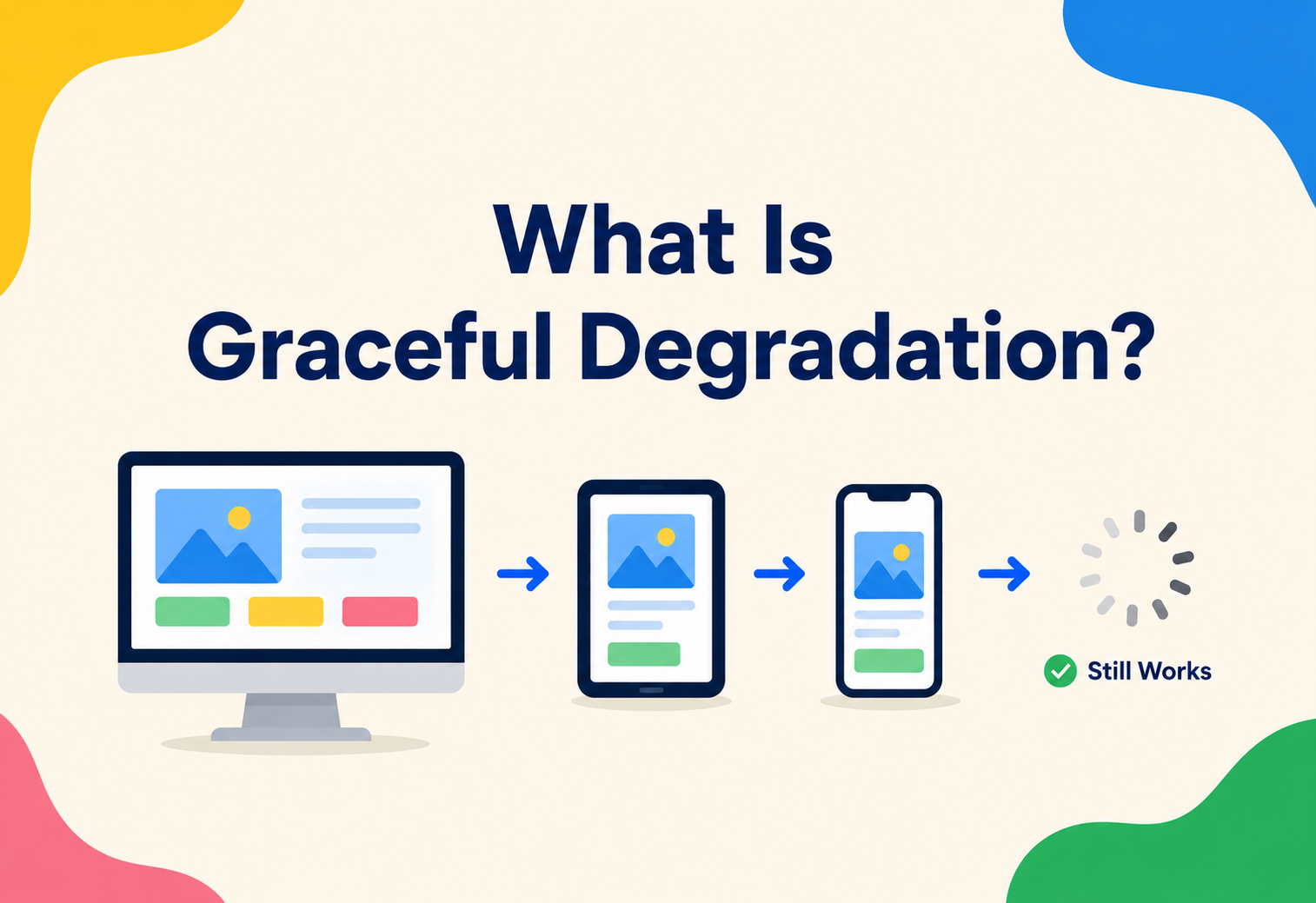
What Is Graceful Degradation?
A complete, beginner-to-production guide to keeping systems useful even when parts of them are failing — explained with real-life analogies, Java code, and lessons from Netflix, Amazon, and Google-scale systems.
Introduction & History
Failing partially and usefully, instead of failing completely and uselessly, is the entire idea behind graceful degradation — and it long predates software.
Imagine you are driving a car and one of your headlights suddenly stops working. A badly built car might completely shut down the entire electrical system the moment any single bulb fails, leaving you stranded in the dark. A well-built car simply keeps driving with one working headlight — dimmer, less ideal, but still moving, still getting you home safely. That difference — failing partially and usefully instead of failing completely and uselessly — is the entire idea behind graceful degradation.
In software systems, graceful degradation is the design principle and set of engineering practices that allow a system to continue operating, in a reduced or simplified capacity, when some of its components, dependencies, or resources fail or become unavailable — rather than the entire system crashing or becoming completely unusable. Instead of an all-or-nothing outcome, a gracefully degrading system intentionally trades away non-essential functionality to preserve its most essential functionality.
The concept did not originate in software at all. It comes from classical engineering — aircraft designers have used the related idea of “fail-operational” and “fail-safe” design for decades, where a plane with one failed engine can still fly and land safely rather than falling out of the sky. Structural engineers design bridges so that the failure of one support cable causes sagging, not total collapse. Electrical grids are designed so that a fault in one substation triggers localised outages rather than a nationwide blackout — though, as history has shown in several famous cascading blackout incidents, this is far harder to get right than it sounds, which is itself an important lesson for software architects.
The phrase “graceful degradation” entered mainstream software vocabulary heavily through two related fields: fault-tolerant distributed systems research from the 1970s–1990s (work on systems like Tandem NonStop computers, designed explicitly to keep running through hardware failures), and later, web development in the 2000s, where “graceful degradation” and its close cousin “progressive enhancement” described building websites that still worked — just with fewer visual bells and whistles — in older or less capable browsers. As internet-scale distributed systems became the norm through the 2010s (driven by companies like Netflix, Amazon, and Google operating systems with thousands of interdependent services), graceful degradation evolved from a nice-to-have UX consideration into a core, non-negotiable reliability engineering discipline.

Think of a restaurant kitchen during a busy dinner rush. If the dessert station’s oven breaks, a well-run kitchen simply stops offering hot desserts for the night and continues serving appetisers, main courses, and cold desserts without interruption. A badly run kitchen might panic and shut down the entire restaurant because “the kitchen isn’t working perfectly anymore” — even though 90% of the menu is still completely available.
1.1 From NASA to Netflix: A Longer Lineage
It is worth appreciating just how far back the underlying discipline of “designing for partial failure” actually goes. NASA’s spacecraft systems, dating back to the Apollo program, were built with the explicit assumption that individual components — sensors, thrusters, communication links — would fail during a mission, and the entire system was engineered around continuing the mission (or at minimum, keeping the crew alive) despite those failures, rather than assuming perfect hardware. This mindset — plan for failure as a certainty, not an exception — is the philosophical ancestor of everything covered in this article.
In enterprise computing, Tandem Computers built entire product lines in the 1970s and 1980s around “NonStop” systems for banking and telecom, where any single hardware component could fail without taking the system down — an idea that later influenced distributed database and cluster design broadly. By the time cloud-scale internet companies emerged in the 2000s and 2010s, the sheer number of independently-failing components (thousands of servers, hundreds of services, countless third-party integrations) made it mathematically inevitable that something, somewhere, would always be failing at any given moment. This reality — sometimes summarised as “at scale, failure is not an edge case, it is the normal operating condition” — is what pushed graceful degradation from a specialised aerospace and telecom concern into a mainstream requirement for any company operating at meaningful internet scale.
1.2 A Note on Terminology Across Industries
Different fields use slightly different words for closely related ideas, which can cause confusion when reading broadly. Aerospace engineers often say “fail-operational.” Structural engineers talk about “ductile failure” versus “brittle failure” (a bridge that bends and warns you is ductile; one that snaps without warning is brittle — clearly the more dangerous of the two). Electrical engineers discuss “load shedding” in the context of power grids. Software engineers borrowed and blended several of these vocabularies, which is why you will see “graceful degradation,” “fault tolerance,” and “resilience” used somewhat interchangeably in casual conversation, even though, as Section 3 will clarify, they are related but technically distinct concepts.
The Problem & Motivation
Modern systems are built from many independently-failing parts. Without a plan for partial failure, the mathematics of dependency stacking guarantees that the whole will be less reliable than any of its pieces.
2.1 Modern Systems Are Built From Many Moving, Failing Parts
A single modern web or mobile application is rarely just “one program.” Behind a single screen, there might be a dozen or more backend microservices, several databases, a caching layer, a search index, a recommendation engine, a payment gateway, a third-party shipping API, and a notification service — all working together. Each of these components has its own uptime, its own failure modes, and its own occasional bad day. If a system requires every single one of these components to be perfectly healthy at all times in order to function at all, then the system’s overall probability of being fully “up” shrinks multiplicatively with every dependency added — a mathematical reality explored further in Section 8.
2.2 The All-or-Nothing Trap
Without graceful degradation, a common and dangerous default behaviour emerges: if any single dependency fails — even a minor, non-critical one like a “customers who bought this also bought” recommendation widget — the entire page, or worse, the entire application, throws an error and shows nothing at all to the user. This is sometimes called the “all-or-nothing” trap. A minor, cosmetic feature failure ends up taking down a completely unrelated, critical feature (like checkout) simply because they happened to share a page, a request, or an upstream dependency.
This trap becomes even more dangerous at scale, because a single overloaded or slow dependency can trigger cascading failures — where waiting threads, exhausted connection pools, and retry storms spread the damage from one struggling service to every service that depends on it, eventually bringing down systems that had nothing to do with the original problem. Graceful degradation, especially combined with circuit breakers (Section 15), exists specifically to stop this chain reaction before it starts.
2.3 Users Prefer Imperfect to Broken
User research and years of production incident data across the industry point to a consistent truth: users are far more forgiving of a slightly reduced experience than of a completely broken one. A shopping site that briefly shows generic “Popular Items” instead of personalised recommendations is a minor inconvenience. A shopping site that shows a blank white error page because the recommendation service timed out is a lost sale, a frustrated customer, and possibly a support ticket.
A simple personal blog fetches a “weather widget” from a third-party API to show in its sidebar. If that third-party API goes down, a well-built blog simply hides the weather widget and shows the blog post as normal. A poorly built blog crashes the entire page with an unhandled error, and readers cannot read the article at all — because of a decorative sidebar widget that had nothing to do with the actual content they came for.
During extremely high-traffic events like Black Friday, large e-commerce platforms often deliberately disable non-essential features — personalised recommendations, detailed inventory counts, real-time “X people are viewing this” indicators — to protect the CPU, memory, and database capacity needed for the truly essential path: browsing products and completing checkout. This is graceful degradation applied proactively, not just reactively.
2.4 The Anatomy of a Cascading Failure
To really internalise why graceful degradation matters, it helps to walk through exactly how a cascading failure unfolds, since this pattern repeats itself, in slightly different clothing, across countless real production incidents. It typically starts small: one downstream service — say, an inventory-check service — becomes slow, perhaps because of an unrelated database issue on its end. Every upstream caller that depends on it starts waiting longer than usual for each call to complete. Because those calls are slower, threads handling incoming requests in the calling service stay “busy” for much longer than normal, and the thread pool serving those requests starts to fill up. As the thread pool saturates, new incoming requests — even ones that have nothing at all to do with inventory — start queueing, then timing out, then failing. Client applications, seeing failures, often retry automatically, which adds even more load onto an already struggling system, making the problem measurably worse rather than better. Within minutes, a single slow dependency deep in the call graph can degrade or completely take down services several layers removed from the original problem, purely through resource exhaustion rather than any direct technical connection.
This is precisely the failure mode that timeouts, circuit breakers, and bulkheads (all covered in Sections 5 and 9) are specifically designed to interrupt. Graceful degradation is, in many respects, the discipline of deliberately breaking these chain reactions before they can propagate.
Core Concepts
Before going deeper, let us establish the vocabulary that will recur throughout this article — six concepts that reappear in every real degradation strategy.
Graceful Degradation
Continuing to operate in a reduced capacity when parts of a system fail, instead of failing completely.
Fallback
An alternative, simpler response used when the primary path fails — a cached value, a default, or a simplified computation.
Critical Path
The minimum set of functionality that absolutely must keep working for the system to be considered “up” from the user’s perspective.
Non-Critical Path
Features that enhance the experience but whose temporary absence does not prevent the core function from working.
Circuit Breaker
A safety mechanism that detects a failing dependency and stops calling it temporarily, preventing wasted effort and cascading failure.
Fail-Safe vs. Fail-Operational
Fail-safe systems stop safely on failure (e.g., an elevator stops rather than falls); fail-operational systems keep working in a reduced mode (e.g., a plane flying on one engine).
3.1 Graceful Degradation vs. Related Terms
These terms are often confused, so it is worth being precise:
| Term | What It Means | How It Relates |
|---|---|---|
| Graceful degradation | Reducing functionality intentionally to preserve core operation during failure. | The overall goal / outcome this article is about. |
| Fault tolerance | The system’s general ability to continue functioning despite faults. | Graceful degradation is one strategy for achieving fault tolerance. |
| High availability | The system stays reachable and responsive with minimal downtime. | Graceful degradation contributes to availability by avoiding full outages. |
| Resilience | The broader capacity to absorb failure and recover. | Graceful degradation is one pillar of a resilient architecture, alongside redundancy and self-healing. |
| Progressive enhancement | Building the base experience first, then layering on enhancements for capable environments. | The frontend / UX-focused cousin of graceful degradation, approaching the same goal from the opposite direction. |
3.2 Levels of Degradation
Graceful degradation is rarely binary (working vs. not working) — it typically involves multiple tiers, each representing a further step down in richness but still delivering real value.
| Level | Description | Example |
|---|---|---|
| Level 0 — Full functionality | Everything works, all dependencies healthy. | Personalised homepage with live recommendations, real-time inventory, live chat support. |
| Level 1 — Reduced richness | Non-critical enhancements disabled or simplified. | Generic “Popular Items” instead of personalised picks; chat support hidden. |
| Level 2 — Cached / stale data | Serve last-known-good data instead of live data. | Show product prices from a 10-minute-old cache instead of a live pricing service call. |
| Level 3 — Core-only mode | Only the absolute critical path remains active. | Browsing and checkout work; reviews, recommendations, and search suggestions are all disabled. |
| Level 4 — Read-only / maintenance | Writes disabled, reads still served, to protect data integrity during severe failure. | Users can browse an e-commerce catalogue but cannot place new orders during a database incident. |
Designing these levels explicitly, ahead of time, is what separates deliberate graceful degradation from accidental, ad-hoc behaviour discovered for the first time during a real outage.
Architecture & Components
Graceful degradation is not a single library you install — it is a cross-cutting architectural capability built from several cooperating pieces.
Health Detection
Mechanisms (health checks, timeouts, error-rate tracking) that determine whether a dependency is healthy, degraded, or down.
Circuit Breaker
Wraps calls to a dependency and “trips open” after repeated failures, short-circuiting future calls instead of waiting on a doomed request.
Fallback Provider
Supplies an alternative response — cached data, a default value, or a simplified computation — when the primary path is unavailable.
Feature Flags / Toggles
Allow specific features to be disabled instantly, manually or automatically, without a full deployment.
Load Shedding
Deliberately rejects or defers lower-priority requests when the system is under extreme load, to protect capacity for critical ones.
Bulkheads
Isolate resources (thread pools, connection pools) per dependency so one failing dependency cannot exhaust resources needed by others.
Notice that the critical path (checkout, auth, core data) is architecturally separated from the optional, degradable path (the recommendation service behind a circuit breaker). This separation is the single most important architectural decision in any graceful degradation strategy — you cannot gracefully degrade something you have not first identified as non-critical.
How It Works Internally
Underneath the architecture sits a small handful of specific mechanisms: detecting failure fast, tracking it over time, and deciding when to stop trying.
5.1 Detecting Failure Before It Becomes a Crisis
Graceful degradation begins with fast, reliable failure detection. A system needs to know — within milliseconds, not minutes — that a dependency is slow, erroring, or unreachable. This typically relies on a combination of:
- Timeouts: A strict maximum wait time for any call to a dependency. Without a timeout, a single slow dependency can hold a thread hostage indefinitely, one of the most common root causes of cascading failure in real production incidents.
- Error-rate tracking: Counting recent successes vs. failures for a dependency over a sliding time window, rather than reacting to a single isolated failure (which could just be noise).
- Health check endpoints: Dependencies expose a lightweight
/healthendpoint that upstream systems can poll to proactively detect degraded state before real traffic even hits the problem.
5.2 The Circuit Breaker State Machine
The circuit breaker pattern, popularised by Michael Nygard’s book Release It! and implemented in libraries like Netflix Hystrix (now largely succeeded by Resilience4j in the Java ecosystem), works as a simple state machine with three states:
In the Closed state, calls flow through to the real dependency normally, while failures are quietly counted. Once failures cross a configured threshold (say, 50% of calls failing over the last 20 calls), the breaker “trips” to the Open state — in this state, calls to the dependency are not even attempted; they fail instantly and the fallback is used immediately, saving time, threads, and the struggling dependency from further pressure. After a cooldown period, the breaker moves to Half-Open, allowing a small number of trial calls through to test whether the dependency has recovered. If those succeed, it closes again; if they fail, it reopens and waits longer.

5.3 Where Fallback Data Actually Comes From
A fallback is only as good as the data or logic behind it. Common internal sources for fallback responses include:
- Last-known-good cache: The most recent successful response from the dependency, stored and served when the live call fails — slightly stale, but almost always better than nothing.
- Static defaults: Hardcoded, sensible defaults (e.g., “Free shipping over ₹500” shown generically when a personalised shipping-calculation service is down).
- Simplified local computation: A cheaper, less accurate algorithm computed locally instead of calling out to an expensive remote service (e.g., a basic “most recently viewed” list instead of a full ML-based recommendation engine).
- Degraded but real data: Querying a read replica or secondary index that might be slightly behind, rather than failing entirely (directly connecting to the read/write splitting concepts covered elsewhere in this series).
5.4 Timeout Tuning Is Harder Than It Looks
Choosing the right timeout value is a genuinely tricky engineering decision, and it is worth spending a moment on why. Set a timeout too high, and a slow dependency can still hold resources hostage for an uncomfortably long time before the system reacts, defeating much of the purpose. Set it too low, and perfectly healthy calls that are just naturally a bit slower than average (due to normal network jitter or a temporary garbage-collection pause) get killed prematurely, triggering unnecessary fallbacks and false alarms. Most mature teams derive timeout values empirically, from real historical latency data for that specific dependency — often setting the timeout somewhere around the 99th or 99.9th percentile of normal observed latency, rather than picking a round number out of habit. This value should also be revisited periodically, since a dependency’s typical latency profile can shift meaningfully as its own traffic and architecture evolve over time.
5.5 Retry Policy Interacts Directly With Degradation
Retries and graceful degradation are closely linked and easy to get wrong together. A naive retry policy — immediately retrying a failed call, possibly several times, with no delay — can turn a brief, minor blip into a full-blown overload event, because every failed request now multiplies into two, three, or more attempts against an already struggling dependency. Well-designed systems use exponential backoff with jitter (increasing the delay between each retry attempt, with some randomness added to avoid many clients retrying in perfect lockstep), and critically, cap the total number of retries before falling back rather than retrying indefinitely. The circuit breaker and the retry policy should be configured to work together: once a breaker has tripped open, retries against that dependency should stop entirely until the breaker allows trial calls again, rather than continuing to hammer a dependency the system has already identified as unhealthy.
Data Flow & Lifecycle
Let us trace what happens to a single user request as a dependency degrades over time.
Note the key detail: the second request never even attempts to call the struggling recommendation service — the open circuit breaker fails fast and goes straight to the fallback cache. This is what protects the recommendation service from being hammered by continued traffic while it is already struggling, giving it room to recover.
6.1 Typical Lifecycle of a Degrading Request
Arrival
A request arrives and needs data from a non-critical dependency.
Attempt with timeout
The system attempts the call, respecting a strict timeout.
Success path
If the call succeeds, the full, rich response is used and returned normally.
Fallback activation
If the call fails or times out, the fallback mechanism activates immediately.
Complete response
The user still receives a complete, usable response — just a slightly reduced one — usually without ever knowing anything went wrong at all.
Observability
In parallel, the failure is logged and metrics are updated, feeding into alerting and the circuit breaker’s internal state.
6.2 Recovery Lifecycle
Cooldown
The circuit breaker, now open, waits out its configured cooldown period.
Trial calls
It transitions to half-open and allows a small number of trial requests through.
Gradual resume
If those succeed, the system considers the dependency healthy again and gradually resumes normal traffic.
Incident close-out
Monitoring dashboards and alerts reflect the return to Level 0 (full functionality), and the incident, if one was declared, can be closed out.
Advantages, Disadvantages & Trade-offs
Graceful degradation buys you a lot — but never for free. Here is the honest ledger.
7.1 Advantages
| Benefit | Why It Matters |
|---|---|
| Preserves core user value | Users can still complete their primary goal even when parts of the system are unhealthy. |
| Prevents cascading failure | Isolates and contains failures instead of letting them spread across the whole system. |
| Improves perceived reliability | Fewer full outages means higher measured uptime and better customer trust over time. |
| Buys time for recovery | Reduces load on a struggling dependency, giving it breathing room to recover instead of being hammered further. |
| Reduces incident severity | A degraded-but-working system is usually a lower-severity incident than a full outage, with less urgent, less stressful response needed. |
7.2 Disadvantages & Trade-offs
| Challenge | Explanation |
|---|---|
| Added complexity | Every dependency needs explicit fallback logic, timeouts, and testing — this is real engineering effort, not free. |
| Silent degradation risk | If not monitored well, a system can run in a degraded state for a long time without anyone noticing, masking a real underlying problem. |
| Stale or inconsistent data | Fallback data (cached or default) may be out of date, potentially confusing or misleading users in edge cases. |
| Harder to test thoroughly | Every possible failure combination and fallback path multiplies the test matrix significantly. |
| Risk of masking real bugs | Overly aggressive fallback logic can hide genuine bugs behind a “working” facade, delaying root-cause fixes. |
Graceful degradation is not a substitute for fixing the underlying reliability of a dependency — it is a safety net, not a foundation. A system that constantly relies on its fallback paths because a dependency is chronically unreliable has a deeper problem that graceful degradation is merely masking, not solving.
Performance & Scalability
Beyond correctness, graceful degradation has a direct, measurable impact on throughput and on the mathematics of overall system availability.
8.1 The Multiplicative Nature of Dependency Failure
Consider a system built from 10 dependent services, each individually available 99.9% of the time (a seemingly excellent number on its own). If the system requires all ten to be healthy simultaneously to function at all, the overall availability is roughly 0.999^10 ≈ 99.0% — nearly a full order of magnitude worse than any individual component, and enough to mean roughly 87 hours of downtime per year instead of under 9 hours. This multiplicative effect is precisely why treating every dependency as equally “required” is so costly at scale. Graceful degradation breaks this multiplication by explicitly marking most dependencies as optional, so their individual failure no longer multiplies against overall system availability.
8.2 Fail-Fast Improves Throughput Under Load
Beyond correctness, fail-fast circuit breaking has a direct, measurable performance benefit: it frees up threads, connections, and CPU that would otherwise be wasted waiting on a doomed call. During an incident, a struggling dependency without a circuit breaker can accumulate large numbers of blocked threads across all its callers, which itself becomes a second, self-inflicted outage — often worse than the original problem. Fast failure keeps resource usage bounded and predictable even during a dependency outage.
8.3 Load Shedding as Proactive Degradation
At extreme scale, some systems do not wait for a dependency to actually fail before degrading — they proactively shed load once utilisation crosses a safe threshold. This might mean rejecting a percentage of non-critical requests with a fast, cheap “try again shortly” response, or automatically disabling expensive features (like detailed search filters) once request queues start backing up, precisely to avoid ever reaching the point of full failure.
| Strategy | How It Works | Best For |
|---|---|---|
| Priority-based shedding | Low-priority requests are rejected first, preserving capacity for high-priority ones. | Systems with a clear request priority hierarchy (e.g., paying customers vs. free tier). |
| Random / probabilistic shedding | A percentage of all requests are rejected uniformly once a threshold is crossed. | Simple systems without clear priority tiers. |
| Adaptive concurrency limits | Dynamically adjusts how many concurrent requests are accepted based on real-time latency feedback. | Highly variable traffic patterns where fixed limits are hard to tune. |
High Availability & Reliability
Graceful degradation is one of several complementary strategies in a mature reliability toolkit — and it answers a very specific question the others cannot.
9.1 Graceful Degradation as a Pillar of Reliability Engineering
Site Reliability Engineering (SRE) practice, as popularised by Google’s SRE books, treats graceful degradation as one of several complementary reliability strategies, alongside redundancy (multiple instances of the same component), replication (multiple copies of data), and automated failover. Where redundancy answers “what if this exact component fails, is there another one,” graceful degradation answers a different, equally important question: “if this component — and every backup of it — is genuinely unavailable, can the rest of the system still deliver value?”
9.2 Bulkheading: Containing the Blast Radius
Borrowed directly from ship design — where a ship’s hull is divided into separate watertight compartments so that flooding in one section does not sink the whole vessel — the bulkhead pattern isolates resources (thread pools, connection pools, even separate service instances) per dependency. This ensures that a single dependency consuming all available resources (a “noisy neighbour” problem) cannot starve unrelated parts of the system that share the same process or infrastructure.
9.3 Reliability Checklist
Explicit fallback for every non-critical dependency
Not an afterthought — a designed, tested behaviour for the “what if this fails” case.
Tuned timeouts everywhere
Every network call has a deliberate, tested timeout — never relies on OS or library defaults blindly.
Chaos testing
Deliberately injecting failures (tools like Chaos Monkey) in controlled conditions to verify degradation actually works as designed.
Runbooks for degraded states
Clear documentation for on-call engineers on what “Level 2 degraded mode” means and how to respond.
Security
Graceful degradation intersects with security in a few important ways that are easy to overlook — and getting them wrong is far worse than the outage you were trying to prevent.
- Never degrade security checks: Authentication and authorisation must never be part of the “optional” path — a common and dangerous mistake is silently allowing a request through when an auth service times out, rather than safely denying it. Fail-safe, not fail-open, for anything security-related.
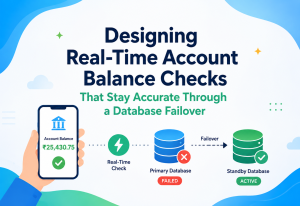
- Fallback data should not leak stale sensitive information: A cached fallback for account balance or permissions data could show outdated, potentially incorrect sensitive information — these paths need their own careful review, separate from purely cosmetic fallbacks.
- Rate limiting during degraded states: A system running in a degraded mode is often more vulnerable to being overwhelmed further — deliberately tightening rate limits during known degraded periods is a common defensive practice.
- Availability itself is a security property: Denial-of-service resistance is fundamentally about graceful degradation under hostile load — a system that degrades gracefully under normal failure is usually better positioned to survive an actual attack too.
Degrade features, never degrade guarantees. It is fine to show a user a generic “Recommended for you” list instead of a personalised one. It is never fine to let someone view another user’s private data, or skip a permission check, just because a downstream service was slow.
Monitoring, Logging & Metrics
You cannot manage what you cannot see — and degraded states are especially dangerous when invisible, because a system can quietly run in a reduced-functionality mode for days without anyone noticing, until a second failure compounds the first.
| Metric | What It Tells You |
|---|---|
| Circuit breaker state (open / closed / half-open) per dependency | Real-time view of which parts of the system are currently degraded. |
| Fallback invocation rate | How often the fallback path is being used — a rising trend signals a chronic, not transient, problem. |
| Dependency error rate & latency (p50 / p95 / p99) | Early warning signs before a circuit breaker even trips. |
| Degraded-mode duration | How long the system stays in a reduced-functionality state — long durations deserve escalation. |
| Shed request count | How many requests were proactively rejected under load shedding, and their impact on users. |
Dashboards (commonly built with Grafana on top of Prometheus metrics) should make it immediately visually obvious when any part of the system is operating below Level 0 (full functionality) — typically through colour-coded panels per dependency. Structured logs should always include which fallback path was used and why, tagged with correlation IDs, so that an engineer investigating a customer complaint about “weird data” can trace it directly back to a specific degraded dependency and time window.
Deployment & Cloud
Cloud platforms provide substantial built-in support for graceful degradation patterns, reducing how much teams need to build entirely from scratch.
Load Balancer Health Checks
AWS ELB/ALB, Google Cloud Load Balancing, and Azure Load Balancer all automatically stop routing traffic to unhealthy instances, a foundational form of degradation at the infrastructure level.
Managed Feature Flags
Services like LaunchDarkly, AWS AppConfig, or Unleash let teams toggle features off instantly across an entire fleet without redeploying, critical for rapid response during an incident.
Service Mesh Resilience Features
Istio, Linkerd, and similar service meshes provide circuit breaking, retries, and timeouts declaratively at the infrastructure layer, without requiring every service to implement this logic itself.
CDN-Level Fallback
CDNs can be configured to serve stale cached content when an origin server is unreachable, a form of graceful degradation happening entirely at the edge, before a request even reaches your infrastructure.
A well-architected deployment pipeline also treats “deploy a fix for a degraded dependency” and “toggle a feature flag to force degradation” as two very different, differently-risky operations — the latter should be near-instant and require minimal approval overhead, precisely because its whole purpose is rapid incident response.
Java Implementation Deep Dive
Let us build a realistic example using Resilience4j, the modern, lightweight successor to Netflix Hystrix, widely used in the Spring Boot ecosystem for exactly this purpose.
13.1 Step 1 — Add the Dependency and Configure the Circuit Breaker
# application.yml
resilience4j:
  circuitbreaker:
    instances:
      recommendationService:
        slidingWindowSize: 20
        failureRateThreshold: 50
        waitDurationInOpenState: 10s
        permittedNumberOfCallsInHalfOpenState: 5
        slowCallDurationThreshold: 2s
slowCallRateThreshold: 5013.2 Step 2 — Wrap the Dependency Call With a Fallback
@Service
public class RecommendationService {

    private final RecommendationClient recommendationClient;
    private final RecommendationCache  fallbackCache;

    public RecommendationService(RecommendationClient recommendationClient,
                                 RecommendationCache  fallbackCache) {
        this.recommendationClient = recommendationClient;
        this.fallbackCache        = fallbackCache;
    }

    @CircuitBreaker(name = "recommendationService", fallbackMethod = "fallbackRecommendations")
    @TimeLimiter(name = "recommendationService")
    public CompletableFuture<List<Product>> getRecommendations(String productId) {
        return CompletableFuture.supplyAsync(() ->
                recommendationClient.fetchRecommendations(productId));
    }

    // Fallback method signature must match, plus a Throwable parameter
    private CompletableFuture<List<Product>> fallbackRecommendations(
            String productId, Throwable throwable) {

        log.warn("Recommendation service degraded for product={}, reason={}",
                productId, throwable.getMessage());

        // Serve last-known-good cached recommendations instead of failing
        List<Product> cached = fallbackCache.getLastKnownGood(productId);
        return CompletableFuture.completedFuture(
                cached != null ? cached : Collections.emptyList());
    }
}13.3 Step 3 — Isolate Resources With a Bulkhead
# application.yml
resilience4j:
  bulkhead:
    instances:
      recommendationService:
        maxConcurrentCalls: 25
        maxWaitDuration: 100ms
--------------------------------------------------------------------------
@Bulkhead(name = "recommendationService", type = Bulkhead.Type.SEMAPHORE)
@CircuitBreaker(name = "recommendationService", fallbackMethod = "fallbackRecommendations")
public CompletableFuture<List<Product>> getRecommendations(String productId) {
    // same as above -- now protected by both a circuit breaker AND a bulkhead
    return CompletableFuture.supplyAsync(() ->
            recommendationClient.fetchRecommendations(productId));
}13.4 Step 4 — Combine With Feature Flags for Manual Override
@Service
public class ProductPageService {

    private final RecommendationService recommendationService;
    private final FeatureFlagClient     featureFlags;

    public ProductPageResponse buildPage(String productId) {

        ProductPageResponse.Builder response = ProductPageResponse.builder()
                .product(productRepository.findById(productId));

        // Critical path -- always attempted, no degradation allowed here
        response.price(pricingService.getPrice(productId));
        response.availability(inventoryService.checkStock(productId));

        // Non-critical path -- explicitly allowed to degrade
        if (featureFlags.isEnabled("recommendations")) {
            try {
                List<Product> recs = recommendationService
                        .getRecommendations(productId)
                        .get(500, TimeUnit.MILLISECONDS);
                response.recommendations(recs);
            } catch (Exception e) {
                // Even the fallback failed catastrophically -- degrade further
                response.recommendations(Collections.emptyList());
            }
        }

        return response.build();
    }
}getRecommendations), and a last-ditch empty-list catch for the truly unexpected.Notice how this example stacks three independent layers of protection: a circuit breaker (stops calling a failing dependency), a bulkhead (limits concurrent calls so it cannot exhaust shared resources), and a feature flag (allows a human to manually disable the entire feature instantly during an incident, without waiting for the circuit breaker’s automatic detection). Production-grade graceful degradation almost always combines multiple layers like this rather than relying on just one.
APIs & Microservices Considerations
In a microservices architecture, graceful degradation becomes especially important because failure isolation between independently deployed, independently owned services is the whole point of the architecture in the first place.

- API Gateway-level degradation: Gateways (Kong, AWS API Gateway, Spring Cloud Gateway) can implement circuit breaking and fallback responses centrally, so individual services do not each need to reimplement this logic for every downstream call.
- Contract-level graceful degradation: API responses can be designed with optional fields from the start (e.g.,
recommendations: []as a valid, expected empty state) so that clients naturally handle a degraded response without special-casing it. - Service mesh sidecars: In an Istio or Linkerd mesh, circuit breaking, retries, and timeout policies can be applied declaratively at the infrastructure layer across dozens of services consistently, rather than each team implementing it slightly differently in code.
- Versioned degradation contracts: Downstream consumers should be explicitly told, via API documentation or schema, which fields might be absent or stale during degraded operation, so their own UIs can handle it gracefully rather than crashing on an unexpected null.
Design Patterns & Anti-Patterns
Five patterns that keep showing up in resilient systems — and five anti-patterns that keep showing up in the post-mortems of systems that turned out not to be.
Good Patterns
- Circuit Breaker — detects failing dependencies and fails fast, protecting both caller and struggling dependency
- Bulkhead — isolates resources per dependency so one failure cannot exhaust shared capacity
- Cache-Aside Fallback — falls back to the most recent cached value when the live source is unavailable
- Feature Toggling — instant, manual or automated disabling of non-critical features without redeploy
- Load Shedding — proactively rejects lower-priority work before the system is pushed into full failure
Anti-Patterns to Avoid
- Silent Failure — swallowing exceptions with no logging or metrics hides real problems instead of surfacing them
- Retry Storms — aggressive retries without backoff make the original problem worse
- Degrading Security — treating an auth failure as “just another dependency failure” and failing open instead of closed
- No Timeout, Ever — unbounded calls let a single slow dependency hold resources indefinitely
- Untested Fallback Paths — fallback logic first exercised during a real incident is usually broken
15.1 Good Patterns in Detail
Circuit Breaker
Detects failing dependencies and fails fast, protecting both the caller and the struggling dependency.
Bulkhead
Isolates resources per dependency so one failure cannot exhaust shared capacity needed by unrelated features.
Cache-Aside Fallback
Falls back to the most recent cached value when the live source is unavailable, rather than failing outright.
Feature Toggling
Allows instant, manual or automated disabling of non-critical features during an incident, without a full redeploy.
Load Shedding
Proactively rejects lower-priority work before the system is pushed into full failure by overload.
15.2 Anti-Patterns in Detail
Silent Failure
Swallowing exceptions and returning empty or default data with no logging or metrics — hides real problems instead of surfacing them.
Retry Storms
Aggressively retrying a failing dependency without backoff, actually making the original problem worse and delaying recovery.
Degrading Security
Treating an authentication or authorisation failure as “just another dependency failure” and failing open instead of closed.
No Timeout, Ever
Calling a dependency with no timeout at all, allowing a single slow call to hold resources indefinitely and trigger cascading failure.
Untested Fallback Paths
Writing fallback logic that is never actually exercised until a real incident — where it is discovered, too late, that the fallback itself has a bug.
Best Practices & Common Mistakes
A short set of habits that, held consistently, prevent more incidents than any single clever fix ever will.
16.1 Best Practices
- Explicitly classify every feature and dependency as critical or non-critical, in writing, as part of the design process — not as an afterthought during an incident.
- Set a deliberate, tested timeout on every network call — never rely on default or unbounded timeouts.
- Build and test the fallback path with the same rigour as the primary path, including automated tests that simulate dependency failure.
- Use chaos engineering practices (deliberately injecting failures in staging, or even carefully in production) to validate that degradation behaves as designed under real conditions.
- Make degraded states highly visible in monitoring dashboards — invisible degradation is often worse than an obvious outage, because nobody responds to it.
- Combine multiple layers of protection (circuit breaker, bulkhead, feature flag) rather than relying on a single mechanism.
16.2 Common Mistakes
- Treating all dependencies as equally critical: leads to unnecessary full outages caused by minor, cosmetic features failing.
- Forgetting to test the fallback: the fallback path is often the least-exercised code in the entire system — and therefore the most likely to be broken exactly when it is needed most.
- No visibility into degraded state: a system can run in Level 2 or Level 3 degradation for days without anyone on the team noticing, until it compounds with a second, unrelated failure.
- Over-engineering degradation for truly critical paths: some things (payment processing, authentication) genuinely should fail loudly and clearly rather than silently degrading — know the difference.
16.3 A Practical Readiness Checklist
Before considering a system production-ready from a resilience standpoint, walk through a short checklist. First, confirm every external call — to another service, a database, a cache, or a third-party API — has an explicit, tested timeout and a defined fallback behaviour. Second, confirm that circuit breakers are configured with sensible thresholds based on real historical latency and error-rate data for that specific dependency, not copy-pasted defaults that might not fit its actual behaviour. Third, run a game-day exercise where you deliberately take a non-critical dependency offline in staging and confirm the system degrades exactly as designed, the fallback activates correctly, and monitoring reflects the degraded state accurately. Fourth, make sure your team has a documented runbook describing what each degradation level means operationally, and who needs to be alerted at each level.
Fifth, review the classification of critical versus non-critical paths periodically, not just once at initial design time — features that started as “nice to have” sometimes quietly become business-critical as a product evolves, and the degradation strategy needs to keep pace with that shift. Sixth, verify that alerting thresholds distinguish clearly between “briefly touched a fallback due to normal network jitter” (not urgent) and “has been running in a degraded state for the last twenty minutes” (urgent, needs human attention) — alert fatigue from overly sensitive fallback-triggered notifications is a very real and common problem that erodes trust in the monitoring system over time. Finally, after any real incident where degradation kicked in, hold a blameless post-incident review specifically asking whether the degradation behaved as intended, whether users were meaningfully protected, and whether the thresholds or fallback logic need adjustment based on what was actually observed.
Real-World / Industry Examples
Four industry examples show how the biggest platforms in the world apply exactly the ideas above, and one worked scenario shows how a fictional but realistic company gets there step by step.
Netflix
Pioneered much of the modern circuit breaker philosophy through Hystrix; famously degrades personalised recommendations to generic popular content when its recommendation microservices are unhealthy, while video playback itself remains unaffected.
Amazon
Widely known internally for treating “every service call needs a fallback” as a core engineering principle, especially on the product page and checkout paths, where a failure in reviews or recommendations must never block a purchase.
Search results pages degrade individual result-enrichment features (like rich snippets, knowledge panels, or live sports scores) independently, so a failure in one enrichment service never blocks core search results from rendering.
Facebook / Meta
Has publicly discussed serving a simplified, cached version of the News Feed during backend incidents rather than showing an error, keeping the core browsing experience alive even during significant internal outages.
17.1 A Worked Example: A Growing Ride-Hailing App
Consider a ride-hailing startup as it scales, tying the concepts in this article together. Early on, a single backend handles everything — matching riders to drivers, calculating fares, and showing estimated arrival times, all tightly coupled in one codebase with no fallback logic anywhere. The first serious outage happens when the traffic-data provider (a third-party API supplying live traffic conditions for ETA calculations) has an unrelated outage of its own — and because the ETA calculation was treated as mandatory, the entire ride-booking flow fails, even though matching riders to drivers and calculating fares had nothing to do with traffic data at all.
The engineering team’s fix mirrors the architecture shown in Section 4: they wrap the traffic-data call in a circuit breaker, with a fallback that estimates ETA using a simpler, locally-computed straight-line-distance calculation instead of live traffic data — less accurate, but always available. As the company grows and adds more third-party integrations (payment processors, SMS providers, mapping services), they apply the same pattern systematically: every non-critical dependency gets a circuit breaker, a tested fallback, and a feature flag for manual override, while the truly critical path — matching a rider with a driver and completing payment — is protected with redundancy and monitored far more strictly rather than being allowed to degrade at all.
A year later, the same company faces a much larger test: their primary cloud region experiences a partial network disruption affecting one of three availability zones. Because they had already invested in bulkheading their thread pools per dependency, and because their driver-matching service had been built with redundancy across all three zones from the start, riders in the affected zone experience only a brief, mild slowdown in matching times — visible in dashboards as a temporary shift from Level 0 to Level 1 — rather than a hard outage. The incident, which years earlier would likely have been a headline-making, company-wide outage, instead resolves as a minor blip that most users never even notice, precisely because graceful degradation had been designed in from the start rather than bolted on reactively after a painful lesson.
Comparison With Related Reliability Techniques
Graceful degradation is often used alongside — not instead of — several other resilience techniques. Understanding how they differ helps you pick the right combination.
| Technique | What It Actually Does | Relationship to Graceful Degradation |
|---|---|---|
| Redundancy / Replication | Runs multiple copies of a component so one failure does not remove capacity entirely. | Complementary — redundancy tries to prevent failure from being visible at all; graceful degradation handles the case where it still is. |
| Retry with backoff | Re-attempts a failed call after a delay, assuming the failure might be transient. | Often the first line of defence before falling back — but must be bounded to avoid retry storms that graceful degradation is partly designed to prevent. |
| Rate limiting | Caps how many requests a client or the system as a whole will accept in a given period. | A proactive form of load shedding, one of the mechanisms graceful degradation relies on under extreme load. |
| Disaster recovery / failover | Switches to a completely separate backup system or region after a major failure. | Operates at a larger, slower timescale (minutes) compared to graceful degradation’s typically sub-second, in-request response. |
| Self-healing / auto-remediation | Automatically restarts, replaces, or reconfigures failing components without human intervention. | Works on a longer timescale to fix the root cause, while graceful degradation keeps the system usable in the meantime. |
In a mature, high-scale system, all of these typically work together: redundancy and self-healing try to prevent and quickly recover from failure, retries and rate limiting smooth over transient issues, and graceful degradation ensures that even when all of that is not enough, the user still gets something useful rather than nothing at all.
Frequently Asked Questions
Short answers to the questions that come up most often once teams start designing for partial failure seriously.
Is graceful degradation the same as having a backup server?
No. A backup server (redundancy / failover) tries to make failure invisible by switching to an identical replacement. Graceful degradation assumes failure is visible and unavoidable in the moment, and instead focuses on reducing functionality intentionally rather than losing it entirely.
Does every feature need a fallback?
No — and trying to give every single feature a fallback is often wasted effort. Truly critical operations (like payment processing) sometimes should fail loudly and clearly rather than silently degrading into a confusing partial state. The key skill is correctly classifying which features genuinely need graceful degradation and which need to fail fast and visibly instead.
How is this different from progressive enhancement in frontend development?
They approach the same underlying goal from opposite directions. Progressive enhancement starts from a basic, always-working baseline and layers on enhancements for capable environments. Graceful degradation starts from the full experience and defines what to remove when things go wrong. Many teams use both together — building a solid baseline and also planning for graceful reduction from the full experience.
Can graceful degradation hide real bugs?
Yes, if not monitored properly. This is why visibility (Section 11) is just as important as the degradation mechanism itself — a fallback path silently absorbing failures without any logging or alerting can mask a genuine, worsening problem until it eventually overwhelms even the fallback.
What is the difference between a circuit breaker and a simple try-catch block?
A try-catch block only handles a single call’s failure after it happens. A circuit breaker tracks failure patterns over time across many calls, and proactively stops attempting calls to a dependency it has learned is currently unhealthy — saving time and resources on calls that would likely fail anyway, rather than reacting to each failure individually.
Do small applications need graceful degradation?
Even small applications benefit from basic versions of these ideas — a sensible timeout and a simple fallback for any third-party API call costs little to implement and prevents an unrelated widget from taking down an entire page. Full circuit breakers, bulkheads, and multi-level degradation strategies become more valuable as the number of dependencies and the scale of traffic grow.
How do I decide what a “reasonable” fallback looks like for a given feature?
A useful exercise is to ask: if this dependency were simply deleted from the system forever, what is the least-bad, most honest thing we could show the user instead? Sometimes that is a cached value, sometimes it is a generic default, and sometimes — for a feature that genuinely has no reasonable substitute — the honest answer is to hide that piece of the interface entirely rather than showing something misleading. The right fallback should never actively mislead the user; a slightly reduced experience is acceptable, a confusing or incorrect one is not.
Summary & Key Takeaways
Seven ideas worth carrying with you into every next design review.
The pieces worth carrying with you
- Graceful degradation is the practice of continuing to operate in a reduced capacity when parts of a system fail, instead of failing completely — trading non-essential functionality to preserve essential functionality.
- It requires explicitly classifying functionality into critical and non-critical paths, since you cannot gracefully degrade something you have not identified as safe to reduce.
- Core mechanisms include circuit breakers (fail fast on unhealthy dependencies), fallbacks (cached or default responses), bulkheads (resource isolation), and feature flags (manual override).
- The multiplicative nature of dependency failures means that without graceful degradation, systems built from many “must all be healthy” components can have surprisingly poor overall availability, even when each individual component is quite reliable.
- Security guarantees should never be part of the degradable path — fail closed on authentication and authorisation, never fail open.
- Visibility matters as much as the mechanism itself — a silently degraded system that nobody notices is often more dangerous than an obvious, loud outage.
- Graceful degradation complements, rather than replaces, redundancy, retries, rate limiting, and disaster recovery — mature systems combine all of these together.
The real measure of a well-architected system is not whether it ever fails, but what happens to the user in the moment it does. Master graceful degradation, and you give your systems the ability to bend without breaking — staying genuinely useful to real people even on their worst day.
As a closing exercise, it can be genuinely valuable to walk through your own current project and ask, honestly, for each external dependency: “if this disappeared right now, what would our users actually see?” If the honest answer is “a blank error page” or “the whole app crashes,” you have found your next resilience investment — and, hopefully, this article has given you a concrete, well-tested playbook for turning that answer into something far more graceful.