What Is a Distributed System?
Every time you search the web, stream a show, or send a message that arrives instantly on the other side of the planet, dozens — sometimes thousands — of separate computers are quietly working together behind the scenes. That teamwork has a name: a distributed system. Here’s how it actually works, why it’s harder than it looks, and what every architect should know before building one.
The Big Idea, in One Breath
A distributed system is what happens when a job is too big for one machine, so you split it across many machines that quietly coordinate to make the result feel like one.
Imagine a class project so big that no single student could ever finish it alone — building a giant model of the solar system, say. So the teacher splits the class into groups: one group builds the sun, another builds Earth, another builds Mars, and so on. Each group works separately, sometimes in a different room, but they all agree ahead of time on how big each planet should be and how far apart to place them, so that when everything comes together, it forms one complete, correct solar system — not a mismatched jumble.
A distributed system works on exactly this principle, except the “students” are computers, scattered across different rooms, different buildings, sometimes different continents, all working on pieces of the same job at the same time. None of these computers can see everything happening on the others directly — they have to send messages back and forth over a network to stay coordinated, the same way the groups in the classroom had to occasionally check in with each other to make sure Mars wasn’t ending up bigger than the sun.
Think of a restaurant kitchen with several chefs working different stations — one on grills, one on salads, one on desserts. No single chef cooks an entire meal alone, but together, coordinating through calls of “order up!” and “two minutes on table five,” they produce a complete dinner far faster than one chef ever could working solo. A distributed system is a kitchen full of computers, coordinating the exact same way.
This idea sits quietly underneath almost every large piece of technology in daily life — from the moment a video call connects two phones on opposite sides of a city, to the split-second a food delivery app matches a driver to an order. Understanding how distributed systems work isn’t just useful for engineers building the next global platform; it’s the foundation for understanding why the internet, as a whole, manages to feel fast, reliable, and always available, even though it’s really an enormous, sprawling collection of independent machines that have never all been in the same room.

What a Distributed System Really Is
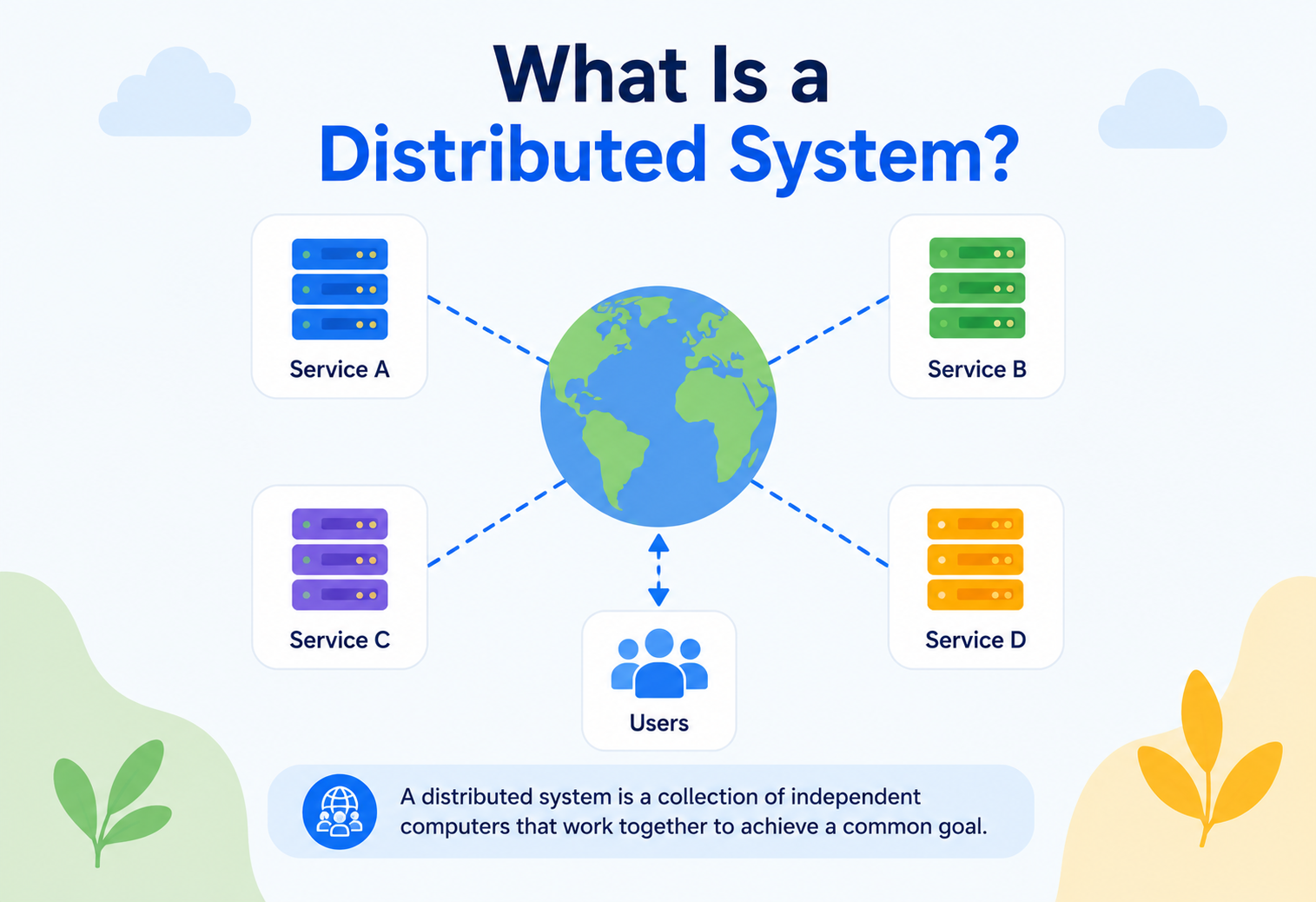
A distributed system is a collection of independent computers that work together, communicating over a network, to appear to their users as a single, unified system. Each computer — usually called a node — has its own memory and does its own processing, but the nodes constantly exchange messages to stay coordinated and to share the workload.
That last part of the definition matters more than it might seem: a distributed system is supposed to feel like one thing, even though it’s secretly made of many things. When you search the web, you don’t see the thousands of individual machines quietly splitting up the job of finding your answer — you just see one search box and one set of results. That illusion of a single, simple system hiding a much larger, more complicated reality underneath is often called transparency, and creating it well is one of the hardest and most important jobs in this entire field.
If an engineer says “this is a distributed system,” they’re really saying: “this isn’t running on one computer — it’s running on many computers that constantly talk to each other over a network to get the job done together.”
It’s worth contrasting this with the monolithic and single-machine systems most people picture when they imagine “a computer program.” A distributed system doesn’t just run in many places — it has to actively handle the reality that a network connecting those places can be slow, unreliable, or even briefly cut off entirely, and it still has to keep working, or at least fail gracefully, when that happens.
Engineers sometimes summarize this reality with a well-known, half-joking list called the “fallacies of distributed computing” — a set of comfortable assumptions that feel obviously true until a real system breaks them. Assumptions like “the network is reliable,” “there is no delay,” and “the network never changes” all sound reasonable on paper, and all of them turn out to be false the moment a system runs at real scale, across real distances, on real hardware that occasionally fails. A big part of learning to design distributed systems well is simply learning to stop believing these comfortable assumptions.
The Building Blocks
Every distributed system, however large or small, is built from the same handful of core ingredients.
Nodes
These are the individual computers — sometimes physical machines, sometimes virtual ones running in the cloud — that each hold a piece of the system’s data or workload. Every node can typically keep running even if some of the others go offline.

The Network
This is the communication highway connecting the nodes — usually the internet, or a private network inside a data center. Nothing in a distributed system happens without a message traveling across this network, and every message takes real time and carries a real risk of getting lost or delayed.
Coordination and Middleware
Because no single node can see the whole picture on its own, distributed systems rely on coordination software — sometimes called middleware — that helps nodes agree on things like which node is in charge right now, whether a piece of data has finished updating everywhere, or what to do when a node suddenly stops responding.
Put simply: a distributed system swaps the comfort of “everything in one place, in one memory” for the power of “many places working in parallel” — and that swap is exactly where both its greatest strengths and its trickiest challenges come from.
Picture a simple example to make this concrete: a food delivery app checking whether a restaurant can accept a new order. The order might arrive at one node, the restaurant’s current status might be tracked by a different node, and the actual notification to the restaurant’s tablet might be handled by a third. None of these three nodes shares memory with the others — the only way they can cooperate is by sending each other timely, well-formed messages, and by handling the moments when one of those messages arrives late, out of order, or not at all.
Types of Distributed Systems
Not all distributed systems are organized the same way. A few recurring patterns show up again and again in real-world designs.
One provider, many requesters
A central server offers a service; many clients send requests to it. Simple and predictable — the backbone of most websites and apps.
Everyone’s equal
There’s no central boss — every node can act as both client and server, sharing resources directly with each other, as seen in file-sharing networks and many blockchain systems.
Layers working together
Several client-server systems are stacked into layers — presentation, application logic, and data — each layer distributed across its own set of machines.
Many machines, one job
A group of servers works together as if they were one powerful machine, commonly rented on-demand from cloud providers like AWS, Azure, or Google Cloud.
Microservices, covered in an earlier guide in this series, are actually a specific flavor of distributed system too — instead of splitting up raw computing power, they split up business responsibilities into small independent services that talk to each other over the same kind of network.
These categories aren’t rigid boxes so much as useful starting points — most large, real-world systems actually blend several of them together. A modern streaming platform, for example, might use client-server communication between the viewer’s device and the video service, an n-tier structure inside its own backend, and a peer-to-peer-style content delivery network to physically move video data closer to viewers around the world. Recognizing which pattern is doing which job is often the first step in understanding a large, unfamiliar system.

Why Build One at All
Splitting a system across many machines is genuinely harder than keeping everything in one place, so it’s worth being clear about what that extra effort actually buys.
More power than one machine
No single computer, however powerful, can serve billions of search queries a day. Spreading the work across thousands of machines makes it possible.
No single point of failure
If one node crashes, the others can keep the system running, rather than the entire service going dark for every single user at once.
Closer to the user
Placing copies of a system in data centers around the world means a user in Tokyo and a user in Toronto can both get fast responses.
Many small machines, not one giant one
It’s often cheaper to combine lots of ordinary, affordable computers than to buy a single enormous supercomputer capable of the same output.
None of these benefits are free, though — every one of them is purchased at the cost of real added complexity. That trade-off is the central theme of this entire guide, and it’s why experienced architects treat “should this be distributed?” as a serious question, not an automatic yes.
There’s a fifth benefit worth naming on its own: elasticity. A distributed system, especially one running in the cloud, can grow and shrink on demand — adding extra nodes automatically during a sudden spike in traffic, like a flash sale or a viral moment, and quietly releasing them again once things calm down. A single, non-distributed machine simply doesn’t have this option; its capacity is fixed the moment it’s provisioned, whether it’s being used or not.
The CAP Theorem: The Big Trade-off
One of the most important ideas in this entire field is a simple rule known as the CAP theorem. It says that whenever a network problem splits a distributed system into two groups of nodes that temporarily can’t talk to each other — called a partition — the system has to choose between two things it can’t fully have at the same time: staying perfectly consistent (every node shows the exact same, most up-to-date information) or staying fully available (every request still gets an answer, even if that answer might be slightly out of date).
In practice, since network hiccups are simply a fact of life in any real distributed system, partition tolerance isn’t really optional — a serious system has to handle it one way or another. That means the meaningful choice architects actually make is between CP (favoring correctness, even if it means briefly refusing some requests) and AP (favoring uptime, even if it means occasionally showing slightly stale information).
Imagine two friends updating the same shared shopping list on paper, but they’re in different rooms and can’t hear each other right now. A “CP” approach means one of them stops writing anything down until they can confirm with the other person, just to be sure the list stays accurate. An “AP” approach means both keep writing freely, and they simply compare notes and fix any mismatches once they’re back in the same room.
A banking system handling money transfers usually leans CP — it would rather briefly pause than risk showing the wrong balance. A social media “like” counter usually leans AP — it would rather show a slightly outdated number than go offline entirely.
It’s worth noting that this choice doesn’t have to be made once for an entire company — it’s usually made separately for each individual piece of functionality, based on what that specific piece actually needs. The very same e-commerce company might run its payment processing as a strict CP system while running its “customers who viewed this also viewed” recommendations as a relaxed AP system, because getting a recommendation slightly wrong for a few seconds costs nothing, while getting a payment wrong is unacceptable.
Consistency Models
Once a system leans toward availability, a natural follow-up question appears: exactly how “out of date” is an acceptable amount of out-of-date? This is where consistency models come in — different rules for how quickly, and how strictly, every node must agree on the latest information.
| Model | What It Promises | Good Fit For |
|---|---|---|
| Strong Consistency | Every node shows the exact same data, instantly, every single time | Bank balances, medical records, anything where being briefly wrong is unacceptable |
| Eventual Consistency | All nodes will agree eventually, but there’s a short window where they might differ | Social media likes, product view counts, anything where a short delay is harmless |
| Causal Consistency | Related updates are seen in the correct order, even if unrelated ones aren’t | Comment threads, chat apps — replies always appear after the message they answer |
Choosing the right consistency model isn’t a purely technical decision — it’s fundamentally a business one. A five-second delay before a “like” count updates for everyone costs almost nothing. A five-second delay before a bank confirms a withdrawal was actually processed could cost real money and real trust. Architects pick the loosest consistency model that the business can genuinely tolerate, because looser models are almost always faster and more resilient.
A helpful habit is to ask, for every piece of data a system stores, a simple question: “if two different users briefly saw two different, both-slightly-wrong versions of this, would anyone actually be harmed?” If the honest answer is no, that data is usually a strong candidate for a looser, faster consistency model. If the answer is yes — money, medical information, legal records — that’s a clear signal the data deserves the stronger, more careful guarantees, even at the cost of some speed.
The Real Cost of Distribution
Spreading a system across many machines solves real problems, but it also introduces a set of challenges that simply don’t exist when everything lives on one computer.
What You Gain
- Far greater capacity than any single machine
- The system can survive individual machines failing
- Users around the world get faster responses
- Different parts can scale independently, on demand
What You Take On
- Network delays and occasional dropped messages
- Nodes can disagree about the “true” current state
- Debugging spans many machines instead of one
- Coordinating updates safely becomes genuinely hard
One especially tricky challenge deserves its own mention: partial failure. In a single-machine program, a crash is usually total and obvious — the whole thing stops. In a distributed system, it’s entirely possible for some nodes to be working perfectly while others have quietly failed, and the tricky part is that a node itself often can’t tell the difference between “the other node crashed” and “the network between us is just being slow.” Designing a system that behaves sensibly under that kind of uncertainty is one of the deepest and most interesting problems in this entire field.
Treating a distributed system like a single computer with really long cables. A network call can fail, arrive out of order, or arrive twice — none of which ever happens when two functions simply call each other inside the same program.
These challenges are exactly why fields like observability — the practice of collecting logs, metrics, and traces from every node so engineers can reconstruct what actually happened — have become such a core part of running distributed systems well. Without good observability, a partial failure can remain invisible for hours, quietly degrading the experience for some fraction of users while every dashboard still shows a comforting, misleading sea of green.
Real-World Examples
Distributed systems aren’t an academic curiosity — they’re the invisible infrastructure behind nearly every large service used today.
Google Search
A single search query is quietly split across a vast network of machines working in parallel across many data centers, returning a unified set of results in a fraction of a second.
Netflix
Content recommendations, account logins, and video streaming are each handled by separate, independently scalable services spread across the globe, working together behind one simple app screen.
Amazon
Product listings, shopping carts, payments, and inventory each run as distributed layers of their own, allowing massive shopping events to be handled without the whole system buckling.
Bitcoin
Thousands of independent computers around the world each keep a copy of the same transaction ledger, agreeing on updates without any single central authority in charge.
What all four examples share is the same underlying pattern: a huge, complicated network of independent machines, carefully coordinated so that the end user only ever sees one simple, seamless experience — completely unaware of the enormous coordination happening behind the screen.
It’s worth noting these systems weren’t built distributed from their very first day. Most large platforms start small, often on something close to a single monolith, and only distribute the pieces that genuinely need it once real usage proves where the pressure actually lies. That gradual, evidence-driven path — rather than distributing everything upfront out of caution or ambition — is a pattern worth borrowing regardless of how big a project eventually hopes to become.
Monolith vs. Distributed
Zooming out, nearly every piece of software falls into one of two broad families: a monolith, where everything runs as one program on essentially one machine, or a distributed system, where the work is spread across many independent, networked machines.
| Dimension | Monolith | Distributed System |
|---|---|---|
| Where it runs | Effectively one process, one machine | Many independent nodes, over a network |
| Failure behavior | Usually fails completely, all at once | Can often survive partial failure |
| Scaling | Scale the whole thing together | Scale individual parts independently |
| Complexity | Lower — one thing to reason about | Higher — many moving, uncertain parts |
These two families aren’t strictly opposites, either — a modular monolith, covered in an earlier guide, deliberately borrows some of the internal organization of a distributed system while still deploying as one unit, and a well-designed distributed system often contains individual nodes that are, internally, small monoliths of their own. The real decision an architect makes isn’t “pick one forever” — it’s “how much of this problem genuinely benefits from being spread across many machines, right now, given what this system actually needs to do.”
Common Pitfalls
Most of the pain associated with distributed systems doesn’t come from the idea itself — it comes from a handful of predictable, well-documented traps that catch even experienced teams off guard.

Assuming the Network Is Reliable
New teams often write code as if a message sent to another machine will always arrive, arrive quickly, and arrive only once. In the real world, networks drop messages, slow down under load, and occasionally deliver the same message twice — and a distributed system has to be built expecting exactly that.
Ignoring Latency
Calling a function inside the same program takes a tiny fraction of a millisecond. Calling another machine over a network — especially one on the other side of the world — can take dozens or hundreds of milliseconds. Treating those two operations as interchangeable is one of the most common design mistakes in distributed systems.
Underestimating Partial Failure
It’s tempting to design for the two simple cases — “everything works” or “everything is down” — while forgetting the much messier, much more common middle ground where some nodes are healthy, some are struggling, and some have quietly disappeared without warning.
Distributing Too Early
Just like splitting a monolith into microservices too soon, building a fully distributed system before there’s a real, demonstrated need for one adds enormous operational overhead for very little actual benefit — complexity that a small team often can’t afford to carry.
A design document that never mentions what happens if a network call simply never returns. If nobody has answered that question, the system almost certainly isn’t ready for the real world yet.
Key Takeaways
Distributed systems power nearly everything meaningful about the modern internet, but that power was never free — it was earned through decades of hard-won lessons about networks, failure, and the honest limits of coordination across many independent machines. Understanding those trade-offs, rather than reaching for distribution reflexively, is what separates a system that scales gracefully from one that simply becomes more complicated without becoming any more capable.
Remember This
- A distributed system is a group of independent computers that work together over a network to appear, to the user, as a single unified system.
- Common types include client-server, peer-to-peer, n-tier, and cluster or cloud-based systems — each organizing the same idea a little differently.
- The CAP theorem explains the core trade-off: when a network problem splits the system, you can favor consistency or availability, but rarely perfect both at once.
- Consistency models range from strict and immediate to relaxed and eventual — the right choice depends entirely on what the business can actually tolerate.
- Distribution buys real power — scale, resilience, and reach — but it also introduces network delays, partial failure, and genuine coordination challenges that don’t exist on a single machine.
- The goal was never “distribute everything.” It’s understanding exactly which parts of a system truly benefit from being spread across many machines, and building the rest simply.