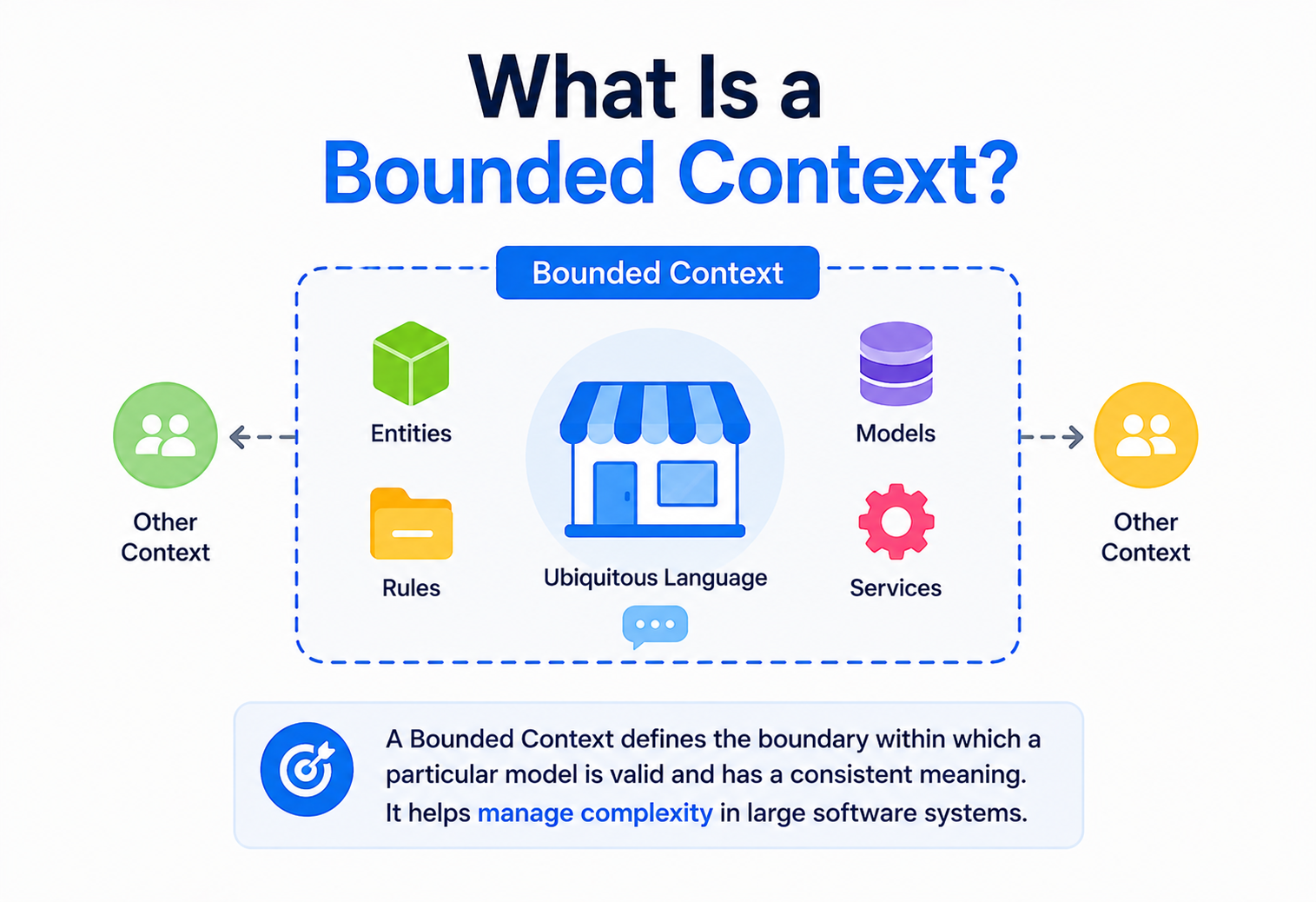
What Is a Bounded Context?
The very same word can mean two completely different things in two different rooms of the same company — and that’s not a problem to fix. It’s a fact to design around. A bounded context is the idea that gives that fact a proper home inside your software, instead of letting it quietly cause chaos.
The Big Idea, in One Breath
Say the word “trunk” out loud to three different people. A gardener pictures the thick, woody stem of a tree. A person packing for a road trip pictures the storage space at the back of a car. An elephant keeper at a zoo pictures a long, flexible nose. Nobody is wrong. Nobody is confused, either — because each of them instantly understands which “trunk” is meant, based on the setting they’re standing in. The word doesn’t need one single, universal meaning to be useful. It just needs a clear enough setting around it.
Businesses work exactly the same way, and this is where a lot of software quietly goes wrong. A single word like “customer,” “account,” or “product” gets used constantly across a company, but it rarely means precisely the same thing in every department. Sales cares about a customer’s interest and buying history. Billing cares about a customer’s payment status and outstanding dues. Support cares about a customer’s open tickets and past complaints. If a team tries to build one single, all-purpose “Customer” class that satisfies every department at once, that class slowly turns into a bloated, fragile mess — full of fields that only make sense to one department, riddled with rules that quietly contradict each other. A bounded context is the deliberate decision to stop forcing one meaning onto everyone, and instead give each department’s version of an idea its own clearly marked, protected space.
Think about a school building. The word “period” means something different in the maths classroom (a lesson slot on the timetable) than it does in the English classroom (a punctuation mark at the end of a sentence). Nobody gets confused walking between the two rooms, because the room itself sets the context. A bounded context is simply that same idea, drawn deliberately around parts of a business, so that “customer” in the Sales room and “customer” in the Billing room can each mean exactly what they need to mean, without stepping on each other’s toes.
This might sound like a small, almost obvious observation, but the consequences of ignoring it are anything but small. Software teams that don’t draw these boundaries on purpose tend to draw them by accident instead — usually far too late, after months of confusing bugs, awkward meetings where two people argue past each other using the same word, and a codebase that quietly grows a tangle of “if this department, do it this way” checks scattered everywhere. A bounded context takes that inevitable messiness and gives it a proper, planned shape from the start, rather than letting it show up later as an emergency.
What a Bounded Context Really Is
A bounded context is a boundary — conceptual, and usually technical too — inside which a particular model and a particular shared vocabulary stay completely consistent. Inside that boundary, a term like “Order” has exactly one meaning, everybody agrees on it, and the code reflects it faithfully. Step outside that boundary into a different bounded context, and “Order” is allowed to mean something else entirely, or might not exist as a concept at all.
The term comes from Eric Evans’s 2003 book on Domain-Driven Design, where it sits right alongside the idea of a ubiquitous language — a shared vocabulary built jointly by developers and business experts. The two ideas need each other to work properly: a ubiquitous language only stays truly unambiguous if it’s scoped to a bounded context. Try to stretch one single ubiquitous language across an entire large company, and it quietly breaks down the moment two departments use the same word differently — which, in any real organisation, happens constantly.
If someone asks “what bounded context does this code belong to?”, they’re really asking: “If I read the word ‘Order’ in this file, whose definition of ‘Order’ am I looking at — Sales’s, Warehouse’s, or Billing’s?”
It helps to notice that a bounded context is not the same thing as a folder, a microservice, or a database, even though it’s often implemented using exactly those tools. It’s fundamentally a modelling boundary first — a line drawn around where a particular way of thinking about the business stays internally consistent. The technical implementation (a separate codebase, a separate service, a separate schema) is simply one common, sensible way of enforcing that boundary in practice, not the definition of the boundary itself.
It’s also worth pointing out that a bounded context is one of the very few DDD patterns that industry commentators, years after the original book, have singled out as the single most important idea in the whole approach — more foundational, in practical terms, than any of the tactical patterns like entities or aggregates. Eric Evans himself has said in later talks that if he could go back and rename his own book, he might have called it “bounded contexts” rather than “domain-driven design,” precisely because so much of the value people get from DDD flows from getting this one boundary-drawing decision right. Everything else — the vocabulary, the tactical patterns, the way teams are organised — tends to fall into place far more easily once the boundaries themselves are sound.

Why Bounded Contexts Exist
Before this idea became common practice, a lot of software teams tried something that sounds perfectly reasonable on paper: build one single, unified model of the entire business, reused everywhere, so nobody ever has to build the same concept twice. In practice, this “one true model” approach almost always collapses under its own weight as a business grows.
The Trouble With One Giant Shared Model
Picture a single “Product” class that has to serve Marketing (which wants glossy descriptions and images), Warehouse (which wants weight, dimensions, and shelf location), Finance (which wants cost price and tax codes), and Customer Support (which wants known issues and return rates). Every department keeps adding fields it needs and rules it depends on, until the class becomes an enormous, tangled object that nobody fully understands, and where a change requested by one department has a real chance of quietly breaking something for a completely different one. This tangled outcome even has a well-known nickname among engineers: a big ball of mud.
What Bounded Contexts Give You Instead
By splitting the “Product” idea into several smaller, purpose-built versions — one inside the Catalog context, a different one inside the Warehouse context, another inside the Finance context — each version stays small, focused, and genuinely understandable by the team that owns it. Nobody has to hold the entire tangled mega-model in their head just to make a safe, confident change. Each team gets the freedom to evolve its own model at its own pace, using words that make sense to the people who actually work in that part of the business.
If two departments would answer “what is a Product?” differently, and both answers are legitimately correct for their own work, you’re looking at two bounded contexts, not one confused one.
There’s also a quieter, longer-term cost to skipping this discipline that’s worth naming directly. Without clear boundaries, every new feature request forces a developer to ask an unspoken, exhausting question before writing a single line: “which department’s rules apply here, and will changing this field quietly break someone else’s assumptions three screens away?” Over months and years, this uncertainty slows a team down in a way that’s hard to measure but easy to feel — estimates grow longer, confidence shrinks, and engineers start double- and triple-checking changes that should have been routine. Bounded contexts remove that background uncertainty by making the question unnecessary in the first place: if you’re inside the Warehouse context, you only ever need to think about the Warehouse context’s rules.
Language, Model, and Boundary — The Three Threads
A bounded context is really three closely woven ideas held together at once, and it helps to pull them apart to see how they support each other.
The words used
The specific vocabulary spoken and written inside this part of the business — what things are called, out loud, by the people who work there.
The meaning behind them
The actual concepts, rules, and relationships those words point to — what a “Shipment” is allowed to do, what states it can be in.
Where it applies
The explicit edge marking where this language and model are guaranteed to hold true — and past which they might not.
These three threads have to travel together. A shared vocabulary without a boundary drifts into ambiguity, because nothing stops two teams from quietly redefining the same word differently over time. A boundary without a genuinely shared vocabulary inside it is just an empty folder — teams might sit inside the same technical service yet still be silently talking past each other, using the same words to mean different things because nobody actually agreed on the language. Eric Evans’s own guidance is blunt about this: a bounded context is kept healthy by relentlessly using the same agreed language in every conversation, every diagram, and every line of code within its boundary — and treating any change in that language as a real change to the underlying model, worth pausing to discuss.
Think of a country with its own currency. The currency (the model) only holds its value because there’s a clear border (the boundary) around where it’s accepted, and everyone inside that border agrees on what it’s worth (the shared language of prices). Cross the border, and you need a different currency, even though “money” is still the general idea in both places. A bounded context works the same way for business concepts.
Consider a concrete worked example to see all three threads at once. Inside a Shipping bounded context, the language includes words like “consignment,” “carrier,” and “manifest.” The model behind those words defines exactly what a consignment is allowed to do — it can be created, assigned to a carrier, marked in transit, and marked delivered, but never, say, marked delivered before it’s been assigned to a carrier at all. The boundary is the guarantee that everywhere inside this context — every screen, every service, every conversation between the shipping team and the warehouse team — “consignment” reliably means this exact thing, with these exact rules, and nothing quietly different has snuck in through a back door.

Subdomain vs. Bounded Context — A Confusion Worth Clearing Up
These two terms get mixed up constantly, and it’s worth taking a moment to separate them properly, because they answer genuinely different questions.
A subdomain belongs to the problem space — it’s a naturally occurring area of the business itself, like “Billing” or “Order Fulfilment,” and it exists whether or not any software has been written yet. A bounded context belongs to the solution space — it’s a boundary drawn inside the software being built to solve that problem. This distinction matters because the two don’t always line up one-to-one. A single subdomain might genuinely need to be solved using two or three separate bounded contexts. Occasionally, a single bounded context might stretch across parts of more than one subdomain, though when that happens, it’s often a hint that the boundary deserves a second look.
| Aspect | Subdomain | Bounded Context |
|---|---|---|
| Lives in | The problem space (the real business) | The solution space (the software) |
| Exists because | The business naturally has this area of work | A team chose to model it as its own boundary |
| Changes when | The business itself changes | The team’s design or technical approach changes |
| Typical count | Roughly fixed by how the business is organised | Can be split, merged, or redrawn by the team |
The subdomain is the question “what part of the real business are we talking about?” The bounded context is the answer to “how did we decide to model and build that part in our software?”
How to Find the Boundaries
Discovering where one bounded context should end and another should begin is rarely obvious from a whiteboard alone. A handful of practical signals, used together, tend to reveal the natural seams far more reliably than guesswork.
Listen for shifts in vocabulary
When a conversation naturally moves from “how we take payments” to “how we prepare a shipment,” that shift in words is often exactly where a boundary belongs.
Watch for overloaded words
If one word needs an ever-growing set of “if this department, then…” rules to make sense, it’s usually secretly two words wearing one costume.
Run an event storming session
Gather developers and domain experts around a timeline of everything significant that happens in the business, and watch related events naturally cluster into groups.
Follow the org chart, carefully
Departments with their own manager, their own goals, and their own way of measuring success often need their own bounded context too — though this is a strong hint, not an absolute rule.
Look at the pace of change
Parts of the business that evolve quickly and independently of each other are natural candidates for separate boundaries, so a fast-changing area doesn’t get held back by a slower, more stable one.
It’s worth being patient with this process, because the first attempt at drawing boundaries is rarely the final one. A common, healthy pattern is to start with a rough, slightly-too-large boundary, build inside it for a while, and only split it further once real friction shows up — a team feeling stretched across two conflicting ways of thinking, or a growing pile of special-case logic that only applies to part of the boundary. Trying to guess the perfect, final boundary on day one, before any code has been written and before the model has been tested against real use, is a recipe for over-engineering. The boundary should earn its shape through actual use, not through a single afternoon of speculation on a whiteboard.
How Big Should a Bounded Context Be?
There’s no fixed number of classes, screens, or lines of code that defines the “correct” size of a bounded context, and chasing a specific size is usually the wrong question to ask. The far more useful test is whether the model inside the boundary can comfortably “fit in your head” — whether one person, or one small team, can hold the whole thing in mind at once without constantly needing to context-switch between two conflicting ways of thinking.
A bounded context that’s too large starts to feel like the very big ball of mud it was meant to prevent — different parts of the model start pulling in different directions, and the team inside it starts needing internal “sub-agreements” about what things mean, which is usually a strong sign that a further split is overdue. A bounded context that’s too small, on the other hand, creates its own kind of pain: an explosion of tiny boundaries means constant translation and coordination overhead just to get anything done, with teams spending more time agreeing on integration contracts than actually building anything.
A healthy bounded context is one where a new team member can hold the entire model, its rules, and its vocabulary in their head after a reasonably short amount of ramp-up time — not instantly, but not after months of confusion either.
It’s also worth remembering that the “right” size is not permanent. As a business grows, what once fit comfortably inside one context may start showing the strain of two different, conflicting sub-models trying to coexist — and splitting it further, at that point, is a healthy, expected evolution rather than a sign that the original design was wrong.
Reading the Warning Signs
A context that’s grown too large tends to announce itself in fairly recognisable ways: pull requests that touch dozens of files for what should be a small change, onboarding that takes new engineers weeks instead of days, and meetings where two people from the “same” team turn out to be assuming completely different rules. A context that’s shrunk too small announces itself differently: an explosion of tiny services that all need to be deployed together anyway because they’re so tightly coupled in practice, endless back-and-forth messages just to complete one user-facing action, and a growing sense that the team spends more time drawing diagrams of how pieces connect than actually building features. Neither extreme is a moral failing — both are simply useful signals that the boundary has drifted away from where the real work naturally wants to happen, and it’s time to redraw it.
Teams, Ownership, and Conway’s Law
Bounded contexts aren’t just a technical drawing exercise — they’re deeply tied to how the people building the software are actually organised. A well-known observation, often called Conway’s Law, notes that any organisation designing a system will end up producing a system whose structure mirrors the organisation’s own communication structure. In practice, this means that if two teams don’t talk to each other very often, their part of the software probably shouldn’t need to talk to each other very often either — and if it does, friction is guaranteed.
A healthy guideline that’s grown out of years of DDD practice is this: one team can comfortably own several bounded contexts, but a single bounded context should not be shared between multiple teams. When several separate teams are all committing changes inside the same bounded context, the shared model quietly starts drifting in different directions depending on which team touched it most recently, priorities clash, and the very consistency a bounded context was supposed to guarantee slowly leaks away.
Imagine two chefs trying to run the exact same kitchen station at the exact same time, each with their own idea of how the sauce should taste. Even if they’re both talented, the dish comes out inconsistent, because nobody has final say. Give each chef their own station instead, with a clear pass-through window between them, and both dishes turn out excellent — and predictable.
If you notice two different teams frequently needing to coordinate a release just to change one shared piece of code, that’s often a sign the bounded context boundary and the team boundary have drifted out of alignment — and one of them needs to move.
There’s a practical implication worth spelling out for anyone setting up a new team: a team built to own a bounded context works best when it’s genuinely cross-functional, holding everyone needed to design, build, test, and ship that context’s features without constantly waiting on another group’s calendar. A team that owns the Ordering context but has to file a request with a separate, central database team every time it needs a schema change hasn’t really achieved independent ownership — the dependency has just moved somewhere less visible. The goal isn’t rigid isolation for its own sake; it’s giving each team enough genuine autonomy that most of their day-to-day decisions can be made and shipped without needing permission from outside their own boundary.
Context Mapping: How Boundaries Relate to Each Other
Drawing boundaries is only half the story — those boundaries still need to cooperate, because an order in the Sales context eventually has to become a shipment in the Warehouse context. Context mapping is the practice of naming these relationships explicitly, including the honest organisational reality of who depends on whom, so that nothing important is left as an unspoken assumption.
Two teams, one goal
Teams coordinate closely and plan changes together, like two neighbours agreeing on a shared fence line before either one builds.
A small, jointly-owned core
Two contexts deliberately share a small piece of model and code, and both teams take joint responsibility for keeping it correct.
One depends on the other
A downstream team relies on an upstream team’s output, and the upstream team genuinely considers the downstream team’s needs when planning changes.
Just accept it as-is
The downstream team has little influence over the upstream team, so it simply adopts the upstream model exactly as given, without negotiation.
A translator at the border
A protective layer of code translates an external or messy model into clean, friendly terms before it ever touches your own context.
A well-documented door
A team publishes a clean, stable interface specifically meant for others to use, instead of forcing them to reverse-engineer internal details.
A shared, formal format
A well-documented, standardised data format that lets many different systems exchange information without custom, one-off translation for each pair.
No integration at all
Sometimes the cleanest answer is to not integrate two contexts at all, and accept some duplicated effort rather than a costly, fragile connection.
None of these patterns is inherently “better” than the others — each one is a deliberate, honest answer to a specific organisational reality. Choosing conformist over partnership isn’t a failure; sometimes a small team genuinely has no leverage to negotiate with a large upstream provider, and pretending otherwise only wastes energy. The value of context mapping is that it forces this reality into the open, drawn on a diagram, instead of leaving it as an unspoken, gradually discovered frustration.
The vocabulary of “upstream” and “downstream” is worth sitting with for a moment, because it captures something genuinely useful about power and influence between teams. An upstream context’s decisions naturally flow down and affect its downstream partners, the way water flows from higher ground to lower ground — but the reverse influence has to be earned or negotiated. A partnership relationship exists precisely because both sides have agreed to let influence flow both ways, coordinating changes together rather than one side simply dictating terms. Recognising honestly which kind of relationship you’re actually in — rather than the one you wish you had — is often the difference between a context map that predicts real friction ahead of time, and one that simply looks tidy on a slide.
When the Same Concept Crosses Contexts
Almost every real system has a handful of ideas — “Customer,” “Product,” “Employee” — that genuinely need to show up in more than one bounded context. This doesn’t break the rule that each context has its own model; it simply means each context is allowed to keep only the slice of that idea it actually cares about, rather than importing the whole thing wholesale.
In the Support context, a “Customer” might be little more than a name, a contact method, and a history of tickets. In the Billing context, the very same real person is represented as a “Customer” with an outstanding balance, a payment method, and an invoice history. Both are legitimate, partial views of the same underlying person, deliberately kept separate and lightweight rather than merged into one bloated object that tries to be everything to everyone. Where the two contexts genuinely need to refer to the same real-world entity, they usually do so through a simple, stable identifier — a customer ID — passed between them, rather than by sharing the full internal model.
Sharing an ID across contexts is healthy. Sharing an entire class, database table, or object definition across contexts is usually the first crack that eventually turns into a big ball of mud.
A useful habit here is to give each context its own small, local representation of a shared concept, named for what that context actually uses it for, rather than reusing a generic imported name. Instead of every context holding a field called customer, the Support context might hold a Requester, and the Billing context might hold a Payer — both ultimately referring to the same real person, connected by a shared ID, but each named and shaped around exactly what that context needs. This small naming discipline does a surprising amount of work: it keeps each context’s code honestly reflecting what it actually does with the data, and it makes it immediately obvious to a future reader that these are deliberately separate, locally-scoped views rather than one leaking, shared object pretending to be several things at once.
Bounded Contexts vs. Microservices
These two ideas get treated as synonyms so often that it’s worth being precise about the difference. A bounded context is a modelling boundary — a line drawn around where a language and a model stay consistent. A microservice is a deployment boundary — a separately built, separately deployed, independently running piece of software. They frequently line up nicely, and DDD’s strategic design is widely regarded as one of the best tools available for deciding where microservice boundaries should actually go — but the relationship is not automatically one-to-one.
Sometimes one bounded context is genuinely large enough, or has different-enough internal pieces, that it gets implemented as more than one microservice. Other times, several small, closely related bounded contexts are deliberately implemented within a single microservice, especially early in a project, when splitting them apart would add operational cost without a matching benefit yet. Chasing an exact one-to-one mapping as a rule, rather than a helpful starting guideline, is one of the more common ways teams end up with either bloated services that don’t feel “micro” at all, or a scattering of tiny, chatty services that spend more time talking to each other than doing real work.
A modelling boundary
A modelling and language boundary. Can exist inside a single application. Defined by where meaning stays consistent.
A deployment boundary
A deployment and runtime boundary. Always a separately running process. Defined by independent build and release.
Design your bounded contexts first, based purely on the business and its language. Decide how many microservices to turn them into second, based on real operational needs like scaling, deployment frequency, and team size.
A useful piece of practical guidance that’s emerged from years of teams learning this the hard way: when a project is genuinely new, or the business rules inside a context are still being actively discovered and refined, it’s often wiser to keep several related bounded contexts inside a single, well-organised application — sometimes called a “modular monolith” — clearly separated internally by module boundaries, but not yet split into physically separate deployed services. Splitting into true microservices too early, before the boundaries have proven themselves stable through real use, tends to lock in guesses that later turn out to be wrong, and the network calls between prematurely separated services add real operational cost for very little benefit at that stage. Splitting later, once a boundary has proven itself durable, is a far cheaper and safer move than trying to merge two microservices back together after they’ve drifted apart.
Implementing a Bounded Context
Once a boundary has been agreed on, it needs to be genuinely enforced, not just implied by good intentions. A few concrete practices make the boundary real rather than theoretical.

Its Own Codebase or Module
Whether it’s a separate repository, a separate service, or at minimum a clearly separated module inside a larger codebase, a bounded context should have a home that other parts of the system can’t casually reach into.
Its Own Data
Wherever practical, a bounded context owns its own data storage, rather than reading and writing directly into a table that another context also depends on. Shared databases are one of the single most common ways a supposedly separate bounded context quietly stops being separate at all — because two teams end up coupled through a shared schema even while believing their code is independent.
Explicit Integration Contracts
Whatever crosses the boundary — an API call, a published event, a message on a queue — should be treated as a deliberate, versioned contract, not an accident of implementation detail leaking out. This is what lets one context change its internals freely, as long as it keeps honouring the contract it promised to the outside world.
Consistent Naming, End to End
The vocabulary agreed on with domain experts should show up unmodified in class names, method names, API field names, and even error messages — so that reading the code out loud to a business expert would sound natural to them, not like a foreign, technical dialect.
A bounded context that shares a live database connection with another context isn’t really bounded at all — it’s two teams sharing one hidden, undocumented contract that nobody wrote down, and that will eventually break in a way nobody expected.
Testing the Boundary, Not Just the Code Inside It
A healthy bounded context deserves tests that specifically check the boundary itself, not only the business logic living inside it. Contract tests — automated checks that verify a context still honours the exact shape of data it promised to send or receive — catch a whole category of painful, late-discovered bugs where one context quietly changes a field’s meaning or format, and a completely different team’s context breaks in production days later without anyone realising why. It’s worth treating these integration contracts with the same seriousness as any other public promise a team makes, complete with versioning, and a clear process for retiring an old version only once every consumer has genuinely moved on to the new one.
Pros, Cons, and When to Use It
What bounded contexts buy you
Removes ambiguity around shared, overloaded words. Lets teams work independently without stepping on each other. Keeps each model small enough to truly understand. Gives large systems natural, sensible seams to split along. Makes integration points explicit instead of accidental.
What they quietly cost
Adds upfront design effort to identify boundaries well. Requires real discipline to keep boundaries enforced over time. Introduces translation cost between contexts. Overkill for small, simple, single-team applications. Wrong boundaries can be as painful as no boundaries at all.
Bounded contexts earn their cost once a system grows large enough, or a business is complex enough, that a single unified model has genuinely started causing more confusion than it prevents. A small application built and maintained by one or two people rarely needs this level of ceremony — the coordination problems bounded contexts solve mostly don’t exist yet when there’s nobody else to miscommunicate with. As soon as multiple teams, multiple departments, or multiple genuinely distinct sub-businesses enter the picture, the calculation flips, and clear boundaries stop being a luxury and start being what keeps everyone able to move quickly without constantly colliding.
Teams new to the idea often worry that adopting bounded contexts means a large, disruptive rewrite, but that’s rarely necessary or wise. It’s entirely possible to introduce the discipline gradually inside an existing, tangled codebase — picking the single most painful, most confusing area first, having the honest conversation with whoever understands that area best about what its true vocabulary and rules actually are, and drawing a first boundary around just that piece. Success there tends to build the confidence and evidence needed to justify doing the same for the next painful area, rather than demanding a leap of faith across the entire system all at once.
Common Pitfalls
Drawing Boundaries Around Technology, Not the Business
Splitting contexts by technical layer — one context for “the database code,” another for “the API code” — misses the point entirely. Bounded contexts should follow business meaning, not technical plumbing.
One-to-One Worship With Microservices
Treating “one bounded context equals exactly one microservice” as an unbreakable law, rather than a helpful starting point, often produces boundaries shaped by a rulebook instead of the actual business.
Letting a Shared Database Undermine the Boundary
Two contexts that look separate in a diagram but secretly read and write the same tables aren’t actually separate — the database has quietly become the real, unacknowledged shared model.
Skipping Context Mapping Entirely
Drawing the boundaries and then leaving the relationships between them completely unspoken leads to exactly the kind of surprise breakage context mapping was designed to prevent — a change deep inside one context quietly breaking three others that were silently depending on it.
Never Revisiting the Boundaries
Treating a bounded context map as something drawn once at the start of a project and never touched again ignores the reality that businesses change. A boundary that made perfect sense two years ago can start to strain and deserve a second look as the company grows or reorganises.
Letting Vocabulary Quietly Drift From the Business
Even a well-drawn boundary loses much of its value if the words used inside the code slowly stop matching the words the business has since moved on to using in meetings. A context named around an old product line that the business no longer calls by that name becomes a small, constant source of friction — new hires learn one vocabulary from the business and a different one from the code, and have to mentally translate between the two forever. Revisiting and renaming, uncomfortable as it can feel, is usually far cheaper in the long run than letting the mismatch fester.
If “just add a special case for this one department” becomes a recurring sentence in a code review, that’s usually a sign a bounded context boundary has been drawn in the wrong place, not that the code needs one more exception.
Real-World Examples
Online Retail
A large online store commonly splits into contexts like Catalog, Cart, Ordering, Shipping, and Returns. “Product” in Catalog carries marketing copy, images, and reviews; “Product” in Shipping carries only weight, dimensions, and fragility flags. The two are connected through a shared product ID and a published event, not through one shared class trying to serve both purposes.
Banking
A bank’s Accounts context treats an account as a tightly guarded model with strict balance rules. Its Fraud Detection context, watching the very same stream of transaction events, applies a completely different set of rules and vocabulary — “suspicious pattern,” “risk score” — concepts that would mean nothing inside the Accounts context, and don’t need to.
Healthcare
A hospital system typically keeps Scheduling (where a patient is mostly an appointment slot and contact details) firmly separate from Clinical Records (where the very same patient is a rich medical history bound by strict privacy rules). Merging these into one “Patient” model would either overexpose sensitive medical data to the scheduling desk, or force clinical staff to wade through irrelevant appointment logistics — bounded contexts avoid both problems at once.
Ride-Hailing
A ride-hailing platform naturally separates into Matching, Trip, Pricing, and Payments contexts. A “Trip” during active matching is mostly a pickup location and a set of nearby drivers; a “Trip” inside the Pricing context, once complete, is mostly distance, duration, and surge multipliers used to calculate a fare — two very different views of the same underlying journey, each shaped by what its own context actually needs to do.
Education Technology
A learning platform used by both schools and individual learners often separates into Enrolment, Course Content, Assessment, and Certification contexts. A “Student” during Enrolment is mostly contact details and a chosen course; a “Student” inside Assessment becomes a set of quiz attempts and scores; a “Student” inside Certification becomes a completion record tied to a verifiable credential. Trying to hold all three views inside one shared “Student” class would mean the Assessment context’s frequent, fast-changing quiz logic constantly risks disturbing the far more stable, formally-audited Certification records — exactly the kind of accidental coupling separate bounded contexts are designed to prevent.
It’s a bit like how the very same building can be called “home” by the family living in it, “an asset” by the bank holding its mortgage, and “a structure” by the city’s fire inspector — three completely different, entirely valid models of one real thing, each shaped by what that particular viewer actually needs to know.
Bounded Contexts in Modern Practice
The idea has aged especially well as systems have grown more distributed and teams have spread across more locations and time zones, because it was never really about a specific technology — it was about honestly modelling how communication and meaning actually work inside a real organisation.
Cloud and Distributed Systems
Modern cloud platforms make it technically easy to spin up a separate database or a separate service for each context, which has made the discipline of proper boundary-drawing more achievable than it was in the era of one enormous shared database serving an entire company. The temptation to take the easy path and share infrastructure across contexts anyway remains just as strong as ever, though, which is why the discipline still matters more than the tooling.
Working Alongside AI-Assisted Development
When code is generated with the help of an AI coding assistant, a clearly bounded context gives that assistant a much smaller, much more coherent slice of vocabulary and rules to work within — closer to how a focused, well-briefed new team member would perform compared to someone handed an entire company’s tangled, contradictory codebase at once. A codebase with clean, well-enforced context boundaries tends to produce far more reliable AI-assisted suggestions than one where “Customer” secretly means five different things depending on which file you’re standing in.
A good health check for any bounded context: could you hand just that one context’s code to a new engineer — or point an AI assistant at just that one folder — and have them build a correct, working feature without ever needing to peek outside it?
Frequently Asked Questions
Is a bounded context the same as a module or a package?
Not automatically. A module or package is a code organisation tool. A bounded context is a modelling boundary that’s often, but not always, implemented as a module, service, or package. You can have well-organised code that still shares one confused model across it.
Can a bounded context change over time?
Yes, and it should. As a business grows or reorganises, a boundary that once made sense can start to strain, and splitting, merging, or redrawing it is a normal part of a healthy system’s evolution, not a sign the original design failed.
Do small projects need bounded contexts?
Usually not in any formal sense. A small application maintained by one or two people rarely has the kind of cross-team ambiguity that bounded contexts exist to solve. The idea becomes valuable once multiple teams or genuinely distinct business areas enter the picture.
What happens if two bounded contexts disagree about a shared concept?
That’s expected, not a bug. Each context is allowed its own partial view of a shared real-world idea. What matters is that the disagreement is handled deliberately — through a clear integration contract or an anti-corruption layer — rather than through one side quietly overriding the other.
Who decides where a bounded context boundary goes?
Ideally, it emerges from close collaboration between developers and the domain experts who actually understand the business, often surfaced through techniques like event storming — not decided unilaterally by engineers looking only at the code, or by business stakeholders looking only at the org chart.
Is it a mistake to have overlapping bounded contexts?
True overlap, where two contexts claim ownership of the exact same piece of data, is usually a sign the boundary needs adjusting. Shared reference to the same real-world entity through an ID, however, is completely normal and expected.
How many bounded contexts should a system have?
There’s no fixed number — it depends entirely on how many genuinely distinct areas of meaning the business actually has. A small system might comfortably have two or three; a large enterprise platform might reasonably have dozens. The right count is whatever honestly reflects the business, not a target chosen in advance.
What’s the very first step for a team new to this idea?
Pick the single area of the system that currently causes the most confusion or the most “wait, which department’s rules apply here?” conversations, and start there. Sit with the people who understand that area best, agree on its true vocabulary, and draw one honest boundary around it before trying to redesign the whole system at once.
Glossary
| Term | Definition |
|---|---|
| Bounded Context | A boundary within which one model and one language stay consistent. |
| Ubiquitous Language | A shared vocabulary used consistently by developers and domain experts within a context. |
| Subdomain | A naturally occurring area of the real business, existing in the problem space. |
| Context Map | A diagram and set of agreements describing how bounded contexts relate to one another. |
| Shared Kernel | A small piece of model and code deliberately shared and jointly owned by two contexts. |
| Customer–Supplier | A relationship where a downstream context depends on an upstream one that considers its needs. |
| Conformist | A relationship where a downstream context simply adopts the upstream model as-is. |
| Anti-Corruption Layer | A translation layer that protects a context’s model from an external one. |
| Open Host Service | A clean, stable interface a team publishes specifically for others to consume. |
| Published Language | A formalised, shared data format used to exchange information across contexts. |
| Separate Ways | A deliberate decision not to integrate two contexts at all. |
| Big Ball of Mud | A system with no real internal boundaries, where everything depends on everything. |
| Conway’s Law | The observation that a system’s structure tends to mirror its organisation’s communication structure. |
| Event Storming | A collaborative workshop technique for mapping significant business events to discover natural boundaries. |
Key Takeaways
The deepest idea behind a bounded context is refreshingly honest: a large business simply doesn’t have one single, universal meaning for its most important words, and pretending otherwise doesn’t make the software simpler — it just hides the complexity somewhere nobody agreed to put it. A bounded context gives every department’s version of an idea a clearly marked home, gives teams the freedom to build and evolve their own small, understandable models, and makes the connections between those models an explicit, deliberate choice instead of an accident waiting to cause a very confusing bug. None of this requires exotic tooling. It requires paying close attention to language, drawing honest lines, and having the discipline to keep those lines standing once they’re drawn.
Perhaps the most reassuring part of this whole idea is how forgiving it is of imperfection. Nobody draws the perfect boundary on the first attempt, and nobody is expected to. What separates a team that benefits from bounded contexts from one that doesn’t isn’t the accuracy of their very first diagram — it’s their willingness to keep listening to the business, keep questioning whether the current boundaries still make sense, and keep redrawing them, calmly and deliberately, as understanding grows. That ongoing willingness to listen and adjust is, in the end, the real skill behind good software architecture.
Remember This
- A bounded context is a boundary within which one model and one language stay completely consistent.
- The same word is allowed to mean different things in different bounded contexts — that’s a feature, not a flaw.
- A subdomain is part of the real business; a bounded context is a boundary drawn inside the software that solves it.
- Boundaries are best found by listening to language shifts, watching for overloaded words, and running collaborative sessions like event storming.
- One team can own several bounded contexts, but a single bounded context shouldn’t be shared across multiple teams.
- Context mapping patterns — partnership, shared kernel, customer-supplier, conformist, anti-corruption layer, open host service, published language, separate ways — name the relationships between boundaries honestly.
- A bounded context is a modelling boundary; a microservice is a deployment boundary. They often align, but not automatically.
- Boundaries aren’t permanent — as a business grows and changes, healthy teams expect to revisit and redraw them.