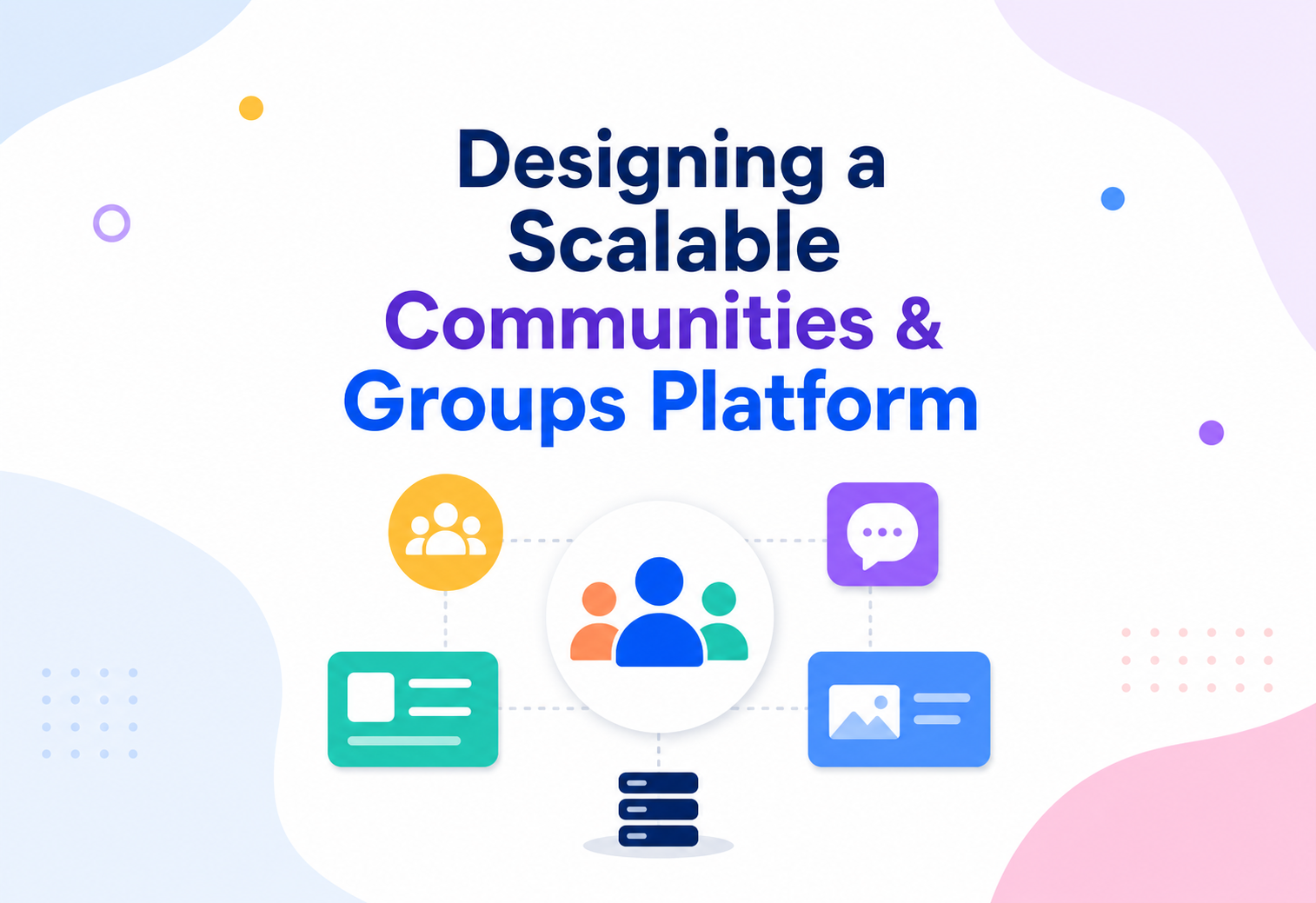
Designing a Scalable Communities & Groups Platform
How to architect a “Groups” or “Communities” feature — like Facebook Groups, Reddit subreddits, or Slack/Discord servers — that can host millions of members per community, serve a fast personalized internal feed, enforce configurable rules, and support moderation at scale, all without falling over under load.
Introduction & History
Think about the last time you joined a Facebook Group for your apartment building, a subreddit for your favorite hobby, or a Discord server for a game you play. Each of those is a small, self-contained world living inside a much bigger platform — its own members, its own posts, its own rules, its own moderators — while still sharing the same underlying app you already have installed.
What Is a “Communities” or “Groups” Feature?
That is exactly what we mean by a Communities or Groups feature. It is a way of letting a huge platform (with hundreds of millions of total users) split itself into millions of smaller “rooms,” each with its own membership list, its own feed of posts, its own set of rules, and its own moderation team — while still running on one shared piece of software underneath. From an engineering standpoint the feature is not a bolted-on module; it is a set of foundational choices that ripple into every other part of the system, from how you store data, to how you fan out writes, to how you enforce policy per tenant.
Imagine a giant shopping mall (the platform). Inside the mall there are thousands of individual stores (the communities). Each store has its own manager (the moderator), its own products on the shelves (the posts), its own store rules (“no food or drink inside”), and its own regular customers (the members). The mall provides shared infrastructure — electricity, security guards, plumbing, parking — but each store runs its own show. A system design for “communities” is really a design for how to build millions of these stores cheaply, safely, and in a way that never makes the whole mall collapse.
A Short History
Usenet — the first “communities”
Usenet newsgroups let people post messages to topic-based boards distributed across servers. There was no central company running it — it was federated, which is why moderation was extremely inconsistent.
Forums & mailing lists — phpBB, vBulletin, Yahoo Groups
Web forums centralized communities on single servers with a database-backed thread-and-reply model. This is the direct ancestor of the “post + comments” pattern almost every community feature still uses today.
Reddit — subreddits as first-class citizens
Reddit turned “a community with its own rules and moderators” into the core unit of the product itself, rather than a bolt-on feature, and popularized community-level upvote-driven ranking.
Facebook Groups — embedded inside a social graph
Facebook added Groups on top of an existing friend-graph platform, forcing engineers to solve the problem of two different feed generation systems (friend feed vs. group feed) living side-by-side at massive scale.
Slack & Discord — real-time, chat-first communities
These platforms treat a “community” as a real-time chat room instead of an asynchronous feed, pushing the system design problem toward WebSockets, presence, and low-latency fan-out rather than ranked feeds.
AI-assisted moderation at scale
As communities crossed the million-member mark, manual moderation became impossible. Machine-learning classifiers, rule engines, and reputation systems became core architectural components, not just add-ons.
A “Book Lovers” Facebook Group with 40 members feels simple: one list of members, one list of posts, one admin approving new members by hand. But scale that same idea to 5 million members posting thousands of times a day, and every one of those “simple” operations — reading the member list, showing the feed, checking a rule, approving a member — becomes a distributed systems problem. This tutorial is about that jump from 40 members to 5 million.
Problem & Motivation
Before drawing any boxes and arrows, we need to be crystal clear about what makes this problem genuinely difficult. It is tempting to think “it’s just posts and comments, how hard can it be?” — but at scale, six distinct problems collide at once, and any one of them can quietly become the bottleneck that takes the whole platform down.
The Six Problems That Collide at Scale
1. Fan-out explosion
When someone posts in a community with 5 million members, do we write that post into 5 million individual feeds immediately (fan-out-on-write), or do we compute each member’s feed only when they open the app (fan-out-on-read)? Both extremes break at this scale — we need a hybrid.
2. Hot communities (the “whale” problem)
99% of communities might have under 1,000 members, but the 1% with millions of members generate a disproportionate share of total traffic. A design that works for the average community will collapse under the biggest one.
3. Rule & permission complexity
Every community can define its own rules: who can post, who can invite, whether posts need approval, what words are banned. Permission checks cannot be hard-coded — they must be evaluated dynamically, per community, on every write and often every read.
4. Moderation at human-impossible scale
A community with 5 million members might receive 50,000 posts a day. No moderation team can manually review that. The system must combine automated detection, community-defined rules, and a scalable human review queue.
5. Consistency vs. latency
Members expect to see their own post appear instantly (strong consistency for the author), but they can tolerate seeing other people’s posts a few seconds late (eventual consistency for the feed). Picking the wrong consistency model for the wrong path wastes either money or user trust.
6. Multi-tenancy at the data layer
Millions of communities sharing the same tables means one giant community’s data (and query load) must never be allowed to degrade performance for every other community — the classic “noisy neighbor” problem.
The single hardest thing about a communities platform is not storing posts — it’s deciding, for each of a billion feed-reads a day, exactly which posts a specific member should see, in what order, without doing a full table scan.
- “Walk me through what happens end-to-end when a user posts in a group with 3 million members.”
- “How would you design the system differently for a community with 20 members vs. one with 5 million?”
- “Where would you introduce eventual consistency, and why is that acceptable here?”
Core Concepts You Must Understand First
The next nine ideas are the building blocks every subsequent section builds on. If any of them feels shaky, the architecture in Section 4 will look arbitrary; if all of them click, the architecture will look almost inevitable.
3.1 Fan-out on Write vs. Fan-out on Read
What: “Fan-out” simply means “spreading one thing out to many places.” When a post is created, we must eventually get it in front of every relevant member. There are two opposite strategies for doing this.
Fan-out on write means the moment a post is created, we immediately push a reference to it into every single member’s personal feed inbox (a per-user list, often stored in a fast store like Redis). Reading a feed later is then just “read my inbox” — extremely fast.
Fan-out on read means we do nothing at write time except save the post. When a member opens their feed, we compute on-the-fly which communities they belong to and merge recent posts from those communities in real time.
Fan-out on write is like a newspaper delivery service — the moment the paper is printed, a copy is walked to every subscriber’s doorstep. Fan-out on read is like a library — nothing is delivered anywhere; you walk in and the librarian assembles a reading list for you on the spot.
Practical example: a small 50-member community can comfortably use fan-out on write (50 inbox writes is cheap). A 5-million-member community cannot — writing 5 million rows for a single post would overload the database and take too long. So large communities use fan-out on read (or a hybrid), while small/medium ones use fan-out on write.
3.2 The Hybrid Fan-out Model
Most production systems use a threshold: if a community has fewer than roughly 5,000–10,000 members, fan-out on write. If it exceeds that, treat it as a “mega-community” and use fan-out on read (often with heavy caching so it still feels instant). This threshold-based routing is itself a core architectural decision, sometimes called the celebrity problem or hot-key problem in feed-system literature.
3.3 Membership as a Graph Edge
What: a “membership” is simply a relationship — an edge — between a user and a community, with metadata attached (role: member/moderator/admin, joined_at, status: active/banned/pending).
Why it matters: every permission check, every feed generation, and every notification decision ultimately asks the same underlying question: “is user X a member of community Y, and if so, with what role?” This lookup must be extremely fast (sub-millisecond) because it happens on nearly every request.
3.4 Rule Engine / Policy Evaluation
What: a rule engine is a small, self-contained system that takes an action (e.g., “create post”), an actor (the user), a context (the community and its configured rules), and returns allow / deny / needs-review.
Think of airport security. The rules (“no liquids over 100ml,” “remove your shoes”) are configured once by an authority (TSA), but every single passenger (request) is evaluated against those same rules independently and quickly, without security staff needing to know the specific rules by memory — they just apply the current policy.
Software example: a rule engine might store rules as structured JSON per community — {"require_approval": true, "banned_words": [...], "min_account_age_days": 7} — and evaluate them in a dedicated microservice so that rule logic is decoupled from the core post-creation code path.
3.5 Sharding by Community ID
What: sharding means splitting one giant logical database into many smaller physical databases, each holding a subset of the data. For a communities platform, the natural shard key is community_id, because almost every query (“get posts for this community,” “get members of this community”) is scoped to a single community.
Why this shard key: it keeps all data for one community together (minimizing cross-shard joins), and it naturally isolates a “hot” community’s load onto its own shard(s) rather than smearing load across the whole cluster unpredictably.
3.6 Eventual Consistency in the Feed
What: eventual consistency means that after a write, different readers might briefly see different (but eventually converging) states of the data, rather than everyone seeing the exact same state instantly.
Practical example: when you post in a large community, you see it appear on your own screen instantly (we optimistically show it to the author immediately), but a friend in the same community two seconds later might not see it yet because the fan-out or feed-generation pipeline hasn’t caught up. This is an intentional, accepted trade-off — not a bug.
3.7 CAP Theorem Applied to This System
What: the CAP theorem says that during a network partition (some nodes in a distributed system can’t talk to others), you must choose between Consistency (every reader sees the same, latest data) and Availability (every request gets a response, even if it might be slightly stale). You cannot have perfect versions of both at the same time during a partition.
Where we choose Availability (AP): the feed-read path. If a Redis node or a database replica is temporarily unreachable, we would much rather show a member a feed that’s a few seconds stale than show them an error page or a blank screen. Millions of daily feed reads make availability the obviously correct choice here.
Where we choose Consistency (CP): membership role changes and moderation bans. If a moderator bans a user, we cannot tolerate that banned user still being able to post for even a short window due to a stale replica — so the ban-write path uses a strongly consistent write to the primary and invalidates caches synchronously, accepting slightly higher latency for the rare “write a ban” operation in exchange for correctness.
Think of a bouncer at a club who’s just been told over radio to blacklist someone. It’s fine if the drink menu (feed content) posted at the bar is slightly out of date, but it is not fine if the bouncer’s blacklist is stale — that’s the one list that must always be current, even if it means the bouncer waits an extra second for radio confirmation before letting the next person in.
3.8 Concurrency & Atomic Counters
What: engagement counters (likes, comment counts, member counts) are updated by potentially thousands of concurrent requests per second on a popular post. A naive “read the count, add one, write it back” approach loses updates under concurrency — this is the classic lost update problem.
Solution: counters use atomic increment operations (e.g., Redis’s INCR, or a database’s atomic UPDATE ... SET count = count + 1) rather than read-modify-write in application code, guaranteeing correctness under high concurrency without needing explicit locks. For extremely hot counters (a viral post’s like count), the system batches increments in memory for a short window and flushes periodically, trading a small amount of real-time precision for a large reduction in write load.
Beginner example: imagine ten people at once trying to update a shared paper tally sheet by crossing out the old number and writing a new one — some updates will get lost if two people read “42” at the same moment and both write “43.” An atomic increment is like each person instead just making one tally mark, so no mark is ever lost regardless of how many people write at the same time.
3.9 Consensus & Leader Election in Practice
What: several infrastructure components underneath this system rely on consensus algorithms (typically Raft) to agree on a single “leader” node when there could otherwise be conflicting decisions — for example, Kafka’s controller broker, or a Postgres primary managed by Patroni, both use Raft-based consensus to elect a leader and detect when that leader needs to be replaced after a failure.
Why it matters here: without consensus, a network partition could cause two nodes to both believe they are “the primary” (a split-brain scenario), leading to conflicting writes. The application-level engineers building the Communities platform don’t implement Raft themselves — they choose infrastructure (managed Kafka, Patroni-managed Postgres) that already solves this correctly, which is itself an important system design decision: know when to build vs. when to rely on battle-tested consensus implementations.
- “At what member count would you switch a community from fan-out-on-write to fan-out-on-read, and how did you pick that number?”
- “Why is community_id a better shard key here than user_id?”
- “Explain how you’d keep rule evaluation from becoming a bottleneck on the post-creation write path.”
- “Where in this system would you accept CP over AP, and why is that the right call specifically there?”
- “How would you prevent a lost update on a post’s like counter under high concurrency?”
High-Level Architecture & Components
Below is the end-to-end architecture for the Communities platform. Every component names the actual piece of infrastructure or service it represents (not just a generic label), because in an interview you should always be able to say exactly what each box is and why it exists.
Component-by-Component Breakdown
Load Balancer (L4/L7)
Sits directly in front of the API Gateway fleet and distributes incoming HTTPS traffic across many gateway instances using round-robin, least-connections, or weighted-latency. It also terminates TLS and continuously health-checks instances, removing unhealthy ones from rotation. AWS ALB or an NGINX/Envoy fleet, deployed across multiple availability zones so losing one data center doesn’t take down the platform.
API Gateway
The single front door for every client request. Authenticates the caller (validates JWT/OAuth), enforces per-user and per-community rate limits, routes each request to the correct downstream microservice, and validates request shape before it ever reaches business logic. Like the reception desk of a large office building — it checks your badge, tells you which floor to go to, and stops random people from wandering into secure areas.
Community Service
Owns the lifecycle of a “community” object itself — name, description, visibility (public/private/secret), and the JSON-configured rule set (which the Rule Engine reads). Intentionally separate from Membership and Post services so that community metadata can be cached aggressively and rarely changes.
Membership Service
Manages join/leave/ban lifecycle and role assignment (member, moderator, admin). The most frequently read component in the entire system, because nearly every other service needs to answer “is this user a member, and what’s their role?” before doing anything else — so it’s backed by an aggressively cached, denormalized store.
Post Service
Handles creation, editing, and deletion of posts and comments. On write, it synchronously calls the Rule Engine (must this post be held for approval? does it violate a banned-word list?) before committing, then asynchronously emits a PostCreated event onto the message queue for fan-out, search indexing, and moderation scanning.
Feed Service
Answers “what should this specific member see when they open this community (or their combined home feed)?” It implements the hybrid fan-out strategy described earlier, reading from the cache layer for small/medium communities and doing on-the-fly ranked aggregation for mega-communities.
Rule Engine Service
A stateless service that loads a community’s rule configuration (cached from the Community DB) and evaluates an incoming action against it, returning allow / deny / hold-for-review. Kept as its own service so rules can evolve (new rule types added) without redeploying the Post Service.
Moderation Service
Consumes events from the queue asynchronously, runs ML classifiers (spam, toxicity, NSFW image detection) against new content, and pushes flagged content into a human-review queue for moderators. It also handles user-submitted reports.
Notification Service
Listens to relevant events (a post was approved, a comment replied to you, you were made a moderator) and delivers push/email/in-app notifications, with its own delivery-retry and batching logic to avoid notification storms.
Search Service
Indexes communities and posts into an inverted-index engine (Elasticsearch/OpenSearch) so users can discover communities and search within a community’s post history — something a relational database is poor at doing efficiently at scale.
Message Queue (Kafka)
The asynchronous backbone connecting write-path services to everything that doesn’t need to happen synchronously — fan-out, search indexing, moderation scanning, notification delivery. This decoupling is what lets the Post Service respond to the user in milliseconds while heavier work happens in the background.
Worker Pool
A horizontally scalable fleet of stateless consumers that pull events off Kafka topics and do the actual fan-out writes into per-user feed caches, run moderation scoring, and build notification digests. Scaling this pool up or down is how the system absorbs traffic spikes without touching the synchronous request path.
Cache Layer (Redis Cluster)
Stores hot, frequently-read data — per-user feed inboxes, membership lookups, rendered “top posts” for mega-communities — so the vast majority of reads never touch a database at all.
Sharded Databases
The durable source of truth — Community DB, Membership DB, Post DB — partitioned by community_id so that one giant community’s data and query volume land on its own shard(s) rather than affecting every other community.
Object Storage (S3)
Stores large binary content — images, video, file attachments — separately from the databases (which should only hold structured metadata and pointers/URLs to objects, never large blobs).
Monitoring Stack
Every service emits metrics, structured logs, and distributed traces into a centralized observability stack (Prometheus for metrics, ELK/OpenSearch for logs, Jaeger/Zipkin for tracing), giving on-call engineers a single place to diagnose problems.
- “Why is Membership Service separated from Community Service instead of one combined service?”
- “What happens to the Post Service if Kafka goes down for five minutes?”
- “Why put the Rule Engine as a separate synchronous call instead of just embedding rule logic in the Post Service?”
- “How does the API Gateway protect the Membership Service from being overwhelmed by a viral community going viral?”
Internal Working — Step by Step
Zooming into the pipeline: a post starts as a client tap and ends as bytes durably written, an event fanned out, a moderation queue entry, a search index row, and a set of push notifications — without any of the async work blocking the user’s response.
5.1 Creating a Post — The Synchronous Path
Notice the key design decision here: the user gets their 201 Created response the moment the post row is durably written and the event is published — typically well under 150ms. Fan-out to millions of feeds, ML moderation scoring, and search indexing all happen afterward, off the critical path. This is what allows the write path to stay fast regardless of how large the community is.
5.2 Membership Lookups — The Most-Called Operation in the System
Because nearly every request needs to check “is this user allowed to be here, and what’s their role,” the Membership Service is designed around a cache-first read pattern:
- Check Redis for
membership:{community_id}:{user_id}— a tiny hash of role + status. - On a cache miss, read from the sharded Membership DB (indexed on the composite key
community_id + user_id). - Populate the cache with a TTL of a few minutes, since role changes are relatively rare.
- On role changes (promote/ban), proactively invalidate the specific cache key rather than waiting for TTL expiry.
For a 5-million-member community, this cache turns what would be a heavy indexed database lookup on every single API call into a sub-millisecond in-memory hash lookup — the difference between the platform staying responsive and the Membership DB shard falling over under load.
5.3 The Rule Engine’s Evaluation Logic
The Rule Engine loads a community’s rule set once (cached), then walks through an ordered chain of checks. If any check returns DENY, evaluation stops immediately (fail fast); if a check returns HOLD, it continues but remembers to route the result to the moderation queue instead of publishing immediately.
public class RuleEngine {

    private final CommunityRuleRepository ruleRepo;
    private final List<RuleCheck> checks;

    public RuleEngine(CommunityRuleRepository ruleRepo) {
        this.ruleRepo = ruleRepo;
        // Ordered chain -- cheapest / fastest checks run first (fail-fast)
        this.checks = List.of(
            new MembershipStatusCheck(),
            new AccountAgeCheck(),
            new BannedWordCheck(),
            new RateLimitCheck(),
            new RequiresApprovalCheck()
        );
    }

    public RuleDecision evaluate(PostAction action, User user, Community community) {
        CommunityRules rules = ruleRepo.getCachedRules(community.getId());

        for (RuleCheck check : checks) {
            RuleDecision decision = check.apply(action, user, rules);
            if (decision.isDeny()) {
                return decision; // fail fast -- no need to run remaining checks
            }
            if (decision.isHold()) {
                return decision; // route to moderation queue, but don't reject outright
            }
        }
        return RuleDecision.allow();
    }
}
Explanation: each RuleCheck implementation is independently testable and pluggable. New moderation rules (e.g., “block posts containing links from unverified members”) can be added as a new class without touching the Post Service at all — a direct application of the Open/Closed Principle and the Chain of Responsibility pattern (covered later in Section 15).
5.4 Feed Ranking Algorithm
Once candidate posts are gathered (either from a member’s fanned-out inbox or from a mega-community’s shared timeline), the Feed Service ranks them before returning results — a plain reverse-chronological list works for small communities, but larger ones need a scoring function that balances recency, engagement, and personal relevance.
public class FeedRanker {

    // Simplified scoring: recency decay + engagement weight + affinity weight
    public double score(Post post, User viewer, long nowEpochSeconds) {
        double ageHours = (nowEpochSeconds - post.getCreatedAt()) / 3600.0;
        double recencyScore = Math.exp(-ageHours / 12.0); // half-life ~12 hours

        double engagementScore = Math.log(1 + post.getLikeCount()
                + 2 * post.getCommentCount()
                + 3 * post.getShareCount());

        double affinityScore = affinityRepo.getAffinity(viewer.getId(), post.getAuthorId());

        return (recencyScore * 0.4) + (engagementScore * 0.4) + (affinityScore * 0.2);
    }
}
Explanation: recency uses exponential decay so brand-new posts are favored but don’t disappear instantly; engagement uses a logarithm so one viral outlier post doesn’t dominate every other signal linearly; affinity captures how often the viewer has previously engaged with this specific author, giving a lightweight personalization signal without needing a full machine-learning ranking model. Production systems at large scale typically replace this hand-tuned formula with a learned ranking model (e.g., a gradient-boosted tree or a lightweight neural ranker) trained on click/engagement data, but the underlying signal categories — recency, engagement, affinity — usually remain the same.
- “Why fail fast on DENY but not on HOLD? What’s the difference in downstream behavior?”
- “How would you avoid the Rule Engine becoming a single point of failure on every post creation?”
- “What happens if the cached rules are stale right after an admin changes them?”
- “Why use a logarithm for engagement score instead of a raw linear sum of likes and comments?”
Data Flow & Lifecycle
6.1 The Asynchronous Fan-out Pipeline
Once PostCreated lands on Kafka, a dedicated Fan-out Worker consumer group picks it up and decides, per community size, how to distribute it:
| Community Size | Strategy | What Happens |
|---|---|---|
| < 1,000 members | Full fan-out on write | Worker writes the post reference directly into every member’s Redis feed list (a capped list, e.g. last 1,000 items). |
| 1,000 – 50,000 members | Batched fan-out on write | Worker fans out in batches across multiple worker threads/instances to avoid a single worker becoming a bottleneck, still landing in per-user Redis lists. |
| > 50,000 members (mega-community) | Fan-out on read | No per-user write happens. The post is appended to a shared, capped “community timeline” cache. Each member’s Feed Service call merges this shared timeline with their personal read-state on demand. |
6.2 Full Post Lifecycle
Draft & submit
Client sends the post payload; Post Service validates size/media limits before anything else.
Rule evaluation
Rule Engine returns ALLOW, DENY, or HOLD_FOR_REVIEW synchronously, on the critical path.
Durable write
Post row is committed to the sharded Post DB; the shard is chosen deterministically by hash(community_id).
Event publish
PostCreated event goes onto Kafka, partitioned by community_id to preserve per-community ordering.
Parallel async consumers
Fan-out worker updates feeds; Moderation worker runs ML scoring; Search worker indexes the post; Notification worker prepares alerts for mentioned users.
Visibility
Within roughly 1–5 seconds, the post is visible in relevant feeds, searchable, and (if flagged) sitting in a moderator’s review queue.
Engagement & ranking signals
Likes/comments/shares update engagement counters (also asynchronously, via counting services) which feed back into the ranking algorithm for future feed reads.
Archival / cold storage
Posts older than a configurable window (e.g., 90 days) are moved from hot storage to cheaper cold storage tiers, with the cache layer no longer holding them.
A frequent mistake is publishing the Kafka event before the database write is confirmed committed. If the write then fails, downstream consumers process an event for a post that never actually exists. Always publish only after a confirmed durable write (or use the transactional outbox pattern described in Section 15).
6.3 The Fan-out Worker in Code
Below is a simplified version of the worker that consumes PostCreated events and applies the hybrid fan-out strategy described in the table above. It is deliberately written as a stateless, horizontally scalable consumer so that increasing throughput is just a matter of running more instances in the same Kafka consumer group.
public class FanOutWorker {

    private static final int SMALL_COMMUNITY_THRESHOLD = 1_000;
    private static final int MEGA_COMMUNITY_THRESHOLD  = 50_000;

    public void handle(PostCreatedEvent event) {
        int memberCount = membershipRepo.getMemberCount(event.getCommunityId());

        if (memberCount < SMALL_COMMUNITY_THRESHOLD) {
            fanOutDirectToAllMembers(event);
        } else if (memberCount < MEGA_COMMUNITY_THRESHOLD) {
            fanOutInBatches(event, 500);  // batch size tuned to avoid Redis pipeline overload
        } else {
            appendToSharedCommunityTimeline(event); // fan-out on read for mega-communities
        }
    }

    private void fanOutDirectToAllMembers(PostCreatedEvent event) {
        List<String> memberIds = membershipRepo.getAllMemberIds(event.getCommunityId());
        for (String memberId : memberIds) {
            feedCache.pushToUserInbox(memberId, event.getPostId());
        }
    }

    private void fanOutInBatches(PostCreatedEvent event, int batchSize) {
        membershipRepo.streamMemberIdsInBatches(event.getCommunityId(), batchSize,
            batch -> feedCache.pipelinedPushToInboxes(batch, event.getPostId()));
    }

    private void appendToSharedCommunityTimeline(PostCreatedEvent event) {
        feedCache.appendToCappedTimeline(event.getCommunityId(), event.getPostId(), 1000);
    }
}
Explanation: the batched path uses Redis pipelining (sending many commands over one connection round-trip) instead of one network call per member, which is essential once a community has tens of thousands of members — without pipelining, network round-trip latency alone would make the batch fan-out path too slow to keep up with Kafka consumer lag targets.
Advantages, Disadvantages & Trade-offs
✓ Advantages of this architecture
- Write path stays fast regardless of community size (async fan-out decouples it)
- Sharding by community_id isolates “noisy neighbor” mega-communities
- Rule Engine as its own service lets moderation policy evolve independently
- Cache-first membership checks keep the hottest read path sub-millisecond
- Microservice boundaries map cleanly to team ownership (Community team, Trust & Safety team, Feed team)
✗ Disadvantages & costs
- Significant operational complexity — many moving services, queues, and caches to run and monitor
- Eventual consistency means occasional “why isn’t my post showing yet” confusion
- Hybrid fan-out logic (threshold-based routing) adds code complexity and needs careful tuning
- Cross-shard queries (e.g. “show me all communities I’ve joined across shards”) are harder than a single-database design
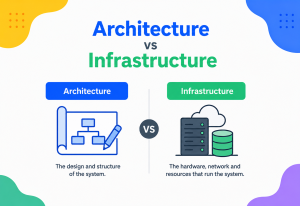
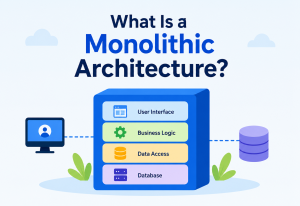
- Higher infrastructure cost than a monolithic design, especially at low-to-medium scale
7.1 Key Trade-off Decisions
| Decision | Option A | Option B | What we chose & why |
|---|---|---|---|
| Fan-out strategy | Always fan-out on write | Always fan-out on read | Hybrid — write-heavy for small/medium communities (fast reads), read-heavy for mega-communities (avoids write amplification) |
| Shard key | user_id | community_id | community_id — keeps all data for one community co-located and isolates hot communities onto dedicated shards |
| Post DB type | Relational (Postgres) | Wide-column (Cassandra/DynamoDB) | Wide-column for posts (huge write volume, simple access patterns); relational for community/membership metadata (needs joins, transactions) |
| Rule evaluation timing | Synchronous, on write path | Fully asynchronous | Synchronous for hard blocks (banned words, bans), async for soft ML-based flags — balances safety with latency |
| Consistency for feed reads | Strong consistency | Eventual consistency | Eventual — a few seconds of feed delay is an acceptable trade for massive read scalability |
- “What would break first if you removed the hybrid threshold and always used fan-out on write?”
- “Justify why you’d accept eventual consistency here but maybe not for, say, a banking ledger.”
Performance & Scalability
8.1 Horizontal Scaling of Stateless Services
The API Gateway, Post Service, Membership Service, Feed Service, and Worker Pool are all designed to be stateless — no service instance holds session data or in-memory state that another instance doesn’t also have access to (all state lives in Redis/DB). This means scaling under load is simply a matter of adding more instances behind the Load Balancer, coordinated by an auto-scaler watching CPU, request latency, or queue depth.
8.2 Read-Heavy Optimization
Communities platforms are overwhelmingly read-heavy — for every post created, there might be thousands of feed reads. This asymmetry drives two major design choices:
- Aggressive caching: feed pages, rendered post summaries, and membership lookups are cached with short TTLs, absorbing the vast majority of read traffic before it ever reaches a database.
- Read replicas: the sharded databases run with multiple read replicas per shard; the application routes reads to replicas and only sends writes to the primary, multiplying read capacity independently of write capacity.
8.3 Handling the “Hot Shard” Problem
What: even with sharding by community_id, a single viral community can still overwhelm its one assigned shard, because sharding distributes communities evenly, not traffic evenly.
Solution: for mega-communities, the system further splits data by time-range or by a secondary hash within that community’s own shard, and leans much more heavily on Redis caching (with the cache absorbing 95%+ of reads) so the underlying shard rarely sees direct query pressure at all.
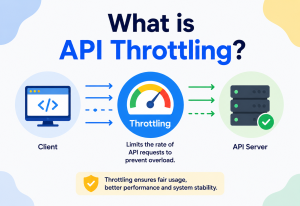
Think of it like assigning checkout lanes at a supermarket by aisle number — fair on average, but if one aisle (say, the milk aisle) suddenly gets ten times more shoppers during a shortage panic, you need extra staff or a separate express lane just for that aisle, not a redesign of the whole store.
8.4 Little’s Law Applied to Feed Generation
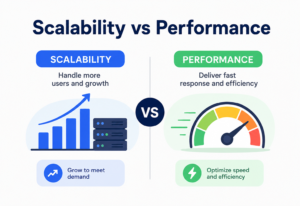
Little’s Law (L = λ × W) tells us that the number of concurrent in-flight requests (L) equals the arrival rate (λ) multiplied by the average time each request takes (W). For the Feed Service, if we expect 50,000 feed requests/sec and each takes 40ms on average, we need capacity for roughly 2,000 concurrent in-flight requests at any instant — this number directly informs how many Feed Service instances and how large a connection pool we provision.
- “How would you detect a hot shard before it causes an outage, rather than after?”
- “Walk me through capacity planning for the Feed Service using expected QPS and latency targets.”
High Availability & Reliability
9.1 Redundancy at Every Layer
- Multi-AZ deployment: every stateless service and the Load Balancer itself run across at least three availability zones, so losing one data center doesn’t take the platform down.
- Database replication: each shard has a primary plus at least two replicas, with automatic failover (e.g., via Patroni for Postgres, or built-in replica promotion for Cassandra/DynamoDB).
- Kafka replication: topics are configured with a replication factor of 3, so a single broker failure doesn’t lose in-flight events.
- Redis Cluster: deployed with replica nodes per shard, so a cache node failure triggers automatic failover instead of a cache-layer outage.
9.2 Graceful Degradation
Not every component failing needs to mean total outage. The system is deliberately designed to degrade gracefully:
| What fails | Degraded behavior |
|---|---|
| Search Service down | Community/post search unavailable, but posting and reading feeds continue normally |
| Notification Service down | Notifications queue up in Kafka and deliver once recovered; no user-facing errors |
| Moderation ML service down | Posts still publish, but all go into a manual review queue as a safety fallback until ML recovers |
| Redis cache layer down | Services fall back to reading directly from the database with higher latency, protected by circuit breakers and request shedding |
9.3 Circuit Breakers & Bulkheads
Every synchronous inter-service call (e.g., Post Service → Rule Engine) is wrapped in a circuit breaker: if the Rule Engine starts timing out repeatedly, the breaker “trips” and fails fast (or falls back to a conservative default like “hold for manual review”) instead of letting every Post Service thread pile up waiting on a dying dependency. Combined with the bulkhead pattern (separate thread/connection pools per downstream dependency), a slow Notification Service can never starve the resources needed to serve fast Post Service requests.
Cross-region backups of all sharded databases run continuously, with a documented Recovery Point Objective (RPO) of under 5 minutes and Recovery Time Objective (RTO) of under 30 minutes for a full regional failover, tested via regular game-day drills.
- “If the Moderation ML service goes down, should posting stop entirely? Why or why not?”
- “How does a circuit breaker in the Rule Engine call actually prevent cascading failure?”
Security Considerations
10.1 Authentication & Authorization
Every request carries a short-lived JWT issued by the Auth Service after OAuth2 login. The API Gateway validates the token’s signature and expiry on every request before it reaches any downstream service — no service trusts a request that hasn’t already passed through the gateway’s checks.
Authorization is layered: the Membership Service answers “is this user a member, with what role,” while community-specific permissions (can this moderator delete posts? can this member invite others?) are evaluated against role-based access control (RBAC) rules stored per community, following the principle of least privilege — a new member starts with the minimum permissions necessary and is only granted more as roles are explicitly assigned.
10.2 Protecting Private & Secret Communities
Communities can be public (anyone can view), private (membership visible, content hidden from non-members), or secret (the community’s existence itself is hidden from search and from non-members). This tiered visibility model must be enforced consistently at every read path — including the Search Service index, which must never leak a secret community’s existence through search results to non-members.
10.3 Data Protection
- Encryption in transit: TLS 1.2+ terminated at the Load Balancer, with internal service-to-service traffic also encrypted via mutual TLS (mTLS) within the service mesh.
- Encryption at rest: database volumes and S3 buckets encrypted using AES-256, with keys managed through a dedicated key management service (e.g., AWS KMS).
- Password/secret hashing: user credentials never touch this system directly (delegated to the Auth Service), which stores password hashes using a slow, salted algorithm like Argon2 or bcrypt — never reversible encryption.
- Compliance: GDPR/CCPA-style data deletion requests must cascade across every shard and cache — a “delete my account” flow triggers an async job that walks Community, Membership, Post, Search, and Cache layers to purge or anonymize personal data within the legally required window.
10.4 Rate Limiting Algorithms
Not all rate limiting is created equal, and the choice of algorithm matters. A naive fixed-window counter (e.g., “max 100 requests per user per minute, resetting on the minute mark”) allows a burst of 200 requests right across a window boundary — 100 in the last second of one window and 100 in the first second of the next. The system instead uses a sliding-window log or token-bucket algorithm at the API Gateway, which smooths this out by tracking a continuously moving time window (or a bucket that refills at a steady rate), giving much more predictable protection against bursty abuse.
A token bucket is like a movie-ticket dispenser that adds one ticket to the tray every second, up to a maximum of ten sitting in the tray at once. You can grab up to ten tickets in a burst if you’ve been away a while, but once the tray is empty you can only take tickets as fast as they’re refilled — smooth and predictable, unlike a strict per-minute reset that creates artificial cliffs.
10.5 Abuse & Attack Surface
| Threat | Mitigation |
|---|---|
| Spam / bot mass-posting | Rate limiting at the API Gateway per-user and per-IP; account-age checks in the Rule Engine; CAPTCHA challenges for suspicious signup patterns |
| Coordinated brigading / raid on a community | Anomaly detection on join-rate spikes; temporary auto-lockdown of posting for newly joined members in a targeted community |
| Credential stuffing on Auth Service | Rate limiting, MFA support, breached-password checks at signup |
| Malicious file uploads (images/attachments) | Virus/malware scanning in the upload pipeline before objects are persisted to S3; strict content-type validation |
| Privilege escalation (member pretending to be moderator) | Server-side role checks on every mutating action — never trust a client-supplied role claim |
- “How do you make sure a secret community never leaks through the Search Service?”
- “Walk me through what happens end-to-end when a user requests full account deletion.”
Monitoring, Logging & Metrics
11.1 The Three Pillars of Observability
Time-series metrics
Prometheus scrapes time-series metrics from every service: request rate, error rate, p50/p95/p99 latency (the “RED” method), plus business metrics like posts-created/sec and fan-out queue depth. Grafana dashboards visualize these in real time.
Structured logs
Structured JSON logs from every service ship to an ELK/OpenSearch stack, tagged with a correlation/trace ID so a single user request can be traced across every service it touched.
Distributed tracing
Distributed tracing (Jaeger/Zipkin, OpenTelemetry-instrumented) shows the full path of a single request — e.g., API Gateway → Post Service → Rule Engine → DB — with per-hop latency, making it obvious exactly where time is being spent.
11.2 Key Alerts
- Fan-out lag exceeding target SLA (e.g., p99 > 10 seconds from post creation to feed visibility)
- Membership cache hit rate dropping below 95% (signals a cache eviction storm or thundering herd)
- Kafka consumer lag growing unbounded on any topic (signals workers can’t keep up)
- Rule Engine p99 latency crossing a threshold (risk of it becoming a bottleneck on the write path)
- Any shard’s CPU/connection pool utilization crossing 80% (early warning of a hot-shard event)
Alerting only on system-level metrics (CPU, memory) and not on business-level metrics (fan-out lag, moderation queue depth) means the on-call engineer often learns about a real user-facing problem from a tweet before the monitoring stack notices it.
- “What’s the single most important metric you’d put on a dashboard for this system, and why?”
- “How would distributed tracing help you debug a report of ‘my post took 30 seconds to appear’?”
Deployment & Cloud Strategy
12.1 Containerization & Orchestration
Every microservice ships as a Docker container and runs on Kubernetes, which handles scheduling, auto-scaling (via Horizontal Pod Autoscaler watching CPU and custom metrics like queue depth), self-healing (restarting crashed pods), and rolling deployments.
12.2 Deployment Strategy: Canary Releases
New versions of the Post Service or Rule Engine are rolled out as a canary: the new version receives a small slice of traffic (e.g., 5%) while metrics are compared against the stable version. Only if error rates and latency stay within acceptable bounds does the rollout proceed to 25%, 50%, then 100%. This is preferred over a full blue-green cutover for high-traffic write-path services, because it limits the blast radius of a bad deploy to a small fraction of users rather than an instant full switch.
12.3 Infrastructure as Code
All infrastructure — Kubernetes clusters, database shards, Kafka topics, Redis clusters, IAM roles — is defined declaratively using Terraform, version-controlled, and applied through a CI/CD pipeline, so environments are reproducible and changes are peer-reviewed before they touch production.
12.4 Multi-Region Considerations
For a truly global platform, communities are often pinned to a “home region” close to their majority of members (reducing write latency for that community), while reads are served from the nearest regional cache/replica. Cross-region replication keeps data eventually consistent globally for disaster recovery, but write authority for a given community typically stays in one region to avoid the complexity of multi-master conflict resolution.
12.5 The CI/CD Pipeline in Practice
- Commit & static analysis: a pull request triggers linting, unit tests, and static security scanning (SAST) before it can even be merged.
- Build & containerize: merging to the main branch builds a versioned Docker image and pushes it to a private container registry.
- Staging deploy & integration tests: the image deploys automatically to a staging Kubernetes cluster where end-to-end integration tests (including simulated fan-out and moderation flows) run against realistic synthetic community data.
- Canary rollout: on approval, the image rolls out to 5% of production traffic; automated checks watch error rate and latency for a fixed soak period.
- Progressive rollout: the deployment automatically progresses to 25%, 50%, then 100% if metrics stay healthy at each stage, or automatically rolls back if any threshold is breached.
This pipeline means a typical change — say, a new rule type added to the Rule Engine — can go from merged code to fully live in production, safely, within roughly an hour, without requiring a human to babysit every stage.
- “Why choose canary over blue-green for the Post Service specifically?”
- “How would you decide which region a new community’s ‘home’ should be?”
- “What automated signal would trigger an automatic rollback mid-canary, and why should that decision not require a human in the loop?”
Databases, Caching & Load Balancing in Depth
13.1 Why Different Databases for Different Data
| Data | Store | Reasoning |
|---|---|---|
| Communities & rules | Sharded PostgreSQL | Relatively low write volume, needs transactional guarantees when settings change, benefits from relational integrity |
| Membership edges | Sharded PostgreSQL or Cassandra | Extremely high read volume, simple key-based access pattern (community_id + user_id), horizontal scale matters more than joins |
| Posts & comments | Cassandra / DynamoDB (wide-column) | Massive write volume, append-heavy, naturally partitioned by community_id + time — wide-column stores excel here |
| Search index | Elasticsearch / OpenSearch | Full-text search and relevance ranking that relational/wide-column stores cannot do efficiently |
| Feed cache | Redis (in-memory) | Sub-millisecond reads required for the highest-QPS path in the system |
| Media / attachments | S3 (object storage) | Large binary blobs should never live inside a transactional database |
13.2 Sharding Strategy in Detail
Each shard is chosen via consistent hashing on community_id, which achieves two things: it distributes communities roughly evenly across shards, and — critically — adding or removing shards only requires remapping a small fraction of communities (rather than a full re-shard of every community), because consistent hashing minimizes key movement.
13.3 Load Balancing Beyond the Edge
Load balancing isn’t only at the client-facing edge. Internally: Kafka partitions distribute event load across consumer instances; database connection pools use least-connections routing to read replicas; and the Redis Cluster uses hash-slot-based routing so that key lookups deterministically land on the right node without a central coordinator on the hot path.
13.4 Replication & Partitioning Depth
Within each shard, data is further replicated for durability and read scaling. Postgres shards use streaming replication with one primary and two or more asynchronous read replicas; Cassandra-backed post storage uses a replication factor of 3 with a tunable consistency level, typically QUORUM for writes (a majority of replicas must acknowledge before a write is considered successful) and ONE for most reads (favoring low latency, since a post being a moment stale for one reader is an acceptable trade). This tunable-per-operation consistency is one of the main reasons wide-column stores are attractive for this workload — the same database can behave more like a CP system for writes and more like an AP system for reads, matching the CAP trade-offs discussed in Section 3.7.
Partitioning within a Cassandra-backed post table typically combines community_id as the partition key with a time-bucketed clustering key (e.g., post_created_at), so that “get recent posts for this community” is a single, efficient partition scan rather than a scatter-gather across the whole cluster.
13.5 Caching Patterns Used
Cache-aside
Used for membership lookups and community metadata — the application checks the cache first, and on a miss reads from the DB and populates the cache.
Write-through
Used for the mega-community shared timeline — writes update both the cache and an async-persisted log simultaneously, ensuring readers never see a gap.
TTL + explicit invalidation
Membership roles use a short TTL as a safety net, combined with explicit cache invalidation the moment a role changes, minimizing stale-permission windows.
- “Why Cassandra for posts but Postgres for community metadata, instead of one database for everything?”
- “Explain consistent hashing and why it matters when you add a new shard.”
- “What cache invalidation strategy would you use for a moderator role change, and why does it matter more than for a regular post edit?”
APIs & Microservice Boundaries
14.1 Representative REST API Surface
POST   /v1/communities                             # create a community
GET    /v1/communities/{id}                        # get community metadata
PATCH  /v1/communities/{id}/rules                  # update rule config (admin only)
POST   /v1/communities/{id}/members                # join a community
DELETE /v1/communities/{id}/members/{userId}       # leave / remove a member
PATCH  /v1/communities/{id}/members/{userId}/role  # promote / demote a member
POST   /v1/communities/{id}/posts                  # create a post
GET    /v1/communities/{id}/feed?cursor=...        # paginated community feed
POST   /v1/posts/{id}/reports                      # report a post to moderators
GET    /v1/moderation/queue?communityId=...        # moderator review queue
14.2 Why Cursor-Based Pagination, Not Offset
The feed endpoint uses cursor-based pagination (an opaque token pointing to “the last item you saw”) rather than offset-based pagination (?page=5). Offset pagination requires the database to count and skip rows, which gets slower as the offset grows and produces duplicate/missing items if new posts arrive while paging — a real problem for a live, fast-moving feed. Cursors avoid both issues entirely.
14.3 Microservice Communication Patterns
| Interaction | Pattern | Why |
|---|---|---|
| Post Service → Rule Engine | Synchronous gRPC | Result is needed immediately to decide whether to accept the write |
| Post Service → Fan-out / Moderation / Search workers | Asynchronous, event-driven (Kafka) | None of these need to block the user’s response |
| Feed Service → Membership Service | Synchronous gRPC, cache-backed | Needed to filter feed content by visibility rules, but must stay fast |
| Client → API Gateway | Synchronous REST/HTTPS (or GraphQL for flexible mobile queries) | Standard client-facing contract, versioned and documented |
gRPC vs REST internally: service-to-service calls inside the system typically use gRPC (binary protocol, strongly typed via protobuf, lower latency and overhead) rather than REST/JSON, since these calls happen at very high volume and internal clients are the services themselves, not third-party developers who benefit from REST’s human-readability.
- “Why gRPC internally but REST at the edge?”
- “What’s wrong with offset pagination for a feed that’s constantly getting new items?”
Design Patterns & Anti-patterns
15.1 Patterns Used
Transactional Outbox
Instead of writing to the DB and separately publishing to Kafka (risking one succeeding without the other), the Post Service writes both the post row and an “outbox” event row in the same DB transaction; a separate relay process reads the outbox and publishes to Kafka, guaranteeing at-least-once delivery without dual-write inconsistency.
Chain of Responsibility
Used in the Rule Engine — each rule check is a link in a chain, and the request passes through until one link denies/holds it or it clears the whole chain.
Circuit Breaker
Wraps every synchronous cross-service call, preventing cascading failure when a downstream dependency degrades.
CQRS
Writes go through the Post Service into the durable Post DB; reads go through the Feed Service against a separately optimized, denormalized cache/read-model — the two paths are deliberately different.
Saga
Used for multi-step flows like “delete community” (must remove members, posts, search index entries, and cached data across several services) — implemented as a sequence of local transactions with compensating actions on failure, since a single distributed transaction across microservices isn’t practical.
Bulkhead
Separate connection/thread pools per downstream dependency so one slow dependency can’t exhaust resources needed by another.
15.2 Anti-patterns to Avoid
✗ Shared DB between services
- Letting the Post Service and Feed Service directly query the same tables creates hidden coupling — a schema change in one silently breaks the other. Each service should own its data and expose it only through its API.
✗ Synchronous fan-out on write
- Blocking the user’s post-creation response on fan-out to millions of feed inboxes ties response latency directly to community size — exactly what we designed the async pipeline to avoid.
✗ One giant “god” rule
- Encoding all moderation logic as one giant if/else block instead of composable rule checks makes the system impossible to extend safely as new rule types are needed.
✗ Dual-write to DB and queue
- Writing to the primary DB and then publishing to Kafka in two separate steps risks either succeeding without the other. The transactional outbox pattern is the correct fix.
- “Explain the transactional outbox pattern and what problem it solves here specifically.”
- “Why is CQRS a natural fit for a feed system?”
Best Practices & Common Mistakes
16.1 Best Practices
✓ Do
- Design the shard key (community_id) in from day one — retrofitting sharding onto an already-large single database is extremely painful.
- Treat moderation as a first-class architectural concern, not an afterthought bolted on after launch.
- Make every synchronous cross-service call fail fast with sane defaults (e.g., default to HOLD_FOR_REVIEW rather than crash if the Rule Engine is unreachable).
- Instrument business metrics (fan-out lag, moderation queue depth), not just infrastructure metrics.
- Version your public APIs from the start, since mobile clients can’t always be force-upgraded immediately.
✗ Don’t
- Assume one fan-out strategy fits every community size.
- Trust client-supplied role or permission claims — always re-verify server-side.
- Use offset pagination for a live, fast-moving feed.
- Dual-write to DB and Kafka without the transactional outbox pattern.
- Alert only on CPU/memory — miss business-level signals like fan-out lag and moderation queue depth.
16.2 Common Mistakes
Applying the same fan-out strategy to a 20-member book club and a 5-million-member public community either wastes resources (over-fanning small groups) or destroys write latency (under-fanning huge ones). Always design for the threshold, and revisit that threshold as usage patterns evolve.
A brand-new community with zero members and zero posts is a legitimate edge case that breaks naive “top posts” ranking logic (divide-by-zero, empty result sets) — always test the empty/small-scale path, not just the mega-community path.
Never let a client tell the server “I’m a moderator” — every permission check must be re-verified server-side against the Membership Service on every request, no exceptions.
- “What edge cases would you specifically test for a brand-new, empty community?”
- “How would you catch a case where a mobile client is silently sending stale permission data?”
Real-World Industry Examples
Facebook Groups
Runs group feeds on infrastructure separate from the main friend-graph News Feed, using its own ranking model per group and an internal rule/permission system that lets group admins configure membership questions, post approval, and topic tags — closely mirroring the Rule Engine concept described in this tutorial.
Subreddits are sharded heavily by subreddit ID; hugely popular subreddits (r/announcements-scale) are known internally to require special-cased caching and ranking infrastructure distinct from the long tail of small subreddits — a real-world instance of the “hot shard” problem.
Discord
Because Discord servers (communities) are real-time chat rather than asynchronous feeds, Discord’s architecture leans on WebSocket gateways and an Elixir/Erlang-based system optimized for millions of concurrent persistent connections rather than the HTTP-request/response model emphasized in this tutorial.
Slack
Workspaces (their unit of “community”) use a channel-sharding model where very large or “hot” workspaces get dedicated infrastructure shards, directly analogous to the community-level sharding strategy covered in Section 13.
LinkedIn Groups
Applies stricter, more conservative moderation defaults than open social platforms, reflecting how the Rule Engine’s configuration (not its architecture) should shift based on the platform’s professional context.
Amazon (retail review communities)
Uses heavy asynchronous, queue-based pipelines (comparable to the Kafka-driven fan-out/moderation pipeline here) to process review submissions through fraud-detection and content-policy checks before they become publicly visible.
- “Why might a chat-first community platform like Discord architecturally diverge from a feed-first one like Reddit?”
- “What real-world evidence suggests the ‘hot community’ problem is genuinely common, not just theoretical?”
Frequently Asked Questions
A single unsharded table works fine until total data volume or query load exceeds what one database server can handle — which happens quickly once you have millions of communities and billions of posts. Sharding by community_id lets you scale horizontally by simply adding more shards, and it isolates a single hot community’s load from affecting everyone else.
Their personal home feed (aggregating across all their communities) is generated via a fan-out-on-read merge across their membership list, using the Feed Service’s ranking model to interleave posts, rather than trying to maintain one giant fanned-out inbox that would need thousands of writes per post from any of their communities.
The moderation queue uses optimistic locking (a version number on the report row) — whichever moderator’s decision commits first wins, and the second moderator’s client is told the item was already handled, avoiding duplicate or conflicting moderation actions.
This is a genuine product/policy decision, not just an engineering one. Many platforms allow “publish-then-review” for speed and only take content down retroactively if flagged, while more sensitive communities use “review-then-publish” (HOLD_FOR_REVIEW) even at the cost of latency. The Rule Engine supports both modes per community.
Rule updates trigger an explicit cache invalidation (not just a TTL wait) published via a lightweight event, so the next read after an update is guaranteed to fetch fresh rules from the source of truth rather than potentially serving stale cached ones for the full TTL window.
Postgres can be scaled a long way with sharding and replicas, but wide-column stores are purpose-built for exactly the access pattern posts need — extremely high write throughput, simple partition-key lookups, and no need for cross-row joins — which typically makes them a better cost/performance fit at very large scale.
Auto-scaling adds Feed Service and Worker Pool instances as request volume and Kafka consumer lag rise; the hybrid fan-out threshold automatically routes the community into read-based fan-out once it crosses the member-count cutoff; and the cache layer absorbs the resulting read spike so the underlying database shard rarely feels the surge directly. Ops teams are also alerted proactively when a single community’s traffic share crosses an anomaly threshold, so a human can watch for hot-shard symptoms before they become an outage.
No — they use the exact same services and data stores. Visibility is enforced as an additional filter at the Membership Service and Search Service layers rather than as separate infrastructure, which keeps the system simpler and avoids duplicating logic across a “public path” and a “private path.”
Load testing simulates the full spectrum from tiny to mega communities using synthetic traffic generators, chaos-engineering drills intentionally kill services (a Kafka broker, a Redis node, a database replica) in staging to confirm graceful degradation actually works as designed, and canary releases (Section 12) provide a final real-traffic safety net before a change reaches every user.
Summary & Key Takeaways
Designing a communities/groups platform is fundamentally an exercise in balancing three tensions: fast writes vs. fast reads, strong consistency vs. massive scale, and flexible per-community rules vs. simple, predictable code paths. The architecture in this tutorial resolves those tensions through async decoupling (Kafka-driven fan-out), smart sharding (by community_id), aggressive caching (Redis-backed membership and feed reads), and a dedicated, composable Rule Engine that keeps moderation policy flexible without bloating the core write path.
Key takeaways
- Use hybrid fan-out — write-heavy for small/medium communities, read-heavy for mega-communities.
- Shard by community_id, not user_id, to isolate hot communities and keep community data co-located.
- Decouple the synchronous write path from async fan-out, moderation, search, and notifications via a message queue.
- Cache membership lookups aggressively — it’s the single most-called operation in the system.
- Treat the Rule Engine as its own composable, pluggable service, not embedded logic.
- Design for graceful degradation — a downed dependency should degrade behavior, not cause a full outage.
- Never trust client-supplied permissions; always re-verify server-side.
- Use cursor-based pagination for any live, fast-moving feed.
- Apply the transactional outbox pattern to guarantee DB writes and event publishes stay consistent.
- Plan for the “hot shard” problem from the start — it is not a rare edge case at scale, it is the norm for the largest communities.
Scale doesn’t just make a system bigger — it changes which trade-offs are correct. A design that’s over-engineered for a 20-member group is exactly right for a 5-million-member one, and vice versa.