What Is a Single Point of Failure (SPOF)?
Some things in life have a backup, and some things do not. A house usually has more than one light switch, but often just one front door lock. This guide explains a simple but powerful idea from engineering — the single point of failure — and why hunting these down is one of the most important habits a careful system builder can have.
The Big Idea, in One Breath
A SPOF is any one part of a system — a bridge, a machine, a person, a wire, a piece of software — that the whole system depends on so heavily that if it breaks, everything connected to it breaks too. Finding these hidden bridges before a storm finds them for you is one of the most valuable skills a system builder can develop.
Imagine a small wooden bridge connecting a village to the only road leading out of town. Every single delivery truck, every doctor rushing to an emergency, every child heading to school on the other side — all of it depends on that one bridge. Now imagine a storm knocks that bridge down. Suddenly, the entire village is cut off from everything, not because anything else went wrong, but because one single piece, doing one single job, stopped working.
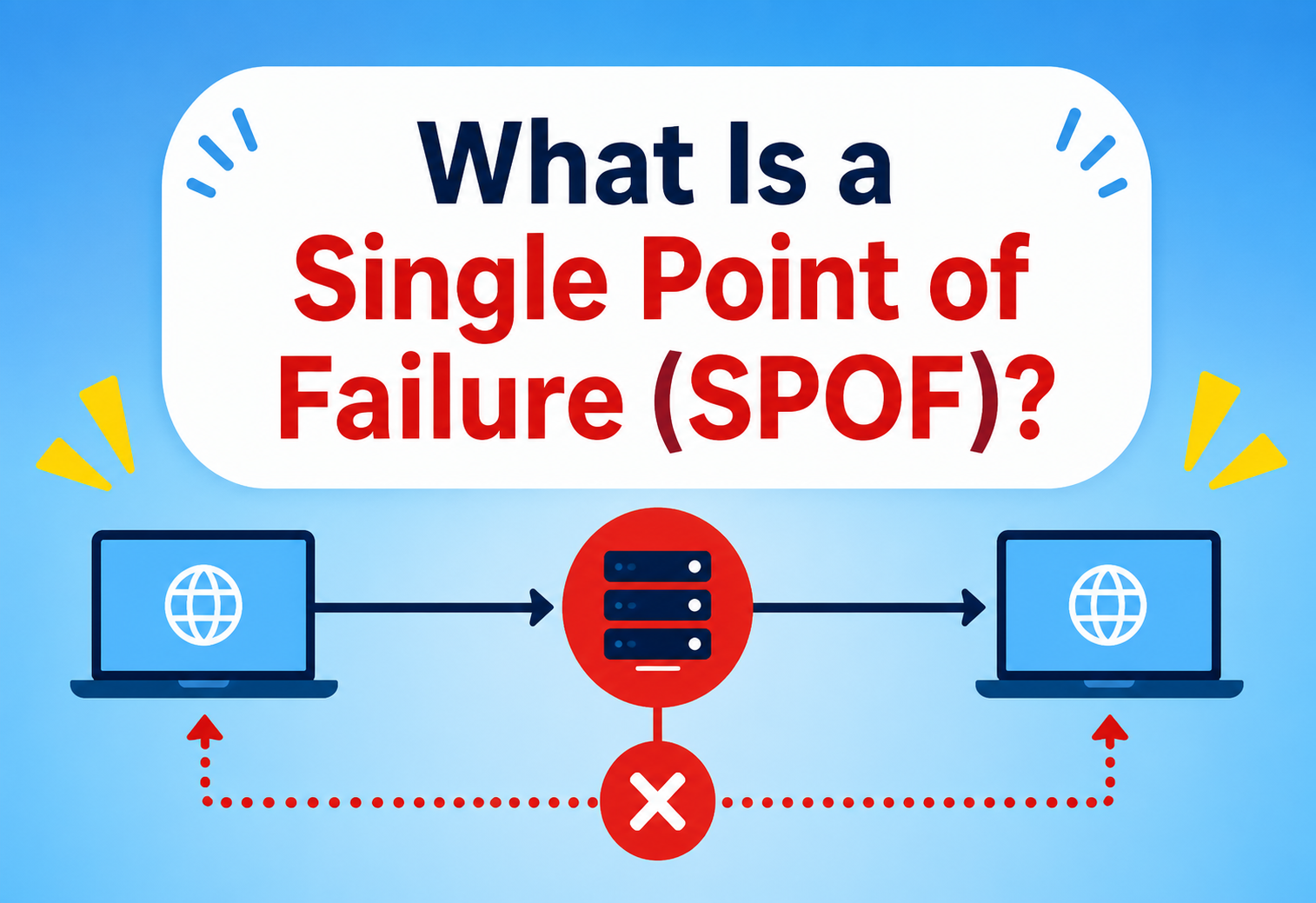
That bridge is a perfect example of what engineers call a single point of failure, often shortened to SPOF. It is any one part of a system — a bridge, a machine, a person, a wire, a piece of software — that the whole system depends on so heavily that if it breaks, everything connected to it breaks too. The scary part is not that the bridge collapsed. Storms happen. The scary part is that nobody had built a second way across, so one failure became everyone’s failure.
Computer systems have bridges like this everywhere, hiding in plain sight. A single server that every request must pass through. A single database holding every customer’s information. A single person who is the only one who knows how to fix a critical piece of software. Finding these hidden bridges, before a storm finds them for you, is one of the most valuable skills a system builder can develop.
The good news is that once you know what to look for, single points of failure stop being invisible. They start showing up everywhere — sometimes in obvious, glaring places, and sometimes tucked away in a quiet corner nobody had thought to question in years. This guide is designed to sharpen exactly that instinct: the habit of looking at any system, large or small, and asking the one question that matters most — “what is the one thing this whole thing secretly depends on?”
Think about a four‑legged table. If one leg wobbles or even breaks off entirely, the table can often still stand, a little unsteady, on the remaining three. Now imagine a table balanced on just one leg in the middle. The moment that single leg fails, the whole table crashes down, along with everything sitting on top of it. A single point of failure is exactly like that one‑legged table — everything rests on a single point that was never given a backup.
What makes this idea so worth understanding properly is how sneaky it can be. Nobody sets out to build a fragile system on purpose. Single points of failure almost always sneak in quietly, one reasonable decision at a time, until one day a system that felt perfectly solid turns out to have been standing on exactly one leg the whole time. This guide walks through how to recognise that one leg before it gives way, not after.

What a SPOF Really Is
A single point of failure is any single part of a system whose failure would cause the entire system, or a critical part of it, to stop working. Its defining feature is consequence, not probability.
A single point of failure is any single part of a system whose failure would cause the entire system, or a critical part of it, to stop working. It does not matter whether that part is a piece of hardware, a line of software, a network cable, or even a person — if there is no backup, no alternative path, and no way for the rest of the system to keep going without it, it qualifies as a SPOF.
The key word here is “single.” A system can have plenty of parts, plenty of complexity, plenty of moving pieces — and still have exactly one spot where everything quietly funnels through, unprotected. That one spot is what makes it dangerous. It only takes one bad day, one broken cable, one crashed server, for the entire system to come to a halt.
It helps to picture a busy household relying on one single water pipe coming into the house. The kitchen sink, the bathroom shower, the washing machine, the garden hose — every single one of these depends entirely on that one pipe working. The house might have several taps, several rooms, several appliances, giving the impression of a rich, varied system. But if that one incoming pipe bursts, none of it matters — every tap in the house runs dry at exactly the same moment. That is the essence of a SPOF: complexity on the surface, but a single, shared vulnerability hiding underneath it all.
If someone asks “is this a SPOF?”, they are really asking: “if this one thing broke right now, would everything relying on it break too, with no backup to catch the fall?”
It is worth being clear that a SPOF is not defined by how likely it is to fail — it is defined by what happens if it does. A part of a system might be extremely reliable, rarely ever breaking down, and still count as a genuine SPOF, because the definition is entirely about consequence, not probability. This distinction matters a great deal, because it is tempting to dismiss a SPOF by saying “but that almost never breaks” — which misses the point entirely. The question was never how often it breaks. It is what happens on the day it finally does.
A Short History: An Idea Older Than Computers
Bridge builders, shipbuilders and aircraft engineers have worried about single points of failure for well over a century. The lesson has been learned, relearned, and re‑taught generation after generation, precisely because it is such an easy trap to fall into.
The idea of a single point of failure did not originate in computing at all — engineers building bridges, buildings, ships, and aircraft have worried about it for well over a century. A famous, sobering example is the story of ships once considered “unsinkable,” designed with watertight compartments meant to keep them afloat even after damage — until a single, catastrophic failure proved that even carefully engineered redundancy has its limits if not applied thoroughly enough.
As computer systems grew from single, standalone machines into enormous networks connecting millions of devices, the same hard‑earned lessons from physical engineering carried over directly. Early computer networks often had exactly one central machine that everything depended on, and outages caused by that one machine failing taught the earliest generations of computer engineers the same lesson bridge builders and shipbuilders had already learned the hard way: never let the survival of the whole depend entirely on one single part.
Today, avoiding single points of failure is considered such a fundamental part of good engineering that it is taught early in most technical education, discussed in almost every serious system design conversation, and treated as one of the first questions worth asking about any new system: “if this one part broke, what would happen to everything else?”
It is a genuinely humbling piece of history to reflect on: some of the most confident, well‑funded engineering projects in human history have been humbled by exactly this mistake — trusting too much in one part, however well‑built, without a genuine backup waiting behind it. The lesson has been learned, relearned, and re‑taught across bridges, ships, aircraft, power grids, and computer networks, generation after generation, precisely because it is such an easy trap to fall into, even for extremely capable, careful engineers.
Why SPOFs Happen at All
SPOFs almost always creep in gradually, one reasonable decision at a time. The longer they survive without causing a problem, the safer they start to feel — which is exactly backwards.
Given how well‑known this problem is, it is fair to wonder why single points of failure still show up so often in real systems, even ones built by experienced, capable teams. The honest answer is that they rarely appear because of carelessness — they usually creep in gradually, for perfectly understandable reasons, often as the unintended side effect of otherwise sensible decisions made along the way.
One server was enough, at first
Early on, a system might genuinely only need one machine, and building in redundancy for a handful of users would not make sense yet.
Backups cost real money
Building a proper backup for every single part of a system takes extra time, extra equipment, and extra ongoing expense.
Shipping fast, fixing later
Teams racing to launch a product often accept a known weak point temporarily, planning to strengthen it “once things settle down.”
Nobody drew the full picture
As a system grows over years, it is easy for a small, once‑harmless dependency to quietly become something the whole system now leans on heavily.
Each of these reasons, taken on its own, is entirely reasonable in the moment it is made. The trouble is that none of these decisions ever come with a built‑in reminder to revisit them later, once circumstances have changed. A choice that made complete sense for a five‑person team with a hundred users can quietly become a serious liability for a fifty‑person team with a hundred thousand users, without anyone ever consciously deciding that the trade‑off should change.
None of these reasons are unreasonable on their own. The real danger is not that a SPOF exists temporarily — it is that it gets forgotten, left unaddressed long after the system has grown large enough, or important enough, that its failure would now cause real, serious harm.
There is a subtle psychological trap at play here too. The longer a SPOF exists without causing a problem, the safer it starts to feel — which is exactly backwards. Every day a fragile, unprotected single point of failure survives without breaking is not proof that it is safe; it is simply proof that its number has not come up yet. This false sense of security is often what allows a known, once‑flagged weak point to quietly slip off everyone’s radar entirely, right up until the day it finally, predictably, fails.

Different Kinds of SPOFs
Six flavours — hardware, software, network, power, data, and human — each hiding in a slightly different place, and often tangled together in real systems.
Single points of failure are not limited to just one category — they can hide almost anywhere in a system, wearing many different disguises. Recognising the different flavours makes them far easier to spot, since each one tends to hide in a slightly different place and gets discovered through a slightly different question.
One physical machine
A single server, hard drive, or piece of networking equipment that everything else depends on.
One piece of code
A single application or service that every other part of the system relies on to function.
One connection or cable
A single internet connection, cable, or router that, if it fails, cuts off communication entirely.
One electrical source
A single power supply or connection to the electrical grid, with no backup generator or battery.
One copy of information
A single, un‑backed‑up copy of important information that would be lost forever if that one copy were damaged.
One irreplaceable person
A single team member who is the only one who understands how a critical system actually works.
It is worth noticing that these categories often overlap in practice. A single server is not just a hardware SPOF — it might also be running a piece of software nobody else knows how to configure, making it simultaneously a hardware SPOF and a human SPOF at the same time. Real‑world SPOFs are rarely as neatly categorised as a tidy list might suggest; they are usually a tangled combination of several of these types layered on top of one another.
Why the Cost of a SPOF Failing Can Be So High
The cost of a SPOF rarely stops at “the system was down for a while” — it ripples outward into lost revenue, lost trust, emergency costs, and knock‑on effects on systems nobody realised were connected.
It is easy to underestimate just how expensive a single point of failure can become the moment it actually breaks. The cost rarely stops at “the system was down for a while” — it tends to ripple outward in ways that are easy to overlook when the system is running smoothly, touching areas of a business that might not seem obviously connected to a single failed server or process at first glance.
No sales while it is down
An online store, bank, or booking service earns nothing while its critical systems are offline.
People remember outages
Customers who experience a serious outage often think twice before relying on that service again.
Panic is expensive
Fixing a problem under pressure, often at odd hours, tends to cost far more than fixing it calmly, ahead of time.
Other systems depend on it too
A single failed component can quietly take down several other systems that depended on it without anyone fully realising beforehand.
This is exactly why experienced architects treat identifying and fixing SPOFs as a genuine investment, not an optional nicety. The cost of building in redundancy ahead of time is almost always smaller than the total cost of a serious, unplanned outage — it is simply a cost that is easier to postpone, right up until the moment postponing it is no longer an option.
There is also a quieter, longer‑lasting cost that is easy to overlook: the toll a serious outage takes on the people responsible for fixing it. Teams that experience a major, preventable failure caused by a known but ignored SPOF often carry that stress for a long time afterward, and it can quietly damage morale and trust within a team, well beyond the technical cost of the outage itself.
How to Find a Hidden SPOF
Four techniques that surface hidden SPOFs — from mapping the whole system, to asking “what if this broke?” of every piece, to testing failures on purpose, to asking the team, not just the diagram.
Some single points of failure are obvious the moment you look for them. Others hide quietly for years, only revealing themselves the day they finally break. A few techniques help surface the hidden ones before that happens, and combining several of them tends to work far better than relying on just one.
Draw the whole system
Map out every major component and how they connect — a SPOF is often obvious once the full picture exists on paper.
Ask “what if this broke?” of every piece
Go through each component one at a time and honestly imagine it failing completely, right now.
Test failures on purpose
In a safe environment, deliberately switch off a component and observe whether the rest of the system truly keeps working.
Ask the team, not just the diagram
Sometimes a SPOF is a person, a habit, or a piece of undocumented knowledge that never shows up on any technical diagram at all.
Assuming something has a backup just because it seems important enough that surely someone built one. Many serious SPOFs are discovered only because someone finally asked, out loud, “wait — does this actually have a backup?”
A particularly useful habit is walking through a system the way a curious newcomer would, rather than the way someone deeply familiar with it does. Long‑time team members often stop consciously noticing a fragile dependency simply because they have worked around it comfortably for so long. A fresh set of eyes, asking simple, honest questions without any assumptions, often spots a SPOF that everyone else had quietly learned to live with.
A Simple Self‑Check Worth Running
| Question | If the Answer Is “No” |
|---|---|
| Does this component have a tested backup? | You likely have a SPOF worth addressing |
| Could someone else step in if the responsible person were unavailable? | You likely have a human SPOF |
| Is this documented somewhere other than one person’s memory? | Critical knowledge is at risk of disappearing |
| Has the backup actually been tested recently? | The backup may exist only in theory |
Running through a short checklist like this one regularly, rather than only during a formal review once a year, tends to catch new SPOFs while they are still small and easy to fix, rather than after they have quietly grown into something much harder to unwind.
It is worth pointing out that this kind of check works just as well applied to a personal project as it does to a massive company. Even a single person managing their own small website or hobby project benefits from occasionally asking these same four questions, because the underlying risk — everything depending on one fragile thing — does not care how big or small the system happens to be.
Deliberately Breaking Things on Purpose
Chaos engineering is the mischievous‑sounding practice of deliberately causing failures in a controlled way, just to see what actually happens — often the most honest test of whether a redundancy plan truly works.
Some of the most SPOF‑resistant systems in the world are tested using a surprising, almost mischievous‑sounding technique: deliberately causing failures on purpose, in a controlled way, just to see what actually happens. This practice is often called chaos engineering, and it exists specifically to answer the question “are we really as protected as we think we are?” with real evidence, rather than hopeful assumption.
The idea might sound reckless at first, but it is actually the opposite — a carefully planned, safety‑conscious way of finding hidden SPOFs before they get found by accident, during a real emergency, at the worst possible time. A team might randomly switch off a server in the middle of a normal business day, specifically to confirm that everything else genuinely keeps working, rather than simply hoping it would.
It is a bit like a fire drill that does not just involve walking calmly to the nearest exit, but actually locking one of the usual exits shut beforehand, just to see whether people genuinely know an alternative route. It feels uncomfortable to arrange, but it reveals the truth about a building’s safety far more honestly than simply assuming the backup exit would work if it were ever needed.
Teams that practise this kind of deliberate testing regularly tend to develop a much more accurate, evidence‑based sense of where their real weak points are, rather than relying on outdated assumptions or an untested diagram that looks reassuring on paper but has never actually been put through its paces.

SPOFs in Real Life
One data centre, one cable, one expert, one supplier — each has caused well‑documented outages across industries. The lesson is always the same: it was never one dramatic disaster, it was the complete absence of a backup plan for that one critical, overlooked piece.
Single points of failure are not a rare, theoretical concern — they have caused real, well‑documented outages and disruptions across nearly every industry, from small local businesses all the way up to massive, global organisations.
A whole service goes dark
A company running everything from a single physical location can lose its entire service if that one building loses power or connectivity.
A country loses connectivity
Undersea internet cables occasionally get damaged, and if too few alternate routes exist, entire regions can lose access at once.
Nobody else knows how it works
A critical, ageing piece of software becomes a serious risk once the one engineer who understands it moves on or retires.
A missing part halts production
A factory relying on a single supplier for one essential component can grind to a halt if that supplier suddenly cannot deliver.
What connects every one of these examples is the same simple, unglamorous lesson: it was never one dramatic disaster that caused the real damage — it was the complete absence of a backup plan for that one critical, overlooked piece.
A Familiar Scenario: The Forgotten Backup Generator
Picture a small business running its own servers in a back office, proudly pointing out that they have a backup generator in case the power ever goes out. One ordinary afternoon, the power does go out — and the generator, which nobody had actually tested in over a year, refuses to start. It turns out its fuel had slowly evaporated, and nobody had noticed because nobody had ever needed it before. The backup existed on paper, and even physically sat in the building, but because it was never tested, it was not really a backup at all — just a comforting illusion of one. This is one of the most common, and most avoidable, SPOF stories in the real world: a redundancy plan that exists, but was never actually verified to work.
Stories like this one repeat themselves constantly, across industries and company sizes, precisely because the mistake is so easy to make and so hard to notice from the inside. A backup that looks fine on an inventory list, a diagram, or a checklist feels reassuring — right up until the moment it is actually called upon, which is exactly the wrong time to discover it does not work.
A SPOF is not the failure itself. It is the missing backup that turns a small failure into a big one.
Eliminating SPOFs with Redundancy
Redundancy — deliberately building extra, duplicate capacity so that no single failure can take everything down — is the direct, practical answer to the whole problem. But not all redundancy is created equal.
The main tool engineers use to fight single points of failure is called redundancy — deliberately building extra, duplicate capacity so that no single failure can take everything down at once. It is the direct, practical answer to the entire problem this guide has been building toward.
Never just one
Spreading work across several servers means losing one still leaves the others running.
An automatic backup
A standby system that automatically takes over the instant the main one fails, often within seconds.
More than one copy
Keeping duplicate copies of important information in separate, independent locations.
More than one expert
Making sure critical knowledge lives in more than one person’s head, not locked away with a single team member.
Redundancy does not have to mean simply duplicating everything blindly — thoughtful redundancy targets the specific weak points that matter most, rather than spending equal effort protecting every part of a system regardless of how critical it actually is.
Different Flavours of Redundancy
Not all redundancy looks the same. Sometimes a backup sits completely idle, waiting silently until it is needed — useful, but slower to kick in and easy to forget about, as the generator story showed. Other times, a backup is active, quietly sharing the workload alongside the main system at all times, so switching over in an emergency is instant, because it was already doing part of the job. Active redundancy tends to be more reliable in practice, precisely because it is exercised constantly rather than left to sit untested until the one day it is suddenly needed.
There is also a difference between redundancy within one location and redundancy spread across several separate locations. Two servers sitting in the very same room still share a single point of failure — the room itself, its power supply, its cooling system. True, thorough redundancy usually spreads backups across genuinely independent locations, so that even a disaster affecting one entire location does not take everything down at once.
SPOFs and Cascading Failures
Sometimes the real danger is not the SPOF failing on its own, but the chain reaction that follows. If the surviving parts cannot handle the extra load, one small failure quickly becomes a system‑wide outage.
Sometimes the real danger of a single point of failure is not that it fails on its own — it is what happens next. A cascading failure occurs when one failure puts extra pressure on the remaining, healthy parts of a system, causing them to fail too, one after another, like a row of dominoes falling. Understanding this connection helps explain why SPOFs are worth taking seriously even in systems that already have some redundancy in place.
Imagine three servers sharing a workload evenly. If one fails and there is no proper redundancy plan, the other two suddenly have to absorb its share of the work too. If they were not built with enough spare capacity to handle that extra load, they can become overwhelmed and fail as well — turning what started as a single, contained failure into a much larger, system‑wide outage.
Assuming that simply having “more than one” of something automatically means it is safe. If the remaining parts cannot realistically handle the full workload alone, a SPOF has not really been eliminated — it has just been given a slightly longer fuse.
This is why thoughtful redundancy planning always asks a second question, right after “is there a backup?” — namely, “can that backup actually handle the full load alone, for as long as necessary?” A backup that exists but cannot cope with real pressure offers only the illusion of safety, which can be more dangerous than having no backup at all, since it breeds false confidence right up until the moment it is tested for real.
Understanding cascading failures also explains why some of the most severe outages in history did not come from one single, catastrophic event, but from a small, initial failure that the rest of the system simply was not prepared to absorb. The original SPOF is often almost forgettable in hindsight; it is the chain reaction that followed it that people remember. This is exactly why fixing a SPOF properly means asking not just “what backs this up?” but “can everything downstream actually survive this failure too?”

The Honest Trade‑Offs
Redundancy is not free. A thoughtful architect weighs how likely a component is to fail against how bad it would be if it did — rather than treating “more backups everywhere” as an automatic win.
Eliminating every single SPOF sounds like an obviously good idea, but redundancy is not free, and a thoughtful architect has to weigh the costs honestly, rather than treating “more backups everywhere” as an automatic win.
Benefits of Removing SPOFs
- The system keeps working even when one part fails
- Fewer sudden, dramatic outages
- Greater trust from the people relying on the system
Costs of Doing So
- Extra hardware, software, and people cost real money
- More moving parts to build, test, and maintain
- Diminishing returns for very low‑risk components
Not every SPOF is worth fixing immediately. A rarely used, low‑stakes tool failing for an afternoon is a very different problem from a payment system failing for an afternoon. Deciding where to invest in redundancy is really a question of priorities, not a blanket rule to apply everywhere equally.
A helpful way to think about this trade‑off is to weigh two things against each other: how likely a component is to fail, and how bad it would be if it did. A component that is very unlikely to fail but would be catastrophic if it did might still deserve serious investment in redundancy, simply because the consequences are so severe. A component that fails somewhat often but barely matters when it does might reasonably be left alone. This kind of honest, deliberate weighing — rather than an instinctive “just fix everything” or an equally instinctive “it is probably fine” — is what separates thoughtful risk management from either wasteful overengineering or reckless neglect.
SPOFs Beyond Technology
Single points of failure show up just as often in teams, processes, and organisations — and human SPOFs are often more dangerous than technical ones, precisely because they are harder to spot.
It is worth remembering that single points of failure are not only a technical problem — they show up just as often in teams, processes, and organisations, often causing just as much disruption as a failed server, even though nobody would ever describe them using technical language.
- The only person who knows the password to an important account, with no documented, secure way for anyone else to access it if needed.
- A process that only works because one manager remembers to do it, with no written instructions for anyone else to follow.
- A single supplier or vendor a whole business depends on, with no backup relationship in place if something goes wrong.
- One decision‑maker who must personally approve every single choice, creating a bottleneck the moment they are unavailable.
These human and organisational SPOFs are often more dangerous than technical ones, precisely because they are harder to spot. A server failing shows up immediately on a dashboard. A key person quietly becoming irreplaceable can go unnoticed for years, right up until the day they leave.
Think of a family where only one parent knows how to cook a particular traditional recipe, never having written it down or taught anyone else. The knowledge works perfectly well for years — right up until that one person is unavailable, and suddenly a piece of the family’s shared life is at genuine risk of disappearing entirely. Organisations lose exactly this kind of “recipe” all the time, simply because nobody thought to write it down while there was still time.
How Different Industries Take This Seriously
Aviation, banking, healthcare, and cloud computing have all built entire cultures around eliminating SPOFs — and the underlying discipline scales up or down to organisations of any size.
Some industries have built entire cultures around eliminating single points of failure, often because the consequences of getting it wrong are severe enough that there is simply no room for a casual attitude.
Redundancy in the sky
Aircraft are built with multiple engines, multiple independent systems for critical functions, and thoroughly trained backup crew, precisely because a single failure at altitude can be catastrophic.
Money that must always move
Financial systems are built with extensive redundancy across data centres and processing systems, since even brief downtime can affect enormous numbers of transactions.
Lives depend on it
Hospitals maintain backup power, backup staff schedules, and backup medical equipment, because a single point of failure in this setting can directly threaten patient safety.
Redundancy as a product
Major cloud providers build entire regions and data centres specifically so that customers can spread their own systems across multiple independent locations.
What these industries share is not a special technical trick unavailable to everyone else — it is simply a deeply ingrained cultural habit of treating “what if this one thing fails?” as a question worth asking about absolutely everything, all the time, rather than an occasional afterthought. That habit, more than any specific tool or technology, is really the heart of good SPOF management.
It is worth noting that smaller organisations do not need to match the scale of these industries to borrow their mindset. A small clinic can still keep backup records. A small online shop can still spread its data across more than one backup location. The specific techniques scale up or down with the size of the organisation, but the underlying discipline — never letting one single thing become too important to fail — applies just as usefully at any size.
Signs Your System Might Have a Hidden SPOF
Four warning signs that tend to show up together when a serious, unaddressed SPOF is quietly lurking — from “one person’s vacation causes anxiety” to “a backup exists but has never actually been tested.”
A handful of warning signs tend to show up together when a serious, unaddressed single point of failure is quietly lurking somewhere in a system or team.
- One person’s vacation causes genuine anxiety, because critical knowledge or access lives only with them.
- Nobody can confidently answer “what happens if this breaks?” for a component that clearly matters a great deal.
- A backup exists but has never actually been tested, the same way the forgotten generator sat untested until the day it was needed.
- A small, ageing piece of infrastructure is quietly holding up something much bigger, discovered only when someone traces a dependency all the way back.
None of these signs guarantee disaster is imminent, but together, they are a strong invitation to take a closer, more deliberate look — ideally before, rather than after, that hidden weak point finally gets tested by reality.
It is worth treating these signs as a normal, healthy part of running any growing system, rather than as an embarrassing admission that something was done wrong. Every system, no matter how carefully built, accumulates a few of these signs over time simply through ordinary growth and change. Spotting them is not a failure of earlier planning — it is success, catching a risk while there is still time to do something calm and deliberate about it.
Best Practices for Managing SPOFs
Seven habits from teams that manage SPOFs well — from mapping systems regularly to reviewing new projects for SPOFs before launch, not after.
Teams that manage single points of failure well tend to follow a consistent set of habits, built up over time through hard‑earned experience rather than luck.
- Map your system regularly. A clear, up‑to‑date diagram makes single points of failure far easier to spot.
- Rank SPOFs by actual impact. Fix the ones that would cause real harm first, not just the ones that are easiest to fix.
- Test failures on purpose, safely. Confirm redundancy actually works before you are forced to find out during a real emergency.
- Document critical knowledge. Do not let understanding of an important system live in only one person’s head.
- Revisit old assumptions. A part of the system that was “fine to leave as one” a year ago might not be fine anymore.
- Treat a “known and accepted” SPOF differently from an unknown one. A conscious, documented decision to accept a risk is very different from an accidental blind spot nobody ever noticed.
- Review new projects for SPOFs before launch, not after. It is almost always cheaper and calmer to design redundancy in from the start than to retrofit it later under pressure.
Good SPOF management is a bit like a household fire drill. Nobody expects a fire, and most households never experience one — but the households that practise an escape plan ahead of time handle a real emergency far better than those who simply hope it never happens. Testing redundancy before it is needed is exactly that same fire drill, applied to systems and teams instead of homes.
Common Myths Worth Clearing Up
Five myths that come up again and again — from “expensive equipment cannot be a SPOF” to “small teams do not need to worry.” Clearing them up early helps avoid both dangerous overconfidence and unnecessary panic.
A handful of misunderstandings about single points of failure come up again and again, even among experienced teams. Clearing them up early helps avoid both dangerous overconfidence and unnecessary, wasted panic.
Myth: Expensive, high‑quality equipment cannot be a SPOF
Not true. As covered earlier, whether something counts as a SPOF has nothing to do with how reliable or expensive it is — it is entirely about whether there is a backup. Even the most reliable, premium equipment eventually fails, and expensive does not automatically mean redundant.
Myth: Having a backup automatically means you are safe
Not true, as the untested backup generator story showed. A backup that is never been tested is really just an assumption dressed up as a plan, and assumptions have a way of quietly failing exactly when they are needed most.
Myth: SPOFs are always big, obvious, dramatic things
Not true. Many of the most damaging SPOFs are small, boring, easy‑to‑overlook details — a single expired certificate, one forgotten configuration setting, one small script that only one person understands.
Myth: Once you fix a SPOF, it is fixed forever
Not true. Systems change constantly. A redundant setup built carefully years ago can quietly drift back into being a SPOF as new dependencies get added around it without anyone updating the original protection.
Myth: Small teams and small companies do not need to worry about SPOFs
Not true. A small team may have fewer resources to build extensive redundancy, but that makes identifying and prioritising their most critical SPOFs even more important, not less — a small team can least afford a single failure taking down everything they have built.
Questions People Often Ask
Nine honest answers to the questions that come up most often about SPOFs — from “can a system ever be completely free of them?” to “how do I convince a team to invest in fixing one?”.
A few questions about single points of failure come up again and again, whether in a technical planning meeting or a casual conversation about risk. Here are clear, honest answers to the most common ones.
Can a system ever be completely free of SPOFs?
In practice, almost never entirely. Even the most carefully designed systems usually have some deeply buried dependency shared by everything else. The realistic goal is eliminating the SPOFs that matter most, not achieving a mathematically perfect zero.
Is having a SPOF always a mistake?
Not necessarily. For a small, low‑stakes system, accepting a known SPOF can be a perfectly reasonable, deliberate trade‑off, as long as it is a conscious choice rather than an accidental oversight.
How do I know if something is a “real” SPOF?
Ask honestly: if this one thing failed right now, would something important actually stop working, with no automatic backup to catch it? If yes, it is a genuine SPOF worth taking seriously.
Are people really considered SPOFs?
Yes — a person holding unique, undocumented knowledge that a whole team depends on is one of the most common, and most overlooked, kinds of single point of failure.
What’s the difference between a SPOF and a bottleneck?
A bottleneck is a part of a system that slows everything down without necessarily stopping it entirely — like one narrow lane on an otherwise wide highway. A SPOF, by contrast, does not just slow things down when it fails; it stops them completely. A component can sometimes be both at once, but they are technically different problems with different fixes.
Does removing every SPOF guarantee a system will never fail?
No. Eliminating single points of failure greatly reduces the chance that one failure brings down the whole system, but it cannot prevent every possible problem, especially rare situations where multiple things fail at the same time.
How do I convince a team or company to invest in fixing a SPOF?
The most effective approach is usually translating the risk into concrete terms: what would actually happen, and what would it cost, if this specific thing failed on a specific busy day? A clear, honest picture of realistic consequences is often far more persuasive than a general, abstract warning.
Is redundancy the only way to deal with a SPOF?
It is the most common approach, but not the only one. Sometimes a SPOF can be avoided entirely by redesigning a process so it simply does not depend on one single thing in the first place, rather than adding a backup to something that could have been unnecessary altogether.
Should every business aim for zero SPOFs?
Not necessarily. The right target depends on what a business can afford, how much risk it is genuinely willing to accept, and how severe the consequences of failure would actually be. A thoughtful, deliberate acceptance of some risk is very different from an accidental, unnoticed one.

Words Worth Knowing
A short glossary gathering the key terms from this guide — SPOF, redundancy, failover, bottleneck, active redundancy, blast radius, cascading failure, and fault tolerance.
A short glossary gathering the key terms from this guide, worth a quick glance any time one of these words comes up again.
Single point of failure
Any one part of a system whose failure would bring down everything depending on it.
Built‑in backup
Deliberately duplicated capacity so a single failure does not take the whole system down.
Automatic switch‑over
A backup system automatically taking over the moment the main one fails.
A narrow squeeze point
A single part of a system that everything else must pass through, often related to but not identical to a SPOF.
A backup already working
A duplicate system sharing the workload at all times, ready to take over instantly if needed.
How far damage spreads
How much of a system is affected when one particular part of it fails.
Falling dominoes
A chain reaction where one failure overwhelms and breaks other, previously healthy parts of a system.
Shrugging off failure
A system’s overall ability to keep working properly even when one or more of its parts have failed.
A Day in the Life of a SPOF Being Discovered
Five predictable stages of how a SPOF actually gets found — from “everything works fine for years” through “someone asks an inconvenient question” to “the fix gets tested too.” The best SPOF stories are the boring ones.
To bring everything together, it helps to walk through a realistic story of how a single point of failure often gets found — sometimes by careful planning, sometimes by accident.
Everything works fine, for years
A system quietly runs on one particular server, one particular process, one particular expert — and nothing ever goes wrong, so nobody thinks twice about it.
Someone asks an inconvenient question
During a routine review, someone finally asks, “what would happen if this one thing broke right now?” — and the room goes quiet.
A test reveals the truth
A safe, deliberate test confirms the uncomfortable answer: yes, everything really would stop, and no, there was never a real backup in place.
A decision gets made
The team weighs the cost of fixing it against the cost of leaving it, and — because the potential impact is serious — decides redundancy is worth building.
The fix gets tested too
Once the backup is built, it gets deliberately tested as well, so it does not quietly become another forgotten, untested generator.
Notice that nothing dramatic actually broke in this story — that is precisely the point. The best SPOF stories are the boring ones, where a weak point gets found and fixed calmly, ahead of time, rather than the dramatic ones where everyone finds out the hard way, during an outage that could have been avoided.
This same simple cycle — notice, question, test, decide, verify — plays out at every scale, from a single small business checking its one office server to a global company reviewing infrastructure spanning entire continents. The size of the system changes; the underlying habit of curiosity and honest testing stays exactly the same.
Key Takeaways
Whenever something important rests entirely on one single, unprotected point, that point deserves a second, honest look. The best time to find a SPOF is calmly, on an ordinary afternoon, long before it ever has the chance to find you.
We began with a village bridge and a wobbly one‑legged table, and ended up walking through failover systems, untested generators, and the quiet, human habit of noticing a weak point only after asking an inconvenient question out loud. Underneath all of it sits one simple, enduring idea: whenever something important rests entirely on one single, unprotected point, that point deserves a second, honest look — not because failure is guaranteed, but because when it eventually happens, as it eventually does, everything resting on that one point falls with it. The best time to find a single point of failure is calmly, on an ordinary afternoon, long before it ever has the chance to find you.
Remember This
- A single point of failure is any one part of a system whose failure would bring down everything relying on it.
- SPOFs can be hardware, software, network, power, data, or even a single irreplaceable person.
- They usually appear gradually, for understandable reasons, not through carelessness.
- Redundancy — building deliberate backups — is the main tool for eliminating them.
- Not every SPOF needs fixing immediately; the ones with the most real‑world impact deserve priority.
- Finding hidden SPOFs takes active effort — mapping systems, testing failures, and asking honest questions.
At its heart, the single point of failure is one of those quietly disciplined ideas that shows up wherever careful people build something meant to last. From bridge builders and shipbuilders of centuries past, through the earliest computer networks with one central machine that everything depended on, to today’s cloud‑spanning services running across independent regions on different continents, the underlying insight never really changes: whenever the survival of the whole rests on one single, unprotected part, sooner or later that part will teach the whole system a very expensive lesson. Systems built with the habit of catching that lesson early — before an outage delivers it loudly — tend to be the ones that quietly earn the trust of everyone relying on them, day after day, without ever making the news.