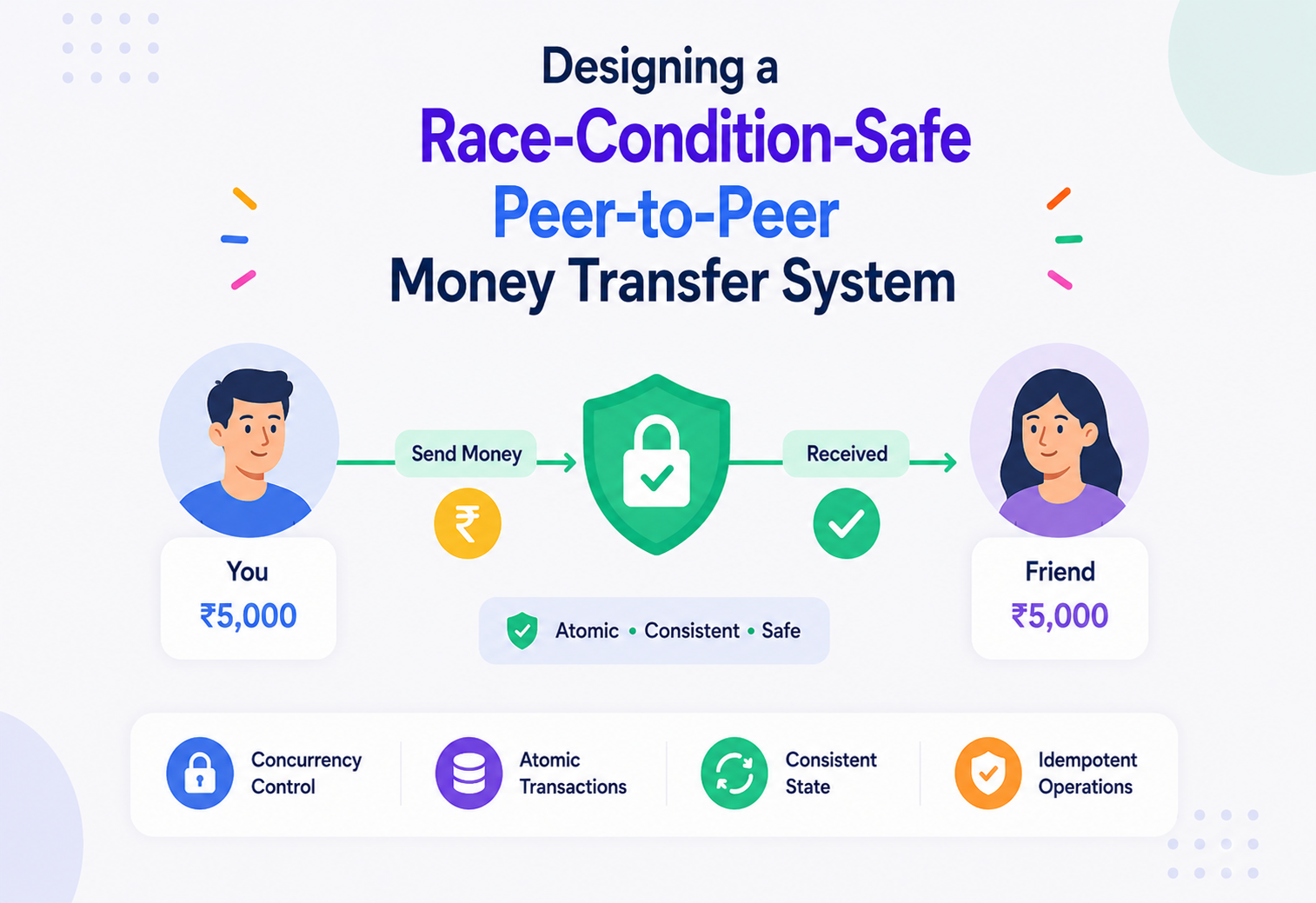
Designing a Race-Condition-Safe Peer-to-Peer Money Transfer System
How to guarantee that a sender with just enough balance for one transfer can never accidentally send money twice, even when two transfers race in at the exact same instant — at a scale of millions of requests per minute.
Introduction & History
Imagine you have exactly 500 rupees in your digital wallet. You owe your friend Riya 500 rupees for dinner, and you also owe your roommate Aman 500 rupees for electricity. Out of habit, you open two different chat threads and tap “Send 500” to Riya, then quickly switch tabs and tap “Send 500” to Aman, within the same second. You only have 500 rupees. What should happen? Exactly one transfer should succeed, and the other should be declined with a clear “insufficient balance” message. This sounds obvious when described slowly in a paragraph, but building a computer system that guarantees this outcome, every single time, even under massive simultaneous load, is one of the classic hard problems in distributed systems engineering.
This class of problem is called a “race condition,” and it has existed since the very first multi-user computer systems in the 1960s and 1970s, when multiple bank tellers accessing the same customer account on a shared mainframe could, without careful engineering, both read the same starting balance, both calculate that a withdrawal was affordable, and both approve it, draining the account into the negative. Banks solved this decades ago using techniques such as row-level locking in their core banking databases, and these same fundamental techniques, refined and adapted, are exactly what power today’s peer-to-peer payment apps like Venmo, Cash App, Google Pay, and PhonePe.
What has changed dramatically since the mainframe era is scale. A single bank branch’s mainframe in the 1980s might have handled a few hundred transactions an hour. A modern peer-to-peer payment platform must correctly handle this exact same balance-checking race condition potentially millions of times per minute, across millions of different accounts, all while keeping response times low enough that the sender sees a confirmation almost instantly. This tutorial walks through, piece by piece, how to design a system that gets this right, every single time, at that scale.
A Short Timeline of Concurrency Correctness in Money Systems
Shared mainframes surface the race
The first multi-user banking mainframes make it possible for two tellers to read the same account balance simultaneously, formally introducing the “check-then-act” hazard into commercial computing.
Row-level locking becomes standard
Commercial relational databases (System R, Oracle, DB2) mature their row-level locking and transaction primitives, giving banking systems a durable, well-understood way to serialize concurrent balance updates.
ACID transactions codified
Atomicity, Consistency, Isolation, and Durability become the shared vocabulary for reasoning about concurrent correctness, and financial systems standardize on them as the base contract for any balance-affecting operation.
Bitcoin frames the double-spend problem publicly
The Bitcoin whitepaper popularizes the term “double-spend” and shows, from a very different angle, that preventing two spends of the same balance is a foundational, unavoidable requirement for any digital money system.
Consumer peer-to-peer payments go mainstream
Venmo, Cash App, WeChat Pay, Google Pay, PhonePe, and Paytm push person-to-person transfer volume into the tens of millions per day, forcing exactly the same decades-old correctness discipline to be applied at a scale that traditional banking never faced.
Think of a single ticket left at a movie theater box office window, and two friends in line at the exact same moment both trying to buy it. A well-run box office has one clerk serve one customer at a time at that window, so whichever friend the clerk helps first gets the ticket, and the clerk immediately and correctly tells the second friend “sorry, sold out,” rather than accidentally selling the same seat to both. Our system needs to behave like that one careful clerk, even when there are millions of ticket windows open across the country at the same instant.
“Why is this specific scenario, two simultaneous transfers from a nearly-empty account, considered a classic system design interview question?” A good answer explains that it forces a candidate to reason precisely about concurrency control, atomicity, and the difference between application-level checks and database-level guarantees, which are foundational concepts that show up in almost every system that manages a shared, mutable resource under load, not just payments.
1.1 A Problem That Predates the Internet
It is worth appreciating just how old this class of problem really is. Long before online banking existed, physical bank branches had to solve a version of this exact issue with paper ledgers and human tellers: if a customer walked into one branch and withdrew money while, at the same moment, another teller at a different branch was processing a check drawn on the same account, the bank needed a reliable process to prevent the account from being drained twice. Early solutions involved centralizing the ledger, and later, computerizing it with the same fundamental locking discipline that a modern database now provides automatically. The lesson carried forward to today’s peer-to-peer payment systems is that this is not a new problem invented by mobile apps; it is an old, well-understood problem that simply needs to be solved correctly again at a much larger scale, using tools, like database transactions and row-level locks, that did not exist in the paper-ledger era but that directly formalize the same discipline those earlier systems were reaching for.
Problem & Motivation
Let’s carefully break down exactly why this is hard, because the failure mode is subtle and easy to miss if you only think about the “happy path” of one transfer at a time.
2.1 The Core Problem: Check-Then-Act
The naive way to implement a balance check looks like two separate steps: first, read the current balance from the database; second, if the balance is enough, subtract the amount and save it back. This pattern is called “check-then-act,” and it is dangerous the moment more than one process can run these two steps at the same time. If Transfer One reads the balance as 500, and before it finishes writing the new balance back, Transfer Two also reads the balance as 500, both transfers will independently conclude “yes, there is enough money,” and both will proceed, resulting in a sender balance of negative 500, money that was never really there being sent out twice.
Two people are looking at the same paper notepad that says “Balance: 500.” Person One reads “500,” decides to cross it out and write “0” after sending their transfer, but before they finish writing, Person Two also reads the still-unchanged “500,” and also decides to send their transfer and write “0.” Both notepad edits happen, but both transfers went through, even though there was only ever 500 to begin with.
This exact class of bug, sometimes called a “double-spend” in the context of digital money, was one of the foundational problems that had to be solved for any digital currency or payment system to be trustworthy, and remains one of the very first things engineers test for when reviewing a new payment feature before launch.
2.2 Why This Is Especially Hard at Scale
Millions of concurrent users
At a target of millions of requests per minute, the system will have enormous numbers of transfers happening at the exact same moment across many different sender accounts, meaning race conditions are not a rare edge case, they are a routine, constant occurrence that must be handled correctly every time.
Multiple servers, not one
Unlike the single mainframe of the 1980s, a modern system runs hundreds or thousands of stateless service instances. Two simultaneous transfer requests for the same sender account can easily land on two completely different servers, which have no shared memory and no natural way to coordinate with each other unless we explicitly design one.
Speed still matters
The correctness fix cannot come at the cost of making every single transfer painfully slow, since customers expect a transfer confirmation in under a second, even during the busiest traffic periods.
Correctness must hold under failure too
A server crashing midway through updating a balance must never leave the system in a state where money simply vanishes or appears from nowhere; the operation must be all-or-nothing.
2.3 The Scale of the Challenge in Numbers
A target of one million requests per minute is roughly 16,700 requests per second on average, with realistic peaks during high-traffic periods, such as salary day or a popular shared bill-splitting event, reaching 50,000 or more requests per second. Even if only a small fraction of accounts, say a fraction of a percent, have multiple transfers initiated within the same second, at this volume that still means many hundreds of genuine “two transfers, one balance” races happening across the platform every single minute, each one an opportunity for the system to either handle it correctly or silently lose money. This is precisely why the concurrency handling described in this tutorial cannot be treated as a rare edge case handled with a quick patch; it must be a core, load-bearing part of the architecture from day one.
“Would this race condition actually happen often in practice, or is it mostly theoretical?” A strong answer points out that even a low per-account probability, multiplied across millions of transfers per minute platform-wide, produces a real, regular occurrence, and that a system which is only “usually correct” is not acceptable for anything involving real money, since even one missed case erodes customer trust and can cause direct financial loss.
Core Concepts
Before assembling the architecture, let’s build the vocabulary this design leans on — the small set of ideas that, together, actually make the correctness guarantee possible.
Race condition
A bug where two operations, running concurrently, interleave in a way that produces an outcome neither would produce alone — here, two transfers both reading a balance of 500 and both concluding it’s enough.
Check-then-act
The dangerous pattern of reading a value in one step and updating it in a separate step; the window between the two steps is exactly where the race condition lives.
Atomic conditional update
Combining the check and the update into a single database statement (UPDATE … WHERE balance ≥ amount), so no other operation can observe or act on a stale balance in between.
Row-level locking
The database mechanism that serializes writes to a single row: when one transaction is updating an account, any concurrent transaction updating the same account is made to wait until the first one commits.
ACID transaction
Atomicity + Consistency + Isolation + Durability: the four-part contract that lets us treat “debit sender, credit receiver, write ledger” as a single indivisible operation.
Sharding
Partitioning the account balance database across many independent clusters by account ID, so unrelated accounts never compete for the same lock and the whole system scales horizontally.
Deadlock & consistent lock order
When two transactions each hold a lock the other wants, both wait forever. Acquiring locks in a fixed, sorted order (e.g. lowest account ID first) provably eliminates this.
Distributed lock (fast path)
A short-lived Redis-based lock per account, used as a performance optimization to keep excess concurrent requests out of the database entirely — but never as the true source of correctness.
Double-entry bookkeeping
Every balance change is recorded as a matched debit and credit pair in an immutable ledger. Money can only move between accounts, never be created or destroyed — and the ledger sum must always be zero.
Idempotency key
A unique client-generated key per transfer attempt. Solves the “did my retry create a duplicate?” problem, which is distinct from — and complementary to — the concurrency problem this tutorial focuses on.
Reconciliation
A continuous batch check that the ledger’s debits and credits sum to exactly zero; any non-zero result is a loud, high-priority signal of a correctness bug somewhere in the system.
Saga / compensating transaction
For cross-shard transfers, the debit and credit happen in two separate local transactions on two shards; if the credit fails, a compensating debit-reverse is applied so the system never gets stuck half-done.
Together, these concepts are the “careful clerk” from the introduction, formalized. The atomic conditional update is the single motion in which the clerk hands over the ticket and marks the seat sold. Row-level locking is the fact that only one clerk can touch that particular seat entry at once. The double-entry ledger is the two-part receipt that records exactly one ticket leaving inventory and one dollar entering the till. And reconciliation is the end-of-day audit that catches the day nothing quite adds up.
Architecture & Components
Let’s design the system, layer by layer, with every box explicitly labeled by the type of component it represents.
Figure 1 — End-to-end architecture. The correctness guarantee lives in the Account Balance DB’s row-level locking, invoked by the Ledger Service inside a single ACID transaction.
4.1 Component-by-Component Explanation
Client Layer
The web or mobile app where a customer selects a recipient, enters an amount, and taps “Send.” The client generates an idempotency key for this specific transfer attempt, reused if the request needs to be retried due to a network issue — protecting against the separate, but related, duplicate-request problem covered in an earlier tutorial in this series.
CDN Edge Node
Serves static assets such as the app’s interface code. Transfer requests themselves are never cached, since they are unique, sensitive, financial operations.
Global Load Balancer
Routes each request to the nearest healthy region using DNS-based anycast routing, minimizing latency and providing automatic failover if an entire region becomes unavailable.
API Gateway
The single front door for all traffic. It authenticates the request, enforces per-customer rate limits, and validates that a required idempotency key is present, rejecting malformed requests before they consume any downstream capacity.
Regional Load Balancer
A Layer 7 load balancer distributes traffic evenly across many replicas of the Transfer Orchestrator, ensuring no single instance becomes a bottleneck.
Transfer Orchestrator
This stateless microservice coordinates the overall transfer workflow: calling the Fraud & Risk Service, then the Ledger Service to perform the actual balance movement, and finally triggering notifications. Critically, the Orchestrator itself holds no balance data and makes no balance decisions; it delegates the concurrency-sensitive work entirely to the Ledger Service and the database beneath it.
Distributed Lock Service
A Redis cluster supporting fast, short-lived, per-account locks. This is used as a performance optimization — to quickly reject or queue a second concurrent request for the same account before it even reaches the database — reducing wasted work and database contention, though, as we will see, it is not the ultimate source of correctness.
Fraud & Risk Service
Scores the transfer for fraud risk, such as an unusual amount, a brand-new recipient, or a suspicious device, before any money moves.
Ledger Service
The most important component in this entire system. It performs the actual atomic debit-and-credit operation as a single database transaction, using the row-level locking and conditional update techniques described in detail in the next chapter, which are what truly guarantee correctness under concurrent access.
Account Balance Database
A sharded PostgreSQL cluster holding every account’s current balance. Sharding is typically by account ID, so any two accounts are very likely to live on different shards, allowing the system to scale horizontally, while all operations affecting a single account’s balance are serialized correctly within that account’s specific shard through standard row-level locking.
Event Bus
A Kafka cluster carries transfer completion events to downstream systems: notifications, analytics, and the Reconciliation Service, decoupling these concerns from the latency-sensitive transfer path itself.
Notification Service
Sends push notifications, SMS, or email confirmations to both the sender and recipient once a transfer completes or fails, consuming events from the Event Bus asynchronously.
Reconciliation Service
A batch microservice that periodically verifies a fundamental invariant: across the entire ledger, the sum of every debit must exactly equal the sum of every credit, since money can only move between accounts, never be created or destroyed. Any discrepancy here is an urgent, high-priority signal that something in the system has a bug.
Monitoring Stack
Prometheus and Grafana track latency, error rates, and, importantly for this system, lock contention and the rate of “insufficient funds due to concurrent transfer” declines — a specific, valuable signal of correctness in action.
“Where does the true correctness guarantee against a double-spend actually live in this architecture?” A strong answer identifies the Account Balance Database’s row-level locking and atomic conditional update within the Ledger Service, not the Redis Distributed Lock Service, as the real, unbreakable source of truth, with Redis serving only as a fast, optional performance optimization layered on top.
4.2 Why Not Solve This Purely With an In-Memory Application Lock
A reasonable early question is why we cannot simply use a lock inside the application code itself, for example a synchronized block in a single Java service, to protect an account’s balance from concurrent modification. The problem is that our Transfer Orchestrator and Ledger Service both run as many independent replicas, potentially hundreds of them, spread across multiple servers and even multiple regions. An in-memory lock only protects against concurrent access within that one single process; it has no way to prevent a completely different replica, running on a different machine with its own separate memory, from concurrently modifying the same account. This is precisely why the true guarantee must live in a shared, external system that every replica consults, and a relational database’s row-level locking is exactly this kind of shared coordination point, since every replica, no matter which machine it runs on, ultimately talks to the same underlying database row for a given account.
Internal Working
Now let’s zoom into exactly how two simultaneous transfers from the same nearly-empty account are handled correctly.
Figure 2 — Two concurrent transfers from the same account. The row lock, taken automatically by the update statement, serializes them so exactly one succeeds.
5.1 The Atomic Conditional Update
The single most important technique in this entire tutorial is replacing the dangerous two-step “check-then-act” pattern with one single, atomic database statement that checks and updates in the same operation. Instead of first reading the balance in one query and then writing the new balance in a second query, the Ledger Service issues one update statement whose WHERE clause itself enforces the balance check.
public class LedgerService {

    private final JdbcTemplate jdbcTemplate;

    public TransferResult debitAccount(String accountId, BigDecimal amount) {
        String sql = "UPDATE accounts " +
                     "SET balance = balance - ? " +
                     "WHERE account_id = ? AND balance >= ?";

        int rowsUpdated = jdbcTemplate.update(sql, amount, accountId, amount);

        if (rowsUpdated == 0) {
            return TransferResult.insufficientFunds();
        }
        return TransferResult.debited();
    }
}
Here is why this single statement is safe even under heavy concurrency. A relational database, at the storage engine level, automatically takes a row-level lock on the specific account row the moment this update statement begins executing against it. If a second, concurrent update statement for the exact same account row arrives while the first is still running, the database itself makes the second statement wait until the first one fully commits or rolls back. This means the second update’s balance ≥ amount check is always evaluated against the truly up-to-date balance, after the first transfer has already been applied, not against a stale value read moments earlier. This is precisely how the database guarantees that only one of the two concurrent transfers can succeed when there is only enough balance for one.
5.2 Why This Beats a Manual Read-Then-Write
It is worth being explicit about why this single atomic statement is fundamentally safer than reading the balance in application code, checking it in a Java if statement, and then issuing a separate update. In the manual approach, there is a window of time, however small, between the read and the write, during which another process can read the same stale balance and make the same, now-incorrect, decision. By pushing both the check and the update into one atomic database operation, we eliminate that window entirely; there is no gap in which a second process could observe a stale value, because the database’s own row locking mechanism serializes concurrent attempts at exactly this operation.
5.3 Wrapping the Full Transfer in a Single Transaction
A complete transfer involves more than just debiting the sender; it also involves crediting the recipient and writing double-entry ledger records for audit purposes. All of these steps happen inside a single database transaction, so that either everything succeeds together, or, if anything fails partway through, everything is rolled back together, leaving no possibility of money disappearing from the sender without appearing for the recipient, or vice versa.
@Transactional
public TransferResult transfer(String senderId, String receiverId, BigDecimal amount) {
    // always lock accounts in a consistent order to prevent deadlocks
    String firstId  = senderId.compareTo(receiverId) < 0 ? senderId  : receiverId;
    String secondId = senderId.compareTo(receiverId) < 0 ? receiverId : senderId;

    lockAccountForUpdate(firstId);
    lockAccountForUpdate(secondId);

    TransferResult debitResult = debitAccount(senderId, amount);
    if (!debitResult.isSuccess()) {
        throw new InsufficientFundsException(senderId);
    }

    creditAccount(receiverId, amount);
    writeLedgerEntries(senderId, receiverId, amount);

    return TransferResult.success();
}Think of the row-level lock like a single bathroom key attached to a physical, unique key fob at a small cafe. Only one person can hold the key and use the bathroom at a time; anyone else who wants to use it must simply wait in line until the key is returned. There is no way for two people to be using that one bathroom simultaneously, no matter how many people are waiting, because the physical key itself, not a sign-up sheet or a verbal promise, enforces the rule.
“Why lock both the sender and receiver accounts in a consistent, sorted order?” A strong answer explains that this prevents a classic deadlock scenario: if Transfer One locks Account A then tries to lock Account B, while Transfer Two simultaneously locks Account B then tries to lock Account A, both transactions can end up waiting forever for a lock the other is holding; always acquiring locks in a fixed, consistent order, such as sorting account identifiers, eliminates this circular waiting pattern entirely.
5.4 A Note on Database Isolation Levels
Relational databases offer several transaction isolation levels, and it is worth understanding why this matters here. At the default isolation level used by many databases, called Read Committed, a plain read within a transaction can still see a stale value if it does not also acquire a lock. This is exactly why the update statement shown earlier is written as a single statement combining the check and the write, rather than a separate read followed by a write within the same transaction, since the act of updating a row is what triggers the database to take the necessary row lock, regardless of the isolation level in use. Some teams choose to additionally raise the isolation level to Repeatable Read or Serializable for extra safety on financial operations, which can catch a wider class of subtle anomalies, at the cost of a higher chance of transactions needing to be retried under heavy contention; for the specific balance-check-and-update pattern described in this tutorial, however, the atomic single-statement update is sufficient on its own, even at the default isolation level, because the row lock is acquired as an inherent part of the write operation itself.
Data Flow & Lifecycle
Let’s trace the complete life of the two competing transfers from the introduction, from the moment both taps happen to the final notifications.
Simultaneous client taps
The customer taps “Send 500 to Riya” and, almost immediately after, “Send 500 to Aman,” each generating its own unique idempotency key, since these are two genuinely distinct actions, not retries of the same one.
Parallel arrival
Both requests travel independently through the CDN, Global Load Balancer, API Gateway, and Regional Load Balancer, and may land on two completely different Transfer Orchestrator instances, since the system is horizontally scaled across many replicas.
Independent risk checks
Both requests pass through the Fraud & Risk Service independently; nothing about risk scoring alone can detect or prevent the balance race, which is why this concern is kept separate from the balance logic itself.
Optional fast-path lock check
Both requests reach the Ledger Service, which may first attempt a quick, short-lived lock claim in the Redis Distributed Lock Service for the sender’s account, allowing one to proceed immediately while the other is told to wait briefly, reducing unnecessary database contention under very high load.
Database transaction begins
Whichever transfer proceeds first begins a database transaction and acquires a row-level lock on the sender’s account row as part of its atomic conditional update statement.
First transfer succeeds
The first transaction’s update statement finds the balance is sufficient, reduces it to zero, credits the recipient, writes ledger entries, and commits, releasing the row lock.
Second transfer evaluated
The second transaction, which was waiting for the row lock, now proceeds and runs its own atomic conditional update, but the balance is now zero, so its WHERE balance ≥ amount condition matches no rows, and it is correctly declined.
Divergent responses
The Transfer Orchestrator handling the successful transfer returns a success response, while the one handling the declined transfer returns a clear “insufficient funds” response, both flowing back through the same load balancers and gateway to the two separate client requests.
Asynchronous notifications
The successful transfer’s completion event flows through Kafka to the Notification Service, sending confirmations to both the sender and Riya, while the declined transfer generates a separate, distinct notification informing the customer their transfer to Aman could not be completed due to insufficient balance.
Continuous reconciliation
In the background, the Reconciliation Service later verifies that the sum of all debits and credits across the ledger for this time window balances to exactly zero, confirming no money was created, lost, or duplicated.
Returning to our opening scenario, the customer with exactly 500 rupees taps to pay Riya and Aman within the same second. Whichever request’s database transaction acquires the row lock on the sender’s account first, entirely dependent on microsecond-level timing and not something the client or customer controls, succeeds. The other is declined instantly and clearly, and the customer sees one green checkmark and one “insufficient balance, please try again” message, exactly the correct, expected outcome.
Advantages, Disadvantages & Trade-offs
Every design choice here buys something and costs something. Making those trades explicit is what turns “we picked row-level locking” into a defensible engineering decision.
Atomic conditional update statement
Advantage: Simple, provably correct, no separate locking infrastructure required.
Trade-off: Relies on the database’s own row-locking behavior, which must be well understood.
Pessimistic row-level locking
Advantage: Guarantees correctness even under extreme concurrency.
Trade-off: A second request must wait, however briefly, for the first to finish.
Optimistic concurrency with version numbers
Advantage: Avoids holding a lock while waiting; can be faster under low contention.
Trade-off: Requires retry logic in application code and can perform worse under high contention on the same account.
Redis distributed lock fast path
Advantage: Reduces unnecessary database load for accounts under heavy simultaneous access.
Trade-off: Adds operational complexity and is not itself the true source of correctness.
Sharding accounts across database clusters
Advantage: Enables horizontal scaling to millions of accounts and requests.
Trade-off: Transfers between accounts on different shards require careful cross-shard transaction handling.
The central trade-off in this system is simplicity and provable correctness versus raw throughput under contention on a single hot account. Pessimistic row-level locking, the approach this tutorial centers on, is simple to reason about and, when built on top of a mature relational database, gives strong, well-tested correctness guarantees. Its cost is that a small number of extremely high-traffic accounts, such as a large business account receiving thousands of incoming transfers per minute, could see individual requests briefly queue behind each other. For the vast majority of ordinary peer-to-peer accounts, this queuing is measured in milliseconds and is imperceptible to users, which is why this remains the standard, recommended approach for the general case described in this tutorial.
What we gain
- Bulletproof correctness on the double-spend scenario, even under adversarial concurrent load.
- Simple, well-understood mental model that a full team can reason about.
- Horizontal scalability of the read/write path via account-ID sharding.
- Straightforward auditability through immutable double-entry ledger entries.
What we accept
- Very brief queueing on a single hot account during simultaneous access.
- Extra care needed for cross-shard transfers (compensating saga).
- Balances cannot be served from a cache for authorization decisions.
- Extra operational discipline around database migrations and connection sizing.
Performance & Scalability
The prompt for this system specifies a target of millions of requests per minute, roughly 16,700 requests per second sustained, with peaks of 50,000 or more requests per second. Let’s examine how the locking-based design holds up.
8.1 Sharding Spreads Lock Contention Across the Whole Cluster
The key insight that makes this design scale is that row-level locks are scoped to a single account row, not the whole database or even the whole table. Since the Account Balance Database is sharded by account ID across many independent database clusters, transfers involving different, unrelated accounts naturally proceed on entirely different shards, in full parallel, with zero contention between them. Lock contention, and any resulting brief waiting, only ever occurs when multiple transfers genuinely target the very same account at the very same moment, which, for the overwhelming majority of accounts, is a rare, brief event measured in milliseconds.
8.2 Horizontal Scaling of Stateless Services
The Transfer Orchestrator, Fraud & Risk Service, and Ledger Service are all stateless, so they scale horizontally with an auto-scaler watching CPU usage and queue depth, exactly the same pattern used throughout this tutorial series. The database layer, however, is the more careful part of capacity planning here, since it is where the actual correctness-preserving work of locking happens.
8.3 The Redis Fast Path for Hot Accounts
For accounts that receive an unusually high volume of simultaneous transfer attempts, a small number of very popular merchant or celebrity accounts, for example, the optional Redis Distributed Lock Service can reduce wasted database work. Rather than letting many concurrent requests all begin a database transaction and queue on the actual row lock, a lightweight Redis-based lock can quickly and cheaply tell all but one request “please wait briefly,” reducing the number of transactions that need to be held open by the database at once, which matters because open transactions consume database connection and memory resources.
Figure 3 — State machine for a single transfer, showing the two failure exits (fraud decline, insufficient funds) and the four-step success path.
8.4 Keeping Transactions Short
The single most important performance rule for a locking-based design is keeping the database transaction that holds the row lock as short as possible. Any slow work, such as calling an external service, formatting a notification message, or performing a network call, must happen entirely outside the transaction boundary, before or after it, never inside. A transaction that holds a lock open for an unnecessarily long time directly increases how long any competing concurrent request for the same account must wait, and at scale, this discipline is often the single biggest lever for keeping tail latency low.
8.5 Capacity Planning With Real Numbers
At a peak of 50,000 requests per second, if the Account Balance Database is sharded across, for example, 50 independent clusters by account ID hash, each shard needs to sustain roughly 1,000 write transactions per second on average, a very manageable, well within normal range figure for a properly tuned relational database cluster, especially given that most individual transactions, once outside-transaction work is excluded, complete in single-digit milliseconds. The Transfer Orchestrator and Ledger Service tiers, being stateless, scale by simply adding more replicas, with a rough planning estimate of one instance per 500 to 800 requests per second, meaning roughly 65 to 100 instances at peak for this tier, scaled automatically as load rises and falls throughout the day.
“Why does sharding by account ID matter so much for this specific system?” A strong answer explains that sharding directly limits the scope of lock contention to a single shard rather than the whole database, meaning the system’s overall throughput scales roughly linearly with the number of shards, since unrelated accounts on different shards never compete for the same lock at all.
8.6 Distinguishing Hot Accounts From Ordinary Traffic
Not every account experiences the same level of concurrent access, and treating them all identically can waste engineering effort. The vast majority of ordinary customer accounts see, at most, a handful of transfers per day, meaning genuine lock contention on these accounts is exceptionally rare and essentially unnoticeable in practice. A small number of accounts, however, such as those belonging to a popular online creator receiving many small simultaneous tips, or a large merchant receiving payments from thousands of customers at once, can experience genuinely high concurrent write volume on a single account row. Identifying these hot accounts through monitoring, and applying the optional Redis-based fast-path lock specifically where it provides real, measurable benefit, is a more targeted and efficient strategy than assuming uniform load across every account in the system.
High Availability & Reliability
A money transfer system that is frequently unavailable, or that occasionally corrupts balances during a failure, causes severe, direct harm to real customers, so reliability here is treated with the same seriousness as correctness.
9.1 Redundancy at Every Layer
Every stateless service runs multiple replicas across multiple availability zones. The Account Balance Database runs as a primary with synchronous or near-synchronous replicas, so the loss of the primary node triggers an automatic, fast failover to a replica without losing any committed transaction.
9.2 Transactional Atomicity Protects Against Partial Failure
Because the entire debit-credit-ledger operation happens inside a single database transaction, a server crash, a network failure, or any other interruption partway through simply causes the whole transaction to roll back automatically, leaving the account balances exactly as they were before the attempt. There is no possibility of a “half-completed” transfer where money leaves the sender’s account but never reaches the recipient’s, which is precisely the guarantee that makes this design trustworthy for real financial operations.
9.3 Deadlock Detection and Retry
Even with consistent lock ordering, as discussed earlier, modern databases include automatic deadlock detection as a further safety net, and will forcibly abort one of two deadlocked transactions, allowing the application to safely retry it. The Ledger Service wraps its transfer logic with a small number of automatic retries specifically for this rare, transient failure mode, since retrying a rolled-back transaction is always safe: nothing was committed, so no duplicate effect can occur.
@Retryable(value = DeadlockLoserDataAccessException.class, maxAttempts = 3)
@Transactional
public TransferResult transfer(String senderId, String receiverId, BigDecimal amount) {
    // transfer logic as shown earlier: safe to retry since nothing
    // is committed until the transaction successfully completes
    return executeTransfer(senderId, receiverId, amount);
}
9.4 Graceful Handling of Database Overload
If a specific database shard becomes overwhelmed, perhaps due to an unusually hot account receiving extreme, viral traffic, the Ledger Service applies backpressure, returning a clear, honest “please try again shortly” response rather than allowing requests to queue indefinitely and exhaust database connections, which could otherwise cascade into an outage affecting completely unrelated accounts on the same shard.
9.5 Disaster Recovery
The Account Balance Database is replicated across regions with a well-tested, regularly rehearsed failover process, and the entire stack can run in a multi-region configuration, so a full regional outage does not stop the platform from processing transfers, with strict data residency and consistency requirements carefully respected given the financial nature of this data.
9.6 Testing Reliability on Purpose
Teams operating this kind of system run controlled chaos engineering exercises, deliberately killing a database node mid-transaction, simulating network partitions, and specifically firing large numbers of genuinely concurrent transfer requests against the same test account with a known, limited balance, to verify in a real, running environment, not just on paper, that exactly the correct number of transfers succeed and the rest are cleanly declined.
“How would you specifically test that this race condition is truly handled correctly?” A strong answer describes an automated test that funds a test account with a known balance, then fires a burst of many genuinely concurrent transfer requests, each for an amount that would only allow a small number of them to succeed, and asserts that exactly the mathematically correct number succeed, no more and no less, directly exercising the same scenario described throughout this tutorial.
Security
Peer-to-peer money transfer systems are high-value targets, and security must be layered carefully across every part of the design.
10.1 Authentication and Authorization
Every transfer request must be tied to a verified, authenticated sender identity, validated at the API Gateway, and the system must strictly enforce that a customer can only initiate a transfer from an account they actually own, never from another customer’s account, regardless of what account ID is present in the request payload.
10.2 Rate Limiting and Velocity Checks
The API Gateway enforces per-customer rate limits using a token bucket algorithm, and the Fraud and Risk Service separately tracks transaction velocity, the rate and pattern of transfers over time, to catch account takeover scenarios where an attacker who has gained access to a customer’s account attempts to rapidly drain it through many small or large transfers in quick succession.
10.3 Protecting Against Automated Balance Draining
Beyond the core concurrency correctness this tutorial focuses on, the system must also guard against a malicious actor deliberately firing many rapid, automated transfer requests specifically to probe or exploit timing behavior. Strict per-account rate limits and anomaly detection on request patterns, such as an unusual number of transfer attempts to newly added recipients within a short window, help catch this kind of automated abuse before it can cause harm.

10.4 Encryption and Data Protection
All traffic uses TLS encryption end to end, and sensitive fields in the Account Balance Database, including balance history, are encrypted at rest. Access to raw balance and transaction data is tightly scoped through role-based access control, with every access logged for audit purposes.
10.5 Immutable Audit Trail
Every balance change is recorded as an immutable, append-only ledger entry, separate from the mutable current balance field, following standard double-entry bookkeeping principles. This means that even though the current balance itself changes over time, the complete history of exactly how it got there, transfer by transfer, is always available and cannot be altered after the fact, which is essential both for regulatory compliance and for resolving customer disputes.
10.6 Data Privacy and Compliance
Transaction data, including who sent money to whom and when, is sensitive personal financial information, regulated under frameworks that vary by jurisdiction. The system enforces strict access controls so that a customer’s transfer history is visible only to that customer and authorized compliance personnel, never broadly accessible across the organization, and retention and deletion policies are implemented in line with applicable regulations.
“Could an attacker exploit timing behavior around the row lock to somehow gain an advantage?” A thoughtful answer notes that the row lock itself only ever enforces correctness, never grants extra funds; the worst an attacker could achieve through timing manipulation is having their own transfer declined instead of succeeding, or experiencing added latency, neither of which creates any exploitable financial advantage, since the atomic conditional update always ties the outcome to the truly current, correct balance.
Monitoring, Logging & Metrics
Given the financial stakes, monitoring for this system needs to specifically surface signals related to concurrency correctness, not just general health.
11.1 Key Metrics to Track
Request rate & latency percentiles
p50, p95, and p99 latency for the transfer endpoint, watched closely since this is a customer-facing, real-time interaction.
Lock wait time
How long transactions spend waiting for a row lock on contended accounts — a direct signal of concurrency pressure on specific hot accounts.
Insufficient-funds due to concurrency
Distinguished from a genuine, pre-existing low balance, this specific signal indicates the atomic conditional update is actively doing its job during real concurrent access.
Deadlock retry count
How often the automatic deadlock detection and retry mechanism fires, which should normally be very rare given consistent lock ordering.
Ledger reconciliation mismatch
The most critical correctness signal of all, which should remain at zero under normal, healthy operation.
11.2 Distributed Tracing
A unique trace ID follows each transfer request through every service it touches, letting engineers investigating a specific customer complaint or an unusual decline see the complete picture, including exactly how long the database transaction held its row lock and whether any competing request was involved.
11.3 Structured, Immutable Logging
Every service emits structured logs including the trace ID and account identifiers involved, sent to a centralized logging system, with all balance-affecting events additionally written to an append-only, tamper-evident audit trail, given the regulatory and dispute-resolution importance of transaction history for a financial system.
11.4 Alerting and Service Level Objectives
A reasonable SLO for this system might state that 99.9 percent of transfer requests resolve, successfully or with a clear decline, within 1 second, and that the ledger reconciliation mismatch count stays at exactly zero under normal operation. Alerts fire immediately if this mismatch count ever rises above zero, since this is the single clearest possible signal that a correctness bug, potentially resulting in real financial loss, exists somewhere in the system.
11.5 Dashboards Built for Different Audiences
An engineering dashboard tracks latency, lock wait time, and deadlock retries, the detail needed to diagnose a technical issue quickly, while a finance and compliance-facing dashboard tracks total transfer volume, decline rates, and reconciliation health over time, giving non-engineering stakeholders confidence that the system’s core financial correctness guarantees are holding up continuously in production.
“How would you distinguish, in your metrics, between a customer being correctly declined for a genuinely low balance versus being declined specifically due to the concurrency scenario this tutorial focuses on?” A good answer describes tagging decline events with a specific reason code at the point of decline, since the Ledger Service already knows, at the moment the atomic update returns zero rows affected, whether this was the account’s ordinary balance or a balance that had just been reduced by a nearly simultaneous competing transfer, making this distinction straightforward to capture and report on separately.
Deployment & Cloud
All services are packaged as containers and orchestrated with Kubernetes, with deployment practices tuned for the caution a financial system demands.
12.1 Careful, Gradual Rollouts
New versions of the Ledger Service, given that it contains the most safety-critical concurrency logic in the entire system, are rolled out using a canary strategy with an especially small initial traffic slice, often 1 percent or less, and close monitoring of the reconciliation mismatch count and decline-reason distribution before gradually increasing traffic, since a subtle bug in the atomic update logic could have direct financial consequences.
12.2 Auto-Scaling
A Horizontal Pod Autoscaler manages the Transfer Orchestrator and Ledger Service tiers based on CPU usage and request queue depth, allowing the system to absorb both predictable daily traffic patterns, such as a lunchtime spike in bill-splitting transfers, and sudden, less predictable spikes.
12.3 Multi-Region Deployment
The stack is deployed across multiple geographic regions for both latency and resilience. The Account Balance Database typically uses a single authoritative writable region per account, often chosen based on the customer’s home region, with read replicas elsewhere, since balance data has strict consistency requirements that make a fully active-active, multi-writer configuration across regions considerably more complex to implement correctly.
12.4 Infrastructure as Code
All infrastructure, including the sharded database cluster configuration, the Redis lock cluster, and Kubernetes manifests, is defined in code using tools such as Terraform, ensuring every change is reviewable and reproducible, which matters especially for a system where a misconfigured shard count or replication setting could have serious correctness implications.
“Why might active-active, multi-writer replication across regions be particularly risky for this specific system, compared to some other systems covered in this tutorial series?” A strong answer explains that allowing writes to the same account’s balance from two different regions simultaneously would reintroduce exactly the kind of race condition this entire tutorial is designed to eliminate, since coordinating a single row-level lock across geographically distant database writers is far harder and slower than within one region, which is why a single-writer-per-account approach is the safer, standard choice for balance data specifically.
Databases, Caching & Load Balancing
Balance data is special: strict correctness matters more than raw read throughput, and briefly stale data is precisely the thing the whole design is engineered to prevent.
13.1 Choosing the Account Balance Database
We chose PostgreSQL, a strongly consistent relational database, specifically because its mature, well-tested row-level locking and transactional guarantees are exactly the tool needed to solve the core problem this tutorial addresses. Unlike shipping-rate tables or product catalogs seen in other tutorials in this series, which prioritize massive read throughput, account balances demand strict correctness under concurrent writes above all else, making a relational database with proper ACID transactions the clear right choice here.
13.2 Sharding Strategy
The database is sharded by account ID, typically using a consistent hashing scheme, so that any given account’s balance always lives on a predictable, specific shard. This directly limits the scope of any lock contention to that single shard, allows the system to scale horizontally simply by adding more shards as the customer base grows, and keeps the vast majority of transfers, those between two accounts that happen to hash to the same shard, fully local and fast, while transfers between accounts on different shards require a carefully designed cross-shard transaction, discussed further below.
13.3 Handling Cross-Shard Transfers
When the sender and recipient accounts live on different database shards, a single local transaction cannot cover both. This case is handled using a two-phase, saga-style approach: the debit is performed and committed on the sender’s shard first, guarded by the same atomic conditional update described earlier, and only once that debit is confirmed successful does the Ledger Service perform the credit on the recipient’s shard. If the credit step fails for some unexpected reason, a compensating transaction automatically reverses the original debit, ensuring the system never ends up in a state where money was removed from the sender but never delivered to the recipient.
13.4 Why Not Cache the Balance
Unlike many other pieces of data in a typical marketplace system, account balances are deliberately never served from a cache for the purposes of a transfer decision. Caching implies the possibility of briefly stale data, and briefly stale balance data is precisely what causes the race condition this entire tutorial exists to prevent. The database itself, with its row-level locking, must always be consulted directly for any operation that changes or checks balance for the purpose of authorizing a transfer, even though this means accepting a small amount of additional latency compared to a cached read, a trade-off that is clearly justified given what is at stake.
13.5 Load Balancing Strategy
The same two-tier load balancing approach used throughout this tutorial series applies here: a Global Load Balancer routes to the nearest healthy region, and a Regional Load Balancer distributes traffic across Transfer Orchestrator replicas using health-checked least-connections routing, ensuring even distribution and automatic removal of unhealthy instances from rotation.
“Why is caching, generally a go-to performance technique in most systems, specifically dangerous here?” A strong answer identifies that any cache, by definition, can serve data that is a moment out of date, and for a value like account balance that must be checked and updated atomically to prevent a race condition, even a moment of staleness reopens exactly the vulnerability this tutorial’s entire design exists to close, which is why balance reads for transfer authorization always go directly to the strongly consistent database.
APIs & Microservices
Clear public contracts, strongly typed internal service calls, and an explicit note that idempotency and concurrency safety are two distinct problems, both of which the production system must solve.
14.1 The Public Transfer API
Headers:
  Idempotency-Key: 7f8e9d0c-1234-5678-90ab-cdef12345678

Request Body:
{
  "senderAccountId":   "ACC-1001",
  "receiverAccountId": "ACC-2002",
  "amountCents":       50000,
  "currency":          "INR"
}

Response Body (success):
{
  "transferId":            "TXN-88451",
  "status":                "COMPLETED",
  "newSenderBalanceCents": 0
}

Response Body (insufficient funds):
{
  "error": {
    "code":      "INSUFFICIENT_FUNDS",
    "message":   "Sender account does not have sufficient balance",
    "retryable": false
  }
}
14.2 Internal Service Contracts
Internal services communicate over gRPC for speed and strongly typed contracts. The Ledger Service’s internal transfer method returns an explicit, structured result type distinguishing success, insufficient funds, and transient system failure, rather than relying on generic exceptions, so calling code, including the Transfer Orchestrator, can handle each case with precise, intentional logic.
14.3 Why Microservices Fit This Problem, With One Caveat
Separating the Transfer Orchestrator, Fraud & Risk Service, and Ledger Service allows each to scale and evolve independently, following the same reasoning seen throughout this tutorial series. The important caveat here is that the Ledger Service specifically should remain narrowly focused and conservatively changed, since it is the one component directly responsible for the core correctness guarantee this entire system exists to provide; teams often apply stricter code review and testing requirements to changes in this specific service compared to less safety-critical parts of the system, such as the Notification Service.

14.4 Idempotency Alongside Concurrency Safety
It is worth being explicit that idempotency, covered in depth in an earlier tutorial in this series, and the concurrency safety covered in this tutorial, solve two related but distinct problems, and a production system needs both. Idempotency ensures that retrying the exact same transfer request due to a network timeout never causes a duplicate transfer. The atomic conditional update covered in this tutorial ensures that two genuinely different, simultaneous transfer requests from the same account are correctly serialized against the true, current balance. A robust Transfer Orchestrator checks the idempotency key first, and only if this is confirmed to be a genuinely new request does it proceed into the balance-checking logic described throughout this tutorial.
“Are idempotency keys and row-level locking solving the same problem?” No, and a strong answer draws this distinction clearly: idempotency keys prevent the same logical request from being processed twice due to a retry, while row-level locking and atomic updates prevent two different, legitimate requests from incorrectly both succeeding when only one truly could; a complete system needs both mechanisms working together, not one in place of the other.
Design Patterns & Anti-Patterns
The whole system is essentially a careful stack of well-understood patterns — and a matching set of anti-patterns it deliberately refuses to use.
15.1 Patterns Used
Pessimistic Locking Pattern
The central pattern of this tutorial: using database row-level locks to serialize concurrent access to a shared, mutable resource, guaranteeing correctness even under heavy contention.
Atomic Conditional Update Pattern
Combining a check and an update into a single database statement, eliminating the dangerous window of time that a separate read-then-write approach would leave open.
Consistent Lock Ordering Pattern
Always acquiring multiple locks — such as sender and receiver account locks — in a fixed, predictable order, to prevent deadlocks.
Saga Pattern
Used for cross-shard transfers, breaking a single logical operation into a sequence of local transactions with compensating actions if a later step fails.
Double-Entry Bookkeeping Pattern
Recording every balance change as a matched debit and credit pair in an immutable ledger, providing both an audit trail and a powerful, simple correctness check through the Reconciliation Service.
15.2 Anti-Patterns to Avoid
- Read-then-write balance checks in application code: The single most dangerous anti-pattern this tutorial addresses; separating the balance check and the balance update into two distinct database operations reopens the exact race condition the whole design exists to close.
- Relying solely on a distributed lock without a database-level guarantee: Treating the Redis Distributed Lock Service as the sole source of correctness, rather than as a performance optimization layered on top of the database’s own atomic guarantees, risks a real financial bug if the lock service ever experiences a bug, a brief outage, or a subtle timing issue.
- Inconsistent lock acquisition order: Locking accounts in whatever order they happen to appear in a request, rather than a fixed, sorted order, invites deadlocks under concurrent, opposite-direction transfers between the same two accounts.
- Long-running transactions: Performing slow, unrelated work such as external API calls inside the same database transaction that holds the account row lock, unnecessarily increasing how long competing requests must wait.
- Caching balance for transfer authorization decisions: As discussed in the databases chapter, this directly reintroduces the staleness window that causes the race condition this tutorial is built to prevent.
“A junior engineer proposes reading the balance, checking it in code, and then issuing a separate update statement, arguing it is simpler to read. How would you respond?” A strong answer acknowledges the code readability appeal, but explains clearly why this reopens the race condition through a concrete example, similar to the one from the introduction, and proposes the single atomic conditional update as a solution that is actually just as simple to read while being fundamentally correct under concurrency.
Best Practices & Common Mistakes
The good news is that the discipline required here is small and well-defined; the bad news is that missing any single item on this list tends to fail loudly and publicly, with real customer money involved.
Best Practices
- Always combine a balance check and a balance update into a single atomic database statement, never two separate operations.
- Keep database transactions that hold row locks as short as possible, moving any slow or external work outside the transaction boundary.
- Always acquire multiple account locks in a consistent, sorted order to eliminate deadlock risk.
- Treat any distributed lock, such as a Redis-based lock, purely as a performance optimization, never as the sole guarantee of correctness.
- Record every balance change as an immutable, double-entry ledger record, and continuously reconcile that the ledger balances to zero.
- Write automated tests that fire genuinely concurrent requests against a shared, limited resource and assert the mathematically correct outcome.
Common Mistakes
- Implementing a balance check as a separate read followed by a separate write, believing this is “good enough” because it works correctly in every manual test performed one request at a time.
- Assuming a distributed lock alone, without a database-level atomic guarantee, is sufficient, and being surprised when a rare timing edge case or lock service issue allows a duplicate transfer through.
- Forgetting to sort lock acquisition order for multi-account operations, leading to intermittent, hard-to-reproduce deadlocks that only appear under real production concurrency.
- Not testing the concurrent scenario at all, since ordinary functional and manual testing naturally sends one request at a time and never exercises the actual race condition this system must handle correctly.
- Allowing slow, unrelated work inside the locked transaction, quietly degrading overall throughput for any account experiencing simultaneous access.
16.3 A Pre-Launch Readiness Checklist
Before launching or meaningfully changing this system, experienced teams confirm that the atomic conditional update statement is in place and has been tested under genuine concurrent load, not just unit tested in isolation; that lock acquisition order is consistently enforced across every code path that touches multiple accounts; that the Reconciliation Service is running continuously and its mismatch count is actively monitored and alerted on; and that a specific, dedicated concurrency test, firing many simultaneous transfer requests against a test account with a known, limited balance, is part of the mandatory test suite and passes reliably, not just occasionally.
“If you inherited this codebase and found the balance check implemented as a separate read and write, with no locking at all, what would be your very first fix?” A strong answer prioritizes replacing the read-then-write pattern with the single atomic conditional update statement first, since this is the smallest, most targeted change that directly closes the core correctness gap, before considering any additional performance optimizations such as a distributed lock fast path.
16.4 A Short Mental Model to Carry Forward
If there is one mental model worth remembering long after the specific details of this tutorial fade, it is this: whenever a system needs to check a condition and then act on it based on that condition, and more than one process could possibly be doing this at the same time against the same shared piece of data, ask whether the check and the act can be combined into a single, atomic operation. If they can, as with the balance update shown throughout this tutorial, that is almost always the simplest, safest, and most maintainable solution, and it should be reached for well before more elaborate coordination mechanisms such as distributed locks or external coordination services, which add real operational complexity and should be treated as an optimization layered on top of a correct foundation, not a substitute for one.
Real-World Industry Examples
The same core idea — serialize access to a shared, mutable balance through a database-level atomic guarantee — shows up across a surprisingly wide range of systems, at very different scales.
Traditional Banking Systems
Core banking systems have relied on row-level locking and atomic balance updates within relational databases for decades, long before the term “microservices” existed, precisely because the underlying correctness problem, ensuring an account cannot be overdrawn through simultaneous access, is exactly the same one this tutorial addresses, simply at a smaller historical scale.
Peer-to-Peer Payment Apps
Modern peer-to-peer payment platforms, handling enormous volumes of person-to-person transfers, rely on precisely this kind of atomic, database-enforced balance checking as a foundational, non-negotiable piece of their architecture, since even a rare failure here translates directly into lost money and lost customer trust at a scale that is completely unacceptable for a financial product.
Ride-Hailing & Wallet Systems
Digital wallet features embedded within ride-hailing and food delivery platforms face the identical challenge whenever a customer’s wallet balance can be spent from multiple points in the app simultaneously, such as paying for a ride while a separate scheduled subscription charge fires at nearly the same moment, and these systems apply the same row-level locking and atomic update principles described throughout this tutorial.
Stock Trading & Exchange Systems
Financial exchanges face an even more extreme version of this same concurrency challenge, where a trader’s available buying power must be checked and reserved atomically across potentially many simultaneous order submissions, and the fundamental solution, serializing access to a shared, mutable balance through database-level locking or an equivalent atomic mechanism, traces back to the same core principles covered in this tutorial.
Large peer-to-peer payment platforms specifically call out, in their public engineering blogs and documentation, that preventing exactly this kind of double-spend race condition was one of the foundational correctness requirements their core ledger systems were built around from the very beginning, rather than a feature added later, underscoring just how central this problem is to any system that moves real money.
Frequently Asked Questions
The questions candidates hear most often on this topic — and the answers that show a clear understanding of where the true correctness guarantee actually lives.
Why use pessimistic row-level locking instead of optimistic concurrency control with version numbers?
Optimistic concurrency, where an update includes a check against a version number and simply fails if another process updated the row first, works well under low contention, but under the specific scenario this tutorial focuses on — two competing requests for the same nearly-empty account — it tends to require more retries and can perform worse than pessimistic locking; pessimistic locking is generally the more straightforward, predictable choice for account balance operations specifically.
What happens if the database itself fails in the middle of a transfer transaction?
The transaction simply never commits, and the database’s own crash recovery mechanisms ensure any partially applied changes are rolled back automatically once the database restarts, leaving account balances exactly as they were before the failed attempt, with no partial or corrupted state ever visible.
Does this design work the same way for transfers between accounts on different database shards?
Not identically; a same-shard transfer uses one local, atomic database transaction as described throughout this tutorial, while a cross-shard transfer uses the saga-style, two-phase approach with compensating actions described in the databases chapter, since a single database transaction cannot span two independent database clusters.
Could this same race condition happen with cryptocurrency or blockchain-based transfers?
The same fundamental double-spend problem exists there too, but blockchain systems solve it through a very different mechanism — a distributed consensus process across many independent nodes agreeing on transaction order — rather than a single, centrally controlled database’s row-level locking; the core underlying problem this tutorial addresses is genuinely universal across very different kinds of systems.
What if the sender’s balance is exactly enough for one transfer but the two competing amounts are different, say 500 and 300, against a balance of 500?
The exact same atomic conditional update handles this correctly without any special-case logic: whichever transaction acquires the row lock first checks its own specific amount against the current balance, and the second transaction, once it proceeds, checks its own amount against whatever balance remains; the mechanism does not need to know about the other transfer’s amount at all, it simply always evaluates correctness against the truly current, up-to-date balance at the moment its own update statement runs.
Summary & Key Takeaways
A short recap of the entire design, and the mental model worth carrying into every future system where a shared, mutable resource is accessed by many competing requests at once.
The six things worth remembering
- The classic “two simultaneous transfers, one balance” scenario is a race condition caused by the dangerous read-then-write, or check-then-act, pattern.
- The core fix is combining the balance check and the balance update into a single atomic database statement, letting the database’s own row-level locking serialize concurrent access correctly.
- Sharding accounts across database clusters scales the system horizontally while naturally limiting lock contention to only the specific account actually experiencing concurrent access.
- A distributed lock, such as one built on Redis, is a valid and useful performance optimization, but should never be treated as the sole source of correctness; the database’s own atomic guarantee remains the true safety net.
- Double-entry bookkeeping and continuous reconciliation provide both a strong audit trail and an ongoing, automated check that the system’s core financial correctness is holding up in production.
- Idempotency and concurrency safety are related but distinct concerns, and a robust production system needs both working together.
This design gives a peer-to-peer payment platform the ability to correctly, reliably handle the exact scenario described in the introduction, a sender with just enough balance and two transfers racing at the same instant, no matter how many millions of times per minute this situation genuinely occurs across the platform. The techniques involved — atomic conditional updates, row-level locking, consistent lock ordering, and continuous reconciliation — are not new or exotic; they are decades-proven principles from traditional banking systems, applied carefully and consistently within a modern, horizontally scalable microservices architecture.
For anyone approaching this as a system design interview question, the strongest signal is recognizing early, and being able to clearly explain, exactly why the naive check-then-act approach fails, and then confidently proposing the single atomic update as the fix, rather than reaching first for a more complex distributed locking solution that, on its own, would not actually be sufficient.
Correctness under concurrency is ultimately not about adding more infrastructure, but about identifying precisely where the true, unbreakable guarantee needs to live, and building everything else around that one solid foundation. That single idea, once genuinely understood, transfers directly to a wide range of other systems well beyond payments, anywhere a shared, mutable resource, whether it is inventory count, a seat reservation, or a rate limit counter, must be safely updated by many competing requests at once. Once you see this pattern clearly here, you will start noticing it everywhere else in distributed systems design too.