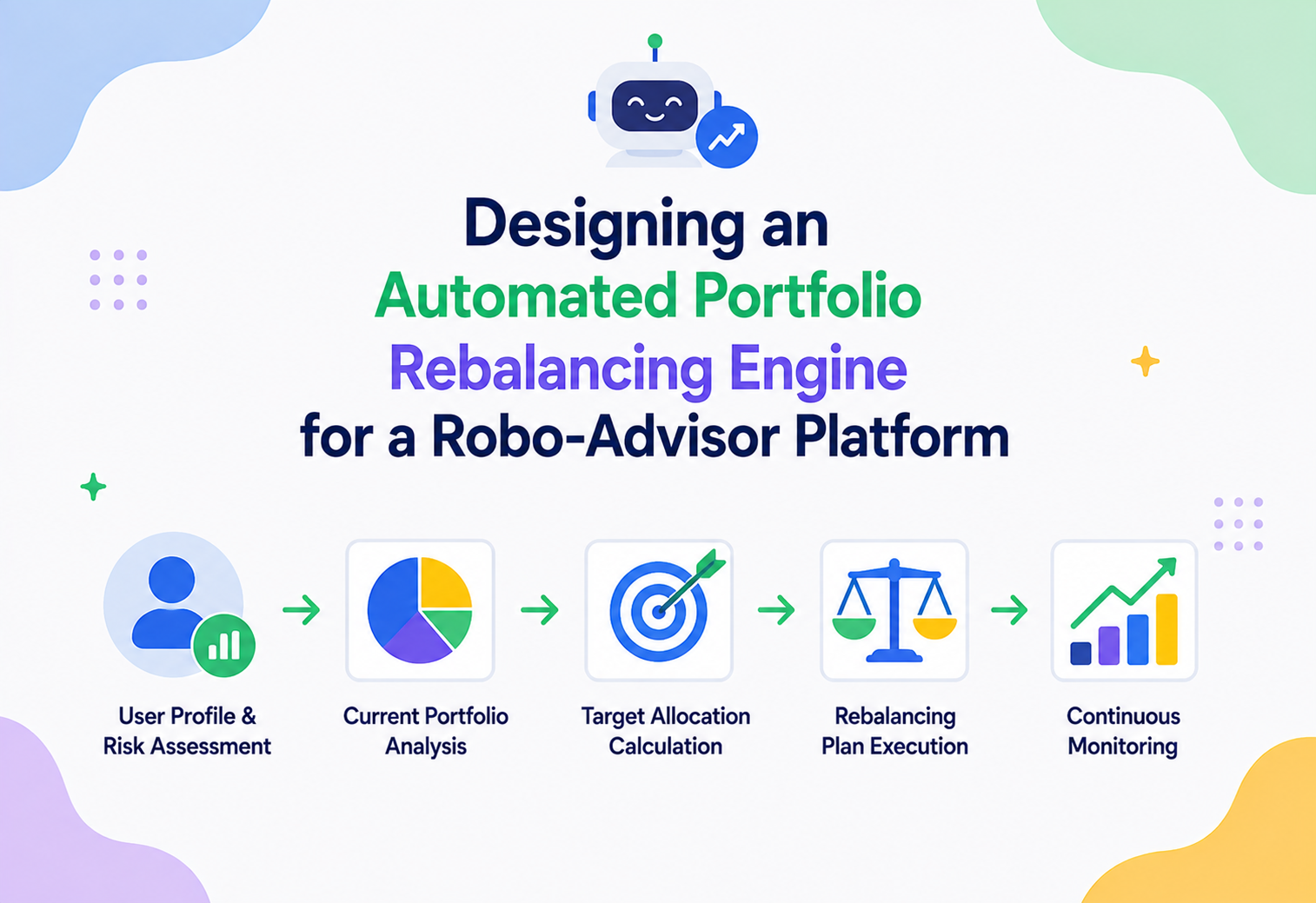
Automated Portfolio Rebalancing Engine for Robo-Advisors
A deep, production-grade system design walkthrough — architecture, data flow, scaling to millions of accounts, tax-aware trading, order netting, and interview-ready trade-off discussions. Threshold-driven rebalancing at retail scale, without the transaction costs eating the alpha.
Introduction & History
A robo-advisor is a platform that manages a customer’s investment portfolio automatically, using software instead of a human financial advisor. When a customer signs up, they answer questions about their goals, time horizon, and risk tolerance. Based on those answers, the platform assigns them a target allocation — for example, “60% stocks, 30% bonds, 10% cash.” Over time, as markets move, the actual mix drifts. If stocks rally, the stock portion grows past 60%, quietly increasing the customer’s risk beyond what they signed up for. Rebalancing is the process of buying and selling assets to bring the portfolio back in line with its target.
Doing this for one account by hand is trivial — an advisor sells a bit of the overweight asset and buys the underweight one. Doing it automatically, correctly, and cheaply for millions of accounts, each with a different target allocation, a different tax situation, and different cash flows happening at different times, is a genuinely hard distributed systems and financial engineering problem. This is the system we are going to design.
A Brief History of the Problem
Pre-2010
Institutional rebalancing on fixed schedules
Pension funds and mutual funds rebalanced on fixed schedules for decades, usually manually or with simple batch scripts — because they managed one large pooled portfolio, not millions of individually customized ones.
Early 2010s
First-wave consumer robo-advisors
A specific promise: give ordinary retail investors the same disciplined, low-cost, algorithmic portfolio management institutions had — but automated end to end and priced as a low annual fee instead of a percentage taken by a human.
Mid-2010s
Engineering pivot: continuous drift + tax-awareness
Platforms began evaluating drift on every account continuously, respecting each customer’s tax situation, and executing possibly millions of small trades through real brokerage infrastructure — without transaction costs eating the value created.
Today
Bank + brokerage adoption
The space now includes not just startups but also the wealth-management arms of large banks and brokerages, all running some version of the engine described here.
Portfolio rebalancing itself is an old idea in institutional finance — pension funds and mutual funds have rebalanced on fixed schedules for decades, usually manually or with simple batch scripts, because they manage one large pool of money rather than millions of individually customized ones. The shift began in the early 2010s when the first wave of consumer robo-advisors launched with a specific promise: give ordinary retail investors the same disciplined, low-cost, algorithmic portfolio management that institutions had, but automated end to end and priced as a low annual fee instead of a percentage taken by a human advisor.
That promise forced a hard engineering pivot. Instead of rebalancing one portfolio a few times a year, these platforms needed a system that could evaluate the drift of every single customer account continuously, decide independently for each one whether and how to trade, respect that customer’s specific tax situation and constraints, and then execute possibly millions of small trades through real brokerage and exchange infrastructure — without the transaction costs eating up the value being created. This is what turned rebalancing from a financial planning exercise into a serious systems design problem, and it is why the space now includes not just startups but also the wealth management arms of large banks and brokerages, all running some version of the engine described in this article.
This tutorial designs the system end to end: how drift is detected, how trading decisions are made per account, how orders from millions of accounts are safely and efficiently netted and routed to real markets, and how the whole pipeline stays correct, auditable, and available at scale.
Architecture & Components
At a high level, the system is a pipeline: it ingests market data and account state, computes drift for every account, decides what trades are needed, aggregates those trades intelligently, and sends them to the market. Each stage is its own service so that the system can scale each concern independently and fail gracefully in isolation.
Core Components
API Gateway
The single entry point for client apps and internal callers. Handles routing, rate limiting, TLS termination, and forwards authenticated requests to the right backend service.
Auth & Identity Service
Verifies who is calling — a customer, an internal scheduler, or a support agent — and what they’re allowed to do. Every downstream service trusts a signed token issued here rather than re-checking credentials.
Goal & Risk Profile Service
Stores each customer’s investment goals, risk tolerance answers, and constraints such as excluded sectors or ESG preferences.
Target Allocation Engine
Translates a risk profile into a concrete target allocation — a set of asset classes and weights, e.g. 45% US equities, 20% international equities, 25% bonds, 10% cash.
Market Data Service
Ingests real-time and end-of-day prices for every security the platform holds, from one or more market data vendors.
Portfolio Valuation Service
Combines each account’s current holdings with live prices to compute its current market value and current allocation weights.
Drift Detection Engine
Compares current weights to target weights for every account and flags accounts whose drift exceeds a tolerance band.
Tax Optimization Service
Evaluates tax consequences of candidate trades — realized gains, losses, wash-sale risk — and can suggest tax-loss harvesting trades or substitute securities.
Rebalancing Decision Engine
The brain of the system. Given drift, tax constraints, cash flows (deposits, withdrawals, dividends), and account-specific rules, it decides exactly which buy and sell orders to generate for an account.
Order Management System
Tracks the full lifecycle of every order from creation to fill or cancellation, and is the system of record for “what did we try to trade.”
Order Netting Service
Aggregates orders across many accounts for the same security so the platform trades in efficient batch sizes instead of millions of tiny individual orders.
Smart Order Router
Decides how and where to route the netted orders — which venue, what order type, and how to slice a large order over time to minimize market impact.
Broker & Exchange
The layer that actually talks to brokers, clearing firms, or exchanges using protocols like FIX, and manages execution confirmations.
Position & Ledger Service
The authoritative record of what every customer owns, their cost basis, and their cash balance. Every fill updates this ledger.
Notification Service
Tells customers what happened — a rebalance occurred, a trade was made, and why — for transparency and regulatory disclosure.
Event Streaming Bus
A backbone (typically Kafka or similar) that lets services communicate asynchronously and lets audit, reporting, and analytics systems consume the same stream of truth.
“Why not just have one monolithic rebalancing service that does everything?” A good answer: the concerns have very different scaling and failure characteristics. Drift detection is an embarrassingly parallel batch computation over millions of accounts; order netting and execution is a low-latency, strictly-ordered, regulated workflow that must never double-submit a trade. Coupling them means a bug in notification logic can block trade execution, and it makes it impossible to scale the drift-detection fleet independently from the brokerage connectivity fleet, which is usually rate-limited by the broker itself.
Internal Working
The most interesting engineering happens inside the Drift Detection Engine and the Rebalancing Decision Engine. This section walks through exactly how a single account is evaluated and turned into orders.
Step 1: Drift Calculation
For every account, the system knows the target weight for each asset class (from the Target Allocation Engine) and the current market value of each holding (from the Portfolio Valuation Service). Drift for an asset class is simply the difference between its current weight and its target weight. The system does not react to every tiny drift, because that would generate excessive trading and tax events for negligible benefit. Instead, it uses tolerance bands — commonly a relative band (for example, trade if an asset class is more than 20% away from its own target, so a 20% target could drift to 24% before triggering) combined with an absolute band (for example, trade only if the dollar amount out of tolerance exceeds $500) so that small accounts are not repeatedly nickel-and-dimed by trading costs.
Step 2: Trade Decision
Once an account is flagged, the Rebalancing Decision Engine determines the actual trades needed to bring every asset class back within tolerance, not just to the exact target — this avoids needless over-trading. It also considers pending cash: if the customer has a fresh deposit sitting uninvested, the engine prefers to use that cash to buy underweight assets rather than selling overweight ones first, since buying doesn’t trigger a taxable event and selling does.
Step 3: Tax-Aware Adjustments
Before finalizing sell orders, the engine checks whether selling a particular lot would realize a gain or a loss, and in what order lots should be sold (commonly highest-cost-basis-first, to minimize realized gains). It also checks for tax-loss harvesting opportunities — selling a security at a loss to offset gains elsewhere, while immediately buying a similar but not “substantially identical” security to preserve the portfolio’s market exposure. This immediately raises a wash-sale risk check, since tax law disallows claiming a loss if a substantially identical security is repurchased within 30 days.
Step 4: Order Generation and Queuing
The engine emits a list of intended trades for the account, each tagged with account ID, security, side, quantity or dollar amount, urgency, and the tax lot(s) involved. These are not sent to the market immediately — they are queued for the netting stage.
Step 5: Netting
If ten thousand accounts all need to sell a few shares of the same index fund, the platform does not submit ten thousand tiny orders. It aggregates them into one large net order per security per trading session, executes it once at a better average price, and then allocates the executed shares back to each account proportionally at the same average fill price. This is critical to making the whole system economically viable at scale.
“How do you fairly allocate a single netted execution back to thousands of individual accounts, especially if the order fills in multiple partial pieces at different prices?” The standard answer is average-price allocation: the system computes the volume-weighted average price of the entire net order’s execution, and every account participating in that order is filled at that same average price, in proportion to the quantity it requested. This is both fair and simple to reconcile, and it’s the same technique institutional trading desks use for block trades.
Step 6: Algorithms Behind Netting and Allocation
The netting stage is essentially a bucketing and aggregation problem, but the details matter at scale. As each account’s proposed orders arrive on the event bus, a stream-processing job groups them into an in-memory hash map keyed by security identifier, incrementing running buy and sell totals for that security. Once the batching window closes (typically a short, fixed interval, or a size-based trigger such as “close this batch once 50,000 orders have accumulated”), the system computes, for each security, the net quantity to buy or sell after crossing internal buys against internal sells. This is a linear-time streaming aggregation — O(n) in the number of proposed orders — which is why it scales comfortably even at millions of orders per batch.
Allocation back to accounts after a fill uses a deterministic, auditable pro-rata algorithm: each account’s share of the net order is proportional to its requested quantity divided by the total requested quantity for that security, multiplied by the total filled quantity. Because share counts must be whole numbers, the system uses a largest-remainder rounding method so that the sum of all allocated shares exactly equals the total filled shares, with no orphaned fractional shares left unaccounted for. This rounding step is deceptively easy to get wrong, and a common bug source is allocating using simple truncation, which systematically leaves a small residual of shares unassigned to any account.
“Two thousand accounts want to buy a total of 10,000.6 shares of a fund, but only whole shares can be allocated. How do you handle the leftover fraction?” A clean answer: allocate whole shares by proportional share first, then distribute any single leftover share (or route the fractional residual to cash, if the platform supports fractional share ownership, which many robo-advisors do) using a stable, deterministic tie-breaking rule such as largest-remainder-first, so that the process is reproducible and auditable rather than arbitrary.
Data Flow & Lifecycle
It helps to trace one full cycle end to end, from a price tick arriving in the system to a customer’s ledger reflecting a completed trade.
Triggers for a Rebalance Cycle
A rebalance evaluation for an account can be triggered by several distinct events, and a well-designed system treats all of them as inputs into the same drift-checking pipeline rather than building separate one-off code paths for each:
Scheduled batch runs
A daily or intraday sweep that checks every account’s drift, typically run after market close when prices are settled, or periodically intraday for large accounts.
Cash flow events
A deposit, withdrawal, or dividend payment changes an account’s cash position and is a natural moment to invest new cash or fund a withdrawal in a tax-efficient way.
Market volatility events
A large, sudden market move can push many accounts out of tolerance simultaneously; the system needs to detect this without triggering a self-inflicted denial-of-service on its own trading pipeline.
Customer-initiated changes
If a customer updates their risk profile, their target allocation changes immediately, which likely creates drift against the new target.
Lifecycle of an Order
Every order the system generates moves through a well-defined state machine: Proposed (generated by the Rebalancing Decision Engine, not yet committed) → Queued (accepted into the netting batch) → Netted (combined into an aggregate order) → Submitted (sent to the broker) → Partially Filled or Filled → Allocated (proportionally assigned back to source accounts) → Settled (ownership and cash officially transferred, typically one to two business days later) → Ledger Updated. An order can also transition to Rejected or Cancelled at several points, and the OMS must be able to answer, at any moment, exactly which state every order is in, because this state machine is what regulators and customer support will audit.
A large US robo-advisor publicly describes rebalancing as an ongoing, continuous background process rather than a single daily job — its system checks portfolios throughout the trading day and only acts when drift crosses its threshold, explicitly to avoid unnecessary trading costs and tax consequences for customers. This event-driven, threshold-based design is exactly the pattern modeled in Figure 2 above.
Advantages, Disadvantages & Trade-offs
Advantages
- Removes emotional, reactive decision-making from investing — the system trades on rules, not fear or greed.
- Scales personalized portfolio management to millions of customers at a fraction of the cost of human advisors.
- Consistent, auditable, and repeatable — every trade can be traced back to a specific rule and data snapshot.
- Order netting reduces transaction costs far below what any individual account could achieve alone.
- Tax-aware logic (loss harvesting, lot selection) can materially improve a customer’s after-tax returns.
Disadvantages / Challenges
- Extremely unforgiving of bugs — a miscalculated drift or a duplicate order submission touches real money and is a regulatory incident, not just a rollback.
- Requires deep integration with brokers, custodians, and clearing firms, each with their own quirks, rate limits, and downtime windows.
- Tax logic (wash sales, lot accounting) is jurisdiction-specific and legally complex, and mistakes have direct financial and compliance consequences for customers.
- Netting and batching introduce a tension between execution efficiency and per-customer responsiveness.
- Market volatility can create thundering-herd load exactly when the system most needs to be reliable.
Key Trade-offs
| Trade-off | Option A | Option B | Typical Choice |
|---|---|---|---|
| Rebalance frequency | Continuous / intraday checking | Scheduled daily or periodic batch | Hybrid: daily batch plus threshold-triggered intraday checks |
| Order execution | Trade every account individually | Net and batch across accounts | Netting, for cost efficiency at scale |
| Tolerance bands | Tight bands, precise tracking | Wide bands, fewer trades | Wide enough to minimize cost and tax drag, tight enough to control risk |
| Consistency model | Strong consistency on positions | Eventual consistency on analytics | Strong consistency for ledger, eventual for dashboards and reporting |
| Tax optimization | Maximize tax efficiency | Maximize allocation precision | Prioritize tax efficiency when both can’t be fully satisfied |
“If tight tolerance bands keep portfolios closer to target, why not just use tight bands everywhere?” The answer is that every rebalancing trade has a cost — trading fees, bid-ask spread, market impact, and potential tax on realized gains — and academic and industry research consistently shows that beyond a certain point, tighter bands produce diminishing risk-reduction benefit while costs keep climbing linearly. The system is optimizing for risk-adjusted, after-cost, after-tax return, not for minimizing drift as a number in isolation.
Performance & Scalability
Consider the target scale: tens of millions of accounts, each holding a handful to a few dozen securities, needing drift evaluation at least daily and ideally continuously, with the ability to burst-process during volatile market days when a large fraction of accounts breach tolerance simultaneously.
Partitioning the Drift Evaluation Workload
The drift-checking job is embarrassingly parallel — evaluating account A’s drift has zero dependency on evaluating account B’s drift. This makes it a natural fit for horizontal sharding: accounts are partitioned (commonly by a hash of account ID) across many worker pools, each independently pulling a batch of accounts, computing valuation and drift, and emitting events for any that breach tolerance. This lets the platform scale drift evaluation linearly by adding worker nodes, and different partitions can be processed by workers in different regions to reduce latency to regional data stores.
Handling Volatility Spikes
On a day when the market drops sharply, a large fraction of accounts can breach tolerance within minutes of each other. A naive system would try to trade all of them immediately, overwhelming broker connectivity and worsening execution prices for everyone through market impact. The production approach is to introduce a priority queue and rate-limited execution windows: the system still detects all breaches promptly, but the Smart Order Router paces submission of netted orders in controlled batches, and can prioritize accounts by how far out of tolerance they are or by other business rules, rather than trying to execute everything in the same instant.
Caching and Precomputation
Recomputing an account’s full valuation from raw transaction history on every check is wasteful. Instead, the system maintains a continuously updated cached valuation per account, incrementally adjusted on each price tick or transaction, and only falls back to full recomputation for reconciliation or after a detected inconsistency. Target allocations, which change infrequently, are cached aggressively and invalidated only when a customer’s profile changes.
Large-scale brokerage and wealth platforms process on the order of tens of millions of retail brokerage accounts and must run valuation and monitoring computations across that entire base efficiently every trading day, which is precisely the kind of embarrassingly parallel, shard-and-batch workload described above.
“How would you estimate throughput requirements for this system?” Walk through the math out loud: say 20 million accounts, each needing a drift check once per day, spread over a 6.5-hour trading window plus an after-hours batch window. That’s roughly 20 million ÷ 23,400 seconds ≈ 850 evaluations per second sustained, but you must design for peak bursts (market open, market close, and volatility events) at 5 to 10 times that baseline, so the system should comfortably handle on the order of 5,000 to 10,000 evaluations per second at peak, which is achievable with a modestly sized, horizontally scaled worker fleet.
Concurrency and Consistency Considerations
Because many workers evaluate different accounts in parallel, but a single account must never be evaluated by two workers at once (which could generate two conflicting sets of trades), the coordinator assigns accounts to workers using consistent hashing with ownership leases. Each worker acquires a time-bound lease on its partition of accounts before processing them; if a worker crashes mid-batch, its lease expires and another worker safely picks up the same partition, rather than two workers racing to process the same accounts simultaneously. This lease-based ownership model is the same pattern used by distributed job schedulers and is preferable to a full distributed lock per account, which would add unnecessary coordination overhead given that account partitions rarely need to be reassigned mid-cycle.
Within the ledger itself, the system relies on database-level row locking and optimistic concurrency control (a version number or timestamp checked on update) to prevent two concurrent writers — for example, a fill confirmation arriving at the same moment as a customer-initiated withdrawal — from corrupting an account’s position. A failed optimistic check simply causes the losing writer to retry against the freshest state, rather than silently overwriting a concurrent change.
CAP Theorem in Practice
The system does not make one single CAP theorem trade-off; different subsystems deliberately sit in different places on the spectrum. The ledger favors consistency over availability during a network partition — if the primary ledger shard becomes unreachable, the system pauses writes to that shard rather than accepting writes against stale data and risking an incorrect balance, because an incorrect financial balance is a worse outcome than a brief unavailability window. The drift-detection and valuation-caching layers, by contrast, favor availability: if a particular price feed is momentarily degraded, the system continues serving the last known good valuation (clearly marked as potentially stale) rather than blocking the entire dashboard experience for millions of customers over one delayed data point.
“Where in this system would you accept eventual consistency, and where would you refuse to?” A strong answer draws a clear line: anything that determines legal ownership of money or securities — the ledger, order state, cash balances — must be strongly consistent, because customers and regulators need a single unambiguous answer to “what do I own right now.” Anything that’s advisory or informational — a dashboard chart, a notification, an analytics aggregate — can be eventually consistent, because a few seconds of staleness there has no legal or financial consequence.
High Availability & Reliability
This system touches real customer money, so reliability requirements are stricter than for a typical consumer application. Two failure modes are unacceptable: silently failing to rebalance an account that needed it (customer risk exposure drifts unnoticed), and duplicating a trade (customer is charged or exposed twice).
Idempotency Everywhere
Every order carries a unique idempotency key derived from the account, the rebalance cycle, and the intended trade. If the Order Management System crashes and retries after a network timeout to the broker, it must be able to check “did this exact order already get submitted?” before submitting again. This is arguably the single most important reliability property in the entire system, because network partitions between the OMS and broker connectivity are a certainty at this scale, not an edge case.
Exactly-Once Effects via At-Least-Once Delivery
True exactly-once delivery across a network is not achievable in the general case, so the system instead guarantees at-least-once delivery of events combined with idempotent processing at the consumer, which together produce the effect of exactly-once execution. The event bus (Kafka or equivalent) persists every drift-breach and order event durably, and downstream consumers use the idempotency key to deduplicate.
Circuit Breakers and Graceful Degradation
If the Market Data Service degrades or a broker connection becomes unhealthy, the system must fail safe, not fail open. A circuit breaker in front of the broker gateway stops sending new orders once error rates spike, queues them durably instead, and alerts operators — rather than continuing to fire orders into a broken connection and losing track of their true state. Similarly, if valuation data becomes stale beyond a defined threshold, the Drift Detection Engine should refuse to generate new trades from stale data rather than trading on bad information.
Disaster Recovery
Position and ledger data is replicated across regions with a defined recovery point objective and recovery time objective. Because this data represents legal ownership of securities, replication favors strong consistency for the ledger’s primary writes, with asynchronous cross-region replication for disaster recovery, and a documented failover runbook that includes reconciliation against the broker’s and custodian’s own records before resuming trading after any failover.
Write-ahead order state; reconcile ambiguous orders on recovery
Context: Network partitions between the OMS and the broker are certain at this scale. Blindly retrying an in-flight order after a crash produces duplicate trades — a hard regulatory incident.
Decision: Persist an order’s submitted state durably before the network call to the broker (write-ahead). On recovery, any order left in an ambiguous state is reconciled against the broker’s own order-status API before any retry.
Consequences: One extra durable write on the happy path and a mandatory broker round-trip on the recovery path, in exchange for zero duplicate submissions when things go wrong.
“What happens if the system crashes right after submitting a net order to the broker but before recording that submission?” This is the classic ‘did I actually send it’ problem. The correct design writes an order to a durable, persisted ‘submitted’ state before making the network call to the broker (write-ahead, not write-after), and on recovery, reconciles against the broker’s own order status API for any order left in an ambiguous state, rather than blindly retrying and risking a duplicate.
Security
This platform sits at the intersection of personal financial data, brokerage credentials, and automated money movement, which makes it a high-value target and subject to strict regulatory oversight.

Key Security Controls
Strong authentication & authorization
Multi-factor authentication for customers, and fine-grained role-based access control internally so that, for example, a customer support agent can view an account but cannot trigger trades.
Least privilege for services
Each internal service has narrowly scoped credentials — the Notification Service, for instance, has no ability to call the broker gateway, limiting blast radius if it is compromised.
Encryption in transit & at rest
All internal and external traffic uses TLS; sensitive data such as account numbers, tax identifiers, and brokerage credentials are encrypted at rest with keys managed by a dedicated key management service.
Immutable audit trail
Every trade decision, order, and fill is written to an append-only, tamper-evident audit log, since regulators and customers must be able to reconstruct exactly why a given trade happened.
Segregation of duties
No single engineer or service should be able to both generate a trade decision and approve/execute it without independent checks, mirroring controls used in traditional trading operations.
Anomaly detection on trading
Automated checks flag unusual patterns — an account generating an abnormally large number of trades, or an order size wildly out of proportion to account value — before submission, as a safety net against bugs or compromised inputs.
Secrets management
Broker API keys and FIX session credentials are stored in a secrets vault, rotated regularly, and never embedded in code or configuration files.
“How would you prevent a bug from generating a runaway series of duplicate or absurdly large trades?” Beyond idempotency keys, production systems add hard pre-trade risk checks — a final validation layer just before order submission that rejects any order exceeding sane bounds (for example, more than a defined percentage of the account’s total value, or more than a defined multiple of the account’s average trade size) regardless of what upstream logic decided. This ‘kill switch’ layer is intentionally simple and independently tested, because it’s the last line of defense against every other component’s bugs.
Monitoring, Logging & Metrics
Observability in this system serves two audiences: engineers debugging issues, and compliance/audit teams reconstructing exactly what happened and why for any given account and trade.
What to Monitor
- Pipeline health metrics: Accounts evaluated per second, drift-breach detection latency, order-to-execution latency, and queue depth at each stage of the pipeline.
- Business correctness metrics: Percentage of accounts within tolerance after each cycle, count of accounts that should have rebalanced but didn’t (a critical alerting metric), and average time an account spends out of tolerance.
- Financial reconciliation metrics: Daily comparison of the platform’s internal ledger against the broker’s and custodian’s records, with automatic alerting on any discrepancy, however small.
- Broker connectivity health: Order rejection rates, FIX session uptime, and execution latency per venue.
- Distributed tracing: Every order carries a trace ID from the moment drift is detected through to settlement, so any single trade can be traced across every microservice it touched.
Logging and Auditability
Structured logs are correlated with the same trace ID and account ID across all services, and are shipped to a centralized, immutable log store. Because financial regulators require the ability to explain any trade years later, logs relevant to trade decisions are retained for extended periods (often seven years or more, depending on jurisdiction) rather than the shorter retention typical of general application logs.
Financial platforms typically run daily automated reconciliation jobs that compare their internal position and cash ledgers line-by-line against the official records held by their custodian or clearing firm, and treat any unexplained discrepancy — even a single cent — as a page-worthy incident, since small unexplained mismatches are often the first visible symptom of a much larger underlying bug.
“What’s the single most important alert in this whole system?” A strong answer: the reconciliation mismatch alert between the internal ledger and the broker/custodian’s records. Almost every serious failure mode in a trading system — duplicate orders, missed fills, calculation bugs, race conditions — eventually shows up as a discrepancy there, making it a high-signal catch-all safety net even when you haven’t anticipated the specific bug.
Deployment & Cloud
The system is deployed as a set of independently deployable microservices, typically containerized and orchestrated with Kubernetes, spread across multiple availability zones within a primary cloud region and replicated into a secondary region for disaster recovery.
Deployment Practices
- Blue-green or canary releases: Especially for the Rebalancing Decision Engine and Order Management System, changes are rolled out to a small percentage of traffic first, with automated rollback if error rates or business-metric anomalies appear, since a bad deploy here has direct financial consequences.
- Infrastructure as code: The entire environment — networking, service definitions, scaling policies, secrets references — is defined declaratively and version-controlled, enabling reproducible environments and fast, auditable disaster recovery.
- Separate deployment cadence for risk-sensitive components: Trade-generation and execution logic typically goes through a slower, more rigorously reviewed release process than, say, the notification service, reflecting the difference in blast radius.
- Market-hours-aware deployment windows: Changes to trading-critical services are generally deployed outside active trading hours where possible, to reduce the risk of an in-flight deployment interacting badly with live order flow.
Cloud Considerations
Because this is a regulated financial system, cloud deployment must account for data residency requirements (customer financial data often must stay within a specific country or region), and for auditors’ ability to review infrastructure configuration. Multi-region active-passive deployment is more common than active-active for the core ledger, since the added complexity of active-active conflict resolution for financial ledgers is rarely worth the availability gain compared to a well-tested failover process.
Deploy stateless workers active-active for latency; keep the ledger active-passive with a single source-of-truth region. Reconciling two independently-writing ledgers after a partition is a much harder problem than accepting a short failover window during a rare regional outage.
“Would you run this system active-active across two regions?” A thoughtful answer distinguishes between components: stateless services like the API gateway or drift-calculation workers can absolutely be active-active for better latency and availability. The ledger and order management system, however, are usually kept active-passive with a single source of truth region at any moment, because reconciling two independently-writing ledgers after a network partition is a much harder and riskier problem than accepting a short failover time during a rare regional outage.
Databases, Caching & Load Balancing
Database Choices
| Data | Access Pattern | Typical Store |
|---|---|---|
| Account & profile data | Read-heavy, moderate write, strong consistency | Relational database (sharded by account ID) |
| Position & ledger | Write-critical, strict consistency, auditable | Relational database with strong ACID guarantees, append-only transaction log |
| Market data / prices | Extremely high write throughput, time-series | Time-series database or in-memory store |
| Order events / audit trail | Append-only, high volume, replay-able | Distributed log (Kafka) with long-term archive in object storage |
| Cached valuations | Very high read throughput, short-lived freshness | In-memory cache (Redis or similar) |
Why Relational for the Ledger
It is tempting to reach for a horizontally-scalable NoSQL store everywhere for “web scale,” but the ledger specifically benefits from strong transactional guarantees: moving shares and cash between an account’s holdings and a pending order state must be atomic, or the system risks either double-counting or losing assets during a crash mid-update. A relational database with proper transaction isolation, sharded by account ID to scale horizontally, is the standard choice here, sometimes paired with a distributed SQL system for global scale while retaining ACID semantics.
Caching Strategy
Portfolio valuations and target allocations are cached aggressively since they are read far more often than they change. The cache is updated incrementally on every price tick or transaction rather than fully recomputed, and a background reconciliation job periodically recomputes from source-of-truth data to catch and correct any cache drift — an important safety net, since a stale or incorrect cached valuation could otherwise silently trigger an incorrect trade.
Load Balancing
Stateless services (API gateway, valuation, drift detection) sit behind standard load balancers distributing traffic across many instances. The harder load-balancing problem is on the job-distribution side: the coordinator distributing account-evaluation work across worker pools uses partition-aware, consistent-hash-based assignment so that the same worker consistently owns the same accounts within a run, which simplifies caching and avoids redundant computation across workers.
“Would you use a NoSQL database for the position ledger to get better write scalability?” Push back gently: raw write throughput usually isn’t the bottleneck for a ledger — correctness under concurrent updates is. The stronger design is to keep the ledger relational and horizontally shard it by account ID (since almost all ledger operations are scoped to a single account), which gives you both the scalability you need and the transactional guarantees you can’t safely give up.
APIs & Microservices
API Design Principles
- Command-query separation: Endpoints that read state (get current allocation, get drift status) are separated from endpoints that trigger actions (initiate rebalance evaluation), so reads can be scaled and cached independently of the more sensitive write path.
- Asynchronous by default for trading actions: A request to rebalance an account does not synchronously wait for a trade to execute; it returns immediately with a tracking identifier, and the client polls or subscribes for status, since real trade execution can take from milliseconds to days (for illiquid securities or market closures) to settle.
- Versioned, backward-compatible contracts: Because this system integrates with external brokers and internal services with independent deploy cycles, APIs are explicitly versioned, and breaking changes go through a deprecation window rather than an immediate cutover.
- Idempotency keys on every mutating endpoint: As discussed under reliability, every action that can move money or submit a trade accepts a client-supplied idempotency key.
Internal Microservice Communication
Synchronous request/response (typically gRPC or REST) is used where an immediate answer is needed, such as the API gateway calling the Auth service. Asynchronous event-driven communication (through the event bus) is used for the core rebalancing pipeline itself, because it decouples the pace of drift detection from the pace of order execution, and naturally supports replay — if the Rebalancing Decision Engine needs to be redeployed with a bug fix, it can reprocess the backlog of drift-breach events once it’s back online, rather than losing them.
“Why event-driven instead of a synchronous call chain from drift detection straight through to order submission?” A synchronous chain means every service in the chain must be available and fast at the same moment, and a slowdown anywhere cascades backward and can back up the entire drift-evaluation fleet. An event-driven design lets each stage process at its own sustainable rate, buffer bursts durably, and be deployed, scaled, and recovered independently — critical properties when one stage (broker connectivity) is inherently rate-limited by an external party you don’t control.
Design Patterns & Anti-Patterns
Patterns Used
Event Sourcing
The order and ledger state is derived from an append-only sequence of events (order proposed, submitted, filled, settled), which gives a natural audit trail and the ability to replay history for debugging or regulatory inquiry.
Saga Pattern
A rebalance is a multi-step process spanning several services (decision, netting, execution, ledger update) that must either complete correctly or be compensated. If execution fails after netting, the saga’s compensating action un-nets and returns the account to “pending re-evaluation” rather than leaving it in limbo.
Circuit Breaker
As discussed, protects the system from cascading failure when the broker connection or market data feed degrades.
Bulkhead
Resource pools (thread pools, connection pools) for different downstream dependencies are isolated from each other, so that a slow market-data vendor cannot starve the thread pool needed to process broker fills.
Command Query Responsibility Segregation
Read-heavy valuation and dashboard queries are served from a separate, denormalized read model, kept eventually consistent with the write-optimized ledger, so read load never competes with the ledger’s transactional write path.
Anti-Patterns to Avoid
Triggering a rebalance check for every account via a synchronous loop in one process is a scalability dead end and a single point of failure; it should be a distributed, partitioned, resumable job.
Using a stale cached valuation to generate a trade without verifying its age can produce trades based on prices that are no longer accurate, especially during volatile markets.
If a netted order for 5,000 accounts partially fails, silently proceeding as if it fully succeeded, without reconciling exactly which accounts were and weren’t filled, leaves the ledger in an inconsistent, undetected state.
Hardcoding jurisdiction-specific tax rules directly into the general rebalancing algorithm makes the system brittle as tax law changes or as the platform expands to new markets; tax logic should be a pluggable, independently testable module.
Deferring idempotency guarantees as a later optimization is a common and costly mistake in trading systems, since the very first production network timeout can produce a duplicate trade.
“Where specifically would you apply the Saga pattern here, and what does compensation look like?” A concrete answer: the saga spans ‘orders netted’ → ‘orders submitted to broker’ → ‘fills confirmed’ → ‘ledger updated.’ If the broker rejects the net order after netting has already reserved those accounts’ intent (so they’re excluded from the next cycle’s evaluation to avoid double-counting), the compensating action releases that reservation and re-queues the affected accounts for immediate re-evaluation, rather than leaving them silently un-rebalanced until the next scheduled cycle.
Best Practices & Common Mistakes
Best Practices
- Always compute and log the “reason” for every trade decision alongside the trade itself — not just what was traded, but why (which asset class was out of tolerance, by how much, and what tolerance rule fired).
- Treat the pre-trade risk check as a separate, independently owned safety layer, never merged into the main decision logic, so it can catch bugs in that very logic.
- Design tolerance bands and trading rules to be configurable per account tier or product, since a taxable individual account and a tax-advantaged retirement account often warrant different rebalancing aggressiveness.
- Build a dry-run / simulation mode into the Rebalancing Decision Engine so new logic can be validated against historical or live data without ever reaching order submission.
- Reconcile against external sources of truth (broker, custodian) daily, automatically, and treat any mismatch as an incident, not a background task.
Common Mistakes
- Rebalancing too frequently with overly tight tolerance bands, quietly eroding customer returns through excessive trading costs and avoidable taxable events.
- Failing to account for pending, unsettled trades when calculating an account’s current position, leading to “double counting” a security that’s already been sold but hasn’t settled yet.
- Not modeling minimum trade sizes or odd-lot restrictions, generating orders that brokers reject, silently stalling a customer’s rebalance.
- Underestimating the operational load of wash-sale tracking, which requires looking not just at trades within this system but sometimes across a customer’s other linked accounts.
- Treating market data as always reliable, without validating for stale, erroneous, or out-of-range price ticks before using them to trigger trades.
Robo-advisor platforms commonly describe using threshold-based rebalancing specifically to keep trading costs and tax impact low, rather than rebalancing on a rigid fixed calendar schedule regardless of need — reflecting the industry’s collective experience that naive, frequent rebalancing quietly destroys customer value.
Real-World Industry Examples
Several types of organizations have built systems resembling the one described here, each shaped by their own scale and regulatory context.
Independent robo-advisor platforms
Built rebalancing as a core, always-on background process from day one, since it is central to their entire product promise, and have publicly discussed threshold-based, tax-aware approaches similar to what’s described in this tutorial.
Brokerage-integrated advisory products
Large retail brokerages that added automated advisory products on top of their existing brokerage infrastructure had to integrate rebalancing logic with pre-existing, high-volume order management and clearing systems originally built for manual and self-directed trading, requiring careful compatibility work rather than a clean-slate design.
Institutional asset managers
Manage rebalancing for pooled funds (mutual funds, ETFs) at massive scale but for far fewer distinct “portfolios” than a retail robo-advisor, since thousands of investors in a mutual fund all share the same underlying target allocation — a fundamentally simpler netting problem than millions of individually customized retail accounts.
Bank-affiliated wealth management arms
Combine robo-style automated rebalancing with human advisor oversight for higher-net-worth accounts, requiring the system to support a “human approval gate” workflow state that a pure robo-advisor doesn’t need.
FAQ, Summary & Key Takeaways
Why not rebalance every account to its exact target every single day?
Every trade has a cost — commissions, bid-ask spread, market impact, and often a taxable event. Rebalancing to exact precision daily would generate enormous unnecessary trading costs and tax drag for a negligible risk-management benefit, since staying within a reasonable tolerance band already controls risk effectively.
What happens if two triggers (a cash deposit and a scheduled batch check) fire for the same account at nearly the same time?
The system serializes rebalance evaluations per account, typically using a per-account lock or a partition-ordered queue keyed by account ID, so that two triggers for the same account can’t produce conflicting, simultaneously-generated trade decisions.
How does netting work when some accounts want to buy and others want to sell the same security?
The netting service nets buy and sell quantities against each other first — internal crossing — reducing the actual market order size and, where regulations permit, avoiding the spread cost entirely for the internally crossed portion; only the residual imbalance is sent to the market.
Is this system real-time or batch?
It’s best understood as a hybrid: continuous, event-driven detection of drift and cash-flow triggers, feeding into rate-limited, batched execution — real-time on the decision side, deliberately batched on the execution side for cost efficiency and market-impact control.
Summary
The core problem is running a personalized rebalancing decision for millions of independent portfolios while executing trades efficiently in aggregate. The whole architecture — drift bands, tax-aware decisions, order netting, event-sourced state, strong-consistency ledger — is a set of coordinated answers to that one tension: individual decision, batch execution.
Bands, not exact targets
Tolerance bands turn what would be constant nickel-and-dime trading into a small number of high-value moves per account per year.
Net, don’t fire individually
Aggregate across accounts before hitting the market. Allocate back pro rata at the same average price.
Idempotency + write-ahead + reconcile
These three together turn “did I send it?” from a scary open question into a bounded, auditable one.
Strong for money, eventual for charts
Ledger and orders are strict; dashboards and analytics get to be seconds stale.
Key Takeaways
- The core problem is running a personalized rebalancing decision for millions of independent portfolios while executing trades efficiently in aggregate — this tension between “individual decision, batch execution” shapes the entire architecture.
- Tolerance bands, not exact-target trading, are what make the system economically sensible at scale.
- Order netting is the single biggest lever for cost efficiency, turning millions of micro-trades into a manageable number of well-priced market orders.
- Idempotency, durable event logging, and a strict order-state machine are non-negotiable — this is a domain where “eventually consistent and mostly correct” is not good enough.
- The ledger deserves strong transactional guarantees even while other parts of the system scale with eventual consistency and horizontal partitioning.
- Tax-awareness (lot selection, loss harvesting, wash-sale checks) is a genuine differentiator and a legally sensitive subsystem that deserves its own isolated, well-tested module.
- Reliability patterns — circuit breakers, sagas, bulkheads, pre-trade risk checks — exist specifically because failures here have direct financial and regulatory consequences, not just user-experience consequences.
Strong candidates don’t promise “we rebalance every account, every day, exactly to target.” They name the scarce resource (per-trade cost + tax), pick a strategy that respects it (threshold bands), defend how they scale the decision (sharded workers with leases) and the execution (netting + pro-rata allocation), and describe how the ledger stays right even when everything else fails (idempotency + write-ahead + reconciliation).