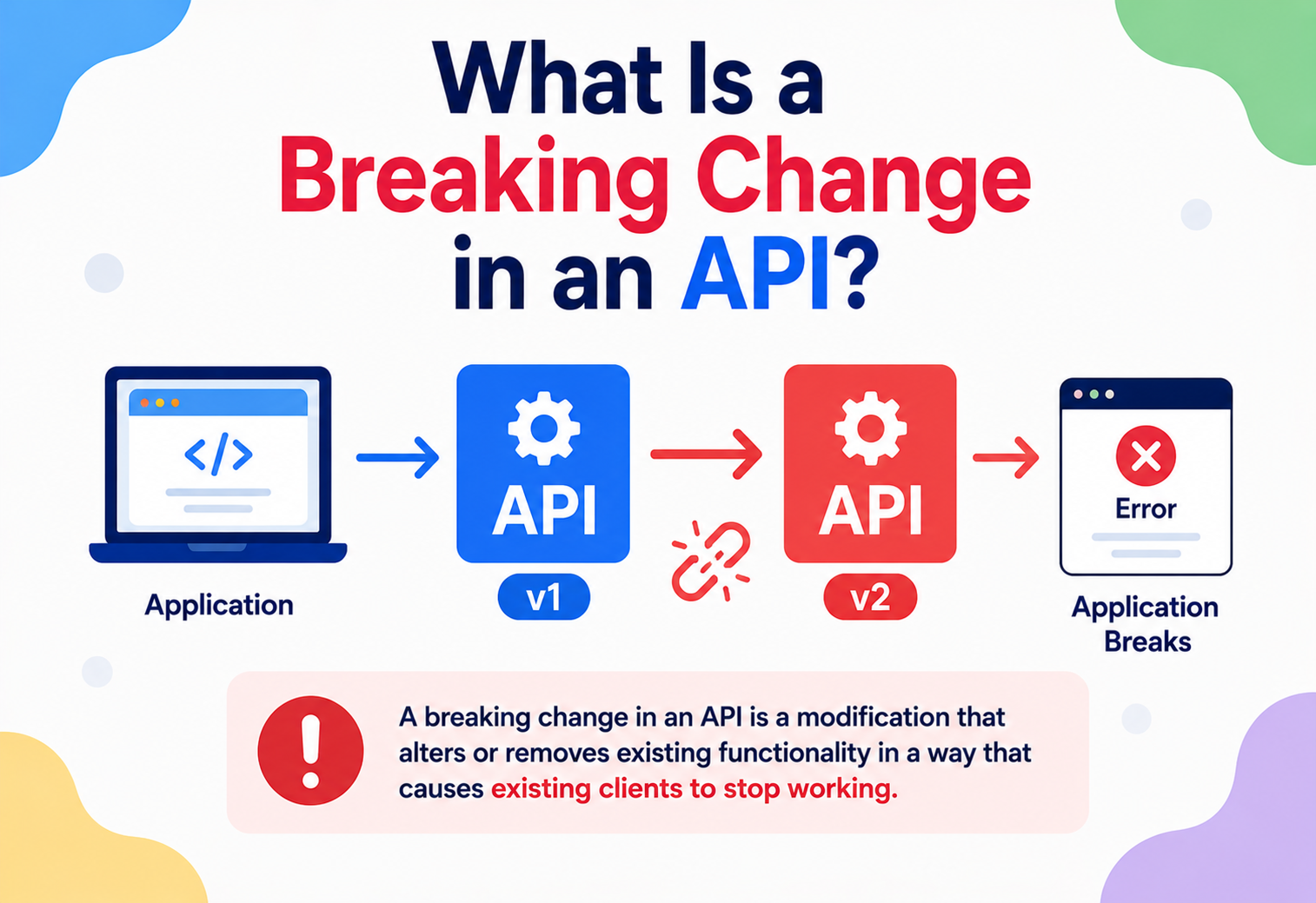
What Is a Breaking Change in an API?
A complete, beginner-to-production guide to understanding, detecting, preventing, and managing breaking changes in APIs — with real Java/Spring Boot examples, diagrams, and lessons from companies like Stripe, GitHub, and AWS.
What Is a Breaking Change in an API?
The apartment analogy: your key stops working overnight, not because you did anything wrong, but because someone changed the lock without telling you.
Imagine you rent an apartment. One day, without warning, the landlord changes the front door lock, moves the mailbox to a different street, and renumbers every room. Your key doesn’t work anymore, your mail never arrives, and you can’t find your own bedroom. Nothing about the apartment is “wrong” from the landlord’s point of view — the new layout might even be better — but from your point of view, as someone who depended on the old layout, everything just broke.
That is exactly what a breaking change is in the world of software APIs (Application Programming Interfaces). It is a change made by the people who own an API that causes the people who use that API — other developers, other services, mobile apps, partner companies — to stop working correctly, without those people doing anything wrong themselves.
A Short History of Why This Matters
In the early days of software, most programs were monoliths running on a single machine, and “integration” meant linking two pieces of code compiled together at the same time. If you changed a function’s signature, the compiler caught it immediately, and you fixed all the call sites in the same commit. There was no concept of “someone else, somewhere else, calling your code without your knowledge.”
That changed with the rise of networked systems in the 1990s and 2000s. Remote Procedure Calls (RPC), then SOAP web services, then REST APIs, then GraphQL and gRPC, all shared one new and dangerous property: the producer of an API and the consumer of that API are now separately deployed, often owned by different teams or even different companies, and often cannot be updated at the same time. Netflix’s public API, Twitter’s (now X) API, and Stripe’s payments API are consumed by thousands of independent applications that Netflix, X, and Stripe do not control and cannot force to upgrade on any particular schedule.
This is the central historical shift that makes breaking changes a first-class engineering concern: once you publish an API, you have made a promise to strangers you will never meet, and you usually cannot know when — or whether — they will be ready for you to change that promise.
1970s–80s — Monolithic Software
Compile-time linking, no network contracts — the compiler caught every mismatch inside a single codebase.
1990s — RPC and CORBA
The first remote contracts appear; producer and consumer are now tightly coupled but separately deployed.
2000s — SOAP and WSDL
Formal contracts arrive; versioning starts becoming a real engineering discipline.
2007–2010 — REST APIs Go Mainstream
Twitter, Facebook, and Google open public APIs consumed by millions of third-party developers.
2010s — Mobile Apps Everywhere
Old app versions installed on customer phones cannot be forced to update, extending the compatibility horizon indefinitely.
2015+ — Microservices and gRPC
Hundreds of internal teams depend on each other’s services, turning internal API breakage into a first-class production risk.
2020s — API-First and GraphQL
Schema evolution and deprecation become core skills every backend engineer is expected to have.
Today, whether you are building a tiny internal microservice at a startup or maintaining a public payments API used by millions of merchants, understanding breaking changes is not optional — it is one of the core skills that separates a junior API designer from a senior one.
Why “It Compiles” Is No Longer Enough
In a single codebase, the compiler is your safety net. If you rename a Java method, every caller inside the same project fails to compile, and you are forced to fix them before you can even build the project, let alone ship it. That safety net completely disappears the moment your API crosses a network boundary. A mobile app running on a customer’s phone in Mumbai, compiled against your API six months ago, has no compiler watching it. It will happily keep calling your old endpoint, sending your old field names, and parsing your old response shape — right up until the moment your server sends back something it doesn’t understand, at which point it fails in whatever way the original developer happened to write, which is very often ugly: a blank screen, a crash, or worse, silently wrong data shown to a real person.
This is the reason “breaking change” had to become a named, studied, tooled discipline rather than just common sense. Once code you don’t control depends on code you do control, across a boundary you can’t instrument with a compiler, you need an entirely different set of habits, tools, and processes to keep everyone working.
The Problem & Motivation
Why do we even need a formal concept of “breaking change”? Because every ship carries risk for someone downstream, and teams that ignore that reality either move too fast and break consumers, or move too slow and never improve.
Without a shared vocabulary and discipline around compatibility, teams either:
- Move too fast and break consumers — causing outages, angry customers, lost revenue, and emergency firefighting.
- Move too slow and never improve the API — because everyone is terrified of breaking something, so the API accumulates cruft forever.
Both failure modes are expensive. The goal of understanding breaking changes is to find the middle path: ship improvements confidently, while giving consumers a fair, predictable way to keep up.
What Happens When a Breaking Change Ships by Accident?
🧑💻 Student TODO API
A student builds a small “TODO list” REST API for a college project. The response for GET /todos/1 used to return {"id": 1, "done": false}. The student renames done to isCompleted to make it “read better.” The frontend, which reads response.done, now silently shows undefined for every todo’s status. Nothing crashes — it just quietly shows wrong information.
🏢 Twitter API v1.1
In 2012, Twitter reduced the number of tweets returned per API call and tightened rate limits as part of “API v1.1,” retiring the old v1 API. Thousands of third-party Twitter client apps — some of which had been Twitter’s earliest and most beloved ecosystem partners — broke or were forced to shut down, because the contract they depended on changed and old endpoints were switched off.
A breaking change is not always obvious from looking at the code diff. A field rename, a status code change, a stricter validation rule, or even fixing a bug that consumers had started silently depending on can all break someone in production — while looking, on paper, like a harmless cleanup.
The Core Tension: Evolution vs. Stability
Every API sits on a spectrum between two competing forces:
| Force | Pulls toward | Risk if it wins completely |
|---|---|---|
| Evolution | Fixing design mistakes, adding features, improving performance | Constant breakage, exhausted and distrustful consumers |
| Stability | Never changing existing behavior once published | API becomes ossified, technical debt piles up, innovation stalls |
Understanding what actually counts as a breaking change — and building tooling and processes around that definition — is how mature engineering organizations resolve this tension.
The Hidden Cost Curve
One of the most useful mental models here is that the cost of a breaking change grows dramatically the further it travels from the point where it was introduced. A rough, illustrative curve looks like this:
| Where the breaking change is caught | Approximate cost | Who feels the pain |
|---|---|---|
| Code review, before merge | Minutes | Just the author |
| CI contract-diff check, before merge | Minutes to hours | Just the author |
| Staging environment, before release | Hours | The team |
| Canary in production, low traffic | Hours to a day | The team, a handful of early users |
| Full production rollout, discovered by monitoring | Hours to days, plus incident response | The team, on-call engineers, some customers |
| Discovered by a customer support ticket or a public tweet | Days to weeks, plus reputational damage | The whole company, customer trust |
This is precisely why the entire second half of this article is organized around pushing detection as far left as possible — into schema definitions, CI pipelines, and contract tests — rather than relying on production monitoring or, worse, angry emails, as the primary detection mechanism.
Core Concepts
A precise vocabulary: what counts as a breaking change, the three categories of API changes, Hyrum’s Law, SemVer, backward vs. forward compatibility, and a change-by-change checklist.
3.1 What Exactly Is a “Breaking Change”?
Definition: A breaking change is any modification to an API’s contract that causes an existing, correctly-written client — one that was working fine against the previous version — to fail, misbehave, or produce incorrect results without any code change on the client’s side.
The key phrase is “without any code change on the client’s side.” If a client is doing something explicitly unsupported or undocumented, and that behavior stops working, that is usually not considered a breaking change (though in practice, popular undocumented behaviors often become de-facto contracts anyway — this is sometimes called Hyrum’s Law, which we’ll cover shortly).
3.2 The Three Categories of API Changes
| Category | Meaning | Example |
|---|---|---|
| Additive / Safe | Purely adds new capability without touching existing behavior | Adding a new optional field, a new endpoint, a new optional query parameter |
| Breaking | Changes or removes something a client could have relied on | Renaming a field, removing an endpoint, changing a status code, tightening validation |
| Ambiguous | Depends on how strictly clients parse responses and how the API is documented | Reordering fields in JSON, changing whitespace, adding a new enum value |
3.3 Hyrum’s Law
“With a sufficient number of users of an API, it does not matter what you promise in the contract: all observable behaviors of your system will be depended on by somebody.” — coined by Google engineer Hyrum Wright.
This is one of the most important ideas in this entire topic. It means that even things you never intended to be part of your API’s contract — the exact order of JSON fields, the precise wording of an error message, the response time of an endpoint, even a bug — can become a real dependency for someone, somewhere, once your API has enough traffic. Netflix, Google, and AWS all design their deprecation processes around this reality.
3.4 Semantic Versioning (SemVer) and What It Tells You
Most APIs communicate the “size” of a change using a version number in the form MAJOR.MINOR.PATCH (e.g., 2.4.1):
- MAJOR increments → a breaking change was introduced.
- MINOR increments → new functionality was added in a backward-compatible way.
- PATCH increments → backward-compatible bug fixes only.
SemVer was formalized around 2011 by Tom Preston-Werner (co-founder of GitHub), and it is now the dominant convention for libraries, and a common — though not universal — convention for HTTP APIs (e.g. /v1/, /v2/ URL prefixes are a coarse-grained application of the same idea).
3.5 Backward Compatibility vs. Forward Compatibility
Backward Compatibility
New API version continues to work correctly with old clients. This is what most people mean by “non-breaking.”
Forward Compatibility
Old API version continues to work correctly when it receives data shaped for a newer client (e.g., ignoring unknown fields instead of crashing). This is what makes rolling upgrades safe.
3.6 A Precise Checklist: Is This Change Breaking?
| Change | Breaking? | Why |
|---|---|---|
| Add a new optional request field | No | Old clients simply don’t send it; server must default it |
| Add a new field to the response | No* | Safe if clients ignore unknown fields (most JSON parsers do by default) |
| Remove a field from the response | Yes | Any client reading that field now gets null/undefined or an error |
| Rename a field | Yes | Equivalent to removing the old field and adding a new one |
| Change a field’s data type (string → number) | Yes | Strongly-typed clients (e.g. generated from OpenAPI/Protobuf) will fail to deserialize |
| Make an optional request field required | Yes | Old clients that never sent it will now get validation errors |
| Change a success status code (200 → 201) | Yes | Clients that check for an exact status code will treat it as a failure |
| Add a new required header | Yes | Existing requests without the header will be rejected |
| Add a new value to an existing enum | Depends | Breaking for clients using exhaustive switch-statements over the enum; safe for clients with a default case |
| Change error message text | Depends | Breaking if any client parses the message string instead of an error code |
| Tighten input validation | Yes | Previously-accepted requests now get rejected |
| Remove an endpoint / operation | Yes | Every caller of that endpoint fails outright (404/405) |
| Change pagination default page size | Yes | Clients relying on the old default now get different result counts |
| Add a new optional endpoint | No | Purely additive |
3.7 Breaking Changes Look Different Across Protocols
The exact mechanics of what “breaks” depend heavily on the protocol and serialization format in use. It’s worth understanding the differences, because the rules that keep a REST/JSON API safe are not identical to the rules for gRPC/Protobuf or GraphQL.
REST + JSON
JSON is loosely typed and order-independent, so adding fields is almost always safe and removing/renaming fields is almost always breaking. The biggest risk is that JSON has no built-in schema, so “the contract” only exists wherever you’ve documented it — often in an OpenAPI file that can quietly drift out of sync with the real implementation.
gRPC + Protobuf
Protobuf fields are identified by number, not name, which is why you can rename a field in the .proto file without breaking wire compatibility — but you must never reuse or change a field’s number, and changing a field’s type (e.g. int32 to string) is almost always breaking at the binary level.
GraphQL
Because clients specify exactly which fields they want, adding fields to a type is always safe. Removing a field, changing its type, or changing an argument’s required-ness are breaking — GraphQL tooling like GraphQL Inspector diffs the schema the same way OpenAPI diff tools do for REST.
SOAP + WSDL
The oldest and strictest of the group — WSDL contracts are typically validated with XML Schema (XSD), and even minor structural changes (element ordering under sequence, for example) can break strict SOAP clients, which is part of why the industry largely moved toward the looser REST/JSON model.
3.8 Breaking Changes vs. Bugs vs. Incidents — Three Different Things
Beginners often conflate these three related-but-distinct concepts, so it’s worth being precise:
- A bug is when the software does not do what it was specified or intended to do.
- A breaking change is a deliberate (or accidental) modification to the contract that changes correct, expected behavior for existing consumers.
- An incident is the observable, operational consequence — an outage, an error spike, a customer-visible failure — which a breaking change can cause, but so can many other things (a bad deploy, a database overload, a network partition) that have nothing to do with API contracts at all.
Confusing these matters in practice: fixing a “bug” by changing observable behavior is still a breaking change if consumers depended on the old (wrong) behavior, and not every breaking change causes an immediate incident — some sit dormant for months until a consumer finally calls the affected code path.
Architecture & Components of Compatibility Management
Preventing and managing breaking changes is not just “be careful” — mature organizations build actual architecture and tooling around it.
4.1 The API Contract Layer
The contract is the formal, machine-readable description of the API — for REST this is usually an OpenAPI (Swagger) specification; for gRPC it’s a .proto file; for GraphQL it’s the schema. This document is the single source of truth that both humans and automated tools use to detect breaking changes.
4.2 Versioning Strategy
| Strategy | How it looks | Used by |
|---|---|---|
| URI versioning | /api/v1/orders, /api/v2/orders | Stripe (partially), most public REST APIs |
| Header versioning | Accept: application/vnd.myapi.v2+json | GitHub API |
| Query parameter versioning | /orders?version=2 | Some internal APIs |
| Date-based versioning | Stripe-Version: 2024-06-20 | Stripe |
| Schema-level evolution (no URL version) | Field-level deprecation, additive-only schema | GraphQL APIs, Protobuf-based gRPC services |
4.3 Key Architectural Components Explained
- API Gateway: A single entry point (e.g. Kong, AWS API Gateway, Spring Cloud Gateway) that can route
/v1/*and/v2/*to different backend services, letting old and new versions run side-by-side. - Contract diff / linting tools: Tools like
openapi-diff,buf breaking(for Protobuf), or GraphQL Inspector run in CI and fail the build automatically if a pull request introduces a breaking change without an explicit version bump. - Consumer-driven contract testing: Frameworks like Pact let each consumer publish the exact subset of the API it actually relies on, so the producer can run those contracts in its own CI and know instantly if a change would break a real consumer.
- Deprecation registry / sunset headers: A system for tracking which API versions and fields are deprecated, and communicating that via the standard
DeprecationandSunsetHTTP headers (RFC 8594).
How Breaking-Change Detection Actually Works
Under the hood: how automated tools walk two schema trees, apply a lookup table of rules, and decide “this pull request contains a breaking change.”
5.1 Structural Diffing of the Schema
The tool loads the previous version of the OpenAPI/Protobuf/GraphQL schema and the new version, and walks both trees, comparing every node: paths, parameters, request bodies, response schemas, field types, required flags, enums. For every difference found, it applies a rule from a lookup table (similar to the one in section 3.6) to classify it as safe, breaking, or ambiguous.
5.2 A Simplified Breaking-Change Checker (Java)
Here is a simplified but real illustration of how such a rule engine works, written in Java, comparing two versions of a JSON Schema-like field map.
public class BreakingChangeDetector {

    public record FieldSpec(String name, String type, boolean required) {}

    /**
     * Compares an old and new set of field specs for a single API response
     * and returns a list of detected breaking changes.
     */
    public List<String> detectBreakingChanges(
            Map<String, FieldSpec> oldFields,
            Map<String, FieldSpec> newFields) {

        List<String> issues = new ArrayList<>();

        // Rule 1: removing a field that previously existed is breaking
        for (String fieldName : oldFields.keySet()) {
            if (!newFields.containsKey(fieldName)) {
                issues.add("BREAKING: field '" + fieldName + "' was removed");
            }
        }

        // Rule 2: changing a field's type is breaking
        for (String fieldName : oldFields.keySet()) {
            if (newFields.containsKey(fieldName)) {
                FieldSpec oldSpec = oldFields.get(fieldName);
                FieldSpec newSpec = newFields.get(fieldName);
                if (!oldSpec.type().equals(newSpec.type())) {
                    issues.add("BREAKING: field '" + fieldName +
                        "' changed type from " + oldSpec.type() +
                        " to " + newSpec.type());
                }
                // Rule 3: making an optional field required is breaking
                if (!oldSpec.required() && newSpec.required()) {
                    issues.add("BREAKING: field '" + fieldName +
                        "' became required");
                }
            }
        }

        // Rule 4: adding a new field is safe, so no issue is raised here.
        return issues;
    }
}
Real tools such as openapi-diff and buf breaking apply the same conceptual algorithm, but at much greater depth — recursively walking nested objects, arrays, oneOf/anyOf unions, path parameters, security schemes, and HTTP status code mappings.
5.3 Enforcing the Check in a CI/CD Pipeline
# .github/workflows/api-contract-check.yml
name: API Contract Check
on: [pull_request]
jobs:
  breaking-change-check:
    runs-on: ubuntu-latest
    steps:
      - uses: actions/checkout@v4
      - name: Run OpenAPI diff against main branch
        run: |
          openapi-diff main-openapi.yaml pr-openapi.yaml
            --fail-on-incompatible
      - name: Comment result on PR
        if: failure()
run: echo "Breaking change detected - bump the major version or add a deprecation plan."You do not need enterprise tooling to start. Even a simple Postman collection with saved response snapshots, compared before and after a change, will catch many accidental breaking changes for a small project.
5.4 Structural Diffing vs. Semantic/Behavioral Diffing
It’s important to understand the limits of automated schema-diff tooling. These tools are excellent at catching structural breaking changes — a field disappearing, a type changing, a status code no longer being documented. They are far weaker at catching semantic (behavioral) breaking changes, where the schema looks identical but the meaning or business logic behind it changed.
For example, imagine an endpoint’s documented contract says a discountPercentage field is “always between 0 and 100.” If an internal refactor accidentally starts returning values like 0.15 instead of 15 (a unit change from percentage-as-integer to percentage-as-fraction), no schema-diff tool will flag it — the type is still a number, the field name is unchanged, and validation still passes. Yet every consumer applying that discount will now compute wildly wrong prices. This is why schema-diff tooling must always be paired with real functional/regression tests and, ideally, consumer-driven contract tests (section 14.2) that assert on actual values, not just shapes.
5.5 Snapshot Testing as a Lightweight Alternative
For smaller teams without budget for a full contract-testing setup, a very effective lightweight technique is snapshot testing: record real request/response pairs from production or staging, commit them to the repository, and run them against every new build, failing the build if any recorded response no longer matches. This is cheap to set up and catches both structural and many semantic breaking changes, at the cost of needing periodic snapshot updates as the API legitimately evolves.
@Test
void ordersEndpointResponseMatchesRecordedSnapshot() throws Exception {
    String actual = mockMvc.perform(get("/api/v1/orders/123"))
            .andReturn().getResponse().getContentAsString();

    String expectedSnapshot = Files.readString(
            Path.of("src/test/resources/snapshots/orders-123-v1.json"));

    JSONAssert.assertEquals(expectedSnapshot, actual, JSONCompareMode.STRICT);
}Data Flow & Lifecycle of an API Change
A responsible breaking change doesn’t happen in a single commit — it flows through a lifecycle designed to give consumers time to adapt.
6.1 The Typical Lifecycle Stages
Proposal
An engineer proposes a change; it’s classified using tooling like the detector above.
Design Review
If breaking, the team decides: is this worth a major version, or can it be redesigned as additive?
Parallel Deployment
The new version is deployed alongside the old one, never replacing it in-place.
Announcement & Documentation
Changelogs, migration guides, and deprecation notices go out through email, dashboards, and response headers.
Grace Period
Old version keeps working, often for months or years, while usage of it is monitored.
Sunset
Once usage drops below an acceptable threshold (or a hard deadline passes), the old version is disabled, usually returning 410 Gone rather than a generic error.
Pros, Cons & Tradeoffs
Strict breaking-change discipline pays for itself in trust and predictability — but it costs real engineering effort. The right level depends on who’s calling your API.
Benefits of Strict Discipline
- Consumer trust — partners integrate more deeply when they know you won’t break them without warning
- Predictable upgrade cadence for internal teams and external developers
- Fewer emergency incidents and 2 a.m. pages
- Clear audit trail of what changed and why
Costs of Strict Discipline
- Running multiple API versions simultaneously increases operational and testing burden
- Design mistakes can linger for years because “fixing” them is breaking
- Deprecation tooling and processes take real engineering investment to build
- Slower iteration speed compared to “just ship it” internal-only APIs
The right tradeoff depends heavily on context. A brand-new internal API with one consumer team that deploys in lockstep might reasonably choose to allow breaking changes freely — the “cost” of coordination is a five-minute Slack message. A public payments API with 500,000 integrated merchants has effectively zero tolerance for surprise breaking changes; the cost of breaking even 0.1% of them is enormous.
7.1 A Simple Decision Framework
When deciding how strict to be, three questions tend to matter more than any framework or tool:
| Question | Push toward “strict” | Push toward “flexible” |
|---|---|---|
| How many independent consumers exist? | Hundreds or unknown (public API) | One team, known and reachable directly |
| Can consumers deploy on your schedule? | No — mobile apps, third-party integrations | Yes — internal service deploys same-day |
| What’s the cost of a consumer failing silently? | High — money, safety, compliance | Low — internal dashboard, non-critical feature |
Most real organizations end up with a tiered policy: public, partner-facing, and payment/compliance-critical APIs get the strictest SemVer-and-deprecation-window treatment, while purely internal APIs between co-deployed services can reasonably relax some of these rules in exchange for faster iteration.
Performance & Scalability Considerations
Running multiple API versions side-by-side to avoid breaking changes has real performance and scalability implications that architects must plan for.
8.1 Version Fan-out Cost
Every additional live version multiplies the surface area you must load-test, cache, monitor, and scale. If /v1/search and /v2/search both hit the same underlying database, a spike in v1 traffic can starve v2 of connection-pool capacity, and vice versa — this is why many teams put versions behind separate rate limits or even separate deployments.
8.2 Adapter/Translation Layer Overhead
A common pattern is to implement only the newest version’s business logic, and have older versions call into it through a thin translation (“adapter”) layer that reshapes the request/response. This avoids duplicating logic, but every translation adds CPU and latency overhead — usually negligible (sub-millisecond), but worth measuring at scale.
@RestController
@RequestMapping("/api/v1/orders")
public class OrderControllerV1 {

    private final OrderControllerV2 v2Controller;

    public OrderControllerV1(OrderControllerV2 v2Controller) {
        this.v2Controller = v2Controller;
    }

    @GetMapping("/{id}")
    public OrderResponseV1 getOrder(@PathVariable Long id) {
        // Delegate to the real, current implementation
        OrderResponseV2 modern = v2Controller.getOrder(id);

        // Adapt the modern shape back to the old v1 contract
        OrderResponseV1 legacy = new OrderResponseV1();
        legacy.setOrderId(modern.getId());
        legacy.setStatus(modern.getStatus().name());
        legacy.setTotal(modern.getTotalAmount().doubleValue());
        // v1 never had "currency" - simply dropped here, which is fine
        // because v1 clients never expected it.
        return legacy;
    }
}
8.3 Caching Implications
Cache keys must include the API version (e.g. cache:v2:orders:1024) — otherwise a v1 client and a v2 client could accidentally read each other’s cached, differently-shaped responses, which is itself a subtle way to accidentally ship a breaking change through the caching layer.
High Availability & Reliability
Breaking changes are, fundamentally, an availability problem viewed from the consumer’s perspective — the API returns 200 OK, but if the client can’t parse the response correctly, it’s effectively unavailable.
9.1 Canary and Progressive Rollout
Even a deliberate, versioned, well-communicated breaking change should be rolled out progressively: route 1% of traffic to the new version, watch error rates and business metrics, then ramp to 10%, 50%, 100%. This protects against the scenario where the “safe” change turns out to violate Hyrum’s Law in a way nobody anticipated.
9.2 Feature Flags for Contract Changes
@GetMapping("/orders/{id}")
public ResponseEntity<?> getOrder(@PathVariable Long id,
                                    @RequestHeader(value = "X-Feature-Flags", required = false) String flags) {
    boolean useNewShape = featureFlagService.isEnabled("new-order-shape", flags);
    Order order = orderService.findById(id);

    if (useNewShape) {
        return ResponseEntity.ok(OrderMapper.toV2(order));
    }
    return ResponseEntity.ok(OrderMapper.toV1(order));
}
9.3 Consistency and the CAP Theorem Connection
In distributed systems, the CAP theorem states a system can only guarantee two of Consistency, Availability, and Partition tolerance at once. This is relevant here: during a rolling deployment across many nodes, some nodes may briefly run the old API version while others run the new one. If those nodes share a database, a request routed to a “new” node writing a new field format, followed immediately by a request routed to an “old” node that doesn’t understand that field, can create a subtle breaking-change-like inconsistency mid-rollout — which is why additive-only, backward-and-forward-compatible schema changes (e.g. via Protobuf’s built-in field evolution rules) are strongly preferred over “hard cutover” changes in any system that can’t guarantee atomic, instant, all-at-once deployment.
9.4 Communicating Reliably During a Breaking Change Window
Reliability isn’t only about the servers staying up — it’s also about consumers reliably finding out that something is changing before it affects them. Mature API providers typically use several redundant channels at once, because any single channel (an email that goes to spam, a changelog page nobody checks) can and will be missed by some fraction of consumers:
- In-band HTTP headers (
Deprecation,Sunset,Linkto migration docs) — the only channel guaranteed to reach every active integration, since it rides along with the responses they’re already receiving. - Developer dashboard banners — visible the next time anyone on the consumer’s team logs in to check API usage or billing.
- Direct email to registered API keys/accounts — reaches the people who registered, though team turnover means it doesn’t always reach the current maintainer.
- Public changelog and status page — a durable, searchable record for anyone investigating unexpected behavior after the fact.
The single most reliable of these, by far, is the in-band header, precisely because it cannot be unsubscribed from or missed in an inbox — it’s attached to the very API call the consumer is already making.
Security Considerations
Breaking changes intersect with security in two important ways — and infrastructure-level tightening is often the sneakiest source of accidental breakage.
10.1 Security Fixes Are Sometimes Unavoidable Breaking Changes
If an API accidentally exposed a field it shouldn’t have (e.g. an internal user ID, or a field that leaks another customer’s data), removing that field is a breaking change — but it is a mandatory one. Security teams generally have authority to override normal deprecation timelines for active vulnerabilities; the standard practice is to disclose responsibly, patch immediately, and treat the aftermath (helping consumers adapt) as a fast-follow rather than delaying the fix itself.
10.2 Old, Unmaintained Versions Become Attack Surface
Every API version you keep alive to avoid breaking consumers is also a version that must keep receiving security patches. A four-year-old /v1 endpoint using an outdated authentication scheme is a real liability — this is one of the strongest arguments for actually enforcing sunset dates rather than letting old versions live forever “just in case.”
10.3 Authentication/Authorization Contract Changes
Changes such as tightening a permission check, requiring a new OAuth scope, or shortening token lifetimes are breaking changes from the consumer’s perspective, even though they’re framed as “security improvements.” They deserve the same versioning and communication discipline as any other breaking change — silently rejecting previously-valid tokens at 2 a.m. is exactly the kind of surprise this whole discipline exists to prevent.
10.4 Infrastructure-Level Breaking Changes
Two very common, easy-to-overlook categories of breaking change happen below the application layer entirely:
- TLS/cipher suite retirement: Disabling an old TLS version (e.g. TLS 1.0/1.1) or a weak cipher suite is essential for security, but it will break any client running on old hardware, an old OS, or an old HTTP library that can’t negotiate a modern handshake — exactly the kind of long-tail consumer that’s hardest to reach with a warning.
- Rate limit and quota tightening: Lowering a rate limit from 1000 requests/minute to 100 requests/minute doesn’t change the API’s shape at all, but it absolutely breaks any consumer whose normal traffic pattern now gets throttled — this is a breaking change to the API’s operational contract, not its structural one, and it deserves the same advance notice.
Treating “structural” contract changes (fields, types, endpoints) as the only kind of breaking change, while quietly shipping infrastructure-level changes — new TLS requirements, tighter rate limits, shorter timeouts — with zero communication, because “the API technically looks the same.”
Monitoring, Logging & Metrics
You cannot safely retire an old API version, or even know if a change was breaking in practice, without good observability.
11.1 What to Track per API Version
| Metric | Why it matters |
|---|---|
Request volume per version (v1 vs v2) | Tells you when it’s safe to sunset an old version |
| Error rate per version, per client (API key / user-agent) | Spikes right after a deploy are the clearest breaking-change signal |
| 4xx rate specifically (not just 5xx) | Breaking changes often manifest as client errors, not server errors |
| Schema validation failures | Direct evidence a client is sending/expecting the old shape |
| Deprecated field usage count | Tells you exactly which consumers still rely on something you want to remove |
11.2 Example: Logging Deprecated Field Usage in Java
public class OrderResponseV1 {
    private static final Logger log = LoggerFactory.getLogger(OrderResponseV1.class);

    private String legacyStatusField; // deprecated, replaced by "status"

    public String getLegacyStatusField() {
        log.warn("DEPRECATED_FIELD_ACCESSED field=legacyStatusField clientId={}",
                 RequestContext.getCurrentClientId());
        metricsRegistry.counter("api.deprecated_field.usage",
                 "field", "legacyStatusField").increment();
        return legacyStatusField;
    }
}
This pattern — instrumenting the deprecated code path itself, not just the endpoint — is exactly how companies like GitHub and Stripe know precisely which customers to contact before finally removing an old field, rather than guessing.
11.3 Alerting Thresholds
A good practice is an automated alert if 4xx error rates for any endpoint jump more than, say, 3x their 7-day baseline within 10 minutes of a deployment — this is often the fastest way to catch an accidental breaking change before it’s noticed by angry consumers.
Version Split
Percentage of traffic still hitting /v1 tells you whether you can safely sunset it or need to reach more consumers first.
4xx Delta
A sudden jump in 4xx immediately after a deploy is the earliest and clearest sign that a change is breaking real clients.
Deprecated-Field Hits
Direct visibility into which consumers still read the field you want to remove — turns guessing into a targeted outreach list.
Schema-Validation Errors
Proof that some client is sending or expecting the old shape — a leading indicator before the outage becomes visible.
Deployment & Cloud Considerations
The mechanics of running parallel versions safely: blue-green environments, gateway-level routing, and expand-contract database migrations.
12.1 Blue-Green and Canary Deployments
Cloud platforms (AWS, GCP, Azure) make it straightforward to run “blue” (old) and “green” (new) environments simultaneously behind a load balancer, shifting traffic gradually. This is the deployment-level mechanism that makes the “parallel versions” strategy from section 6 practical at scale.
12.2 API Gateway-Level Version Routing
# Example: AWS API Gateway-style routing config (conceptual YAML)
routes:
  - path: /api/v1/*
    target: order-service-v1.internal:8080
    deprecation_header: "Sun, 01 Mar 2026 00:00:00 GMT"
  - path: /api/v2/*
    target: order-service-v2.internal:8080
12.3 Backward-Compatible Database Migrations
API-level compatibility is closely tied to database migration discipline. The “expand-contract” pattern (also called parallel change) is standard: expand the schema (add the new column, keep the old one), deploy code that writes to both, migrate/backfill data, switch reads to the new column, and only then contract (drop the old column) once you’re certain nothing reads it anymore. Skipping straight to “drop the old column” is one of the most common causes of accidental production breaking changes.
Databases, Caching & Load Balancing
Breaking changes aren’t only an HTTP-level concept — they can enter through the database, replica lag, or a sloppy load-balancer rule.
13.1 Database Schema Changes as Breaking Changes
A breaking change is not only an HTTP-level concept. Renaming a database column that a reporting API directly exposes, changing a column’s type, or removing a table that a data-export API reads from are all breaking changes to whoever consumes that API — even though the change happened three layers down in the stack.
13.2 Read Replicas and Eventual Consistency
If an API is backed by read replicas, a write followed immediately by a read from a replica that hasn’t caught up yet can look like a breaking change to a client (“I just created this resource and now GET says it doesn’t exist!”) even though no API contract actually changed. This is a reminder that “breaking change” analysis must also consider the data layer’s consistency guarantees, not just the API schema.
13.3 Load Balancer Routing and Version Stickiness
When both v1 and v2 are live, load balancers must route consistently — a client shouldn’t randomly get v1-shaped data on one request and v2-shaped data on the next due to sloppy routing rules. Version routing is usually done by URL path or header inspection at the gateway, before load balancing to backend pools.
APIs & Microservices
In a microservices world, one service’s API is another service’s dependency. A single careless breaking change can cascade across dozens of services simultaneously.
14.1 Breaking Changes Are Amplified in Microservices
In a microservices architecture, one service’s API is another service’s dependency — often dozens of them. A single careless breaking change to a shared “inventory service” API can cascade into failures across checkout, shipping, recommendations, and analytics services simultaneously.
14.2 Consumer-Driven Contracts with Pact
// Pact consumer test (conceptual Java/JUnit example)
@Pact(consumer = "checkout-service")
public RequestResponsePact createPact(PactDslWithProvider builder) {
    return builder
        .given("order 123 exists")
        .uponReceiving("a request for order 123")
        .path("/api/v2/orders/123")
        .method("GET")
        .willRespondWith()
        .status(200)
        .body(newJsonBody(o -> {
            o.numberType("id", 123);
            o.stringType("status", "SHIPPED");
        }).build())
        .toPact();
}

@Test
@PactTestFor(pactMethod = "createPact")
void checkoutServiceCanParseOrderResponse(MockServer mockServer) {
    OrderClient client = new OrderClient(mockServer.getUrl());
    Order order = client.getOrder(123L);
    assertThat(order.getStatus()).isEqualTo("SHIPPED");
}
The inventory-service team can then run every consumer’s published Pact contract against their own CI pipeline before merging any change — turning “will this break someone” from a guess into a deterministic test.
14.3 GraphQL’s Different Model
GraphQL schemas encourage an “additive-only, deprecate-in-place” philosophy: fields are marked @deprecated(reason: "...") rather than removed immediately, and clients only receive the exact fields they query for, which naturally reduces (but does not eliminate) breaking-change risk compared to REST’s “take the whole response shape” model.
Design Patterns & Anti-patterns
A field guide to the shapes that work — and the shapes that keep hurting teams over and over.
15.1 Good Patterns
Expand-Contract
Add the new field/behavior, migrate consumers gradually, only remove the old one once usage hits zero.
Tolerant Reader
Clients should be built to ignore unknown fields and use sensible defaults for missing optional ones, rather than failing on any unexpected shape.
Versioned Envelope
Wrap every response in a stable envelope ({"apiVersion": "2", "data": {...}}) so clients can branch behavior explicitly instead of guessing.
Additive-Only Evolution
Treat “never remove, only add and deprecate” as a design default for schemas — this is how Protobuf and Kafka schema registries encourage teams to think.
15.2 Anti-patterns to Avoid
- Silent in-place mutation: Changing
/api/orders’s response shape without any version bump or announcement. - “It’s just a bug fix” excuse: Treating a behavior change as exempt from breaking-change review just because the old behavior was technically a bug — Hyrum’s Law says someone is depending on it anyway.
- Version number without real isolation: Calling something
/v2/but routing it to the exact same handler as/v1/, so a “v1-only” fix accidentally changes v2 too. - No sunset date: Keeping every version alive forever “to be safe,” which slowly turns the codebase into an unmaintainable museum of every historical decision.
- Big-bang cutover: Deleting the old version the same day the new version ships, giving consumers zero migration window.
Best Practices & Common Mistakes
A distilled checklist of what mature API programs do — and the mistakes that keep showing up in the immature ones.
16.1 Best Practices Checklist
- Define your API contract formally (OpenAPI/Protobuf/GraphQL schema) and treat it as source-controlled, reviewable code.
- Run automated contract-diff checks on every pull request, not just before major releases.
- Adopt SemVer or an equivalent explicit versioning scheme, and document what each level means for your API specifically.
- Always add fields as optional first; only make something required in a genuinely new major version.
- Use standard
DeprecationandSunsetHTTP headers (RFC 8594) so tooling — not just humans reading a changelog — can detect upcoming removals. - Instrument deprecated fields/endpoints with usage metrics before removing them.
- Give consumers a real migration guide with before/after examples, not just a changelog line.
- Roll out breaking changes progressively (canary), even when they are “intentional and announced.”
16.2 Common Mistakes
| Mistake | Consequence | Fix |
|---|---|---|
| Testing only the “happy path” after a change | Edge cases (nulls, empty arrays, old enum values) silently break | Maintain a regression test suite built from real historical request/response pairs |
| Assuming “nobody uses that old field” | Hyrum’s Law bites — someone always does | Measure actual usage before removing anything |
| Changing shared libraries used by multiple services without a major version bump | One library change breaks many unrelated services at once | Apply the same SemVer discipline to internal libraries as to public APIs |
| No rollback plan | A bad deploy can’t be undone quickly, extending the outage | Always deploy in a way that’s instantly reversible (feature flags, blue-green) |
16.3 Anatomy of a Good Migration Guide
A migration guide is the single artifact most likely to determine whether a breaking change is a smooth transition or a support-ticket avalanche. A good one includes, at minimum:
- What changed and why — one paragraph, in plain language, explaining the motivation (performance, security, correctness, new capability).
- Side-by-side before/after examples — actual request/response payloads, not just prose descriptions.
- A concrete timeline — the exact date the old version stops working, not “soon” or “in a future release.”
- An automated compatibility checker, if possible — a script or endpoint consumers can run against their own integration to see if they’d be affected.
- A support channel — where to ask questions if the migration doesn’t go smoothly.
## Migrating from /v1/orders to /v2/orders

### What changed
`status` is now an enum object { "code": "SHIPPED", "label": "Shipped" }
instead of a plain string, to support localization.

### Before (v1)
{ "id": 123, "status": "SHIPPED" }

### After (v2)
{ "id": 123, "status": { "code": "SHIPPED", "label": "Shipped" } }

### Timeline
- 2026-08-01: /v2 available
- 2026-11-01: /v1 marked deprecated (Deprecation header added)
- 2027-02-01: /v1 returns 410 Gone

### Need help?
Email api-support@example.com or open a ticket referencing "orders-v2-migration".
16.4 Rollback Strategy for a Breaking Change Gone Wrong
Even with all this discipline, sometimes a change classified as “safe” turns out to break a consumer nobody anticipated — usually a Hyrum’s Law surprise. The best practice is to always have a rollback path that doesn’t require a new deployment: feature flags, gateway-level routing toggles, or a config-driven “serve the old response shape” switch are all far faster to flip than rolling back a full deployment, which can take minutes you don’t have during an active incident.
Real-World / Industry Examples
How Stripe, GitHub, AWS, Netflix, PostgreSQL — and the cautionary Twitter tale — approach breaking changes at scale.
💳 Stripe
Stripe pins every merchant account to a specific dated API version (e.g. 2024-06-20) at the moment they first integrate. Even as Stripe’s API evolves for new customers, existing integrations keep receiving responses shaped exactly as they were on their pinned date, via an internal request/response transformation layer — an industrial-scale version of the “adapter pattern” shown in section 8.2.
🐙 GitHub
GitHub uses header-based versioning (Accept: application/vnd.github+json) and maintains a public, detailed changelog distinguishing additive changes from breaking ones, with long deprecation windows and clear migration guides for REST and GraphQL APIs alike.
☁ AWS
AWS treats “backward compatibility forever” as close to an absolute rule for its core APIs — new AWS SDK versions must still work against services launched over a decade ago, because enterprise customers run infrastructure-as-code that cannot be rewritten on demand.
🐦 Twitter/X API v1.1 Shutdown (2012–2013)
A widely studied cautionary example: Twitter deprecated API v1 with a firm shutdown date, which forced an entire ecosystem of third-party client apps to rebuild or shut down, illustrating both the power and the real human cost of enforcing hard sunset dates.
🎬 Netflix
Netflix’s internal API layer serves hundreds of device types — smart TVs, game consoles, and set-top boxes, some of which cannot be remotely updated once shipped to a customer’s living room. This constraint pushed Netflix toward a client-adaptive API gateway (historically their “API Gateway” and later GraphQL-based federated gateway) that can reshape responses per device generation, effectively guaranteeing near-permanent backward compatibility for hardware that may be a decade old.
🐘 PostgreSQL & Major OSS Projects
Open-source database and library projects like PostgreSQL publish detailed “Compatibility” sections in every major release’s notes, explicitly listing every behavior change that could break existing applications or extensions, and maintaining multi-year support windows for older major versions — a pattern most large-scale API providers have converged on independently.
17.1 Common Thread Across All These Examples
Across every example above — regardless of industry, company size, or protocol — the same three ingredients keep showing up in the organizations that manage breaking changes well: (1) an explicit, machine-checkable contract, (2) a versioning scheme consumers can rely on, and (3) real usage data driving deprecation decisions instead of guesswork. Organizations that skip any one of these three tend to end up either breaking consumers by accident, or getting stuck unable to ever remove old cruft.
FAQ, Summary & Key Takeaways
Short answers to the questions that keep coming up — and a distilled list of the ideas that matter most from this entire guide.
Is adding a new required field always breaking?
Yes, for both requests and responses. For requests, old clients that never sent that field will fail validation. For responses, strongly-typed consumers may already be fine (they just get a new field they can add support for later), but if your contract or code generation treats “required” as “guaranteed non-null and validated,” making it required retroactively can still break stricter consumers.
If I fix a bug, is that a breaking change?
It depends entirely on whether any consumer had started depending on the buggy behavior — which, per Hyrum’s Law, is more likely than you’d expect at scale. The safest approach for high-traffic APIs is to treat meaningful behavior changes with the same caution as any other breaking change, even when the old behavior was clearly a bug.
Do internal microservice APIs need the same discipline as public APIs?
The stakes are usually lower because you can coordinate directly with the small number of internal teams affected, but the underlying risk is identical — many production incidents at large companies are caused by internal API breaking changes, not public ones.
How long should a deprecated API version stay alive?
There’s no universal number — it depends on your consumer base’s ability to move. Public, high-fanout APIs often give 6–24 months; tightly coupled internal services might give 2–4 weeks. What matters is that a real deadline exists and is communicated clearly, backed by usage data.
Can GraphQL or gRPC eliminate breaking changes entirely?
No technology eliminates the risk — GraphQL’s field-level querying and Protobuf’s field-number based evolution both reduce the surface area for accidental breakage compared to naive REST/JSON, but a determined change (removing a field entirely, changing its type) is still breaking in any of these systems.
What’s the difference between a breaking change and an “API deprecation”?
A breaking change is the modification itself. Deprecation is the formal, announced process of phasing something out ahead of a breaking change actually taking effect. You can deprecate something long before it becomes breaking — deprecation is the warning; the breaking change is the event.
Should I ever version at the level of individual fields instead of the whole API?
Yes, and many mature APIs do exactly this — deprecating and evolving individual fields (with a deprecated: true marker or a @deprecated GraphQL directive) rather than bumping an entire API’s major version for a single field change. Field-level evolution is more granular and often less disruptive than forcing every consumer through a full version migration for one small change.
How do I decide whether an ambiguous change (like adding an enum value) is safe enough to ship without a major version?
Look at how your documentation instructs clients to handle enums. If your contract explicitly tells clients to always include a default/fallback case for unknown enum values, then adding a new value is safe by contract, even though it could still break a poorly-written client. If your documentation makes no such promise, treat new enum values as breaking until you can update the documented contract and give consumers time to add defensive handling.
Key Takeaways
- A breaking change is any API modification that causes a correctly-written existing client to fail or misbehave without any change on its end.
- Hyrum’s Law means that, at sufficient scale, even unintended or undocumented behaviors become de-facto contracts.
- Use SemVer (or an equivalent explicit scheme) and automated contract-diff tooling in CI to catch breaking changes before they ship.
- Prefer additive, expand-contract style evolution over in-place mutation whenever possible.
- Deploy breaking changes as new, parallel versions with real deprecation windows, sunset headers, and usage-based monitoring — never as silent in-place replacements.
- Security-critical fixes are the one case where breaking changes should ship immediately, with communication and consumer support following as a fast-follow.
- Real companies — Stripe, GitHub, AWS, and the cautionary tale of Twitter’s API v1 shutdown — show both the discipline and the human cost involved in managing this well.