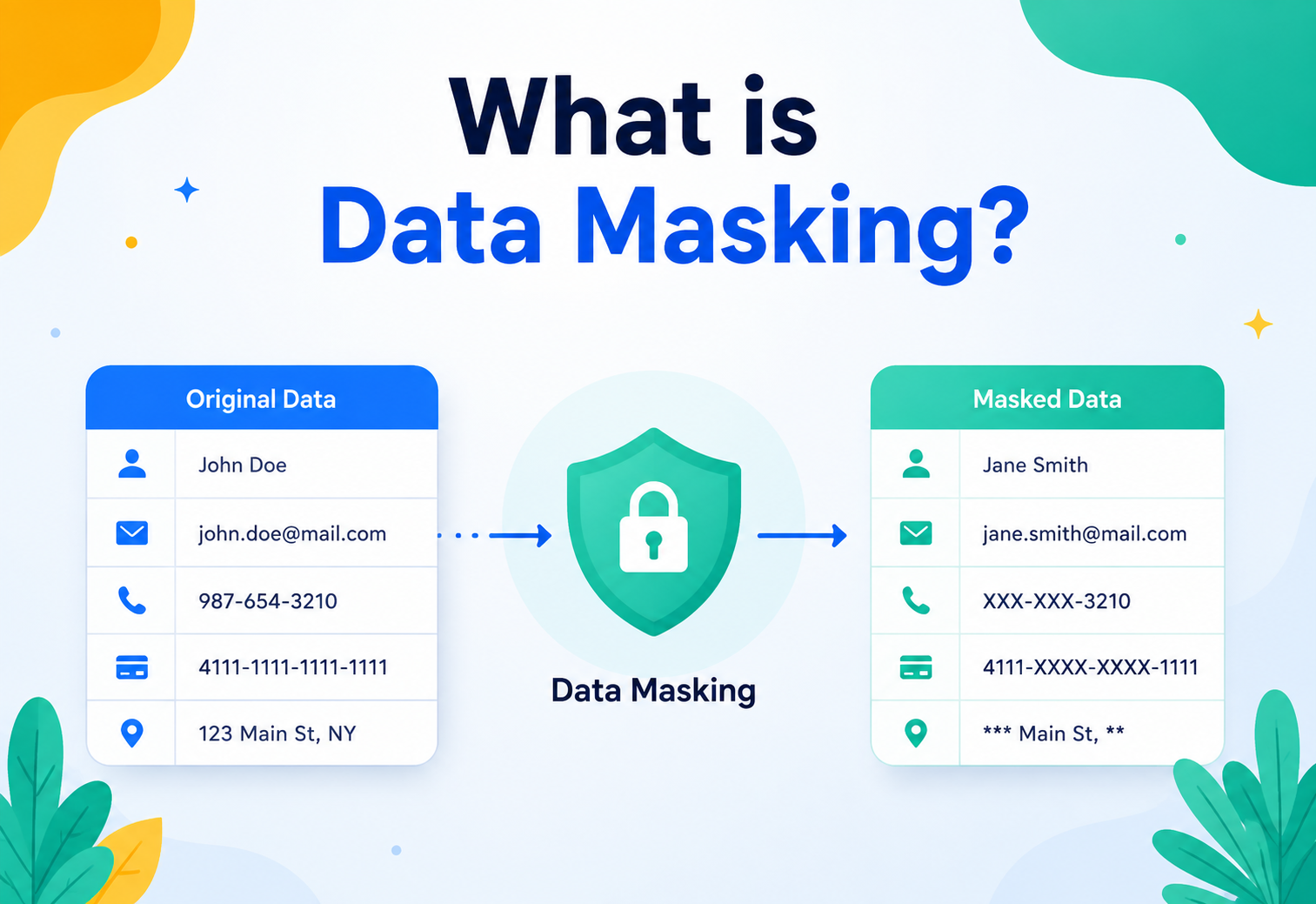
What is Data Masking?
How production systems hide real customer data from the people, tools, and environments that don’t need to see it — without breaking the applications built on top of it.
Introduction & History
Imagine a hospital training new interns using real patient files — real names, real diagnoses, real social security numbers — because building a realistic set of fake files “would take too much effort.” Every intern who ever makes a mistake, loses a laptop, or accidentally emails the wrong person now puts real patients at risk. This is, remarkably, close to how most companies used to handle test and development data: copy the production database, strip nothing, and hand it to whoever needs it.
Data masking is the practice of transforming sensitive data into a realistic but fictional version of itself — so that a name still looks like a name, a credit card number still looks like a valid credit card number, and a date of birth still behaves like a date — while the actual sensitive value is hidden or destroyed. The masked data preserves the shape and statistical usefulness of the original, without exposing anything a person or system isn’t authorized to see.
1.1 Where Did the Practice Come From?
Data masking has quieter, less mythologized origins than many security disciplines — it grew organically out of a very practical software engineering problem. As soon as organizations started maintaining separate development, testing, staging, and production environments (a practice that became standard through the 1980s and 1990s), someone had to decide what data those non-production environments would run on. The easiest answer — “just copy production” — was also immediately recognized as dangerous, because non-production environments are typically far less protected: more engineers have access, security controls are looser, and the data often ends up in logs, backups, and even developer laptops.
Early masking was manual and crude: a database administrator might run a one-off script to replace names with “Test User 1,” “Test User 2,” and so on. As data privacy regulation matured — especially with the EU’s General Data Protection Regulation (GDPR) in 2018, and industry-specific rules like HIPAA in healthcare and PCI DSS for payment card data — masking evolved from an engineering nicety into a compliance requirement with real legal and financial consequences for getting it wrong. Regulators and standards bodies began explicitly recognizing techniques like pseudonymization and anonymization as legitimate ways to reduce risk and regulatory obligations around personal data.
Today, data masking is a standard pillar of any serious data governance program, sitting alongside encryption, access control, and data classification as one of the core techniques used to protect sensitive data throughout its lifecycle — not just in databases, but in logs, analytics pipelines, support tooling, and increasingly, the prompts and outputs of AI systems that touch real customer data.

Think of a movie script given to extras versus the lead actors. The lead actors get the full script with real character names, secrets, and plot details. Background extras only get “sides” — pages rewritten so the scene still makes sense and flows naturally, but with any spoiler-level details replaced or removed. Data masking does exactly this for your data: everyone who needs to see realistic-looking data to do their job gets it, but only the people who actually need the real, sensitive values ever see them.
1.2 A Compact Evolution Timeline
1980s — Separate environments
Organizations formalize dev, test, staging, and production — and immediately face the “what data goes into non-prod?” problem.
1990s — Ad-hoc DBA scripts
Database administrators run one-off scripts to overwrite names and IDs with placeholder values in non-prod copies.
2000s — Regulatory pressure
HIPAA, PCI DSS and early privacy laws start treating masking and de-identification as recognized safeguards.
2010s — Purpose-built platforms
Dedicated data masking and test-data-management platforms emerge; format-preserving encryption and tokenization go mainstream.
2018 — GDPR
Pseudonymization is codified in GDPR as a formally recognized risk-reduction technique across EU-facing organizations.
2020s — Cloud-native & AI-aware masking
Cloud data warehouses ship native column-level masking; new focus on masking data flowing into third-party SaaS and AI tools.
1.3 Why This Matters to You as an Engineer
If you’ve ever pulled a “sanitized” copy of production data into a local dev environment, debugged an issue by grepping through logs that happened to contain a customer’s email address, or built an analytics dashboard that could technically re-identify individual users from “anonymized” data — you’ve been on one side or the other of exactly the problem data masking exists to solve. As systems become more distributed, and as data flows through more pipelines, more logs, and more third-party tools than ever, knowing how to design and implement masking correctly is a core skill for any engineer working with real user data.
The Problem & Motivation
To understand why data masking exists, it helps to walk through exactly what goes wrong when it’s missing.
2.1 The “Just Copy Production” Anti-pattern
Many organizations, especially early in their life, populate development, staging, and QA databases by taking a direct snapshot of the production database. It’s fast, it’s realistic, and it “just works” for testing — which is exactly why it’s so tempting, and so dangerous.
Non-production environments are almost always far less protected than production: more people have credentials to them (every engineer, every QA tester, sometimes every contractor), fewer monitoring and alerting systems watch them closely, and they’re more likely to be spun up quickly with default or weak configurations. Copying real, unmasked data into these environments means your weakest-defended systems are holding your most sensitive data — the exact opposite of good security design.
2.2 Concrete Failure Scenarios
- Leaked staging database: A misconfigured staging environment, left publicly accessible “just for a quick test,” turns out to contain a full, unmasked copy of the production customer database — this exact pattern has caused some of the most embarrassing and costly breaches in recent history.
- Sensitive data in logs: An application logs full request payloads for debugging, which happen to include social security numbers or credit card numbers — now that sensitive data sits in a log aggregation system accessible to a much wider set of engineers than the production database itself.
- Third-party analytics and support tools: Customer support platforms, analytics tools, and outsourced QA vendors are routinely given access to “real-looking” data to do their jobs — without masking, this quietly multiplies the number of systems and organizations holding sensitive personal data.
- Insider risk in development teams: Even without a breach, unmasked production data sitting in a dev database means every engineer with access can casually browse real customers’ financial details, health records, or private messages — a serious privacy and trust problem even if nothing is ever “hacked.”
- AI and LLM tooling: Increasingly, real customer data finds its way into prompts sent to AI coding assistants or analytics copilots during debugging — without masking, this can leak sensitive data to third-party AI vendors in ways that are hard to audit or undo.
2.3 The Motivation, in One Sentence
Data masking exists because most of the people and systems that need realistic-looking data don’t actually need the real, sensitive values — a QA engineer testing a checkout flow needs a credit card number that passes validation, not someone’s actual card; an analyst studying churn patterns needs realistic distributions of ages and locations, not the ability to identify individual customers by name.
Imagine a bank teller training program that uses real customer account statements for practice. Trainees would see real balances, real names, real transaction histories — none of which they need to learn how to process a withdrawal correctly. A masked version — “Jordan Smith, Account ****4521, Balance: $12,340.00” where the name and account number are fabricated but the format and general shape are preserved — teaches exactly the same skills with zero privacy risk.
Core Concepts
“Data masking” is often used loosely, but it actually covers a family of related techniques, each with different guarantees and tradeoffs. Let’s build up the vocabulary carefully.
3.1 Static vs. Dynamic Masking
Static Data Masking (SDM) transforms data at rest, permanently, before it’s copied somewhere else — typically when creating a non-production copy of a database. Once masked, the transformation is (by design) not reversible, and the masked copy is what non-production environments actually use. Dynamic Data Masking (DDM) instead leaves the underlying data untouched and masks it on the fly, at query or API-response time, based on who is asking — a database administrator querying directly might see the real value, while an application user querying through a restricted role sees a masked one.
Static masking is like photocopying a confidential document with certain paragraphs already blacked out before handing out copies — the redaction is baked into every copy, permanently. Dynamic masking is like a document viewer that blacks out different paragraphs in real time, depending on who’s logged in to view it — the original document underneath is never altered, only what’s displayed changes based on the viewer’s permissions.
3.2 Masking Techniques
| Technique | What it does | Example |
|---|---|---|
| Substitution | Replaces real values with realistic fake ones from a lookup set | “Priya Sharma” → “Anjali Verma” |
| Shuffling | Randomly reorders values within a column across rows | Salaries shuffled among employee rows |
| Redaction / nulling | Replaces the value entirely with a fixed placeholder | “9876543210” → “XXXXXXXXXX” |
| Format-Preserving Encryption (FPE) | Encrypts a value but keeps its format/length identical | “4111-1111-1111-1111” → “8823-4471-2290-5567” |
| Tokenization | Replaces a value with a non-sensitive token mapped in a secure vault | Card number → “tok_9f8a3e1c” |
| Pseudonymization | Replaces identifying fields with consistent pseudonyms, reversible only with a separate key | “user_42891” consistently for the same person across tables |
| Generalization / bucketing | Reduces precision to make re-identification harder | Exact age “34” → age range “30–39” |
| Data perturbation / noise | Adds small random noise to numeric values | Income of $54,320 → $54,890 for analytics |
3.3 Masking vs. Encryption vs. Tokenization — a Crucial Distinction
These three are frequently confused, but they solve different problems. Encryption is reversible with the right key and protects data primarily in transit or at rest from anyone without that key — but a legitimate application with the key sees the real value. Tokenization replaces sensitive data with a reference token that has no mathematical relationship to the original value; the real value is stored separately in a secure vault, and only systems with explicit access to that vault can reverse the mapping. Masking is usually designed to be irreversible (in the static case) or context-dependent (in the dynamic case) — its entire purpose is to make sure most people and systems never see, and often cannot recover, the original value at all.
Encrypting a production database and then copying that encrypted database to a dev environment does not count as masking if the application (and therefore the developers using it) still holds the decryption key needed to read the real values. Encryption protects data from someone who steals the raw storage; masking protects data from someone who has entirely legitimate access to query the system.
3.4 Referential Integrity in Masking
A masked dataset is only useful if it still behaves like the real one. If “Customer 42” placed “Order 108,” the masked version must preserve that same relationship — Masked-Customer-42 must still be linked to Masked-Order-108 — even though the actual names and IDs are fabricated. This property is called referential integrity, and it’s one of the hardest parts of masking to get right at scale, especially across many interrelated tables or microservices.
3.5 Anonymization vs. Pseudonymization
Anonymization aims to make it practically impossible to re-identify an individual from the data, even by combining it with other available datasets — this is a very high bar, and under many privacy regulations, genuinely anonymized data falls outside strict data-protection obligations entirely. Pseudonymization is weaker: identifying fields are replaced with consistent pseudonyms, but re-identification remains possible for anyone holding the separate mapping key — most “masked” datasets used in practice are pseudonymized, not truly anonymized, and organizations should not overstate the privacy guarantee they provide.

3.6 Direct Identifiers vs. Quasi-identifiers
Not every sensitive field is equally obvious. A direct identifier — a name, an email address, a national ID number — points unambiguously to one person on its own. A quasi-identifier — a ZIP code, a date of birth, a job title — doesn’t identify anyone by itself, but can re-identify a specific individual when combined with a small number of other quasi-identifiers or an external dataset. Effective masking strategies must account for quasi-identifiers, not just the obviously sensitive fields, because a dataset that carefully masks names and emails but leaves exact birthdate, ZIP code, and gender untouched can still often be re-identified by cross-referencing publicly available records — a well-documented finding in privacy research going back decades.
3.7 k-anonymity and Related Privacy Models
To reason more rigorously about re-identification risk from quasi-identifiers, privacy researchers developed formal models like k-anonymity, which requires that every combination of quasi-identifying attributes in a released dataset matches at least k different individuals, so no single record can be isolated and attributed to one specific person. Generalization and bucketing (turning an exact age into an age range, for instance) are common techniques used specifically to help a dataset satisfy a target k-anonymity threshold. While rarely implemented with full mathematical rigor outside specialized data-release contexts, the underlying idea — “make sure a combination of attributes isn’t so rare that it singles someone out” — is a useful mental model any engineer designing a masking strategy should keep in mind.
Architecture & Components
A production-grade masking system is more than a script — it typically involves several cooperating components, whether implemented with an off-the-shelf data masking platform or built in-house.
Fig 1. Cooperating components of a production data masking system.
4.1 Data Discovery and Classification Engine
Before you can mask sensitive data, you have to know where it lives. A classification engine scans schemas (and increasingly, unstructured data like documents and logs) to identify columns or fields likely to contain sensitive data — social security numbers, email addresses, phone numbers, health information — often using a combination of column-name pattern matching, regular expressions on sample values, and machine-learning classifiers trained to recognize sensitive data shapes.
4.2 Masking Rule Engine
Once sensitive fields are identified, a rule engine maps each field (or field type) to a specific masking technique and configuration — “SSN columns get format-preserving encryption,” “email columns get substitution from a realistic fake-email generator,” “free-text ‘notes’ fields get redaction of any detected named entities.” These rules are typically defined centrally so they’re applied consistently across every database, table, and pipeline in the organization.
4.3 Masking Execution Engine
The component that actually performs the transformation — reading source data, applying the configured technique per field, and either writing out a masked copy (static) or transforming values in real time as they’re read (dynamic).
4.4 Token Vault / Key Store
For tokenization and format-preserving encryption approaches, a secure vault stores the mapping between real and masked values (for tokenization) or the encryption keys (for FPE) — this vault is one of the highest-value targets in the entire system and needs its own dedicated hardening, since compromising it can undo masking across the entire dataset at once.
4.5 Dynamic Masking Proxy / View Layer
For dynamic masking, a proxy layer — sometimes a database view, sometimes a query-rewriting proxy sitting in front of the database, sometimes logic embedded in the application or API gateway — intercepts read queries and applies masking rules based on the identity and role of the requester before the data is returned.
Large SaaS companies commonly run a nightly pipeline that takes a production database snapshot, runs it through a masking execution engine that applies format-preserving encryption to card numbers, substitution to names and emails, and generalization to birthdates, and publishes the result as the dataset every staging and development environment refreshes from the next morning — so engineers always have realistic, current-shaped data without ever touching a real customer record.
Internal Working: How a Field Actually Gets Masked
Let’s trace, step by step, what happens when a static masking pipeline processes a production database table containing customer records.
Discovery
The classification engine scans the customers table and flags full_name, email, phone, ssn, and date_of_birth as sensitive, based on column naming patterns and sample-value analysis.
Rule lookup
For each flagged column, the rule engine looks up the configured technique: full_name → substitution from a name-generation dictionary; email → substitution preserving a valid email format; ssn → format-preserving encryption; date_of_birth → generalization to birth year only.
Seed generation for consistency
To preserve referential integrity, the engine derives a deterministic seed from the row’s primary key (or another stable identifier), ensuring that the same customer always maps to the same masked name and email across every table that references them, without needing a giant lookup table stored anywhere insecure.
Transformation
Each value is transformed according to its rule. Format-preserving encryption on the SSN, for instance, produces a value that is still a valid-looking SSN pattern (same number of digits, same general structure) but bears no resemblance to the real value.
Referential propagation
Any foreign-key relationships — orders linked to this customer, support tickets linked to this customer — are updated consistently so the masked dataset’s relationships still make sense.
Write-out
The masked row is written to the destination (a new database, a data warehouse table, or an export file) that non-production systems will actually use.
Verification
An automated verification pass checks that no known-sensitive patterns (valid-format SSNs matching real known values, for instance) leaked through unmasked — a critical safety net given how costly a masking bug can be.
Audit logging
The pipeline logs metadata about the run — which tables were masked, which rules were applied, when, and by which job — without logging the actual sensitive values themselves.
5.1 Dynamic Masking at Query Time
In dynamic masking, steps 1–2 happen ahead of time (rules are pre-configured), but steps 3–5 happen live: when a query arrives, the proxy or database checks the requester’s role, and if that role is not authorized to see real values for a given column, it rewrites the result set on the fly — often using database-native features like column-level masking policies (available in platforms such as Snowflake, SQL Server, and Oracle) rather than a separate external proxy.
Below is a simplified Java utility that deterministically masks a credit card number, preserving its format (16 digits, same grouping) while making it useless for any real transaction — the same input always produces the same masked output, preserving referential integrity across tables.
public class FormatPreservingMasker {

    private final Mac hmac;

    public FormatPreservingMasker(byte[] secretKey) throws Exception {
        this.hmac = Mac.getInstance("HmacSHA256");
        hmac.init(new SecretKeySpec(secretKey, "HmacSHA256"));
    }

    /**
     * Masks a credit card number, preserving its 16-digit format.
     * Deterministic: the same input always produces the same masked output,
     * which preserves referential integrity across related tables.
     */
    public String maskCardNumber(String realCardNumber) {
        byte[] hash = hmac.doFinal(realCardNumber.getBytes(StandardCharsets.UTF_8));

        // Derive 16 pseudo-random digits from the HMAC output,
        // never touching or logging the real card number itself.
        StringBuilder masked = new StringBuilder();
        for (int i = 0; i < 16; i++) {
            int digit = Math.abs(hash[i % hash.length]) % 10;
            masked.append(digit);
            if ((i + 1) % 4 == 0 && i != 15) {
                masked.append('-');
            }
        }
        return masked.toString();
    }
}

// Usage in a masking pipeline:
// FormatPreservingMasker masker = new FormatPreservingMasker(vaultKey);
// String masked = masker.maskCardNumber(customer.getCardNumber());
// customer.setCardNumber(masked); // real value never persisted downstream
Notice the key properties: the transformation is deterministic (same input → same output, preserving joins across tables), keyed by a secret so it can’t be trivially reversed without the key, and the real value is never logged or written to the masked destination at any point.

Data Flow & Lifecycle
Masking isn’t a single event — it’s a lifecycle stage that data passes through repeatedly as it moves between environments and systems.
Fig 2. Full data flow from production snapshot through masking pipeline to non-production consumers.
6.1 Scheduled Refresh Cycles
Most organizations refresh masked non-production datasets on a schedule — nightly, weekly, or on-demand before a major testing cycle — balancing the need for reasonably current data against the cost and risk of running the masking pipeline more frequently.
6.2 Incremental vs. Full Masking
For very large databases, re-masking the entire dataset on every refresh is expensive. Incremental masking pipelines instead detect and mask only new or changed rows since the last run, using change-data-capture techniques — trading some pipeline complexity for significantly reduced processing time and cost.
6.3 Consistency Across Pipeline Runs
If a masking pipeline runs today and again next week, does “Customer 42” get the same masked name both times? For most use cases, yes — this is why deterministic, keyed transformations (like the HMAC-based example above) are preferred over purely random substitution; they guarantee the same input always produces the same masked output, which matters enormously when developers or analysts need to correlate masked data across multiple exports taken at different times.
Deterministic masking is convenient (same input, same output, stable joins across time) but also has a subtle weakness: if an attacker can guess likely real values and run them through the same masking function, they can confirm whether a specific person’s data exists in the dataset — a form of inference attack. This is why the masking key must be kept as secret and tightly controlled as any encryption key, and why some highly sensitive fields use non-deterministic masking specifically to prevent this kind of correlation attack, accepting the loss of cross-run consistency as the price of stronger privacy.
Pros, Cons & Trade-offs
Every design choice around masking trades some fidelity, effort, or performance for a reduction in risk. Weigh both sides honestly.
Advantages
- Dramatically reduces the blast radius of a breach in non-production systems
- Preserves realistic data shape, so tests and analytics remain meaningful
- Helps meet regulatory obligations (GDPR, HIPAA, PCI DSS) around data minimization
- Reduces the number of people/systems that need “real data” access at all
- Enables safer collaboration with third parties, contractors, and AI tools
Costs / Trade-offs
- Upfront engineering effort to build/configure discovery and masking pipelines
- Some fidelity loss — masked data is never a perfect substitute for the real thing
- Referential integrity across many tables/services is genuinely hard to get right
- Ongoing maintenance as schemas evolve — new sensitive fields must be detected
- Dynamic masking adds runtime overhead to every masked query
The core trade-off to internalize: masking trades a small amount of data fidelity and engineering effort for a large reduction in exposure and regulatory risk. Poorly designed masking (weak techniques, broken referential integrity, inconsistent coverage) gives you the worst of both worlds — degraded data and false confidence in your security posture — so the quality of the masking implementation matters as much as the decision to mask at all.
“Poorly designed masking is worse than no masking — it leaves you with degraded data and false confidence.”
Performance & Scalability
Masking at the scale of a large production database — potentially billions of rows across thousands of tables — is a genuine data-engineering performance problem, not just a security checkbox.
8.1 Where the Cost Comes From
- Cryptographic operations at scale: Format-preserving encryption and HMAC-based deterministic masking involve real cryptographic computation per field, per row — multiplied across billions of rows, this adds up fast.
- Referential integrity resolution: Maintaining consistent masked values across foreign-key relationships often requires either a lookup step per related row, or careful deterministic derivation that avoids a lookup entirely — the latter scales far better.
- Dynamic masking’s per-query overhead: Since dynamic masking transforms data on every read, poorly optimized masking logic can measurably slow down every query that touches a masked column, especially under high query volume.
8.2 How Production Systems Scale This
Deterministic derivation
Prefer HMAC-based keyed derivation over lookup-table joins wherever possible — computing a masked value directly from the original avoids an expensive join against a giant mapping table.
Parallelized static pipelines
Masking one row is independent of masking another, so pipelines can be parallelized across partitions or shards, cutting wall-clock time dramatically.
Push masking into the engine
Native column-level masking policies in modern data warehouses execute far more efficiently than an external proxy that has to parse and rewrite every query.
Cache policy lookups
Cache which technique applies to which column, for which requester role, so the hot path of a dynamic-masking query doesn’t re-fetch configuration on every call.
Large e-commerce platforms that refresh multi-terabyte staging databases nightly typically run their masking pipelines as parallelized, partitioned Spark or similar batch jobs, processing different table shards concurrently across a cluster — bringing a job that would take many hours running serially down to a window that comfortably fits an overnight refresh cycle.
High Availability & Reliability
Masking pipelines and dynamic masking layers aren’t typically on the critical path of production traffic the way an identity provider is — but their reliability still matters enormously, because a failure mode here tends to fail in the worst possible direction: exposing real data instead of masked data.
9.1 Fail-safe, Not Fail-open
If a dynamic masking proxy or policy engine fails or times out, the correct behavior is to deny the read entirely, not to silently return the unmasked value. A masking system that “fails open” under load or during an outage defeats its entire purpose at precisely the moment things are already going wrong.
9.2 Pipeline Monitoring and Verification
For static masking pipelines, reliability means more than “the job completed” — it means the job completed and produced correctly masked output. Production pipelines include automated post-run verification that scans the output for patterns matching known-real sensitive values (or simply for any values that look like unmasked SSNs, card numbers, or emails) and blocks the masked dataset from being published if verification fails, rather than assuming success.
9.3 Handling Schema Drift Safely
When a new column is added to a source table — say, a new tax_id field — a masking pipeline that isn’t aware of it will happily copy that new sensitive column through completely unmasked. Mature pipelines default to a conservative stance: any new, unclassified column is masked or blocked by default until a human explicitly reviews and classifies it, rather than defaulting to “pass through unmasked until someone notices.” This same discipline applies to renamed columns and restructured tables — a masking rule keyed to a specific column name silently stops applying the moment that column is renamed, so pipelines should alert on any rule that hasn’t matched a column in a recent run, rather than assuming silence means everything is fine.

Treating “the nightly masking job ran successfully” (exit code zero) as sufficient reliability signal, without verifying the actual content of the output, has caused real incidents where a schema change silently introduced an unmasked sensitive column that then flowed into every developer’s laptop for months before anyone noticed. Reliability for a masking pipeline must include content verification, not just job-completion status.
Securing the Masking System Itself
Ironically, the systems that implement data masking become high-value targets in their own right — compromising the masking pipeline’s configuration, keys, or vault can undo the protection it provides across an entire organization’s data estate.
10.1 Protect the Masking Keys and Token Vault Above Everything Else
Whether you use format-preserving encryption keys or a tokenization vault, this key material is functionally equivalent to holding the “real” data — anyone who can reverse the masking has defeated it entirely. These keys deserve hardware-backed storage (an HSM or a managed key-management service), strict access control, and aggressive audit logging of every access.
10.2 Access Control on Masking Rule Configuration
The rules that decide which fields get masked and how are themselves sensitive: an attacker (or a careless insider) who can quietly modify a rule to stop masking the ssn column has defeated the entire system without touching a single row of data directly. Masking rule changes should go through the same code review and change-control process as application code.
10.3 Least Privilege for the Masking Pipeline’s Own Data Access
The service account the masking pipeline uses to read from production should have narrowly scoped, read-only access to exactly the tables it needs to mask — a compromised masking pipeline should not become a new, broad avenue into the entire production database.
10.4 Securing Masked Data Isn’t “Job Done”
Masked data still deserves reasonable protection — it’s not the same as public data. Especially with pseudonymized (not fully anonymized) data, the risk of re-identification by combining it with other datasets means masked non-production environments should still sit behind proper access control, not be treated as a free-for-all simply because the data “isn’t real.”
Think of it like a costume department for a play: the costumes make actors look like different characters, but the department that controls who gets which costume — and definitely the department that knows which actor is really playing which role — needs its own locked door. Knowing “who’s really who” behind the masks is exactly as sensitive as the original information, sometimes more so, because it’s the single point that unlocks everything at once.
Monitoring, Logging & Metrics
Because a masking failure is silent by nature — nothing crashes, no error is thrown, the data just quietly isn’t masked — observability is what turns “we hope it’s working” into “we know it’s working.”
11.1 What to Log
- Every masking pipeline run — start time, tables processed, rules applied, row counts — without ever logging the actual sensitive values being masked
- Every verification check result (pass/fail), with details on which pattern or column triggered a failure
- Every access to the masking key vault or token store, including which service or user requested it
- Every dynamic-masking policy evaluation — was this column masked or shown in the clear for this requester, and why
- Schema-drift detections — new columns discovered that aren’t yet classified
11.2 Key Metrics to Track
| Metric | Why it matters |
|---|---|
| Masking coverage percentage | What fraction of known-sensitive fields are actually covered by an active masking rule |
| Verification failure rate | Directly signals potential unmasked-data leaks; should trend toward zero |
| Pipeline run duration | Tracks whether masking can still complete within its refresh window as data grows |
| Unclassified/new column count | Surfaces schema drift before it becomes an unmasked-data incident |
| Dynamic masking query latency overhead | Quantifies the performance cost being paid for real-time masking |
| Vault/key access frequency and source | Anomalies here can indicate an attempt to reverse masking at scale |
11.3 Alerting on the Failure Modes That Matter Most
The highest-priority alert in any masking system should be a verification failure — a sign that sensitive, unmasked data may have flowed into a less-protected environment. This deserves the same urgency as a production security incident, because in every meaningful sense, it is one.
Regulated financial institutions typically wire masking-verification failures directly into their security incident response process, treating a failed verification check with the same severity classification as a detected intrusion attempt — because the practical consequence (sensitive data reaching an unauthorized environment) is functionally identical, even though the cause is a pipeline bug rather than an external attacker.
Deployment & Cloud
Data masking has adapted significantly to cloud-native and multi-cloud data architectures, where sensitive data increasingly flows through managed data warehouses, data lakes, and SaaS analytics tools rather than a single on-premises database.
12.1 Native Masking in Cloud Data Warehouses
Modern cloud data platforms (Snowflake, BigQuery, Databricks, Redshift) increasingly offer built-in dynamic data masking as a first-class feature — column-level masking policies defined declaratively and enforced by the platform itself, avoiding the need for a separate external proxy layer and its associated latency and operational overhead.
12.2 Masking as Part of the Data Pipeline (ETL/ELT)
In modern data engineering, masking is frequently implemented as a transformation step within the same ETL/ELT pipelines that already move data from operational databases into a data warehouse or data lake — masking becomes just another transformation stage, alongside cleaning, enrichment, and aggregation, rather than a separate bolt-on process.
12.3 Kubernetes and Ephemeral Environments
As development environments become increasingly ephemeral — spun up per pull request, torn down after merge — masking pipelines need to support fast, on-demand masked-data provisioning rather than only a slow nightly batch job; some organizations solve this by maintaining a continuously refreshed masked “golden copy” that ephemeral environments can cheaply clone from, rather than re-running the full masking pipeline for every short-lived environment.
12.4 Masking Data Destined for Third-party SaaS Tools
Increasingly, masking happens as data leaves an organization’s boundary entirely — before data is synced to a third-party customer support tool, analytics platform, or AI service, an outbound masking layer strips or transforms sensitive fields, so third parties only ever receive the minimum data they need.
Fig 3. Masking as an ETL step feeding both an internal data warehouse and outbound SaaS tools.
Databases, Caching & Load Balancing
13.1 Column-level vs. Row-level Masking Policies
Most modern databases support masking policy at the column level (mask this entire column for unauthorized roles) and, in more advanced setups, at the row level combined with column masking (a support agent might see full order details only for orders assigned to them, and even then with payment details masked). Designing these policies requires close collaboration between data engineers and the teams who actually consume the data, to avoid over-masking data people legitimately need.
13.2 Caching and Dynamic Masking — a Genuine Hazard
Caching layers sitting in front of a database are a classic place where dynamic masking quietly breaks: if a cache stores the result of a query made by a privileged user (who saw unmasked data) and then serves that same cached result to a lower-privileged user, the masking is silently bypassed. Cache keys for any data that passes through dynamic masking must include the requester’s role or identity, ensuring masked and unmasked results are never cross-served from the same cache entry.
A team adds a Redis cache in front of a frequently-queried customer lookup endpoint to improve latency, without accounting for dynamic masking — the first (privileged) caller populates the cache with unmasked data, and every subsequent (lower-privileged) caller then receives that same unmasked data straight from the cache, completely bypassing the masking policy. Cache-key design must treat “requester privilege level” as part of the cache key, not an afterthought.
13.3 Load Balancing Masking Pipelines and Services
For dynamic masking implemented as a proxy service (rather than natively in the database), that proxy needs the same production-grade load balancing, health checking, and horizontal scaling as any other critical read-path service — since every masked query now depends on it being healthy and responsive.
APIs & Microservices
In a microservices architecture, sensitive data doesn’t just live in one database — it flows through dozens of internal APIs, event streams, and service boundaries, each a potential point where masking needs to be applied or preserved.
14.1 Masking at the API Gateway / Response Layer
A common pattern is to apply masking as a response-transformation step at the API gateway, based on the caller’s role and scopes — so individual microservices don’t each need to reimplement masking logic themselves, and the masking behavior stays centrally auditable and consistent.
// A Spring Boot response filter that masks sensitive fields
// in an API response based on the caller's authorization scope

@Component
public class DynamicMaskingResponseAdvice
        implements ResponseBodyAdvice<CustomerDto> {

    @Override
    public boolean supports(MethodParameter returnType, Class converterType) {
        return CustomerDto.class.isAssignableFrom(returnType.getParameterType());
    }

    @Override
    public CustomerDto beforeBodyWrite(CustomerDto body, MethodParameter returnType,
            MediaType mediaType, Class converterType,
            ServerHttpRequest request, ServerHttpResponse response) {

        Authentication auth = SecurityContextHolder.getContext().getAuthentication();

        // Only callers with the "pii:read:full" scope see real values.
        boolean canSeeFullPii = auth.getAuthorities().stream()
                .anyMatch(a -> a.getAuthority().equals("SCOPE_pii:read:full"));

        if (!canSeeFullPii) {
            body.setSsn(maskSsn(body.getSsn()));
            body.setEmail(maskEmail(body.getEmail()));
            body.setPhone(maskPhone(body.getPhone()));
        }
        return body;
    }

    private String maskSsn(String ssn) {
        return ssn == null ? null : "XXX-XX-" + ssn.substring(ssn.length() - 4);
    }

    private String maskEmail(String email) {
        int at = email.indexOf('@');
        return at <= 1 ? "***" + email.substring(at)
                        : email.charAt(0) + "***" + email.substring(at);
    }

    private String maskPhone(String phone) {
        return phone == null ? null : "XXX-XXX-" + phone.substring(phone.length() - 4);
    }
}
14.2 Masking in Event Streams
Event-driven architectures (Kafka topics, message queues) present a special challenge: an event published once may be consumed by many different downstream services, each potentially needing a different level of data visibility. A common pattern is to publish two versions of sensitive events — a full-fidelity version on a tightly access-controlled topic for services that genuinely need real data, and a masked version on a broadly accessible topic for services (like analytics or notification systems) that don’t.
14.3 Field-level Scopes, Not Just Endpoint-level Scopes
Just as Zero Trust access control benefits from fine-grained API scopes rather than one broad “authenticated” flag, effective masking benefits from field-level authorization — a support tool might legitimately need a customer’s masked card number for verification purposes but never their full SSN, and API design should make that distinction explicit rather than an all-or-nothing toggle.
Design Patterns & Anti-Patterns
A small set of good habits produces most of the benefit. A small set of anti-patterns produces most of the incidents.
15.1 Patterns to Adopt
Deterministic keyed masking
Same input, same output, same key — preserves referential integrity across time and tables without a giant lookup table.
Format-preserving encryption
Keeps field format (length, structure, character classes) intact so downstream validation and business logic keep working against masked data.
Masking-as-a-pipeline-step
Treats masking as just another transformation in an existing ETL/ELT pipeline, rather than a bolted-on afterthought, keeping it maintained alongside schema changes.
Column-level native policies
Uses built-in masking primitives in modern data warehouses for the lowest possible per-query overhead.
Automated verification gates
Never publishes a masked dataset without an automated check confirming no known-sensitive patterns leaked through — treat it like a required test suite blocking a bad deploy.
Centralized rule ownership
A single, reviewable source of truth for “which fields get masked, and how” avoids the drift and inconsistency of every team implementing its own ad hoc masking logic.
15.2 Anti-Patterns to Avoid
- Copy-production-as-is: populating dev, staging, and QA databases with unmasked production snapshots — the origin story of most sensitive-data-in-non-prod incidents.
- Ad hoc per-team masking: every team building its own masking logic, using different techniques, with no central review — inevitable drift and gaps.
- Masking as an afterthought: bolted on late in a project when sensitive data is already flowing through logs, caches, and third-party tools that nobody thought to include in scope.
- Trusting job success alone: assuming exit code zero means the masking worked, without verifying the actual content of the output.
- “Masking theater”: masking the obvious fields (name, email) while leaving equally sensitive but less obvious fields (free-text support notes that mention a customer’s medical condition, IP addresses, device identifiers) completely untouched — a false sense of security is often worse than an honest acknowledgment that data isn’t masked yet.
- Reversible “masking” mistaken for real masking: simple substitution ciphers or easily-reversible transformations that look masked at a glance but can be undone with minimal effort don’t provide real protection against a motivated party.
- Breaking referential integrity carelessly: masking each table independently, without a consistent deterministic strategy, silently breaks joins and foreign-key relationships — producing masked data that looks fine in isolation but fails in ways that erode trust in every test built on top of it.
- Assuming pseudonymized data is “safe” data: treating pseudonymized (reversible-with-a-key) data the same as truly anonymized data, and therefore relaxing access controls on it, overlooks the real re-identification risk that remains.
Best Practices & Common Mistakes
The difference between an organization that treats masking as a genuine safeguard and one that treats it as a checkbox usually comes down to a handful of concrete habits, repeated consistently over time rather than applied once during an initial rollout.
Best Practices
- Start with discovery, not masking rules — you cannot mask what you haven’t found
- Default to masking unknown/new fields until a human explicitly classifies them
- Preserve referential integrity deliberately, using deterministic keyed derivation
- Verify, don’t just trust — every pipeline run must end with an automated leak-pattern scan that can block publication
- Treat masking keys and vaults as tier-0 critical infrastructure with hardware-backed storage and aggressive audit logging
- Extend masking beyond databases to logs, event streams, third-party integrations, and AI tool inputs
Common Mistakes
- Masking only the primary production database while backups, logs, and analytics exports remain unmasked
- Under-investing in referential integrity, producing masked datasets that quietly break tests and analyst workflows
- Letting masking rules go stale as new features add new sensitive fields with no classification process
- Ignoring caching layers, which silently bypass dynamic masking when cache keys don’t account for requester privilege
- Treating masking as a one-time compliance project rather than an ongoing engineering discipline
16.1 A Rollout Order That Tends to Work
- Classify first: run a broad data discovery scan across databases, logs, and pipelines to understand where sensitive data actually lives — the results are almost always surprising.
- Mask the highest-blast-radius environment first: usually the shared staging or QA database that every engineer touches, since it has both the largest exposure and the most immediate payoff.
- Add verification gates and monitoring before rolling out further — visibility on failure is what makes the rest of the program sustainable.
- Expand to logs, backups, third-party integrations, and event streams — these secondary channels are where masked-database organizations still leak data quietly.
- Introduce dynamic masking for production read paths only after static coverage is solid, since dynamic masking is more subtle and error-prone.
Real-World / Industry Examples
The same principles apply from a small startup to the largest regulated enterprise — just at very different scales and with different regulatory stakes.
Financial services
Organizations that handle payment card data are required, under the Payment Card Industry Data Security Standard (PCI DSS), to protect cardholder data — and masking (showing only the last four digits of a card number in receipts, statements, and support tooling) is one of the most visible, everyday applications of masking that most people interact with regularly, often without realizing it’s a formal compliance control.
Healthcare
Under HIPAA in the United States, healthcare organizations that need to use patient data for research, training, or system testing rely heavily on de-identification techniques — including masking and generalization of identifiers like exact birthdates and addresses — to use realistic clinical data without exposing protected health information tied to identifiable patients.
Test data management at scale
Major technology and e-commerce companies with thousands of engineers routinely maintain automated pipelines that produce masked, referentially-consistent snapshots of production data specifically for development and testing, refreshed on a regular cadence, precisely so that thousands of engineers never need direct access to real customer records just to build and test features.
European & global operators
The EU’s GDPR explicitly recognizes pseudonymization as a technique that can reduce risk to data subjects and, in some circumstances, reduce an organization’s compliance burden — driving widespread adoption of pseudonymizing techniques (a masking variant) across European and internationally-operating companies handling EU residents’ data.
Many large technology companies maintain a centrally-owned “data privacy platform” team responsible for data discovery, classification, and masking as a shared internal service — other product teams don’t build their own masking logic; they simply tag fields as sensitive in a central schema registry, and the platform automatically applies the appropriate masking technique across every environment and pipeline that touches that field.
FAQ, Summary & Key Takeaways
Short, direct answers to the questions that come up most often — followed by a compact summary of everything above.
18.1 Frequently Asked Questions
Is data masking the same as encryption?
No. Encryption is generally reversible with the right key and protects data primarily from someone who steals the raw storage; masking is designed to hide real values from people and systems that have entirely legitimate query access, and static masking is typically irreversible by design.
Does masked data count as “anonymized” under privacy law?
Usually not automatically. Most masking in practice is pseudonymization — reversible with a separate key or mapping — which most regulations treat differently (and less favorably) than true anonymization, where re-identification is genuinely, practically impossible even by combining datasets.
Should I mask data in production too, or only in non-production environments?
Dynamic masking is increasingly used in production itself — for example, masking a customer’s full SSN from a support agent’s view even while they’re looking at a live production record, showing only the last four digits unless they have a specific business reason (and the corresponding permission) to see more.
How do I mask data without breaking my tests?
Preserve format and statistical shape, not just “any fake value” — a masked date of birth should still be a valid date that produces a sensible age, a masked email should still pass email format validation, and referential integrity across related tables must be maintained deterministically so joins and business logic keep working correctly against masked data.
What’s the very first step a team should take?
Run a data discovery/classification pass to find out exactly where sensitive fields actually live across your databases, logs, and pipelines — most organizations are surprised by how many places sensitive data has quietly spread to, and you cannot mask what you haven’t found.
Can masked data still be useful for machine learning and analytics?
Yes, often very useful — techniques like generalization, bucketing, and controlled noise addition are specifically designed to preserve the statistical patterns a model or analyst needs, while removing or obscuring the individually-identifying details that create privacy risk.
Do I need a dedicated masking tool, or can I build this myself?
It depends on scale and complexity. Small teams with a handful of sensitive tables can often get meaningful protection from a well-written script using deterministic keyed transformations, like the HMAC-based example earlier in this guide. Larger organizations with hundreds of databases, evolving schemas, and multiple regulatory regimes to satisfy typically find that a dedicated masking platform — commercial or a shared internal service — pays for itself by centralizing discovery, rule management, and verification in one place rather than reimplementing that logic separately in every team.
How does masking interact with “right to be forgotten” requests?
Data subject deletion requests under regulations like GDPR typically need to reach every copy of a person’s data, including masked non-production copies, if those copies retain any reversible link back to the individual (as pseudonymized data does). This is one of the strongest arguments for using deterministic, key-based masking rather than storing a giant reversible lookup table: revoking or rotating the masking key for a specific identifier can efficiently sever that link across every masked copy at once, without needing to track down and edit every downstream dataset individually.
18.2 Summary
Data masking transforms sensitive data into a realistic but fictional version of itself, so that the people, tools, and environments that need realistic-shaped data — developers, testers, analysts, third-party integrations — never need direct access to the real, sensitive values. It grew out of the very practical problem of populating non-production environments safely, matured alongside privacy regulation like GDPR and HIPAA, and today spans a family of techniques — substitution, tokenization, format-preserving encryption, generalization — each suited to different data types and risk levels, applied both statically (transformed once, at rest) and dynamically (transformed live, based on who’s asking). Getting it right requires treating masking as an ongoing engineering discipline with its own architecture, monitoring, and failure modes to guard against — not a one-time compliance checkbox to tick and forget.
Key Takeaways
- Masking is not encryption and not automatically anonymization — know which guarantee you actually need before choosing a technique for a given field.
- Deterministic, keyed masking preserves referential integrity across related tables, which is essential for masked data to remain genuinely useful.
- Fail-safe, not fail-open: any masking failure should block or deny access, never silently expose real data.
- Automated verification after every masking run is what turns “we hope it worked” into “we know it worked” — treat it as a required gate, not an optional check.
- Masking keys and rule configuration are themselves extremely high-value targets and deserve tier-0 protection, since compromising them can undo protection across an entire data estate at once.
- Masking needs to extend beyond the primary database — to logs, backups, event streams, caches, and third-party/AI tool integrations — everywhere sensitive data actually flows.
“You cannot mask what you haven’t found — discovery, not rules, is the first step of every serious masking program.”