Designing a Returns & Refunds Processing System at Scale
A complete, ground-up engineering guide to building a system that processes millions of returns and refunds a month accurately, quickly, and without losing a single dollar to reconciliation errors.
Introduction & History
Before drawing a single box on a diagram, we need to understand what “returns and refunds processing” really means as a software system, and why it is far harder than it first appears.
Imagine a large public library. Thousands of books go out every day, and hundreds come back — some on time and undamaged, some late, some torn, some never returned at all. The librarian at the return desk must, in seconds, decide: accept this book back into circulation, note a late fee, flag it as damaged and charge the borrower, or reject the return entirely because the book does not belong to this library. Now imagine that library operates at the scale of ten million transactions a month, spread across hundreds of warehouses worldwide, and every single decision has real money attached to it. That is, in essence, the returns and refunds problem at e-commerce scale.
In plain terms: a returns and refunds processing system is the software that lets a customer request to send an item back, tracks that item as it physically moves back to a warehouse, inspects and restocks it, and finally moves real money back to the customer’s original payment method — all while keeping the company’s inventory counts, financial ledgers, and customer trust perfectly consistent.
A short history of returns processing
Manual, in-store returns
Returns were handled entirely at physical store counters, with paper receipts and manual cash-register reversals. There was no separate “returns system” — it was just a reversal of the original sale, done by a human.
Mail-order returns and RMA numbers
As catalog and early e-commerce sales grew, companies introduced the Return Merchandise Authorization (RMA) number — a unique code a customer had to obtain before shipping an item back, so the warehouse could match returned packages to the right original order.
Self-service web returns portals
Retailers built the first self-service web portals letting customers initiate a return, print a prepaid shipping label, and track its status online, removing the need to call customer support for every return.
Automated refund rules and fraud controls
As return volume exploded alongside e-commerce growth, companies introduced automated eligibility rules (return windows, condition checks) and dedicated returns-fraud detection to combat wardrobing and other abuse patterns.
Real-time, instant, sustainability-aware returns
Modern systems offer instant refunds before the item is even received back (backed by risk models), integrate with reverse-logistics networks and resale or donation channels for sustainability, and treat returns data as a first-class signal for improving product listings and reducing future returns.
Returns are not a rare edge case — for many e-commerce categories, especially apparel, 20 to 40 percent of purchases come back. A returns system is not a minor supporting feature; it is core, high-volume infrastructure that directly touches revenue, inventory accuracy, and customer trust every single day.
“Why can’t returns just be handled as the reverse of the original order flow?” A strong answer explains that a return is not a simple reversal: the item’s physical condition is unknown until inspected, the refund amount may differ from the original charge (partial returns, restocking fees, promotional adjustments), and the timeline stretches over days or weeks with many possible failure and dispute points, unlike an atomic, near-instant checkout.
Why this guide uses e-commerce returns as the running example
Returns and refunds processing is an especially instructive system design example because it combines nearly every hard constraint an engineer faces in a long-running business process: strict financial correctness requirements, dependence on unreliable external parties such as carriers and payment gateways, a genuinely adversarial population actively trying to exploit lenient policy, and a process duration measured in days rather than milliseconds, which changes almost every design assumption compared to a typical low-latency request-response system. Mastering this scenario in depth gives you a design vocabulary and mental toolkit, particularly around sagas, idempotency, and reconciliation, that transfers directly to many other long-running, financially sensitive business processes you may encounter elsewhere, such as insurance claims processing or subscription billing disputes.
Problem & Motivation
Let’s define the exact engineering problem before designing anything.
The problem statement: Design a system that lets a customer request a return or refund for one or more items in an order, validates the request against eligibility rules, tracks the physical journey of the returned item back to a warehouse, coordinates inspection and restocking, and reliably issues the correct refund amount to the correct payment method — all at a scale of millions of orders per month, with strong financial accuracy and predictable customer-facing latency.
These figures vary considerably by category and region, but the underlying pattern holds broadly across the industry: returns represent a large, recurring share of total order volume rather than a rare exception, the value of goods moving back through the reverse-logistics pipeline is substantial enough to justify serious engineering investment, the end-to-end cycle time is long enough that the system must be designed around a multi-day process rather than a single request-response interaction, and even a modest share of abusive behavior, at this scale, translates into meaningful financial exposure if left unchecked.
Why is this genuinely hard?
A newcomer might think: “just reverse the payment when the customer asks.” The real difficulty is that a return spans physical logistics, inventory management, fraud risk, and financial accounting, all of which must stay perfectly synchronized over a process that can take days to complete.
Physical-digital synchronization
The system must track a real, physical object moving through carriers and warehouses, and keep that physical state in sync with the digital order and refund state at every step.
Financial correctness
Every rupee or dollar refunded must be traceable, reconciled against the original payment, and never lost, duplicated, or double-refunded — this is core accounting, not a “nice to have.”
Long-running, multi-day process
Unlike checkout, which completes in seconds, a return can take a week or more, spanning many services, retries, and possible failures at any point.
Adversarial behavior
Return fraud (wardrobing, box-stuffing empty packages, item-not-as-described claims) actively tries to exploit lenient policies, requiring the same adversarial mindset seen in payment fraud detection.
Massive, uneven scale
Return volume spikes sharply after major shopping events (like a holiday season), arriving weeks after the original purchase spike, requiring capacity planning that is offset in time from the sales curve it follows.
Policy complexity
Return windows, restocking fees, final-sale exclusions, and category-specific rules (electronics vs. apparel vs. groceries) all vary, and the system must apply the right policy correctly every time.
Real-life analogy: the hospital discharge process
Think of a hospital discharging a patient. It is not simply “the patient walks out.” There is a defined process: a doctor must approve the discharge, paperwork must be completed, medication and billing must be reconciled, and the bed must be marked available again for the next patient — and each step depends on the one before it completing correctly. A returns system works the same way: an eligibility check must approve the return, the physical item must be verified back at the warehouse, inventory must be marked available again, and only then does the financial system release the refund — skipping or misordering any step causes real, costly problems.
Beginner example
Rahul buys a pair of shoes for $80. They don’t fit, so he requests a return through the app. The system checks that the shoes are still within the 30-day return window, generates a prepaid shipping label, and tells Rahul to drop the package at a courier location. A week later, the warehouse scans the package in, an inspector confirms the shoes are unworn and in original packaging, and $80 (minus nothing, since this was a standard return) is refunded to Rahul’s original card within 3 to 5 business days.
Now imagine Meera buys the same shoes, wears them outdoors for two weeks, and then tries to return them claiming they were “never worn.” When the warehouse inspects the shoes, they show clear signs of wear. The system must catch this discrepancy, deny or partially approve the refund, and route the case to a human review queue rather than blindly trusting the customer’s stated reason — precisely the kind of adversarial case that makes this problem hard.
Refund processing is not just “call the payment gateway’s refund API.” The payment gateway call is often the easiest, last step. The hard engineering problems are upstream: eligibility validation, inventory reconciliation, fraud detection, and coordinating a process that spans days and multiple physical handoffs.
A simple framework for quantifying the decision
To turn this problem into something an engineering team can actually optimize, it helps to express the cost of every possible policy choice in concrete monetary terms rather than treating “prevent abuse” and “keep customers happy” as vague, competing goals. For a given return request, the expected cost of approving it instantly can be thought of as the probability that it is abusive multiplied by the loss if it turns out to be abuse, while the expected cost of requiring full inspection before any refund can be thought of as the added operational cost of that inspection multiplied by the number of genuinely legitimate returns subjected to it, plus the lost customer goodwill from the added wait. This framing makes explicit that the “right” policy is not a fixed universal choice, but depends on the specific dollar values and customer-trust dynamics at stake for each segment, which is exactly why risk-based instant refunds and category-specific policies, introduced earlier in this guide, matter so much in practice.
The business stakeholders involved
Unlike a purely internal engineering system, a returns platform sits at the intersection of several business functions, each with a legitimate but sometimes competing perspective. The finance team cares primarily about accurate, timely reconciliation and minimizing fraud losses. The customer experience team cares primarily about fast, low-friction returns that keep customers loyal even after a purchase did not work out. The operations and logistics team cares about the physical cost and throughput of warehouse inspection and reverse shipping. A well-designed system, and the team that builds it, must serve all three simultaneously rather than optimizing narrowly for just one, which is why this guide repeatedly frames technical choices, like the instant-refund threshold or manual review capacity, in terms of the business trade-offs they represent.
Core Concepts
Let’s build the shared vocabulary used throughout this guide.
Return Merchandise Authorization (RMA)
What: A unique identifier issued to a customer once a return request is approved, which the warehouse uses to match a physically returned package back to the correct original order and line item.
Why it matters: Without an RMA, an incoming package at a warehouse is just an anonymous box; the RMA is the thread connecting the physical item back to digital order and refund records.
Analogy: Like a claim ticket at a dry cleaner — without it, nobody can match your specific garment back to your specific order.
Return window
What: The number of days after delivery (or purchase) during which a customer is eligible to request a return, often varying by product category.
Practical example: Standard apparel might allow a 30-day window, while perishable groceries allow none, and electronics might allow 15 days with an unopened-box condition.
Refund
What: The actual movement of money back to the customer, which may go to the original payment method, an in-store credit or wallet balance, or a replacement item shipment (an exchange), depending on the customer’s choice and the merchant’s policy.
Why it matters: A refund is not always simply “money back” — the possible outcomes (original payment method, store credit, exchange) each have different technical and financial implications.
Exchange
What: A resolution path where, instead of refunding money, the system ships a replacement item, such as a different size or color of the same product, and typically only processes an actual monetary refund or additional charge if the replacement’s price differs from the original.
Why it matters: An exchange is technically more complex than a simple refund, since it must coordinate an outbound shipment alongside the inbound return, and requires careful sequencing so a replacement item is not shipped before the original return is confirmed as genuinely eligible, particularly for exchanges granted before the original item has been physically received back.
Restocking fee
What: A partial deduction from the refund amount, charged for certain return reasons or product categories, to cover the cost of processing and restocking (or discarding) a returned item.
Practical example: A returned opened electronics item might incur a 15 percent restocking fee, while a defective item returned under warranty incurs none.
Reverse logistics
What: The physical supply chain that moves a product from the customer back to a warehouse, disposal center, or resale channel — essentially the supply chain running in reverse compared to the outbound delivery flow.
Why it matters: Reverse logistics is often less efficient and more expensive per unit than forward logistics, since return volumes are less predictable and the condition of returned goods varies widely.
Grading / inspection
What: The process of physically examining a returned item at the warehouse and assigning it a condition grade (such as “resellable as new,” “resellable as open-box,” “damaged, needs refurbishment,” or “scrap”), which determines what happens to the item next and whether the full refund is approved.
Analogy: Like a quality inspector at a factory checking finished goods before they are approved to ship — except here, the inspection happens on the way back in, not the way out.
Practical example: A returned blender graded “resellable as new” goes straight back into sellable inventory at full price; the same blender graded “open-box” might be relisted at a discount through a separate open-box sales channel; and a blender graded “damaged beyond repair” is routed to scrap or recycling, with the refund decision for the customer handled independently based on the stated return reason rather than the grade alone.

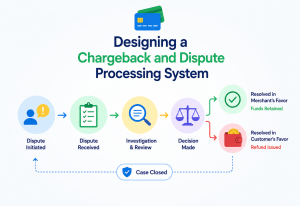
Chargeback (in the returns context)
What: A forced payment reversal initiated by a customer’s bank, sometimes filed by customers who feel their legitimate return refund is taking too long, rather than waiting for the merchant’s own refund process.
Why it matters: A slow or opaque returns process directly drives up chargeback rates, which, as discussed in fraud-related system designs, carries its own financial and compliance costs beyond the refund amount itself.
Practical example: A customer whose return sits unprocessed for three weeks with no status update may simply file a chargeback with their bank rather than continuing to wait, converting what should have been a routine, low-cost return into a more expensive and adversarial chargeback dispute for the merchant to fight or absorb.
Wardrobing
What: A specific type of return abuse where a customer buys an item (commonly clothing for a one-time event), uses it briefly, and then returns it claiming it was never used, seeking a full refund for what was effectively free temporary use.
Why it matters: This is one of the most common and costly forms of return fraud, and detecting it requires combining behavioral signals (return frequency, timing relative to events) with physical inspection evidence.
Return reason code
What: A structured, standardized code capturing why a customer is returning an item — for example, “wrong size,” “item not as described,” “changed my mind,” “arrived damaged,” or “defective.”
Why it matters: Reason codes drive both the refund policy applied (a damaged item warrants a full refund and possibly free return shipping, while “changed my mind” might not) and valuable product-quality feedback used elsewhere in the business.
Idempotent refund
What: A refund operation designed so that processing the exact same refund request multiple times (due to a retry after a network failure, for instance) results in exactly one refund being issued, never more.
Why it matters: Without this property, a transient network failure during a retry could cause a customer to be refunded twice for the same return, a direct and often invisible financial loss until caught in reconciliation.
Store credit / wallet balance
What: An internal, non-cash balance credited to a customer’s account, usable only for future purchases on the same platform, often offered as a faster or bonus-incentivized alternative to a traditional refund.
Why it matters: Store credit improves customer retention (the money stays inside the platform) and can be issued instantly without waiting on external payment gateway processing, but requires its own ledger and expiry management.
Serial returner
What: A customer whose return frequency and pattern significantly exceeds typical behavior, such as regularly ordering multiple sizes or colors of the same item with the clear intent of returning most of them after choosing one.
Why it matters: While occasional over-ordering to compare sizes is normal and healthy customer behavior, an extreme and sustained pattern erodes margins meaningfully, and identifying it requires tracking return behavior at the customer level over time, not just evaluating each return request in isolation.
Practical example: A customer whose return rate sits at 85 percent over the last six months, far above the platform’s typical 17 percent average, is a candidate for closer review, additional friction, or in extreme cases, a restricted returns policy applied specifically to that account.
Proof of delivery and proof of return shipment
What: Carrier-provided evidence confirming that a package was delivered to the customer (proof of delivery) or that a return package was actually dropped off and is moving through the carrier network (proof of return shipment), typically a tracking scan event with a timestamp and location.
Why it matters: These proofs are the foundation for both eligibility timing (the return window usually starts from confirmed delivery, not from the order date) and fraud prevention (a customer claiming a return was shipped, with no corresponding carrier scan event after a reasonable grace period, is a strong signal worth investigating before an instant refund is honored).
Return abuse ring
What: A coordinated group of accounts, sometimes linked by shared devices, addresses, or payment methods, systematically exploiting return policies at scale, for example by repeatedly claiming items arrived damaged to receive free replacements while keeping the original items.
Why it matters: Similar to fraud rings in payment fraud detection, individual return requests from a ring member can look unremarkable in isolation; only a network-level view across accounts, addresses, and devices reveals the coordinated pattern, making graph-based analysis just as valuable here as in real-time payment fraud detection.
Detection note: Because a well-organized ring deliberately spreads its activity across many accounts to stay under any single account’s abuse threshold, effective detection typically requires periodically re-running graph analysis over the full population of recent return cases, rather than evaluating each new request only against that one customer’s own isolated history.
Grading criteria in detail
What: The specific, standardized set of physical conditions an inspector checks to assign a condition grade, typically including whether original packaging and tags are intact, whether the item shows signs of use or wear, whether all included accessories are present, and whether the item matches the original product description and SKU.
Why it matters: Without a standardized, written grading rubric, different inspectors at different warehouses would apply inconsistent judgment, leading to unpredictable refund outcomes for otherwise identical returns, undermining both customer trust and internal financial consistency.
“Why would a business want to offer store credit instead of a cash refund?” A well-rounded answer covers both sides: store credit keeps money within the platform, can be issued instantly without external payment gateway delay, and often nudges customers toward another purchase, but must be balanced by giving customers the genuine ability to get their original payment method refunded, since law and platform policy in many regions require this option, especially in the case of a returned defective item.
Architecture & Components
Now we assemble these concepts into a coherent system. Every box below plays a specific, necessary role.
Why not a single monolithic returns module?
A reasonable early question is why this needs so many separate services rather than one application handling the whole flow. The split becomes necessary once several real pressures appear together: the Warehouse Management System must integrate with physical scanning hardware and operates on a completely different rhythm than a customer-facing API; the Refund Service must talk to external payment gateways with their own rate limits, retry semantics, and compliance requirements; the Eligibility and Fraud services are frequently updated by risk and policy teams and benefit from independent, fast deployment cycles; and the Ledger and Reconciliation services demand extremely strong consistency and auditability that would be unnecessarily heavy to enforce across the entire system if bundled into one monolith. Splitting these concerns lets each one scale, evolve, and be owned independently, at the cost of the added operational complexity of coordinating many services, which this guide addresses throughout.
Component-by-component breakdown
1. Content Delivery Network (CDN) and Edge Layer
Caches static returns-portal assets close to the user geographically and absorbs the first wave of any denial-of-service traffic before it reaches the core data centers.
2. Load Balancer
Distributes incoming HTTPS requests across many identical API Gateway instances, terminates TLS, and continuously health-checks backend instances, routing traffic away from unhealthy ones. Typically a Layer 7 load balancer capable of path-based routing.
3. API Gateway
The single front door for all client requests. Authenticates the caller, applies rate limiting (protecting against automated return-abuse scripts), and routes requests to the correct backend microservice.
4. Returns and Refunds Service (RRS)
The central orchestrator of the entire return lifecycle. It receives a return request, coordinates calls to the Eligibility Service, Order Service, and Fraud Service, drives the return through its state machine (covered in Data Flow & Lifecycle), and ultimately triggers the refund once all conditions are satisfied.
5. Eligibility Service
Evaluates whether a given order and item combination is currently eligible for return, applying return-window rules, category-specific policies (final-sale items, hygiene-restricted goods), and any promotional or regional exceptions. It is intentionally kept independent of the Returns Fraud Service so each can be tuned, tested, and deployed by its respective policy or risk team without the two changes interfering with one another.
6. Returns Fraud Service
Scores a return request for abuse risk, similar in spirit to real-time payment fraud detection: checking the customer’s historical return frequency, matching patterns against known wardrobing signatures, and flagging suspicious combinations such as an unusually high-value item returned immediately after a known promotional event.
7. Shipping Label Service
Generates a prepaid return shipping label through a carrier integration, attaching the RMA number so the physical package can be matched to the digital return case once it arrives at a warehouse.
8. Reverse Logistics Service
Tracks the shipment as it moves from the customer back toward a warehouse, ingesting carrier tracking webhooks or polling carrier APIs, and updating the return case status accordingly (label created, in transit, delivered to warehouse).
9. Warehouse Management System (WMS)
Handles the physical receiving of the returned package, scanning it against the RMA, and routing it to an inspector who assigns a condition grade.
10. Inventory Service
Based on the inspection grade, decides whether the item is restocked as sellable inventory, routed to a refurbishment or resale channel, or marked as scrap, and updates the platform’s live inventory counts accordingly.
11. Event Bus (Kafka)
Publishes every state change in the return lifecycle as an event, decoupling the synchronous customer-facing flow from downstream financial, notification, and analytics processing.
11a. Notification Service
Consumes return lifecycle events from the event bus and sends the customer timely updates through email, SMS, or push notification at each meaningful milestone, such as label generation, warehouse receipt confirmation, and refund completion. Keeping this as a separate, asynchronous consumer rather than a synchronous call from the Returns and Refunds Service means a slow or failing notification provider can never delay or block the underlying return workflow itself.
12. Refund Service
Orchestrates the actual movement of money: calling the payment gateway to refund the original payment method, or crediting an internal wallet balance, depending on the customer’s selection and eligibility.
13. Financial Ledger Service
Maintains a double-entry bookkeeping record of every financial movement related to returns, ensuring that every refund is matched against the original charge and that the platform’s books always balance.
14. Reconciliation Service
Runs periodic batch jobs comparing the ledger, the payment gateway’s own transaction records, and the returns database, surfacing any mismatches for finance team investigation before they compound into larger, harder-to-trace discrepancies.
Notice the same pattern seen in other high-scale commerce systems: a synchronous, customer-facing path (initiating and tracking a return) is clearly separated from an asynchronous, financially critical path (refund issuance, ledger updates, reconciliation), so that a slow downstream financial process never blocks a customer from simply checking their return status.
“Why does the Financial Ledger Service need to be separate from the Refund Service?” The strongest answer notes that the Refund Service’s job is to successfully call an external payment gateway, while the Ledger Service’s job is to maintain a permanent, auditable, double-entry financial record regardless of what happens downstream — separating them means a ledger entry can be recorded even if a particular refund attempt needs to be retried, and the two components can be tested, scaled, and audited independently.
Internal Working
Let’s go one level deeper: what actually happens, step by step, when a customer initiates a return?
Step-by-step internal flow
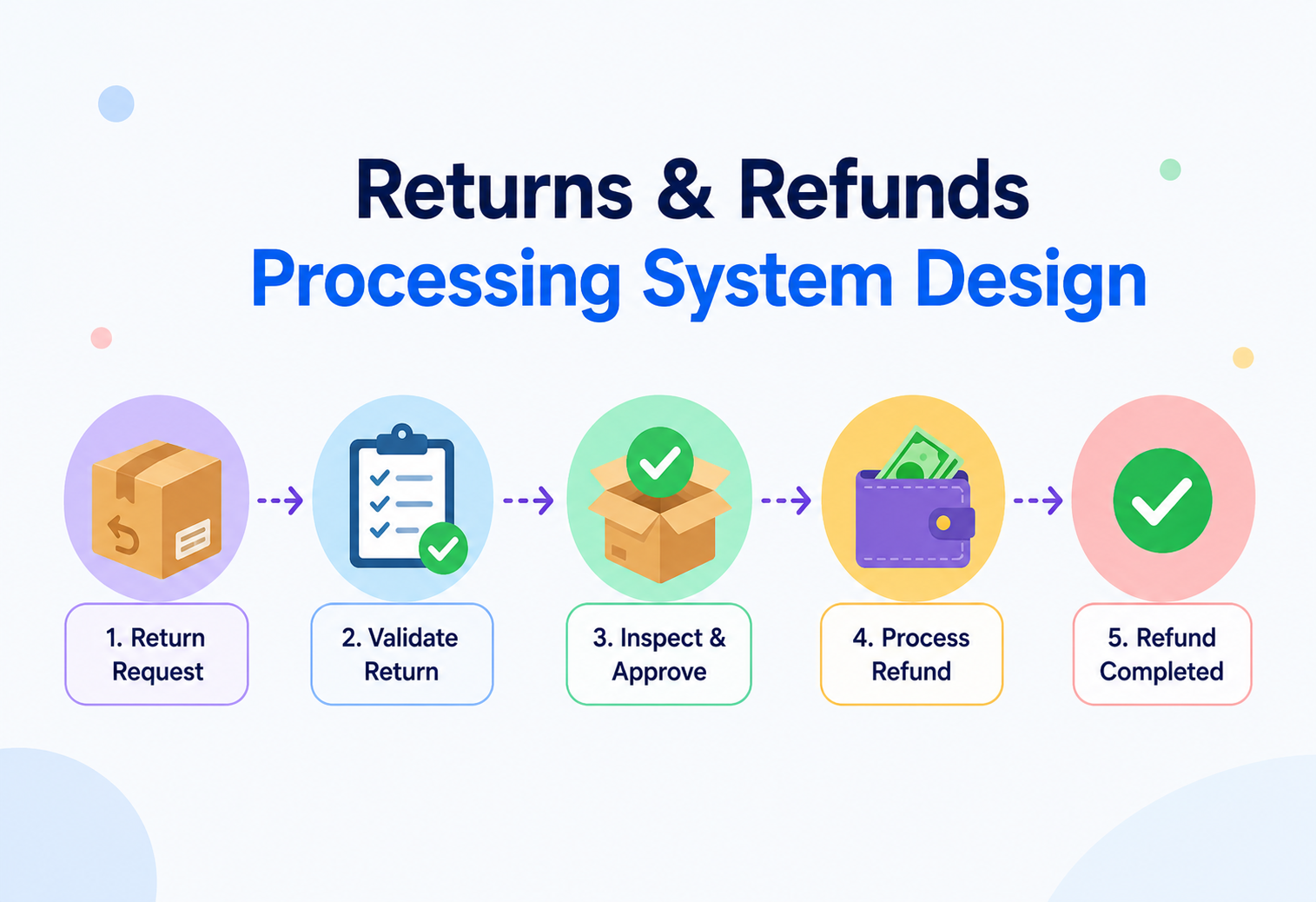
- Return request received: the customer selects an item from a past order and a return reason in the client app; the request reaches the Returns and Refunds Service through the Load Balancer and API Gateway.
- Eligibility check: the RRS calls the Eligibility Service, which checks the return window, item category rules, and any order-specific exclusions (final sale, already returned once).
- Fraud risk check: in parallel, the Returns Fraud Service scores the request, considering the customer’s return history, the item’s return-abuse profile, and behavioral signals.
- Decision: if both checks pass, an RMA is generated and a prepaid shipping label is issued; if the fraud score is high but not conclusive, the request is routed to manual review rather than outright rejected.
- Physical return in transit: the Reverse Logistics Service tracks the package via carrier webhooks as it moves back toward the warehouse.
- Receiving and inspection: the Warehouse Management System scans the package in against the RMA, and an inspector assigns a condition grade, feeding this back to the RRS.
- Inventory update: based on the grade, the Inventory Service restocks the item as sellable, routes it to refurbishment, or marks it scrapped, updating live inventory counts.
- Refund trigger: once inspection is complete and approved, the RRS publishes a “refund approved” event; the Refund Service picks this up asynchronously and calls the payment gateway or credits a wallet balance.
- Ledger and notification: the Financial Ledger Service records the double-entry transaction, and the Notification Service informs the customer their refund has been issued.
Sample Java: the eligibility rule evaluator
public class EligibilityEvaluator {

    private static final int STANDARD_RETURN_WINDOW_DAYS = 30;

    public EligibilityResult evaluate(OrderItem item, ReturnRequest request) {

        long daysSinceDelivery = Duration.between(
                item.getDeliveredAt(), Instant.now()).toDays();

        int windowDays = resolveWindowForCategory(item.getCategory());

        if (daysSinceDelivery > windowDays) {
            return EligibilityResult.ineligible("return_window_expired");
        }

        if (item.isFinalSale()) {
            return EligibilityResult.ineligible("final_sale_item");
        }

        if (item.getReturnCountOnOrder() >= 1 && request.getReason() == ReturnReason.CHANGED_MIND) {
            // Already returned once on this order line; require a stronger reason
            return EligibilityResult.needsReview("repeat_return_changed_mind");
        }

        return EligibilityResult.eligible(windowDays);
    }

    private int resolveWindowForCategory(String category) {
        return switch (category) {
            case "electronics" -> 15;
            case "groceries" -> 0;
            case "apparel" -> STANDARD_RETURN_WINDOW_DAYS;
            default -> STANDARD_RETURN_WINDOW_DAYS;
        };
    }
}
Note: real policy rules are typically externalized into a configuration or rules engine editable by a policy team, rather than hard-coded, exactly as with the fraud rules engine pattern discussed in payment fraud system designs.
Sample Java: idempotent refund processing
public class RefundProcessor {

    private final IdempotencyStore idempotencyStore;
    private final PaymentGatewayClient gatewayClient;
    private final LedgerClient ledgerClient;

    public RefundResult processRefund(RefundRequest request) {

        String idempotencyKey = request.getReturnCaseId() + ":refund";

        Optional<RefundResult> existing = idempotencyStore.lookup(idempotencyKey);
        if (existing.isPresent()) {
            // Safe to return the prior result; never issue a second refund
            return existing.get();
        }

        RefundResult result = gatewayClient.refund(
                request.getOriginalPaymentToken(),
                request.getRefundAmount());

        ledgerClient.recordDoubleEntry(
                request.getReturnCaseId(),
                request.getRefundAmount(),
                LedgerEntryType.REFUND_ISSUED);

        idempotencyStore.save(idempotencyKey, result);
        return result;
    }
}
The idempotency key is derived from the return case identifier, so any retry of the same return’s refund, whether from a network timeout or a duplicate event delivery, resolves to exactly one financial movement.
A frequent and expensive mistake is triggering the refund directly from the warehouse inspection event without idempotency protection. Carrier and warehouse systems often redeliver the same “item received” event more than once during retries or reprocessing; without a durable idempotency key tied to the return case, this can trigger duplicate refunds that are painful to detect and claw back after the fact.
A closer look at returns fraud signals
Just as a payment fraud model depends heavily on well-engineered features, the Returns Fraud Service’s accuracy depends on the quality of the signals it evaluates. Below is a representative sample of signal categories used in a real deployment.
| Signal category | Example signal | Why it signals risk |
|---|---|---|
| Behavioral history | Customer’s return rate over the trailing six months compared to the category average | A sustained, extreme deviation from typical behavior suggests serial-returner or abuse patterns |
| Reason code patterns | Frequency of “item not as described” claims relative to the customer’s total order volume | An unusually high rate of this specific claim, compared to peers buying similar items, often indicates exaggerated or false claims |
| Timing | Time between delivery and return request, and any correlation with known event dates | A pattern of returning formal wear shortly after typical event dates, such as weekends, suggests wardrobing |
| Network and graph | Shared shipping address or device across multiple seemingly unrelated accounts with high return rates | Suggests a coordinated return abuse ring rather than independent, unrelated behavior |
| Financial | Ratio of total refunded value to total spent value for this customer over time | A ratio approaching or exceeding one signals the customer is effectively shopping for free at the platform’s expense |
| Physical evidence mismatch | Warehouse inspection grade significantly worse than the customer’s stated condition at request time | A repeated mismatch pattern for a specific customer is a strong, hard-to-fake signal of misrepresentation |
Each of these signals feeds into the same kind of layered decision approach used in real-time payment fraud detection: deterministic rules catch obvious, known abuse patterns instantly, while a machine learning risk score handles the subtler, evolving cases that a fixed rule set would eventually be reverse-engineered around.
Data Flow & Lifecycle
Let’s trace a single return case across its entire lifecycle, from request to final resolution.
Why the multi-day delay between approval and refund matters
Unlike a checkout decision made in milliseconds, a return case can sit in the “InTransit” state for several days, entirely outside the system’s direct control, waiting on a carrier to physically move the package. This is one of the most misunderstood aspects of returns systems by newcomers: the system’s job during this period is not to do nothing, but to actively track and surface this waiting state to the customer, detect and escalate packages that seem to have stalled in transit beyond an expected threshold, and remain ready to resume the workflow the instant new information arrives, rather than treating the process as a simple two-step “request then refund” transaction.
Data flow across the three timescales
| Timescale | What happens | Typical technology |
|---|---|---|
| Milliseconds to seconds (synchronous) | Return request submission, eligibility and fraud checks, RMA and label generation | REST or gRPC APIs, in-memory rules evaluation |
| Hours to days (event-driven, asynchronous) | Carrier tracking updates, warehouse receiving and inspection, refund issuance, notifications | Kafka, webhook ingestion, workflow orchestration engines |
| Days to weeks (batch) | Financial reconciliation, returns-fraud pattern analysis, product-quality feedback aggregation | Data warehouse, batch reconciliation jobs, analytics pipelines |
“How would you detect a return package that seems to be lost in transit?” A good answer describes setting expected transit-time thresholds per carrier and region, running a periodic batch job that flags return cases exceeding this threshold without a warehouse-received event, and proactively notifying both the customer and a support workflow rather than waiting indefinitely for a webhook that may never arrive.
Advantages, Disadvantages & Trade-offs
No architecture is free. Let’s be explicit about what this design gains and what it costs.
✓ Advantages
- Clear separation between the fast customer-facing flow and the slower physical and financial processes keeps the app responsive regardless of warehouse or carrier delays.
- Event-driven design allows the ledger, notifications, and analytics to evolve independently without touching the core return workflow.
- Explicit state machine modeling makes every return case’s status auditable and easy to reason about, even mid-flight.
- Layered fraud and eligibility checks catch abuse while still allowing legitimate returns to move quickly.
- Idempotent refund processing protects against costly duplicate financial movements during retries.
× Disadvantages
- Significant engineering complexity: many services, an event bus, and integrations with external carriers and payment gateways must all be built and kept in sync.
- Long-running, multi-day processes are harder to test, monitor, and reason about than short-lived request-response flows.
- Financial reconciliation requires dedicated, ongoing engineering and finance-team investment; it is never “done.”
- Fraud checks, even when well-tuned, will sometimes wrongly delay or flag legitimate customers, creating real support burden.
- Dependency on external carriers for tracking data means the system’s visibility into physical state is only as good as those third-party integrations.
Key trade-off: instant refunds vs. inspection-gated refunds
Some platforms offer an “instant refund” the moment a return is requested, before the item is physically received or inspected, to improve customer experience and reduce perceived friction. This trades increased fraud exposure (a small percentage of customers may never actually ship the item back) for a meaningfully better customer experience and reduced support load. Most large platforms manage this trade-off by extending instant refunds only to customers with a strong trust history, determined by the same kind of risk scoring discussed in the Returns Fraud Service, while lower-trust customers go through the standard inspection-gated flow.
Key trade-off: centralized policy engine vs. category-specific logic
A single, centralized eligibility rules engine is simpler to maintain, but different product categories (electronics, apparel, groceries, furniture) often have meaningfully different return logic, condition-grading criteria, and fraud patterns. Many platforms start centralized and gradually introduce category-specific policy modules only where the difference in rules genuinely justifies the added complexity.
Instant refunds should be treated as a risk-based privilege extended to trusted customers, not a universal default — rolling it out broadly without a supporting risk model is one of the fastest ways to see return-fraud losses spike.
Key trade-off: build vs. buy
Many organizations face a genuine decision between building this entire architecture in-house, as described throughout this guide, or purchasing a third-party returns management platform and integrating it through an API. Building in-house offers full control over policy logic, fraud rules, and warehouse workflows, and avoids recurring per-transaction vendor fees, but demands sustained investment in specialized engineering and operations talent that many companies do not have readily available. Buying a vendor solution gets a reasonably capable system running much faster and benefits from returns patterns learned across the vendor’s broader customer base, but introduces a hard external dependency and less flexibility to encode business-specific policy nuances. Many growing companies start with a vendor solution and gradually build specific in-house components, most commonly a custom fraud-scoring layer or a warehouse-specific grading workflow, once their return volume justifies the investment.
Key trade-off: immediate friction vs. delayed friction
Requiring photo evidence of an item’s condition at return-request time adds a small amount of immediate friction to every return, but can meaningfully reduce disputes and mismatches discovered later at inspection. Skipping this step keeps the request flow faster for the vast majority of legitimate customers, but pushes more discrepancies into the slower, more expensive Disputed state at inspection time. Neither option is universally correct; a business handling many high-value electronics returns might favor the immediate friction of photo evidence, while a business handling mostly low-value apparel returns might favor the faster flow and accept a somewhat higher dispute rate.
Performance & Scalability
How does this system stay fast and correct when return volume spikes sharply after major sales events?
Scaling the synchronous path
- Horizontal auto-scaling: the API Gateway, Returns and Refunds Service, Eligibility Service, and Returns Fraud Service are stateless and scale out horizontally behind the load balancer as request volume rises.
- Connection pooling: every service maintains pre-warmed connection pools to its database and downstream services, avoiding the latency cost of establishing new connections under load.
- Caching policy and eligibility rules: return-window and category policy rules change infrequently and are cached locally in each service instance with short invalidation windows, avoiding a database round-trip on every single eligibility check.
Scaling the asynchronous path
- Kafka partitioning: events are partitioned, commonly by return case identifier, so downstream consumers such as the Refund Service and Ledger Service can process partitions in parallel across many worker nodes.
- Backpressure-aware carrier webhook ingestion: sudden bursts of carrier tracking updates, common right after a holiday return surge, are buffered through the event bus rather than processed synchronously, so a slow downstream consumer cannot cause tracking webhooks to be dropped.
Applying Little’s Law to capacity planning
Little’s Law states that the average number of requests in a system (L) equals the average arrival rate (λ) multiplied by the average time each request spends in the system (W): L = λ × W. If the Returns and Refunds Service must sustain 500 return-initiation requests per second at peak, and each request takes an average of 150 milliseconds to process synchronously, the system must support roughly 500 × 0.15 = 75 requests in flight concurrently, directly informing how many service instances and how large a connection pool each instance needs.
Handling post-holiday return surges
Unlike checkout traffic, which spikes during a sale itself, return traffic spikes weeks later, as gifted or purchased items get tried, worn, or reconsidered. This predictable, delayed surge is handled with pre-scaling based on historical post-holiday return curves, rather than relying purely on reactive auto-scaling, and by pre-provisioning additional warehouse inspection capacity and carrier pickup slots ahead of the expected wave, since the physical reverse-logistics network is often the true bottleneck rather than the software layer itself.
“Why might the software layer of this system not be the actual bottleneck during a return surge?” A strong answer points out that physical constraints, such as warehouse inspection staffing and carrier pickup capacity, often become the true bottleneck well before the API and service layer does, so capacity planning for this system must extend beyond software auto-scaling into coordinated planning with logistics and operations teams.
Load testing and capacity validation
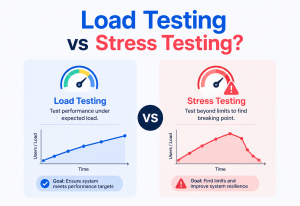
Capacity plans calculated on paper must be validated against reality before an actual post-holiday return wave arrives. Teams typically run three kinds of load tests against a staging environment mirroring production as closely as possible: steady-state tests sustaining expected peak return-initiation volume for an extended period to catch slow memory leaks or resource exhaustion; spike tests simulating a sudden surge within minutes to verify auto-scaling and connection pools react fast enough; and soak tests running elevated load for many hours to uncover slow degradations, such as a growing event-bus consumer lag, that only appear after extended run time. Results from these tests directly inform auto-scaling policies, connection pool sizes, and pre-scaling schedules, replacing guesswork with measured evidence.
Segment-specific scaling
Return traffic is rarely uniform across product category or region, and neither is the operational cost of processing it. A surge concentrated in one region’s warehouses should trigger targeted operational scaling there rather than a blunt global response, and a category known to generate disproportionate return and inspection volume, such as apparel, may warrant dedicated inspection capacity and even dedicated software service instances so a surge in that category cannot degrade processing time for the much smaller volume of unrelated, low-return categories happening at the same time.
High Availability & Reliability
A returns system outage does not just block a feature — it can strand physical inventory in transit and delay real money owed to customers. Reliability here has direct financial and legal stakes.
Redundancy at every layer
- Multi-zone deployment: every service runs across at least three availability zones within a region so the loss of one data center does not cause an outage.
- Multi-region failover: for platforms operating globally, a secondary region stands ready to take traffic if the primary region fails, coordinated by a global traffic manager.
- Database replication: the returns database and financial ledger are replicated synchronously within a region and asynchronously across regions, favoring strong consistency for ledger data specifically, given its financial sensitivity.
Circuit breakers and safe fallbacks
Every call from the Returns and Refunds Service to an external dependency, such as the Payment Gateway or a carrier’s tracking API, is wrapped in a strict timeout and a circuit breaker. If the Payment Gateway becomes unresponsive, refund requests are queued durably (via Kafka) rather than lost, and retried automatically once the gateway recovers, ensuring no customer’s refund silently disappears due to a transient downstream outage.
Graceful degradation ladder
- Full mode: eligibility, fraud scoring, label generation, and refund processing all functioning normally.
- Reduced-automation mode: Fraud Service degraded; return requests default to a conservative, slightly stricter automatic approval threshold, with more cases routed to manual review.
- Label-deferred mode: Shipping Label Service or carrier integration unavailable; return requests are still accepted and approved, but label generation is queued and retried once the dependency recovers, rather than blocking the customer’s request entirely.
- Refund-queued mode: Payment Gateway unavailable; approved refunds are held in a durable queue and automatically retried, with customers notified of a short delay rather than a failed refund.
A serious design mistake is allowing a Payment Gateway outage to silently drop a refund request rather than durably queuing it. Because refunds involve real customer money and often carry regulatory timelines (many regions legally require refunds within a defined number of days), a lost or silently dropped refund is both a customer-trust failure and, in some jurisdictions, a potential compliance violation.
Reliability targets
| Metric | Typical target | Meaning |
|---|---|---|
| RTO (Recovery Time Objective) | < 10 minutes | Maximum acceptable time to restore service after a failure |
| RPO (Recovery Point Objective) | < 1 minute | Maximum acceptable data loss window, especially critical for ledger data |
| Availability SLA | 99.99% | No more than about 52 minutes of downtime per year |
“What should the system do if the Payment Gateway is completely unreachable when a refund needs to be issued?” The expected answer describes durable queuing of the refund request via the event bus, automatic retries with backoff once the gateway recovers, and proactive customer communication about the delay, rather than either failing silently or blocking the rest of the return workflow.
Runbooks and game days
Redundant infrastructure alone does not guarantee a fast, correct response during a real incident; the humans operating the system need clear, rehearsed procedures too. Every major failure scenario identified for this system, such as the Payment Gateway returning elevated error rates, a carrier’s tracking API going silent, or an entire region failing over, has a corresponding written runbook describing exactly what an on-call engineer should check first and which specific mitigation steps to take, so a stressful incident does not depend on someone improvising a correct response from scratch. Many mature teams also run scheduled game days, where a failure is deliberately and safely triggered in a controlled environment, and the on-call team responds to it in real time exactly as they would during a genuine incident, validating both the technical fallback behavior and the human response process together, and routinely surfacing gaps that would otherwise only be discovered during an actual, high-pressure outage.
Security
A returns system handles sensitive financial and personal data, and directly controls the movement of real money, making its own security posture critical.
Protecting payment data: tokenization
Just as in the original checkout flow, the Refund Service never handles raw card numbers directly. It uses the same payment token issued during the original transaction to instruct the payment gateway to refund back to that specific original method, drastically limiting the scope of PCI DSS compliance for this system.
Transport and API security
- TLS everywhere: all traffic, including internal service-to-service calls, is encrypted in transit.
- Zero trust internal networking: services authenticate each other with short-lived mutual TLS certificates or signed service tokens rather than assuming the internal network is inherently safe.
- Rate limiting on return initiation: prevents automated scripts from mass-generating fraudulent return requests or probing eligibility rules at scale.
- Least privilege access: warehouse staff, customer support agents, and engineers each have access scoped only to what their specific role requires; a warehouse inspector, for instance, should never have access to a customer’s full payment details.
Preventing refund manipulation
Because the entire point of this system is to move real money, it is a natural target for both external attackers and, occasionally, insider abuse. Refund amounts are always recalculated server-side from the original order record and the applicable policy rules, never trusted from client-supplied input, preventing a manipulated request from claiming an inflated refund amount. Any refund exceeding the original item price, or issued to a payment method different from the one used in the original order without an explicit, audited override, is automatically flagged for review.
Encryption at rest and financial data protection
The Returns Database and Financial Ledger both encrypt data at rest using managed encryption keys. Given the direct financial sensitivity of ledger data specifically, access to it is more tightly restricted than most other services in the platform, with mandatory audit logging of every read and write, and a strict separation of duties so no single individual can both approve a refund override and execute it unreviewed.
Data privacy and compliance
Return records contain personal data (addresses, payment details, purchase history) and are subject to regulations like GDPR, requiring data minimization, defined retention periods, and clear audit trails for both regulators and customer disputes. Many jurisdictions also impose specific legal timelines within which a refund must be issued once a return is accepted, making refund-issuance latency a compliance concern, not merely a customer-experience one.
No component in this architecture, including internal services like the Warehouse Management System, should implicitly trust another simply because it is inside the network. Every request is authenticated, authorized, and logged.
“How do you prevent a compromised or buggy client from requesting a refund larger than the original purchase amount?” The expected answer centers on always recalculating the refund amount server-side from the authoritative original order record and current policy rules, never trusting any amount value supplied directly by the client.
Insider threat and separation of duties
Because this system directly moves real money, insider risk is a genuine and specific concern, distinct from external attacks. A customer support agent or warehouse employee with excessive access could, in principle, approve fraudulent refunds for accounts they control or collude with. This is mitigated through strict least-privilege access scoped tightly to each role’s actual job function, mandatory audit logging of every refund override or manual approval, and separation of duties so that no single individual can both flag a case for manual override and approve that same override without independent review.
Secure handling of personally identifiable information in return cases
Return records often contain sensitive personal details beyond the original order, including home addresses used for pickup, reasons for return that may reference personal circumstances, and images submitted as evidence of item condition or damage. Field-level access controls ensure that, for example, a data analyst studying return-rate trends sees anonymized or aggregated data, while only a narrowly scoped support or fraud-investigation role can see the full, identifiable details behind a specific case.
Monitoring, Logging & Metrics
You cannot manage what you cannot measure, and in a financial system like this, blind spots translate directly into lost money or angry customers.
System health metrics
- Latency percentiles (p50, p95, p99): tracked for the synchronous return-initiation path, since a slow p99 means a meaningful number of customers are having a frustrating experience even if the average looks fine.
- Error rates per dependency: tracked separately for the Payment Gateway, carrier APIs, and internal services, so an on-call engineer can immediately identify which specific integration is degrading.
- Event bus consumer lag: measures how far behind the Refund Service or Ledger Service is in processing published events, since a growing lag directly delays real customer refunds.
- Circuit breaker state: dashboards showing which circuit breakers are open, so operators immediately know which degraded mode the system is running in.
Returns-specific business metrics
- Return-to-refund cycle time: the end-to-end time from a return request to a completed refund, tracked as a primary customer-experience metric.
- Refund accuracy rate: the percentage of refunds matching the expected amount per policy, with any deviation investigated as a potential bug or fraud signal.
- Manual review queue depth and age: if analysts cannot keep up with fraud-flagged or disputed cases, customers experience longer, more frustrating delays.
- Reconciliation mismatch count: the number of discrepancies found between the ledger, payment gateway records, and returns database during batch reconciliation, ideally trending toward zero.
- Return rate by category and reason code: watched both for fraud signals (sudden spikes in a specific reason code) and product-quality feedback (a specific item generating unusually high “item not as described” returns).
Distributed tracing
Since a single return case touches many services over a period of days, a distributed tracing system (such as one built on OpenTelemetry) assigns a trace ID to the entire return case, letting engineers see exactly how long each stage took, from eligibility check through inspection to refund completion, rather than piecing together logs from many separate systems manually.
“How would you detect that refunds are silently taking longer than they should?” Strong answers describe tracking the full return-to-refund cycle time as a first-class metric with defined SLA thresholds and automated alerting, rather than relying solely on customer complaints to surface the problem after the fact.
Structured audit logging
Beyond operational metrics, every state transition in a return case is recorded as a structured, immutable audit log entry containing the return case identifier, the exact rule or policy version involved, the resulting decision, and the actor responsible, whether an automated service or a human analyst. This audit trail serves several purposes: it lets a support agent or auditor reconstruct exactly why any specific historical return was approved, partially refunded, or rejected; it satisfies regulatory requirements in many jurisdictions mandating a traceable basis for consumer-facing financial decisions; and it provides the ground truth needed to correctly attribute a later reconciliation mismatch back to the specific service and version responsible.
Synthetic transaction canaries
In addition to monitoring real customer traffic, mature returns platforms continuously send small, clearly labeled synthetic return requests through the entire pipeline end to end, purely to verify the whole system behaves correctly regardless of real customer volume at that moment. A synthetic request crafted to be clearly eligible should reliably be approved and reach a simulated refund step, and one crafted to be clearly ineligible should reliably be rejected. If either canary starts producing an unexpected result, that is a fast, reliable signal that something in the pipeline has broken, often catching an issue well before it would show up clearly in aggregate business metrics.
Deployment & Cloud
How does this system get built, tested, deployed, and safely updated, especially given how financially sensitive some of its components are?
Containerization and orchestration
Each microservice (Returns and Refunds Service, Eligibility Service, Returns Fraud Service, Refund Service, Ledger Service) is packaged as a container and orchestrated by a platform like Kubernetes, handling scheduling, health checks, auto-scaling, and rolling restarts across the fleet.
Deployment strategies for application code
Standard service changes use blue-green or canary deployments: a new version receives a small percentage of traffic first, with automated checks on error rate and latency before gradually shifting all traffic over, allowing instant rollback if anything looks wrong.
Deployment strategies for financial logic — extra caution required
Changes to refund calculation logic, policy rules, or ledger entry code carry outsized risk compared to typical feature changes, since a bug here can silently mis-refund thousands of customers before anyone notices through normal monitoring. The standard practice layers on additional safeguards:
- Offline validation against historical cases: a candidate change to refund logic is run against a large sample of historical, already-resolved return cases, comparing its calculated refund amounts against the amounts actually issued, to catch unintended behavior changes before deployment.
- Shadow deployment: the new logic runs in parallel with the current production logic on live traffic, but its output is only logged and compared, never used for an actual refund, until it has been observed to match expectations closely.
- Gradual rollout with reconciliation monitoring: once shadow results look healthy, the new logic is enabled for a small percentage of real return cases, with the Reconciliation Service watching closely for any new mismatch patterns.
- Full rollout with instant rollback capability: only after sustained, clean reconciliation results is the change rolled out fully, with the previous version kept available for immediate rollback.
Infrastructure as Code
All infrastructure — Kubernetes clusters, Kafka topics, database clusters, IAM roles, networking rules — is defined in version-controlled configuration using tools like Terraform, so environments are reproducible, changes are peer-reviewed, and disaster recovery can rebuild infrastructure from code rather than manual intervention.
Multi-region and data residency considerations
Large platforms operating across multiple countries often need to keep certain customer and financial data within specific regional boundaries to satisfy data residency regulations, which shapes how the Returns Database and Ledger Service are partitioned and deployed across regions, sometimes requiring fully independent regional ledgers rather than one globally shared one.
Warehouse Management System integrations and carrier tracking polling can generate significant, spiky infrastructure load right after major sales events. Autoscaling these specific integration points aggressively, and batching non-urgent carrier status polling where webhooks are unavailable, meaningfully reduces cost without affecting the always-on, customer-facing return-initiation path.
“Why does a change to refund calculation logic need more deployment caution than a typical feature change?” The expected answer is that a subtle bug in financial calculation logic can silently affect real money across many customers before it is caught by normal error-rate monitoring, so shadow deployment and historical backtesting against real past cases are essential extra safeguards beyond a standard canary release.
Feature flags for policy rules
Separately from code deployments, individual return-window durations, category exclusions, and restocking-fee percentages are typically controlled through a feature-flagging or dynamic-configuration system rather than being hard-coded into the deployed application. This allows a policy team to shorten a return window for a specific promotional item within minutes, or adjust a restocking-fee percentage in response to a shift in return patterns, without waiting for a full code build, review, and deployment cycle. Because these changes bypass the normal code-deployment safety net, they still go through a lightweight approval and audit process, and every change is logged with who made it and when, so a sudden shift in approval or refund-amount patterns can always be traced back to a specific configuration change if needed.
Databases, Caching & Load Balancing
Let’s zoom into the data layer choices that make this system both fast and financially trustworthy at scale.
Returns database
Stores every return case, its current state, associated events, and inspection results, for both live operation and audit purposes. Given the volume, this database is typically sharded, commonly by customer ID or order ID, so that no single machine holds or serves the entire dataset. A relational database is often preferred here over a purely NoSQL store, because the strong relationships between orders, return cases, and refunds benefit from relational integrity constraints. It is common to pair this relational store with a separate document store for less structured data such as inspection photos and free-text customer descriptions, keeping the highly structured, relationally constrained core data (order references, amounts, state transitions) cleanly separated from bulkier, less structured supporting evidence.
Financial ledger store
The ledger demands the strongest consistency guarantees in the entire system, since it is the permanent, auditable record of every financial movement. It typically runs on a relational database configured for strong consistency (favoring correctness over raw throughput), often with write-ahead logging and strict transaction isolation, reflecting the principle that a lost or duplicated ledger entry is a far more serious failure than a few extra milliseconds of write latency.
Choosing a sharding key
Sharding the Returns Database by customer ID keeps a customer’s full return history together on one shard, making customer support lookups and per-customer fraud scoring fast, since they rarely need to fan out across shards. Sharding by return case creation date instead makes time-range batch queries efficient, such as pulling all cases from a given week for reconciliation, but scatters a single customer’s history across shards. Many production systems use a hashed customer ID for the live transactional path, while maintaining a separately organized, date-partitioned copy in the data warehouse purely for batch reconciliation and analytics.
Caching strategy
| Cache layer | What it stores | Typical TTL |
|---|---|---|
| CDN / edge cache | Static returns-portal assets | Hours to days |
| In-memory local cache (per instance) | Return-window and category policy rules | Minutes, invalidated immediately on policy change |
| Redis lookup cache | Recent order and item details needed for eligibility checks | Minutes |
| Carrier tracking cache | Most recent known shipment status, reducing repeated carrier API polling | A few minutes |
Load balancing strategies in depth
At the edge, a Layer 7 load balancer routes based on URL path and performs TLS termination. Internally, service-to-service calls often use client-side load balancing combined with health checks that quickly remove an unhealthy instance from rotation, preventing requests from being routed to a service that will only time out, exactly as in other high-scale commerce systems.
Cache invalidation challenges
A stale policy cache that has not yet picked up a newly shortened return window could let an ineligible request slip through for the length of its cache lifetime, while an overly short cache lifetime could add unnecessary database load by forcing frequent re-fetches of rarely changing data. This system addresses the problem by using different invalidation strategies for different data: policy and return-window changes trigger an explicit, immediate cache invalidation event pushed to every service instance the moment a policy team makes a change, since these are rare, high-stakes updates, while high-volume order and carrier-tracking lookups simply rely on short, fixed time-to-live values, since the acceptable staleness window for a tracking status update is naturally small.
Consistency considerations: CAP theorem in practice
During a network partition, this system makes deliberately different choices for different data. Carrier tracking status and cached policy rules favor availability — a slightly stale tracking update is far better than blocking the customer’s ability to check their return status. The financial ledger favors strong consistency — two conflicting ledger entries for the same refund, or a lost entry, is a serious correctness and compliance problem that no amount of availability benefit can justify.

“Would you choose the same consistency model for the returns database and the financial ledger?” The best answer explains that these should be treated differently: the returns database can tolerate brief eventual consistency for things like status display, while the ledger requires strong consistency because financial correctness cannot be compromised for a small latency gain.
APIs & Microservices
How do these services actually talk to each other, and why decompose this into microservices rather than one large application?
Why microservices here
Splitting the system into the Returns and Refunds Service, Eligibility Service, Returns Fraud Service, Refund Service, and Ledger Service lets each be built, scaled, and deployed independently. The Ledger Service, for example, needs extremely strong consistency guarantees and a conservative, heavily reviewed release cadence, while the Eligibility Service changes far more often as policy teams adjust return-window rules, and benefits from a much faster, lower-risk deployment cycle.
Synchronous API: gRPC for internal calls
Internal, latency-sensitive calls, such as the Returns and Refunds Service calling the Eligibility Service, commonly use gRPC rather than REST, since its binary protocol buffer serialization and HTTP/2 multiplexing reduce per-call overhead, which matters when a single return request fans out to several internal checks that must all complete within a reasonable customer-facing latency budget.
Public-facing API: REST for the returns portal client
The client-facing API remains REST over HTTPS, prioritizing broad client compatibility and simplicity for the web and mobile returns portal, over the last few milliseconds of performance that matter more for high-fan-out internal calls.
Idempotency: a non-negotiable requirement
Because networks are unreliable, a client may retry a return-request submission that actually succeeded on the server but whose response was lost in transit. Every return request therefore includes a client-generated idempotency key, and the Returns and Refunds Service stores the outcome keyed by this value, so a retried request simply returns the original RMA and label rather than creating a duplicate return case for the same item.
The return-to-refund saga pattern
A single return touches multiple services and data stores across days: eligibility, inventory, refund, and ledger. Rather than a single distributed transaction, which would require holding locks across services for days, the system uses a saga: a sequence of local transactions, each with a defined compensating action if a later step fails. For example, if inspection reveals the item is significantly damaged in a way that invalidates the initial approval, a compensating action reduces or reverses the previously issued partial approval before the final refund step executes.
“What happens if the warehouse inspection finds the returned item is not what the customer described?” The expected answer describes routing the case to the Disputed state in the return lifecycle, triggering a compensating action that halts or reduces the pending refund, and involving a human reviewer to resolve the mismatch rather than defaulting automatically to either full approval or full rejection.
Authentication and authorization between services
Every internal API call in this architecture carries its own service identity, separate from the end customer’s session. The Returns and Refunds Service authenticates to the Refund Service using a short-lived service token or mutual TLS certificate, and the Refund Service in turn authorizes exactly which operations that caller may invoke, following the principle of least privilege. This matters because a compromised or buggy downstream service should never be able to silently request an arbitrary refund simply because it holds a generically valid internal credential.
Rate limiting as an API-layer concern
Rate limiting is enforced at multiple layers for different reasons. At the API Gateway, a per-account rate limit on return-initiation requests protects the whole platform from generic abuse. Within the Returns Fraud Service itself, a finer-grained limit tied specifically to account and device identifiers exists purely to catch automated return-abuse scripts, since a legitimate customer will essentially never attempt to submit dozens of return requests within a short window, while an automated script frequently will. These two rate limits serve different purposes and are tuned independently.
API versioning and backward compatibility
As the Returns and Refunds Service’s request and response schema evolves, for instance adding a new field for a richer condition-grading detail, it must remain backward compatible with existing callers such as the customer support tooling, since these are deployed independently and cannot be forced to upgrade in lockstep. New fields are added as optional with sensible defaults, and any genuinely breaking change is released as an explicitly versioned new endpoint.
Design Patterns & Anti-Patterns
A tour of the recurring, named patterns this design leans on, and the traps engineers commonly fall into.
None of the patterns below were invented specifically for returns processing; they are general distributed-systems patterns that happen to fit this problem particularly well, because a returns platform combines exactly the ingredients that make these patterns valuable: a long-running, multi-step business process spanning days, unreliable external dependencies like carriers and payment gateways, and a strict requirement for a durable, replayable financial audit trail. Recognizing which general pattern solves which specific pain point is often more useful during a design discussion than memorizing pattern names in isolation, since the same underlying pattern frequently reappears across unrelated systems once you learn to see past the surface-level differences.
Saga
Coordinates the multi-day return-to-refund process across services using local transactions plus compensating actions, instead of a fragile long-held distributed transaction.
Circuit breaker
Stops cascading failures by short-circuiting calls to a repeatedly failing dependency such as the Payment Gateway, giving it time to recover while the caller falls back to durable queuing.
Event sourcing (partial)
Every state change in a return case is stored as an immutable event on Kafka, giving a full, replayable audit trail useful for compliance, disputes, and reconciliation.
CQRS
The write path (recording a state change) and the read path (a customer checking return status, or an analyst querying case history) use different, independently optimized data models.
Cache-aside
Application code checks the cache first, and on a miss, loads from the source of truth and writes back to the cache, used for policy and order lookups during eligibility checks.
Bulkhead
Isolates resource pools per dependency, so a slowdown in the carrier tracking integration cannot exhaust resources needed to call the Payment Gateway.
Dead letter queue
Captures events that repeatedly fail processing, such as a malformed carrier webhook, for later inspection rather than silently dropping them or endlessly retrying and blocking the queue.
Anti-patterns to avoid
× Anti-patterns
- Refunding directly from a client-supplied amount: trusting any refund amount value sent from the client rather than always recalculating it server-side from the authoritative order and policy data.
- Treating the refund event as fire-and-forget: publishing a refund-approved event without durable delivery guarantees or idempotency protection, risking lost or duplicated financial movements.
- One-size-fits-all return policy: applying identical return-window and condition rules to categories as different as electronics, groceries, and furniture, ignoring that each carries very different risk and handling realities.
- Silent reconciliation drift: running the Reconciliation Service but not alerting promptly on mismatches, allowing small discrepancies to compound into significant, hard-to-trace financial gaps over time.
- Ignoring warehouse and carrier realities in capacity planning: scaling only the software layer for an expected return surge while ignoring that physical inspection staffing and carrier pickup capacity are often the true bottleneck.
“A refund you cannot explain, line by line, is a refund you cannot trust.” — A common principle among finance and platform engineering teams
“Why use a saga instead of a two-phase commit distributed transaction spanning inventory, refund, and ledger services?” A strong answer notes that two-phase commit would require all participants to hold locks for potentially days while a physical item is in transit, which does not scale and would badly hurt availability; a saga instead allows each step to complete independently with a well-defined compensating action if a later step fails.
Best Practices & Common Mistakes
Concrete, hard-earned lessons for anyone actually building a system like this.
Best practices
- Always separate the synchronous customer-facing path from the asynchronous financial and logistics path — never let a slow carrier API call or ledger write add latency to a customer simply checking their return status.
- Always recalculate refund amounts server-side from the authoritative order and policy data, never from client-supplied values.
- Build a durable, idempotent refund pipeline from day one, since retries are inevitable across a process spanning external carriers and payment gateways over multiple days.
- Model the return lifecycle as an explicit state machine rather than a loose collection of boolean flags, making every case’s status auditable and every valid transition clear.
- Treat reconciliation as a first-class, continuously monitored process, not an occasional finance-team spreadsheet exercise, since small unnoticed discrepancies compound over time.
- Extend instant refunds only as a risk-based privilege to trusted customers, backed by an actual risk model, rather than as a universal default.
- Close the feedback loop from returns data back into product and fraud teams: return reason codes are valuable signal for improving product listings and detecting emerging abuse patterns, and should not be treated as pure operational exhaust.
- Plan capacity jointly with logistics and operations teams, since warehouse inspection staffing and carrier pickup capacity often constrain the system as much as software scaling does.
- Keep policy rules externalized and editable by non-engineers, so return-window and restocking-fee changes can respond to business needs within minutes rather than waiting on an engineering deployment cycle.
- Give support agents and analysts full case context, not just a status field: a tool that shows only “pending inspection” forces agents to guess; showing the full timeline, inspection photos, and customer return history produces far faster, more accurate manual decisions.
Common mistakes
- Ignoring the multi-day nature of the process: designing the system as if a return completes in one request-response cycle, leading to poor handling of stalled shipments, delayed inspections, and long-running state.
- Under-resourcing manual review: letting the fraud or dispute review queue back up for days, effectively turning “flag for review” into “delay indefinitely” for legitimate customers.
- Not testing financial logic against historical real cases: deploying a refund calculation change validated only with synthetic test data, missing edge cases that only appear in real historical order and return combinations.
- Overly rigid return-window enforcement: applying a strict, uniform cutoff with no allowance for genuine edge cases like delayed delivery confirmation, generating unnecessary support escalations and customer frustration.
- Forgetting regional legal requirements: applying identical refund-timeline and policy logic globally, ignoring that many jurisdictions have specific, legally mandated refund timeframes and consumer-rights requirements.
If you cannot trace a specific refund, dollar for dollar, from the original charge through the ledger to the final payment gateway confirmation, your reconciliation tooling is not yet ready for the volume this system is meant to handle.
Testing strategies specific to returns systems
Traditional unit and integration tests are necessary but far from sufficient for a system like this, since the hardest bugs are often behavioral and financial rather than purely functional. Several additional testing practices are commonly layered on top:
- Shadow testing: as described in the deployment section, running new policy rules or refund logic against live traffic without letting them affect real customer outcomes, comparing output to the current production system to catch unexpected behavior before any customer is impacted.
- Backtesting against historical return cases: running a candidate rule change against a large historical dataset of already-resolved returns, comparing calculated outcomes to what was actually decided and refunded, to catch unintended behavior shifts before they reach production.
- Chaos engineering: intentionally injecting failures into staging, such as artificially delaying or failing the Payment Gateway integration, to verify that circuit breakers, durable queuing, and fallback behavior work exactly as designed under real failure conditions.
- End-to-end lifecycle testing: automated tests that simulate an entire return case across days, from request through label generation, simulated carrier tracking updates, simulated warehouse inspection, and final refund, verifying the full state machine behaves correctly across every valid and invalid transition.
- Fraud and abuse simulation: deliberately crafting test scenarios that mimic known abuse patterns, such as a simulated wardrobing case or a simulated return ring sharing a device fingerprint, to verify the Returns Fraud Service correctly flags them before real criminals find the same gaps.
“How would you test a new return policy rule before rolling it out to all customers?” A strong answer walks through backtesting against historical labeled return data first, then shadow deployment against live traffic to compare outcomes with the current system, followed by a small-percentage gradual rollout with close reconciliation monitoring.
Real-World Industry Examples
How do real companies apply these exact principles at massive scale?
Amazon
Amazon’s returns system is widely regarded as one of the most sophisticated in the industry, offering instant refunds for many trusted customers before an item is even shipped back, backed by a strong risk-scoring model, while routing lower-trust cases through standard inspection-gated flows. Amazon also operates an extensive resale and liquidation channel for returned goods, reflecting how deeply the inventory-grading decision (restock, refurbish, liquidate, scrap) is integrated into its returns architecture.
Zappos
Zappos built its brand around an unusually generous, long return window and free return shipping, intentionally trading a higher gross return rate for stronger customer trust and loyalty. This illustrates that the “right” set of eligibility rules is a genuine business strategy decision, not merely a technical default, and the underlying system must be flexible enough to support very different policy philosophies.
Shopify
As a platform serving many independent merchants, Shopify provides a shared returns and refunds infrastructure that individual merchants can configure with their own return windows, restocking fees, and policies, echoing the same shared-platform-plus-merchant-configuration pattern seen in payment fraud detection tools, and demonstrating how a returns platform can serve many different risk and policy profiles from one underlying architecture.
ASOS
ASOS, a large online fashion retailer with an especially high apparel return rate, invested heavily in automated, high-throughput warehouse inspection and grading systems, since the sheer physical volume of returned clothing items makes manual, unaided inspection a significant operational bottleneck, showing how the Warehouse Management System component of this architecture can become a major point of competitive investment in categories with structurally high return rates.
Walmart
Operating both a massive e-commerce business and a vast network of physical stores, Walmart has invested in a hybrid returns model that lets customers initiate an online return and drop the item off at a nearby physical store rather than shipping it back through a carrier, effectively using existing retail infrastructure as an alternative reverse-logistics channel. This illustrates that the Reverse Logistics Service in this architecture does not need to rely solely on carrier shipping; any existing physical touchpoint capable of receiving and forwarding an item can serve as a valid channel, provided it integrates cleanly with the same RMA-tracking and inventory-update flow described throughout this guide.
Common threads across these examples
- All separate the fast customer-facing decision from the slower physical verification and financial settlement processes.
- All treat return policy as a deliberate, tunable business lever rather than a fixed technical constant.
- All invest in risk-based automation (instant refunds, automated grading) for trusted, low-risk cases, while preserving human review for genuinely ambiguous ones.
- All treat returns data as valuable signal feeding back into product quality and fraud detection, not merely as an operational cost center.
“Why might a fashion retailer invest more heavily in automated warehouse inspection than a retailer selling mostly electronics?” The expected answer is about volume and per-unit inspection cost: apparel return rates are structurally much higher than most other categories, so the marginal value of automating inspection at scale is correspondingly larger, making it a rational competitive investment specifically in that category.
Frequently Asked Questions
Why not refund the customer as soon as they submit the return request, every time?
Because this removes any verification that the item is ever actually shipped back, creating significant fraud exposure. Most platforms instead reserve unconditional instant refunds for customers with a strong trust history, determined by a risk model, while everyone else goes through the standard inspection-gated flow described throughout this guide.
How is this different from the original checkout and payment system?
They share some infrastructure, such as the payment gateway integration and parts of the fraud-scoring philosophy, but checkout is a short, synchronous, largely irreversible flow measured in seconds, while returns processing is a long-running, multi-day, highly reversible and disputable flow with physical logistics and inspection steps that checkout never has to deal with.
Can this system work without a dedicated Returns Fraud Service, relying only on the original checkout fraud checks?
It can function, but with meaningfully higher exposure to return-specific abuse patterns like wardrobing and item-swap fraud, which look nothing like payment fraud at checkout time and require their own dedicated signals, such as return frequency and physical inspection mismatches, that a checkout-time fraud model was never designed to capture.
How often should reconciliation between the ledger and payment gateway run?
Most mature platforms run automated reconciliation at least daily, with real-time or near-real-time sanity checks on individual high-value refunds, since daily reconciliation limits the maximum window during which an undetected discrepancy can silently compound before being caught and corrected.
What is the single most important latency optimization in the synchronous return-initiation path?
Running the eligibility check and the fraud risk check concurrently rather than sequentially, and caching frequently accessed, slow-changing policy rules locally rather than querying a database for them on every single request. Together these typically account for the largest share of the return-initiation latency budget saved.
How do you handle a returned item that arrives at the wrong warehouse?
The Warehouse Management System records the mismatch and either triggers an internal transfer to the correct facility or, for lower-value items, approves the refund without requiring a physical transfer, since the cost of moving the item can sometimes exceed its value; this decision is typically governed by a configurable threshold rather than a rigid universal rule.
Does a small e-commerce business really need this full architecture?
The complete multi-service, multi-region version described in this guide is genuinely justified only at significant scale. A small business can apply the same underlying principles at a much smaller scope: a simple eligibility rules check, manual warehouse inspection, and direct calls to a payment gateway’s refund API capture a large share of the benefit described here with a small fraction of the engineering investment.
Should refund logic live inside the Order Service instead of as a separate Returns and Refunds Service?
Keeping it separate is strongly preferred, because the Returns and Refunds Service has a fundamentally different lifecycle, external dependency set (carriers, warehouse systems), and release cadence for policy rules compared to the Order Service. Bundling them together would force both to scale, deploy, and fail together, defeating the isolation benefits described earlier under microservices and the bulkhead pattern.
How do you handle a customer disputing the warehouse’s inspection grade?
This routes into the Disputed state described in the return lifecycle, where a human analyst reviews the available evidence, which may include photos submitted by the customer at request time, the warehouse inspector’s notes and photos, and the customer’s return history, before making a final determination. Some platforms also offer a middle-ground resolution, such as a partial refund reflecting a compromise between the customer’s claim and the inspector’s finding, rather than a strict binary outcome.
What happens if a customer never actually ships the item back after an instant refund was issued?
The system sets an expected shipment deadline when an instant refund is granted, and if no carrier scan event confirming shipment arrives within that window, the case is automatically flagged for the Returns Fraud Service to review, which may result in the instant-refund privilege being revoked for that customer going forward, or in more severe or repeated cases, a charge being issued to recover the refunded amount, following the platform’s terms of service.
Summary & Key Takeaways
Let’s bring everything together into a concise mental model you can carry forward.
The core idea in one paragraph
A returns and refunds processing system for e-commerce is a long-running, event-driven orchestration spanning customer request, policy and fraud evaluation, physical reverse logistics, warehouse inspection, and financial settlement. It combines a fast, synchronous path for initiating and tracking a return with a separate, durable, asynchronous path for refund issuance and ledger updates, so that physical and financial delays, which are inevitable in a process spanning days, never block the customer-facing experience. Idempotency, an explicit state machine, and rigorous financial reconciliation are what keep the system trustworthy at a scale of millions of return cases a month.
Key takeaways
- The single biggest architectural decision is separating the fast, synchronous customer-facing flow from the slower, asynchronous physical and financial processes that can take days to complete.
- Refund amounts must always be recalculated server-side from authoritative order and policy data, never trusted from client input.
- Idempotent refund processing is non-negotiable, since retries across external carriers and payment gateways are inevitable over a multi-day process.
- Modeling the return lifecycle as an explicit state machine, including manual-review and dispute branches, makes every case auditable and every valid transition clear.
- Financial reconciliation is a continuously monitored, first-class process, not an occasional afterthought, because small discrepancies compound silently over time.
- Return policy, instant-refund eligibility, and category-specific rules are business levers as much as technical settings, and the system must be flexible enough to support genuinely different policy philosophies.
- Testing must extend beyond typical unit and integration tests to include backtesting against historical cases, shadow deployment, and full end-to-end lifecycle simulation, since the highest-risk bugs in this system are behavioral and financial rather than purely functional.
Treat this system the way you would treat a hospital’s discharge process, not a simple refund button: it is a carefully sequenced, auditable set of steps involving real physical items and real money, where skipping or misordering any single step causes costly, hard-to-reverse problems. Build for that reality from the start, and the rest of this guide’s recommendations will feel like natural consequences rather than arbitrary rules.
Where to go from here
If you are building a system like this for the first time, resist the temptation to design the entire architecture described in this guide on day one. Start small: a simple eligibility check, manual warehouse inspection, and a direct, idempotent call to your payment gateway’s refund API cover a large share of the value described throughout this guide, while giving your team the operational experience needed before introducing automated fraud scoring, instant refunds, and multi-region high availability. Add each additional layer only once concrete evidence from your own return and chargeback data shows it will meaningfully move the specific trade-off between fraud loss, operational cost, and customer trust that matters most to your business at that stage of growth. This incremental, evidence-driven path mirrors how nearly every mature returns platform referenced in the industry examples above actually evolved, starting from a modest, largely manual process and layering in automation, risk scoring, and alternative reverse-logistics channels only as scale and data justified the investment. The same discipline that keeps a payment fraud system honest, measuring real outcomes rather than assuming a design is correct because it looks sophisticated on paper, applies just as directly here.