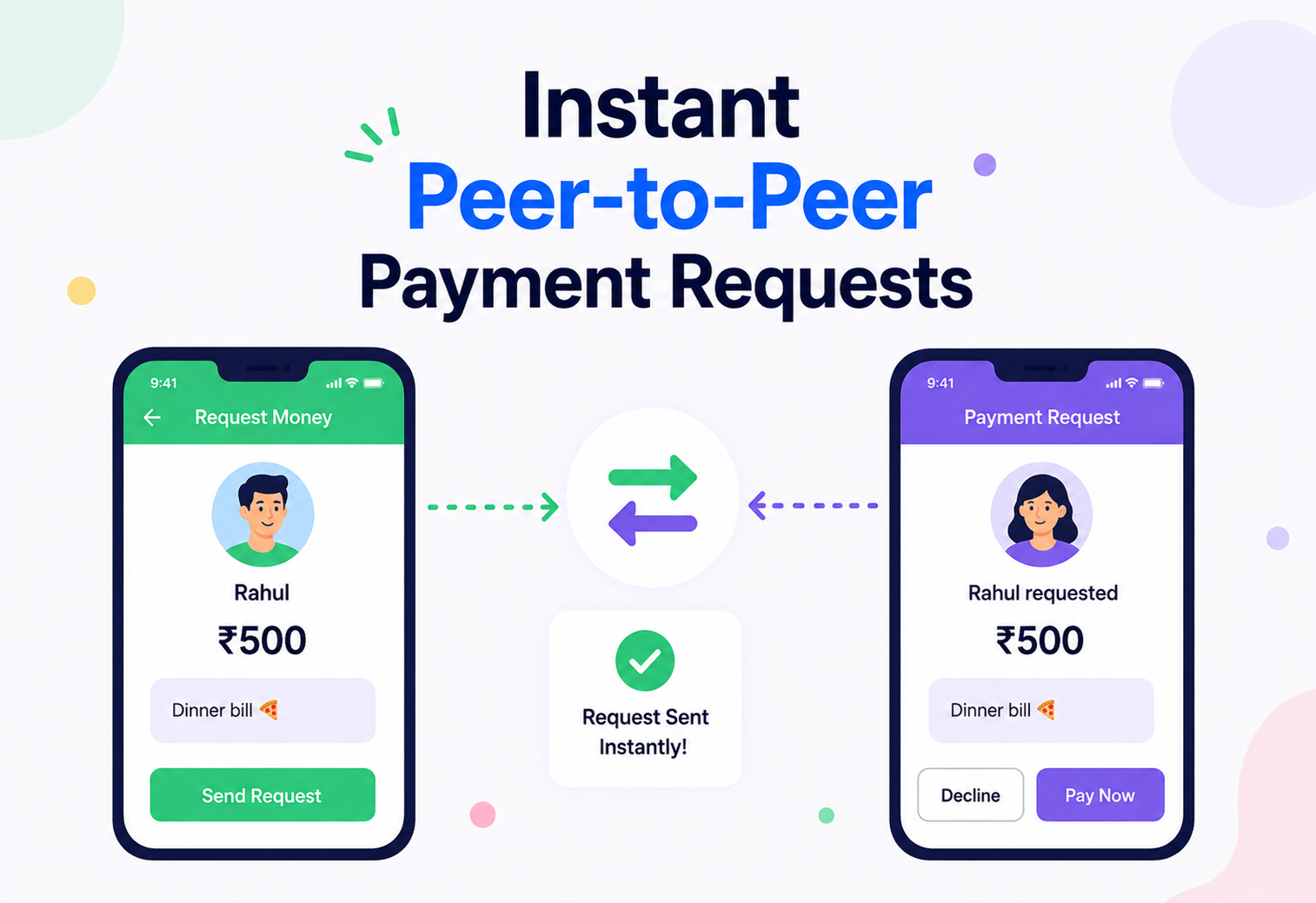
Instant Peer-to-Peer Payment Requests
Designing a system where one user can request money from another, with real-time notification and frictionless one-tap payment, for a modern financial platform.
Introduction & History
Asking a friend to pay you back is one of the oldest social transactions there is, and for most of history it was also one of the most awkward. Someone covers a shared bill, and the other person owes them money until, days or weeks later, cash changes hands, or more often, it simply gets forgotten. Traditional banking never solved this problem well — a bank transfer required knowing someone’s account and routing numbers, could take one to several business days to settle, and offered no natural way to simply “ask” for money the way you would ask a friend to pass the salt.
The rise of smartphone-based peer-to-peer (P2P) payment platforms in the 2010s changed this fundamentally. Services built the “request money” flow as a core primitive alongside “send money,” recognizing that a huge share of everyday P2P payments start with someone asking to be paid rather than someone proactively paying. A payment request turns an implicit social debt into an explicit, trackable, time-stamped digital object: one person creates a request specifying an amount and a reason, the other person receives an instant push notification, and settling the debt becomes a single tap rather than a multi-step bank transfer.
Underneath the simple two-button interface — “Pay” or “Decline” — sits a system that must generate and deliver notifications within a second or two of a request being created, maintain a consistent, auditable ledger of who owes whom and who has paid, integrate with banking rails or internal wallet balances to move real money reliably, and do all of this at a scale where a single popular platform might process tens of millions of requests a day, each one expecting to feel instantaneous to the people involved.
“Why treat a payment request as a distinct object from the payment itself, rather than just letting users send money directly?” A strong answer highlights that a request captures intent and social context before money moves, allows the payer to review and confirm rather than being surprised by an unexpected debit, and creates a natural audit trail distinguishing “asked for” from “received,” which matters both for user trust and for dispute resolution.
1.1 Why This Is a Genuinely Hard Distributed Systems Problem
On the surface, a payment request looks like a simple messaging feature: one user sends a structured message to another, and the recipient can respond. What makes it hard is that the response, when positive, is not just an acknowledgment — it triggers the movement of real money, which brings every one of the correctness, consistency, and fraud-prevention concerns of a financial ledger into what would otherwise be a straightforward notification system. A duplicate notification is a minor annoyance in most apps; a duplicate payment triggered by the same “Pay” tap being processed twice is a real financial loss that someone has to detect, reverse, and apologize for. This tension between “feels instant and effortless” and “is exactly, provably correct, every single time” is the central design challenge running through this entire guide.

1.2 The Product & Engineering History Behind This Pattern
Early digital money-movement products, including the first generation of online bank bill-pay systems, were built almost entirely around the “push” model: a payer initiates every transfer, and there is no equivalent notion of a payee formally asking to be paid within the system itself. This made sense for recurring bills, where the payee is typically a business with its own separate invoicing system, but it fit awkwardly onto everyday social payments between individuals, where the person owed money is very often the one who knows the amount and the reason, and is the natural party to initiate the interaction. The product insight that reshaped this space was recognizing that “request” and “send” are two directions of the same underlying transfer primitive.
From an engineering perspective, this history matters because it explains why the request object cannot simply be treated as a lightweight wrapper around a payment. A payment system designed only around the push model tends to assume every transfer is authorized and intentional from the moment it is initiated, since only the payer, who controls their own funds, can start one. A request, by contrast, is initiated by someone who does not control the funds at all; the entire feature exists specifically to let one party propose a transfer that the other party must review and separately authorize. This inversion is why the request lifecycle, and the explicit acceptance step that turns a request into an actual payment, deserves to be modeled as its own first-class concept rather than folded into the payment execution engine as an implementation detail.
Problem Definition & Requirements
The functional surface of this feature is deceptively small from a user’s point of view — request, notify, pay — but each of those three verbs expands into a meaningful list of concrete capabilities the system must support once the full range of realistic usage is accounted for, including group scenarios, expiration, and cross-border transfers.
2.1 Functional Requirements
- Allow a user to create a payment request specifying a recipient, an amount, a currency, and an optional note or reason.
- Deliver a real-time notification to the recipient within a small, bounded time window of the request being created.
- Allow the recipient to pay the request with a single tap, without re-entering payment details already on file.
- Allow the recipient to decline, or the requester to cancel, a pending request.
- Support requests that expire automatically after a configurable period if unanswered.
- Support group or split requests, where one request is divided among multiple recipients.
- Maintain a complete, queryable history of requests and their outcomes for both parties.
- Handle the actual movement of funds atomically and reliably once a request is accepted, whether funds come from an internal wallet balance, a linked bank account, or a linked card.
- Prevent duplicate payments even if the user double-taps, loses connectivity mid-payment, or retries after an ambiguous error.
2.2 Non-Functional Requirements
Low-latency notification
The recipient should see the request appear, ideally within one to two seconds of creation, for the interaction to feel real-time and conversational.
Strong consistency for money movement
Unlike many consumer features that can tolerate eventual consistency, the ledger entries and balance updates from an accepted request must be strongly consistent and auditable.
Retry-safe by design
Every payment action must be safe to retry without risk of double execution.
Always-on core paths
The request/notification path, and especially the payment execution path, must remain available even during partial infrastructure failures, since users reasonably expect a financial app to simply work.
Auditability & compliance
Every request, notification, and payment must be traceable for dispute resolution and regulatory reporting.
Fraud resistance
The system must resist being used for social-engineering scams, where a bad actor tricks a victim into paying a fraudulent request.
2.3 Scale Assumptions
A large consumer P2P platform can see tens of millions of payment requests created per day, with strong intra-day peaks around common social moments such as evenings, weekends, and paydays. Notification delivery must sustain sharp bursts, for example when a popular group event generates hundreds of simultaneous split requests. The read side — people checking their request history and pending requests — generates read traffic that typically outweighs write traffic by a wide margin, a pattern that shapes several of the caching and database decisions later in this guide.
“Which parts of this system need strong consistency, and which can tolerate eventual consistency?” A good answer separates the ledger and balance-affecting operations, which must be strongly consistent, from things like notification delivery, request history feeds, and search indexes, which can tolerate brief eventual consistency without any real user-facing harm.
2.4 Stakeholders & Their Competing Priorities
As with any financial system, several distinct stakeholders shape the requirements in ways that sometimes pull against each other. Product and growth teams care primarily about conversion: how quickly and reliably a request turns into a completed payment, since a slow, clunky, or confusing flow directly costs the business real transaction volume. Risk and fraud teams care about minimizing losses from scams and account takeover, and would generally prefer more friction and more verification on every payment if that friction alone were the only consideration. Compliance and legal teams need a complete, defensible audit trail and adherence to relevant money-transmission and anti-money-laundering regulations in every jurisdiction the platform operates in. Customer support teams need enough visibility into a request’s full history to resolve disputes quickly, since “where is my money” is one of the most common and most emotionally charged support inquiries a financial platform receives. Site reliability and engineering teams need the system to be operable: understandable failure modes, fast incident response, and confidence that a fix for one part of the system will not silently break another.
These priorities genuinely conflict in visible ways. The one-tap payment experience that product teams want directly trades against the additional friction that risk teams would otherwise prefer on every transaction; the resolution, discussed further in the security section, is applying friction selectively and proportionally to actual risk signals rather than uniformly to every payment, so that the vast majority of low-risk, everyday transactions stay effortless while genuinely risky transactions receive real additional scrutiny.
2.5 Scale & Volume Assumptions in More Depth
A large consumer P2P platform can see tens of millions of payment requests created per day, with strong intra-day peaks around common social moments such as evenings, weekends, paydays, and shared events like group meals or trips where several people settle up at once. Notification delivery must sustain sharp bursts, for example when a popular group event generates hundreds of simultaneous split requests within the same few seconds. The read side generates read traffic that typically outweighs write traffic by a wide margin, often by an order of magnitude or more, a pattern that shapes several of the caching and database decisions later in this guide. It is also worth noting that request volume and payment volume are not the same number: a healthy platform sees a meaningful fraction of requests expire or get declined rather than paid, and the system needs to handle that “no financial event occurs” outcome just as gracefully and efficiently as the “money moves” outcome, since it happens just as often, if not more so.
Architecture & Components
The system separates into five cooperating layers: the request service that owns the lifecycle of a payment request, the notification pipeline that delivers real-time alerts, the payment execution engine that moves money once a request is accepted, the ledger that records every financial event immutably, and a set of supporting services for fraud detection, compliance, and user-facing history. Each layer is deliberately scoped to a single, well-defined responsibility.
3.1 Payment Request Service
This service owns the full lifecycle of a request object: creation, delivery acknowledgment, acceptance, decline, cancellation, and expiration. It is the system of record for “what was asked,” as distinct from the ledger, which is the system of record for “what actually happened financially.” Keeping these concerns separate, discussed further under design patterns, is one of the more important architectural decisions in this system.
3.2 Notification Pipeline
Real-time delivery is handled through a combination of push notifications, for when the recipient’s app is not actively open, and a persistent WebSocket or similar real-time channel, for when the app is in the foreground and can render the incoming request instantly without waiting for the operating system’s push infrastructure. Both paths are fed from the same underlying event, published once by the request service, so there is a single source of truth for “a request was created” even though it fans out through two different delivery mechanisms.
3.3 Payment Execution Engine
When the recipient taps “Pay,” this engine is responsible for the entire money-movement transaction: verifying funds availability, running fraud and limits checks, debiting the payer, crediting the requester, and writing the resulting ledger entries, all as a single atomic unit of work from the user’s perspective, even though it may involve multiple internal services and, for external rails, asynchronous settlement.
3.4 Ledger Service
The ledger is an append-only record of every financial event: debits, credits, reversals, and fees. It is the ultimate source of truth for account balances and is designed so that a balance is always derivable by replaying or summarizing ledger entries, rather than being an independently mutable field that could drift out of sync with the entries that supposedly explain it.
3.5 Fraud & Compliance Layer
Every payment execution passes through fraud scoring and limits checks before funds move. This layer also feeds the compliance audit log required for regulatory reporting and dispute investigation.
“Why separate the request service from the ledger and payment execution engine instead of handling everything in one service?” A request is a lightweight, high-volume, mostly conversational object, while the ledger demands the strictest possible consistency and auditability; conflating them would force the lightweight request path to inherit the ledger’s stricter latency and consistency constraints unnecessarily, and vice versa.
3.6 How the API Gateway Fits Into the Picture
The API gateway sitting in front of every client interaction is more than a simple reverse proxy in this system; it is where authentication and session validation happen for every single call, where basic rate limiting is enforced before a potentially abusive request pattern ever reaches an internal service, and where request and response schemas are validated so malformed or unexpected payloads are rejected early rather than propagating deeper into the system where they could cause harder-to-diagnose failures. Centralizing these concerns at the gateway, rather than duplicating authentication and validation logic independently across every internal service, keeps that logic consistent and reduces the chance that a gap in one service’s own validation becomes an exploitable weakness.
Internal Working
Every important guarantee this system makes ultimately traces back to careful handling at the point where a user action first enters the system, which is why the creation flow, even though it involves no money movement at all, is held to nearly the same rigor as the payment flow itself.
4.1 Request Creation and the Idempotency Key
When a user taps “Request,” the client generates a unique idempotency key alongside the request payload before sending it to the server. This key ensures that if the client retries the call, for example because of a flaky network connection and an ambiguous timeout, the server can recognize the retry as the same logical request rather than creating a duplicate. The request service persists the request with a status of pending, publishes a request-created event for the notification pipeline, and returns confirmation to the requester’s app, all before the recipient has necessarily even seen anything, so the requester’s experience of “sending” the request feels instant regardless of how quickly the recipient responds.
4.2 The One-Tap Payment Flow
The “one tap” experience is only possible because the payer’s payment method and authorization are already established before the request ever arrives, typically during account setup or a previous payment. When the recipient taps “Pay,” the client sends a single authenticated call containing the request identifier and its own idempotency key. The server does not ask for any additional payment details; it looks up the payer’s default or previously specified funding source, and proceeds directly into the execution flow. This is why account-level trust and authorization, established once, are treated as a precondition of the entire feature rather than something re-verified on every single payment, which is what allows the actual payment action to be a single, low-friction tap.
4.3 Atomic Balance Updates
The execution engine must debit one party and credit another as a single atomic operation, ensuring the system never observes a state where money has left one account but not yet arrived in the other, except for the deliberately bounded and tracked window inherent to any external settlement rail. For internal wallet-to-wallet transfers, this is implemented as a single database transaction against the ledger, using appropriate isolation guarantees so that concurrent operations against the same account cannot interleave in a way that produces an incorrect balance. For transfers that touch an external bank or card rail, the internal ledger records an initiated state immediately, and a reconciliation process updates the entry to settled once the external rail confirms completion, with the wallet balance reflecting available versus pending funds distinctly so users are never misled about what they can actually spend right now.
4.4 Handling the Decline and Expiration Paths
Not every request results in payment. A decline is a simple, immediate state transition with no financial component, but it still needs to notify the requester promptly so they are not left wondering. Expiration is handled by a scheduled sweep process that periodically finds requests past their configured time-to-live and transitions them to an expired state, since relying purely on a client checking an expiration timestamp at read time would leave a request looking pending indefinitely to anyone who is not actively viewing it at the right moment.
“How do you guarantee a user tapping ‘Pay’ twice in a row, perhaps due to a slow UI response, never results in two payments?” Walk through the client-generated idempotency key, the server’s check against previously processed keys for that request before executing any balance change, and returning the original result for a detected duplicate rather than silently ignoring or re-executing it.
4.5 Incremental State Transitions and the FSM Behind a Request
It helps to think of every request as governed by an explicit, small finite state machine, rather than a loosely defined set of boolean flags scattered across a database row. A request moves from pending to exactly one of paid, declined, cancelled, or expired, and once it reaches any of those terminal states, no further transition is permitted; the service enforces this transition table directly rather than trusting every caller to respect it implicitly. This matters more than it might first appear, because without an explicitly enforced state machine, it becomes possible, especially under concurrent access from multiple devices or a retried request, for a request to be paid and then separately marked as expired by a background sweep that ran a moment later, leaving the system in a logically contradictory state that is confusing to reconcile after the fact. Enforcing state transitions atomically, typically through a conditional update that only succeeds if the request is still in the expected prior state, closes this entire class of race condition at the source rather than trying to detect and repair it downstream.
4.6 What Happens Between Acceptance and Settlement
It is worth being precise about the distinction between a payment being accepted by the recipient and the underlying funds being fully settled, especially when an external bank or card rail is involved. The moment the recipient taps “Pay” and the fraud check passes, the system can immediately mark the request as paid and notify both parties, because from the perspective of the social interaction, the debt has been resolved. Internally, however, the wallet or ledger may still show the specific funds as pending rather than fully available, particularly for a transfer funded from a bank account rather than an existing wallet balance, since many bank transfer rails do not guarantee final, irrevocable settlement instantly. The system is careful to keep these two notions — “the request is resolved” and “the funds are fully and finally settled” — visible and distinguishable internally, even while presenting a single, simple “paid” state to the users involved in the everyday case, so that support and compliance teams have the detail they need if a settlement issue does arise later.
Idempotency keys work like a coat-check ticket at a restaurant. The first time you hand it over, you get your coat. If you hand the same ticket over a second time in confusion, you get the same coat — not a mysterious second coat billed to your account.
Data Flow & Lifecycle
Tracing a single request from creation through payment illustrates how the layers described above cooperate.
Two things are worth highlighting in this lifecycle. First, the requester receives confirmation that their request was created before the recipient has necessarily seen or acted on anything, decoupling the two sides of the interaction so neither party’s experience depends on the other’s response time. Second, the fraud check happens synchronously, in the critical path of the payment itself, rather than only after the fact, because the entire point of a fraud check on a P2P payment platform is to prevent a fraudulent transfer from completing, not merely to detect it afterward when the money is already effectively gone.
It is also worth tracing what happens on the less common but operationally important paths that do not appear in the sequence diagram above. When the recipient declines, the flow is far shorter: the request service transitions the request directly to a declined state, publishes a request-declined event, and the notification pipeline informs the requester, with no interaction with the payment execution engine, the fraud service, or the ledger at all, since no financial event has occurred. When a request simply expires unanswered, the scheduled sweep process described earlier performs essentially the same state transition and notification, triggered by the passage of time rather than by an explicit user action. Designing these non-payment paths to be simple, cheap, and clearly separated from the payment execution path, rather than routing every outcome through the same heavyweight machinery built for the strongly consistent payment case, keeps the system efficient for what is, in aggregate, a very large share of all requests created.
Advantages, Disadvantages & Trade-offs
No architectural decision in this system is free; every choice that strengthens correctness or user experience in one dimension carries a corresponding cost somewhere else, and understanding these trade-offs explicitly is part of what separates a defensible design from one that simply happens to work under the specific conditions it was first tested against.
| Aspect | Advantage | Disadvantage / trade-off |
|---|---|---|
| Treating requests as first-class objects | Clear audit trail, better user experience, natural expiration and cancellation semantics. | Additional service and data model complexity compared to just letting users send money directly. |
| One-tap payment | Extremely low friction, drives engagement and completion rates. | Requires pre-established trust and authorization, which itself is an attack surface if account takeover occurs. |
| Synchronous fraud checks on the payment path | Blocks fraudulent transfers before money moves. | Adds latency to every single payment, even the overwhelming majority that are entirely legitimate. |
| Strong consistency for the ledger | Guarantees correctness of balances, essential for user trust and regulatory compliance. | Limits how aggressively the payment execution path can be horizontally scaled compared to a purely eventually-consistent design. |
| Push notification + WebSocket dual delivery | Covers both foreground and background app states for genuinely real-time delivery. | Two delivery mechanisms to build, monitor, and keep consistent with each other. |
A further trade-off worth naming is between building a fully custom fraud detection system in-house versus relying on a third-party fraud and risk scoring provider. Building in-house gives the platform full control over its risk model and the ability to tune it precisely to its own user base and observed fraud patterns, but requires accumulating a large volume of labeled fraud and legitimate transaction data before an in-house model can perform competitively, which newer or smaller platforms simply may not have yet. Relying on an established third-party risk provider gets a platform to a reasonably effective fraud posture much faster, at the cost of less direct control and an ongoing dependency on an external vendor’s uptime, pricing, and roadmap. Many mature platforms end up running both together: a third-party provider or model for baseline coverage, augmented by an in-house layer of rules and signals specific to patterns the platform has observed in its own data that a generic external model would not otherwise catch.

Performance & Scalability
A platform processing tens of millions of requests a day, with strong diurnal and social-event-driven peaks, needs a design that scales the read-heavy history and notification paths independently from the write-heavy, strongly-consistent payment execution path.
7.1 Techniques for Scale
Sharding the ledger by account
Since almost every ledger operation touches a small, specific set of accounts, partitioning ledger storage by account identifier allows the system to scale writes horizontally while keeping the strong consistency guarantees local to a single shard for the common case.
Read replicas for history & search
Request history, read far more often than written, is served from read replicas or a dedicated read-optimized store, keeping that traffic entirely off the primary ledger and request-write path.
Async fan-out for notifications
The notification service processes request-created events through a durable queue, allowing push and WebSocket delivery to scale independently of the request service’s write throughput and to absorb bursts without back-pressuring the core request flow.
Caching payment-method metadata
Data needed to support the one-tap flow, such as a user’s default funding source, is cached aggressively since it changes rarely but is read on every single payment attempt.
Rate limiting & burst absorption
A single popular group event splitting a request among many recipients can generate a burst of near-simultaneous notifications; the notification pipeline absorbs and smooths this burst rather than assuming a steady, evenly distributed load.
7.2 Latency Budget Example
| Stage | Target latency budget |
|---|---|
| Request creation, persisted and acknowledged to requester | Low tens of milliseconds |
| Request-created event published to notification pipeline | Under 100 milliseconds |
| Push notification delivered to recipient device | Roughly 1–2 seconds, largely bounded by external push infrastructure |
| WebSocket delivery to an actively open app | Under 200 milliseconds |
| Payment execution including fraud check and ledger write | Low hundreds of milliseconds |
“How would you scale the ledger without sacrificing the strong consistency it needs?” A strong answer discusses sharding by account so that most transactions only touch a single shard, and explains the harder case of a transfer between two accounts on different shards, which typically requires a distributed transaction protocol or a carefully designed two-phase commit-like process specifically for that cross-shard case, while the common same-shard case stays fast and simple.
7.3 The Cross-Shard Transfer Problem in Depth
Sharding the ledger by account solves the common case elegantly, since the overwhelming majority of P2P transfers happen between two accounts that, purely by the nature of how accounts get assigned to shards, may or may not land on the same shard. When they do not, the system needs a way to guarantee that a debit on one shard and a credit on another either both succeed or both fail, with no possibility of one completing without the other. A common, pragmatic approach borrows heavily from the saga pattern: the debit is performed first and recorded as provisional, an event or message is durably queued to trigger the corresponding credit on the other shard, and only once the credit is confirmed does the debit get marked final; if the credit cannot be completed after retries within a bounded window, an automated compensating transaction reverses the provisional debit. This trades a small amount of additional latency and complexity, specifically for the cross-shard case, in exchange for keeping the much more common same-shard case simple, fast, and free of any distributed coordination overhead at all.
7.4 Handling Bursty Group and Social-Event Traffic
Group payment scenarios, where one event generates many related requests in quick succession, create a distinctive burst pattern that differs from the more evenly spread background load the system otherwise sees. A dinner among a dozen friends that ends with one person splitting the bill into eleven simultaneous requests produces a small but sharp spike concentrated in a narrow time window, and if a platform is popular for a particular kind of shared social event, these spikes can be correlated across many independent groups at similar times of day, compounding into a genuinely large aggregate burst. The notification pipeline in particular is designed with this pattern specifically in mind, using a durable, bufferable queue between request creation and notification delivery so that a burst is smoothed out and processed as fast as downstream push infrastructure allows, rather than requiring the request service itself to synchronously wait on notification delivery before acknowledging each request.
High Availability & Reliability
Reliability in this system is inseparable from correctness: a failure that is handled gracefully from an availability standpoint but incorrectly from a financial standpoint — such as silently losing track of a debit — is arguably worse than an outright outage, because an outage is at least visible and immediately actionable, while a quiet correctness failure can go unnoticed until a much later reconciliation catches it.
8.1 Handling Partial Failures Mid-Payment
The most operationally sensitive failure mode in this system is a payment that fails partway through: the payer’s account has been debited, but the credit to the requester, or the ledger write confirming it, has not yet completed due to a downstream failure. This must never result in money simply disappearing from the user’s perspective. The execution engine uses a durable, ordered write-ahead log for each payment’s steps, so that on recovery from a failure, the system can determine exactly which steps completed and either resume or safely compensate the incomplete ones, rather than guessing or requiring manual reconciliation for every such incident.
8.2 Notification Delivery Guarantees
Because a missed or delayed notification directly harms the “feels instant” promise of the feature, the notification pipeline is built with at-least-once delivery semantics and client-side deduplication, rather than accepting silent notification loss as a tolerable failure mode. If a push notification provider is temporarily degraded, the system falls back to ensuring the request appears promptly the next time the recipient opens the app or reconnects a realtime session, rather than depending entirely on the external push provider’s reliability.
8.3 Multi-Region Deployment
The request and notification path can run active-active across multiple regions with relatively loose coordination, since these operations are not strictly ordered relative to each other in a way that requires cross-region consensus. The ledger, by contrast, typically runs with a clearly defined primary region per account shard, using synchronous or near-synchronous replication to a secondary region for failover, since the ledger’s correctness guarantees are much harder to maintain under a fully active-active, multi-region write model without significantly more complex distributed consensus machinery.
“What happens if the service crashes exactly between debiting the payer and crediting the requester?” Describe the durable write-ahead log approach, explain that recovery logic replays incomplete payments from their last confirmed step using the same idempotency keys used during normal operation, and emphasize that this recovery path is tested regularly, not just designed and forgotten.
8.4 Proactively Testing Failure Modes
The system benefits enormously from deliberately, regularly inducing failures against a controlled environment rather than only discovering gaps during a real incident. Simulating a mid-payment service crash, a delayed or lost push notification, a ledger shard becoming temporarily unreachable during a cross-shard transfer, and a fraud service timing out under load are all scenarios worth exercising on a recurring schedule, with the expected recovery behavior verified automatically rather than manually inspected after the fact. Because the cost of a real, undiscovered gap in this domain is direct financial loss or a duplicate payment that erodes user trust, the investment in this kind of proactive testing tends to pay for itself very quickly compared to letting a production incident be the first time a given failure path is actually exercised.
8.5 Graceful Degradation Under Partial Outage
Not every failure needs to take down the entire feature. If the fraud detection service is degraded or unavailable, a well-designed system does not necessarily have to halt all payments entirely; it can fall back to a more conservative policy, such as applying stricter default limits or additional friction to every payment during the outage window, while still allowing low-risk transactions to proceed, rather than presenting every user with a hard failure for a problem that, from their perspective, has nothing to do with what they are trying to do. Similarly, if the realtime WebSocket notification channel is degraded, push notifications and on-open history fetches continue to work independently, so a single channel’s outage degrades the experience gracefully rather than eliminating real-time delivery altogether.
Security
Security in this domain spans both conventional infrastructure protection and threats specific to a system whose entire purpose is moving money between individuals, including manipulation tactics that would not exist in a typical consumer application.
Strong authentication for payment actions
Even though the payment method itself does not need re-entry, the action of accepting a payment request requires a valid, current session and, for larger amounts, step-up authentication such as biometric confirmation.
Fraud scoring on both sides
The system screens for patterns associated with social-engineering scams, such as a newly added contact immediately requesting an unusually large amount, and applies additional friction or holds when risk signals are elevated.
Least privilege between services
The notification service has no ability to trigger a payment; it only consumes events and delivers alerts, limiting the blast radius of any compromise in that component.
Encryption in transit and at rest
All payment and personal data is encrypted end-to-end between client and server and at rest in every data store that holds it.
Immutable audit logging
Every request, decision, and payment event is written to an append-only log for both security forensics and regulatory obligations.
Rate limiting per account
Limits on how many requests a single account can create, or how much can be requested in aggregate over a period, help contain the damage from a compromised account being used to spam requests at a victim’s contacts.
“How would you defend against a scam where an attacker tricks a victim into paying a fraudulent request?” A thoughtful answer discusses risk signals like newly established relationships, unusual amounts relative to the recipient’s history with that contact, in-app warnings for first-time or high-risk payments, and step-up authentication for anomalous transactions, while acknowledging that some social-engineering risk cannot be eliminated purely through system design and also requires user education.
9.1 Account Takeover as the Dominant Threat Model
While social-engineering scams that trick a legitimate user into paying a fraudulent request are a real and important threat, in practice a large share of serious fraud losses on P2P platforms trace back to account takeover, where an attacker gains control of a genuine user’s account through a stolen password, a SIM-swap attack, or a phishing campaign, and then either sends fraudulent requests to that victim’s real contacts, who trust the compromised account, or drains the account’s own linked funding sources directly. This reframes a meaningful part of the security design: protecting the login and session layer, detecting anomalous account behavior such as a sudden change in device, location, or spending pattern, and building rapid account-freeze and recovery tooling for confirmed takeover cases are just as central to fraud prevention here as the payment-specific fraud scoring described elsewhere in this guide.
9.2 Data Minimization and Sensitive Field Handling
Beyond encryption and access control, the system practices data minimization deliberately: full card or bank account numbers, once linked, are tokenized immediately and the raw values are not retained in any service that does not specifically require them for a regulated settlement function, limiting how much genuinely sensitive data exists in how many places at all. Personal notes attached to a request, while generally low-sensitivity, are still treated as user-generated content requiring the same content-safety and abuse-monitoring consideration given to any other user-facing text field on the platform, since a request note is visible to another person and is technically a messaging surface even though its primary purpose is transactional.

Monitoring, Logging & Metrics
Observability for this system needs to answer two different kinds of questions simultaneously: is the infrastructure healthy in the conventional sense, and is the system’s financial behavior correct, since the second question has no true equivalent in most non-financial systems and requires its own dedicated category of metrics and alerting.
| Category | Example metrics |
|---|---|
| Latency | Request creation latency, notification delivery latency (p50, p99), payment execution latency |
| Throughput | Requests created per minute, payments executed per minute, notifications sent per minute |
| Correctness | Duplicate payment rate (should be effectively zero), ledger reconciliation discrepancies, failed-then-recovered payment rate |
| Reliability | Notification delivery success rate, payment execution success rate, service uptime per region |
| Business | Request-to-payment conversion rate, average time to payment, decline and expiration rates |
Every request and payment carries a correlation identifier threaded through every service it touches, so the complete lifecycle of any single interaction can be reconstructed for debugging or dispute resolution. Alerts are tiered: a brief regional latency increase is a warning; any nonzero duplicate-payment rate or ledger reconciliation discrepancy is treated as critical and paged immediately, since these directly represent real financial correctness failures rather than degraded user experience.
“What single metric would you treat as most critical to watch in production?” A strong answer names the duplicate-payment or ledger-discrepancy rate specifically, explaining that unlike most consumer metrics, this one should be exactly zero under normal operation, so any nonzero value at all is itself the alert condition, rather than a threshold that has to be crossed.
10.1 Reconciliation as a Continuous Background Process
Beyond real-time alerting, the system runs a continuous, automated reconciliation process comparing the internal ledger’s record of settled transactions against the external bank and card rails’ own settlement confirmations, since these two systems of record must agree exactly, and any divergence, however small, indicates either a bug in the platform’s own logic or a problem on the external rail’s side that needs prompt investigation. This reconciliation runs on a fixed schedule, typically much more frequently than the regulatory reporting cadence actually requires, precisely because catching a discrepancy early, while it is still small and traceable to a specific recent transaction, is dramatically cheaper to investigate and resolve than discovering the same discrepancy weeks later after it has potentially compounded with other unrelated issues.
10.2 Observability for the User-Facing Experience
Metrics that measure backend health are necessary but not sufficient; the team also tracks client-side, user-experienced metrics such as the time between a push notification arriving on a device and the user actually opening and viewing the request, and the time between viewing a request and completing or declining it. These metrics surface a different class of problem than pure backend latency: a backend that responds in a few hundred milliseconds can still deliver a poor experience if the client app is slow to render the notification, or if the payment confirmation screen itself introduces unnecessary friction, and this kind of end-to-end, user-perceived latency is ultimately what determines whether the feature actually delivers on its “instant and effortless” promise.
Deployment & Cloud Strategy
Unlike the ultra-latency-critical hot path of a trading system, this system’s latency targets — low hundreds of milliseconds for payment execution and one to two seconds for notification delivery — are comfortably achievable within standard, well-architected cloud infrastructure, which makes this a much more conventional cloud deployment than a colocated trading system. That said, “conventional” does not mean “identical to a typical consumer application” — the deployment strategy still needs to account for the elevated correctness and regulatory stakes specific to a system that moves real money.
- Multi-region cloud deployment: services are deployed across multiple cloud regions for both latency (serving users from a nearby region) and resilience (surviving a regional outage).
- Managed database services: the ledger and account data typically run on managed, strongly consistent database services with built-in replication, reducing operational burden compared to self-managing this critical infrastructure.
- Container orchestration: stateless services like the request service, notification service, and API gateway run in an orchestrated container environment, scaling horizontally with demand.
- Blue-green and canary deployments: changes to the payment execution engine specifically go through careful canary rollouts with close monitoring of the correctness metrics described above, since a bug here has direct financial consequences.
- Infrastructure as code: the entire deployment is defined declaratively so that environments are reproducible and disaster recovery does not depend on manual, undocumented setup steps.
“Would you deploy the payment execution engine the same way you deploy the notification service?” A good answer explains that both can live in standard cloud infrastructure, but the payment execution engine warrants a much more conservative rollout process, extra monitoring, and possibly a slower, more heavily gated deployment cadence, because its failure mode is financial loss rather than a delayed notification.
Context
The payment execution engine sits directly in the money-movement critical path, and even a subtle regression here can produce duplicate payments, missed credits, or ledger discrepancies that are extremely expensive to unwind after the fact. Treating it with the same deployment cadence as lower-stakes services (request service, notification service) accepts a level of risk disproportionate to the actual cost of a bad change.
Decision
Every payment engine and ledger schema change goes through a dedicated canary track: multi-day soak on synthetic and shadow traffic, a small live percentage rollout with automated rollback gated on the correctness dashboard (duplicate-payment rate, ledger reconciliation discrepancies), and an explicit sign-off from someone outside the immediate authoring team before wider release.
Consequences
Slower release cadence for the payment engine, in exchange for effectively eliminating self-inflicted financial-correctness incidents from deploys. Lower-stakes services keep their normal cadence.
11.1 Regional Data Residency and Regulatory Constraints
Multi-region deployment for a financial platform is not purely a latency and resilience decision the way it might be for a general consumer application; it is also shaped heavily by data residency regulations that, in many jurisdictions, require certain categories of financial and personal data to remain stored and processed within specific geographic or legal boundaries. This means the multi-region architecture typically cannot simply replicate every piece of data everywhere for uniform low latency; it needs a more deliberate data placement strategy, keeping a given user’s financial records within the region their regulatory obligations require, while still providing acceptable latency and a coherent, unified experience for users who travel or transact across regional boundaries.
Databases, Caching & Load Balancing
The storage architecture in this system is deliberately non-uniform: different pieces of state have very different consistency, latency, and volume characteristics, and treating them all with the same database technology and access pattern would be a poor fit for at least some of them.
12.1 The Ledger Store
The ledger is built on a strongly consistent, transactional database, since correctness here is non-negotiable. It is modeled as an append-only sequence of entries, with account balances derived from summing entries rather than stored as an independently updatable field, which prevents an entire class of bugs where a balance drifts out of sync with the transactions that should explain it.
12.2 The Request Store
Request objects, being higher volume and more read-heavy, live in a separate store optimized for fast key-based lookups and reasonably fast queries by user for history views, with read replicas absorbing the bulk of history-browsing traffic away from the primary write path.

12.3 Caching
Frequently accessed, slowly changing data, such as a user’s default payment method or contact list, is cached aggressively close to the services that need it, since this data is read on nearly every request and payment action but changes rarely. Pending request counts and recent history, shown prominently in the app’s home screen, are also cached with short time-to-live values and invalidated on relevant writes, balancing freshness against the very high read volume this view generates.
12.4 Load Balancing
Stateless services sit behind standard load balancers distributing traffic across replicas. The notification pipeline additionally uses consistent hashing to route a given user’s realtime WebSocket connection consistently to the same backend instance where practical, simplifying connection state management without requiring a fully distributed session store for every realtime connection.
“Why should account balance be derived from ledger entries rather than stored as its own field?” A directly mutable balance field can drift out of sync with the transaction history if any write path has a bug or a partial failure, while a balance derived from summing an append-only, immutable ledger is self-verifying: it can always be recomputed and reconciled against the entries that are supposed to explain it.
12.5 Materialized Balances for Read Performance
Deriving a balance purely by summing every historical ledger entry for an account, every single time the balance is needed, would be correct but far too slow for an account with a long transaction history, since a user who has been active on the platform for years may have thousands of entries. In practice, the system maintains a materialized, cached current balance alongside the ledger, updated transactionally as part of the same atomic operation that writes the new ledger entry, so the two can never drift apart under normal operation. This materialized balance is what the application actually reads on the common path, while the full ledger remains available, and periodically used, for reconciliation, auditing, and rebuilding the materialized value from scratch in the rare case that a discrepancy is detected, giving the system both the read performance it needs day to day and the self-verifying correctness guarantee the pure derivation approach provides.
12.6 Relational vs. Purpose-Built Ledger Storage
Many production financial systems build their ledger on a conventional relational database specifically because of its mature, well-understood transactional guarantees, while a smaller number of large-scale platforms invest in purpose-built ledger storage systems designed from the ground up around append-only, double-entry accounting semantics. The relational approach is generally the pragmatic starting point: it is well understood, broadly supported by existing tooling and operational expertise, and entirely sufficient at the scale most platforms operate at for a long time. A purpose-built ledger system becomes more attractive once transaction volume and the need for specialized guarantees, such as native support for double-entry bookkeeping invariants enforced at the storage layer itself, outgrow what a general-purpose relational database can comfortably provide, but this is a genuine build-versus-buy-versus-adapt decision that depends heavily on the specific scale and regulatory context a given platform operates within.
APIs & Microservices
Because none of this system’s latency targets require sub-millisecond internal calls, conventional REST or gRPC interfaces between services are entirely appropriate, and the design effort goes instead into getting the consistency and idempotency guarantees right at every service boundary.
| Service | Responsibility | Typical interface |
|---|---|---|
| Payment Request Service | Owns request lifecycle: creation, acceptance, decline, cancellation, expiration | REST/gRPC API, publishes domain events |
| Notification Service | Fans out real-time alerts via push and WebSocket | Consumes events from a durable queue, pushes to devices |
| Payment Execution Engine | Atomic money movement, fraud check orchestration | Internal RPC, strong consistency requirements |
| Ledger Service | Append-only financial record of truth | Internal RPC with strict transactional guarantees |
| Wallet / Balance Service | Tracks available versus pending balance, links to external rails | Internal RPC, integrates with bank and card networks |
| Fraud Detection Service | Real-time risk scoring on requests and payments | Low-latency internal RPC, synchronous in the payment path |
| Compliance / Audit Service | Immutable audit trail, regulatory reporting | Event-driven ingestion, batch reporting APIs |
API versioning and backward compatibility also deserve deliberate attention in this domain, more so than in many other systems, because the client applications making these calls are mobile apps that users do not always update promptly, meaning an older app version can remain in active use, calling these APIs, for months or even years after a newer version has shipped. The request and payment APIs are therefore designed with a strong compatibility discipline: new optional fields can be added without breaking older clients, and any genuinely breaking change is rolled out behind an explicit new API version, with the older version kept operational for a defined deprecation window, since a broken payment API for even a small fraction of still-active older app installations translates directly into real users unable to complete real transactions.
“Why is the fraud detection call synchronous and in the critical path, rather than an asynchronous check that flags suspicious payments after the fact?” The entire value of a pre-payment fraud check is preventing the transfer from completing at all; an after-the-fact check can only flag a payment for review once the money has already moved, which is a much weaker and more costly form of protection.
Design Patterns & Anti-Patterns
The patterns below were selected specifically because each one directly addresses a concrete failure mode discussed elsewhere in this guide, rather than being included as generic best practice unrelated to this system’s actual requirements.
14.1 Useful Design Patterns
Domain events as fabric
Request creation and payment completion are published as domain events, decoupling the request and payment services from the notification pipeline and any other consumer, such as analytics or fraud model training.
Server-enforced idempotency keys
Used consistently across request creation and payment execution to make retries safe by design rather than by careful, error-prone coordination at the client level.
Saga with compensations
When a payment touches multiple internal services or an external rail, treating it as a saga with explicit compensating actions for each possible partial-failure point keeps the system’s behavior predictable and auditable under failure.
Split writes from reads
The strongly consistent write path for ledger entries is kept separate from the read-optimized, eventually-consistent views used for request history and search, so heavy read traffic never contends with the critical write path.
Transactional outbox
Writing a domain event to the same transactional store as the underlying state change, and relaying it to the event bus asynchronously, avoids the classic dual-write problem where a database update succeeds but the corresponding event publish fails or vice versa.
Explicit request state machine
Request lifecycle transitions are enforced atomically via conditional updates rather than through loose boolean flags, closing off entire classes of race condition at the source.
14.2 Common Anti-Patterns to Avoid
Directly incrementing or decrementing a balance column, rather than deriving it from an append-only ledger, makes the system vulnerable to silent drift between the balance and the transaction history that should explain it.
Relying on the client to simply avoid double-tapping, without server-side idempotency key enforcement, is not a real guarantee; networks retry, apps crash and relaunch mid-request, and the server must be the final authority on preventing duplicate execution.
Sending a push notification without any delivery tracking or fallback means a silently failed notification is invisible to the system, directly undermining the “instant” promise of the feature with no way to detect the problem.
Assuming that a request between two users with an existing relationship is inherently safe ignores account takeover scenarios, where the attacker is operating from within an already-trusted relationship.
If creating and viewing requests requires the strongly consistent, more conservative payment execution path to be healthy, an issue in that path unnecessarily takes down a much larger, otherwise independent, part of the user experience.
“What is the outbox pattern, and why does it matter here specifically?” Explain the dual-write problem — a database write succeeding while the corresponding event publish fails, or the reverse — and how writing the event to the same transaction as the state change, then relaying it asynchronously from that same durable record, guarantees the event is eventually published if and only if the state change actually committed.
14.3 Why Certain Popular Patterns Are Used Only Selectively
A few generally excellent architectural patterns are used only in limited, carefully scoped ways in this system, and it is worth understanding why. Full microservices decomposition down to very fine-grained services, popular in many domains for maximizing independent deployability, is deliberately not taken to its logical extreme for the payment execution engine and ledger, since splitting the atomic debit-and-credit operation across too many independently deployable services would reintroduce exactly the kind of distributed transaction complexity the design otherwise works hard to avoid for the common, same-shard case. Similarly, aggressive caching, while used heavily for read-heavy, slowly changing data like payment method metadata, is deliberately avoided for anything balance-related, since a stale cached balance in a financial context is not a minor inconvenience the way a stale cached product price might be in an e-commerce context; it directly risks a user believing they have funds they do not actually have, or missing funds they do.
Best Practices & Common Mistakes
The practices and mistakes below are drawn less from theoretical first principles and more from patterns that repeatedly show up across teams building this kind of feature, which is exactly why they are worth calling out explicitly rather than assuming they will be obvious to anyone with general backend engineering experience.
Best practices
- Enforce idempotency keys at every service boundary that can trigger a financial state change, not just at the outermost API gateway.
- Derive balances from an immutable ledger rather than maintaining them as independently mutable fields.
- Run fraud and risk checks synchronously in the payment path, not as an after-the-fact review process.
- Track notification delivery explicitly, with fallback paths for when the primary push channel is degraded.
- Test partial-failure recovery paths regularly, not only when a real incident forces the team to discover a gap.
- Keep the request lifecycle service decoupled from the payment execution engine so that the two can scale, deploy, and fail independently.
- Invest as much in the audit trail as in the feature logic itself, since disputes and regulatory review are a certainty, not an edge case.
Common mistakes
- Underestimating how often mobile clients retry ambiguous network failures, and therefore underestimating how often duplicate submission attempts genuinely occur in production.
- Treating notification latency as a nice-to-have performance metric rather than a core part of the feature’s value proposition.
- Allowing the payment execution engine’s deployment cadence and review rigor to match that of much lower-stakes services, rather than deliberately holding it to a higher bar.
- Failing to model the “available versus pending” balance distinction clearly, leading to confusing or incorrect balance displays when funds are mid-settlement on an external rail.
- Under-investing in fraud detection specifically for the request-and-pay flow, since it is a distinct attack surface from ordinary account takeover and warrants its own dedicated risk signals.
“What’s the most common way teams underestimate correctness risk in a system like this?” A strong answer points to underestimating retry frequency from real-world mobile network conditions, and to the assumption that “it probably won’t happen often” is an acceptable stance for a failure mode whose cost, when it does happen, is a real financial loss rather than a degraded but recoverable experience.
15.3 Organizational Practices That Support System-Level Correctness
Technical safeguards alone are not sufficient without matching organizational discipline. Changes to the payment execution engine, the ledger schema, or fraud scoring logic should go through a review process specifically weighted toward correctness and financial risk, with sign-off from someone outside the immediate authoring team, regardless of how routine or urgent a given change feels to the engineer proposing it. Regular, scheduled reviews of near-miss incidents, including cases where a retry correctly prevented a duplicate payment or a fraud check correctly blocked a risky transaction, are just as valuable here as they are in any high-stakes systems domain, since they provide low-cost insight into how well the safeguards are actually working without requiring an expensive real loss to generate that insight.
Real-World Industry Examples
Looking at how established platforms and national payment infrastructures have actually implemented this pattern at scale grounds the architectural choices covered so far in real, observable outcomes rather than purely theoretical design reasoning.
Venmo, Cash App, PayPal
Built the “request money” flow as a first-class feature specifically because a large share of everyday peer-to-peer payments start as a request rather than a spontaneous send. The social, feed-like presentation of these requests and payments became a meaningful part of their product identity and engagement strategy.
Zelle & instant rails
Bank-backed real-time payment networks like Zelle in the United States and similar real-time rails elsewhere focus more narrowly on the underlying instant transfer capability, relying on participating banks’ own apps to build request and notification experiences on top of that rail.
UPI (India)
India’s Unified Payments Interface represents one of the largest-scale real-world deployments of exactly this pattern, processing an enormous volume of person-to-person and person-to-merchant payment requests daily across a shared, interoperable national payment rail. UPI “collect requests” function conceptually identically to the request object described throughout this guide.
Traditional issuers
Card networks and traditional banks have introduced instant or near-instant transfer capabilities that touch similar ground, generally by settling over faster underlying clearing rails while keeping much of the request, notification, and one-tap acceptance experience conceptually similar to what is described here, even where underlying settlement mechanics differ.
Specific product behaviors, feature names, and operational details described in this guide are illustrative and drawn from general, publicly discussed industry patterns rather than any single company’s disclosed internal architecture; exact implementations vary by provider and should be verified independently for any real design or business decision.
16.1 What Smaller Platforms Can Learn From Large-Scale Deployments
A team building this feature for the first time, at a much smaller scale than the platforms discussed above, does not need to build every piece of this guide’s full architecture on day one. The core lessons that transfer regardless of scale are the ones around correctness: enforcing idempotency from the very first version of the payment flow, deriving balances from an immutable ledger rather than a mutable field even in an early, simple implementation, and treating the request lifecycle as an explicit state machine rather than a loose set of flags. These practices cost relatively little to build correctly from the start and are extremely expensive to retrofit later, once real user data and real financial history already exist on top of a less rigorous foundation. Scaling techniques like sharding, multi-region deployment, and sophisticated burst-absorption for notifications, by contrast, are the kind of investments that genuinely can and should wait until the platform’s actual growth demands them, since building them prematurely mostly adds complexity without a corresponding benefit at low scale.
“How does a shared, interoperable rail like UPI change the design compared to a single closed platform like a typical consumer P2P app?” A thoughtful answer notes that interoperability across many independent bank and app providers requires a standardized protocol and shared settlement infrastructure rather than a single company’s internal services, shifting some of what was an internal API design problem into a much harder multi-party protocol and governance problem.
Frequently Asked Questions
The questions below cover the edge cases and design decisions that come up most often when this system is discussed in practice, whether in an actual production design review or in an interview setting.
What happens if the recipient’s app is completely offline when a request is created?
The request is still persisted and the request-created event is still published; the notification pipeline attempts push delivery through the operating system’s notification infrastructure, which typically queues the notification for delivery once the device reconnects. Independently, the next time the recipient opens the app, the client fetches current pending requests directly, so the request is never dependent purely on push delivery succeeding to eventually be seen.
How is a split or group request different from a simple one-to-one request?
A group request is modeled as a parent request divided into multiple independent child requests, one per recipient, each with its own lifecycle, notification, and payment action. This keeps the core request and payment logic unchanged for the common one-to-one case while allowing the group scenario to be built as a composition on top, rather than complicating every request with group-specific logic it does not need.
Why does the payer need step-up authentication for some payments but not others?
Step-up authentication, such as an additional biometric or passcode confirmation, is applied based on risk signals like unusually large amounts, first-time payments to a given recipient, or other fraud-model indicators, rather than uniformly on every payment. This balances the one-tap experience most users expect for their normal, low-risk activity against the additional friction genuinely warranted for higher-risk transactions.
How does this system handle currency conversion for cross-border requests?
A cross-border request typically fixes the requested amount in the requester’s currency at creation time, and the payment execution engine applies a conversion rate, sourced from a rate service with its own freshness and margin logic, at the moment of payment, clearly disclosing the converted amount to the payer before they confirm. The ledger records both the original requested amount and currency and the actual settled amount and currency, preserving a complete and unambiguous record for both parties and for compliance.
Could the ledger use an eventually consistent database to improve write throughput?
In principle a very carefully designed eventually consistent ledger is possible, and some large-scale systems do pursue sophisticated approaches along these lines, but the practical complexity of reasoning correctly about eventual consistency for money movement is very high, and most production systems judge that the operational and correctness risk is not worth the throughput gain compared to a well-sharded, strongly consistent design, which is generally the more conservative and defensible starting point.
What happens if a user requests money from someone who has never used the platform before?
The system typically still creates the request and delivers a notification through whatever channel is available, such as a text message or email containing a link, inviting the non-user to install the app or complete a lightweight web-based flow to accept and pay. This onboarding-through-a-request pattern is a meaningful growth channel for many P2P platforms, but it also introduces its own fraud and verification considerations, since the platform is extending some level of trust to a brand-new, unverified party purely on the basis of an existing user’s request, and typically applies additional identity verification before that new user’s first payment completes.
How does the system prevent a requester from harassing someone with repeated requests after a decline?
Beyond the general per-account rate limits already discussed, the platform typically applies a specific cooldown or escalating friction after a request is declined by the same recipient, and gives the recipient an easy way to block further requests from a specific sender entirely. This is treated as both a fraud-adjacent concern, since repeated unwanted requests can be a vector for harassment or scam pressure tactics, and a straightforward product quality concern, since nobody wants a financial app that can be used to pester them.
Does the recipient’s decision to pay ever get reversed after the fact?
A completed payment is generally treated as final under normal operation, consistent with how most instant payment systems work, but the platform still needs a well-defined process for handling disputes, confirmed fraud, or a payment made in error, typically involving a manual review and, when warranted, a separate reversing transaction recorded transparently in the ledger rather than silently deleting or rewriting the original entry, preserving a complete and honest history of exactly what happened.
How does the request lifecycle interact with account closure or app deletion mid-flight?
Account closure does not retroactively erase pending or historical requests, since doing so would break the audit trail the compliance function depends on; instead, pending requests involving a closed account are typically transitioned to a cancelled or expired state automatically, with the counterparty notified that the request can no longer be completed, while the historical record of what occurred before closure is retained according to the platform’s standard regulatory retention policy regardless of the account’s current active status.
17.1 A Note on How to Approach This Problem in an Interview Setting
When a problem shaped like this comes up in a system design interview, strong candidates tend to establish early which parts of the system need strong consistency and which can tolerate eventual consistency, since that single distinction shapes almost every subsequent architectural decision, from database choice to how services are decomposed. From there, walking through the request lifecycle explicitly, and being ready to discuss idempotency and partial-failure recovery in concrete detail rather than only at a high level, tends to distinguish a strong answer from a superficial one, since these are precisely the areas where a system that looks correct in a simple, happy-path design diagram often turns out to have subtle gaps once failure scenarios are actually worked through in detail.
Summary & Key Takeaways
Bringing together everything covered in this guide, a small number of core ideas do most of the work in making an instant peer-to-peer payment request system both delightful to use and safe to operate: treating the request as a distinct, explicitly modeled object rather than an implementation detail of a payment; making idempotency a first-class, server-enforced guarantee rather than a client-side convention; deriving financial truth from an immutable, append-only ledger rather than any independently mutable field; and running fraud prevention synchronously, before money moves, rather than as an after-the-fact detection exercise.
First-class, not a wrapper
A payment request is a distinct, first-class object from the payment itself, capturing intent and social context and enabling a clean audit trail, decline, and expiration lifecycle.
Explicit state machine
Modeling the request as an explicit finite state machine, enforced atomically at the storage layer, closes off an entire class of race conditions that a looser, flag-based representation would leave open.
Trust established once
The one-tap payment experience is only possible because trust and payment authorization are established once, ahead of time, rather than re-verified on every transaction.
Lightweight vs. strongly consistent
The system separates cleanly into a lightweight, high-volume request service, a real-time notification pipeline, and a strongly consistent payment execution engine backed by an immutable ledger.
Key takeaways
- Requests are first-class objects. A payment request captures intent and social context and enables a clean audit trail, decline, and expiration lifecycle distinct from the payment itself.
- Idempotency is server-enforced. Enforce idempotency keys at every financial state-changing boundary; client-only conventions are not real guarantees.
- Fraud checks run synchronously. Prevent, don’t just detect — an after-the-fact check on a completed payment is a much weaker form of protection.
- Balances are derived, not stored. An append-only ledger with a materialized balance updated in the same transaction is self-verifying; a mutable balance field is not.
- Standard cloud is enough — but rolled out carefully. This is not a colocated trading system; the primary engineering discipline is correctness, idempotency, and fraud resistance, not raw speed.
- Event-driven, saga, outbox, CQRS. These patterns are natural fits; mutable balances, fire-and-forget notifications, and client-only idempotency are the most damaging anti-patterns to avoid.
- The pattern scales from one company to a nation. From closed consumer P2P platforms to shared rails like UPI, the same request/notify/pay primitive generalizes cleanly to interoperable financial infrastructure.
- Simple surface, deliberate engineering discipline. The one-tap experience is only trustworthy because of the sometimes invisible discipline underneath it: idempotency, strong consistency, synchronous fraud checks, and a complete, immutable audit trail.
Everything else in the architecture, from sharding strategy to deployment topology to monitoring design, exists in service of protecting those core guarantees while still delivering the fast, effortless, one-tap experience users have come to expect from modern financial platforms.