What Is a Cascading Failure?
A complete, beginner-friendly, production-grade guide to understanding, preventing, and surviving the domino effect that takes down entire systems — explained from first principles with real Java code and real-world stories.
Introduction & History
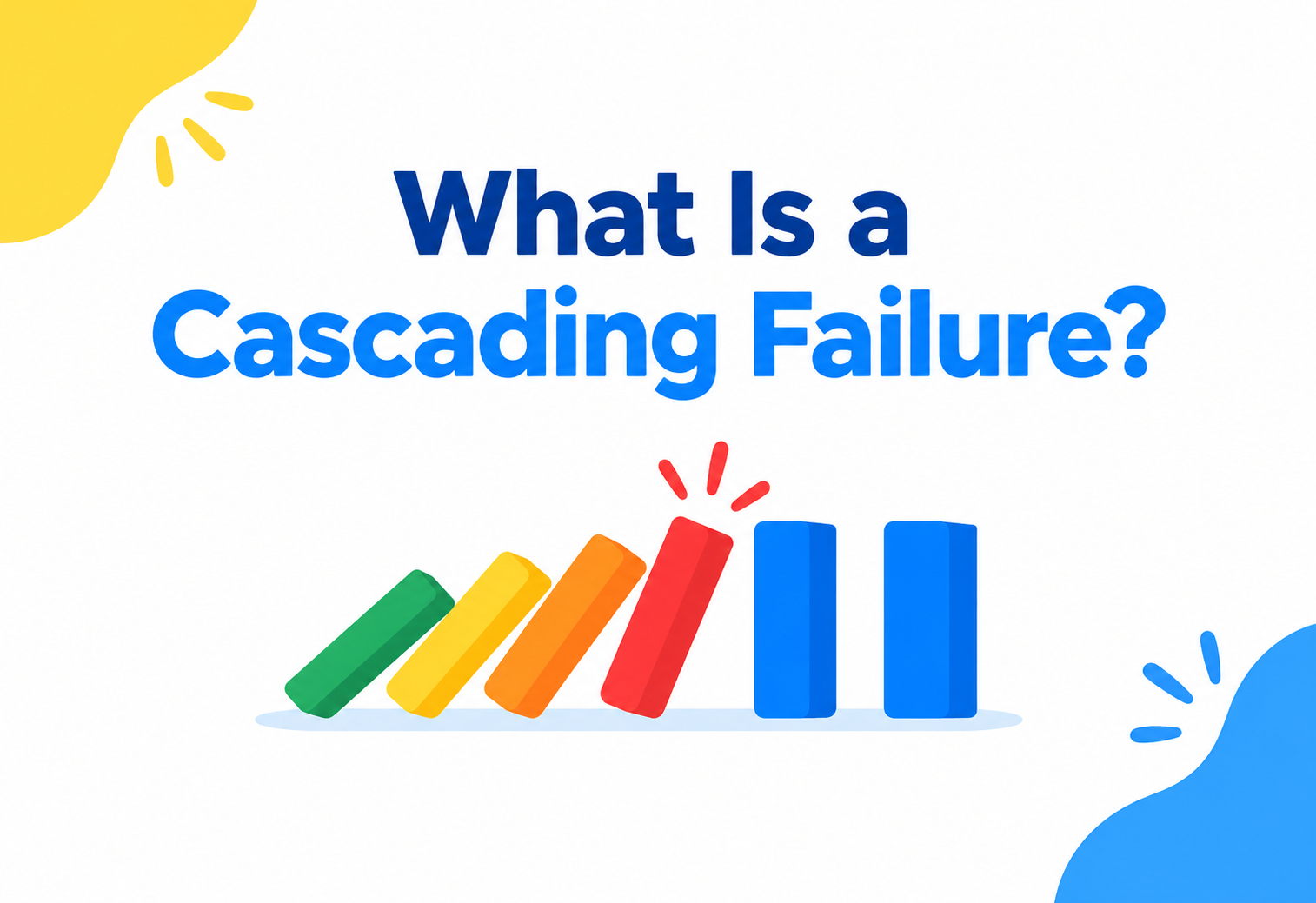
Imagine you are standing at the very first domino in a long, winding line of a thousand dominoes. You give it a tiny push. It falls onto the second domino. The second knocks over the third. Within seconds, all one thousand dominoes are lying flat on the table, even though you only touched one of them with one finger.
A cascading failure is the software-systems version of that domino line. It is what happens when one small failure in one part of a system triggers a chain reaction of failures in other, connected parts — until, eventually, a large portion of the system (or the whole thing) stops working, even though only one small piece was originally broken.
This idea is not new, and it did not start in software. Engineers who study power grids, bridges, aircraft, and even ecosystems have used the term “cascading failure” for decades. The most famous non-software example is the Northeast Blackout of 2003 in the United States and Canada, where a software bug in one alarm system at a power company in Ohio, combined with a few sagging power lines touching overgrown trees, eventually cut off electricity to 55 million people across eight U.S. states and Ontario, Canada. One undetected local problem cascaded into one of the largest blackouts in history.
Software engineers borrowed this term because the exact same pattern happens inside computer systems. As applications moved from single, giant programs (“monoliths”) running on one big computer, to hundreds of small, independent services talking to each other over a network (“microservices”), the number of dominoes standing next to each other exploded. A single slow database query in one service can, in the worst case, bring down an entire e-commerce website during its biggest sale of the year.
Think of a busy restaurant kitchen. If the dishwasher machine breaks, dirty plates start piling up. Soon there are no clean plates left, so the chefs cannot plate new food. Waiters have nothing to serve, so they start apologizing to customers and taking longer at each table. New customers waiting at the door get impatient and leave. One broken dishwasher slowly stops the entire restaurant — not because the kitchen forgot how to cook, but because every station depended on the one before it.
In modern distributed systems — the kind that power companies like Netflix, Amazon, Uber, and Google — a single application is broken into dozens or hundreds of smaller services. Each service depends on other services, databases, caches, and third-party APIs. This interconnectedness is powerful (it lets teams build and deploy independently) but it also means that failure can travel along the same wires that success travels along. Understanding cascading failures is one of the most important skills for anyone who designs, builds, or operates large-scale software systems.
By the end of this guide, you will understand exactly what a cascading failure is, why it happens, how to see it coming, how to stop it in its tracks, and how the biggest technology companies in the world have learned (often through painful, public outages) to build systems that bend without breaking.

One Push, Many Falls
A single trigger toppling a long chain of dependent components in seconds.
55 Million People
One alarm bug + a few sagging lines cascaded into one of history’s biggest outages.
Hundreds of Dominoes
Microservices multiplied the number of adjacent failure paths dramatically.
Bend, Don’t Break
Great systems fail small, contain the blast, and recover fast.
The Problem & Motivation
Cascading failures exist because of the way modern software is built — not one program on one server, but hundreds of small services talking to each other constantly. Every one of those conversations is a potential propagation path for failure.
2.1 Why does this problem exist at all?
In the early days of computing, most applications were monoliths: one large program, running on one server, talking to one database. If that program crashed, the whole application went down — but there was nothing else for the failure to “spread” to, because there was only one thing running.
As businesses grew, engineers split monoliths into many small, independent services (this is called a microservices architecture). Now, a single user action — like clicking “Buy Now” on a shopping website — might quietly trigger calls to a dozen different services: an inventory service, a pricing service, a payment service, a fraud-detection service, a shipping service, a notifications service, and more. Each of these services may call still more services or databases behind the scenes.
Fig 1. A single “Buy Now” click can quietly depend on 8+ services. If any one of them slows down badly, the effect can ripple back to the user — and to every other request waiting behind it.
This is the root of the problem: every dependency you add is a potential path for failure to travel through. The more services talk to each other, the more “dominoes” you have standing next to each other. This is sometimes called the fan-out problem — one request fans out into many downstream calls, and if even one of those downstream calls behaves badly, the effects can fan back in and overwhelm the original caller.
2.2 What specifically goes wrong?
Cascading failures are almost never caused by a service crashing instantly and cleanly. They are usually caused by a service becoming slow, not dead. A dead service is easy to detect and route around. A slow service is dangerous because callers keep waiting, keep retrying, and keep piling up work, silently consuming resources until they, too, become slow or unresponsive.
| Trigger (the first domino) | How it spreads (the chain reaction) |
|---|---|
| A database starts responding slowly due to a slow query | Application servers hold open connections waiting for the DB, exhausting the connection pool for every other request |
| One microservice instance runs out of memory | The load balancer keeps sending it traffic (it hasn’t crashed yet), making it even slower, until it finally dies — dumping its traffic onto the remaining instances, which then also become overloaded |
| A third-party payment API takes 30 seconds to respond instead of 200ms | Every thread calling that API is now blocked for 30 seconds; the thread pool fills up; new unrelated requests can’t get a thread and start failing too |
| A cache node goes down | All requests that used to be served instantly from cache now hit the database directly; the database, never designed for that much direct traffic, falls over |
A system can be running perfectly fine at 9:59 AM and be almost completely down by 10:02 AM — not because three separate things broke, but because one small thing broke and the system’s own retry logic, connection pools, and traffic patterns turned that one small thing into a company-wide outage. Cascading failures are dangerous precisely because they can go from “barely noticeable” to “total outage” in minutes.
2.3 The business cost
This isn’t just an academic concern. Amazon has estimated that even a one-second delay in page load can cost billions of dollars in lost sales over a year at their scale. A full cascading outage during a peak shopping event, a bank’s month-end processing, or a hospital’s patient record system can mean lost revenue, regulatory fines, lost customer trust, and in the case of critical infrastructure, real danger to human life. This is why every major technology company invests heavily in engineers and tools whose entire job is to prevent, detect, and stop cascading failures.
Core Concepts
Before we can design systems that resist cascading failures, we need a shared vocabulary. Let’s build it up term by term, from the simplest idea to the more advanced ones.
3.1 Dependency
A dependency is simply something a piece of software needs in order to do its job — another service, a database, a cache, a third-party API, even a shared library or a piece of hardware.
If you are cooking a meal and you need salt from the kitchen shelf, the salt is your “dependency.” If the salt jar is missing, your recipe (your task) cannot fully complete the way you planned.
3.2 Failure vs. Fault vs. Error
These three words are often used loosely, but reliability engineers separate them carefully:
- Fault — the underlying defect or condition (e.g., a bug in the code, a full disk, a network cable that’s cut).
- Error — the incorrect internal state that results from a fault (e.g., a variable holding a wrong value, a connection object that’s actually closed but the code doesn’t know it yet).
- Failure — the externally visible, user-facing consequence (e.g., the website shows an error page, the API call times out).
A cascading failure is what happens when the failure of one component becomes the fault that triggers a failure in the next component, which becomes the fault for the one after that, and so on.
3.3 Latency Spike
Most cascades don’t start with a service crashing. They start with a service becoming slow. This slowness is called a latency spike. Latency is simply “how long something takes.” A spike means it suddenly takes much longer than usual.
3.4 Resource Exhaustion
Every piece of software runs with limited resources: a limited number of threads, a limited number of database connections, a limited amount of memory, a limited number of open network sockets. Resource exhaustion is what happens when a slow dependency causes these limited resources to fill up and never get released, leaving nothing left for new, unrelated work.
Imagine a small coffee shop with only 5 tables. If a group of customers sits down and waits an extremely long time for their coffee because the espresso machine is broken, those 5 tables stay occupied. Even though the shop technically has “5 tables,” it can now serve zero new customers, because every table is stuck waiting on the same broken machine.
3.5 Retry Storm
When a request fails or times out, it is common for software to automatically try again (“retry”). This is usually helpful — but if thousands of clients all retry a struggling service at the same time, the retries themselves can multiply the load on the already-struggling service, making the problem far worse. This is called a retry storm, and it is one of the single most common causes of a small hiccup turning into a full cascading outage.
3.6 Thundering Herd
A related concept: when a popular cache entry expires, or a service restarts, a huge number of requests can suddenly “wake up” and hit the same backend resource at the exact same moment, like a herd of animals all charging toward the same watering hole at once. This sudden spike can itself trigger a cascade.
3.7 Blast Radius
The blast radius of a failure is how much of the system is affected by it. A well-designed system tries to keep the blast radius of any single failure as small as possible — ideally limited to just the one broken component, rather than the entire platform.
3.8 Backpressure
Backpressure is a signal sent backward through a system, telling upstream callers to “slow down, I can’t keep up.” Systems that support backpressure can gracefully shed or delay load instead of accepting more work than they can handle and collapsing under it.
3.9 Graceful Degradation
This is the opposite of a cascade. Instead of one broken piece taking down everything, a system with graceful degradation continues to work in a reduced, “good enough” way. For example, if the “recommended products” service is down, an e-commerce site can still let you view products and check out — it simply hides the recommendations section instead of showing an error for the entire page.
Quick Glossary Table
| Term | One-line meaning |
|---|---|
| Cascading Failure | One failure triggers a chain of further failures |
| Latency Spike | A sudden, sharp increase in response time |
| Resource Exhaustion | Threads, connections, or memory run out |
| Retry Storm | Mass simultaneous retries overload a struggling service |
| Thundering Herd | A sudden spike of simultaneous requests hitting the same resource |
| Blast Radius | How much of the system a single failure affects |
| Backpressure | A “slow down” signal sent to upstream callers |
| Graceful Degradation | Reduced but working functionality instead of total failure |
Architecture & Components Involved
To understand where cascades happen, we need to look at the typical architecture of a modern distributed system and identify every place a failure can enter and spread.
Fig 2. A typical layered architecture. Every arrow is a potential path for a cascade to travel along.
4.1 The Client Layer
This is the browser, mobile app, or another system calling your API. Clients can contribute to cascades through aggressive automatic retries or by all hammering the “refresh” button when they see an error.
4.2 Load Balancer
Distributes incoming traffic across multiple servers. If it doesn’t detect unhealthy instances quickly, it will keep sending traffic to a struggling server, worsening the problem. If it removes too many instances too aggressively, the remaining instances get overloaded instead — this is itself a cascade risk.
4.3 API Gateway
The front door for external traffic into your microservices. A well-built gateway can apply rate limiting and circuit breaking here, stopping bad traffic before it reaches internal services.
4.4 Application Services
The actual business logic (Order Service, Inventory Service, Payment Service, etc). Each service has its own thread pool, memory limits, and connection pools — all finite resources that can be exhausted.
4.5 Databases
Often the ultimate bottleneck. Databases have a hard limit on concurrent connections. If every application server opens the maximum number of connections and holds them while waiting on a slow query, the database connection limit is reached, and every other service that also needs the database is locked out too — even ones with no relation to the original slow query.
4.6 Caches
Caches (like Redis or Memcached) exist specifically to protect databases from too much direct traffic. A cache outage is a classic cascade trigger: suddenly, 100% of traffic that used to be absorbed by the cache slams into the database directly.
4.7 Message Queues
Systems like Kafka or RabbitMQ decouple services in time, which actually helps prevent cascades — a slow consumer doesn’t directly block the producer. But if consumers fall too far behind, queues can grow unbounded and eventually run out of disk or memory themselves.
4.8 External / Third-Party Dependencies
Payment gateways, SMS providers, mapping APIs — anything outside your own infrastructure. You have zero control over their reliability, which makes isolating failures from them especially important.
Netflix’s architecture famously assumes that every single one of these components will fail at some point. Their internal tool, Chaos Monkey, deliberately kills servers in production at random, specifically to force engineers to build services that survive the failure of any one dependency without cascading.
Internal Working: How a Cascade Actually Unfolds
Let’s walk through, step by step, exactly how a tiny problem becomes a giant outage. We’ll use a realistic scenario: an e-commerce “Order Service” that calls a “Payment Service.”
Step 1 — The Trigger
The Payment Service’s database starts running a slow query (perhaps due to a missing index after a new feature was deployed). Instead of responding in 50ms, it now takes 8 seconds.
Step 2 — Threads Get Stuck
The Order Service calls the Payment Service using a fixed-size thread pool (say, 200 threads). Each incoming order request grabs a thread and calls the Payment Service, then waits. Because the Payment Service now takes 8 seconds instead of 50ms, each thread is occupied 160x longer than normal.
Step 3 — The Pool Fills Up
Normal traffic keeps arriving. Within seconds, all 200 threads in the Order Service are stuck waiting on the Payment Service. There are no threads left to handle any new request — even requests that have nothing to do with payments, like “view my order history,” because they happen to share the same thread pool.
Step 4 — Timeouts and Retries Kick In
Client applications (or an internal retry policy) see failures and automatically retry. Now, instead of one attempt per order, there are two, three, or more attempts per order, multiplying the load on the already-struggling Payment Service.
Step 5 — The Failure Spreads Upstream
The API Gateway, which calls the Order Service, now also experiences slow responses and exhausts its own resources. Any other service that happens to call the Order Service for unrelated reasons (e.g., a “recently viewed orders” widget on the homepage) also starts failing.
Step 6 — The Whole Platform Feels It
Because everything eventually shares infrastructure — the same load balancers, the same Kubernetes cluster, sometimes the same database server — even completely unrelated features (like the search bar, or user login) can start failing as the underlying infrastructure becomes starved of CPU, memory, or connections.
Fig 3. A sequence diagram showing how one slow database query starves an unrelated request of resources.
A Minimal Java Example: How an Unbounded Call Causes This
Here is a simplified, dangerous version of a service-to-service call — the kind of code that, without protection, directly causes the scenario above.
// DANGEROUS: no timeout, no circuit breaker, no bulkhead
@RestController
public class OrderController {

    private final RestTemplate restTemplate;

    public OrderController(RestTemplate restTemplate) {
        this.restTemplate = restTemplate; // default: NO timeout configured!
    }

    @PostMapping("/orders")
    public ResponseEntity<String> placeOrder(@RequestBody OrderRequest req) {
        // This call can hang FOREVER if Payment Service is slow.
        // Every thread that reaches this line gets stuck waiting.
        String result = restTemplate.postForObject(
            "http://payment-service/charge", req, String.class);
        return ResponseEntity.ok(result);
    }
}
Notice: there is no timeout. There is no limit on how many requests can be “in flight” to the Payment Service at once. There is no fallback if the Payment Service is unhealthy. This single, innocent-looking piece of code is exactly how real cascading failures begin in production systems every day.
Data Flow & Lifecycle of a Cascade
Reliability engineers often describe a cascading failure as having distinct phases. Recognizing which phase you’re in during an incident helps you choose the right response.

Fig 4. The nine-phase lifecycle of a cascading failure, from first trigger to lessons learned.
Phase 1 — Trigger Event
Something changes: a deploy introduces a bug, traffic spikes unexpectedly (a marketing campaign goes viral), hardware fails, or a dependency (cloud provider, DNS, third-party API) has its own outage.
Phase 2 — Local Degradation
One component becomes slow or partially unavailable. At this point, the problem is still small and, if caught here, easy to contain.
Phase 3 — Resource Exhaustion
Calling services start accumulating stuck threads, connections, or memory as they wait on the degraded component.
Phase 4 — Failure Propagation
The exhausted calling service itself becomes slow or unresponsive to its callers, and the pattern repeats one layer further out.
Phase 5 — Amplification via Retries
Automatic retries, client refresh spam, and load balancer re-routing multiply the effective load on already-struggling components, accelerating the spread.
Phase 6 — Full Outage
A large portion of the system, or the entire system, is now unavailable or severely degraded for end users.
Phase 7 — Detection & Response
Alerts fire, on-call engineers are paged, and an incident response process begins — ideally within minutes, not hours.
Phase 8 — Recovery
Engineers apply mitigations: rolling back a bad deploy, restarting unhealthy instances, manually shedding load, scaling up capacity, or disabling a feature via a feature flag (“kill switch”).
Phase 9 — Post-Incident Learning
A blameless post-mortem is written, identifying root causes and contributing factors, and concrete action items (like adding a missing timeout or circuit breaker) are tracked to completion.
Many teams stop investigating once they find “what broke” (Phase 1) without asking “why did it spread so far?” (Phases 2–5). The trigger is often unavoidable — hardware fails, traffic spikes happen. What is always preventable, with the right architecture, is the propagation and amplification that turns a small trigger into a full outage.
Trade-offs of Cascade-Prevention Strategies
Preventing cascading failures is not free. Every protection mechanism has a cost, and understanding these trade-offs is part of mature system design.
| Strategy | Benefit | Cost / Trade-off |
|---|---|---|
| Timeouts | Frees up resources quickly instead of waiting forever | Set too short, healthy-but-slightly-slow requests get killed unnecessarily |
| Circuit Breakers | Stops calling a failing dependency, protecting your own resources | Adds complexity; misconfigured thresholds can trip on normal, temporary blips |
| Retries with Backoff | Recovers from brief, transient failures automatically | Adds latency; poorly designed retries cause retry storms |
| Bulkheads (isolated pools) | Contains failures to one part of the system | Uses more total resources (dedicated pools per dependency) than one shared pool |
| Rate Limiting | Prevents overload from consuming all capacity | Legitimate users may be rejected during genuine traffic spikes |
| Load Shedding | Keeps the system alive by dropping some requests on purpose | Some users get an explicit error instead of a (slow) success |
| Extra redundancy / over-provisioning | More headroom to absorb spikes and failures | Higher infrastructure cost, paid every day, for a rare event |
The overarching trade-off is almost always cost and complexity versus resilience. A small startup with modest traffic may reasonably accept more risk of cascading failure in exchange for simpler code and lower cloud bills. A bank, a hospital system, or a company the size of Amazon cannot accept that same risk, and invests heavily in the mechanisms above.
Pros of Layered Defenses
- Small, contained failures instead of enterprise-wide outages
- Faster recovery: minutes instead of hours
- Predictable behavior under load, not sudden collapse
- Teams can deploy independently without fearing shared blast radius
Costs to Accept
- Extra code, extra config, extra learning curve
- More metrics and dashboards to maintain
- Legitimate traffic may occasionally see 429/503 responses
- Higher steady-state infrastructure bill for headroom
There is no such thing as a system with zero cascade risk. The goal of good engineering is not to eliminate risk (impossible) but to make failures small, contained, cheap, and fast to recover from instead of large, spreading, expensive, and slow to recover from.
Performance & Scalability
Cascading failures and performance/scalability are deeply connected: systems most often cascade precisely at the moments they are under the most load — big sale days, viral moments, breaking news events — which is exactly when failure is most costly.
8.1 Capacity Planning and Headroom
A system running at 95% of its maximum capacity under normal conditions has almost no room to absorb a spike or a partial failure. Reliability engineers generally recommend running key systems well below their theoretical maximum (commonly targeting 40–60% utilization for critical paths) specifically to leave “headroom” that can absorb shocks without cascading.
8.2 Horizontal Scaling as a Mitigation
Auto-scaling — automatically adding more server instances as load increases — is a powerful cascade defense, but it isn’t instant. Spinning up a new container or virtual machine, waiting for it to pass health checks, and routing traffic to it can take anywhere from a few seconds to several minutes. During a fast-moving cascade, that delay can be too slow, which is why auto-scaling is usually combined with the faster-acting protections discussed later (circuit breakers, load shedding).
8.3 Connection Pool Sizing
Connection pools (for databases, HTTP clients, etc.) must be carefully sized. Too small, and you throttle legitimate traffic unnecessarily. Too large, and a single slow dependency can consume enough connections to starve the database or downstream service entirely, hurting every other caller. A common formula for sizing database connection pools (from the widely cited HikariCP / PostgreSQL guidance) is roughly:
connections = ((core_count * 2) + effective_spindle_count)
// For an 8-core server with SSD storage (spindle count ~1):
// connections = (8 * 2) + 1 = 17
This is intentionally a small number — the insight behind it is that more connections than the database can truly process in parallel just creates queuing and contention, not more real throughput.
8.4 Queueing Theory in Plain Language
As a system’s utilization approaches 100%, queueing theory tells us that wait times don’t increase gradually — they increase exponentially. A system at 70% utilization might have barely-noticeable queues; the same system at 95% utilization can have queues that are 10x or 20x longer. This is why systems often seem to “suddenly” fall over: the mathematics of queuing is not linear, and cascades often begin right at that steep part of the curve.
High Availability & Reliability
Reliability engineering is where the concepts covered so far turn into concrete defensive patterns. This section is the longest in the guide because it is also the most practical.
9.1 Redundancy
Running multiple copies (replicas) of every critical component means the failure of any single instance doesn’t bring down the service. This is the most basic and most important defense against cascading failure.
9.2 Multi-AZ and Multi-Region Deployments
Cloud providers organize data centers into Availability Zones (AZs) and Regions. Deploying across multiple AZs protects against the failure of a single data center. Deploying across multiple Regions protects against much larger events — like an entire region-wide cloud outage — but at significantly higher cost and complexity (data must be kept in sync across huge distances).
9.3 Circuit Breaker Pattern (Deep Dive)
A circuit breaker is directly inspired by the electrical circuit breakers in your home. If too much current flows (too many failures happen), the breaker “trips” and stops the flow of electricity (calls) entirely, protecting the house (your service) from damage. It has three states:
Fig 5. The three states of a circuit breaker: Closed (normal), Open (blocking calls), Half-Open (testing recovery).
- Closed — requests flow normally; failures are counted.
- Open — once failures cross a threshold, all calls are immediately rejected (without even trying) for a cooldown period, giving the struggling dependency room to recover.
- Half-Open — after the cooldown, a small number of test requests are allowed through. If they succeed, the breaker closes again; if they fail, it re-opens.
Here is a realistic Java example using Resilience4j, the standard circuit breaker library in the Spring Boot ecosystem:
@Configuration
public class ResilienceConfig {

    @Bean
    public CircuitBreaker paymentServiceCircuitBreaker() {
        CircuitBreakerConfig config = CircuitBreakerConfig.custom()
            .failureRateThreshold(50)                 // trip if 50% of calls fail
            .waitDurationInOpenState(Duration.ofSeconds(10)) // stay open 10s
            .slidingWindowSize(20)                     // look at last 20 calls
            .permittedNumberOfCallsInHalfOpenState(5)  // test with 5 calls
            .build();

        return CircuitBreaker.of("paymentService", config);
    }
}

@Service
public class PaymentClient {

    private final CircuitBreaker circuitBreaker;
    private final RestTemplate restTemplate;

    public PaymentClient(CircuitBreaker circuitBreaker, RestTemplate restTemplate) {
        this.circuitBreaker = circuitBreaker;
        this.restTemplate = restTemplate;
    }

    public PaymentResult chargeCard(PaymentRequest request) {
        Supplier<PaymentResult> call = () -> restTemplate.postForObject(
            "http://payment-service/charge", request, PaymentResult.class);

        Supplier<PaymentResult> protectedCall =
            CircuitBreaker.decorateSupplier(circuitBreaker, call);

        try {
            return protectedCall.get();
        } catch (CallNotPermittedException ex) {
            // Circuit is OPEN: fail fast instead of waiting/hanging
            return PaymentResult.temporarilyUnavailable();
        }
    }
}
9.4 Bulkhead Pattern (Deep Dive)
Named after the watertight compartments (“bulkheads”) in a ship’s hull. If one compartment floods, the doors seal, and the rest of the ship stays afloat. In software, this means giving each dependency its own dedicated pool of threads or connections, so that if one dependency’s pool is exhausted, it cannot consume resources meant for calls to a different, healthy dependency.
@Configuration
public class BulkheadConfig {

    @Bean
    public Bulkhead paymentServiceBulkhead() {
        BulkheadConfig config = BulkheadConfig.custom()
            .maxConcurrentCalls(15)  // only 15 threads can call Payment at once
            .maxWaitDuration(Duration.ofMillis(500))
            .build();
        return Bulkhead.of("paymentService", config);
    }

    @Bean
    public Bulkhead inventoryServiceBulkhead() {
        // Inventory gets its OWN separate pool of 15 threads.
        // A payment outage cannot starve inventory calls, and vice versa.
        BulkheadConfig config = BulkheadConfig.custom()
            .maxConcurrentCalls(15)
            .maxWaitDuration(Duration.ofMillis(500))
            .build();
        return Bulkhead.of("inventoryService", config);
    }
}
9.5 Timeouts (Deep Dive)
A timeout is the simplest and most essential cascade defense: never wait indefinitely for anything.
@Bean
public RestTemplate restTemplate(RestTemplateBuilder builder) {
    return builder
        .setConnectTimeout(Duration.ofMillis(500))   // time to establish connection
        .setReadTimeout(Duration.ofSeconds(2))       // time to wait for response
        .build();
}Set timeouts based on real, measured latency data (e.g., p99 latency of the dependency, plus a small buffer) — not arbitrary round numbers. A timeout set too high provides almost no protection; a timeout set too low creates unnecessary failures during normal, brief slowdowns.
9.6 Retries with Exponential Backoff and Jitter
Naive retries (retry immediately, every time) are a major cause of retry storms. The safe pattern combines three ideas: a maximum number of attempts, exponentially increasing delay between attempts, and a small random “jitter” so that many clients don’t retry at the exact same moment.
public class RetryWithBackoff {

    public <T> T executeWithRetry(Supplier<T> action, int maxAttempts) {
        int attempt = 0;
        long baseDelayMs = 100;

        while (true) {
            try {
                return action.get();
            } catch (TransientException ex) {
                attempt++;
                if (attempt >= maxAttempts) {
                    throw ex; // give up, let the caller decide (e.g. circuit breaker)
                }
                long exponential = baseDelayMs * (long) Math.pow(2, attempt);
                long jitter = ThreadLocalRandom.current().nextLong(0, exponential / 2);
                sleep(exponential + jitter);
            }
        }
    }

    private void sleep(long ms) {
        try {
            Thread.sleep(ms);
        } catch (InterruptedException e) {
            Thread.currentThread().interrupt();
        }
    }
}
9.7 Load Shedding
When a system detects it is approaching overload, it can deliberately reject a portion of incoming requests — usually the lowest-priority ones — in order to keep enough capacity free to properly serve the remaining requests. This is a controlled, intentional trade: a small number of users see an error immediately, in exchange for the majority of users continuing to get fast, working responses instead of everyone getting a slow, cascading failure.
Security Angle
Cascading failures are not just a reliability topic — they are also a security concern, because attackers can deliberately trigger them.
10.1 Denial of Service (DoS) as Deliberate Cascade Triggering
A Denial-of-Service attack is, at its core, an attempt to deliberately cause the resource exhaustion phase of a cascade — by sending far more traffic (or specifically expensive requests) than a system can handle, hoping the overload spreads and takes the whole system down.
10.2 Algorithmic Complexity Attacks
Some attacks target a single, cheap-looking API endpoint that secretly triggers an expensive database query or computation. A small volume of these “expensive” requests can exhaust resources far faster than an equal volume of normal requests, tripping the same cascade mechanisms as a genuine traffic spike.
10.3 Retry Amplification as an Attack Vector
An attacker who understands that your system retries failed requests can deliberately induce failures (e.g., by sending malformed requests to a shared, expensive dependency) specifically to trigger a retry storm from your own legitimate traffic, using your own resilience logic against you.
10.4 Rate Limiting and Authentication as Cascade Defenses
Rate limiting (discussed further below) and strong authentication both reduce the “attack surface” available for someone to deliberately trigger resource exhaustion. Web Application Firewalls (WAFs) and API gateways commonly enforce per-client rate limits specifically to prevent both accidental and malicious cascade triggers.
During a genuine cascading failure, engineers under pressure sometimes temporarily disable security controls (like rate limiting or authentication checks) to “get things working again” — this can open a real security gap. Incident response playbooks should explicitly plan for which controls, if any, are safe to relax during an outage, and ensure they are re-enabled immediately afterward.
Monitoring, Logging & Metrics
You cannot stop a cascading failure you cannot see. Observability — the ability to understand what’s happening inside your system from the outside — is a cascade defense in its own right, because it determines how quickly humans (or automated systems) can detect and react.
11.1 The Three Pillars of Observability
- Metrics — numeric measurements over time (request rate, error rate, latency, CPU usage, queue depth, connection pool utilization).
- Logs — detailed, timestamped records of individual events, useful for deep investigation after an alert fires.
- Traces — the full path of a single request as it travels across many services, showing exactly where time was spent.
11.2 The Four Golden Signals
Google’s Site Reliability Engineering (SRE) book popularized four key metrics that should be monitored for every service:

| Signal | What it means | Why it matters for cascades |
|---|---|---|
| Latency | How long requests take | Rising latency is almost always the earliest cascade warning sign |
| Traffic | How much demand the system is receiving | Sudden spikes are common cascade triggers |
| Errors | Rate of failed requests | A rising error rate confirms a cascade is actively spreading |
| Saturation | How “full” the system is (CPU, memory, connections, queue depth) | High saturation means little headroom left to absorb a shock |
11.3 Distributed Tracing and Correlation IDs
In a system with dozens of services, a single slow user request might touch ten different services. A correlation ID (a unique identifier attached to a request at the very start, and passed along to every downstream call) lets engineers reconstruct the entire journey of that one request across every service it touched, and pinpoint exactly which hop introduced the delay.
@Component
public class CorrelationIdFilter extends OncePerRequestFilter {

    private static final String HEADER = "X-Correlation-Id";

    @Override
    protected void doFilterInternal(HttpServletRequest request,
                                     HttpServletResponse response,
                                     FilterChain chain) throws IOException, ServletException {
        String correlationId = request.getHeader(HEADER);
        if (correlationId == null) {
            correlationId = UUID.randomUUID().toString();
        }
        MDC.put("correlationId", correlationId);
        response.setHeader(HEADER, correlationId);
        try {
            chain.doFilter(request, response);
        } finally {
            MDC.remove("correlationId");
        }
    }
}
11.4 Alerting: Symptom-Based, Not Just Cause-Based
Good alerting systems page engineers based on user-visible symptoms (elevated error rate, elevated latency) rather than waiting for a specific known cause. This ensures that even a brand-new, never-seen-before failure mode still triggers an alert quickly, before it has time to cascade.
11.5 Dashboards for Cascade Detection
A well-designed dashboard for cascade detection typically shows, at a glance: connection pool utilization per dependency, circuit breaker state (open/closed/half-open) per dependency, queue depths, and the golden signals for every major service — all on one screen, so an on-call engineer can see the shape of a spreading failure in seconds, not minutes.
Deployment & Cloud Considerations
A large fraction of real-world outages trace back to a recent deployment or a cloud infrastructure change. The good news: modern cloud practice offers well-understood techniques to make deploys safer.
12.1 Deployment Itself as a Cascade Trigger
A large fraction of real-world outages trace back to a recent deployment. Common cloud practice mitigates this with staged rollout strategies:
- Canary Deployments — roll out a new version to a very small percentage of traffic first (e.g., 1%), watch key metrics closely, and only proceed to 100% if everything looks healthy.
- Blue-Green Deployments — run the old (“blue”) and new (“green”) versions side by side, switching all traffic over in one instant, with the ability to switch back just as instantly if something goes wrong.
- Feature Flags — ship new code turned off, then enable it gradually (and disable it instantly, without a redeploy, if it misbehaves).
Fig 6. A canary rollout pipeline: bad deployments are caught and rolled back automatically before reaching most users.
12.2 Kubernetes and Container Orchestration
Kubernetes offers several built-in cascade defenses: resource requests and limits (preventing one container from consuming all of a node’s memory/CPU and starving its neighbors), liveness and readiness probes (automatically removing unhealthy pods from traffic rotation), Pod Disruption Budgets (ensuring enough healthy replicas remain during voluntary disruptions like node upgrades), and Horizontal Pod Autoscalers (adding capacity automatically as load increases).
apiVersion: apps/v1
kind: Deployment
metadata:
  name: payment-service
spec:
  replicas: 6
  template:
    spec:
      containers:
      - name: payment-service
        image: payment-service:v3
        resources:
          requests:
            cpu: "500m"
            memory: "512Mi"
          limits:
            cpu: "1000m"
            memory: "1Gi"
        readinessProbe:
          httpGet:
            path: /actuator/health/readiness
            port: 8080
          periodSeconds: 5
          failureThreshold: 3
        livenessProbe:
          httpGet:
            path: /actuator/health/liveness
            port: 8080
          periodSeconds: 10
12.3 Multi-Region and Multi-Cloud Considerations
The largest cascading failures in history have often involved a cloud provider’s own core services (like DNS or an identity system) failing, taking down thousands of unrelated companies simultaneously. Multi-region deployments (running independent copies of your system in different geographic regions of the same cloud provider) protect against a single region’s outage. Multi-cloud (using two different cloud providers) protects against an entire provider’s outage, at significant added complexity and cost, and is typically reserved for the most critical systems.
Databases, Caching & Load Balancing
Data-layer components are involved in almost every large cascading failure ever documented, because a single shared database is often the ultimate serialization point for the entire system.
13.1 Database Connection Pool Cascades
As discussed earlier, database connection limits are one of the single most common cascade chokepoints, because every service that touches that database shares the same finite pool. Using a dedicated connection pooler like PgBouncer (for PostgreSQL) in front of the database can multiplex many application-level connections onto a smaller number of real database connections, protecting the database from being overwhelmed.
13.2 Read Replicas
Directing read-heavy traffic to read replicas (copies of the database that only handle reads) instead of the primary database reduces load on the primary and limits the blast radius: a surge of read traffic cannot exhaust the primary’s connections and block writes.
13.3 Caching as a Double-Edged Sword
Caches (Redis, Memcached, CDN edge caches) dramatically reduce load on backend systems in normal operation — but they also create a hidden dependency. If the cache goes down or a large number of cache entries expire at the same moment (a “thundering herd”), all that absorbed traffic slams into the backend at once. Two well-known techniques address this:
- Cache stampede protection — when a cache entry expires, only one request is allowed to regenerate it from the backend; all other simultaneous requests wait for that one result instead of all hitting the backend independently.
- Staggered TTLs (Time-to-Live) — adding small random variation to cache expiry times so that thousands of entries don’t all expire in the same instant.
// Staggered TTL example: base 10 minutes + up to 2 minutes of random jitter
Duration ttl = Duration.ofMinutes(10)
    .plusSeconds(ThreadLocalRandom.current().nextInt(0, 120));
redisTemplate.opsForValue().set(cacheKey, value, ttl);
13.4 Load Balancer Health Checks
Load balancers must be configured with health checks aggressive enough to remove a struggling instance from rotation quickly, but not so aggressive that a brief, harmless blip causes healthy instances to be needlessly removed (which only concentrates more load on the remaining instances — itself a cascade risk).
| Load Balancing Algorithm | Cascade-relevant behavior |
|---|---|
| Round Robin | Simple, but ignores actual server load — can send equal traffic to a struggling instance |
| Least Connections | Naturally avoids overloading a slow instance, since it already has many pending connections |
| Weighted Response Time | Actively shifts traffic away from instances showing rising latency — a strong cascade defense |
APIs & Microservices
The way services talk to each other — synchronously or asynchronously, directly or through a gateway, with or without idempotency — shapes how easily failures can propagate between them.
14.1 Synchronous vs. Asynchronous Communication
Direct, synchronous API calls (Service A calls Service B and waits) are simple to reason about, but they directly couple the availability and latency of A to B. Asynchronous communication (Service A publishes an event to a message queue, and Service B processes it whenever it can) decouples the two: a slow or temporarily-down Service B doesn’t block Service A. This is one of the most powerful architectural cascade defenses, though it’s not appropriate for every interaction (e.g., a payment that must be confirmed before showing a success page usually still needs a synchronous or semi-synchronous response).
14.2 API Gateway Responsibilities
A well-designed API Gateway can implement rate limiting, authentication, and even circuit breaking centrally, protecting every internal service behind it without each individual service needing to reimplement the same protections.
// Simple token-bucket style rate limiter using Resilience4j
@Bean
public RateLimiter apiRateLimiter() {
    RateLimiterConfig config = RateLimiterConfig.custom()
        .limitForPeriod(100)                       // 100 requests
        .limitRefreshPeriod(Duration.ofSeconds(1))  // per second
        .timeoutDuration(Duration.ofMillis(50))     // wait up to 50ms for a slot
        .build();
    return RateLimiter.of("apiGateway", config);
}
14.3 Service Mesh
Tools like Istio or Linkerd add a “sidecar” proxy next to every service instance, which can transparently apply timeouts, retries, circuit breaking, and traffic shifting at the network level — without requiring every team to implement this logic in every service’s application code. This standardization is one reason large organizations with hundreds of microservices adopt a service mesh.

14.4 Idempotency
When retries are involved, it’s essential that repeating the same operation twice doesn’t cause harm (e.g., charging a customer’s card twice). Designing APIs to be idempotent — often using a client-supplied idempotency key — makes retries safe, which in turn makes retry-based resilience strategies safe to use in the first place.
@PostMapping("/charge")
public ResponseEntity<PaymentResult> charge(
        @RequestHeader("Idempotency-Key") String idempotencyKey,
        @RequestBody PaymentRequest request) {

    Optional<PaymentResult> existing = paymentRepository.findByIdempotencyKey(idempotencyKey);
    if (existing.isPresent()) {
        // Already processed this exact request before (e.g. a retried call) -
        // return the same result instead of charging the card again.
        return ResponseEntity.ok(existing.get());
    }

    PaymentResult result = paymentProcessor.charge(request);
    paymentRepository.save(idempotencyKey, result);
    return ResponseEntity.ok(result);
}Design Patterns & Anti-patterns
Almost every cascade-defense technique in this guide has a name. Recognizing the pattern (and the corresponding anti-pattern) is what makes system-design conversations quick and precise.
15.1 Protective Patterns
| Pattern | Purpose |
|---|---|
| Circuit Breaker | Stop calling a failing dependency; fail fast instead of piling up |
| Bulkhead | Isolate resource pools per dependency to contain blast radius |
| Timeout | Never wait indefinitely for any operation |
| Retry with Backoff + Jitter | Recover from transient failures without amplifying load |
| Rate Limiter | Cap incoming or outgoing request rate to a safe level |
| Load Shedding | Deliberately drop low-priority work to protect core capacity |
| Fallback / Graceful Degradation | Serve a reduced but working response instead of an error |
| Backpressure | Explicitly signal upstream callers to slow down |
15.2 Fallback Example in Java
public List<Product> getRecommendations(String userId) {
    Supplier<List<Product>> call = () -> recommendationClient.fetch(userId);
    Supplier<List<Product>> protectedCall =
        CircuitBreaker.decorateSupplier(recommendationCircuitBreaker, call);

    try {
        return protectedCall.get();
    } catch (Exception ex) {
        // Graceful degradation: show generic best-sellers instead of
        // personalized recommendations, rather than showing an error
        // or blocking the whole page.
        return fallbackProductCatalog.getBestSellers();
    }
}
15.3 Common Anti-patterns (What Causes Cascades)
| Anti-pattern | Why it’s dangerous |
|---|---|
| No timeouts anywhere | A single slow dependency can hang callers forever |
| Unbounded / naive retries | Directly causes retry storms during an outage |
| Shared thread pool for all dependencies | One slow dependency starves calls to every other, healthy dependency |
| Synchronous chains many layers deep | Each hop adds latency and coupling; one slow hop delays everything above it |
| No health checks / slow health check intervals | Load balancers keep sending traffic to unhealthy instances |
| Single shared database for unrelated services | Removes the isolation microservices were supposed to provide |
| No load testing before major traffic events | Real capacity limits are discovered live, in production, during the worst possible moment |
Many systems that suffer severe cascading failures share one root architectural choice: every service call is synchronous and blocking, and every service shares its thread pool and connection pool across all of its dependencies. This single decision, repeated across dozens of services, is often the true underlying cause behind an entire company’s biggest historical outages.
Best Practices & Common Mistakes
Everything covered so far distills down to a compact checklist. Use it during design reviews, before major traffic events, and after every incident.
16.1 Best Practices Checklist
- Set explicit, data-driven timeouts on every network call, with no exceptions.
- Use circuit breakers on every synchronous call to another service or third-party API.
- Use bulkheads (separate pools) so one dependency’s failure cannot starve calls to another.
- Implement retries only with exponential backoff and jitter, and cap the maximum number of attempts.
- Design APIs to be idempotent wherever retries are possible.
- Prefer asynchronous, event-driven communication for interactions that don’t require an immediate response.
- Load test regularly at realistic (and above-realistic, “stress test”) traffic levels, including simulated dependency failures.
- Run chaos engineering exercises in production or production-like environments to find weaknesses before real incidents do.
- Monitor the Four Golden Signals for every service and alert on symptoms, not just known causes.
- Maintain runbooks and practiced incident response processes, including clear ownership and communication channels.
- Build feature flags / kill switches for risky features so they can be disabled instantly without a full deployment.
- Conduct blameless post-mortems after every significant incident, and track action items to completion.
16.2 Common Mistakes
- Treating resilience as an afterthought. Adding timeouts and circuit breakers only after the first major outage, rather than designing them in from the start.
- Copy-pasting default library configurations without tuning timeout and pool-size values to the specific service’s real traffic and latency characteristics.
- Testing only the “happy path.” Never simulating a slow or partially-failing dependency in staging or load tests.
- Over-relying on auto-scaling as the only defense, without accounting for the several minutes it can take to provision new capacity.
- Ignoring the retry behavior of client libraries and SDKs, which sometimes retry aggressively by default without the engineer even realizing it.
- Fixing the symptom, not the root cause, after an incident (e.g., “just add more servers”) without addressing the underlying architectural coupling.
Chaos engineering is the discipline of deliberately injecting failures — killing servers, adding artificial latency, blocking network calls — into a system (often in production) to verify that resilience mechanisms actually work as intended, before a real, uncontrolled failure tests them for you. Netflix’s Chaos Monkey and the broader Chaos Toolkit / Gremlin ecosystem popularized this practice.
Real-World Industry Examples
Every industry has its own version of the cascading-failure story. The details differ but the underlying pattern is always the same: a small trigger, insufficient isolation, and automatic mechanisms amplifying the damage instead of containing it.
17.1 The Northeast Blackout of 2003
Referenced in the introduction, this remains the textbook example of a cascading failure. A software alarm bug at a utility company in Ohio meant operators didn’t realize several power lines had failed after sagging into trees. Without that early warning, the local overload wasn’t corrected, and it spread across interconnected power grids, eventually cutting power to 55 million people across the northeastern United States and Ontario, Canada, for up to two days in some areas.
17.2 Major Cloud Provider Outages
Large cloud providers have experienced multi-hour outages where a failure in one core internal service (such as an internal DNS system, a load-balancing configuration service, or an authentication service) cascaded into failures across many unrelated products, because so many independent systems inside the provider shared that one core dependency. These incidents illustrate that even companies with immense engineering resources are not immune, and that shared, foundational dependencies are especially high-risk cascade points precisely because so much depends on them.
17.3 E-Commerce Flash Sale Outages
Large online retailers have repeatedly experienced site-wide slowdowns or outages during major sale events (like Black Friday or festival sales) when a surge in checkout traffic overwhelmed a payment or inventory service, and the resulting backpressure spread to unrelated parts of the site, like product browsing and search — often traced back to shared infrastructure or a missing rate limit on a critical, high-traffic endpoint.
17.4 Financial Trading Systems
Stock exchanges and trading platforms have experienced incidents where a burst of order volume, combined with a software bug in order-matching logic, cascaded into a broader system slowdown, delaying trades for many unrelated securities and triggering significant financial and regulatory consequences. These incidents are a major reason the financial industry invests heavily in circuit breakers — both the software kind discussed in this guide, and market-wide “trading halt” circuit breakers that pause an entire exchange if prices move too violently in a short time.
2003 Blackout
Alarm bug + undetected line faults → 55M without power across 8 states + Ontario.
Core Service Outages
Shared DNS/identity fails; hundreds of unrelated products go down together.
Flash Sales
Checkout hotspot spreads backpressure into browsing and search.
Trading Halts
Order-matching bugs trigger exchange-wide breakers that pause trading.
In nearly every large, publicly documented cascading failure — across power grids, cloud platforms, e-commerce, and finance — the same pattern repeats: a small, local problem; insufficient isolation between components; and automatic mechanisms (retries, alarms, traffic routing) that, without proper safeguards, amplified the problem instead of containing it.
Frequently Asked Questions
Short, direct answers to the questions that come up most often once teams start seriously investing in cascade resilience.
Is a cascading failure the same thing as a single point of failure (SPOF)?
No, though they’re related. A single point of failure is one component whose failure alone can take down the whole system. A cascading failure is the process by which a failure spreads from one component to others. A system can have no single point of failure and still suffer a cascading failure if enough components fail or degrade together, and a system with a single point of failure will experience a very short, simple “cascade” (really just a direct failure) the moment that one component breaks.
Can adding more servers prevent a cascading failure?
It can help, but it’s not a complete solution. More servers add more raw capacity, which increases headroom, but if the underlying issue is a shared dependency (like one database) or a design flaw (like unbounded retries), adding more application servers can sometimes make things worse by generating even more simultaneous load against that shared bottleneck.
What’s the very first thing to fix if my system has no cascade protection at all?
Start with timeouts on every outbound network call. They are the cheapest, simplest change, and they alone prevent the most common cascade mechanism: threads or connections getting stuck waiting forever on a slow dependency.
Do cascading failures only happen in microservices architectures?
No. They can happen in monoliths too (for example, a slow database query exhausting the application’s connection pool and making the entire monolith unresponsive), and they happen in non-software systems like power grids, as shown by the 2003 blackout. However, microservices architectures do have more interconnected components and more network hops, which generally does increase the number of possible propagation paths.
Is it possible to completely eliminate the risk of cascading failure?
No system can eliminate the risk entirely, because complex systems with multiple interacting parts will always have some possible chain of events that leads to widespread failure. The realistic engineering goal is to reduce the likelihood, shrink the blast radius, and speed up detection and recovery — not to achieve a theoretical zero-risk state.
How is a cascading failure different from a Distributed Denial of Service (DDoS) attack?
A DDoS attack is a deliberate, malicious attempt by an attacker to overwhelm a system, usually by flooding it with traffic. A cascading failure can happen with no malicious intent at all — from a bug, a hardware fault, or an unexpected but legitimate traffic spike. That said, a successful DDoS attack often works precisely by triggering a cascading failure inside the target system.
Summary & Key Takeaways
A cascading failure happens when a small, local failure in one part of a connected system triggers failures in other, dependent parts, spreading like falling dominoes until a large portion (or all) of the system stops working. Here’s what to remember.
Key Takeaways
- Cascades are usually caused by slowness, not outright crashes — a slow dependency is more dangerous than a dead one because callers keep waiting and piling up work.
- The core mechanism is resource exhaustion: threads, database connections, and memory get consumed waiting on a struggling dependency, starving unrelated requests.
- Retry storms and thundering herds are the most common amplifiers that turn a small problem into a large one.
- The essential defenses are timeouts, circuit breakers, bulkheads, backoff-with-jitter retries, rate limiting, and load shedding — each with real trade-offs, not free lunches.
- Observability (metrics, logs, traces, and the Four Golden Signals) determines how fast a spreading failure can be detected and stopped.
- Architectural choices — asynchronous communication, dedicated resource pools, idempotent APIs — prevent cascades at a structural level, not just a defensive one.
- Real-world history, from power grids to cloud platforms to stock exchanges, shows the same repeating pattern: a small trigger, insufficient isolation, and amplification through automatic mechanisms.
- No system can eliminate cascade risk entirely — the goal is always to make failures small, contained, and fast to recover from.
“The trigger is often unavoidable. The propagation almost never is. Great systems are the ones that turn a would-be outage into a footnote in a post-mortem.”