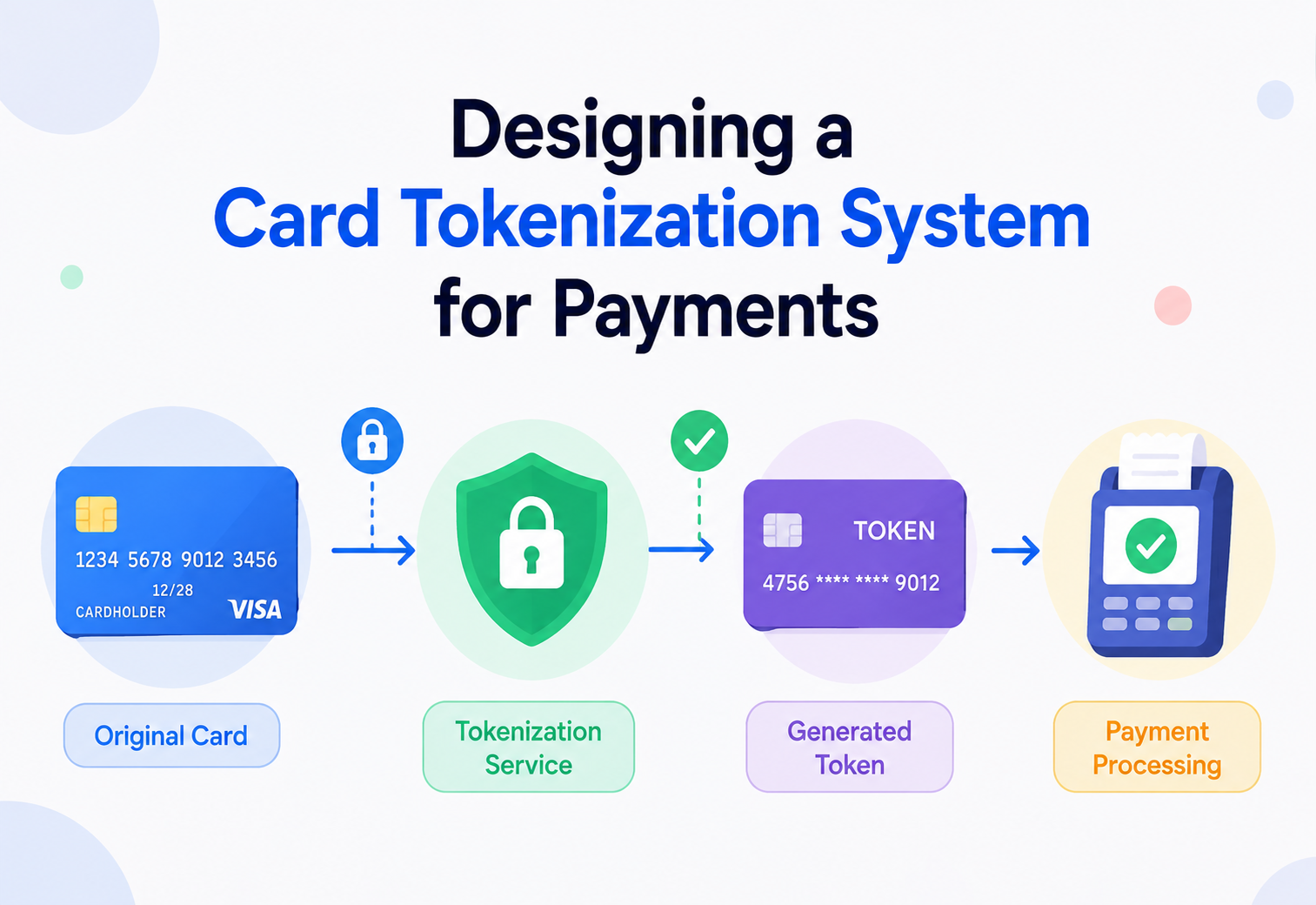
Designing a Card Tokenization System for Payments
A complete, production-grade system design walkthrough for replacing sensitive card numbers with non-sensitive tokens across an entire payment processing pipeline, at the scale of a major card processor — covering architecture, algorithms, security, scalability, availability, deployment and real-world industry patterns.
Introduction & History
Before we design a card tokenization platform at processor scale, it helps to understand where the idea came from and why it has become the default architecture for modern payment infrastructure.
Every time someone pays with a card online, saves a card for one-click checkout, or taps a phone at a coffee shop, a sixteen-digit number sits at the centre of the transaction — the Primary Account Number, or PAN. For most of the history of card payments, this number travelled through every system involved in the transaction in its raw, original form: the merchant’s website, the payment gateway, the processor, the bank, and often several databases along the way, all storing or passing around the same real card number.
This created an enormous, spread-out attack surface. If a fraudster could break into any single one of those systems — a small online retailer’s poorly secured database, for example — they could walk away with real, usable card numbers belonging to potentially millions of customers who had never even heard of that retailer’s specific security practices. Some of the largest data breaches in retail history, from the 2013 Target breach to numerous others across the following decade, followed exactly this pattern: attackers found the weakest link in a long chain of systems that all had access to raw card numbers, and once they compromised it, they harvested card data at massive scale.
The payment card industry’s response, formalised through the Payment Card Industry Data Security Standard (PCI DSS) starting in the mid-2000s, was strict but blunt: any system that stores, processes, or transmits card data has to meet a demanding set of security requirements. This was effective but expensive — it meant that literally every system touching a card number, including systems that had no real business need to see the actual number, had to be built and audited to the same high security bar.
Tokenization emerged as a much smarter answer to the same problem. Instead of making every system in the chain strong enough to safely handle the real card number, tokenization removes the real card number from almost the entire chain in the first place. A token — a substitute value that looks similar in shape to a real card number but carries no real value or usable card data on its own — is generated once, early in the flow, and used everywhere else instead of the real number. Only a small, tightly controlled component, the token vault, ever holds the mapping back to the real card number, and only that component needs to meet the very highest security bar.
The concept gained major momentum starting around 2014, when Visa, Mastercard, and other card networks launched their own network tokenization services (Visa Token Service and Mastercard Digital Enablement Service among them), specifically to support mobile wallets like Apple Pay and Google Pay, where a token tied to a specific device is fundamentally safer than the real card number ever leaving the card issuer’s systems. Since then, tokenization has expanded far beyond mobile wallets and become the default architecture for how modern payment platforms handle card data anywhere in their systems — this tutorial designs that architecture from the ground up.
PCI DSS is created
The major card networks jointly publish the Payment Card Industry Data Security Standard, imposing a strict, expensive-to-implement security bar on every system that stores, processes, or transmits raw cardholder data.
Tokenization emerges as a scope-reduction strategy
Payment gateways realise that most systems handling cards do not actually need the real PAN; a non-sensitive substitute confined to a small vault can achieve the same business outcome with dramatically less compliance burden.
PCI Council standardises tokenization guidance
The PCI Security Standards Council publishes tokenization product guidelines, formally recognising vaulted tokenization as a scope-reduction control and giving processors a clear compliance path to build around.
Network tokenization launches with mobile wallets
Visa Token Service, Mastercard Digital Enablement Service and the EMVCo tokenization framework arrive together with Apple Pay, replacing the real card number on the device with a device-bound network token backed by a per-transaction cryptogram.
Network tokens become the default for card-on-file
Merchants, aggregators and processors begin adopting network tokens for stored payment methods too, gaining automatic card lifecycle updates (the “account updater” capability) so recurring subscriptions no longer break when cards are reissued.
Regulators start mandating tokenization
India’s Reserve Bank of India mandates card-on-file tokenization for online merchants and payment aggregators, prohibiting storage of raw PANs and requiring network-issued tokens instead — a preview of tokenization moving from best practice to legal baseline.
“Why is tokenization considered a better security strategy than simply encrypting the card number everywhere it is used?” The expected answer is that encryption still requires every system that needs to use the data to also be able to decrypt it, meaning the decryption keys — and therefore the real card number — remain reachable from many places in the system, each one a potential point of compromise. Tokenization instead removes the real card number from those systems entirely; a token has no cryptographic relationship an attacker can exploit to recover the PAN, because recovering it requires access to the vault’s mapping table, not a key that travels with the data.
Problem & Motivation
To understand why this system needs careful design, picture a payments platform processing card transactions for thousands of merchants, handling recurring subscription billing, one-click checkout, refunds, chargebacks, and settlement, all at a volume of many thousands of transactions per second during peak shopping periods.
2.1 Reducing PCI DSS Scope
Every system that stores, processes, or transmits raw card numbers falls under PCI DSS compliance requirements, which are expensive to implement and expensive to audit annually. If a merchant’s checkout page, order management system, analytics pipeline, and customer support tools all touch the raw card number, all of them fall into scope. Tokenization is primarily a scope-reduction strategy: by replacing the real card number with a token everywhere except the smallest possible component, the vast majority of the platform’s systems fall out of PCI DSS scope entirely, dramatically reducing both compliance cost and the number of systems whose compromise could expose real card data.
2.2 Enabling Safe Card-on-File Experiences
Modern commerce depends heavily on saved cards: one-click checkout, recurring subscriptions, and stored payment methods for return customers. Without tokenization, “saving a card” means storing the real card number somewhere, which is both a compliance burden and a standing security risk for as long as that card stays on file. A token can be safely stored and reused for future charges without ever re-exposing the real card number to the merchant’s own systems.
2.3 Surviving Card Reissuance Without Breaking Recurring Payments
Cards expire, get lost, or get replaced after a breach, and issuers assign new numbers. Historically, this broke every recurring subscription tied to the old card number, since the merchant had no idea what the new number was. Network tokenization solves this elegantly: because the token is managed by the card network in coordination with the issuer, the network can automatically update the token’s underlying mapping when a card is reissued, and the merchant’s stored token keeps working without any customer action — a capability often called “account updater” or “automatic card lifecycle management.”
2.4 High-Volume, Low-Latency Requirements
Tokenization has to sit directly in the critical path of every single transaction the platform processes, meaning it must add negligible latency even at extreme transaction volume, since any meaningful slowdown here would directly degrade checkout conversion rates and the platform’s ability to serve as infrastructure for other businesses.
2.5 Multi-Party Trust Boundaries
A payments platform sits between merchants, card networks, issuing banks, and acquiring banks, each with different levels of trust and different legitimate needs to reference a specific card. The system has to support detokenization (recovering the real card number) only for the small set of parties and processes that genuinely require it — like the final authorization message sent to the card network — while keeping the real number invisible to everyone else, including, ideally, most of the platform’s own internal engineering teams.
Think of tokenization like a coat check at a busy restaurant. You hand over your coat (the real card number) once, at a single secure counter, and receive a numbered ticket (the token) that has no value to anyone else and reveals nothing about your coat. You can use that ticket everywhere for the rest of the evening — showing it to the waiter, the cashier, the door attendant — without ever handing your actual coat to any of them. Only the coat check counter itself can turn the ticket back into the real coat, and only when it genuinely needs to.
Visa Token Service and Mastercard’s Digital Enablement Service both operate at the network level precisely to solve this problem for mobile wallets and merchant card-on-file scenarios simultaneously — a single network token can be provisioned to a phone’s mobile wallet, automatically refreshed when the underlying card is reissued, and safely stored by a merchant for recurring billing, all without the merchant ever seeing the real card number.
Core Concepts
Before designing the architecture, it helps to build a clear, precise vocabulary, since tokenization terminology is often used loosely but has specific technical meaning here.
3.1 Primary Account Number (PAN)
The actual card number embossed on a physical card or stored digitally — typically fourteen to nineteen digits, structured with an issuer identification number prefix, an account identifier, and a check digit. This is the sensitive value the entire system exists to protect.
3.2 Token
A substitute value that stands in for the PAN throughout the transaction pipeline. A well-designed token is not a real card number and carries no independent value if intercepted, but it is typically format-preserving — the same length and general shape as a real PAN — so that existing systems built to expect a card-number-shaped value do not need to be rewritten just to handle tokens.
3.3 Token Vault
The single, tightly secured component that stores the actual mapping between tokens and real PANs. This is the only place in the entire platform where that mapping exists, making it the highest-value target in the system and, correspondingly, the component built and audited to the strictest security standard.
3.4 Detokenization
The reverse operation: given a token, retrieve the real PAN. This capability is deliberately restricted to the small number of processes that genuinely require the real card number, most notably the final authorization request sent to the card network, and every detokenization event is logged and monitored closely given its sensitivity.
3.5 Network Token vs. Vault (Merchant/Acquirer) Token
A network token is issued by a card network (Visa, Mastercard, and others) and is tied to a specific card and, often, a specific device or merchant relationship, with the network itself managing the token-to-PAN mapping and coordinating card lifecycle updates. A vault token (sometimes called a merchant or acquirer token) is generated and managed entirely within a payment platform’s own token vault, useful for internal scope reduction even for transactions that do not otherwise use network tokenization. Modern platforms commonly use both together — a vault token for internal system-to-system references, layered on top of an underlying network token used for actual network authorization.
3.6 Format-Preserving Tokenization
A tokenization approach where the generated token has the same format as the original PAN (same length, same numeric character set, sometimes even preserving the first six and last four digits for internal reference and fraud-pattern purposes) so that downstream systems expecting a card-number-shaped value continue to function without modification.
3.7 Cryptogram
A dynamically generated, single-use or short-lived cryptographic value used alongside a token during an actual authorization request, adding an additional layer of proof that the party presenting the token is authorized to use it for this specific transaction — this is central to how mobile wallet transactions like Apple Pay remain secure even though the token itself may be reused across many transactions.
3.8 Scope Reduction
The compliance and security concept at the heart of why tokenization exists: minimising the number of systems that ever handle raw, sensitive card data, thereby minimising both the compliance burden and the practical attack surface across the whole platform.
Reversible with a key
Ciphertext is mathematically derived from the PAN; anyone holding the correct key can decrypt it directly wherever the ciphertext lives.
One-way by design
Useful for equality checks (“is this the same card?”) but cannot be reversed to recover the PAN even by the system that produced the hash.
Unrelated substitute
The token has no mathematical relationship to the PAN in a vaulted design; recovering the real value requires the vault’s mapping, not just a key that travels with the data.
“What is the difference between tokenization and encryption, and why does that difference matter for PCI DSS scope?” The expected answer is that an encrypted card number is still, technically, the card number — recoverable by anyone holding the right key — so systems handling encrypted PANs and their associated keys can still fall under PCI DSS scope depending on how key access is controlled. A token, by contrast, has no mathematical relationship to the PAN that could be reversed without access to the vault’s mapping table specifically, which is why properly implemented tokenization can remove a system from PCI DSS scope in a way that simply encrypting the same data in place typically cannot.
Requirements
Any serious system-design conversation starts with an honest list of what the system must do and how well it must do it. Card tokenization has an unusually strict set of both.

4.1 Functional Requirements
- Accept a raw PAN at a single, tightly controlled entry point and return a token that can be used throughout the rest of the platform in place of the real card number.
- Support detokenization for the limited set of authorized processes that require the real PAN, most importantly network authorization requests.
- Preserve token format so downstream systems built to expect card-number-shaped values continue to function unmodified.
- Support both vault-based tokenization for internal scope reduction and integration with card network tokenization services for network-level tokens used in mobile wallets and card-on-file scenarios.
- Handle card lifecycle events — reissuance, expiration, cancellation — by updating token mappings without breaking recurring payments or requiring merchant or customer action.
- Support token deletion and data subject requests in line with data protection and privacy regulation (GDPR, CCPA, and similar).
- Provide comprehensive, tamper-evident audit logging of every tokenization and detokenization event.
4.2 Non-Functional Requirements
| Attribute | Target | Why it matters |
|---|---|---|
| Latency | Single-digit millisecond tokenize / detokenize p99 | Sits directly on the transaction critical path, on top of the transaction’s own latency budget. |
| Throughput | Tens of thousands of TPS sustained; multiples of that at peak | Must absorb Black Friday and similar peaks without becoming a bottleneck. |
| Availability | ≥ 99.99% (four nines) | Downtime halts revenue-generating transactions across every merchant on the platform. |
| Consistency | Strong, linearizable for token ↔ PAN mapping | A token must always resolve to exactly one PAN; eventual consistency here charges the wrong card. |
| Security | HSM-backed keys, network isolation, PCI DSS Level 1 | The vault is the highest-value target in the platform. |
| Auditability | Immutable, append-only log for every operation | Required for internal detection and for annual external audits. |
| Compliance | PCI DSS, GDPR/CCPA, plus regional card data residency rules | Failure here is a regulatory violation, not just an outage. |
“Why does the token vault need such a strict consistency guarantee when many other parts of a payments platform can tolerate eventual consistency?” The expected answer is that a token resolving to the wrong PAN, or failing to resolve when it should, is not a minor inconsistency — it means either charging the wrong card entirely or failing a legitimate transaction outright, both of which are severe, directly financial failures with real customer and regulatory consequences, unlike, say, a slightly stale fraud score or a delayed analytics update elsewhere in the platform where a few seconds of staleness causes no real harm.
Architecture & Components
The system is built around a small, highly secured token vault at its centre, surrounded by services that generate, validate, and use tokens, with the raw PAN touching as few components as architecturally possible.
5.1 Tokenization API Gateway
The single, narrowly scoped entry point where a raw PAN is ever allowed to enter the system from a merchant integration. It terminates TLS, authenticates the calling merchant or integration, and forwards the request directly to the Tokenization Service, deliberately minimising how far the raw PAN travels before being tokenized.
5.2 Tokenization Service
Validates the incoming PAN (basic format and Luhn checksum validation), checks whether a token already exists for this PAN under this merchant relationship (to avoid issuing duplicate tokens for the same card), and if not, requests a new token from the Token Vault. This service itself does not persist raw PAN data — it is a thin, stateless coordinator in front of the vault.
5.3 Token Vault
The most tightly secured component in the platform. It generates the token, encrypts the real PAN using keys managed by a hardware security module, and stores the token-to-encrypted-PAN mapping in its dedicated vault database. Every operation here is logged, access is restricted to an extremely small set of authorized services, and the vault is built and audited to the strictest security tier in the organisation.
5.4 Vault Database
Stores the token-to-PAN mapping, with the PAN itself encrypted using envelope encryption tied to keys held in a hardware security module. This database is logically and often physically isolated from the rest of the platform’s infrastructure, with network access restricted to only the Token Vault service itself.
5.5 Detokenization Service
A separate, equally tightly controlled service that accepts a token and an authorization context (which process is requesting this, and why), checks that the request is from an authorized caller for an authorized purpose, and if so, retrieves and decrypts the real PAN from the vault for that single use. Nearly every other service in the platform never calls this service at all.
5.6 Network Token Provisioning Service
Coordinates with card networks to obtain network-level tokens for scenarios like mobile wallet provisioning or merchant card-on-file relationships, layering the platform’s own internal vault token on top of, or in coordination with, the network’s own token, and handling the lifecycle synchronisation (like automatic updates on card reissuance) that network tokenization services provide.
5.7 Authorization Service
The service that actually sends a transaction to the card network for approval. It is one of the very few services authorized to call the Detokenization Service, since the network authorization message requires either the real PAN or an appropriately formatted network token and cryptogram, depending on which tokenization approach is in use for that transaction.
“Which services in this architecture should be allowed to call the Detokenization Service, and how would you enforce that?” The expected answer is that the list should be as short as possible — typically just the Authorization Service and perhaps a small number of specific network-integration processes — enforced through strict service-to-service authentication and authorization (mutual TLS with a scoped service identity, not a broadly shared credential), with every call logged and alerting configured for any call from an unexpected caller, since an unauthorized or unexpected detokenization request is one of the most serious possible security signals in the entire platform.
Internal Working
This section walks through exactly what happens for both the tokenization path (turning a real card into a token) and the transaction authorization path (using that token to actually charge the card).
6.1 Tokenization Flow, Step by Step
A merchant’s checkout page or app collects the card number, typically directly into a hosted field or SDK provided by the payments platform so that the raw PAN never actually touches the merchant’s own servers at all. That raw PAN travels over an encrypted channel straight to the Tokenization API Gateway. The Tokenization Service checks for an existing token for this PAN under this merchant context; if none exists, it requests the vault to generate one. The vault encrypts the PAN, stores the mapping, and returns a newly generated, format-preserving token. That token — and only the token — is returned to the merchant, who stores it for future use exactly as they might have previously stored a raw card number.
6.2 Transaction Authorization Flow, Step by Step
When the merchant later wants to charge the customer, they submit the token (not a raw PAN) to the payments platform’s transaction API. The transaction flows through the platform’s normal processing pipeline — fraud screening, order validation, and so on — entirely using the token, since none of those systems have any genuine need to see the real card number. Only when the transaction reaches the Authorization Service, immediately before the message is sent to the card network, does a detokenization request occur (or, if network tokenization is in use, the network token and a freshly generated cryptogram are used directly, potentially without any explicit detokenization step happening within the platform’s own infrastructure at all).
6.3 Handling Network Tokenization Specifically
When network tokenization is used, the flow differs slightly: the Network Token Provisioning Service registers the PAN with the card network directly, receiving a network token in return, which is what gets stored (often itself further wrapped by the platform’s own vault token for internal consistency). At authorization time, the platform requests a fresh cryptogram from the network for that specific token and transaction, and the network itself resolves the token back to the real PAN internally at the issuing bank, meaning the payments platform may never need to hold or handle the raw PAN at all for these transactions.
6.4 Card Lifecycle Events
When a card is reissued (lost, stolen, or simply expired and replaced), the issuing bank notifies the card network, which — for network-tokenized cards — automatically updates the token’s underlying mapping. For platform-managed vault tokens tied to cards that are not network-tokenized, the platform typically subscribes to account updater services from the card networks that provide updated card details for tokens on file, allowing the vault mapping to be refreshed without ever requiring the merchant or customer to re-enter card details.
“If a merchant’s own systems never see the raw PAN at all, how does that change their PCI DSS obligations?” A merchant using hosted fields or an SDK that sends card data directly to the payments platform, never touching their own servers, typically qualifies for a substantially reduced PCI DSS assessment burden (commonly a much simpler self-assessment questionnaire) compared to a merchant whose own systems directly handle raw card data, since their infrastructure never falls into the highest-scrutiny scope in the first place — this is one of the most concrete, practical business benefits tokenization provides to merchants on the platform.
Data Flow & Lifecycle
Every piece of card data has a well-defined path through the platform. If you can draw that path on paper — from first entry to eventual deletion — you understand the security posture of the whole design.
7.1 Initial Tokenization
A raw PAN enters the system exactly once, through the narrowly scoped Tokenization API Gateway, and is immediately encrypted and vaulted, with a token generated and returned before the raw value is used anywhere else in the platform.
7.2 Token Usage Throughout the Transaction Lifecycle
From the moment a token is issued, it flows through order creation, fraud screening, recurring billing schedules, customer support tooling, analytics, and reporting — every one of these systems operates entirely on the token, with no legitimate need to ever see the underlying PAN.
7.3 Just-in-Time Detokenization
Only at the final moment before a message is sent to the card network does detokenization (or network token cryptogram generation) occur, and the resulting raw PAN value is used for that single authorization call and then discarded — it is never persisted outside the vault itself.
7.4 Card Lifecycle Maintenance
Ongoing background processes handle card reissuance and expiration updates, keeping token mappings current through network account updater services or, for network tokens, automatic updates coordinated directly between the issuer and the network.
7.5 Token Deletion and Data Retention
When a customer requests deletion of a stored payment method, or when data retention policy requires it, the token and its underlying vault mapping are securely deleted, and this deletion is itself logged and auditable, supporting compliance with data protection regulation that grants individuals rights over their stored personal data.
7.6 Audit and Compliance Reporting
Every tokenization event, detokenization event, and lifecycle update feeds into an immutable audit log used both for internal security monitoring and for the periodic external audits required to maintain PCI DSS compliance certification.
Stripe’s card-on-file and payment tokenization architecture follows this exact “tokenize once, use everywhere” pattern — merchants integrate with hosted card collection fields specifically so that raw card data touches Stripe’s PCI-compliant infrastructure directly rather than the merchant’s own servers, and every subsequent charge, refund, and subscription renewal operates entirely on a token.
Token Vault & Vaultless Tokenization
The vault design deserves a closer look, since it is the single most security-critical component in the entire system, and because there are genuinely different architectural approaches to building it.
8.1 Traditional Vault-Based Tokenization
In this approach, a dedicated database stores an explicit mapping between each token and its corresponding encrypted PAN. Token generation is typically a random value with no mathematical relationship to the PAN, meaning the only way to reverse a token back to a PAN is through a direct lookup in the vault’s mapping table. This is straightforward to reason about and audit, but the vault database itself becomes both a scaling bottleneck (every tokenization and detokenization call requires a database round trip) and, because it holds every PAN the platform has ever processed, an extremely high-value target that must be defended accordingly.
8.2 Vaultless Tokenization
An alternative approach uses format-preserving encryption to mathematically derive the token directly from the PAN and a securely managed cryptographic key, without needing to store an explicit mapping table at all. Detokenization simply reverses the same encryption function using the key. This removes the vault database as a scaling bottleneck and as a single concentrated store of every PAN ever processed, but it shifts essentially all of the security burden onto protecting the encryption keys themselves, since anyone who obtains the key can mathematically reverse any token without needing database access at all.
8.3 Choosing Between the Two
Many production payment platforms use a hybrid: format-preserving encryption for fast, low-friction internal tokenization at very high volume, combined with a smaller, traditional vault for particularly sensitive workflows or for network token relationships where an explicit mapping fits the required protocol better. The right choice depends heavily on the platform’s specific throughput requirements, its existing key management infrastructure maturity, and its regulatory environment.
8.4 Hardware Security Modules
Whichever approach is used, the cryptographic keys involved — whether for encrypting stored PANs in a traditional vault, or for the format-preserving encryption function in a vaultless design — are generated, stored, and used exclusively within hardware security modules, specialised, tamper-resistant hardware devices designed so that the key material itself never exists in a readable form outside the device, even to the platform’s own engineers.
8.5 Key Rotation
Encryption keys are rotated on a defined schedule, with careful handling required for any tokens or mappings created under a previous key — typically involving re-encryption of vault contents under the new key during a controlled rotation window, or, for vaultless designs, careful key-versioning so that old tokens can still be correctly reversed using the key version that originally created them.
“What is the fundamental security trade-off between vault-based and vaultless tokenization?” The expected answer is that vault-based tokenization concentrates risk into protecting a specific, well-defined database, which is easier to reason about and monitor but becomes an extremely high-value single target and a potential throughput bottleneck. Vaultless tokenization removes that centralised data store and its bottleneck, but concentrates essentially all risk into the cryptographic key itself — if that key is ever compromised, every token the platform has ever issued becomes reversible, making key management and hardware security module protection even more critical than in the vault-based approach.
Algorithms, Data Structures & Cryptography
Under the polished architecture lies a small set of very specific cryptographic building blocks that make the whole design possible.
9.1 Format-Preserving Encryption
A class of encryption algorithms specifically designed to produce ciphertext in the same format as the input — for a sixteen-digit PAN, the output is also a sixteen-digit numeric value. This matters enormously for tokenization because it allows tokens to flow through existing systems built to expect card-number-shaped data without requiring those systems to be rewritten, while still providing strong cryptographic protection for the underlying value. The industry-standard constructions are NIST FF1 and FF3-1, both based on AES.
9.2 Envelope Encryption
Rather than encrypting every stored PAN directly with a single master key, envelope encryption uses a unique data encryption key for each PAN (or batch of PANs), and that data encryption key is itself encrypted using a master key held in the hardware security module. This limits the practical impact of any single key’s compromise and allows key rotation of the master key without needing to re-encrypt every stored PAN individually.
9.3 Deterministic vs. Randomized Tokenization
Deterministic tokenization always produces the same token for the same PAN (useful for recognising that two transactions used the same underlying card without ever exposing the PAN itself, which matters for fraud pattern detection). Randomized tokenization produces a different token each time, offering slightly stronger security properties at the cost of losing that same-card recognition capability unless it is deliberately layered back in through a separate mechanism.
9.4 Cryptogram Generation for Network Tokens
For network-tokenized transactions, a dynamic cryptogram is generated fresh for each transaction, cryptographically binding that specific transaction to that specific token and device, so that even if a network token value itself were somehow intercepted, it could not be reused for a separate, unauthorized transaction without also forging a valid, freshly generated cryptogram — a capability protected by keys held on the secure element of the originating device or within the network’s own infrastructure.
9.5 Key Data Structures
| Data Structure | Where It Is Used | Why |
|---|---|---|
| Encrypted key-value mapping table | Vault-based Token Vault database | Provides fast, indexed lookup from token to encrypted PAN and from PAN-hash to existing token, avoiding duplicate token issuance. |
| Hash index on PAN (salted, one-way HMAC) | Duplicate-token detection | Allows checking whether a PAN has already been tokenized without storing or comparing the raw PAN value directly during the lookup. |
| Hardware Security Module key store | All encryption/decryption operations | Keeps cryptographic key material within tamper-resistant hardware, never exposed in plaintext to application code or engineers. |
| Append-only audit log | Every tokenization/detokenization event | Immutable, tamper-evident record required for security monitoring and PCI DSS audit requirements. |
| LRU cache (encrypted, short TTL) | Hot-path token metadata (non-PAN) | Speeds up repeated lookups of token status/validity without caching the sensitive PAN value itself. |
| Bloom filter on issued-token space | Fast “is this token unknown?” reject at the gateway | Rejects clearly invalid or obviously malformed token references before they ever hit the vault, reducing load and probing surface. |
9.6 Consistency and Idempotency
Token generation must be idempotent for a given PAN and merchant context — submitting the same card twice should not create two different tokens under normal conditions, both to avoid vault bloat and to preserve deterministic fraud-pattern recognition where that is desired. This is typically achieved by hashing the PAN with a merchant-scoped salt and checking for an existing token before generating a new one, all within a single atomic operation to avoid a race condition creating duplicate tokens under concurrent requests for the same card.
function tokenize(pan, merchantId, idempotencyKey):
    // never log or trace pan itself; only its salted hash
    panHash = hmac_sha256(pan, merchantSalt(merchantId))

    // fast path: existing token for this (merchant, panHash)
    existing = vault.findByPanHash(merchantId, panHash)
    if existing != null:
        return existing.token

    // slow path: create new token under a lock scoped to panHash
    with distributedLock("vault:" + merchantId + ":" + panHash, ttl=2s):
        // re-check under lock (double-checked locking)
        existing = vault.findByPanHash(merchantId, panHash)
        if existing != null:
            return existing.token

        token   = generateFormatPreservingToken(len(pan))   // Luhn-valid
        edek    = hsm.generateDataKey()                     // per-record
        cipher  = aes_gcm_encrypt(pan, edek.plaintext)
        vault.insert({
            token:          token,
            merchantId:     merchantId,
            panHash:        panHash,
            encryptedPan:   cipher,
            wrappedKey:     edek.wrapped,       // encrypted under master
            createdAt:      now(),
            idempotencyKey: idempotencyKey
        })
        auditLog.append("tokenize", merchantId, token, callerIdentity())
return token“How would you prevent two simultaneous requests to tokenize the same card from creating two different tokens?” The expected answer describes using a salted, one-way hash of the PAN as a lookup key with a database-level uniqueness constraint or a distributed lock scoped to that hash during token creation, so that even under concurrent requests, only one token generation succeeds and the second request is redirected to return the already-created token rather than generating a duplicate.
Advantages, Disadvantages & Trade-offs
No architecture is universally correct. The one designed here makes very deliberate trade-offs, and it is worth naming them out loud.
Advantages of this design
- Dramatically reduces PCI DSS compliance scope across the platform and its merchants by confining raw PAN handling to a small, dedicated component.
- Enables safe card-on-file experiences (one-click checkout, subscriptions) without merchants ever storing real card data themselves.
- Network tokenization’s automatic card lifecycle updates reduce failed recurring payments from card reissuance.
- Just-in-time detokenization minimises how long and how widely the real PAN is ever exposed within the platform.
- Format preservation allows the rest of the platform’s systems to keep working without costly rewrites.
- Every detokenization is logged and correlated, so misuse is loud and detectable rather than silent.
Disadvantages and limitations
- The token vault becomes a uniquely critical single point of failure and a uniquely high-value attack target requiring exceptional investment.
- Vaultless designs shift risk almost entirely onto key management, which if mishandled can be catastrophic across every token ever issued.
- Integrating with multiple card networks’ own tokenization services adds real coordination and engineering complexity.
- Deterministic tokenization, useful for fraud pattern recognition, introduces a subtle trade-off against the stronger security properties of fully randomized tokens.
- Detokenization, even when tightly scoped, remains a permanent, unavoidable operation the system must support and secure indefinitely.
- Regional data residency requirements can force multiple regional vaults, adding operational surface area.
10.1 Vault-Based vs. Vaultless: Centralised Risk vs. Key-Centric Risk
As covered in the vault section, this is the platform’s most consequential architectural trade-off, and reasonable, well-run platforms make different choices here depending on their existing infrastructure and risk tolerance. There is no universally correct answer — only a deliberate trade-off between concentrating risk in a monitorable data store versus concentrating it in cryptographic key management.
10.2 Deterministic Tokens vs. Maximum Security
Deterministic tokenization provides real business value (recognising repeat card usage for fraud detection and analytics without exposing the PAN), but a deterministic token is, by definition, slightly more predictable than a fully randomized one, since the same input always produces the same output. Platforms typically judge this an acceptable trade-off given the strength of the underlying encryption, but it is a deliberate choice worth understanding rather than an accident of implementation.
10.3 Latency Overhead vs. Security Depth
Every additional security layer — hardware security module calls, additional authorization checks before detokenization, audit logging — adds some latency to a system that must remain extremely fast. The architecture manages this by keeping the hot path (tokenization and ordinary token usage) as lean as possible while concentrating heavier security checks specifically around the comparatively rare detokenization operation.
Performance & Scalability
Because tokenization sits on the critical path of every single transaction, its latency and throughput profile is not a nice-to-have — it directly shapes the platform’s own limits.
11.1 Horizontal Scaling of the Tokenization Service
The stateless Tokenization Service and API Gateway scale horizontally behind load balancers, since they hold no persistent state themselves and can be scaled purely based on request volume, absorbing peak shopping-event traffic through autoscaling.
11.2 Scaling the Vault Itself
The vault database is the harder scaling challenge, since it is both extremely security-sensitive and directly in the hot path for every new card tokenized. It is typically scaled through horizontal partitioning (sharding by a hash of the PAN or token identifier) combined with read replicas for the far more frequent read-heavy lookup pattern of existing-token validation, while write throughput for new token creation is managed through careful shard design to avoid hotspots.
11.3 Reducing Vault Load Through Caching
Token validity and non-sensitive token metadata (such as whether a token is active or has been deleted) can be cached briefly to reduce load on the vault for the very common “is this token still valid” check, while the sensitive PAN mapping itself is never cached outside the vault’s own tightly controlled boundary.
11.4 Asynchronous, Non-Blocking Lifecycle Updates
Card lifecycle maintenance (processing account updater files from card networks, refreshing network token mappings) runs as an asynchronous batch or streaming process entirely separate from the real-time transaction path, ensuring that this necessary but non-urgent work never competes with or slows down live transaction processing.
11.5 Hardware Security Module Throughput
Because every encryption and decryption operation must pass through a hardware security module, and these devices have their own throughput limits (often lower than general-purpose compute), careful capacity planning and horizontal scaling across a cluster of hardware security modules is required to avoid this becoming the platform’s actual bottleneck at very high transaction volume.
11.6 Regional Data Residency and Latency
For a platform operating across multiple countries with data residency requirements, regional token vaults may be required, each handling tokenization for transactions originating in or subject to that region’s regulatory requirements, adding architectural complexity but keeping both latency and compliance requirements manageable at global scale.
“What’s the actual bottleneck at extreme scale — the vault database or the hardware security modules?” A strong answer notes that this genuinely depends on implementation details, but hardware security modules are frequently the tighter constraint in practice, since they are specialised, comparatively expensive hardware with real cryptographic-operations-per-second limits, whereas a well-sharded vault database can generally scale further with more commodity infrastructure — meaning capacity planning for the hardware security module cluster deserves particular attention and often needs to scale ahead of general database capacity.
High Availability & Reliability
If the vault stops answering, the whole platform stops processing money. That is the reliability posture we design for.
12.1 Multi-Region, Multi-Availability-Zone Vault Deployment
Given that tokenization sits on the critical path of every transaction the platform processes, the vault and its supporting services are deployed redundantly across multiple availability zones at minimum, and typically across multiple regions, with synchronous or near-synchronous replication of the vault’s mapping data to avoid any single-zone or single-region failure halting transaction processing entirely.
12.2 Hardware Security Module Redundancy
Hardware security modules are deployed in redundant clusters with automatic failover, since a hardware security module outage would directly block both new tokenization and all detokenization, immediately halting the ability to process any new transactions requiring network authorization.
12.3 Graceful Handling of Vault Unavailability
If the vault becomes degraded or unavailable, the system is designed to fail safely rather than dangerously — new tokenization requests and detokenization requests should fail clearly and be retried or queued rather than falling back to any behaviour that might expose or mishandle raw PAN data, even under pressure to keep transactions flowing.
12.4 Disaster Recovery
Given the extreme sensitivity of vault data, disaster recovery planning includes not just standard backup and restore procedures but also careful handling of encrypted backups and key material recovery procedures, tested regularly, with a tightly defined recovery point and recovery time objective appropriate to a system this central to the platform’s ability to operate at all.
12.5 Circuit Breakers for Network Token Provisioning
Calls to external card network tokenization services are wrapped in circuit breakers and fallback logic, so that a temporary outage at a card network’s tokenization service degrades gracefully (falling back to vault-only tokenization for affected transactions where policy allows) rather than blocking transaction processing entirely.
“If the token vault goes down entirely, should the platform fall back to processing transactions using raw PANs to keep revenue flowing?” The expected answer is an emphatic no — the correct behaviour is to fail the affected transactions clearly and queue or retry them once the vault recovers, because falling back to raw PAN handling, even temporarily and even under significant business pressure, would reintroduce exactly the security and compliance exposure the entire system was built to eliminate, and could constitute a serious compliance violation on its own.
Security
Security is not a chapter you bolt on at the end of a payments design — it is the reason the design exists at all. The controls below are cumulative, not a menu.
13.1 Strict Access Control Around the Vault
Access to the Token Vault and Detokenization Service is restricted to the smallest possible set of authorized services and personnel, enforced through mutual TLS with scoped service identities, with even authorized human access (for exceptional debugging or investigation scenarios) requiring multi-person authorization and generating a permanent audit record.
13.2 Encryption in Transit and at Rest
Raw PAN data is encrypted in transit using strong TLS from the moment it leaves the customer’s browser or app, and encrypted at rest within the vault using envelope encryption backed by hardware security module-protected keys, with no point in the system where a raw PAN exists unencrypted outside of momentary, in-memory processing during tokenization or detokenization itself.
13.3 Network Segmentation
The vault and its supporting infrastructure sit in a dedicated, isolated network segment with strict firewall rules permitting only the specific, necessary traffic from authorized services, physically and logically separated from the platform’s general application infrastructure to limit the blast radius of any broader network compromise.
13.4 Monitoring for Anomalous Detokenization Patterns
Because detokenization is rare and tightly scoped by design, any deviation from expected patterns — an unexpected calling service, an unusual volume spike, requests outside normal transaction-processing hours or geography — is treated as a high-priority security signal requiring immediate investigation, since it may indicate a compromised service or credential being used to exfiltrate card data.
13.5 Secure Software Development and Key Management Practices
Code that interacts with the vault or handles any card data undergoes stricter review and security testing than the rest of the platform’s codebase, and cryptographic key management follows industry-standard practices for generation, rotation, and secure destruction, with dual control (requiring two authorized individuals) for the most sensitive key management operations.
13.6 PCI DSS Compliance Program
Beyond the technical architecture itself, the organisation maintains an ongoing PCI DSS compliance program covering the vault and any other systems still within scope, including regular vulnerability scanning, penetration testing, and the periodic external audits required to maintain certification.

“How would you detect an insider threat — an authorized engineer misusing their legitimate vault access?” A strong answer covers requiring dual control or multi-person authorization for the most sensitive operations so no single individual can unilaterally access raw PAN data at scale, comprehensive and immutable audit logging of every access with automated anomaly detection on access patterns (volume, timing, scope relative to that person’s normal role), and periodic access reviews that revoke standing access not actively needed, treating “an authorized person” as still a potential risk requiring monitoring, not an assumption of inherent trustworthiness.
Monitoring, Logging & Metrics
You cannot secure or reliably run what you cannot see. The observability posture for a token vault is stricter and more security-flavoured than for a typical service.
14.1 Operational Metrics
Standard service health metrics apply across the pipeline: tokenization and detokenization latency percentiles, error rates, hardware security module operation throughput and latency, and vault database read/write performance, all feeding dashboards with alerting on any deviation from expected bounds.
14.2 Security-Specific Metrics
Beyond general system health, the platform tracks detokenization volume and rate by calling service, failed authorization attempts against the vault and detokenization service, and any access pattern anomalies, all monitored with particular urgency given how directly these metrics relate to the platform’s core security posture.
14.3 Compliance and Audit Reporting
Automated reporting summarises tokenization and detokenization volumes, access patterns, and key rotation events for periodic internal compliance review and for the evidence required during external PCI DSS audits, reducing the manual effort otherwise required to assemble this evidence under audit pressure.
14.4 Card Lifecycle Update Monitoring
The success rate of account updater processing and network token lifecycle synchronisation is tracked closely, since a failure here silently degrades the platform’s recurring payment success rate over time without necessarily triggering an obvious, immediate alert unless specifically monitored.
14.5 Distributed Tracing
A shared correlation ID traces a transaction’s path through tokenization, the broader processing pipeline, and eventual authorization, which is essential for diagnosing latency issues while being careful that trace data itself never includes raw PAN values, only token references.
“What’s the danger of using distributed tracing across a system that handles card data, and how do you avoid it?” The expected answer identifies the risk that trace and logging infrastructure, if not carefully controlled, can become an unintended, poorly secured secondary store of sensitive data — a raw PAN accidentally logged in a trace span or error message can undermine the entire tokenization architecture’s security guarantees. The mitigation is strict, enforced logging and tracing policy that only ever includes tokens, never raw PAN values, combined with automated scanning of logs and traces for anything that looks like an accidentally leaked card number.
Deployment & Cloud Architecture
The deployment topology for a vault tier is not the same as for the platform’s general services — and deliberately so.
15.1 Isolated Deployment for the Vault Tier
Unlike most services in the platform, the vault tier is deployed into a distinctly isolated network segment with its own, stricter change management and deployment process, since the blast radius of any misconfiguration here is uniquely severe compared to the rest of the platform’s infrastructure.
15.2 Containerisation with Additional Hardening
Vault-tier services run as containers with additional hardening beyond the platform’s general baseline — minimal base images, no unnecessary installed packages, strict read-only filesystem policies where possible — reducing the attack surface of the runtime environment itself.
15.3 CI/CD with Enhanced Review for Vault Code
Standard CI/CD practices apply platform-wide, but changes touching vault or detokenization code paths require additional, mandatory security review and testing beyond the normal process, with deployment to the vault tier gated separately from general application deployments.
15.4 Infrastructure as Code with Strict Change Control
All infrastructure, including the especially sensitive vault network segmentation and access control rules, is defined as code with mandatory review, but changes to the vault tier’s infrastructure code follow a stricter approval workflow than changes elsewhere in the platform, given the severity of any misconfiguration.
15.5 Compliance-Driven Deployment Regions
Deployment regions are chosen not purely for latency and cost, as might be typical elsewhere, but also to satisfy data residency and regulatory requirements specific to card data handling in each market the platform operates in, sometimes requiring dedicated regional vault instances rather than a purely latency-optimised global topology.
“Why might the token vault’s deployment topology differ from the rest of the platform’s services?” The expected answer covers the combination of stricter regulatory and data residency requirements specific to card data, the uniquely severe consequences of any vault misconfiguration compared to a typical application service, and the practical need for isolated network segmentation and hardware security module proximity, all of which push the vault tier toward a more constrained, deliberately controlled deployment topology than the platform’s more general, latency-and-cost-optimised services.
Databases, Caching & Load Balancing
Ordinary performance intuitions do not always transfer to a vault. What follows are the vault-specific twists on generally familiar patterns.
16.1 Vault Database Choice
The vault database prioritises strong consistency, strong encryption support, and mature access control features over raw throughput alone, commonly a relational database or a specialised encrypted key-value store, chosen specifically for its ability to enforce strict data integrity and support the auditing and access control the vault requires.
16.2 Read Replicas for Token Validation
Because checking whether a token is still valid happens far more often than creating a new token or detokenizing, read replicas of non-sensitive token metadata (validity status, not PAN mapping) serve this high-frequency read pattern without adding load to the primary vault write path.
16.3 Caching Strategy
Non-sensitive token metadata is cached briefly to reduce load for common validity checks; the sensitive PAN mapping itself is never cached outside the vault’s tightly controlled boundary, prioritising security over the additional performance a broader cache might otherwise offer.
16.4 Load Balancing
Layer 7 load balancers distribute tokenization requests across the stateless service tier with health-check-based routing, while the vault database tier itself uses careful, security-aware routing that ensures traffic only ever reaches the vault through the authorized Tokenization and Detokenization services, never directly from general application traffic.
16.5 Sharding the Vault
At extreme scale, the vault database is sharded, commonly by a hash of the token or PAN identifier, allowing horizontal scaling of both storage and throughput while keeping each individual shard’s security boundary and access controls consistent with the vault’s overall strict security posture.
“Why is caching handled so differently for the vault compared to a typical high-traffic service?” The expected answer explains that typical caching optimises for read latency and reduced database load with usually limited security consequences if a cache is misconfigured, whereas caching sensitive PAN mapping data outside the vault’s tightly controlled security boundary would directly undermine the entire architecture’s core purpose — so the design deliberately accepts the performance cost of never caching the sensitive mapping itself, while still allowing caching of clearly non-sensitive metadata like token validity status.
APIs & Microservices
Tokenization is one of the rare places in a modern payments pipeline where synchronous, blocking calls are the correct choice, not an anti-pattern.
17.1 Service Boundaries
Tokenization, the vault itself, detokenization, and network token provisioning are each separate services with clearly defined, minimal responsibilities, allowing the vault and detokenization services — the most security-sensitive components — to be scaled, secured, and audited independently from the broader, larger surface area of general transaction processing services.
17.2 Synchronous Communication on the Critical Path
Unlike some of the more event-driven architectures common elsewhere in payments systems, tokenization and detokenization calls are typically synchronous request-response operations, since a transaction genuinely cannot proceed until a token is issued or a PAN is retrieved — this is one of the relatively few places in a modern payments platform where synchronous, blocking calls are the appropriate design choice rather than an anti-pattern.
17.3 API Contracts and Versioning
The Tokenization API’s external contract with merchants is versioned carefully and changed conservatively, since merchants integrate directly against it and backward-incompatible changes would require coordinated updates across potentially thousands of merchant integrations.
17.4 Strict Input Validation
Every API accepting card data performs rigorous input validation (Luhn checksum validation, format checks, length checks) before any data proceeds further into the pipeline, both to catch integration errors early and to reduce the risk of malformed or malicious input reaching sensitive downstream components.
17.5 Idempotency
Tokenization requests carry idempotency keys to ensure that a retried request (from a network timeout, for instance) does not create a duplicate token for the same card, and detokenization requests are similarly protected against unintended duplicate processing.
POST /v1/tokens
Authorization: Bearer <merchant-service-account>
Idempotency-Key: 8f3d-2b1c-...
Content-Type: application/json

{
  "pan": "4242424242424242",
  "exp_month": 12,
  "exp_year": 2029,
  "merchant_id": "acct_9F1a"
}

201 Created
{
  "token":        "tok_4242XXXXXXXX4242",
  "network":      "visa",
  "brand":        "visa",
  "last4":        "4242",
  "exp_month":    12,
  "exp_year":     2029,
  "network_tokenized": true
}


POST /v1/tokens/tok_.../detokenize
Authorization: Bearer <authorization-service-account>
X-Purpose: network_authorization
X-Correlation-Id: txn_01HZ...

200 OK   (returned only to the Authorization Service, single use, never cached)
{ "pan": "4242424242424242", "exp_month": 12, "exp_year": 2029 }“Why would a synchronous call be the right choice for tokenization when most of the rest of a modern payments pipeline favours asynchronous, event-driven communication?” The expected answer is that tokenization sits directly and unavoidably on the critical path of a single transaction — there is no meaningful way to proceed with checkout without a token in hand, unlike, for example, fraud analytics or portfolio reporting elsewhere in a payments system that can tolerate processing a few seconds or minutes later. When a step is a hard, blocking prerequisite for the very next step in the same user-facing flow, synchronous request-response is usually the simpler and more appropriate choice.
Design Patterns & Anti-patterns
A short catalogue of the reusable patterns this system leans on, and the anti-patterns it deliberately avoids.
18.1 Useful Design Patterns
One narrow entry for raw PAN
The Tokenization API Gateway presents a single, simple interface to merchants while hiding the complexity of vault-based and network tokenization coordination behind it.
DEK protected by KEK
Layers a data encryption key protected by a master key, limiting the blast radius of any single key’s compromise and simplifying key rotation.
Contain network partner failures
Protects the pipeline from cascading failure when an external card network’s tokenization service is degraded.
Vault has its own everything
Isolates the vault tier’s resources entirely from the rest of the platform’s infrastructure, both for security segmentation and to prevent unrelated load elsewhere in the platform from ever affecting vault availability.
Tamper-evident by construction
Every vault operation is recorded immutably, supporting both security monitoring and compliance audit requirements.
Retry-safe by default
Every write to the vault is scoped to an idempotency key so retries never double-tokenize or double-charge the same card.
18.2 Anti-patterns to Avoid
- Letting raw PAN data leak into logs, traces, or error messages: a single careless debug log statement can quietly undermine the entire architecture’s security guarantee.
- Overly broad detokenization access: granting detokenization capability to more services “just in case” defeats the core purpose of minimising where raw card data can be exposed.
- Treating the vault like any other database for scaling and caching purposes: applying generic performance-optimisation patterns like broad caching to vault data ignores its unique security requirements.
- Falling back to raw PAN handling during vault outages: prioritising short-term availability over the platform’s core security guarantee, discussed earlier in the High Availability section, is a serious anti-pattern regardless of business pressure.
- Neglecting card lifecycle synchronisation: failing to properly handle reissuance and account updater processing silently increases failed recurring payments over time without an obvious, immediate symptom.
“You discover a service was granted detokenization access ‘temporarily’ for a debugging session two years ago and never had it revoked. How do you think about this?” The expected answer treats this as a serious, if quiet, security finding: unnecessary standing access to detokenization is exactly the kind of unnoticed scope creep that undermines the entire tokenization architecture’s core purpose, and the appropriate response is to immediately revoke the access, audit whether it was ever actually used inappropriately during those two years, and put in place periodic, mandatory access reviews specifically for anything touching the vault or detokenization, so this kind of drift is caught quickly rather than persisting indefinitely.
Best Practices & Common Mistakes
A distilled checklist of the practices that consistently produce a safer tokenization platform — and the mistakes that most reliably undermine one.
Best Practices
- Minimise the number of services and people who can ever call the Detokenization Service, and review that list regularly rather than assuming it stays correct over time.
- Never allow raw PAN data into logs, traces, metrics, or any general-purpose storage outside the vault’s own tightly controlled boundary.
- Design for graceful, safe failure of the vault tier rather than any fallback path that would reintroduce raw PAN handling elsewhere in the platform.
- Invest in hardware security module capacity planning early, since it is a common and often underestimated scaling bottleneck at high transaction volume.
- Support both vault-based and network tokenization, since each solves a slightly different problem and together they provide broader coverage and better card lifecycle management than either alone.
- Treat vault-tier code changes and infrastructure changes with a stricter review and deployment process than the rest of the platform.
Common Mistakes
- Assuming tokenization alone achieves full PCI DSS scope reduction without also carefully auditing every other place raw PAN data might still flow, such as hosted field implementation details or legacy integration paths.
- Underestimating the operational complexity of coordinating with multiple card networks’ own tokenization services, each with different protocols and lifecycle management approaches.
- Caching sensitive PAN mapping data for performance reasons without recognising the security trade-off being made.
- Failing to plan for encryption key rotation early in the design, making it a far more painful retrofit later once a large volume of data has been encrypted under the original key.
- Treating the vault as “done” once built, rather than as a permanent, ongoing focus of security investment, monitoring, and periodic review as the platform and threat landscape evolve.
“A new engineering team wants to integrate a new internal analytics service directly with the Detokenization Service to enrich their reports with ‘the real card number for context.’ How do you respond?” A strong answer firmly declines this request as presented, explaining that analytics use cases essentially never have a genuine business need for the raw PAN — the token itself, or non-sensitive derived attributes like card network or issuing bank, are almost always sufficient — and that granting detokenization access for convenience directly contradicts the entire purpose of the architecture, representing exactly the kind of scope creep that must be actively prevented rather than accommodated.
Real-World / Industry Examples
The architecture in this guide is not academic. Variants of it are quietly running at massive scale across the industry today.
Network-level tokenization
Visa Token Service and Mastercard’s Digital Enablement Service are the clearest large-scale examples of network-level tokenization, originally built to support mobile wallets like Apple Pay and Google Pay, and now widely used by merchants and payment platforms for card-on-file tokenization with automatic lifecycle management as a core benefit.
Processor-managed tokenization
Large payment platforms all offer tokenization as a core part of their merchant integration, typically through hosted card collection fields or SDKs specifically designed so that raw card data never touches a merchant’s own servers at all, directly reducing the merchant’s PCI DSS scope as described earlier in this tutorial.
Independent tokenization vendors
Specialist vendors offer tokenization as a standalone service that businesses can integrate independently of any single payment processor, useful for organisations that work with multiple processors or acquiring banks but want a single, consistent tokenization layer across all of them.
Device-bound network tokens
Every time a card is added to one of these wallets, a device-specific network token is provisioned rather than storing the real card number on the device, and every tap-to-pay transaction uses that token together with a freshly generated cryptogram rather than the underlying real card number ever leaving the issuer’s own systems.
Regulator-mandated tokenization
India’s central bank prohibited storage of raw card numbers by online merchants and payment aggregators starting in 2022, mandating network tokenization instead — a striking example of tokenization moving from best practice to legal baseline at national scale.
The interoperability standard
The EMV Payment Tokenisation specification defines the shared cross-network framework for how issuers, networks and token service providers create, provision and use network tokens, so any conforming wallet or platform can interoperate without ad-hoc integrations per network.
When a customer adds a card to Apple Pay, the device requests a network token from the card network rather than storing the actual card number locally; every subsequent tap-to-pay transaction generates a fresh cryptogram bound to that specific transaction and device, meaning even a compromised or lost phone never exposes a real, reusable card number to anyone who gains access to it.
Frequently Asked Questions
The questions engineers, product managers and merchants ask most often when they first encounter a real tokenization design.
Is a token the same thing as an encrypted card number?
No. An encrypted card number is still mathematically the card number, recoverable by anyone with the right decryption key. A token, particularly in a vault-based design, has no independent mathematical relationship to the card number at all — recovering the real number requires access to the vault’s specific mapping, not just a key, which is why tokenization can achieve stronger scope reduction than encryption alone.
Why do merchants still need to handle tokens at all, if the platform is protecting the real card number?
Merchants need a stable reference to a specific stored payment method so they can charge it again later for a subscription renewal or a returning customer’s saved card, issue a refund against the original transaction, or simply keep records associated with a specific customer’s payment method — the token safely provides all of this functionality without ever requiring the merchant to handle or store the real card number themselves.
What happens to existing tokens when a customer’s card is lost or stolen and reissued?
For network-tokenized cards, the card network typically updates the token’s underlying mapping automatically once the issuer processes the reissuance, so a merchant’s stored token continues working without any customer action. For platform-managed vault tokens without network tokenization, the platform typically relies on card network account updater services to receive and apply the new card details to the existing vault mapping.
Can a stolen token be used to make a fraudulent purchase?
A vault token used outside its intended context (a different merchant, for instance) is typically rejected, since tokens are usually scoped to a specific merchant relationship. Network tokens used with mobile wallets add an additional layer of protection through dynamically generated, transaction-specific cryptograms, meaning even an intercepted token value alone is generally not sufficient to complete a fraudulent transaction without also forging a valid cryptogram.
Does tokenization completely eliminate PCI DSS obligations for a merchant?
Not entirely, but it can dramatically reduce them. A merchant that never has raw card data touch their own systems, using hosted fields or an SDK that sends card data directly to a compliant payments platform, typically qualifies for a substantially simplified compliance assessment rather than being fully exempt, since some baseline security obligations still apply to any business accepting card payments.
Why do some platforms use both vault-based tokens and network tokens for the same transaction?
A vault token provides a stable, platform-controlled internal reference useful for the platform’s own systems and merchant integrations, while an underlying network token provides the actual mechanism used for network authorization along with its automatic card lifecycle management benefits — layering both together gives the platform internal flexibility and control while still gaining the network-level protection and lifecycle synchronisation that only the card networks themselves can provide.
Is tokenized data still considered personal data under GDPR?
Generally yes, from the perspective of the organisation that also controls (or can request access to) the vault capable of reversing the token — regulators typically look at whether re-identification is realistically possible by the organisation as a whole, not just by whichever specific system happens to be holding the token at a given moment. Tokenization is a strong risk-reduction and scope-reduction measure, but it is not automatically equivalent to full anonymisation in the strict legal sense.
Summary & Key Takeaways
Card tokenization is fundamentally a scope-reduction strategy: rather than trying to make every system in a payments platform strong enough to safely handle real card numbers, the architecture removes real card numbers from almost the entire platform, concentrating the highest security investment into the smallest possible component.
Key Takeaways
- A token vault or format-preserving encryption scheme replaces the real PAN with a non-sensitive, format-preserving token immediately upon entry into the platform, and this token is what the rest of the system uses everywhere.
- Detokenization is deliberately rare, tightly scoped, and heavily monitored, occurring essentially only immediately before a card network authorization request.
- Vault-based and vaultless (format-preserving encryption) tokenization represent a genuine architectural trade-off between concentrating risk in a monitorable data store versus concentrating it in cryptographic key management, and mature platforms often combine both.
- Network tokenization, coordinated with card networks like Visa and Mastercard, adds automatic card lifecycle management and is central to how mobile wallets and modern card-on-file experiences remain both secure and reliable through card reissuance.
- The vault tier deserves a fundamentally different security, deployment, and operational posture than the rest of the platform — stricter access control, isolated infrastructure, hardware security module protection, and mandatory, ongoing review of who can access it.
- Every architectural decision in this design — synchronous calls on the tokenization critical path, refusing to fail over to raw PAN handling during outages, never caching sensitive mapping data — traces back to the same root principle: minimising where and how long real card data can ever be exposed, even under real operational or business pressure to do otherwise.
- Tokenization succeeds not because any single technical mechanism is unbreakable, but because it deliberately shrinks the attack surface down to one small, exceptionally well-defended component, instead of asking an entire sprawling platform to defend sensitive data everywhere at once.
Read this architecture back as a single sentence and it is almost embarrassingly simple: keep the real card number in one small, extremely well-defended place, and never let it out again except at the exact moment a card network needs it. Everything else in the design — the HSMs, the isolated network segment, the sharded vault, the strict detokenization policy, the audit trails, the fail-closed behaviour — exists in service of that one sentence. When you evaluate a real-world tokenization platform, evaluate it against that sentence first; if any part of the system quietly violates it, the rest of the architecture cannot save you.