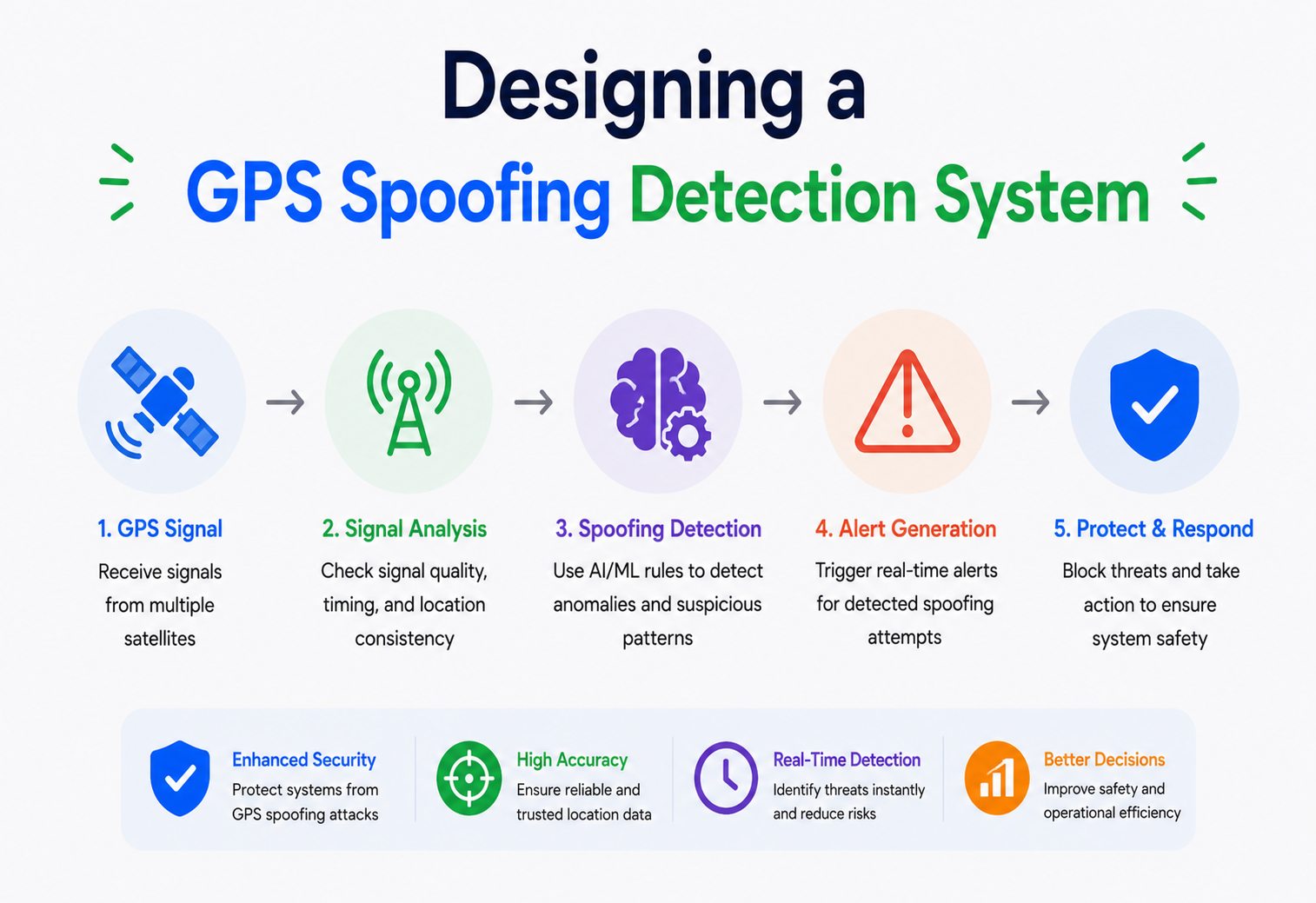
Designing a GPS Spoofing Detection System
A ground-up walkthrough of how ride-hailing platforms, food-delivery apps, fleet-tracking backends, drone operators, mobile games and financial-fraud systems detect when a device is lying about where it is — and how to catch a fabricated GPS signal reliably, at planet scale, without blaming the honest majority of users who simply have bad reception.
The Big Idea, in One Breath
A GPS spoofing detection system is the machinery that decides, in real time, whether the latitude/longitude a device is reporting is truthful. It fuses satellite metadata, motion physics, network signals and platform history into a per-event trust score — and quietly flags, downgrades or blocks the events that fail the physics of the real world.
It is a deceptively hard problem. A truthful signal from a city canyon can look worse than a fabricated one from a rooftop laboratory. Real users move in messy, drifty, occasionally teleport-like ways because of tunnels, elevators and cheap chipsets. Fake users move in suspiciously perfect ones. The detection system’s single job is to tell those two stories apart, at planet scale, without becoming another source of user pain.
Imagine a hotel where every guest must sign in with their real-time home address. Most people write the truth. A few try to write “the Eiffel Tower” while sitting in the lobby. GPS spoofing detection is the concierge who cross-checks the ID, the accent, the luggage tag, the taxi receipt and the arrival time before deciding whether “the Eiffel Tower” is plausible. It never says “you are lying” out loud — it just quietly gives a different room key, or a different rate, to the guest whose story does not add up.
per location ping
on top attack shapes
on honest users
What GPS Spoofing Detection Really Is
Before designing one, we need to be precise about what spoofing is, what detection is, and where the system sits in the stack.
2.1 A Working Definition
A GPS spoofing detection system is a service that, given a stream of location events from a device (lat, lon, accuracy, speed, altitude, chipset metadata, network context), produces — ideally within a single event’s worth of latency — a decision:

- trust the location and pass it downstream to the business logic,
- demote its trust score so downstream services can weigh it accordingly,
- challenge the device (fresh handshake, extra signals, biometric),
- or block / soft-block the event, action or account.
2.2 Where You Encounter It
Ride-Hailing & Delivery
Uber, Lyft, DoorDash, Bolt, Rappi — drivers/couriers spoofing to grab high-demand zones or fake completed deliveries; riders spoofing to abuse promo codes.
Location-Based Games
Pokémon GO, Ingress, Niantic titles — players teleporting to rare spawns, spoofing to farm regions without moving.
Fleet & Logistics
Long-haul trucking, courier fleets, cold-chain compliance — drivers spoofing to hide unauthorised detours or falsify delivery proof.
Fintech & KYC
Onboarding & transaction risk — devices claiming a sanctioned or unsupported region actually operate from another; classic sanctions-evasion pattern.
Ad & Attribution Fraud
Fake location events driving geo-targeted ad payouts or falsifying visits to physical stores.
Enterprise & Compliance
Field staff “visited” a customer they never went to; workforce apps that trust GPS blindly bleed money.
2.3 What It Is Not
It is not the GPS receiver, not the map, and not the geofencing engine. It is a trust layer that sits between the raw location signal and every downstream service that consumes it — matching, pricing, dispatch, payouts, compliance.
Every location event is a claim. The detection system is the referee that scores each claim against multiple independent witnesses — satellite metadata, radio signals, motion physics, historical behaviour — before letting the game state advance.
Why It Matters So Much
Location fraud is not a theoretical annoyance. It is a direct hit on marketplaces, unit economics, regulatory posture and user trust. And it is one of the few fraud categories where the attackers can, and do, distribute tooling as consumer apps.
3.1 The Business & Human Problem
- Marketplace integrity. A spoofed driver at a surge zone steals a ride from a real driver five kilometres away. Repeat that ten thousand times a day and the marketplace decays.
- Direct financial loss. Fake “delivered” pins let couriers claim payouts without delivering. Location-abuse coupon fraud can approach the promo budget in high-growth markets.
- Regulatory & sanctions risk. Financial platforms that trust GPS accept transactions from jurisdictions where they are not permitted; fines and licence loss follow.
- Safety & compliance. Fleet, gig-work and cold-chain regulations demand truthful position history. Spoofed logs are not just fraud — they are legal exposure.
- Trust. Every legitimate user hurt by a false positive costs more than any single spoofer caught. The cost of over-blocking is asymmetrically high.
3.2 What Makes It Uniquely Hard
Harder than classical fraud
- Attackers have equal access to consumer-grade tooling.
- The signal itself is legally allowed to be noisy and drifty.
- Ground truth is expensive — you rarely know for sure where the phone was.
Harder than geofencing
- Real users teleport through subways, tunnels and elevators.
- Every OS/chipset behaves differently under weak signal conditions.
- False positives create user pain that dwarfs the fraud saved.
Every design decision here serves one asymmetric truth: catching spoofers reliably is worthwhile only if honest users almost never feel the system exists. Precision matters more than raw recall.
The Attack Model
You cannot defend what you have not enumerated. GPS spoofing has an unusually rich attack surface — from three-dollar mock-location apps to hardware SDR rigs that transmit fake satellite signals.
4.1 The Attack Spectrum
Mock-Location Apps
Android “mock location” APIs (developer mode) or third-party apps overriding the OS location provider. Ubiquitous, cheap, entry-level.
Rooted & Jailbroken Devices
Xposed / Magisk modules that patch the location provider at a deeper level and hide from basic mock-location flags.
Emulators & Cloud Phones
Android emulators (Bluestacks, Genymotion) and cloud-phone farms that report arbitrary locations at low cost per instance.
API / Hook Injection
Runtime hooking of the app’s own location APIs (Frida, Xposed) to overwrite fields after the OS returns a truthful value.
Network Path Manipulation
VPNs, residential proxies and remote desktops to spoof both the location and the network origin so IP-based checks fail.
SDR Radio Spoofing
Software-defined radios that transmit fake GNSS signals; the phone’s receiver locks onto them and produces a truthful-looking fake fix.
Replay & Trace Attacks
Recorded real trips replayed by malicious clients or by cloud-phone farms at scale to impersonate normal-looking users.
Coordinated Farms
Rooms of spoofed devices sharing accounts, IPs and behavioural patterns to abuse promos, ride matching or ad attribution.
4.2 What Attackers Optimise For
| Attacker goal | Preferred attack | Why it hurts |
|---|---|---|
| Grab surge / high-demand jobs | Mock-location + rooted device | Diverts income from real drivers; erodes marketplace |
| Cash out promo codes | Emulator farms + fresh accounts | Direct hit on the marketing budget |
| Fake delivered / visited events | API hook + replay of real trip | Direct payout without work done |
| Evade sanctions / KYC | VPN + hooking + spoofed IP | Regulatory exposure |
| Ad attribution fraud | Cloud phones + SDK spoofing | Steals advertiser spend |
| Game & virtual-world abuse | Consumer teleport apps | Erodes competitive integrity |
A serious defence treats every attack class as a first-class threat model, with its own signal source, its own detector and its own downstream action. A single “isMockLocation” boolean stops the beginners; nothing else.
The Building Blocks
A production spoofing detection system is a small constellation of focused services. Each has one narrow job; the leverage is in how they compose — and in the fact that decisions are made in layers, not in one god-function.

Device SDK
Collects raw location, chipset metadata, sensor readings, mock-location flags, root/jailbreak indicators, tamper checks — signed and delivered to the backend.
Ingress & Auth
Authenticates the device, checks integrity attestation (Play Integrity, DeviceCheck / App Attest), rate-limits abusive posters.
Event Bus
Durable, ordered stream of raw location events, partitioned by userId. The source of truth from which every detector reads.
Feature Store
Real-time + batch features: rolling velocities, jump histograms, network fingerprints, historical distributions of the account.
Rule Engine
Fast, deterministic checks (mock-location flag, impossible speed, obvious teleport). Cheap first-line filter.
ML Scoring Service
Streaming model that outputs a per-event spoof-probability, using dozens of features and per-account priors.
Trust Score Store
Persists per-event and per-account trust scores; consumed by downstream services (matching, pricing, payouts).
Challenge Service
Progressive challenges: liveness selfie, wifi-scan proof, motion-sensor challenge, human review.
Decision & Enforcement
Turns scores into actions: allow, demote, challenge, soft-block, hard-block. Different downstreams use the score differently.
Ground-Truth & Labelling
Human-in-the-loop for confirmed cases, replay of trip data, driver-side audits. Feeds model retraining.
Observability
Metrics per signal, per model version, per attack shape; explainability panels per case.
Ops & Appeals
Appeal flow for false positives, tenant dashboards, on-call runbook, coordinated-attack incident response.
Signals & Sensors: What We Actually Look At
The detection is only as good as the raw signals it can trust. A robust system fuses many independent signals so that no single one has to be perfect. Attackers can fake any single signal; making all of them line up is exponentially harder.
6.1 Device-Level Signals
Mock-Location Flag
Android isFromMockProvider, iOS-equivalent hints. Free to check, catches beginners, easy to spoof for anyone above beginner.
Root / Jailbreak & Emulator Check
SafetyNet / Play Integrity / DeviceCheck / App Attest. Emulator detection via CPU, sensor and build fingerprints.
GNSS Constellation Metadata
Number of satellites, C/N0 values, HDOP, PRN distribution, use of multi-constellation (GPS + GLONASS + Galileo + BeiDou). A single-constellation, high-signal, no-noise fix from downtown Tokyo is highly suspicious.
Sensor Consistency
Accelerometer, gyroscope, magnetometer, barometer, step counter. A phone claiming to be moving at 60 km/h with a still accelerometer is lying.
Chipset & OS Fingerprint
Model, kernel version, mock-provider capability, known-bad emulator strings, hooking frameworks fingerprints.
6.2 Network & Environmental Signals
IP Geolocation
Delta between IP-derived location and GPS-claimed location. Not authoritative alone (VPNs), but a strong feature.
Wi-Fi BSSID Neighbourhood
Nearby BSSIDs cross-referenced with a global BSSID map. A phone in Rome should not see BSSIDs known to be in São Paulo.
Cell-Tower Fix
Serving cell ID + neighbour list; independent coarse fix that spoofers rarely bother to fake.
Round-Trip Time to Edge
Latency profile to nearest PoP that is inconsistent with the claimed region.
6.3 Motion & Behavioural Signals
- Trajectory smoothness — real trajectories have chipset-specific noise; teleport apps produce impossibly perfect ones.
- Kinematic sanity — speed derivatives (acceleration, jerk) that violate physics for the claimed vehicle type.
- Ping cadence — real SDKs emit at natural, jittered intervals; scripted spoofers emit at metronomic ones.
- Session-history divergence — the account’s historical trajectories cluster at home / work / a few zones; a sudden appearance across the planet is a strong feature.
Any single signal can be faked cheaply; making all of them line up requires a physical presence at the claimed location. The detector’s art is picking the smallest set of signals that jointly become expensive to spoof, and cheap to compute.
The Detection Model: Rules, Physics & ML
Detection is layered on purpose. Rules for the obvious, physics for the near-obvious, ML for the subtle. Each layer is cheaper to run than the next, and each has its own explainability.
7.1 The Layered Detector
| Layer | What it catches | Cost |
|---|---|---|
| Deterministic rules | Mock-location flags, emulator fingerprints, obvious teleports, blacklisted BSSIDs | Micro-CPU per event; runs on 100% of traffic |
| Physics checks | Speeds > vehicle max, impossible jerks, altitude vs ground, cross-track kinematic breaks | Micro-CPU per event; deterministic and highly explainable |
| Cross-signal consistency | IP/GPS mismatch, Wi-Fi neighbourhood mismatch, cell-tower mismatch, sensor stillness vs claimed speed | Feature-store lookups; still cheap |
| Streaming ML | Emulator farms, replay attacks, coordinated fleets, subtle statistical deviations | Small model per event; larger model for high-suspicion cases |
| Human review | Ambiguous, high-stakes, appeal-flagged events | High per-case; low volume; feeds labels back |
7.2 Physics Illustrated
function kinematic_score(prev, curr, vehicleType):
    dt      = curr.ts - prev.ts                     # seconds
    dist    = haversine(prev.latlon, curr.latlon)    # meters
    speed   = dist / max(dt, 1e-3)                   # m/s
    accel   = (speed - prev.speed) / max(dt, 1e-3)   # m/s^2

    limits  = VEHICLE_LIMITS[vehicleType]            # walk, bike, car, plane
    penalty = 0
    if speed  > limits.max_speed:  penalty += 0.4
    if accel  > limits.max_accel:  penalty += 0.3
    if dt     < 0:                 penalty += 1.0   # negative-time replay
    if dist   > 100 and curr.accuracy < 5 and prev.accuracy < 5 and dt < 2:
        penalty += 0.5                              # teleport with perfect accuracy

    return min(penalty, 1.0)                        # 0.0 clean .. 1.0 clearly spoofed
7.3 Feature Set for the ML Layer
Per-event features
Accuracy, altitude, HDOP, satellite count, C/N0 statistics, mock-location, root indicators, sensor coherence.
Rolling features
Median speed last 5/30/300 s, entropy of heading, ping jitter, distinct H3 cells visited.
Session features
Session length, restart rate, background/foreground transitions, permission changes.
Account priors
Historical H3 clusters (home / work), typical vehicle, historical spoof score, tenure, KYC level.
Network features
IP-vs-GPS delta, ASN reputation, VPN/proxy score, Wi-Fi neighbourhood confidence.
Graph features
Device / account / IP overlap graph; ring signatures of coordinated farms.
7.4 Turning Score Into Action
Low score
- Pass through unchanged.
- Continue to observe silently.
- No user-visible effect.
High score
- Downstreams (matching, promo, payout) use the score to demote or exclude.
- Challenge service triggers liveness or wifi-scan proof.
- Repeat high scores per account move it into review or block.
Do not block on the raw score. Score is an input to a decision; the decision belongs to each downstream service, weighed against the cost of a false positive in that domain. Payouts can be pessimistic; navigation UI must stay optimistic.
End-to-End Flow: One Ping’s Journey
Enough abstraction. Let us follow two location pings arriving at the backend in the same second: a real courier at a corner in Bengaluru, and a spoofer on a laptop pretending to be at that same corner.
Device SDK collects the payload
Real courier: GPS with 8-satellite mixed-constellation fix, accuracy 6 m, HDOP 1.4, accelerometer showing walking motion, Play Integrity intact, real cell + wifi neighbourhood. Spoofer: mock-location app on rooted emulator, single-constellation, perfect accuracy 1 m, no sensor motion, integrity fails softly, VPN egress in another country.
Ingress + integrity check
Both authenticate. Real device attestation passes; spoofer’s attestation is missing or forged — ingress tags the event with an integrity risk flag but does not reject (attestation can legitimately fail on flaky networks).
Event bus assigns ordering
Both events land in the userId-partitioned event bus with monotonic sequence numbers, so all downstream detectors see them in per-user order.
Rule engine runs
Real event: passes all rules cleanly. Spoofer’s event: fails mock-location, emulator fingerprint, and IP/GPS delta rules; assigned a starter penalty of 0.6.
Feature lookup + ML scoring
Feature store returns rolling stats and account priors. Streaming model scores: real event 0.03; spoofer 0.97 with top contributing features “sensor stillness at claimed 12 km/h,” “VPN egress mismatch,” “perfect-accuracy teleport from previous ping.”
Trust score is stored
Both scores land in the trust store, keyed by (userId, ts). Downstreams read them in-line for their next decision (dispatch, pricing, payout).
Downstreams act differently
Real courier: matched to the next order normally. Spoofer: dispatch demotes them out of the queue; challenge service silently issues a wifi-scan proof; payout for the last delivery is held for review.
Labelling + retraining
The spoofer case is queued for human review with the full feature snapshot. Confirmed cases feed the daily label pipeline; the model retrains weekly and is A/B rolled out per-region.
Quality Attributes: The “-ilities”
The non-functional targets for spoofing detection are unusual: it must be fast enough to sit in the request path of every location-consuming service, correct enough to survive audit, cheap enough to run on billions of events per day, and explainable enough for humans to trust.
Decision Latency
< 200 ms P95 from ingress to downstream trust score; < 50 ms P95 rule-engine hop.
Throughput
Billions of location events per day across regions; peak tens of thousands per second per shard.
Precision-First
False-positive rate on honest users < 0.5%; every false positive is triaged with root-cause tracking.
Recall on Top Attacks
> 99% detection on the top attack shapes (mock-location, emulator farms, obvious teleport, network path mismatch).
Reliability
Even if ML is down, rule engine still returns a safe default score; downstreams degrade gracefully, never fail closed on the whole platform.
Scalability
Partitioned by userId; streaming ML sharded independently; feature store multi-region.
Explainability
Every high-suspicion decision comes with the top contributing features, thresholds and rule IDs. Auditors and appeals rely on this.
Observability
Per-model, per-signal, per-region metrics; drift monitoring; canary attack shapes replayed continuously to detect silent regressions.
9.1 The Latency Budget
| Hop | Target | How |
|---|---|---|
| Ingress + integrity | < 30 ms | Edge PoP, cached attestation results, quick rejects |
| Event bus append | < 20 ms | Regional log with quorum ack |
| Feature store lookup | < 30 ms | Hot in-memory tier per shard; async batch for cold features |
| Rule engine | < 10 ms | Compiled rules, tight code paths |
| ML scoring | < 40 ms | Small streaming model; larger model only for high-suspicion cases |
| Trust store + fanout | < 30 ms | Hot KV; async fanout to consumers |
| Total end-to-end | < 200 ms P95 | Feels instant to downstream services |
Common Pitfalls & Trade-offs
Every real deployment gets bitten by the same handful of subtle bugs. Knowing them turns quarters of firefighting into a paragraph in a design review.
10.1 Ten Traps We’ve All Fallen Into
Trusting a single boolean
“isMockLocation” alone catches beginners and misses everyone else. Fuse many signals; treat each as one vote among many.
Ignoring chipset diversity
Some Android chipsets emit perfect-accuracy fixes routinely. Blanket “too accurate” rules produce mass false positives.
Trusting IP alone
Half the honest world is behind carrier NAT or corporate VPN. IP is a feature, not a verdict.
Hard block on first suspicion
Every hard block that turns out wrong is a support ticket, a lost user and sometimes a lawsuit. Prefer demote-and-observe, then challenge, then block.
No appeal path
Honest false positives with no way to appeal accumulate churn. A visible, fast appeal flow is table stakes.
Model rot in the wild
Attackers evolve; the model stays static. Regularly re-baseline against replayed real attack data; monitor score drift by region.
Same threshold everywhere
The right threshold for payouts is not the right threshold for map UI. Ship a score, let each domain choose its own action.
SDK data trusted blindly
Client can be reverse-engineered; sign what you can, but validate server-side. Integrity attestation is critical.
Attack surface leaks in errors
Verbose “spoof detected because X, Y, Z” responses let attackers optimise around specific signals. Enforce silently.
No shadow mode for new detectors
Ship a new rule to production; discover the false-positive rate in the incident channel. Every new detector runs in shadow first.
10.2 The Trade-offs You Cannot Avoid
Recall vs Precision
- More recall catches more attackers, but ships more false positives.
- For consumer platforms, precision-first is nearly always the right call.
Explainability vs Complexity
- Complex models catch more subtle attacks but are harder to defend in an appeal.
- Best practice: ship both a score and top contributing features per decision.
Context
Every downstream service (matching, pricing, payout, compliance) wants a signal about whether a location can be trusted, but the cost of a false positive is very different in each.
Decision
Publish a trust score per location event and per account, along with top contributing features and rule IDs. Do not publish a binary “spoofer / not spoofer” verdict. Each downstream service chooses its own thresholds and actions, weighted by the local cost of false positives and false negatives.
Consequences
Downstreams stay in control of their user-facing behaviour. Auditors and appeals can be served with the features that drove any given decision. The detection team owns quality of the score; product teams own consequences. This is the choice that keeps a shared platform capability sustainable.

How Spoofing Detection Evolves
GPS spoofing detection is a comparatively young sub-discipline of fraud and integrity engineering. The waves reflect the industry’s slow discovery of just how central location is to the trust of every consumer product.
Wave 1 — Simple Flags (pre-2015)
Just check isMockLocation; check jailbreak; block. Catches beginners; misses everyone else.
Wave 2 — Attestation & Fingerprinting (2015–2018)
SafetyNet, DeviceCheck, App Attest. Emulator fingerprints. Ride-hailing and games catch up to the tooling.
Wave 3 — Signal Fusion (2018–2021)
Multiple independent signals fused: GNSS metadata, network context, sensor coherence, Wi-Fi neighbourhood. Rule engines evolve into scoring pipelines.
Wave 4 — Streaming ML & Graph (2021–2024)
Streaming models with per-account priors. Graph features expose emulator farms and coordinated abuse. Explainability becomes non-optional.
Wave 5 — Multi-GNSS & Anti-SDR (2024+)
Use of multi-constellation raw measurements, PRN correlations, and anti-jamming/anti-spoofing detection on the receiver itself. Federated feature sharing across trust-safety consortiums.
11.1 Adjacent Systems That Plug In
Identity & KYC
Trust scores feed risk-based KYC; suspicious location events elevate identity re-verification.
Payments & Risk
Spoof scores factor into payment approvals, especially in cross-border and geo-restricted scenarios.
Marketplace & Dispatch
Matching engines demote low-trust supply; pricing engines can strip surge multipliers from suspicious devices.
Trust & Safety
Coordinated-abuse investigations, farm takedowns, cross-platform threat intelligence.
Key Takeaways
GPS spoofing detection is one of those quiet subsystems where success is invisible. Every decision in this chapter serves a single goal: make the marketplace, the payouts and the compliance posture trustworthy without ever bothering the honest majority of users.
Key Takeaways
- Location is a claim, not a fact. Score every claim against multiple independent witnesses.
- Fuse signals; do not rely on any single one. Attackers fake booleans cheaply; fake ten correlated signals almost never.
- Layered detector. Rules for the obvious, physics for the near-obvious, ML for the subtle, humans for the ambiguous.
- Publish a score, not a verdict. Let downstreams weigh it against their own false-positive costs.
- Precision-first. A false positive costs more than a missed catch on consumer platforms; tune with that asymmetry in mind.
- Explain every high-suspicion decision. Appeals, audits and product trust depend on this.
- Shadow mode is mandatory. Every new detector rides shadow before it can affect a single user.
- Chipset & regional realities matter. Global thresholds are a lie; calibrate by device family and region.
- Enforce silently. Verbose error messages train attackers on how to optimise around your signals.
- The system is a moving target. Attackers evolve; drills, red teams and continuous relabelling keep the detector honest.
A great spoofing detector is invisible. Real users click the button and the ride starts, the coupon works, the payout arrives. Spoofers see promotions expire, jobs quietly disappear from the queue and reviews take longer than they expected. That silent, well-calibrated asymmetry is what a well-designed detection system is really for — and everything in this chapter is in service of it.