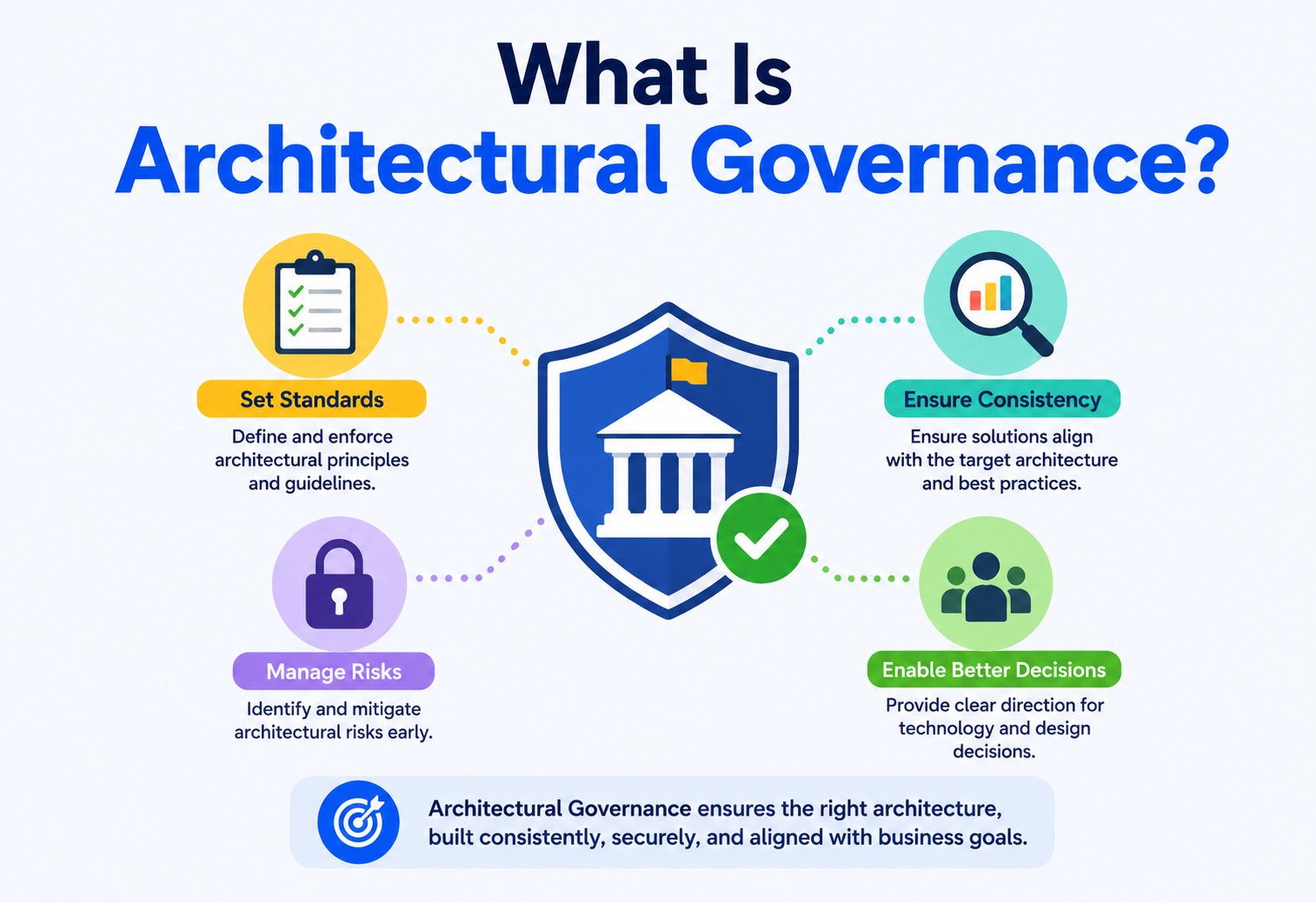
What Is Architectural Governance?
Drawing a good architecture is one thing. Making sure that dozens of teams, over many years, actually stick to it — that is a completely different challenge. Architectural governance is the quiet system of checks that keeps a good plan from slowly falling apart.
The Big Idea, in One Breath
A beautiful playground with clear rules works wonderfully on opening day. Six months later, without someone watching, the rules quietly fade. Governance is the watcher.
Imagine a school builds a beautiful new playground, with clear rules painted on the wall: take turns on the slide, no running near the swings, youngest children get the low climbing frame. On opening day, everyone follows the rules and the playground works wonderfully.
But six months later, without anyone watching, kids start skipping the queue, older children take over the low climbing frame, and the painted rules fade and get ignored. The playground itself hasn’t changed — but nobody is checking that people still follow the plan. That is the exact gap that architectural governance exists to close, except for software systems instead of playgrounds.
Think of a city that has excellent traffic laws on the books — speed limits, stop signs, lane rules. Those laws only keep the city safe if someone actually enforces them: police watching the roads, cameras at intersections, and a fair process when a rule gets broken. Architectural governance is that traffic police force for software — it keeps good architectural rules from quietly becoming ignored suggestions.
What Architectural Governance Really Is
Not the architecture itself — the system that keeps the architecture honest over time. Guardrails on a mountain road, not a wall across it.
Architectural governance is the ongoing practice of watching over, guiding, and checking architecture-related decisions across an organisation, to make sure they stay lined up with agreed principles, standards, and long-term plans. It isn’t the architecture itself — it is the system that keeps the architecture honest over time.
Where architecture answers “how should this system be structured?”, governance answers a quieter but equally important question: “how do we make sure that structure is actually followed, kept up to date, and adjusted responsibly as things change?” One is the plan. The other is the discipline that protects the plan from slowly drifting away from itself.
If someone asks “do we have governance around this?”, they are really asking: “Is somebody actually checking that teams follow our agreed standards, or is everyone just doing their own thing?”
Good governance doesn’t mean an all-powerful committee that says “no” to every new idea. Done well, it is closer to a set of guardrails on a mountain road — mostly invisible, rarely touched, but there precisely for the moment someone drifts too close to the edge.

Why Architectural Governance Exists
Even the best-designed system drifts. Governance answers hard questions with evidence instead of guesswork — usually before something has already gone wrong.
Left alone, even the best-designed system tends to drift. New developers join who never read the original plans. Deadlines push teams to take small shortcuts. Old rules get forgotten. None of this happens out of carelessness — it is simply what happens naturally when many people, over many years, build on top of the same system without anyone checking the whole picture.
Governance also gives leadership a trustworthy way to answer hard questions — “are we following our own security rules?”, “why does this system look nothing like our standards?” — with evidence instead of guesswork. Without it, those questions usually only get answered after something has already gone wrong.
Architecture Design vs. Architecture Governance
Two activities that happen at different times, involve different questions, and are often done by different people. Confusing them stalls many governance efforts before they start.
These two activities happen at different times, involve different questions, and are often even done by different people. Confusing them is one of the most common reasons governance efforts stall.
| Question | Architecture Design | Architectural Governance |
|---|---|---|
| What does it answer? | How should this system be structured? | Is the system still following what was agreed? |
| When does it happen? | Mostly upfront, during design and major changes | Continuously, for as long as the system exists |
| Main output | Diagrams, decisions, a target structure | Reviews, approvals, compliance records |
| Typical owner | Software or solutions architect | Architecture review board or governance lead |
| Example activity | “We’ll split this into three services” | “Let’s check whether teams actually did that” |
Design decides what “good” looks like. Governance keeps checking that reality still matches that picture, months and years later.
The Core Pillars of Architectural Governance
Four pillars that turn good intentions into something actually checked and maintained: principles, standards, review and approval, and ongoing compliance monitoring.
Most governance practices, however they are set up, lean on the same handful of building blocks. Together, these pillars turn good intentions into something that is actually checked and maintained.
Guiding beliefs
Simple, memorable rules like “prefer cloud-native services” that shape countless smaller decisions without spelling out every detail.
Specific requirements
Concrete, checkable rules — like which encryption method must be used — that leave little room for interpretation.
A checkpoint process
A defined moment where a new design is examined against the principles and standards before work moves forward.
Ongoing monitoring
Regular checks on live systems to catch when reality has quietly drifted away from what was agreed.
A healthy governance setup treats these four pillars as a loop, not a one-time event: principles guide design, standards make expectations concrete, reviews catch problems early, and monitoring keeps watching long after the review is over.
How It Actually Works, Day to Day
A repeating cycle, not a single dramatic event. Five stages — set the rules, design against them, review, monitor, adjust — that quietly loop for as long as the system stays alive.
In practice, architectural governance shows up as a repeating cycle rather than a single dramatic event. Here is roughly how that cycle tends to unfold inside a well-run organisation.
Set the Rules
Leadership and senior architects agree on principles and standards, and write them down clearly enough that anyone can follow them.
Design Against Them
Teams design new systems or changes, using the agreed principles and standards as their starting reference point.
Review Before Building
A review board or senior architect checks the design, asking questions and flagging anything that strays from the standards.
Monitor After Launch
Once live, the system is periodically checked to confirm it is still behaving the way it was approved to behave.
Adjust the Rules
When a rule turns out to be outdated or unhelpful, it gets revisited and updated — governance evolves too, not just the systems it watches.
Who’s Involved
Rarely one person. A small group each holding a different piece of the responsibility — and, ideally, a two-way conversation between the writers of the rules and the people applying them.
Architectural governance rarely rests on one person’s shoulders. It usually involves a small group of people, each holding a different piece of the responsibility.
The checkpoint group
A small panel of experienced architects who review major designs and decide whether they are ready to proceed.
Keeper of the big picture
Owns the overall principles and standards, and makes sure they still make sense as the business changes.
Designers in the field
Apply the agreed standards to real, specific projects, and bring feedback back when a rule doesn’t fit well.
Watching for exposure
Focus on legal, security, and regulatory requirements that architectural decisions must respect.
The healthiest governance setups treat this as a two-way conversation rather than a one-way order. Architects on the ground often spot real-world problems with a standard long before the people who wrote it do — and a good governance process makes it easy for that feedback to travel back upstream.
Frameworks Teams Lean On
Few organisations invent governance entirely from scratch. Most borrow structure from well-known frameworks and adapt it to their scale — the framework isn’t the point, having a consistent, written-down process is.
Very few organisations invent architectural governance entirely from scratch. Most borrow structure from well-established frameworks, adapting them to their own size and culture.
A widely used enterprise framework
Includes a dedicated governance component covering roles, review checkpoints, and how architecture decisions get formally approved.
An IT governance framework
Focuses more broadly on aligning technology decisions with business goals, often used alongside architecture-specific frameworks.
An architecture description standard
Sets common expectations for how architecture should be documented, which makes it easier to review consistently.
Custom, lighter-weight setups
Many smaller organisations build a simplified governance process of their own, borrowing only the parts of bigger frameworks that fit their scale.
None of these frameworks are mandatory, and picking one isn’t the point — the point is having some consistent, written-down way of making and checking architectural decisions, instead of relying on memory and good intentions alone.

A Spectrum, Not a Switch
Governance isn’t “on” or “off.” It runs from light-touch guidance to strict, heavily enforced control — and the right spot depends on size, industry, and how much a mistake would cost.
Architectural governance isn’t simply “on” or “off.” In practice, organisations sit somewhere along a spectrum, from very light-touch guidance to strict, heavily enforced control — and the right spot on that spectrum depends on the size of the organisation, how regulated its industry is, and how much risk a mistake could cause.
A startup with ten engineers usually needs little more than a shared set of written principles and a quick weekly sync. A hospital’s billing system, handling sensitive patient data under strict laws, needs formal reviews, sign-offs, and documented evidence that rules were followed — because the cost of a mistake is far higher.
Benefits and Trade-offs
Real value, real costs. The goal is the right amount of control for the risk — too little, and standards quietly rot; too much, and good engineers spend more time filling out forms than solving problems.

Like any control system, architectural governance brings real, measurable value — but it isn’t free, and getting the balance wrong causes its own problems.
Strengths
- Keeps large systems consistent as many teams build on them
- Catches security and compliance risks earlier, when they are cheaper to fix
- Creates a clear paper trail for why decisions were made
- Makes onboarding easier, since standards are written down, not tribal knowledge
Trade-offs
- Can slow teams down if reviews are slow or overly bureaucratic
- Risks becoming a rubber-stamp exercise if nobody truly enforces it
- Needs real ongoing effort — a governance process nobody maintains decays fast
- Too much rigidity can discourage useful, well-reasoned innovation
The goal isn’t maximum control — it is the right amount of control for the risk involved. Too little governance, and standards quietly rot. Too much, and good engineers spend more time filling out forms than solving real problems.
Common Pitfalls
Three recurring failure modes — the rubber stamp, the bottleneck, and rules nobody remembers writing — each of which quietly turns governance into paperwork or an obstacle.
The Rubber Stamp
A review board that approves everything without real scrutiny gives the appearance of governance without any of its actual protection. Teams eventually notice, and stop taking the process seriously.

The Bottleneck
If every small decision needs formal sign-off, teams either slow to a crawl or start quietly working around the process altogether — which is often worse than having no process at all.
Rules Nobody Remembers Writing
Standards that are never revisited tend to outlive their usefulness. A rule written for yesterday’s technology can quietly become an obstacle rather than a safeguard.
Governance that only exists on paper. If nobody actually checks whether systems follow the standards, the standards are really just a wish list, not governance.
Key Takeaways
If you remember only these six ideas from the whole guide, you’ll be able to introduce, defend, or push back on any governance conversation you find yourself in.
Remember This
- An ongoing practice. Architectural governance is the ongoing practice of checking that real systems still follow agreed architectural principles and standards.
- Design vs governance. Design decides what “good” looks like; governance keeps checking reality against it.
- Four pillars. Principles, standards, review and approval, and ongoing compliance monitoring, working as a loop.
- Shared roles. Architecture review boards, enterprise architects, solution architects, and compliance teams typically share the responsibility.
- A spectrum. Ranges from light-touch to strict, and the right level depends on risk, size, and industry.
- Do it well or don’t do it. Done well, it protects consistency and catches risk early; done poorly, it becomes a slow, ignored formality.