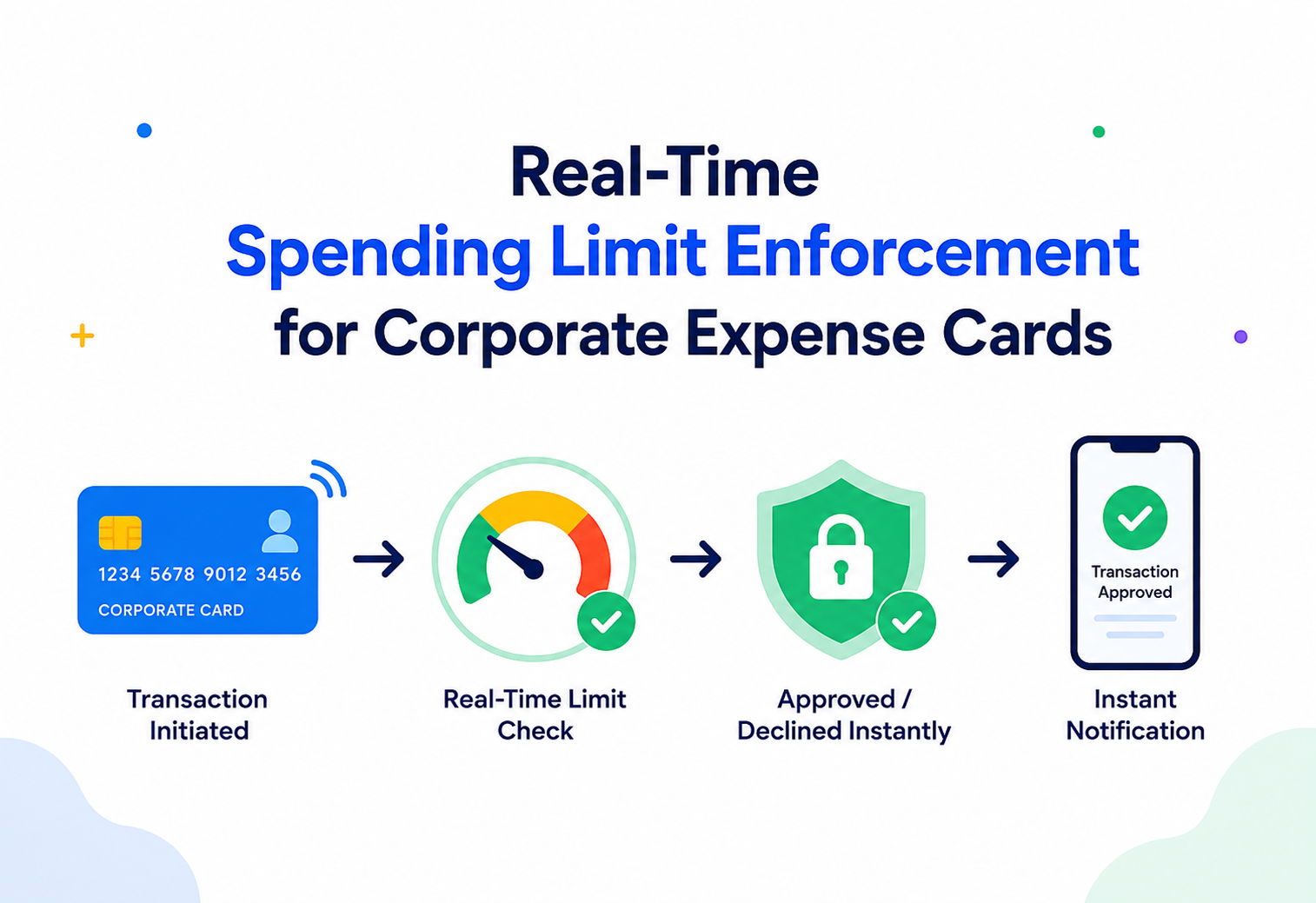
Real-Time Spending Limit Enforcement for Corporate Expense Cards
How to approve or decline a card swipe in under 100 milliseconds, correctly, when the limit that applies depends on which employee is swiping, what they’re buying, and what time period you’re currently inside — an interview-ready walkthrough of atomic multi-key check-and-reserve logic, hold-then-settle lifecycles, PACELC trade-offs, and the reconciliation discipline that keeps a fine-grained spending policy enforced at the exact moment of the transaction, not weeks later in an audit.
Introduction & History
Picture a company credit card the old way: one plastic card, one credit limit, one statement at the end of the month, and a finance team that discovers a problem thirty days after it happened. For decades, this was the entire model of corporate spending control. The limit was a single number attached to a single card, checked once by the bank that issued it, and everything else — was this a reasonable expense, did it belong to the right budget, did this employee already spend their travel allowance for the week — was a question answered by a human, later, staring at a PDF statement.
That model breaks down the moment a company issues cards to hundreds or thousands of employees and wants spending policy to be enforced at the moment of the swipe, not discovered after the fact in an audit. A modern expense card program — the kind offered by platforms like Brex, Ramp, Divvy, or a large enterprise’s own card program built on an issuer-processor like Marqeta or Galileo — needs the limit that governs any given swipe to depend on who is swiping, what they’re buying, and when they’re buying it. A sales director might have a ₹50,000 monthly travel limit but only ₹5,000 for office supplies. A software engineer might have generous limits for approved SaaS subscriptions but a hard ₹0 limit for anything categorized as entertainment. A limit might reset daily for meals, weekly for transportation, and monthly for everything else combined — and all of these limits might apply to the very same card at the very same instant, each one independently, all of them needing to be checked before a single authorization response goes back to the card network.
1.1 From single-limit cards to programmable policy
This tutorial is about the system that makes that check happen — correctly, atomically, and within the extremely tight latency window that the global card networks (Visa, Mastercard, and similar rails) impose on every authorization request. The history of this problem tracks the history of corporate card programs themselves: as fintech-native card issuers emerged through the 2010s and offered programmable, API-driven card issuing platforms, the limit-checking logic that used to live, slowly and manually, inside a bank’s back office moved into a real-time decisioning system that a company’s own engineering team could configure, extend, and reason about. What used to be a monthly spreadsheet reconciliation became a system that must make a correct, auditable decision in the time it takes to blink.
1.2 Why the shift happened when it did
It is worth being precise about why this shift happened when it did, rather than treating it as an inevitable technology upgrade. Before programmable card issuing existed, a company that wanted category-based restrictions on employee spending had very few real options: either trust employees on the honor system and audit expense reports after the fact, or work with a bank to configure a small, rigid set of merchant-category-code blocks at the card-product level, which applied uniformly to every card issued under that product and could take weeks of back-and-forth with the bank to change. Neither option gave a finance team the ability to say, in effect, “this specific employee gets this specific limit for this specific category during this specific time window,” and have that policy take effect within minutes and be enforced with certainty on the very next swipe. The emergence of issuer-processing platforms that expose authorization decisions as a real-time webhook — effectively letting a company’s own software cast the deciding vote on every single transaction, within a strict deadline — is what turned spending policy from a slow, negotiated, bank-mediated configuration into fast, self-service, code-like infrastructure that a product and engineering team can iterate on the same way they iterate on any other feature.
1.3 Accountability moves in-house
That shift also changed who is accountable for correctness. When the bank owned the entire authorization decision, a limit-enforcement bug was the bank’s operational problem. Once a company’s own real-time decisioning service sits in that authorization path, any bug in it has an immediate, first-party financial consequence — an incorrect approval spends real company money, and an incorrect decline embarrasses an employee at a merchant counter and generates a support ticket. This is why the discipline of building this kind of system borrows so heavily from techniques more commonly associated with core banking infrastructure: strict atomicity guarantees, append-only audit trails, and a default posture of caution whenever the system is uncertain, all covered in depth throughout the sections that follow.
Think of a stadium turnstile. It does not just check whether you have a ticket — it also checks whether that ticket is for today, for this section, and whether you have already entered once. Every one of those checks must succeed, in the same instant, before the gate opens, and once it opens your ticket is marked used so a second attempt does not sneak through behind you. A real-time limit check for a corporate card is the same idea, dressed in money instead of turnstiles.
“Why can’t the bank or card network just check the credit limit like they do for a normal consumer card?” The expected answer: a normal consumer card checks one number — available credit — against one balance. A corporate expense program needs to check several independent, overlapping limits (by employee, by spending category, by time window) simultaneously, which the card network itself has no concept of; that logic has to live in a system the company controls, sitting in the authorization path between the network and the final decision.
The Problem — Limits That Aren’t One Number
Precisely stated, the requirement is this: when a card is swiped or used online, an authorization request arrives carrying a card identifier, a merchant category code (MCC) describing what kind of business the merchant is, and an amount. The system must determine, within the response window the card network allows (commonly under a few hundred milliseconds end-to-end, with the issuer’s own internal decisioning ideally consuming a much smaller slice of that, often targeted under 50 to 100 milliseconds), whether approving this specific transaction would cause any applicable limit to be exceeded — and if any one of them would be, the transaction must be declined, even if every other applicable limit still has room.
The limits that can apply to a single transaction include, at minimum:
- Per-employee overall limit — a ceiling on how much this specific person can spend across all categories in a given period.
- Per-category limit — a ceiling scoped to a spending category (travel, meals, software, office supplies), typically derived from the merchant category code the network sends with the authorization request.
- Per-time-period limit — the same employee or category limit can be defined per transaction, per day, per week, per month, or per an arbitrary rolling window, and multiple time-scoped limits often apply to the same category simultaneously (a daily meal cap and a monthly meal cap both active at once).
- Per-merchant or per-vendor limit — some programs cap spend with a specific recurring vendor (a particular SaaS provider, for instance) independent of the broader category cap.
- Team or department-level pooled limits — a shared budget that multiple employees draw against, requiring the check to look beyond the individual cardholder entirely.
Every one of these limits can be true or false independently for the same ₹2,000 transaction: the employee’s personal limit might have plenty of room, but the department’s shared travel budget might be exhausted for the month. The final decision must be a logical AND across every applicable limit — approve only if none of them would be breached — computed correctly even when two swipes from the same card arrive within milliseconds of each other, which is the central hard problem this tutorial is built around.
Imagine an employee’s remaining daily limit is exactly ₹1,000, and two nearly simultaneous ₹800 charges arrive — perhaps a genuine duplicate from a flaky merchant terminal, or two different purchases seconds apart. If the system reads the remaining balance, computes “₹800 fits,” and only then writes the new balance back, both requests can read the same starting balance and both can be approved, letting ₹1,600 through against a ₹1,000 limit. This read-then-write race condition, not any single slow component, is the single most consequential bug class in real-time limit enforcement, and defending against it shapes almost every design decision in the sections that follow.
2.1 The shape of the underlying data problem
Stepping back from any single limit, the underlying data structure that must be modeled correctly is a directed hierarchy of quotas, where a single monetary event can be required to debit several nodes of that hierarchy simultaneously, and where the hierarchy itself is not fixed but configured per company, per department, and sometimes per individual employee. One company might define limits strictly employee-first (an overall employee cap, then category sub-limits within it); another might define them department-first (a shared department pool, with individual employee caps as a sub-allocation within that pool). The system therefore cannot assume a single fixed tree shape; it must treat “which limit keys apply to this transaction” as a lookup driven entirely by configuration, resolved fresh for every transaction based on the employee, the merchant category, and the currently active policy version, rather than a structure baked into application code.
2.2 Time as its own hidden dimension
A second, easily underestimated dimension of the same problem is time itself. A “monthly limit” is not simply a number; it is a number paired with a reset rule, a time zone, and a definition of what counts as the start of a period — calendar month in the employee’s local time zone, a rolling thirty-day window, or a company fiscal period that does not align with the calendar at all. Getting this wrong at the boundary is subtle and easy to miss in testing: an employee traveling across time zones, or a limit that resets at midnight UTC while the finance team assumes midnight in their own local time zone, can both produce a limit check that technically executes correctly but enforces a policy the business never actually intended.
Architecture & Components
The system is built around one governing idea: the moment of decision — checking every applicable limit and reserving the money against them — must happen as a single atomic operation against a purpose-built, low-latency counter store, with every slower, less time-critical piece of work (writing the full audit ledger entry, notifying the employee, updating dashboards) pushed out of the synchronous authorization path entirely.
3.1 Issuer Authorization Gateway
Speaks the card network’s native protocol — historically ISO 8583 message formats over dedicated financial networks, increasingly wrapped in modern REST or gRPC APIs by issuer-processing platforms — and translates an inbound authorization request into an internal format the rest of the system understands. This component owns the hard latency contract with the network: if no response is returned within the allowed window, the network’s own stand-in processing takes over and makes a decision on the issuer’s behalf, usually using much cruder rules, which is a reliability concern covered in depth later.
3.2 Authorization Orchestrator
The synchronous decision-making core. For every request, it resolves which card and employee this is, fetches the applicable policy configuration, determines the merchant category, and calls the Limit Engine to perform one atomic check across every limit that applies. It owns the overall latency budget and is responsible for making a firm decision — approve or decline — even if a non-critical downstream dependency (like the fraud service) is slow, generally by treating such dependencies as advisory rather than blocking.
3.3 Card & Policy Config Service
Holds the structured, versioned configuration of every limit: which employee has which limits, which categories map to which merchant category codes, what time windows apply, and any team or department-level pooled budgets. This configuration changes far less often than transactions occur, so it is aggressively cached close to the orchestrator, with changes propagated via invalidation events rather than being read fresh on every authorization.
3.4 Limit Engine and Distributed Counter Store
The heart of the system. The Limit Engine takes the full set of limit keys that apply to one transaction — the employee’s overall limit, the category limit, every active time-window limit, any pooled team budget — and performs a single atomic operation against the Distributed Counter Store that checks every one of them and reserves the transaction amount against each simultaneously, or reserves against none of them if even one would be breached. This all-or-nothing, single-round-trip requirement is why the counter store is typically an in-memory system like Redis Cluster, executing the check-and-reserve logic as a single server-side script rather than as a sequence of separate read and write calls from the orchestrator.
3.5 Fraud and Velocity Check
Evaluates signals like unusual merchant, unusual location, or rapid-fire transaction velocity. Because a hard dependency on a fraud model would jeopardize the strict latency budget, this check is typically designed to be advisory and non-blocking under normal conditions, contributing a fast pre-computed risk score rather than performing heavy computation inline — a deliberate trade-off discussed further in the trade-offs section.

3.6 Transactional Outbox, Ledger, and Settlement
Once a decision is made, the full details of the transaction are durably written via an outbox before the response is even sent back to the network, guaranteeing no authorized transaction is ever lost even if the process crashes immediately afterward. The heavier work — writing the permanent audit ledger entry, notifying the employee, reconciling the temporary “hold” against the eventual settlement amount days later — happens asynchronously off the critical path.
“Why is the fraud check advisory instead of a hard blocking dependency in the authorization path?” Because the overall latency budget is only a few tens of milliseconds and shared across every component; a fraud model that occasionally takes 200ms would blow the entire budget. The expected answer recognizes this as a deliberate trade-off between fraud detection thoroughness and authorization latency, usually resolved by doing the heaviest fraud scoring asynchronously and feeding a fast, pre-computed risk signal into the synchronous path instead.
3.7 Why the policy hierarchy is resolved before, not during, the atomic check
A design detail worth calling out explicitly: the work of figuring out which limit keys apply to a given transaction — resolving the employee’s policy, mapping the merchant category code to an internal spending category, identifying any pooled department budget the employee belongs to — happens entirely before the atomic check-and-reserve operation is invoked, using data that is already cached locally and does not require a network call. By the time the Limit Engine actually talks to the Distributed Counter Store, it already knows the complete, final list of keys to check; the atomic operation itself does not perform any policy interpretation, only arithmetic against known keys. This separation keeps the one operation that must be perfectly atomic as simple and fast as possible, while all the more complex, business-rule-heavy logic of “which limits even apply here” lives in ordinary, easily testable application code that runs before the time-critical section begins.
3.8 The role of the Admin Console
The Admin Console is the finance team’s window into the Card & Policy Config Service, and its design matters more than it might first appear, precisely because it is a security-sensitive surface, not just a convenience UI. Every limit created, raised, lowered, or removed through this console produces a versioned, audit-logged change rather than a silent in-place update, and role-based permissions typically distinguish between someone who can view spending against limits and someone who can actually modify the limits themselves, a distinction covered further in the security section.
Internal Working
The mechanism that prevents the double-swipe race described earlier is the single most important piece of internal design in this entire system: every limit check and reservation must happen as one atomic operation, not as a read followed by a separate write.
4.1 Why a single atomic script, not application-level locking
A tempting but flawed alternative is to acquire an application-level lock on the employee’s card before checking limits, do the read, do the write, then release the lock. This works correctness-wise but adds a full extra network round trip for lock acquisition and release on every single transaction, which is often too costly given the latency budget, and it introduces its own failure mode — what happens if the process holding the lock crashes before releasing it. The standard production answer is to push the entire check-and-reserve logic into the data store itself as a single atomic operation, most commonly a Lua script executed server-side inside Redis, which runs to completion without interleaving with any other script, eliminating the race window entirely without any separate locking round trip.
The script logic is conceptually simple even though it touches several keys: for each limit key relevant to this transaction (employee-daily, employee-monthly, category-daily, department-pooled, and so on), read the current reserved amount and its configured cap; if adding this transaction’s amount to any one of them would exceed its cap, abort the entire script and return a decline with no side effects; if every key has room, increment every key’s reserved amount by the transaction amount and return an approval. Because the script runs atomically inside the store, no other transaction — not even one arriving a microsecond later from the very same card — can observe or act on a partially-applied state.
-- KEYS: limit keys to check (emp:monthly, emp:cat:daily, dept:pool, ...)
-- ARGV: [amount, txId, txIdTtlSeconds]
local amt   = tonumber(ARGV[1])
local txId  = ARGV[2]
local ttl   = tonumber(ARGV[3])

-- idempotency short-circuit
local prev = redis.call('GET', 'tx:'..txId)
if prev then return prev end

-- first pass: check every key
for i = 1, #KEYS do
  local used = tonumber(redis.call('HGET', KEYS[i], 'used') or '0')
  local cap  = tonumber(redis.call('HGET', KEYS[i], 'cap')  or '0')
  if used + amt > cap then
    redis.call('SET', 'tx:'..txId, 'DECLINE', 'EX', ttl)
    return 'DECLINE'
  end
end

-- second pass: reserve on every key
for i = 1, #KEYS do
  redis.call('HINCRBY', KEYS[i], 'used', amt)
end

redis.call('SET', 'tx:'..txId, 'APPROVE', 'EX', ttl)
return 'APPROVE'
4.2 Algorithms and data structures for the time-window limits
A daily, weekly, or monthly limit is, underneath, a rolling counter that must reset at a defined boundary, and the same fixed-window-versus-sliding-window tension that appears in rate limiting appears here too. A naive fixed window (reset the counter to zero at midnight) allows an employee to spend their full daily limit at 11:59 PM and their full daily limit again one minute later at 12:01 AM, effectively doubling the intended daily cap around the boundary. Most expense platforms accept this specific boundary behavior for calendar-aligned limits (a “daily limit” genuinely meaning “per calendar day” is often the actual policy intent, not a bug), but for limits meant to represent a true rolling window — “no more than ₹10,000 in any trailing 24 hours” — a sliding window implementation is required, commonly built as a sorted set keyed by transaction timestamp, where checking the limit means summing all entries within the trailing window and evicting entries that have aged out.
Each limit key’s current reserved amount and cap are stored as a compact structure — typically just two numbers, current usage and configured cap, alongside a window-reset timestamp — designed to be read and updated in a single operation with minimal serialization overhead, since this structure is touched on the hot path of every authorization.
4.3 Concurrency beyond the single-card race
Pooled department or team budgets introduce a second concurrency dimension: many different cards, held by different employees, can all decrement the very same shared counter simultaneously. This turns what looks like a per-card problem into a genuinely high-contention, shared-counter problem, especially for a large sales team all traveling and swiping cards during the same conference week. The same atomic-script approach handles this correctly regardless of how many distinct cards are involved, because the atomicity guarantee is about the key being modified, not about which card triggered the modification — but it does mean a popular shared key can become a hot spot under load, which is a scaling consideration addressed in the performance section.
“Two transactions on the same card arrive within a millisecond of each other. Walk me through exactly how your system prevents both from being approved when only one should fit.” The strong answer describes the single atomic script touching every relevant limit key, explains that the store processes scripts one at a time per affected key (or per shard), and emphasizes that the second transaction’s check happens against the already-updated counter from the first, not against a stale read — so the race window that exists in a naive read-then-write implementation simply does not exist here.
4.4 Idempotency for retried and repeated network messages
Card networks and issuer-processors are themselves distributed systems, and they retry a message they believe may not have been delivered or acknowledged, which means the same logical authorization request can genuinely arrive at the orchestrator more than once, carrying the same network-assigned transaction identifier. If the atomic check-and-reserve script were invoked again for a retried message without any awareness that it had already been processed, the employee’s limit would be debited twice for what is, from the real world’s perspective, a single purchase. The fix is to record the outcome of every processed transaction identifier, keyed by that identifier, as part of the very same atomic operation that performs the check-and-reserve; if a request with an already-seen identifier arrives again, the script short-circuits and returns the previously computed decision without touching any limit counters a second time. This idempotency record needs a bounded retention window, long enough to cover any realistic retry delay the network might introduce, after which it can be safely expired to keep the counter store’s memory footprint under control.
4.5 Why per-shard atomicity is sufficient, not global atomicity
A natural worry is whether atomicity guarantees that hold within a single shard are enough, given that a transaction might in principle need to check keys that live on different shards — for instance, an individual employee limit on one shard and a company-wide global cap on another. In practice, the sharding strategy is deliberately designed so that this cross-shard case is rare to nonexistent for any single transaction: by colocating an employee’s individual, category, and time-window keys together on one shard (since they are always looked up together), and reserving genuinely global or cross-cutting limits for a separate, much less frequently invoked check with its own relaxed consistency model, the hot path almost never needs multi-shard atomicity at all. Where a rare cross-shard case is unavoidable, the standard technique is a two-phase reservation — tentatively reserve on each involved shard, confirm only once every shard has successfully reserved, and roll back any partial reservation if even one shard fails — accepting a small amount of additional latency specifically for that uncommon case rather than paying that cost on every single transaction.
Data Flow & Lifecycle
Trace one transaction end to end, from the physical card swipe to the final settled ledger entry, several days later.
Five states matter for every transaction, and the gap between the first and the last of these is exactly where most of the design complexity in this domain lives:
| State | Meaning | Typical duration |
|---|---|---|
| AUTHORIZED (hold) | Limit checked and reserved; funds provisionally set aside, no money has actually moved yet | Milliseconds to create |
| PENDING SETTLEMENT | Merchant has not yet submitted the final capture/settlement to the network | Typically 1–5 days |
| CAPTURED / SETTLED | Final amount confirmed by the merchant’s acquiring bank, often different from the authorized amount (tips, partial shipments) | Permanent, ledger entry finalized |
| EXPIRED HOLD | Merchant never captured within the network’s allowed window; the reserved limit is automatically released back to the employee | Commonly 7–30 days depending on network rules |
| REVERSED / VOIDED | Merchant or issuer explicitly cancels the authorization before capture | Can happen any time before settlement |
The gap between AUTHORIZED and CAPTURED matters enormously for limit accuracy: the amount reserved at authorization time is often an estimate (a hotel might authorize for an estimated stay total, then capture a different final amount including incidentals), so the limit engine’s reservation must be adjusted, not just left as-is, once the true settlement amount is known. If the settled amount is higher than the original hold, the limit engine needs to check whether the difference still fits within the same limits — potentially declining the difference even though the original authorization already succeeded, a case many corporate card programs handle by flagging it for manual review rather than an automatic hard decline after the fact, since the goods or service has typically already been delivered.

“What happens to an employee’s available limit if a hold expires without ever being captured?” The limit engine must release the reserved amount back to every limit key it was originally reserved against, restoring the employee’s available balance. This requires either an explicit expiry event from the network or issuer-processor, or a background sweep that finds holds past their maximum allowed age and releases them proactively, so that an employee doesn’t appear permanently short on limit because of a transaction that, from the merchant’s side, never actually completed.
5.1 Partial captures and split shipments
Not every transaction settles as a single, final amount matching the original hold exactly. A merchant shipping goods in multiple batches might submit several partial captures against a single original authorization, each one needing to be checked against the remaining reserved amount rather than the full original hold, and the limit engine must track how much of the original reservation has already been consumed by prior partial captures versus how much remains available for a subsequent one. Handling this correctly requires the settlement lifecycle to track a running “captured so far” total per original authorization, not just a single before-and-after snapshot, so that the sum of all partial captures against one hold can never silently exceed the amount originally reserved.
5.2 What the async queue decouples, concretely
It is worth being specific about why the transactional outbox and async queue exist here rather than simply performing every downstream action synchronously within the authorization request itself. Writing the full, richly detailed ledger entry, dispatching a push notification to the employee’s phone, and updating the finance team’s real-time reporting store are all operations whose own latency and reliability characteristics are irrelevant to whether the transaction should be approved or declined — a slow notification service should never cause a card swipe to be declined, and a notification service that is briefly down should never cause a lost record of what happened. Publishing a durable event once the core decision and hold are recorded, and letting every downstream concern subscribe to and process that event independently, at its own pace, with its own retry semantics, is what allows the one truly time-critical decision to stay fast and isolated from everything that does not need to happen within the same tight window.
Design Patterns & Anti-Patterns
6.1 Patterns that help
Atomic multi-key check-and-reserve
The core mechanism covered above; the entire correctness guarantee of the system rests on this single operation, not on any surrounding logic.
Hierarchical limit evaluation as one operation
Rather than checking the employee limit, then separately checking the category limit, then separately checking the time-window limit (each its own round trip), collapse the entire hierarchy into one atomic script invocation so latency stays flat regardless of how many limit dimensions apply to a given card.
Hold-then-settle (two-phase capture)
Never treat authorization as final money movement; reserve first, adjust and finalize later, mirroring exactly how the underlying card networks themselves separate authorization from settlement.
Idempotency on network retries
Card networks and issuer-processors retry authorization messages that appear to have timed out; every request carries a network-supplied transaction identifier, and a retried request with the same identifier must return the original decision rather than reserving the amount a second time.
CQRS for limits versus reporting
The hot, latency-critical write path (check-and-reserve) is deliberately separate from the read-heavy reporting and dashboard path (spend-by-category charts, monthly summaries for finance), which can tolerate eventual consistency and query a denormalized, ledger-derived read store instead of touching the live counter store.
Configuration versioning with effective-dated policies
When a finance admin changes an employee’s limit, the change is versioned with an effective timestamp rather than overwriting the live value in place, so a transaction authorized moments before a policy change is evaluated against the policy that was actually in effect at that instant, not one that took effect a millisecond later.
6.2 Anti-patterns to avoid
| Anti-pattern | Why it’s dangerous |
|---|---|
| Read-then-write limit checks | The direct cause of the double-swipe overspend bug and the single most important anti-pattern to eliminate. |
| Checking limits sequentially across separate network round trips | Multiplies latency by the number of limit dimensions and reintroduces race windows between each separate check. |
| Treating a declined authorization as a terminal event with no cleanup | If any part of a multi-step check partially succeeds before a later step declines, failing to unwind the already-applied reservations leaves permanently phantom-reserved limit that the employee can never use again without manual intervention. |
| Blocking synchronously on heavy, non-critical services | Pulling a full fraud model inference or a full policy re-fetch from a cold cache into the synchronous authorization path, rather than keeping the hot path narrow and pushing heavier work to pre-computed signals or asynchronous follow-up. |
| Hardcoding limit hierarchy depth | Assuming there will always be exactly “employee, category, month” and baking that assumption into the schema or the atomic script, rather than designing the limit key structure to be extensible as the business inevitably adds new dimensions like per-vendor or per-project budgets. |
“How would you extend this system to support a brand-new limit dimension, like a per-project budget, without a major rewrite?” A strong answer points to the hierarchical, key-based design: as long as limit keys are generated dynamically from policy configuration rather than hardcoded, adding a new dimension is a matter of configuring a new key pattern (for example, project:PRJ-118:monthly) that gets included in the same atomic check-and-reserve script for any transaction tagged with that project, without touching the core engine logic at all.
Advantages, Disadvantages & Trade-offs
Advantages
Spending policy is enforced at the exact moment of the swipe rather than discovered weeks later in an audit. Finance teams get precise, real-time control at the granularity that actually matches how budgets are organized. Employees get immediate, clear feedback instead of a surprise on a monthly statement. Fraud and misuse are caught before money leaves the company, not after.
Disadvantages
Significant engineering investment in a low-latency, highly available counter store that the whole authorization path now hard-depends on. More complex configuration model for finance admins to reason about, with real risk of misconfigured or conflicting limits. Harder to test exhaustively across every combination of overlapping limit dimensions. A bug in the atomic script logic has direct financial consequences, unlike a bug in a reporting dashboard.
7.1 CAP theorem and PACELC: the tension is latency, not just partitions
The classic CAP theorem asks what a distributed store gives up during a network partition: consistency or availability. That framing is useful but incomplete for this system, because the more constant, everyday tension here is not about rare partitions — it is about the trade-off between consistency and latency that exists even when everything is healthy, which is exactly what the PACELC extension to CAP theorem describes: if Partitioned, choose Availability or Consistency; Else, choose Latency or Consistency.
The limit counter store in this system must sit firmly on the consistency side of that “Else” branch. Unlike the health registry in a general-purpose resilience system, which can tolerate a few hundred milliseconds of staleness with no real financial harm, a limit counter that is even slightly stale directly reopens the double-swipe race this entire tutorial is built around. This is why the counter store uses strongly consistent, single-shard atomic operations rather than eventually-consistent replicas that could be read for lower latency — the system deliberately accepts the latency cost of true consistency because the alternative is an actual, monetary overspend, not a cosmetic inconsistency. Where this system does lean toward availability and lower latency at the cost of some consistency is in the advisory fraud signal and in the policy configuration cache, both of which can tolerate being briefly stale without ever letting money move incorrectly.
7.2 Fail-open versus fail-closed when the limit engine itself is unavailable
If the Limit Engine or its counter store becomes unreachable, the orchestrator faces a stark choice with no comfortable answer: approve the transaction without a limit check (fail open, prioritizing employee experience and avoiding a false decline) or decline it outright (fail closed, prioritizing financial control). Most corporate card programs choose to fail closed for this specific dependency, in direct contrast to the general advice of failing open on advisory health signals elsewhere in a system — because the entire value proposition of the product is enforced spending control, and an availability incident that silently disables that control, even briefly, undermines the core guarantee the business is selling. This is usually softened in practice with tight, aggressive retries and a very short failure window before falling back to a conservative, low, pre-configured default limit rather than an outright decline of everything, balancing safety against a poor employee experience during a brief blip.
7.3 Key trade-offs
| Decision | Trade-off |
|---|---|
| Fail-open vs. fail-closed on limit engine unavailability | Fail-closed protects against overspend but can decline legitimate transactions during an infrastructure blip; fail-open protects employee experience but exposes the company to real financial risk for the outage duration. |
| Sliding window vs. fixed window for time-period limits | Sliding windows are more accurate to the stated policy intent but cost more memory and compute per check; fixed windows are cheaper but allow a burst around the reset boundary. |
| Blocking vs. advisory fraud check in the hot path | Blocking gives stronger fraud protection per transaction but risks the strict latency budget; advisory keeps latency safe but defers full fraud analysis to an asynchronous, post-authorization pass. |
| Granularity of pooled/shared limit keys | Fewer, broader shared keys are simpler to reason about but create hot-key contention under concurrent load; more numerous, finer-grained keys reduce contention but multiply the number of checks per transaction. |
7.4 The cost of correctness, made explicit
It is worth naming directly what this system spends its engineering effort on, because it is not evenly distributed across the problem. A disproportionate share of the total design and testing effort goes into a very small piece of logic — the atomic check-and-reserve script — precisely because that piece carries essentially all of the financial correctness risk in the entire system. Everything else, from the gateway’s protocol translation to the notification service’s delivery guarantees, can tolerate ordinary levels of engineering rigor and ordinary failure modes without threatening the core promise the business is making to its customers. Recognizing which small part of a large system deserves this disproportionate level of scrutiny, rather than spreading effort evenly across every component, is itself one of the more transferable judgments this tutorial is trying to teach.
Performance & Scalability
Assume the platform serves a large enterprise client base issuing cards across many countries, with authorization volume spiking into the millions of requests per minute during predictable peaks (travel-heavy weeks, month-end SaaS renewal cycles, or major corporate events). Every component on the authorization hot path is designed against a hard, shared latency budget, not just a “make it fast” aspiration.
8.1 Latency budgeting across the hot path
Because the card network imposes an overall response deadline, the internal latency budget is explicitly allocated across each component — a fixed number of milliseconds for gateway parsing and translation, a fixed number for policy and MCC lookup (served almost entirely from a local cache, not a network round trip), and the largest remaining share for the atomic limit check itself, which is the one operation that cannot be skipped or approximated without breaking correctness. Components are instrumented to alert not just on absolute latency but on how much of their allocated budget share they are consuming, since a component quietly creeping from 20 percent to 60 percent of its budget is an early warning long before it causes an outright timeout.
8.2 Scaling the counter store
The Distributed Counter Store is sharded, typically by employee or card identifier via consistent hashing, so that the vast majority of transactions — which touch only that one employee’s individual limit keys plus their category and time-window variants, all colocated on the same shard — complete with a single, local atomic operation. Pooled department or team budgets are the exception: because many different cards across many different shards can all touch the same shared key, that specific key can become a hot spot under high concurrent load. Mitigations include splitting a single hot pooled counter into several sub-counters that are summed only periodically for reporting (accepting slightly coarser real-time accuracy on the pooled limit specifically, in exchange for removing the single-key bottleneck), or, more commonly, keeping department budgets checked less strictly in the synchronous hot path and reconciled more precisely in a fast asynchronous follow-up when contention is expected to be rare.
8.3 Geographic distribution
A multinational card program authorizes transactions from cardholders and merchants around the world, and network latency between a merchant’s country and a single centralized authorization service can itself consume a meaningful fraction of the overall budget. Deploying orchestrator and counter store nodes across multiple regions, geographically close to the acquiring networks each region’s transactions typically route through, reduces this network latency component — but requires deciding how strongly consistent limit state needs to stay across regions for an employee who might swipe a card while traveling internationally, which is usually solved by keeping each employee’s canonical counter state pinned to a single home region (consistent with the sharding-by-employee strategy above) while still accepting the authorization request itself at whichever regional gateway is geographically closest.
“An employee based in Mumbai is traveling and swipes their card in London. How does your system handle the latency of checking a limit whose canonical counter lives in a data center on the other side of the world?” Good candidates recognize this as an unavoidable trade-off given the strong-consistency requirement on limit counters: the request must reach the employee’s home-region shard for a correct check, adding real cross-region network latency. Mitigations include minimizing the number of network hops in that cross-region path, keeping the shard’s response itself extremely fast so the added latency is close to pure network transit time, and, for very latency-sensitive deployments, offering a slightly relaxed mode for infrequent international travel scenarios specifically, with clear trade-off disclosure to the business.
8.4 Capacity planning for predictable and unpredictable peaks
Transaction volume for a corporate expense card program is not uniform across time; it follows recognizable business rhythms — a spike at the start of a major industry conference when hundreds of employees are traveling simultaneously, a spike at month-end when recurring SaaS subscriptions renew and get charged in a tight window, and a spike during any company-wide event involving group travel or bulk purchasing. Capacity planning treats these as knowable, schedulable events where infrastructure can be pre-warmed ahead of time — additional counter store replica capacity brought online proactively rather than reactively — distinct from genuinely unpredictable spikes, which rely on fast, automated horizontal scaling and, critically, on the sharded architecture ensuring that a spike concentrated among a specific subset of employees or one department does not create load that spills over and degrades authorization latency for every other, unrelated cardholder.
8.5 Read-heavy versus write-heavy paths at scale
Although this tutorial focuses heavily on the write-side atomic check-and-reserve operation, the overall system at scale also serves a large, continuous volume of read traffic — dashboards, reporting queries, and employees checking their remaining limit through a mobile app. Serving these reads from the same live counter store that the authorization path depends on would introduce read contention directly competing with the one operation that must never be delayed, which is precisely why the CQRS separation introduced earlier matters at scale, not just for architectural cleanliness: it physically isolates read load onto a separate, independently scaled store, so a popular new dashboard feature or an unexpectedly chatty mobile app can never, even under a bug or a traffic surge, threaten the latency of a single card swipe.
High Availability & Reliability
9.1 Stand-in processing: the card network’s own fallback
Card networks are built around a hard reality: an issuer’s systems will occasionally be unreachable or too slow to answer within the allowed window. To keep commerce moving, networks implement what is generally called stand-in processing (STIP): if the issuer does not respond in time, the network itself makes a decision on the issuer’s behalf, using pre-configured fallback rules the issuer has agreed to in advance — commonly a conservative default like approving small transactions under a threshold and declining larger ones, or declining everything, depending on the issuer’s risk appetite. This is directly relevant to this tutorial’s architecture, because it means the internal limit-enforcement logic described throughout this document is entirely bypassed during a stand-in event: the network’s crude fallback rule, not the company’s carefully configured per-employee, per-category, per-time-period policy, decides the outcome. Designing the system to almost never trigger stand-in processing — through aggressive redundancy and a latency budget with real headroom below the network’s deadline — is therefore not just a performance goal but a correctness and policy-enforcement goal.
9.2 Redundancy of the counter store
Because the counter store is the one component every transaction depends on for a correct decision, it is deployed with in-region replication and automated failover, using a consensus-based leader election mechanism so that a failed primary shard is replaced quickly and unambiguously, without a window where two nodes might both believe themselves to be the authoritative primary for the same set of keys and accept conflicting writes.
9.3 Graceful conservative defaults
As discussed in the trade-offs section, the system generally fails closed when the limit engine itself is unavailable, but “fail closed” does not have to mean “decline everything unconditionally.” A common middle ground is a pre-configured, deliberately conservative fallback limit — much lower than the employee’s normal limit — that applies only during a confirmed, ongoing infrastructure incident, letting genuinely small, low-risk transactions continue to be approved while larger transactions are held back until full limit-checking capability is restored, rather than a blanket decline that would visibly embarrass an employee at a merchant counter for a routine, low-value purchase.
9.4 Reconciliation as the ultimate safety net
Even with all of the above, real-world networks are messy: settlement amounts differ from authorization holds, stand-in-processed transactions bypass the real-time check entirely, and rare software bugs happen. A daily (or more frequent) reconciliation process compares the full set of authorized and settled transactions from network-provided settlement files against the internal ledger and counter state, flags any employee whose actual spend has drifted from what the limit engine believes it reserved, and surfaces these as clear, actionable discrepancies for finance review — treating reconciliation not as an afterthought but as the backstop that catches everything the real-time path, by design, cannot guarantee to catch itself.
“What happens to your carefully designed limit enforcement during a card network stand-in processing event?” This tests whether a candidate understands the boundary of their own system. The correct answer: stand-in processing is entirely outside the company’s control during that window; the network’s own coarse fallback rule decides, not the fine-grained policy engine. The company’s responsibility becomes minimizing how often stand-in triggers at all, and catching any resulting discrepancy through reconciliation after the fact.
9.5 Testing reliability deliberately, not accidentally
Because triggering a real stand-in processing event or a real counter-store failover in production is both risky and hard to schedule on demand, mature teams build the ability to simulate these conditions deliberately in a controlled environment — artificially delaying the orchestrator’s response to a synthetic test transaction to confirm what happens once the internal deadline is exceeded, or forcing a counter store shard to fail over mid-request to confirm the failover completes correctly without either losing a reservation or double-applying one. These exercises are the only reliable way to gain confidence in reliability behavior that, by design, is meant to almost never happen during normal operation, and therefore would otherwise go essentially untested until the day it matters most.
9.6 Graceful handling of upstream network degradation
Reliability concerns are not limited to the company’s own infrastructure; the card network itself, or the connectivity between the issuer’s systems and the network, can degrade. A well-designed authorization gateway monitors its own round-trip health with the network independently of transaction volume, so that a degrading connection is detected through steady low-level heartbeat signals rather than only being noticed once real authorization requests start timing out, giving operations teams earlier warning and more time to react before customer-visible impact begins.
Security
10.1 PCI DSS scope and cardholder data handling
Any system that processes card authorization data falls under Payment Card Industry Data Security Standard obligations. Raw card numbers are tokenized as early as possible in the flow, ideally at the gateway boundary, so that the orchestrator, limit engine, and every internal service downstream operate on a tokenized reference rather than the actual card number, sharply reducing the surface area that must meet the strictest PCI controls.
10.2 Access control on limit configuration
The ability to raise, lower, or restructure an employee’s spending limits is itself a high-value target: an attacker who compromises a finance admin’s account, or an insider acting maliciously, could quietly raise their own limit before making a large unauthorized purchase. Limit configuration changes require strict role-based access control, typically restricted to a small finance-admin role, and every change is written to an immutable audit log capturing who changed what, from what value, to what value, and when — with unusual patterns (a limit raised and a large transaction following within minutes) flagged for review.
10.3 Segregation of duties
Mature programs separate the ability to configure limits from the ability to approve exceptions or overrides, so that no single individual can both raise a limit and immediately benefit from that change without a second party’s visibility, mirroring the segregation-of-duties controls long standard in traditional corporate finance departments.
10.4 Protecting the atomic script and counter store itself
Because the entire correctness guarantee of the system rests on the atomic check-and-reserve script, that script’s source is treated as security-and-correctness-critical code, subject to the same rigorous review, testing, and change-control process as any code that directly moves money — a subtle bug that allows even a rare, hard-to-reproduce bypass of the check has direct financial impact, unlike a bug in a less critical part of the platform.
“How would you detect an insider raising their own spending limit right before making a large purchase?” Good answers point to immutable audit logging of every configuration change tied to the identity that made it, combined with a simple correlation rule — flag any case where a limit increase is followed by a transaction consuming a large share of that increase within a short window — routed to a human for review rather than silently allowed through.
10.5 Securing the internal service-to-service path
Even though every service in this architecture is internal, the authorization decision is high-value enough to warrant treating internal traffic with genuine suspicion rather than implicit trust. Mutual TLS between the orchestrator, the limit engine, and the policy config service ensures that even a compromised internal network segment cannot allow an attacker to inject a forged approval directly, and every internal call carries a signed, short-lived service identity token rather than a long-lived shared secret, limiting the blast radius if any single credential were ever exposed.
10.6 Protecting against limit-check bypass through malformed input
Because the atomic script’s behavior is driven by the merchant category code and amount provided in the authorization request, input validation at the gateway boundary matters more here than it might in a typical internal service: a malformed or unexpected merchant category code must map to a safe, well-defined default category and corresponding limit treatment, rather than causing the policy resolution step to skip a category-specific limit entirely because it found no matching rule. Similarly, amount fields are validated for sane bounds and currency consistency before ever reaching the atomic check, so that a corrupted or adversarially crafted field cannot be used to attempt a reservation for a value the check-and-reserve logic was never designed to handle correctly.
Monitoring, Logging & Metrics
11.1 Key metrics
- Authorization latency, end to end and per component, tracked at p50/p95/p99, with explicit alerting as any component approaches its allocated share of the overall latency budget.
- Approval and decline rates, sliced by decline reason — distinguishing “declined for insufficient limit” from “declined for fraud signal” from “declined due to a system fault” is essential, since these require completely different responses from the operations team.
- Stand-in processing trigger rate — every time the internal system fails to respond within the network’s deadline is a direct measurement of a real reliability gap, and should be tracked and alerted on independently from general latency metrics.
- Hot-key contention on the counter store, particularly for pooled department budgets, since this is the most likely source of tail-latency spikes under load.
- Reconciliation discrepancy rate — the count and value of transactions where the settled amount, or the network’s own record, diverges from what the internal ledger believes happened.
11.2 Structured, correlation-aware logging
Every authorization request is logged with a consistent correlation identifier threaded through the gateway, orchestrator, limit engine, and every limit key it touched, along with which specific limit (if any) caused a decline. This turns “why was this specific transaction declined” — a question an employee or finance admin will ask constantly — into a fast, single-query lookup instead of a multi-system investigation.

11.3 Real-time dashboards for finance teams
Beyond engineering-facing monitoring, the finance team needs its own real-time view: current utilization against every active limit, upcoming resets, and employees approaching a cap, fed from the same underlying ledger and counter data but served through the separate, eventually-consistent read path described in the CQRS pattern earlier, so that heavy reporting queries never compete for capacity with the live authorization path.
Deployment & Cloud
The orchestrator and limit engine are deployed as independently scalable services, typically on a container orchestration platform, each with autoscaling tuned to authorization request rate rather than generic CPU thresholds, since a sudden travel-season spike in transaction volume is a far more direct predictor of required capacity than average CPU usage.
12.1 Multi-region active deployment
Given the geographic distribution discussion in the performance section, orchestrator instances run active in every region the business serves significant transaction volume from, routing each request to the counter shard that owns the relevant employee’s canonical limit state regardless of which region physically received the network’s authorization request.
12.2 Progressive rollout of policy and engine changes
Because a bug in the limit-checking logic has direct financial consequences, changes to the atomic script or the orchestrator’s decisioning logic go through canary deployment with a small percentage of live traffic first, alongside a shadow-mode testing capability where a new version of the logic evaluates real production transactions in parallel without its decision actually being used, allowing its output to be compared against the current production decision for a period before it is trusted with real traffic.
12.3 Configuration deployment separate from code deployment
Limit policy configuration changes — a finance admin raising a department budget, adding a new spending category — are deployed through a separate, much faster path than code changes, typically taking effect within seconds via the same invalidation-and-propagation mechanism used for the policy cache, since forcing a full application deployment cycle for a routine business configuration change would be both slow and operationally risky for something that happens many times a day.
12.4 Blue-green and rollback readiness for the atomic script specifically
Because the atomic script running inside the counter store is the single most correctness-critical piece of logic in the entire system, its deployment process deserves special mention beyond generic application deployment practice. Many production implementations version the script itself explicitly, load a new version alongside the old one rather than overwriting it in place, and route a small percentage of traffic to the new version first, with the ability to instantly route all traffic back to the previously proven version if any anomaly in decline rates or latency appears — treating a script update with the same seriousness as a database schema migration, since an undetected logic error here would not surface as an obvious crash but as a subtle, silent miscalculation of who can spend how much.
Databases, Caching & Load Balancing
13.1 Ledger database choice
As with any financial system of record, the ledger favors strong durability and transactional guarantees over raw throughput, using a relational or distributed SQL system with an append-only schema that preserves the full history of every authorization, hold adjustment, capture, and reversal — never overwriting a prior state, only adding new rows that represent each transition, which is essential for audits and for reconstructing exactly what the system believed at any point in time.
13.2 Counter store choice and configuration
The Distributed Counter Store prioritizes raw read/write latency and atomic multi-key operations above all else, typically an in-memory data store like Redis Cluster running server-side scripts, with persistence (append-only file or periodic snapshotting) enabled specifically so that a node restart does not silently reset live limit counters to zero, which would be a serious correctness failure distinct from, and arguably worse than, simply being briefly unavailable.
13.3 Caching the policy configuration
Because policy configuration — which limits apply to which employee, how categories map to merchant codes — changes far less frequently than transactions occur, it is cached locally on every orchestrator instance with sub-second invalidation propagation, removing what would otherwise be a network round trip to a configuration service on every single authorization request, directly protecting the tight latency budget.
13.4 Load balancing across counter store shards
Application-level routing, keyed by employee or card identifier through consistent hashing, directs each transaction’s limit check to the correct shard holding that employee’s canonical counter state, keeping the vast majority of checks local to a single shard and avoiding the cross-shard coordination that would otherwise be needed for a request touching keys spread across multiple nodes.
“Why does the counter store need persistence if it’s meant to be a fast in-memory system?” Because losing the in-memory state on a restart would silently reset every employee’s spent amount to zero, effectively granting everyone their full limit again — a serious overspend risk, not a minor inconvenience. Persistence (snapshotting or an append-only log) ensures a restarted node reloads its true last-known state rather than starting from a blank slate.
13.5 Denormalized read models for reporting
The reporting read path deliberately does not query the ledger’s normalized, append-only transactional schema directly for every dashboard request, since scanning and aggregating a large history of individual state-transition rows on every page load would be both slow and unnecessarily repeated work. Instead, a denormalized read model — pre-aggregated spend totals by employee, category, department, and month — is maintained by a background consumer of the same event stream that feeds the ledger, updated incrementally as new events arrive, giving the reporting API a fast, simple table to query directly rather than recomputing aggregates from raw history on every request.
APIs & Microservices
- Authorization Orchestrator — exposes the synchronous, network-facing authorization decision endpoint; the only service on the absolute critical path for every transaction.
- Limit Engine — an internal service (or a thin wrapper directly around the atomic script logic) exposing a single check-and-reserve operation and a corresponding release/adjust operation used during settlement.
- Policy Config Service — a CRUD-style API for finance admins to define and update employee, category, and pooled limits, with every write versioned and audit-logged.
- Settlement & Reconciliation Service — consumes settlement files and network events, adjusts holds to final captured amounts, and surfaces discrepancies.
- Reporting/Read API — a separate, eventually-consistent query surface for dashboards and finance reporting, deliberately decoupled from the live counter store per the CQRS pattern discussed earlier.
POST /v1/limits/check-and-reserve
{
  "employeeId":   "emp_1042",
  "cardId":       "card_88a3",
  "mcc":          "5812",
  "amount":       { "currency": "INR", "value": 210000 },
  "networkTxId":  "vn_2026-08-11-77c9",
  "occurredAt":   "2026-08-11T10:14:31Z"
}

Response 200:
{
  "decision":   "APPROVE",
  "holdId":     "hold_9b2e",
  "reservedOn": [
    "emp:1042:monthly",
    "emp:1042:meals:daily",
    "dept:sales:meals:monthly"
  ]
}

POST /v1/limits/release
{ "holdId": "hold_9b2e", "reason": "EXPIRED" }
14.1 Contract design and the authorization endpoint’s strict SLA
The authorization endpoint’s contract is unusually strict compared to most internal APIs: it must always return a definite decision within its allocated time budget, with no ambiguous or partial response ever acceptable, since the card network is waiting on exactly one of “approve” or “decline.” Every other internal API in this system can afford to be more conventionally designed, with normal error handling and retries, but this one endpoint is held to a harder standard because of what sits on the other end of it.
14.2 Webhook design for downstream consumers
Beyond the internal service boundaries, the platform typically exposes its own outbound webhooks to consumers such as an accounting-system integration or a company’s internal expense-tracking tool, notifying them of authorizations, captures, and reversals as they happen. These outbound webhooks follow the same at-least-once delivery philosophy as the internal event queue, meaning every consumer is expected to handle duplicate deliveries gracefully using the transaction identifier as a natural deduplication key, rather than the platform guaranteeing exactly-once delivery, which is a much harder and more expensive guarantee to provide reliably across an arbitrary number of external integrations with varying uptime characteristics.

Best Practices & Common Mistakes
15.1 Best practices
- Make every limit check-and-reserve a single atomic operation against the counter store; never split it into a separate read followed by a separate write.
- Keep the synchronous authorization path narrow — only the operations genuinely required to produce a correct decision belong inside the latency budget; everything else moves to an asynchronous follow-up.
- Design limit keys and the hierarchy they represent to be data-driven and extensible from day one, since new limit dimensions are a near-certainty as the business grows.
- Treat every configuration change to spending limits as a security-sensitive, audit-logged event, not an ordinary CRUD update.
- Build reconciliation as a first-class, continuously running process, not a manual, occasional finance task — it is the backstop for everything the real-time path cannot fully guarantee.
- Explicitly test and monitor for stand-in processing triggers, since every one of them represents a transaction that bypassed the company’s actual spending policy entirely.
15.2 Common mistakes
- Implementing limit checks as separate reads and writes, reopening the exact double-swipe race condition this entire tutorial is designed to prevent.
- Forgetting to release reserved limit amounts when a hold expires or is reversed, leaving employees permanently short on limit for money they never actually spent.
- Blocking the authorization path on a heavy, non-essential dependency, risking the strict deadline and pushing more transactions into the card network’s own crude stand-in fallback.
- Treating settlement as identical to authorization and skipping the reconciliation step, missing the routine cases where the final captured amount differs from the original hold.
- Under-investing in observability for decline reasons specifically, leaving finance teams and employees unable to understand why a transaction was declined, which erodes trust in the entire program.
- Assuming the merchant category code the network provides is always accurate or stable for a given merchant, when in practice merchants occasionally get reclassified or submit ambiguous codes, which can silently shift which category limit applies to a familiar, everyday vendor.
Real-World & Industry Examples
The general pattern of programmable, real-time, policy-driven card issuing has become its own recognized category of fintech infrastructure, and the core mechanisms described in this tutorial appear consistently across the companies operating in it.
Modern corporate card platforms
Companies such as Brex, Ramp, and Divvy built their core product differentiation around exactly this capability — configurable, real-time spending controls by employee, category, and vendor, enforced at the moment of swipe rather than reconciled after the fact — using underlying card-issuing infrastructure that exposes programmable authorization webhooks precisely so a company’s own policy engine can approve or decline each transaction in real time.
Card issuing processors
Platforms like Marqeta and Galileo provide the underlying issuer-processor layer that other companies build corporate card products on top of, exposing real-time authorization webhooks with strict response-time requirements that mirror the latency budget discussed throughout this tutorial, and explicitly documenting stand-in processing behavior for exactly the reliability reasons covered in the high availability section.
Purchasing card (p-card) programs
Traditional card networks and large banks have long offered enterprise “purchasing card” programs with merchant-category restrictions — for example, a card that can only be used at office supply or travel-related merchants — which is the earliest, coarser-grained ancestor of the category-based limit enforcement described in this tutorial, refined over time from a small fixed set of network-level restrictions into the fully dynamic, per-employee, per-category, per-time-period system covered here.
Ride-hailing and gig-worker expense cards
Platforms issuing cards to drivers or gig workers for fuel or vehicle-related expenses apply a similar real-time enforcement model, restricting spend to specific merchant categories and daily caps, precisely to prevent misuse while still giving workers immediate, frictionless access to funds at the point of purchase rather than a slow reimbursement cycle.
Retail gift card and prepaid platforms
Large-scale gift card and prepaid card platforms face a closely related version of the same atomicity problem, even without the category or employee dimensions: many concurrent redemption attempts against a single stored balance must never be allowed to collectively exceed that balance, which is precisely the same single atomic check-and-reserve discipline described throughout this tutorial, just without the multi-dimensional policy hierarchy that makes the corporate expense card version more elaborate.
Any real-time quota system
API rate limiters with multiple simultaneous tiers, ride-share payout caps, and promotional discount budgets that must not be oversold across many simultaneous customers all reach for the same atomic check-and-reserve mechanism, dressed in different business vocabulary. Once the pattern is internalized here, it transfers directly to those adjacent problems.
“Can you name a real industry term for this category of infrastructure?” Mention “programmable card issuing” or “real-time authorization webhooks,” where an issuer-processor forwards each authorization request to the card program owner’s own decisioning service and waits, within a strict deadline, for an approve or decline response — precisely the orchestrator-and-limit-engine pattern covered throughout this tutorial.
FAQ
Why can’t the limit check just happen after the transaction, during nightly batch processing?
Because the entire point of real-time enforcement is to prevent overspend before it happens, not merely detect it afterward. A nightly batch check can only ever produce a report of violations that have already occurred; by then the money has already left the company’s account and reversing a completed purchase is far harder, and often impossible, compared to simply declining it at the point of sale.
What happens if an employee’s limit is changed in the middle of a transaction being processed?
The effective-dated policy versioning pattern described earlier ensures the in-flight transaction is evaluated against whichever policy version was active at the precise instant the authorization request was received, not a version that becomes effective a moment later — avoiding an ambiguous outcome where it’s unclear which limit actually applied.
How do you handle currency conversion when an employee spends abroad against a limit defined in their home currency?
The transaction amount, typically provided by the card network already converted to the card’s billing currency (often with the network’s own exchange rate and any foreign transaction fee already applied), is what gets checked against the limit; the limit engine itself generally does not need to perform currency conversion directly, since that conversion has already happened upstream by the time the authorization request reaches the internal system.
Should refunds increase an employee’s available limit back up?
Most programs do restore limit availability when a genuine refund is processed, treating it as a negative-amount transaction that increases the relevant counters back toward their cap, though the timing can lag behind the original purchase by days, since refunds themselves flow through the same settlement pipeline as regular captures rather than happening instantly.
Can an employee see why exactly their transaction was declined?
Well-designed programs expose the specific decline reason — which limit was exceeded, by how much, and when it resets — directly to the employee through a mobile app or notification, rather than the vague generic decline message a traditional bank card typically shows, because this specific, structured decline reason is exactly what the internal system already computed at authorization time and simply needs to be surfaced rather than discarded.
Is this architecture only relevant to corporate cards, or does it generalize?
It generalizes directly to any system that must enforce a hierarchy of overlapping, time-scoped quotas with a hard real-time correctness guarantee against concurrent access — API rate limiting with multiple simultaneous tiers, ride-sharing driver payout caps, or promotional discount budgets that must not be oversold across many simultaneous customers all reach for the same atomic check-and-reserve pattern described throughout this tutorial.
How do you test that limit enforcement genuinely handles concurrent requests correctly, not just sequential ones?
Sequential test cases, run one request at a time, can never expose a race condition, since the bug only appears under genuine concurrency. Effective testing fires many simultaneous requests against the same limit key deliberately — often using a load-testing tool configured to send a burst of requests at the exact same instant against a counter with known, tight remaining headroom — and asserts that the total approved amount never exceeds the configured cap, regardless of how many requests arrived concurrently. This kind of concurrency-focused test is run as a standard, repeatable part of the test suite for the limit engine specifically, not treated as a one-off exercise performed only after a production incident.
What happens if the same employee has two active cards and both are swiped at nearly the same time?
Because the limit keys are scoped to the employee, not to an individual physical card, both cards resolve to the same underlying limit keys, and the same atomic check-and-reserve operation correctly enforces the shared limit across both cards exactly as it would across two rapid swipes of a single card — the design is inherently card-agnostic at the data-modeling level, treating “employee” as the true owner of most limit dimensions rather than any individual piece of plastic.
Summary & Key Takeaways
Real-time spending limit enforcement is, underneath its business framing, a distributed concurrency problem: many independent limits, spanning different dimensions and different time windows, must all be checked and reserved against correctly and atomically, within a latency budget measured in tens of milliseconds, even when multiple transactions for the same employee or the same shared budget arrive at nearly the same instant.
- Collapse every applicable limit — employee, category, time window, pooled budget — into a single atomic check-and-reserve operation; a read followed by a separate write is the single most consequential mistake in this domain.
- Treat authorization and settlement as genuinely separate phases, with holds that can expire, adjust, or reverse, and build reconciliation as a permanent safety net rather than an afterthought.
- Recognize that this system sits firmly on the consistency side of the PACELC trade-off for its core counters, even at real latency cost, because the alternative is an actual financial overspend, not a cosmetic inconsistency.
- Fail closed, thoughtfully, when the limit engine itself is unavailable, and understand that the card network’s own stand-in processing will otherwise make the decision using rules the company does not control.
- Keep the synchronous hot path as narrow as possible, pushing every non-essential piece of work into an asynchronous follow-up, so the one operation that cannot be skipped — the atomic limit check — gets the overwhelming majority of the available latency budget.
The techniques here — atomic multi-key operations, sliding-window counters, consistent-hashed sharding by owner, PACELC-aware consistency choices, and a hold-then-settle two-phase lifecycle — are not unique to corporate cards. They form a reusable blueprint for any system that must enforce a hierarchy of real-time quotas correctly, under real concurrency, without ever letting two nearly-simultaneous requests both succeed against a limit that only had room for one.
What ultimately distinguishes a merely functional version of this system from a production-grade one is discipline at the boundaries: discipline about what belongs inside the strict latency budget versus what gets pushed to an asynchronous follow-up, discipline about treating every configuration change to a limit as a security event worth auditing, and discipline about never trusting a single successful test case as proof that concurrent access has been handled correctly. A spending limit that is enforced correctly ninety-nine times out of a hundred, and silently bypassed on the hundredth due to a race condition nobody tested for, is not a minor edge case in this domain — it is the entire problem this tutorial exists to solve.
Collapse every applicable limit into one atomic check-and-reserve, and treat every millisecond of the authorization latency budget as sacred — because in this domain, a race condition and an overspend are the same event, wearing different names.