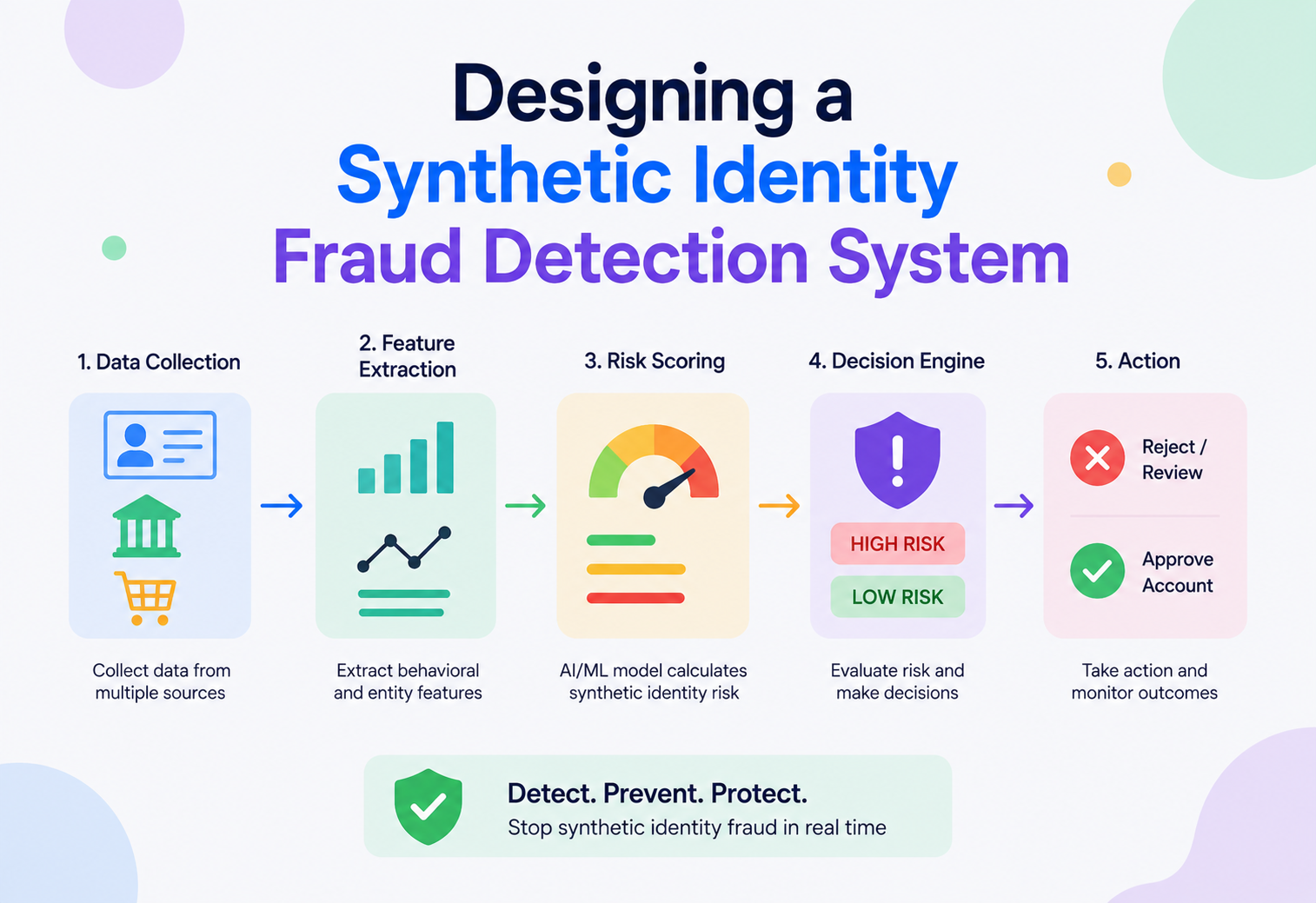
Designing a Synthetic Identity Fraud Detection System
A complete, production-grade system design walkthrough for detecting synthetic identities — fraud built from a mix of real and fake personal details — at the scale of millions of financial account applications, layering deterministic rules, calibrated ML scoring, and an identity graph into one fail-fast, explainable pipeline.
Introduction & History
Every day, banks, credit card issuers, and fintech companies receive a flood of new account applications. Most of these applications come from real people who want a real bank account, a real credit card, or a real loan. But hidden inside that flood, a small and dangerous fraction of applications come from a person who does not exist at all. These are not stolen identities in the traditional sense — nobody’s wallet was pickpocketed and nobody’s identity was “taken over.” Instead, a fraudster builds a brand-new identity by combining pieces of real information with pieces of invented information. This is called synthetic identity fraud, and it has become one of the fastest-growing and hardest-to-catch forms of financial crime in the world.
The idea of combining real and fake information is not new. Criminals have forged documents for centuries. What changed is the environment. In the 1990s and early 2000s, opening a bank account usually meant walking into a branch, showing a physical ID, and talking to a human being who could ask questions and notice something odd about a nervous stranger. As banking moved online and then onto mobile phones, that human checkpoint disappeared. A fraudster today can apply for a credit card from a laptop in another country in under three minutes, using a name that has never existed anywhere except inside their own application.
The other major shift was the widespread availability of data. Data breaches over the last two decades have leaked billions of Social Security Numbers, addresses, phone numbers, and dates of birth. A fraudster does not need to invent everything — they can take one real, valid Social Security Number (often belonging to a child, an elderly person, or someone who does not actively monitor their credit) and attach it to a completely fabricated name, address, and date of birth. Because the SSN is real and traceable in government databases, but the rest of the identity is new, this “Frankenstein identity” often passes basic verification checks that were designed to catch stolen identities, not manufactured ones.
Financial regulators and credit bureaus began formally recognizing synthetic identity fraud as a distinct category of crime in the mid-2010s, once analysts noticed a strange pattern: thousands of “people” who had a credit history but no verifiable life outside of it — no utility bills in their name from years ago, no employment history that matched public records, no consistent address history. These identities were built specifically to be approved by automated systems, then used to slowly build a credit profile over months or years before being “busted out” — maxed out on credit and abandoned, leaving the losses with the lender.
Today, synthetic identity fraud is estimated by industry analysts to cause billions of dollars in losses annually across banking and lending, and it is considered one of the top fraud typologies facing financial institutions, ahead of many older, more “manual” fraud patterns. This tutorial designs, from the ground up, a real-time detection system capable of catching these fabricated identities during account opening and throughout the account’s life, at the scale of a large national or global financial institution.
Synthetic identity fraud is like a costume made from real spare parts. A fraudster takes a real head (a valid SSN), attaches it to a fake body they built themselves (an invented name, address, and birth date), and dresses the whole thing convincingly enough that, from a distance, a single guard checking IDs at the door cannot tell the costume from a real person. Catching this requires more than one guard looking from more than one angle, and it requires guards who compare notes with each other about who else has recently worn a similar costume.
“Why is synthetic identity fraud harder to detect than traditional identity theft?” A strong answer explains that traditional identity theft impersonates an existing, real person — so the victim eventually notices unfamiliar activity and reports it, and the identity itself has years of consistent history that a fraudster’s behavior will eventually contradict. A synthetic identity has no real owner to notice anything is wrong, and its “history” is manufactured from day one, so there is no natural tripwire — the system has to actively look for the absence of a real life, not just the presence of suspicious activity.
Problem & Motivation
To understand why this system needs to exist, imagine a bank that approves a new credit card application every few seconds, twenty-four hours a day, across every timezone. Each application must be evaluated in a couple of seconds, because a slow application process loses honest customers to competitors. At the same time, every application must be checked carefully enough to stop a small percentage of applicants who are not real people at all.
The core business problem breaks down into a few concrete pain points that a well-designed system must solve simultaneously.
2.1 The “First Payment Default” and “Bust-Out” Problem
Synthetic identities are usually not used for immediate theft. A fraudster typically applies for a small credit line, makes a few small purchases, pays the minimum balance on time for months, and lets the credit limit grow through natural credit-building or repeated limit-increase requests. Once the credit line is large enough, the fraudster maxes it out in a very short period — often days — and disappears. This is called a “bust-out.” Because the identity behaved like a normal, trustworthy customer for a long time, traditional fraud rules that look for sudden anomalies in an established account often miss it until the loss has already happened.
2.2 Legitimate-Looking Documents and Data
Unlike a forged passport with a photo that clearly does not match, a synthetic identity’s supporting data can be entirely internally consistent. The SSN passes a Social Security Number validation check because it genuinely was issued by the government — just not to the person applying. The address might be a real, rentable mailbox or a legitimate short-term rental. The phone number might be a real prepaid SIM. Every individual piece of data can be “real,” even though the combination — the identity as a whole — is fake.
2.3 Scale and Speed Requirements
A large retail bank or a popular fintech app can receive well over a million new account applications per day during peak periods such as holiday shopping promotions or back-to-school credit card campaigns. The detection system must make an accurate decision in real time — typically under a couple of seconds for the automated portion of the check — without becoming a bottleneck that damages the experience for the overwhelming majority of honest applicants.
2.4 Evolving Fraud Tactics
Fraud rings actively study how detection systems work. Once a bank starts rejecting synthetic identities that share a phone number across applications, fraud rings switch to using a unique, disposable phone number per application. Once a bank flags applications from the same device, fraud rings switch devices or use device-spoofing tools. This means the system cannot be a fixed set of rules; it must be able to learn and adapt continuously, and it must layer multiple independent signals so that defeating one layer does not defeat the whole system.
Major credit bureaus such as Experian and TransUnion, along with specialist fraud-detection vendors, publish “synthetic identity risk scores” that banks plug directly into their application-decisioning pipelines. These scores are built exactly the way this tutorial designs the system: by combining identity-element consistency checks, cross-institution velocity signals, and machine learning models trained on confirmed synthetic fraud cases.
Core Concepts
Before designing the architecture, it helps to build a clear, simple vocabulary. Every term below is something the design will depend on later.
3.1 Synthetic Identity
A synthetic identity is a fabricated identity created by combining real personally identifiable information (PII) — most commonly a Social Security Number or national ID number — with fictitious or mismatched PII, such as an invented name, a manufactured date of birth, and an address that has no real connection to the SSN’s original owner. There are two common sub-types worth knowing:
- Manipulated synthetic identity: based on one real person’s actual information but with certain fields intentionally altered — for example, a real person’s real SSN and real name, but a fabricated date of birth to make them appear to be a different age (often to obscure a poor credit history or to appear to be an adult when they are a minor).
- Manufactured synthetic identity: built almost entirely from invented information anchored to a single real, valid data point — commonly an SSN that belongs to someone who is not using credit, such as a child, an incarcerated person, a deceased individual, or an immigrant without an established credit file.
3.2 Identity Element
An identity element is any single piece of PII used to identify an applicant: SSN, full legal name, date of birth, home address, phone number, email address, IP address, and device fingerprint. The detection system’s job, at its core, is to check how consistently these elements relate to each other and to their history, rather than checking any single element in isolation.
3.3 Identity Graph
An identity graph is a network data structure where identity elements and applications are nodes, and shared connections between them (the same phone number used on two different applications, for example) are edges. This is the single most powerful tool for catching synthetic identities, because it turns an isolated-looking application into part of a visible pattern when compared against thousands of other applications.
3.4 Velocity Signal
A velocity signal measures how often a particular piece of data has been seen recently — for example, “this exact phone number has been used on eleven different account applications in the past thirty days.” Fraud rings that manufacture synthetic identities in bulk tend to reuse infrastructure (phone numbers, devices, email domains, IP address ranges) because building a completely fresh, untraceable footprint for every single fake identity is expensive and slow. Velocity signals exploit that reuse.
3.5 Credit File Thinness / No-Hit
When a credit bureau is asked about an SSN and finds no prior credit history at all, or an extremely thin history, this is called a “no-hit” or “thin file.” Legitimate reasons for a thin file include young adults just starting to build credit, or recent immigrants. Synthetic identities are disproportionately represented among thin files because the identity itself is new — but so are many honest young applicants, which is exactly why thin-file status alone is a weak, noisy signal and must be combined with others.
3.6 Identity Element Age / Velocity of First Use
This measures how long ago an identity element was first observed anywhere in available data sources — for example, “this SSN was first associated with any credit activity eight months ago” versus “forty years ago.” A very recently created identity footprint, especially one that suddenly appears with an adult date of birth, is a classic synthetic identity signature, since real people accumulate data trails gradually over a lifetime.
“What is the single strongest signal for synthetic identity fraud, and why is no single signal ever enough on its own?” The best signal is usually SSN-to-identity-element consistency across time combined with cross-application velocity on shared elements, because fraud rings must reuse either the SSN pool or the contact infrastructure to operate at scale. But no signal alone is enough, because fraud rings adapt the moment a detection method becomes public knowledge, and honest applicants can innocently trigger any single rule — a student who just got a new phone number and applied for their first credit card looks similar to a thin-file synthetic identity on paper.
Requirements
A regulated, adversarial workload turns non-functional requirements into first-class design constraints, so we spell both sides out explicitly.
4.1 Functional Requirements
- Accept an application event (new account, credit line increase, or existing-account activity) and return a fraud risk decision — approve, decline, or route to manual review — within the application flow.
- Verify the internal consistency of identity elements against authoritative and semi-authoritative data sources (credit bureaus, government ID validation services, phone/email intelligence providers, device fingerprinting providers).
- Maintain and continuously update an identity graph connecting applications, identity elements, and known fraud rings.
- Score every application using both deterministic rules and machine learning models, and combine the two into a final risk decision.
- Support human case management for applications routed to manual review, including the ability for a fraud analyst to see the graph, the score explanation, and comparable past cases.
- Feed confirmed fraud and confirmed-good outcomes back into the model training pipeline to keep the system improving over time.
- Support post-approval monitoring, since some synthetic identities are only exposed months after account opening through unusual behavior such as a sudden “bust-out.”
4.2 Non-Functional Requirements
- Low latency: a decision for the automated majority of applications must complete in well under two seconds end-to-end, including all external data lookups.
- High throughput: the system must sustain bursts far above average load — for example, several thousand applications per second during a major promotional campaign — without degrading latency.
- High availability: application decisioning is on the critical path of revenue-generating account opening, so the system needs to target availability in the range of 99.95% or higher, with graceful degradation rather than hard failure when a downstream dependency is slow or unavailable.
- Consistency of the identity graph: the graph does not need to be perfectly real-time-consistent across every region instantly, but it must never silently miss a strong connection that would have changed a decision — this pushes the design toward eventual consistency with strong guarantees on write durability.
- Explainability: regulated financial institutions must be able to explain why an application was declined, both to internal auditors and, in many jurisdictions, to the applicant themselves (adverse action notices). This constrains model choice and requires an explanation layer.
- Privacy and data protection: the system processes highly sensitive PII and must comply with data protection regulation, data residency rules, and strict access control.
- Auditability: every decision must be traceable, replayable, and retained for a regulator-defined retention period.
“How would you balance latency against thoroughness, given that the strongest checks — like a full graph traversal across billions of edges — are inherently slower than a simple rule lookup?” The expected answer is a tiered, “fail-fast, escalate-slow” architecture: cheap, fast checks run first and can approve or decline low-ambiguity cases immediately, while only the genuinely ambiguous middle band of applications pays the cost of deeper graph traversal and model inference, and even that heavier tier has a hard timeout budget with a safe default (usually “route to manual review”) if it cannot complete in time.
Architecture & Components
At a high level, the system is organized as a pipeline of independent, horizontally scalable services connected by an event streaming backbone. Each stage adds more evidence to the decision, and the pipeline is designed so that a clearly low-risk application can exit early without paying the cost of every stage, while an ambiguous application flows through all of them.
API Gateway
The entry point for every application event. It authenticates the calling channel (mobile app, web app, branch system, or partner integration), enforces rate limits per channel to blunt bulk automated fraud attempts, and routes the request to the Application Intake Service. It also strips or masks any fields that downstream services do not need, reducing unnecessary PII exposure.
Application Intake Service
This service receives the raw application, performs basic structural validation (are required fields present, is the SSN format valid, is the date of birth a real calendar date), assigns a unique application ID, and publishes the event onto the event bus. It intentionally does very little logic itself — its job is to get the event durably recorded and moving through the pipeline as fast as possible.
Data Enrichment Service
This service calls out to external and internal data providers to enrich the raw application with context: a credit bureau lookup (does this SSN have a credit history, and if so how old is it and does the reported name/address match), a phone intelligence lookup (is this a real, active number, how long has it existed, is it a VOIP or prepaid line), an email intelligence lookup (domain age, whether the email has been seen in previous breaches or fraud cases), and a device fingerprinting lookup (browser/device characteristics, whether this device has applied before under a different identity). Enrichment calls run in parallel with individual timeouts, and any call that does not return in time is marked as “unavailable” rather than blocking the whole pipeline.
Feature Store
A centralized store of computed features — both freshly computed for this application and historical aggregates (for example, “number of applications from this device in the last 24 hours”). It has an online, low-latency component for real-time scoring and an offline, batch component used for model training, and the two are kept consistent so that a feature computed one way at training time matches the way it is computed at serving time.
Rules Engine
A deterministic, human-readable set of business rules — for example, “decline if the SSN is on the Social Security Administration’s Death Master File” or “route to review if the reported date of birth would make the applicant under eighteen.” Rules are fast, explainable, and easy for compliance teams to audit, which is why they remain a permanent part of the architecture even alongside machine learning.
ML Scoring Service
Runs one or more trained models against the enriched features and returns a calibrated probability of synthetic identity fraud, along with an explanation of which features contributed most to the score. This is discussed in depth in the Internal Working and Algorithms chapters.
Identity Graph Service
Maintains the identity graph and answers questions like “has this phone number, address, or device been linked to any confirmed fraud rings” and “does this application’s identity elements cluster tightly with a group of other recent applications that share little else in common with a normal population of applicants.” This is described in detail in its own chapter below.
Decision Orchestrator
Combines the outputs of the rules engine, ML scoring service, and identity graph service into a single decision, applies business policy thresholds (which can differ by product, region, and risk appetite), and routes the application to auto-approve, auto-decline, or manual review.
Case Management & Fraud Analyst UI
A human-facing tool where fraud analysts investigate ambiguous applications. It surfaces the graph visually, the model’s explanation, and comparable historical cases, and it captures the analyst’s final decision as a labeled outcome for future model training.
“Why not just run the ML model and skip the rules engine entirely, since machine learning should be strictly more powerful?” The expected answer is that deterministic rules give guaranteed, auditable behavior for known hard-fail conditions (like using a deceased person’s SSN) that regulators and compliance teams require to be enforced without any statistical uncertainty, they are far cheaper to run at the front of the pipeline to shed obviously bad or obviously safe traffic before expensive model inference, and they act as a safety net that keeps working correctly even if a model degrades or a training pipeline has a bug.
Internal Working
This chapter walks through what actually happens, step by step, when a single application enters the system, focusing on the decision logic rather than the plumbing.
6.1 Step One — Structural and Format Validation
The intake service first checks that the submitted data is even well-formed: a nine-digit SSN in a valid range, a real calendar date of birth, a phone number matching a valid country dialing pattern. This step catches obvious junk instantly and cheaply, before any expensive external lookups happen.
6.2 Step Two — Identity Element Consistency Checks
The enrichment service compares the applicant’s submitted name, date of birth, and address against what the credit bureau and government-linked databases have on file for that SSN. A perfect match is reassuring. A partial match — for example, the SSN is associated with a completely different name at the bureau — is a strong signal, but not an automatic decline, because legitimate reasons exist (a recent legal name change from marriage, for instance). This is why the system produces a graded consistency score rather than a binary match/no-match flag.
6.3 Step Three — Velocity and History Checks
The system asks: how many other applications in a recent time window share this phone number, this email, this device fingerprint, or this address? It also checks the “age” of the identity element itself — how long has this phone number existed, how long has this email address existed, how long ago did this SSN first appear anywhere in available credit data. Fresh, recently created contact information paired with an SSN that has decades of history is not necessarily suspicious (people change phones constantly), but fresh contact information paired with an SSN that also has almost no credit history is a much stronger combined signal.
6.4 Step Four — Graph Lookup
The identity graph service checks whether any of this application’s identity elements connect, even indirectly, to a cluster of applications already flagged as suspicious or confirmed fraudulent. This step can catch a fraud ring even when every individual identity element looks clean in isolation, because the ring’s applications share subtle infrastructure (the same device, the same mailbox service, the same IP subnet) that only becomes visible when applications are compared against each other.
6.5 Step Five — Machine Learning Scoring
All of the above — consistency scores, velocity counts, identity element ages, and graph-derived features — become inputs to a machine learning model trained specifically to distinguish confirmed synthetic identity fraud cases from confirmed legitimate applications. The model outputs a calibrated probability, meaning a score of 0.80 should correspond to roughly an 80% historical fraud rate among applications with similar scores, which matters for setting sensible business thresholds.
6.6 Step Six — Decision and Explanation
The Decision Orchestrator combines the rules engine’s verdict (which can hard-override everything else for known hard-fail conditions) with the ML score and the graph signal, applies the current policy threshold, and produces a final decision along with a structured, human-readable explanation of the top contributing factors — required both for internal audit and, where applicable, for adverse action notices sent to declined applicants.
“What happens if the credit bureau lookup times out?” A well-designed answer describes graceful degradation: the enrichment service marks that feature as missing rather than blocking, the ML model is trained to handle missing features (rather than crashing or defaulting to a fixed value that could bias the decision), and if too many critical features are missing, the orchestrator routes the application to manual review instead of guessing — this keeps the pipeline available even when a dependency degrades, without silently making an unsafe automated decision.
Data Flow & Lifecycle
Understanding the lifecycle of a single application, from submission to long-term outcome, clarifies why the system is built as an event-driven pipeline rather than a single synchronous function call.
7.1 Ingestion
An application event is created the moment a user submits a form or a partner system calls the application API. This event is immediately and durably written to an event streaming platform (commonly Kafka) before any processing begins, so that no application can be silently lost even if a downstream service is temporarily down.
7.2 Enrichment and Feature Computation
Consumers of the raw application event fan out to enrichment providers in parallel, then write the combined result — both the raw enrichment data and the derived features — into the feature store. This step is the most latency-sensitive part of the pipeline because it involves network calls to third parties outside the company’s own infrastructure.
7.3 Scoring
Once features are available, rules, ML scoring, and graph lookups run — largely in parallel with each other, since they depend on the same feature set but not on each other’s outputs — and their results converge at the Decision Orchestrator.
7.4 Decisioning and Action
The orchestrator’s decision triggers one of three actions: the account is created and handed to the core banking system, the application is declined and an adverse action notice is generated, or the application is placed in a manual review queue with all supporting evidence attached.
7.5 Post-Decision Monitoring
Because some synthetic identities are specifically designed to behave well for months before a bust-out, the lifecycle does not end at account opening. Ongoing behavioral monitoring continues to feed signals — sudden large balance increases, a cluster of accounts opened around the same time suddenly all maxing out credit within days of each other — back into the same identity graph and scoring infrastructure, which can trigger a post-approval review or account restriction even long after the original decision.
7.6 Feedback and Retraining
Confirmed outcomes — whether from a fraud analyst’s manual review, a later confirmed loss, or a confirmed-good customer who has been in good standing for a long period — are captured as labeled training data. This label data flows into the offline feature store and model training pipeline, closing the loop so the models keep adapting to new fraud tactics.
Point Predictive and similar fraud-analytics vendors describe exactly this pattern of continuous feedback loops in their published fraud consortium models: fraud confirmed at one lending institution becomes a labeled signal that improves detection across every other institution contributing to the same shared consortium data, since synthetic identity rings typically target multiple lenders with the same or similar fabricated identity.
Identity Graph & Entity Resolution
The identity graph deserves its own deep dive because it is the component that catches what nothing else can: coordinated fraud rings whose individual applications each look clean on their own.
8.1 What the Graph Looks Like
Nodes in the graph represent both applications and individual identity elements: an application node, an SSN node, a phone number node, an email node, an address node, and a device fingerprint node. An edge connects an application to each identity element it used. Over time, as thousands of applications are added, elements that are reused across multiple applications naturally become highly connected hub nodes.
8.2 Entity Resolution
Entity resolution is the process of deciding whether two records that are not perfectly identical actually refer to the same real-world entity — for example, “123 Main Street Apt 4B” and “123 Main St, Apartment 4-B” should resolve to the same address node. Without good entity resolution, a fraud ring can evade the graph simply by adding small, meaningless variations to how they type their reused address or name. Entity resolution typically uses a combination of normalization rules (standardizing address formats, phone number formats), fuzzy string matching, and, for harder cases, learned similarity models.
8.3 Community Detection
Once the graph is built, community detection algorithms identify densely connected clusters of applications that share unusually many elements compared to how often random, unrelated applicants would coincidentally share the same data. A single shared address between two applications might be an innocent coincidence (roommates, a family). A cluster of fifteen applications, submitted over three weeks, sharing combinations of three or four elements with none of the applicants otherwise overlapping in any normal way (same employer, same social network) is a strong signal of a coordinated fraud ring.

8.4 Graph Freshness and Update Strategy
New applications are added to the graph as streaming events, typically within seconds, so that a fraud ring’s fifth application in the same week can already benefit from graph signals generated by its first four. Heavier analytics like full-graph community detection across the entire historical graph are too expensive to run on every single application in real time, so they run as a periodic batch job (for example, every few hours), while the real-time path only needs to check direct and near-direct neighbor connections, which is fast on a well-indexed graph database.
“How would you scale a graph traversal to work in under a couple hundred milliseconds when the full identity graph has billions of edges?” The expected answer covers bounding the real-time query to a small number of hops (usually one or two) from the application’s own identity elements rather than traversing the whole graph, using a graph database with efficient adjacency indexing so that “who else used this phone number” is an indexed lookup rather than a scan, caching hot/highly-connected nodes, and pushing the expensive, whole-graph community detection work to an offline batch layer whose output — cluster membership and cluster risk scores — is then just a fast lookup at request time.
Algorithms, Data Structures & Machine Learning
This chapter covers the computational techniques that power the scoring and graph layers.
9.1 Feature Engineering
Raw enrichment data is transformed into model-ready features. Categories of features that matter most for this problem include: identity consistency features (name/address/DOB match rates against bureau records), identity element age features (how long each element has existed), velocity features (counts of shared elements across recent applications, at multiple time windows such as one hour, one day, thirty days), graph-derived features (cluster size, cluster risk score, shortest-path distance to a confirmed fraud node), and behavioral features for post-approval monitoring (spend pattern changes, payment timing changes).
9.2 Gradient Boosted Decision Trees
The primary scoring model is typically a gradient boosted tree ensemble (the same family of algorithm used widely across the fraud detection industry) because it handles a mix of numeric and categorical features well, handles missing data gracefully, trains efficiently on large labeled datasets, and — importantly for a regulated use case — supports feature-importance and per-prediction explanation techniques that satisfy audit and adverse-action requirements more easily than deep neural networks.
9.3 Graph Embeddings and Anomaly Detection
In addition to explicit graph traversal features (like cluster size), the system can learn graph embeddings — numeric vector representations of each node that capture its position and connectivity pattern within the graph — and feed these as additional features into the main scoring model. Separately, unsupervised anomaly detection techniques (such as isolation forests) run over the population of applications to catch genuinely novel fraud patterns that do not yet resemble any previously confirmed fraud case, since supervised models can only learn patterns present in past labeled data.
9.4 Model Ensemble and Calibration
Rather than relying on one single model, production systems typically combine several models — one tuned for precision on clearly egregious cases and one tuned for recall on subtle cases — and calibrate the combined output so that the resulting score is a genuinely interpretable probability, not just a ranking. Calibration matters because business teams set concrete policy thresholds (for example, “auto-decline above 0.85”) and those thresholds only make sense if the underlying score behaves consistently over time and across applicant populations.
9.5 Key Data Structures
| Data Structure | Where It Is Used | Why |
|---|---|---|
| Graph (adjacency list / property graph) | Identity Graph Service | Efficiently represents and traverses relationships between applications and shared identity elements. |
| Bloom filter | Fast pre-check for “has this element ever been seen before” | Extremely memory-efficient, near-constant-time membership check before a more expensive exact lookup. |
| Sliding-window counters (HyperLogLog / count-min sketch) | Velocity feature computation | Approximate but very fast and memory-efficient counting of distinct or repeated elements over rolling time windows at massive scale. |
| LSM-tree based key-value store | Online feature store | Optimized for the high write throughput of continuously updated features alongside fast point reads. |
| Union-Find (disjoint set) | Entity resolution / cluster merging | Efficiently groups records that resolve to the same real-world entity as new matches are discovered. |
9.6 Concurrency and Consistency Considerations
Because many services read and write features and graph edges concurrently at high volume, the design leans on eventual consistency for the graph (a slightly stale view of “who shares this phone number” for a few seconds is an acceptable trade-off for availability and speed) while using strongly consistent, idempotent writes for the actual decision record, since a decision must never be duplicated or lost. Idempotency keys on every application event prevent duplicate processing if a message is retried after a transient failure.
“Why use gradient boosted trees instead of a deep neural network here, given neural networks often outperform trees on large datasets?” A strong answer notes that tabular, structured fraud data (rather than images, audio, or unstructured text) is exactly the regime where gradient boosted trees are competitive with or better than deep learning, that trees train faster and need less infrastructure to serve at low latency, and — crucially in a regulated financial context — trees are easier to explain per-prediction using established techniques, which matters when the business is legally required to justify a decline to a regulator or to the applicant.
Advantages, Disadvantages & Trade-offs
A layered, adaptive design has clear strengths and equally clear limits. Naming both up front makes it easier to explain and defend architectural decisions later.
What this design gets right
- Layered detection (rules, ML, graph) means defeating one layer does not defeat the whole system.
- Fail-fast tiering keeps the common case cheap and fast while still applying deep analysis to genuinely ambiguous cases.
- The identity graph catches coordinated fraud rings that would be invisible to any single-application check.
- Continuous feedback loop lets the system adapt as fraud tactics evolve, instead of relying on a static rulebook.
- Explainability is built in from the start, avoiding a costly retrofit for regulatory compliance.
Where it hurts
- Heavy reliance on third-party data providers (bureaus, phone/email intelligence) introduces external latency and availability risk.
- Graph-based detection is inherently reactive to the population already seen; a brand-new, isolated fraud ring’s very first few applications may not yet show strong graph signals.
- False positives on legitimate thin-file applicants (young adults, new immigrants) can cause real reputational and business harm if not carefully tuned.
- Bust-out fraud can still cause loss even with perfect detection at account opening, since risk is not static — ongoing monitoring is required, adding cost and complexity.
- Sophisticated fraud rings actively probe and adapt to detection systems, requiring continuous investment rather than a “build once” mindset.
10.1 Precision vs. Recall Trade-off
Setting the auto-decline threshold too aggressively (favoring recall) rejects more real fraud but also rejects more honest applicants, directly costing revenue and customer trust. Setting it too conservatively (favoring precision) lets more fraud through, directly costing money. Because this trade-off has direct business consequences, the threshold is not a purely technical decision — it is set jointly with risk and business teams, often varying by product line and even by promotional campaign, and is revisited regularly as fraud rates and acquisition goals change.
10.2 Latency vs. Depth of Analysis
Deeper graph traversal and heavier feature computation catch more fraud but take longer. The tiered architecture is the resolution to this trade-off, but it is not free: it adds engineering complexity, since the system must correctly route applications between fast and slow paths and must define sensible fallback behavior when the slow path cannot finish in time.
10.3 Build vs. Buy
Many institutions do not build every component from scratch. Bureau data, phone/email intelligence, and device fingerprinting are almost always bought from specialized vendors, since building and maintaining that breadth of ground-truth data in-house is prohibitively expensive. The identity graph, scoring models, and decision orchestration are more commonly built in-house (or built on top of a vendor’s fraud platform with heavy customization), since these encode the institution’s own risk appetite and proprietary signals.
Performance & Scalability
At the scale of a large institution, the system must comfortably handle millions of requests per day with burst capacity to handle promotional spikes that can push instantaneous request rates far above the daily average — realistically needing to sustain several thousand application events per second at peak, alongside a much larger volume of read-heavy post-approval monitoring events.
11.1 Horizontal Scaling of Stateless Services
The API gateway, intake service, enrichment service, rules engine, and ML scoring service are all designed to be stateless request handlers that can be scaled horizontally behind a load balancer, with autoscaling driven by request queue depth and CPU/latency metrics rather than a fixed instance count, so capacity grows automatically during a traffic spike and shrinks back down afterward to control cost.
11.2 Partitioning the Event Stream
The event bus is partitioned, commonly by a hash of the application ID or applicant SSN, so that related events for the same identity land on the same partition and can be processed in order relative to each other, while unrelated applications are spread across many partitions for parallel throughput. Partition count is sized with headroom well above current peak throughput, since repartitioning a live topic is operationally disruptive.
11.3 Caching Strategy
Enrichment results and graph lookups for recently seen identity elements are cached with a short time-to-live, since the same phone number, device, or address commonly appears again within the caching window (either because of retries, multi-step application flows, or genuine fraud ring reuse). Caching sharply reduces both latency and the cost of expensive third-party API calls, while a short TTL keeps the cache from serving stale data that misses recent fraud signals.
11.4 Feature Store Read/Write Scaling
The online feature store is the single hottest path in the system, since nearly every service reads from it on every application. It is scaled using a distributed, horizontally partitioned key-value store with replicas serving reads, and write-heavy velocity counters use approximate, mergeable data structures (like count-min sketches) instead of exact counts, trading a small amount of precision for a large reduction in write contention and storage cost at scale.
11.5 Bounding the Cost of Graph Traversal
As described in the identity graph chapter, real-time graph queries are strictly bounded to a small number of hops and rely on precomputed, periodically refreshed cluster-risk scores for the heavier whole-graph analysis, which keeps the real-time query cost roughly constant even as the total graph grows into the billions of edges.
11.6 Backpressure and Load Shedding
During extreme spikes that exceed even the auto-scaled capacity, the system applies backpressure at the API gateway (queueing or briefly delaying non-critical traffic) and, as a last resort, sheds load by routing a larger share of borderline-risk applications straight to manual review rather than letting the whole pipeline’s latency degrade for every applicant, preserving a good experience for the overwhelming majority of clearly low-risk traffic.
“How would you design the system to handle a 20x traffic spike during a flash promotional campaign without breaching your latency SLA?” A complete answer covers pre-scaling based on known promotional calendars, autoscaling policies with headroom, approximate/mergeable counters for velocity features to avoid write hotspots, bounded-cost graph queries, aggressive caching of repeat lookups, and — as the final safety valve — controlled load shedding that routes a larger fraction of ambiguous traffic to manual review instead of degrading latency for everyone.
High Availability & Reliability
Account origination is directly on the revenue path, so “degrade gracefully” is the design mantra everywhere a dependency can fail.
12.1 Multi-Region Deployment
The core services are deployed across at least two geographically separate regions, with the event bus and databases replicated between them, so that a full regional outage does not take down account origination for the entire institution. Application traffic is routed to the nearest healthy region, with automated failover if a region’s health checks fail.
12.2 Graceful Degradation of Dependencies
Every external dependency (bureau APIs, phone/email intelligence, device fingerprinting) has a strict timeout and a defined fallback behavior when it is slow or unavailable — typically treating the missing signal as “unknown” rather than either blocking the whole request or silently assuming a “safe” default value, and routing to manual review if too many critical signals are missing for a confident automated decision.
12.3 Circuit Breakers
Calls to external providers are wrapped in circuit breakers that detect when a provider is failing repeatedly and temporarily stop sending traffic to it, both protecting the provider from being hammered during an outage and protecting the pipeline’s own latency from being dragged down by a dependency that is failing slowly rather than cleanly.
12.4 Durable, Replayable Event Log
Because every application event is first durably written to the event bus before processing, any downstream service failure is recoverable: the service can be restarted and will simply resume consuming from where it left off, and in the case of a serious bug, the event log can be replayed from an earlier offset to reprocess affected applications with corrected logic.
12.5 Disaster Recovery
Databases and the feature store are backed up on a defined schedule with tested restore procedures, and the system defines a recovery point objective and recovery time objective appropriate to a regulated financial workload — commonly targeting minutes, not hours, of potential data loss and downtime, given the direct revenue and compliance impact of an extended outage in account origination.
“If the entire Identity Graph Service becomes unavailable, should the whole pipeline stop approving applications?” The expected answer is no — the system should degrade gracefully by proceeding on rules and ML scoring alone, but shift its policy thresholds more conservatively (routing more borderline cases to manual review) while the graph signal is unavailable, since losing one layer of defense should reduce automated confidence rather than halt the business entirely or silently approve at the normal risk tolerance.
Security
The system handles some of the most sensitive data a business ever touches, and it is also actively targeted by adversaries who probe it deliberately. Security is engineered into every layer accordingly.
13.1 Data Protection for PII
SSNs, dates of birth, and other sensitive identity elements are encrypted at rest and in transit, with field-level encryption for the most sensitive elements so that even a database-level breach does not expose raw SSNs. Access to raw PII is restricted through strict role-based access control, and most internal services operate on tokenized or hashed representations of identity elements rather than the raw values wherever the raw value is not strictly required for the task.
13.2 Access Control and Least Privilege
Fraud analysts, data scientists, and engineers are granted the minimum access necessary for their role, with sensitive actions (viewing raw PII, overriding an automated decision) requiring additional authentication and generating an audit log entry. Service-to-service communication uses mutual TLS and scoped service identities rather than broad shared credentials.
13.3 Protecting Against Adversarial Probing
Fraud rings sometimes deliberately submit test applications to learn how the detection system responds, effectively probing it like an attacker probes any other security system. The system defends against this by rate-limiting and fingerprinting probing behavior itself (many rapid applications with small deliberate variations from a similar origin), by not returning overly detailed decline reasons to the client that could reveal exactly which check failed, and by rotating and periodically retraining models so that patterns learned by a fraud ring from observing outcomes become stale.
13.4 Model and Pipeline Integrity
The model training pipeline is protected against data poisoning — a scenario where a fraud ring deliberately manipulates labeled outcomes (for example, appealing declines to flip labels, or manufacturing a long history of “good behavior” specifically to poison the good-customer label) to make future fraud harder to detect. Training data is monitored for anomalous shifts, and label sources are weighted by their trustworthiness rather than treated as uniformly reliable ground truth.
13.5 Audit Logging
Every decision, every override, and every access to sensitive data is logged in an immutable audit trail that supports both internal fraud investigation and external regulatory examination, retained for the period required by applicable financial regulation.
“How do you prevent a fraud ring from reverse-engineering your detection rules by submitting many test applications?” A good answer covers rate-limiting and behavioral fingerprinting of the probing pattern itself, returning minimal, non-specific decline reasoning externally, monitoring for clusters of near-identical test applications, and treating this as an ongoing security discipline — including periodic model retraining and threshold rotation — rather than a one-time fix, since a sufficiently patient adversary can eventually infer static rules through repeated probing.
Monitoring, Logging & Metrics
Because fraud outcomes are confirmed with a lag of weeks or months, this system relies on carefully chosen leading indicators — not just after-the-fact loss rates — to know if it is working.
14.1 Operational Metrics
Standard service health metrics apply throughout: request latency percentiles (p50, p95, p99) at every stage of the pipeline, error rates per service, queue depth on the event bus, and third-party provider latency and error rates, all feeding into dashboards and paging alerts when they cross defined thresholds.
14.2 Fraud-Specific Metrics
Beyond generic system health, the business needs fraud-specific metrics tracked continuously: approval rate, decline rate, manual review rate, confirmed fraud rate among approved applications (measured with a lag, since confirmation often takes months), false positive rate among declined applicants (estimated through sampling and secondary review), and model score distribution drift over time, which can indicate either a genuine shift in the applicant population or a data quality problem upstream.
14.3 Model Performance Monitoring
Because fraud tactics evolve, the model’s real-world performance is tracked continuously against fresh labeled outcomes, watching for degradation in metrics like precision and recall at the operating threshold. A sustained drop signals that fraud rings may have adapted to defeat the current model’s blind spots, triggering an accelerated retraining and investigation cycle rather than waiting for the next scheduled retrain.

14.4 Explainability and Traceability
Every decision is logged along with the full feature vector, the model version used, the rule verdicts, and the graph signal at the time of the decision, so that any past decision can be fully reconstructed and explained during an audit or a customer dispute, even long after the models involved have since been retrained or replaced.
14.5 Distributed Tracing
Because a single application touches many services and external calls, distributed tracing with a shared correlation ID (the application ID) lets engineers see the full path and timing of a single application through the pipeline, which is essential for diagnosing latency problems that only appear under specific conditions, such as a particular enrichment provider being slow for a subset of applicants.
“How would you detect that your synthetic identity model has started missing a new fraud pattern, before losses become large?” The expected answer covers monitoring leading indicators rather than waiting for confirmed losses: score distribution drift, a rising rate of very-narrowly-approved applications later showing early bust-out behavior, unsupervised anomaly detection flagging a growing cluster of applications that do not fit any previously seen fraud signature well, and close collaboration with fraud analysts whose manual review overrides can surface emerging patterns before enough labeled data exists to formally retrain on them.
Deployment & Cloud Architecture
Deployment discipline — multi-region topology, shadow deployment of models, tight rollback triggers — is what keeps a regulated, always-on origination pipeline safe to change without fear.
15.1 Containerization and Orchestration
Each service is packaged as an independently deployable container and run on a container orchestration platform, which handles rolling deployments, automated restarts of unhealthy instances, and horizontal autoscaling based on load metrics, all without manual intervention during normal operation.
15.2 CI/CD Pipeline
Code changes go through automated testing (including replaying a fixed regression set of historical applications through the pipeline to confirm decisions do not unexpectedly change), staged rollout through a lower-traffic canary environment, and gradual traffic shifting in production, with automated rollback if error rates or key fraud metrics move outside expected bounds during the rollout.
15.3 Model Deployment
Machine learning models are deployed through a separate, model-specific pipeline that includes offline validation against a held-out test set, shadow deployment (running the new model alongside the current production model on live traffic without acting on its output) to compare real-world behavior before cutover, and a controlled, gradual traffic ramp once the new model is approved for production use.
15.4 Infrastructure as Code
All infrastructure — networking, compute clusters, database configuration, access policies — is defined and version-controlled as code, so environments are reproducible, changes are reviewable before they are applied, and disaster recovery can stand up a fresh environment reliably rather than depending on undocumented manual setup steps.
15.5 Cost Optimization
Since third-party enrichment calls are billed per lookup, aggressive caching directly reduces cost as well as latency. Compute autoscaling matches capacity to actual demand rather than provisioning for permanent peak load, and the heavier batch analytics jobs (like whole-graph community detection) run on flexible, lower-cost compute during off-peak hours rather than on the always-on real-time serving fleet.
“How would you safely deploy a new fraud model without risking a sudden spike in false declines?” The expected answer describes shadow deployment to compare the new model’s decisions against the current model’s on real traffic without acting on them, a gradual, monitored traffic ramp (for example 1%, then 5%, then 25%, then 100%) with automated rollback triggers tied to fraud and false-positive metrics, and keeping the previous model version instantly available for rollback rather than requiring a fresh redeploy under pressure.
Databases, Caching & Load Balancing
Different tiers of data need very different storage engines. Getting this split right is what keeps the real-time hot path fast while still supporting heavy analyst and batch workloads on the same underlying facts.
16.1 Choosing the Graph Database
The identity graph is stored in a purpose-built graph database rather than a relational database, because relational joins across a highly connected, unpredictable-depth network of relationships become prohibitively slow as the graph grows, whereas a graph database’s native index-free adjacency makes “who else shares this element” and small-hop traversals fast even at very large scale.
16.2 Feature Store Database Choice
The online feature store uses a distributed key-value store optimized for high write throughput and low-latency point reads (features are written continuously as new applications and events arrive, and read on almost every scoring request), while the offline feature store used for model training uses a columnar data warehouse optimized for large-scale historical analytical queries.
16.3 Application and Case Data
Core application records, decisions, and case management data are stored in a relational database, since this data has clear structure, requires strong transactional guarantees (a decision must not be partially written), and benefits from relational integrity constraints for compliance and audit purposes.
16.4 Caching Layers
An in-memory cache sits in front of the enrichment service (caching recent third-party lookups) and in front of the identity graph service (caching recent one-hop neighbor lookups for frequently seen identity elements), both with short TTLs balancing freshness against the significant latency and cost savings of avoiding a repeat external call or graph traversal.
16.5 Load Balancing
Layer 7 load balancers distribute incoming application traffic across service instances using latency-aware routing, so that a slow instance receives less new traffic rather than continuing to be sent requests it cannot serve quickly, and health checks continuously remove unhealthy instances from rotation automatically.
16.6 Read Replicas
Both the graph database and the relational case management database use read replicas to serve the read-heavy traffic from the fraud analyst UI and reporting systems, keeping that traffic separate from the primary write path that the real-time scoring pipeline depends on, so heavy analyst or reporting queries cannot degrade real-time decisioning latency.
“Why not store the identity graph in the same relational database as the core application records?” The expected answer explains that graph traversal queries — especially variable-depth “who is connected to whom, within two hops” queries — require repeated self-joins in a relational model that become slow and complex as the graph grows, while a purpose-built graph database is designed specifically for this access pattern with native adjacency indexing, making it both faster and simpler to query and maintain at scale.
APIs & Microservices
Clean service boundaries, an event-driven internal fabric, and explicit versioning let the fraud team ship independently of every neighboring product engineering team.
17.1 Service Boundaries
Each major capability — intake, enrichment, rules, ML scoring, graph, decisioning, case management — is a separate microservice with its own data store where appropriate, allowing each team to develop, deploy, and scale their service independently, and allowing the heaviest components (like graph traversal) to be scaled separately from the lightest ones (like rules evaluation).

17.2 Synchronous vs. Asynchronous Communication
The initial submission from the client to the API gateway and intake service is synchronous, since the applicant is waiting for a decision. Internally, most communication between services is asynchronous, event-driven communication through the event bus, which decouples services from each other’s availability and allows independent scaling — the enrichment service does not need the rules engine to be healthy to do its job, and a temporary backlog in one service does not directly block another.
17.3 API Contracts and Versioning
Service APIs and event schemas are versioned explicitly, and schema evolution follows backward-compatible practices (adding optional fields rather than removing or renaming existing ones) so that services can be deployed independently without requiring a coordinated, simultaneous release across the whole system.
17.4 External Partner APIs
Where the institution exposes fraud decisioning as a service to partner lenders or embedded finance partners, a well-documented external API layer sits in front of the internal pipeline, with its own authentication, rate limiting, and a stable contract that can evolve independently of internal implementation changes.
17.5 Idempotency
Every API and event carries an idempotency key (typically the application ID plus an event type), so that retries — whether from network failures, client-side retries, or event bus redelivery — never cause duplicate account creation, duplicate scoring, or duplicate case creation.
POST /v1/applications/score
Idempotency-Key: app_9f2a-a12
Authorization: Bearer <partner-token>
Content-Type: application/json

{
  "application_id": "app_9f2a-a12",
  "channel":        "mobile",
  "product":        "consumer_credit_card",
  "applicant": {
    "ssn_token":     "tok_ssn_c1c2c3",
    "full_name":     "Jordan Rivera",
    "date_of_birth": "1998-04-11",
    "address":       { "line1": "12 Birch Ln", "postal_code": "10001" },
    "phone":         "+1-555-0134",
    "email":         "jordan.rivera@example.com"
  },
  "device": { "fingerprint": "dfp_71b2", "ip": "203.0.113.42" }
}

// Response
{
  "application_id": "app_9f2a-a12",
  "decision":       "review",
  "score":          0.72,
  "top_factors": [
    { "code": "SSN_ELEMENT_AGE_SHORT",     "weight": 0.31 },
    { "code": "PHONE_SHARED_ACROSS_APPS",  "weight": 0.22 },
    { "code": "DEVICE_LINKED_TO_CLUSTER",  "weight": 0.19 }
  ],
  "policy_version": "2026.07",
  "model_version":  "gbm-v14.3"
}
Note the four properties that matter most for a regulated fraud API: an explicit idempotency key, tokenized rather than raw SSN, a calibrated numeric score in [0, 1], and human-readable factor codes that flow directly into an adverse action notice if the final decision becomes a decline.
“Why use asynchronous, event-driven communication internally instead of synchronous service-to-service API calls throughout the pipeline?” A strong answer covers decoupling — a service can be temporarily unavailable or slow without directly blocking every other service that would otherwise call it synchronously — combined with the natural fit of an event log for durability and replayability, and the ability to add new consumers of the same event stream (for example, a new analytics service) without changing any existing producer.
Design Patterns & Anti-Patterns
Reusable patterns that consistently pay off in this domain — and the tempting shortcuts that consistently punish teams that take them.
18.1 Useful Design Patterns
Circuit Breaker
Protects the pipeline from cascading failure when a third-party data provider degrades.
Bulkhead
Isolates resource pools per external dependency so a slow provider cannot exhaust threads or connections needed by other, healthy dependencies.
Event Sourcing
The durable, append-only application event log doubles as a full audit trail and enables replay for debugging or reprocessing.
Strangler Fig
Useful when migrating from a legacy rules-only fraud system to this modern architecture, gradually routing an increasing share of traffic to the new pipeline while the old system remains available as a fallback.
CQRS
Command Query Responsibility Segregation — separating the write-heavy real-time feature and graph updates from the read-heavy analyst and reporting queries, using replicas tuned for each access pattern.
18.2 Anti-Patterns to Avoid
| Anti-Pattern | Why It Hurts |
|---|---|
| Single monolithic scoring rule | Relying on one big rule or one single model score with no layered defense makes the whole system brittle to any one blind spot or evasion technique. |
| Synchronous chaining of every external call | Calling enrichment providers one after another instead of in parallel needlessly multiplies latency and creates a fragile dependency chain. |
| Training/serving skew | Computing a feature one way during model training (from a batch historical dataset) and a subtly different way at real-time serving time silently degrades model accuracy in production in ways that are hard to detect without careful feature store design. |
| Black-box-only decisioning | Deploying a model with no explanation layer creates compliance risk in a regulated industry and makes it far harder for fraud analysts to trust and act on the system’s output. |
| Ignoring post-approval monitoring | Treating the account-opening decision as the end of the fraud lifecycle misses bust-out fraud, which is specifically designed to pass the opening check and cause damage later. |
“What is training/serving skew, and how would you prevent it in this system specifically?” The expected answer defines the mismatch between how a feature is computed during offline model training versus real-time serving, and describes the prevention strategy of using a single shared feature store and shared feature computation logic (or a feature definition layer) for both the offline training pipeline and the online serving path, so the exact same code and logic produces a feature’s value in both contexts.
Best Practices & Common Mistakes
A short field guide, distilled from experience: the habits teams that ship this well share, and the traps that catch teams that ship this badly.
19.1 Best Practices
- Treat the identity graph as a living system that needs continuous maintenance — entity resolution rules and cluster-detection thresholds need periodic review as data patterns shift.
- Build explanation and auditability in from day one rather than retrofitting it once a regulator asks for it.
- Keep a human-in-the-loop for genuinely ambiguous cases permanently — full automation of every decision is neither realistic nor safe in a regulated, adversarial domain.
- Invest in a fast, reliable feedback loop from confirmed outcomes back into training data, since stale models are the single biggest reason detection systems lose effectiveness over time.
- Design for graceful degradation everywhere a third party is involved, since external dependencies will fail or slow down eventually.
- Collaborate closely with fraud analysts — their intuition about emerging patterns is often the earliest signal, well before enough labeled data exists to formally retrain a model.
19.2 Common Mistakes
- Over-indexing on a single strong-looking signal (like SSN-name mismatch) and building a rule so aggressive it generates unacceptable false positives among honest applicants with legitimate name changes.
- Under-investing in entity resolution, which lets fraud rings evade graph detection through trivial formatting variations in reused data.
- Treating model retraining as a rare, manual event rather than a continuous, monitored pipeline, causing detection quality to silently decay as fraud tactics shift.
- Failing to separate real-time and analytical workloads, letting heavy reporting queries degrade the latency of live application decisioning.
- Ignoring the long-tail lifecycle of an account and only ever scoring fraud risk at the moment of application, missing bust-out fraud entirely.
“A fraud analyst tells you the model recently started approving applications that ‘feel obviously synthetic’ to experienced reviewers. How do you investigate?” A strong answer describes pulling a sample of these cases, checking for score distribution drift or a recent change in the applicant population, checking whether a recent model or feature pipeline deployment coincides with the shift, verifying feature completeness (are enrichment calls silently failing more often), and treating the analyst’s qualitative pattern recognition as an early warning worth formal investigation even before enough confirmed-fraud labels exist to prove it statistically.
Real-World / Industry Examples
Several categories of real institutions operate systems that closely mirror this design, each contributing a different piece of the puzzle.
Credit Bureaus
Major credit bureaus maintain synthetic-identity-specific risk scoring products that banks integrate directly into their application decisioning, built on the same core idea of identity-element consistency and identity-element age described in this tutorial, since the bureaus sit on the richest available source of long-term credit history data needed to assess whether an SSN’s reported history looks organically built over time or suspiciously assembled.
Fraud Consortium Data Vendors
Specialist vendors operate shared fraud consortiums where participating lenders contribute anonymized, confirmed fraud outcomes, allowing a fraud ring caught at one bank to immediately strengthen detection at every other participating institution — a direct real-world implementation of the feedback-loop and identity-graph concepts covered earlier, but extended across company boundaries rather than staying internal to one institution.
Large Retail Banks and Card Issuers
Large card issuers run internal fraud engineering teams that build exactly this kind of layered pipeline — rules, ML scoring, and graph analytics — as part of their new account origination flow, often processing millions of applications monthly and iterating on models continuously as fraud patterns shift, particularly around high-volume promotional periods that fraud rings specifically target because of the higher approval-rate pressure on the business.
Fintech and Buy-Now-Pay-Later Providers
Newer digital-first lenders, including buy-now-pay-later providers, have been especially targeted by synthetic identity fraud because their onboarding is designed to be extremely fast and low-friction, which is attractive to legitimate customers but also to fraud rings seeking the path of least resistance — driving significant industry investment specifically in real-time graph-based detection to keep onboarding fast for honest users while still catching manufactured identities.
Socure, a widely used identity verification and fraud platform in the financial services industry, publicly describes combining document verification, phone/email intelligence, and graph-based network analysis specifically to target synthetic identity fraud — an architecture directly analogous to the enrichment, scoring, and identity graph layers designed in this tutorial.
Frequently Asked Questions
A distilled set of the questions that come up repeatedly in interviews and in real design reviews for this feature.
Is synthetic identity fraud the same as identity theft?
No. Identity theft impersonates a real, existing person using their actual complete identity, and that person typically discovers the fraud when they notice unfamiliar activity. Synthetic identity fraud manufactures a new identity by mixing real and fake elements, so there is no single real person who will notice and report it, which is exactly what makes it harder to catch.
Why can’t this be solved just by requiring a government-issued photo ID?
A photo ID check helps confirm that the person applying matches the photo on a document, but it does not verify that the underlying identity itself (the name, SSN, and date of birth combination) corresponds to a real, coherent life history. A fraudster can obtain or fabricate a document that internally matches their invented identity elements, so document verification is a useful additional layer but not a complete solution on its own.
Why is a thin credit file not, by itself, proof of synthetic identity fraud?
Millions of honest people — young adults opening their first account, recent immigrants, or people who have simply avoided credit for years — have thin or no credit files for completely legitimate reasons. Treating a thin file as automatic proof of fraud would decline a large number of honest customers, which is why it is used as one input among many rather than a standalone trigger.
How long does it typically take for synthetic identity fraud to be discovered after an account is opened?
It varies widely, but fraud rings often deliberately behave well for months, sometimes over a year, specifically to build a larger credit line before a bust-out. This is why post-approval monitoring, not just point-of-application screening, is a necessary and permanent part of the system.
Can this system fully automate every application decision without any human review?
No, and it should not try to. A meaningful share of applications will always fall into a genuinely ambiguous middle band where automated confidence is not high enough for a safe fully automated decision, and human fraud analysts remain essential both for those cases and as an early-warning source for new fraud patterns the models have not yet learned.
How does the system stay effective as fraud tactics change over time?
Through the continuous feedback loop described earlier: confirmed outcomes from manual review and later-discovered fraud feed back into model retraining, model performance is actively monitored for degradation rather than assumed to remain constant, and the layered architecture (rules, ML, graph) means a fraud ring has to simultaneously defeat multiple independent detection mechanisms, which is far harder than defeating a single static rule.
Summary & Key Takeaways
Synthetic identity fraud is fundamentally different from traditional identity theft because it manufactures a new identity rather than impersonating an existing one, which removes the natural tripwire of a real victim noticing unfamiliar activity. Detecting it well requires a layered system rather than any single clever check.
- The architecture combines fast, explainable deterministic rules; calibrated machine learning scoring; and identity graph analysis, so that defeating any one layer still leaves the others in place.
- A fail-fast, escalate-slow tiering strategy keeps the common case fast and cheap while still applying deep, expensive analysis to genuinely ambiguous applications.
- The identity graph and entity resolution are what expose coordinated fraud rings whose individual applications look clean in isolation — this is the design’s single strongest advantage over simpler, single-application scoring systems.
- Non-functional requirements — latency, availability, explainability, and privacy — are not afterthoughts in this domain; they are first-class design constraints driven directly by regulatory obligation and real-time business need.
- Detection does not end at account approval. Bust-out fraud specifically exploits systems that only check risk once, making continuous post-approval monitoring a required part of the full lifecycle.
- A continuous feedback loop from confirmed outcomes back into model retraining is what keeps the system effective as fraud rings adapt — this is a permanently ongoing operational commitment, not a one-time engineering project.
- Every architectural decision in this system — from choosing gradient boosted trees over deep learning, to keeping deterministic rules alongside machine learning, to building an explanation layer from day one — traces back to the same root constraint: this is a regulated, adversarial, high-stakes domain where both accuracy and accountability matter equally.
Synthetic identity fraud is not a single-check problem — it is a pattern-of-patterns problem. No single rule, no single model, and no single graph query is ever enough on its own. What works is a small number of independent, adaptive detection layers cooperating in real time, with a human analyst in the loop for the ambiguous middle and a fast feedback loop keeping every layer honest as the adversary evolves.