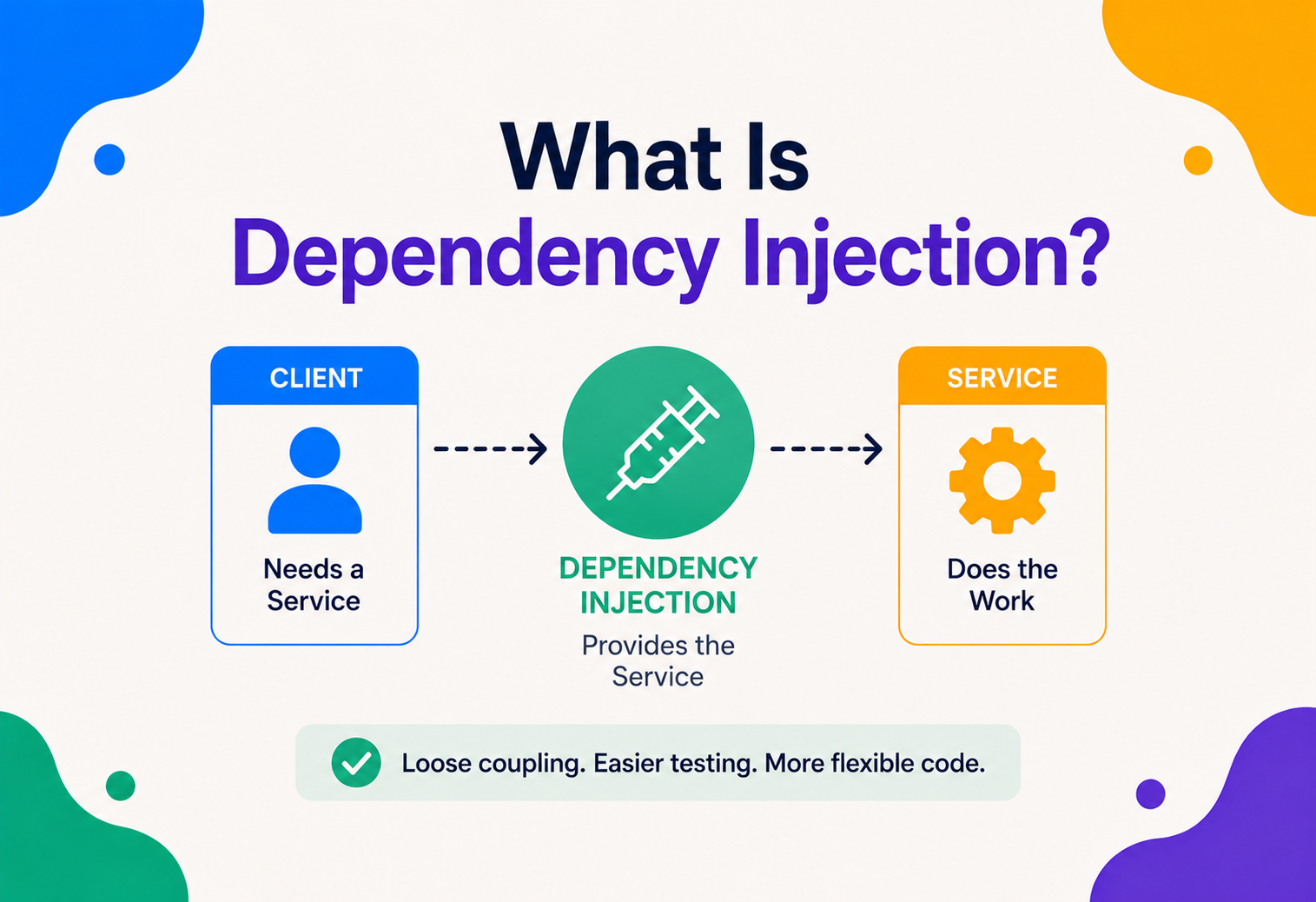
What Is Dependency Injection?
A flashlight doesn’t manufacture its own batteries. Someone hands it batteries from the outside, it clicks them into place, and it works — with any brand of battery that fits. That simple habit of “don’t build it yourself, just accept it from outside” is the entire idea behind one of the most quietly powerful habits in software design.
The Big Idea, in One Breath
Think about a lamp. A lamp doesn’t grow its own light bulb, and it definitely doesn’t generate its own electricity from scratch. Instead, it has a socket, and you screw whatever bulb you like into that socket, and you plug it into whatever power outlet happens to be nearby. The lamp’s whole design depends on the idea that the bulb and the electricity come from outside the lamp, handed in through a socket and a plug, rather than being built permanently into the lamp itself.
This turns out to be a wonderfully useful habit, and it’s exactly what Dependency Injection — often shortened to DI — brings to software. Instead of a piece of code creating the other pieces of code it needs all by itself, those other pieces are handed to it from the outside, the same way a bulb is handed to a lamp. The code doesn’t go looking for what it needs; what it needs is simply given to it, ready to use.
Picture a barista making your coffee. The barista doesn’t personally grow coffee beans in a backyard farm, raise a cow for milk, or mine sugar out of the ground. Instead, beans, milk, and sugar all arrive at the coffee shop from outside suppliers, and the barista simply combines whatever arrives into your drink. If the shop switches milk suppliers next month, the barista doesn’t need to relearn how to make coffee — the recipe still works exactly the same, because the milk was always something handed in, never something the barista had to personally produce.
In software terms, a piece of code that needs something else to do its job — a database connection, a notification sender, a payment processor — is said to have a dependency on that something else. Dependency Injection is simply the practice of handing those dependencies to a piece of code from the outside, usually through its constructor or its setup, rather than letting that code create its own dependencies internally. It sounds like a small, almost trivial difference. It turns out to change an enormous amount about how easy software is to test, change, and grow.
It’s worth sitting with just how ordinary this idea feels once it’s spelled out plainly. Nobody finds it strange that a wall socket, not a lamp, is responsible for producing electricity. Nobody expects a phone charger to be permanently soldered to one specific phone. These everyday objects already embrace the “accept it from outside” philosophy so completely that we barely notice it’s a design choice at all — we only notice when something breaks that philosophy, like a gadget with a battery sealed inside that can never be replaced. Dependency Injection simply brings that same, already-familiar habit into how software classes are built.

What Dependency Injection Really Is
Formally speaking, Dependency Injection is a technique in which an object receives the other objects it depends on from an external source, rather than creating those dependencies itself. It’s a specific, concrete way of applying a broader idea called Inversion of Control, which simply means flipping who’s in charge of creating and wiring things together — instead of a class controlling its own dependencies, that control is handed over to something else, usually the code that’s using the class, or a specialized tool built just for this job.
Two ideas anchor this practice, and they’re worth holding onto through the rest of this guide:
- Depend on the shape, not the specific thing. Code should ask for “something that can send a notification,” described through a general interface, rather than insisting on one particular, specific notification class by name.
- Someone else does the wiring. Deciding exactly which specific implementation gets used — email versus text message versus push notification — happens somewhere else entirely, outside the code that actually uses it.
If someone asks “what does Dependency Injection actually do?”, the honest short answer is: it stops a piece of code from building the tools it needs by itself, and instead lets someone else hand those tools to it, ready to use.
It’s worth being precise about one small but important distinction: Dependency Injection isn’t itself a single design pattern in the same way Decorator or Facade are — it’s more accurately described as a design principle, or a technique, that can be applied in a few different concrete ways. Many teams also use a helper tool called a DI container or DI framework to automate the wiring process at a larger scale, but the core idea — hand dependencies in from outside, don’t build them internally — works perfectly well even without any special tool at all, using nothing more than plain constructors.
The broader idea of Inversion of Control mentioned earlier deserves a moment of its own attention, since Dependency Injection is really just its most common, most concrete expression. Traditionally, a piece of code is “in control” — it decides what it needs, and it goes and gets it, calling out to create objects and fetch data on its own initiative. Inversion of Control flips that relationship: the code no longer reaches out to get what it needs; instead, whatever it needs is handed to it, and it simply waits to receive it. This same flip shows up in other places too — a framework calling your code at the right moment, rather than your code calling the framework, is another everyday example of Inversion of Control at work, even outside the specific context of dependencies.
The Problem It Solves (Why It Matters)
To see why Dependency Injection earns its place in a software architect’s toolbox, imagine a class that sends order confirmation emails, and imagine it builds its own email-sending tool internally, right inside itself, the moment it’s created.
without-di.tsclass OrderService {
    private mailer = new SmtpEmailSender("smtp.mailhost.com")

    confirmOrder(order: Order) {
        this.mailer.send(order.customerEmail, "Your order is confirmed!")
    }
}
This looks harmless enough at first glance, but it quietly creates a tangle of problems. OrderService is now permanently, tightly bound to one specific email tool, with one specific server address, hardcoded right inside it. Testing confirmOrder() now means actually sending a real email every single time a test runs — slow, unreliable, and likely to spam a real inbox during automated testing. Switching to a different email provider later means digging directly into OrderService and editing it, even though sending confirmations was never really OrderService‘s core job to begin with.
This kind of unnecessary welding between two classes is called tight coupling, and it’s one of the most common sources of pain in growing codebases. When a class builds its own dependencies internally, it becomes stuck with those exact dependencies forever, unable to be tested in isolation, and unable to be reused in a slightly different context without being rewritten.
Real side effects every time
Testing logic ends up triggering real emails, real database writes, or real network calls.
Stuck with one implementation
Changing providers or tools means editing the class itself, everywhere it’s used.
Baggage travels with the class
Reusing the class elsewhere drags its hardcoded dependencies along with it.
Hard to see what a class truly needs
A class’s real requirements are buried inside its own code, invisible from the outside.
Dependency Injection fixes this by handing the email tool to OrderService from the outside, instead of letting it build one internally. OrderService simply declares “I need something that can send messages,” and whatever calls it decides exactly what that something actually is — a real email sender in production, and a harmless fake stand-in during testing.
There’s a deeper cost to tight coupling worth naming directly too: it makes a codebase resistant to change in a way that’s hard to notice until it’s genuinely painful. A business decision as simple as “let’s switch email providers to save money” can quietly turn into a much bigger project than it should be, purely because dozens of classes across the codebase each built their own hardcoded connection to the old provider. Dependency Injection doesn’t make that kind of business change free, but it does concentrate the actual code change into one small, predictable place — the wiring — instead of scattering it across every class that happened to need an email tool.
The Building Blocks
Every use of Dependency Injection, in any language, is built from the same handful of roles.
- Client (or Consumer) — the class that needs something to do its job, like
OrderServiceneeding something that can send messages. - Service (or Dependency) — the thing being needed, usually described through a general interface rather than one specific class, like “something that can send messages.”
- Injector — whatever is responsible for creating the actual, specific implementation and handing it to the Client — this might be a small piece of setup code, or a dedicated DI container tool.
Notice that on the right side of the diagram, OrderService no longer contains the word “Smtp” or “email” anywhere at all — it only knows about a general Mailer shape. Whether that Mailer turns out to be a real email sender, a text message sender, or a harmless fake used during testing is a decision made entirely outside OrderService, by whatever’s doing the injecting.
It’s worth noticing, too, that the Injector role doesn’t have to be anything fancy. In a small application, it might just be a few lines of setup code, run once when the application starts, that creates the real implementations and passes them into the classes that need them. In a larger application, that same job is often handed over to a dedicated DI container tool, which can automatically figure out an entire web of dependencies — sometimes dozens or hundreds of classes deep — and wire everything together correctly with far less manual setup code than doing it all by hand would require.
How It Works, Step by Step
Let’s rebuild the order confirmation example properly, using simple pseudocode that reads a lot like Java, C#, or TypeScript.
Step 1 — Describe the shape, not the specific tool
Mailer.tsinterface Mailer {
    send(to: string, message: string): void
}
Step 2 — Build real implementations of that shape
implementations.tsclass SmtpEmailSender implements Mailer {
    send(to: string, message: string) { /* real email logic */ }
}

class FakeMailer implements Mailer {
    sentMessages: string[] = []
    send(to: string, message: string) { this.sentMessages.push(message) }
}
Step 3 — Let OrderService simply ask for a Mailer
This is the heart of Dependency Injection: the Mailer arrives through the constructor, handed in from outside, rather than being created inside.

OrderService.tsclass OrderService {
    constructor(private mailer: Mailer) {}

    confirmOrder(order: Order) {
        this.mailer.send(order.customerEmail, "Your order is confirmed!")
    }
}
Step 4 — Inject the right Mailer for the situation
wiring.ts// In production
const service = new OrderService(new SmtpEmailSender())

// In a test
const fakeMailer = new FakeMailer()
const testService = new OrderService(fakeMailer)
testService.confirmOrder(sampleOrder)
// assert fakeMailer.sentMessages contains the expected message
OrderService itself never changed between these two situations. The exact same class works correctly with a real email sender in production and a harmless fake stand-in during testing, purely because it never insisted on building its own Mailer in the first place.
Testing confirmOrder() no longer sends a single real email. The test runs in milliseconds, checks exactly what it needs to check, and leaves no side effects behind — all because the dependency was injected rather than built internally.
Three Ways to Inject a Dependency
There’s more than one way to actually hand a dependency to a class. All three achieve the same underlying goal, but each fits slightly different situations.
| Style | How It Works | Best Suited For |
|---|---|---|
| Constructor Injection | Dependencies are passed in when the object is first created, through its constructor. | Dependencies the class absolutely requires to function correctly at all. |
| Setter Injection | Dependencies are handed in afterward, through a dedicated setter method, once the object already exists. | Optional dependencies that aren’t strictly required for the object to be usable. |
| Interface Injection | The dependency itself defines a method that the injector calls to hand itself over. | Less common in modern practice, but useful in certain plugin-style architectures. |
Constructor injection is, by a wide margin, the most commonly recommended approach in modern software, and for good reason: it makes a class’s true requirements completely visible at a glance, right there in its constructor signature, and it guarantees the object can never exist in a half-broken state missing something it truly needs. Setter injection remains useful specifically for dependencies that are genuinely optional — a logging tool a class can function without, for instance, just with slightly less detailed output.
If a class truly cannot do its job without a dependency, inject it through the constructor. If a dependency is genuinely optional, a setter is reasonable. Interface injection is rarely the first choice for typical application code today.
Real-World Examples You’ve Already Used
Dependency Injection quietly runs underneath an enormous amount of the software you interact with daily, especially anything built with a mature enterprise or mobile framework.
The Spring Framework
One of the most influential frameworks in enterprise Java, built almost entirely around a powerful dependency injection container.
Built-in DI container
Modern .NET applications include dependency injection as a first-class, built-in feature of the framework itself.
Angular’s injector system
Angular is built around dependency injection from the ground up, letting components request services without building them.
Android’s Hilt and Dagger
Popular Android libraries that automate dependency injection for large, complex mobile applications.
Everyday appliances offer a helpful non-software parallel too. A wall-mounted electric drill’s battery pack is injected, not built in — you can swap in a fresh, fully charged battery without the drill itself ever needing to change, and different brands of tools sometimes even share compatible battery packs, exactly because the connection point was designed to accept whatever fits, rather than being permanently welded to one specific battery.
Kitchen appliances follow the same idea in a slightly different form. A stand mixer accepts different attachments — a whisk, a dough hook, a paddle — through the same standardized connection point, rather than needing a completely different machine for each task. The mixer’s motor doesn’t know or care which attachment is currently connected; it simply spins whatever’s handed to it. That’s Dependency Injection in physical form: one flexible connection point, many interchangeable things that can be plugged into it.

Strengths and Trade-offs
Strengths
- Makes automated testing dramatically easier, using fakes instead of real dependencies.
- Loosens tight coupling between classes, making each one easier to change independently.
- Makes a class’s true requirements visible at a glance, right in its constructor.
- Allows swapping implementations — different providers, environments, or configurations — without editing the class itself.
- Encourages designing around general interfaces rather than specific, rigid implementations.
Trade-offs
- Adds a small amount of upfront ceremony and extra files, especially for tiny projects.
- DI container “magic” can make it harder to trace exactly where an object came from, for newcomers.
- Overusing interfaces for things that will genuinely never have more than one implementation adds needless complexity.
- A misconfigured DI container can produce confusing runtime errors that are trickier to diagnose than a simple compile error.
- Learning curve exists for teams unfamiliar with the underlying Inversion of Control idea.
Dependency Injection is a genuine trade-off, not a free upgrade. It buys flexibility and testability at the cost of a little extra upfront structure — a trade that pays off quickly on any project expected to grow or be tested seriously.
When to Reach for It (and When Not To)
Anything you plan to test automatically
Injected dependencies can be swapped for fakes, making thorough, fast automated testing genuinely practical.
Code that may need to swap implementations
Different environments — production, staging, testing — often need slightly different tools behind the same interface.
Growing, long-lived applications
The looser coupling DI encourages pays off increasingly as a codebase and its team both grow larger.
A tiny, throwaway script
A quick five-line script rarely benefits from interfaces and injected dependencies — direct and simple is often better here.
A useful gut-check question: “Will I ever want to test this in isolation, or use a different implementation of this dependency somewhere else?” If the honest answer is yes, injecting that dependency will likely pay off. If a class genuinely has just one dependency that will never realistically change or need faking, a small amount of direct construction may be perfectly reasonable, and adding interfaces “just in case” can sometimes add complexity without ever delivering real benefit.
Team size and project lifespan factor into this decision too, much as they do with other architectural choices. A short prototype meant to validate an idea over a weekend can often skip the ceremony of interfaces and injection entirely, since the code may never survive long enough to need testing infrastructure or implementation swaps. A production system maintained by a growing team over several years benefits enormously from the discipline, since dependencies tend to multiply naturally as features are added, and untangling tightly coupled code after the fact is a far more expensive undertaking than building it loosely coupled from the start.
Common Pitfalls and Best Practices
Constructor Overload
A constructor demanding eight or ten different dependencies is usually a warning sign that the class itself has taken on too many responsibilities, not that dependency injection has failed. Splitting an overloaded class into smaller, more focused ones, each with a shorter, cleaner list of real dependencies, is usually the healthier fix.
Injecting Concrete Classes Instead of Interfaces
Technically, dependency injection can be done with specific, concrete classes instead of general interfaces — but doing so quietly gives up most of the flexibility and testability that made the practice worthwhile in the first place. Depending on an interface, even when there’s currently only one implementation, keeps the door open for testing and future changes.

Treating the DI Container as Magic
Larger applications often reach for a dedicated DI container tool to automate wiring at scale, which is genuinely useful — but it’s worth understanding roughly how that container decides what to hand to what, rather than treating it as an unexplainable black box. A little understanding of the underlying wiring goes a long way when something doesn’t behave as expected.
Service Locator Confusion
A related but subtly different technique, sometimes called the Service Locator pattern, lets a class actively reach out and ask a central registry for whatever it needs, rather than having dependencies handed to it upfront. This can look similar to Dependency Injection at a glance, but it hides a class’s true requirements instead of making them visible, and it’s generally considered a less transparent approach for most modern application code.
A class’s constructor should read like an honest, complete list of everything it truly needs to do its job — no more, no less. If that list feels uncomfortably long, that discomfort is usually pointing at a design problem worth addressing.
A Quick Tour Across Languages and Frameworks
The core idea of Dependency Injection stays remarkably consistent, though the tooling supporting it varies quite a bit by ecosystem.
| Language / Framework | How DI Typically Appears |
|---|---|
| Java (Spring) | A mature, widely used DI container automatically wires together beans based on configuration or annotations. |
| C# (.NET) | Dependency injection is built directly into the framework, with services registered and resolved through a built-in container. |
| TypeScript / Angular | An injector system built into the framework automatically supplies services to components that request them. |
| Plain JavaScript / Python | Often done manually, without a dedicated container — simply passing dependencies through function or constructor parameters. |
What stays constant everywhere is the underlying discipline: describe what a piece of code needs in general terms, and let something else decide exactly what to hand it. Whether that “something else” is a sophisticated container tool or a single line of manual setup code in a small project, the core habit — and the testability and flexibility it buys — remains exactly the same.
Key Takeaways
Remember This
- Dependency Injection hands a class the tools it needs from the outside, instead of letting the class build those tools itself.
- It’s a specific way of applying Inversion of Control — flipping who’s in charge of creating and wiring dependencies together.
- It solves tight coupling, making code dramatically easier to test, swap, and reuse without editing the class itself.
- Constructor injection is the most common and most recommended approach, making a class’s true requirements visible at a glance.
- It’s a genuine trade-off — a small amount of upfront structure in exchange for real flexibility and testability, which pays off especially well as a project grows.
- Depend on general interfaces rather than specific implementations, and keep a class’s list of injected dependencies honest and short.