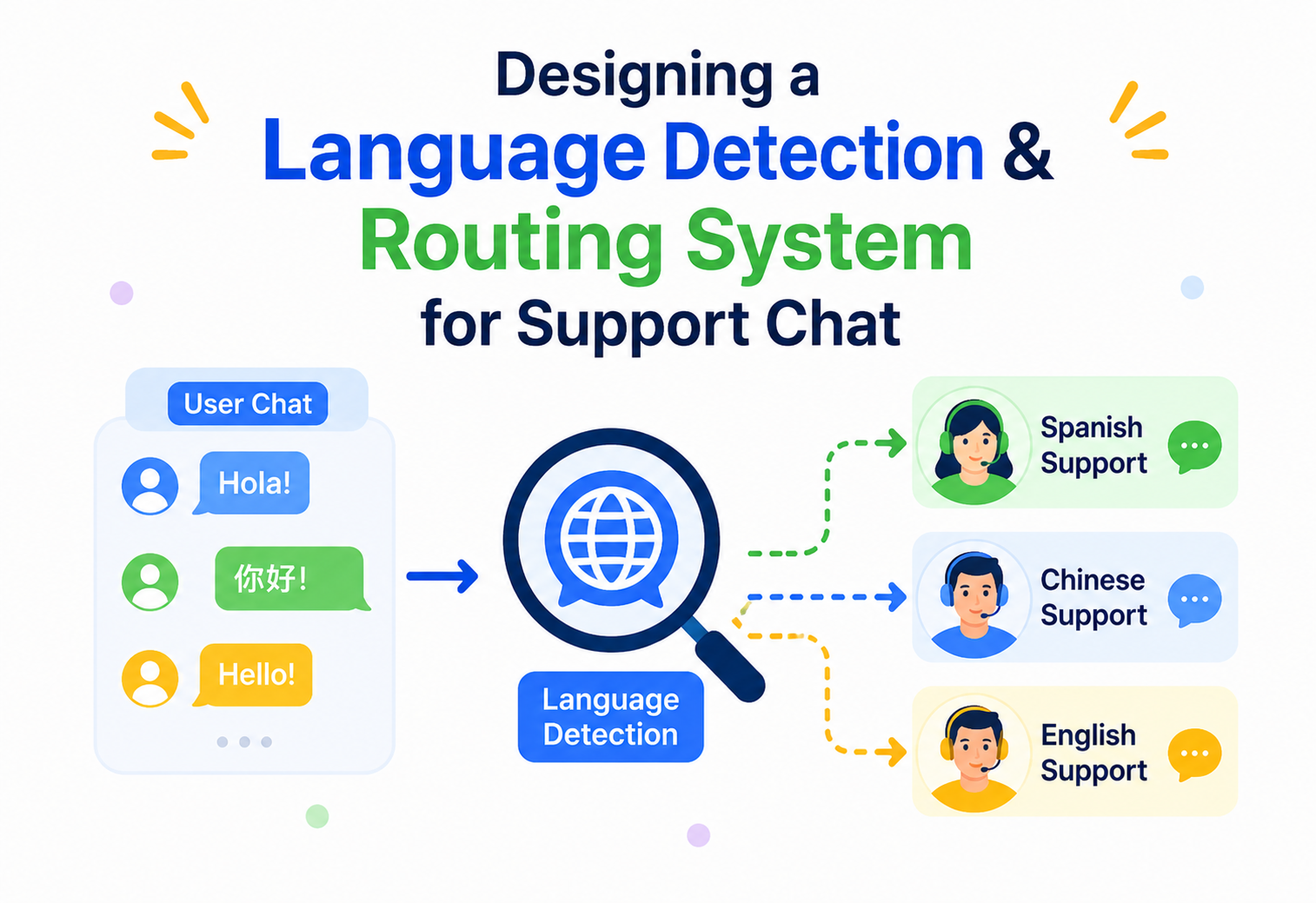
Designing a Language Detection & Routing System for Support Chat
A complete, ground-up walkthrough of how modern support platforms — Zendesk, Intercom, Salesforce Service Cloud, WhatsApp Business, and every large in-house chat — detect the customer’s language within a few characters and route the conversation to the right agent, bot or LLM in the right locale, at global scale.
The Big Idea, in One Breath
A language detection & routing system for support chat is the quiet component that reads the very first line a customer types — often just a few words — and decides, in milliseconds, what language they are writing in, what dialect and locale they need, and who should answer them: a language-specific bot, an LLM prompted in that language, a queue of native-speaker agents, or a fallback with machine translation.
Underneath the “magic” is a coordinated stack: a fast text pre-processor, a robust language identifier, a policy layer that turns the language into a routing target, an integration with the agent workforce, and a feedback loop that learns from mis-routings. Done well, the customer never notices it happened. Done badly, half your inbound chat lands in the wrong queue.
Picture a large hotel lobby. Every guest who walks in speaks a different language. A single, unflappable concierge listens to their first sentence, understands which language they are speaking, waves them to the correctly staffed desk, and calls a translator over the intercom for anything exotic. The concierge never treats a patient, prepares a bill or serves a meal — she just makes sure the right expert is talking to the right guest, right away. That concierge is your language detection & routing system.
per message
supported
on first message
What Language Detection & Routing Really Is
Before we design one, let us pin down what the system actually does — and what it does not. It is deceptively easy to describe (“figure out the language, pick a queue”) and full of subtle traps once you look closely.
2.1 A Working Definition
A language detection & routing system for support chat is a real-time service that, given an incoming customer message (with optional session context — profile, locale hint, past conversations), returns:
- a language decision: BCP-47 tag such as
en-GB,pt-BR,zh-Hant-HK, plus a confidence score, - a routing target: agent skill queue, bot flow, LLM prompt template, or translation-augmented fallback,
- an evidence bundle: the top candidates, features used and the policy that fired, and
- a versioned decision so every routing outcome can be audited and replayed.
2.2 Where You Encounter It
Web & App Support
The first “Hello, how can I help?” happens in the customer’s language; the widget calls this service before the message is dropped into a queue.
WhatsApp / Messenger / SMS
Business messaging APIs receive one-off messages from any locale. Detection has to be right on message #1.
Ticketing Inbox
Detection runs on the first email body (excluding signatures / quoted threads) to route into the correct language queue.
Voice / IVR
Speech-to-text feeds the same detector, which then chooses a call queue and TTS voice for the reply.
2.3 What It Is Not
Language detection & routing is not translation, and it is not intent classification. It sits before both: translation happens only if we intentionally fall back to it, and intent classification runs later, in the target language, once we know what that is. It is also not skill-based routing on its own — it feeds the routing engine but does not replace it.
Think of it as the first mile of the support experience. Everything downstream — bot flows, LLM prompts, agent picking, canned responses, sentiment analysis — assumes it knows the language. If the first mile is wrong, every downstream step is wrong too.
Why It Matters So Much
A support platform that routes a French customer to a Portuguese-only bot has already lost the interaction, no matter how good the rest of the stack is. Language is the very first predicate on which every other decision rests, and even small error rates translate into large operational costs at global scale.
3.1 The Business & Human Problem
- Customer satisfaction collapses when a distressed user is asked to switch language just to be understood. Even a five-second translation stall is felt.
- Handle time doubles on mis-routed cases: the wrong agent asks the customer to repeat themselves, then transfers the case, then the receiving agent starts over.
- Contact-centre cost is dominated by human minutes. Even 3% mis-routing across millions of chats compounds into serious over-staffing.
- Regulatory obligations in some regions (e.g. official languages in Canada, Belgium, India, Switzerland) require documented, consistent language handling.
- Brand trust in local markets is fragile: telling a Vietnamese customer “Sorry, we only speak English” leaks straight to social media.
3.2 What Makes It Uniquely Hard
Harder than long-form language ID
- You must decide from very short text — often 2–5 words on message #1.
- Code-switching (Hindi + English, Spanglish, Arabic + French) is the norm, not the exception.
- Emojis, product SKUs, order numbers and URLs pollute the signal.
Harder than pure detection
- You do not just need the language — you need the locale (pt-BR vs pt-PT, es-MX vs es-ES).
- The right queue depends on time-of-day and staffing availability, not just language.
- Every wrong answer is not just a metric — it is a real human waiting in the wrong queue.
Language routing is where cheap automation either delights or infuriates. Get it right and a customer feels the platform “knows me.” Get it wrong and every downstream investment — bots, LLMs, agent training — delivers less than it should. The system exists to make the correct language the default, silently, before anyone has to ask.
The Building Blocks
A production language detection & routing system is a small constellation of focused components. Each has one narrow job; the value is in how they compose.
Chat Gateway
Receives inbound messages from web widget, mobile app, WhatsApp, Messenger, SMS, email. Normalises them into a common message envelope.
Text Pre-Processor
Strips emojis, URLs, phone numbers, order IDs, product SKUs, code blocks and quoted threads. What remains is the “linguistic core” used for detection.
Language Identifier
The core model that turns text into (language, script, confidence). Usually fastText, CLD3, a small transformer, or a hybrid ensemble.
Locale Resolver
Refines language → locale using signals: profile locale, IP geo, phone country code, past ticket language, product surface used.
Session Store
Holds per-conversation state: sticky language, prior confidences, corrections, agent overrides. Redis / DynamoDB, TTL-bound.
Policy Engine
Deterministic rules: legal locale overrides, VIP steering, business-hour language coverage, minimum confidence to route without translation.
Router
Turns (locale, policy) into a target: agent skill queue, bot flow, LLM prompt template, or MT-augmented fallback queue.
MT Fallback
Machine translation service used when no native-speaker capacity is available. Both directions, with disclosure to customer and agent.
Feedback Loop
Captures corrections: agent-clicked-language, transfer events, customer opt-in language switch. Feeds retraining and rule tuning.
Policy Registry
Versioned store of rules, thresholds, and model bindings. Every routing decision records the exact policy version that produced it.
Observability
Metrics (per-language precision/recall, routing accuracy, MT usage rate), traces per decision, dashboards per market.
Admin & Ops Console
Where operations managers see live routing, override queues, tune thresholds and mark corrections without a deploy.
Detection Approaches & Signals
The identifier is the heart of the system, and the honest truth is: no single technique is enough. Real deployments combine text-based detectors with structured metadata, and treat “language” as a joint distribution over language, script and locale.
5.1 The Four Signal Families
Text Signals
Character n-grams, byte pairs, script (Latin / Cyrillic / Arabic / CJK), punctuation, diacritics, common function words.
Profile Signals
Account language preference, mobile app locale, browser Accept-Language, phone country code, last-used interface language.
Behavioural Signals
Language of past tickets, click-through on localised help articles, opted-in newsletter language.
Channel & Context Signals
Store or storefront domain (.de, .jp), payment currency, timezone offset, WhatsApp phone country, business unit.
5.2 Detection Techniques, Compared
| Technique | Strengths | Where it fits |
|---|---|---|
| Character n-gram classifier (fastText, CLD3) | Fast, small, 100+ languages, tiny footprint | The default first-pass detector |
| Script detector (Unicode block ratios) | Robust on short text; near-zero cost | Disambiguating script-family languages (zh vs ja, hi vs ur) |
| Small transformer / distilled encoder | Handles code-switching and short text better | Second-pass model for ambiguous cases |
| Large LLM | Great on messy, code-switched or transliterated text | Escalation on low-confidence outputs only |
| Rule / lexicon | Deterministic, auditable, easy for ops to tune | Regulated markets, product-specific vocabulary |
5.3 Handling Short Text & Code-Switching
“Hi” alone is unroutable — the detector should abstain. “Hola, my order” is code-switched Spanish/English. Practical mitigations:
- Require a minimum character budget (say 12 characters after cleaning) before trusting the model; below that, rely on profile/geo signals.
- Track the dominant language across the last N messages once the conversation starts; do not re-decide every keystroke.
- Output a secondary language alongside the primary one for known code-switching pairs (en/es, en/hi, fr/ar).
{
  "text_len_clean": 42,
  "primary": { "lang": "pt", "script": "Latn", "conf": 0.94 },
  "secondary": { "lang": "en", "conf": 0.11 },
  "candidates": [ { "lang": "pt", "conf": 0.94 }, { "lang": "es", "conf": 0.03 } ],
  "signals": {
    "profile_lang": "pt-BR",
    "geo_country" : "BR",
    "phone_cc"    : "55",
    "channel"     : "whatsapp"
  },
  "decision": { "locale": "pt-BR", "confidence": 0.97, "policy_version": "lp-v7" }
}Two rules of thumb: never let a single feature exceed 10 ms at P99, and always output an abstain option. An honest “I don’t know” that falls back to profile/geo signals is worth ten confident wrong answers.
Routing Patterns: Rules, ML, and Hybrid
Detecting the language is only half the job. Turning that into a routing target — agent queue, bot flow, LLM prompt, translated queue — is where policy, staffing and product converge. Almost every real system uses a hybrid of deterministic rules and adaptive scoring.
6.1 Deterministic Rules
The rule engine (Drools, Open Policy Agent, or a bespoke DSL) evaluates policies like:
- “Any zh-Hant customer with ‘VIP’ tier goes straight to the Hong Kong senior desk between 08:00–20:00 HKT.”
- “For any legal or complaint intent, force the customer’s registered legal language regardless of chat language.”
- “If confidence < 0.7 and no profile locale, ask a one-tap language picker instead of guessing.”
Rules are fast, auditable, easily tuned by non-engineers — and essential for regulated markets.
6.2 ML-Assisted Scoring
A learned scorer (gradient-boosted trees, small transformer, or an LLM) refines the detection score with contextual features: message intent hints, historical routing outcomes, current agent-availability by language. Its output is the expected routing quality of each candidate target.
6.3 The Hybrid That Actually Ships
msg = preprocess(inbound)
lang = detector.predict(msg, session_signals)

// 1. hard policy always wins
if policy.forceLocale(msg, lang, session):
    return route(target=policy.forcedQueue, reason=policy.reason)

// 2. abstain path
if lang.confidence < policy.minRouteConf:
    return askOneTapPicker(topK=lang.candidates)

// 3. score candidate targets
targets = router.candidateTargets(lang.locale, session)
scores  = ml_scorer.rank(targets, features(msg, session))

best = scores.top1()
if best.confidence < policy.minTargetConf:
    return route(target=policy.mtFallbackQueue, reason="low_target_conf")

return route(target=best.target,
             reason=best.explain,
policy_version=policy.version)Rules encode what you are legally or contractually required to do. ML encodes what you have learned about the marketplace of agents, bots and MT quality. Never let the ML silently overrule a hard rule — and never let a rule silently overrule the ML without leaving a reason string.
Streaming vs Batch, Monolith vs Distributed
Two architectural axes must be picked up front. They are orthogonal, and both have long tails once shipped.
7.1 When Does Detection Fire?
- Per-message (streaming) — every inbound message is re-scored; conversation-level state decides whether to re-route.
- First-message-only — detect once on message #1, then trust session stickiness. Cheaper and safer against flicker.
- Sticky-with-drift — detect on message #1, re-detect only if evidence has drifted materially (script change, long-run confidence swing).
Serious systems ship the third: sticky, but observant.
7.2 Streaming, Micro-Batch or Batch?
Streaming (event-at-a-time)
- Best UX — routing decisions land within milliseconds of the message.
- Required for live chat, WhatsApp, voice.
- Needs careful back-pressure, exactly-once semantics for corrections.
Micro-batch / Batch
- Cheaper for email or async ticket queues.
- Good for nightly retraining and per-market accuracy reports.
- Never good enough for interactive channels.
7.3 Deployment Shape
| Shape | When it fits | Trade-offs |
|---|---|---|
| Single detection service | < 500 chats/s, small language footprint | Fast to build; caps at a single fleet |
| Detector + router as separate services | Multiple product lines sharing a detector | Cleaner ownership; adds one hop |
| Model server + orchestrator (Triton, TorchServe) | Large model footprint / GPU inference | Great throughput; needs careful traffic shaping |
| Regional shards | Global scale, data-residency needs | Data locality wins; more routing complexity |
7.4 Sharding Strategy
The natural unit of scale is region — language distributions differ dramatically per region, and data-residency rules often demand it. Sessions are partitioned by conversationId so that a single conversation always hits the same worker and its stickiness stays consistent.

A viral product incident in one market can 20× a single language’s traffic in minutes. Auto-scale on per-language queue depth, not global CPU, and pre-warm models for peak business hours per region.
End-to-End Flow: One Message’s Life
Enough abstraction. Let us follow a single message — a Brazilian customer opening WhatsApp support at 21:00 local time — from arrival to the moment a Portuguese-speaking agent says “Olá.”
Message lands at the gateway
Meta’s WhatsApp webhook posts "Olá, meu pedido nao chegou ainda" to the chat gateway. The envelope carries phone number, WA business account and message id.
Session lookup
Gateway checks the session store: this phone number has no active conversation, but past tickets show pt-BR. Signals attached to the envelope.
Pre-processing
Text is cleaned of accents-preserving normalisation, order IDs and emojis are stripped; 34 characters remain — enough to trust the detector.
Detection
fastText returns pt: 0.94, es: 0.03, gl: 0.02. Script detector confirms Latin. Locale resolver combines with phone +55, geo BR, past ticket pt-BR → final locale pt-BR, confidence 0.97.
Policy check
Business hours in São Paulo: yes. Portuguese senior desk staffed: yes. No forced legal locale. Policy fires: route to pt-BR/whatsapp/L1.
Router picks target
Router asks the staffing service “is a pt-BR L1 agent available in < 30 s?” It returns yes. Target = queue:pt-BR/L1.
Session & sticky state stored
Session store gets { locale: pt-BR, stickiness: high, confidence: 0.97, policy: lp-v7 }. Future messages in this conversation skip full detection unless drift is observed.
Feedback captured
Agent answers in Portuguese without triggering a language transfer — a positive label lands in the training pipeline. Handle-time and satisfaction close the loop.
Quality Attributes: The “-ilities”
Every serious system design is judged against a handful of non-functional properties. For language detection & routing, the mix is unusual: raw accuracy matters, but calibrated confidence and honest abstention matter almost as much.
Latency
< 30 ms P95 for detection; < 60 ms P95 for the full detect + route decision. Non-negotiable, because it blocks the first agent-facing keystroke.
Throughput
Sized for global peak; tens of thousands of chats/second across the top markets, with headroom for viral incidents.
Accuracy per Language
Precision and recall tracked per language, not just globally. Low-resource languages are treated as first-class targets, not error tail.
Calibrated Confidence
When the model says “80%,” the actual accuracy at that bucket should be near 80%. Calibrated abstention thresholds depend on it.
Explainability
Every routing decision carries top-K candidates, signals used and the policy version. Ops can audit any decision in seconds.
Reliability
Graceful degradation: if the detector is unhealthy, fall back to profile/geo signals and route with a “degraded” flag rather than failing the message.
Scalability
Sharded by conversation and by region. Add capacity to hot languages without redeploying the whole detector.
Human Trust
Agents and ops managers must feel the system is on their side. Their corrections must visibly reshape behaviour within a release cycle.
9.1 The Latency Budget
| Hop | Target | How |
|---|---|---|
| Gateway parse + auth | < 3 ms | Warmed workers, cached JWKS |
| Session lookup | < 3 ms | Redis in same VPC, in-memory replica |
| Pre-processing | < 3 ms | Compiled regex / SIMD normaliser |
| Detection | < 15 ms | fastText / CLD3 in-process; big models on warm servers |
| Locale + policy | < 5 ms | Compiled ruleset in memory |
| Router decision | < 10 ms | Cached agent-availability snapshot |
| Total end-to-end | ~40–60 ms P95 | Well under human perception on live chat |
Common Pitfalls & Trade-offs
Almost every language detection & routing system, in production, gets bitten by the same handful of subtle bugs. Knowing them turns quarters of firefighting into a paragraph in a design review.
10.1 Ten Traps We’ve All Fallen Into
Detecting on raw text
Emojis, order IDs and URLs poison the signal. Always pre-process, and never route on fewer than the minimum clean character count.
Ignoring the script
The model swears the text is “Vietnamese” but the script is Cyrillic. Trust the Unicode block ratio first, the classifier second.
Re-detecting every message
Flips the queue on the customer mid-conversation. Sticky by default; re-detect only on drift evidence.
No abstain path
The system is forced to guess on 3 characters. Provide a one-tap language picker as a first-class UI fallback.
Locale collapsed to language
Portuguese customers routed to European agents; Mexican customers routed to Castilian bots. Never lose the locale once you have it.
Training on labelled data only
The corrections dataset is skewed to what agents notice. Sample unlabelled messages regularly for gold-standard annotation.
Uncalibrated confidences
Model says 0.9 on a language it has almost never seen. Calibrate per language using isotonic or Platt scaling.
Routing without checking availability
Perfect detection, empty queue at 03:00 local. The router must always ask the staffing service before committing.
Silent MT fallback
Customer sees translated Portuguese sent by a French agent, no disclosure — then reads the machine mistakes. Always disclose MT to both sides.
No shadow mode for new models
Ship v2 to Brazil, break an entire market for a day. Every new model runs in shadow with online metrics before enforcement.
10.2 The Trade-offs You Cannot Avoid
Precision vs Coverage
- High confidence bar → fewer routing errors, more asks for a picker.
- Low confidence bar → more auto-routes, more mis-routings.
- Per-language threshold, tuned on real routing accuracy, always wins.
Native Agent vs MT Fallback
- Native-speaker path is best UX but expensive in low-volume languages.
- MT-augmented path scales cheaply but needs disclosure and careful QA.
- Publish a per-language service policy so ops know exactly which languages get which path.
Context
We must decide when to trust an automatic language decision versus asking the customer to pick.
Decision
Route automatically only when detector confidence ≥ per-language calibrated threshold and at least two independent signals (text + profile/geo) agree. Otherwise, present a one-tap language picker with the top 3 candidates.
Consequences
Slightly more picker impressions on message #1 for low-resource languages, dramatically fewer mis-routings globally, and honest expectations set with the customer.
How Language Routing Evolves
Language routing has been on a decade-long journey from “pick your language from a dropdown” to “we already knew before you typed the second word.” Understanding the waves helps place your own platform.
Wave 1 — Manual Selection (pre-2013)
Customer picks their language from a dropdown before the widget opens. High-friction, high-abandonment.
Wave 2 — Profile/Geo Guessing (2013–2016)
Systems infer language from browser Accept-Language, IP geo and account settings. Right most of the time; wrong for travellers and shared devices.
Wave 3 — Text-Based Detection (2016–2019)
fastText, CLD3 and small transformers land in production. First real per-message language inference.
Wave 4 — Locale-Aware & Marketplace-Aware (2019–2023)
Systems learn locales, staffing constraints, code-switching patterns and per-market policies. MT fallbacks become mainstream.
Wave 5 — LLM-Native Routing (2024+)
Large language models handle detection, code-switching and low-resource languages in one shot, generate a routing rationale in natural language, and pair with an LLM agent that answers in the correct locale immediately.
11.1 Adjacent Systems That Plug In
Skill-Based Routing
Consumes the language decision as a first-class skill and combines it with product, tier and topic skills.
Bot Orchestrator
Selects the correct dialogue tree or LLM prompt template based on the resolved locale.
Machine Translation
Bi-directional MT for the fallback queue with disclosure to both customer and agent.
Market Analytics
Per-market volume, deflection, CSAT and MT-usage dashboards drive staffing and language coverage decisions.
Key Takeaways
Language detection & routing is a quiet piece of infrastructure whose quality shapes every downstream metric that matters. Nobody says “wow, what great language routing” — but everyone notices the moment it is wrong.

Key Takeaways
- Language routing is the first mile of support. Everything downstream — bots, LLMs, agents, MT, analytics — assumes it knows the language.
- Signals matter more than models. Text + profile + geo + phone + past ticket beats any single detector in isolation.
- Always resolve to a locale, not just a language. Losing
pt-BRvspt-PTis a routing bug in disguise. - Ship a heuristic + geo baseline first. It is your floor, your fallback and your reference for every learned model.
- Emit an abstain option. A one-tap language picker for low-confidence cases beats a confident wrong answer every time.
- Be sticky by default, observant on drift. Do not re-decide the language on every message, but do watch for real evidence that you were wrong.
- Region is the natural shard. Model, feature store and inference pool per region; global façade above.
- Same source of truth for router and analytics. One decision object, one lineage, policy transforms on top.
- Close the feedback loop before shipping v1 of the ML model. Corrections are the compound-interest asset of the whole system.
- Design for graceful degradation. Any sub-component down ⇒ fall back to safer signals and flag the response “degraded.”
A great language routing system is one the customer never has to think about. They open a chat in their native language, get answered in their native language, and never suspect that a hundred milliseconds ago a small, quiet service made the whole thing possible. That silence is the sound of the system doing its job.