Polling vs. Webhooks — How Systems Really Talk to Each Other
A ground-up guide to the two fundamental strategies for keeping systems in sync — how they work internally, when to use each, and how the biggest companies in the world combine them at scale.
Introduction & History
Imagine you just ordered a pizza. There are two ways to find out when it’s ready. You could call the pizza shop every two minutes and ask, “is it ready yet?” — that’s polling. Or you could hand over your phone number, sit back, and let them call you the moment it’s out of the oven — that’s a webhook. Both approaches get you your pizza. But one keeps you busy dialing, and the other lets you do something else with your time.
This simple idea — “who checks, and when?” — is one of the oldest and most fundamental questions in software integration. Any time one system (call it System A) needs to know about something that happened in another system (System B), someone has to decide: does A keep asking B, or does B tell A when something happens?
Polling is by far the older of the two ideas. In the earliest computer networks, machines simply didn’t have a reliable way to “call” each other unprompted — communication was often a scheduled, one-directional pull. Batch jobs in the 1960s and 70s would run on a timer (“every night at 2 AM, check if there’s new data to process”) because that was the only practical way to coordinate independent machines.
Webhooks are a much newer idea, made possible by the growth of the modern web. The term “webhook” was coined around 2007 by Jeff Lindsay, combining “web” with “hook” (a programming term for a callback that fires when something happens). As HTTP became the universal language of the internet and every server could act as both a client and a receiver, it became practical for System B to make an outbound HTTP call directly into System A whenever an event occurred — no polling required.
Scheduled Batch Jobs
Mainframes and early networked systems synchronize data using nightly or hourly batch pulls — the ancestor of polling.
Client-Server & HTTP Polling
Web browsers begin regularly re-requesting pages or using techniques like “meta refresh” to check for updates — early web-native polling.
AJAX & Long Polling
Asynchronous JavaScript lets pages poll servers in the background without a full page reload, paving the way for near-real-time web apps.
The Term “Webhook” Is Coined
Jeff Lindsay popularizes the idea of user-defined HTTP callbacks, letting any service notify another the instant something happens.
Webhooks Go Mainstream
GitHub, Stripe, Slack, Twilio, and PayPal adopt webhooks as the standard way to notify third-party integrations of events.
Hybrid & Event-Driven Architectures
Modern systems blend webhooks, polling, and message queues (Kafka, SQS) into resilient, event-driven pipelines.
Why does this history matter for someone writing code today? Because both patterns are still with us, and neither has “won.” Every time you build an integration between two systems — your app and a payment provider, your backend and a third-party CRM, two microservices inside your own company — you will run into this exact fork in the road: should the consumer keep checking, or should the producer notify? Understanding where each idea came from helps explain why they look the way they do today, and why certain trade-offs, like polling’s simplicity or webhooks’ need for a public endpoint, are baked into their very design rather than being accidental limitations.
It’s also worth noting that this isn’t purely a technical decision — it has real business consequences. A stock trading platform that finds out about a price change thirty seconds late because of slow polling could cost its users money. A nightly backup job that checks a file server once every 24 hours doesn’t need webhooks at all, and building them would be pure over-engineering. Learning to match the pattern to the actual need, rather than reaching for whichever technique is trendier, is one of the most valuable integration skills a developer can build — and it’s a skill that transfers across every programming language and cloud platform you’ll ever work with.
The Problem & Motivation
Here’s the core problem both patterns try to solve: System A needs fresh information from System B, but A and B are separate programs, often running on separate machines, that don’t share memory. The only way they can talk is by sending messages back and forth over a network.
Now, System B might update its data at any moment — a payment might succeed, a file might finish uploading, a user might place an order. System A wants to know “as soon as possible” without wasting resources. This creates a genuine tension:
- If A asks too often, it wastes network calls, CPU, and money — most of the time, the answer is “nothing changed.”
- If A asks too rarely, it finds out about important events late, which can mean unhappy customers, missed deadlines, or stale data.
- If B tries to push updates to A, B needs a way to reach A directly, which requires A to expose a public, reachable address — something that’s not always possible or safe.
This tension is why neither pattern “wins” outright. The right choice depends on how often things change, how urgently you need to know, whether the receiving system can accept inbound connections, and how much reliability and infrastructure you’re willing to build and maintain.
2.1 A concrete motivating example
Say you’re building a small online store, and you use a third-party shipping company to fulfill orders. Once you hand off an order, the shipping company needs to tell you two things eventually: when the package leaves the warehouse, and when it’s delivered. You have two options for finding this out.
Option 1 — Polling: Every 15 minutes, your server calls the shipping company’s API and asks, “what’s the status of order #4521?” Most of the time, nothing has changed, so you’re spending API calls (and possibly money, since some providers charge per API call) on empty answers. But your integration is dead simple: a timer and an HTTP request.
Option 2 — Webhook: You give the shipping company a URL, and the moment your package’s status flips to “shipped” or “delivered,” they call you directly. You find out in seconds instead of minutes, and you never waste a single request. But now you need to run a publicly accessible web server, secure it against forged requests, and handle the case where your server happens to be down for maintenance at the exact moment they try to notify you.
Neither option is “wrong.” A tiny hobby store processing five orders a day might be perfectly happy polling once an hour. A high-volume retailer processing thousands of orders per minute, where customers expect live tracking updates, essentially requires webhooks to stay competitive. The right answer always depends on the shape of your traffic and how much that immediacy is actually worth to your users.
2.2 Why not just “always push”?
A natural question is: if pushing is faster and more efficient, why would anyone ever choose to poll? The answer is that pushing has a hidden requirement — the receiver must be reachable. Many real systems can’t guarantee that:
- Mobile apps and desktop clients often sit behind carrier-grade NATs or corporate firewalls and simply cannot accept unsolicited inbound connections.
- Some consumers are themselves ephemeral — a script that runs once a day in a scheduled job has no “server” listening at all.
- Security-conscious environments (banks, hospitals, government systems) often deliberately block all inbound traffic as a matter of policy.
- Small teams may not want the operational burden of running and securing a public-facing endpoint 24/7.
In all of these cases, polling isn’t a “worse” choice — it’s often the only workable choice, and understanding this is key to not treating webhooks as a silver bullet.
Core Concepts
3.1 What is polling?
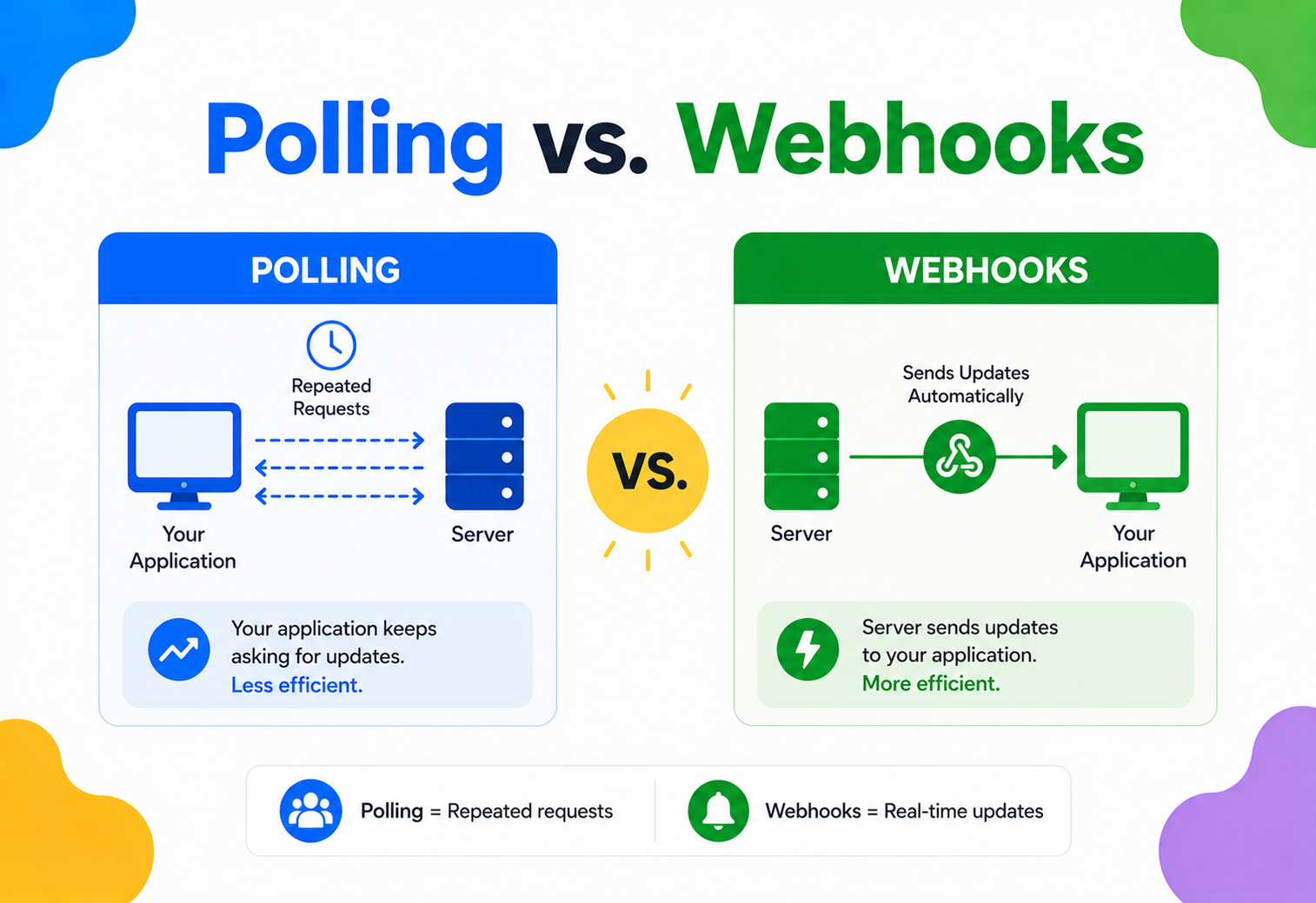
Polling means System A (the client or consumer) repeatedly sends requests to System B (the server or producer) asking, “Do you have anything new for me?” B responds every time, even if the answer is “no, nothing changed.” The client controls the timing — it decides how often to ask, usually on a fixed interval (every 5 seconds, every minute, every hour).
3.2 What is a webhook?
A webhook flips the direction of communication. Instead of A repeatedly asking B, A registers a URL with B in advance (this is often called subscribing or registering a callback). When something noteworthy happens inside B, B itself sends an HTTP request — usually a POST — directly to that URL, carrying the event data. A doesn’t ask; A simply waits and reacts when notified. This is why webhooks are sometimes called “reverse APIs” or “HTTP callbacks.”
3.3 Push vs. pull — the key distinction
The entire difference between polling and webhooks boils down to one simple idea:
| Model | Who initiates each check? | Direction of the “ask” |
|---|---|---|
| Polling | The consumer (System A) | Pull — A reaches into B |
| Webhook | The producer (System B) | Push — B reaches into A |
3.4 Related concepts you’ll encounter
Long Polling
A hybrid where the client asks a question, but the server holds the connection open and only responds once new data is actually available (or a timeout hits).
Server-Sent Events (SSE)
A one-way, persistent HTTP connection where the server can keep pushing text-based updates to the browser over time.
WebSockets
A full-duplex, persistent connection allowing both sides to send messages at any time — used for chat apps, live dashboards, and games.
Message Queues
Systems like Kafka, RabbitMQ, or SQS that decouple producers and consumers by storing events in a durable buffer between them.
Polling = “Are we there yet? Are we there yet?” asked over and over. Webhook = someone tapping you on the shoulder to say “we’re there!” the moment it happens.
3.5 Where each related concept fits
It’s easy to lump “real-time” technologies together, but they actually solve slightly different problems, and it helps to see them on a single spectrum from “pure pull” to “pure push”:
| Technique | Who initiates? | Connection style | Best for |
|---|---|---|---|
| Simple Polling | Client | New connection per check | Infrequent changes, simple infra |
| Long Polling | Client (held open by server) | Long-lived, one request at a time | Near real-time without a public receiver |
| Server-Sent Events | Server (after initial client connect) | Persistent, one-way stream | Live feeds, dashboards, notifications to a browser |
| WebSockets | Either side, any time | Persistent, two-way | Chat, multiplayer games, collaborative editing |
| Webhooks | Server (producer) | New request per event | Server-to-server event notification |
| Message Queues | Producer publishes; consumer subscribes | Durable, asynchronous buffer | Decoupled, resilient internal microservice communication |
Notice that webhooks and message queues are conceptually cousins — both are push-based — but webhooks are typically used between separate companies or systems over plain HTTP, while message queues are typically used within a single company’s infrastructure, offering stronger delivery guarantees, ordering, and replay capability at the cost of needing shared infrastructure (like a running Kafka cluster) rather than just an HTTP endpoint.
Architecture & Components
Let’s break down the moving parts on each side.
4.1 Polling architecture
- Poller / Scheduler: A component (a cron job, a background thread, a scheduled task) that fires requests at fixed intervals.
- HTTP Client: Makes the actual request to System B’s API endpoint.
- State Store (Checkpoint): Keeps track of “what did I already see?” — usually a timestamp, an ID, or a cursor — so the client only processes new data.
- Target API (System B): Exposes a read endpoint, e.g.
GET /orders?updatedSince=....
4.2 Webhook architecture
- Event Source: The part of System B’s code that detects “something happened” (e.g. a database trigger, an application event).
- Subscription Registry: A table inside B that stores which URLs (System A’s endpoints) want to be notified about which event types.
- Delivery Worker / Dispatcher: The component in B responsible for actually sending the outbound HTTP POST, including retries on failure.
- Webhook Receiver (Endpoint): A public HTTP endpoint hosted by System A that accepts incoming POST requests from B.
- Signature Verifier: Code on A’s side that checks the request really came from B (more on this in the Security section).
Notice the structural difference: polling needs almost nothing on System A’s side except a scheduler and a memory of “what I last saw.” Webhooks require System A to run a publicly reachable web server, and require System B to build and maintain a whole delivery-and-retry subsystem.
4.3 The subscription registry in detail
The subscription registry deserves a closer look, because it’s the piece that makes webhooks flexible. Rather than hard-coding “always call this one URL,” most production webhook systems let each consumer register for exactly the event types they care about. A typical subscription record looks something like this:
{
  "id": "sub_8f21ac",
  "url": "https://a.example.com/hooks/orders",
  "events": ["order.shipped", "order.delivered", "order.cancelled"],
  "secret": "whsec_5f9a...",
  "active": true,
  "createdAt": "2026-06-01T09:12:00Z"
}
When an event happens inside System B, the event engine doesn’t send it to every URL it has on file — it looks through the registry, filters for subscriptions whose events list contains the matching type, and only delivers to those. This filtering step is what lets one producer serve thousands of different consumers, each interested in a different slice of activity, without any of them needing to filter out irrelevant noise on their own end.
4.4 Where state lives
A subtle but important architectural difference is where “memory” of progress lives. In polling, the consumer owns the state — it remembers the checkpoint. If the consumer’s database is wiped, it can usually recover simply by resetting the checkpoint and re-polling from an earlier point in time. In webhooks, the producer owns the delivery state — it tracks which events have been sent, retried, or failed for each subscriber. If the producer loses that state, recovering delivery history can be much harder, which is exactly why large webhook providers invest heavily in durable delivery logs.
Internal Working
5.1 How polling works, step by step
1. Scheduler wakes up
A scheduler wakes up on a timer (e.g. every 30 seconds).
2. Request with checkpoint
The client sends a request to B’s API, often including a “checkpoint” like
?since=2026-07-19T10:00:00Zor?cursor=abc123.3. Server queries for changes
B’s server queries its database for anything new since that checkpoint.
4. Response — new data or empty
B responds — either with new records, or an empty list if nothing changed.
5. Client processes & advances
A processes any new records, then updates its checkpoint to the latest timestamp/ID it saw.
6. Sleep until next tick
A goes back to sleep until the next tick.
5.2 How webhooks work, step by step
1. Consumer registers URL
A registers a callback URL with B ahead of time, typically through an API call or a dashboard setting, e.g.
POST /webhooks {"url": "https://a.example.com/hook", "events": ["order.completed"]}.2. Producer stores subscription
B stores this subscription in its registry.
3. Event happens inside B
Later, an event happens inside B (e.g. an order status flips to “completed”).
4. Look up subscribers
B’s event system looks up all subscribers interested in that event type.
5. Producer sends POST
B’s delivery worker builds a payload (usually JSON) describing the event and sends an HTTP POST to A’s registered URL.
6. Consumer acknowledges
A’s receiver endpoint accepts the request, verifies it’s authentic, and responds quickly with a
200 OKto acknowledge receipt.7. Retry on failure
If A doesn’t respond in time or returns an error, B’s delivery worker retries — often with exponential backoff — for a limited number of attempts.
A webhook receiver must respond fast (typically under a few seconds) just to acknowledge “I got it.” Any slow processing (sending emails, updating multiple databases) should happen afterward, in a background job — not while the sender is waiting for your response.
5.3 A minimal Java example: polling client
import java.net.URI;
import java.net.http.HttpClient;
import java.net.http.HttpRequest;
import java.net.http.HttpResponse;
import java.util.concurrent.Executors;
import java.util.concurrent.ScheduledExecutorService;
import java.util.concurrent.TimeUnit;

public class OrderPoller {

    private static String lastCheckpoint = "2026-07-19T00:00:00Z";
    private static final HttpClient client = HttpClient.newHttpClient();

    public static void main(String[] args) {
        ScheduledExecutorService scheduler = Executors.newScheduledThreadPool(1);
        // Poll every 30 seconds
        scheduler.scheduleAtFixedRate(OrderPoller::pollForUpdates, 0, 30, TimeUnit.SECONDS);
    }

    private static void pollForUpdates() {
        try {
            HttpRequest request = HttpRequest.newBuilder()
                .uri(URI.create("https://api.example.com/orders?since=" + lastCheckpoint))
                .GET()
                .build();

            HttpResponse<String> response = client.send(request, HttpResponse.BodyHandlers.ofString());

            if (response.statusCode() == 200) {
                // Parse response, process new orders, then advance the checkpoint
                System.out.println("Fetched updates: " + response.body());
                lastCheckpoint = java.time.Instant.now().toString();
            }
        } catch (Exception e) {
            System.err.println("Polling failed: " + e.getMessage());
        }
    }
}
5.4 A minimal Java example: webhook receiver (Spring Boot)
@RestController
@RequestMapping("/webhooks")
public class OrderWebhookController {

    @PostMapping("/orders")
    public ResponseEntity<String> receiveOrderEvent(
            @RequestBody String payload,
            @RequestHeader("X-Signature") String signature) {

        // 1. Verify the signature so we know it really came from System B
        if (!SignatureVerifier.isValid(payload, signature)) {
            return ResponseEntity.status(401).body("Invalid signature");
        }

        // 2. Acknowledge quickly, then hand off heavy work to a background queue
        eventQueue.enqueue(payload);

        return ResponseEntity.ok("Received");
    }
}
5.5 Understanding the checkpoint pattern
Look closely at the polling example above: the variable lastCheckpoint is doing a lot of quiet, important work. Without it, every poll would have to ask “give me everything,” which gets more expensive as the dataset grows, and would force the client to re-process records it has already seen. The checkpoint — sometimes called a cursor, watermark, or sync token — is what turns polling from “re-download everything every time” into “give me only what’s new.”
There are two common ways to represent a checkpoint:
- Timestamp-based: “Give me everything updated after 2026-07-19T10:00:00Z.” Simple, but can miss records if two updates share the exact same timestamp and one is skipped due to a rounding or timezone bug.
- Cursor/ID-based: “Give me everything after record ID 48213” or an opaque cursor token the server hands back. More robust against timestamp collisions, and is the approach most mature APIs (like Stripe’s list endpoints) actually use.
5.6 Understanding retry & backoff logic for webhooks
On the sending side, a production webhook dispatcher doesn’t just try once and give up. A typical retry schedule looks like this: attempt immediately, then retry after 1 minute, 5 minutes, 30 minutes, 2 hours, and finally 12 hours, before giving up and moving the event to a dead-letter queue for manual inspection. This is called exponential backoff because the wait time roughly doubles (or more) between each attempt, which avoids hammering a receiver that’s temporarily struggling while still giving it many chances to recover.
// A simplified exponential backoff delivery loop
public class WebhookDispatcher {
    private static final int[] BACKOFF_SECONDS = {0, 60, 300, 1800, 7200, 43200};

    public void deliver(WebhookEvent event, String targetUrl) {
        for (int attempt = 0; attempt < BACKOFF_SECONDS.length; attempt++) {
            try {
                Thread.sleep(BACKOFF_SECONDS[attempt] * 1000L);
                int statusCode = sendPost(targetUrl, event.toJson());
                if (statusCode >= 200 && statusCode < 300) {
                    markDelivered(event);
                    return; // success, stop retrying
                }
            } catch (Exception e) {
                logFailure(event, attempt, e);
            }
        }
        moveToDeadLetterQueue(event); // exhausted all retries
    }
}Data Flow & Lifecycle
It helps to trace a single piece of information — say, “Order #4521 just shipped” — through both models from start to finish.
6.1 Lifecycle under polling
Notice the delay: if the timer fires every 30 seconds and the order shipped 1 second after the last poll, A won’t find out for nearly 30 seconds. This gap is called polling latency, and on average it equals half your polling interval.
6.2 Lifecycle under webhooks
Here, the moment the order ships, B fires the webhook almost immediately — typically within milliseconds to a few seconds, depending on network and queueing delay. There’s no artificial waiting period baked into the design.
6.3 What happens when things go wrong mid-lifecycle
Real systems fail in the middle of these flows constantly, and it’s worth walking through what happens in each model:
Polling failure scenario: If A’s network call to B times out, A simply tries again on the next scheduled tick. Because A never advanced its checkpoint, nothing is lost — the same “new” data will simply show up again on the next successful poll. This is a big part of why polling is often described as “self-healing.”
Webhook failure scenario: If B’s POST to A fails (say A’s server was mid-deployment and briefly unreachable), B’s dispatcher marks the attempt as failed and schedules a retry per its backoff policy. If all retries are exhausted before A comes back, the event lands in a dead-letter queue, and unless someone notices and manually replays it, A never finds out that order #4521 shipped. This is precisely the gap that a reconciliation poll (discussed later in this guide) is designed to close.
Advantages, Disadvantages & Trade-offs
Polling — Strengths
- Simple to build; just an HTTP client and a timer
- Consumer doesn’t need a public endpoint or its own server
- Works behind firewalls and NATs (no inbound traffic needed)
- Easy to reason about — you control exactly when checks happen
- Naturally tolerant of the consumer being offline; it just checks when it comes back
Polling — Weaknesses
- Wasteful — most requests return “nothing new”
- Introduces latency (average delay = half the poll interval)
- Doesn’t scale well with many consumers hammering the same API
- Can hit rate limits on the producer’s API
- Trade-off between freshness and efficiency is hard to tune perfectly
Webhooks — Strengths
- Near real-time notification — low latency
- Efficient — no wasted “nothing changed” requests
- Scales well with many events, since work is event-driven not timer-driven
- Reduces load on the producer compared to many polling clients
Webhooks — Weaknesses
- Consumer must expose a public, reachable, secure endpoint
- Producer must build reliable delivery, retries, and dead-letter handling
- Harder to debug — failures happen asynchronously, “in the dark”
- Risk of missed events if the consumer’s endpoint was down when it fired
- Requires signature verification and other security work to avoid spoofing
7.1 A quick decision framework
When you’re staring at a real integration and need to pick one, these questions usually settle it fast:
| Question | Leans toward Polling | Leans toward Webhooks |
|---|---|---|
| How often does the data actually change? | Rarely (hourly/daily) | Frequently, unpredictably |
| How urgently do you need to know? | Minutes/hours is fine | Seconds matter |
| Can the consumer accept inbound HTTP? | No (firewalled, mobile, ephemeral) | Yes, has a public endpoint |
| How many consumers does the producer serve? | Few, or the producer’s API is cheap | Many — pushing avoids a “polling storm” |
| How much engineering effort can you invest? | Minimal — just a timer and HTTP client | More — retries, security, receiver uptime |
If your answers land mostly in one column, that’s your pattern. If they’re split, that’s a strong signal you want the hybrid approach: webhooks as the fast path, with a slow polling-based reconciliation job as a safety net — a pattern we’ll return to later in this guide.
Performance & Scalability
Performance characteristics diverge sharply between the two models as the system grows.
8.1 Polling at scale
Imagine 10,000 customers all polling your API every 10 seconds to check for updates. That’s 1,000 requests per second hitting your servers — even if nothing has changed for 99% of those customers. This is sometimes called the “polling storm” problem. As the number of consumers grows, load grows linearly even though useful information delivered doesn’t. Producers often respond by adding rate limits, caching layers, or moving high-traffic clients onto webhooks instead.
8.2 Webhooks at scale
Webhooks scale with the number of events, not the number of consumers checking in. If nothing happens, no traffic flows at all. But scaling the delivery side introduces its own challenges: if one event needs to be delivered to 50,000 subscriber URLs simultaneously (a “fan-out”), the producer needs a robust, horizontally-scalable delivery pipeline — often built on a message queue internally (e.g., an event lands in Kafka, and a pool of delivery workers drains it out to each subscriber).
8.3 Adaptive & smarter polling
Many production systems soften polling’s weaknesses with techniques like:
- Exponential backoff polling: Poll frequently right after activity is expected, then slow down if nothing changes.
- Conditional requests: Use HTTP headers like
ETagorIf-Modified-Sinceso the server can respond with a cheap304 Not Modifiedinstead of resending full data. - Long polling: The server holds the request open until data is ready (or a timeout), reducing wasted round trips while staying pull-based.
8.4 Batching in webhook delivery
At very high event volumes, even push-based systems can strain if every single micro-event fires its own HTTP request. A common optimization is batching: instead of sending a webhook for each of 500 events that happened in one second, the producer bundles them into a single payload containing an array of events and sends one request. This trades a small amount of latency (waiting to accumulate a batch) for a large reduction in connection overhead on both ends — a technique used by providers like Segment and analytics platforms that handle very high event throughput.
8.5 Capacity planning
When designing a polling client, capacity planning means estimating: (number of consumers) × (requests per minute) × (average response size), and making sure the producer’s infrastructure — and your own rate limit budget — can sustain it. When designing a webhook producer, capacity planning instead means estimating peak event throughput (e.g., “Black Friday could produce 50,000 order events per minute”) and ensuring the delivery worker pool, and the underlying queue feeding it, can absorb that burst without falling behind.
High Availability & Reliability
9.1 Reliability in polling
Polling is naturally self-healing. If the consumer crashes for an hour, it simply resumes polling from its last saved checkpoint when it comes back — no events are structurally “lost,” as long as the checkpoint and the producer’s data retention line up (the producer must still have the older records available to return).
9.2 Reliability in webhooks
Webhooks require deliberate engineering to be reliable, because a push-based system can easily lose an event if the receiver is unreachable at the exact moment of delivery. Production-grade webhook systems typically include:
- Retries with exponential backoff: If a POST fails or times out, try again after 1s, then 5s, then 30s, and so on.
- Dead-letter queues: After exhausting retries, park the failed event somewhere so it can be inspected or replayed manually.
- Idempotency keys: Since retries can cause the same event to be delivered twice, the receiver should be built to safely handle duplicate deliveries.
- Delivery logs & replay tools: Let consumers see a history of events sent to them and manually re-trigger a delivery if needed (Stripe and GitHub both provide this).
Most reliable webhook systems guarantee “at-least-once” delivery, not “exactly-once.” That means your receiver will occasionally get the same event twice — always design your handler to be idempotent (safe to process more than once).
9.3 Designing for high availability
For a webhook receiver to be highly available, it typically needs to sit behind a load balancer with multiple redundant instances, so a single server restart or deployment doesn’t cause missed deliveries. For a webhook producer’s delivery system, high availability usually means the delivery workers are stateless and horizontally scalable, and the queue feeding them (Kafka, SQS, RabbitMQ) is itself replicated across multiple availability zones so a single data-center failure doesn’t lose pending events.
For a polling consumer, high availability is comparatively simple: run more than one instance of the scheduler, but make sure only one of them actually executes each poll at a time (using a distributed lock or a leader-election mechanism), so you don’t accidentally double-process the same data from two competing pollers.
9.4 Circuit breakers
Both patterns benefit from a circuit breaker — a safety mechanism that temporarily stops sending requests to a target that’s clearly failing, rather than continuing to hammer it (and wasting resources) until it comes back. A polling client might pause and back off entirely if the producer returns five consecutive server errors. A webhook dispatcher might mark a subscriber’s endpoint as “unhealthy” and slow down delivery attempts to it until it starts responding successfully again.
Security
Both models introduce very different attack surfaces.
10.1 Securing polling
- Use standard API authentication (API keys, OAuth tokens) on every request.
- Use HTTPS/TLS to prevent eavesdropping and tampering in transit.
- Apply rate limiting to protect the producer from abusive or misconfigured pollers.
10.2 Securing webhooks
Because a webhook receiver is a public endpoint that accepts inbound requests from the internet, it needs its own defenses against forged or malicious requests:
- Signature verification (HMAC): The producer signs each payload with a shared secret; the receiver recomputes the signature and rejects anything that doesn’t match. This is the single most important webhook security control.
- HTTPS-only endpoints: Never accept webhook deliveries over plain HTTP.
- Timestamp checks / replay protection: Reject requests with an old timestamp to prevent captured requests being resent later.
- IP allow-listing: Where the producer publishes a fixed set of sending IPs, restrict inbound traffic to just those.
- Strict payload validation: Never blindly trust or execute anything inside the payload; validate its shape and types before use.
// Example: verifying an HMAC-SHA256 webhook signature in Java
import javax.crypto.Mac;
import javax.crypto.spec.SecretKeySpec;
import java.util.HexFormat;

public class SignatureVerifier {
    public static boolean isValid(String payload, String receivedSignature, String secret) throws Exception {
        Mac mac = Mac.getInstance("HmacSHA256");
        mac.init(new SecretKeySpec(secret.getBytes(), "HmacSHA256"));
        byte[] computed = mac.doFinal(payload.getBytes());
        String expectedSignature = HexFormat.of().formatHex(computed);
        // Use a constant-time comparison to avoid timing attacks
        return java.security.MessageDigest.isEqual(
            expectedSignature.getBytes(), receivedSignature.getBytes());
    }
}
10.3 Common webhook attack scenarios
Understanding why these defenses matter is easier with concrete scenarios in mind:
- Forged events: Without signature verification, an attacker who simply guesses or discovers your webhook URL (e.g.,
/webhooks/orders) could POST a fake “payment succeeded” event and trick your system into shipping goods that were never actually paid for. - Replay attacks: An attacker who intercepts a legitimate, correctly signed request could resend it later to trigger the same action twice — refunding a payment twice, for example — unless the receiver checks that the request timestamp is recent.
- Server-Side Request Forgery (SSRF) risk on the producer side: If a producer lets any customer register any URL as a webhook target with no restrictions, a malicious customer could register an internal address (like
http://169.254.169.254/, a cloud metadata endpoint) and trick the producer’s own infrastructure into leaking secrets. Producers should validate and restrict subscription URLs to prevent this.
None of these risks apply to polling in the same way, because the consumer is always the one initiating contact with a known, trusted producer — there’s no equivalent “anyone can call me” attack surface. This is one of the underappreciated reasons some security-sensitive organizations still prefer polling internally, even when webhooks would technically be more efficient.
Monitoring, Logging & Metrics
You can’t improve what you can’t see. Both patterns need dedicated observability, but they look for different failure signals.
Polling Metrics
Request success rate, average response time, “empty” vs “non-empty” response ratio, checkpoint staleness (how far behind is the client?).
Webhook Metrics
Delivery success rate, retry counts, average delivery latency, dead-letter queue size, receiver response time and error rate.
Shared Concerns
Error rate by endpoint, alerting on stale data, tracing a single event/request end-to-end (distributed tracing IDs).
Tooling
Prometheus + Grafana dashboards, structured JSON logs, distributed tracing (OpenTelemetry), and provider dashboards (e.g. Stripe’s webhook delivery log).
For webhooks, always log a unique event ID on both the sender and receiver side. When something goes wrong, this ID lets you match up “we sent it” with “did they get it?” across two separate systems.
11.1 Alerting strategy
Good alerting for polling watches for staleness — for example, “alert me if the checkpoint hasn’t advanced in over 2 hours,” which usually signals the poller itself has crashed or lost credentials. Good alerting for webhooks watches for delivery failure rate and dead-letter queue growth — for example, “alert me if more than 5% of deliveries to any subscriber failed in the last 15 minutes,” which usually signals either a producer-side bug or a receiver that’s down or misconfigured.
11.2 Distributed tracing
In a complex system where an event might be produced by Service B, delivered via webhook to Service A, then re-published internally to three other services, it becomes essential to attach a single trace ID to the event at the moment it’s created, and propagate that same ID through every hop. Tools like OpenTelemetry make this practical, letting an engineer search “trace ID abc123” and see the entire journey of one event across every system it touched — turning what would otherwise be a frustrating cross-team log-hunting exercise into a single dashboard view.
Deployment & Cloud
In modern cloud environments, both patterns map onto well-known managed building blocks.
12.1 Deploying pollers
- Scheduled Lambda functions / Cloud Functions triggered by a cron expression (e.g., AWS EventBridge Scheduler, Google Cloud Scheduler).
- Kubernetes CronJobs for containerized polling workloads.
- Simple background threads inside a long-running service.
12.2 Deploying webhook infrastructure
- The receiving endpoint is usually just a normal API route behind a load balancer, an API gateway, or a serverless function (e.g., API Gateway + Lambda).
- Producers often route outgoing webhook deliveries through a durable queue (SQS, Kafka, RabbitMQ) feeding a pool of worker processes, so a slow or failing receiver never blocks the main application.
- Many teams use managed webhook infrastructure providers (like Svix or Hookdeck) to offload retries, signing, and delivery dashboards instead of building this from scratch.
Since webhooks require a publicly reachable URL, developers commonly use tunneling tools (like ngrok or Cloudflare Tunnel) to expose their local machine to the internet temporarily while testing webhook integrations.
12.3 Infrastructure-as-Code considerations
When teams define their infrastructure with tools like Terraform or CloudFormation, polling infrastructure tends to be lightweight — a scheduled rule and a function or container definition. Webhook infrastructure tends to require more moving pieces defined in code: an API Gateway route, a queue, an auto-scaling worker pool, a dead-letter queue resource, and IAM permissions tying them together. This extra complexity is a real cost that should be weighed against the latency benefits webhooks provide — for a low-traffic internal tool, that added infrastructure surface area may simply not be worth it.
APIs & Microservices Integration
In a microservices architecture, dozens of small services need to stay informed about each other’s state. Both patterns show up constantly:
- A billing service might poll a payment gateway periodically to reconcile transaction statuses as a safety net.
- That same payment gateway typically also sends webhooks the instant a payment succeeds or fails, which is the primary, fast path most systems rely on.
- Internally, many microservices avoid both patterns for service-to-service communication and instead publish events onto a message broker (Kafka, RabbitMQ), which behaves like an internal, durable webhook system — this is often called event-driven architecture.
A very common and robust real-world pattern is to combine both: use webhooks as the primary, fast notification channel, and use a much slower background poll (e.g., once every hour) purely as a reconciliation safety net in case a webhook was ever missed. This gives you the speed of push with the reliability guarantee of pull.
13.1 REST, GraphQL, and webhooks together
It’s worth clarifying that webhooks aren’t a replacement for a REST or GraphQL API — they’re a complement to one. A typical third-party integration exposes a full REST API for on-demand queries (“give me this specific order’s details right now”) and webhooks for event notification (“tell me whenever any order changes”). The two work together: the webhook tells you that something changed and gives a lightweight summary, while your code often turns around and calls the REST API to fetch the complete, authoritative record before acting on it — since payloads for security-sensitive events (like payments) are often deliberately kept minimal to avoid leaking sensitive data over a channel that’s harder to fully lock down.
13.2 API gateways as a meeting point
In many microservice architectures, an API Gateway sits at the edge and plays a role in both directions: it can rate-limit and cache responses for polling clients calling into the system, and it can also serve as the single, secured entry point that receives inbound webhooks from third parties before routing them to the correct internal service. Centralizing this logic in the gateway means individual microservices don’t each need to reimplement signature verification, rate limiting, and authentication from scratch.
Design Patterns & Anti-patterns
14.1 Good patterns
- Webhook + Reconciliation Poll: Primary delivery via webhook, backed by an infrequent poll to catch anything missed.
- Idempotent Receiver: Design webhook handlers to safely process the same event twice without side effects (e.g., check an event ID before applying changes).
- Fast Ack, Async Process: Webhook receivers immediately acknowledge with 200 OK, then hand off real work to a background queue.
- Adaptive Polling Interval: Poll faster during active hours, slower during quiet periods, to balance freshness and cost.
14.2 Anti-patterns to avoid
Polling every second “just to be safe” without any backoff logic can overwhelm the producer’s API and get your client rate-limited or banned.
If your handler takes 30 seconds to process a payload before responding, the sender may time out and retry, causing duplicate processing and cascading failures.
Skipping signature verification means anyone who discovers your endpoint URL can send fake events and manipulate your system’s state.
Relying on webhooks alone with zero fallback means a single missed delivery (e.g., during a receiver outage) can silently desync your data forever.
Best Practices & Common Mistakes
Do
- Use exponential backoff for both polling retries and webhook delivery retries
- Verify webhook signatures on every request
- Make webhook processing idempotent
- Track a checkpoint/cursor for polling instead of “since last hour”
- Log event IDs on both sender and receiver for traceability
- Add a reconciliation poll as a safety net behind webhooks
Don’t
- Poll faster than the data actually changes
- Assume webhook delivery is guaranteed or exactly-once
- Perform slow synchronous work inside a webhook handler
- Expose a webhook receiver without HTTPS and signature checks
- Forget to handle the “consumer was offline” case
15.1 A story of a common mistake
Here’s a mistake almost every team makes at least once: a developer builds a webhook receiver, tests it manually with a single sample event, and ships it. Everything works fine for weeks. Then, during a big sale event, the producer sends a thousand events in a burst. The receiver, written to do all its database writes synchronously before responding, starts timing out. The producer’s dispatcher — quite correctly, per its retry policy — starts resending those same events. Now the receiver is processing not just the original thousand events, but also their retries, compounding the load exactly when it’s least able to handle it. The fix is almost always the same: make the receiver’s first job simply to accept and acknowledge quickly, and push the actual processing work onto an internal queue that can absorb bursts at its own pace. This single design decision — “acknowledge fast, process later” — prevents the vast majority of production webhook incidents.
15.2 Testing strategy
For polling clients, write tests that simulate the producer returning empty responses, malformed data, rate-limit errors (HTTP 429), and network timeouts — since these are the failure modes your poller will actually encounter in production. For webhook receivers, write tests that simulate duplicate deliveries (the same event ID arriving twice), out-of-order deliveries (a “shipped” event arriving after a “delivered” event due to retry timing), and invalid signatures — since a receiver that only ever sees the “happy path” in testing tends to fall over quickly once it meets the real internet.
Real-World Industry Examples
A pattern worth noticing: almost every large-scale provider that can offer webhooks does — because polling thousands of customer integrations against their API is expensive at scale. But nearly all of them also keep a polling-friendly API around, both as a fallback and for customers who can’t run a public receiver.
16.1 Netflix and internal event streaming
Netflix’s engineering blog has described how internal services communicate primarily through event streams (built on Kafka) rather than direct polling between microservices. When a user finishes watching an episode, that event is published once and consumed by many downstream services — recommendation engines, viewing-history services, billing systems — each independently, without any of them needing to poll a central “did the user finish watching?” API. This is the internal, high-throughput cousin of the public-facing webhook pattern, optimized for durability, replay, and massive internal scale rather than cross-company simplicity.
16.2 Google Cloud Pub/Sub push subscriptions
Google Cloud’s Pub/Sub messaging service offers both a “pull” subscription model, where consumers poll for new messages, and a “push” subscription model, where Google’s infrastructure sends an HTTP POST directly to a specified endpoint the moment a message arrives — essentially a managed, first-class webhook delivery system built directly into the cloud platform. This mirrors the exact push-vs-pull decision covered in this guide, just implemented as configuration rather than custom code.
16.3 PayPal’s IPN legacy
PayPal’s original Instant Payment Notification (IPN) system, one of the earliest widely-used payment webhooks, taught the industry many of its current best practices the hard way — including the now-standard requirement to verify incoming notifications by calling back to the sender to confirm authenticity, a precursor to today’s cryptographic signature verification approach.
Frequently Asked Questions
Is a webhook the same thing as an API?
Not quite. A traditional API is something you call to ask a question. A webhook is closer to the opposite — it’s a URL you provide so someone else can call you. In fact, a webhook receiver is itself a small API endpoint, just one designed to receive pushes rather than answer requests.
Can I use webhooks and polling together?
Yes, and many production systems do exactly this — webhooks for speed, with a slow background poll as a reconciliation safety net in case any webhook deliveries were ever lost.
Why did my webhook fire twice for the same event?
Most webhook systems guarantee “at-least-once” delivery. If your receiver was slow to respond or the network hiccupped, the sender may retry, resulting in a duplicate. This is why idempotent handling (checking if you’ve already processed an event ID) is essential.
What if my server can’t accept inbound webhooks (e.g., it’s behind a corporate firewall)?
In that case, polling is often the only practical option, since webhooks require a publicly reachable endpoint. Some providers also offer “polling-friendly” alternatives like an events log endpoint you can page through.
Is long polling the same as a webhook?
No. Long polling is still client-initiated (a pull) — the client asks a question and the server simply delays answering until there’s something to say. A webhook is entirely server-initiated (a push); the client never asks at all.
Which one is “better”?
Neither is universally better — it depends on your constraints. Webhooks are usually better when you need low latency, have many events, and can host a public receiver. Polling is usually better when updates are infrequent, you can’t accept inbound traffic, or you want the simplicity of full control over timing.
How do I test a webhook integration during development?
Use a tunneling tool like ngrok to expose your local machine with a temporary public URL, register that URL with the provider’s sandbox/test mode, and trigger test events (most providers, including Stripe and GitHub, offer a “send test event” button in their dashboard for exactly this purpose).
Should I ever poll faster than the data actually changes?
Generally no — polling faster than the underlying data source updates just wastes resources without gaining any real freshness. If you find yourself wanting sub-second updates, that’s usually a strong signal you actually need a webhook, SSE, or WebSocket connection instead of a tighter polling loop.
What’s the difference between a webhook and a callback URL in OAuth?
They’re related but different. An OAuth callback (redirect) URL is used once, during a login flow, to send an authorization code back to your app after a user approves access. A webhook is used repeatedly, over the life of an integration, to notify you about ongoing events unrelated to any single login flow.
What’s the difference between a webhook and Server-Sent Events (SSE)?
Both are push-based, but SSE keeps a single long-lived HTTP connection open between a client (usually a browser) and a server, over which the server streams a series of small text messages. A webhook opens a brand-new HTTP request from the producer to the consumer for each individual event. SSE fits “dashboard on a browser” use cases; webhooks fit “server-to-server integration.”
Do webhooks guarantee event ordering?
Usually not. Because retries and network variability mean a delayed event can arrive after a later one, most webhook systems make no ordering guarantee. Handlers should be written to tolerate out-of-order arrivals — for example, by checking a version number or event timestamp on the payload before applying a state change.
Summary & Key Takeaways
Polling and webhooks aren’t rivals so much as two ends of the same design spectrum — one favours simplicity and control, the other favours speed and efficiency. The best integrations rarely pick one dogmatically; they pick the pattern that matches how often data changes, how quickly the consumer needs to know, and what kind of endpoint the consumer can (or cannot) realistically expose. In the toughest, most reliability-sensitive systems, both patterns show up together: webhooks for speed, and a slower background poll as a safety net that quietly catches whatever a bad hour on the network might have lost.
Key Takeaways
- Polling is a pull-based model: the consumer repeatedly asks the producer for updates. It’s simple, requires no public endpoint, but wastes resources and introduces latency.
- Webhooks are a push-based model: the producer notifies the consumer the instant something happens. They’re efficient and near real-time, but require a reachable receiver and careful engineering around retries, security, and idempotency.
- The core trade-off is efficiency and speed (webhooks) vs. simplicity and control (polling).
- Production-grade systems very often use both together — webhooks as the fast primary path, polling as a slower reconciliation safety net.
- Whichever you choose, design for failure: retries, backoff, idempotent processing, and signature verification are non-negotiable for reliable, secure integrations.