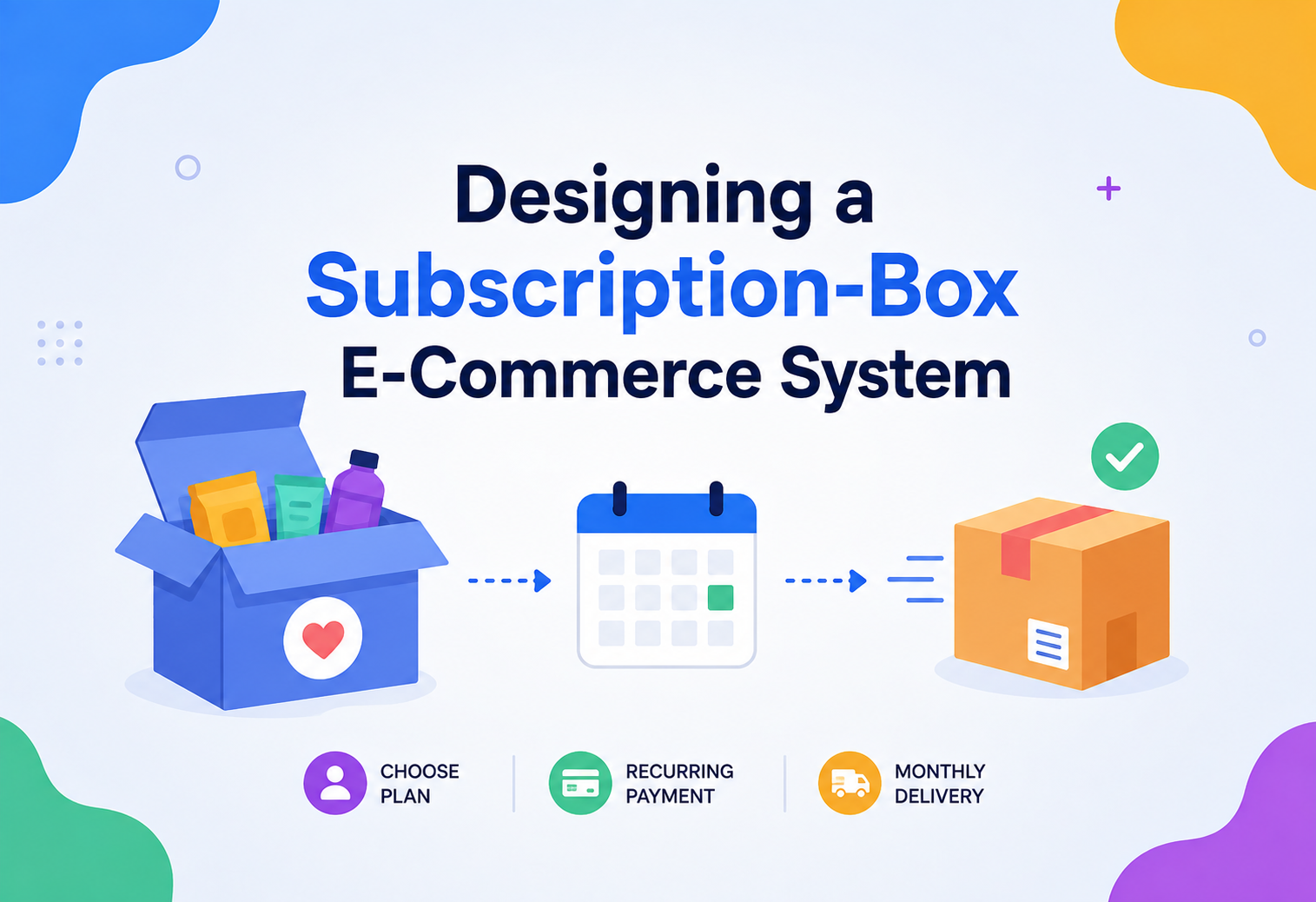
Designing a Subscription-Box E-Commerce System
A ground-up, production-grade walkthrough of how subscription-box businesses build systems that handle recurring billing, per-subscriber customization preferences, and coordinated shipment scheduling at scale — reliably charging millions of customers on staggered cycles and turning their preferences into a correctly packed, correctly timed box every single period.
Introduction & History
A subscription box arrives at a customer’s door once a month, curated to their stated tastes, paid for automatically without them lifting a finger. From the customer’s side, this feels effortless. From the engineering side, it means a system quietly did three genuinely hard things in the background: it charged the right amount of money to the right payment method on the right day, it turned a customer’s stated and inferred preferences into a specific selection of physical items, and it coordinated that selection with a warehouse’s inventory and a shipping cutoff so the box actually left on time.
A subscription-box e-commerce system is the software platform that does all three of these continuously, for a subscriber base that can range from thousands to many millions of people, each potentially on a different billing date.
Recurring billing itself is not new — magazine subscriptions and gym memberships have used some form of automated recurring charge for decades, typically through simple batch billing runs against a fixed catalog of plans. What subscription-box commerce added, starting in earnest in the early 2010s as companies in categories like beauty, food, and hobby goods popularised the model, was genuine per-subscriber personalisation layered directly on top of that recurring billing relationship. The box is not the same for every subscriber; it is assembled based on a preference profile that can itself change between cycles, which means the system has to solve billing, personalisation, and physical fulfilment as three tightly coupled problems rather than three independent ones.
This coupling is what makes the domain interesting from a systems perspective. A billing failure has to interact sensibly with fulfilment — you generally do not want to ship and incur cost of goods for a box nobody paid for. A late preference update has to interact sensibly with a shipping cutoff — a change submitted after curation has already been locked in for that cycle cannot retroactively alter a box that is already being packed. And all of this has to happen not for one customer at a time, but for potentially staggered cohorts of subscribers whose individual billing dates are spread across the entire month, each moving through this same sequence largely independently of the others.
This guide focuses on that generation of systems: recurring billing at scale with staggered cycles, preference-driven personalisation, and inventory-aware fulfilment scheduling, built on the same distributed-systems building blocks used broadly across modern backend engineering — API gateways, load balancers, schedulers, message queues, and payment-provider integrations — applied specifically to the problem of coordinating money, preferences, and physical goods on a recurring cadence.
1.1 The Three Coupled Problems at a Glance
Recurring Billing
Charge the right amount to the right payment method on the right day — reliably, at scale, across staggered subscriber cycles, and gracefully in the face of routine payment failures.
Per-Subscriber Curation
Turn each subscriber’s stated and inferred preferences into a specific, personalised selection of physical items, respecting hard constraints like allergies and recently-received exclusions.
Fulfilment Scheduling
Coordinate that selection with live warehouse inventory and a hard shipping cutoff so the box actually leaves on time — a real, physical deadline no software delay can shift.
The Problem & Why a Naive Approach Fails
It is worth being precise about why this is hard, because the naive version — “run one big billing script on the first of every month, then figure out shipping after” — breaks down quickly at real subscriber scale, for several concrete reasons.
2.1 A Single Monthly Billing Run Does Not Survive Contact with Reality
Charging every subscriber on the same calendar day creates an enormous, synchronised spike in payment-processor traffic, and payment providers themselves rate-limit and can degrade under exactly this kind of concentrated load. It also concentrates failure risk: any bug in that single run potentially affects the entire subscriber base at once, rather than a small, staggered slice of it. Nearly every real subscription-box platform instead staggers billing dates across subscribers, often based on their original signup date, which turns billing into a continuous, rolling process rather than a single risky monthly event.
2.2 Payments Fail, and Failure Has to Be Handled Gracefully, Not Silently
Card declines, expired cards, and temporary processor issues are a routine, expected part of recurring billing, not an edge case — real-world decline rates for recurring charges are meaningfully higher than for one-time checkout purchases. A system that simply gives up on the first failed charge attempt loses subscribers unnecessarily; a system that retries blindly and indefinitely risks charging a customer unexpectedly weeks later or annoying their bank into flagging the merchant as suspicious. This has to be handled with a deliberate, well-understood retry strategy, covered in detail later in this guide.
2.3 Preferences and Inventory Can Conflict with Each Other
A subscriber’s stated preference might request an item that is currently out of stock, or that conflicts with another subscriber-stated constraint such as an allergy or a previously-received item they should not receive twice in a row. Naively “filling the box with whatever matches the stated preferences” without checking real-time inventory and recent shipment history against every constraint simultaneously produces boxes that cannot actually be packed, discovered only once a warehouse worker is already holding an empty box.
2.4 Everything Has a Hard Physical Deadline
Unlike many software systems where a delayed computation just means a slightly later result, this system feeds a physical warehouse operation with real cutoff times — trucks leave on a schedule, and a box not finalised by the cutoff simply does not ship that cycle. Billing, preference resolution, and curation all have to complete reliably before that cutoff, which means the system’s reliability requirements are tied to a real-world clock in a way that a purely digital product typically is not.
Build a system that manages staggered recurring billing across a large subscriber base, resolves each subscriber’s customisation preferences against live inventory into a concrete, packable box selection, and reliably hands off a finalised order to fulfilment before each cycle’s shipping cutoff — handling payment failures, preference changes, and inventory constraints gracefully, without ever shipping an unpaid box or missing a shipping deadline due to a solvable software delay.
“Why not just bill everyone on the first of the month and simplify the whole system?” — a good answer explains that synchronised billing concentrates both payment-processor load and failure blast radius into a single risky event, and that staggering billing dates based on signup date, spread across the month, is what most real subscription platforms do specifically to smooth out processing load and limit the impact of any single bug or outage to a small, rolling slice of subscribers rather than the entire base at once.
Core Concepts You Need First
Here is the shared vocabulary this guide relies on, each explained in plain language with a simple example.
3.1 Billing Cycle and Anchor Date
A billing cycle is the recurring interval, typically monthly, on which a subscriber is charged. The anchor date is the specific day within that cycle a given subscriber is billed on, usually derived from their original signup date, which is exactly what creates the staggering described above rather than every subscriber sharing a single billing day.
3.2 Dunning
The structured process of handling a failed recurring payment: retrying the charge on a defined schedule, notifying the customer, and eventually pausing or cancelling the subscription if payment cannot be recovered after a defined number of attempts. Dunning is a term borrowed from traditional collections and billing operations, and it is one of the most consequential pieces of logic in this entire system, since it directly determines both revenue recovery and customer relationship health.
3.3 Preference Profile
The structured record of what a subscriber has told the system about their tastes, either directly through an onboarding quiz or settings page, or inferred indirectly from past feedback such as ratings on previous boxes. This profile is the primary input the curation logic uses to select what goes into a given subscriber’s box.
3.4 Curation Window and Cutoff
Each billing cycle has a defined window during which preference changes are accepted and reflected in the upcoming box, closing at a hard cutoff after which the box’s contents are locked in for fulfilment regardless of any further preference changes, which will instead apply starting the following cycle.
3.5 Proration
The adjusted, partial charge applied when a subscriber changes plans mid-cycle — upgrading to a larger box partway through a billing period, for example, typically results in a prorated charge covering only the remaining days at the new plan’s rate, rather than either ignoring the change until next cycle or charging the full new amount immediately on top of what was already paid.
3.6 Idempotency Key (in Payments)
A unique identifier attached to a charge attempt that lets the payment provider recognise and safely ignore an accidental duplicate request, such as one caused by a network retry, ensuring a customer is never charged twice for what was meant to be a single billing attempt.
3.7 Quick-Reference Vocabulary
| Term | What It Answers | Typical Data Source |
|---|---|---|
| Anchor date | Which day of the cycle is this subscriber billed on? | Original signup date |
| Dunning state | Where is this subscriber in the payment-retry process? | Billing Service state machine |
| Preference profile | What does this subscriber want in their box? | Onboarding quiz, settings, feedback history |
| Curation cutoff | Is it still possible to change this cycle’s box? | Fulfilment Scheduling Service configuration |
System Architecture & Components
With shared vocabulary in place, here is the full picture: the subscriber-facing read and update path, and the recurring pipeline that turns a billing date into a paid, curated, scheduled shipment.
Below is what each labelled box in that diagram is actually responsible for, in plain terms.
4.1 Component Breakdown
CDN
Caches static assets close to the subscriber so only dynamic account and preference requests travel to the origin.
API Gateway
The single entry point for every client request. Handles authentication, per-subscriber rate limiting, and routing to the correct backend service.
Load Balancer
Distributes account, preference, and status requests across many identical service instances using health checks.
Subscription Service
Owns plan state, billing cycle anchor dates, and subscription status such as active, paused, or cancelled.
Billing Service
Orchestrates charge attempts against the payment gateway and drives the dunning state machine on failure.
Preference Service
Stores and exposes each subscriber’s customisation profile, updated through onboarding and ongoing settings changes.
Curation Service
Resolves a subscriber’s preference profile against live inventory into a concrete, packable box content selection.
Fulfilment Scheduling Service
Enforces curation cutoffs and hands off finalised, paid orders to the warehouse fulfilment system on schedule.
Payment Gateway Adapter
Translates internal charge requests into the specific API shape of the external payment processor.
Payment Webhook Gateway
Receives asynchronous payment confirmation and failure callbacks from the payment processor.
Billing Scheduler
Continuously triggers billing attempts for subscribers whose anchor date has arrived, driving the entire recurring pipeline.
Redis Cache
Stores frequently read subscriber state so dashboard and account views almost never hit the database directly.
“Why do we need both an API Gateway and a Load Balancer here?” — the API Gateway is the application-layer front door, handling authentication, request validation, and routing across many different backend services, including ones unrelated to subscriptions, such as customer support tooling. The Load Balancer sits specifically in front of a given service’s fleet, distributing load across many stateless instances of that one service for scalability and fault tolerance. They solve different problems at different layers, and production deployments typically use both together.
4.2 Networking Considerations
Services within the Subscription Core and Payment Integration layers communicate over a private virtual network, isolated from the public internet, with only the API Gateway and Payment Webhook Gateway exposed publicly, the latter necessarily so since the external payment provider must be able to reach it. Connection pooling matters heavily between the Billing Service and the Payment Gateway Adapter, since establishing a fresh connection on every charge attempt would add meaningful overhead at the volume this system handles during a busy billing period; persistent, pooled connections avoid that cost. Service discovery lets each core service locate healthy instances of its dependencies dynamically as individual fleets scale independently, which matters given how differently billing, curation, and dashboard traffic each scale.
4.3 Why the Payment Integration Layer Is Kept Separate from the Core Services
It might seem simpler to have the Billing Service call the payment provider’s API directly, but isolating this into a dedicated Payment Gateway Adapter and Webhook Gateway is deliberate. It confines the blast radius of a payment-provider API change or outage to one well-defined layer, it is the natural place to enforce the tokenisation boundary described later under security, and it means switching or adding a second payment provider, which many platforms eventually need for regional coverage or redundancy, only ever requires changes within this one layer rather than touching the Billing Service’s core orchestration logic at all.
Internal Working: From Anchor Date to Shipped Box
It helps to separate this system into three sequential stages that run for each subscriber on their own cadence: billing, curation, and fulfilment handoff, each of which has to succeed before the next can proceed.
5.1 The Billing Stage
The Billing Scheduler continuously scans for subscribers whose anchor date has arrived, publishing a billing-due event for each onto Kafka rather than charging synchronously in a single monolithic loop. The Billing Service consumes these events and calls the Payment Gateway Adapter to attempt the charge, using an idempotency key derived from the subscriber ID and billing cycle so a retried request can never result in a duplicate charge. A successful charge, confirmed either synchronously or through an asynchronous webhook depending on the payment method, transitions the subscription into a paid state for that cycle and publishes a billing-succeeded event that the Curation Service is waiting on.
5.2 The Curation Stage
Only after billing succeeds does the Curation Service resolve that subscriber’s current preference profile against live inventory, selecting a specific set of items that satisfies the subscriber’s stated preferences, excludes anything flagged by a hard constraint such as an allergy, and reserves the necessary stock so no other subscriber’s box can claim the same limited-quantity item. This reservation step matters enormously at scale, since many subscribers’ curation runs happen concurrently and popular items can genuinely run out mid-cycle.
5.3 The Fulfilment Handoff Stage
Once curation produces a finalised box selection, the Fulfilment Scheduling Service checks it against the current cycle’s shipping cutoff. If there is still time before the cutoff, the finalised order is handed off to the warehouse fulfilment system, conceptually similar to the shipment tracking and carrier integration patterns used broadly in e-commerce logistics. If curation could not complete before the cutoff for some reason, the subscriber is automatically rolled into the next available shipping window rather than silently missing a cycle.
public class BillingOrchestrator {

    public void processBillingDue(BillingDueEvent event) {
        String idempotencyKey = event.getSubscriberId() + ":" + event.getCycleId();

        ChargeResult result = paymentGatewayAdapter.charge(
                event.getSubscriberId(), event.getAmount(), idempotencyKey);

        if (result.isSuccess()) {
            subscriptionRepository.markCyclePaid(event.getSubscriberId(), event.getCycleId());
            eventPublisher.publish(new BillingSucceededEvent(event.getSubscriberId(), event.getCycleId()));
        } else {
            dunningService.startOrAdvanceRetry(event.getSubscriberId(), event.getCycleId(), result.getFailureReason());
        }
    }
}
“What happens if curation finishes selecting a box, but the payment that authorised it is later reversed as fraudulent?” — a well-designed system treats this as a compensating action rather than something that should have been prevented upfront in every case, since fraud signals can sometimes only be detected after initial payment authorisation. The Fulfilment Scheduling Service should support cancelling a handoff up until the physical pack-and-ship step actually begins, releasing any reserved inventory back into the pool, and the Billing Service’s dunning-adjacent fraud-handling logic should flag the account for review rather than simply retrying the charge as if it were an ordinary decline.
5.4 A Complete Worked Example
It helps to trace one subscriber’s cycle end to end. Suppose subscriber SUB-77390’s anchor date arrives on the fourteenth of the month. The Billing Scheduler publishes a billing-due event that morning, and the Billing Service attempts a charge of forty-two dollars using an idempotency key combining the subscriber ID and cycle identifier. The payment gateway responds with a decline due to insufficient funds; the Billing Service records this outcome and starts the dunning schedule, setting the first retry for two days later rather than attempting again immediately.
Two days later, the retry succeeds — perhaps the subscriber’s payday has since passed — and the Billing Service marks the cycle as paid, publishing a billing-succeeded event. The Curation Service, which has been waiting on exactly this event, resolves SUB-77390’s preference profile, filters out an item flagged under a stated allergy, ranks the remaining eligible items by preference score, and successfully reserves its top four picks against live inventory. The Fulfilment Scheduling Service checks the current cycle’s cutoff, finds there are still six hours remaining before the warehouse’s shipping deadline, and hands the finalised order off to the warehouse system, which packs and ships the box that same evening. This same sequence, running independently and concurrently for millions of subscribers each on their own anchor date, is the entire system in miniature.
Algorithms, Data Structures & Concurrency
A handful of classical techniques do most of the real work underneath the service boundaries already described, and understanding them clarifies why the system behaves correctly under the kind of concurrent, deadline-driven load this domain involves.
6.1 Exponential Backoff for Dunning Retries
Rather than retrying a failed charge at a fixed interval, or as fast as possible, the dunning process uses exponential backoff with jitter — waiting a randomised, growing interval between each retry attempt, such as roughly one day, then three days, then seven days — which both respects payment-processor and issuing-bank rate limits and gives a subscriber’s underlying issue, such as an expired card needing to be updated, realistic time to resolve itself between attempts.
6.2 Priority Queue for the Billing Scheduler
The Billing Scheduler maintains subscribers in a priority structure ordered by “next billing attempt due time,” whether that is a fresh cycle’s anchor date or a scheduled dunning retry, letting it always efficiently pop whichever subscriber is due next rather than repeatedly scanning the entire subscriber base. This is the same priority-queue pattern used for scheduling problems throughout distributed systems, applied here specifically to billing cadence.
6.3 Constraint Satisfaction in the Curation Engine
Selecting a box’s contents is, formally, a constraint satisfaction problem: find a combination of available items that satisfies hard constraints such as allergies and quantity limits, respects soft preferences such as stated favourite categories, and does not repeat an item the subscriber received too recently. Production curation engines typically solve a simplified, tractable version of this — filtering the eligible item pool down by hard constraints first, then ranking remaining candidates by a weighted preference score, and greedily selecting the top-scoring combination that fits the box’s defined slot count — rather than attempting a fully general constraint solver, which would be far more computationally expensive than the problem’s actual real-world complexity justifies.
6.4 Inventory Reservation and Concurrency Control
Because many subscribers’ curation runs happen concurrently and popular items have finite stock, reserving an item for one subscriber’s box has to be atomic with respect to every other concurrent reservation attempt. This uses the same optimistic concurrency control pattern seen throughout high-write-contention systems: a reservation attempt reads the current available quantity, and commits the decrement only if the quantity has not changed since it was read, retrying against a different candidate item if a concurrent reservation won the race first.
public class InventoryReservationService {

    public boolean reserve(String itemId, int quantity, long expectedVersion) {
        int rowsUpdated = inventoryRepository.decrementIfVersionMatches(
                itemId, quantity, expectedVersion, expectedVersion + 1);
        return rowsUpdated == 1; // false means a concurrent reservation won; caller picks a fallback item
    }
}
6.5 Idempotency in Payment Processing
Every charge attempt carries a stable idempotency key, and the payment gateway itself is responsible for recognising a repeated key and returning the original result rather than processing a second charge. This is essential given that network failures between the Billing Service and the payment gateway are routine, and a naive retry without idempotency protection would risk double-charging a subscriber on exactly the kind of transient failure that makes retrying necessary in the first place.
“Two subscribers’ curation runs both want the last unit of a popular item at the same moment. How do you make sure only one of them gets it, without either subscriber’s box getting stuck?” — the answer is the optimistic concurrency control pattern shown above: whichever reservation attempt commits first wins the item, and the losing attempt does not fail outright — it simply falls back to the next best-scoring eligible item from the curation engine’s ranked candidate list, which is why the curation algorithm needs to produce more than one viable candidate per slot rather than a single fixed answer.
Data Flow & Lifecycle
Tracing one subscriber’s cycle from anchor date to shipped box is one of the more natural whiteboard exercises for this kind of system. Two views are useful: the sequence for a single billing-to-fulfilment cycle, and the lifecycle a subscription itself moves through over its life.
Separately, every subscription itself moves through a well-defined lifecycle, independent of any single cycle’s outcome. Representing this explicitly as a state machine keeps the Billing Service, Notification Service, and customer support tooling all easy to reason about.
Notice that the entire billing-to-fulfilment pipeline is event-driven and strictly sequential per subscriber: curation never begins until a billing-succeeded event exists for that subscriber’s current cycle, and fulfilment handoff never begins until curation has published a finalised selection. This ordering, enforced through the event backbone rather than through direct synchronous calls, is what keeps the system correct even though billing, curation, and fulfilment run as independently scalable services.
7.1 Event Schema and Partitioning
Each event published to Kafka in this pipeline carries a compact schema — subscriber ID, cycle ID, event type, and a small payload specific to that stage — and is published keyed by subscriber ID. This guarantees all events for a given subscriber’s cycle land in the same Kafka partition and are processed in the order they were produced, which matters because curation absolutely must not begin processing before that subscriber’s corresponding billing-succeeded event has been consumed.
{
  "eventId": "evt-2f88ab",
  "eventType": "BILLING_SUCCEEDED",
  "subscriberId": "SUB-77390",
  "cycleId": "2026-08",
  "timestamp": "2026-07-30T09:14:22Z"
}
7.2 Backpressure Near Shipping Cutoffs
Because a large share of subscribers can share similar anchor dates within a given shipping window, curation and fulfilment handoff volume naturally spikes as a cutoff approaches. The Stream Processor consuming curation events tolerates this the same way any Kafka-backed pipeline does, queuing durably rather than dropping events, but the Fulfilment Scheduling Service also tracks how close the pipeline is running to the actual cutoff time and can raise an operational alert if processing lag threatens to push subscribers past it, which is a domain-specific escalation beyond ordinary consumer-lag monitoring.
Databases, Caching & Load Balancing
8.1 Choosing the Subscriber Database
The subscriber database is the durable source of truth for subscription state, billing history, and preference profiles. Because subscriber records are read and written relationally — a subscription references a billing history, which references charge attempts, which reference a preference profile — many production systems choose a relational database with careful sharding by subscriber ID for this store, rather than a pure key-value or wide-column store, since the transactional guarantees around billing state transitions matter more here than in some other high-scale domains, and the relational structure between subscription, billing, and preference data is genuinely useful to query directly.
8.2 Why Caching Matters for the Subscriber-Facing Dashboard
A subscriber checking “when is my next box arriving” or “what’s currently in my box” generates read traffic that should never be allowed to compete with or slow down the billing and curation pipelines running against the same underlying data. A Redis cache in front of the most commonly requested subscriber-facing views, populated using the same read-through pattern used broadly across high-read-volume systems, absorbs this traffic so dashboard reads stay fast and isolated from the operational pipeline’s write load.
8.3 Inventory Data Store
The Inventory Service backing curation’s reservation logic needs to support very fast, highly concurrent read-and-decrement operations on stock counts, which favours a store optimised for this specific access pattern — often a dedicated, carefully indexed relational table or a distributed counter-friendly store, kept deliberately separate from the broader product catalog database, since inventory reservation during a cutoff crunch is one of the most contention-heavy write patterns in the entire system.
8.4 Replication Choices and CAP Theorem Trade-offs
The subscriber database replicates across zones, with the choice between synchronous and asynchronous replication carrying real consequences here that are somewhat different from a purely read-heavy system: billing state changes are exactly the kind of write where losing a recent update during a rare failover could mean a subscriber’s successful payment is not correctly reflected, risking either a missed shipment or, worse, an accidental duplicate charge on retry. For this reason, many production billing systems favour synchronous or near-synchronous replication specifically for billing-state writes, accepting the added write latency as a reasonable cost given how much more consequential a lost billing-state update is compared to, say, a slightly stale dashboard read.
This is a domain where the CAP theorem trade-off genuinely leans differently than in some other systems covered elsewhere in this series: during a network partition, the Billing Service is often better off favouring consistency over availability for the specific act of recording a charge outcome, briefly refusing to acknowledge a billing state change it cannot confirm was durably replicated, rather than risking an inconsistent view of whether a subscriber has actually been charged. Subscriber-facing dashboard reads, by contrast, can and should still favour availability, serving a slightly stale cached view rather than failing outright, since the two access patterns carry very different consequences for being wrong.
8.5 Load Balancing Across Service Instances
Each core service — Subscription, Preference, Billing, Curation, and Fulfilment Scheduling — runs as its own fleet of stateless instances behind a Layer 7 load balancer, scaled independently based on that specific service’s load profile. Billing and curation load is naturally spiky around anchor-date clusters and shipping cutoffs, while subscriber-facing dashboard load follows more ordinary daily traffic patterns, which is exactly why keeping these as separately scalable fleets, rather than one monolithic service, matters operationally.

| Layer | Technology Examples | Why It Fits Here |
|---|---|---|
| Subscriber dashboard cache | Redis, Memcached | Fast reads, isolates dashboard traffic from pipeline writes |
| Subscriber source of truth | Sharded relational database | Transactional guarantees across billing, subscription, and preference state |
| Inventory counters | Dedicated relational table or distributed counter store | High-concurrency atomic decrements under cutoff-driven contention |
| Event backbone | Kafka, Kinesis | Ordered, partitioned, durable pipeline sequencing |
“Why keep inventory in a separate store from the main product catalog database instead of one shared database?” — inventory reservation during a cutoff crunch is an extremely high-contention, latency-sensitive write pattern, fundamentally different from the catalog database’s much more read-heavy, low-contention access pattern for product descriptions and images. Separating them lets each store be tuned and scaled for its actual access pattern, and prevents contention on inventory counters from ever degrading unrelated catalog browsing performance.
APIs & Microservices
Clean service boundaries let different teams own, scale, and deploy each part of this system independently. A reasonable boundary looks like the following.
9.1 Core Service Boundaries
- Subscription Service — owns plan and cycle state, exposing endpoints for viewing and changing plan, pausing, and cancelling.
- Billing Service — owns charge orchestration and the dunning state machine, exposed mostly internally rather than as a direct public API.
- Preference Service — owns the customisation profile, exposing endpoints for the onboarding quiz and ongoing settings updates.
- Curation Service — owns resolving preferences and inventory into a finalised box selection, exposed internally to the pipeline and, in a limited read-only form, to the subscriber-facing “what’s in my next box” view.
- Fulfilment Scheduling Service — owns cutoff enforcement and warehouse handoff, exposing status endpoints such as estimated ship date.
Each of these is a separate deployable service because they scale and change independently. The Billing Service has strict correctness and auditability requirements that justify slower, more careful deployment practices, while the Preference Service can iterate quickly on a subscriber-facing onboarding quiz without any of that same billing-grade caution. Keeping them separate means an experimental change to the onboarding quiz UI never risks the billing pipeline’s stability.
9.2 Public API Design
The externally facing subscriber API stays intentionally simple, exposing plan status, upcoming charge date, and box status without exposing internal orchestration details.
GET /v1/subscribers/SUB-77390/subscription

{
  "subscriberId": "SUB-77390",
  "status": "ACTIVE",
  "plan": "MONTHLY_DELUXE",
  "nextBillingDate": "2026-08-14",
  "currentCycle": {
    "cycleId": "2026-07",
    "boxStatus": "PACKED",
    "estimatedShipDate": "2026-07-31"
  }
}
9.3 Preference Update Endpoint and Cutoff Awareness
The preference update endpoint deliberately returns whether a given change will apply to the current cycle or only the next one, based on where the request falls relative to that cycle’s curation cutoff, so the subscriber-facing UI can set accurate expectations at the moment of the change rather than surprising the subscriber later.
PATCH /v1/subscribers/SUB-77390/preferences
{ "favoriteCategory": "SKINCARE" }

{
  "updated": true,
  "appliesToCycle": "2026-08",
  "reason": "Current cycle 2026-07 curation cutoff has already passed"
}
9.4 Idempotency and Versioning
Write endpoints that affect billing or subscription state accept an idempotency key, exactly as the internal payment charge flow does, so a client-side retry after a network timeout can never accidentally trigger a duplicate plan change or duplicate pause request. The public API is versioned explicitly in its path, and new fields are always added in a backward-compatible way so existing mobile app versions already in the field, which cannot be force-updated instantly, continue working correctly.
“A subscriber updates their preferences five minutes after the curation cutoff for this cycle. What should the API tell them?” — the API should clearly communicate that the change was saved successfully but will apply starting with the next cycle, rather than either silently applying it to a box that has already been curated and reserved, or rejecting the update entirely, which is exactly the behaviour shown in the preference update example above.
9.5 Batch Account Summary Requests
Customer support tooling frequently needs a consolidated view across several data sources — subscription status, recent billing history, and current box status — for one subscriber at once. A batch endpoint aggregates these into a single response, which the underlying services fulfil through parallel internal calls orchestrated by a thin aggregation layer, rather than requiring the support tool itself to make and stitch together several separate API calls.
GET /v1/support/subscribers/SUB-77390/summary

{
  "subscription": { "status": "ACTIVE", "plan": "MONTHLY_DELUXE" },
  "recentBilling": [
    { "cycleId": "2026-07", "outcome": "SUCCEEDED_ON_RETRY", "attempts": 2 }
  ],
  "currentBox": { "boxStatus": "PACKED", "estimatedShipDate": "2026-07-31" }
}
9.6 Versioning Discipline for a Long-Lived Mobile Client Base
Because mobile app updates roll out gradually and some subscribers keep older app versions installed for a long time, the public API’s versioning discipline matters more here than in an all-web product: a field never changes meaning within an existing version, and any genuinely breaking change, such as restructuring the box-status representation, ships as a new version with the old one kept fully functional for a defined deprecation period long enough to cover realistic mobile update adoption curves.
Design Patterns & Anti-Patterns
10.1 Patterns Worth Using
Saga Pattern
The three-stage sequence of billing, curation, and fulfilment handoff is a textbook saga, with each stage’s compensating action clearly defined: a failed billing stage never proceeds to curation, and a cancelled or reversed payment triggers a compensating inventory release if curation had already run.
Circuit Breaker
Wraps calls from the Billing Service to the external payment gateway. If the gateway degrades or times out excessively, the breaker trips and pending charge attempts queue for retry rather than piling up against a struggling dependency.
State Machine
Both the subscription lifecycle and the dunning process are modelled explicitly as state machines, which makes illegal transitions, such as attempting to bill a cancelled subscription, structurally impossible rather than something application code has to remember to check everywhere.
Event Sourcing
Every charge attempt, success, and failure is stored as an immutable event, which makes it possible to reconstruct a subscriber’s complete billing history for support investigations, disputes, and financial reconciliation.
Read-Through Caching
The Subscription Service itself is responsible for fetching from the database on a cache miss and populating the cache, so callers never need to know the cache exists. A short TTL is generally sufficient here.
Bulkhead Isolation
Each saga stage runs with its own dedicated compute and its own Kafka consumer group, so a slowdown in curation cannot starve the billing stage of resources it needs to keep processing new charge attempts on schedule.
10.2 Anti-patterns to Avoid
Common Mistakes
- Letting curation start before billing is confirmed successful, which risks reserving inventory and incurring cost of goods for a box that may never actually be paid for.
- Retrying failed charges on a fixed, aggressive schedule rather than exponential backoff, which stresses the payment gateway unnecessarily and can flag the merchant account as suspicious to issuing banks.
- Hardcoding the shipping cutoff as a single global constant rather than a per-warehouse, per-region configuration, which breaks the moment the business expands to a second fulfilment center with a different schedule.
- Applying a preference change retroactively to an already-curated box without any cutoff boundary, which leads to inconsistent, unpredictable fulfilment outcomes.
Treating a declined charge as equivalent to a cancelled subscription. A decline is an expected, recoverable event that dunning is specifically designed to handle; only exhausting the full dunning schedule without recovery should ever result in an automatic cancellation.
10.3 Read-Through Caching, Named Precisely
The caching strategy in front of the subscriber-facing dashboard is a direct application of read-through caching: the Subscription Service itself is responsible for fetching from the database on a cache miss and populating the cache, so callers never need to know the cache exists. A short time-to-live, rather than write-through invalidation, is generally sufficient here, since dashboard views such as “next billing date” change infrequently enough that a brief staleness window is an entirely reasonable trade-off against the added complexity of invalidating the cache on every relevant write.
10.4 Bulkhead Isolation Between Pipeline Stages
Each stage of the billing-to-fulfilment saga — billing, curation, and fulfilment handoff — runs with its own dedicated compute resources and its own Kafka consumer group, rather than sharing a thread pool across stages. This bulkhead isolation means a slowdown in curation, for instance during a particularly complex constraint-resolution period, cannot starve the billing stage of the resources it needs to keep processing new charge attempts on schedule.
Performance & Scalability
The subscriber-facing read path and the billing-to-fulfilment pipeline scale along different dimensions, and it is worth reasoning about each separately.
11.1 Scaling the Subscriber-Facing Read Path
Because dashboard reads are cache-fronted and each core service’s instances are stateless, horizontal scaling is straightforward: add more instances behind the load balancer and grow the Redis cache tier as active subscriber count grows. A well-tuned deployment serves the large majority of dashboard queries with p99 latency in the tens of milliseconds.
11.2 Scaling the Billing-to-Fulfilment Pipeline
This side of the system is inherently bursty rather than smoothly continuous, since subscriber anchor dates and shipping cutoffs naturally cluster. Kafka’s partitioned design lets the Billing Service and Curation Service scale out horizontally by adding more parallel consumers as a cutoff approaches, and autoscaling policies tied to consumer lag, rather than to raw CPU alone, are particularly effective here, since lag is a more direct signal of whether the pipeline is keeping pace with the deadline it is racing against.
11.3 Cost Optimization
Staggering anchor dates across the subscriber base, described earlier primarily as a reliability measure, is equally a cost optimisation, since it smooths both payment-processor transaction volume and internal compute load across the month rather than requiring infrastructure sized for a single synchronised peak that sits idle the rest of the time. Batching dunning retry attempts intelligently, rather than treating every retry as an isolated, immediately-processed event, similarly smooths load on the payment gateway integration layer.

11.4 Capacity Planning Example
As a concrete illustration, consider a platform with three million active subscribers whose anchor dates are spread evenly across the month, producing roughly one hundred thousand billing attempts on a typical day, with a predictable multi-day spike around common signup-heavy periods such as the start of a month. A well-partitioned Billing Service and Curation Service fleet, autoscaled ahead of these known clustering periods, comfortably absorbs this pattern, whereas a naive single-day billing run for the entire subscriber base would require infrastructure sized for three million simultaneous charge attempts, an order of magnitude larger peak capacity for no benefit to the business.
3 M
Active subscribers, spread evenly across the month.
~100 K
Billing attempts on a typical day with staggered anchor dates.
3 M/day
Same volume if you ran a synchronised billing day — an order of magnitude larger peak, for no benefit.
< 50 ms
Target dashboard read latency (cache-fronted, stateless services behind L7 LB).
“A large cohort of subscribers all signed up on the same promotional launch day, creating a genuine anchor-date cluster every month. How do you handle that without a recurring capacity crisis?” — a strong answer notes that even a naturally clustered cohort can be smoothed after the fact by re-distributing a portion of those subscribers’ future anchor dates slightly, within a range the subscriber would not even notice, specifically to avoid a permanent recurring monthly spike, combined with autoscaling the billing and curation fleets specifically ahead of that known, predictable date each month.
High Availability & Reliability
A failure in this system has an unusually direct consequence: a subscriber either gets charged incorrectly, or their box simply does not ship, both of which are highly visible, trust-damaging outcomes, which makes reliability here a genuine product and financial concern.
12.1 Redundancy at Every Layer
Every component — API Gateway, Load Balancer, each core service’s instances, Redis, and the subscriber database — runs as multiple redundant nodes spread across at least three availability zones, so no single machine or zone failure can take billing or fulfilment availability down.
12.2 Graceful Degradation Around the Payment Gateway
If the external payment gateway is degraded or unreachable, the Billing Service should queue pending charge attempts for retry once the gateway recovers, rather than failing them outright as declines, since a gateway outage is fundamentally different from a genuine card decline and should never count against a subscriber’s dunning retry budget.
12.3 Data Durability and Reconciliation
The complete, immutable billing event history, described earlier under event sourcing, is what makes financial reconciliation possible: a periodic batch job compares the subscriber database’s current billing state against the full event history and the payment gateway’s own transaction records, flagging any discrepancy for manual review. This three-way reconciliation is standard practice in billing systems generally, given how costly a silent billing bug can become if left undetected for even a short time.
12.4 Failure Recovery in the Pipeline
If a Curation Service worker crashes mid-processing, Kafka’s committed consumer offsets mean the replacement worker resumes exactly where processing left off, and because inventory reservation is implemented as an idempotent, version-checked operation, reprocessing an in-flight curation event produces the same final result as if no crash had occurred.
12.5 Chaos Testing Near Cutoffs
Given how directly this system’s failure modes are tied to a hard physical deadline, teams operating it at scale specifically rehearse failure scenarios close to a simulated cutoff in staging — a Curation Service outage with thirty minutes remaining before cutoff, a payment gateway slowdown during a billing spike — to confirm that alerting and fallback behaviour genuinely give operators enough time to intervene before subscribers are actually affected, rather than only after.
Security
Because this system handles real payment credentials and recurring financial transactions, it faces security requirements beyond the standard list, most notably around payment card data handling.
13.1 Security Controls
PCI DSS & Tokenization
Raw card numbers should never touch internal systems at all; the payment gateway’s own hosted fields or tokenisation APIs capture card details directly, and internal services only ever handle an opaque payment token, which dramatically reduces the compliance scope and breach risk of the subscription platform itself.
Strict AuthN / AuthZ
Every account, billing, and preference endpoint requires a valid subscriber session, and any internal tooling capable of viewing or modifying billing state requires elevated, audited access separate from ordinary application credentials.
Idempotency as Security
Idempotency keys on charge and plan-change requests protect against both accidental duplicate requests and certain classes of replay-style abuse — not just correctness but a defensive property.
Rate Limiting
Protects preference and plan-change endpoints against automated abuse, such as an attacker probing for valid promotional codes or attempting rapid account enumeration.
Encryption In Transit & At Rest
Standard TLS for all API traffic, and encryption at rest for the subscriber database, given the combination of personal and payment-adjacent data it holds.
Storing raw card numbers, even temporarily or “just for debugging,” anywhere within internal systems. This immediately and dramatically expands PCI compliance scope and breach liability; tokenisation at the payment gateway boundary should be a hard architectural rule, not a best-effort guideline.
“How does tokenisation actually reduce your PCI compliance burden?” — tokenisation means the raw card number is captured and stored only by the payment gateway, a provider already certified to handle that data, and the subscription platform’s own systems only ever see and store an opaque token that is meaningless outside that specific gateway relationship. Because the platform’s own infrastructure never touches raw card data, the scope of systems that must be audited and hardened to PCI DSS standards shrinks dramatically compared to a design where card numbers pass through or are stored in internal databases.
13.2 Secrets and Credential Management
The Payment Gateway Adapter depends on API credentials for the payment provider, and the Payment Webhook Gateway depends on a signing secret used to verify that inbound webhook payloads genuinely originated from the payment provider and were not spoofed. Neither of these should live in application configuration files or environment variables checked into source control; a dedicated secrets manager issues short-lived, automatically rotated credentials at runtime, so a leaked configuration file or compromised container never exposes a long-lived, high-privilege payment credential.
Monitoring, Logging & Metrics
14.1 Key Metrics to Track
| Metric | Why It Matters |
|---|---|
| Billing success rate | Core revenue health indicator; sudden drops signal a gateway or logic issue |
| Dunning recovery rate | Measures how effectively failed payments are being recovered over time |
| Curation-to-cutoff time margin | Directly measures risk of missing a physical shipping deadline |
| Inventory reservation conflict rate | High rates may indicate under-forecasted stock for popular items |
| Kafka consumer lag per pipeline stage | Rising lag threatens the hard cutoff deadline this whole system exists to meet |
| Payment gateway error rate | Distinguishes genuine card declines from gateway-side outages requiring different handling |
14.2 Logging and Tracing
Every stage of the billing-to-fulfilment pipeline logs its inputs and outcome — which charge attempt, which curation decision, which inventory reservation — which is essential both for debugging and for explaining a specific subscriber’s billing or shipping history to a customer support agent. Distributed tracing ties a single subscriber’s cycle together across the Billing Service, Curation Service, and Fulfilment Scheduling Service, which is invaluable when diagnosing why a specific box was delayed or a specific charge behaved unexpectedly.
14.3 A Typical Debugging Workflow
When a support ticket says “I was charged but my box never shipped,” the on-call engineer’s first step is checking that subscriber’s billing event history to confirm the charge genuinely succeeded, then checking whether a corresponding curation event exists and completed, and finally checking the fulfilment handoff log for that cycle. Because each stage’s outcome is logged independently and the saga pattern makes the pipeline’s sequential dependencies explicit, this kind of investigation almost always narrows to one specific stage quickly, rather than requiring the engineer to reason about the whole pipeline as an opaque black box.
Deployment & Cloud
Modern subscription-billing systems are typically deployed on containers orchestrated by Kubernetes across multiple availability zones on a major cloud provider, often paired with a managed payment-gateway integration rather than any custom payment infrastructure, given the specialised compliance burden of handling payment data directly.
15.1 Deployment Practices
Canary Releases
Any change to charge orchestration or curation scoring logic is rolled out to a small percentage of subscribers first, with close monitoring of billing success rate and curation outcomes, before a full rollout, given how directly a subtle bug here could affect real revenue and real shipments.
Blue-Green Deployment
For subscriber-facing services, a full parallel environment is stood up and traffic switched over only once health checks pass, allowing instant rollback.
Infrastructure as Code
Kubernetes manifests, Kafka topic configuration, and scheduler timing configuration are defined declaratively so environments are reproducible and auditable.
Freeze Windows Around Cutoffs
Many teams deliberately avoid deploying billing or curation changes during the hours immediately surrounding a major shipping cutoff, preferring to absorb any deployment risk during quieter periods rather than during the system’s highest-stakes window.
15.2 Testing and Validation Before Release
Because a bug in billing or curation logic can directly and silently affect real money and real physical shipments, changes are validated through backtesting against recorded historical billing and curation data, then through a shadow deployment processing live events in parallel with the current logic but writing to a separate, non-authoritative table for comparison, before any change is promoted to a canary rollout affecting real subscribers.
15.3 Multi-Region and Multi-Warehouse Operation
A subscription-box business operating across several countries typically deploys per-region infrastructure with region-specific payment gateway integrations, since payment methods, currencies, and regulatory requirements differ significantly by market, while the Fulfilment Scheduling Service is configured per warehouse, each with its own cutoff schedule, so expanding into a second fulfilment center never requires touching the core billing or curation logic at all.
Advantages, Disadvantages & Trade-offs
Advantages
- Enables genuine per-subscriber personalisation at scale, rather than the same fixed box for everyone.
- Smooths both processing load and failure risk through staggered anchor dates instead of a synchronised monthly event.
- Recovers a meaningful share of otherwise-lost revenue through structured dunning.
- Cleanly decouples billing, curation, and fulfilment as independently scalable services.
Disadvantages / Costs
- Adds real coordination complexity across billing, preferences, and physical inventory that a simple one-time-purchase e-commerce system does not need to solve at all.
- Event-driven saga pipelines are harder to reason about end-to-end than a single synchronous workflow.
- Ties the software system’s reliability requirements to a real physical clock (the shipping cutoff), a constraint most purely digital products do not face.
16.1 Key Trade-off: Personalisation Depth vs Curation Speed
The more elaborate the preference-matching logic, the harder it becomes to guarantee every subscriber’s box finalises comfortably before a hard shipping cutoff. Every additional constraint the curation engine has to satisfy adds computation and can increase the reservation conflict rate as more concurrent runs contend for the same limited-quantity items.
16.2 Key Trade-off: Aggressive vs Gentle Dunning
Retrying more frequently and for longer recovers more failed payments, but also risks appearing to a subscriber’s bank as suspicious repeated charge activity, and can frustrate subscribers who intended to cancel rather than simply update a card. Most production systems tune this balance empirically, typically settling on a small number of retries, three to four, spread over one to two weeks, rather than either extreme.
16.3 Key Trade-off: Strict Cutoff vs Subscriber Flexibility
A hard, unmovable cutoff is operationally simple and protects the warehouse’s scheduling reliability, but subscribers occasionally want to make a last-minute preference change right at the boundary. Some platforms offer a narrow, clearly-communicated grace window immediately before the true operational cutoff specifically to absorb this friction, accepting the added scheduling complexity in exchange for a better subscriber experience at the margin.
16.4 Key Trade-off: Transparency vs Simplicity in Curation Explanation
Showing a subscriber exactly why a specific item was chosen — this weighted preference, that inventory constraint — is the most honest option and can build genuine trust in the personalisation, but it can also overwhelm a subscriber who simply wants a nice surprise each cycle. Most platforms choose a middle ground, offering a brief, friendly explanation for headline items while keeping the full scoring logic internal, reserving deeper transparency for cases where a subscriber explicitly asks why a particular item appeared.
Best Practices & Common Mistakes
17.1 Best Practices
- Never let curation or fulfilment handoff begin before billing has genuinely succeeded for that cycle, enforced through the pipeline’s event-driven sequencing rather than through convention alone.
- Use exponential backoff with jitter for every dunning retry schedule, never a fixed or aggressive fallback interval.
- Tokenise payment data at the gateway boundary and never let raw card numbers touch internal systems, treating this as a hard architectural rule.
- Model subscription and dunning state explicitly as state machines, making illegal transitions structurally impossible rather than something application code has to remember to check.
- Reconcile internal billing records against both the full event history and the payment gateway’s own records on a regular schedule, not only when a discrepancy is already suspected.
17.2 Common Mistakes
Synchronised Billing Day
Running a single synchronised billing event for the entire subscriber base instead of staggering anchor dates — concentrates load and failure blast radius.
Decline == Cancel
Treating a declined charge the same as a subscriber’s intent to cancel, skipping dunning entirely and needlessly losing subscribers.
Retroactive Preference Changes
Allowing a preference change to retroactively alter a box that curation has already finalised and reserved inventory for.
Global Cutoff Constant
Hardcoding shipping cutoffs as a single global value rather than configuration scoped per warehouse and region — breaks the moment you open a second fulfilment center.
Deploying Into Cutoff Window
Deploying billing or curation logic changes directly into a live cutoff window without a canary or shadow-deployment safety net first.
17.3 A Pre-Launch Checklist
Before this system goes live for a meaningful share of real subscribers, it is worth confirming each of the following explicitly: anchor dates are staggered rather than synchronised; the dunning retry schedule and maximum attempt count are configured and tested end to end; payment tokenisation is verified to never expose raw card data to internal systems; inventory reservation has been load tested under realistic cutoff-driven concurrency; and dashboards for the key metrics listed in the monitoring section are wired up to alerting before real subscribers’ billing and shipments depend on this pipeline.
Real-World Industry Examples
Beauty & Lifestyle Boxes
Among the earliest and most visible adopters of the subscription-box model, this category relies heavily on preference-driven curation, often built around an onboarding quiz that captures skin type, style preferences, and stated dislikes, feeding directly into the same kind of constraint-and-scoring curation engine described throughout this guide.
Meal-Kit & Food Services
Food-based subscription businesses add a further layer of complexity on top of everything described so far: perishability means shipping cutoffs are even less forgiving, and dietary restrictions function as genuinely hard constraints rather than soft preferences, since getting an allergy wrong carries real safety consequences rather than merely a disappointing box.
Software & Media Subscriptions
Pure digital subscription businesses, without any physical curation or fulfilment component at all, still rely on the same billing and dunning architecture described in this guide, which is one reason recurring-billing infrastructure is so often built or bought as a genuinely reusable layer, cleanly separable from whatever product-specific curation or fulfilment logic sits on top of it for a given business.
Pet Product Subscriptions
Pet-focused subscription businesses combine preference-driven curation based on pet size, age, and stated preferences, with the same recurring billing and shipping-cutoff constraints seen throughout this guide, and often add a secondary personalisation dimension, such as rotating through different toy or treat categories cycle to cycle specifically to avoid repeating the same item too soon, which maps directly onto the “recently received” exclusion constraint described in the curation algorithms section.
Age-Restricted & Regulated Categories
Wine, spirits, and similar age-restricted subscription businesses add a regulatory dimension: age verification has to be enforced as a hard gate before billing or shipment, and in many jurisdictions the set of eligible products and even permissible shipping destinations varies by regional regulation, which means the curation engine’s hard-constraint layer has to account for legal eligibility alongside allergy-style personal constraints, and the Fulfilment Scheduling Service has to be aware of which warehouses and carriers are actually licensed to ship a given category into a given destination.
“How would this design change for a meal-kit service where dietary restrictions are safety-critical rather than just preferences?” — a solid answer treats dietary restrictions as hard, non-negotiable constraints enforced before any preference scoring happens at all, rather than as one weighted factor among many, and notes that the curation engine should fail closed — refusing to finalise a box rather than guessing — if it cannot confidently confirm a candidate item satisfies every declared restriction, escalating to manual review rather than ever shipping an item that might violate a safety-relevant constraint.
Frequently Asked Questions
A mid-cycle plan change typically triggers a prorated charge or credit covering the remaining days at the new plan’s rate, applied immediately rather than waiting for the next full cycle, and the Curation Service is notified of the plan change so it can adjust box size or contents accordingly for the current or next cycle depending on where the change falls relative to that cycle’s cutoff.
There is no universal answer, but most production dunning schedules settle on somewhere between three and five attempts spread across one to two weeks, balancing genuine revenue recovery against the risk of appearing as suspicious repeated charge activity to the subscriber’s bank, and against subscriber frustration if the underlying reason for the decline was an intentional cancellation rather than an accident.
A well-designed curation engine has an explicit fallback tier below its normal preference-matching logic — a curated “safe default” selection of generally popular, well-stocked items — that it falls back to rather than either failing the entire box or shipping an incomplete one, ensuring every paid subscriber still receives a reasonable box even during an unusual inventory shortage.
Yes. A business with a modest subscriber count can start with a much simpler design — a single scheduled billing job, a basic preference form stored directly against the subscriber record, and manual or lightly-assisted curation by a small team. The full event-driven, staggered-cycle architecture in this guide becomes necessary primarily once subscriber count and personalisation complexity grow enough that manual coordination and a single synchronised billing run can no longer keep pace with both scale and the physical shipping deadlines involved.
Idempotency keys on every charge attempt, combined with the subscription and dunning state machines that make illegal transitions structurally impossible, are what prevent this: a retried billing event for a cycle that has already been marked paid is recognised and safely ignored rather than reprocessed, and the same protection applies to fulfilment handoff, which checks whether a cycle has already been handed off before submitting it to the warehouse system again.
Skipping a single cycle is modelled as a temporary, one-time modifier on that specific cycle’s billing and curation, rather than a change to the subscription’s overall lifecycle state — the subscription remains active, its anchor date and plan are untouched, and billing and curation simply do not run for the one skipped cycle before resuming normally the following period. Pausing, by contrast, is a genuine lifecycle state transition, as shown in the state diagram earlier, that halts the subscription indefinitely until the subscriber explicitly resumes it. Keeping these as clearly distinct concepts, rather than collapsing “skip” into a special case of “pause,” keeps both the state machine and the subscriber-facing UI far easier to reason about.
Glossary
A quick-reference glossary of terms used throughout this guide, useful for review or as an interview refresher.
| Term | Plain-Language Definition |
|---|---|
| Anchor date | The specific day within a billing cycle a given subscriber is charged on. |
| Dunning | The structured process of retrying a failed recurring payment before giving up. |
| Preference profile | A subscriber’s stated and inferred customisation preferences used to curate their box. |
| Curation cutoff | The deadline after which a cycle’s box contents are locked in regardless of preference changes. |
| Proration | An adjusted, partial charge applied when a subscriber changes plans mid-cycle. |
| Idempotency key | A unique identifier that lets a repeated request be safely recognised and ignored rather than reprocessed. |
| Tokenisation | Replacing raw payment card data with an opaque token to reduce compliance scope and breach risk. |
| Saga pattern | Breaking a multi-step process into local steps with defined compensating actions if a later step fails. |
| Circuit breaker | A pattern that stops calling a failing dependency temporarily, falling back to a safe default instead. |
| Exponential backoff | A retry strategy using a randomised, growing interval between attempts. |
Summary & Key Takeaways
Key Takeaways
- Three coupled problems, not one: subscription-box e-commerce systems coordinate recurring billing, preference-driven personalisation, and physical fulfilment scheduling as a strict, event-driven sequence for each subscriber’s cycle.
- Stagger, don’t synchronise: staggering billing anchor dates across the subscriber base, rather than a single synchronised billing run, is central to both reliability and cost, smoothing payment-processor load and limiting failure blast radius.
- Layered front door: an API Gateway and Load Balancer sit at the front door for subscriber-facing traffic, while the billing-to-fulfilment pipeline runs as an independently scalable, Kafka-driven saga behind the scenes.
- Dunning is not optional: implemented with exponential backoff and a bounded number of retries, dunning is what recovers otherwise-lost revenue from routine payment failures without either giving up too early or retrying too aggressively.
- Curation is constraint satisfaction: resolving preferences against live, concurrently-contested inventory uses the same optimistic concurrency control pattern seen throughout high-write-contention systems.
- Tied to a physical clock: every stage of the pipeline is tied to a real physical shipping cutoff, which makes consumer-lag monitoring and cutoff-margin tracking genuinely safety-critical operational signals rather than ordinary performance metrics.
- Security centres on tokenisation: keeping raw card data out of internal systems entirely minimises both compliance scope and breach risk.
- The pattern generalises: the same underlying architecture, with different curation constraints and cutoff sensitivities, generalises directly to beauty, meal-kit, pet-product, and any other business built around recurring, personalised, physically-fulfilled deliveries.
If you take away one framing from this entire guide, let it be this: a subscription-box platform is a coordination system before it is anything else. The hard problem is not billing on its own, nor personalisation on its own, nor fulfilment on its own — each of those has well-understood solutions in isolation. The hard problem is keeping money, preferences, and physical goods consistent with each other on a recurring cadence, across a large subscriber base whose individual cycles are all running at slightly different times, in front of a real, unmoving shipping deadline. Every architectural choice in this guide — staggered anchor dates, event-driven saga sequencing, per-subscriber Kafka partitioning, cutoff-aware APIs, and three-way billing reconciliation — exists in service of that one coordination problem.