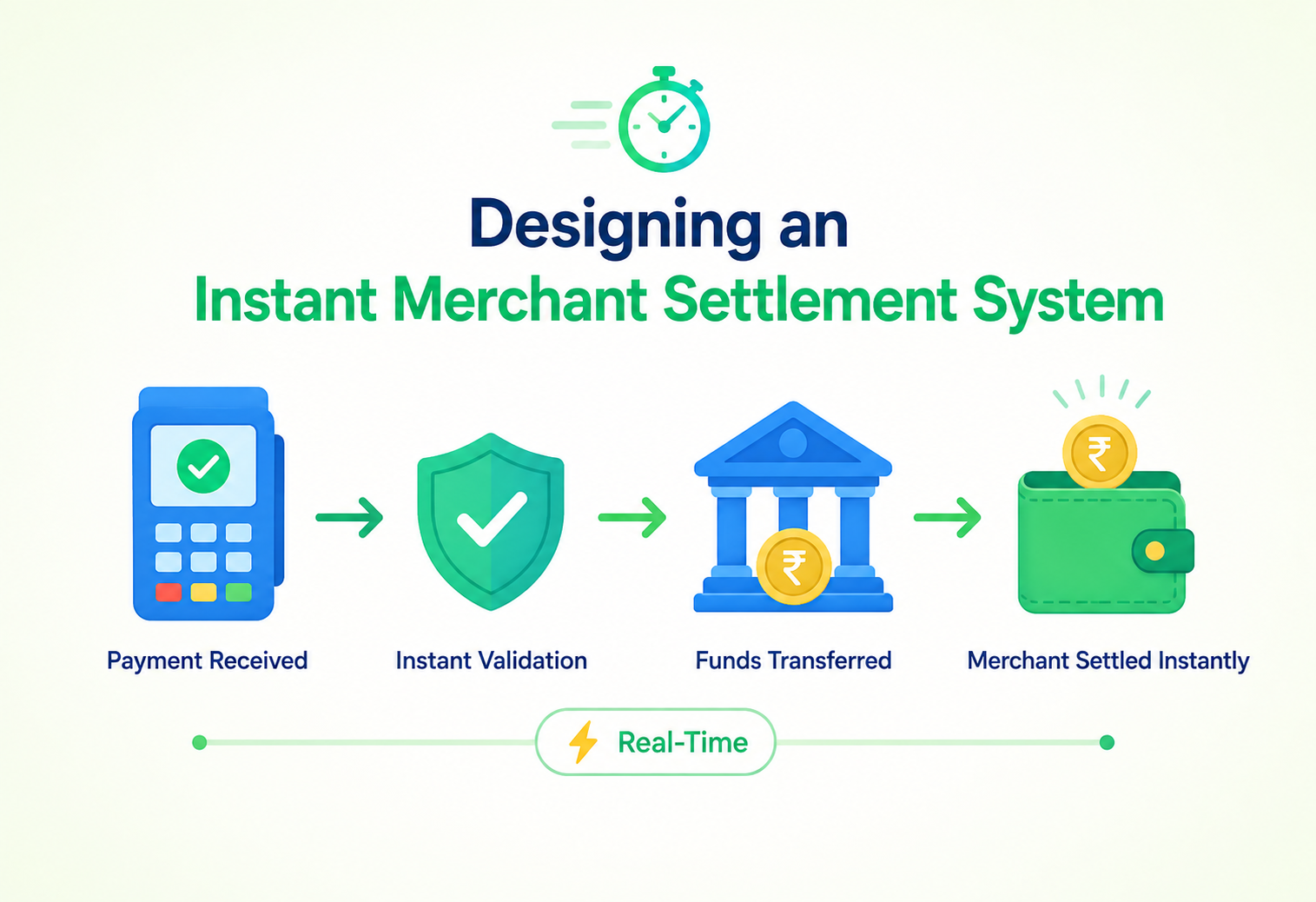
Designing an Instant Merchant Settlement System
A complete, interview-focused walkthrough of building a payment platform capability that moves money to merchants within seconds or minutes of a sale, replacing the traditional multi-day settlement cycle — without exposing the platform to unacceptable financial risk.
Introduction — Foundations
When a small coffee shop owner sells a cup of coffee using a card reader, something surprising happens behind the scenes: the customer’s bank has already released the money, but the coffee shop typically does not actually receive it for one to three business days. This gap exists because of how traditional card payment networks work — money moves through several intermediaries (the card network, the customer’s bank, the merchant’s bank, and the payment processor), each of which needs time to verify, clear, and net out transactions before actual cash changes hands. For decades, this delay was simply accepted as “how payments work.”
But for a merchant who depends on daily cash flow — to pay suppliers, staff, or simply keep the lights on — waiting three days for money they have already earned can be a real hardship. This is exactly the gap that instant, or real-time, settlement systems are built to close. Instead of making a merchant wait for the traditional multi-day cycle, the payment platform advances or directly transfers the money to the merchant’s bank account within seconds to minutes of the sale, while the platform itself absorbs and manages the underlying settlement timeline with the card networks and banks behind the scenes.
This sounds simple in one sentence, but it is one of the most operationally and financially risky features a payment platform can build. The platform is essentially promising to pay the merchant before it has fully and finally received the money itself, which means it must very quickly decide, for every single transaction, whether that transaction is trustworthy enough to pay out on immediately. Get this decision wrong at scale, and the platform can lose enormous amounts of money to fraud, chargebacks, or merchant insolvency, all before the underlying card transaction has even finished clearing through the traditional rails.
This tutorial explains how to design such a system the way a Software Architect would present it in a real design interview or a real engineering planning session — starting from the core financial challenge, through the architecture that makes instant payouts possible, all the way to the risk controls, ledger design, and monitoring that keep the platform financially safe while still delivering on the promise of speed. Every technical term is explained in plain language the first time it is used.
1.1 What “Instant Settlement” Actually Means
It is important to separate two different things that are easy to confuse: authorization (the moment a customer’s bank confirms the customer has enough funds and approves the sale, which already happens in real time today) and settlement (the moment money actually, finally moves between banks). Traditional card payments are authorized instantly but settle days later. An instant settlement system does not change how the underlying card networks settle — it changes when the merchant receives their money, by having the platform front the funds immediately and collect the actual settlement from the card networks on its own normal timeline, absorbing the timing gap itself.
1.2 Why This Is a Hard Problem
Three forces are in constant tension in a system like this:
Merchants want money in seconds
Not days — which pushes the platform toward paying out with minimal friction.
Every payout is fronted money
Money the platform is fronting before it has certainty the underlying sale will not be reversed (through a chargeback, a fraud dispute, or a refund), pushing the platform toward more caution and more checks.
Ready cash across many partners
The platform needs enough of its own readily available cash to fund a potentially enormous, spiky volume of instant payouts across thousands of merchants at once — pushing toward careful treasury and liquidity management.
Balancing these three forces, at very high transaction volume, without ever running out of cash or absorbing catastrophic fraud losses, is exactly what makes this such a rich and popular system design topic in FinTech and payments engineering interviews.
1.3 Who Actually Bears the Risk
It helps to be explicit about a question that is easy to gloss over: when the platform pays a merchant instantly and the underlying sale is later reversed through a chargeback, who loses the money? In almost every real design, the answer is the platform itself, at least in the first instance — the platform has already handed over cash it may not fully recover, and it must then attempt to claw that money back from the merchant, typically through the reserve balance described later in this tutorial, or from the merchant’s future earnings. If the merchant has no further funds coming and cannot repay the amount directly, the platform absorbs the loss. This single fact is what justifies almost every risk-related component in the rest of this architecture; every piece of extra complexity in this system, from risk scoring to reserves to liquidity management, exists specifically to keep that loss small, rare, and predictable rather than large, common, and unpredictable.
1.4 A Spectrum, Not a Binary Switch
It is also worth understanding that “instant settlement” is rarely offered as a single, all-or-nothing feature. Mature platforms typically offer a spectrum: same-day settlement, a few-hours settlement, and truly instant, minutes-or-seconds settlement, often at different price points and with different eligibility requirements attached to each tier. Thinking of the problem this way, rather than as one fixed target, gives the architecture much more flexibility — a merchant who does not yet qualify for true instant payout under the risk model can still be offered a faster-than-traditional option, which is both a better business outcome and a more gradual, safer way to expand access to the fastest tier over time as trust is established.
Sale authorized
Customer’s bank confirms funds exist and approves the sale — but no money has physically moved yet.
Ingestion & risk scoring
The instant-settlement pipeline evaluates fraud signals, merchant profile, and current exposure in under half a second.
Reserve, ledger, liquidity
Holdback percentage applied, balanced double-entry ledger record written, treasury confirms cash is available.
Merchant receives funds
Payout rail router picks the fastest safe path (real-time rail, push-to-card, or ACH fallback) and delivers cash to the merchant’s account.
Platform receives actual settlement
Card networks and banks settle to the platform on the traditional schedule; reconciliation confirms internal ledger matches external reality.
Architecture & Components — Blueprint
Think of the system as an air-traffic control tower for money: transactions land continuously, and before any plane (payout) is allowed to take off toward a merchant’s bank account, the tower must quickly check its risk profile, confirm there is enough fuel (liquidity) available, and choose the fastest safe route (payment rail) to get it there. Let us name each part of this tower.
2.1 High-Level Components
Transaction Ingestion Service
Receives confirmed, authorized sale events from the core payment processing flow the moment a card or digital payment is approved.
Eligibility & Risk Scoring Engine
Decides, in real time, whether a specific transaction and a specific merchant are safe enough to receive an instant payout, based on fraud signals, merchant history, and current exposure.
Merchant Risk Profile Service
Maintains an ongoing, continuously updated risk score and payout eligibility tier for every merchant, based on their history, business type, chargeback rate, and account age.
Double-Entry Ledger Service
The financial system of record; records every movement of money as balanced debit-and-credit entries so the platform always has a mathematically consistent view of who owes what to whom.
Reserve & Holdback Engine
Automatically withholds a small percentage of certain payouts into a reserve balance, used to absorb future chargebacks or refunds without the platform taking a direct loss.
Liquidity & Treasury Management Service
Tracks how much of the platform’s own operating cash is available for instant payouts in real time, across currencies and banking partners, and triggers funding actions when reserves run low.
Payout Rail Router
Decides which underlying money-movement rail to use for a given payout (for example, an instant push-to-card network, a real-time bank transfer rail, or a slower traditional bank transfer as a fallback), based on speed, cost, and availability.
Payout Execution Service
Integrates with banks, card networks, and real-time payment rails to actually initiate and track the movement of funds to the merchant’s account.
Reconciliation Service
Continuously compares the platform’s internal ledger against actual settlement reports from card networks and banks, to catch and resolve any mismatches.
Chargeback & Dispute Management Service
Handles cases where an already-paid-out transaction is later reversed, and coordinates recovering funds from the merchant’s reserve or future payouts.
Merchant Notification & Dashboard Service
Informs merchants of payout status, timing, and any holds in near real time.
Compliance & AML Screening Service
Screens payouts against regulatory watch lists and anti-money-laundering rules before funds are released.
Figure 1 — End-to-end architecture. Blue lines are the happy-path control flow, red lines are risk / chargeback recovery flows, green lines feed and reconcile the ledger, purple dashed lines are asynchronous audit logging.
“Why is the ledger placed so centrally in this design, rather than just tracking payouts in a normal application database?” A strong answer: unlike a typical application database, a double-entry ledger enforces that money is never created or destroyed by a bug — every entry must have a matching offsetting entry — which is essential in a financial system where a silent accounting error could mean the platform pays out money it does not actually have, or loses track of a merchant’s true balance, without anyone noticing until it is a large, hard-to-unwind problem.
2.2 Why Risk Scoring Sits Before the Ledger, Not After
A design mistake many teams make early on is deciding to “pay out first and check risk later.” This inverts the entire safety model — once money has left the platform, recovering it from a fraudulent or now-bankrupt merchant is far harder than simply declining or delaying the payout in the first place. By placing eligibility and risk scoring as a mandatory gate before any ledger entry authorizes a payout, the system ensures that every dollar sent out has already passed a real-time safety check, rather than treating risk management as cleanup after the fact.
2.3 How the Components Map to Distinct Failure Domains
Another way to appreciate this architecture is to notice that each major component is designed around containing one specific category of failure, rather than every component trying to guard against everything. The risk scoring engine exists to contain fraud and credit risk; the reserve engine exists to contain the financial impact of disputes that slip past risk scoring; the liquidity service exists to contain the operational risk of the platform running short on usable cash; the reconciliation service exists to contain the risk of silent data drift between the platform’s own records and external reality; and the compliance service exists to contain regulatory risk. Recognizing this separation is genuinely useful in an interview setting, because it shows an understanding that resilience in a financial system comes from many narrow, well-understood safety nets layered together, rather than from one single all-powerful risk check trying to catch every possible problem at once.
Internal Working — Under the Hood
Let us trace exactly what happens from the moment a sale is authorized to the moment funds land in the merchant’s bank account.
3.1 Step 1: Receiving the Authorized Sale
The moment a customer’s card payment is authorized by their bank — meaning the bank has confirmed the funds exist and approved the sale — the core payment processing flow emits an event containing the transaction amount, the merchant identifier, the payment method used, and a unique transaction identifier. This event is what triggers the instant settlement pipeline; nothing here waits for the card network’s actual settlement, which, as discussed, can still take days.
3.2 Step 2: Real-Time Risk and Eligibility Scoring
The risk scoring engine evaluates the transaction against several dimensions almost instantly: the merchant’s historical chargeback rate, how long the merchant has been active on the platform, whether this specific transaction looks statistically unusual for this merchant (an unusually large sale amount, for example), the merchant’s current total exposure (how much money is already outstanding in pending instant payouts that have not been fully settled), and broader fraud signals shared across the platform. Based on this, the transaction is assigned an eligibility outcome: approved for instant payout, approved with a partial holdback, delayed for manual review, or denied instant payout and routed to standard multi-day settlement instead.
3.3 Step 3: Reserve Calculation
For merchants who are approved but carry moderate risk — for example, a newer merchant or one in an industry with historically higher dispute rates — the reserve engine calculates a holdback percentage, withholding a small slice of the payout into a reserve balance rather than sending the full amount immediately. This reserve acts as the platform’s own insurance policy against a future chargeback on this specific transaction, without denying the merchant most of their money right away.
3.4 Step 4: Ledger Entry Creation
Once eligibility and reserve amounts are determined, the ledger service records a balanced set of entries: reducing the platform’s “funds owed to merchant” liability, increasing the “cash paid out” account, and, if applicable, increasing the “merchant reserve” liability account. This is the single moment the transaction becomes a real, tracked financial commitment inside the platform’s books, and it happens before any money physically moves, so the ledger always reflects the platform’s true financial position even if the actual bank transfer is still in flight.
3.5 Step 5: Liquidity Check
Before actually initiating the transfer, the treasury service confirms the platform currently has sufficient available operating cash, in the correct currency and in an account connected to the right payout rail, to cover this payout without breaching the platform’s own safety buffers. If liquidity is temporarily tight, lower-priority payouts can be queued for the next available liquidity refresh cycle, rather than the platform over-extending itself.
3.6 Step 6: Rail Selection and Execution
The payout rail router picks the fastest available and appropriate money movement method — a real-time payment rail if the merchant’s bank supports it, a push-to-debit-card option as another fast alternative, or a traditional bank transfer as a slower fallback if neither fast rail is available. The execution service then initiates the actual transfer and tracks its status until confirmation of receipt.
3.7 Step 7: Reconciliation
Separately, and continuously, the reconciliation service compares the platform’s internal ledger entries against the actual settlement files eventually received from the card networks and banks days later, confirming that what the platform’s books say happened truly matches what happened in the outside financial system, and flagging any mismatch for investigation.
Think of a landlord who lets a trusted long-term tenant move in immediately and pay the security deposit over the next few weeks, while a brand-new, unknown tenant is asked to pay the full deposit and first month up front before getting the keys. The risk scoring and reserve engine plays exactly this role — trusted, established merchants get fast, low-friction payouts, while newer or riskier merchants get a bit more caution applied before the platform hands over the money.
Data Flow & Lifecycle — Journey of a Payout
Figure 2 — Sequence of events from an authorized sale to funds arriving in the merchant’s account.
4.1 Payout Lifecycle States
Every instant payout moves through a well-defined set of states, which interviewers often ask candidates to enumerate explicitly: Received (the sale event has arrived), Scored (risk evaluation complete), Reserved (holdback amount calculated and applied if applicable), Ledgered (balanced entries recorded as the system of record), Funded (liquidity confirmed available), Routed (rail selected), Executing (transfer in flight), Settled (funds confirmed received by the merchant’s bank), and, for the unlucky minority, Reversed (a later chargeback or dispute claws back funds from reserve or future payouts).

4.2 Timing Budget for “Instant”
| Stage | Typical Budget | Why |
|---|---|---|
| Risk scoring | < 200 ms | Real-time lookup against merchant profile and fraud signals |
| Reserve calculation | < 50 ms | Simple rules and percentage lookup |
| Ledger write | < 100 ms | Balanced double-entry write, must be durable |
| Liquidity check | < 100 ms | Read against continuously updated cash position |
| Rail execution | Seconds to a few minutes | Depends entirely on the external rail’s own processing time |
Notice that the platform’s own internal processing (scoring, reserve, ledger, liquidity check) can realistically complete in under half a second, but the true end-to-end “instant” experience for the merchant is ultimately bounded by how fast the external payout rail itself can move money — which is exactly why choosing the right rail per transaction matters so much.
“What happens if the platform confirms a payout in its ledger, but the actual bank transfer later fails?” A strong answer describes a compensating transaction: the ledger records a new, offsetting entry reversing the original payout liability rather than silently deleting or editing the original entry, preserving a complete, honest audit trail of exactly what was attempted and what ultimately happened — deleting or mutating financial history is treated as unacceptable in a system of record.
Databases, Caching & Load Balancing — Storage Layer
5.1 The Ledger Database: Correctness Above All
The ledger is the single most sensitive data store in the entire system, and it prioritizes strong consistency and durability over raw speed — every write must be reliably persisted, and every debit must have a matching credit, with no exceptions, because a single lost or unbalanced entry represents real money the platform can no longer account for. This typically means using a relational database with strict transactional guarantees for the ledger’s core tables, even though other parts of the system may use faster but eventually-consistent stores.
5.2 Merchant Risk Profile Store
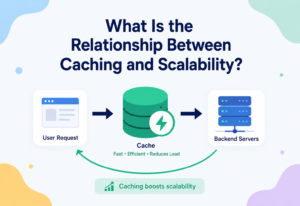
Because the risk scoring engine needs to read a merchant’s current profile on every single transaction, this data is kept in a fast, low-latency store — commonly an in-memory cache such as Redis sitting in front of a durable underlying database — so that a risk check adds only a few milliseconds of delay rather than becoming a bottleneck on the critical payout path. The profile is updated asynchronously as new transaction history, chargebacks, and account signals accumulate, rather than being recalculated from scratch on every single check.
5.3 Liquidity Position Store
The platform’s real-time available cash position, broken down by currency and by banking partner, is maintained in a fast, frequently updated store that every payout must check before execution. Because this value changes with every single payout and every incoming settlement, it uses an approach similar to a running balance with atomic increment and decrement operations, ensuring two simultaneous payouts cannot both read the same “available” amount and together overdraw the account — a classic race condition this design must explicitly guard against.
5.4 Historical Transaction and Audit Store
Every state transition in a payout’s lifecycle, along with the exact risk signals and reasoning behind each decision, is persisted in a durable, append-only historical store, separate from the live ledger and profile stores optimized for fast current-state access. This historical record is what powers dispute investigations, regulatory audits, and machine learning model retraining for the risk engine.
5.5 Load Balancing Strategy
Because most of this system’s traffic is a steady, high-volume stream of individually small, independent transactions rather than long-lived connections, standard stateless load balancing (spreading requests evenly across service instances) works well for the risk scoring, ledger write, and payout execution tiers. The one exception is the liquidity position store, where writes for a given currency-and-partner combination must be coordinated (often through a single logical owner or a distributed lock) to prevent the race condition described above, even while reads can be scaled out broadly.
| Store | Technology | Why |
|---|---|---|
| Double-entry ledger | Strongly consistent relational DB (e.g., PostgreSQL / spanner-style) | Transactional guarantees; balanced debit/credit invariant |
| Merchant risk profile | Redis in front of durable DB | Sub-millisecond profile lookup on every scoring call |
| Liquidity position | Atomic counter store, sharded per (currency, partner) | Serialized writes prevent double-spend race |
| Historical / audit log | Append-only columnar store (e.g., ClickHouse, S3+Parquet) | Regulatory retention, dispute investigations, ML retraining |
Payment platforms offering instant payouts commonly run their core ledger on a strongly consistent relational database cluster specifically because of the financial correctness guarantees it provides, while keeping merchant risk profiles and liquidity snapshots in a much faster in-memory layer that is refreshed continuously from the ledger, giving the risk and treasury checks the speed they need without compromising the ledger’s own integrity.
APIs & Microservices — Interfaces
6.1 Internal Event-Driven Core
The heart of the pipeline — ingestion, risk scoring, reserve calculation, ledger writing, liquidity checking, and rail routing — is built as a chain of services communicating through an event streaming backbone rather than direct synchronous calls, for the same reason a real-time data pipeline benefits from this pattern: each stage can be scaled and deployed independently, and a temporary slowdown in one stage (say, a spike in manual review volume) does not block or crash earlier stages, which simply continue queuing work durably.
6.2 Merchant-Facing APIs
Merchants and their accounting software interact with the platform through a REST API that lets them check the real-time status of a specific payout, view their current reserve balance, and see upcoming scheduled payouts — this is a request-response interface since merchants are checking status occasionally, not subscribing to a continuous stream of every internal event. A lighter-weight webhook mechanism separately notifies a merchant’s own systems the moment a payout status changes, so merchants do not have to constantly poll for updates.
6.3 Internal Risk and Compliance APIs
The risk scoring engine exposes an internal synchronous API used both by the automated instant-payout pipeline and by human risk analysts investigating a specific merchant, ensuring both the automated and manual review paths are always looking at the exact same underlying risk signals rather than two systems that could disagree with each other.

6.4 Microservice Boundaries
Splitting this system into focused services — risk scoring, ledger, treasury, rail routing, reconciliation — mirrors real organizational boundaries in a payments company: risk and compliance teams own the risk scoring and AML services, finance and treasury teams own the ledger and liquidity services, and payments infrastructure teams own rail integration. This alignment between service boundaries and team ownership is a deliberate and valuable design choice, not a coincidence, because it lets each team move independently while still integrating cleanly through well-defined APIs and events.
6.5 Why the Ledger Is Never Bypassed
Every single service that touches money — risk scoring approving a payout, the reserve engine holding back funds, the execution service confirming a transfer — writes through the ledger service rather than maintaining its own separate notion of balances. This single-source-of-truth design prevents the dangerous scenario where two different services disagree about how much money a merchant is actually owed, which would be a severe and hard-to-detect bug in any other kind of system, but a genuine financial and regulatory incident in a payments platform.
“Why use an event-driven backbone for the internal pipeline but a synchronous REST API for merchants checking payout status?” A good answer separates the two very different needs: the internal pipeline processes a continuous, high-volume stream where decoupling and durability matter most, while a merchant checking on one specific payout is a simple, occasional, single-answer question that a direct request-response call answers perfectly well without the added complexity of a subscription model.
Performance & Scalability — Scale
7.1 Where the Real Bottlenecks Are
The computation involved in scoring a single transaction or writing a single ledger entry is cheap in isolation. The real scaling challenge is sustaining a very high, steady throughput of these operations — potentially millions of transactions per minute during peak shopping periods — while keeping every single one strictly ordered and correctly accounted for, since financial correctness cannot be sacrificed for speed the way it sometimes can in less sensitive systems.
7.2 Horizontal Scaling of the Pipeline
The ingestion, risk scoring, and reserve calculation stages are largely stateless per transaction and can be scaled horizontally by simply adding more service instances behind the event streaming backbone, with the backbone partitioned (commonly by merchant identifier) so that all events for a given merchant are processed in order by a consistent set of workers, which matters because risk decisions for a merchant often depend on that merchant’s very recent transaction history.
7.3 Scaling the Ledger Without Losing Correctness
The ledger is the hardest part of this system to scale, precisely because of its strong consistency requirements. A common approach is to shard the ledger by merchant, so that all entries for a given merchant live on the same database partition and can be written with strong transactional guarantees without needing complex cross-shard coordination for the overwhelming majority of operations, while cross-merchant reporting and aggregation happen through a separate, asynchronously updated reporting layer rather than the live transactional path.
7.4 Liquidity as a Scaling Constraint, Not Just a Compute One
Unlike most system design problems, this one has a scaling constraint that has nothing to do with servers: the platform’s actual available cash. Even with infinite compute capacity, the system cannot pay out more money than it actually has readily available across its banking partners. This means capacity planning here includes financial capacity planning — treasury teams forecast expected payout volume and pre-position sufficient operating cash across currencies and banking relationships, treating available liquidity as a resource to be scaled and monitored just like CPU or database connections.
7.5 Handling Peak Volume Events
Major shopping events cause enormous, predictable spikes in both transaction volume and, consequently, payout demand. The system handles this through pre-emptive auto-scaling of the processing tiers ahead of known peak periods, combined with treasury pre-funding additional liquidity buffers in advance of the expected surge, since waiting to react to a liquidity shortfall in real time during a peak event is far riskier than planning for it ahead of time.
“How would you scale instant settlement to a country with a very different banking infrastructure and no fast payment rail available?” A thoughtful answer acknowledges this as fundamentally a liquidity and rail-availability problem, not a compute problem: the platform may need to hold pre-funded balances directly with local banking partners in that country and rely on whatever fastest local rail exists, even if it is slower than the rails available in more developed payment infrastructures, adjusting the “instant” promise’s actual timing per region based on real infrastructure constraints rather than pretending one global standard applies everywhere.
High Availability & Reliability — Resilience
8.1 No Single Point of Failure
Every service in the pipeline runs multiple redundant instances across availability zones, the event streaming backbone replicates every message across multiple brokers, and the ledger database runs with synchronous replication to a standby so a primary database failure does not lose any committed financial entries. The guiding principle, as in any serious financial system, is that no single machine or even data center failure should ever cause money to be lost or double-counted.
8.2 Idempotency: The Most Important Property in This System
Network retries, service restarts, and message redelivery are all normal, expected occurrences in a distributed system — but in a payments system, accidentally processing the same authorized sale event twice could mean paying a merchant twice for one sale. Every stage of the pipeline is designed around a unique transaction identifier attached at ingestion, with each service checking whether it has already processed that identifier before taking any action, guaranteeing that even if an event is delivered multiple times, its financial effect happens exactly once.
8.3 Graceful Degradation Under Partial Failure
If the risk scoring engine’s live fraud-signal service becomes temporarily unavailable, the system should not simply halt every payout platform-wide. Instead, it can fall back to a more conservative default policy — for example, temporarily routing all transactions to standard multi-day settlement, or applying a higher default reserve percentage — until the dependency recovers, preserving the platform’s safety even when it cannot offer its full “instant” experience for a short period.
8.4 Reconciliation as a Safety Net
Even with strong idempotency and consistency controls, real-world financial systems occasionally develop small discrepancies due to timing differences, partial failures, or external system quirks. The continuous reconciliation process comparing the platform’s internal ledger against actual bank and card network settlement reports acts as an essential second line of defense, catching and surfacing any drift between what the platform believes happened and what actually happened in the outside financial world, well before it can grow into a larger unnoticed problem.
8.5 Disaster Recovery for Financial Data
The ledger and transaction history are backed up continuously and replicated to a geographically separate region, with regular, tested recovery drills — not just backups that are assumed to work — because for a system holding the definitive record of who is owed what money, an untested or failed recovery process during an actual disaster would be a catastrophic, potentially unrecoverable failure for the business.
Payment platforms offering instant payouts typically maintain dedicated treasury operations teams working alongside the engineering team, continuously monitoring real-time liquidity dashboards, because the reliability of this feature depends not just on servers staying up, but on the platform’s own bank accounts always having sufficient pre-positioned funds available.
Security — Protection
9.1 Preventing Fraudulent Instant Payout Requests
Because instant settlement moves real money out the door before the underlying card transaction has fully cleared, it is a natural target for fraud — for example, a bad actor setting up a fake merchant account, running fraudulent transactions, and cashing out through instant payout before the fraud is detected. The risk scoring engine’s merchant onboarding checks, ongoing behavioral monitoring, and velocity limits (capping how much a newly onboarded or higher-risk merchant can receive through instant payout in a given period) are core defenses against exactly this pattern.
9.2 Compliance and Anti-Money-Laundering Screening
Every payout is screened against regulatory watch lists and anti-money-laundering rules before funds are released, since instant settlement could otherwise be misused to move illicit funds quickly before authorities have a chance to intervene. This screening happens as a mandatory step in the pipeline, not an optional or after-the-fact check, and a match against a restricted list halts the payout for mandatory human review regardless of how strong the transaction’s other risk signals look.
9.3 Securing the Ledger and Treasury Systems
Access to the ledger and treasury services is tightly restricted using the principle of least privilege — only the specific services that need to write ledger entries or initiate fund transfers are granted that permission, every such action is authenticated and logged, and particularly sensitive actions like manually overriding a risk decision require a second authorized approver, similar to the two-person rule used in traditional bank operations, rather than trusting any single automated decision or individual alone.
9.4 Protecting Merchant and Banking Data
Merchant bank account details and other sensitive financial information are encrypted both in transit and at rest, and access to this data is scoped narrowly to only the specific services (like the payout execution service) that genuinely need it to move money, rather than being broadly readable across the platform.
9.5 Audit Trails and Non-Repudiation
Every risk decision, every ledger entry, and every payout execution is permanently and immutably logged with the specific reasoning or signals behind it. This is essential both for regulatory compliance and for resolving merchant disputes — if a merchant claims a payout was wrongly delayed or a reserve was wrongly applied, the platform must be able to reconstruct exactly what happened and why.
“How would you detect a coordinated fraud ring opening many seemingly unrelated merchant accounts to exploit instant payouts?” A strong answer discusses looking beyond any single merchant’s individual risk score toward cross-merchant pattern detection — shared banking details, shared device fingerprints, shared IP addresses, or unusually similar onboarding timing and transaction patterns across accounts that otherwise look independent — since sophisticated fraud rings are specifically designed to look unremarkable when each account is evaluated in isolation.
Monitoring, Logging & Metrics — Visibility
10.1 The Metrics That Matter Most
Beyond standard system health metrics, this system tracks financial health metrics as first-class signals: total outstanding instant payout exposure (how much money has been paid out but not yet finally settled with the card networks), real-time available liquidity per currency and banking partner, the reserve fund balance relative to projected chargeback risk, and the fraud loss rate on instantly settled transactions compared to standard settlement, since a rising fraud loss rate on instant payouts specifically would indicate the risk model is not keeping pace with how fraudsters are adapting.

10.2 Ledger Integrity Monitoring
An automated, continuously running check verifies that the ledger remains balanced at all times — that the sum of all debits equals the sum of all credits across the entire system — with any imbalance, even a tiny one, treated as a critical, page-immediately incident, because a ledger imbalance signals a bug capable of silently losing track of real money.
10.3 Liquidity Alerting
Real-time dashboards track available liquidity against a set of warning thresholds per currency and banking partner, with automated alerts firing well before liquidity actually runs out, giving the treasury team time to move additional funds into position rather than discovering a shortfall only when a payout actually fails.
10.4 Pipeline Latency and Throughput
Each stage of the payout pipeline — risk scoring, reserve calculation, ledger write, liquidity check, and rail execution — is individually timed, so that when a merchant reports a slower-than-expected payout, engineers can pinpoint exactly which stage introduced the delay rather than investigating the entire pipeline from scratch.
10.5 Reconciliation Discrepancy Tracking
The reconciliation service reports the count and total value of any discrepancies found between the internal ledger and actual bank settlement reports, trending this over time — a rising trend here, even if each individual discrepancy is small, is an early warning sign of a systemic bug worth investigating immediately rather than dismissing as noise.
Payment platforms with instant payout features commonly maintain a dedicated real-time “risk and treasury” operations dashboard, distinct from standard engineering monitoring dashboards, specifically because the people responsible for financial risk and liquidity need visibility into business-level financial health metrics that a typical infrastructure dashboard would never surface.
Deployment & Cloud — Rollout
Containerized microservices
Each service in the pipeline is packaged as an independent container and deployed onto a container orchestration platform, allowing independent scaling, independent deployment, and automatic recovery from individual instance failures, consistent with standard modern microservice deployment practice.
Multi-region deployment for financial data
Given the criticality of the ledger and treasury systems, the platform typically runs across at least two geographically separate regions, with the ledger database replicating synchronously or near-synchronously to a standby region, so that a regional outage does not risk losing any committed financial record, even though this stronger consistency requirement can add some latency compared to fully asynchronous replication approaches used elsewhere in less sensitive systems.
Careful, gradual rollout of risk model changes
Because a bug or miscalibration in the risk scoring model could directly translate into real financial losses, changes to risk scoring logic are rolled out through a “shadow mode” first — the new logic runs alongside the existing production logic and its decisions are logged and compared, but not actually acted upon — before being gradually promoted to control a small percentage of real traffic, and only fully promoted once its behavior has been thoroughly validated against real-world outcomes.
Infrastructure as code
All infrastructure, including the event streaming cluster, database replication topology, and access control policies, is defined in version-controlled configuration, making the environment reproducible, auditable by compliance teams, and quick to recreate during disaster recovery.
Regulatory and compliance considerations in deployment
Because payment platforms operate under financial regulation, deployment processes typically include mandatory compliance sign-off steps for any change touching the ledger, risk scoring, or compliance screening logic, and maintain detailed change logs suitable for regulatory audit — a deployment practice that goes beyond typical software engineering concerns into genuine financial governance.
Design Patterns & Anti-Patterns — Reusable Wisdom
12.1 Patterns Used in This System
Double-Entry Bookkeeping
Every financial movement is recorded as a balanced pair of entries, providing a built-in, mathematically enforced correctness check that a typical single-value balance field could never offer.
Saga Pattern
A payout that fails partway through (for example, after the ledger entry but before the actual bank transfer completes) is resolved through a defined sequence of compensating actions rather than leaving the system in an inconsistent, half-finished state.
Circuit Breaker
If an external payout rail or a risk data provider becomes unhealthy, the system automatically stops relying on it and falls back to an alternative or a safer default, preventing that external failure from cascading into the rest of the pipeline.
Idempotent Consumer
Every processing stage safely handles receiving the same event more than once, which is essential given the retries and redeliveries inherent to distributed, event-driven systems.
Tiered Risk-Based Access
Treating merchants differently based on an ongoing risk tier, rather than applying one uniform policy to every merchant, mirrors how real financial institutions manage credit risk and directly reduces the platform’s overall exposure.
12.2 Anti-Patterns to Avoid
- Paying out before recording the ledger entry: executing the actual fund transfer before the ledger has durably recorded the corresponding entries risks the platform losing track of a payout entirely if a failure occurs in between, since there would be no financial record of the money having left.
- Treating risk scoring as a one-time onboarding check: evaluating a merchant’s risk only once, when they join the platform, rather than continuously, misses the reality that a merchant’s risk profile can change significantly over time, sometimes specifically because they are being used for fraud.
- Single-currency liquidity thinking: assuming liquidity is one single pool of cash rather than tracking it separately per currency and banking partner leads to a dangerous blind spot where the platform might have plenty of cash overall but insufficient funds actually available where and in the currency it is needed.
- Silent risk model drift: deploying risk model updates without shadow-mode validation or comparison against prior model behavior risks a subtle miscalibration going unnoticed until it has already caused meaningful financial losses.
“Why use the Saga pattern here instead of a traditional distributed transaction?” A solid answer: a traditional distributed transaction requires all participating systems to support the same transactional protocol and generally requires holding locks across systems until every participant commits, which is impractical when one of the “participants” is an external bank or card network the platform does not control. The Saga pattern instead breaks the payout into a sequence of local steps, each with a defined compensating action if a later step fails, which works naturally across systems the platform does not fully control.
Advantages, Disadvantages & Trade-offs — Balancing Act
Advantages of this architecture
- Merchants receive funds within seconds to minutes, dramatically improving their cash flow compared to traditional multi-day settlement.
- Tiered, continuous risk scoring allows the platform to offer instant payout broadly while still protecting itself from its highest-risk transactions and merchants.
- The double-entry ledger provides strong, auditable financial correctness that scales cleanly as transaction volume grows.
- Event-driven decoupling allows each stage of the pipeline to scale and evolve independently, matching how real payments organizations are structured.
Disadvantages and costs
- The platform takes on direct financial risk it did not carry under traditional multi-day settlement, since it is now fronting money before the underlying transaction has fully cleared.
- Maintaining sufficient pre-positioned liquidity across currencies and banking partners has a real, ongoing capital cost, distinct from typical infrastructure costs.
- The risk scoring and reserve systems add genuine complexity and require ongoing tuning, data science investment, and human oversight, rather than being a “build once and forget” component.
13.1 Key Trade-offs
| Trade-off | Choosing Speed | Choosing Safety |
|---|---|---|
| Risk scoring depth | Lighter checks, faster payout decision | Deeper checks, slightly slower but lower fraud exposure |
| Reserve percentage | Lower holdback, merchant gets more cash immediately | Higher holdback, more protection against future chargebacks |
| Rail selection | Fastest available rail regardless of cost | Cost-optimized rail, potentially a little slower |
As with most financial system design problems, there is no universally correct setting for these trade-offs — the right balance depends on the platform’s risk appetite, the specific merchant segment being served, and the maturity of the underlying fraud and risk models.
13.2 The Cost of Being Wrong in Either Direction
It is worth being explicit about what failure looks like on each side of these trade-offs, since it is not symmetric. Erring too far toward safety — overly conservative risk scoring, unnecessarily high reserve percentages, or defaulting too often to slower fallback rails — mostly costs the platform in the form of merchant dissatisfaction and lost competitive advantage, since merchants who feel unfairly held back will often move to a competitor offering a smoother instant payout experience. Erring too far toward speed — overly permissive risk scoring, too-low reserves, or racing to the fastest rail regardless of its own reliability — risks direct, sometimes severe, financial losses that can materialize weeks after the fact, once chargebacks and disputes for fraudulent transactions finally surface. Because the costs of these two kinds of mistakes show up on very different timelines and are owned by different parts of the business, mature platforms deliberately build feedback loops that connect eventual chargeback outcomes back into the risk model’s ongoing training and tuning, rather than only measuring success by how many transactions were approved for instant payout in the moment.
Best Practices & Common Mistakes — Doing It Right
Best practices
- Never let a payout leave the platform without a corresponding, already-committed ledger entry recording it — the ledger entry must always come first.
- Treat merchant risk as continuously evolving, not a one-time onboarding decision, and re-evaluate regularly using fresh transaction history.
- Design every pipeline stage to be idempotent from the very beginning, given how central duplicate-safe processing is to financial correctness.
- Track liquidity per currency and per banking partner explicitly, never as one single aggregate number.
- Validate risk model changes in shadow mode against real production traffic before letting them make live decisions.
Common mistakes
- Launching instant payout broadly to all merchants at once rather than starting with the platform’s lowest-risk, longest-tenured merchants and expanding gradually as confidence in the risk model grows.
- Underestimating the operational cost of maintaining sufficient liquidity, treating it as a one-time infrastructure decision rather than an ongoing treasury management responsibility.
- Building reconciliation as an afterthought rather than a first-class part of the system from day one, and only discovering ledger drift much later once it has already grown significant.
- Applying a single, uniform reserve percentage to every merchant regardless of actual risk, which either over-penalizes trustworthy merchants or under-protects the platform against risky ones.
- Not load-testing the liquidity check and ledger write paths for the specific concurrency patterns of a real peak sales event, and discovering a race condition only in production.
Real-World Industry Examples — In Practice
E-commerce payment processors
Major payment processors serving online sellers offer instant or same-day payout features that let a merchant move their available balance to their bank account in minutes rather than waiting for the standard settlement cycle, typically charging a small fee for this faster option — directly reflecting the real cost and risk the platform takes on by fronting the funds early.
Point-of-sale and small business platforms
Point-of-sale companies serving small, in-person businesses like restaurants and retail shops commonly offer an instant deposit feature specifically because small businesses are especially cash-flow sensitive, using tiered risk-based eligibility so that trusted, established merchants get instant access by default while newer merchants build up that eligibility over time.
Card network push-payment rails
Card networks themselves offer push-to-card capabilities that let money move directly onto a debit card in near real time, which payment platforms integrate as one of several available payout rails, selecting it dynamically for merchants and banks that support it while falling back to other rails where it is not available.
Gig economy and marketplace platforms
Platforms connecting independent workers or sellers with customers commonly offer instant payout for completed jobs or sales, applying particularly careful risk scoring and reserve policies given how quickly new worker or seller accounts can be created, which makes this segment a common target for exactly the kind of onboarding fraud discussed earlier in this tutorial.
Frequently Asked Questions — Quick Answers
Does instant settlement change how quickly the platform itself receives money from the card networks?
No — the underlying card network settlement timeline to the platform generally remains unchanged. Instant settlement changes when the merchant receives their money, with the platform choosing to front those funds from its own operating cash and absorb the timing gap itself, recovering the actual funds from the card networks on the normal, slower schedule.
What happens to a merchant’s reserve balance over time?
As transactions age past the typical window during which a chargeback or dispute could realistically occur, and no dispute has been raised, the held reserve amount for those transactions is released back to the merchant, gradually returning funds that were never actually needed to cover a loss.
How does the platform decide the right reserve percentage for a given merchant?
Through the merchant risk profile service, which factors in the merchant’s own historical chargeback and dispute rate, their industry’s typical dispute rate, how long they have operated on the platform, and any anomalies in their recent transaction pattern, producing a personalized reserve percentage rather than one fixed value applied to everyone.
Can a merchant lose more money in disputes than their available reserve covers?
Yes, in principle, if disputes significantly exceed the reserve amount, which is why the risk scoring and eligibility engine exists in the first place — its whole purpose is to keep the probability and typical size of this scenario low enough that the platform’s overall reserve pool and financial buffers can absorb it without material loss, rather than eliminating the possibility entirely.
How is this system tested before going live with real money?
Through extensive simulation using historical transaction and chargeback data to validate the risk model’s decisions against known real-world outcomes, load testing the ledger and liquidity check paths under realistic peak concurrency, and a careful, gradual rollout starting with the platform’s most trusted merchant segment before expanding further, rather than testing only in an idealized, low-volume staging environment.
Is instant settlement offered for free, or does it typically come with a fee?
Most platforms charge a small fee for instant or same-day payout options, distinct from their standard settlement, which is offered at no extra charge on the traditional multi-day timeline. This fee is a direct, transparent reflection of the real financial cost and risk the platform takes on by fronting funds early, and it also naturally discourages merchants from requesting instant payout for every single small transaction when it is not genuinely needed, keeping overall system load and liquidity demand more predictable.
Summary & Key Takeaways — Wrap-Up
The big picture
An instant merchant settlement system is fundamentally about the platform taking on carefully managed financial risk on behalf of its merchants — fronting money the moment a sale is authorized rather than making the merchant wait for the traditional multi-day card settlement cycle to complete. Making this safe and sustainable at scale requires real-time risk and eligibility scoring on every single transaction, a strict double-entry ledger that never lets money go untracked, a reserve mechanism that protects the platform against future chargebacks without unduly penalizing trustworthy merchants, and careful treasury and liquidity management that treats available cash as a first-class scaling constraint, not just a compute or database problem.
Every architectural choice in this system traces back to that central tension between speed and risk: an event-driven pipeline that lets processing scale independently at each stage; idempotent, durable processing that guarantees financial correctness even under retries and partial failures; tiered, continuously updated merchant risk profiles rather than one-time onboarding checks; and monitoring that treats financial health metrics like liquidity and ledger balance as seriously as any conventional system health metric.
Whether explaining this system in an interview or actually building it, the strongest engineers are the ones who can clearly articulate why speed alone was never the real design challenge — the real challenge is delivering that speed while keeping the platform’s own books, cash position, and fraud exposure completely and provably under control at every single moment.