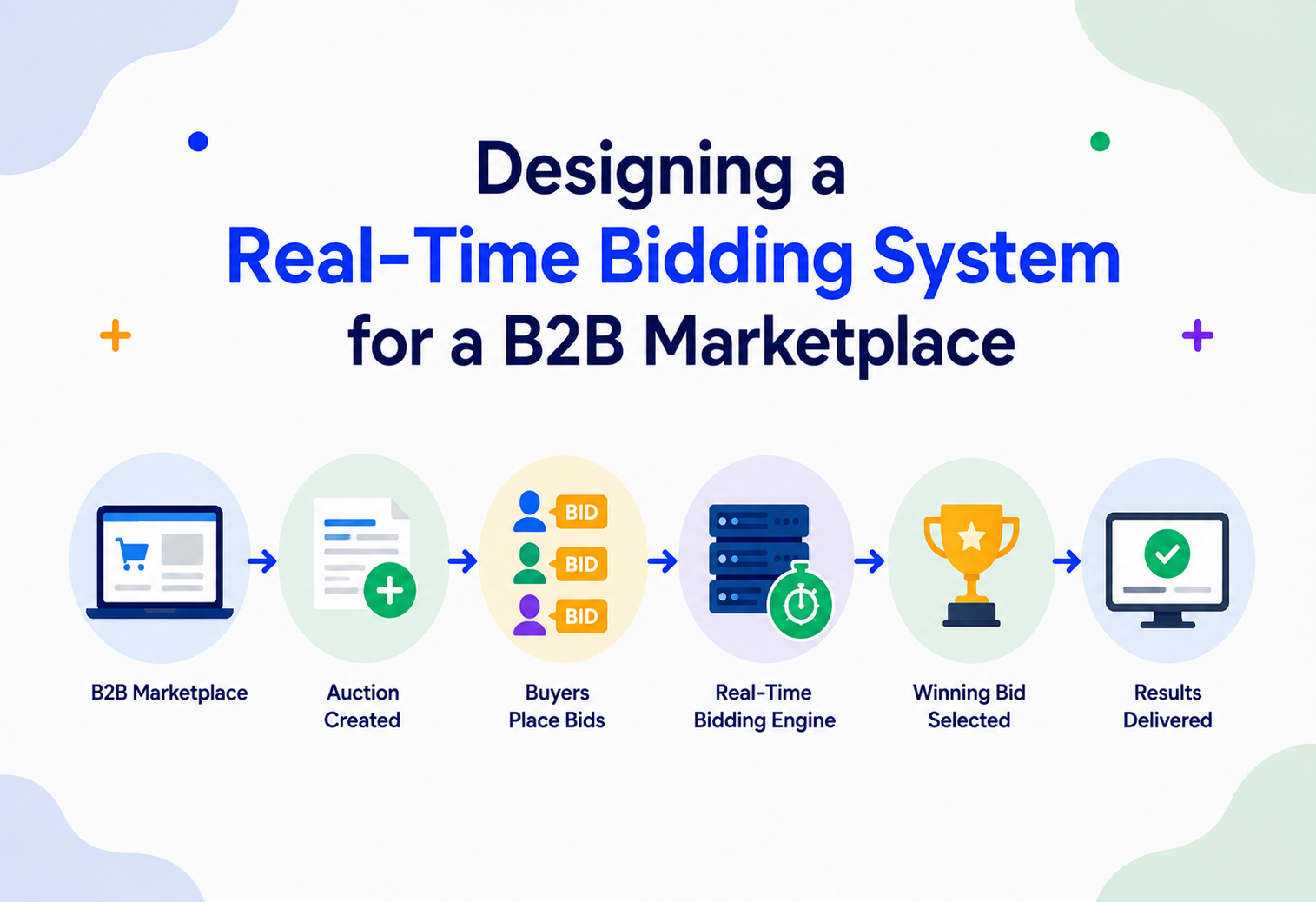
Designing a Real-Time Bidding System for a B2B Marketplace
How do you let hundreds of buyers compete simultaneously for the same limited batch of supplier inventory, guarantee every bid is processed in a fair, strict order, and broadcast live updates to every participant within milliseconds — all without ever letting two buyers believe they both won the same lot?
Introduction & History
Picture a room full of buyers at a traditional auction house, each holding a paddle, all watching the same auctioneer, all hearing every new bid announced at the exact same instant, in the exact same order. Nobody ever wonders “wait, did my bid actually count, and did it come before or after that other buyer’s bid?” — the room itself, and the auctioneer’s voice, make the order unambiguous to everyone at once.
Now take that same experience and scatter the buyers across a hundred different cities, each looking at their own laptop screen, submitting bids over an unreliable public internet connection, sometimes within milliseconds of each other. A real-time B2B bidding system is the software equivalent of that auctioneer’s room — a platform that lets many geographically distributed buyers compete for the same limited pool of supplier inventory through a live auction, while guaranteeing every single participant sees a fair, consistent, correctly-ordered view of who is currently winning, and the platform itself never allows more than one buyer to believe they’ve won the exact same lot.
1.1 Why B2B bidding is a different problem from consumer auctions
Consumer auction sites are a familiar mental starting point, but B2B real-time bidding for supplier inventory has its own distinct pressures that shape this architecture.
Inventory is finite and often fungible
A supplier auctioning off 500 units of a raw material isn’t selling one unique item — bids may need to be allocated across a quantity, not just a single winner-take-all lot.
Professional bidders, professional stakes
Buyers are businesses making high-value procurement decisions, often bidding programmatically through their own automated systems, not casually browsing on a phone.
Compressed bidding windows
Many B2B auctions run for minutes, not days, to clear inventory quickly, meaning the system has far less slack time to recover gracefully from any delay or inconsistency.
Contractual and financial stakes
The outcome of the auction typically becomes a binding purchase agreement, so the fairness and correctness of the bid ordering carries real legal and financial weight.
1.2 A short history of the problem
Page-refresh based online auctions
Early online auction sites required buyers to manually refresh a page to see the current highest bid, meaning “real time” really meant “as fresh as your last refresh,” with no true live experience.
Polling-based live updates
Sites began using background polling — the browser silently asking the server “anything new?” every few seconds — giving the illusion of live updates while still introducing a small, noticeable lag.
WebSockets enable true push-based updates
The widespread adoption of the WebSocket protocol let servers push new bid updates to every connected buyer instantly, the moment they happened, rather than waiting for the client to ask.
Event sourcing and strict per-auction ordering
As B2B and financial-style auction platforms matured, teams increasingly adopted event-sourced architectures with a single, strictly ordered event log per auction lot, borrowing techniques from stock exchange matching engines to guarantee fairness under concurrent bidding.
Programmatic and proxy bidding at scale
Modern B2B platforms increasingly support automated proxy bidding (a buyer sets a maximum they’re willing to pay, and the system bids incrementally on their behalf) and must handle bursts of algorithmic bidding from buyers’ own procurement systems, not just human clicks.
By the end of this tutorial, you will understand how to design a real-time bidding pipeline that combines the strict, fair ordering guarantees of a financial matching engine with the live, low-latency broadcast experience buyers expect from a modern web application.
1.3 Why this problem sits at the intersection of several disciplines
Building this well pulls together at least four distinct engineering disciplines, and a strong system designer needs to move comfortably between all of them.
Distributed systems and concurrency theory
Guaranteeing a strict, provable ordering of concurrent writes to a shared, contended resource is a classic distributed systems problem, borrowing techniques from consensus and single-writer partitioning.
Real-time web architecture
Delivering live updates to hundreds of simultaneously connected buyers with minimal perceived lag requires genuine expertise in persistent connection management at scale.
Auction theory and market design
Decisions like minimum increments, anti-sniping windows, and proxy bidding rules are not arbitrary engineering choices — they come from decades of economic research into what makes an auction mechanism genuinely fair and efficient.
Legal and financial compliance
Because the auction’s outcome becomes a binding commercial agreement, the system must produce an audit trail robust enough to stand up to a legal or regulatory challenge.
Keeping this framing in mind helps you answer follow-up interview questions gracefully, since interviewers often probe from whichever of these four angles matches their own background — moving comfortably between “how do you guarantee ordering under concurrency” and “why does anti-sniping exist at all” and “how would you defend this outcome to an auditor” is exactly the kind of well-rounded judgment senior system design interviews are designed to surface.
Problem & Motivation
Let’s ground this in the specific mechanics of the failure modes this system must prevent.
The system must accept bids from many geographically distributed buyers concurrently, yet produce a single, unambiguous, strictly ordered sequence of events for any given auction lot — and it must broadcast the resulting state to every connected buyer fast enough that nobody feels like they’re bidding against stale information.
2.1 Why this is a genuinely hard system design problem
Concurrent writes to a single, contended resource
Every bid on the same auction lot competes for the same logical resource — “what is currently the winning bid” — which fundamentally resists naive horizontal scaling the way stateless read traffic does.
Fairness under network jitter
Two buyers might click “bid” at almost the same physical instant, but arrive at the server at different times due to differing network latency; the system must define, and consistently apply, what “first” actually means.
Real-time fan-out at scale
Every accepted bid must be broadcast to potentially hundreds of simultaneously connected bidders on that same lot, without the broadcast mechanism itself becoming a bottleneck or a source of inconsistent views.
Anti-sniping
Without protection, a bidder could submit a winning bid in the literal final second of the auction, leaving no time for anyone else to respond — undermining the very idea of a competitive auction.
Auditable, legally defensible outcomes
Because the auction’s result becomes a binding commercial agreement, the exact sequence of events leading to that outcome must be fully reconstructable and defensible after the fact.
Partial-quantity allocation
Many B2B lots involve a bulk quantity that may need to be allocated across multiple winning bids at different price levels, not simply a single highest bidder taking everything.
A real-time auction is not really a real-time systems problem first — it is a fairness and ordering problem first, and a real-time systems problem second. This framing shapes every architectural decision that follows.
2.2 Why “just use a database row and a lock” doesn’t scale as an answer
It is tempting to imagine solving this with a single database row holding “current highest bid,” updated inside a transaction with a lock preventing concurrent writes. This works correctly for a single auction lot at low volume, but it does not answer several questions this tutorial needs to answer completely: how do you broadcast the new state to hundreds of live bidders the instant it changes, how do you extend the auction fairly if a bid arrives in the final seconds, how do you scale to thousands of simultaneous auction lots each with their own contention, and how do you produce a fully auditable history of every bid, accepted or rejected, and why. A single locked database row is a reasonable starting point for the correctness core of the problem, but the full system needs quite a bit more built around it.
Why can’t you just let every bid write directly to the database and use the highest value at query time? — A strong answer identifies that this approach cannot guarantee a strict total order of events under true concurrency; two bids arriving within microseconds of each other might commit in either order depending on database internals, with no clear, auditable record of which one was genuinely first. It also does nothing to solve real-time broadcast to bidders, nor does it provide a clean mechanism for anti-sniping extensions or partial-quantity allocation, all of which require an explicit, ordered event pipeline rather than a bare table update.
2.3 The three stakeholders whose needs must all be balanced
| Stakeholder | What they need | What happens if ignored |
|---|---|---|
| Buyers | Confidence that every bid was fairly considered in the correct order, and a genuinely live view of the competition | Buyers who suspect the process is unfair or laggy will simply stop participating, starving the marketplace of demand |
| Suppliers | Assurance the auction mechanism will surface true market price for their inventory, free of manipulation | Suppliers who suspect shill bidding or unfair advantage toward certain buyers will take their inventory elsewhere |
| The marketplace operator | A legally defensible, fully auditable record of every auction’s outcome | Without this, any disputed outcome becomes a costly, hard-to-resolve conflict with real reputational and legal risk |
2.4 Why fairness, not raw speed, is the true north star
It’s tempting to frame this purely as a low-latency engineering challenge, but speed alone is not the goal — a system that broadcasts updates in ten milliseconds but occasionally processes two nearly-simultaneous bids in the wrong order is worse than one that takes fifty milliseconds but is always provably correct. The entire architecture in this tutorial is built around getting the ordering guarantee unquestionably right first, and only then optimizing aggressively for speed within that constraint, rather than the reverse.
Core Concepts
Before drawing the architecture, let’s build a shared vocabulary for every technique this system relies on.
3.1 Single-writer, per-auction sequencing
What: A design where every bid for a specific auction lot is processed by exactly one logical, ordered stream — often achieved by partitioning bids by auction lot identifier and ensuring only one consumer processes a given partition at a time.
Why: This is the single most important idea in the entire system. By guaranteeing that all bids for the same lot pass through one strictly ordered pipeline, the question “which bid came first” has one unambiguous, provable answer, even though bids for different lots are processed fully in parallel across the platform.
Think of many separate auctioneers running many separate auctions in the same building simultaneously — each auctioneer handles their own room’s bids in strict order, but the auctioneers never need to coordinate with each other, since their rooms (auction lots) are entirely independent.
3.2 WebSockets and real-time fan-out
What: A persistent, bidirectional connection between a buyer’s browser and the server, allowing the server to push new bid updates instantly, without the client needing to ask.
Why: Polling for updates every few seconds is both slower than buyers expect in a competitive bidding context and wasteful at scale; a persistent connection lets the platform push the new highest bid the instant it is accepted.
Practical example: The moment the Auction Engine accepts a new highest bid, a broadcast service pushes that update to every WebSocket connection currently subscribed to that specific auction lot, typically within a couple hundred milliseconds.
3.3 Optimistic concurrency control
What: A concurrency strategy where a write includes the version of the data it expected to be modifying, and is rejected if that version has since changed, rather than acquiring a lock upfront and holding it for the duration of the operation.
Why: At high bid volume, holding a pessimistic lock on an auction lot’s state for the full duration of every bid’s validation would create a serialization bottleneck; optimistic concurrency lets validation happen without blocking, only rejecting and prompting a retry in the rare case of a genuine conflict.
3.4 Anti-sniping (auction extension)
What: A rule that automatically extends an auction’s closing time by a short window whenever a new qualifying bid is placed very close to the scheduled end, preventing a bidder from winning simply by waiting until the last possible instant.
Why: Without this, the fairest possible strategy for any sufficiently sophisticated bidder is to submit their true bid in the final second, denying every other participant any chance to respond — auction extension restores genuine competition right up to the true close.
Beginner example: If a new highest bid arrives with 10 seconds left on the clock, the auction automatically extends by, say, 60 more seconds, giving other bidders a fair chance to respond, and this can repeat as long as new qualifying bids keep arriving within the extension window.
3.5 Proxy bidding
What: A bidder specifies the maximum price they are willing to pay once, and the system automatically places incremental bids on their behalf, only as high as needed to remain the current leading bid, up to their specified maximum.
Why: This removes the need for a buyer to manually watch the auction and respond in real time to every competing bid, while still preserving genuine price competition, since the system only reveals as much of a buyer’s true maximum as competition actually requires.
3.6 Event sourcing
What: Storing every meaningful change as an immutable, ordered event (bid submitted, bid accepted, bid rejected, auction extended, auction closed) rather than only storing the current state, so the full history can always be reconstructed and replayed.
Why: Given the legal and financial stakes of an auction’s outcome, being able to reconstruct exactly what happened, in what order, and why any given bid was accepted or rejected, is not optional — it is a core requirement, and event sourcing provides this naturally as a byproduct of how state changes are stored in the first place.
3.7 Backpressure on the bid ingestion path
What: A signal that flows backward from the Auction Engine to the Bid Validation Service and API Gateway, indicating that bids for a specific lot are arriving faster than the single-writer pipeline can process them, so upstream components should slow acceptance rather than pile up an unbounded backlog.
Why: Because a single lot’s ordering guarantee fundamentally requires serialized processing, an extremely hot lot could otherwise accumulate an ever-growing queue of unprocessed bids, each one becoming progressively more stale by the time it’s finally evaluated; backpressure lets the system respond honestly, for example by briefly rejecting or delaying acceptance, rather than silently degrading fairness for bids stuck deep in a growing backlog.
3.8 Total ordering versus causal ordering
What: A total order arranges every event in one single, unambiguous sequence. A causal order only guarantees that events which genuinely depend on each other appear in the correct relative sequence, while independent events may be interleaved in any order.
Why: This system deliberately requires total ordering within a single auction lot — there is no meaningful concept of two bids on the same lot being “independent” of each other, since accepting one directly affects whether the next is even valid. Across different lots, however, only causal independence is needed, which is exactly why the partitioning-by-lot design is sufficient and appropriately not over-engineered into a single, platform-wide total order that would needlessly bottleneck the entire system.
The entire architecture exists to make one single-lot, single-threaded, strictly-ordered decision — “which bid is currently winning” — appear instantaneous and consistent to hundreds of geographically distributed buyers at once, while still scaling horizontally across thousands of independent, simultaneously running auction lots.
Architecture & Components
Let’s assemble every concept above into one coherent picture. Every box below is a distinct, independently deployable component, labeled explicitly.
Layer 7 Health Checked”] LB –> GW[“API Gateway
AuthN Rate Limiting Routing”] GW –> WSGateway[“WebSocket Gateway
Persistent Live Connections”] GW –> BidAPI[“Bid Submission API
Accepts New Bid Requests”] BidAPI –> BidValidator[“Bid Validation Service
Format Eligibility Funds”] BidValidator –> BidQueue[“Bid Ingestion Queue
Partitioned by Auction Lot ID”] BidQueue –> AuctionEngine[“Auction Engine
Single Writer Per Lot Strict Ordering”] AuctionEngine –> AuctionState[“Auction State Cache
Redis Current Leader Per Lot”] AuctionEngine –> EventStore[“Event Store
Kafka Immutable Event Log”] EventStore –> BroadcastSvc[“Broadcast Service
Fans Out State Changes”] BroadcastSvc –> WSGateway AuctionEngine –> InventorySvc[“Inventory Service
Supplier Quantity Tracking”] AuctionEngine –> FraudSvc[“Fraud Detection Service
Suspicious Pattern Flags”] Scheduler[“Auction Scheduler
Starts Extends Closes”] –> AuctionEngine EventStore –> AuctionDB[“Auction Database
Durable Bid History Final Outcomes”] AuctionEngine –>|”Auction Closed”| SettlementSvc[“Settlement Service
Binding Purchase Agreement”] SettlementSvc –> NotifySvc[“Notification Service
Winner Notifications”] AuctionDB –> MetricsSvc[“Monitoring Service
Latency and Fairness Dashboards”] AuctionEngine –> MetricsSvc
Every box above maps to a real, independently deployable component. Let’s walk through each one.
4.1 Component breakdown
Load Balancer
Distributes both bid-submission HTTP traffic and WebSocket connection upgrade requests across a horizontally scaled fleet, with health checks ensuring traffic never reaches an unhealthy instance.
API Gateway
Handles buyer authentication, per-buyer rate limiting (preventing any single bidder or automated system from flooding a lot with excessive bid attempts), and routes requests to the correct backend service.
WebSocket Gateway
Maintains persistent, subscription-based connections per buyer, tracking which auction lots each connection is currently watching, and receives pushed updates from the Broadcast Service to forward instantly to subscribed clients.
Bid Submission API & Validation
Performs fast, stateless checks — is the bid properly formatted, is the buyer eligible and authenticated, does the bid meet the minimum increment — before the bid is ever handed off to the ordering pipeline, rejecting obviously invalid bids cheaply and immediately.
Bid Ingestion Queue
Partitioned specifically by auction lot identifier, guaranteeing all bids for the same lot are delivered, in arrival order, to the same downstream consumer — the foundation of the entire single-writer ordering guarantee.
Auction Engine
The single, authoritative decision-maker for each auction lot, processing bids strictly in order, applying the auction’s rules (minimum increment, proxy bidding logic, anti-sniping extension) and producing the definitive accept-or-reject outcome for every bid.
Auction State Cache
Holds the current leading bid and time remaining for every active lot in memory, giving the Auction Engine extremely fast read access to the state it needs to validate the next incoming bid.
Event Store
An immutable, ordered log of every bid submitted, accepted, or rejected, and every auction lifecycle event (started, extended, closed), forming the permanent, auditable record of exactly what happened.
Broadcast Service
Consumes the event stream and pushes relevant state changes out to the WebSocket Gateway for fan-out to every buyer currently watching the affected auction lot.
Auction Scheduler
Manages the lifecycle timing of every auction lot — starting it at the scheduled time, applying anti-sniping extensions when qualifying bids arrive near the close, and finally closing it once no further extension is triggered.
Inventory & Fraud Services
The Inventory Service tracks the true available supplier quantity backing each lot, while the Fraud Detection Service watches for suspicious patterns such as coordinated shill bidding between related buyer accounts.
Settlement Service
Triggered the moment an auction closes, generating the binding purchase agreement between the supplier and the winning buyer or buyers, in the case of a partial-quantity, multi-winner allocation.
Why partition the bid queue by auction lot ID specifically, rather than just scaling the Auction Engine horizontally like a stateless service? — The Auction Engine’s core correctness guarantee (a strict, unambiguous order of bids for a given lot) fundamentally requires that all bids for that lot be processed by exactly one logical consumer at a time; if two different Auction Engine instances could process bids for the same lot concurrently, you would reintroduce the very race condition the entire architecture exists to prevent. Partitioning by lot ID lets the system scale horizontally across many simultaneously running auctions, since each partition is independent, while still guaranteeing strict single-writer ordering within any individual lot.
Internal Working
Let’s zoom into the two mechanisms that make this system trustworthy: the Auction Engine’s per-bid decision logic, and the anti-sniping extension rule.
5.1 Auction Engine bid processing
Each bid arrives at the Auction Engine having already passed basic validation, and the engine now must apply the auction’s actual competitive rules — is this bid high enough to beat the current leader by at least the minimum increment, and if proxy bidding is enabled, how does it interact with any existing proxy maximums.
public class AuctionEngine {

    private final AuctionStateCache stateCache;
    private final EventStorePublisher eventPublisher;

    // Called exactly once per bid, strictly in arrival order, for a
    // single auction lot partition. No concurrent invocation for the
    // same lot is ever possible by construction of the partitioned queue.
    public BidDecision processBid(BidRequest bid) {

        AuctionLotState state = stateCache.get(bid.getLotId());

        if (state.isClosed()) {
            return BidDecision.rejected(bid, "Auction already closed");
        }

        BigDecimal requiredMinimum = state.getCurrentLeadingPrice()
                .add(state.getMinimumIncrement());

        if (bid.getAmount().compareTo(requiredMinimum) < 0) {
            return BidDecision.rejected(bid, "Below minimum required increment");
        }

        // Apply proxy bidding: the new bid only needs to beat the previous
        // leader by the minimum increment, not necessarily match its own
        // full submitted amount, if that amount exceeds what's required.
        BigDecimal effectivePrice = ProxyBiddingResolver.resolve(state, bid);

        state.setCurrentLeadingPrice(effectivePrice);
        state.setCurrentLeader(bid.getBuyerId());

        boolean extended = AntiSnipingRule.applyIfNeeded(state, bid.getSubmittedAt());

        stateCache.save(state);
        eventPublisher.publishBidAccepted(bid, effectivePrice, extended);

        return BidDecision.accepted(bid, effectivePrice, extended);
    }
}
Notice the comment at the top of the method: this code is only ever safe because the surrounding infrastructure guarantees exactly one invocation of this method at a time per auction lot. The engine itself contains no explicit locking, because the partitioning scheme upstream has already eliminated the possibility of concurrent access to a single lot’s state — a deliberate design choice that keeps this correctness-critical code as simple and reviewable as possible.
5.2 Anti-sniping extension logic
public class AntiSnipingRule {

    private static final Duration TRIGGER_WINDOW = Duration.ofSeconds(30);
    private static final Duration EXTENSION_AMOUNT = Duration.ofSeconds(60);

    public static boolean applyIfNeeded(AuctionLotState state, Instant bidTime) {

        Duration timeRemaining = Duration.between(bidTime, state.getScheduledCloseTime());

        if (timeRemaining.compareTo(TRIGGER_WINDOW) <= 0) {
            state.setScheduledCloseTime(bidTime.plus(EXTENSION_AMOUNT));
            return true;
        }
        return false;
    }
}
Without a sensible cap, a determined bidder war in the final moments could theoretically extend an auction indefinitely. Most production systems cap the total number of extensions, or the total additional time an auction can accumulate beyond its original schedule, ensuring the auction still reaches a definite close within a reasonable, bounded window even under an intense final bidding contest.
Why does the Auction Engine’s bid processing method contain no explicit lock, and is that actually safe? — It is safe precisely because the surrounding system architecture (partitioning the bid queue by lot ID, and ensuring exactly one consumer instance processes a given partition at any time) has already guaranteed single-writer access to any individual lot’s state before this method is ever called. This is a deliberate trade-off: rather than relying on locking within the business logic itself, the concurrency guarantee is pushed upstream into infrastructure, which is both easier to reason about correctly and removes lock contention entirely from the correctness-critical decision path.
Data Flow & Lifecycle
Let’s trace two competing bids through the system as a sequence of messages, including a near-close bid that triggers an anti-sniping extension.
6.1 Auction lot lifecycle states
| State | Meaning |
|---|---|
| SCHEDULED | Lot is published and visible, but bidding has not yet opened |
| OPEN | Bidding is active; buyers may submit and have bids evaluated in real time |
| EXTENDED | A qualifying near-close bid has pushed the scheduled close time later |
| CLOSED | No further bids are accepted; the current leader (or leaders, for partial-quantity lots) is final |
| SETTLED | A binding purchase agreement has been generated between supplier and winning buyer or buyers |
Notice cheap, stateless checks — is the buyer authenticated, is the bid properly formatted — happen in the Bid Validation Service before a bid ever enters the strictly-ordered per-lot pipeline. This keeps the correctness-critical, inherently serialized Auction Engine free to spend its limited processing capacity only on bids that are already known to be well-formed, maximizing the throughput of the one part of the system that fundamentally cannot be parallelized per lot.
Advantages, Disadvantages & Trade-offs
Advantages of this architecture
- Partitioning by auction lot ID provides a provably correct, strict bid ordering guarantee without needing a global lock across the entire platform.
- WebSocket-based push delivery gives buyers a genuinely live, low-latency view of the auction, closely matching the experience of an in-person auction room.
- Event sourcing produces a complete, auditable history of every bid and decision automatically, as a natural byproduct of the architecture rather than a bolted-on afterthought.
- Each auction lot’s processing is fully independent of every other lot, allowing the platform to scale horizontally to thousands of simultaneous auctions.
Disadvantages & challenges
- A single, extremely high-volume auction lot (a highly contested item drawing enormous simultaneous bid volume) is inherently harder to scale further, since its ordering guarantee requires single-writer processing.
- WebSocket connection management at scale (tracking subscriptions, handling reconnects) adds meaningful operational complexity compared to a simpler request-response API.
- Anti-sniping extensions, while fair, make the true auction end time unpredictable in advance, which can complicate downstream scheduling for buyers and suppliers.
- Event-sourced systems require careful schema evolution discipline, since old events must remain interpretable as the event schema evolves over the platform’s lifetime.
7.1 Key trade-off: strict single-writer ordering vs raw throughput per lot
| Approach | Pros | Cons |
|---|---|---|
| Strict single-writer per lot (this architecture) | Provably correct, unambiguous bid ordering; simple, lock-free business logic | Throughput for any single, extremely hot lot is bounded by one logical processing stream |
| Multiple concurrent writers with distributed locking | Potentially higher throughput per lot under extreme contention | Significantly more complex to reason about and prove correct; lock contention itself can become the bottleneck |
| Batching bids into fixed time windows (like a periodic call auction) | Simplifies ordering to “all bids in this window are compared together”; can support very high burst volume | Sacrifices the truly continuous, real-time feel buyers expect from this kind of live auction |
7.2 Key trade-off: full proxy bidding vs simple manual bidding only
Supporting proxy bidding provides genuine convenience and can improve overall price discovery, since buyers reveal their true willingness to pay only as much as competition requires. However, it also adds meaningful logic complexity to the Auction Engine’s core decision path — precisely the piece of the system where simplicity and provable correctness matter most. Some B2B platforms deliberately launch with manual bidding only, and add proxy bidding later once the core ordering and broadcast pipeline has proven itself reliable under real production load.
Performance & Scalability
8.1 Horizontal scaling across independent auction lots
Because each auction lot’s bid stream is an independent partition, the platform scales its total bidding capacity by adding more partitions and more consumer instances across the Auction Engine fleet, exactly the way a partitioned messaging system scales any partitioned workload — the correctness constraint (single writer) applies only within a lot, never across the whole platform.
8.2 Applying Little’s Law to WebSocket fan-out
Little’s Law states $L = lambda W$, where $L$ is the average number of items in the system, $lambda$ is the arrival rate, and $W$ is the average time an item spends in the system. If a popular auction lot has 500 simultaneously connected bidders, and a new bid update needs to be delivered and rendered within an average of 200 milliseconds ($W$), the Broadcast Service and WebSocket Gateway together need enough concurrent fan-out capacity to push $L = 500$ messages within that 200 millisecond window for every single accepted bid — directly informing how many WebSocket Gateway instances and how much broadcast throughput must be provisioned per actively-watched lot.
8.3 Read-heavy auction browsing versus write-heavy active bidding
The vast majority of platform traffic is buyers browsing upcoming and past auction lots, which is a classic read-heavy workload well served by caching and read replicas. Active bidding on a currently open lot is a comparatively tiny fraction of total traffic by volume, but carries far higher correctness stakes per request — exactly the kind of workload split that justifies routing these two traffic types through entirely different backend paths, each optimized for its own very different profile.
Provisioning for this system is really two separate capacity problems: provisioning enough total partitions and Auction Engine instances to handle the platform’s overall number of simultaneously active auction lots, and separately provisioning enough WebSocket and broadcast capacity to handle the platform’s total number of simultaneously connected, watching buyers — these two numbers do not scale together in a fixed ratio and must be planned independently.
What happens if one single auction lot becomes vastly more popular than any other, drawing far more simultaneous bid volume than a single partition can comfortably process? — Since the correctness guarantee fundamentally requires single-writer processing per lot, you cannot simply add more partitions for that one lot without changing what “ordering” means for it. Practical mitigations include ensuring the Bid Validation Service aggressively filters out invalid or clearly non-competitive bids before they ever reach the Auction Engine, keeping the per-bid processing cost inside the engine itself extremely low and fast, and, in extreme cases, deliberately designing the auction format for exceptionally high-demand lots (such as short, discrete bidding rounds) to bound worst-case load rather than a fully continuous real-time format.
8.4 CAP theorem trade-offs in this system
The CAP theorem states a distributed data store can only guarantee two of three properties during a network partition: consistency, availability, and partition tolerance. This architecture makes distinct, deliberate choices for different pieces of state.
| Component | Choice | Reasoning |
|---|---|---|
| Auction lot ordering (Event Store per partition) | Favors consistency (CP) | Two conflicting views of bid order for the same lot is a direct fairness and legal-defensibility failure, not a tolerable inconsistency window. |
| Auction browsing and listing data | Favors availability (AP) | A shopper seeing a slightly stale list of upcoming auctions is a minor inconvenience with no fairness implications whatsoever. |
| Broadcast delivery to WebSocket subscribers | Favors availability (AP) with best-effort delivery | A momentarily delayed broadcast update is recoverable on reconnect by fetching current authoritative state; it is not the source of truth itself. |
This distinction matters enormously in an interview setting: the single place this system refuses any compromise on consistency is the ordering decision within a lot, while every other piece of state is free to trade some consistency for availability and simplicity, since the true cost of staleness there is genuinely low.
High Availability & Reliability
9.1 Multi-AZ deployment with partition failover
The Bid Ingestion Queue and Event Store are deployed across multiple availability zones, with each partition replicated so that the loss of a single broker does not lose any accepted bid. If the specific consumer instance processing a given lot’s partition fails, a replica or standby instance takes over, resuming from the last durably committed event, guaranteeing the ordering stream for that lot is never silently broken or duplicated.
9.2 Graceful degradation chain
WebSocket Gateway instance fails
Affected clients automatically reconnect and resubscribe to their active auction lots; a brief gap in live updates is bridged by immediately fetching the current authoritative state on reconnect, rather than trusting any buffered state that might be stale.
Broadcast Service falls behind
Buyers may see a short delay in receiving the newest bid update, but the Auction Engine’s own accept-or-reject decision, and the durable event log, are entirely unaffected, since broadcast is a downstream, decoupled concern from the correctness-critical ordering decision itself.
Fraud Detection Service unavailable
Bid processing continues uninterrupted with fraud checks queued for asynchronous, after-the-fact review, rather than blocking the time-sensitive bidding process on a non-critical-path dependency.
Auction Scheduler delayed
A slight delay in applying a scheduled close is far preferable to closing an auction prematurely; the scheduler is designed to err on the side of extending rather than risk an unfairly early close under its own operational issues.
9.3 Why the Auction Engine’s state must be durable, not just cached
Although the Auction State Cache provides fast reads for the next incoming bid’s validation, every accepted state change is also durably published to the Event Store before being considered final. If the cache were the only record of current state and it were lost, the platform would have no reliable way to reconstruct exactly who was leading a given lot and at what price — an unacceptable risk given the binding financial nature of the outcome.
A buyer’s client might retry a bid submission after a network timeout, uncertain whether the original request was received. Every bid submission carries a client-generated idempotency key, so a retried submission that was, in fact, already accepted is recognized and safely returns the original result rather than being mistakenly processed as a second, separate bid.
How do you recover the correct current state of an auction lot if the Auction State Cache is lost entirely? — Because every accepted bid and lifecycle event is durably recorded in the Event Store, the current state of any lot can always be fully reconstructed by replaying its complete event history from the beginning, in order. This is one of the core benefits of the event-sourced design: the cache is purely a performance optimization for fast reads, never the sole source of truth, so its complete loss is a recoverable, if temporarily slower, situation rather than a catastrophic data loss event.
9.4 Consensus and leader election for partition ownership
The Bid Ingestion Queue’s partitions, and therefore the responsibility for processing any given auction lot’s bids, are owned by exactly one consumer instance at a time, with ownership coordinated through a consensus protocol under the hood of the messaging platform. If the instance owning a hot lot’s partition fails mid-auction, the remaining instances run a leader election to promote a replacement, which resumes processing from the last durably committed event. This is precisely why every accepted bid must be durably published to the Event Store before being considered final — a mid-processing failure must never lose or duplicate a bid’s effect, regardless of which specific instance ultimately ends up owning that lot’s partition afterward.
9.5 Rehearsing the concurrent-bid race scenario directly
Beyond generic failure injection, teams building this specific system benefit enormously from a dedicated test that deliberately fires many near-simultaneous bids at the same hot lot from many parallel clients, verifying the single-writer guarantee holds under genuine concurrent pressure and produces a fully deterministic, correct, and reproducible outcome every single time it’s run.
Security
10.1 Preventing shill bidding and collusion
Shill bidding — a seller or their associate placing fake bids purely to drive up the price without any genuine intent to win — is a serious integrity risk in any auction platform. The Fraud Detection Service analyzes bidding patterns for signals such as accounts closely tied to the supplier bidding on that supplier’s own lots, or a cluster of accounts sharing suspicious identifying characteristics that repeatedly bid against each other in a coordinated pattern.
Buyer authentication and eligibility checks
Every bid submission is authenticated, and buyer eligibility for a specific auction category (credit standing, verified business registration) is checked before a bid is accepted for processing.
Rate limiting per buyer account
Prevents any single automated bidding system from flooding an auction lot with an excessive volume of bid attempts, which could otherwise be used both to game the system and to degrade performance for other genuine bidders.
WebSocket connection authentication
Every WebSocket connection is authenticated at the time of the initial upgrade request, and subscriptions to specific auction lots are authorized based on the buyer’s actual eligibility for that lot’s category.
Tamper-evident audit trail
The Event Store’s immutable, append-only design means the full history of any auction’s bids cannot be retroactively altered, providing a tamper-evident record that can be produced with confidence if a dispute or legal challenge ever arises.
10.2 Protecting proxy bid maximums
A buyer’s true maximum proxy bid amount is highly sensitive competitive information — if another buyer or the platform itself leaked it, that buyer would lose any negotiating advantage. Proxy maximums are stored encrypted and are never exposed through any API response or broadcast event; only the effective current bid needed to maintain the lead is ever revealed publicly, exactly mirroring how proxy bidding works in a traditional, in-person auction house.
How would you detect a supplier secretly bidding on their own auction lot to drive up the price? — Discuss cross-referencing bidder account identity and business registration information against the supplier’s own registered identity and known affiliated entities, monitoring for bidding accounts created suspiciously close to a specific auction’s start with no other platform activity, and flagging bid patterns that consistently push the price up just enough to beat a specific competing buyer without ever appearing to genuinely intend to win — patterns a well-tuned fraud detection model can learn to recognize over time from confirmed historical cases.
Monitoring, Logging & Metrics
11.1 Key metrics to track
| Metric | Why it matters |
|---|---|
| Bid acceptance latency (p50/p95/p99) | Directly affects how fair and responsive the auction feels; a slow tail latency could let a bid arrive too late to matter competitively |
| WebSocket broadcast latency | The time between a bid being accepted and every subscribed buyer seeing the update; core to the “real-time” promise |
| Active WebSocket connections per lot | Directly informs fan-out capacity planning for popular, highly-watched auction lots |
| Bid rejection rate and reasons | A sudden spike in rejections for a specific reason can reveal a client-side bug or a targeted abuse attempt |
| Anti-sniping extension frequency | Tracks how often auctions are extending, which can inform whether the trigger window and extension amount are well-tuned |
| Event Store replication lag | A leading indicator of durability risk; rising lag means recent bids are less protected against a broker failure |
11.2 Distributed tracing across the bid pipeline
Every bid carries a correlation identifier from the moment it is submitted through validation, ingestion, the Auction Engine’s decision, event publication, and broadcast, allowing an engineer to reconstruct the exact millisecond-by-millisecond path of any specific bid, which is invaluable both for performance debugging and for investigating a buyer’s dispute about why their bid was rejected or arrived too late.
Alert on bid acceptance and broadcast latency crossing thresholds that would make the auction feel unfair or unresponsive to a real bidder, not merely on infrastructure-level metrics like CPU. A slow p99 broadcast latency during a hot, high-value auction is a direct threat to the platform’s core value proposition and deserves immediate attention.
A buyer claims their winning bid was wrongly rejected. How would you investigate this using the monitoring and event data available? — Using the bid’s correlation identifier, trace its exact path through validation, ingestion, and the Auction Engine’s decision, cross-referencing the immutable Event Store to see the precise sequence of events for that lot around the time the disputed bid arrived, including the timestamp and content of whichever bid the engine considered the leader at that moment. Because the event log is the authoritative, tamper-evident record, this investigation can produce a definitive, defensible answer rather than a best guess.
Deployment & Cloud Architecture
12.1 Independent scaling of stateless and stateful tiers
The Bid Validation Service, API Gateway, and WebSocket Gateway are stateless and scale horizontally through standard auto-scaling based on connection count and request volume. The Auction Engine, by contrast, scales by adjusting the number of partitions and consumer instances, a fundamentally different scaling dimension tied to the number of simultaneously active auction lots rather than raw request volume alone.
12.2 Canary rollout for Auction Engine logic changes
Given how directly the Auction Engine’s logic determines binding financial outcomes, any change to its bidding rules or proxy bidding resolution logic is rolled out with extreme caution — first validated extensively in a staging environment replaying historical real auction event logs, then piloted on a small number of genuinely low-stakes auction lots, before being trusted with high-value production auctions.
12.3 Blue-green deployment for the WebSocket Gateway
Because WebSocket connections are persistent and stateful at the connection level, deploying a new version typically uses a blue-green strategy where new connections are routed to the new version while existing connections on the old version are allowed to gracefully drain and reconnect, avoiding an abrupt mass disconnection of every actively bidding buyer mid-auction.
Since the vast majority of platform traffic is read-heavy auction browsing rather than active bidding, aggressively caching and CDN-serving the browsing experience while reserving more carefully tuned, possibly more expensive infrastructure specifically for the comparatively small volume of active bidding and WebSocket traffic keeps overall infrastructure cost proportionate to where genuine complexity and correctness requirements actually live.
Databases, Caching & Load Balancing
13.1 Why the Auction Database favors strong consistency for lot state
The durable record of every accepted bid and every auction lifecycle event demands strong consistency — two conflicting views of who currently holds the winning bid is not a tolerable inconsistency window given the binding financial nature of the eventual outcome, so writes to the Event Store and Auction Database are never allowed to be eventually consistent with respect to a single lot’s ordering.
13.2 Caching for auction browsing versus no caching for active bid state
Upcoming and past auction listings, supplier profiles, and category browsing are aggressively cached, since staleness here carries essentially no correctness risk. The current leading bid and time remaining for an actively open lot, by contrast, is never served from a generic cache layer to a decision-making code path — only the Auction Engine’s own tightly-controlled state cache, which it exclusively owns and updates, is trusted for this purpose.
13.3 Load balancing strategy for WebSocket connections
Layer 7 load balancing with support for long-lived connections routes new WebSocket upgrade requests using a strategy that accounts for existing connection counts per instance, avoiding a scenario where new connections pile disproportionately onto instances that already hold many long-lived, resource-consuming connections from earlier in the day.
Would you use a traditional relational database or a specialized data store for the Auction State Cache? — An in-memory data store such as Redis is typically the right fit here, given the need for extremely fast reads and writes of a relatively small, hot working set (the current leader and price for every actively open lot), combined with the fact that durability for this specific piece of state is already guaranteed separately by the Event Store, so the cache itself does not need to bear that burden alone and can prioritize raw speed.
APIs & Microservices
14.1 Sample bid submission API
@RestController
@RequestMapping("/api/v1/auctions/{lotId}/bids")
public class BidController {

    private final BidValidationService validationService;
    private final BidQueuePublisher queuePublisher;

    @PostMapping
    public ResponseEntity<BidResponse> submitBid(
            @PathVariable String lotId,
            @RequestHeader("Idempotency-Key") String idempotencyKey,
            @RequestBody BidRequest request) {

        ValidationResult validation = validationService.validate(lotId, request);
        if (!validation.isValid()) {
            return ResponseEntity.badRequest().body(BidResponse.rejected(validation.getReason()));
        }

        // Enqueued to the partition for this specific lot; the Auction
        // Engine will process it strictly in arrival order relative to
        // every other bid for the same lot.
        queuePublisher.publish(lotId, request, idempotencyKey);

        return ResponseEntity.accepted().body(BidResponse.submitted(idempotencyKey));
    }
}
14.2 Why the public bid API is asynchronous, not synchronous end to end
The endpoint returns as soon as the bid is durably enqueued, not after the Auction Engine has actually rendered its accept-or-reject decision. The buyer’s client instead learns the outcome through its WebSocket subscription, exactly the same channel every other watching buyer uses — ensuring the bidder who submitted the bid and every other observer of the auction learn the outcome through the same consistent, real-time path, rather than the submitter potentially learning it slightly differently or slightly earlier through a separate synchronous response.

14.3 Why microservices, not a monolith, for this domain
Bid validation, the Auction Engine, WebSocket connection management, and fraud detection each have distinct scaling dimensions and risk profiles — the Auction Engine’s correctness-critical, partition-bound logic benefits from being kept as small and simple as possible, while the WebSocket Gateway’s scaling is driven by total concurrent connections, an entirely different concern. Splitting these into independent services lets each be developed, tested, and deployed according to its own appropriate cadence and caution level.
Why not just have the buyer’s client poll for the bid outcome instead of relying on a WebSocket push? — Polling reintroduces exactly the lag this architecture is built to eliminate, and more importantly, creates an inconsistent experience where the submitting buyer might learn the outcome through a different mechanism, and potentially at a different time, than every other buyer watching the same lot through their WebSocket subscription. Using the same broadcast channel for every participant, including the bidder who just submitted, guarantees everyone genuinely sees the same auction state at the same time, which is central to the fairness this entire system is designed to provide.
Design Patterns & Anti-patterns
Single-Writer Principle
All state changes for a given auction lot are applied by exactly one logical process at a time, eliminating race conditions in the correctness-critical ordering decision without needing explicit locking in business logic.
Event Sourcing
Every bid and lifecycle event is stored as an immutable, ordered record, providing both the mechanism for state reconstruction and the permanent audit trail this domain legally requires.
Publish-Subscribe Fan-Out
The Broadcast Service and WebSocket Gateway together implement a pub-sub pattern, decoupling the act of accepting a bid from the act of notifying every interested party of the result.
Idempotent Receiver
Bid submissions carry an idempotency key so a client-side retry after a network timeout can never be mistakenly processed as a genuinely separate, additional bid.
CQRS
Auction browsing (read-heavy, cache-friendly) and active bidding (write-heavy, correctness-critical) are served through entirely separate, independently optimized paths.
Bulkhead
Fraud detection and other non-critical-path checks are isolated from the time-sensitive bid acceptance decision, so a slow or failing fraud check can never stall the core auction.
15.1 Anti-patterns to avoid
Common mistakes
- Allowing concurrent writers to a single lot’s state: reintroduces the exact race condition this entire architecture exists to eliminate; a lot’s ordering must always have exactly one authoritative writer at a time.
- Blocking bid acceptance on non-critical-path checks: running expensive fraud analysis synchronously in the bid acceptance path adds unnecessary latency to every single bid, degrading the real-time experience for everyone.
- Letting the submitting buyer learn the outcome through a different channel than other observers: creates an unfair information asymmetry and undermines the platform’s core promise of a level playing field.
- No cap on anti-sniping extensions: without a bound, a determined final bidding contest could theoretically extend an auction indefinitely, frustrating suppliers and buyers alike.
- Exposing a buyer’s true proxy maximum: leaks sensitive competitive information and defeats the entire purpose of offering proxy bidding as a feature.
Best Practices & Common Mistakes
Keep the Auction Engine’s logic minimal and provably correct
Since this is the single correctness-critical, hardest-to-parallelize component, resist the urge to add non-essential logic here; push anything that can be asynchronous or eventually-consistent to a separate service.
Design the event schema for long-term evolution
Given that historical events must remain interpretable indefinitely for audit purposes, invest early in a versioned, forward-compatible event schema rather than assuming today’s event shape will never need to change.
Test the exact concurrent-bid race condition directly
Write dedicated tests that simulate two bids arriving within microseconds of each other for the same lot, verifying the single-writer guarantee holds and produces a deterministic, correct outcome every time.
Bound every extension and retry mechanism
Anti-sniping extensions, bid retries, and reconnection attempts should all have sensible, explicit caps to guarantee the system always reaches a definite, bounded outcome.
Route the submitting buyer’s confirmation through the same broadcast channel
Preserves fairness and avoids any perception, or reality, of the submitting buyer having privileged, faster access to the true outcome than everyone else observing the same lot.
Rehearse the exact double-bid race scenario under load
Beyond unit tests, run a dedicated load test simulating many buyers bidding on the same hot lot simultaneously, confirming the system’s behavior under genuine concurrent pressure, not just in isolated, low-volume testing.
Treating the real-time broadcast layer and the correctness-critical ordering decision as if they were the same problem solved by the same piece of code. Conflating “make sure everyone sees updates quickly” with “make sure the ordering decision is correct” tends to produce a system where a broadcast delay or hiccup is mistakenly treated as a correctness bug, or worse, where broadcast logic accidentally influences the actual accept-or-reject decision itself.
Real-World / Industry Examples
Stock exchange matching engines
Modern electronic exchanges use a strict, single-writer, price-time-priority matching engine per instrument, conceptually very close to the per-lot Auction Engine described in this tutorial, having pioneered many of the low-latency, strictly-ordered processing techniques this domain borrows from.
Freight and commodity B2B marketplaces
Platforms connecting shippers with carriers, or buyers with commodity suppliers, commonly run time-boxed, real-time bidding events for available capacity or inventory lots, often incorporating anti-sniping extensions borrowed directly from established online auction practice.
Ad exchange real-time bidding
Online advertising auctions resolve an enormous volume of extremely short-lived bidding events, prioritizing raw speed over some of the richer fairness mechanisms (like extensions) this tutorial covers, since each individual auction here typically completes within milliseconds rather than minutes.
Government e-procurement platforms
Many public-sector procurement systems use structured, time-boxed reverse auctions (suppliers competing to offer the lowest price) with the same fundamental ordering, fairness, and auditability requirements described throughout this tutorial, given the strict legal scrutiny public procurement decisions face.
How does this architecture’s approach to strict ordering compare to how a stock exchange matching engine works? — Both rely on the same fundamental principle: a single, authoritative, strictly-ordered processing stream per independently-tradeable unit (an instrument on an exchange, an auction lot here), eliminating race conditions by construction rather than through locking. The key difference is typically in latency requirements and complexity of the matching rules themselves; exchange matching engines often operate at microsecond-level latency with highly specialized hardware and networking, while a B2B auction platform’s millisecond-level latency requirements allow for a more conventional, cloud-based microservices architecture like the one described in this tutorial.
17.1 A common pattern across all of these examples
Every system described above, despite operating at wildly different speeds and serving very different markets, converges on the same underlying shape: a single, authoritative, strictly-ordered decision-making component per independently-competing unit, paired with a fast, decoupled broadcast mechanism to keep every interested party informed. This convergence reflects a genuine, unavoidable property of any competitive real-time bidding problem — you cannot have a fair, unambiguous winner without an unambiguous, agreed-upon order of events, and you cannot have a satisfying real-time experience without decoupling that correctness-critical decision from the comparatively less time-critical work of telling everyone about it. Recognizing this pattern is itself a valuable piece of system design intuition: whenever a problem involves many competitors racing for a scarce, contested resource under a real-time deadline, this same shape of solution — strict single-writer ordering per contested resource, decoupled from a fast broadcast layer — tends to reappear, regardless of the specific industry or the specific technology stack chosen to implement it.
Frequently Asked Questions
How does the system decide which of two nearly simultaneous bids arrived first?
Because all bids for a given lot pass through a single partitioned queue processed by exactly one consumer at a time, the order in which they are durably enqueued becomes the authoritative order, regardless of the exact network timing of when each buyer’s original click happened. This queue-arrival order, not any client-reported timestamp, is what the Auction Engine treats as ground truth.
What happens to a buyer’s WebSocket connection if their internet briefly drops during active bidding?
On reconnect, the client immediately fetches the current authoritative state of the auction lot rather than trusting any potentially stale locally-cached view, ensuring the buyer’s display is accurate the moment they’re back online, even if they missed several bid updates during the disconnection.
Can this architecture support partial-quantity auctions where multiple buyers win different portions of the same lot?
Yes — the Auction Engine’s allocation logic extends naturally to rank all qualifying bids by price and allocate available quantity accordingly once the lot closes, rather than only tracking a single leading bidder; the same strict single-writer ordering guarantee applies throughout, since the underlying need for an unambiguous, provable sequence of events doesn’t change.
Why not just use a simple auto-refresh every few seconds instead of building WebSocket infrastructure?
Auto-refresh introduces a real, noticeable lag exactly during the highest-stakes moments of an auction — the final seconds before close — undermining both the perceived fairness and the actual competitiveness of the auction. WebSockets eliminate this lag by pushing updates the instant they happen, which is central to why this system feels genuinely “real time” rather than merely “frequently refreshed.”
How does anti-sniping interact with proxy bidding?
A proxy bid that automatically raises a buyer’s effective bid in response to a new competing bid is treated exactly like any other qualifying bid for anti-sniping purposes — if it lands within the trigger window before the scheduled close, it extends the auction the same way a manually-submitted bid would, preserving fairness regardless of whether a human or the buyer’s proxy logic was the immediate source of the winning update.
Summary & Key Takeaways
- The core challenge — guaranteeing a strict, fair, unambiguous bid order for each auction lot while broadcasting live updates to every connected buyer within milliseconds — and why this is fundamentally a fairness and ordering problem before it is a real-time systems problem.
- Core building blocks — single-writer per-lot sequencing, WebSocket-based real-time fan-out, optimistic concurrency, anti-sniping extensions, proxy bidding, and event sourcing as the natural foundation for a fully auditable outcome.
- A full architecture spanning API Gateway, Load Balancer, a dedicated WebSocket Gateway, a lot-partitioned Bid Ingestion Queue, a lock-free single-writer Auction Engine, an immutable Event Store, and a decoupled Broadcast Service.
- Reliability patterns — idempotent bid submission, durable event-sourced state reconstruction, and bulkheads isolating non-critical-path checks like fraud detection from the time-sensitive bid acceptance decision.
- Scaling techniques grounded in horizontal partitioning across independent auction lots, and Little’s Law applied to sizing WebSocket fan-out capacity for the platform’s most popular, heavily-watched lots.
- The industry-wide convergence on this same fundamental shape — a single authoritative ordering decision per competing unit, paired with decoupled real-time broadcast — across stock exchanges, ad exchanges, and public-sector procurement platforms alike.
A real-time auction system earns buyers’ trust not by being fast, but by being unambiguously fair — and the fastest possible broadcast is worthless if the underlying ordering decision it’s broadcasting was never provably correct in the first place.Closing principle for this system design
If you take away only one idea from this entire tutorial, let it be this: every architectural decision described here — partitioning bids by auction lot to guarantee single-writer ordering, decoupling that correctness-critical decision from the broadcast mechanism that tells everyone about it, and recording every event immutably for later audit — traces back to the same foundational requirement stated at the very beginning. A real auction, whether in a physical room or across a distributed network, only works if every participant trusts that the order of events was genuinely fair and unambiguous. Once you hold that single requirement firmly in mind, the specific technical choices in this tutorial stop looking like an arbitrary collection of distributed systems techniques and start looking like the necessary, deliberate answer to a problem that is, underneath all the technology, fundamentally about trust.
It is also worth remembering that no amount of clever engineering substitutes for genuinely testing the exact scenario this fairness guarantee depends on. A single-writer ordering guarantee that has only ever been exercised by a unit test with two sequential calls has not really been tested at all; the teams that trust this kind of system in production are the ones who have deliberately, repeatedly, and successfully thrown genuine concurrent load at their busiest simulated auction lots, and watched the system produce the same correct, deterministic outcome every single time.