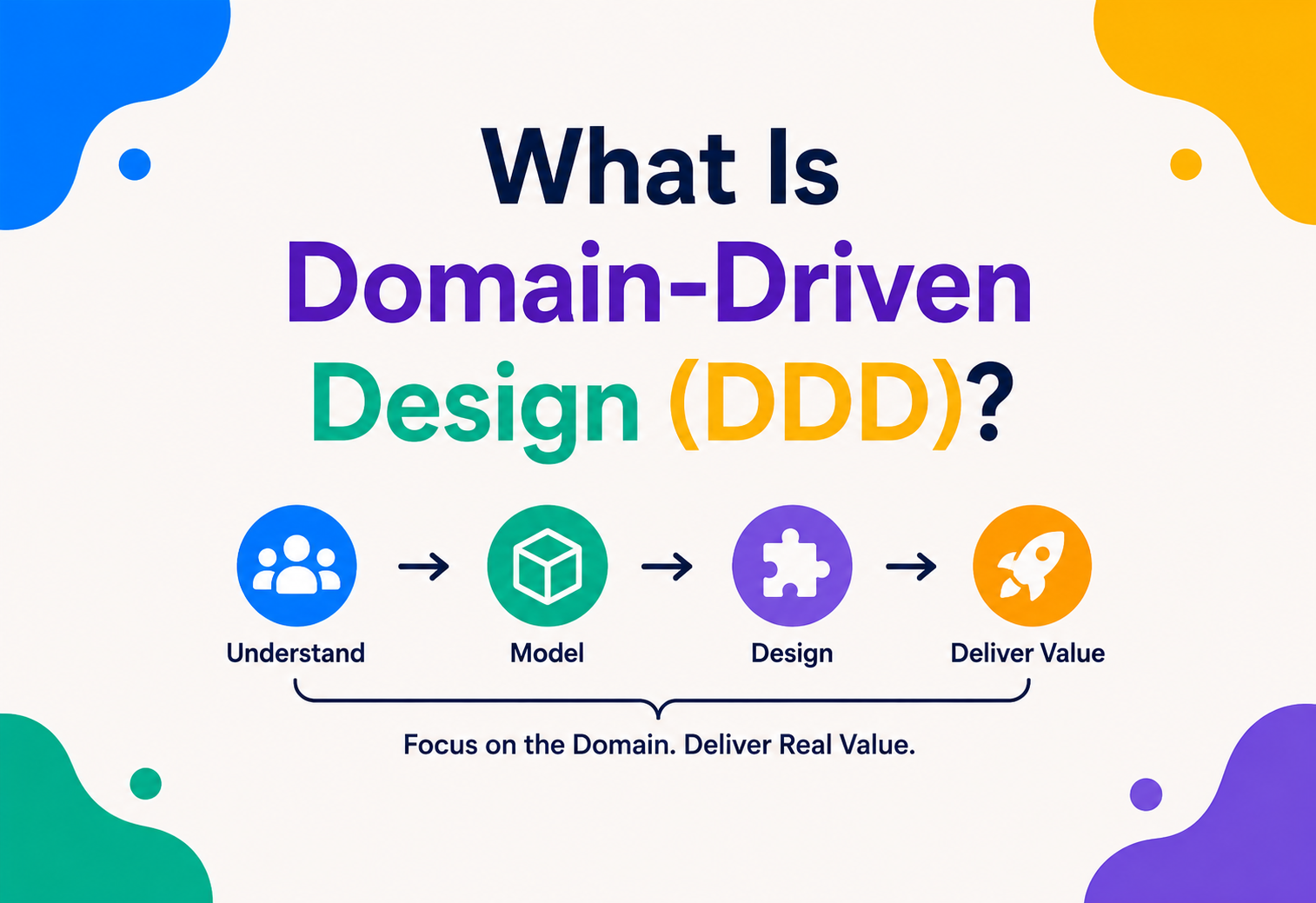
What Is Domain-Driven Design (DDD)?
Some software feels like it truly understands the business it was built for. Other software feels like a pile of screens bolted together. The difference usually comes down to one thing — whether the people who built it really understood the world they were building for, and gave that understanding a permanent home inside the code. That is what Domain-Driven Design is about.
The Big Idea, in One Breath
Picture a school putting on a big play. There is a director, actors, someone building the set, someone in charge of costumes, and someone running the lights. Every single one of these people uses the word “scene” — but they mean slightly different things by it. To the director, a scene is a piece of the story. To the lighting person, a scene is a lighting setup they need to switch to. To the costume person, a scene is a moment when someone needs a quick outfit change. If everyone assumed “scene” meant exactly the same thing to everyone else, the play would fall apart on opening night — cues would be missed, cues would clash, and nobody would know whose job it was to fix what.
Now picture a company instead of a school play. A shipping company has people who talk about “orders,” “shipments,” “customers,” and “routes” all day long. The trouble is, the word “customer” might mean something different to the sales team than it does to the billing team. Software that gets built without noticing this — software that assumes there is just one simple meaning for every word — tends to grow into a tangled mess that nobody fully trusts. Domain-Driven Design (DDD) is a way of building software that takes this problem seriously from day one, by putting the real business — the “domain” — at the very centre of every decision, instead of treating it as an afterthought bolted onto a database.
Think about how a doctor and a patient talk. A doctor does not say “your left ventricle is showing signs of hypertrophy” to a worried patient — they translate it into something like “your heart muscle has thickened a bit, and here is what we are going to do about it.” Good software teams do something similar in reverse. They sit with the real experts of a business — the shipping planners, the underwriters, the nurses — and slowly build a shared vocabulary that both sides understand in exactly the same way. That shared vocabulary becomes the actual names used inside the code. DDD is the discipline of doing this on purpose, everywhere, all the time.
What Domain-Driven Design Really Is
Domain-Driven Design is an approach to building software where the problem being solved — the “domain” — shapes the software far more than the technology used to build it. The term was introduced by software engineer Eric Evans in his 2003 book, which argued that the hardest part of building complex software is not the code itself, but truly understanding the messy, detailed, real-world business the code is supposed to serve.
A “domain” is simply the subject matter your software deals with. For an airline booking system, the domain is flights, seats, fares, and passengers. For a hospital system, the domain is patients, appointments, prescriptions, and billing. For a music streaming app, the domain is songs, playlists, artists, and listening habits. DDD says: before you draw a single database table, go and deeply understand this world, and let that understanding drive your design.
DDD is usually described as having two connected halves:
- Strategic design — the big-picture work of figuring out how a large business breaks down into smaller, more manageable pieces, and how those pieces should talk to each other.
- Tactical design — the hands-on work of actually modelling those pieces in code, using a specific toolbox of patterns like entities, value objects, and aggregates.
If someone asks “is this project using DDD?”, they are really asking two things. First: did the team sit down with real business experts and build a shared vocabulary? Second: does the code actually look like that vocabulary, or does it look like generic database tables with a thin layer of screens on top?
It helps to know a little of where this idea came from. Eric Evans was not writing from a theoretical perch — his book grew out of years spent on real, difficult projects where teams kept building the wrong thing, not because they lacked skill, but because nobody had properly captured what the business actually needed before the coding started. He noticed that the most successful projects he had seen all shared one habit: a tight, ongoing feedback loop between the people who understood the problem and the people writing the code, with the model itself acting as the bridge between them. Everything else in DDD — the language, the boundaries, the tactical patterns — exists in service of keeping that feedback loop healthy.
It is also worth being clear about what DDD is not. It is not a specific programming language feature, it is not a particular framework you can download, and it is not a checklist you tick off once and forget. It is closer to a discipline, similar to how “eating well” is not a single recipe but an ongoing set of habits and choices. Some projects apply it thoroughly across an entire system. Others borrow just a few of its ideas — like the ubiquitous language — without adopting every tactical pattern. Both are legitimate uses, as long as the underlying goal stays intact: make the software genuinely reflect the business it serves.
Why DDD Matters — The Problem It Solves
Most software does not fail because a programmer typed something wrong. It fails slowly, over years, because the code stops matching how the business actually works. Three very common traps cause this.
The “Anaemic” Model
Imagine a robot that can carry boxes but has absolutely no idea what is inside them, whether they are fragile, or where they are supposed to go — it just picks things up and puts them down wherever it is told. A lot of software ends up like that robot. Data gets stored in simple containers — just fields with names — while all the actual business rules live somewhere else entirely, scattered across dozens of separate “helper” files. Nothing enforces the rules automatically. A programmer has to remember, every single time, to apply them correctly. Forget once, and the business rule gets silently broken. This pattern even has a name in software circles: an anaemic domain model — data with no real behaviour attached to it.
The “Big Ball of Mud”
The second trap happens when a system grows without any real internal boundaries. Every part can quietly reach into every other part. A change to how invoices are calculated accidentally breaks how shipping labels print, for reasons nobody can explain. Engineers call this a big ball of mud — everything connected to everything, with no walls left standing to contain the damage. New team members take months just to feel safe making a change.
The “One True Model” Trap
There is a third, quieter trap: the belief that a whole company can share exactly one master model of everything. It sounds efficient on paper — build the “Customer” class once, reuse it everywhere, save time. In practice, this single shared model slowly turns into a monster, stitched together from the conflicting needs of every department that ever touched it, until nobody can safely add a field without breaking something unrelated three teams away. It is a bit like trying to design one single shoe that has to work for running, swimming, and mountain climbing all at once — the compromises pile up until the shoe is bad at everything.
DDD directly attacks all three traps. It pushes business rules back into the objects that own the data (so behaviour and data live together, the way they do in the real world). It deliberately draws boundaries around different parts of a business so that a change in one place cannot quietly ripple through everywhere else. And it gives teams permission to stop chasing one impossible universal model in favour of several smaller, honest ones. The payoff shows up gradually: fewer mysterious bugs, faster onboarding for new engineers, and a codebase that keeps making sense even as the company itself grows and changes shape.
The Ubiquitous Language
The very first building block of DDD is deceptively simple: agree on the words. Eric Evans called this the ubiquitous language — a shared vocabulary, built together by developers and the people who actually run the business, and then used everywhere, without exception: in meetings, in diagrams, in documentation, and — most importantly — as the actual names of classes, functions, and variables in the code itself.
This might sound like a small thing, but it changes everything about how a team works. Normally, a business person describes a process in plain English, and then a developer silently translates it into “programmer words” before writing any code. Every translation is a chance for meaning to leak away, the same way a message garbles slightly each time it is whispered down a line of people. The ubiquitous language removes the translation step entirely. If the insurance team calls something a “claim,” the code has a class called Claim — not Ticket, not Case, not Record. If a warehouse team says an order gets “picked” and then “packed,” the code has methods named pick() and pack(), not generic ones like updateStatus().
Imagine two friends building a blanket fort together, but one of them calls the entry flap the “door” and the other calls it the “window.” Every time they talk about it, there is a tiny moment of confusion. Now imagine they agree, right at the start, to always call it “the door” — no exceptions, not even when they are tired and want to say something quicker. That tiny agreement saves them from dozens of little mix-ups later. A ubiquitous language is that same agreement, scaled up to an entire company and its software.
An important detail: a ubiquitous language is not meant to be one giant dictionary for an entire company. A word like “account” might mean a login credential to the security team and a financial ledger entry to the billing team — and that is completely fine, as long as each meaning stays inside its own clearly marked area. Which brings us to the next big idea.
Domains, Subdomains, and Bounded Contexts
Real businesses are big and messy, and trying to build one giant, perfectly unified model for an entire company almost always fails. DDD instead encourages teams to slice things up, using three related ideas.
The Domain and Its Subdomains
The domain is the whole problem space — everything the business does. This is usually too large to model as one thing, so it gets split into subdomains, which are naturally occurring areas of the business, such as “order fulfilment,” “customer support,” or “billing” for an online retailer. DDD sorts subdomains into three flavours:
The competitive edge
The part of the business that makes it special and worth building carefully. This deserves the most design attention and your best people.
Necessary, but not unique
Important to the business but not what sets it apart — still needs custom code, just not the deepest investment.
Solved problems
Things like login, payments, or sending emails — usually best bought or borrowed rather than built from scratch.
The Bounded Context
A bounded context is the boundary inside which one particular version of the ubiquitous language stays completely consistent. Inside the “Sales” bounded context, a “Product” might mean something with a price, a description, and a marketing image. Inside the “Warehouse” bounded context, a “Product” might mean something with a weight, a shelf location, and a barcode. Both are legitimate — the trick is making sure the boundary between them is explicit, so nobody accidentally mixes the two meanings together in one confused, overloaded class.
If you find yourself adding “type” flags or endless optional fields to one giant class just to make it fit two different departments’ needs, that is usually a sign you actually have two bounded contexts pretending to be one.
How Teams Actually Find These Boundaries
Discovering the right subdomains and bounded contexts is rarely obvious on the first try, and that is completely normal. A useful early technique is to pay close attention to team structure and language shifts — whenever a conversation naturally moves from “how we sell things” to “how we ship things,” that shift in vocabulary is often a hint that a boundary belongs right there. Another sign is organisational: if two different departments each have their own manager, their own goals, and their own way of measuring success, their software very often deserves its own bounded context too, rather than being forced into a single shared model that satisfies neither department particularly well. None of these boundaries are set in stone forever — as a business grows or reorganises, its bounded contexts sometimes need to be redrawn, and a healthy DDD practice treats that as a normal, expected part of a system’s life rather than a sign that something went wrong the first time.
Context Mapping
Once a business is split into bounded contexts, those contexts still need to cooperate — an order in the Sales context eventually has to become a shipment in the Warehouse context. Context mapping is the practice of drawing out these relationships honestly, including the political and organisational reality of who depends on whom.
Two teams, one goal
Teams coordinate closely and evolve their contexts together, like two neighbours who agree on a shared fence line.
One depends on the other
A downstream team relies on an upstream team’s output, and the upstream team takes the downstream team’s needs seriously when planning changes.
Just accept it as-is
The downstream team has no real influence, so it simply adopts the upstream team’s model exactly as given.
A translator at the border
A protective layer of code translates an outside system’s confusing or messy model into clean, friendly terms before it ever touches your own code.
A well-lit front counter
A team publishes a clean, well-documented interface designed for other teams to consume, so nobody has to reverse-engineer its internals.
An industry-standard format
A shared, well-documented data format that many parties can exchange information through without pairwise translation.
An anti-corruption layer works like an interpreter at an international meeting. The interpreter listens to a foreign guest speaking freely in their own language, and only ever passes along a clean, well-formed translation to the rest of the room. The room never has to deal with the raw, unfiltered original — and the guest never has to change how they naturally speak. This lets two very different systems collaborate without either one being forced to compromise its own internal integrity.
Context maps are not just diagrams for decoration — they are honest conversations about power and dependency between teams. A team that skips this step often discovers, painfully, that a small change made deep inside one system quietly broke three other systems that were silently depending on undocumented details of how it used to work.
Why Open Host Service and Published Language Matter Together
An open host service is what happens when a team publishes a clean, well-documented, stable interface specifically designed for other teams to consume, rather than forcing everyone downstream to reverse-engineer its internals — much like a restaurant kitchen has a proper order window instead of letting waiters wander in and grab food off any counter they like. A published language takes this further by formalising that interface as a well-documented, shared data format — the kind of thing an entire industry might standardise on, so that many different companies’ systems can exchange information without each pair needing its own custom translation. Together with partnership, customer-supplier, conformist, and the anti-corruption layer, these patterns give teams a genuinely rich vocabulary for describing exactly how independent parts of a large system should relate to one another — instead of the usual vague, unspoken assumptions that quietly cause so much friction between teams.
Entities and Value Objects
Strategic design draws the big boundaries. Tactical design is what happens once you step inside one of those boundaries and start actually writing the model in code. The two most fundamental building blocks are entities and value objects, and the difference between them is one of the most useful ideas in all of software design.
Entities: Things With an Identity
An entity is something that has its own continuous identity, even as its details change over time. A student in a school is an entity — even if they change their name, move to a new house, or grow six inches taller, they are still recognisably the same student, tracked by the same student ID from their first day to their last. In code, an entity almost always carries a unique identifier that never changes, even while every other field on it might.
Value Objects: Things Defined Only By Their Value
A value object, on the other hand, has no identity of its own — it is defined completely by its contents, and it never changes after it is created. Think of a five-rupee coin: nobody cares which specific five-rupee coin they are holding, only that it is worth five rupees. Two five-rupee coins are completely interchangeable. A date, a colour, an amount of money, or a postal address are all natural value objects — if two of them hold exactly the same information, they are simply equal, full stop. If something about a value object needs to change, you do not edit it — you throw it away and create a brand-new one, the same way you would get change instead of melting down a coin to make it a different value.
Identity, over time
Has a unique, lasting identity. Can change over time. Example: a Customer or a BankAccount.
Content, not identity
Has no identity, only content. Never changes once created. Example: Money, an Address, a date range.
Why does this distinction matter so much? Because value objects are wonderfully simple to test, safe to share between different parts of a system, and impossible to accidentally corrupt — since nothing can ever secretly change them halfway through a calculation. Experienced DDD practitioners tend to reach for value objects far more often than beginners expect, tucking small but meaningful concepts like “a shipping weight” or “a phone number” into their own tiny, well-guarded objects rather than leaving them as loose, unguarded text fields.
Ask yourself: “Do I care which one this is, or only what it says?” If you only care what it says, it is a value object. If you care which specific one it is, even when its details change, it is an entity.
Here is a small but telling example. Imagine two customers both named “Aarav Sharma” who both live at the exact same office address. As entities, they are still two completely different people — each one has their own customer ID, their own order history, their own identity that the business needs to track correctly, even though on paper their details currently look identical. Now imagine two separate orders that both happen to cost exactly four hundred and fifty rupees. As value objects, those two Money amounts are simply equal — there is no meaningful sense in which one four-hundred-and-fifty-rupee amount is “more special” than the other. Mixing these two ideas up is one of the most common sources of subtle, hard-to-explain bugs in ordinary business software, because code that quietly assumes something is a value object (safe to duplicate freely) can misbehave badly when it is actually an entity that needed careful, identity-aware tracking.
Aggregates
Real business objects rarely stand alone. An order comes with order lines. A shopping cart comes with its items. DDD groups these tightly related objects into a single unit called an aggregate, and every aggregate has exactly one aggregate root — a single entity that acts as the front door for the whole group.
Nobody outside the aggregate is allowed to reach in and directly touch the inner pieces. If you want to add an item to an order, you do not quietly poke a new line item into the order’s internal list yourself — you call a method on the Order aggregate root, like order.addLine(product, quantity), and the root is responsible for keeping everything inside consistent, valid, and sensible at every single step.
Why Draw This Line at All?
Aggregates exist to protect consistency. Picture a school bus: passengers cannot get on or off except through the door the driver controls, and the driver will not pull away until everyone is safely seated and the door is shut. This stops the ridiculous situation where the bus starts moving with someone half-hanging out the door. An aggregate does the same thing for data — a well-designed Order aggregate root would simply refuse a request to add an item after the order has already been marked as shipped, keeping the whole order forever in a state that actually makes sense.
A very common beginner mistake is making aggregates too large — for instance, treating an entire customer’s complete order history as one aggregate. Big aggregates are slow to load, painful to save, and more likely to cause two people to accidentally step on each other’s changes at the same time. Most experienced designers keep aggregates small and focused, often centred around just one true transaction boundary.
Invariants: The Rules That Can Never Be Broken
The whole reason aggregates exist is to protect what DDD calls invariants — rules that must always hold true, no matter what. “A shopping cart’s total can never be negative.” “An order cannot be shipped twice.” “A seat on a flight can never be assigned to two passengers at the same time.” An aggregate root is the single place responsible for checking these rules before allowing any change to go through, which means that as long as every change flows through the root, the invariant simply cannot be broken — not by a rushed developer, not by a forgotten edge case, not by two requests arriving at almost the same moment. This is a much stronger guarantee than hoping every programmer remembers to run the same validation check in every single place that ever touches the data.
This is also why aggregate boundaries usually match transaction boundaries in a database — everything inside one aggregate gets saved together, as one atomic unit, so the system is never left half-updated. If you find yourself needing two separate aggregates to update together in the same instant to keep something correct, that is often a sign the boundary was drawn in the wrong place.
Events, Repositories, Services & Factories
Domain Events
A domain event is a small, factual record that something meaningful already happened in the business — OrderShipped, PaymentReceived, SeatReserved. Domain events are written in the past tense on purpose, because they describe something that is already done and cannot be undone, the way a school announcement says “the bell has rung,” not “the bell might ring.” Once an aggregate raises an event, other parts of the system — even ones in completely different bounded contexts — can react to it without the original aggregate needing to know or care who is listening.
Repositories
A repository gives the rest of the code a simple, tidy way to fetch and save whole aggregates, hiding all the messy database details behind something that feels like a neat, well-organised shelf. Instead of writing raw database queries scattered everywhere, the rest of the code just asks the repository for what it needs — orderRepository.findById(orderId) — and the repository quietly handles wherever the data actually lives.
Domain Services
Sometimes a piece of business logic genuinely does not belong to any single entity or value object — like calculating a shipping cost that depends on both an order and a set of current carrier rates. Rather than force that logic awkwardly into one object that does not really own it, DDD allows a small, stateless domain service to hold it instead, keeping it clearly labelled as business logic rather than quietly hiding it inside a generic “helper” or “utility” file.
Factories
When creating a complex object involves several steps or rules of its own, a factory takes on that responsibility, so the object itself does not need messy setup logic cluttering its main purpose — much like a car is not built by the driver fumbling through an assembly line themselves, but arrives ready to drive from a factory that handled all that complexity beforehand.
Something happened
A fact, written in the past tense, that other parts of the system can react to.
Fetch & save aggregates
A clean shelf that hides database details from the rest of the code.
Logic with no single owner
Business rules that span more than one entity or value object.
Handles complex creation
Builds valid, ready-to-use objects so nothing else has to.
A Quick Word on Event Sourcing
Some teams take domain events a step further with a technique called event sourcing: instead of only storing the current state of an aggregate, the system stores the entire sequence of events that ever happened to it, and rebuilds the current state by replaying them, a bit like reconstructing today’s bank balance by re-adding up every deposit and withdrawal ever made rather than just trusting a single stored number. This gives a complete, trustworthy history for free and can be extremely valuable in domains like banking or auditing, though it adds real complexity and is not something every DDD project needs to adopt.
DDD vs. Plain CRUD
A huge amount of software is built as simple CRUD — Create, Read, Update, Delete — where screens map almost directly onto database tables, and “business logic” is really just a handful of validation checks sprinkled around the edges. CRUD is fast to build and perfectly fine for simple record-keeping — a contact list, a to-do app, a basic inventory count. It runs into trouble the moment a business has real rules, exceptions, and workflows that go beyond simply storing and retrieving fields.
| Aspect | Plain CRUD | Domain-Driven Design |
|---|---|---|
| Where rules live | Scattered across controllers and services | Inside the entities and aggregates that own the data |
| Vocabulary | Often generic (Record, Item, Status) | Matches the real business language exactly |
| Best suited for | Simple, low-complexity record management | Complex domains with real rules and workflows |
| Change safety | Easy to silently break a rule elsewhere | Invalid states are much harder to create at all |
| Upfront effort | Low | Higher, but pays off as complexity grows |
DDD is a tool for taming complexity, not a universal law. A simple internal tool for booking meeting rooms almost certainly does not need it. A core insurance claims engine almost certainly does.
It is also worth noting that CRUD and DDD are not always rivals — they often coexist happily within the very same application. A retailer’s Catalog context, where products are mostly just displayed and edited, might stay comfortably simple and CRUD-shaped. Meanwhile, that same retailer’s Pricing and Promotions context, full of overlapping discount rules, loyalty tiers, and seasonal exceptions, is exactly where DDD’s tactical patterns start paying for themselves. A mature engineering team does not reach for DDD out of habit everywhere — it reaches for the simplest approach that honestly fits each part of the system, and saves the heavier tools for the parts that truly need them.
DDD and Software Architecture
DDD describes what to model, but it pairs naturally with certain architectural styles that decide where that model lives in the codebase.
Layered Architecture
The classic pairing keeps the domain model in its own clean, central layer, with a user-interface layer above it and an infrastructure layer (databases, external services) below it. The domain layer knows nothing about screens or databases — it is pure business logic, free to be tested and understood entirely on its own.
Hexagonal Architecture (Ports & Adapters)
A closely related idea places the domain model at the very centre of a hexagon, surrounded by “ports” — clearly defined interfaces the domain needs, like “a place to save orders” — and “adapters,” the actual plug-in implementations of those ports, like a specific database or a specific payment provider. This means you could swap an entire database technology without changing a single line of business logic, the same way a country can change its electrical wall sockets without changing how electricity itself behaves.
Microservices and Event-Driven Systems
Bounded contexts map remarkably well onto microservices — each service can own exactly one bounded context, its own database, and its own version of the ubiquitous language, communicating with others mainly through domain events. This is why so many teams that adopt microservices lean on DDD’s strategic design first, to figure out where the service boundaries should actually go, rather than slicing services up arbitrarily and regretting it later.
DDD is not the same thing as microservices, and you do not need microservices to benefit from DDD. Plenty of healthy, well-modelled systems apply DDD’s ideas inside a single, well-organised application — sometimes called a “modular monolith” — and only split into separate services later, if and when there is a real reason to.
CQRS: Splitting Reads from Writes
One more pattern often travels alongside DDD: CQRS, short for Command Query Responsibility Segregation. The idea is simple once you see it — the rules for changing data (commands, handled carefully by aggregates) are often very different from the rules for displaying data (queries, which usually just need a fast, flat view for a screen). Rather than force one model to serve both jobs well, CQRS lets a system use its rich, rule-protecting domain model for writes, while reading from a separate, simplified, read-optimised copy of the data for display — the way a library might keep a carefully catalogued archive for adding new books, but hand visitors a simple, searchable index for finding what they want quickly.
How Teams Actually Practise DDD
DDD is not just a set of coding patterns — it is also a way of working, built around close, ongoing collaboration with the people who understand the business best.
- 1
Talk to the experts
Sit with the people who actually run the process — underwriters, warehouse leads, support agents — and listen closely to the words they naturally use.
- 2
Run an event storming session
Gather developers and domain experts around a big wall of sticky notes, mapping out every significant thing that happens in the business, in the order it happens, using orange notes for events like “Order Placed” or “Payment Failed.”
- 3
Spot the natural seams
Look for clusters of related events and vocabulary — these clusters are usually your subdomains and bounded contexts revealing themselves.
- 4
Model the core, protect the language
Turn the clusters into entities, value objects, and aggregates, always naming things exactly the way the business experts say them out loud.
- 5
Keep refining, forever
Treat the model as a living thing. When the business’s understanding of itself changes, the code’s vocabulary changes with it — right away, not “eventually.”
The model is a living conversation, not a diagram you draw once and forget.
It is worth being honest that this collaborative process takes real effort to sustain. Domain experts are usually busy people with their own jobs to do, and getting consistent time with them requires genuine organisational support, not just good intentions from the engineering team. Teams that succeed with DDD tend to treat these modelling sessions as recurring, ordinary parts of how the project runs — a short session every couple of weeks — rather than a single big workshop held once at the very start and never repeated. The businesses themselves keep changing, after all, so a model that was accurate six months ago can easily drift out of date if nobody keeps checking it against how the work actually happens today.
Pros, Cons, and When to Use It
Where DDD earns its cost
- Code vocabulary matches the real business exactly.
- Business rules live in one clear, protected place.
- Bounded contexts limit the blast radius of change.
- Makes large teams able to work independently.
- Naturally scales toward microservices, if needed.
Where it hurts
- Requires real, ongoing access to domain experts.
- More upfront design effort than plain CRUD.
- Overkill for genuinely simple applications.
- Easy to over-engineer if applied everywhere blindly.
- Has a real learning curve for new team members.
DDD earns its cost in domains that are genuinely complicated — insurance, banking, logistics, healthcare, complex e-commerce — where the business rules themselves are the hard part, not the technology. It is usually the wrong tool for a simple internal dashboard, a small marketing site, or a straightforward record-keeping app, where the extra structure would just slow the team down without buying anything meaningful back.
A useful gut check: if you could fully explain your application’s rules in two sentences, you probably do not need DDD. If explaining the rules properly would take a whiteboard and twenty minutes, DDD is very likely worth the investment.
Team size and structure matter here too. A single developer building a personal project rarely needs the full ceremony of strategic and tactical DDD — there is nobody else to miscommunicate with, and the coordination problems DDD solves mostly do not exist yet. As soon as multiple teams start working on different parts of the same business, though, the calculation changes quickly. Bounded contexts stop being a nice-to-have and start being the thing that lets ten different teams ship changes in the same week without constantly stepping on each other’s work. This is really the heart of why DDD tends to show up so often in larger organisations — not because bigger companies love ceremony for its own sake, but because the coordination cost of many people working on one shared, tangled model grows painfully fast, and DDD gives that growth somewhere sensible to go.
Common Pitfalls
Modelling Without the Experts
DDD without genuine, regular access to domain experts is not really DDD — it is just guessing with fancier class names. The whole approach depends on a real, continuing conversation, not a one-off interview at the start of a project.
Treating It as “All or Nothing”
Some teams try to apply full DDD tactical patterns to every single part of a system, including the boring, simple bits that never had any real complexity to begin with. This just adds ceremony without adding value. It is perfectly healthy to use DDD deeply in your core subdomain and keep supporting subdomains plain and simple.
Anaemic Aggregates in Disguise
A common trap is naming things correctly — calling a class Order instead of Record — while still letting outside code freely poke at its internal fields directly. That is DDD vocabulary wrapped around old CRUD habits; the protective behaviour has to actually be enforced, not just implied by a nice name.
Letting the Language Drift
When the business starts using a new term in meetings but the code keeps its old name, the shared language quietly breaks, and confusion creeps back in exactly where DDD was supposed to prevent it.
If developers and business stakeholders start needing a “translation” conversation again before a meeting can proceed smoothly, that is a warning sign the ubiquitous language has quietly drifted out of sync with reality.
Over-Investing in Generic Subdomains
Building a beautifully modelled, richly designed authentication system or email-sending module from scratch is a classic way to burn weeks of effort on a problem that has already been solved extremely well by existing, battle-tested tools. DDD’s own strategic thinking warns against this — generic subdomains are exactly the parts of a system where buying, borrowing, or reusing something existing is usually smarter than crafting a custom, deeply-modelled solution. Save the deep modelling energy for the parts of the business that are actually unique.
Real-World Examples
Online Retail
A large online store might split into bounded contexts like Catalog, Cart, Ordering, Shipping, and Returns. “Product” in Catalog carries marketing copy and images. “Product” in Shipping carries only weight and dimensions. An OrderPlaced domain event, raised inside the Ordering context, quietly triggers the Shipping context to prepare a shipment, without Ordering ever needing to know how shipping actually works internally.
Banking
A bank’s Accounts context treats an Account as an aggregate root, refusing any withdrawal that would push the balance rules into an invalid state. Meanwhile, a completely separate Fraud Detection context watches the very same stream of TransactionCompleted events, applying its own rules, using its own vocabulary, without ever needing write access to the Accounts context’s own database.
Healthcare
A hospital system might treat “Patient” very differently across contexts. In Scheduling, a patient is mostly an appointment slot and contact details. In Clinical Records, a patient is a rich medical history bound by strict privacy rules. Keeping these as separate bounded contexts, connected through careful, deliberate integration, avoids a single dangerously overloaded “Patient” object trying to serve every department’s very different needs at once.
It is a bit like how a single person can be a “student” at school, a “customer” at a shop, and a “patient” at a clinic, all at the same time, without any confusion — because each place only cares about the details relevant to it, and nobody tries to cram all three roles into one all-purpose form.
Ride-Hailing and Logistics
A ride-hailing platform naturally separates into contexts like Matching (pairing a rider with a nearby driver), Trip (tracking a journey from pickup to drop-off), Pricing (calculating fares, including surge conditions), and Payments (settling the transaction afterward). A TripCompleted domain event, raised the moment a driver ends a trip, can quietly trigger Pricing to finalise the fare and Payments to charge the rider, while Matching immediately marks that driver as available again — four different contexts, each with its own tight focus, cooperating through simple, well-defined events rather than one enormous class trying to know and do everything at once.
DDD in Modern Practice
DDD’s ideas have aged remarkably well, partly because they were never really about a specific technology — they were about how people communicate and how software should reflect that communication. As systems have grown more distributed and teams have grown larger and more spread out, some of DDD’s oldest advice has only become more relevant, not less.
Collaborative Modelling Tools
Event storming, once done purely with paper sticky notes on a physical wall, is now commonly run using online collaborative whiteboards, letting teams spread across different offices or even different countries take part in the same modelling session together. This has made it much easier for distributed teams to keep their shared language genuinely shared, rather than slowly drifting apart the way it once did when only the people in one physical room got a say in how the model was shaped.
Working Alongside AI-Assisted Development
As more code gets written with the help of AI coding assistants, the value of a clear, well-named domain model has, if anything, gone up rather than down. An assistant generating new code for an Order aggregate produces far more accurate, trustworthy results when the surrounding codebase already uses precise, consistent business vocabulary, clear boundaries, and well-named methods like cancel() or markAsPaid() — because that vocabulary gives the assistant the same shared context a new human team member would need. A codebase full of vague, generic names and tangled responsibilities gives an AI assistant just as little to work with as it would give a confused new hire on their first day. In this sense, DDD’s oldest promise — code that reads like the business it serves — turns out to be just as useful for helping machines understand a system as it always was for helping people.
A good test of how well a model is holding up: could a new engineer — human or AI-assisted — read the core aggregate’s method names out loud to a business expert and have that expert nod along, without needing anything translated?
Frequently Asked Questions
Is DDD a framework or a library I install?
No. DDD is a way of thinking and a set of design patterns — it does not come as a package you install. It can be applied in any programming language, using ordinary classes and objects.
Do I need microservices to use DDD?
Not at all. DDD works perfectly well inside a single, well-organised application. Many teams practise DDD for years inside one codebase before ever splitting anything into separate services.
Is DDD only for huge enterprise companies?
It is most valuable wherever the business rules themselves are genuinely complex, regardless of company size. A small startup with an intricate pricing engine can benefit just as much as a large bank.
How is a bounded context different from a microservice?
A bounded context is a modelling boundary — a conceptual line around where a vocabulary stays consistent. A microservice is a deployment boundary — a separately running piece of software. They often line up, but they answer different questions.
What is the very first step for a team that is new to DDD?
Start small. Pick one genuinely complex, high-value part of the business, get time with the people who actually understand it, and try naming your code exactly the way they describe their own work — before touching any of the more advanced tactical patterns.
Does DDD slow a team down?
It slows down the very beginning, because more thought goes into the model upfront. In genuinely complex domains, this investment usually pays for itself many times over, by preventing the kind of tangled, fragile code that becomes painfully slow to change later.
Can DDD be used with any programming language?
Yes. DDD is a way of thinking about a problem, not a feature of a particular language. It is most naturally expressed in object-oriented languages, since entities, value objects, and aggregates map neatly onto classes, but the underlying ideas — a shared language, clear boundaries, protected consistency — translate into functional and other styles of programming too.
What is the difference between DDD and simply writing “clean code”?
Clean code is about how individual pieces of code are written — clear names, small functions, tidy structure. DDD operates one level up: it is about making sure the entire shape of the system, its boundaries and vocabulary, actually mirrors the real business. You can write beautifully clean code that still models the business completely wrong. DDD is aimed squarely at preventing that second kind of mistake.
Glossary
| Term | Meaning |
|---|---|
| Domain | The subject matter or problem space your software addresses. |
| Ubiquitous Language | A shared vocabulary used consistently by developers and domain experts alike. |
| Bounded Context | A boundary within which one model and one language stay consistent. |
| Entity | An object with a lasting identity that can change over time. |
| Value Object | An immutable object defined entirely by its attributes, with no identity. |
| Aggregate | A cluster of related objects treated as one unit for consistency. |
| Aggregate Root | The single entity that guards access to everything inside an aggregate. |
| Domain Event | A record that something significant has already happened in the business. |
| Repository | A clean interface for fetching and saving whole aggregates. |
| Domain Service | Stateless logic that does not naturally belong to one entity or value object. |
| Anti-Corruption Layer | A translation layer that protects a model from an external system’s model. |
| Anaemic Domain Model | A model with data but no real behaviour, where rules live elsewhere. |
| Big Ball of Mud | A system with no real internal boundaries, where everything depends on everything. |
| Event Sourcing | Storing an object’s full history of events instead of just its current state. |
| CQRS | Command Query Responsibility Segregation — separating the model used for writes from the one used for reads. |
Key Takeaways
If there is one idea worth carrying away from everything above, it is this: software does not get better simply by writing more careful code — it gets better by understanding the real problem more deeply, and then protecting that understanding so it does not quietly erode over time. Domain-Driven Design is really a collection of habits built around that single goal. Talk to the people who know the business. Agree on words and stick to them. Draw honest boundaries instead of pretending everything is one big simple thing. And let the objects in the code actually behave the way their real-world counterparts behave. None of this requires exotic technology. It requires patience, conversation, and a willingness to keep refining a model as understanding grows — which, in the end, is a fairly human way to build something as intricate as software.
Remember This
- Business, not database. DDD puts the real business at the centre of software design, instead of the database or the technology.
- One language, everywhere. The ubiquitous language is the shared vocabulary that ties conversations, diagrams, and code together with no translation loss.
- Same word, different rooms. Bounded contexts let the same word mean different things in different parts of a system, safely and on purpose.
- Identity vs. content. Entities have identity and can change; value objects have no identity and never change once created.
- One door in. Aggregates protect consistency by forcing every change to pass through a single, responsible root object.
- Events over calls. Domain events let different parts of a system cooperate without knowing each other’s insides.
- Architecture, not religion. DDD pairs naturally with layered, hexagonal, and microservice architectures — but it does not require any of them.
- Right tool, right place. It is a powerful tool for genuinely complex domains, and an unnecessary one for genuinely simple applications.
DDD is forgiving of imperfection. No team gets its bounded contexts exactly right on day one, and no ubiquitous language stays perfectly clean forever. The point is not to arrive at a flawless model. The point is to keep the conversation alive between the people who understand the business and the people writing the code, and to give that conversation a permanent, protected home inside the software itself — so that a year from now, five years from now, the system still reads like the business it was built to serve, rather than a museum of forgotten assumptions.