What is an API Contract?
A complete, beginner-friendly walkthrough of one of the most important — and most under-discussed — ideas in software engineering: the formal agreement that lets two independent pieces of software talk to each other reliably, forever, even as both sides keep changing.
Introduction & History
The formal, written agreement that lets two pieces of software trust each other’s behaviour without trusting each other’s code.
Imagine ordering food at a drive-through. You don’t walk into the kitchen, you don’t need to understand how the grill works, and you don’t need to read the chef’s recipe. You just speak into a microphone, say “one burger, no onions,” and a few minutes later a bag comes through the window. The window itself — the fixed opening, the menu board, the agreed order of steps (order, pay, receive) — is a contract. It is a shared interface between you (the customer) and the restaurant (the kitchen). As long as both sides honour that interface, the restaurant can rebuild the entire kitchen next week and you’d never notice, because the window still works the same way.
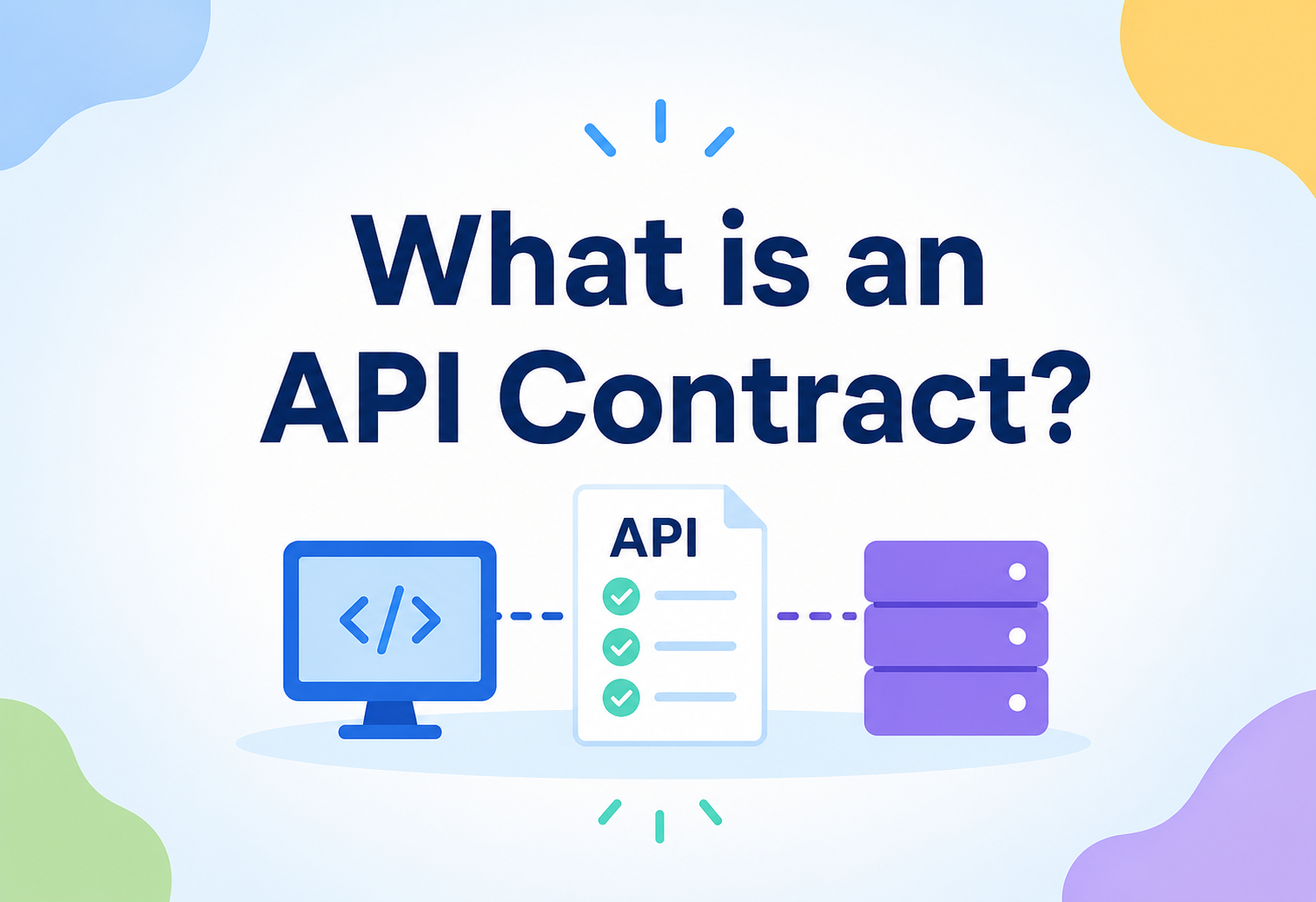
An API contract is the software equivalent of that drive-through window. It is a precise, documented agreement between a service that provides functionality (the “provider” or “server”) and the applications that use it (the “consumers” or “clients”) describing exactly how they are allowed to talk to each other.
1.1 · What does “API” mean, in plain English?
API stands for Application Programming Interface. Strip away the jargon and it means: a set of rules that lets one piece of software ask another piece of software to do something and get an answer back. If a mobile app needs to show a user’s bank balance, it doesn’t reach into the bank’s database directly — it calls an API, which is like knocking on a very specific, very well-labelled door and asking a very specific question.
1.2 · What does “contract” add to that?
An API tells you that a door exists. A contract tells you exactly what happens when you knock: what you’re allowed to say, what format your words must be in, what you’ll get back, how long you might wait, and what happens if you knock incorrectly (do you get an error message, silence, or the door slammed in your face?). Without the contract, an API is just a door with no signage — you’d have to guess, and guessing at scale, across dozens of teams and thousands of client applications, causes chaos.
1.3 · A short history
1990s — RPC and CORBA
Early distributed systems relied on Remote Procedure Calls and CORBA, where contracts were defined using Interface Definition Languages (IDLs). Rigid and tightly coupled, but they established the idea that machine-readable interface descriptions matter.
2000 — SOAP and WSDL
SOAP paired with WSDL formalised the “contract-first” idea: you wrote an XML document describing every operation, input, and output before writing any implementation code.
2000 — Roy Fielding’s REST dissertation
Roy Fielding’s doctoral thesis introduced REST (Representational State Transfer), a simpler resource-oriented style built on plain HTTP. REST didn’t originally mandate a formal contract format — liberating at first, and, eventually, a problem.
2011 — Swagger is born
Swagger (later renamed the OpenAPI Specification in 2016 after being donated to the Linux Foundation) gave REST APIs the machine-readable contract that SOAP always had, but with lightweight JSON/YAML instead of heavy XML.
2015 — gRPC and Protocol Buffers
Google open-sourced gRPC, using
.protofiles as strict, binary-efficient contracts. Widely adopted for high-performance internal microservice communication.2015 onward — GraphQL and contract testing
GraphQL introduced schema-based contracts with a different querying model, while tools like Pact popularised “consumer-driven contract testing” — letting client teams and server teams verify compatibility automatically, without a shared staging environment.
Today, in a world of microservices, mobile apps, third-party integrations, and public developer platforms, the API contract has become one of the most important artefacts a software team produces — arguably as important as the code itself.
In one line
An API contract is the written promise between a provider and its consumers about exactly how they will talk to each other — precise enough that a machine can verify it.
The Problem & Motivation
Why formal contracts exist at all — and why informal agreements silently fall apart at scale.
Why do we even need a formal contract? Couldn’t the client team and the server team just… talk to each other and figure it out as they go?
At a tiny scale, sure. But software rarely stays tiny. Consider what happens without a contract:
- A backend engineer renames a field from
userNametousernameto fix a typo. Three mobile apps that depend on that field instantly break in production, and nobody finds out until angry app-store reviews start rolling in. - A frontend developer assumes an API always returns a list, but on empty results the server sometimes returns
nullinstead of[]. The app crashes for new users who have no data yet — arguably the most important users to not crash for. - Two teams building the same feature in parallel (say, a “checkout” service and a “payments” service) each guess at what the other expects, and by integration time nothing lines up: different date formats, different error codes, different expectations about who retries a failed request.
This is called tight coupling through implicit assumptions. When teams share no formal contract, they end up depending on each other’s actual current behaviour rather than an agreed promise of behaviour. That’s incredibly fragile, because “current behaviour” can shift with any code change, while a promise is something both sides commit to preserving.
Why this matters more as systems grow
In a monolith, a “contract violation” is often caught immediately — the compiler complains, or a single team notices during code review. In a microservices architecture with dozens of independently-deployed services owned by different teams, there is no compiler that checks cross-service compatibility. The contract is the only compiler you get.
2.1 · The core motivation, distilled
An API contract exists to solve one problem: allowing two pieces of software, built and evolved independently by different people (possibly on different continents, in different companies, on different schedules), to interoperate safely, predictably, and without constant direct communication. It replaces “trust me, it’ll work” with “here’s exactly what to expect, in writing, that a machine can verify.”
Core Concepts
Every term defined the way you’d explain it to someone brand new to backend engineering.
Let’s build up the vocabulary piece by piece, using simple language and analogies.
3.1 · Provider and consumer
The provider (sometimes called the “producer” or “server”) is the piece of software that offers a capability — for example, a Payments Service that can charge a credit card. The consumer (or “client”) is the piece of software that uses that capability — for example, a mobile checkout screen. Think of the provider as a restaurant kitchen and the consumer as the customer placing an order.
3.2 · Endpoint
An endpoint is a specific address where a specific operation lives — like a specific counter at a government office that only handles passport renewals. In a REST API, an endpoint is usually a URL plus an HTTP method, such as POST /orders (create an order) or GET /orders/{id} (fetch one order).
3.3 · Request and response
The request is what the consumer sends (think: the order you place). The response is what the provider sends back (think: the food, or a “sorry, we’re out of burgers” message). A contract defines the exact shape of both — every field, its type, whether it’s required, and what values are valid.
3.4 · Schema
A schema is the blueprint describing the shape of data — like a form with labelled blanks: “Name (text, required), Age (number, optional), Email (text matching an email pattern, required).” JSON Schema is the most common way to describe this for JSON-based APIs.
3.5 · Status codes and error contracts
A response isn’t just data — it also carries a signal about what happened. HTTP status codes (200 OK, 404 Not Found, 500 Internal Server Error) are part of the contract too. A well-designed contract also specifies the exact shape of error responses, so a client can programmatically understand and react to failures rather than just displaying “Something went wrong.”
3.6 · Versioning
Versioning is how a contract evolves over time without breaking consumers who haven’t upgraded yet — similar to how a restaurant might print “Menu v2” while still honouring gift cards issued under the old menu for a transition period.
3.7 · Backward compatibility and breaking changes
A change is backward compatible if every consumer that worked correctly before the change still works correctly after it, without any code change on their part. Adding a new optional field is usually backward compatible. Removing a field, renaming a field, or changing a field’s type is a breaking change — the equivalent of the drive-through window suddenly requiring payment in a currency you don’t have.
Schema
The blueprint for data shape — fields, types, required vs. optional.
Endpoint
A specific address + operation, like a labelled counter at an office.
Versioning
How the contract changes over time without breaking existing users.
Breaking Change
Any change that would make a previously-working consumer stop working.
3.8 · Idempotency keys
When a client sends a request but the network connection drops before a response arrives, the client has no way of knowing whether the operation actually succeeded on the server. Did the payment go through, or not? A well-designed contract solves this with an idempotency key — a unique identifier the client generates and attaches to the request. If the client retries with the same key, the server recognises it has already processed that exact operation and simply returns the original result instead of charging the customer twice. This small addition to a contract can prevent an entire category of costly, embarrassing bugs.
3.9 · Pagination contracts
Any endpoint that can return an unbounded number of results — a list of orders, a list of search results — needs a documented pagination strategy as part of its contract. Two common approaches are offset-based pagination (page 1, page 2, page 3…) which is simple but can skip or duplicate items if the underlying data changes between requests, and cursor-based pagination (give me everything after this specific marker) which is more resilient to concurrent changes but slightly more complex to implement. Whichever approach is chosen, the contract must specify exactly which query parameters control it, what the response envelope looks like (is there a nextPageToken? a hasMore boolean?), and what the default and maximum page sizes are.
3.10 · Content negotiation
Some contracts allow a single endpoint to return different formats depending on what the consumer asks for — JSON for one client, XML for a legacy client, a compact binary format for a performance-sensitive client. This is typically handled through the HTTP Accept header, and the contract must enumerate every supported format rather than leaving it as an implicit assumption.
3.11 · Contract formats you’ll encounter
| Format | Style | Typical Use |
|---|---|---|
| OpenAPI (Swagger) | REST, JSON/YAML | Public and internal HTTP/JSON APIs |
| Protocol Buffers (.proto) | gRPC, binary | High-performance internal microservice calls |
| GraphQL SDL | Query language schema | Flexible client-driven data fetching |
| AsyncAPI | Event-driven / messaging | Kafka topics, message queues, pub/sub |
| WSDL | SOAP, XML | Legacy enterprise web services |
Architecture & Components
A contract isn’t just a text file — it’s part of an ecosystem of tools that create, validate, and enforce it.
An API contract isn’t just a text file — it’s part of a larger ecosystem of tools and processes that create, validate, and enforce it. Let’s break down the pieces.
4.1 · The specification document
This is the source of truth — often an openapi.yaml or .proto file, checked into version control just like source code. It describes every endpoint, every field, every type, every error.
4.2 · The schema registry (for event-driven contracts)
In messaging systems (like Kafka), a schema registry is a central service that stores and versions the schemas for every message type flowing through the system, so producers and consumers can validate compatibility before publishing or subscribing.
4.3 · Code generators
Tools that read the contract file and automatically generate client libraries, server stubs (skeleton code), and data model classes — so developers don’t hand-write boilerplate that could drift from the actual contract.
4.4 · Contract validators / linters
Automated tools (like Spectral for OpenAPI) that check a contract file for style issues, missing documentation, or inconsistent naming — the same way a code linter checks source code style.
4.5 · Contract testing framework
Tools like Pact let the consumer team write down their expectations (“I expect GET /orders/123 to return an object with an id and a total”), publish that expectation as a “pact file,” and then have the provider team automatically verify — in their own CI pipeline — that their real API actually satisfies every consumer’s expectations.
4.6 · API Gateway
Sits in front of the actual services and enforces parts of the contract at the network edge — validating incoming requests against the schema, rate-limiting, authenticating, and routing to the correct backend version.
4.7 · CI/CD pipeline hooks
Automated checks that block a deploy if the new server code would violate the published contract, or if a proposed contract change is a breaking change without a version bump.
4.8 · Mock servers
Because a contract fully describes every request and response shape, tools can spin up a fake server that returns realistic, contract-compliant sample data without any real business logic behind it. This is enormously valuable in practice: a frontend team can start building and testing an entire screen against a mock server the same day the contract is agreed upon, weeks before the real backend is finished. It also unblocks parallel work — the backend team isn’t a bottleneck for frontend progress, and vice versa.
4.9 · Design and collaboration tooling
Tools like Stoplight, Postman, and SwaggerHub provide a visual, collaborative editor for the contract file itself, letting non-engineers (product managers, technical writers, QA engineers) read, comment on, and sometimes even propose changes to a contract without needing to hand-edit raw YAML. This lowers the barrier for the contract to genuinely be a shared artefact across a whole team, not just something backend engineers touch.
Spec Doc
The source of truth — versioned like code.
Code Generators
Produce matching stubs and SDKs from the same file.
Gateway
Enforces the contract at the network edge, at runtime.
Contract Tests
Verify compatibility automatically in CI.
Internal Working
How a contract actually gets enforced, step by step, using a concrete OpenAPI example.
Let’s walk through, mechanically, how a contract is enforced — using a concrete example: a POST /orders endpoint defined with OpenAPI.
5.1 · Step 1 — define the schema
openapi: 3.0.3
info:
  title: Order Service API
  version: 1.2.0
paths:
  /orders:
    post:
      summary: Create a new order
      requestBody:
        required: true
        content:
          application/json:
            schema:
              type: object
              required: [customerId, items]
              properties:
                customerId:
                  type: string
                items:
                  type: array
                  items:
                    type: object
                    required: [sku, quantity]
                    properties:
                      sku: { type: string }
                      quantity: { type: integer, minimum: 1 }
      responses:
        '201':
          description: Order created
          content:
            application/json:
              schema:
                type: object
                properties:
                  orderId: { type: string }
                  status: { type: string, enum: [PENDING, CONFIRMED] }
        '400':
          description: Validation error
5.2 · Step 2 — generate code from the contract
A code generator reads this YAML and produces a Java interface the server team must implement, and a Java client class the consumer team can call directly — both derived from the exact same source, so they can never silently drift apart.
// Generated server-side interface (provider implements this)
public interface OrdersApi {
    ResponseEntity<OrderResponse> createOrder(
        @Valid @RequestBody CreateOrderRequest request
    );
}

// Generated request/response model classes
public class CreateOrderRequest {
    @NotBlank
    private String customerId;

    @NotEmpty
    private List<OrderItem> items;
    // getters/setters omitted
}

public class OrderResponse {
    private String orderId;
    private OrderStatus status; // enum: PENDING, CONFIRMED
}
5.3 · Step 3 — runtime validation
When a real HTTP request arrives, a validation layer (often built into the framework, e.g. Spring’s @Valid annotation, or a dedicated schema-validation middleware) checks the incoming JSON against the contract before any business logic runs. If quantity is missing or negative, the request is rejected with a 400 automatically — the business logic code never even has to think about it.
@RestController
public class OrderController implements OrdersApi {

    @Override
    public ResponseEntity<OrderResponse> createOrder(
            @Valid @RequestBody CreateOrderRequest request) {
        // By the time execution reaches here, the request
        // has already been validated against the contract.
        Order order = orderService.create(request);
        OrderResponse response = new OrderResponse(order.getId(), order.getStatus());
        return ResponseEntity.status(HttpStatus.CREATED).body(response);
    }
}
5.4 · Step 4 — contract testing in CI
Before either team deploys, an automated contract test replays every consumer’s recorded expectations against the actual running server (or a mock), failing the build if anything no longer matches. This catches breaking changes days before they’d otherwise be discovered in production.
Key mental model
Think of the contract as sitting between the two teams’ code, acting like a border-control checkpoint: nothing crosses from consumer to provider (or back) without matching the paperwork on file. Neither side needs to trust the other’s internal implementation — they only need to trust the shared document.
5.5 · Step 5 — detecting breaking changes automatically
Beyond individual request validation, teams also run a diffing tool that compares the newly proposed contract file against the currently published one on every pull request. This tool understands compatibility rules deeply — for example, it knows that adding a new optional field is safe, but making a previously optional field required is not, even though both changes might look like small, innocent edits in a code diff.
$ openapi-diff old-contract.yaml new-contract.yaml

BREAKING CHANGES:
  - /orders POST requestBody:
      field 'items[].quantity' changed from optional to required
  - /orders/{id} GET response 200:
      field 'internalNotes' removed

NON-BREAKING CHANGES:
  - /orders POST requestBody:
      new optional field 'giftMessage' added
When this tool detects a breaking change, the CI pipeline fails the build automatically, forcing the engineer to either revert the change, make it backward compatible, or explicitly bump the major version and go through a deprecation process — turning what used to be an easy-to-miss human judgment call into a hard, automated gate.
Data Flow & Lifecycle
Two lifecycles that matter — the contract’s own, and every single request governed by it.
An API contract has its own lifecycle, distinct from any single request. Let’s trace both: the lifecycle of the contract itself, and the lifecycle of a single request governed by it.
6.1 · Lifecycle of the contract
Design
Teams draft the contract collaboratively — often before any implementation code exists (“contract-first” or “API-first” design). Stakeholders review the shape of requests and responses.
Review & approval
The contract is reviewed for consistency, naming conventions, and completeness — much like a code review, sometimes with automated linting.
Publish
The contract is versioned and published to a shared registry or repository where consumer teams can discover it.
Implement
The provider builds the real service (or generates stubs to implement); consumers build against generated client code or manually against the spec.
Verify
Contract tests run in CI on both sides, confirming the real implementation matches the promise.
Evolve
Over time, new fields or endpoints are added (non-breaking). When a breaking change is unavoidable, a new major version is published, and the old version is deprecated on a schedule.
Retire
Once all consumers have migrated off an old contract version, it is formally retired and removed.
6.2 · Lifecycle of a single request
Real-life analogy
Think of the contract like a passport control officer at both ends of an international flight. On the way out, they verify your paperwork before you board. On the way back, they verify the incoming stamps. The passenger (the data) doesn’t travel unless the paperwork checks out at every crossing.
Advantages, Disadvantages & Trade-offs
The honest two sides — and the two big spectrums every team eventually has to pick a spot on.
7.1 · Advantages
| Benefit | Explanation |
|---|---|
| Parallel work | Teams can work in parallel without waiting on each other — the contract unblocks them the moment it’s agreed. |
| Breaking changes caught early | Automated checks catch incompatible edits in CI, long before production. |
| Auto-generated code | Client SDKs and server stubs are generated from the same source, reducing hand-written bugs. |
| Faster onboarding | New developers read the contract as living documentation instead of hunting through Slack history. |
| Independent deploys | Microservices can be released independently because their public promise is stable. |
| Trustworthy public APIs | Third-party developers can build on a public API confidently when its contract is versioned and enforced. |
7.2 · Disadvantages / costs
| Cost | Explanation |
|---|---|
| Upfront design work | Discipline required to write and review the contract — slower to “just start coding.” |
| Drift risk | Contracts can become outdated silently if the tooling doesn’t enforce them at runtime. |
| Over-rigidity | An overly strict contract can slow down legitimate rapid iteration. |
| Tooling investment | Schema registries, contract testing, and linters take time to set up and operate. |
| Version maintenance | A versioning strategy adds long-term overhead as old versions have to be supported and eventually retired. |
7.3 · Key trade-off: flexibility vs. safety
A very loose, informal API (“just send us some JSON, we’ll figure it out”) is fast to start with but fragile at scale. A very strict, formally-versioned contract is slower to change but dramatically safer as the number of consumers grows. Most mature organisations converge on: loose and fast during early prototyping, strict and contract-tested once more than one team depends on the API.
7.4 · Key trade-off: contract-first vs. code-first
In contract-first design, the OpenAPI/proto file is written first, and code is generated from it. This produces highly consistent APIs but requires more upfront design skill. In code-first design, you write the server code first and generate the contract from annotations. This is faster to start but risks the contract becoming an afterthought, since it’s derived rather than deliberately designed.
How to think about the trade-off
You are trading a small, well-understood amount of upfront design work for a large reduction in ambiguity, silent breakage, and cross-team miscommunication. For anything more than a throwaway prototype, this trade almost always pays back within the first meaningful integration.
Performance & Scalability
Contracts affect performance in ways that are easy to overlook — payload shape, format choice, and where you validate.
API contracts affect performance in ways that are easy to overlook.
8.1 · Payload design and network cost
A contract that over-fetches (returns far more data than most consumers need) wastes bandwidth and slows down mobile clients on poor connections. This is one reason GraphQL exists — its contract lets each consumer specify exactly the fields it needs, avoiding both over-fetching and under-fetching.
8.2 · Serialisation format matters
| Format | Payload Size | Parse Speed | Human Readable |
|---|---|---|---|
| JSON | Medium | Moderate | Yes |
| Protocol Buffers | Small (binary) | Fast | No |
| XML | Large | Slow | Yes |
| Avro | Small (binary) | Fast | No |
Choosing Protocol Buffers as a contract format (as gRPC does) trades human-readability for significantly smaller payloads and faster parsing — a meaningful win at very high request volumes.
8.3 · Validation overhead
Runtime schema validation (checking every request/response against the contract) adds a small amount of CPU overhead per request. At extreme scale, teams sometimes validate strictly in staging/CI but relax runtime validation in production hot paths, trusting that CI already caught mismatches — a deliberate trade-off between safety and raw throughput.
8.4 · Caching and idempotency
A well-designed contract explicitly documents which endpoints are safe to cache (typically GET requests) and which operations are idempotent — meaning calling them multiple times has the same effect as calling them once (important for safe retries after network timeouts). This directly affects how aggressively a client, CDN, or gateway can scale reads without hitting the origin service.
Rule of thumb
If your contract doesn’t say whether an operation is idempotent, engineers will guess — and guesses about retry-safety are exactly the kind of assumption that causes duplicate charges or duplicate orders in production.
High Availability & Reliability
Why a well-kept contract is one of the most powerful reliability tools a team has.
A contract is one of the most powerful tools for reliability, because it lets providers change their internals — swap databases, rewrite services in a new language, scale out horizontally — without consumers ever noticing, as long as the contract is honoured.
9.1 · Graceful degradation via contract design
Well-designed contracts anticipate partial failure. For example, a search API contract might define an optional partial: true flag in its response, signalling “some backend shards timed out, here are the results we do have” rather than failing the entire request when one dependency is slow.
9.2 · Deprecation windows, not sudden cutoffs
Reliable systems never remove a contract version overnight. Instead, they publish a deprecation date months in advance, monitor which consumers are still calling the old version, and proactively reach out before flipping it off — treating the contract’s stability as a reliability guarantee in itself.
9.3 · Consumer-driven contract testing prevents “surprise outages”
A huge class of production incidents is not caused by a server crashing — it’s caused by a server changing its response shape in a way that silently breaks a client’s parsing logic (for example, a client throwing an unhandled exception on an unexpected null). Running consumer-driven contract tests in CI catches these before deploy, functioning as a reliability safety net that’s cheaper than a full end-to-end staging environment.
Security
An API contract is a security boundary, not just a functional one.
An API contract is a security boundary, not just a functional one.
10.1 · Input validation as a first line of defence
Because the contract precisely defines allowed shapes, types, and ranges for every field, strict schema validation at the gateway rejects malformed or malicious payloads (like oversized strings meant to trigger buffer issues, or unexpected nested objects meant to exploit a parser) before they ever reach business logic.
10.2 · Preventing over-exposure of data
A contract explicitly lists which fields a response is allowed to contain. This prevents a common mistake: a developer serialising an entire internal database object (which might include a password hash or internal notes) instead of the intentionally-scoped response the contract defines.
// BAD: leaks internal fields not defined in the contract
return ResponseEntity.ok(userEntityFromDatabase);

// GOOD: maps only the fields the contract promises to expose
UserResponse response = new UserResponse(
    userEntityFromDatabase.getId(),
    userEntityFromDatabase.getDisplayName()
    // passwordHash, internalNotes, etc. deliberately excluded
);
return ResponseEntity.ok(response);
10.3 · Authentication and authorisation as part of the contract
Modern contract formats (OpenAPI’s securitySchemes, for example) document exactly which authentication mechanism (API key, OAuth 2.0 bearer token, mutual TLS) each endpoint requires, so both automated tooling and human developers know the security expectations without reverse-engineering them.
10.4 · Rate limiting and abuse prevention
Contracts often specify rate limits and quota rules, enforced at the gateway layer — this protects the provider from being overwhelmed (accidentally or maliciously) and gives consumers predictable, documented limits to design around rather than discovering them via 429 Too Many Requests errors in production.
Common mistake
Treating the contract purely as documentation and skipping runtime enforcement. A contract that isn’t actually validated at runtime provides zero security benefit — it’s a promise nobody is checking.
Monitoring, Logging & Metrics
A contract defines expected behaviour — and therefore gives you a precise baseline to alert against.
Because a contract defines expected behaviour, it also gives you a precise baseline to monitor against — deviations from the contract are, almost by definition, bugs worth alerting on.
11.1 · What to monitor
- Schema validation failure rate — a spike often means a client shipped a bad update, or the provider silently changed behaviour.
- Contract version usage — tracking which API version each consumer is calling helps plan safe deprecation.
- Latency per endpoint — since the contract defines expected response shape/size, unusually slow responses for a “should be small” payload can indicate a regression.
- Error code distribution — the contract defines which error codes are expected; an unexpected code (like a raw
500where the contract only documents400/404) signals an unhandled edge case.
11.2 · Contract-aware logging
Structured logs that reference the contract version and endpoint make it trivial to correlate an incident with a specific contract change: “Errors began exactly when consumers on contract v2.3 started calling the v3.0-only field.”
logger.info("api_request",
    Map.of(
        "endpoint", "/orders",
        "contractVersion", "1.2.0",
        "statusCode", 201,
        "latencyMs", 84
    )
);
11.3 · Alerting on contract drift
Some organisations run continuous “contract diffing” jobs — comparing the live API’s actual observed responses against the published schema in production traffic — and alert automatically if real responses start drifting from what was promised, catching silent contract violations that slipped past CI.
Deployment & Cloud
In cloud-native environments, the contract is central to how safely you can deploy.
In cloud-native environments, the contract plays a central role in how safely you can deploy.
12.1 · API gateways in the cloud
Managed gateways (AWS API Gateway, Google Cloud Endpoints, Azure API Management, or self-hosted options like Kong) can import an OpenAPI contract directly and use it to auto-configure routing, request validation, and even mock responses before the real backend exists — letting frontend teams start building against a contract-derived mock server on day one.
12.2 · Blue-green and canary deployments, made safer by contracts
When a new version of a service is deployed alongside the old one (blue-green) or rolled out to a small percentage of traffic first (canary), automated contract verification can run against the new deployment before it receives real traffic, confirming the new version still satisfies the previously published contract.
12.3 · Multiple contract versions running simultaneously
Cloud deployments commonly run two or three contract versions in parallel behind the same gateway, routing requests based on a version header or URL path (e.g., /v1/orders vs /v2/orders), giving consumers time to migrate on their own schedule.
12.4 · Infrastructure as contract-adjacent artefact
Some teams check their OpenAPI/proto files into the same repository as their infrastructure-as-code (Terraform, Helm charts), treating the contract as a deployable artefact with its own CI pipeline, version tag, and release notes — just like the service binary itself.
12.5 · Service catalogs and discoverability
As an organisation’s number of services grows into the hundreds, simply knowing which contracts exist becomes a challenge in itself. Many companies build or adopt an internal service catalog — a searchable directory that automatically indexes every published contract, showing ownership, current version, deprecation status, and usage statistics (which teams actually call this API, and how often). This turns the contract from something you have to already know about and go find, into something that’s actively discoverable by any engineer in the organisation, which matters enormously for avoiding duplicate effort and for onboarding new hires quickly.
12.6 · Feature flags and contract rollout
Some teams pair contract changes with feature flags, allowing a new field or endpoint to be deployed to production but only activated for a subset of consumers initially. This decouples the act of deploying code from the act of exposing a new contract capability, giving teams a safety valve to instantly disable a new contract feature if something goes wrong, without needing a full rollback and redeploy.
APIs & Microservices
Nowhere do contracts matter more than in a system built from many independent, evolving services.
Nowhere does the API contract matter more than in a microservices architecture, where a single business feature might involve a chain of five, ten, or fifty independently-deployed services calling each other.
13.1 · The N-squared communication problem
With N microservices, there are potentially N × (N−1) possible communication paths. Without formal contracts on each of those paths, verifying compatibility becomes combinatorially unmanageable. Contracts, combined with automated contract testing, let each service verify compatibility with its direct neighbours without needing a full end-to-end integration environment spinning up all N services at once.
13.2 · Consumer-driven contracts (CDC)
In a CDC workflow (popularised by the Pact framework), each consumer team writes down, in code, exactly what they expect from a provider (“when I call GET /inventory/{sku}, I expect a JSON object with quantity as a number”). These expectations are aggregated and given to the provider team, whose CI pipeline runs them against the real service on every change — meaning a provider literally cannot merge a change that breaks a known consumer, without every affected team being informed.
13.3 · Service meshes and contracts
In advanced microservice setups, a service mesh (like Istio or Linkerd) can enforce mTLS, retries, and even schema validation as sidecar-level policy, effectively making contract enforcement part of the network layer rather than something each service has to implement individually.
13.4 · Synchronous vs. asynchronous contracts
Not all microservice contracts are request/response. Many services communicate via events on a message broker (Kafka, RabbitMQ, SQS). Here, the “contract” is the schema of the event message itself, and AsyncAPI (the event-driven sibling of OpenAPI) is commonly used to document it. Event contracts have their own quirks — for example, since events might be consumed by services that don’t exist yet, the compatibility bar for “don’t break anyone” is even higher.
Analogy
Synchronous (REST/gRPC) contracts are like a phone call — you ask a question and wait for the answer. Asynchronous (event-based) contracts are like a public bulletin board — you post a notice and have no idea who’s reading it, so you’d better be extra careful about how you phrase it.
Design Patterns & Anti-patterns
Six habits that keep contracts healthy — and six traps that quietly rot them.
14.1 · Good patterns
Contract-First Design
Write and review the contract before writing implementation code, so both sides agree before effort is spent.
Additive-Only Evolution
Prefer adding new optional fields/endpoints over changing or removing existing ones.
Semantic Versioning
Use MAJOR.MINOR.PATCH so consumers can tell at a glance whether an update is safe to auto-adopt.
Consumer-Driven Contracts
Let consumers formally declare their expectations, verified automatically against the provider.
Tolerant Reader
Clients should ignore unrecognised fields rather than erroring, so providers can add fields freely.
Explicit Nullability
Every field explicitly marks whether it can be null, rather than leaving it to be discovered by accident.
14.2 · Anti-patterns and their fixes
| Anti-pattern | Fix |
|---|---|
| Silent breaking changes — changing a field’s type or removing it without a version bump. | Enforce breaking-change detection in CI (tools like openapi-diff). |
| Chatty contracts — forcing consumers to make many sequential calls to assemble one logical result. | Design coarser-grained endpoints for common use cases (e.g., a combined “checkout summary” endpoint). |
| Leaky abstractions — exposing internal database column names or implementation details directly in the API shape. | Design the contract from the consumer’s perspective, not the database schema. |
| Undocumented “magic” behaviour — special-casing certain input values in ways not described anywhere in the contract. | Document every conditional behaviour explicitly, including edge cases. |
| Contract drift — letting the actual running service diverge from its published contract over time without anyone noticing. | Run automated contract-vs-reality diffing jobs continuously in production. |
| Version sprawl — supporting so many old contract versions indefinitely that maintenance becomes unsustainable. | Set and enforce a firm deprecation policy (e.g., “old versions retired 12 months after a new major version ships”). |
Best Practices & Common Mistakes
Seven habits the best teams follow — and five recurring mistakes the rest fall into.
15.1 · Best practices
Design for the consumer, not the database
Your API shape should reflect what’s useful to callers, not mirror internal storage structures.
Version from day one
Even a
v1prefix on your very first endpoint saves painful retrofits later.Make the contract machine-readable and enforceable
Not just prose documentation that can silently go stale.
Automate breaking-change detection
Put it in CI so a human reviewer isn’t the only safety net.
Write explicit error contracts
Don’t leave error shapes as an afterthought — specify them just like happy-path responses.
Communicate deprecations early and often
With a real, tracked timeline — not a hopeful email nobody remembers.
Treat the contract as a product
With its own changelog, review process, and ownership.
15.2 · Common mistakes
- Treating the contract as “just documentation we update after the fact.”
- Reusing the same version number for both breaking and non-breaking changes.
- Assuming all consumers will “just deal with it” when something changes unexpectedly.
- Skipping contract tests because “we already have end-to-end tests” (end-to-end tests are slower and don’t isolate which service broke compatibility).
- Forgetting to document rate limits, pagination, and idempotency behaviour.
A simple test
If a new engineer, with zero access to Slack or tribal knowledge, could read only your contract file and correctly predict exactly how your API behaves — including every edge case and error — your contract is doing its job.
15.3 · Write realistic examples, not placeholder values
A contract that says a field is type: string tells a reader very little. A contract that also includes an example like "customerId": "cus_8f2a91" immediately communicates the expected format, length, and prefix convention, without anyone having to ask. Good contracts include realistic examples for every field, every request, and every response — including error responses — because examples are often what developers actually read first, before the formal schema definitions.
15.4 · Keep the contract and the implementation from drifting apart
The single most common way contracts fail in practice isn’t a bad initial design — it’s slow, silent drift, where the real service quietly starts behaving slightly differently from what the contract says, one small unreviewed change at a time, until eventually nobody trusts the contract anymore and everyone goes back to reading the source code directly. The fix isn’t heroics; it’s making the contract the actual source that code and tests are generated from, so drift becomes structurally difficult rather than something that has to be manually prevented through discipline alone.
Real-World & Industry Examples
Six well-known companies, one underlying conclusion.
Netflix
Netflix operates hundreds of microservices communicating internally, and has been vocal about relying heavily on API contracts and automated compatibility checks to let independent teams deploy dozens of times per day without a central “integration freeze.” Their internal tooling generates client libraries directly from service contracts to eliminate hand-written integration bugs.
Stripe
Stripe’s public payments API is famous for extremely disciplined API versioning — every merchant account is pinned to a specific API version, and Stripe maintains backward compatibility for years, transforming requests/responses internally so old integrations keep working even as the “current” contract evolves. This is a textbook example of a contract used to protect an enormous base of third-party consumers.
Uber
Uber’s engineering blog has described using Protocol Buffers and gRPC contracts extensively across its massive microservice fleet, valuing the strict schema enforcement and compact binary payloads for the extremely high request volumes their real-time dispatch systems generate.
Amazon
Amazon is often cited as an early adopter of the internal principle that all teams must expose their functionality exclusively through well-defined service interfaces (contracts) — famously formalised in an internal mandate that all inter-team communication happen via service APIs, with no direct database access — a philosophy widely credited as a precursor to modern microservice and API-contract culture.
Google developed and open-sourced Protocol Buffers and gRPC specifically to solve internal contract problems at massive scale, prioritising forward and backward compatibility rules (like never reusing a field number) baked directly into the contract format’s design rules.
PayPal
PayPal has published detailed internal API design guidelines that treat the API contract as a first-class deliverable, mandating contract-first design reviews before any implementation begins for new public-facing endpoints. Their guidelines explicitly call out consistent pagination, error-shape, and versioning conventions across every team, precisely because inconsistent contracts across dozens of internal teams create a confusing, unpredictable experience for the external developers building on top of their platform.
What these examples have in common
Despite operating at wildly different scales and in different industries, every one of these companies arrived at the same underlying conclusion: as the number of teams and consumers grows, informal agreements about API behaviour stop being sufficient, and a formally documented, automatically enforced contract becomes not a nice-to-have but a load-bearing part of how the entire engineering organisation functions day to day.
Frequently Asked Questions
The eight questions that show up in almost every architecture-review conversation about API contracts.
Q1 · Is an API contract the same thing as API documentation?
They overlap, but they’re not identical. Documentation is human-readable prose meant to explain and guide. A contract is the precise, often machine-readable specification that can be automatically validated and enforced. Good documentation is usually generated from the contract, not written separately by hand.
Q2 · Do I need a formal contract for a tiny internal API only one team uses?
Probably not a heavyweight one. The value of formal contracts scales with the number of independent consumers. A single-team internal API can often get away with lighter conventions — but it’s still good practice to at least write down expected request/response shapes somewhere, since teams and ownership change over time.
Q3 · What’s the difference between REST, SOAP, GraphQL, and gRPC contracts?
They’re different styles of expressing the same underlying idea. REST (with OpenAPI) is resource-oriented and uses standard HTTP methods. SOAP (with WSDL) is XML-based and operation-oriented, common in older enterprise systems. GraphQL uses a single flexible schema that lets consumers query exactly the fields they need. gRPC (with Protocol Buffers) uses a compact binary format and strict schemas, popular for high-performance internal service-to-service calls.
Q4 · What happens if a provider breaks its contract by accident?
Depending on how well the ecosystem is instrumented: automated contract tests catch it before deploy (best case), a schema-validating gateway rejects the malformed responses (good case), or consumers experience runtime errors and the team has to do an emergency rollback (worst case). This is exactly why investing in contract testing pays off.
Q5 · How strict should versioning be?
A common, well-tested convention is semantic versioning: increment the MAJOR version only for breaking changes, MINOR for backward-compatible additions, and PATCH for bug fixes that don’t change the contract shape at all. Many teams also expose the version in the URL (/v2/orders) or a header, so routing and monitoring can be version-aware.
Q6 · Can a contract ever be “too strict”?
Yes. Overly rigid contracts (e.g., requiring every field to be present and disallowing any unknown fields) can slow down legitimate iteration and make additive changes harder than necessary. A well-designed contract is strict about types and required fields, but tolerant of new, unrecognised fields being added by the provider over time.
Q7 · Who should own the API contract — the backend team, the frontend team, or someone else?
In practice, ownership works best as a shared, collaborative process rather than one team dictating terms to another. The provider team typically holds final responsibility for the contract file since they implement it, but the healthiest organisations treat contract changes like any other cross-team API design decision — proposed, reviewed, and agreed upon by every team that depends on it, ideally with lightweight tooling (like a pull request against the contract repository) rather than a slow, meeting-heavy approval process.
Q8 · How is an API contract different from a database schema?
A database schema describes how data is stored internally — table names, column types, indexes, foreign keys. An API contract describes how data is exposed externally to consumers. These often look similar early in a project, which tempts teams to just serialise database rows directly as API responses. But they should be allowed to diverge: internal storage details change for performance or migration reasons far more often than the promises made to external consumers should change, and conflating the two makes both harder to evolve independently.
Summary & Key Takeaways
One paragraph of summary, one paragraph on why the tooling changed but the idea didn’t, and seven one-line takeaways.
18.1 · Summary
An API contract is the formal, ideally machine-readable agreement that defines exactly how a provider and its consumers are allowed to interact — every endpoint, every field, every type, every error, and every guarantee about compatibility over time. It exists because, at any meaningful scale, implicit assumptions between independently-evolving teams are simply too fragile to rely on.
18.2 · From WSDL to OpenAPI — the idea, not the tooling
From SOAP’s WSDL in the early 2000s to today’s OpenAPI, gRPC, GraphQL, and AsyncAPI ecosystems, the tooling has changed dramatically, but the underlying purpose has stayed constant: let two pieces of software trust each other’s behaviour without either side having to trust — or even see — the other’s source code.
18.3 · Key takeaways
- An API contract is a precise, ideally machine-enforceable agreement between a provider and its consumers.
- It exists to remove reliance on implicit, fragile assumptions as teams and systems scale.
- Core building blocks: endpoints, schemas, status codes, error shapes, and versioning rules.
- Contracts are enforced at multiple points: code generation, runtime validation, gateways, and automated contract tests.
- Backward compatibility and clear deprecation policies are what let providers evolve safely.
- Contracts directly impact performance, security, reliability, and monitoring — not just “documentation.”
- In microservices and public APIs, formal and consumer-driven contract testing is what makes independent, frequent deployment possible without constant breakage.
The one idea to remember
An API contract turns “trust me, it’ll work” into “here’s exactly what to expect, in writing, that a machine can verify” — and that single shift is what lets independent teams keep shipping at speed without breaking each other in production.