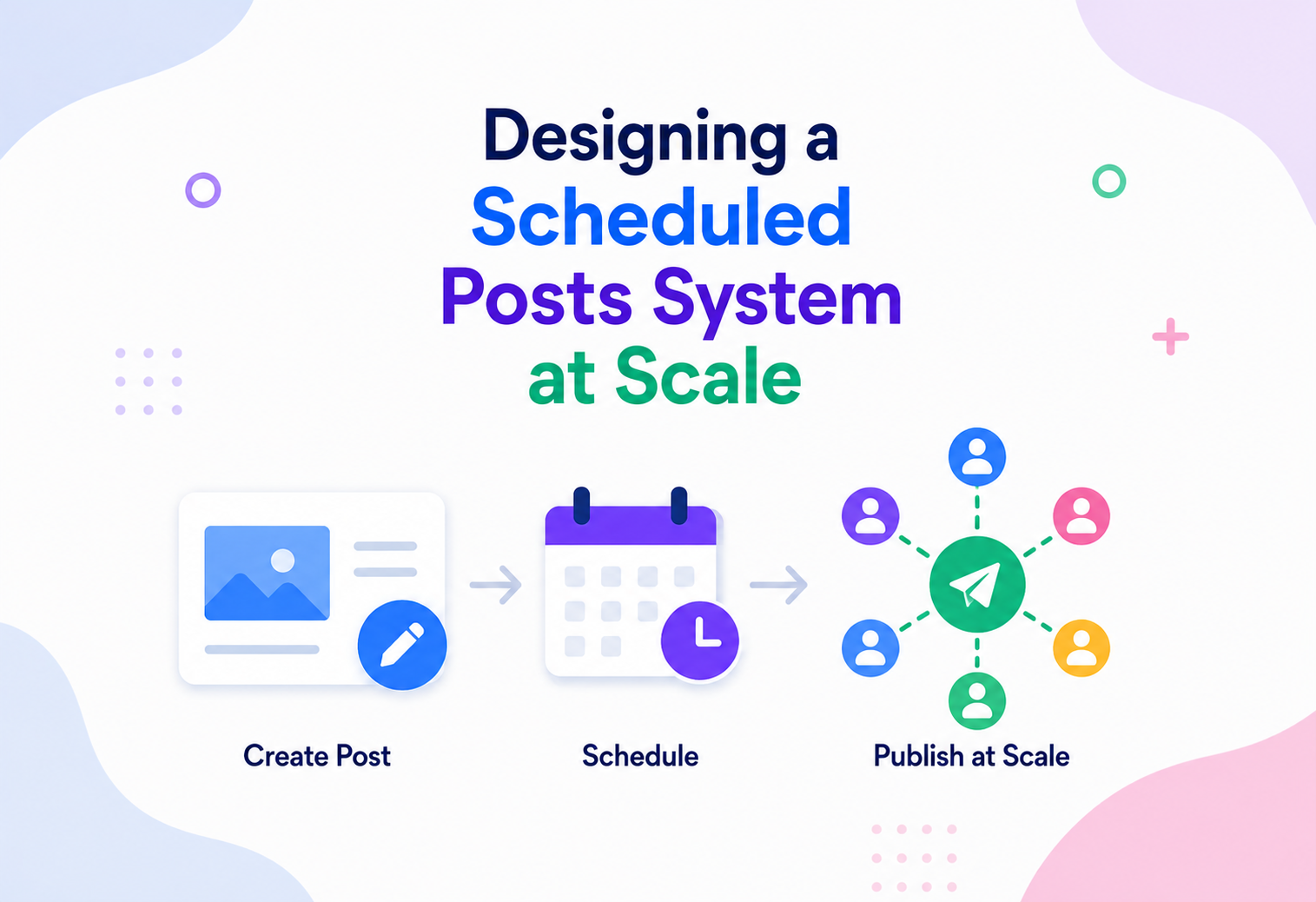
Designing a Scheduled Posts System at Scale
A ground-up, production-grade blueprint for reliably publishing millions of future-dated social posts at the exact second they are due — covering time-bucketed queues, distributed locking, exactly-once delivery, and the trade-offs real platforms make when time itself becomes a scaling dimension.
Introduction and History
The feature sounds almost too simple to deserve a system design tutorial: a user writes a post, picks a future date and time, taps “Schedule,” and closes the app. Hours or days later, at exactly the right moment, the post appears publicly — without the user’s device being open, without their phone even being on. That last detail is the entire engineering problem in one sentence: the system has to remember to do something on the user’s behalf, correctly, at a precise future moment, completely independent of whether the user is present.
This is fundamentally different from almost everything else a social platform’s backend does. Most backend work is reactive — a user taps a button, a request arrives, the system responds within milliseconds. Scheduled publishing is proactive — nothing arrives from outside to trigger the action; the system itself has to notice that time has passed and act on its own initiative. Making that happen reliably for one post is trivial. Making it happen reliably for tens of millions of posts, scattered across every second of the calendar, surviving server crashes, deployments, and traffic spikes, is a genuinely hard distributed systems problem.
Think of a giant hotel with a wake-up call service. A guest can ask the front desk, days in advance, “please call my room at exactly 6:47 AM on Thursday.” The front desk needs a system that does not just remember one such request — it needs to reliably track thousands of these requests, sorted by time, and make the calls at exactly the right moment even if the person working the front desk changes shifts, goes on break, or the phone system itself needs to be restarted overnight. A scheduled-post system is that wake-up call service, except the “guest” is a piece of content, the “call” is a publish action, and there are millions of requests stacked up at once instead of thousands.
1.1 A short history of “do this later” systems
cron is born
Unix’s cron daemon introduced the idea of a background process that wakes up periodically and checks a table of scheduled jobs — the direct ancestor of every “run this later” system that followed, including the one this tutorial designs.
Enterprise job schedulers
Systems like Quartz Scheduler (Java) and enterprise batch schedulers formalized “durable, distributed cron” — jobs stored in a database, survivable across restarts, with clustering support so multiple servers could share scheduling duties without double-firing a job.
Delayed message queues
Message queue systems added native delayed-delivery features (RabbitMQ’s delayed message plugin, AWS SQS delay queues), letting engineers say “deliver this message, but not until X” without building a custom poller — a pattern this design borrows heavily from.
Time-wheel algorithms go mainstream
Kafka’s purgatory and Netflix’s and Twitter’s internal scheduling systems popularized hierarchical timing wheels — a data structure originally from real-time operating systems research — as the standard way to efficiently track millions of pending timers without constantly re-scanning them all.
Scheduled social publishing at scale
As creators and businesses adopted content calendars and social media management tools (Buffer, Hootsuite, and native scheduling features on Instagram, X/Twitter, LinkedIn, and Facebook), scheduled posting evolved from a niche power-user feature into table-stakes functionality expected to work flawlessly at the scale of tens of millions of concurrently pending posts.
“Design a scheduling system” (in flavors ranging from scheduled posts to reminder notifications to delayed job queues) is a favorite system design interview question because, unlike most feed or messaging problems, it forces a candidate to reason explicitly about time as a first-class scaling dimension — a very different mental model from request/response systems.
1.2 What this tutorial will build
We will design a system that lets a user schedule a post for any future time, stores that schedule durably, and publishes it automatically at the right moment — even if it was scheduled a year in advance — while handling millions of pending scheduled posts, tolerating server failures without missing or duplicating a publish, and giving users the ability to edit or cancel a scheduled post right up until the moment it fires. By the end, you should be able to explain, from first principles, why each major component exists and what specific failure mode it prevents — not just recite the names of the boxes in the architecture diagram.
Problem and Motivation
Before getting into the architecture, it is worth spending time on why this problem resists the obvious solution, because every design decision in the rest of this tutorial exists specifically to answer one of the failure modes described below.
A single scheduled post is easy: store a row with a publish_at timestamp, write a script that checks the table every minute, and publish anything whose time has come. That “obvious” design is precisely where most engineers start — and precisely where it falls apart once real scale and real failure modes enter the picture. Let us build up the problem carefully.
2.1 Why businesses need this feature
Content calendars
Creators and brands plan content days or weeks ahead, often batching a week’s worth of posts in one sitting rather than logging in daily — scheduling turns that batch work into a steady, timed publishing cadence.
Time-zone optimized reach
A creator with a global audience wants a post to go live when their audience is most active, which is rarely when the creator themselves is awake and at their desk.
Organizational workflows
Marketing teams often require content to be written, reviewed, and approved well before the intended publish date, decoupling the “who writes it” step from the “when it goes live” step entirely.
2.2 Why the naive “poll every minute” design fails
Picture the simplest possible implementation: one process, running on a timer, executing SELECT * FROM posts WHERE publish_at <= NOW() AND status = 'scheduled' once a minute, then publishing whatever comes back. Walk through what happens as this system grows:
1. The table scan gets slower as pending posts grow
At ten million pending scheduled posts, even an indexed range query against publish_at run every sixty seconds puts sustained, non-trivial load on the primary database — and that is before considering that this same database also needs to serve normal reads and writes for the rest of the platform.
2. A single poller is a single point of failure
If that one process crashes, restarts, or gets stuck, every scheduled post silently stops firing until someone notices — and “someone notices” in production usually means a user complaint, not a monitoring alert, because the failure produces no errors, just silence.
3. Running multiple pollers naively causes duplicate publishes
The obvious fix — run the poller on multiple machines for redundancy — immediately creates a new bug: two machines can both select the same due post in the same polling cycle and both publish it, resulting in a duplicate post. Solving this requires distributed coordination (locking, claiming, or partitioning), which is exactly the kind of problem this tutorial addresses in depth.
4. Minute-level polling caps your precision
If precision better than “within a minute” is ever required (and for a platform managing millions of posts across every timezone, this becomes a real product expectation), naive polling has to poll more frequently, multiplying the load problem from point 1.
Every scheduling system design decision traces back to one tension: you need to efficiently find “what is due right now” out of millions of pending items sorted by an arbitrary future timestamp, repeatedly, forever, without either scanning everything each time or missing anything.
2.3 Formal problem statement
Given up to tens of millions of scheduled posts, each with a target publish_at timestamp that can be anywhere from seconds to a year in the future, design a system that: publishes each post exactly once, within a tight accuracy window (typically a few seconds) of its target time; survives individual node failures without missing or duplicating publishes; supports editing or cancelling a scheduled post any time before it fires; and scales horizontally as the number of pending posts and the rate of new schedules grows.
“A scheduling system is not really storing posts — it is storing promises about the future, and its entire job is to keep every single one of them.” Every architectural choice that follows exists in service of keeping that promise, at scale, without the operator ever having to manually check whether it did.
Core Concepts
Scheduling systems draw on a specific set of distributed-systems building blocks that do not come up as often in typical CRUD-service design. Let us build a shared vocabulary before assembling the architecture — skimming ahead and returning to a term once it reappears in the architecture discussion is a perfectly reasonable way to read this section too.
3.1 Timing wheel
What: A data structure — conceptually a circular array of “buckets,” like the face of a clock — where each bucket holds all the timers due within a specific small time range. A pointer sweeps around the wheel; whenever it reaches a bucket, everything in that bucket has come due.
Why: Checking “what is due” becomes an O(1) lookup of the current bucket instead of scanning every pending item to compare timestamps, which is what makes it possible to track millions of timers without the checking cost growing with the number of timers.
Picture a large parking garage with one exit gate per level, and a valet who wheels a cart around, level by level, at the top of every hour. Instead of walking around checking every single car’s ticket to see whose hour is up, the valet only needs to look at whichever level the cart is currently parked at — because every car on that level is due at the same time. That is exactly how a timing wheel avoids scanning everything.
3.2 Delayed queue / delay exchange
What: A message queue variant where a message becomes visible/consumable only after a specified delay, rather than immediately upon being published. Many production queue systems (RabbitMQ, Amazon SQS, Kafka via specific patterns) support this natively.
Why: Lets a “schedule a post for later” request become “publish a message onto a queue that will not be delivered until the right time” — offloading the correctness of the delay mechanism to battle-tested queue infrastructure rather than reinventing it.
3.3 Time-bucketing (sharding by time)
What: Splitting the storage of scheduled items into separate partitions or tables based on coarse time ranges — for example, one shard per hour, or per day — rather than one giant table holding every scheduled post regardless of when it is due.
Why: A scheduler that only needs to publish things due “in the next hour” should only need to query the shard(s) covering that hour, not scan across a table containing posts scheduled a year out.
3.4 Leader election and distributed locking
What: Coordination mechanisms (via systems like ZooKeeper, etcd, or Redis-based locks) that let a cluster of machines agree on which one of them is responsible for a given piece of work at a given moment, preventing two machines from doing the same job simultaneously.
Why: Multiple scheduler instances need to run for redundancy, but without coordination, two instances could both pick up and publish the same due post — a distributed lock (or an equivalent “claim” mechanism) ensures only one instance actually executes the publish.
Think of a deli counter’s take-a-number system. Multiple staff are ready to help, but the ticket system ensures only one staff member calls out and serves a given number — nobody duplicates the work, and if one staff member steps away, another can still call the next number. A distributed lock plays exactly this role among multiple scheduler workers.
3.5 Idempotency
What: A property of an operation where performing it multiple times has the same effect as performing it once. An idempotent “publish this post” operation, if accidentally triggered twice, results in the post being published once — not twice.
Why: Distributed systems cannot guarantee “exactly-once” execution at the network level (messages can be redelivered after a timeout even if the first attempt actually succeeded) — idempotency is what lets the system safely tolerate “at-least-once” delivery underneath while still presenting an exactly-once publish to the end user.
3.6 At-least-once vs exactly-once delivery
| Guarantee | What it means | Trade-off |
|---|---|---|
| At-most-once | A message is delivered zero or one times — never retried | Simple, but risks silently losing a scheduled publish on any transient failure |
| At-least-once | A message is guaranteed delivered, but might be delivered more than once (e.g. after a timeout-triggered retry) | Never silently loses a publish, but requires idempotent handling to avoid duplicates |
| Exactly-once (effective) | Achieved in practice as at-least-once delivery combined with idempotent processing, not as a native network guarantee | The practical target for this system — never lose, never duplicate, from the user’s point of view |
3.7 Clock skew and drift
What: The unavoidable small differences between the system clocks on different machines in a distributed system, caused by imperfect hardware clocks and network synchronization delays.
Why it matters here: If different scheduler instances have clocks that disagree by even a few seconds, they might disagree about whether a given post is “due yet,” leading to inconsistent behavior. Production systems mitigate this with NTP (Network Time Protocol) synchronization and, in the most precision-sensitive designs, deliberately built-in tolerance windows.
- “Why would you use a timing wheel instead of just querying a database sorted by publish time?”
- “How would you guarantee a scheduled post is published exactly once even if the worker publishing it crashes mid-operation?”
- “What happens if two scheduler instances both think they own the same due post?”
- “How would you partition ownership of the near-future window across multiple timing wheel instances?”
3.8 CAP theorem, applied to this system
What: The CAP theorem states that a distributed data store can only guarantee two of three properties at once during a network partition: Consistency, Availability, and Partition tolerance. Since network partitions are an unavoidable reality, the practical choice in any real distributed store is between consistency and availability when one occurs.
Where it applies here: The Scheduled Posts DB — the system’s single source of truth, holding the compare-and-set claim state that prevents duplicate publishes — deliberately favors consistency over availability for writes touching a post’s status. A brief unavailability window during a leader failover is an acceptable cost; a duplicate publish caused by two nodes disagreeing about a post’s claim status is not. The Timing Wheel Service and Delayed Message Queue, by contrast, can lean more toward availability, since their state is always rebuildable from the authoritative database if a node is temporarily out of sync.
3.9 Consistent hashing for partition ownership
What: A hashing technique that maps both data items and the nodes responsible for them onto the same conceptual ring, such that each item is owned by the nearest node clockwise on the ring. When a node is added or removed, only a small fraction of items need to be reassigned, rather than the entire dataset.
Why it matters here: When multiple Timing Wheel Service instances each own a slice of the near-future window (Section 8), consistent hashing lets that ownership be redistributed smoothly as instances scale up or down, without a disruptive full reshuffle of which instance is tracking which posts every time the fleet size changes.
Imagine assigning tables in a large restaurant to a rotating set of servers by marking each table and each server’s name on a circular seating chart, then giving each table to the nearest server’s name going clockwise. If one server goes home early, only the tables between their name and the next server’s name need to be reassigned — everyone else keeps their original tables. That is the core benefit consistent hashing gives a resizable cluster of timing-wheel owners.
Architecture and Components
With the vocabulary in place, here is the complete end-to-end architecture — from the moment a user taps “Schedule” to the moment their post appears publicly, including every infrastructure component a production system needs, such as the Load Balancer and API Gateway that sit in front of every request. Every box in the diagram below corresponds to one of the concepts introduced in Section 3, so it is worth pausing at each one and confirming you can explain why it exists before moving on to the component-by-component breakdown that follows.
4.1 Component-by-component breakdown
Load Balancer
Role: The first stop for every client request — whether scheduling a new post, editing one, or cancelling one. Distributes traffic across API Gateway instances using health-checked round-robin or least-connections routing, so no single instance becomes a bottleneck or single point of failure.
API Gateway
Role: Authenticates the request, enforces per-user rate limits (preventing a single account from scheduling thousands of posts per second), validates the request shape, and routes it to the Scheduling Service. Centralizes cross-cutting concerns so downstream services can trust everything reaching them has already been vetted.
Scheduling Service
Role: The entry point for create/edit/cancel operations on a scheduled post. Writes the post’s content reference and target publish_at time to durable storage, and decides — based on how far in the future the post is scheduled — whether to route it directly into the near-term Delayed Queue/Timing Wheel path or leave it in durable storage to be picked up later by the sweeper as its time approaches.
Validation Service
Role: Runs content-policy checks and validates the requested time itself (not in the past, within any platform-defined maximum scheduling window) before a post is accepted, so obviously invalid schedules are rejected immediately rather than silently failing at publish time.
Scheduled Posts DB
Role: The durable source of truth for every pending scheduled post, sharded by time bucket (e.g., one logical partition per day) so that queries for “what is coming due soon” only touch a small, relevant slice of the data rather than the entire table.
Timing Wheel Service
Role: An in-memory structure (see Section 3.1) holding only the near-future window of posts — for example, the next hour — enabling near-instant, low-overhead detection of exactly which posts are due right now without touching the database on every tick.
Bucket Sweeper / Poller
Role: A horizontally scaled pool of workers that periodically queries the Scheduled Posts DB for posts entering the near-future window and loads them into the Timing Wheel (or pushes them onto the Delayed Queue directly), bridging long-term durable storage and the fast in-memory dispatch path.
Distributed Lock Service
Role: Ensures that when a post becomes due, exactly one Publish Worker claims and executes it, even though many worker instances are running concurrently — the mechanism that prevents duplicate publishes described in Section 3.4.
Delayed Message Queue
Role: Handles the actual timed delivery for near-term posts — a message enters the queue and becomes consumable by a Publish Worker only once its delay has elapsed, offloading fine-grained timing correctness to proven queue infrastructure.
Publish Worker Pool
Role: Executes the actual publish: marks the post as published in the database, hands it to the Feed/Fan-out Service, and does so idempotently — safe to retry without creating duplicate posts if a worker crashes mid-operation.
Feed / Fan-out Service, Notification Service, Audit/Event Log
Role: Once published, the Feed Service pushes the new post into followers’ feeds (reusing the platform’s normal publish/fan-out pipeline), the Notification Service confirms success to the creator, and every step is recorded on an event bus for observability and debugging.
Notice the split between “far future” (durable, cold storage, cheap to hold, coarse-grained) and “near future” (hot, in-memory, precise, expensive to hold at scale). This two-tier design is the single most important idea in the whole architecture — it means the system never needs to hold ten million timers actively in memory at once, only however many are due in the next few minutes.
It is worth noticing, too, that no single component in this diagram is individually exotic — a load balancer, an API gateway, a sharded relational database, a message queue, a pool of stateless workers. What makes the system genuinely capable of the scale and correctness this tutorial targets is not any one clever piece of technology; it is how these ordinary components are arranged around the specific two-tier timing split and the claim-based coordination mechanism that ties them together.
Internal Working
Let us trace two separate journeys in detail: the write path (a user schedules a post) and the fire path (the system detects a post is due and publishes it). These are asynchronous and decoupled — they do not happen in the same request, and understanding that decoupling is central to understanding why this architecture looks the way it does.
5.1 The write path in detail
When a user schedules a post, the Scheduling Service does two things atomically from the caller’s point of view: it persists the post content reference and target time to the Scheduled Posts DB, and it returns a confirmation immediately. Critically, the write path never blocks waiting for anything related to timing — scheduling a post for one minute from now and scheduling a post for eleven months from now should feel identical and equally fast to the user, because both are simply durable writes with a status of “scheduled.” The system decides how to route the post internally, invisibly to the user, based on how far away publish_at is.
5.2 The fire path in detail: two-tier dispatch
This is where the two-tier design from Section 4 earns its keep. A post scheduled a year out does not need millisecond-precision tracking on day one — it just needs to sit safely in durable, time-bucketed storage. As its target time approaches (typically within a configurable near-future window, such as the next hour), the Bucket Sweeper picks it up and promotes it into the fast path — either the in-memory Timing Wheel or directly onto the Delayed Message Queue. Only posts inside this near-future window ever occupy memory-resident structures, which is what keeps the system’s active working set small and fast regardless of how many total posts are sitting in cold storage months out.
5.3 The claim-and-publish step
When a post’s moment finally arrives, the responsible component does not just publish it directly — it first acquires a distributed lock (or an equivalent claim, such as a conditional database update using an optimistic concurrency check) scoped to that specific post. Only the worker that successfully acquires the claim proceeds to publish; any other worker that also noticed the post was due simply backs off. This single step is what turns “at-least-once notice that a post is due” (which is easy to guarantee) into “exactly-once publish” (which is what users actually need).
// Uses a conditional (compare-and-swap style) update as the claim
// mechanism instead of a separate lock service, keeping the critical
// path to a single atomic database operation.
public class PublishWorker {

    private final ScheduledPostRepository repository;
    private final FeedFanoutClient feedClient;

    public PublishWorker(ScheduledPostRepository repository, FeedFanoutClient feedClient) {
        this.repository = repository;
        this.feedClient = feedClient;
    }

    // Called whenever the timing wheel or delayed queue signals a post is due.
    // Safe to call more than once for the same postId — only the first
    // successful claim actually publishes.
    public void handleDue(String postId) {
        boolean claimed = repository.compareAndSetStatus(
            postId,
            "SCHEDULED",   // expected current status
            "PUBLISHING"   // new status, only applied if current == expected
        );

        if (!claimed) {
            // Another worker already claimed this post, or it was
            // cancelled/edited before this fired. Safe to no-op.
            return;
        }

        try {
            ScheduledPost post = repository.findById(postId);
            feedClient.publishAndFanout(post);
            repository.updateStatus(postId, "PUBLISHED");
        } catch (Exception e) {
            // Roll the claim back so a retry (by this or another worker)
            // can safely attempt the publish again.
            repository.compareAndSetStatus(postId, "PUBLISHING", "SCHEDULED");
            throw new RuntimeException("Publish failed, will retry", e);
        }
    }
}
The compare-and-set pattern above is a lightweight alternative to a dedicated distributed lock service for many designs — it pushes the “only one winner” guarantee down into the database’s native atomic update support, which is often simpler to operate than running a separate coordination service, at the cost of putting slightly more load on the primary datastore under contention.
- “Walk me through exactly what happens between a post’s scheduled time arriving and it appearing in a follower’s feed.”
- “Why not just keep every scheduled post in memory the whole time, however far in the future it is?”
- “How does a compare-and-set claim prevent two workers from double-publishing the same post?”
5.4 Inside the timing wheel: hierarchical buckets
A single flat timing wheel with one bucket per second, covering a full hour, would need 3,600 buckets — manageable, but the design gets more elegant, and more efficient for very fine-grained precision, using a hierarchical timing wheel, the same structure used inside Kafka’s purgatory (see Section 17). A hierarchical wheel stacks multiple wheels of different granularities: a seconds-wheel with 60 buckets covering the next minute, a minutes-wheel with 60 buckets covering the next hour, and so on. A post due in 45 minutes is initially placed in the minutes-wheel; only as its bucket approaches does it get “cascaded” down into the finer-grained seconds-wheel. This avoids the memory and management overhead of maintaining thousands of nearly-empty fine-grained buckets far in advance, while still achieving second-level precision once a post is truly imminent.
5.5 Ownership handoff when the fleet resizes
When the Timing Wheel Service scales from, say, four instances to six (using the consistent hashing scheme from Section 3.9), some in-flight bucket ownership needs to move between instances. This is handled safely because, again, no instance’s in-memory wheel is ever the only copy of the truth — the newly-responsible instance simply re-sweeps its newly-owned time range from the Scheduled Posts DB on startup, exactly as it would after a restart. Scaling the fleet and restarting an instance are, from a correctness standpoint, the same event, which is a deliberate and valuable simplification.
Data Flow and Lifecycle
Beyond the happy path traced in Section 5, a scheduled post has several possible lifecycle branches — editing, cancellation, and failure recovery — each of which touches the architecture differently. Understanding these branches matters just as much as understanding the happy path, since in a system managing millions of pending posts, edits and cancellations are not rare exceptions — they are routine, continuous traffic that the architecture needs to handle just as gracefully as the straightforward create-and-fire case.

6.1 Editing a scheduled post
Because a not-yet-fired post is just a row in durable storage (or, if it is within the near-term window, an entry in the Timing Wheel or Delayed Queue), editing its content is a straightforward update — as long as it has not already been claimed for publishing. Editing the time is more delicate: if the post has already been promoted into the fast path, moving its time might require removing it from its current timing-wheel bucket or delayed-queue entry and re-inserting it at the new time, which is why many implementations simply mark the old entry as stale (checked and skipped when it fires) and create a fresh scheduled entry for the new time, letting the sweeper pick it up again naturally.
6.2 Cancelling a scheduled post
Cancellation follows the same “mark and let it be skipped” pattern for maximum safety: rather than trying to reach into an in-memory timing wheel or a queue and forcibly remove an entry (which is possible but adds real complexity and race-condition risk), the simplest robust approach flips the post’s status to “cancelled” in durable storage. When the fire path eventually reaches that post, the claim step (Section 5) checks the current status before publishing and simply no-ops if it finds “cancelled” instead of “scheduled” — reusing the exact same compare-and-set safety mechanism that already prevents duplicate publishes.
6.3 Failure recovery: what happens when a worker crashes mid-publish
If a Publish Worker crashes after claiming a post (moving it to “Publishing”) but before completing the fan-out, the post would be stuck forever without a recovery mechanism. Production systems handle this with a watchdog: any post that has been sitting in the “Publishing” state for longer than a reasonable timeout (say, 30 seconds) is considered abandoned and is automatically rolled back to “Scheduled” by a background reconciliation job, making it eligible to be claimed and retried by a healthy worker. This is the same pattern used broadly in distributed task-queue design, and it is what turns “a worker crash” from a lost post into, at worst, a slightly delayed one.
Think of the “Publishing” state like a library book checkout that has not been returned or renewed. If it has been checked out far longer than any reasonable reading time, the library does not assume the book is gone forever — it assumes something interrupted the return process and follows up. The scheduling system’s watchdog plays exactly that role for stuck posts.
Advantages, Disadvantages, and Trade-offs
The two-tier, claim-based architecture in this tutorial solves the correctness problems of naive polling, but it is not free — every additional moving part is something that has to be built, operated, and monitored. It is worth being explicit about the trade-offs before treating this design as the obvious answer for every scale of problem. A team building this for a platform with a few thousand scheduled posts a day should think carefully about how much of this architecture they genuinely need versus how much is justified specifically by the “millions of posts” scale this tutorial targets.
Advantages
- Scales to tens of millions of pending posts without the “what is due” check getting slower as pending count grows.
- Exactly-once publish guarantee (in practice) via idempotent claim-and-publish, even with multiple redundant workers.
- Graceful failure recovery — a crashed worker never permanently loses a scheduled post.
- Editing and cancellation are simple, low-risk operations thanks to the “mark and skip” pattern.
- Two-tier storage keeps the expensive, precise in-memory structures small regardless of how far out posts are scheduled.
Disadvantages and costs
- Meaningfully more complex than a single cron job — more services, more failure modes, more to monitor.
- Requires careful tuning of the near-future window size, sweep frequency, and claim timeout — get these wrong and precision or throughput suffers.
- Distributed locking (or compare-and-set contention) adds latency and a potential bottleneck if not designed carefully.
- Clock skew across machines can introduce small, hard-to-debug timing inconsistencies.
- Building idempotency correctly throughout the publish path takes real engineering discipline — it is easy to introduce a non-idempotent step accidentally.
7.1 Key trade-offs every design must confront
| Trade-off | Option A | Option B | Typical resolution |
|---|---|---|---|
| Precision vs cost | Check every post’s exact timestamp continuously | Check in coarse time buckets, refine only near-term | Two-tier design: coarse far-future storage, precise near-future timing wheel |
| Simplicity vs coordination overhead | Single poller, no locking needed | Multiple redundant workers with distributed claims | Multiple workers + lightweight compare-and-set claims for the best of both |
| Immediate cancellation vs safety | Actively remove an entry from in-flight timing structures on cancel | Mark cancelled and let the fire path skip it | Mark-and-skip — simpler, avoids race conditions, small acceptable “dead entry” overhead |
| Retry aggressiveness vs duplicate risk | Retry failed publishes immediately and often | Retry conservatively with backoff and a claim timeout | Backoff-based retry with a watchdog timeout, relying on idempotency as the safety net |
Interviewers often push on why you would not just keep everything in one big in-memory timing wheel for simplicity. Be ready to explain that a wheel large enough to hold ten million far-future entries would consume enormous memory and complicate every server restart or deployment — the two-tier split exists specifically to bound the expensive, fragile in-memory structure to a small, manageable near-term window.
Performance and Scalability
~5s accuracy
Publish within a few seconds of the target time under normal operating conditions.
10–20M pending
Steady-state count of scheduled-but-not-yet-published posts across the whole platform.
~1 hour
Near-future window held actively in the Timing Wheel Service in memory.
~100s/sec
Peak publish throughput at busy clustered minutes like the top of a popular posting hour.
8.1 Back-of-the-envelope capacity planning
Consider a platform with 50 million monthly active creators, where 5% use scheduling in a given month, averaging 4 scheduled posts each — that is roughly 10 million scheduled posts created per month, or about 4 per second on average, though creation is typically bursty around common planning times (Sunday evenings, start of business hours) rather than perfectly even. On the publish side, posts are spread across every minute of every day, but real-world scheduling behavior clusters heavily around “nice” times — the top of the hour, common posting times like 9 AM or 6 PM in major timezones — which means peak publish throughput at those popular minutes can be dramatically higher than the flat average, sometimes by one or two orders of magnitude. Designing the Publish Worker pool to auto-scale based on queue depth, rather than a fixed size, is essential precisely because of this clustering.
8.2 Sizing the near-future window
The near-future window (how far ahead the Bucket Sweeper promotes posts into the fast Timing Wheel / Delayed Queue path) is the single most important tuning parameter in this system. Too short, and the sweeper has to run very frequently, adding database load and risking missed promotions if a sweep cycle is delayed. Too long, and the in-memory Timing Wheel grows large, consuming more memory and complicating restarts. A one-hour window is a common, reasonable default for a social-scale system: it is long enough that even a sweeper hiccup of a few minutes is easily recovered from well before affected posts are due, and short enough to keep the in-memory structure’s size bounded and predictable.
8.3 Horizontal scaling strategy
Time-bucketed DB sharding
Sharding the Scheduled Posts DB by coarse time bucket (e.g. by day) means the sweeper’s near-future queries only ever touch one or two shards, keeping query cost flat regardless of total pending post count.
Partitioned timing wheels
Multiple Timing Wheel Service instances each own a disjoint slice of the near-future window (e.g. by a hash of post ID), so no single instance needs to hold the entire near-term workload in memory alone.
Auto-scaled worker pools
The Publish Worker pool scales based on the Delayed Queue’s depth and age-of-oldest-message metric, growing ahead of predictable spikes (like the top of a popular posting hour) and shrinking during quiet periods.
8.4 Batching the sweep query
Rather than the sweeper querying continuously, it runs on a fixed interval (for example, every 30 seconds) and fetches a bounded batch of posts entering the near-future window, using keyset pagination on the indexed publish_at column rather than a large offset-based scan — keeping each sweep query fast and predictable even as the total pending post count grows into the tens of millions.
- “How would you size the near-future window, and what happens if you get it wrong in either direction?”
- “How would you handle a sudden spike of a million posts all scheduled for exactly midnight on New Year’s Eve?”
- “Walk me through your back-of-the-envelope math for how many pending scheduled posts this system needs to support.”
- “How would you keep a single timing wheel instance’s bucket-tick logic thread-safe under high concurrent load?”
8.5 Concurrency inside a single timing wheel instance
Within one Timing Wheel Service instance, the bucket-advancing “tick” operation (checking which bucket is now due) and concurrent insertions (new posts being promoted in by the sweeper) both need to touch the same underlying structure safely. Production implementations typically use fine-grained locking per bucket, or a lock-free concurrent data structure, rather than a single coarse lock around the entire wheel — a coarse lock would force every insertion to wait for the tick operation to finish and vice versa, creating exactly the kind of contention bottleneck that would undermine the whole point of using an O(1) structure in the first place. Getting this right is a genuinely subtle piece of systems engineering, which is part of why many production designs (Section 17 discusses several) lean on well-tested, battle-hardened implementations of this pattern rather than writing one from scratch.
High Availability and Reliability
Of every property this system could have, “never silently fail to publish a post the user was told would go live” is the one users will least forgive a violation of — a missed scheduled post, especially a time-sensitive one (a product launch announcement, an event reminder), can have real business consequences for the creator. Reliability here is not optional polish; it is the core requirement the entire architecture exists to satisfy. Every reliability technique in this section is, in a real sense, more important to this system than to a typical CRUD service, precisely because the cost of failure is invisible until a user notices it days later.
9.1 Reliability techniques used throughout
Watchdog reconciliation
A background job continuously scans for posts stuck in “Publishing” past a timeout and rolls them back to “Scheduled” for retry (Section 6), turning worker crashes into brief delays rather than lost posts.
Multi-AZ replication
The Scheduled Posts DB and Delayed Message Queue are both replicated across multiple availability zones, so a single zone outage does not take pending schedules down with it.
Redundant sweepers and workers
Both the Bucket Sweeper and Publish Worker pools run multiple instances behind load balancing; the compare-and-set claim mechanism makes this redundancy safe rather than risky.
Dead-letter handling
A post that repeatedly fails to publish (after several retries) is moved to a dead-letter queue and flagged for manual review or automatic alerting rather than being silently dropped or retried forever.
NTP-synchronized clocks
Every machine in the fleet synchronizes its clock via NTP, minimizing the clock skew described in Section 3.7 that could otherwise cause inconsistent “is this due yet” decisions across instances.
Multi-region failover
The entire pipeline can fail over to a secondary region if the primary region becomes unavailable, with the Scheduled Posts DB’s replication ensuring no schedule data is lost in the process.
9.2 What happens during a deployment or restart?
Because the durable source of truth lives in the Scheduled Posts DB, not in any single process’s memory, deploying a new version of the Scheduling Service, Sweeper, or Publish Worker fleet is safe by design: in-memory Timing Wheel state can be rebuilt from the database on startup (by re-running the sweep for the current near-future window), and any posts mid-claim during a rolling restart are simply picked up by the watchdog and retried by whichever instance is healthy next. This is a direct, deliberate consequence of never treating in-memory state as authoritative — it is always a rebuildable cache of what the database says is true.
Treat the database as the only source of truth and every in-memory structure (timing wheels, queue contents) as a disposable, rebuildable cache. Any design where losing in-memory state means losing data is a design that will eventually lose data, because processes restart — during deploys if nothing else.
9.3 Replication and consensus underneath the data layer
The Scheduled Posts DB’s strong-consistency requirement from Section 3.8 is typically implemented via leader-based replication with a consensus protocol like Raft: a single elected leader accepts writes (including the compare-and-set claim operations) and replicates them to follower nodes, so that if the leader crashes, a new leader can be elected and continue serving without any writes being lost or applied twice. This costs a brief unavailability window during leader election — typically a few seconds — which is an acceptable trade given how rarely leader failures actually occur, versus the alternative of a leaderless design that would make the claim mechanism’s correctness guarantees far harder to reason about.
9.4 Failure recovery in practice
When a Scheduled Posts DB replica fails, or a Timing Wheel Service instance crashes, the recovery sequence is consistent across the stack: health checks detect the failure within seconds, the load balancer or service mesh routes traffic away from the failed node, a replacement instance is provisioned automatically (Kubernetes reschedules the pod), and the new instance rebuilds any necessary in-memory state by re-sweeping its owned time range from the database. None of this requires human intervention in a well-built system — it is designed to be routine and automatic, with the watchdog reconciliation job (Section 6) providing a final independent safety net that catches anything the automatic recovery might have missed.
9.5 Graceful degradation
It is worth designing what a user experiences when parts of the pipeline are degraded, rather than leaving it as an accident of implementation. If the Timing Wheel Service is temporarily behind, near-term posts fall back to the Delayed Queue path directly — slightly slower but still safe. If the Notification Service is degraded, publishes still happen on time, only the confirmation to the creator arrives a few minutes late. If the Bucket Sweeper is slow, posts scheduled far in advance can be promoted a bit closer to their target time than the ideal one-hour lead, but never so close that the fire path cannot fire them. And if the entire near-term fast path is somehow unavailable, a fallback direct-query path against the Scheduled Posts DB — slower and coarser, but functional — can still catch imminent posts, trading precision for availability rather than dropping publishes entirely.
Security
A scheduled post has an unusual security property most published content does not: between the moment it is created and the moment it fires, it exists somewhere in the system while explicitly not being visible to anyone but its author. That window — sometimes months long — is a meaningful attack surface that a simpler “publish immediately” system never has to think about. Every security control described below exists specifically because of that window, not because scheduling introduces entirely new categories of threat unrelated to it.
10.1 Threats specific to a scheduling system
| Threat | Description | Mitigation |
|---|---|---|
| Unauthorized early access | Another user or an internal actor views an unpublished scheduled post before its intended time | Strict row-level access control on the Scheduled Posts DB — only the creator (and, if applicable, authorized team members) can read an unpublished post’s content |
| Scheduled-time tampering | An attacker modifies another user’s post’s publish_at time or content before it fires | Every mutation to a scheduled post requires the same authentication and ownership checks as any other write, enforced at the Scheduling Service, never trusted from the client |
| Time-bomb / abuse content | A user schedules policy-violating content far in advance, betting that moderation review happens closer to real-time posting and might be bypassed | Content policy validation (Section 4’s Validation Service) runs at schedule-creation time and again at publish time, since platform policy or context can change between the two |
| Denial of service via scheduling spam | A malicious or compromised account schedules an enormous number of posts to exhaust storage or overload the sweep/publish pipeline | Per-account rate limits on schedule creation, enforced at the API Gateway, plus a reasonable cap on total pending scheduled posts per account |
| Stale credential replay | A post scheduled far in the future publishes using since-revoked permissions (e.g., the user’s account was suspended in the interim) | The Publish Worker re-checks account standing and content policy immediately before publishing, not just at creation time |
10.2 Defense in depth
- Edge: The Load Balancer and API Gateway terminate TLS and authenticate every request before it reaches the Scheduling Service.
- Encryption at rest: Unpublished post content in the Scheduled Posts DB and Media Storage is encrypted at rest, since it represents a meaningful window of sensitive, not-yet-public data.
- Least privilege: The Bucket Sweeper and Timing Wheel Service only need post IDs and timestamps to do their job — they do not need read access to full post content, and should not be granted it.
- Re-validation at publish time: As shown in the table above, checks that were valid when a post was scheduled are not assumed to still be valid months later — they are re-run immediately before publish.
Because scheduled content can sit unpublished for a long time, “validate once at creation” is not sufficient — content policy, account standing, and even platform rules can all change between scheduling and publishing. Treat the publish-time check as just as important as the creation-time check, not a redundant formality.
10.3 Compliance and data retention
Because unpublished scheduled content is, by definition, private data the creator has not chosen to make public yet, it typically warrants the same or stricter data-handling treatment as private messages under regulations like GDPR — including supporting export and deletion requests that reach into the Scheduled Posts DB, not just published content. If a user deletes their account or exercises a right-to-erasure request while they have pending scheduled posts, those posts need to be reliably removed from every tier of the system — durable storage, any in-memory timing structures they may have already been promoted into, and the Delayed Message Queue — which is another reason the “mark and skip” cancellation pattern from Section 6 is valuable: it provides a single, well-tested code path that account-deletion workflows can reuse rather than needing a separate, bespoke removal mechanism.

10.4 Encryption and secrets management
All internal service-to-service traffic in this pipeline is encrypted with TLS, including the connections between the Bucket Sweeper and the Scheduled Posts DB, and between the Publish Worker and the Feed / Fan-out Service. Any credentials used by these internal services — database passwords, message-queue authentication tokens, distributed-lock-service credentials — live in a dedicated secrets manager (like AWS Secrets Manager or HashiCorp Vault) rather than in configuration files or environment variables committed to source control, and are rotated on a regular schedule so a leaked credential has a bounded window of usefulness to an attacker.
Monitoring, Logging and Metrics
Unlike a slow API response, which a user notices immediately, a missed scheduled post can go unnoticed by the system for a long time — nothing “errors out,” a post simply never appears. This makes proactive, purpose-built monitoring more important here than in most request/response services, where errors are usually loud and immediate. The monitoring strategy for this system has to be designed around the assumption that the worst failures will be silent ones, not the loud ones a generic uptime dashboard is built to catch.
11.1 The single most important metric: publish lag
Publish lag — the difference between a post’s actual publish time and its intended publish_at time — is the north-star reliability metric for this entire system. It should be measured for every single publish, aggregated as P50/P95/P99, and alerted on aggressively: a P99 publish lag creeping from 3 seconds to 3 minutes is an early warning sign of sweeper, timing wheel, or worker pool trouble, long before any user files a complaint.
Publish lag (P50/P95/P99)
Tracked continuously; the primary indicator of whether the whole pipeline — sweeper, timing wheel, queue, workers — is keeping up.
Missed-post count
A dedicated reconciliation job periodically compares “posts that should have published by now” against “posts actually marked published,” alerting on any discrepancy above zero.
Duplicate-publish count
Tracked via the audit event log — should be effectively zero given the idempotency guarantees in Section 5; any non-zero count indicates a claim-mechanism bug.
Queue depth & age-of-oldest-message
On the Delayed Message Queue and Publish Worker input, rising values indicate the worker pool is not keeping pace with demand and needs to scale up.
Sweep cycle duration
How long each Bucket Sweeper pass takes; a growing duration signals the near-future shard query needs tuning or re-sharding.
Stuck-in-Publishing count
Posts sitting in the intermediate claimed-but-not-completed state longer than the watchdog timeout — should self-heal quickly; a sustained count indicates worker health issues.
11.2 Logging and traceability
Every scheduled post carries a unique trace ID from creation through publish, propagated through the Scheduling Service, Bucket Sweeper, Timing Wheel, and Publish Worker, captured via structured logs and distributed tracing. This makes it possible to answer, for any single post, “exactly when was this created, when was it promoted to the near-term window, when was it claimed, and when did it actually publish” — essential both for debugging individual user complaints and for auditing the reconciliation job’s findings.
- “What is the single most important metric for this system, and why?”
- “How would you detect a missed scheduled post if nothing in the system actually errors?”
- “Design a reconciliation job that catches gaps between what should have published and what actually did.”
11.3 Defining SLOs without paging on every blip
As with most production systems, alerting on every metric that can be measured leads quickly to alert fatigue, where real problems get lost in noise. The healthier approach defines a small number of Service Level Objectives that genuinely reflect user-facing reliability — for example, “P99 publish lag under 10 seconds for 99.9% of the trailing 30 days,” or “zero missed publishes per week, verified by the reconciliation job” — and pages on those specifically, using an error-budget model where routine, brief fluctuations do not trigger a page but a sustained trend toward breaching the objective does. Slower-moving health signals, like sweep-cycle duration creeping upward over weeks, are better suited to a dashboard reviewed regularly by the owning team than to an urgent page, preserving on-call attention for genuinely time-sensitive issues.
Deployment and Cloud
A scheduling system’s deployment story has one requirement that sets it apart from most services: a deploy or restart must never cause the pipeline to “forget” what it was doing, because unlike a stateless API that can simply resume serving fresh requests after a restart, this system has millions of pending promises it is actively responsible for keeping. Every practice in this section exists to protect that single invariant through routine operational events, not just through rare disasters.
12.1 Container orchestration
The Scheduling Service, Bucket Sweeper, Timing Wheel Service, and Publish Worker pool are all containerized and run on Kubernetes (or a managed equivalent), each as an independently scaled deployment. Because in-memory Timing Wheel state is rebuildable from the database (Section 9), rolling restarts of that service are safe — new instances simply re-sweep the current near-future window on startup before serving.
12.2 Deployment strategy
- Canary rollout: New versions of the Scheduling Service or Publish Worker are rolled out to a small percentage of instances first, with publish-lag and error-rate metrics watched closely before proceeding.
- Drain before terminate: When scaling down a Publish Worker instance, it is given a grace period to finish any in-flight claims rather than being killed abruptly, minimizing reliance on the watchdog’s rollback-and-retry path for routine scaling events.
- Staggered sweeper deploys: Bucket Sweeper instances are never all restarted simultaneously, ensuring at least one instance is always actively sweeping the near-future window during a rolling deploy.
- Post-deploy reconciliation check: After any deploy touching the fire path, the reconciliation job (Section 11) is run immediately as a smoke test, confirming no posts were missed during the transition.
12.3 Infrastructure as code
The full stack — load balancer configuration, Kubernetes manifests, database sharding topology, queue provisioning, autoscaling policies for the worker pool — is defined declaratively (Terraform, Helm) and version controlled, making the multi-region failover setup from Section 9 something that can be stood up reproducibly in a disaster-recovery drill, not something reconstructed manually under pressure during an actual incident.
Run scheduled, automated disaster-recovery drills that simulate killing the entire Publish Worker fleet mid-day and measure how quickly the watchdog and reconciliation systems recover pending publishes — treat “time to full recovery” as a tracked, improvable metric, not an unknown.
12.4 Cost optimization
The Publish Worker pool and the Timing Wheel Service are the two components most worth watching for cost efficiency, since their load fluctuates heavily with the clustered scheduling patterns discussed in Section 8. Aggressive autoscaling — scaling the worker pool down substantially during quiet overnight hours and scaling up ahead of predictable peaks like the top of a popular posting hour — keeps compute spend proportional to actual demand rather than provisioned for a worst-case that only occurs briefly each day. On the storage side, far-future scheduled posts sitting in cold, time-bucketed shards can use cheaper storage tiers than the hot, frequently-queried near-future shard, since they are touched rarely until the sweeper eventually promotes them — a form of storage tiering directly analogous to the content-freshness tiering used in feed-ranking systems.
Databases, Caching and Load Balancing
The storage choices in this system are shaped almost entirely by one dominant access pattern — “find what is due soon” — and it is worth keeping that pattern in mind as the justification for every choice below, rather than treating each technology pick as independent.
13.1 Database choices, and why
| Store | Technology examples | Why this shape of database |
|---|---|---|
| Scheduled Posts DB | Sharded PostgreSQL/MySQL, or a wide-column store like Cassandra/DynamoDB | Needs strong consistency for the compare-and-set claim mechanism, efficient range queries on publish_at within a shard, and horizontal write scale across time-bucketed shards |
| Delayed Message Queue | Kafka (with a delay-based partitioning pattern) or Amazon SQS delay queues | Purpose-built for at-least-once, timed delivery — offloads the hardest part of “deliver this later” to proven infrastructure rather than reinventing it |
| Distributed Lock Service | etcd, ZooKeeper, or Redis with the Redlock pattern | Provides a consistent, fault-tolerant way for multiple workers to agree on ownership of a claim, when not relying purely on database-level compare-and-set |
| Media Storage | Object storage (S3-style) with CDN in front | Scheduled post media (images, video) needs durable, cheap, high-throughput storage independent of the scheduling metadata itself |
13.2 Why time-bucketed sharding, specifically
Sharding the Scheduled Posts DB by coarse time bucket (for example, one shard per day, or per week for further-out posts) rather than by, say, a hash of user ID, is a deliberate choice tailored to this system’s specific query pattern. The overwhelmingly dominant query the system runs is “find posts due in the next N minutes” — a query that is naturally scoped to a narrow time range. Sharding by time means that query only ever touches one or two shards, no matter how many total pending posts exist across the whole system; sharding by user ID, by contrast, would force that same query to fan out across every shard, since due posts from different users are scattered evenly across all of them.
13.3 Caching strategy
Unlike the read-heavy explore/feed systems common elsewhere in social platforms, this system’s core hot path (the Timing Wheel) is itself already a purpose-built, in-memory cache of near-future posts — a more conventional read-through cache adds little value on top of it. Where caching does help is on the write side: a short-lived cache of a user’s own pending scheduled posts (for rendering their content calendar UI) avoids hitting the sharded database repeatedly for a view that does not need millisecond freshness.
13.4 Load balancing in depth
- Edge load balancer: Distributes client traffic (schedule/edit/cancel requests) across API Gateway instances, with health checks removing unhealthy instances automatically.
- Internal service load balancing: Calls from the Scheduling Service to the Validation Service, and from the Timing Wheel to the Publish Worker pool, are load balanced across their respective instance pools via a service mesh.
- Consumer group balancing: The Publish Worker pool consumes from the Delayed Message Queue as a consumer group, with the queue infrastructure itself balancing message delivery across available worker instances.
- “Why shard the Scheduled Posts DB by time bucket instead of by user ID?”
- “Would you use a database-level compare-and-set or a dedicated distributed lock service for the claim mechanism, and why?”
- “Where, if anywhere, does caching genuinely help in this architecture?”
13.5 Aging out old shards
Time-bucketed sharding has a pleasant operational side effect worth calling out: once every post in a given day’s shard has either published or been cancelled, that shard’s active write and read traffic drops to essentially zero, and it can be safely archived to cheaper cold storage or dropped entirely after a retention period, without any complex data-migration or rebalancing logic. This is a meaningfully simpler lifecycle than the shard rebalancing required by hash-based sharding schemes, where data does not naturally “age out” of a given shard — another point in favor of time-bucketing beyond just query efficiency, and one worth mentioning explicitly if asked to compare sharding strategies in an interview setting.
APIs and Microservices
14.1 The scheduling endpoints
The client-facing API surfaces four simple operations, hiding the entire two-tier dispatch pipeline behind them:
POST /v1/scheduled-posts
Authorization: Bearer <jwt>
{
  "content": "Launching our new feature today!",
  "media_ids": ["m_881a"],
  "publish_at": "2026-08-15T13:00:00Z"
}

// Response
{
  "schedule_id": "sch_44f21",
  "status": "scheduled",
  "publish_at": "2026-08-15T13:00:00Z"
}

PATCH /v1/scheduled-posts/{schedule_id}
// Updates content or publish_at, only while status == "scheduled"

DELETE /v1/scheduled-posts/{schedule_id}
// Cancels; only while status == "scheduled"

GET /v1/scheduled-posts?status=scheduled
// Lists a user's pending scheduled posts, for content-calendar views
14.2 Why publish_at is stored and transmitted as UTC
Every timestamp in this API is UTC (indicated by the trailing Z), never a local time with an implicit timezone. This is a small detail with outsized consequences: storing local times invites subtle, hard-to-debug bugs around daylight saving time transitions and users travelling across timezones between scheduling a post and it firing. The client is responsible for converting the user’s locally-selected time into UTC before sending it, and for converting back to local time only when displaying it — the backend never needs to reason about timezones at all, which eliminates an entire category of bugs from the server side.

14.3 Internal service-to-service APIs
Internally, the Bucket Sweeper, Timing Wheel Service, and Publish Worker communicate over gRPC for the same reasons covered in prior tutorials in this series — lower serialization overhead than JSON, and strongly-typed contracts that catch integration bugs at compile time rather than at runtime.
14.4 Why microservices here, not a monolith
The Scheduling Service (handling user-facing CRUD) and the Publish Worker (executing time-sensitive publishes) have very different operational profiles: the Scheduling Service scales with user request volume and needs to be always warm and responsive, while the Publish Worker pool scales with how many posts are due at any given moment and can be more aggressively autoscaled up and down. Splitting them lets each be deployed, scaled, and monitored according to its own actual load pattern, and means a deploy of one never risks the availability of the other.
Always transmit and store scheduling timestamps in UTC (or with an explicit, unambiguous offset), and push all local-time display logic to the client. This single convention prevents an entire class of daylight-saving-time and cross-timezone bugs that are otherwise notoriously easy to introduce and hard to catch in testing.
14.5 Pagination for the content calendar view
The listing endpoint (GET /v1/scheduled-posts) needs pagination since a prolific user or business account can accumulate hundreds of pending scheduled posts. Because this is a straightforward, non-time-critical read against a user’s own posts (unlike the sweeper’s due-post query), simple cursor-based pagination ordered by publish_at is sufficient — there is no need for the specialized time-bucketed sharding logic the sweeper relies on, since this query is naturally scoped to one user’s data rather than the entire platform’s pending posts.
14.6 Rate limiting scheduling requests
Per-account rate limits on the scheduling endpoints serve two distinct purposes worth calling out separately: a request-rate limit (how many API calls per second an account can make) protects the API Gateway and Scheduling Service from abuse in the usual way, while a separate pending-schedule-count limit (how many total not-yet-published scheduled posts an account may have outstanding at once) protects the Scheduled Posts DB and downstream pipeline from a single account accumulating an unbounded backlog that skews capacity planning for everyone else. Both limits are enforced at the API Gateway and Scheduling Service respectively, with clear, actionable error messages returned to legitimate users who hit them, distinguishing this from the more punitive handling appropriate for genuinely abusive traffic.
Design Patterns and Anti-patterns
15.1 Patterns worth adopting
Two-tier time storage
Coarse, cheap, durable storage for far-future items; precise, in-memory structures only for the near-future window. The single most important pattern in this design, reused across nearly every large-scale scheduler.
Compare-and-set claiming
Using an atomic conditional update as a lightweight distributed lock, avoiding the operational overhead of a separate coordination service where the database can do the job.
Watchdog reconciliation
A background process that finds and heals “stuck” work, turning crash recovery into an automatic, boring, self-healing event rather than an incident.
Mark-and-skip cancellation
Rather than surgically removing an entry from an in-flight timing structure, simply mark it invalid and let the normal fire-path check catch and skip it — trading a tiny bit of wasted work for a large reduction in race-condition risk.
Dead-letter queue
Repeatedly-failing publishes are routed to a separate queue for investigation rather than retried forever or silently dropped, giving operators a clear, bounded place to look for systemic problems.
15.2 Anti-patterns to avoid
- Single-instance poller — no redundancy, and a silent single point of failure for every pending post in the system.
- Naive multi-poller without coordination — “fixing” the single point of failure by adding more pollers without a claim mechanism, causing duplicate publishes.
- Treating in-memory timing state as authoritative — losing pending schedules on every restart because nothing durable backs the in-memory structure.
- Storing and comparing local timestamps — inviting daylight-saving-time and cross-timezone bugs into the core scheduling logic.
- Unbounded retries with no idempotency — retrying a failed publish without a safe claim mechanism, risking duplicate posts on every transient failure.
- No reconciliation safety net — trusting that per-component metrics alone will catch every missed post, rather than independently verifying due-vs-published counts.
Adding more poller instances to fix a single point of failure is the most common mistake in this problem space, precisely because it looks like the right fix and does improve availability — while silently introducing a duplicate-publish bug that often is not caught until it happens in production. Redundancy and correctness under concurrency are two separate problems, and solving the first without solving the second is worse than not solving either.
15.3 One more pattern: outbox-style fan-out
A pattern worth naming explicitly for the hand-off between the Publish Worker and the Feed/Fan-out Service is the transactional outbox pattern: rather than the worker directly calling the fan-out service as a separate network step (which introduces a window where the database has been updated to “published” but the fan-out call could still fail), the worker writes both the status update and a fan-out event to the database in a single local transaction, and a separate, dedicated process reads unprocessed fan-out events and delivers them, retrying independently of the original publish operation. This decouples “did we successfully mark the post as published” from “did we successfully notify every downstream system,” letting each be retried and monitored on its own terms rather than forcing the publish operation itself to wait on, or be entangled with, fan-out delivery guarantees.
Best Practices and Common Mistakes
16.1 Best practices
- Design idempotency in from day one, not as a retrofit. Every step in the publish path — the fan-out call, the notification, the database status update — should be safe to run more than once, because at-least-once delivery guarantees mean it eventually will run more than once.
- Make publish lag your primary dashboard, above everything else. A team that watches publish lag closely will catch pipeline degradation hours before users notice; a team that only watches generic error rates will find out from user complaints instead.
- Always store timestamps in UTC. This single discipline eliminates an entire, notoriously painful category of scheduling bugs around daylight saving time and travel across timezones.
- Build the reconciliation job before you need it. A due-vs-published cross-check that runs continuously in the background is cheap to build early and invaluable the first time something in the main pipeline misbehaves.
- Test the failure paths as rigorously as the happy path. Deliberately kill a Publish Worker mid-claim in staging and confirm the watchdog recovers it correctly — do not assume the recovery logic works just because it compiles.
- Give users clear feedback on schedule state. A content-calendar view that clearly shows “scheduled,” “published,” or “failed — will retry” builds trust in a feature that is, by its nature, invisible while it is working correctly.
16.2 Common mistakes (beyond the anti-patterns above)
| Mistake | Why it hurts | Fix |
|---|---|---|
| Assuming scheduled time distribution is uniform | Real users cluster heavily around “nice” times (top of the hour, common posting windows), creating sharp, predictable spikes | Load test against realistic clustered distributions, not a uniform random spread, and autoscale workers based on real-time queue depth |
| No maximum scheduling horizon | Allowing posts scheduled arbitrarily far in the future (years out) can let stale content policy or account state drift far from reality by the time it fires | Set a sensible maximum scheduling window and re-validate content/account status at publish time regardless |
| Coupling schedule creation to the fire-path’s precision requirements | Making every single “create schedule” request pay the cost of inserting into a precise, memory-resident structure, even for posts a year out | Two-tier design (Section 4) — only pay the precision cost once a post enters the near-future window |
| Ignoring the “edit changes near-term to far-term or vice versa” edge case | An edit that moves a post’s time across the near-future boundary needs to correctly move it between storage tiers, which is easy to miss in initial designs | Route every edit through the same promotion/demotion logic the sweeper uses, rather than a special-cased edit path |
When load-testing this system, do not just simulate a flat, evenly-spread rate of scheduled posts. Simulate realistic clustering — a large fraction of test posts scheduled for the same popular minute — since that is the scenario that actually stresses the Publish Worker pool’s autoscaling and the queue’s throughput, not the average case.
16.3 Debugging a “my post did not publish” report, step by step
When a creator reports a scheduled post that never went live, the structured logging and tracing investment from Section 11 turns what could be a frustrating, open-ended investigation into a short, mechanical checklist. First, pull the post’s trace ID and walk its full history: was it successfully created with the correct publish_at? Was it promoted into the near-future window by the sweeper at the expected time? Was it claimed by a worker, and if so, did the claim succeed or roll back? Second, check whether the post’s current status in the database matches what the client is showing the user — a mismatch here often points to a client-side caching or polling bug rather than a backend failure. Third, if the trace shows the post genuinely never being picked up by the sweeper, check whether it fell into an edge case: was it scheduled inside a very short window before the near-future promotion should have occurred, right as a deploy or fleet resize was happening? This structured trace-first approach turns most “missing post” investigations into a five-minute lookup rather than a lengthy, speculative debugging session.
16.4 Handling the “edit crosses the near/far boundary” edge case correctly
One specific scenario deserves a full best-practice treatment on its own: a user edits a scheduled post’s time, moving it from three days out (far-future, sitting only in cold storage) to five minutes out (near-future, needing immediate promotion into the fast path). The correct implementation routes every edit through the exact same promotion logic the sweeper itself uses, rather than writing a separate “handle late edits” code path — treating an edit as functionally equivalent to “cancel the old schedule, create a new one,” and letting the standard sweep-and-promote mechanism pick up the new schedule on its next cycle, or immediately triggering an out-of-band promotion check if the new time falls inside the near-future window right away. Special-casing this scenario with bespoke logic is a common source of subtle bugs; reusing the existing, well-tested promotion path is not.
Real-World and Industry Examples
17.1 Kafka’s purgatory pattern
Apache Kafka’s internal “purgatory” mechanism — used to hold requests that cannot be completed immediately (like a produce request waiting for enough replicas to acknowledge) until a condition or timeout is met — is built on a hierarchical timing wheel almost identical in concept to the one described in Section 3.1. It is one of the most widely cited real-world implementations of this exact data structure, and studying it is a common recommendation for engineers building any large-scale timer system.
17.2 Social media management platforms (Buffer, Hootsuite)
Third-party scheduling tools that predate most native platform scheduling features had to solve this exact problem years before it became a standard feature — reliably firing posts to external platforms’ APIs at precise future times, at the scale of managing schedules for large numbers of business accounts simultaneously. Their publicly discussed architectures commonly describe a similar split between durable long-term storage and a fast, near-term dispatch mechanism, along with heavy emphasis on idempotent retries against the target platform’s API, since a duplicate post to a brand’s official account is a highly visible, embarrassing failure mode.
17.3 Amazon SQS delay queues and EventBridge Scheduler
AWS’s own managed services illustrate the same core ideas at the infrastructure level: SQS delay queues natively support per-message delays up to 15 minutes, useful for the near-term fire path directly, while Amazon EventBridge Scheduler is explicitly designed for far-future, large-scale scheduled invocations — architecturally validating the two-tier “near-term fast path, far-future durable path” split as a pattern general enough that cloud providers built dedicated managed products around each half of it.
17.4 Distributed cron implementations (Quartz, Airflow)
Enterprise-grade job schedulers like Quartz Scheduler (which explicitly supports clustered, database-backed job storage with built-in misfire handling for missed triggers) and workflow orchestrators like Apache Airflow both converge on the same fundamentals: a durable database as the source of truth for scheduled work, distributed locking or leader election to prevent duplicate execution across a cluster, and explicit handling for what happens when a scheduled trigger is missed — directly mirroring the watchdog and reconciliation patterns covered in Sections 6, 9, and 11 of this tutorial.
17.5 X (Twitter)’s native scheduling and Cassandra-based storage
Platforms that have publicly discussed their timeline and content storage infrastructure, including systems built on wide-column stores like Cassandra, illustrate why time-bucketed partitioning (Section 13) is such a natural fit for this problem: Cassandra’s data model, built around partition keys and clustering columns, maps almost directly onto “partition by day, cluster by exact publish time within that day” — letting the database’s native storage engine do most of the work of keeping near-future range queries fast, rather than requiring extensive custom indexing logic in the application layer.
Every mature scheduling system — whether a message broker’s internal timer, a social media management SaaS product, a cloud provider’s managed scheduler, an enterprise job orchestrator, or a social platform’s own timeline storage — converges on the same shape: a durable source of truth, a bounded near-term fast path, and an explicit mechanism for preventing duplicate execution across redundant workers. That convergence across completely unrelated domains is strong evidence this is close to the correct general solution, not a coincidence of any one team’s preference.
Frequently Asked Questions
Why not just use a simple cron job that runs every minute and checks the database?
It works at small scale, but breaks down as pending posts grow into the millions: the query gets progressively more expensive, a single cron instance is a silent single point of failure, and naively adding more instances for redundancy causes duplicate publishes without a coordination mechanism. The architecture in this tutorial solves all three problems at once.
How do you guarantee a post publishes exactly once?
You do not guarantee it at the network level — no distributed system can. Instead, you guarantee at-least-once delivery (via retries and a watchdog) combined with an idempotent claim-and-publish operation (via compare-and-set or a distributed lock), which together produce an effectively exactly-once result from the user’s point of view.
What happens if a post is scheduled for a time that has already passed due to a client bug or clock issue?
The Validation Service (Section 4) rejects any publish_at that is in the past (with a small grace window to tolerate minor client/server clock differences) at creation time, returning a clear error to the client rather than silently accepting an already-due post.
How would this system handle a massive spike, like millions of posts all scheduled for the same New Year’s Eve midnight moment?
This is exactly why the Publish Worker pool autoscales based on real-time queue depth rather than running at a fixed size, and why load testing should specifically simulate clustered, non-uniform scheduling patterns (Section 16). In practice, platforms may also smooth out extreme spikes by publishing within a small jittered window (a few seconds) around the exact target time rather than guaranteeing perfect simultaneity for millions of posts at once.
Why keep a separate Timing Wheel Service instead of just using the Delayed Message Queue for everything?
Many production designs do lean primarily on a delayed queue and skip a custom timing wheel entirely, especially if the queue technology already provides sufficiently precise, scalable delayed delivery. The timing wheel is most valuable when very fine-grained, high-throughput, low-overhead timer management is needed beyond what off-the-shelf delayed queues offer — it is an optimization, not a strict requirement, and many real systems reasonably choose to rely on the queue alone for simplicity.
How is cancellation handled if the post has already been claimed by a worker?
The compare-and-set claim mechanism naturally handles this race: if a cancellation request arrives after a worker has already claimed the post (moved it to “Publishing”), the cancellation attempt’s own compare-and-set (expecting status “Scheduled”) simply fails, and the post publishes as already in progress. The system favors publishing over silently dropping a post whose cancellation arrived a moment too late, since users generally find an unwanted-but-expected publish easier to deal with than mysteriously missing content.
What is the difference between this system’s exactly-once goal and Kafka’s exactly-once semantics feature?
They solve related but distinct problems. Kafka’s exactly-once semantics ensure a message is processed and its effects committed exactly once within Kafka’s own transactional framework. This system’s exactly-once publish guarantee is achieved at the application level, through idempotent business logic (the compare-and-set claim) layered on top of whatever underlying delivery guarantee the queue provides — a pattern that applies regardless of which specific queue technology is chosen.
How would you handle a user in a timezone that observes daylight saving time scheduling a post for a local time that does not exist (during a “spring forward” transition)?
Because the backend only ever stores and reasons about UTC (Section 14), this ambiguity is resolved entirely on the client: the client’s timezone library resolves the user’s locally-selected time to a well-defined UTC instant before ever sending it to the API, using whatever convention that platform follows for nonexistent or ambiguous local times (typically rounding to the nearest valid instant). The backend never needs its own logic for this edge case, which is precisely the benefit of keeping all timezone handling out of the server.
Could this same architecture be reused for other “do this later” features, like scheduled reminders or drip email campaigns?
Yes — the two-tier storage design, compare-and-set claiming, watchdog recovery, and reconciliation pattern are all generic to “reliably do something at a precise future time, at scale,” independent of what that something is. Swapping the Publish Worker’s action (publish a post) for a different action (send a reminder notification, trigger an email) is a small, isolated change; the surrounding scheduling infrastructure stays essentially the same, which is exactly why systems like Quartz Scheduler and cloud-managed schedulers are built as general-purpose primitives rather than single-feature tools.
Summary and Key Takeaways
A scheduled posts system asks a deceptively simple question — “publish this later” — and turns out to require nearly every core distributed-systems tool in the book to answer reliably at scale: durable storage as the single source of truth, an efficient data structure for tracking millions of pending timers, coordination to prevent duplicate execution across redundant workers, idempotency to survive retries safely, and continuous reconciliation to catch anything that slips through despite all of the above.
Key takeaways
- The core architecture is a two-tier time storage design: durable, coarse-grained storage for far-future posts, and a fast, precise, in-memory structure (timing wheel or delayed queue) only for the near-future window.
- Every client request passes through a Load Balancer and API Gateway before reaching any scheduling logic — infrastructure that handles traffic distribution, authentication, and rate limiting so individual services do not have to.
- Exactly-once publishing is achieved in practice through at-least-once delivery combined with an idempotent, compare-and-set claim mechanism — never through a network-level guarantee that does not actually exist.
- A watchdog and reconciliation job turn worker crashes and pipeline hiccups into automatically self-healing events rather than silently lost posts — critical because missed publishes fail silently, unlike most API errors.
- Time-bucketed database sharding keeps the dominant “what is due soon” query fast regardless of how many total pending posts exist across the whole system.
- Treat in-memory timing state as a disposable, rebuildable cache, never as the authoritative source of truth — this single discipline is what makes deploys, restarts, and failures survivable without data loss.
- Store and transmit every timestamp in UTC, pushing all local-time display logic to the client, eliminating an entire class of daylight-saving and cross-timezone bugs.
- Real systems — Kafka’s purgatory, cloud-managed schedulers, enterprise job orchestrators, and social media management platforms — independently converge on this same shape, strong evidence it reflects the genuine constraints of the problem rather than one team’s preference.
“A scheduling system’s job is to be so reliable that its correctness is invisible — the only time anyone should ever think about it is when they are designing it.”
19.1 Where to go from here
If you are preparing this topic for a system design interview, the strongest preparation is being able to redraw Figure 1 from scratch and explain, specifically, why the near-future/far-future split exists and what would break without it. If you are building something like this for real, invest early in the reconciliation job and the publish-lag dashboard described in Section 11 — a scheduling system without a way to independently verify it kept every promise is a scheduling system that will, eventually, quietly break one.
It is also worth remembering that this same shape of problem — durable storage as ground truth, a bounded fast path for what is imminent, and idempotent, coordinated execution across redundant workers — shows up far beyond social media scheduling. Reminder systems, subscription renewal jobs, SLA-timeout monitors, and drip marketing campaigns all reduce to the same underlying requirement: reliably do something once, at a precise future time, at scale, without a human watching. Internalizing this architecture as a general pattern rather than a feature-specific solution is what makes it genuinely reusable the next time a “do this later” requirement shows up in a completely different part of a system.