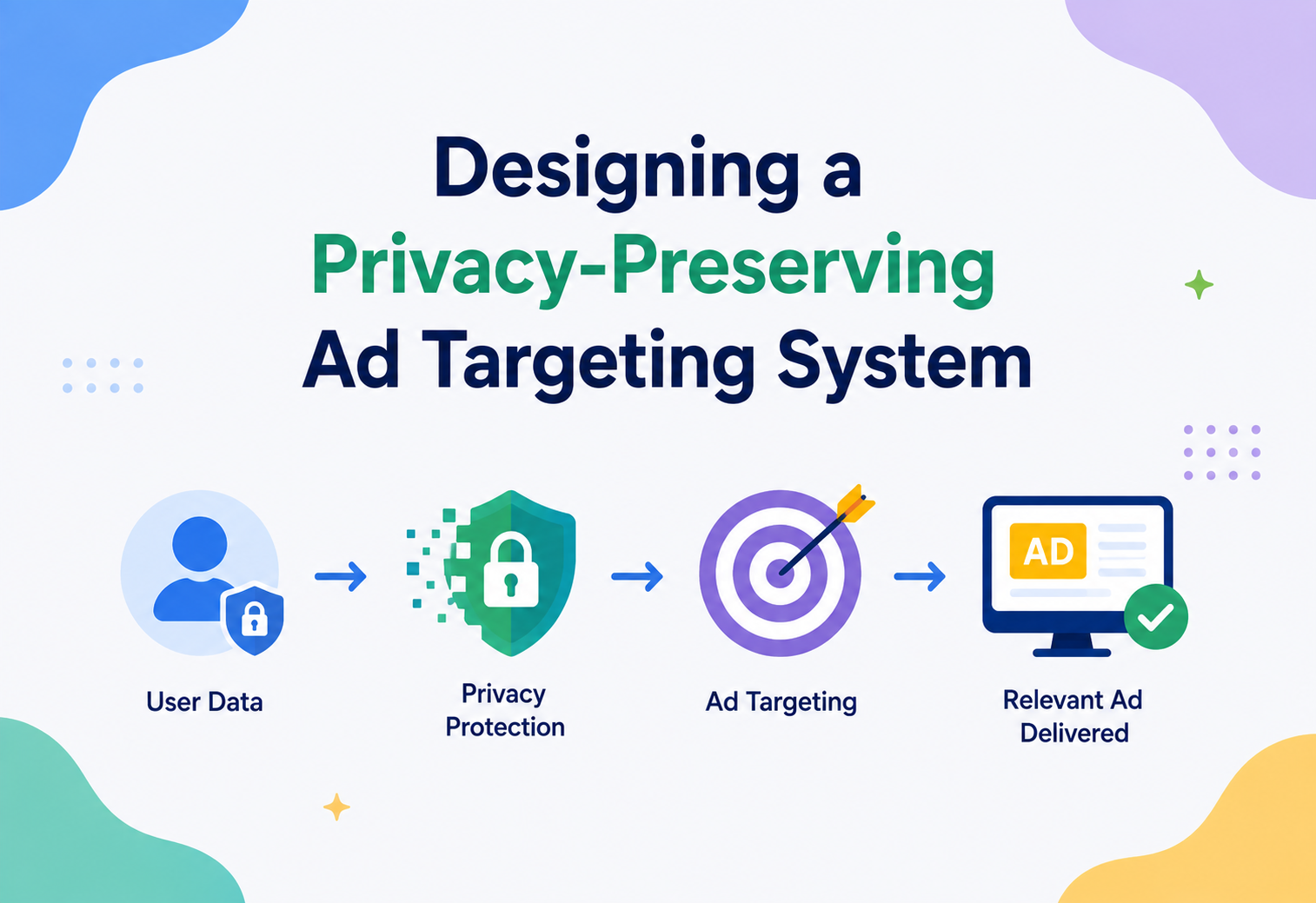
Designing a Privacy-Preserving Ad Targeting System
How do you let an advertiser reach “people likely to be interested in hiking gear” without ever handing anyone a list of individuals, a raw browsing history, or a device identifier that can be traced back to a person? This tutorial builds that system from first principles: on-device signal processing, differential privacy, k-anonymity, cohort formation, privacy budgets, and the production infrastructure needed to run it all at internet scale.
Introduction and History
For roughly two decades, online advertising was built on a simple but privacy-hostile idea: track a person across as many websites and apps as possible, build a detailed profile of their behavior, and use that profile to decide which ad to show them. The mechanism that made this possible was the third-party cookie, and later, persistent device identifiers on mobile. This approach worked well for ad relevance, but it also meant that a handful of companies quietly accumulated enormous, individually-identifiable behavioral histories on billions of people, often without those people understanding what was being collected or why.
Two forces converged to end that era. The first was regulation: the EU’s General Data Protection Regulation (GDPR, enforceable from 2018) and California’s Consumer Privacy Act and its successor the CPRA established legal rights around consent, data minimization, and the right to know what is collected about you, with real financial penalties for violations. The second was platform-level change: Apple’s App Tracking Transparency framework (2021) required apps to ask explicit permission before accessing the device’s advertising identifier, and browser vendors began phasing out third-party cookies entirely. Together, these changes made the old model — raw, individually-identifiable tracking — increasingly illegal, increasingly opt-out by default, and increasingly reputationally toxic.
The industry’s response was not to abandon targeted advertising, but to rebuild it on a fundamentally different foundation: instead of moving raw individual-level data around, move only aggregated, noised, or on-device-computed signals that cannot be traced back to a specific person, even by the systems processing them. This tutorial designs exactly that kind of system.
1.1 The academic foundations
Two ideas from privacy research underpin almost everything in this design. K-anonymity, formalized by Latanya Sweeney in the late 1990s, states that a released piece of data is only safe to share if it is indistinguishable from at least k other records — if fewer than k people share a given combination of characteristics, that combination is suppressed rather than released, because a small enough group can often be re-identified by cross-referencing other public information.
Differential privacy, formalized by Cynthia Dwork and colleagues in 2006, goes further: it provides a mathematical guarantee that the presence or absence of any single individual’s data has only a small, bounded effect on the output of a computation, achieved by deliberately injecting calibrated statistical noise. Differential privacy is now used in production by the U.S. Census Bureau (for the 2020 census), by Apple (for on-device usage analytics since iOS 10), and by Google (across several products) — and it is the mathematical backbone of the ad-targeting system this tutorial builds.
1.2 A brief timeline of privacy-preserving ad targeting
Third-party cookies era
Cross-site behavioral tracking becomes the dominant ad-targeting mechanism; individually-identifiable profiles quietly accumulate at ad-tech companies.
Differential privacy formalized
Dwork et al. publish the mathematical framework that will, more than a decade later, become the industry-standard privacy guarantee for aggregated releases.
Apple introduces IDFA
An opt-out advertising identifier ships on iOS — still per-device and stable, but a first step toward user-controlled tracking.
GDPR becomes enforceable
The EU introduces meaningful financial penalties for consent-free profiling, permanently changing the calculus for global ad platforms.
US Census adopts differential privacy
The 2020 census is the first census-scale, government-run release built on formal DP guarantees, providing a major real-world validation of the technique.
Google announces third-party cookie deprecation
The largest ad platform in the world publicly commits to ending the dominant cross-site tracking mechanism, accelerating industry-wide redesign.
Apple App Tracking Transparency
Explicit opt-in becomes required for cross-app tracking on iOS; the previous default of implicit consent collapses almost overnight.
Google Privacy Sandbox ships
The Topics API, Protected Audience API, and Attribution Reporting API roll out as production instances of on-device cohort formation, on-device auctions, and aggregated measurement.
Industry-wide architectural shift
On-device cohorts, data clean rooms, and aggregated measurement replace individual-level tracking as the default architecture for major ad platforms.
Google’s Privacy Sandbox (Topics API, Protected Audience API, Attribution Reporting API), Apple’s SKAdNetwork and AdAttributionKit, and data “clean room” products used by advertisers and publishers to match audiences without exchanging raw customer lists are all production instances of the patterns this tutorial covers.
1.3 Federated learning: the third pillar
Alongside k-anonymity and differential privacy, a third technique — federated learning, introduced by Google researchers around 2016 — matters for systems like this one. Federated learning trains a shared machine learning model (for example, a model that predicts broad interest categories from behavioral signals) without ever centralizing the raw training data: each device computes a small local update to the model based on its own data, and only that update (itself often further protected with differential privacy noise) is sent to a central server, which averages updates from many devices to improve the shared model. This is how the on-device cohort engine’s underlying model can keep improving over time without any single person’s raw behavioral data ever being centrally collected for training purposes.
Problem and Motivation
The core tension is straightforward to state and hard to solve: advertisers want to reach relevant audiences, and relevance requires some understanding of user interests — but any system that lets a third party learn “this specific person is interested in X” creates a re-identifiable profile, which is exactly what privacy regulation and user expectation now prohibit. The system we design must resolve this tension structurally, not just through policy promises.
2.1 What “strict privacy guarantees” must actually mean
It is easy to say a system is “privacy-preserving.” A rigorous design has to translate that into concrete, testable properties:
| Guarantee | What it actually means |
|---|---|
| No raw individual-level data leaves the device | Behavioral history, browsing data, and app usage are processed on-device; only derived, coarse signals are ever transmitted. |
| k-anonymity on any released grouping | Any segment or cohort exposed to an advertiser must contain at least k distinct users (commonly thousands), so no released group can single out one person. |
| Differential privacy on aggregate statistics | Any released count, sum, or report has calibrated noise added, bounding how much any single user’s data could have influenced the result. |
| Purpose limitation | Data collected for ad targeting cannot silently be repurposed for unrelated uses (credit decisions, insurance pricing, law enforcement) without separate, explicit justification and consent. |
| Consent enforcement, not just consent collection | A user’s “no” must be technically enforced at every downstream system, not merely recorded in a database that other services can choose to ignore. |
| Auditability | It must be possible to prove, after the fact, that these guarantees were actually upheld — not just asserted in a privacy policy. |
Think of the difference between a national census report saying “12,000 people in this zip code enjoy hiking” versus a marketer being handed a spreadsheet with 12,000 names and addresses. Both technically describe “people who like hiking,” but only one of them can be misused to target, discriminate against, or surveil an individual. This system is designed to make sure advertisers only ever get the equivalent of the census report, never the spreadsheet — and, critically, that no combination of census reports over time can be recombined to reconstruct the spreadsheet either.
2.2 A worked scenario worth keeping in mind throughout
Priya is shopping for hiking boots. She visits three outdoor gear websites, reads two hiking blog posts, and watches a trail-running video. A week later, an ad for hiking boots appears in a completely unrelated app. In the old model, this happened because a tracking pixel on each of those five sites silently reported “user ID 88214 visited this page” to an ad network, which stitched those events into a single profile and sold access to target ID 88214 specifically. In the system this tutorial builds, none of Priya’s individual page visits ever leave her device in identifiable form. Instead, her device locally determines she likely belongs to a broad “outdoor and hiking” interest cohort — a cohort that, at the time it is computed, contains many thousands of other people with similar recent browsing patterns — and only that coarse, k-anonymous cohort label, not her identity or her specific page visits, is ever exposed to an advertiser’s bidding system.
“Isn’t ‘the ad still found her’ proof that privacy wasn’t actually preserved?” No — the guarantee is not that ads become impossible, it’s that no party other than Priya’s own device ever learns Priya specifically was interested in hiking boots. The advertiser only ever learns “show this creative to members of the hiking cohort,” a group Priya happens to currently be a k-anonymous member of alongside thousands of others.
2.3 Why regulation alone isn’t a sufficient design input
It’s tempting to treat privacy regulation as a checklist — collect a consent banner, publish a privacy policy, respond to data-access requests — and consider the problem solved. But regulations like GDPR and CPRA describe outcomes and rights (meaningful consent, data minimization, the right to erasure) without prescribing specific technical architectures. A system can be technically GDPR-compliant on paper while still centralizing enormous amounts of re-identifiable behavioral data, simply because no regulation explicitly forbids doing so as long as consent was nominally collected. This tutorial’s approach goes further than minimum legal compliance deliberately: it aims for privacy guarantees that hold even if a consent banner was clicked through without being read, even if a future regulation tightens further, and even if the company’s own policies changed tomorrow — because the guarantee is structural, built into what data can physically exist and where, rather than dependent on policy discipline alone, which is ultimately a stronger and more durable promise to make to users.
Requirements
3.1 Functional requirements
- Assign users to broad interest segments/cohorts based on behavior, computed without exposing raw behavioral history to any server.
- Let advertisers target ad campaigns at cohorts, not individuals, and run an auction to select the winning ad for a given ad opportunity.
- Measure ad effectiveness (impressions, clicks, conversions) and report aggregated, noised statistics back to advertisers, without revealing which specific user performed which specific action.
- Let users view, understand, and control which cohorts they belong to, and opt out entirely.
- Support “clean room” style matching, where an advertiser’s own customer list can be matched against publisher audiences without either party seeing the other’s raw data.
3.2 Non-functional (privacy) requirements
- Data minimization: collect and transmit the least amount of information necessary to support the targeting and measurement use case.
- Non-re-identifiability: no combination of released cohorts, ad impressions, or reports, even queried repeatedly over time, should allow reconstruction of an individual’s behavior.
- Consent enforcement: opted-out users must be technically excluded from data collection at the source, not merely excluded from targeting after the fact.
- Auditability: every privacy-relevant decision (cohort assignment, noise parameters, consent state at time of processing) must be logged in a way that supports independent audit.
These six properties are listed roughly in the order they should be designed for, not in order of importance — data minimization and non-re-identifiability are structural properties that must be baked into the architecture from the very first schema and API decision, while auditability, though equally essential, can be layered on top of an already-sound structural design more incrementally. Treating auditability as the starting point instead, without first getting the structural guarantees right, tends to produce systems that are very good at proving what happened after the fact, but not actually very private in the first place.
3.3 Non-functional (systems) requirements
- Latency: real-time bidding auctions must resolve in well under 100ms end-to-end, since they happen inside a page or app load.
- Scale: billions of devices, tens of billions of ad opportunities per day.
- Availability: 99.95%+ for the ad-serving path; measurement/reporting can tolerate more latency since it is not user-facing in real time.
3.4 Out of scope (for this tutorial)
We will not design the creative rendering/ad-format pipeline, fraud detection for ad clicks, or the general real-time-bidding protocol’s financial settlement layer. We focus specifically on the privacy-preserving targeting, auction, and measurement architecture — the part that determines what can be learned by whom, and under what guarantees.
3.5 Why cohort-level relevance is enough for most advertising use cases
A reasonable objection is that individual-level targeting is simply more effective, and any privacy-first alternative is a step backward for advertisers. In practice, most advertising decisions don’t actually require individual-level precision — a campaign optimizing for “reach people likely interested in hiking gear” is fundamentally a segment-level decision even in the old model; the individual-level tracking was doing the work of statistically inferring segment membership, not delivering genuinely person-specific creative in most cases. Cohort-based targeting delivers largely the same practical relevance for the overwhelming majority of advertising use cases, while removing the individual-level data trail that created the privacy risk in the first place. The remaining gap in effectiveness is real but bounded, and it is the trade-off this entire tutorial is built around making explicit and deliberately tunable, rather than either ignored or treated as an unsolvable blocker. Interviewers evaluating a design against this problem statement should expect a candidate to name this trade-off directly, rather than implying that a privacy-preserving system somehow achieves equal or better targeting precision than the individually-tracked alternative at no cost.
Architecture and Components
The single most important architectural idea in this system is the privacy boundary: a hard line, enforced in software and (where possible) in hardware, past which only de-identified, aggregated, or formally noised data is ever allowed to cross. Everything on the user’s side of that boundary can see raw behavior. Nothing on the advertiser’s side of it ever can.
4.1 Component responsibilities
| Component | Responsibility |
|---|---|
| On-device cohort engine | Analyzes local browsing/app behavior and assigns the device to coarse interest cohorts, entirely on-device; raw history never leaves. |
| Consent & de-identification gateway | The single enforcement point through which any signal must pass before reaching server infrastructure; checks consent state and strips any residual identifiers. |
| Aggregation & DP service | Adds calibrated statistical noise to any aggregate computation and tracks how much of each privacy budget has been spent. |
| Cohort directory | Publishes the current taxonomy of interest segments and, for each, confirms it currently contains at least the minimum k-anonymity threshold of members — never a member list. |
| Ad auction service | Matches advertiser bids to cohorts and ad opportunities; the final, person-specific decision is resolved on the user’s own device. |
| Attribution clean room | Computes whether an ad likely led to a conversion, releasing only noised, aggregated conversion counts — never a person-level attribution record. |
| Consent ledger | Durable record of each user’s current consent state, consulted by the gateway on every request. |
| Privacy audit log | Tamper-evident record of every privacy-relevant decision — noise parameters used, budget consumed, k-anonymity checks performed — supporting independent audit. |
Google’s Privacy Sandbox mirrors this shape closely: the Topics API computes interest topics on-device, the Protected Audience API runs the final ad auction inside a locked-down on-device execution environment, and the Attribution Reporting API releases only noised, aggregated conversion summaries to advertisers.
4.2 Why the auction service and the aggregation service are separate components
It’s tempting to combine “match bids to cohorts” and “compute noised statistics” into a single service, since both deal with cohort-level data. They are kept separate deliberately, for two reasons. First, they have fundamentally different latency requirements — the auction path must resolve in milliseconds, while the aggregation path can tolerate seconds or longer, and coupling them would force one to compromise for the other’s sake. Second, and more importantly for the privacy guarantee, only the aggregation service needs access to the confidential-computing environment where less-aggregated intermediate values briefly exist; keeping the auction service entirely outside that boundary means the vast majority of the system’s request volume never touches the most sensitive execution environment at all, which meaningfully shrinks the attack surface an insider or attacker would need to compromise to see anything approaching individual-level data.
Internal Working: The Privacy Techniques
This is the technical heart of the system. Four techniques do almost all of the work: on-device processing, k-anonymity thresholds, differential privacy noise, and privacy budget accounting. We’ll build up each one from first principles.
It’s worth noting upfront that none of these four techniques is sufficient on its own. On-device processing alone prevents raw data centralization but says nothing about what happens once a coarse signal is transmitted. K-anonymity alone protects against small-group re-identification but does nothing to prevent a differencing attack across repeated queries against a large, safely-sized group. Differential privacy alone provides a strong mathematical guarantee per query but, without budget accounting, that guarantee silently erodes under repeated querying. The system’s actual privacy strength comes from all four working together, layered at different points in the pipeline — which is also why a system claiming to be “privacy-preserving” on the strength of just one of these techniques deserves closer scrutiny.
5.1 On-device processing: moving the computation, not the data
The single biggest architectural lever available is simply refusing to centralize raw data at all. Instead of sending a user’s browsing history to a server for analysis, the analysis itself runs locally, on the device, using a model or ruleset that was trained centrally (on already-aggregated data) but is executed locally. Only the output of that local computation — a cohort label, or a locally-noised statistic — is ever transmitted.
This is the difference between mailing your diary to a stranger so they can summarize it for you, versus reading the diary yourself and only telling the stranger “I’ve been writing about hiking lately.” The stranger gets a useful signal without ever touching the diary itself.
5.2 K-anonymity: safety in numbers
A cohort is only safe to expose to an advertiser-facing system if enough distinct people belong to it that no individual can be singled out. If a cohort ever shrank to, say, three members, an advertiser (or a malicious actor) who already knew something about two of those three people could infer facts about the third by elimination. The system enforces a minimum threshold — commonly thousands of members — before a cohort is published at all, and cohorts are recomputed and re-checked regularly as membership naturally shifts.
public class KAnonymityGate {
    private static final int MIN_COHORT_SIZE = 2000;

    // Only cohorts meeting the minimum size threshold are ever published
    // to advertiser-facing systems. Smaller cohorts fall back to a broader
    // parent category instead of being suppressed entirely.
    public CohortPublicationResult evaluate(Cohort cohort, long estimatedMemberCount) {
        if (estimatedMemberCount >= MIN_COHORT_SIZE) {
            return CohortPublicationResult.publish(cohort);
        }
        Cohort parent = CohortTaxonomy.parentOf(cohort);
        if (parent == null) {
            return CohortPublicationResult.suppress(cohort, "below k-anonymity threshold");
        }
        return CohortPublicationResult.publish(parent);
    }
}
5.3 Differential privacy: bounding what any single user’s data can reveal
K-anonymity protects against a group being too small. Differential privacy protects against a subtler risk: even a large, safely-sized aggregate statistic can leak information about one person if it is queried repeatedly under slightly different conditions — a differencing attack. For example, if an attacker can ask “how many hiking-cohort members are there” both including and excluding a known target, the difference reveals whether that target is in the cohort, even though each individual query looked perfectly safe on its own.
Differential privacy defends against this by adding carefully calibrated random noise to any released statistic, such that the released number would look statistically almost identical whether or not any single specific person’s data was included in the computation. The amount of noise is controlled by a parameter called epsilon ($varepsilon$): smaller epsilon means more noise and stronger privacy; larger epsilon means less noise and weaker privacy (but more useful, accurate numbers). This explicit epsilon parameter is what makes differential privacy a genuine engineering trade-off, not just a vague promise.
| $varepsilon$ value | Relative statistic accuracy | Privacy strength |
|---|---|---|
| 0.1 | ~20% | Very strong |
| 0.5 | ~45% | Strong |
| 1.0 | ~65% | Moderate-strong |
| 2.0 | ~82% | Moderate |
| 5.0 | ~93% | Weak |
| 10.0 | ~98% | Very weak |
Even a fairly strong privacy setting (small epsilon) still yields a report that’s directionally useful for campaign planning, and the curve flattens out quickly — which is why most production systems don’t need to push epsilon very high to get numbers advertisers can actually work with.
A simplified Laplace mechanism in Java
The classic way to add differential-privacy noise to a numeric count or sum is the Laplace mechanism: draw random noise from a Laplace distribution scaled to the “sensitivity” of the query (how much one person’s data could possibly change the result) divided by epsilon.
public class LaplaceMechanism {

    // sensitivity = the maximum amount one single user's data could change
    // the true result (e.g., 1, if we're counting users).
    // epsilon = the privacy budget spent on this specific release.
    public static double addNoise(double trueValue, double sensitivity, double epsilon) {
        double scale = sensitivity / epsilon;
        double u = ThreadLocalRandom.current().nextDouble() - 0.5;
        double noise = -scale * Math.signum(u) * Math.log(1 - 2 * Math.abs(u));
        return trueValue + noise;
    }

    public static long noisedCohortCount(long trueCount, double epsilon) {
        double noised = addNoise(trueCount, 1.0, epsilon);
        return Math.max(0, Math.round(noised)); // counts can't be negative
    }
}Suppose the hiking cohort truly has 8,412 members. With a reasonably tight epsilon, a released count might come back as 8,395 or 8,431 instead of the exact figure — close enough to be useful for campaign planning, but with just enough uncertainty injected that no one querying the system repeatedly can reliably detect whether any single specific person joined or left the cohort between two queries.
5.4 Local versus central differential privacy
| Model | Where noise is added | Trust required |
|---|---|---|
| Central DP | On a trusted central server, after raw data has been collected | Requires trusting the server operator not to look at the raw data before noising it. |
| Local DP | On the user’s own device, before anything is transmitted | Requires trusting only the user’s own device — the server never sees unnoised data at all, even briefly. |
Local differential privacy provides a strictly stronger guarantee (no trusted-server assumption at all) but typically requires more noise to achieve the same formal privacy level, since noise added once centrally, across an aggregate of many users, can be proportionally smaller than noise each individual device must add on its own. Production systems often use a hybrid: local DP for the most sensitive signals, central DP (executed inside a hardened, audited environment) for less sensitive aggregate reporting.
5.5 Privacy budget accounting
Differential privacy’s guarantee degrades every time a noised statistic is released about the same underlying data — epsilon values accumulate (“compose”) across repeated queries. If this is not tracked and capped, an attacker (or just an over-eager analytics team) could run enough slightly-different queries against the same cohort to average out the noise and reconstruct something close to the true, un-noised answer. The system therefore maintains a privacy budget ledger: a running total of epsilon spent per data domain per time window, with queries rejected once the budget is exhausted.
public class PrivacyBudgetLedger {
    private final Map<String, Double> spentEpsilon = new ConcurrentHashMap<>();
    private static final double MAX_EPSILON_PER_WINDOW = 4.0;

    public synchronized boolean tryReserve(String dataDomain, double requestedEpsilon) {
        double alreadySpent = spentEpsilon.getOrDefault(dataDomain, 0.0);
        if (alreadySpent + requestedEpsilon > MAX_EPSILON_PER_WINDOW) {
            return false; // budget exhausted: query must be denied or deferred
        }
        spentEpsilon.put(dataDomain, alreadySpent + requestedEpsilon);
        return true;
    }

    // Called on a fixed schedule (e.g. daily) to reset the budget window.
    public void resetWindow(String dataDomain) {
        spentEpsilon.remove(dataDomain);
    }
}“What stops someone from just waiting for the budget window to reset and querying again?” Nothing stops them from querying again, and that’s fine — the budget window bounds how much can be learned within a period, which is the formal guarantee differential privacy provides. Systems requiring guarantees across unlimited time typically use a smaller per-window epsilon and/or a lifetime total budget per data domain, in addition to the per-window cap, precisely to prevent this “wait and repeat” strategy from eventually draining the guarantee to nothing.
5.6 Clean rooms and secure multi-party computation
A separate but related problem: an advertiser wants to know how many of their own customers also match a publisher’s audience — without either party handing the other their raw customer list (which would itself be a privacy and competitive-risk problem). A clean room solves this by hosting both parties’ data inside a locked-down, audited environment where neither side can directly query or export the other’s raw records; only pre-approved, aggregated queries (themselves typically subject to differential privacy and k-anonymity thresholds) are allowed to produce output. Some implementations use genuine secure multi-party computation (cryptographic protocols where no single party ever holds the combined dataset in the clear at all), while others rely on a trusted, audited execution environment operated by a neutral third party.
A simplified secure aggregation sketch
One widely-used secure aggregation technique lets a server compute the sum of many devices’ values without ever learning any individual device’s contribution, using pairwise masking: each pair of participating devices agrees on a shared random mask, one adds it and the other subtracts it, so the masks cancel out exactly when all devices’ masked values are summed together, but no single masked value reveals anything on its own.
public class SecureAggregationClient {

    // Each device adds random masks agreed pairwise with every other
    // participating device. When the server sums everyone's masked value,
    // every pairwise mask cancels out exactly, leaving only the true sum.
    public double maskedContribution(double trueLocalValue,
                                      List<PeerHandshake> peers,
                                      String myDeviceId) {
        double maskedValue = trueLocalValue;
        for (PeerHandshake peer : peers) {
            double sharedMask = peer.deriveSharedMask();
            maskedValue += (myDeviceId.compareTo(peer.deviceId()) < 0)
                ? sharedMask : -sharedMask;
        }
        return maskedValue; // safe to send; individually meaningless
    }
}Imagine ten people each writing a secret number on a slip of paper, then each pair privately agreeing to add a random offset to one slip and subtract it from the other before anyone hands their slip to a tally-keeper. The tally-keeper can still correctly sum all ten secret numbers, because every offset cancels out overall — but staring at any single slip in isolation reveals nothing about the number that was actually written on it.
5.7 On-device auction resolution in more detail
The final step of the ad-selection process deliberately happens inside a locked-down, sandboxed execution environment on the user’s own device, not on a server. The server-side auction service sends down a set of eligible ad creatives along with each advertiser’s bid logic (itself running inside the sandbox, unable to communicate results back out except through the final, coarse “this ad won” render instruction). This matters because it means no server, including the auction service’s own operator, ever learns which specific ad was shown to which specific person — that pairing exists, briefly, only inside the user’s own device.
Data Flow and Lifecycle
Let’s trace one ad opportunity end-to-end: Priya opens a news app, and the app needs to decide which ad to show her.
6.1 Step-by-step explanation
- On-device cohort assignment (already done): before this specific ad request even happens, Priya’s device has already, independently and locally, computed which broad interest cohorts she currently belongs to, based on recent on-device signals.
- Consent check: the gateway checks Priya’s current consent state before anything is forwarded — if she has opted out, the request either carries no cohort information at all, or is served a non-personalized ad instead.
- De-identified request: only a cohort label (not a user ID, not raw browsing history) is sent to the ad auction service.
- k-anonymity confirmation: the auction service confirms the targeted cohort currently meets the minimum size threshold before using it at all.
- Auction: advertiser bids are matched against the cohort; multiple eligible ads and their bid signals are returned to the device — deliberately not a single final decision.
- On-device resolution: the device itself makes the final choice of which ad to actually show, using additional local context that never needs to leave the device, and renders it locally. No server ever learns which specific ad was shown to which specific person.
- Delayed, batched conversion reporting: if Priya later buys hiking boots, that conversion event is reported to the clean room only after a delay and only in batched, aggregated, noised form — never as an immediate, individually-attributable “user X converted” event.
6.2 Why the delay and batching for conversions matters
Reporting a conversion instantly and individually would recreate exactly the re-identification risk this whole architecture exists to prevent — an advertiser could correlate “an ad was shown to cohort member at time T” with “a conversion was reported at time T+2 minutes” and infer it was the same, specific person. Deliberate reporting delays and batching many devices’ conversion events together before releasing an aggregated, noised count is what breaks that correlation.
Apple’s SKAdNetwork enforces exactly this kind of randomized reporting delay for install attribution, and Google’s Attribution Reporting API similarly aggregates and delays conversion reports specifically to prevent this style of timing-based re-identification.
6.3 The consent revocation flow
A separate, equally important flow is what happens the instant a user withdraws consent. Rather than marking the user as “excluded going forward” while leaving previously-computed cohort assignments and in-flight requests untouched, the revocation flow actively propagates the change: the device immediately stops computing new cohort assignments, any locally-cached cohort labels are cleared, and the consent gateway begins rejecting personalized ad requests for that device on the very next request, typically within seconds rather than the days a purely database-driven, poll-based propagation model might take.
Data Model and Storage
The data model has to encode, structurally, the absence of raw individually-identifiable records — not merely as a policy, but as a schema decision that makes storing such a record impossible or immediately obvious as a violation.
7.1 Entity relationships
| Entity | Key fields | Notes |
|---|---|---|
| Cohort | cohortId (PK), taxonomyLabel, lastRecomputedAt, epsilonBudgetRemaining | Segment definition — never contains member lists. |
| CohortMembershipCount | cohortId (FK), noisedMemberCount, computedAt, meetsKAnonymity | Only the noised count, not a list of who is in it. |
| AggregateReport | reportId (PK), cohortId (FK), campaignId (FK), noisedImpressions, noisedConversions, epsilonSpent, generatedAt | The unit of storage — already-noised counts, plus the exact budget cost. |
| Advertiser | advertiserId (PK), name | Advertiser identity, no user data attached. |
| Campaign | campaignId (PK), advertiserId (FK), targetCohortId (FK), bidAmount | Targets a cohort, never a person. |
| ConsentLedger | deviceHash (PK — salted, rotating), adPersonalizationOptIn, lastUpdatedAt | Deliberately uses a rotating hash, not a stable identifier. |
There is no table mapping a stable user or device identifier to individual browsing events, cohort memberships, or ad interactions. Nothing in this data model, even if fully compromised in a breach, contains an individually-identifiable behavioral record — because that record was never created on any server in the first place.
7.2 The consent ledger’s identifier design
Even the consent ledger, which must track opt-in/opt-out state per device, deliberately avoids using a stable, cross-context identifier. A salted, periodically-rotating hash is used instead of a persistent device ID, so that the consent record itself cannot be used as a tracking identifier by anyone who might gain access to it — the one place we do need to know “is this device opted in” is engineered so it cannot double as a re-identification key.
7.3 Why aggregated reports, not raw events, are the unit of storage
The AggregateReport table stores only already-noised counts, with the exact epsilon spent recorded alongside each report — this is what makes the privacy budget ledger auditable after the fact: for any report an advertiser has ever received, the system can show exactly how much privacy budget that report cost, and confirm it stayed within the allowed total for that cohort and time window.
7.4 Choosing storage technology
| Data | Good fit | Why |
|---|---|---|
| Cohort definitions & taxonomy | Relational database (PostgreSQL) | Small, structured, infrequently updated, benefits from strong consistency. |
| Aggregate reports | Columnar analytics store (BigQuery-style / ClickHouse) | Write-heavy, queried in bulk for reporting dashboards, naturally tabular. |
| Consent ledger | Fast key-value store (DynamoDB / Redis-backed) | Looked up on every single ad request; needs very low read latency. |
| Privacy audit log | Append-only, tamper-evident log (hash-chained or WORM storage) | Must be provably unaltered after the fact to support genuine audit. |
7.5 What an aggregate report looks like on the wire
It’s worth seeing the actual shape of what an advertiser receives, since it makes concrete just how far this is from an individual-level record:
{
  "reportId": "rep_88213",
  "cohortId": "cohort_outdoor_hiking",
  "cohortTrueSizeRange": "2000-10000",
  "campaignId": "camp_5541",
  "metric": "conversions",
  "noisedValue": 412,
  "epsilonSpent": 0.5,
  "reportingWindow": {
    "start": "2026-07-21T00:00:00Z",
    "end":   "2026-07-28T00:00:00Z"
  },
  "confidenceNote": "value includes calibrated statistical noise; not an exact count"
}
Notice there is no user identifier, no list of device hashes, and no exact count field anywhere in this payload — only a coarse size range, a noised metric, and metadata about how much privacy budget the release cost. That last field is deliberately surfaced to the advertiser, not hidden, because transparency about the privacy mechanism is itself part of building durable trust in the system.
7.6 Schema evolution under a strict privacy constraint
Adding a new field to any of these schemas requires an extra review step beyond ordinary schema-change review: does the new field, on its own or combined with existing fields, create a new re-identification risk? A seemingly innocuous addition — say, a more precise geographic granularity on the aggregate report — can quietly erode the k-anonymity guarantee if it lets an advertiser narrow a broad cohort down to a much smaller, effectively re-identifiable group by cross-referencing geography with other public information. Schema changes to any table on the advertiser-facing side of the privacy boundary go through the same privacy review process described later in the deployment section, not just ordinary code review.
APIs and Microservices
8.1 Service map
| Service | Primary API | Notes |
|---|---|---|
| Consent Gateway | REST: checkConsent, deidentifyRequest | Every single request passes through this service first; sits directly on the critical path. |
| Cohort Directory | REST: getCohortStatus, listTaxonomy | Read-heavy, cache-friendly; never exposes member lists. |
| Ad Auction Service | gRPC (low-latency): runAuction | Must resolve in well under 100ms; scales horizontally per ad opportunity. |
| Aggregation & DP Service | Internal gRPC: releaseNoisedStat | The only path by which any statistic is allowed to leave the aggregate data domain. |
| Attribution Clean Room | Batch API: submitConversionBatch, getAggregateReport | Deliberately asynchronous and delayed, never real-time per-event. |
8.2 Example: requesting a noised aggregate report
POST /v1/reports/aggregate
Authorization: Bearer <advertiser_api_key>
Content-Type: application/json

{
  "campaignId": "camp_5541",
  "cohortId":   "cohort_outdoor_hiking",
  "metric":     "conversions",
  "requestedEpsilon": 0.5
}

// --- Response 200 ---
{
  "reportId": "rep_88213",
  "cohortId": "cohort_outdoor_hiking",
  "noisedValue": 412,
  "epsilonSpent": 0.5,
  "remainingBudgetThisWindow": 1.8,
  "generatedAt": "2026-07-28T10:04:00Z"
}

// --- Response 429 (budget exhausted) ---
{
  "error": "PRIVACY_BUDGET_EXHAUSTED",
  "message": "Requested epsilon exceeds remaining budget for this cohort/window.",
  "remainingBudgetThisWindow": 0.1
}
8.3 Java: the aggregate report service
@Service
public class AggregateReportService {

    private final PrivacyBudgetLedger budgetLedger;
    private final KAnonymityGate kAnonymityGate;
    private final AggregateStatsRepository stats;
    private final PrivacyAuditLogger auditLog;

    public ReportResult generateReport(ReportRequest request) {
        Cohort cohort = cohortDirectory.get(request.cohortId());

        CohortPublicationResult gate =
            kAnonymityGate.evaluate(cohort, stats.trueMemberCount(cohort));
        if (!gate.isPublishable()) {
            throw new PrivacyViolationException("cohort below k-anonymity threshold");
        }

        boolean budgetOk =
            budgetLedger.tryReserve(cohort.dataDomain(), request.requestedEpsilon());
        if (!budgetOk) {
            throw new BudgetExhaustedException(cohort.dataDomain());
        }

        double trueValue = stats.trueMetricValue(cohort, request.metric());
        double noisedValue = LaplaceMechanism.addNoise(
            trueValue, 1.0, request.requestedEpsilon());

        auditLog.record(new PrivacyDecision(
            cohort.id(), request.metric(),
            request.requestedEpsilon(), Instant.now()));

        return new ReportResult(cohort.id(),
            Math.max(0, Math.round(noisedValue)),
            request.requestedEpsilon());
    }
}There is no method anywhere in this service, or anywhere in this architecture, that accepts a user or device identifier and returns individual-level data. That absence is not an oversight — it is the entire point of the design.
8.4 Example: the consent check endpoint
This endpoint is called on the hot path of every single ad request, so its contract is intentionally minimal — it exists purely to answer a yes/no question as fast as possible, not to expose any additional detail about the user:
POST /internal/v1/consent/check
Content-Type: application/json

{
  "deviceHash": "8f2a...c91e",
  "requestedPurpose": "AD_PERSONALIZATION"
}

// --- Response 200 (granted) ---
{
  "consentGranted": true,
  "lastUpdatedAt": "2026-06-02T09:14:00Z"
}

// --- Response 200 (opted out) ---
{
  "consentGranted": false,
  "lastUpdatedAt": "2026-07-15T18:40:00Z"
}

// --- Response 503 (dependency unavailable) ---
{
  "error": "CONSENT_SERVICE_UNAVAILABLE",
  "fallbackBehavior": "TREAT_AS_NOT_GRANTED"
}
Notice the 503 response explicitly documents its own fail-closed behavior in the payload itself, rather than leaving callers to guess or assume — this is a small but deliberate API design choice that makes the fail-closed guarantee visible and testable at the contract level, not just described in a design document that could drift out of sync with the actual implementation.
Caching and Load Balancing
9.1 What we cache, and why
- Consent state (Redis): looked up on every single ad request, so it must be served from memory with single-digit-millisecond latency, with short TTLs and active invalidation the moment a user changes their preference.
- Cohort k-anonymity status: whether a cohort currently meets the publication threshold is cached and refreshed on a fixed schedule (e.g., hourly), rather than recomputed on every single request, since membership counts change gradually.
- Cohort taxonomy: the list of available segments changes rarely and is cached aggressively, including at the CDN edge for read-only taxonomy browsing endpoints.
9.2 Load balancing strategy
The ad auction path is latency-critical and stateless per request, so it uses standard least-connections load balancing across a horizontally-scaled fleet, geographically distributed close to users to minimize round-trip time within the sub-100ms budget. The aggregation and reporting path, by contrast, is not latency-critical and can be load-balanced more simply, with headroom prioritized for correctness (accurate budget accounting) over raw throughput.
“Why not cache the noised aggregate report itself, to avoid spending privacy budget on repeated identical queries?” This is a genuinely good practice — caching an already-noised, already-budget-charged report and serving it for repeated identical requests within a time window avoids spending additional privacy budget for no informational gain, since the advertiser receives the same answer either way.
9.3 Cache invalidation is a privacy-critical operation here, not just a freshness concern
In most systems, a stale cache entry is a minor correctness annoyance. In this system, a stale consent-cache entry is a privacy incident waiting to happen: if a user opts out but the consent gateway keeps serving a cached “opted in” result for several more minutes because of an unusually long TTL, personalized ads continue being served against the user’s explicit wishes during that window. This is why the consent cache uses short TTLs (commonly under a minute) combined with active, event-driven invalidation the moment the consent ledger changes, rather than relying on TTL expiry alone as most ordinary application caches do.
Consistency and Privacy-Utility Trade-offs
This system has an unusual second axis of trade-off layered on top of the familiar CAP theorem: not just consistency versus availability, but privacy versus statistical utility. Every design decision that increases privacy protection (a smaller epsilon, a higher k-anonymity threshold, more aggressive reporting delays) tends to make the released numbers noisier and less immediately actionable for advertisers, and vice versa. This trade-off cannot be engineered away — it can only be tuned deliberately and transparently.
| Parameter | Higher value means | Lower value means |
|---|---|---|
| Epsilon ($varepsilon$) | Less noise, more accurate reports, weaker formal privacy guarantee | More noise, less accurate reports, stronger formal privacy guarantee |
| k (minimum cohort size) | Fewer, coarser cohorts, but each one very hard to individually target | More, finer-grained cohorts, but higher re-identification risk per cohort |
| Reporting delay | Weaker timing-correlation protection, faster advertiser feedback | Stronger timing-correlation protection, slower advertiser feedback |
| Budget window length | Longer windows allow more cumulative queries before reset, weakening the effective per-period guarantee | Shorter windows reset the guarantee more often but limit how many meaningful queries an advertiser can run before hitting the cap |
On the ordinary systems-consistency axis, this design deliberately favors availability and eventual consistency for cohort membership (a device’s cohort assignment can lag reality by hours without causing harm) while requiring strong consistency for the privacy budget ledger specifically — two concurrent requests against the same cohort’s remaining epsilon budget must not both succeed if, combined, they would exceed the cap. This is one of the few places in the whole system where a distributed lock or a strongly consistent data store is worth the latency cost, precisely because the thing being protected is the core privacy guarantee itself.
“Where would a naive eventually-consistent implementation of the budget ledger actually break the privacy guarantee?” If two concurrent requests each independently check “is there budget left” against a stale, cached read, both could be approved even though their combined epsilon spend exceeds the cap — silently weakening the formal privacy guarantee below what was promised. This is exactly the kind of race condition that argues for strong consistency (or a single-writer, serialized reservation step) specifically on the budget ledger, even while the rest of the system stays loosely consistent.
10.1 Composition: why the budget must be tracked, not just spent per-query
Differential privacy’s composition theorem states that if you release the results of several independently-noised queries about overlapping data, the total privacy loss is bounded by roughly the sum of each query’s individual epsilon (simple composition), or, with more sophisticated accounting methods, a somewhat tighter bound that still grows with the number of queries. This is precisely why a single global cap on epsilon per query would be an inadequate design: an attacker (or an advertiser simply running many legitimate-looking campaign reports) could still drain the guarantee to nothing by making enough small queries over time, unless the system tracks and enforces a cumulative cap across all of them, which is exactly the job the privacy budget ledger performs.
It is worth being explicit that this composition property is not a flaw specific to this system’s implementation — it is a mathematical fact about differential privacy itself, true of any system built on the same foundation, including the production systems referenced throughout this tutorial. Any engineer designing against this constraint should treat “how does privacy loss compose across the queries my system allows” as a first-class design question from day one, not a detail to patch in once an audit or incident reveals the gap. Systems that skip this step tend to look privacy-preserving under casual inspection while actually offering very little protection against a patient, moderately sophisticated querier.
Performance and Scalability
11.1 The sub-100ms auction constraint
Real-time ad auctions happen inside a page or app load, so the entire request — consent check, cohort validation, bid matching — has to resolve in a strict latency budget, commonly well under 100 milliseconds end-to-end. This rules out anything resembling a slow, synchronous differential-privacy computation on the hot path; noise-adding and budget accounting are reserved for the asynchronous reporting path, not the real-time auction path, which only needs to check a pre-computed, cached k-anonymity status.
This latency constraint is also why the architecture pushes as much work as possible to the on-device cohort engine and the auction resolution step rather than to any server round-trip: every additional network hop on the critical path consumes part of an already tight budget, and a system that needed to make even one extra synchronous call to a privacy-checking service per auction would struggle to reliably stay under the target latency at global scale, particularly for users on higher-latency mobile networks.
11.2 On-device compute constraints
Because cohort assignment and the final auction resolution both run on the user’s own device, the algorithms involved must be lightweight enough to run on a wide range of hardware, including older phones, without noticeably draining battery or slowing down page loads. This pushes the design toward simple, efficient local models (lightweight classifiers or rule-based bucketing) rather than large, expensive ones, and toward infrequent (e.g., daily or weekly) cohort recomputation rather than continuous, per-event recalculation.
11.3 Scaling the aggregation and reporting path
Because this path is not latency-critical, it can batch aggressively: rather than noising and releasing a statistic on every individual request, the system accumulates raw (still on-device-originated, already de-identified) counts over a batching window, computes the true aggregate once, adds noise once, and serves that single noised value to every subsequent identical query within the window — both saving compute and conserving privacy budget, as covered in the caching section.
11.4 Back-of-envelope capacity planning
Assume 2 billion active devices globally, each generating an average of 20 ad opportunities per day — roughly 40 billion auction requests daily, or approximately 460,000 requests per second at a typical average rate, with peak traffic (evening hours across major time zones overlapping) commonly running 3–4x that average, so the auction service fleet needs to comfortably sustain somewhere in the range of 1.5–2 million requests per second at peak. Since cohort assignment and the final auction resolution both happen on-device, none of that per-request compute cost falls on centralized infrastructure at all — the server-side auction service only needs to match bids against a cached, pre-validated cohort list and return eligible creatives, which is a comparatively cheap, highly cacheable operation. The genuinely expensive centralized computation — noised aggregate report generation — happens at a dramatically lower rate (advertisers requesting reports, not every single ad impression), so it can be provisioned far more modestly than the real-time auction path.
“If cohort computation is entirely on-device, what does the server-side infrastructure actually need to scale for?” A good answer separates the two very different workloads clearly: the auction path scales with ad opportunity volume (extremely high, but cheap per-request since it’s mostly cache lookups and bid matching), while the aggregation and reporting path scales with advertiser query volume (much lower, but individually more compute-intensive because of the noise-generation and budget-accounting steps).
High Availability and Reliability
The consent gateway and privacy budget ledger are the two components where an outage has a genuine privacy consequence, not just an availability inconvenience — so their reliability design deserves particular care.
12.1 Fail closed, not fail open
If the consent gateway cannot reach the consent ledger (network partition, database outage), the system must fail closed: treat the request as if consent were not given, and serve a non-personalized ad, rather than defaulting to “assume consent” simply because the check couldn’t complete. This is the opposite of how most systems handle a dependency outage (where failing open, to preserve availability, is often preferred), and it is a deliberate, privacy-first exception to that general rule.

A system that fails open on consent checks would silently start showing personalized ads to opted-out users the moment its consent ledger had a bad day — converting an infrastructure availability incident into a privacy violation. Fail-closed behavior turns the same incident into a revenue-reducing but privacy-safe degradation instead, which is a trade favorably worth making given what is at stake on either side.
12.2 Replication and durability of the budget ledger
The privacy budget ledger is replicated across availability zones with synchronous acknowledgment for budget-reservation writes specifically (even though most of the rest of the system favors asynchronous replication for throughput), because an under-replicated, lost budget-reservation write is exactly the failure mode that could let concurrent requests collectively overspend the privacy guarantee, silently and without any single obvious symptom pointing back to the root cause.
12.3 Disaster recovery
Because no raw individual-level data exists anywhere in this system, disaster recovery for this architecture is unusually low-stakes from a privacy-breach perspective: even a full, catastrophic loss and restore of every server-side store would not expose an individually-identifiable behavioral record, because none exists to lose. Recovery focuses on restoring service availability and the accuracy of the audit log, not on preventing a data-exposure incident that structurally cannot happen.
12.4 Chaos testing the fail-closed guarantee
Because “fail closed on consent” is a correctness property just as important as any functional requirement, it deserves the same kind of adversarial testing as the CRDT convergence tests common in other distributed systems: a dedicated chaos-testing suite deliberately kills the consent ledger, injects network partitions between the gateway and its dependencies, and simulates slow or corrupted responses, then asserts — across every single simulated failure mode — that no personalized ad request is ever approved when the consent check could not be definitively completed. A single passing test under normal conditions says little; the valuable signal comes from confirming the fail-closed behavior holds under genuinely adverse, unpredictable failure conditions.
12.5 Multi-AZ deployment specifics
The consent ledger and privacy budget ledger are both deployed across at least three availability zones with synchronous quorum writes, so that a single zone failure cannot silently cause either an availability outage or, worse, a fallback to a stale replica that could approve a request that should have been denied. The auction service, by contrast, being stateless and latency-sensitive, is deployed with looser cross-zone coordination, favoring the lowest possible latency to nearby users over strict cross-zone consistency, since an individual auction’s correctness does not depend on cross-zone state agreement the way the ledgers do.
Security and Privacy Deep Dive
13.1 Threat model
A useful threat model here has to consider not just external attackers, but curious insiders, well-meaning but overly aggressive analytics teams, and advertisers acting entirely within the rules of the published API but still probing for edge cases. The mitigations below are designed to hold against all three categories, not just the most obviously malicious one.
| Threat | Description | Mitigation |
|---|---|---|
| Re-identification via small cohorts | An attacker infers an individual’s membership from an unusually small, specific segment | k-anonymity threshold enforced before any cohort is published. |
| Differencing attack | Comparing two nearly-identical aggregate queries to isolate one person’s contribution | Differential privacy noise plus a strictly enforced privacy budget ledger. |
| Timing correlation | Linking an ad impression to a near-simultaneous conversion report to infer identity | Randomized, batched, delayed conversion reporting. |
| Fingerprinting via device signals | Reconstructing a stable identifier from a combination of supposedly-anonymous device/browser characteristics | Deliberately coarsened, standardized signal sets; active fingerprinting-surface monitoring. |
| Consent bypass | A downstream service ignoring or not checking current consent state | Consent enforcement centralized at a single mandatory gateway, not left to each service individually. |
| Privacy budget draining | An attacker (or overzealous internal team) making many small queries to exhaust the noise’s protective effect | Hard-capped, monitored, per-domain privacy budget with alerting on unusual query velocity. |
13.2 Fingerprinting is a real, ongoing risk
Even a system carefully engineered to avoid explicit identifiers can leak identity through the combination of many individually-innocuous signals — device model, operating system version, screen resolution, installed fonts, time zone, and battery level, taken together, can be unique enough to fingerprint a device almost as reliably as a cookie. Mitigating this requires actively limiting and standardizing which signals any component is allowed to see at all, auditing for entropy (how much any given combination of signals narrows down the population), and treating “we didn’t store an ID” as necessary but not sufficient for a genuine privacy guarantee.
13.3 Secure execution environments
For the pieces of this system that must, by necessity, briefly handle less-aggregated data (for example, an aggregation service computing a true count before noising it), that computation should run inside a hardened, access-restricted, and ideally hardware-attested execution environment (a Trusted Execution Environment or confidential-computing enclave), so that even engineers with database access cannot casually query the pre-noise intermediate values, and so that the “trusted server” in a central-DP design is trusted for a verifiable, narrow, audited reason rather than by blanket assumption.
13.4 Consent as a first-class, technically enforced concept
Consent is not a checkbox recorded once and forgotten — it must be re-verified on every relevant request, support easy, immediate withdrawal, and propagate that withdrawal to every downstream system within a defined, short time bound. A consent system that takes days to fully propagate an opt-out across all services is not meeting the “enforced, not just collected” bar this design requires.
“A hashed email address is often treated as ‘anonymized’ — is that actually safe here?” No, and this is an important distinction to raise unprompted in an interview: a hash of a stable identifier (like an email) is deterministic and reversible via lookup tables or brute-force matching against known email lists — it is pseudonymization, not anonymization, and it does not provide the guarantees k-anonymity or differential privacy provide. Treating a hashed identifier as sufficiently private is one of the most common real-world mistakes in systems that claim to be privacy-preserving.
13.5 Insider risk and least-privilege access
A well-designed privacy boundary also has to account for insider risk — engineers, analysts, and support staff who have legitimate production access but should still never be able to reconstruct individual-level behavior. Access to the aggregation service’s confidential-computing environment is restricted to a small, audited set of automated processes rather than interactive human logins wherever technically possible, and any exceptional human access (for incident response, for example) is time-boxed, logged in the privacy audit log alongside every other privacy-relevant event, and reviewed after the fact by someone other than the person who requested the access. The goal is that “an engineer could just look” is never actually true, not merely discouraged by policy.
13.6 Third-party and vendor risk
Any advertiser, data partner, or infrastructure vendor with API access to aggregate reports is itself a potential leakage point if their own systems combine this system’s outputs with other data sources they hold. Contractual purpose-limitation clauses matter, but the stronger technical mitigation is ensuring that even a fully cooperative, well-intentioned advertiser cannot reconstruct individual-level data purely from what the API is capable of returning — the k-anonymity and differential privacy guarantees are designed to hold even against a recipient actively trying to combine multiple reports, not just against an adversarial attacker probing the system directly, which is a meaningfully higher bar than most contractual data-use agreements alone can provide.
Monitoring, Logging and Tracing
14.1 Privacy-safe telemetry: the observability system must not itself leak
An easy mistake is building rich, detailed operational logs and traces for debugging — and inadvertently recreating the exact individually-identifiable record the rest of the architecture was designed to avoid, just inside a logging pipeline instead of a primary data store. Telemetry in this system is scoped, reviewed, and itself subject to aggregation and access controls, not exempted from the privacy design just because it’s “only for engineers.”
14.2 Key metrics
| Metric | Why it matters |
|---|---|
| Privacy budget utilization per cohort/domain | Direct visibility into how close the system is to needing to deny further queries, and an early signal of possible abuse. |
| Cohorts suppressed for k-anonymity | Tracks how often the size threshold is actually being enforced — a healthy, non-zero number is a good sign the gate is doing real work. |
| Auction latency (P50/P95/P99) | Directly measures whether the sub-100ms real-time constraint is being met. |
| Consent check latency and failure rate | Sits on the critical path of every single request; failures here trigger fail-closed behavior, so a spike directly reduces ad-serving volume. |
| Query velocity per advertiser/API key | An early warning signal for potential differencing or budget-draining attack patterns. |
14.3 The privacy audit log as a first-class product
Unlike ordinary application logs, the privacy audit log — recording every noise parameter used, every budget reservation, every k-anonymity check performed — is treated as a compliance-grade artifact, not just an operational debugging aid. It supports answering, months later and with confidence, “prove that this specific report never exceeded its allowed privacy budget,” which is the kind of question a regulator or an internal privacy review is likely to ask.
14.4 Defining SLOs
Reasonable starting SLOs for this system: 99.9% of real-time auction requests resolved within 100ms; 100% of consent-check failures result in fail-closed (non-personalized) behavior, verified continuously via chaos testing rather than assumed; and zero privacy-budget-ledger overspend events, verified via the continuous audit-log reconciliation process described below. Notice that the third SLO has no acceptable non-zero tolerance — unlike ordinary reliability SLOs, which typically allow a small error budget, a privacy-budget overspend is treated as a hard incident regardless of how small or brief.
14.5 Continuous audit-log reconciliation
Beyond ad-hoc audits, a scheduled, automated job continuously reconciles the privacy audit log against the live budget ledger state, confirming that the sum of every recorded epsilon expenditure for each data domain matches what the ledger believes has been spent, and alerting immediately on any discrepancy. This turns “trust that the ledger is accurate” into “continuously verify that the ledger matches its own audit trail,” which is a meaningfully stronger operational guarantee.
Deployment and Cloud
Each service deploys independently on standard container orchestration, with two deployment decisions specific to this system’s privacy requirements worth calling out.
A general principle worth stating explicitly here: deployment and infrastructure decisions in most systems are judged primarily on cost, reliability, and operational simplicity. In this system, they are also judged on a fourth axis — how much they narrow or widen the set of parties who could, even in principle, access less-aggregated data — and that fourth axis sometimes takes priority over the other three, which is a genuine and deliberate departure from how infrastructure trade-offs are usually made.

15.1 Confidential computing for the aggregation service
The aggregation and DP service, which is one of the only components that ever briefly touches less-aggregated intermediate values before noising them, is deployed inside a confidential-computing environment (such as AWS Nitro Enclaves or Google Confidential Space) — hardware-enforced isolation that prevents even the cloud provider’s own infrastructure operators, and the company’s own engineers with normal production access, from inspecting memory contents during that brief, sensitive computation window.
15.2 Data residency and jurisdictional constraints
Because privacy regulation varies meaningfully by jurisdiction (GDPR in the EU, CPRA in California, and a growing patchwork elsewhere), the consent ledger and cohort computation are deployed with regional data residency in mind — a user’s consent record and locally-relevant cohort data stay within their applicable jurisdiction’s infrastructure, rather than being freely replicated globally by default, consistent with the data-minimization principle applied at the infrastructure layer rather than only at the schema layer.
15.3 Safe rollout for privacy-parameter changes
Any change to core privacy parameters — the k-anonymity threshold, default epsilon values, reporting delay windows — ships behind a feature flag with a mandatory privacy-review sign-off step in the deployment pipeline, separate from the ordinary engineering code-review process, since these parameters directly determine the strength of the system’s core guarantee, not just its behavior.
15.4 Rolling out changes to the on-device cohort model
Updates to the on-device model that assigns interest cohorts ship through app-store or browser-update mechanisms rather than a server-side deploy, which means rollout is inherently slower and more staggered than a typical backend release — a meaningful operational constraint worth planning around, since it means old and new model versions coexist on real user devices for an extended overlap period, and both the auction service and the cohort taxonomy need to remain compatible with cohort labels produced by several recent model versions simultaneously, not just the very latest one.
15.5 Why confidential computing specifically, not just access controls
Ordinary role-based access controls restrict who can query a database, but they don’t protect against a compromised credential, a misconfigured permission, or a well-intentioned engineer debugging a production incident by attaching a debugger to a live process. Hardware-enforced confidential computing closes that gap for the narrow, specific window where the aggregation service briefly holds less-aggregated intermediate values, by making that memory genuinely inaccessible — not merely access-controlled — to anything outside the attested enclave, including the host operating system and hypervisor.
Design Patterns and Best Practices
16.1 Patterns worth applying
- Data minimization at the schema level: encode the absence of individually-identifiable records structurally in the data model, not merely as a policy commitment that could quietly drift.
- Privacy-first defaults: when in doubt, choose the more private option (higher k, smaller epsilon, longer delay); make weakening those defaults explicit and reviewable, never the accidental result of a small refactor.
- Fail closed on privacy-relevant checks: a consent-check outage results in non-personalized ads served, not in personalized ads served on the optimistic assumption that consent existed.
- Aggregation is the API: external consumers cannot query at the individual level even if they try, because the API surface does not offer that shape of query at all — not merely because such queries would be denied by an access-control layer.
- Auditability by construction: every privacy-relevant decision (noise added, budget spent, cohort suppressed) is recorded in a form that supports proving what happened months later, without depending on anyone’s memory or on log retention accidents.
16.2 Anti-patterns to actively avoid
Pseudonymization treated as anonymization
Storing hashed emails or device IDs and calling the result “anonymized.” A deterministic hash is still an identifier — join it against any other dataset with the same identifier and it becomes fully re-identifying.
Adding noise without tracking a budget
Sprinkling differential-privacy noise on individual reports feels like a privacy improvement, but without a budget ledger enforcing a cumulative cap, an attacker can average the noise out across enough queries to reconstruct the true value.
Consent as a checkbox, not an enforced state
Recording consent at registration and then never re-checking it, or letting a withdrawn consent take days to propagate through downstream systems, converts a legal formality into a technical vulnerability.
Rich per-user debug logging
Building deep, individually-attributable logs for troubleshooting effectively recreates the very data store the rest of the architecture was designed to prevent, just inside an observability tool where its risks are less visible to reviewers.
Trusting recipient contracts alone
Relying on an advertiser’s contractual promise not to combine your aggregate reports with their own data to re-identify users. Contracts are useful, but a system designed so that combination is technically infeasible is stronger than one that merely forbids it in writing.
Adding “just one more” field to aggregate reports
Each additional dimension in a released report reduces the cohort size within which any given advertiser can view results, silently eroding the k-anonymity guarantee — often without any single field looking like the culprit.
Trade-offs and Alternatives
| Alternative approach | Why it’s tempting | Why the layered design here still wins |
|---|---|---|
| Third-party cookies with a “privacy policy” | Familiar, high-accuracy, well-understood by advertisers | Provides no technical guarantee; regulators and browsers are actively removing this option entirely. |
| Contextual advertising only (no user data at all) | Maximum privacy, zero personal-data handling | Meaningfully lower revenue and relevance for both users and advertisers; harder to justify commercially at scale. |
| Central data lake + strict access controls | Rich data available for analytics, controlled by ACLs | Concentrates risk: a single breach or insider misuse exposes everyone’s raw data at once, and provides no protection against the operator itself. |
| Fully homomorphic encryption for everything | Mathematically ideal — server never sees plaintext | Currently far too computationally expensive for real-time auction workloads; a promising research direction for narrower components rather than the whole system. |
| Federated learning without differential privacy | Model training happens on-device, feels private | The updates devices send back can themselves leak information about local data if not noised; federation without DP is a partial protection at best. |
17.1 Where reasonable engineers disagree
Not every choice in this design is settled. The exact epsilon value to use as a system-wide default, the specific minimum k threshold, and how long reporting delays should be are all judgment calls that reasonable, well-informed engineers weigh differently based on the specific product context, regulatory environment, and threat model — and it is worth being able to articulate the trade-off clearly when questioned, rather than defending a specific number as if it were the only correct answer, because it never is in isolation from the surrounding context.
17.2 What this design deliberately does not attempt
It is worth being explicit about the boundaries of this design: it does not attempt to prevent an advertiser from doing rough population-level modeling based on which broad cohorts perform well in which broad geographies, it does not prevent legitimate contextual signals (like which app or article an ad appears in) from influencing which ads are shown, and it does not attempt to eliminate all statistical inference about aggregate user behavior — only inference that could be reasonably attributed back to a specific, identifiable individual. Being honest about what a privacy-preserving system does and does not achieve is itself part of designing one worth trusting.
Real-World Case Studies
18.1 Google’s Privacy Sandbox and Topics API
Google’s Privacy Sandbox is one of the largest active attempts to replace third-party cookies with a suite of privacy-preserving alternatives. The Topics API is a direct real-world instance of on-device cohort computation: the browser locally derives a small set of coarse interest topics from recent site visits, and only a few of those topics are ever exposed to sites — and only when they have significant overlap between the visitor and the site’s prior audience, structurally preventing narrow re-identification.
18.2 Apple’s App Tracking Transparency and SKAdNetwork
Apple’s ATT framework requires apps to obtain explicit user consent before tracking, and SKAdNetwork provides an attribution mechanism that reports conversions only in aggregated, delayed, and noised form — a direct real-world instance of the delayed-batched-reporting pattern described in the data flow section. The privacy trade-off is real: advertisers have publicly stated that their ability to precisely measure campaign performance has been reduced, which is exactly the utility-side cost of moving privacy meaningfully forward.
18.3 The U.S. Census Bureau’s 2020 differential privacy deployment
The 2020 U.S. Census was the first census in history to apply differential privacy to its published statistics at the block level, adding calibrated noise to prevent the reconstruction of individual household data from cross-tabulated tables. The public debate this triggered — researchers and demographers arguing about the utility loss at small geographies — is a valuable real-world illustration that the privacy-utility trade-off is genuine, not just a theoretical concern raised by system-design authors.
18.4 Ad tech clean rooms in practice
Amazon Marketing Cloud, Google Ads Data Hub, and Meta’s Advanced Analytics all provide clean-room environments where advertisers can run pre-approved queries combining their own first-party data with the platform’s audience data, and only receive results that meet minimum aggregation thresholds — a direct commercial adoption of the clean-room pattern described earlier. These are not academic curiosities; they are how a growing share of large-scale ad measurement actually happens today.
18.5 Meta’s aggregated event measurement
Meta introduced Aggregated Event Measurement partly in response to Apple’s ATT changes, capping the number of conversion events an advertiser can track per domain and reporting them in aggregated, delayed form — another concrete instance of the batched-delayed-noised reporting pattern described in the data flow section, adopted at very large commercial scale under regulatory and platform pressure rather than purely voluntarily.
18.6 Privacy-preserving browsers as case studies
Browsers like Brave and Firefox have taken different but complementary approaches: Brave built its own attention-based, on-device ad model that pays users directly and shares aggregate anonymous statistics with advertisers, while Firefox has focused on aggressive fingerprinting protection and anti-tracking defaults. Both illustrate that meaningful commercial ad models can be built around a privacy-first architecture rather than despite one, though the revenue and reach trade-offs remain real and visible in each browser’s market share.
18.7 What all of these have in common
Across every one of these real-world systems — Google, Apple, the U.S. Census Bureau, the ad-tech clean rooms, Meta, the privacy-first browsers — the same four techniques (on-device processing, k-anonymity, differential privacy, and privacy budget accounting) appear again and again, mixed in different proportions but always drawn from the same core toolkit. That convergence is a useful signal: the design space for genuinely privacy-preserving systems at scale is much narrower than it might first appear, and the choices covered in this tutorial are not one architect’s idiosyncratic preferences but the emerging industry-wide consensus about what actually works.
Testing Strategies
19.1 Testing what privacy actually means, not just whether the code runs
Ordinary functional tests will not catch a broken privacy guarantee — the code can happily return the wrong-shaped noise, or spend the same epsilon twice, without any test failing unless the tests were specifically designed to check for those failure modes. Privacy-focused tests are a distinct category worth investing in as a first-class part of the test suite.
- Noise-distribution tests: statistical tests confirming that the noise actually added over many samples matches the expected Laplace (or Gaussian) distribution for the configured epsilon — a subtly-broken RNG or noise formula could silently produce noise that’s biased or narrower than intended, weakening the guarantee without any obvious symptom.
- Composition tests: a test suite that runs many sequential noised queries and asserts the ledger correctly composes and caps the cumulative epsilon, refusing further queries once the budget is exhausted, including across process restarts and replica failovers.
- k-anonymity gate tests: confirm that no cohort below the threshold is ever emitted from any endpoint, including edge cases like a cohort that briefly shrank below the threshold and hasn’t yet been re-checked in the freshness cache.
- Consent-check chaos tests: deliberately kill the consent ledger and inject network partitions between the gateway and its dependencies, then assert that the system never approves a personalized ad request when the consent check couldn’t be completed.
- Adversarial simulation: a red-team suite that programmatically runs the differencing-attack and budget-draining patterns against a staging environment, verifying that the mitigations hold in practice, not just in theory.
19.2 A concrete test: privacy budget under concurrent load
@Test
public void concurrentReservationsMustNotOverspend() throws Exception {
    PrivacyBudgetLedger ledger = new PrivacyBudgetLedger();
    String domain = "cohort_outdoor_hiking";

    // 100 concurrent threads, each attempting to reserve 0.1 epsilon,
    // against a per-window cap of 4.0. Only 40 should succeed; 60 must fail.
    ExecutorService pool = Executors.newFixedThreadPool(20);
    AtomicInteger successCount = new AtomicInteger(0);
    CountDownLatch startGate = new CountDownLatch(1);

    List<Future<?>> futures = new ArrayList<>();
    for (int i = 0; i < 100; i++) {
        futures.add(pool.submit(() -> {
            startGate.await();
            if (ledger.tryReserve(domain, 0.1)) {
                successCount.incrementAndGet();
            }
            return null;
        }));
    }
    startGate.countDown(); // release all threads simultaneously
    for (Future<?> f : futures) f.get();

    assertEquals("budget cap must never be exceeded, even under contention",
                 40, successCount.get());
}
19.3 Load testing the fail-closed guarantee
A specific, easily-missed load-testing scenario worth codifying explicitly: send legitimate ad requests at a realistic peak rate while the consent ledger is deliberately throttled to failure, and assert that 100% of those requests either fail closed to a non-personalized ad or return a clean error — never approve a personalized ad request during the throttle window. It is common for systems to pass this test at low load but silently regress at high load when a poorly-tuned circuit breaker begins short-circuiting the consent check to protect availability — a change that is entirely correct for ordinary services but is a genuine privacy incident here.
Best Practices and Common Mistakes
20.1 Best practices worth internalizing
- Decide what data you genuinely need before designing how to store it — and store as little as you can defensibly justify.
- Push work onto the device wherever possible; every step that stays local is a step no server needs to be trusted with.
- Treat privacy parameters (epsilon, k, delay windows) as system-wide, versioned configuration, not values scattered throughout the code as inline constants.
- Design the audit story before you launch, not after regulators or internal reviewers ask — retrofitting auditability is far more expensive than building for it from day one.
- Be transparent with users about what is happening: a genuinely privacy-preserving system has nothing to lose from clear explanation and quite a lot to gain in earned trust.
- Have a named person or small team responsible for the privacy guarantee as a whole — not just for each service’s reliability — so that the cross-cutting property has an owner who can catch subtle regressions no single service team would notice on its own.
20.2 Common mistakes that surface repeatedly
- Treating a hashed identifier as anonymization when it is really pseudonymization — still identifying, just less obviously so.
- Building rich debug logging that recreates the individually-attributable record the primary data model was carefully designed to avoid.
- Assuming a small cohort is safe because the average cohort is large — the risk lives at the tails of the size distribution, not at the average.
- Under-testing what happens when a privacy-relevant dependency (consent ledger, budget ledger) is degraded, then finding out during a real incident that the system fails open rather than closed.
- Adding “just one more” reporting dimension without recognizing that combining it with existing dimensions has silently narrowed the effective k-anonymity guarantee.
- Assuming privacy work is “done” after an initial launch, rather than treating it as an ongoing commitment that requires attention every time the system, its threat model, or the surrounding regulatory environment evolves.
Interview FAQ
Q1: What’s the single most important idea in this design?
Aggregation is enforced by architecture, not by policy. The system is not designed to individually identify anyone and then decline to; it is designed so that individually identifying anyone is structurally not possible given the data the servers actually hold. Everything else — the noise, the k-anonymity thresholds, the delays — is layered on top of that structural choice, not a substitute for it.
Q2: How is differential privacy different from just adding random noise?
Any random noise makes a number less exact. Differential privacy specifies exactly how much noise is required so that the released number would look statistically almost identical whether any single specific person’s data was included or not, quantifying that guarantee via the epsilon parameter and tracking its cumulative expenditure via a budget ledger — converting “we added some noise” into a formal, measurable, provable guarantee rather than an intuition.
Q3: What’s the biggest risk in this architecture?
Almost certainly the privacy budget ledger. If it silently overspends — whether through a concurrent-update race, a mis-implemented composition rule, or a subtle bug in the reservation logic — the entire mathematical guarantee weakens without any single obvious symptom pointing back to the root cause. Careful concurrency control (strong consistency on the ledger writes specifically), thorough testing of composition and reservation under load, and continuous audit-log reconciliation together mitigate this.
Q4: Why not just use fully homomorphic encryption for everything?
FHE is elegant and provides very strong mathematical guarantees, but at current performance levels it is many orders of magnitude too slow for a real-time ad auction. It is a promising direction for narrower, less latency-sensitive components (aggregation, reporting) as its performance continues to improve, but a full-system FHE deployment for real-time auctions is not currently practical at global scale.
Q5: How do you handle a user who wants to know exactly what data you have about them?
Honestly: not much. The system stores their consent state and, on their own device, a small set of coarse cohort labels. There is no individually-attributable browsing history or ad-interaction record on any server to return. This is a genuinely good answer to give a regulator or user — and it’s a good one to be able to give truthfully rather than by careful phrasing that hides a less-flattering underlying reality.
Q6: What’s the trade-off you’re most worried about?
Utility, honestly. Advertisers accustomed to precise, individual-level attribution find aggregated, noised reporting less immediately actionable. The long-term case for this design rests on the argument that users, regulators, and the broader industry increasingly value the guarantees this system provides more than they value the precision the alternative offered — and being willing to say that clearly, rather than pretending the utility loss is zero, is part of what makes the trade-off defensible in the first place.
Q7: How would you scale this to a new region with different privacy laws?
The consent gateway, consent ledger, and cohort computation are deployed regionally, respecting data residency requirements. The privacy parameters (epsilon, k, delay windows) are region-configurable so that stricter jurisdictions can run with tighter values without requiring code changes, and the same audit-log design supports whatever specific regulatory reporting each region requires without needing a separate compliance system per region.
Q8: What would you do differently if you were starting today?
A good honest answer: I’d invest earlier and more heavily in the privacy audit log and the continuous reconciliation process, because it’s the piece that quietly makes every other guarantee provable rather than merely claimed, and I’d treat the privacy chaos-testing suite as a launch requirement rather than a follow-up item — both are the kind of thing you regret not having earlier, and rarely regret having built too soon.
Summary and Takeaways
The five ideas worth remembering
- Move the computation, not the data. On-device processing eliminates the central raw-data honeypot entirely; nothing you never collect can ever leak.
- Aggregate before releasing. Enforce k-anonymity as a hard gate, not a soft guideline, so no cohort small enough to individually target is ever exposed.
- Bound what any single person’s data can reveal. Differential privacy’s epsilon converts “we added noise” into a mathematically measurable, cumulatively-tracked guarantee.
- Fail closed on privacy checks. When the consent or budget infrastructure has a bad day, degrade to non-personalized ads — never fall through to the wrong default.
- Design for provable audit. The privacy guarantee is only as strong as your ability to prove, months later, that it actually held under every query the system served.
A closing thought on why this design pattern matters beyond ad-tech
The techniques described here — on-device processing, k-anonymity, differential privacy, and privacy budget accounting — are not specific to advertising. Exactly the same four techniques, in different proportions, are how modern census reporting, health-analytics platforms, telemetry systems for consumer software, and increasingly financial-analytics systems handle the same underlying question: how do you get useful information out of many people’s data without letting anyone extract information about any specific person? An engineer who understands this design deeply is well-prepared to design similar systems in adjacent domains, not just to answer the specific interview question this tutorial started with.
Where to go next
The natural next steps are: read Cynthia Dwork’s foundational papers on differential privacy for the mathematical grounding, review published documentation for real production systems (Google’s Privacy Sandbox, Apple’s SKAdNetwork, the U.S. Census Bureau’s 2020 disclosure-avoidance system) to see how the theoretical ideas translate into concrete engineering decisions at scale, and, if you can, build a small end-to-end sandbox implementation of the noised-aggregate-with-budget-ledger pattern yourself — the constraints become far more intuitive once you’ve wrestled with them in your own code rather than only read about them.