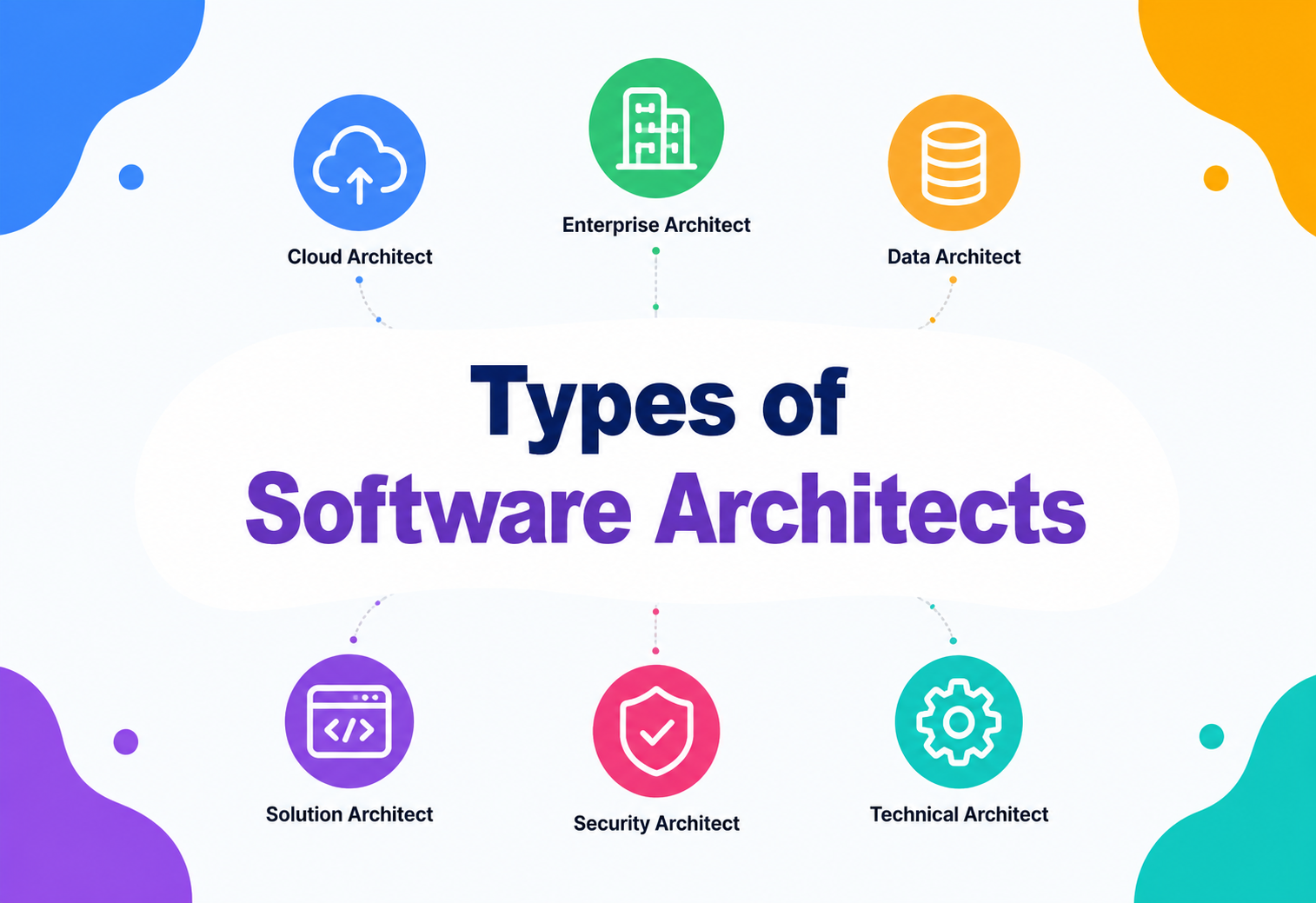
The Main Types of Software Architects
One job title, many jobs. Here is the mental map that sorts enterprise, solution, technical and the domain specialists into a shape you can reason about, hire against, and grow into.
The Big Idea, in One Breath
“Software architect” is not a single job. It is a family of related roles that specialise by scope, by depth, and by domain.
Someone tells you they are a “software architect” and you learn almost nothing about what their week actually looks like. The title covers at least half a dozen distinct roles, all senior, all technical, all shaped very differently by scope and specialisation. This guide sorts them into a mental map that keeps them straight.
The cleanest analogy is a large hospital. Everyone in the building is a “doctor”, but a cardiologist, a radiologist, and a hospital medical director all spend their days on very different work. Some go deep on one organ system. Others coordinate across every specialism to run the whole institution. Nobody would confuse them — and no patient benefits from pretending they are interchangeable.
Think of software architects the way you think of medical specialists in a hospital. They share a foundation, they respect each other’s craft, and they show up for different problems — and getting the wrong specialist for a given case is expensive.
The Three Altitudes
The first way architects differ is scope. Three altitudes cover the vast majority of roles: enterprise, solution, technical.
The simplest way to organise the field is by altitude — how far the architect’s attention has to stretch. Three altitudes cover most of what you will run into.
Whole organisation, years
Anchored to the entire company’s technology landscape and its long-term business strategy. Sets standards, roadmaps and reference architectures that everyone else designs within.
One business problem, end-to-end
Anchored to a specific business initiative that touches multiple systems. Shapes how those systems, vendors and teams connect to deliver one coherent answer.
One system, in depth
Anchored to a single system. Owns its stack, its internal structure, its non-functional requirements, and its evolution over years.
The three are not a ladder — you do not automatically “grow up” from technical through solution to enterprise. Many careers stay firmly at one altitude for decades, and each is a full, respected specialism in its own right.
The Domain Specialists
Alongside the three altitudes sit the domain specialists — architects who go deep on one cross-cutting concern that spans many systems.
Alongside the altitude-based roles, most large organisations also have domain specialists — architects who go extremely deep on one specific concern that cuts across the whole landscape rather than living inside one system.
Data Architect
How information is modelled, stored, integrated, governed and moved across the organisation — from operational databases through analytics platforms.
Cloud Architect
How the organisation’s systems run in the cloud — account structure, network topology, cost model, resilience posture, cloud-native patterns.
Security Architect
How systems, data and access are protected against realistic threats — identity, encryption, monitoring, compliance boundaries, incident response.
Integration Architect
How systems and vendors talk to each other — APIs, events, message brokers, contract management, service meshes.
Infrastructure Architect
How networks, compute, storage and platform services are laid out at the physical or virtual level, especially in on-prem or hybrid environments.
AI / ML / Data Platform Architect
Increasingly common variants that go deep on one specific technology domain such as machine-learning pipelines or lakehouse-style data platforms.
These specialisations are usually orthogonal to altitude — you can be a solution architect who happens to specialise in security, or a technical architect who happens to specialise in data. The two dimensions multiply rather than replace each other.
How They All Connect
The types are not isolated silos. They interlock in a fairly consistent shape across most organisations.
Drawn out, the roles form a fairly consistent shape across most organisations: the three altitudes stack on top of each other, and the domain specialists sit alongside, supporting everyone.
Read that as a scope relationship, not a management one. Enterprise architects rarely manage solution architects directly, and solution architects rarely manage technical architects. What flows down the picture is constraints: the enterprise architect sets the boundaries the solution architect designs within; the solution architect sets the boundaries the technical architect designs within; and the domain specialists supply expertise anywhere along the way.
The T-Shaped Architect
The mental model most experienced architects match is a “T”: broad horizontal knowledge, plus one vertical bar of real depth.
Effective architects almost universally exhibit what recruiters call a T-shape — broad knowledge across many technologies and concerns (the horizontal bar), combined with one area of genuine, credible depth (the vertical bar).
The horizontal bar is what lets an architect reason across systems, negotiate between teams, and route decisions to the right specialist. The vertical bar is what keeps them credible — without it, they slide into being a “big-diagram person” whose recommendations the deep experts quietly ignore. Different types of architects have different vertical bars — cloud for a cloud architect, data for a data architect, one specific stack for many technical architects — but almost every strong architect has one.
Four Personalities to Recognise
Beyond the titles, four working personalities show up repeatedly in the field — each with its own strengths and its own failure modes.
Titles describe scope; personalities describe how someone actually shows up to the work. Four archetypes appear over and over across all the types above.
Still deep in the code
Prefers prototypes to slides. Sharpest when a real system needs to be brought back to life, weakest when a decision needs weeks of stakeholder alignment.
Master of alignment
Thrives in meetings, unblocks stakeholders, translates between worlds. Weakest when nobody is available to challenge an unproven technical assumption.
Long-horizon thinker
Sees three years ahead and drafts roadmaps that hold up. Weakest when a project needs a decision this afternoon, not next quarter.
Standards & governance
Protects consistency across teams and prevents regression. Weakest when new territory needs invention rather than enforcement.
Most real architects blend two of these on their best days and hit the failure mode of a third on their worst. Recognising the mix early — in yourself or a colleague — is often the biggest lever for improving how a team of architects works together.
Two Architects, One Day, Compared
A quick side-by-side to make the difference feel concrete rather than abstract.
Two Tuesdays, side by side. Same title on paper — very different jobs in practice.
Across many systems
Walks a business owner through a proposed integration, meets a vendor to compare products, reviews a legal constraint that changes the data flow, and updates the solution blueprint by end of day.
Deep in one platform
Reviews a multi-region failover design, benchmarks two managed database options, pairs with an SRE on a cost anomaly, and updates the cloud reference architecture for the next quarter.
Both are senior. Both make the systems they touch demonstrably better. Neither could easily do the other’s day.
Choosing the Right Type for a Project
A rough guide to which architect a project actually needs — and when it needs more than one.
A useful reflex: before you decide to add “an architect” to a project, decide which kind. Different types are appropriate for different signals.
| Signal | Type to Bring In |
|---|---|
| Systems across the whole org are drifting into overlap | Enterprise architect |
| A business initiative needs several systems to cooperate | Solution architect |
| One system must be built or scaled to a demanding standard | Technical architect |
| Data is duplicated, inconsistent, or hard to govern | Data architect |
| Cloud bills, resilience or account sprawl are a real problem | Cloud architect |
| Compliance or threat exposure is rising fast | Security architect |
Large, cross-cutting programmes almost always need more than one type at the same time — a solution architect to shape the whole, a technical architect per major system, and a domain specialist or two on the parts that carry the biggest risk.
Shared Skills and Unique Skills
A common technical base underneath, with each type stretching in a different direction on top of it.
Every type shares a common foundation — solid engineering roots, comfort with distributed systems, and the judgement to make trade-offs. On top of that base, each type stretches in a different direction.

Skills every type shares
- Strong engineering foundation and system-design instincts
- Ability to reason about non-functional requirements — scale, reliability, security
- Comfort communicating trade-offs to both engineers and non-engineers
- Judgement about when to escalate a decision versus resolve it locally
Skills that differ by type
- Enterprise: strategy fluency, executive communication, framework literacy
- Solution: cross-vendor breadth, negotiation, integration patterns
- Technical: deep stack mastery, structural code review, refactor planning
- Domain specialists: extreme depth in one crosscutting area (data, cloud, security, …)
Moving Between Types
Most careers touch more than one type. Here are the common moves — and the common traps.
Careers rarely land on one type and stay put for forty years. Some transitions are common and natural; others are surprisingly hard.
Technical → Solution
Adding cross-system breadth on top of one system’s depth — often the most-taken path.
Solution → Enterprise
Zooming out further from projects to the whole landscape, usually after many delivered solutions.
Technical → Domain specialist
Going even deeper on one crosscutting concern — cloud, data, security — often after a project where that concern dominated.
Domain specialist → Enterprise
Requires deliberately broadening back out; specialists sometimes struggle to escape the pull of their own domain.
The best time to prepare for a move is one job before you make it. Volunteer for scope that tastes like the destination role while still doing your current one; nobody promotes into new scope without evidence of it.
Common Myths, Cleared Up
Three misconceptions that keep resurfacing whenever architect titles get discussed — and the reality behind each.
“There is only one real kind of software architect.”
Almost every conversation that starts this way ends with someone accidentally describing whichever type they personally happen to be. There are at least six recognisable types in most large orgs, plus emerging ones like AI/ML architect. Insisting on only one flattens a whole discipline.

“A domain specialist is less senior than a solution or enterprise architect.”
Not at all — different axis of seniority. A principal security architect is not junior to a solution architect; they are equally senior on a different axis. Confusing depth for lack of scope is a common recruiting mistake.
“Small teams do not need to think about any of this.”
They do not need dedicated architects, but they still make architectural decisions all the time. Understanding which type of decision is in front of them — system-level, solution-level, cross-cutting — helps them route it to the right person, even if that person is wearing three other hats.
Hiring “an architect” without deciding which type. It is one of the most reliable ways to end up with a mismatched hire six months into a role neither side is happy with.
Key Takeaways
The five ideas from this guide worth carrying into any conversation about architect roles — whether you are hiring, being hired, or staffing a project.
What to Remember
- “Software architect” is a family of roles, not a single job title.
- Three altitudes cover most positions: enterprise, solution, technical.
- Domain specialists — data, cloud, security, integration — sit alongside the altitudes, not below them.
- Every effective architect is T-shaped: broad awareness plus one credible area of real depth.
- Match the type to the signal. Diagnose which kind of architect a project actually needs before you post the job description.