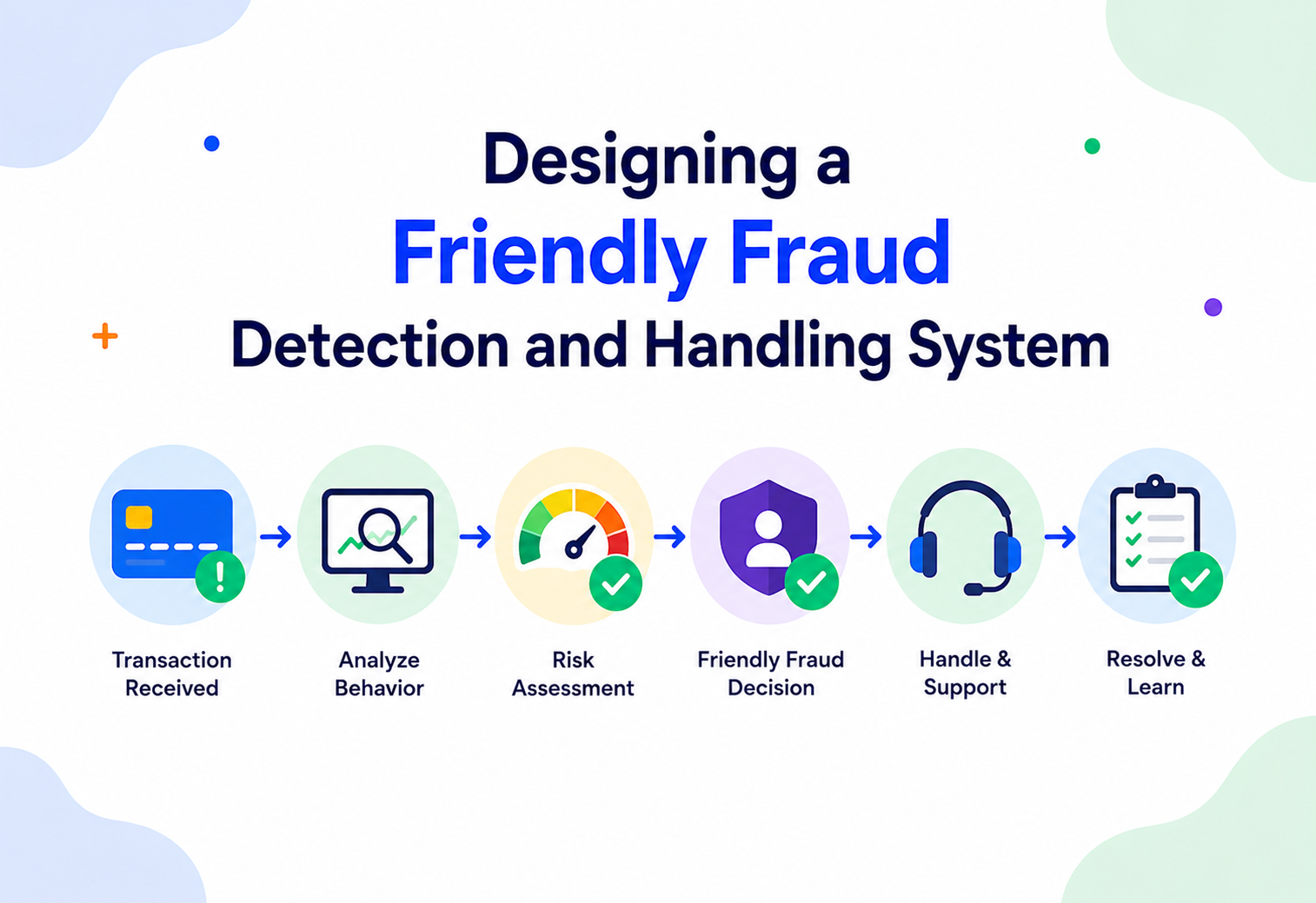
Designing a Friendly Fraud Detection and Handling System
A production-grade, interview-focused deep dive into building a system that recognises when a cardholder disputes a charge for something they genuinely ordered and received, builds a compelling evidence case automatically, and protects merchant revenue without wrongly treating honest customers as suspects.
Introduction and History
Most conversations about payment fraud imagine a stranger: someone who steals a card number and uses it to buy something the real cardholder never wanted. But there is a second, quieter kind of fraud that does not involve a stranger at all — where the actual cardholder places a real order, receives the real product, and later calls their bank to dispute the charge anyway.
This is called friendly fraud, sometimes referred to as first-party fraud or chargeback fraud, and despite the friendly-sounding name, it is one of the most expensive and hardest-to-fight problems a payment platform faces, because unlike stolen-card fraud, there is no criminal impersonating anyone — the person disputing the charge is exactly who they claim to be.
To understand why this is genuinely difficult, imagine a simple neighborhood video rental shop from decades ago. A customer rents a movie, watches it, returns it, and later tells the shop owner they were never given a movie at all, demanding their deposit back. The shop owner remembers the customer’s face, remembers handing over the movie, and can simply say no. A payment platform processing millions of transactions between people who never meet face to face has no such memory to lean on directly — it has to reconstruct, entirely from data, whether a specific disputed order really was received as claimed, and it has to do this at a scale no human could manage by simply “remembering.”
Friendly fraud grew alongside e-commerce itself. As online shopping and card-not-present transactions expanded through the 1990s and 2000s, so did chargeback rights designed to protect cardholders from genuine merchant fraud and delivery failures. Those same protections, unfortunately, created an opportunity: a cardholder who received a legitimate product could dispute the charge under a reason code meant for non-delivery or unauthorized use, often successfully, because early dispute processes were not well equipped to distinguish a genuine victim from someone gaming the system. Industry studies over the past decade have consistently found that a majority of chargebacks filed under “item not received” or “unauthorized transaction” reason codes involve cases where the cardholder did, in fact, receive and use what they ordered — making friendly fraud not an edge case, but the dominant category of chargeback loss for many merchants.
What makes this domain different from other fraud problems is that the system’s job is not to block a bad actor before a transaction happens — the transaction was already legitimate. Its job is to reconstruct, after the fact and often weeks later, a defensible narrative of what actually occurred, while simultaneously being careful never to treat every honest, confused customer as a criminal. Getting this balance wrong in either direction is costly: too aggressive, and the platform alienates good customers and invites regulatory and reputational trouble; too passive, and merchants bleed revenue to a pattern that, once discovered by a bad-faith customer, tends to repeat.

1.1 A Short Timeline of Chargeback Rights and Friendly Fraud
1974 — Fair Credit Billing Act
US law establishes formal cardholder rights to dispute billing errors and unauthorised charges, creating the legal skeleton chargeback processes are built on.
1990s — Rise of E-Commerce
Card-not-present transactions explode, and dispute reason codes designed for lost-in-mail catalog orders start being used for online purchases the same day they arrive.
2010s — Compelling Evidence Frameworks
Card networks publish formal categories of proof (matching device, prior undisputed history) that meaningfully counter a friendly-fraud claim.
2018+ — Pre-Dispute Alert Networks
Issuer-side early warning networks let merchants proactively refund a likely dispute before it ever becomes a formal chargeback.
2020s — Consortium Signal Sharing
Cross-merchant fraud data consortiums catch repeat disputers whose behaviour would be invisible to any single merchant.
- How is friendly fraud fundamentally different from stolen-card fraud, and why does that difference change the system design?
- Why can’t a platform simply block a customer who disputed a charge once, the way it might block a stolen card?
- Who are the actors involved, and what does each one need from a friendly fraud system?
1.2 Why the Word “Friendly” Is Misleading, and Why That Matters for Design
The term “friendly fraud” is a historical artifact, coined at a time when the dominant scenario was thought to be innocent confusion between family members sharing a card, rather than deliberate abuse of the dispute process. The name has stuck even as the underlying behavior has grown to include everything from genuine forgetfulness to organized, repeated exploitation across many merchants. This matters for system design because a name suggesting universal innocence can quietly bias a team toward under-building the detection and evidence side of the system, on the assumption that most cases are harmless mistakes needing only a light touch. A well-designed system resists that bias structurally, by measuring actual outcomes and patterns rather than assuming intent from the category label alone, and by building genuine detection capability even while remaining careful, in tone and consequence, about how it treats any individual customer before the evidence actually supports a stronger response.
1.3 The Problem, Stated Precisely
Stripped of jargon, the engineering problem is this: build a system that continuously collects strong, verifiable signals about every order as it happens — who placed it, from where, how it was delivered, how it was used afterward — so that if a dispute arrives weeks later, the platform can quickly and confidently distinguish “this genuinely was not delivered or authorized” from “this was delivered and used, and the dispute itself is the problem,” and can assemble that evidence into a form a card network’s evidence framework will actually accept, all without ever treating a merely confused, good-faith customer as an adversary before there is real reason to.
1.4 Why This Problem Resists a Purely Technical Solution
It is tempting to imagine friendly fraud as a pattern-matching problem no different from detecting a stolen credit card, but the two differ in a way that matters enormously for system design. Stolen-card fraud detection tries to stop something from happening; friendly fraud handling tries to fairly reconstruct something that already happened, using data that must be gathered before anyone knows it will be needed, evaluated by rules that must account for genuine human forgetfulness alongside deliberate abuse, and ultimately judged not by the platform itself but by an external card network applying its own evidentiary standards. This means the system’s real product is not a block or an allow decision, but a well-organized, persuasive account of history — closer in spirit to building a legal case file than to a conventional real-time fraud filter.
This distinction also shapes who the system needs to serve well. A stolen-card detection system’s primary customer is the platform’s own risk team. A friendly fraud system’s primary customer is, in an important sense, the card network’s dispute reviewer — a third party, outside the platform entirely, who was not present for the transaction and has no independent way to know what really happened except what the evidence package tells them. Designing for that external, skeptical reader, rather than only for internal risk staff, is what separates an effective evidence system from a merely thorough one.
Architecture and Components
Before drawing the architecture, it helps to name the actors and the two-phase rhythm that makes this system unlike other fraud systems: a long, quiet evidence-collection phase during ordinary commerce, followed by a short, deadline-bound classification and representment phase when a dispute finally arrives.
There is the cardholder, who placed and later disputes an order. There is the merchant, who fulfilled it and stands to lose both the product and the payment if the dispute succeeds. There is the payment platform, sitting between them, responsible for both processing the original transaction and, later, representing the merchant’s side of the dispute. There is the issuing bank and the card network, who ultimately decide the dispute’s outcome based on the evidence presented. And increasingly, there are fraud data consortiums — shared industry networks where platforms and merchants pool anonymized signals about repeat disputers, since a customer who serially disputes legitimate charges rarely does it at only one merchant.
A friendly fraud detection and handling system is best understood as an always-on evidence-collection pipeline feeding a dispute-time risk-classification and evidence-assembly workflow. Unlike a system that tries to stop fraud before it happens, this system’s real work happens continuously, quietly, at the moment of every legitimate transaction — long before anyone knows whether a dispute will ever be filed.
2.1 Evidence Collection Service
This is the quiet workhorse of the entire system, and arguably the single most important component, because evidence gathered days or weeks after a dispute is far weaker than evidence captured the moment the order happened. It records device fingerprint, IP address and approximate geolocation, session behavior during checkout, delivery confirmation details (tracking number, signature, geolocation of delivery), and for digital goods, actual usage signals like logins, downloads, or streaming activity after purchase. None of this exists to judge the customer at purchase time — it exists purely as a durable record that can be consulted later, if and only if a dispute occurs.
2.2 Friendly Fraud Classification Engine
When a dispute arrives, this engine is the first to look at it, comparing the disputed transaction’s reason code and details against the evidence collected at order time and the customer’s broader dispute history. Its output is not a final verdict but a confidence score and a recommended handling path: strong evidence of legitimate delivery and usage routes toward automated evidence assembly and a fight recommendation, while genuinely ambiguous or thin-evidence cases route toward a more careful human review rather than an automatic accusation.
2.3 Customer Dispute History Service
A single dispute, on its own, tells you very little — genuine mistakes and legitimate issues happen even to honest customers. A pattern across time and across merchants tells you much more. This service aggregates a customer’s own dispute history within the platform and, where the platform participates in a fraud data consortium, anonymized signals about dispute behavior at other merchants entirely, since a customer who has filed unusually frequent “item not received” disputes across several unrelated merchants is a meaningfully different case than someone disputing for the very first time.
2.4 Automated Evidence Builder
Card networks have increasingly formalized what counts as strong evidence against a friendly fraud claim — frameworks like Visa’s Compelling Evidence requirements specifically define categories of proof, such as matching IP addresses between account login and delivery tracking, or prior undisputed purchase history with the same device. The Automated Evidence Builder assembles exactly this kind of structured package from the Evidence Collection Service’s stored data, dramatically reducing the manual work a merchant would otherwise need to do for every single dispute.
2.5 Pre-Dispute Alert Network
Some disputes can be caught before they ever become a formal, deadline-bound chargeback at all. Issuer-side alert networks allow a cardholder’s own bank to flag a likely dispute early, giving the merchant a window to proactively resolve the issue — a refund, an apology, clarified billing descriptor — without it ever escalating into a full chargeback with its associated fees and dispute-rate impact. Integrating with this kind of network is one of the highest-leverage components in the whole architecture, because the cheapest and fastest way to win a dispute is to prevent it from formally happening in the first place.
2.6 Deterrence and Risk Scoring Service
Every dispute outcome, win or loss, feeds back into the customer’s ongoing risk profile, and where appropriate, into the broader consortium data. This is the mechanism that allows the platform to recognize a repeat pattern the second time it happens, rather than treating every dispute as if it were the customer’s first, and it is also what allows appropriately calibrated friction — like requiring stronger authentication on future orders — to be applied specifically to customers whose behavior has earned it, rather than uniformly across the entire customer base.
- Why does evidence need to be collected at order time rather than gathered only after a dispute arrives?
- What is a pre-dispute alert network, and why is preventing a chargeback better than winning one?
- Why is a single past dispute a weak signal on its own, and what makes a pattern across time or merchants stronger?
2.7 Merchant Review Portal
Even with strong automation, the final decision to submit evidence, or in ambiguous cases to simply accept the loss and issue a refund, often benefits from merchant input, since the merchant may know context the system cannot infer from data alone — a known difficult customer, a recent service issue, or a business reason to preserve goodwill even when the evidence favors fighting. The portal presents the classification engine’s recommendation and the assembled evidence clearly, but leaves merchants with the final call rather than fully automating away their judgment.
2.8 Order Fulfillment and Usage Integration
The architecture depends heavily on tight, low-latency integration with systems that are not, strictly speaking, part of fraud or dispute handling at all — the fulfillment and logistics platform that generates delivery confirmations, and for digital products, the account and usage-tracking systems that record logins and downloads. This cross-cutting integration is often the hardest part of building this system in practice, not because any single integration is technically difficult, but because it requires coordinating with teams and systems that were never originally designed with dispute defense in mind, and convincing them that capturing and forwarding a few additional fields is worth the engineering investment for a benefit they may not directly see themselves.
2.9 Chargeback Fee and Financial Impact Tracking
Every dispute, regardless of outcome, typically carries a processing fee charged by the card network or acquiring bank, separate from the disputed amount itself. A dedicated tracking component within the Case Management Service records this financial impact per case and aggregates it at the merchant level, since understanding the true cost of friendly fraud — disputed amount plus fees, won or lost — is what ultimately justifies continued investment in evidence collection infrastructure to both merchants and the platform’s own leadership.
2.10 Adaptive Friction Service
Not every response to elevated friendly-fraud risk needs to wait for a dispute to happen at all. An Adaptive Friction Service consumes risk scores from the Deterrence and Risk Scoring Service and applies proportionate, graduated friction at future checkout moments for specifically flagged customers — an additional identity confirmation step, a requirement for signature-on-delivery rather than leave-at-door, or in the highest-risk cases, a request for stronger cardholder authentication before an order is accepted at all. This component is what turns the system’s learning from past disputes into genuine prevention on future orders, rather than leaving every improvement purely reactive.
2.11 Explainability Layer
Because classification outcomes affect real customers and real merchant revenue, and because they may eventually need to be defended to a card network reviewer, an internal auditor, or a customer who contests the outcome, the system maintains a dedicated Explainability Layer that translates a case’s underlying evidence and model signals into a clear, human-readable rationale. This is treated as a first-class output of the classification process, not an afterthought bolted on for debugging purposes, since “why was this decision made” is a question the system needs to be able to answer clearly and consistently, to multiple different audiences with different levels of technical background.
2.12 Feedback Loop to Product and Fulfillment Teams
Evidence gaps discovered during dispute handling are often not fraud problems at all, but product or operational gaps — a delivery courier that does not reliably capture signatures, or a checkout flow that fails to record device information consistently for a subset of browsers. A structured feedback channel routes these findings back to the teams who own fulfillment and checkout, closing a loop that purely fraud-focused teams are rarely positioned to close on their own, since the fix often lives entirely outside the fraud system’s own codebase.
Internal Working
Internally, this system has an unusual two-phase rhythm that distinguishes it from most other workflow systems: a long, quiet, continuous phase where evidence accumulates with no urgency at all, followed by a short, intense, deadline-bound phase that begins the instant a dispute arrives. Both phases need to be modeled correctly, and the transition between them is where a great deal of the system’s real value is created or lost.
3.1 Evidence Retention Without Judgment
A subtle but important design principle is that the Evidence Collection Service does not classify or judge anything at order time — it simply records. This separation matters both technically and ethically: technically, because classification logic and card network evidence requirements evolve over time and should be able to improve retroactively against historical data without needing to have been predicted correctly at the moment of the original order; ethically, because treating every customer as a potential future fraud case at the moment of purchase would be both invasive and largely pointless, given that the overwhelming majority of orders will never be disputed at all.
3.2 Confidence Scoring, Not Binary Verdicts
The Classification Engine deliberately outputs a confidence score and routing recommendation rather than a hard “fraud” or “not fraud” label, because friendly fraud sits on a genuine spectrum — from a customer who plainly forgot they placed an order, through one who is quietly exploiting an easy refund process, to one running an organized, repeated pattern across many merchants. Treating this as a scored, routed decision, with human review available for the ambiguous middle, avoids the two failure modes of a binary system: falsely accusing a confused-but-honest customer, or automatically waving through a case that a human would have caught.
3.3 Idempotency and Consistency Across the Long Gap
Because weeks or months can pass between an order and a dispute, the system needs strong guarantees that evidence recorded at order time remains exactly, verifiably unchanged by the time it is needed. Evidence records are write-once and cryptographically hashed at creation, so any later tampering, even accidental, is detectable, and every dispute-time operation carries an idempotency key so a retried classification or evidence-assembly request never produces two conflicting evidence packages for the same case.
- Why should evidence collection stay completely separate from fraud judgment at order time?
- Why output a confidence score and routing decision instead of a simple fraud or not-fraud label?
- How would you guarantee evidence recorded weeks ago hasn’t been altered by the time a dispute actually arrives?
3.4 Consensus for Cross-Region Evidence Consistency
When evidence is written from a fulfillment event in one region and later read by a classification engine potentially operating from another, the system needs a consistent, agreed-upon view of what evidence exists for a given order, even during a transient network partition between regions. This is handled by anchoring each order’s evidence to a single, designated home region determined at order creation time, with cross-region reads routed there rather than each region maintaining an independently updated, potentially conflicting local copy — a deliberate simplification that trades a small amount of cross-region read latency for avoiding a much harder distributed consensus problem the domain does not actually require solving in real time.
3.5 CAP Theorem Trade-offs in This Domain
For the Order Evidence Store, the system leans toward availability during a partition, since a delayed evidence write, recovered shortly after, is generally acceptable given the weeks-long window before that evidence is typically needed. For the Case Management Service handling an active, deadline-bound dispute, the system leans toward consistency instead, since a conflicting or lost update to an active case’s state carries immediate, hard-to-reverse consequences. This is a clear illustration of a broader principle: CAP trade-offs are rarely uniform across an entire system, and should instead be decided independently based on what each specific component is actually protecting and how much staleness that protection can tolerate.
3.6 Handling Schema Evolution Over a Long Dormant Period
A genuinely tricky internal challenge specific to this domain is that the evidence schema itself may change between when an order’s evidence was originally written and when it is finally read, months later, during an active dispute. A field added last quarter simply will not exist on evidence records from a year ago, and a classification engine that assumes every record has the current schema will silently misbehave on older data. The system handles this with explicit schema versioning on every evidence record, and classification logic that is written defensively against multiple historical schema versions rather than assuming a single, current shape, treating this the same way any long-lived, append-only data store must treat backward compatibility as a permanent, ongoing concern rather than a one-time migration event.
Data Flow and Lifecycle
Let’s trace one case end to end. A customer orders a pair of headphones, has them delivered with a signature confirmation to their verified home address, logs into the merchant’s app three times over the following week to check the order status and register the product for warranty, and then, six weeks later, disputes the charge as “item not received.”
4.1 What Counts as Strong Evidence
Not all evidence carries equal weight, and part of the Classification Engine’s job is understanding which signals card networks and issuers actually find persuasive. A signature-confirmed delivery to a verified address is strong. A matching device fingerprint between the original order and later account activity is strong. A billing address that matches the shipping address is moderate. A single login from the same general geographic region is weak on its own but can combine meaningfully with other weak signals to become collectively persuasive. The Evidence Builder is specifically designed around known card-network evidence frameworks, since a technically true but poorly organized evidence package is far less effective than the same facts presented in the specific structure a network’s evidence review process expects.
| Evidence type | Strength | Why it matters |
|---|---|---|
| Signed delivery confirmation | Strong | Directly proves physical receipt at a verified address |
| Matching device fingerprint pre- and post-purchase | Strong | Ties the same real-world actor to both the order and later usage |
| Post-purchase account activity (logins, downloads) | Strong for digital goods | Shows the product or service was actually accessed |
| Matching billing and shipping address | Moderate | Reduces likelihood of unauthorised third-party use |
| Prior undisputed order history | Moderate | Establishes an existing, trusted relationship |
| General IP geolocation match | Weak alone | Useful only combined with other corroborating signals |
4.2 Handling Ambiguous Middle
Not every case resolves cleanly. A digital subscription customer who never logged in after their trial converted to a paid plan, then disputes the first real charge, presents genuine ambiguity — the lack of usage could indicate either a customer who forgot to cancel and is now trying to avoid responsibility, or a legitimate case of an unclear cancellation flow that the merchant itself should fix. The Classification Engine explicitly routes this kind of case to human review rather than forcing a confident automated verdict, and importantly, feeds the outcome of that human review back as a labeled training signal, so the system’s judgment on similarly ambiguous future cases continues to improve rather than staying static.
- Walk me through how you would rank different types of evidence by strength, and why some signals matter more than others.
- How would you handle a genuinely ambiguous case where the evidence points in both directions?
- How does a human reviewer’s decision on an ambiguous case improve the system going forward?
4.3 A Sharded View of the Evidence Store
It helps to visualize how evidence data physically spreads across the store as order volume grows, since this is a natural follow-up question once the sequence flow is understood.
4.4 Linking Evidence Across a Customer’s Order History
A single order’s evidence is useful on its own, but a customer’s broader order history often strengthens a case considerably — for example, five prior undisputed deliveries to the same address, using the same device, materially reinforce the plausibility of a sixth delivery having also occurred as described. The Evidence Builder optionally pulls this kind of supporting historical context, when available and relevant, rather than treating each disputed order as a fully isolated case with no connection to the customer’s broader, otherwise unremarkable transaction history.
4.5 Handling Multi-Item and Partial Disputes
Real orders are often messier than the single-item examples used to illustrate the lifecycle so far. A customer might dispute only part of a multi-item order, claiming one of several items never arrived while acknowledging the rest, or might dispute a subscription renewal while the underlying account remains active and in regular use. The Evidence Builder is designed to assemble evidence at the appropriate granularity — per line item where the dispute itself is partial, or across a subscription’s full billing history where the dispute concerns an ongoing service — rather than forcing every case into a single, whole-order evidence template that would poorly fit these more nuanced, and quite common, real-world situations.
4.6 Coordinating With Merchant-Side Customer Service
A dispute rarely arrives in a vacuum from the merchant’s own perspective — a customer who is genuinely confused or dissatisfied often contacts support before, or instead of, disputing the charge through their bank. Integrating case context with the merchant’s customer service tooling lets a support agent see, at the moment a complaint comes in, that a similar issue is already flagged internally, and lets the system, conversely, learn from a resolved support ticket that a dispute might be preventable through a direct refund rather than escalating into a formal chargeback at all. This coordination is one of the most effective, and most commonly overlooked, ways to shift cases out of the more expensive, adversarial representment path entirely.
Advantages, Disadvantages and Trade-offs
Every guarantee this system provides is paid for by giving something up elsewhere — storage cost, integration complexity, ongoing model tuning, and the residual risk of ever wrongly flagging an honest customer. Being explicit about that exchange is what turns “we fight friendly fraud” from a marketing line into a genuine, defensible engineering posture.
Advantages of this architecture
- Passive, continuous evidence collection means dispute-time response is fast and well-supported, not a scramble.
- Confidence-scored routing avoids the two failure extremes of always-accuse or always-trust.
- Cross-merchant consortium signals catch repeat offenders a single merchant would never see on its own.
- Pre-dispute alert integration prevents a meaningful share of disputes from ever becoming formal chargebacks.
Disadvantages / costs
- Continuous evidence collection adds storage and privacy-compliance overhead to every single order, not just disputed ones.
- Consortium participation requires careful data-sharing agreements and anonymisation, adding real integration complexity.
- Confidence-scoring models require ongoing tuning and labeled outcome data to stay accurate as fraud patterns evolve.
- Overly aggressive friendly-fraud flagging risks alienating genuinely honest, simply forgetful customers.
A central trade-off is between evidence collection breadth and customer privacy. Collecting more device, behavioral, and usage signals produces stronger dispute defense, but every additional signal collected is also additional personal data the platform must protect, justify, and eventually delete under applicable privacy law. Mature platforms resolve this by collecting only what is proportionate to genuine dispute-defense value, and by being transparent, within customer-facing terms of service, about what is collected and why, rather than quietly maximizing data collection purely because more data is theoretically useful.
Another real trade-off is between automation speed and fairness to ambiguous cases. Fully automating every classification would minimize dispute handling cost and speed, but it would also mean some genuinely ambiguous, good-faith cases get automatically fought rather than thoughtfully reviewed, risking real damage to a customer relationship and, at larger scale, reputational and regulatory exposure for the platform. Keeping a human review path for the ambiguous middle costs time and staffing, but it is a deliberate, necessary check on a system that is ultimately making judgments about individual people’s honesty.
A further trade-off worth naming concerns how heavily to weight machine-learned scoring versus explicit, deterministic evidence rules. A learned model can surface subtle behavioral patterns a fixed rule set would never anticipate, but its reasoning is harder to explain to a merchant, a customer who contests the outcome, or a regulator asking how a particular decision was reached. Deterministic rules, like “signed delivery plus matching device fingerprint equals strong evidence,” are transparent and easy to justify, but can only catch patterns someone thought to encode in advance. Mature systems combine both, using explainable rules as a defensible floor and machine-learned scoring as an additional layer for nuance, rather than relying on either approach exclusively.

Section Takeaway
Neither pure automation nor pure caution wins here; the actual craft is deciding, per case, when to lean on each. The confidence score, the human review path, and the explainability layer exist specifically so that trade-off can be made consciously in the middle of a live case, not baked in blindly at model training time.
Performance and Scalability
A payment platform processing millions of orders per minute needs the Evidence Collection Service to keep pace with that same volume continuously, since falling behind here does not just delay a dashboard — it means evidence for orders placed during the backlog window may be thinner or entirely missing by the time a dispute eventually arrives weeks later.
6.1 Write-Heavy, Rarely-Read Storage Pattern
The Order Evidence Store has an unusual access pattern worth designing around deliberately: it is written to constantly, for every single order, but read only for the small fraction of orders that are ever disputed, often weeks or months after being written. This makes it a strong candidate for a storage tier optimized for high-throughput, append-only writes with relatively rare, latency-tolerant reads, rather than a store optimized for balanced read-write performance, since optimizing for reads that rarely happen would waste resources that are better spent absorbing the platform’s full order volume smoothly.
6.2 Horizontal Scaling of Classification
The Classification Engine, unlike the Evidence Collection Service, only needs to handle the much smaller volume of actual disputes, which is a small fraction of total transaction volume. This asymmetry means the two services can be scaled completely independently, with evidence collection provisioned against total order volume and classification provisioned against historical dispute-rate volume, avoiding the wasted cost of over-provisioning the smaller, less frequently used component to match the much larger one.
Large payment platforms report that friendly fraud evidence pipelines are among their highest-cardinality, highest-write-volume systems precisely because they touch every single transaction, not just flagged ones — this is exactly why treating evidence storage as a distinct, independently scaled tier from the transactional and dispute-handling databases is standard practice rather than an unusual optimisation.
6.3 Batch Evidence Retrieval for Representment
When the Evidence Builder assembles a package, it typically needs to pull several related records — delivery confirmation, session logs, usage history — for the same order. Rather than issuing several separate round trips, the builder batches these into a single retrieval keyed by order ID, significantly reducing latency for the merchant review step and, more importantly, ensuring the full evidence picture is available in one pass rather than assembled piecemeal under time pressure as a filing deadline approaches.
- Why does the Order Evidence Store need a different storage strategy than a typical read-heavy application database?
- How would you provision the Classification Engine differently from the Evidence Collection Service, and why?
6.4 Connection Pooling and Backpressure
Given the extreme write volume the Evidence Collection Service handles, every writer maintains a bounded connection pool rather than opening fresh connections per order, and when the pool is saturated during a traffic spike, work queues safely in a durable message bus rather than backing up as half-completed database connections. It is far better for evidence to be written a few seconds later during a burst than for the underlying store to be driven into a degraded state that could delay writes for unrelated orders processing at the same time.
6.5 Capacity Planning Around Seasonal and Promotional Spikes
Order volume, and with it evidence-write volume, is rarely flat — major shopping events, promotional campaigns, and seasonal peaks can multiply normal traffic several times over for short windows. Because evidence gathered during exactly these high-volume periods is also disproportionately likely to be disputed later (return and complaint volume tends to track order volume with a lag), the Evidence Collection Service’s capacity planning has to account for sustained peak-adjacent load, not just the peak moment itself, since a backlog that clears within hours can still mean thinner evidence for a meaningful slice of that period’s orders.
touches 100% of transactions
classification engine handles
read of evidence records
High Availability and Reliability
Because evidence that is never captured can never be reconstructed later, the Evidence Collection Service’s reliability bar is arguably higher than almost any other component in the system — a missed delivery-confirmation write is not something that can be retried after the fact once the fulfillment system has moved on to processing new orders.
7.1 Durability-First Write Path
Evidence writes are treated with the same durability discipline as financial ledger writes elsewhere in a payment platform: acknowledged only after being safely replicated, never held purely in a cache or in-memory buffer that could be lost on a crash. If the primary evidence store is temporarily unavailable, writes fail over to a durable, geographically separate queue rather than being silently dropped, since a silently dropped evidence write only becomes visible as a problem weeks later, at exactly the moment it is needed most.
7.2 Graceful Degradation Elsewhere
If the Customer Dispute History Service or the consortium data connection is temporarily unavailable at classification time, the system does not block the dispute workflow entirely — it proceeds with a documented note that pattern-history context was unavailable, falling back to a more conservative routing decision that favors human review over automated fight recommendations when historical context is missing, rather than either stalling the case or guessing with incomplete information.
7.3 Multi-Region Considerations
Evidence and case data replicate synchronously within a region for strong consistency, and asynchronously across regions for disaster recovery, following the same pattern used for other financially significant records. Given the long dormant period between order and potential dispute, cross-region backup coverage matters more here than in many other systems, since a regional failure affecting historical evidence, even briefly, could permanently weaken a merchant’s position in disputes filed against orders from that period.
- Why is the Evidence Collection Service’s reliability bar arguably higher than most other components in this system?
- What should the system do if historical dispute-pattern data is temporarily unavailable at classification time?
7.4 Backup, Retention, and Disaster Recovery
Beyond live replication, the system takes regular snapshots of evidence and case data, retained for a period aligned to the longest realistic dispute window across all supported card networks and payment methods, since evidence needed for an unusually late-filed dispute is worthless if it was already purged. Recovery procedures are tested on a regular schedule against realistic scenarios, including the specific case of restoring evidence for orders placed just before a simulated regional outage, since that boundary condition is exactly where a poorly tested recovery plan is most likely to reveal a gap.
7.5 Health Checks That Reflect Real Evidence Integrity
A shallow health check confirming the Evidence Collection Service is simply running can mask a real problem, such as a specific fulfillment integration silently failing to send delivery confirmations while checkout-time signals continue flowing normally. Deeper, synthetic health checks periodically verify that a complete, representative evidence record — spanning checkout, fulfillment, and usage sources — can actually be assembled end to end, surfacing partial integration failures long before they would otherwise only become visible weeks later, when a dispute arrives and the evidence turns out to be incomplete.
Security
This system sits at a genuinely sensitive intersection: it collects detailed behavioral and device data about ordinary, honest customers as a matter of routine, specifically in case that data is ever needed to argue against one of those same customers later. This makes both data protection and fairness first-order design concerns, not afterthoughts.

8.1 Data Minimization Despite Broad Collection
While the system collects a wide range of signals, it collects only what has demonstrated genuine evidentiary value, retiring signal types over time that consistently prove weak or unnecessary in practice, rather than accumulating data indefinitely simply because it might someday be useful. Raw device and behavioral data is aggregated into evidence records with clear retention windows aligned to the maximum realistic dispute timeframe for each payment method, rather than retained indefinitely by default.
8.2 Protecting the Dispute History and Risk Profile
A customer’s dispute history and risk score are sensitive in a specific way: they can meaningfully affect how that customer is treated on future orders, up to and including additional friction or, in severe repeat cases, being declined service. Access to this data is tightly scoped to the fraud and risk functions that legitimately need it, and — critically — customers are generally entitled under many privacy regimes to know that automated profiling is occurring and, in some jurisdictions, to contest an automated decision that materially affects them, which the system needs to support structurally rather than treat as a theoretical compliance afterthought.
8.3 Consortium Data Sharing Safeguards
Sharing dispute-pattern signals across merchants and platforms is powerful precisely because it catches patterns no single merchant could see alone, but it also means one platform’s data practices can affect another. Data shared into a consortium is anonymized and aggregated specifically to prevent re-identification of individual transaction details, and participation agreements define strict limits on how received consortium signals can be used, preventing, for example, a signal meant only for risk scoring from being repurposed into something like a public blacklist.
Treating a high friendly-fraud risk score as equivalent to proof of wrongdoing, and allowing that score alone to automatically trigger customer-facing consequences, like an account suspension, without any human review. A risk score is a prioritisation and routing signal, not a verdict, and systems that collapse this distinction risk real, damaging harm to honest customers who happen to share behavioral characteristics with genuine repeat offenders.
- How would you design data retention so evidence isn’t kept longer than it could realistically ever be needed?
- What safeguards would you put around consortium data sharing to prevent misuse across participants?
- Why is a risk score not the same thing as proof, and how does that distinction need to be enforced structurally?
8.4 Encryption and Key Management
Evidence records, particularly those containing device identifiers, precise location data, and behavioral detail, are encrypted at rest using envelope encryption, with per-record data keys protected by a master key managed through a dedicated key management service enforcing strict separation of duties on key rotation and access. Given the multi-month retention window this system typically requires, key rotation is designed from the outset to support decrypting older records without needing to re-encrypt the entire historical evidence archive on every single rotation cycle.
8.5 Access Control on the Classification and Risk Layer
Access to a customer’s aggregated dispute history and risk score is restricted to the specific fraud, risk, and merchant support functions that need it to do their jobs, with every access logged, since this data can materially influence how a customer is treated on future transactions and therefore deserves the same access discipline given to any other sensitive, decision-influencing personal data within the platform.
Monitoring, Logging and Metrics
Because this system’s value is measured in both dispute outcomes and customer fairness, observability has to track both financial and ethical dimensions, not just system health.
9.1 Key Metrics
- Representment win rate — the percentage of fought disputes the merchant ultimately wins, segmented by evidence strength category, used to continuously validate the classification engine’s judgment.
- Evidence completeness rate — the percentage of disputed orders that had strong, usable evidence available, a leading indicator of whether the collection pipeline is keeping pace with order volume.
- False-positive escalation rate — how often a case initially routed as likely friendly fraud is later overturned by human review or by the network’s decision, tracked specifically to catch a classification model drifting toward over-accusation.
- Repeat disputer capture rate — how often the system correctly identifies a customer with a genuine cross-merchant dispute pattern before a third or fourth incident, rather than only after significant cumulative loss.
- Pre-dispute resolution rate — the share of potential disputes resolved proactively through early alert networks before ever becoming a formal, deadline-bound chargeback.
9.2 Fairness Auditing as a Monitoring Discipline
Beyond typical operational metrics, the system is periodically audited for disparate impact — checking whether the classification engine’s fight-versus-refund recommendations correlate with factors like geography or spending patterns in ways that would suggest unfair treatment of particular customer groups, independent of actual evidence strength. This kind of fairness auditing is treated as a first-class, recurring monitoring discipline rather than a one-time model validation exercise done only at launch.
9.3 Case Traceability
Every case is stamped with a persistent case ID from the moment a dispute is ingested through final resolution, with every log line, model score, and human decision tied to that ID, letting a fraud engineer or compliance reviewer reconstruct exactly why a specific case was routed the way it was, which matters enormously both for internal quality review and for responding to a customer who contests how their dispute was handled.
- What single metric would best reveal whether the classification engine is becoming too aggressive over time?
- How would you audit this system for unfair treatment of specific customer groups?
9.4 Service Level Objectives
Rather than pursuing generic uptime numbers, the platform defines explicit service level objectives around the outcomes that actually matter here — for example, “99.9 percent of evidence writes complete durably within one second of the triggering event” or “99 percent of dispute classifications complete within one hour of ingestion.” An error budget derived from these objectives gives engineering and risk teams a shared way to balance shipping detection improvements against protecting the evidence pipeline’s reliability, rather than making that trade-off informally after a gap has already caused real financial impact.
9.5 Structured Logging
Every log line across the pipeline is emitted as structured data with consistent fields for order ID, case ID, evidence type, and confidence score, rather than free-form text. This structure is what makes case-level tracing genuinely practical at this system’s scale — a structured query can retrieve every event tied to a single disputed order in milliseconds, which matters enormously when a merchant or compliance reviewer asks exactly why a specific case was classified and routed the way it was.
Deployment and Cloud
Each service is independently deployable, allowing the always-on, extremely high-volume Evidence Collection Service to scale and deploy on a different cadence and infrastructure profile than the lower-volume, more workflow-oriented Classification and Case Management services.
10.1 Shadow Deployment for Classification Model Updates
Because a change to the Classification Engine’s model could shift thousands of cases toward or away from automated fight recommendations, updates are validated in shadow mode first — the new model scores live disputes in parallel without affecting actual routing decisions, and its outputs are compared against the current production model and against eventual real outcomes before it is trusted to go live, rather than being deployed directly based purely on offline historical testing.
10.2 Configuration as Governed Data
Evidence-strength weightings, routing thresholds, and consortium data-sharing rules are treated as versioned configuration deployed through their own reviewed pipeline, distinct from application code, so that risk and fraud teams can tune the system’s sensitivity in response to observed outcomes or new card-network evidence requirements without waiting on an engineering release cycle, while still preserving a clear record of exactly which configuration version was active for every case.
- How would you validate a new classification model without risking a sudden shift in how thousands of live disputes get routed?
- Why treat evidence-weighting and routing thresholds as configuration rather than application code?
10.3 Infrastructure as Code and Environment Parity
The full platform topology is defined declaratively and version-controlled rather than manually configured, giving two properties that matter directly in this domain: a clear, reconstructable record of exactly what infrastructure state was active at any point in the platform’s history, and a reliably reproducible disaster-recovery environment built from the same definitions used in production, avoiding the dangerous failure mode where a rarely exercised recovery environment has quietly drifted out of sync with what production actually looks like.
10.4 Environment Isolation for Sensitive Behavioral Data
Staging and testing environments use synthetic or heavily anonymized evidence data rather than real customer device and behavioral information, since this data is exactly the kind of sensitive personal information that has no legitimate reason to exist outside the tightly access-controlled production environment.
Databases, Caching and Load Balancing
The data layer here is deliberately split into two very different personalities: a high-throughput, write-heavy evidence firehose, and a much smaller, strictly consistent case-and-ledger store.
11.1 Primary Evidence Store
Given the write-heavy, rarely-read access pattern described earlier, the Order Evidence Store is well suited to a high-throughput, append-only, wide-column or object-based store rather than a heavily indexed relational database, since most of its value comes from durably absorbing enormous write volume rather than serving complex, frequent queries.
11.2 Case and Ledger Data
Once a dispute is active, case state, classification results, and financial impact tracking move into a strongly consistent relational store, following the same reasoning used across other financially significant workflows: this is a much smaller volume of data than the raw evidence firehose, but it carries real transactional and legal weight that benefits from strict consistency guarantees.

11.3 Caching Strategy
Merchant-facing dashboards showing dispute status and evidence summaries are cached with short expiry, since brief staleness there is acceptable, while the underlying evidence writes and case state transitions always bypass the cache and go straight to primary storage. Cache invalidation is event-driven, triggered the instant a case’s classification or state changes, rather than relying solely on a fixed expiry window.
11.4 Load Balancing
Given the extreme volume asymmetry between evidence collection and dispute handling, these two paths are load balanced and scaled entirely independently at the infrastructure level, ensuring a burst in ordinary checkout traffic never competes for the same compute or connection resources as the comparatively rare, but latency-sensitive, dispute classification path.
- Why does the Order Evidence Store call for a different database technology than the Case Management Service?
- How would you keep the merchant dashboard’s cached view of a case in sync the instant a classification changes?
11.5 Replication and Indexing in Detail
Case and ledger data replicates synchronously to at least one standby within a region, allowing a zero-loss failover for already-acknowledged writes, and asynchronously across regions for disaster recovery, trading a small, bounded lag for avoiding cross-region latency on every ordinary case update. The store is indexed around the questions actually asked at scale — “all open cases assigned to a given reviewer,” “all cases nearing their representment deadline,” and “a customer’s full historical case list” — translating into composite indexes that keep the most time-sensitive queries fast even as the volume of historical, closed cases grows into the millions over time.
APIs and Microservices
The API surface splits naturally along the two-phase rhythm of the system: an internal, extremely high-throughput evidence-write API, and a slower, more deliberate merchant-facing dispute API where clarity and stability matter more than raw QPS.
The system exposes distinctly different API surfaces for different consumers. The internal evidence-collection API, called on essentially every order, is optimised purely for high-throughput, low-latency writes with minimal validation overhead. The merchant-facing API exposes dispute status, evidence summaries, and recommendation detail through a more deliberate, developer-friendly interface, since merchants building automation on top of it prioritise clarity and stability over raw throughput.
12.1 Service Boundaries
Each service owns its own data. The Classification Engine never writes directly to the Customer Dispute History Service’s records; it queries them and separately publishes its own classification results as events, which the History Service and Risk Scoring Service independently consume to update their own state. This separation ensures a bug in classification logic can never directly corrupt the underlying historical record it depends on for future decisions.
12.2 Consortium Integration as an Isolated Boundary
Integration with external fraud data consortiums is deliberately isolated behind its own service boundary, with a clear anti-corruption layer translating between the platform’s internal risk model and whatever schema and semantics a given consortium partner uses. This isolation means a change in a consortium partner’s data format or participation terms never ripples directly into the core classification and case management logic.
- Why should the evidence-collection API and the merchant-facing dispute API be designed so differently from each other?
- Why isolate consortium data integration behind its own service boundary rather than embedding it directly into the classification engine?
12.3 Rate Limiting and API Fairness
The merchant-facing API applies rate limits per merchant rather than only globally, ensuring a single merchant’s aggressive polling or automated integration cannot degrade response times for every other merchant sharing the same gateway fleet. Limit responses include clear guidance on retry timing, encouraging well-behaved client backoff rather than tighter retry loops that would only compound the underlying problem during a period of elevated load.
12.4 Versioning the Merchant-Facing Contract
The merchant-facing API is explicitly versioned, with a defined deprecation window for older versions rather than unannounced breaking changes, since merchants build real automation against evidence and case status data, and an unexpected schema change could silently break a merchant’s own dispute-response tooling at exactly the wrong moment. The internal evidence-collection API, by contrast, can evolve more freely since it has a much smaller, tightly coordinated set of internal callers.
Design Patterns and Anti-patterns
The patterns below are not novel — they are the disciplined re-application of well-known distributed-systems building blocks to the specific shape of the friendly-fraud problem, with a few anti-patterns that keep undermining otherwise well-intentioned implementations.
Patterns that fit well
- Event sourcing for the case lifecycle, giving a defensible audit trail of exactly how a routing decision was reached.
- Anti-corruption layer isolating consortium and card-network-specific data formats from core logic.
- CQRS — separating the high-throughput evidence write path from the far less frequent, richer dispute-time read path.
- Circuit breaker around calls to the Dispute History Service and consortium integrations.
- Outbox pattern ensuring a classification result event is published if and only if the underlying case update actually committed.
Anti-patterns to avoid
- Collapsing a risk score into an automatic, unreviewed customer-facing consequence.
- Hardcoding card-network evidence formatting requirements directly into core case logic instead of an isolated builder.
- Retaining raw behavioural evidence indefinitely rather than aligning retention to realistic dispute windows.
- Treating a single past dispute as equivalent in weight to a genuine cross-merchant repeat pattern.
13.1 CQRS in This Domain, Explained Simply
Command Query Responsibility Segregation, or CQRS, means using a different model, and often a different storage technology, for writes than for reads, rather than forcing one unified model to serve both well. Here, the write side — evidence collection — needs to absorb enormous volume with minimal per-write overhead, while the read side — dispute-time evidence retrieval and case investigation — needs a much richer, more queryable view assembled from that same underlying data. Rather than trying to make one database excellent at both extremes simultaneously, the system writes evidence in a simple, high-throughput form and separately builds richer, queryable case views only when a dispute actually activates that data, at a much lower volume where the extra structure is affordable.
Best Practices and Common Mistakes
Best practices in this domain tend to come from the tension between two legitimate goals that are easy to state but genuinely hard to balance in practice: protecting merchant revenue, and treating honest customers fairly. The practices below are the ones that consistently keep that balance from tipping too far in either direction.
It is worth stating plainly why this balance is not merely an ethical nicety but a real operational risk in either direction. A platform that leans too far toward automatic suspicion risks alienating its best, most loyal customers — the same evidence signals that flag a repeat abuser can, in isolated instances, superficially resemble an honest customer who simply travels frequently, shares a household device, or has a legitimate reason for unusual purchase timing. A platform that leans too far toward unconditional trust, on the other hand, effectively subsidises the small minority actively exploiting the dispute process, and that cost is ultimately passed on to every other customer and merchant on the platform through higher fees and tighter policies. Neither failure mode is abstract; both show up directly in churn, revenue, and trust metrics that leadership tracks closely.
14.1 Best Practices
- Collect evidence as a routine, judgment-free part of every order, not as a special process triggered only for “suspicious” customers.
- Always route genuinely ambiguous cases to human review rather than forcing an automated verdict purely for the sake of full automation.
- Feed every dispute outcome, including losses and manual overrides, back into the classification model as labeled training data.
- Audit the system periodically for disparate impact across customer groups, independent of raw win-rate metrics alone.
- Prioritise pre-dispute resolution wherever possible, since preventing a chargeback is cheaper and less adversarial than winning one.
14.2 Common Mistakes
- Treating a high risk score as proof rather than a prioritisation signal, leading to unfair, unreviewed consequences for honest customers.
- Under-investing in evidence collection breadth early on, only to discover critical gaps once dispute volume and losses are already significant.
- Letting classification thresholds drift without re-validation as fraud patterns and customer behavior evolve over time.
- Ignoring cross-merchant consortium signals and only ever looking at a customer’s history within the platform’s own data.
- Applying the same evidence template uniformly across very different product types, rather than tailoring evidence expectations to what the underlying business actually sells.
One especially valuable discipline is a regular “contested case review,” where cases a customer has pushed back on — disputing not just the original charge, but the platform’s handling of their dispute — are reviewed independently of the original classification decision. This surfaces both genuine model weaknesses and, sometimes, cases where the evidence was correct but the customer experience around the process itself could have been handled with more empathy, which matters for long-term customer trust even when the underlying fraud determination was accurate.
Another practice worth calling out explicitly is treating every human reviewer override as a labeled training signal with the same seriousness as a final network decision. When a trained investigator disagrees with the Classification Engine’s recommendation, that disagreement is far more informative than a simple thumbs-down would suggest — it often reveals a specific evidence type the model is currently underweighting or overweighting. Platforms that capture this feedback systematically, with a brief structured reason rather than a free-text note nobody revisits, build a continuously improving detection loop; platforms that treat reviewer overrides as one-off exceptions tend to see the same avoidable misclassifications recur indefinitely.
14.3 A Pre-Launch Readiness Checklist
| Check | Question to Confirm Before Launch |
|---|---|
| Evidence coverage | Does every order path (web, mobile, kiosk, in-app) reliably produce a complete evidence record? |
| Confidence routing | Are ambiguous cases actually routed to human review, or do they silently default to a “fight” recommendation? |
| Model shadow-testing | Has the current model been evaluated in shadow mode before going live? |
| Consortium anonymisation | Is data shared into the consortium properly stripped of re-identifiable detail? |
| Retention windows | Are retention windows aligned to the longest realistic dispute filing period, and no longer? |
| Fairness audit | Has the classification engine been audited for disparate impact across customer segments? |
| Explainability | Can the system produce a clear, human-readable rationale for any single decision on demand? |
- What is the single biggest risk of over-automating this system, and how would you guard against it?
- How would you detect that your classification model has started drifting toward being too aggressive?
Real-World and Industry Examples
The design principles above are not theoretical — they show up, with minor variations, in the friendly-fraud infrastructures of every major payment platform, marketplace, and subscription business in wide use today.
Large payment platforms and card networks have all invested heavily in systems resembling the architecture described here. Card networks themselves have published formal “compelling evidence” frameworks, similar in spirit to the Automated Evidence Builder described in this tutorial, specifically defining what categories of proof meaningfully counter a friendly fraud claim — a strong signal that the industry has converged on evidence-based, rather than purely accusatory, approaches to this problem.
Subscription and digital-goods platforms, from streaming services to software products, face a particularly sharp version of this problem, since usage-based evidence — logins, downloads, active sessions — is often their single strongest signal, and many have built automated systems that specifically surface post-purchase usage history as the centerpiece of their dispute defense, closely mirroring the Automated Evidence Builder’s reliance on usage signals for digital goods described earlier in this tutorial.
E-commerce marketplaces connecting many independent sellers to buyers face an added layer of complexity, since a friendly fraud dispute might involve a third-party seller rather than the platform itself, requiring the same evidence-collection and classification architecture to operate per-seller while still allowing the platform to see cross-seller patterns for the same buyer — an application of the consortium-style pattern-detection principle at an internal, single-platform scale rather than across independent companies.
Airlines and travel platforms illustrate a distinct pattern: high transaction value combined with genuinely ambiguous cancellation and refund policies makes friendly fraud both more financially significant per case and harder to classify confidently, which is exactly why these platforms tend to invest heavily in the pre-dispute alert integration described earlier — resolving a confused customer’s concern proactively, before a formal dispute is filed, is often far more effective than fighting a high-value dispute after the fact.
- How would this architecture change for a marketplace platform with many independent third-party sellers?
- Why might a subscription business rely more heavily on usage-based evidence than a physical goods retailer does?
Payment Processors & Card Networks
Card networks publish formal compelling-evidence frameworks defining categories of proof that meaningfully counter a friendly-fraud claim; large processors build automated evidence assembly directly against those frameworks.
Streaming & Digital Goods
Usage-based evidence — logins, downloads, active sessions — is the strongest defence here. Systems surface post-purchase usage history as the centrepiece of their dispute defence.
Marketplaces
Third-party seller involvement means the same evidence and classification architecture runs per-seller, while the platform reserves the right to see cross-seller patterns for the same buyer.
Airlines & Travel
High transaction value and ambiguous cancellation policies push these platforms to invest heavily in pre-dispute alert integration — resolving concerns proactively before a formal dispute is filed.
Ride-Sharing & On-Demand Services
Evidence centres on GPS trip data, timestamped service completion events, and in-app confirmations from both customer and service provider — a useful illustration of tailoring evidence types to what the business actually delivers.
Ticketing & Event Platforms
Digital ticket delivery happens well before the event, but the strongest proof of use is venue entry-scan data available only afterwards — systems weight entry-scan evidence especially heavily once available.
15.1 Ride-Sharing and On-Demand Service Platforms
On-demand service platforms, where the “product” is a completed trip or delivered task rather than a physical item, present a distinct evidence challenge: there is no signed delivery slip in the traditional sense, so evidence instead centers on GPS trip data, timestamped service completion events, and in-app confirmations from both the customer and the service provider. This is a useful illustration of a broader principle underlying the whole architecture — the specific evidence types collected are always tailored to what the underlying business actually does, while the surrounding classification, case management, and representment workflow stays structurally the same regardless of industry.
15.2 Ticketing and Event Platforms
Event and ticketing platforms sit at an interesting extreme of this problem, since the “delivery” of a ticket often happens digitally, well before the event itself, while the actual value is only consumed later, at the venue, on the day of the event. This creates a meaningful evidentiary gap between when a dispute typically arrives and when the strongest proof of genuine use — venue entry scan data — actually becomes available, pushing these platforms to weight entry-scan evidence especially heavily once it exists, while relying more on delivery and purchase-intent signals for disputes that arrive before the event has even taken place.
Frequently Asked Questions
The questions that come up most often in interviews, merchant conversations, and internal reviews for friendly fraud systems, answered as a Software Architect would explain them to a mixed audience of engineers, risk analysts and product owners.
In many jurisdictions, knowingly disputing a legitimate charge can constitute a form of fraud or larceny, though enforcement against individual consumers is rare in practice; most platforms address it through evidence-based dispute defense and gradual risk-based friction rather than pursuing legal action against individual customers.
A general dispute processing system handles the full range of dispute reason codes, including genuine fraud, delivery failures, and billing errors. This system specifically focuses on distinguishing genuine cases from friendly fraud within that broader dispute flow, adding a dedicated evidence-collection and classification layer on top of general dispute handling infrastructure.
Rarely with absolute certainty. The system deals in confidence levels and evidence strength, not proof beyond doubt, which is exactly why ambiguous cases are routed to human review and why final decisions ultimately rest with the card network’s own dispute resolution process, not the platform’s internal classification alone.
Typically, escalating friction rather than an immediate ban: additional purchase verification, closer delivery confirmation requirements, or in persistent, well-evidenced cases, account restrictions — applied gradually and proportionally to the strength and pattern of evidence, rather than as an immediate, irreversible consequence from a single disputed transaction.
Requiring the strongest possible evidence on every order would meaningfully increase shipping cost and friction for the overwhelming majority of transactions that will never be disputed at all; the system instead calibrates evidence collection intensity to a mix of order value, customer history, and product category, applying the strongest evidence requirements where the expected value of doing so is actually justified.
In persistent, well-evidenced cases of repeated abuse, yes, though this is generally treated as a last resort applied gradually, after escalating friction has already been tried, rather than a first response to any single disputed transaction, since the cost of wrongly excluding a genuinely honest customer is taken seriously throughout the system’s design.
Primarily through the fairness auditing discipline described in the monitoring section, which periodically checks whether classification outcomes correlate with factors unrelated to actual evidence strength, combined with keeping evidence-based, explainable rules as a defensible floor underneath any machine-learned scoring layer, rather than relying on an opaque model’s judgment alone.
Summary and Key Takeaways
A compact summary of the design and the ideas most worth carrying forward into an interview, a design review, or a real-world implementation.
The Core Mental Model
A friendly fraud detection and handling system is, at its core, a continuous, judgment-free evidence pipeline paired with a confidence-scored, human-reviewable classification and evidence-assembly workflow. Every design decision — collecting evidence passively at order time rather than reactively at dispute time, scoring confidence instead of issuing binary verdicts, isolating consortium data behind an anti-corruption layer, and keeping a human review path for the ambiguous middle — traces back to the same underlying tension: protecting real merchant revenue from a genuinely costly problem, without ever losing sight of the fact that the vast majority of the customers this system watches are completely honest.
If you remember nothing else from this tutorial, remember this: the strength of a dispute defense is decided weeks before the dispute exists, at the moment ordinary evidence is or is not captured, not in a scramble after a chargeback notice arrives. That single insight is what shapes almost every architectural choice described above, from treating evidence collection as a completely separate, judgment-free concern from fraud classification, to designing storage around a write-heavy, rarely-read access pattern. Build the evidence pipeline first, quietly and continuously, and the dispute-time workflow that sits on top of it becomes dramatically simpler and more defensible.
Key Takeaways to Carry Into an Interview
- Separate evidence collection, which is continuous and judgment-free, from fraud classification, which is dispute-triggered and judgment-heavy.
- Treat classification output as a confidence score and routing decision, never a final, unreviewed verdict.
- Design storage around each component’s real access pattern — high-throughput writes for evidence, strong consistency for case and ledger data.
- Isolate card-network and consortium-specific formats behind dedicated boundaries so core logic stays stable as external requirements evolve.
- Feed every outcome, won, lost, or refunded, back into the model as labeled data, so the system keeps improving rather than staying static.
- Never forget that most of the customers this system watches are honest, and design every automated consequence with that fact firmly in mind.
Taken together, these principles describe a system that looks, on the surface, like a fraud-fighting tool, but underneath is a careful balance of distributed systems fundamentals — high-throughput event collection, confidence-based decisioning, and strict service isolation — all in service of a genuinely difficult goal: protecting real revenue from a real problem, while treating every individual customer with the fairness they deserve until the evidence says otherwise.
For anyone approaching this as a system design interview problem, the strongest answers tend to share a common thread: they resist the temptation to design a single, monolithic fraud-detection service, and instead recognize that this domain is really two systems wearing one name — a quiet, high-volume evidence pipeline running underneath ordinary commerce, and a much smaller, deadline-aware, human-in-the-loop decisioning workflow that only activates when a dispute actually arrives. Naming that split explicitly, and explaining why each half deserves its own scaling, consistency, and reliability posture, is usually what separates a strong walkthrough from a merely adequate one. A well-rounded answer will also, unprompted, raise the fairness dimension — acknowledging that this system’s power to influence real people’s access to commerce comes with a responsibility to remain accountable, auditable, and genuinely open to correction when it gets a case wrong.
The best friendly fraud systems do not present themselves as courts, verdicts, or juries. They present themselves as careful record-keepers whose only job is to make the truth of what happened easier to see for whoever eventually has to judge it. Everything else — the models, the consortium signals, the workflow — is in service of that one, quieter goal.