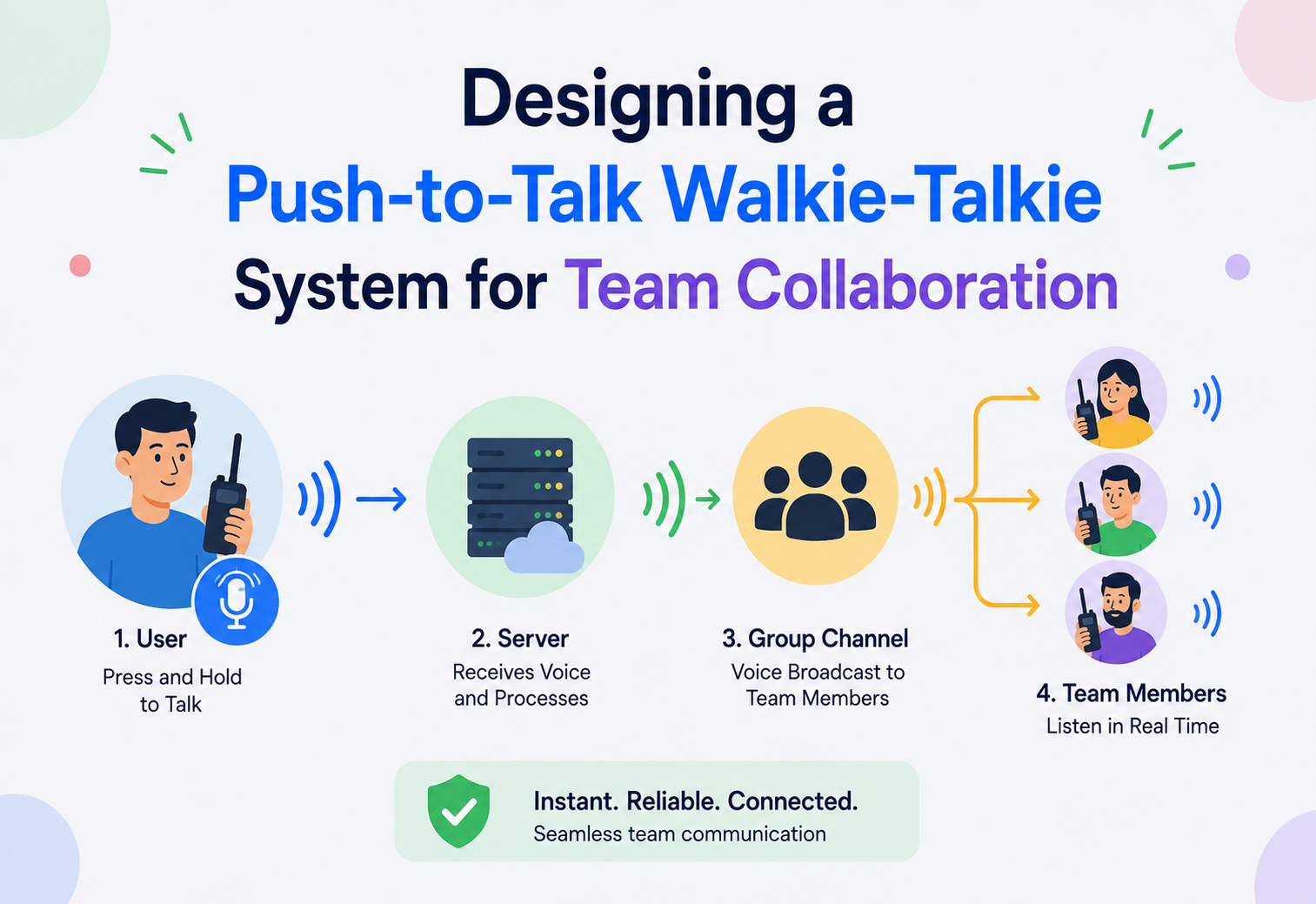
Designing a Push-to-Talk Walkie-Talkie System for Team Collaboration
A deep, interview-ready walkthrough of how to build an instant, one-touch voice communication feature where every millisecond of delay matters more than pristine audio — the exact opposite priority ordering of a normal phone call.
Introduction and History
Push-to-talk (PTT) is one of the oldest ideas in voice communication and, paradoxically, one of the hardest to get right in modern software. The concept is simple: hold a button, speak, release, and your voice reaches everyone on the channel almost instantly — no dialing, no ringing, no “hello, can you hear me?”
The entire value of the feature lives or dies on one number: how fast does the other person’s radio (or phone) start playing your voice after you press the button. In this guide we design that system for a team collaboration app — construction crews, warehouse teams, delivery fleets, or distributed engineering teams who want radio-style instant voice without carrying an actual radio.
Push-to-talk’s history goes back to two-way radios used by military and emergency services from the mid-20th century onward — a hardware button keys a transmitter, and everyone tuned to that frequency hears the transmission with latency measured in tens of milliseconds, bound almost entirely by the speed of radio waves and simple analog circuitry. This set an extremely high bar: an entire generation of users grew up expecting “press and speak, heard almost instantly,” and any software-based replacement is implicitly judged against that expectation, even though it now has to traverse cellular networks, the internet, and multiple software layers instead of a direct radio link.
Digital and cellular PTT systems emerged in the 1990s and 2000s (Nextel’s “Direct Connect” being the most famous consumer example), using proprietary network protocols to keep latency in the range of a few hundred milliseconds to about a second — noticeably slower than analog radio, but still fast enough to preserve the “instant” feel that defines the category. As Nextel-style networks declined, PTT moved toward IP-based delivery over standard cellular data and Wi-Fi, which introduced new latency challenges (internet routing, jitter, server processing) that this kind of system has to specifically engineer around, rather than getting the benefit “for free” from dedicated radio spectrum.
Today, PTT has found a strong second life inside team collaboration and field-operations apps — companies like Zello and various enterprise workforce communication platforms package PTT specifically because certain jobs (warehouse floors, delivery drivers, security teams, distributed engineering teams needing instant human-to-human sync) benefit enormously from radio-style “instant broadcast” communication that a phone call or chat message simply cannot replicate.

1.1 A Short Timeline
Mid-20th century — Analog Two-Way Radios
A physical button keys a transmitter; everyone on the frequency hears you within tens of milliseconds. This is the bar every software PTT is silently measured against.
1990s – 2000s — Cellular PTT (Nextel Direct Connect)
Proprietary iDEN signalling delivered PTT over cellular with a few hundred milliseconds of end-to-end delay — still “instant enough” to feel like a radio.
2010s — IP-Based PTT Apps
Delivery moved onto standard cellular data and Wi-Fi. The “free” latency dedicated radio spectrum provided disappeared; latency now had to be actively engineered for.
Today — Workforce & Team-Collab PTT
PTT lives inside enterprise field-communication apps for warehouses, logistics, and distributed teams — the shape of system this tutorial designs.
When a user presses a button and speaks, their voice must reach every other listener on that channel with latency low enough to feel instantaneous — commonly targeting under 200–300 milliseconds end to end — even though achieving that over IP networks, mobile connections, and shared server infrastructure is architecturally much harder than it sounds, and the entire system must be optimized around minimizing every possible source of delay, deliberately trading away audio fidelity wherever that trade buys speed.
Architecture and Components
The defining architectural decision in this system is that latency is the primary optimization target, above almost everything else — audio quality, bandwidth efficiency, and even some reliability guarantees are all secondary to keeping the “press button, voice arrives” delay as short as physically possible.
This inverts several assumptions that hold true in general-purpose video/voice calling systems, where quality and accuracy typically get more weight relative to raw speed.
2.1 High-Level Component Map
- PTT Client (Mobile/Desktop): Captures audio the instant the talk button is pressed, encodes it with a low-latency codec, and streams it immediately without waiting to buffer.
- Floor Control Service: Manages “who has the floor” (who is currently allowed to transmit) on each channel, since PTT channels are typically half-duplex — only one speaker at a time, just like a real radio channel.
- Low-Latency Relay Server: A lightweight server-side component that receives audio packets from the active speaker and immediately fans them out to all other channel members, doing the absolute minimum processing necessary.
- Channel & Group Membership Service: Tracks which users belong to which PTT channels, and their current online/reachable status.
- Push Notification / Wake Service: Ensures that even a listener whose app is backgrounded or device is asleep is woken up fast enough to receive an incoming transmission, since PTT is expected to work like a radio that’s always “on.”
- Presence & Availability Service: Tracks who is actively connected and reachable in real time versus who would need a push-wake to receive audio.
- Playback Queue Manager (Client): Handles the (hopefully rare) case of overlapping or out-of-order transmissions, and manages smooth, gapless audio playback the instant packets arrive.
- Optional Store-and-Forward Buffer: For listeners who are briefly offline or reconnecting, holds a short recent transmission so they don’t miss the message entirely — a deliberate deviation from “pure live” behavior in exchange for reliability.
2.2 Why This Is Not Just “Video Calling Without the Video”
It’s tempting to assume a PTT feature could just reuse a general-purpose voice/video calling stack (like an SFU-based system) and simply not send video. But PTT has a fundamentally different usage pattern that changes the right architecture:
| Aspect | Typical Voice/Video Call | Push-to-Talk |
|---|---|---|
| Duplex mode | Full-duplex — everyone can speak and listen simultaneously | Half-duplex — only one speaker at a time per channel, just like a radio |
| Session lifecycle | Explicit “call” with ringing, answering, and hangup | No call setup at all — the channel is always “live,” transmissions are instantaneous bursts |
| Priority | Balance of latency and quality, tuned for sustained conversation | Latency dominates almost every other concern, including quality |
| Connection state | Persistent, continuously negotiated media session | Often needs to work even from a cold-start / backgrounded app state, waking instantly on transmission |
| Group size and dynamics | Typically fixed for the call’s duration | Channels are often long-lived, with members joining/leaving/listening passively over hours or days |
This is why PTT systems are usually purpose-built rather than a thin layer over general video-calling infrastructure: the entire architecture — from how sessions are established (or rather, not established, since there’s no “call setup” step) to how audio is buffered (or deliberately not buffered) — is shaped around minimizing time-to-first-sound rather than sustaining a smooth, symmetric two-way conversation.
“Why not just reuse your existing SFU-based video calling infrastructure for this?” A strong answer highlights that an SFU is built around persistent, negotiated, full-duplex sessions optimized for sustained call quality, while PTT needs to work instantly with no session setup delay and prioritizes the absolute minimum time-to-first-audio over everything else — reusing the SFU stack as-is would likely inherit connection-setup latency (ICE negotiation, codec negotiation) that directly conflicts with PTT’s core requirement.
Internal Working
Every design choice inside the client and the relay is measured against one question: does it shave milliseconds off the button-to-audio path, or does it add them?
3.1 Capture Without Buffering Delay
The single biggest lever for minimizing latency is avoiding buffering wherever possible. A general-purpose audio pipeline often buffers a chunk of audio (say, 20–40 milliseconds) before encoding and sending, to improve encoding efficiency or smooth network jitter. A PTT system deliberately uses the smallest practical audio frame size — commonly in the 10–20 millisecond range — and pushes each frame to the network the instant it’s encoded, accepting slightly less efficient compression and slightly higher per-packet network overhead in direct exchange for lower latency.
3.2 Low-Latency Codec Selection
The audio codec choice matters enormously here. Codecs like Opus, widely used in real-time communication, support an explicit low-latency mode with small frame sizes and minimal algorithmic delay, as opposed to codecs or configurations tuned for maximum compression efficiency at the cost of larger frames and more encoding lookahead. PTT systems typically configure the codec for the smallest viable frame size and disable or minimize any lookahead-based compression techniques that would otherwise trade latency for a modest bitrate improvement — exactly the opposite trade-off priority used in bandwidth-constrained systems.
3.3 Floor Control: Managing Who Can Speak
Because PTT channels are half-duplex, the system needs a floor control mechanism deciding who currently “has the floor” (permission to transmit) and preventing (or gracefully handling) simultaneous transmissions. When a user presses talk, the client sends an immediate floor request to the floor control service. In the common case (no one else is talking), the floor is granted essentially instantly, often optimistically — the client can begin transmitting audio immediately while the floor grant confirmation is still in flight, rather than waiting for a round-trip confirmation before starting to speak, since that round trip would itself introduce user-perceptible delay for the vast majority of transmissions where there’s no actual contention.
3.4 Handling Simultaneous Talk Attempts
Occasionally, two users press talk at nearly the same instant. The floor control service needs a fast, deterministic tie-breaking rule (commonly first-request-wins based on server-received timestamp, sometimes with a priority override for designated roles like a team lead or emergency broadcast). The “losing” party’s client receives an immediate signal (often a short audio or haptic cue, mimicking the “busy channel” feedback of a real radio) indicating the channel is occupied, so they know instantly to wait rather than transmitting into a void or, worse, silently failing with no feedback at all.
3.5 The Relay Server’s Minimal-Processing Design
Unlike an SFU that manages simulcast layers, congestion control per viewer, and quality adaptation, a PTT relay server is deliberately kept as thin as possible: receive a packet, immediately forward it to every other connected channel member, with as few processing steps and as little added delay as the implementation can achieve. Any additional processing — logging, analytics, content moderation scanning — is done asynchronously, off the critical forwarding path, specifically so it never adds to the time between the speaker’s mouth and the listener’s ear.
3.6 Waking Backgrounded Listeners Fast
A defining characteristic of PTT is that listeners expect to receive a transmission even if their app isn’t actively in the foreground — much like how a real radio is always listening. For a backgrounded or asleep device, the system relies on high-priority push notifications (using platform-level mechanisms designed for time-sensitive delivery) to wake the app and begin audio playback as fast as the underlying mobile OS allows, which is itself a meaningful and sometimes dominant source of latency for backgrounded listeners compared to actively-connected ones.
3.7 Client-Side Playback and Jitter Handling
On the listening side, the client plays audio essentially as it arrives, using the smallest jitter buffer it can get away with — often just a few tens of milliseconds — rather than the larger, smoother buffers used in typical voice/video calls. This is a deliberate trade: a very small jitter buffer means occasional network jitter can cause a brief audio glitch or gap, but it minimizes the added delay for the common case of a clean network path, which matches PTT’s priority ordering of speed over polish.
3.8 The “Talk Tone” and Channel Feedback Loop
Real two-way radios give the user immediate auditory feedback the instant a channel becomes active — a short tone or click confirming the channel is open and it’s safe to speak. Software PTT systems replicate this deliberately, playing a brief confirmation tone or haptic pulse the moment the floor is granted (or, in the optimistic-grant model, the moment local capture begins), so the speaker has instant confidence their voice is being transmitted rather than silently wondering if the button press registered. This small detail matters more than it might first appear: without it, users tend to develop a habit of unnecessarily repeating themselves or pausing awkwardly at the start of every transmission, second-guessing whether the system is working, which directly undermines the natural, fluid communication PTT is meant to enable.
3.9 Handling Rapid Successive Transmissions
In active team coordination, it’s common for multiple short transmissions to happen in quick succession — a question, a brief acknowledgment, a follow-up clarification — all within a few seconds. The system needs to handle floor release and re-grant cycling fast enough that this natural conversational rhythm doesn’t feel sluggish. This means the floor control service’s release-to-available transition needs to be essentially as fast as the initial grant, and the relay layer needs to cleanly terminate one transmission’s audio stream and begin the next without any audible artifact (like a lingering echo or overlap) bridging the two, even when they happen within a fraction of a second of each other.
Data Flow and Lifecycle
A single PTT transmission has a clear four-phase lifecycle. Each phase has its own latency budget and its own failure modes.
4.1 Transmission Start Phase
The instant a user presses the talk button, capture and encoding begin locally with zero network round trip required before the first audio can be produced. The floor request is sent in parallel, not as a blocking prerequisite — this “optimistic transmission” approach is central to hitting aggressive latency targets, since waiting for a confirmed floor grant before starting to speak would add a full round trip of otherwise avoidable delay to every single transmission.
4.2 Streaming Phase
Audio frames are encoded and sent continuously as the user speaks, each frame forwarded by the relay server to all listeners with minimal added processing. There is no session negotiation happening during this phase — no renegotiating quality, no simulcast layer switching — the pipeline is intentionally simple and static for the duration of the transmission, which is itself a latency-reducing design choice, since dynamic adaptation logic (valuable in other systems) adds decision-making overhead that PTT’s priorities argue against.
4.3 Listener Reception Phase
Actively connected listeners begin playback essentially as packets arrive, using a minimal jitter buffer. Backgrounded listeners go through the wake-and-catch-up path — a high-priority push wakes the app, which then connects to receive the remainder of the ongoing (or a recently buffered) transmission, accepting that these listeners will experience meaningfully higher latency than actively connected ones as an unavoidable consequence of mobile OS background execution limits.
4.4 Transmission End Phase
When the user releases the talk button, the stream ends, and the floor control service is notified the channel is free. This release needs to propagate fast enough that another team member pressing talk immediately after doesn’t experience an artificial delay waiting for stale floor state to clear — a slow floor-release path would create the exact kind of perceptible lag PTT users are least tolerant of, since “instant” is the entire promise of the feature.
Advantages, Disadvantages and Trade-offs
Every decision in this system is a deliberate trade-off in favor of latency. Being explicit about what is being given up is what makes the design defensible rather than accidental.
5.1 Latency vs Audio Quality
This is the defining trade-off named directly in the requirements. Every design decision in this system — small frame sizes, minimal jitter buffering, low-latency codec modes, thin relay processing — sacrifices some potential audio quality or bandwidth efficiency in exchange for speed. This is a deliberate, correct choice for the PTT use case, but it is worth being explicit that it is a choice, not a free win: the same system optimized differently could produce noticeably clearer audio at the cost of the near-instant feel that defines the feature’s value.
| Design Choice | Latency Benefit | Quality/Efficiency Cost |
|---|---|---|
| Small audio frame size (10–20 ms) | Minimizes per-frame encoding and transmission delay | Slightly less efficient compression than larger frames |
| Optimistic floor grant | Removes a full round trip before speech can start | Small risk of two overlapping transmissions in rare race conditions |
| Minimal jitter buffer | Lowest possible playback delay | More susceptible to audible glitches under network jitter |
| Thin, minimal-processing relay | Removes server-side processing delay from the critical path | Less opportunity for server-side quality enhancement or adaptive bitrate |
5.2 Half-Duplex vs Full-Duplex
Choosing half-duplex (only one speaker at a time) rather than full-duplex is itself a trade-off. Full-duplex, like a phone call, allows natural back-and-forth conversation but requires more complex mixing if multiple people speak at once, and doesn’t match the mental model users bring from real radios. Half-duplex is simpler to implement, matches user expectations directly, and reduces audio complexity, but requires floor control and inherently limits the system to one active speaker per channel, which is an intentional constraint rather than a limitation to engineer around.
5.3 Store-and-Forward vs Pure Live-Only
A pure live-only design (if you weren’t listening at the moment of transmission, you simply missed it, exactly like a real radio) is the simplest and lowest-latency approach, but a short store-and-forward buffer that lets a briefly-reconnecting listener catch a recent transmission improves reliability at the cost of some architectural complexity and a very small amount of added system surface area. Most production systems land on a hybrid: live-only for actively connected listeners, with a short (seconds to low minutes) buffer available for reconnecting or recently-offline listeners.
“Should you ever sacrifice a few milliseconds of latency for meaningfully better reliability?” A well-reasoned answer recognizes this isn’t all-or-nothing: certain reliability investments (like the optimistic floor grant with async confirmation) cost essentially nothing in latency, while others (like waiting for delivery confirmation before allowing the next transmission) would meaningfully hurt the feature’s core promise — the skill is identifying which reliability mechanisms are nearly free and which ones directly compete with the latency budget.
5.4 Channel Size vs Coordination Clarity
A PTT channel can technically support a very large number of listeners, but as channel size grows, so does the practical difficulty of coordinated communication — more people means more potential contention for the floor, more background noise sources feeding into the channel, and a greater chance that any single transmission is relevant to only a subset of listeners. Many production systems address this not through a technical latency trade-off but a product design one: encouraging smaller, purpose-specific channels (a single shift, a single site, a single project team) rather than one large all-hands channel, since the technical system can handle scale, but the human communication pattern it supports degrades well before the infrastructure does.

5.5 Client Battery and Resource Usage vs Always-On Readiness
Keeping a client ready to receive a transmission with minimal wake latency generally means maintaining a more persistent, active connection or listening state than a typical background app would use, which has a real battery and resource cost on mobile devices. This is a genuine trade-off: a more aggressive always-connected posture improves listener latency at the cost of battery life, while a more conservative, deeper-sleep posture conserves battery but increases the delay before a backgrounded listener can receive a transmission. Production systems typically tune this balance based on platform-specific background execution allowances rather than picking one extreme, since mobile operating systems increasingly restrict how much background activity any app can sustain regardless of the app’s own preference.
Pros
- End-to-end latency low enough to feel genuinely radio-like in the common case.
- No call setup step — the “connection” is invisible to the user, matching real-radio muscle memory.
- Half-duplex simplifies mixing and makes floor control tractable.
- Thin relay is cheap per node and easy to reason about operationally.
- Graceful degradation: prefer to stay available even when strict floor consistency is briefly lost.
Cons
- Audio quality is deliberately below what a similar system tuned for a phone call would produce.
- Backgrounded-listener latency is bounded by mobile OS wake behavior — largely outside the platform’s control.
- Optimistic grants accept an occasional rare overlap between simultaneous talkers.
- Always-on readiness has a real battery cost on mobile devices.
- Very large channels degrade as a human coordination pattern well before the infrastructure does.
Section takeaway
PTT does not try to be a “good phone call.” It tries to be a good radio. Every trade-off, from tiny frames to optimistic grants to minimal jitter buffers, is a step further from “call quality” and closer to “walkie-talkie immediacy” — which is exactly what the users of this feature actually want.
Performance and Scalability
We now scale this design from a single team’s PTT channel to a platform-wide scenario: an enterprise collaboration platform running many thousands of active channels simultaneously across distributed teams, generating a continuous stream of small, latency-critical packets amounting to millions of relay operations per minute.
6.1 The Real Scaling Bottleneck: Per-Packet Processing Overhead, Not Raw Bandwidth
Unlike screen sharing (bandwidth-bound) or live transcription (compute/inference-bound), PTT’s dominant scaling challenge is the sheer number of small, frequent packets that must each be forwarded with minimal added delay. A relay server handling many concurrent channels needs extremely efficient, low-overhead packet forwarding — every microsecond of per-packet processing overhead, multiplied across millions of packets per minute, becomes a meaningful cumulative latency and throughput concern in a way that wouldn’t matter nearly as much for a system moving fewer, larger chunks of data.
6.2 Relay Server Efficiency Techniques
- Event-driven, non-blocking I/O: Relay servers are built on asynchronous, event-driven architectures that can handle many thousands of concurrent connections per process without the overhead of one thread per connection, since traditional thread-per-connection models don’t scale efficiently to this packet volume.
- In-memory channel routing tables: Which listeners belong to which channel is kept in fast in-memory structures on each relay node, avoiding any database lookup on the per-packet forwarding path.
- Co-locating channel members on the same relay node where possible: Assigning all members of a given channel to the same relay node (or a small, tightly-coupled cluster) avoids extra network hops between relay nodes for every single packet, which would otherwise add avoidable latency to every transmission.
- UDP-based transport with minimal per-packet overhead: Using UDP (versus TCP) for the actual audio relay avoids TCP’s head-of-line blocking and retransmission delays, consistent with the same reasoning used in general real-time media systems, but taken even further here given PTT’s even tighter latency tolerance.
6.3 Geographic Distribution and Team Co-location
Because most real-world teams using PTT are geographically clustered (a warehouse floor, a job site, a regional delivery fleet), the system benefits from placing relay capacity close to where teams actually are, and from being smart about assigning an entire channel’s members to relay infrastructure in the same region whenever the team’s membership allows it, minimizing cross-region hops that would otherwise add latency for every single transmission on that channel.
6.4 Push Notification Delivery at Scale
Waking backgrounded listeners at scale means the push notification pipeline itself must be engineered for speed, using the highest-priority delivery channels each mobile platform offers for time-sensitive content, and monitoring push delivery latency as a first-class metric, since a slow push pipeline directly undermines the “always reachable, radio-like” promise of the feature for any listener who isn’t actively in the foreground app.
6.5 Capacity Planning Numbers (Illustrative)
| Metric | Approximate Target |
|---|---|
| Audio frame size | 10–20 ms per frame |
| Target end-to-end latency (active listener) | Under 200–300 ms, ideally closer to 150 ms |
| Target floor-grant latency (common case) | Under 50–100 ms, often effectively instant via optimistic grant |
| Concurrent channels per relay node (rough) | Thousands, bounded by per-packet processing efficiency, not raw bandwidth |
| Push-wake to audio-start latency (backgrounded listener) | Under 1–2 seconds, heavily dependent on mobile OS wake behavior |
“Your relay servers have plenty of spare bandwidth capacity, but latency still creeps up under load — what’s likely happening?” This points toward per-packet processing overhead rather than bandwidth exhaustion: at high packet rates, inefficient forwarding logic, cross-node hops for channel members split across relay nodes, or blocking I/O patterns can all add cumulative microsecond-level delays per packet that become clearly perceptible once multiplied across a busy system, even when raw bandwidth is nowhere near its limit.
6.6 Handling Growth Without Adding Cross-Node Hops
As the platform grows and a single organization’s PTT usage expands across more teams and channels, a naive scaling approach might simply add more relay nodes and spread new channels across them round-robin. The better approach, consistent with the co-location principle discussed earlier, is to scale by adding capacity within each region while preserving the rule that any single channel’s members stay together on the same node or tightly-coupled cluster — meaning horizontal scale-out adds more independent relay clusters serving different sets of channels, rather than splitting individual channels’ traffic across more nodes and introducing new cross-node hops that didn’t exist at smaller scale.
6.7 Load Testing Considerations Specific to PTT
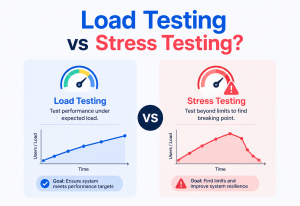
Load testing this system well requires simulating the actual usage pattern PTT produces, which looks very different from a sustained video call: many short bursts of transmission (often just a few seconds each), frequent floor-request contention during busy coordination periods (like a shift change or an incident response), and a realistic mix of actively-connected and backgrounded listeners. A load test that only simulates a small number of long, continuous streams will miss the specific failure modes — floor contention handling, rapid burst-forwarding efficiency, push-wake pipeline throughput under a sudden spike — that actually matter for this system at scale.
“How would you load-test this system realistically?” A strong answer emphasizes simulating PTT’s actual traffic shape: many short, bursty transmissions rather than a few long sustained streams, deliberate floor-contention scenarios during simulated busy periods, and a realistic mix of actively-connected versus backgrounded listeners to properly exercise both the live relay path and the push-notification wake pipeline under load.
High Availability and Reliability
In an operationally critical communication tool, users judge availability against physical radios — a very high bar. The reliability strategy prefers “keep talking, degrade gracefully” over “block until strictly consistent.”
7.1 Failure Domains
The system must tolerate a relay node failing mid-transmission, a region becoming unreachable, and the very common case of a mobile client’s network flickering in and out (a warehouse worker walking behind metal shelving, a delivery driver entering a tunnel). Each of these needs a fast, low-friction recovery path, because PTT users have essentially zero tolerance for a feature that’s supposed to feel as reliable as a physical radio behaving unpredictably.
7.2 Relay Node Failure
If a relay node hosting an active channel fails, connected clients need to detect the disconnect quickly (via a short heartbeat interval, tuned tighter than in less latency-sensitive systems) and reconnect to a healthy node almost immediately. Because channel membership and routing state is kept lightweight and can be quickly reconstructed from the channel membership service, a new node can pick up serving that channel’s members within a very short window, accepting a brief gap in the (hopefully rare) case a failure happens mid-transmission.
7.3 Graceful Handling of Network Instability
Given how common brief network drops are on mobile connections, the client is built to reconnect fast and resume listening seamlessly, rather than requiring any manual user action. If a listener misses part of an ongoing transmission due to a brief drop, most systems accept the gap rather than attempting complex retroactive recovery, since by the time recovery logic could reconstruct missed audio, the conversational moment has usually already passed — consistent with the same “live, low latency over completeness” priority that shapes the rest of this system.
7.4 Multi-Region Redundancy
Relay infrastructure is deployed across multiple regions, with channel assignment favoring proximity to the majority of a channel’s members, and a failover path to a secondary region’s relay capacity if a whole region becomes unavailable — critical for teams that may be geographically distributed even if most PTT usage is regionally clustered.
7.5 Reliability of the Floor Control Mechanism
Floor control itself needs to be robust to failure — if the floor control service becomes briefly unavailable, the system should fail toward continuing to allow optimistic transmission (accepting a slightly higher risk of overlapping speakers) rather than blocking all communication entirely, since a PTT feature that goes silent because a supporting service had a hiccup defeats the entire purpose of a communication tool meant to be dependable in exactly the operational moments (emergencies, coordination-critical tasks) where it matters most.
“If the floor control service goes down, should the whole PTT feature stop working?” A strong answer argues no: given PTT is often used in operationally critical, sometimes safety-related contexts, the system should degrade gracefully by allowing optimistic transmission without strict floor enforcement rather than blocking all communication, since occasional overlapping speech is a far smaller problem than a team losing its communication channel entirely during an outage.
Security
Team communication carries sensitive operational context. Security cannot come at the cost of the latency budget, so it has to be designed to sit alongside the hot path rather than on top of it.
8.1 Encryption in Transit
Audio packets relayed between speaker and listeners are encrypted in transit, and channel membership and floor control signaling are protected over TLS, since team communications — especially in operational, field, or safety-related contexts — often carry sensitive coordination information that shouldn’t be exposed to network eavesdropping.
8.2 Channel Access Control
Because PTT channels often map to organizational structures (a specific team, shift, or site), access control needs to ensure only authorized members can join a channel and transmit or listen, with administrative controls for team leads to manage membership, mute or remove disruptive participants, and, in some deployments, reserve override or priority transmission rights for supervisory or emergency roles.
8.3 Authentication for Fast Reconnection
Because clients need to reconnect quickly and frequently (mobile networks drop often), the authentication mechanism for reconnecting to a relay node needs to be fast and lightweight (such as a short-lived, renewable session token) rather than requiring a full, slower authentication flow on every reconnect, since a heavyweight reconnect flow would directly undermine the system’s latency goals during exactly the moments — network instability — when fast recovery matters most.
8.4 Abuse and Spam Prevention
Because transmission is nearly instant and low-friction by design, the system needs safeguards against abuse — a malicious or careless user repeatedly seizing the floor, or flooding a channel with noise — through rate limiting on floor requests per user, and clear audit logging of who transmitted when, so team administrators can identify and address disruptive behavior.
8.5 Data Retention for Transmitted Audio
Whether transmitted audio is retained (for compliance, training, or dispute-resolution purposes in some enterprise contexts) versus treated as ephemeral is a policy decision that should be explicit and configurable per organization, since some regulated industries (logistics, healthcare-adjacent field work) may have specific retention obligations, while others prioritize minimizing retained sensitive audio.
“How would you prevent one user from monopolizing a channel?” A practical answer combines a maximum transmission duration (auto-releasing the floor after some ceiling, like 30–60 seconds, to prevent one person holding the channel indefinitely), rate limiting on floor requests, and giving team administrators visibility and override control, balancing the low-friction nature of PTT against the real possibility of one participant crowding out the rest of the team.
Monitoring, Logging and Metrics
If the whole system exists to serve one number — end-to-end transmission latency — that same number must be the north star of the monitoring stack.
9.1 The Primary Metric: End-to-End Transmission Latency
Given that latency is this system’s entire reason for being, end-to-end transmission latency (time from button press to audio audible on each listener’s device) is the single most important metric, tracked continuously and broken down by network type, region, and whether the listener was actively connected or woken from background, since these conditions produce meaningfully different latency profiles that a single blended average would obscure.
9.2 Floor Control Metrics
- Floor grant latency and floor-contention rate (how often two users attempt to transmit simultaneously).
- Floor release-to-next-grant latency, since a slow release path directly creates perceptible lag for the next speaker.
- Rate of “channel busy” rejections experienced by users, a direct signal of contention-heavy channels that might benefit from splitting into sub-channels.
9.3 Delivery and Reachability Metrics
- Push notification wake latency for backgrounded listeners, tracked as its own distinct metric family from actively-connected listener latency.
- Packet loss and jitter per channel and per relay node, since even though the jitter buffer is deliberately minimal, understanding network quality trends is essential for capacity and infrastructure planning.
- Relay node per-packet processing time, monitored at a very fine granularity given how sensitive this system is to even small per-packet overhead increases.
9.4 Real-Time Alerting
Given the operationally critical nature of many PTT use cases (safety coordination, logistics, emergency response), alerting thresholds for latency regressions are set aggressively tight, and dashboards segment by customer/organization and region, since a latency regression affecting one large enterprise customer’s regional relay assignment could easily be masked by a healthy global average.
“Average end-to-end latency looks great, but a specific warehouse team is complaining about lag — what would you check?” This is a strong prompt to discuss metric segmentation by region, relay node, and connectivity type: check whether that team’s channel members are split across multiple relay nodes (adding cross-node hops), whether their local network conditions are unusually poor, or whether their devices are frequently backgrounded, pulling their experience below what the global average suggests.
Deployment and Cloud Considerations
The deployment posture is unusual for a media system: many small, lightweight relay nodes deployed as close to users as possible, prioritizing physical proximity over centralization.
10.1 Edge-Proximate Deployment
Because every millisecond of network round-trip time directly subtracts from the latency budget, relay infrastructure benefits enormously from being deployed as close to users as possible — regional or even edge-level points of presence rather than a small number of centralized data centers, since the physical distance data must travel is one of the few latency sources that cannot be optimized away through better software.
10.2 Lightweight, High-Density Relay Nodes
Because relay nodes do minimal per-packet processing (just forwarding, not transcoding or complex adaptation logic), they can typically run at much higher connection density per node than heavier media-processing systems like an SFU, meaning the platform can achieve strong capacity-per-dollar efficiency, provided the software avoids introducing unnecessary per-packet overhead as connection density scales up.

10.3 Auto-Scaling Characteristics
Similar to other real-time systems, active channels are somewhat bound to specific relay nodes for their duration (to preserve the co-location benefits discussed in the performance section), so scaling primarily happens at new-channel-assignment time, with node draining used for graceful capacity reduction rather than live migration of in-progress channels.
10.4 Cost Optimization
Because this system is packet-processing-bound rather than bandwidth-bound or compute-bound, the most effective cost levers are maximizing connections handled efficiently per relay node through careful low-level engineering (efficient I/O patterns, minimal per-packet overhead) rather than the bandwidth-focused or GPU-focused optimizations relevant to the other systems.
| Deploy-time gate | Why include it on every rollout |
|---|---|
| Latency-regression canary on live channels | The system’s whole reason for being is one number; watch it during every rollout. |
| Graceful node drain rather than abrupt kill | An in-progress transmission being cut is exactly the kind of “unreliable radio” moment users remember. |
| Push-wake latency budget check | Backgrounded listeners are half the audience — regressions here are silent otherwise. |
| Edge PoP capacity headroom verified | Latency is bounded by physical distance; running edge PoPs hot means users pay the round-trip. |
| Reconnect-flow load test rehearsed | Mobile networks drop constantly — the reconnect path is a hot path, not a cold one. |
“Would edge computing make sense for this system?” Yes, more so than for many other real-time systems: because PTT’s latency budget is so tight and its per-node resource requirements are relatively light (no heavy transcoding or inference), pushing relay capacity out to edge locations physically closer to users offers a genuinely strong latency return relative to the infrastructure investment, more so than it would for a heavier, more centralized workload.
Databases, Caching and Load Balancing
The live audio path never touches a database. Everything durable lives off the hot path.
11.1 What Actually Needs Persistent Storage
As with other real-time systems, the live audio relay path itself never touches a database. What needs durable storage: channel definitions and membership, organizational and team structure, user accounts and roles, and, where policy requires it, retained transmission audio and logs.
11.2 Channel Routing State
Which relay node currently serves which channel, and the live list of connected members for fast fan-out, is held in a fast in-memory store: this data is short-lived, accessed at extremely high frequency, and doesn’t need the durability guarantees (or the latency cost) of a traditional database.
11.3 Caching Layer
Channel membership and permission data is read on every connection and reconnection but changes relatively rarely, making it a strong caching candidate close to the relay layer, with explicit invalidation on membership changes so that access control updates (like removing a departed employee from a channel) take effect immediately rather than waiting on a cache expiry window.
11.4 Load Balancing Layers
| Layer | What It Balances | Typical Approach |
|---|---|---|
| Global entry point | Which region a client connects to | Geo-aware routing to the nearest healthy region |
| Channel assignment router | Which relay node hosts a given channel | Co-location aware — tries to place all of a channel’s members on the same node/cluster |
| Push notification dispatch | Wake requests across push delivery infrastructure | Highest-priority delivery tier per platform, load-balanced across dispatch workers |
11.5 Optional Audio Retention Storage
Where organizational policy requires retaining transmitted audio, it is written to durable object storage asynchronously, off the live relay path entirely, so retention writes never add latency to the live transmission experience for any listener.
“Why prioritize co-locating a channel’s members on one relay node over more evenly balancing load across the fleet?” Because cross-node hops add real, measurable latency to every single packet on that channel, and PTT’s latency budget is tight enough that this cost outweighs the load-balancing benefit in most cases — the system instead balances load at the coarser granularity of which node new channels are assigned to, rather than splitting individual channels across nodes.
APIs, Microservices and Protocols
The service boundaries mirror the architecture: one specialized latency-critical service (the relay), surrounded by a small number of supporting services that can afford ordinary internet-scale latency.
12.1 Service Decomposition
The platform decomposes into: an Auth/Identity service, a Channel & Membership Management service, a Floor Control service, the Relay Server fleet (the specialized, latency-critical service class at the heart of this system), a Push Notification/Wake service, a Presence service, and, optionally, a Retention/Compliance service for organizations that require it.
12.2 Protocol Choices
- Audio relay: UDP-based transport for the actual audio packets, prioritizing low latency over guaranteed delivery, consistent with the reasoning used for real-time media.
- Floor control signaling: A very fast, lightweight request-response or short-lived persistent connection, engineered for minimal round-trip time given how directly floor-grant latency affects the user’s perceived responsiveness.
- Channel and presence updates: A persistent connection (WebSocket or similar) pushes membership and presence changes to clients in real time.
- Push notifications: Platform-native high-priority push channels (rather than a custom protocol) to leverage each mobile OS’s most reliable and fastest wake mechanism for backgrounded apps.
12.3 Why the Relay Path Avoids Heavier Protocols
Protocols with built-in reliability guarantees, ordering guarantees, or connection-oriented handshakes all add some form of latency or overhead that directly works against this system’s core goal. The relay path is deliberately kept as close to “raw, minimal, get the audio there fast” as the underlying network and security requirements allow, pushing any needed reliability logic (like brief store-and-forward for reconnecting listeners) to higher layers that operate outside the single, tightest latency-critical hot path.
12.4 Inter-Service Communication
The floor control service and relay servers communicate via very low-latency internal calls, since floor state directly gates whether a transmission proceeds. Less time-critical flows — updating channel membership, writing audit logs, dispatching retention storage — use asynchronous, decoupled communication patterns that don’t share the same tight latency budget as the core transmission path.
“Would you ever use TCP anywhere in this system?” Yes, selectively: TCP (or a TCP-based protocol like WebSocket) is appropriate for connections where ordering and reliability genuinely matter more than raw latency, such as channel membership updates or administrative actions, but the live audio relay path itself should avoid TCP specifically because its retransmission and ordering guarantees would introduce exactly the kind of delay this system is built to eliminate.
Design Patterns and Anti-patterns
The patterns to reach for — and the ones from general-purpose calling systems that will actively hurt this design if copied without thought.
13.1 Useful Patterns
- Optimistic Execution: Begin transmitting before a floor grant is formally confirmed, resolving the rare conflict case after the fact rather than paying a round-trip cost on every single transmission.
- Thin Relay, Fat Edges: Keep the server-side forwarding path minimal and push complexity (jitter handling, playback smoothing) to the client, where it doesn’t add to the shared, latency-critical server hot path.
- Co-location by Access Pattern: Group resources (channel members) that frequently interact onto the same infrastructure node to minimize cross-node communication overhead.
- Graceful Degradation of Reliability Guarantees, Not of Speed: When forced to trade off under failure conditions, this system prioritizes staying fast and available over staying strictly consistent or fully reliable — the opposite prioritization from many traditional distributed systems.
- Asynchronous Side-Channel Processing: Push anything not strictly necessary for the core “voice reaches listener” path (logging, analytics, compliance retention) off the critical path entirely.
13.2 Anti-patterns to Avoid
- Requiring full session negotiation before allowing transmission: Borrowing a call-setup pattern from general-purpose voice/video calling directly conflicts with PTT’s near-zero-setup-time expectation.
- Large jitter buffers “for smoothness”: A buffering strategy that would be entirely appropriate for a sustained phone call actively works against PTT’s defining latency goal.
- Blocking floor grant confirmation before allowing speech to start: Adds an entirely avoidable round trip to every single transmission, the most common case, in service of preventing a rare edge case (transmission collision) that can be handled after the fact instead.
- Treating relay servers like general-purpose media servers: Adding SFU-style features (simulcast, quality adaptation, transcoding) to the relay path reintroduces complexity and processing overhead that directly works against this system’s minimal-latency design goal.
- Ignoring backgrounded-listener latency as a separate, distinct metric: Blending actively-connected and push-woken listener latency into one average metric hides a real and expected latency gap between the two, making it harder to identify genuine regressions in either path.
“What’s a pattern from general video calling that would actively hurt this system if copied directly?” A strong answer names session negotiation and connection-establishment handshakes (like a full ICE/SDP exchange before any audio can flow): these are entirely appropriate for a sustained call where setup cost is amortized over minutes of conversation, but for PTT’s single-button, instant-transmission model, that same setup cost would be paid on every single short transmission, directly undermining the feature’s core value proposition.
Best Practices and Common Mistakes
Concrete guidance that separates a PTT system that works in a demo from one that works on a subway platform, a warehouse floor, and a delivery truck moving between towers.

14.1 Best Practices
- Treat end-to-end transmission latency as the single north-star metric, and make every architectural decision traceable back to its effect on that number.
- Use optimistic floor grants for the common case, resolving rare conflicts after the fact rather than paying a round trip on every transmission.
- Keep audio frame sizes small and jitter buffers minimal, deliberately accepting a small quality/robustness cost for a latency win.
- Co-locate channel members on the same relay infrastructure wherever possible to avoid cross-node hop latency.
- Engineer the push-notification wake path as carefully as the live relay path, since backgrounded listeners are a large and expected fraction of real usage, not an edge case.
- Provide clear, immediate feedback (audio or haptic cues) when a floor request fails due to contention, mirroring the intuitive feedback of a real two-way radio.
- Set a maximum transmission duration to prevent one speaker from monopolizing a channel indefinitely.
- Design failure modes to favor staying available and fast over staying strictly consistent, given the operationally critical contexts PTT is often used in.
14.2 Common Mistakes
- Benchmarking latency only under ideal lab network conditions rather than the real, often imperfect mobile and field-network conditions PTT is actually used in.
- Under-investing in the push-notification wake path because it feels like a secondary concern compared to the live relay, when in practice a large share of real transmissions are received by backgrounded listeners.
- Copying reliability or session-management patterns from general-purpose calling systems without questioning whether they fit PTT’s very different latency priorities.
- Not setting a maximum transmission duration, allowing one user to inadvertently or deliberately monopolize a channel.
- Treating floor-control failures as a reason to block all communication, rather than degrading gracefully toward continued, if slightly less coordinated, availability.
| Pre-launch checklist | Why it belongs on every launch |
|---|---|
| Field-condition latency test on real cellular/Wi-Fi mixes | Lab-only measurements systematically under-count the exact failure modes PTT users hit daily. |
| Contention-heavy floor-control simulation | Shift changes and incident responses spike floor requests; the release-to-regrant path must survive them. |
| Backgrounded-listener wake latency SLO | Half the real audience is backgrounded; the wake path deserves its own budget and alert. |
| Max-transmission-duration guardrail active | One user holding the floor indefinitely turns the whole channel dark. |
| Failure-mode drill: floor control degraded | Confirm the system stays talkable, not silent, when the floor service is unhealthy. |
“What’s the first thing you’d load-test before shipping this?” A thoughtful answer prioritizes realistic, imperfect field network conditions (spotty cellular coverage, frequent brief drops, devices moving between Wi-Fi and cellular) over clean lab conditions, since PTT’s core user base — warehouse floors, delivery routes, job sites — is exactly the kind of environment where network conditions are least ideal, and that gap between lab testing and real usage is where latency regressions most often hide undetected until production.
Section takeaway
The gap between “works in the office” and “works on a warehouse floor” is where PTT products win or lose. Chaos-style field testing, aggressive backgrounded-listener SLOs, and honest failure-mode drills are what close it — not more polished lab numbers.
Real-World and Industry Examples
Every one of these products shaped, or was shaped by, the constraints described in this tutorial.
Zello
Zello is one of the most recognizable modern PTT apps, explicitly marketed as a smartphone replacement for two-way radios for industries like logistics, security, and hospitality, and its product design closely mirrors the priorities discussed throughout this guide — near-instant transmission, channel-based group communication, and reliable delivery to backgrounded listeners.
Nextel Direct Connect
Nextel’s Direct Connect service, popular through the 1990s and 2000s before Nextel’s networks were phased out, is frequently cited as the benchmark that shaped user expectations for cellular PTT — its combination of iDEN network technology and dedicated PTT signaling achieved latency low enough to feel genuinely radio-like, and its retirement left a gap in the market that many of today’s app-based PTT products were built to fill.
Discord’s Push-to-Talk Mode
While Discord’s core voice channels are full-duplex, its optional push-to-talk input mode for gaming and communities illustrates a related but distinct design point: here, PTT refers to a client-side input control layered onto an otherwise standard full-duplex voice call, rather than a half-duplex, channel-wide floor-controlled system — a useful contrast showing that “push-to-talk” as a UI concept and “push-to-talk” as a full architectural pattern (as designed in this guide) are not always the same thing.
Enterprise Workforce Platforms
Various enterprise field-communication and workforce platforms (widely used in retail, hospitality, and logistics) build PTT as a core feature specifically because frontline and field teams need instant, low-friction voice coordination without pulling out a phone to make a call, illustrating the broader category this guide’s design targets: team collaboration contexts where speed of coordination directly affects operational outcomes.
Motorola WAVE PTX
Motorola’s WAVE PTX is a carrier-independent PTT service used by public-safety, utility and industrial customers to bridge traditional land-mobile radios with smartphones on the same channel — a direct real-world example of the “software PTT judged against radio expectations” bar this tutorial’s design has to clear.
Common Threads
Across every product above, three things repeat: latency treated as the north-star metric, half-duplex floor control (not full-duplex mixing) at the channel level, and a serious investment in the push-wake path for backgrounded listeners. That is a strong signal this is a genuine architectural blueprint, not a platform-specific accident — it is exactly the shape this tutorial recommends.
Frequently Asked Questions
The questions that come up most often in design reviews, on-call handovers, and interview loops for a PTT system.
Half-duplex matches how real two-way radios work, avoids the complexity of mixing simultaneous speakers, and — most importantly for this design — removes the need for continuous, sustained bidirectional session management, keeping the system architecturally simpler and faster for its specific instant-transmission use case.
Occasionally, yes, but this is treated as an acceptable, rare cost in exchange for removing a full round trip of delay from every single transmission — the vast majority of transmissions have no contention at all, so paying a latency cost on all of them to prevent a rare edge case would be the wrong trade for this system’s priorities.
The transport-layer instincts (UDP, small packets, minimal buffering) are shared, but PTT removes session negotiation entirely, uses half-duplex floor control instead of full-duplex mixing, and treats even small round trips as meaningfully costly given how short individual transmissions typically are.
The system relies on the mobile OS’s push notification wake mechanisms to relaunch the app in a background-capable state; latency here is meaningfully higher than for an actively running app and is tracked as a distinct metric, since this path is bound by mobile OS constraints outside the platform’s direct control.
For PTT’s specific use case, yes — the entire value proposition is the “instant, radio-like” feel, and users in this category (warehouse teams, field crews) have consistently shown they prioritize speed and reliability of coordination over polished audio fidelity, which is the opposite priority ordering from, say, a customer-facing video call.
Combine three levers: a maximum transmission duration cap so nobody holds the floor indefinitely, deterministic fast tie-breaking on simultaneous requests (first-request-wins with priority override for designated roles), and immediate “channel busy” feedback to losing requesters so they know instantly to wait rather than repeatedly re-pressing the button, which would otherwise amplify the contention rather than resolve it.
The optional store-and-forward buffer holds a short window of recent transmissions off the hot path; a reconnecting listener that is still within that window catches the buffered recent transmission rather than missing it entirely, which is the sensible middle ground between “pure live only” (simplest, lowest latency, but brittle) and “full history replay” (complete, but expensive and defeats the point).
Summary and Key Takeaways
Push-to-talk is a system built around one number. Everything else — codec choice, transport, floor control, deployment topology — is downstream of the decision to make button-to-audio latency the north star.
The core mental model
PTT is a thin server-side relay wrapped around a fast client-side capture path, coordinated by a lightweight floor-control service that is deliberately allowed to fail toward “keep talking” rather than “block everything.” Every architectural decision in the system exists either to shave milliseconds off the button-to-audio path, or to make sure a bad day (partial outage, spotty network, backgrounded device) does not silently blow past the latency budget.
Key takeaways to carry into an interview
- Push-to-talk inverts the usual priority ordering of real-time media systems: latency dominates over audio quality, bandwidth efficiency, and even some reliability guarantees.
- A thin, minimal-processing relay server — not a full SFU or MCU — is the right architectural fit, since the core job is fast forwarding, not media adaptation.
- Optimistic floor granting removes a full round trip from the common case, accepting rare contention as a manageable cost.
- Half-duplex floor control, not full-duplex mixing, matches both user expectations from real radios and the system’s architectural simplicity goals.
- Per-packet processing overhead, not raw bandwidth, is the dominant scaling constraint — efficient, co-located, event-driven relay infrastructure is the key lever.
- Backgrounded-listener wake latency deserves its own dedicated engineering focus and metrics, since it’s a large and expected part of real usage, not an edge case.
- Reliability strategy favors staying fast and available over staying strictly consistent, appropriate for the often operationally critical contexts PTT serves.
- Real products like Zello and historical systems like Nextel Direct Connect validate these same core patterns, each shaped by the specific constraints of their era’s networks.
The best PTT systems are not the ones with the fanciest audio processing. They are the ones where the engineering team was disciplined enough to keep the hot path boring — small frames, thin relay, optimistic grant, minimal jitter buffer, dashed-line control plane — so that on a bad day, when a warehouse worker on a spotty cellular connection hits the talk button in an emergency, the voice still arrives on time. That is what “designing for latency” actually looks like in production.