
What Is Separation of Concerns in Software Architecture?
A kitchen works best when the chef cooks, the cashier takes payments, and the cleaner keeps things tidy — each person doing one job well, instead of everyone trying to do everything at once. Software works the very same way. This guide unpacks separation of concerns, the quiet habit sitting underneath almost every well-built system.
The Big Idea, in One Breath
One chef chops, one stirs, one plates, one serves. Nobody tries to do all four jobs at once. Software works exactly the same way — and it has a name for it.
Picture a busy kitchen in a restaurant. One person chops vegetables. Another stirs the sauce. Someone else plates the food, and a completely different person carries it out to the table. Nobody tries to do all four jobs at once, and nobody needs to fully understand every other job to do their own well. If the chopping station gets faster knives, nothing about how the sauce is stirred needs to change. If the plating style changes, the person carrying food to tables barely notices.
This is exactly the habit good software borrows, and it has a name: separation of concerns. It simply means organising a system so that each part handles one clear responsibility — one “concern” — and stays out of every other part’s business. When a screen only worries about what is shown, calculations only worry about getting the numbers right, and storage only worries about keeping data safe, the whole system becomes dramatically easier to build, understand, and fix.
Think about a toolbox with labelled drawers — screws in one drawer, nails in another, wrenches in a third. You could dump everything into one giant pile instead, and technically all the tools would still be there. But finding the right screw at the right moment would take forever, and putting something back in the wrong drawer would make the next search even harder. Labelled drawers are separation of concerns for tools; clean code structure is separation of concerns for software.
What makes this idea so quietly powerful is that it isn’t really a technique so much as a habit of thinking. It shows up in how a well-run kitchen assigns roles, how a hospital separates reception from surgery, and how a good book separates chapters by topic rather than mixing every idea into one long, unbroken paragraph. Software engineering didn’t invent this instinct — it simply borrowed something people already do naturally whenever a job grows too large for one person, or one piece of code, to sensibly handle alone.
What Separation of Concerns Really Is
A precise definition, and the two smaller ideas — cohesion and coupling — that quietly hold the whole principle together.
A concern, in this context, is simply any distinct piece of responsibility a piece of software needs to handle — displaying information, validating input, talking to a database, sending a notification, checking whether a user is allowed to do something. Separation of concerns is the principle of keeping each of these responsibilities in its own clearly defined place, so that one concern can be understood, changed, or replaced without dragging every other concern along with it.
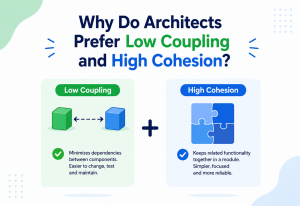
Two smaller ideas sit underneath this bigger principle, and understanding them makes the whole picture click into place. Cohesion is about how tightly related the things inside one part are — a highly cohesive piece of code only does things that clearly belong together. Coupling is about how tangled up different parts are with each other — loosely coupled parts can change independently, while tightly coupled parts tend to break each other the moment one of them changes. Good separation of concerns is really the pursuit of high cohesion within each part, and low coupling between different parts.
If someone asks “what is separation of concerns?”, the honest answer is: it is the habit of giving every piece of a system exactly one job, and making sure it sticks to that job.
It is worth noticing that a “concern” doesn’t have to be a big, dramatic responsibility to count. Something as small as “turning a raw number into a nicely formatted currency string” is a genuine concern of its own, every bit as much as something as large as “processing every payment for the entire company.” Separation of concerns applies its logic at every size, which is exactly why it feels less like one single rule and more like a lens you learn to look through, again and again, at whatever scale you happen to be working.
Why This Idea Was Invented
Coined by Edsger Dijkstra in the early 1970s to manage complexity that no single human mind could hold. Fifty years on, it is still one of the few ideas almost every engineer agrees on.
The phrase “separation of concerns” is usually credited to the computer scientist Edsger Dijkstra, who described it in the early 1970s as a way of managing the sheer complexity that comes with building anything nontrivial. His observation was refreshingly human: nobody, no matter how brilliant, can hold an entire large, tangled system in their head all at once. But almost anyone can hold one small, focused concern in their head comfortably, think about it carefully, and get it right.
Before this kind of thinking became widespread, it was common for early software to mix everything together — calculations, screen updates, and data storage all jumbled into the very same block of code. This worked passably for small programs, but as software grew larger and lived longer, that tangled style became a serious liability: a tiny change in one place could break something completely unrelated somewhere else, simply because the two things had never been properly separated to begin with.
Dijkstra’s insight became one of the quiet foundations that later, more specific ideas were built on top of — object-oriented programming’s classes, layered architecture’s horizontal slices, and microservices‘ independent boundaries can all be traced back to this same starting instinct: complexity is manageable only when it is broken into pieces small enough for a human mind to reason about comfortably, one piece at a time. Half a century later, it remains one of the very few ideas in software engineering that almost every practitioner, regardless of language or framework, agrees is simply good sense.
One thing to think about at a time
Working on one clearly bounded concern is far less mentally exhausting than juggling several tangled responsibilities at once.
Changes stay contained
A change to how data is displayed is far less likely to accidentally break how that data is calculated or stored.
Parts can be used again elsewhere
A cleanly separated concern, like formatting a date, can often be reused in many different places without modification.
People can work in parallel
Different people, or different teams, can safely work on separate concerns at the same time without constantly colliding.
Concerns, and the Levels They Live At
The same habit — one clear job per part — repeats at every size, from a single function all the way up to an entire service. Cross-cutting concerns are the one exception.
Separation of concerns isn’t just one single decision made once — it is a habit applied again and again, at many different sizes, throughout a system. Understanding these levels helps explain why the same principle can sound completely different depending on whether an engineer is talking about a single function or an entire company’s software estate. Here is how it tends to show up, from the smallest scale to the largest.
At the Function Level
The smallest scale is a single function or method — a small block of code that should ideally do one clear thing, like calculating a total or validating an email address, rather than quietly doing three or four unrelated things at once inside the same block.
At the Class or Module Level
A group of closely related functions and data is often organised into a class or module — say, everything related to managing a shopping cart lives together, separate from everything related to sending emails.
At the Layer Level
Zooming out further, related modules are grouped by role into layers — presentation, business logic, data — as seen in layered architecture, keeping “what the user sees” cleanly apart from “how information is calculated” and “where it is stored.”
At the Service or System Level
At the largest scale, entire services or systems are separated by capability — a payments service, a notifications service, an inventory service — each one a self-contained concern within a much bigger picture, as seen in microservices architecture.
Cross-Cutting Concerns
A few responsibilities don’t fit neatly at any one level, because nearly everything needs them — logging, security checks, error handling. These are called cross-cutting concerns, and rather than scattering them everywhere by hand, thoughtful teams often build them as a shared, reusable thread that quietly runs alongside all the other concerns, much like the electrical wiring running through every room of a house without belonging to any single room.
The tricky part about cross-cutting concerns is that they genuinely resist being placed at just one level. Logging matters just as much inside a tiny function as it does across an entire service, and trying to force it into the same tidy boxes as everything else usually leads to either a lot of repeated code or an awkward compromise. Recognising that some concerns are simply built differently — spread thin across everything rather than boxed neatly into one place — is itself an important part of applying this principle well.
Related Principles Worth Knowing
Separation of concerns rarely stands alone. Three close relatives — SRP, high cohesion / low coupling, and DRY — are each useful in their own right.
Separation of concerns rarely stands entirely alone — it is closely connected to a small family of other well-known ideas, and knowing how they relate makes each one easier to understand.
Single Responsibility Principle (SRP)
Often described as separation of concerns applied specifically to a class or module, this principle simply says: a class should have one, and only one, reason to change. If a single class handles both saving data and formatting a printed report, it now has two separate reasons to change, and separating those two jobs into two classes usually makes both easier to maintain.

High Cohesion, Low Coupling
As mentioned earlier, these two qualities are really the measurable outcome of doing separation of concerns well. High cohesion means each part is focused and makes sense on its own; low coupling means different parts can be changed, tested, or replaced without dragging unrelated parts along with them.
DRY — Don’t Repeat Yourself
This principle is a close cousin rather than the same idea: DRY is about avoiding duplicated logic, while separation of concerns is about organising distinct responsibilities into distinct places. The two often support each other nicely — a well-separated concern is usually easier to keep DRY, since there is exactly one clear place where that particular logic is supposed to live.
It is worth noting these two principles can occasionally pull in slightly different directions, and recognising that tension early saves confusion later. Chasing DRY too aggressively can sometimes tempt an engineer to merge two concerns that only look similar on the surface, purely to avoid a small amount of repeated code — and that merge can quietly undo good separation. A little intentional repetition between two genuinely different concerns is often a fair price to pay for keeping their boundaries clean.
Different Flavours of Separation
Horizontal by technical role, vertical by business feature, or aspect-oriented for the cross-cutting bits. Most mature systems blend more than one.
Horizontal Separation
This slices a system by technical role, the way layered architecture does — presentation, business logic, and data sitting one above another. It is called “horizontal” because these roles apply broadly across the entire system, regardless of which specific feature is being worked on.
Vertical Separation
This slices a system by business feature instead — everything related to “orders,” from screen to logic to storage, grouped together, separate from everything related to “payments.” This is closer to how microservices are typically organised, with each vertical slice owning its whole concern end-to-end.
Aspect-Oriented Separation
For cross-cutting concerns like logging or security that don’t fit neatly into either slice above, some teams use techniques that let this shared behaviour be defined once and automatically “woven” into many parts of the system, rather than manually copy-pasted everywhere it is needed.
Most real, mature systems actually blend more than one of these flavours rather than picking a single one in isolation. A microservices platform, organised vertically by business feature at the largest scale, will very often still use horizontal, layered separation inside each individual service — proof that these flavours aren’t rivals competing for the same job, but tools that work comfortably at different zoom levels of the very same system.
Strengths That Made This Habit So Valuable
A side-by-side look at what separation of concerns gives back — and the small handful of places it struggles when applied too rigidly.
What It Gets Right
- Makes large, complex systems mentally manageable, one concern at a time
- Limits how far a bug or a change can spread across the system
- Makes testing easier, since each concern can be tested largely on its own
- Encourages genuine reuse of well-defined, focused pieces
- Helps new team members understand a codebase faster, one clear piece at a time
Where It Struggles
- Can be taken too far, splitting things so finely that the big picture gets lost
- Sometimes adds a little extra structure and indirection for very small, simple projects
- Deciding exactly where one concern ends and another begins isn’t always obvious
- Cross-cutting concerns like logging can be awkward to separate cleanly
- Requires ongoing discipline — it is easy to blur boundaries under deadline pressure
A well-organised workshop with labelled drawers is a joy to work in — until someone adds forty tiny drawers for forty barely-different types of screws, and now finding anything takes even longer than the messy pile did. Separation of concerns is meant to make life easier, and like any good habit, it can be overdone until it starts working against the very goal it was meant to serve.
The strengths above all trace back to the very same source: reducing how much a person needs to hold in their head at once. A codebase built with genuine separation lets an engineer confidently say “I only need to understand this one piece to make this change,” which is an enormously freeing thing to be able to say about a system that might otherwise contain hundreds of thousands of lines of code written by dozens of people over many years.

A Closer Look at the Trade-offs
Four honest trade-offs worth naming before you split every concern into its own tidy file, plus a clear warning about separation that lives only in folder names.
Over-Separation
Splitting a system into too many tiny, hyper-specific pieces can make it just as hard to understand as not separating it at all — except now, instead of one tangled file, there are fifty small files, and understanding one simple feature means jumping between all fifty of them. Good separation aims for pieces that are meaningful and self-contained, not merely small for the sake of being small.
Where Exactly Does One Concern End?
Reasonable, experienced engineers can genuinely disagree about where to draw a particular boundary — should input validation live with the presentation layer, or with the business layer? There is rarely one single correct answer; what matters more is that the team agrees on a consistent boundary and sticks to it, rather than drawing it differently in every corner of the codebase.
The Cost of Coordination
When concerns are separated across different services or teams, a single feature that touches several of them now requires a bit of coordination between people, rather than one person simply editing one file. This coordination cost is real, and it is part of why very small teams sometimes benefit from slightly less separation than a large organisation would.
A Small Performance Cost, Usually Worth Paying
Passing information between cleanly separated pieces — through an interface, an API call, or a message — nearly always costs a tiny bit more than simply reaching in and grabbing what is needed directly. For the overwhelming majority of applications, this cost is genuinely too small to matter, and the clarity gained is worth far more than the sliver of speed it costs; only in a small number of highly performance-sensitive systems does this trade-off need to be weighed carefully.
Separation that exists only in name — folders and files labelled neatly, while the actual logic inside quietly reaches across every boundary anyway. Real separation lives in behaviour, not just in folder names.
How to Actually Apply It
Three practical habits — ask, name, draw — that catch most boundary problems long before they hit production.
Knowing the theory is one thing; applying it day to day inside a real, growing codebase is another. A few practical habits help enormously.
A genuinely useful test, borrowed loosely from the Single Responsibility Principle, is to ask: “if I described what this piece of code does in one sentence, does the word ‘and’ show up?” A function that “validates the form and saves it to the database and sends a confirmation email” is quietly doing three separate jobs, and each “and” is a strong hint that a further split would help. A function that simply “validates the form” passes the test cleanly.
It also helps to separate concerns gradually rather than all at once. A team inheriting a large, tangled piece of code rarely needs to untangle everything in a single sitting — identifying just the messiest, most frequently changed concern and carefully pulling it apart first often delivers most of the benefit, long before the rest of the cleanup is even finished.
Another practical habit is writing down, in a sentence or two, what each major part of the system is not responsible for, alongside what it is. This sounds unusual at first, but it is often the fastest way to catch a boundary that has quietly grown blurry — if two different parts of the documentation both claim responsibility for the same thing, that overlap is exactly the kind of quiet drift worth fixing before it causes a real, confusing bug.
Common Mistakes Teams Make
Even engineers who deeply understand this principle in theory still stumble over it in practice, usually not from a lack of knowledge but from small, reasonable-feeling shortcuts taken under real, everyday pressure.
Even engineers who deeply understand this principle in theory still stumble over it in practice, usually not from a lack of knowledge but from small, reasonable-feeling shortcuts taken under real, everyday pressure.
Confusing File Structure With Real Separation
Creating neatly named folders feels like progress, but a folder name alone guarantees nothing about what actually happens inside the code. True separation lives in how pieces of logic call each other, not merely in how files happen to be arranged on disk.
Letting “Just This Once” Become a Habit
Under deadline pressure, it is tempting to let one concern quietly reach into another’s territory “just this once, to save time.” A single shortcut rarely causes visible harm, but these shortcuts tend to multiply quietly, and a codebase that once had clean boundaries can gradually turn into the very tangle separation of concerns was meant to prevent.
Splitting Too Early, Before the Boundaries Are Clear
Aggressively separating concerns before a team truly understands the problem can lock in the wrong boundaries, which then have to be painfully undone later. Sometimes it is wiser to let a new piece of functionality live in one place briefly, and split it cleanly once its real shape becomes clear through actual use.
Forgetting About Cross-Cutting Concerns
Logging, error handling, and security checks are easy to forget when drawing boundaries, since they don’t belong neatly to any one concern. Left unplanned, they tend to get copy-pasted inconsistently everywhere, which quietly undermines the very tidiness the rest of the system worked hard to achieve.
Adding Layers of Indirection Nobody Actually Needs
In an effort to separate everything perfectly, it is possible to introduce so many small interfaces and intermediate layers that simply following one piece of logic requires jumping through half a dozen files. When the structure meant to aid understanding starts actively working against it, that is a clear sign the separation has outgrown the problem it was meant to solve.
Best Practices for Keeping It Clean
Four habits that quietly protect a codebase’s boundaries over months and years, without demanding one big design overhaul.
Talk through clear doorways
Let each concern expose a simple, well-defined way for others to interact with it, hiding its internal details completely.
Test every piece against SRP
If a class or module has more than one clear reason it might need to change, that is usually a sign it should be split.
Revisit them as the system grows
A boundary that made sense a year ago may no longer fit; healthy teams redraw boundaries occasionally rather than treating day-one decisions as permanent.
Write down who owns what
Make it clear, in writing, which concern is responsible for which piece of logic, so the rule doesn’t just live in one person’s memory.
Above all, remember that separation of concerns is a means to an end, not a trophy to chase for its own sake. The real goal is always a system that is easier to understand, safer to change, and more pleasant to work in — and any separation that doesn’t genuinely serve that goal is worth questioning, no matter how theoretically “correct” it might look on a whiteboard.
Quick Questions, Straight Answers
Short, honest answers to the questions engineers ask most often once separation of concerns has clicked into place.

Is separation of concerns the same as modularity?
They are closely related but not identical. Modularity is about breaking a system into distinct, self-contained pieces; separation of concerns is the underlying reasoning that helps decide where those pieces’ boundaries should actually sit. Modularity is the outcome; separation of concerns is the guiding principle behind it.
Does separation of concerns apply only to code?
Not at all. It applies just as naturally to teams, documents, and processes. A company that keeps its billing team, its support team, and its product team focused on their own clear responsibilities — rather than everyone doing a little bit of everything — is applying the very same principle to how humans, not just code, are organised.
How do I know if I’ve separated something correctly?
A helpful sign is that a change to one concern rarely requires touching the others. If updating how something looks on screen keeps forcing changes deep inside how data is stored, that is a strong hint the boundary between those two concerns isn’t quite where it should be yet.
Can separation of concerns slow a small project down?
For a tiny, short-lived project, strict formal separation can occasionally feel like more structure than the project truly needs, and that is a fair trade-off to make consciously. Even so, most experienced engineers still keep a light, informal version of the habit — separating “what is shown” from “how it is calculated” — simply because it rarely costs much and often saves real trouble later.
Who decides where the boundaries should go?
In most healthy teams, this is a shared decision, often revisited together during design discussions or code reviews, rather than something one person quietly decides alone. Because reasonable engineers can genuinely disagree about exactly where a boundary belongs, the real goal isn’t finding one universally “correct” answer — it is reaching a boundary the whole team understands and consistently respects.
Real-World Examples You Already Rely On
Four small, everyday examples that anchor the abstract idea of separation of concerns in things you have almost certainly used yourself.
Separation of concerns isn’t an abstract classroom idea — it quietly shapes technology you use every single day.
Websites built with HTML, CSS, and JavaScript
Structure, appearance, and behaviour are deliberately kept in three separate files, so a designer can change the colours without ever touching the logic that makes a button actually work.
MVC-based applications
The Model, View, and Controller pattern separates data, what is displayed, and the logic connecting them, so each piece can be changed with far less risk of breaking the others.
Operating systems
The part managing your files, the part managing your screen, and the part managing your network connection are all kept deliberately separate, so a problem in one rarely crashes the whole computer.
Microservices platforms
A large streaming or shopping platform separates payments, recommendations, and search into entirely independent services, each owning its concern completely, end-to-end.
Notice the common thread running through every single example: something that could have been jumbled together into one confusing block was deliberately split along a natural seam instead. That seam is exactly what separation of concerns asks every engineer to go looking for, at every scale, in everything they build.
Key Takeaways
If you remember only six ideas from this guide, let it be these. Together they cover most of the situations where separation of concerns actually matters in day-to-day engineering practice.
Remember This
- One clear job per part. Separation of concerns means giving each part of a system exactly one clear responsibility, and keeping it out of every other part’s business.
- Applies at every scale. From a single function, to a class, to a layer, to a whole service — the same habit repeats at every size.
- Cohesion in, coupling out. High cohesion within a part and low coupling between parts are the measurable results of doing it well.
- Sits inside a small family. It is closely related to the Single Responsibility Principle and to DRY, though each idea plays a slightly different role.
- Don’t overdo it. Overdoing it fragments a system just as harmfully as ignoring it entirely — the goal is meaningful boundaries, not the smallest possible pieces.
- The foundation underneath the rest. It underpins nearly every major architectural style covered elsewhere, from layered systems to microservices to event-driven design.