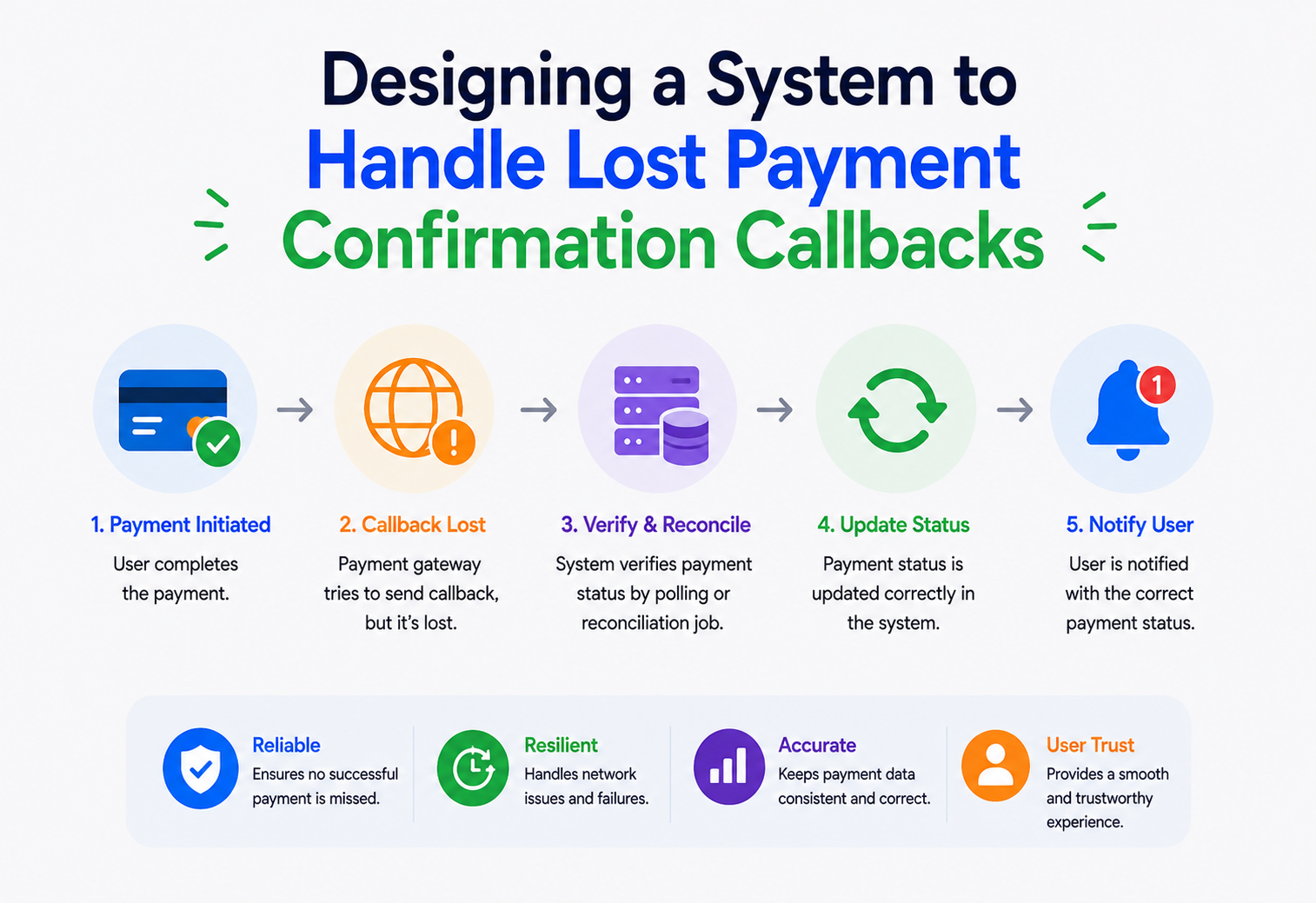
Designing a System to Handle Lost Payment Confirmation Callbacks
What happens when a payment processor successfully charges a customer’s card, but the network drops the confirmation message on its way back to your servers? How do you build a system that guarantees the customer is never charged without getting their order, and never gets their order without being correctly charged? A full architectural walkthrough from webhooks and idempotency to reconciliation, state machines, and audit-grade recovery.
Introduction & History
Imagine handing cash to a cashier through a small gap in a broken window, and just as they hand you your receipt back, a gust of wind blows the receipt away before you can grab it. You know you paid. The cashier knows they were paid. But right now, standing there with an empty hand, you have no proof, and neither does the shop’s till roll show your transaction as “given to customer” yet. This is exactly the situation an e-commerce platform faces when a payment processor successfully charges a customer’s card, but the confirmation message meant to travel back over the network to the merchant’s servers never arrives.
A lost-callback-safe payment reconciliation system is the architecture and set of practices that guarantee this exact scenario — money moved, but the news of it lost in transit — can never result in a customer being charged without receiving their order, nor in a completed sale silently vanishing from the merchant’s books. It is one of the single most important reliability problems in all of e-commerce engineering, because unlike most bugs, this one directly touches real money and real customer trust.
1.1 Why this specific failure mode is so treacherous
Most system failures are visible immediately — a server crashes, an error appears, someone gets paged. This failure mode is dangerous precisely because it is silent. From the payment processor’s point of view, everything went perfectly: the card was charged, the funds are moving, and a webhook was dutifully sent. From your system’s point of view, nothing happened at all — no event arrived, no error was thrown, nothing looks broken. The order simply sits in “awaiting payment” forever, while the money has already left the customer’s account.
Two independent systems, two independent truths
The payment processor’s ledger and your own order database are two separate systems of record that must eventually agree, but have no shared transaction to guarantee they always do.
The network is the weak link
The payment itself happens inside the processor’s infrastructure; only the notification of that payment has to cross the public internet back to you, and that hop is exactly where packet loss, timeouts, and outages live.
Silence looks identical to “nothing happened”
A dropped webhook produces no error on your side — there is no exception to catch, no failed request to retry, just an event that never arrived at all.
1.2 A short history of the problem
- 1990s – early 2000s — Synchronous, same-request payment confirmation. Early online payment integrations tried to get the payment result back within the same HTTP request the customer’s browser made, which seemed simpler but meant any network hiccup during that single request left the true payment outcome genuinely unknown to the merchant.
- Mid 2000s — Asynchronous webhooks become standard. Payment processors began sending a separate, asynchronous “here’s what happened” callback after the fact, decoupling the customer’s checkout experience from the payment’s true settlement, but introducing exactly the lost-callback problem this tutorial addresses.
- 2008–2012 — Retry-with-backoff webhook delivery. Major processors started retrying webhook delivery automatically for a period of time if the merchant’s endpoint did not acknowledge receipt, significantly reducing — but never fully eliminating — the chance of a permanently lost notification.
- 2013–2018 — Reconciliation jobs and status-polling APIs. Processors began exposing “check the status of this payment” query APIs, and merchants started running scheduled reconciliation jobs that actively polled for any payment whose true status disagreed with what the merchant’s own database believed.
- 2019 – Present — Idempotent, event-sourced payment state machines. Modern systems treat payment state as an explicit, auditable state machine driven by idempotent events from multiple sources — webhooks, polling, and manual reconciliation — so that no matter which channel eventually delivers the truth, the system converges on the correct final state exactly once.
By the end of this tutorial, you will understand how to design a payment confirmation pipeline that treats “the callback might never arrive” not as an edge case to patch around, but as a first-class design assumption baked into the architecture from day one.
1.3 Why this problem sits at the intersection of several disciplines
Solving this well pulls together at least four distinct engineering disciplines, and a strong system designer needs to move comfortably between all of them.
Distributed systems theory
This is, at its heart, a distributed consensus problem between two independently operated systems that cannot share a single atomic transaction, resolved through eventual consistency and idempotent reconciliation.
Financial correctness and auditability
Every state transition touching real money needs to be explainable after the fact, both for customer support and for regulatory or compliance review.
Site reliability engineering
Monitoring the stale-order pool, alerting on early degradation signals, and rehearsing the lost-callback scenario deliberately are what turn a theoretical design into a system a real team can operate with confidence.
Security engineering
An inbound webhook is, from a security perspective, an unauthenticated request from the internet until proven otherwise, and must be treated with the same rigor as any other externally-facing attack surface.
Keeping this framing in mind helps you answer follow-up interview questions gracefully, since interviewers often probe from whichever of these four angles matches their own background — moving fluently between “how do you guarantee idempotency” and “how would you explain this correction to a regulator” and “how do you monitor for this failing silently” is exactly the kind of well-rounded judgment senior system design interviews are designed to surface.
Problem & Motivation
Let’s precisely define the failure scenario, because a fuzzy understanding of the problem leads to a fuzzy, incomplete solution.
The merchant must eventually learn the true outcome of every single payment attempt, with zero exceptions, while having no direct control over the network path the confirmation message must travel, and no ability to force the processor to retry indefinitely.
2.1 Why this is a genuinely hard system design problem
Two systems of record, no shared transaction
The payment processor’s ledger and the merchant’s order database cannot be updated within a single atomic distributed transaction across two entirely separate companies’ infrastructure.
Silent failure, not loud failure
A lost webhook produces no error anywhere; nothing crashes, nothing times out visibly, the event simply never arrives, making this bug class notoriously hard to detect through conventional error monitoring alone.
The cost of guessing wrong is money
Assume the payment failed when it actually succeeded, and you either double-charge a retried customer or fail to deliver a product they already paid for. Assume it succeeded when it actually failed, and you ship a product you were never paid for.
Idempotency across every retry path
Whatever mechanism eventually confirms the payment — a delayed webhook, a manual reconciliation job, a customer support inquiry — must never be able to process the same successful payment twice.
Time sensitivity
A customer waiting an unbounded amount of time to learn if their order succeeded will lose confidence in the platform, so the system needs a bounded, predictable maximum time to reach the correct final state, not just eventual correctness with no deadline.
Auditability
Financial regulators, payment card industry compliance requirements, and basic customer service needs all demand a clear, permanent audit trail of exactly what happened and when, for every single payment, including the ones that took the long way around to get confirmed.
“You cannot prevent a network from losing a message. You can only design a system that never depends on any single message arriving at all.”
2.2 Why “just retry the webhook” is not a complete answer
Payment processors already retry webhook delivery automatically for a period of time — often for hours or even a day — if the merchant’s endpoint does not acknowledge receipt quickly. This solves the vast majority of transient network blips. But it does not solve every case: the merchant’s endpoint could be down for the entire retry window during a major outage, a firewall or DNS misconfiguration could silently blackhole every retry attempt, or the processor’s own retry queue could itself fail in some rare, catastrophic way. A robust system cannot assume the webhook will always eventually succeed; it needs an entirely independent path to discover the truth, one that does not depend on the processor successfully delivering anything at all.
Q: “Why isn’t ‘the payment processor retries the webhook automatically’ a sufficient solution on its own?”
A strong answer recognizes that webhook retries reduce the probability of a lost confirmation but cannot reduce it to zero, since the merchant’s own endpoint, network path, or infrastructure could be unavailable for the entire retry window. A system that only relies on inbound webhook delivery has a single point of failure in the pipeline; a complete design needs an independent, merchant-initiated verification path — active polling or reconciliation — that does not depend on the processor’s retry mechanism succeeding at all.
2.3 The three stakeholders whose needs must all be balanced
| Stakeholder | What they need | What happens if ignored |
|---|---|---|
| Customers | Confidence that a successful payment always results in a fulfilled order, and honest communication if there’s a delay | Customers who were genuinely charged but see no order confirmation lose trust and may dispute the charge with their bank, creating additional cost and friction |
| Finance and accounting teams | An order database that always eventually matches the processor’s ledger exactly, with a clear audit trail for every correction | Books that don’t reconcile create real accounting and compliance risk, and make revenue reporting untrustworthy |
| Customer support teams | A clear, queryable history of exactly what happened to any given payment, including which channel eventually confirmed it | Without this, support agents cannot answer “did my payment go through” with confidence, escalating simple questions into lengthy investigations |
2.4 Why this problem cannot be fully solved by “just retry the request”
A tempting first instinct is to treat this like any other network reliability problem and simply retry the failed request until it succeeds. But retrying which request, exactly? The original charge already succeeded once at the processor; retrying it naively risks double-charging the customer. Retrying “check if the webhook arrived” is meaningless, since there’s nothing on your side actively watching for its absence. The only request genuinely safe and meaningful to retry is an independent question posed directly to the processor — “what is the true, current status of this specific payment reference?” — which is precisely what reconciliation is built to do, and precisely why it cannot simply be replaced by a naive retry loop around the original charge request.
Core Concepts
Before drawing the architecture, let’s build a shared vocabulary for every technique this system leans on.
3.1 Webhooks
What: An asynchronous HTTP callback that the payment processor sends to a URL you provide, notifying you of an event such as “payment succeeded” or “payment failed,” separate from the customer’s original checkout request. Why: Some payment methods take time to settle (bank transfers, certain card authentications), so the final outcome cannot always be known within the original synchronous checkout request; webhooks let the processor tell you the outcome whenever it becomes known, even minutes or hours later. Analogy: Ordering food for delivery and being told “we’ll text you when it’s on the way” instead of being made to stand at the counter until the food is physically cooked.
3.2 Reconciliation
What: A scheduled process that actively compares your own records against the payment processor’s records for the same set of transactions, and corrects any disagreement it finds. Why: This is the safety net for every payment whose webhook never arrived. Rather than waiting passively for a notification that may never come, the system periodically asks the processor directly, “what is the true status of this payment?” Practical example: Every few minutes, a reconciliation job queries the payment processor’s status API for every order still sitting in “awaiting payment” for longer than some threshold, and updates any order whose true status disagrees with the merchant’s records.
3.3 Idempotency
What: A property where performing the same operation multiple times produces exactly the same result as performing it once, with no unwanted side effects from the repeats. Why: A payment’s true “succeeded” status might arrive through a webhook, then again through a reconciliation job, then again if a customer support agent manually re-checks it. Idempotency guarantees the order is only ever marked paid, and fulfillment only ever triggered, exactly once, no matter how many times the same true outcome is reported. Beginner example: Pressing an elevator call button five times because you are impatient does not summon five elevators; the system recognizes the repeated signal as the same original request.
3.4 Outbox pattern
What: A pattern where a service writes both its own state change and the corresponding event to be published into the same local database transaction, then a separate process reliably publishes that event afterward. Why: Without this, a service might update its own database successfully but crash before publishing the corresponding event (or vice versa), creating exactly the same kind of “two systems disagree” problem this entire tutorial is about, just moved one layer deeper into your own infrastructure.
3.5 Payment state machine
What: An explicit, finite set of states a payment can be in (initiated, processing, succeeded, failed, refunded) with clearly defined, valid transitions between them, rather than a loosely-typed status field that could be set to anything from anywhere. Why: A well-defined state machine makes illegal transitions structurally impossible to represent — you cannot accidentally move a payment from “succeeded” back to “processing,” because no code path is ever written to allow that transition, regardless of which channel (webhook, reconciliation, manual override) is driving the update.
3.6 Distributed transaction & the Saga pattern
What: A distributed transaction spans multiple independent systems (your database and the payment processor’s ledger) that cannot be committed or rolled back together atomically. The Saga pattern manages this by breaking the overall operation into a sequence of local transactions, each with a defined compensating action if a later step fails. Why: You cannot wrap “charge the customer” and “mark the order paid in my database” inside one atomic two-phase commit across your infrastructure and a third-party processor’s infrastructure. The Saga pattern accepts this reality and instead defines exactly what to do — including how to detect and recover — when the steps get out of sync.
3.7 At-least-once vs exactly-once semantics
What: At-least-once delivery guarantees a message will arrive one or more times, but never guarantees it arrives exactly once. Exactly-once semantics is a stronger, harder-to-achieve guarantee that an effect happens precisely one time, no more and no less, from the receiver’s point of view. Why: Nearly every messaging system in practice — the payment processor’s webhook delivery, the internal event queue — realistically only offers at-least-once delivery. Rather than fighting to build a true exactly-once delivery mechanism, this architecture accepts at-least-once delivery everywhere and instead builds exactly-once effects on top of it through idempotency, which is a far more achievable and battle-tested engineering pattern. Analogy: A mail carrier cannot guarantee a letter arrives exactly once — it might arrive twice due to a sorting error, or the carrier might re-deliver after an unclear delivery confirmation. But if the letter itself says “this is invoice number 4471, ignore if you’ve already received one with this number,” the recipient can achieve the equivalent of exactly-once processing even though delivery itself was never guaranteed to be exactly-once.
3.8 Compensating transactions
What: An explicit action that undoes or corrects the effect of an earlier step in a multi-step workflow, used when that workflow cannot be wrapped in a single atomic transaction. Why: If a payment is initially believed to have failed, an order might be canceled and inventory released back to available stock. If reconciliation later discovers the payment actually succeeded, a compensating action must re-create or reinstate the order correctly, rather than the system being left in a state where money was charged but no corresponding order exists at all.
No single notification channel — not the webhook, not a single reconciliation pass, not a customer’s own claim — is trusted as the sole source of truth. The system is designed so that the true payment state, wherever it eventually surfaces from, converges to exactly one correct, permanently recorded outcome.
Architecture & Components
Let’s assemble every concept above into one coherent picture. Every box below is a distinct, independently deployable component, labeled explicitly.
Layer 7 Health Checked”] LB –> GW[“API Gateway
AuthN Rate Limiting Routing”] GW –> OrderSvc[“Order Service
Creates Order in Awaiting Payment”] OrderSvc –> PaymentSvc[“Payment Service
Initiates Charge Request”] PaymentSvc –> Processor[“Payment Processor
External Third Party System”] Processor -.->|”Webhook Attempt May Be Lost”| WebhookLB[“Load Balancer
Dedicated Webhook Endpoint”] WebhookLB –> WebhookGW[“API Gateway
Webhook Signature Verification”] WebhookGW –> WebhookReceiver[“Webhook Receiver Service
Validates and Enqueues Event”] WebhookReceiver –> EventQueue[“Event Queue
Kafka Topic for Payment Events”] EventQueue –> EventProcessor[“Payment Event Processor
Idempotent State Update Worker”] EventProcessor –> OrderDB[“Order Database
Source of Truth for Payment State”] Scheduler[“Reconciliation Scheduler
Runs Every Few Minutes”] –> ReconSvc[“Reconciliation Service
Compares Processor vs Order DB”] ReconSvc –>|”Polls Status API”| Processor ReconSvc –> OrderDB EventProcessor –>|”Cannot Process Event”| DLQ[“Dead Letter Queue
Holds Failed Events for Investigation”] OrderDB –> FulfillmentSvc[“Fulfillment Service
Triggered Once Payment Confirmed”] OrderDB –> NotifySvc[“Notification Service
Order and Payment Status Updates”] EventProcessor –> MetricsSvc[“Monitoring Service
Payment State Dashboards and Alerts”] ReconSvc –> MetricsSvc DLQ –> MetricsSvc
Every box above maps to a real, independently deployable component. Let’s walk through each one.
4.1 Component breakdown
Load Balancer (customer-facing)
Distributes checkout traffic across the Order and Payment Service fleets, with health checks ensuring requests never route to an unhealthy instance.
API Gateway (customer-facing)
Handles authentication, rate limiting, and routing for the customer-initiated checkout flow, separate from the webhook-receiving path.
Order Service
Owns the order’s lifecycle, creating it in an “awaiting payment” state immediately and never blocking the customer’s checkout experience on the payment’s final confirmation.
Payment Service
Initiates the charge request to the external payment processor and records the attempt, including the processor’s own transaction identifier, before the true outcome is even known.
Load Balancer + API Gateway (webhook-facing)
A dedicated, separately scaled entry point for inbound webhook traffic from the payment processor, kept isolated from customer-facing traffic so a webhook flood or the processor’s own retry storm cannot degrade the checkout experience.
Webhook Receiver Service
Verifies the cryptographic signature on every inbound webhook, rejects anything that fails verification, and enqueues valid events for processing, responding quickly so the processor does not consider the delivery failed.
Event Queue (Kafka)
Decouples the fast webhook-acknowledgment path from the potentially heavier work of updating order state, and provides durable storage so an event is never lost once it has been successfully received and enqueued.
Payment Event Processor
Consumes queued payment events and applies idempotent state transitions to the order, guaranteeing the same event processed twice (or the same true outcome arriving via two different channels) never double-applies its effect.
Reconciliation Scheduler and Service
Runs on a fixed schedule, proactively polling the payment processor’s status API for every payment still in an unresolved state past a defined threshold, and is the safety net for every webhook that was ever lost.
Order Database
The single source of truth for order and payment state, updated only through the idempotent state-machine logic, regardless of which channel — webhook or reconciliation — supplied the update.
Dead Letter Queue
Captures any payment event the processor could not successfully apply after retries, ensuring a malformed or unexpected event is surfaced for investigation rather than silently dropped.
Fulfillment and Notification Services
Triggered only once the Order Database reflects a confirmed payment, guaranteeing a customer is never shipped a product, nor told their payment succeeded, before that fact is genuinely and durably true.
Q: “Why have a completely separate load balancer and gateway for webhooks instead of reusing the customer-facing ones?”
Strong answer: webhook traffic has a fundamentally different profile and risk surface than customer-facing traffic — it comes from a small number of trusted third-party IP ranges, needs signature verification rather than customer authentication, and can arrive in unpredictable bursts if the processor is retrying a large batch of previously failed deliveries. Isolating this path means a webhook retry storm, or a temporary issue in webhook processing, can never degrade the customer-facing checkout experience, and vice versa.
Internal Working
Let’s zoom into the two mechanisms that make this system actually trustworthy: the idempotent webhook handler, and the reconciliation job’s comparison logic.

5.1 Idempotent webhook processing
Every inbound webhook carries a unique event identifier from the payment processor. Before applying any state change, the event processor checks whether this exact event identifier has already been successfully processed, and if so, simply acknowledges receipt without repeating any side effect.
public class PaymentEventProcessor {

    private final ProcessedEventRepository processedEvents;
    private final OrderRepository orderRepository;

    @Transactional
    public void process(PaymentWebhookEvent event) {

        // Idempotency check happens inside the same transaction as the
        // state update, so a duplicate event can never partially apply.
        if (processedEvents.existsByEventId(event.getEventId())) {
            return; // Already handled, safe to acknowledge and skip
        }

        Order order = orderRepository.findByPaymentReference(event.getPaymentReference())
                .orElseThrow(() -> new OrderNotFoundException(event.getPaymentReference()));

        // The state machine only allows valid transitions; an out-of-order
        // or already-terminal event is rejected rather than silently applied.
        if (!order.getPaymentState().canTransitionTo(event.getNewState())) {
            throw new InvalidStateTransitionException(order.getPaymentState(), event.getNewState());
        }

        order.applyPaymentStateTransition(event.getNewState(), event.getEventId());
        orderRepository.save(order);
        processedEvents.markProcessed(event.getEventId());
    }
}
Notice the idempotency check and the state update happen inside a single database transaction. This is deliberate: if these were two separate steps, a crash between them could leave the system having “recorded” an event as processed without actually applying its effect, or vice versa — exactly the kind of subtle bug that reintroduces the very problem this tutorial is solving, just at a smaller scale inside your own infrastructure.
5.2 Reconciliation comparison logic
The reconciliation job does not simply overwrite the merchant’s records with whatever the processor reports; it compares the two and only acts when there is a genuine, meaningful disagreement, logging every comparison for audit purposes even when no correction was needed.
public class ReconciliationService {

    private final PaymentProcessorClient processorClient;
    private final OrderRepository orderRepository;
    private final PaymentEventProcessor eventProcessor;

    public void reconcilePendingOrders() {

        List<Order> staleOrders = orderRepository
                .findByPaymentStateAndCreatedBefore(
                        PaymentState.AWAITING_PAYMENT,
                        Instant.now().minus(Duration.ofMinutes(5)));

        for (Order order : staleOrders) {
            try {
                PaymentStatusResponse trueStatus =
                        processorClient.getStatus(order.getPaymentReference());

                if (trueStatus.getState() != order.getPaymentState()) {
                    // Synthesize an equivalent event and route it through the
                    // exact same idempotent processing path as a real webhook,
                    // so there is only ever one code path that mutates state.
                    PaymentWebhookEvent syntheticEvent = PaymentWebhookEvent.fromReconciliation(
                            order.getPaymentReference(), trueStatus);
                    eventProcessor.process(syntheticEvent);

                    auditLog.record("Reconciliation corrected order " + order.getId()
                            + " from " + order.getPaymentState() + " to " + trueStatus.getState());
                }
            } catch (ProcessorApiException e) {
                auditLog.recordFailure(order.getId(), e);
                // Leave the order untouched; it will be retried on the next run.
            }
        }
    }
}
Notice the reconciliation service does not update the order database directly — it constructs a synthetic event and routes it through the exact same idempotent event processor a real webhook would use. This guarantees there is only ever one piece of code in the entire system that is allowed to mutate payment state, regardless of which channel discovered the truth, dramatically reducing the chance of the two paths ever disagreeing about what a valid transition looks like.
Q: “What happens if the reconciliation job itself crashes halfway through processing a batch of stale orders?”
Because each order in the batch is processed and committed independently — not as one giant all-or-nothing transaction across the whole batch — a crash partway through simply means the remaining orders in that batch are picked up again on the very next scheduled run. Combined with the idempotency guarantee in the event processor, re-running reconciliation over an order that was already corrected in a partially-completed previous run is always safe and produces no duplicate effect.
Data Flow & Lifecycle
Let’s trace the exact failure scenario from the prompt: a payment succeeds at the processor, but the webhook confirming it is lost, and reconciliation later catches and corrects it.
6.1 Payment lifecycle states
| State | Meaning |
|---|---|
AWAITING_PAYMENT | Order created; charge request submitted to processor, outcome not yet known |
PROCESSING | Processor has acknowledged the charge request but final settlement is still pending |
SUCCEEDED | Payment confirmed successful, whether learned via webhook or reconciliation |
FAILED | Payment confirmed unsuccessful; customer notified and invited to retry |
REFUNDED | A previously succeeded payment has since been refunded |
Notice the customer is shown a pending confirmation immediately after the charge request is submitted, not an error, and not a false “success” either. This honest, intermediate state is important: it sets the correct expectation that final confirmation may take a short time, without ever telling the customer something that isn’t yet verifiably true. In practice, this pending state also becomes the exact signal customer support tooling uses to distinguish a normal, still-in-progress order from one that has genuinely stalled beyond the expected window and may warrant proactive outreach.
Advantages, Disadvantages & Trade-offs
No architecture is free. Being honest about what this one gives up in exchange for what it delivers is what turns a design into a defensible one under interviewer pressure or an architecture review.
Advantages of this architecture
- Guarantees eventual correctness even in the face of a fully and permanently lost webhook, since reconciliation provides an entirely independent path to the truth.
- Idempotent processing means the same true outcome can safely be reported through multiple channels without ever double-applying its effect.
- Isolating the webhook-facing infrastructure from customer-facing infrastructure prevents either from degrading the other under load or failure.
- A single, shared state-transition code path (used by both webhooks and reconciliation) minimizes the risk of the two channels disagreeing about what a valid state change looks like.
Disadvantages & challenges
- Reconciliation introduces a bounded but real delay — a lost webhook is not corrected instantly, but only at the next scheduled reconciliation run.
- Additional operational complexity: an entirely separate scheduled job, its own failure modes, and its own monitoring must be built and maintained.
- Depends on the payment processor exposing a reliable status-query API; not every processor or payment method supports this equally well.
- Aggressive reconciliation polling frequency can itself strain the processor’s rate limits if not tuned carefully.
7.1 Key trade-off: reconciliation polling frequency
| Approach | Pros | Cons |
|---|---|---|
| Very frequent polling (e.g., every 30 seconds) | Minimizes the time a lost webhook stays undetected | Higher load on the processor’s API; may hit rate limits, especially at high order volume |
| Infrequent polling (e.g., every hour) | Minimal load on the processor’s API | Customers could wait an uncomfortably long time to see their order confirmed if a webhook is lost |
| Tiered polling (frequent at first, backing off over time) | Fast detection for the common case while limiting long-term API load for rare, persistent issues | More complex scheduling logic to design, tune, and maintain |
7.2 Key trade-off: strict state machine vs flexible status field
A strict, explicit payment state machine with clearly enumerated valid transitions is harder to design upfront and less flexible to extend quickly, but makes an entire class of bugs — illegal or nonsensical state transitions — structurally impossible to introduce by accident. A loosely-typed status field is faster to build initially but leaves the door open for a rushed code change somewhere in the codebase to set an order’s status to something invalid, silently corrupting the very system of record this whole architecture exists to protect.
Performance & Scalability
8.1 Sizing the reconciliation job with Little’s Law
Little’s Law states L = λ × W, where L is the average number of items in the system, λ is the arrival rate, and W is the average time an item spends in that state. If orders enter “awaiting payment” at a rate of 50 per second (λ), and the vast majority resolve via webhook within an average of 3 seconds, but a small fraction linger due to lost webhooks until reconciliation catches them roughly 5 minutes later (300 seconds), the “stale orders awaiting reconciliation” pool size depends heavily on what fraction actually falls into that slow path. If even 0.5% of orders end up needing reconciliation, that’s 0.25 orders per second entering the stale pool, times a 300 second window, giving an average of about 75 orders in the stale pool at any moment — a very manageable number for a reconciliation job to query and correct on each scheduled run.
8.2 Horizontal scaling of the event processor
Because the payment event processor consumes from a partitioned event queue and applies idempotent, per-order state transitions, it scales horizontally simply by adding more consumer instances to the same consumer group, with the queue automatically rebalancing partitions across them as the fleet grows or shrinks.
8.3 Batching reconciliation API calls
Rather than querying the processor’s status API one order at a time, a well-designed reconciliation job batches multiple payment references into a single bulk status-lookup call where the processor’s API supports it, dramatically reducing the total number of API calls needed per reconciliation run and helping stay comfortably within the processor’s rate limits even during high order volume.

The reconciliation job’s load scales with the rate of lost webhooks, not the rate of total orders — and the entire point of good webhook infrastructure (fast acknowledgment, generous processor-side retries) is to keep that lost-webhook rate as close to zero as realistically possible, so reconciliation remains a lightweight safety net rather than a primary, heavily-loaded processing path.
Q: “How would you avoid reconciliation itself becoming a bottleneck if lost webhooks suddenly spike, for example during a processor-side outage?”
Discuss adaptive polling frequency that increases temporarily when the stale-order pool grows beyond a normal baseline, combined with batched status lookups to minimize per-call overhead, and alerting that treats a sudden spike in the stale-order pool size as an actionable signal in its own right — since a rising pool size may indicate a genuine processor-side outage worth investigating directly, not just something reconciliation alone should quietly absorb.
8.4 CAP theorem trade-offs specific to payment state
The CAP theorem states a distributed data store can only guarantee two of three properties during a network partition: consistency, availability, and partition tolerance. This system makes a deliberate choice worth stating explicitly.
| Component | Choice | Reasoning |
|---|---|---|
| Order Database payment state | Favors consistency (CP) | Two conflicting reads of whether a payment succeeded is not a tolerable inconsistency window; every read of payment state that drives a real action must see the current, correct value. |
| Event Queue | Favors availability (AP) with at-least-once delivery | It is safer to occasionally reprocess a duplicate event, guarded by idempotency, than to lose an event or block the webhook receiver during a partition. |
| Reconciliation’s view of the processor | Favors eventual consistency by design | Reconciliation explicitly accepts that its view of the processor’s true state is only as fresh as the last poll, trading some staleness for a bounded, predictable, and low-cost verification mechanism. |
Notice that the one place this system refuses any compromise on consistency is the payment state itself, while cheerfully accepting eventual consistency in exactly the pieces where staleness genuinely does no harm — a return to the general principle that CAP trade-offs should be made deliberately, piece by piece, based on the true cost of getting each one wrong.
High Availability & Reliability
9.1 Multi-AZ deployment
The event queue, order database, and reconciliation service are all deployed across multiple availability zones, so the loss of a single data center does not prevent either the webhook path or the reconciliation path from continuing to function. This multi-AZ resilience is applied uniformly across every stateful component in the pipeline, since a payment confirmation system that survives a lost network message but not a lost data center would only be solving half of the reliability problem it was actually built for.
9.2 Graceful degradation chain
Webhook receiver down
The processor’s own automatic retry mechanism covers this window; once the receiver recovers, queued retries are processed normally, and reconciliation independently catches anything still unresolved beyond that.
Event queue unavailable
The webhook receiver should fail its acknowledgment to the processor in this case rather than silently dropping the event, so the processor’s own retry logic kicks in once the queue recovers.
Reconciliation job fails partway
Each order is processed and committed independently; a partial failure simply means the remaining stale orders are corrected on the next scheduled run, with no risk of duplicate effects thanks to idempotency.
Processor’s status API is down
Reconciliation logs the failure and retries on its next scheduled run rather than blocking; if the processor’s own webhook delivery also recovers in the meantime, the webhook path may resolve the order before reconciliation even needs to.
9.3 Why idempotency is the single most important reliability property here
Every fallback path described above — processor-side webhook retries, reconciliation re-runs, even a manual correction made by a support agent — converges on the same event-processing code path. None of these mechanisms would be safe to use at all if that shared path were not fully idempotent, because every one of them can, and eventually will, report the same true outcome more than once.
Beyond individual component health checks, the single most valuable reliability signal in this entire system is the size and age distribution of the “awaiting payment beyond normal threshold” pool. A sudden, sustained growth in this pool is often the earliest warning sign of a genuine upstream issue — a processor-side outage, a firewall change silently blocking inbound webhooks, or a bug in the event processor itself.
Q: “What is the absolute worst-case scenario this design still needs to handle, and how does it handle it?”
The worst case is a payment succeeding at the processor while every single automated notification path — the original webhook and all of the processor’s own retries — fails for the entire retry window, for example due to an extended outage on the merchant’s side. In this case, reconciliation is the only remaining safety net, and its bounded polling interval guarantees the order will still be corrected automatically once the merchant’s infrastructure recovers, without requiring any manual intervention, provided reconciliation itself is deployed with the same multi-AZ resilience as the rest of the pipeline.
9.4 Ensuring exactly one active reconciliation scheduler
If the reconciliation job were accidentally triggered by two overlapping scheduler instances at once — for example during a deployment rollover — both could query and attempt to correct the same stale order simultaneously. Rather than relying purely on idempotency to paper over this, most production deployments use a distributed lock (commonly backed by the same consensus mechanism underlying the messaging or coordination service already in the stack) so that only one scheduler instance is ever the active leader running a given reconciliation pass at a time. If that leader crashes mid-run, lock expiry allows a standby instance to take over automatically, and idempotency guarantees no double effect even in the brief window before that failover completes.
9.5 Rehearsing the exact failure scenario
Beyond generic chaos engineering, teams building this specific pipeline benefit enormously from a dedicated rehearsal that simulates precisely the scenario in this tutorial’s title: instructing a test payment to succeed at the processor while deliberately blackholing the corresponding webhook delivery, then confirming reconciliation detects and corrects it within the expected time window. This single, highly specific test is often far more valuable than a broader chaos exercise, because it directly validates the one failure mode the entire architecture exists to survive.
Security
10.1 Webhook signature verification
Every inbound webhook must be cryptographically verified as genuinely originating from the payment processor before its contents are trusted at all. Payment processors typically sign each webhook payload with a shared secret, and the webhook receiver recomputes this signature and compares it, rejecting anything that does not match.
public class WebhookSignatureVerifier {

    private final String webhookSecret;

    public boolean isValid(String rawPayload, String providedSignature) {
        try {
            Mac hmac = Mac.getInstance("HmacSHA256");
            hmac.init(new SecretKeySpec(webhookSecret.getBytes(StandardCharsets.UTF_8), "HmacSHA256"));

            byte[] computed = hmac.doFinal(rawPayload.getBytes(StandardCharsets.UTF_8));
            String computedSignature = Hex.encodeHexString(computed);

            // Constant-time comparison prevents timing attacks from
            // leaking information about the correct signature byte by byte.
            return MessageDigest.isEqual(
                    computedSignature.getBytes(StandardCharsets.UTF_8),
                    providedSignature.getBytes(StandardCharsets.UTF_8));

        } catch (Exception e) {
            return false;
        }
    }
}
10.2 Replay attack prevention
A valid, correctly signed webhook payload captured by an attacker could in theory be replayed later to trigger unintended effects. Combining the event’s unique identifier and a timestamp check (rejecting anything outside a reasonable delivery window) with the idempotency mechanism already described means a replayed event either gets rejected outright as too old, or is recognized as already processed and safely ignored.
IP allowlisting
The webhook-facing gateway restricts inbound connections to the payment processor’s published, documented IP ranges as an additional defense-in-depth layer beyond signature verification.
Least privilege for reconciliation credentials
The reconciliation service’s API credentials for querying the processor are scoped to read-only status lookups wherever the processor’s API supports such scoping, limiting the damage possible if those credentials were ever compromised.
Encrypted storage of payment references
Payment references and any processor-issued identifiers stored in the order database are treated as sensitive data, encrypted at rest, with tightly scoped access controls.
Audit logging for every correction
Every state transition applied by reconciliation, not just those applied by webhooks, is logged with full context, since a corrected payment state is exactly the kind of change that may need to be explained to a customer, an auditor, or a regulator later.
Q: “Why is constant-time comparison used when verifying the webhook signature, instead of a normal string equality check?”
A normal string comparison typically returns as soon as it finds the first mismatched character, meaning the time it takes to reject an incorrect signature subtly depends on how many leading characters happened to match. An attacker able to measure this timing difference precisely enough could, in theory, guess the correct signature one byte at a time. A constant-time comparison always takes the same amount of time regardless of where or whether a mismatch occurs, eliminating this timing side-channel entirely.
Monitoring, Logging & Metrics
11.1 Key metrics to track
| Metric | Why it matters |
|---|---|
| Stale-order pool size (awaiting payment beyond threshold) | The earliest and most direct signal of lost webhooks accumulating faster than reconciliation can correct them |
| Webhook delivery success rate | A sustained drop signals a possible network, firewall, or receiver-side issue worth investigating immediately |
| Reconciliation correction rate | How often reconciliation actually finds and fixes a genuine disagreement; a sudden spike is itself an actionable alert |
| Dead letter queue depth | Tracks events the system could not automatically resolve, requiring human investigation |
| Time-to-resolution distribution | How long, end to end, orders actually take to reach a final payment state, split by whether resolution came via webhook or reconciliation |
| Processor status API error rate | An early warning that the processor’s own systems, on which reconciliation depends, may be experiencing issues |
11.2 Distributed tracing across the two paths
Every order carries a correlation identifier from creation through both possible resolution paths — webhook and reconciliation — allowing an engineer investigating a specific customer’s stuck order to see the entire history at a glance: when the charge was initiated, whether a webhook ever arrived, and if not, when reconciliation picked it up and what it found.
Alert on the stale-order pool size and its rate of growth, not merely on whether any individual component reports itself healthy. A component can report perfectly healthy status checks while still silently failing to deliver webhooks due to a misconfiguration, and the stale-order pool is often the first place that failure becomes visible.
Q: “How would you detect a silent webhook delivery failure before a customer ever complains?”
Track the ratio of orders resolved via webhook versus orders that needed reconciliation as a rolling metric. In healthy operation, this ratio should be heavily skewed toward webhook resolution. A sudden shift toward reconciliation resolving a much larger share of orders than usual is a strong, early signal that something in the webhook delivery or receiving path has degraded, well before the stale-order pool grows large enough to cause visible customer-facing delays.
Deployment & Cloud Architecture
12.1 Independent scaling and deployment of the webhook path
The webhook receiver, event queue, and event processor are deployed as their own independently scalable set of services, separate from the customer-facing checkout path, so a deployment, incident, or scaling event on one side never directly impacts the other.
12.2 Scheduled job orchestration for reconciliation
The reconciliation job runs as a managed, scheduled task rather than a long-running always-on process, with built-in safeguards against overlapping runs — if one run is still processing when the next scheduled run would begin, the new run is skipped or queued rather than allowed to run concurrently against the same stale-order pool, avoiding duplicate work and unnecessary load on the processor’s API.
12.3 Canary rollout for state-machine logic changes
Because the payment event processor’s state-transition logic is the single most sensitive piece of code in this entire system, any change to it is rolled out gradually and monitored closely — first in a shadow mode logging what it would have done without acting, then to a small percentage of real events, before a full rollout, given how directly this logic touches real customer money.
Reconciliation’s polling frequency and batch size are the primary levers for controlling ongoing operational cost in this system, since a well-tuned webhook path should resolve the overwhelming majority of payments quickly and cheaply, leaving reconciliation to handle only the small residual fraction that needs it — keeping the safety net lightweight rather than a primary, expensive processing path.
Databases, Caching & Load Balancing
13.1 Why the Order Database favors strong consistency
Unlike many read-heavy e-commerce workloads where eventual consistency is an acceptable trade-off, the payment state stored in the Order Database is one of the few pieces of data in an entire e-commerce platform where strong consistency is essentially non-negotiable — two concurrent updates disagreeing about whether a payment succeeded is not a minor inconvenience but a direct financial correctness failure.
13.2 Indexing for fast reconciliation queries
A composite index on (payment_state, created_at) allows the reconciliation job to efficiently query exactly the set of orders that are stale and unresolved, without scanning the entire orders table, which matters increasingly as the platform’s total historical order volume grows far larger than the small, current, actionable stale-order pool.
13.3 Separating the processed-events table from the orders table
The idempotency-tracking table (which events have already been successfully processed) is deliberately a separate table from the orders table itself, even though both are updated within the same transaction. This separation keeps the orders table’s schema focused purely on business state, while the processed-events table can be aggressively pruned or archived independently once events age past any window where a duplicate delivery is realistically still possible.
13.4 No caching on the payment-state read path
Unlike product catalog data, payment state is deliberately never served from a cache in the critical decision paths (deciding whether to trigger fulfillment, deciding whether to show a customer their order succeeded). The correctness cost of a stale cached read here — potentially shipping a product for an order that was actually never paid — far outweighs the performance benefit caching would provide, given how comparatively low the read volume on individual payment-state lookups is compared to catalog browsing traffic.
Q: “Would you ever cache payment status reads to reduce database load?”
Generally no, specifically for the decision paths that trigger real-world consequences like fulfillment or customer-facing success messaging — a stale cached “succeeded” or “failed” read here can directly cause a financially incorrect action. Payment-state reads are comparatively low volume next to catalog or search traffic, so the performance argument for caching is weak, while the correctness risk is uniquely high, making this one of the few reads in the whole platform where always reading the current, authoritative database value is the right default.
APIs & Microservices
14.1 Sample webhook receiving endpoint
@RestController
@RequestMapping("/webhooks/payments")
public class WebhookController {

    private final WebhookSignatureVerifier signatureVerifier;
    private final EventPublisher eventPublisher;

    @PostMapping
    public ResponseEntity<Void> receiveWebhook(
            @RequestHeader("X-Signature") String signature,
            @RequestBody String rawPayload) {

        if (!signatureVerifier.isValid(rawPayload, signature)) {
            // Reject silently without revealing why, to avoid helping an
            // attacker iteratively guess a valid signature.
            return ResponseEntity.status(HttpStatus.UNAUTHORIZED).build();
        }

        PaymentWebhookEvent event = JsonMapper.fromJson(rawPayload, PaymentWebhookEvent.class);

        // Publish to the durable queue and acknowledge quickly; the
        // actual state-changing work happens asynchronously downstream.
        eventPublisher.publish(event);

        return ResponseEntity.ok().build();
    }
}
14.2 Why the webhook endpoint responds quickly and does minimal work
The endpoint’s only responsibilities are verifying the signature and durably enqueuing the event; it deliberately does not perform the actual order lookup or state transition inline. This keeps the response time fast and predictable, which matters because most payment processors consider a slow or timed-out response a delivery failure and will schedule a retry — an endpoint that is merely slow, not actually broken, could otherwise trigger unnecessary retries and duplicate load.
14.3 Why reconciliation is a separate service, not a method on the Order Service
Keeping reconciliation as its own independently deployable service, rather than a background thread inside the Order Service, means its scaling, deployment cadence, and failure isolation are entirely decoupled from the customer-facing order-creation path. A bug or performance issue in reconciliation logic can never accidentally slow down or crash the live checkout flow that customers are actively using.
Q: “Would you make the reconciliation service call the payment processor’s API synchronously or asynchronously?”
The scheduled reconciliation run itself is not latency-sensitive from a user’s perspective — it is a background job, not something a customer is waiting on in real time — so synchronous, sequential (or lightly parallelized and batched) calls to the processor’s status API within the job are perfectly reasonable. The key design concern here is not synchronous versus asynchronous, but respecting the processor’s rate limits and using batched status lookups where available, rather than optimizing for raw call latency the way you would for a customer-facing request.
Design Patterns & Anti-patterns
Idempotent Receiver
The payment event processor is designed so that processing the same event, or the same true outcome delivered via a different channel, more than once never produces a different result than processing it exactly once.
Saga Pattern
The overall “charge customer, then confirm and fulfill” workflow is treated as a saga with an explicit reconciliation step acting as the compensating mechanism for the case where the confirmation step fails to arrive through its primary channel.
Outbox Pattern
Internally, whenever the Order Service or Payment Service needs to both update its own state and emit an event, both happen within the same local database transaction, preventing the same class of “state updated but event lost” problem from recurring inside your own infrastructure.
Dead Letter Queue
Events the processor cannot successfully apply after retries are routed here for human investigation, rather than being silently dropped or endlessly retried against a payload that will never successfully process.
Polling / Reconciliation Fallback
A scheduled, independent verification path that does not depend on any single notification channel succeeding, acting as the ultimate safety net for the entire pipeline.
Bulkhead
Separate infrastructure and thread pools for the customer-facing checkout path versus the webhook-receiving path prevent load or failure on one from affecting the other.
15.1 Anti-patterns to avoid
Common mistakes
- Trusting the webhook as the only source of truth: without an independent reconciliation path, any permanently lost webhook results in a permanently stuck order with no automatic recovery.
- Non-idempotent event processing: applying a state transition without first checking whether that exact event was already processed risks double-fulfillment or duplicate notifications when the same outcome arrives more than once.
- Overwriting instead of comparing during reconciliation: blindly setting the local record to whatever the processor reports, without routing through the same validated state-transition logic, risks applying an invalid or out-of-order transition.
- Reconciliation and webhook processing sharing infrastructure with customer-facing traffic: couples the reliability of the safety-net mechanisms to the availability of the primary customer-facing path, defeating the purpose of having an independent safety net at all.
- No audit trail for reconciliation-driven corrections: makes it far harder to answer a customer’s or auditor’s question about exactly what happened and when for a payment that took the slow path to resolution.
How to avoid them
- Design reconciliation as a first-class, independently deployed safety net alongside the webhook path from day one.
- Guard every event application with an idempotency-key check inside the same transaction as the state update.
- Route reconciliation-driven updates through the exact same idempotent, validated state-transition code as webhook-driven ones.
- Isolate webhook and reconciliation infrastructure from the customer-facing checkout stack.
- Log every comparison, correction, and manual override with full context so any state transition can be explained later.
Best Practices & Common Mistakes
Treat lost callbacks as a first-class design assumption
Design the payment pipeline from the start assuming any given webhook may never arrive, rather than treating reconciliation as an afterthought bolted on later.
Route every channel through one shared state-transition path
Webhooks, reconciliation, and any manual corrections should all call the exact same idempotent, validated state-machine logic, never bypassing it with a direct database write.
Make the stale-order pool a first-class monitored metric
Its size and growth rate are often the earliest, clearest signal that something in the notification pipeline has degraded, well before individual component health checks would show anything wrong.
Log every reconciliation comparison, not just corrections
A full audit trail, including the cases where reconciliation found everything already correct, is invaluable for both compliance and for building confidence the safety net is genuinely working as intended.
Isolate webhook-facing infrastructure
Keep the webhook-receiving path’s load balancer, gateway, and compute entirely separate from customer-facing infrastructure to prevent either from affecting the other.
Test the lost-callback scenario directly
Deliberately simulate a dropped webhook in a staging environment and verify reconciliation correctly detects and resolves it within the expected time window, rather than assuming the safety net works without ever exercising it.
Assuming that because the payment processor “usually” retries failed webhook deliveries, a dedicated reconciliation mechanism is unnecessary. The entire premise of this tutorial is the scenario where that assumption fails — and a system with no independent path to the truth beyond a single notification channel has, by definition, a single point of failure sitting directly on top of real customer money.
Real-World / Industry Examples
Stripe
Publicly documents that webhook delivery is retried automatically for a period of time on failure, and explicitly recommends merchants implement idempotent webhook handlers and treat their own status-query API as the authoritative fallback whenever a webhook cannot be confirmed as received.
PayPal
Offers both instant payment notification webhooks and a separate transaction-search API specifically so merchants can reconcile their own records against PayPal’s, acknowledging directly that webhook delivery alone cannot be guaranteed with absolute certainty.
Razorpay and regional gateways
Commonly provide both webhook events and an order or payment status-fetch API, with published guidance encouraging merchants to run a periodic reconciliation job specifically for orders that remain unconfirmed beyond a short window.
Card networks and settlement reconciliation
At an even larger scale, card networks and acquiring banks run their own end-of-day settlement reconciliation processes between merchants, acquirers, and issuers — the same fundamental pattern of “compare two independent ledgers and resolve any disagreement” recurring one layer up in the broader payments ecosystem.
Q: “If a major payment processor already retries webhooks reliably, why do real companies still build their own reconciliation on top of that?”
Because “reliably” is not the same as “guaranteed,” and the processors themselves are explicit about this in their own documentation, generally recommending merchant-side reconciliation as a best practice rather than treating their own retry mechanism as sufficient on its own. A retry mechanism reduces the probability of a lost confirmation dramatically, but a system handling real customer money needs to reduce that probability to as close to zero as achievable, which requires an independent verification path the merchant fully controls.
17.1 A common pattern across all of these examples
Every payment processor and every large-scale settlement system described above converges on the same underlying shape: an asynchronous notification mechanism for the common case, paired with an independent, actively-queried source of truth for the case where that notification fails. This is not a coincidence or a shared implementation detail — it reflects a genuine, unavoidable property of any system where two independent parties must agree on the outcome of an event neither can fully control the delivery of. Recognizing this pattern is itself a useful piece of system design intuition that generalizes well beyond payments, to any integration between two independently-operated systems connected only by an unreliable network. Whether it’s a payment processor and a merchant, two banks settling a wire transfer, or a shipping carrier and a retailer reconciling delivery confirmations, the same shape of solution keeps reappearing: trust the fast, asynchronous notification when it arrives, but never depend on it arriving, and always keep an independent, periodically-checked source of truth as the ultimate backstop.
Frequently Asked Questions
How long should an order wait before reconciliation is triggered for it?
This threshold balances giving the normal webhook path enough time to succeed against not leaving a genuinely lost webhook unresolved for too long. Many systems use a threshold of a few minutes past the typical webhook delivery time, so the vast majority of orders never even touch reconciliation, while the rare lost webhook is still caught reasonably quickly.
What should the customer see while their order is stuck between the initial charge and final confirmation?
An honest, clearly-worded pending or processing state, ideally with an estimated resolution time, rather than either a false success message or an alarming error. If the delay extends unusually long, proactively notifying the customer and offering a support contact builds far more trust than silence.
Can this same architecture handle a webhook that arrives twice for the same successful payment?
Yes — this is exactly what the idempotency mechanism is designed for. The second delivery of the same event identifier is recognized as already processed and safely ignored, with no duplicate fulfillment or duplicate customer notification.
What happens if reconciliation and a delayed webhook both try to resolve the same order at nearly the same time?
Because both paths route through the same idempotent, transactional event processor, whichever arrives first successfully applies the transition and records the event as processed; the second arrival, whether it’s the delayed webhook or a reconciliation-triggered synthetic event, is recognized as redundant and safely ignored without any race condition.
Does this system need to handle refunds and chargebacks too, or just the initial payment?
The same architecture extends naturally to refunds, chargebacks, and any other payment-processor-initiated event: each is simply another type of event flowing through the same webhook and reconciliation paths, applying its own valid state transitions within the same underlying state machine, protected by the same idempotency guarantees.
Summary & Key Takeaways
- The core failure scenario — a payment succeeds at the processor while its confirmation is silently lost in transit — and why this is uniquely dangerous because it produces no visible error anywhere in the system.
- Core building blocks — webhooks, idempotency, the outbox pattern, an explicit payment state machine, and reconciliation as an independent safety net that does not depend on any single notification channel succeeding.
- A full architecture with isolated webhook-facing infrastructure, a durable event queue, an idempotent event processor, and a scheduled reconciliation service that actively polls the processor and routes any correction through that same shared, validated state-transition logic.
- Reliability patterns — the Saga pattern for managing a distributed transaction that spans your infrastructure and a third party’s, idempotent receivers, dead letter queues, and bulkheads isolating customer-facing traffic from webhook traffic.
- Monitoring practices centered on the stale-order pool as the earliest warning signal, and the webhook-versus-reconciliation resolution ratio as a leading indicator of degrading notification delivery.
- The industry-wide convergence on this exact pattern — asynchronous notification paired with independent reconciliation — across major payment processors and even larger-scale settlement systems, confirming this shape reflects a genuine, unavoidable property of the problem itself.
“A payment system is not trustworthy because it rarely loses a confirmation message. It is trustworthy because it was designed assuming it eventually will, and built a second, independent path to the truth for exactly that day.”
If you take away only one idea from this entire tutorial, let it be this: every design decision described here — the isolated webhook infrastructure, the idempotent event processor, the shared state-transition logic, and the scheduled reconciliation safety net — traces back to a single, humbling engineering truth. You cannot make a network never lose a message. You can only design a system that never needs any single message to arrive in order to eventually reach the correct, final, and provably true state. Once you accept that constraint fully, rather than quietly hoping it never bites you, the specific architecture in this tutorial stops looking like defensive over-engineering and starts looking like the only honest way to build a payment system that real people can trust with real money.
It is also worth remembering that this entire architecture is only as trustworthy as its weakest untested assumption. A reconciliation job that has never actually been exercised against a deliberately simulated lost webhook is a safety net that has never been checked for holes. The teams that handle this failure mode most gracefully in production are the ones who treat testing the exact scenario in this tutorial’s title — a successful payment, a lost callback, and an automatic recovery — as a routine, repeatable part of their engineering practice, not a hopeful assumption written once into a design document and never revisited.