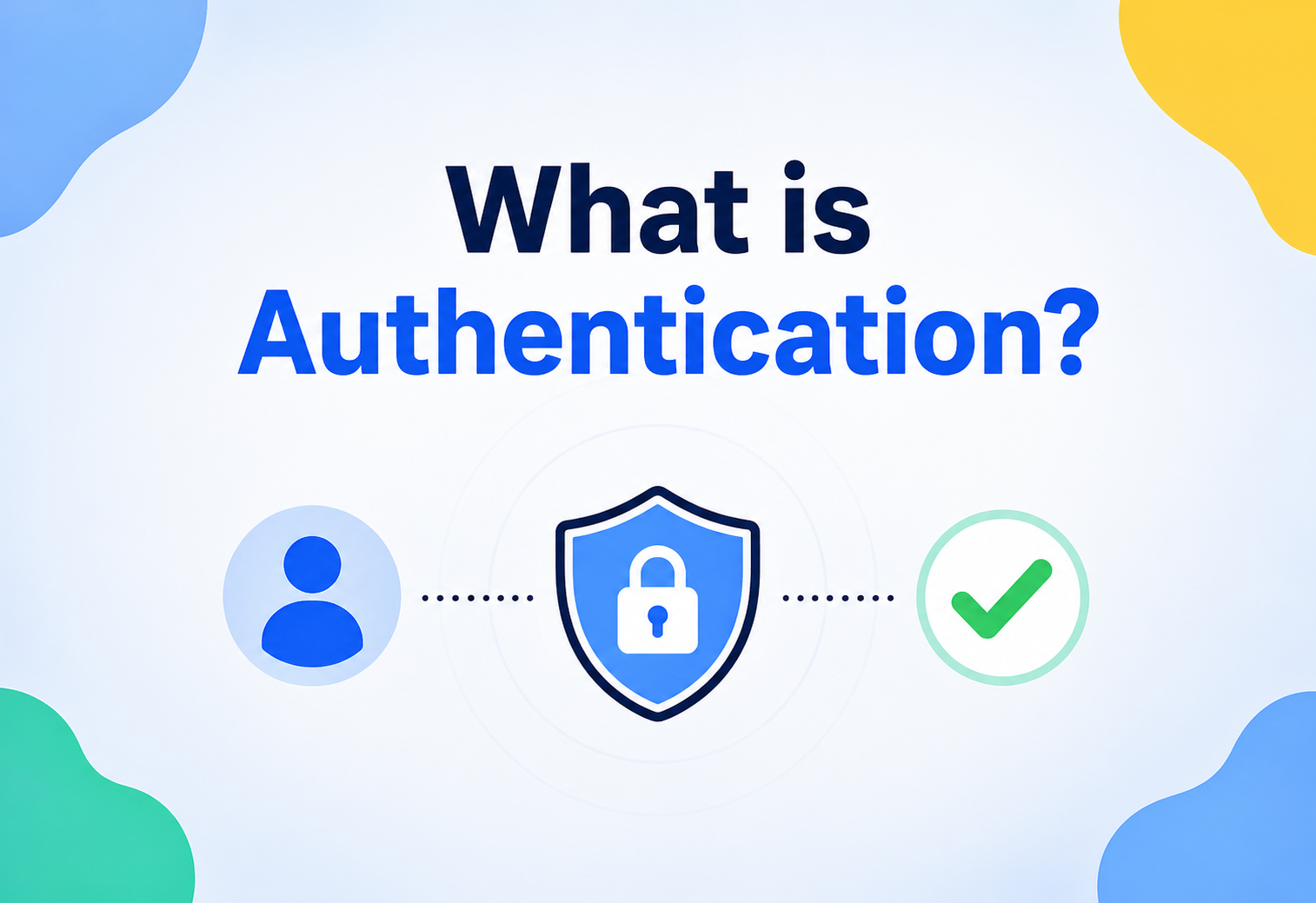
What is Authentication?
A complete, beginner-to-production guide to authentication — what it is, why every system needs it, how it works internally, how it scales to millions of users, and how companies like Google, Netflix, and Amazon build it in practice.
Introduction & History
Every single day, you prove who you are dozens of times without thinking about it. You unlock your phone with your face. You type a password to check your email. You tap your card and enter a PIN at a store. Each of these small moments is an act of authentication — the process of proving that you are who you claim to be.
In the world of software, authentication is the very first gate that stands between a stranger on the internet and your private data. Before a banking app shows you your balance, before an email service opens your inbox, before a company’s internal tool shows an employee their payroll details — the system must first answer one question: “Are you really who you say you are?”
Think of authentication like the security guard at the entrance of an office building. Before you can even think about which floor to go to or which desk is yours, the guard checks your ID badge. If the badge doesn’t match your face, you don’t get past the lobby — no matter how important you claim to be.
1.1 A Short History of Proving Identity
Authentication is not a new idea invented by computer scientists — it is one of the oldest problems in human civilization. Ancient armies used secret passwords (“watchwords”) so sentries could tell friend from foe in the dark. Medieval kings used wax seals pressed with a unique signet ring to prove that a letter truly came from them and had not been tampered with. Banks in the 19th century used signature cards, comparing a customer’s handwriting against a stored sample before releasing funds.
When computers entered the picture in the 1960s, the same problem resurfaced in a new form. The first time-sharing systems, like the Compatible Time-Sharing System (CTSS) built at MIT in 1961, allowed multiple people to use the same expensive mainframe computer through separate terminals. Suddenly, the computer needed a way to separate “Alice’s files” from “Bob’s files.” The solution was simple and familiar: a username and a password, stored in a list on the machine.
That simple idea — a shared secret known only to the user and the system — became the foundation of digital authentication for the next sixty years, and it is still the most common form of authentication today, even as far more sophisticated methods have been layered on top of it.
1.2 The Evolution Timeline
1960s — Plaintext passwords
Shared mainframes introduce the first digital “who are you” check — usernames and passwords stored in a list on the machine.
1970s — Password hashing
Unix crypt stops storing passwords in readable form — only the hash of the password is kept.
1980s–90s — Kerberos & LDAP
Centralized directory services allow one identity to work across many machines in a network.
2000s — Session cookies & TLS
SSL/TLS becomes standard and session cookies move authentication onto the web at scale.
2007–2012 — OAuth & OpenID Connect
“Log in with Google/Facebook” introduces delegated identity across the consumer web.
2010s — MFA & JWT
Multi-factor authentication and stateless JSON Web Tokens power APIs and mobile apps at massive scale.
2020s — Passkeys & Zero Trust
Passkeys, WebAuthn, biometrics, and Zero Trust architectures start moving the industry away from passwords entirely.
This tutorial walks through all of these ideas — not as a history lesson, but as building blocks. Each new mechanism was invented to fix a real weakness in the one before it, and understanding that chain of cause-and-effect is the fastest way to actually understand authentication, rather than just memorizing terms.
The Problem & Motivation
Imagine you are building your very first web application: a simple note-taking app. At first, it has no login at all — anyone who visits the website can see every note ever written by every user. This obviously will not work once more than one person uses the app. You need a way to say: “these notes belong to Priya, and only Priya should see them.”
Without authentication, a computer system has no concept of “you.” It only sees anonymous network requests. Every request looks identical, whether it came from the account owner, a coworker, or an attacker on the other side of the world. Authentication is the mechanism that attaches an identity to a request.
2.1 Why “Just Trust the Client” Doesn’t Work
A beginner’s first instinct is often to have the app itself say who the user is — for example, sending a request like GET /notes?user=priya. But this is trivially broken: anyone can change the user parameter to alice or admin and instantly see someone else’s private data. The client (the browser, the mobile app) is running on a device the attacker fully controls, so it can never be trusted to honestly declare who it is. Identity must be established and verified on the server, using something the attacker cannot easily fake or steal.
2.2 Authentication vs. Authorization — the Most Confused Pair in Security
Beginners very frequently mix up two related but distinct ideas. It is worth being extremely precise here because the rest of this guide depends on the distinction.
Authentication
Question answered: “Who are you?”
Verifies identity. Happens first. Example: logging in with a username and password.
Authorization
Question answered: “What are you allowed to do?”
Checks permissions. Happens after authentication. Example: checking whether “Priya” is allowed to delete this specific note.
At the airport, showing your passport at immigration is authentication — proving you are the person named on the document. Being allowed to enter the business-class lounge because you hold a certain ticket is authorization — a permission check that only makes sense once your identity is already established.
2.3 Real-World Consequences of Getting This Wrong
- Data breaches: Weak or missing authentication is consistently one of the top causes of large-scale data breaches, from credential-stuffing attacks on retail sites to leaked internal admin panels with no login at all.
- Account takeover: If authentication can be bypassed or guessed, an attacker can impersonate a real user completely — reading their messages, spending their money, or acting on their behalf.
- Regulatory and financial risk: Regulations like GDPR, PCI-DSS, and India’s DPDP Act require organizations to prove they have reasonable safeguards, including strong authentication, around personal and financial data. Failures can mean significant fines.
- Trust: Users abandon products where their accounts feel unsafe. Authentication is invisible when done well, and catastrophic for a brand when done poorly.
With the motivation clear, we can now build up the vocabulary and mechanics needed to design authentication correctly.
Core Concepts
Before we can look at architecture and code, we need a common vocabulary. This section builds up the ideas every authentication design depends on.
3.1 The Three Factors of Authentication
Security professionals classify every authentication method into one of three broad categories, often called “factors.” Understanding these is the foundation of everything else in this article.
| Factor | Definition | Examples |
|---|---|---|
| Something you know | A secret memorized by the user | Password, PIN, security question |
| Something you have | A physical object the user possesses | Phone (OTP app), hardware key (YubiKey), smart card |
| Something you are | A biological trait unique to the user | Fingerprint, face scan, voice, retina |
A beginner example: logging into an email account with just a password uses one factor (“something you know”). A production example used by Google, Amazon, and most banks combines a password with a one-time code sent to your phone — this is Multi-Factor Authentication (MFA), because it combines two different factor categories, making it far harder for an attacker to succeed even if they steal your password.
3.2 Identification vs. Authentication vs. Verification
- Identification — claiming an identity. Typing a username or email address.
- Authentication — proving that claim. Providing the correct password or biometric.
- Verification — the system’s internal act of checking the proof against stored records.
3.3 Credentials
A credential is any piece of evidence used to prove identity — a password, a fingerprint template, a cryptographic key, or a token. Credentials are the raw material of authentication, and how they are stored, transmitted, and verified is where most security failures happen in practice.
3.4 Sessions and Tokens
Because HTTP is a stateless protocol — meaning the server does not automatically remember who made the previous request — a system needs some way to remember “this browser already proved who it is” across multiple requests. There are two dominant approaches:
Session-based
After login, the server creates a session record (often in memory or a database like Redis) and gives the browser a random session_id in a cookie. Every future request sends that cookie, and the server looks up the session to know who it is.
Token-based
After login, the server issues a signed token (commonly a JWT — JSON Web Token) containing the user’s identity and permissions. The browser or app sends this token with every request, and the server verifies its signature without needing to look anything up in a database.
A session is like checking your coat at a theater cloakroom — you get a numbered ticket, and the cloakroom staff must look up “ticket #482” in their own records to hand back the right coat. A token is like a wristband at a music festival — the wristband itself visibly proves you paid, and any staff member can check it just by looking, without calling the ticket office.
3.5 Password Hashing
A well-built authentication system never stores a user’s actual password. Instead, it stores a hash — the output of a one-way mathematical function that turns “MyPassword123” into something like $2b$12$KIXQ..., from which the original password cannot practically be recovered. When a user logs in, the system hashes the password they typed and compares the two hashes, rather than comparing raw passwords.
Modern systems use slow, memory-hard hashing algorithms specifically designed to resist brute-force attacks, such as bcrypt, scrypt, or Argon2 (the current recommended standard from the Password Hashing Competition). Fast general-purpose hashes like plain SHA-256 are deliberately avoided for passwords because their speed makes brute-forcing billions of guesses per second feasible on modern GPUs.

// Hashing a password with BCrypt (Spring Security)
import org.springframework.security.crypto.bcrypt.BCryptPasswordEncoder;

BCryptPasswordEncoder encoder = new BCryptPasswordEncoder(12); // work factor 12

String rawPassword = "MySecurePass!23";
String hashed = encoder.encode(rawPassword);
// hashed => "$2a$12$eImiTXuWVxfM37uY4JANjQ==..."

// Verifying at login time
boolean matches = encoder.matches(rawPassword, hashed); // true
3.6 Salting
A salt is a random value added to a password before hashing, unique per user. Salting ensures that two users with the identical password (“password123”) end up with completely different stored hashes, which defeats precomputed lookup tables (called “rainbow tables”) that attackers use to reverse common hashes instantly. Modern libraries like BCrypt generate and store the salt automatically as part of the hash string, so developers rarely need to manage it by hand.
3.7 Biometric Authentication in Practice
When you unlock a phone with your face or fingerprint, the device is not sending a photo of your face to a remote server for comparison. Instead, the sensor captures your biometric trait, converts it into a mathematical representation (a “template”), and compares it locally against a template stored securely on the device itself, often inside dedicated hardware like Apple’s Secure Enclave or Android’s Trusted Execution Environment. This local-only design is deliberate: biometric traits cannot be changed the way a password can be reset, so if a fingerprint template were ever leaked from a central server, the damage would be permanent. A beginner example is unlocking a laptop with Windows Hello; a production example is a banking app that requires a fingerprint scan before authorizing a large money transfer, layering a “something you are” factor on top of an existing session.
3.8 Single Sign-On (SSO) and Federated Identity
Single Sign-On allows a user to authenticate once with a trusted identity provider and then access multiple, otherwise-independent applications without logging in again for each one. This is achieved through federated identity: applications agree to trust assertions issued by a common identity provider, using protocols like SAML (common in enterprise settings) or OpenID Connect (common on the consumer web). A beginner analogy is a company ID badge that opens the front door, the parking garage, and the cafeteria till, all because every reader trusts the same badge office, rather than each door requiring its own separate key.
Architecture & Components
A production authentication system is made up of several cooperating components. Understanding each piece — and how they connect — is essential before writing any code.
Fig 1. Cooperating components of a production authentication system.
4.1 Identity Provider (IdP)
The Identity Provider is the authoritative component that owns user identities and knows how to verify them. It could be a piece of your own application (a custom login service), or an external, dedicated system such as Okta, Auth0, Keycloak, AWS Cognito, or Google Identity Platform. Large organizations increasingly separate the IdP from individual applications so that one login works across many internal tools — this pattern is called Single Sign-On (SSO).
4.2 User Store
A database (relational like PostgreSQL/MySQL, or a directory service like LDAP/Active Directory) that holds user records: usernames, hashed passwords, MFA settings, roles, and account status (active, locked, disabled).
4.3 Session/Token Store
For session-based systems, an in-memory data store like Redis is almost always used to hold active sessions, because it offers extremely fast reads and writes and supports automatic expiration (TTL) of old sessions. For token-based systems, a store isn’t strictly required for validation, but a small store (or a “denylist”) is often kept to support token revocation, i.e., forcibly logging a user out before their token naturally expires.
4.4 API Gateway
In microservice architectures, an API Gateway is frequently the single entry point that terminates TLS, and in many designs also performs an initial authentication check — validating the token before forwarding the request further into the system — so that internal services do not each have to reimplement this logic.
4.5 MFA / Second-factor Provider
A separate integration (SMS gateway, push-notification service, or a Time-based One-Time Password library) that issues and validates the second proof of identity during login.
4.6 Auditing & Logging Component
Every login attempt, success, or failure should be recorded for security monitoring and compliance, typically shipped to a centralized logging system.
4.7 Component Responsibilities at a Glance
| Component | Primary responsibility |
|---|---|
| Identity Provider | Verifies “who are you,” issues tokens/sessions |
| User Store | Persists user records and credentials (hashed) |
| Session/Token Store | Tracks active logins, enables logout/revocation |
| API Gateway | Enforces authentication at the network edge |
| MFA Provider | Issues and checks the second factor |
| Audit Log | Records every authentication event for security review |
Internal Working: How Authentication Actually Happens
Let’s trace exactly what happens, step by step, when a user logs into a typical web application using a username and password, ending with a JWT-based token.
Fig 2. Step-by-step lifecycle of a login request ending with a signed JWT.
5.1 Step-by-Step Breakdown
Credential submission
The client sends the username and password to the server, always over HTTPS/TLS so the data is encrypted in transit.
User lookup
The server queries the user store for a record matching the given username or email.
Hash comparison
The server hashes the submitted password using the same algorithm and salt as the stored hash, and compares the two — using a constant-time comparison so timing information doesn’t leak.
Decision
If the hashes match and the account is in good standing (not locked, not disabled), authentication succeeds.
Token/session issuance
The server creates either a session record or a signed token representing the now-authenticated identity.
Response
The token or session cookie is returned to the client, which stores it and attaches it to every subsequent request.
5.2 A Minimal Java / Spring Boot Login Endpoint
@RestController
@RequestMapping("/api/auth")
public class AuthController {

    private final UserRepository userRepository;
    private final BCryptPasswordEncoder passwordEncoder;
    private final JwtService jwtService;

    public AuthController(UserRepository userRepository,
                           BCryptPasswordEncoder passwordEncoder,
                           JwtService jwtService) {
        this.userRepository = userRepository;
        this.passwordEncoder = passwordEncoder;
        this.jwtService = jwtService;
    }

    @PostMapping("/login")
    public ResponseEntity<?> login(@RequestBody LoginRequest request) {
        Optional<User> userOpt = userRepository.findByUsername(request.getUsername());

        if (userOpt.isEmpty() ||
            !passwordEncoder.matches(request.getPassword(), userOpt.get().getPasswordHash())) {
            // Same generic error for "no such user" and "wrong password"
            // to avoid revealing which accounts exist (user enumeration).
            return ResponseEntity.status(401).body(new ErrorResponse("Invalid username or password"));
        }

        User user = userOpt.get();
        if (!user.isEnabled()) {
            return ResponseEntity.status(403).body(new ErrorResponse("Account disabled"));
        }

        String token = jwtService.generateToken(user.getId(), user.getRoles());
        return ResponseEntity.ok(new LoginResponse(token));
    }
}
5.3 Verifying a JWT on Every Subsequent Request
public class JwtAuthFilter extends OncePerRequestFilter {

    private final JwtService jwtService;

    @Override
    protected void doFilterInternal(HttpServletRequest req,
                                     HttpServletResponse res,
                                     FilterChain chain) throws IOException, ServletException {
        String header = req.getHeader("Authorization");

        if (header != null && header.startsWith("Bearer ")) {
            String token = header.substring(7);
            try {
                Claims claims = jwtService.parseAndValidate(token); // signature + expiry
                String userId = claims.getSubject();
                List<String> roles = claims.get("roles", List.class);

                var auth = new UsernamePasswordAuthenticationToken(
                        userId, null,
                        roles.stream().map(SimpleGrantedAuthority::new).toList());
                SecurityContextHolder.getContext().setAuthentication(auth);
            } catch (JwtException e) {
                // Invalid/expired token — request proceeds unauthenticated
                // and will be rejected downstream by access-control rules.
            }
        }
        chain.doFilter(req, res);
    }
}
5.4 What’s Inside a JWT
A JWT has three base64url-encoded parts separated by dots: header.payload.signature. The header describes the signing algorithm; the payload (“claims”) holds data like the user ID, roles, and expiry time; the signature is a cryptographic proof, generated with a secret key (HMAC) or a private key (RSA/ECDSA), that lets the server verify nobody tampered with the payload after it was issued.
A JWT’s payload is only base64-encoded, not encrypted. Anyone who intercepts a token can read its contents (though they cannot alter it without invalidating the signature). Never put secrets like raw passwords inside a JWT payload.
Data Flow & Lifecycle
Authentication is not a single event — it has a full lifecycle from account creation through to eventual logout or expiry.

Fig 3. Account state transitions across the full authentication lifecycle.
6.1 Registration and Credential Creation
A new user provides identifying details and a password. The server validates password strength, hashes it, and stores the record — often in an unverified state until the user confirms their email or phone number, which prevents fake accounts and typos.
6.2 Login and Token Issuance
As detailed in the previous section, successful credential verification results in a session or token being issued, marking the beginning of an authenticated period.
6.3 Token Refresh
Access tokens are deliberately given a short lifetime (commonly 15 minutes to 1 hour) to limit the damage if one is stolen. To avoid forcing the user to log in again every few minutes, systems issue a longer-lived refresh token alongside the access token. When the access token expires, the client silently exchanges the refresh token for a new access token, without bothering the user.
POST /api/auth/refresh
{
  "refreshToken": "eyJhbGciOiJIUzI1NiIsInR5cCI6IkpXVCJ9..."
}

// Server validates refresh token (checks it hasn't been revoked/expired)
// and issues a brand-new access token (and often a new refresh token too —
// this rotation pattern limits the impact of a leaked refresh token).
6.4 Logout and Revocation
Logging out should invalidate the session (deleting the Redis record) or, for tokens, add the token to a short-lived denylist / revoke the associated refresh token, since a stateless JWT otherwise remains technically valid until it naturally expires.
6.5 Expiry and Re-authentication
Both sessions and tokens carry an expiry. Once expired, the user must re-authenticate — either transparently via a refresh token, or explicitly by logging in again if the refresh token has also expired or been revoked (for example, after a password change).
6.6 Account Lockout and Anomaly Response
Production systems track failed login attempts. After a threshold (e.g., 5 failed attempts), the account may be temporarily locked, or an additional verification step (CAPTCHA, email confirmation) may be triggered — a defense against brute-force and credential-stuffing attacks.
Pros, Cons & Trade-offs
There is no single “correct” authentication design — every choice trades off simplicity, security, performance, and user experience. This section compares the major approaches.
7.1 Sessions vs. Tokens
| Aspect | Session-based | Token-based (JWT) |
|---|---|---|
| State | Stateful — server stores session data | Stateless — server verifies signature only |
| Revocation | Instant — just delete the session record | Hard — token valid until expiry unless denylisted |
| Scaling | Needs shared session store (e.g., Redis) across servers | Scales easily — any server can verify independently |
| Payload size | Small cookie (just an ID) | Larger — carries claims data on every request |
| Cross-domain / mobile | Harder — cookies are browser/domain-bound | Easier — works naturally with APIs, mobile apps, SPAs |
| Best fit | Traditional server-rendered web apps | APIs, microservices, mobile, SPAs |
7.2 Password-based vs. Passwordless
Passwords
Cheap to implement, universally understood by users. But: easily phished, reused across sites, and require costly infrastructure (hashing, rate limiting, breach monitoring) to keep secure.
Passkeys / WebAuthn
Uses public-key cryptography tied to a device; nothing secret is transmitted or stored on the server, so there’s no password to phish or leak. Requires modern browser/OS/hardware support and a bigger initial engineering investment.
7.3 Centralized IdP (SSO) vs. Per-app Authentication
| Aspect | Centralized IdP / SSO | Per-application auth |
|---|---|---|
| User experience | Log in once, access everything | Separate login per app — friction |
| Security consistency | One well-audited implementation | Risk varies app to app |
| Single point of failure | IdP outage affects all apps | Failures are isolated per app |
| Engineering effort | High upfront cost to set up IdP | Lower upfront, but repeated effort per app |
7.4 Overall Advantages and Disadvantages
Advantages of strong authentication
- Attaches a verified identity to every request, enabling per-user data isolation
- Enables auditing — you can prove who did what, and when
- Foundational for authorization, personalization, and compliance
- Modern methods (passkeys, MFA) dramatically raise the cost of an attack
- Managed IdPs let small teams reach enterprise-grade security quickly
Costs and Trade-offs
- Adds friction to every user interaction — sign-ups and logins have real drop-off
- Introduces critical-path infrastructure that must always be up
- Password hashing is intentionally slow, adding CPU cost on login
- Session/token stores add another moving part to operate
- Recovery flows (forgot password, lost device) are attack surfaces of their own
There is a direct tradeoff between statelessness (tokens) and controllability (sessions). Many production systems land on a hybrid: short-lived stateless access tokens for speed, backed by a stateful, revocable refresh token so that “kill this user’s access right now” is still possible.
Performance & Scalability
Authentication sits directly in the critical path of almost every request in a system, so its performance characteristics matter enormously at scale.
8.1 Why Hashing Speed Matters — and Why It’s Deliberately Slow
BCrypt and Argon2 are intentionally slow (tens to hundreds of milliseconds per hash) to resist brute-force attacks. This is fine for the occasional login request, but it means the login endpoint itself is one of the more expensive endpoints in a system, and needs to be protected from being hammered (see rate limiting below) rather than optimized to be “fast.”
8.2 Stateless Verification at Scale
Once a JWT is issued, verifying it on every request is cheap — just a signature check using CPU-bound cryptography, with no database round trip. This is precisely why token-based authentication scales so well horizontally: any of hundreds of stateless application servers can validate a request independently, with no shared bottleneck.
Fig 4. Session-based auth funnels through a shared store; token-based auth verifies locally on every server.
8.3 Caching Strategies
- Public key caching: When verifying tokens signed with RSA/ECDSA, the IdP’s public key is cached in memory on each server, refreshed periodically, avoiding a network call per request.
- User permission caching: Roles/permissions embedded directly in the JWT avoid a database lookup on every request — at the cost of staleness if permissions change mid-session.
- Negative caching: Recently-seen invalid or revoked tokens can be cached briefly to avoid repeated denylist checks under attack traffic.
8.4 Rate Limiting the Login Endpoint
Because password hashing is CPU-intensive and login endpoints are prime targets for brute-force and credential-stuffing attacks, production systems apply strict rate limits — for example, a maximum number of login attempts per IP address or per account within a time window — often enforced at the API Gateway before the request even reaches the authentication service.
8.5 Horizontal Scaling of the Auth Service
Because the authentication service is on the critical path for essentially all traffic, it is typically deployed as multiple stateless replicas behind a load balancer, backed by a horizontally-scaled or read-replicated user database, so that authentication throughput can grow independently of any single machine’s capacity.
High Availability & Reliability
If the authentication service goes down, effectively the entire product goes down — no one can log in, and depending on token expiry, existing users may start getting logged out too. This makes authentication one of the most reliability-critical subsystems in any architecture.

9.1 Replication of the User Store
The user database is typically deployed with a primary and multiple read replicas. Login reads (fetching a user’s hash) can often be served from replicas, while writes (registration, password changes) go to the primary, improving both availability and read throughput.
9.2 Consensus and Leader Election
In distributed session stores like Redis Cluster or etcd-backed systems, a consensus protocol (such as Raft, used by etcd, or Redis Sentinel’s own failover logic) elects a leader node responsible for writes, with followers ready to take over if the leader fails. This ensures the session store keeps functioning correctly even if individual nodes crash.
9.3 CAP Theorem in Authentication Systems
The CAP theorem states that a distributed data store can only guarantee two of three properties at once: Consistency, Availability, and Partition tolerance. Authentication systems typically lean toward availability for read-heavy token verification (since a stale “is this token still valid” check is often acceptable for a few seconds), but lean toward consistency for critical writes like “this account is now locked” or “this password was just changed,” where stale data could mean a compromised account stays accessible longer than it should.
A partition between data centers might mean a just-revoked token is still accepted by a server in the isolated region for a short window. Most production systems accept this small risk in exchange for availability, and shrink the window with short token lifetimes rather than trying to achieve perfect real-time consistency globally.
9.4 Failover and Disaster Recovery
Multi-region IdP
Large companies run authentication services in multiple geographic regions, so a regional outage doesn’t take down global login.
Graceful degradation
If the MFA provider is down, some systems fall back to a secondary factor (e.g., backup codes) rather than blocking login entirely — a deliberate, security-reviewed tradeoff.
Circuit breakers
Calls from resource services to the auth service for token introspection are wrapped in circuit breakers, so a slow or failing auth service doesn’t cascade into failures across the whole platform.
Backup & restore
Regular, tested backups of the user store are essential — a lost user database is effectively a lost product.
9.5 Concurrency Concerns
Two simultaneous login requests for the same user (e.g., double-clicking “Login”) must not create inconsistent state. Databases use row-level locking or optimistic concurrency (a version column) when updating fields like “last login time” or “failed attempt count” to avoid race conditions under concurrent access.
Security
Security is not one section of authentication design — it is the entire point of it. This section covers the most important, concrete defenses.
10.1 Transport Security
Credentials and tokens must always travel over TLS (HTTPS). Sending a password or token over plain HTTP exposes it to anyone who can observe network traffic — a classic man-in-the-middle attack.
10.2 Common Attacks and Their Defenses
| Attack | Description | Defense |
|---|---|---|
| Brute force | Trying many password guesses rapidly | Rate limiting, account lockout, CAPTCHA |
| Credential stuffing | Reusing leaked username/password pairs from other breaches | MFA, breach-database checks, anomaly detection |
| Phishing | Tricking users into entering credentials on a fake site | Passkeys/WebAuthn (phishing-resistant by design), user education |
| Session hijacking | Stealing a valid session cookie/token | HttpOnly + Secure cookies, short token lifetime, IP/device binding |
| SQL injection on login form | Malicious input manipulating the login query | Parameterized queries / ORM usage, never string-concatenated SQL |
| Timing attacks | Inferring valid usernames via response time differences | Constant-time comparisons, generic error messages |
| Token replay | Reusing an intercepted valid token | Short expiry, token binding, one-time-use refresh tokens |
10.3 Secure Cookie Configuration
Set-Cookie: session_id=abc123;
  HttpOnly;         // JavaScript cannot read this cookie — blocks XSS token theft
  Secure;           // Cookie only sent over HTTPS
  SameSite=Strict;  // Cookie not sent on cross-site requests — blocks CSRF
  Max-Age=3600
10.4 Defense in Depth for Passwords
- Enforce minimum password strength (length matters more than complexity rules, per current NIST guidance).
- Check new passwords against known-breached password lists.
- Never limit maximum password length unreasonably or restrict special characters — this only weakens the password space.
- Never send password reset links that don’t expire, and always invalidate old sessions after a password change.
10.5 Password Reset and Account Recovery
The “forgot password” flow is, in practice, one of the most attacked parts of an authentication system, because it is an alternate path to gaining access to an account that does not require knowing the current password. A secure reset flow sends a single-use, time-limited link or code to a channel already proven to belong to the account owner — a verified email address or registered phone number — never a security question alone, since answers to questions like “what is your mother’s maiden name” are frequently guessable or publicly discoverable. Once a password is reset, every existing session and refresh token for that account should be invalidated immediately, so that an attacker who had previously stolen a valid session loses access the moment the legitimate owner regains control.
10.6 Zero Trust Principles
Modern architecture increasingly follows a Zero Trust model: never trust a request just because it comes from “inside the network.” Every request, internal or external, must carry a valid, verified identity, and that identity is checked at every hop, not just at the perimeter.
Fig 5. Zero-trust authentication decision flow — three checks between a request and the resource.
Monitoring, Logging & Metrics
Authentication systems need robust observability, both to detect attacks in progress and to diagnose everyday production issues.
11.1 What to Log
- Every login attempt (success and failure), with timestamp, source IP, user agent, and — critically — never the password itself.
- Token issuance and refresh events.
- Account lockouts, password resets, and MFA enrollment/removal.
- Administrative actions like manual account unlocks or permission changes.
11.2 Key Metrics to Track
| Metric | Why it matters |
|---|---|
| Login success rate | Sudden drops may indicate an outage or a broken deploy |
| Failed login rate / spikes | Signals brute-force or credential-stuffing attacks |
| p95/p99 login latency | Detects hashing bottlenecks or database slowness |
| Token verification latency | Should be extremely low; regressions hurt every downstream request |
| MFA challenge completion rate | Low rates may indicate a broken SMS/push integration |
| Account lockouts per hour | Attack indicator, and a support-load indicator |
11.3 Correlation IDs and Distributed Tracing
In a microservices setup, a single login flow may touch the gateway, the auth service, the user database, and an MFA provider. Attaching a correlation ID to the request at the edge and propagating it through every downstream call allows engineers to reconstruct the full path of a single login attempt across distributed tracing tools, which is invaluable when debugging intermittent failures.
11.4 Alerting
Alerts should fire on: an abnormal spike in failed logins from a single IP or against a single account (credential stuffing / brute force), a sudden drop in successful logins (possible outage), and unusual geographic login patterns for a given user (impossible-travel detection, e.g., a login from Delhi followed two minutes later by one from São Paulo).
Deployment & Cloud
How and where the authentication service is deployed has a direct impact on its security and reliability.
12.1 Containerization
Authentication services are commonly packaged as Docker containers and orchestrated with Kubernetes, allowing them to be scaled horizontally, rolled out with zero-downtime deployments, and automatically restarted if a pod becomes unhealthy.

# Simplified Kubernetes deployment for an auth service
apiVersion: apps/v1
kind: Deployment
metadata:
  name: auth-service
spec:
  replicas: 4
  selector:
    matchLabels:
      app: auth-service
  template:
    metadata:
      labels:
        app: auth-service
    spec:
      containers:
        - name: auth-service
          image: registry.example.com/auth-service:1.4.2
          ports:
            - containerPort: 8080
          env:
            - name: JWT_SIGNING_KEY
              valueFrom:
                secretKeyRef:
                  name: auth-secrets
                  key: jwt-signing-key
          resources:
            requests: { cpu: "250m", memory: "256Mi" }
            limits:   { cpu: "500m", memory: "512Mi" }
12.2 Secrets Management
Signing keys, database credentials, and MFA provider API keys are never hardcoded or checked into source control. They are stored in a dedicated secrets manager (AWS Secrets Manager, HashiCorp Vault, Kubernetes Secrets backed by encryption at rest) and injected into the running service at deploy time.
12.3 Cloud-Managed Identity Services
Rather than building authentication entirely from scratch, many teams use managed identity platforms: AWS Cognito, Azure Active Directory B2C, Google Identity Platform, Okta, or Auth0. These handle password storage, MFA, social login, and compliance concerns out of the box, at the cost of vendor lock-in and per-user pricing.
12.4 Blue-Green and Canary Rollouts
Because bugs in authentication logic can lock out every user simultaneously, changes to the auth service are typically rolled out cautiously — first to a small percentage of traffic (canary deployment), with automated rollback if error rates spike, rather than deploying to 100% of servers at once.
Databases, Caching & Load Balancing
Every authentication decision eventually touches a database, a cache, or a load balancer — and how those pieces are chosen and arranged determines both speed and safety at scale.
13.1 Choosing a Database for User Data
User records are usually stored in a relational database (PostgreSQL, MySQL) because of strong consistency guarantees and support for unique constraints (e.g., enforcing that no two users share an email address) — a property that is difficult to guarantee correctly in an eventually-consistent NoSQL store.
13.2 Indexing
The username/email column, being the primary lookup key on every login request, must be indexed (typically as a unique index) to keep lookups fast even as the user table grows to millions of rows. Without this index, every login would require a full table scan — catastrophic at scale.
CREATE UNIQUE INDEX idx_users_email    ON users (email);
CREATE INDEX        idx_users_username ON users (username);
13.3 Read Replicas and Partitioning
As the user base grows into the tens of millions, a single database instance may struggle. Two common strategies:
- Read replicas: Route read-heavy login lookups to replicas, keeping the primary free for writes (registrations, password changes).
- Sharding/partitioning: Split the user table across multiple database instances, commonly by a hash of the user ID or email, so no single machine holds the entire dataset.
13.4 Caching Layer: Redis
Redis plays a dual role in authentication systems: as a session store (holding active session data with automatic TTL-based expiry) and as a cache in front of the user database (caching frequently-accessed, rarely-changing data like a user’s roles, to avoid a database round-trip on every request).
# Storing a session in Redis with a 30-minute TTL
SET session:8f14e45f '{"userId": 4821, "roles": ["USER"]}' EX 1800

# On every request, the gateway does:
GET session:8f14e45f
# -> if found and not expired, request is authenticated
13.5 Load Balancing the Authentication Service
A load balancer (e.g., NGINX, AWS ALB, or an API Gateway) distributes login and token-verification traffic across multiple stateless auth service instances. Because JWT verification is stateless, any healthy instance can handle any request — load balancing here is refreshingly simple compared to session-based designs, which sometimes require “sticky sessions” to route a user’s requests to the same server unless a shared session store is used instead.
Fig 6. Load-balanced, stateless auth service pods reading from replicas and writing to the primary.
APIs & Microservices
14.1 Authenticating API Requests
REST APIs typically authenticate every request using a bearer token sent in the Authorization header:
GET /api/orders/582 HTTP/1.1
Host: api.example.com
Authorization: Bearer eyJhbGciOiJIUzI1NiIsInR5cCI6IkpXVCJ9...
14.2 Authentication in a Microservices Architecture
In a monolith, authentication logic lives in one place. In microservices, dozens of independent services need to know who the caller is, without each one re-implementing password checking. The standard pattern:
- The API Gateway authenticates the incoming request once, validating the token’s signature and expiry.
- The Gateway forwards the request downstream with identity already attached (e.g., as a verified
X-User-Idheader, or by simply passing the still-valid JWT along). - Individual microservices trust this identity because it arrived through the gateway on a network only the gateway can reach (or they independently re-verify the JWT signature — a defense-in-depth choice).
Fig 7. Gateway-terminated auth — internal services trust the pre-verified identity.
14.3 Service-to-Service Authentication
Beyond user authentication, microservices also need to authenticate each other — Service A calling Service B must prove it really is Service A. Common approaches include mutual TLS (mTLS), where both sides present certificates, or short-lived service-account tokens issued by an internal identity system, avoiding the situation where any process on the internal network can silently impersonate a trusted service.
14.4 OAuth 2.0 and OpenID Connect
When a user clicks “Log in with Google,” the application is delegating authentication to Google using the OpenID Connect (OIDC) protocol, built on top of the authorization framework OAuth 2.0. In simple terms: the app redirects the user to Google, Google authenticates them and asks for consent, and then redirects back with a signed token proving the user’s identity — without the application ever seeing the user’s Google password.

Fig 8. OpenID Connect login flow — the app never sees the user’s Google password.
Design Patterns & Anti-Patterns
A small number of established patterns compound into robust designs. A short list of anti-patterns causes most of the disasters.
15.1 Useful Patterns
Token refresh rotation
Issue a new refresh token every time one is used, and invalidate the old one. If an old, already-rotated refresh token is ever presented again, it signals theft, and the entire token family is revoked.
Backend-for-Frontend (BFF)
A dedicated backend layer holds tokens server-side on behalf of a single-page app, keeping sensitive tokens out of browser JavaScript entirely and reducing XSS exposure.
Progressive / step-up authentication
Require a lightweight login for browsing, but demand re-authentication or an extra MFA challenge before a sensitive action (like a bank transfer), balancing convenience and security.
Circuit breaker on the auth dependency
Downstream services calling the auth service for token introspection wrap that call in a circuit breaker, failing fast rather than hanging when the auth service is degraded.
15.2 Anti-Patterns to Avoid
| Anti-pattern | Why it’s dangerous |
|---|---|
| Storing passwords in plaintext or using reversible encryption | A single database leak exposes every user’s real password |
| Rolling your own crypto/hashing algorithm | Cryptography is extremely easy to get subtly, catastrophically wrong |
| Long-lived tokens with no refresh/expiry | A stolen token remains valid indefinitely |
| Detailed error messages (“no such username” vs “wrong password”) | Enables user enumeration attacks |
Storing JWTs in localStorage | Directly readable by any injected script — a serious XSS risk |
| Trusting client-supplied user IDs without verifying the token | Trivial impersonation of any user |
| Using the same secret key across all environments (dev/stage/prod) | A leaked dev key compromises production |
Best Practices & Common Mistakes
A distilled checklist of what tends to work and, just as importantly, what tends to quietly go wrong.
16.1 Best Practices Checklist
Do
- Hash passwords with a slow, salted algorithm (bcrypt, Argon2) — never a fast general-purpose hash
- Enforce HTTPS everywhere; never allow authentication endpoints over plain HTTP
- Use short-lived access tokens paired with longer-lived, revocable refresh tokens
- Offer MFA, at minimum as an optional, strongly encouraged setting
- Rate-limit and monitor the login endpoint; lock accounts (temporarily) after repeated failures
- Return generic error messages for failed logins to prevent user enumeration
- Invalidate all active sessions/tokens after a password reset
- Log every authentication event, but never log raw passwords or full tokens
- Rotate signing keys periodically, and support graceful key rollover
- Prefer battle-tested libraries and managed identity providers over custom-built cryptography
Don’t
- Compare passwords with plain
==— timing information leaks - Put JWT signing secrets in source code or shared config files
- Treat “logged in” as “authorized for everything” — permission checks are still needed
- Assume “logout” only means clearing the local cookie — the server-side session must go too
- Design password reset around guessable security questions
16.2 Common Mistakes Beginners Make
Comparing passwords with ==
String comparison operators often short-circuit at the first mismatched character, leaking timing information. Always use a constant-time comparison for secrets.
Putting the JWT secret in source code
Anyone with repository access — or anyone who finds the public GitHub repo — can then forge valid tokens for any user.
Treating “logged in” as “authorized for everything”
Authentication and authorization are separate checks; every sensitive action still needs its own permission check.
Forgetting to expire old sessions on logout
A “logout” button that only clears the local cookie, while the session remains valid server-side, doesn’t actually protect a user whose device was stolen.
Real-World / Industry Examples
The same principles that help a two-person startup also power the biggest identity systems on the planet — just at very different scales.
Google’s authentication system supports billions of accounts and popularized the “Sign in with Google” OpenID Connect flow used by countless third-party apps. Google also pioneered widespread consumer use of physical security keys (via the Advanced Protection Program) and, more recently, passkeys, pushing the industry toward passwordless authentication.
Netflix
Netflix operates authentication across hundreds of millions of accounts and thousands of device types (TVs, consoles, phones, browsers). It relies heavily on token-based, stateless authentication so that its globally distributed microservices architecture can verify identity without a centralized bottleneck, and it profile-switches within a single authenticated account using lightweight, locally-scoped session data.
Amazon
Amazon Web Services offers Cognito, a fully managed authentication and user-directory service used by countless companies to avoid building login systems from scratch. Internally, Amazon’s own retail platform uses layered, risk-based authentication — adding extra verification steps automatically when a login looks unusual (new device, new location, high-value account).
Uber
Uber’s authentication needs to work reliably even on poor mobile networks in many countries, so it relies heavily on phone-number-based OTP (one-time password) login rather than traditional passwords for riders, reducing both friction and the password-reuse risks associated with password-based systems, while using stronger, MFA-backed authentication for its internal engineering and driver-facing systems.
Banking systems in India
Indian banking and payment systems (UPI, net banking) commonly combine a knowledge factor (MPIN or password) with a possession factor (a registered device or OTP sent to a registered mobile number), aligning with RBI’s mandated two-factor authentication guidelines for digital financial transactions — a direct, large-scale, real-world example of the “factors of authentication” concept from Section 3.
GitHub and Microsoft
GitHub, used daily by tens of millions of developers, strongly encourages hardware security keys and TOTP-based MFA for account protection, and has progressively phased out password-based authentication for Git operations entirely in favor of personal access tokens and SSH keys — a practical illustration of moving from long-lived shared secrets toward scoped, revocable credentials. Microsoft’s identity platform, Azure Active Directory (Entra ID), is one of the largest identity providers in the world, handling authentication for enterprise employees across thousands of organizations, and has been a major driver behind the industry-wide push toward passwordless sign-in using Windows Hello, authenticator apps, and FIDO2 security keys.
17.1 What These Examples Have in Common
Despite operating at vastly different scales and in different industries, every one of these systems follows the same underlying principles covered in this guide: credentials (or cryptographic key pairs) are never stored in a directly reusable form, tokens are short-lived and scoped, multiple factors are layered for sensitive actions, and the authentication service itself is treated as a highly available, independently scaled piece of critical infrastructure rather than a small feature bolted onto the rest of the product.
“Authentication is invisible when done well — and catastrophic for a brand when done poorly.”
FAQ, Summary & Key Takeaways
Short, direct answers to the questions that come up most often as teams begin taking authentication seriously — followed by a compact summary of the whole guide.
18.1 Frequently Asked Questions
Q: Is authentication the same as encryption?
No. Encryption protects data confidentiality; authentication proves identity. They are often used together (e.g., TLS encrypts the channel over which authentication happens), but they solve different problems.
Q: Why can’t I just store passwords encrypted instead of hashed?
Encryption is reversible by design — anyone with the decryption key can recover the original password, including an attacker who steals both the encrypted data and the key. Hashing is intentionally one-way, so even the system itself cannot recover the original password.
Q: Do I need to build my own authentication system?
For most production applications, no. Using a well-audited managed provider (Auth0, AWS Cognito, Okta, Firebase Auth) or a mature open-source solution (Keycloak, Spring Security) is almost always safer and faster than building authentication from scratch, unless identity management is genuinely core to your product.
Q: What’s the difference between a JWT and an opaque token?
A JWT is self-contained and verifiable without a database lookup (stateless). An opaque token is just a random string that means nothing on its own — the server must look it up in a database or cache to know what it represents (stateful). Opaque tokens are easier to revoke instantly; JWTs are cheaper to verify at scale.
Q: Is MFA really necessary for a small application?
Even for small applications, offering MFA as an option significantly reduces account-takeover risk at very low implementation cost using standard libraries (e.g., TOTP), and is increasingly expected by users.
Q: What happens if the authentication service itself is compromised?
Because the auth service is the trust anchor for an entire system, a compromise here is treated as a top-severity incident: signing keys are rotated immediately (invalidating every existing token), all active sessions are force-expired, affected users are required to reset passwords, and a full audit trail is reviewed to determine the blast radius. This is precisely why signing keys are stored in dedicated secrets managers with strict access controls rather than alongside regular application configuration.
Q: Should access tokens be stored in cookies or in local storage on the client?
Security-conscious implementations generally favor HttpOnly, Secure cookies over browser storage APIs like localStorage, because HttpOnly cookies are inaccessible to JavaScript and therefore far more resistant to theft via a cross-site scripting (XSS) vulnerability elsewhere on the same page. The tradeoff is that cookies bring their own risk, cross-site request forgery (CSRF), which is mitigated with the SameSite cookie attribute and, where needed, an explicit anti-CSRF token.
18.2 Summary
Authentication is the foundational process of proving identity before any other part of a system can safely make decisions about a user. It began with simple shared secrets on 1960s mainframes and has evolved into a rich ecosystem of hashing algorithms, tokens, multi-factor schemes, delegated identity protocols like OAuth/OIDC, and passwordless standards like passkeys. A production-grade authentication system is not just a login form — it is a distributed architecture spanning identity providers, replicated databases, caching layers, monitoring, and careful tradeoffs between statelessness and revocability, availability and consistency, convenience and security.
Key Takeaways
- Authentication answers “who are you?”; authorization answers “what can you do?” — never conflate the two.
- Never store raw passwords; always use a slow, salted hash like bcrypt or Argon2.
- Choose sessions for simplicity and instant revocation, or tokens for statelessness and scale — most real systems use a hybrid.
- Multi-factor authentication combines two different factor categories (know/have/are) for dramatically stronger security.
- Authentication is a critical-path, high-availability system — design it with replication, caching, rate limiting, and monitoring from day one, not as an afterthought.
- Prefer proven libraries and managed identity platforms over custom cryptography.
Once authentication is solid, the natural next topics to study are Authorization & Access Control (RBAC/ABAC), OAuth 2.0 in depth, and Zero Trust Architecture — each builds directly on the identity foundation covered in this guide.