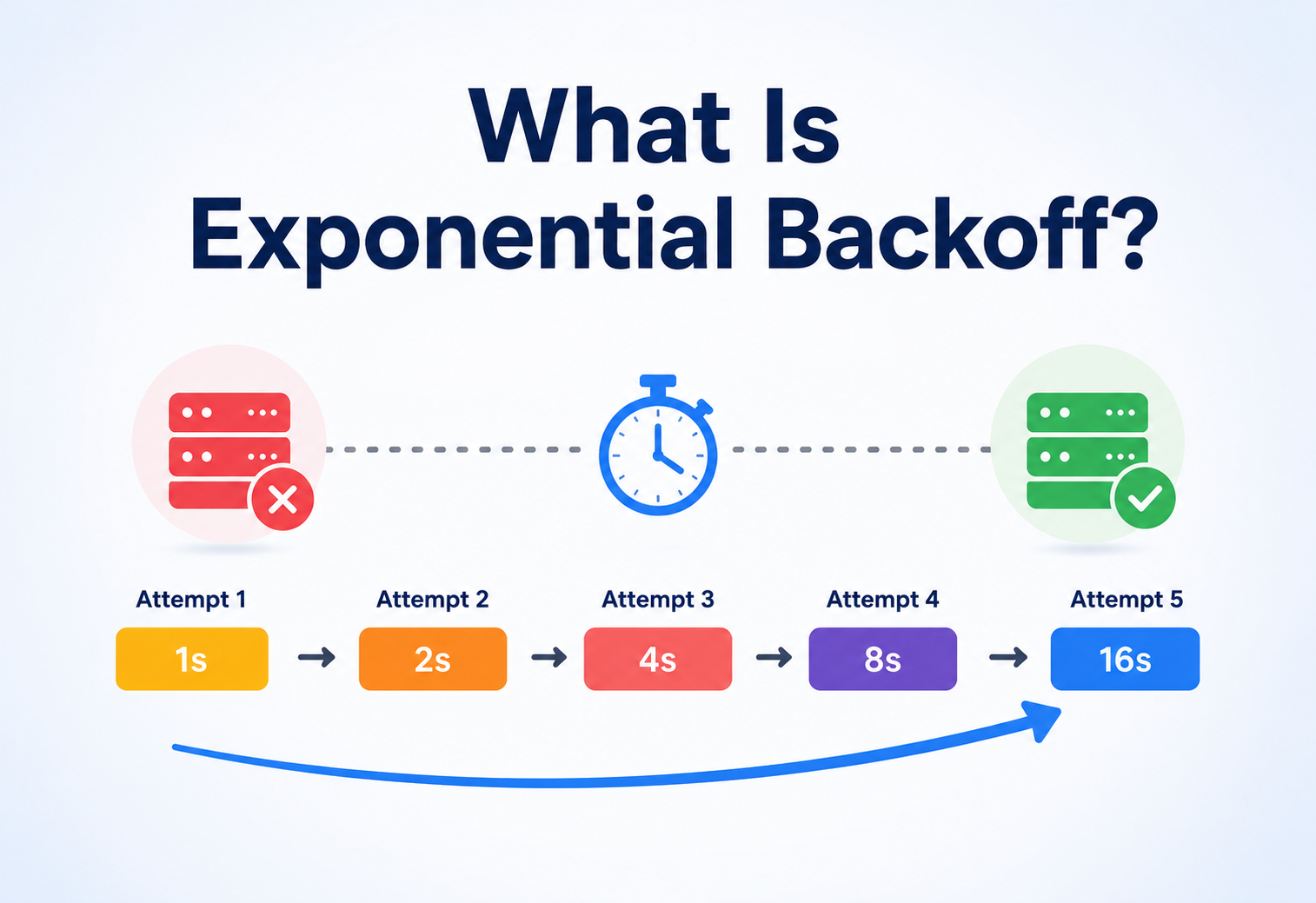
What Is Exponential Backoff?
A time‑tested algorithm for making systems retry politely under failure. This guide walks you from the very first idea — “why not just try again?” — all the way to the production‑grade patterns used by AWS, Google, and Kubernetes, complete with diagrams, Java code, and the trade‑offs nobody tells you about.
Introduction & History
Picture yourself on the phone. You dial a friend and get a busy tone. You hang up and dial again a second later — still busy. Do you now redial every second forever? Of course not. You wait a bit longer between each try, then a bit longer still, until either the line clears or you give up and move on with your day. Congratulations — you have just invented exponential backoff. Every large distributed system on Earth does exactly this, only far more precisely, millions of times a second.
Formally, exponential backoff is a strategy for retrying a failed operation in which the wait between successive attempts grows exponentially — typically doubling after each failure. Instead of hammering a struggling service with a wall of instant retries, the client politely spaces its attempts further and further apart, giving the downstream system a genuine chance to recover.
1.1 Why it exists
It exists because retrying too aggressively is one of the most destructive things a well‑meaning client can do. When a downstream service starts failing, hundreds or thousands of clients often notice at the exact same instant. If every one of them immediately retries, and retries again, the recovering service is drowned in an even bigger wave than the one that took it down — a classic self‑inflicted outage known as a “retry storm.” Exponential backoff exists specifically to prevent that.
1.2 Where it is used
Everywhere retries happen: cloud SDKs (AWS, Google Cloud, Azure), HTTP client libraries, gRPC calls, database drivers, message queue consumers, Kubernetes container restarts, mobile push delivery, and even the low‑level network stack on your laptop right now.
1.3 A simple analogy
Think of exponential backoff like knocking on a door where nobody answered the first time. You wait one second and knock again — still nothing. Two seconds — nothing. Four seconds — nothing. Eight seconds. Sixteen. Rather than pounding continuously (which would only annoy the neighbours), you back off exponentially, so that if someone eventually does come to the door, they aren’t greeted by a jackhammer.
- 1970sALOHAnet — the first packet‑radio network — struggles with shared‑medium collisions and pioneers randomised retry timing.
- 1976Metcalfe & Boggs publish the seminal Ethernet paper introducing CSMA/CD; Binary Exponential Backoff (BEB) is the collision‑resolution scheme.
- 1980s–90sBEB is baked into the IEEE 802.3 Ethernet standard and shipped in every network card of the era.
- 2000sAs distributed systems and web APIs scale, the same pattern re‑emerges at the application layer — retry logic in database drivers, message queues, and HTTP clients.
- 2015–nowAWS, Google, and Netflix publish influential engineering posts on “Exponential Backoff and Jitter,” making it the industry‑wide default for cloud SDK retries.
Fig 1.1 · the same failure, three retry strategies — constant retries flood, linear retries add up, exponential retries let the target breathe.
Today, exponential backoff sits alongside timeouts, circuit breakers, and idempotency keys as one of the core building blocks of resilient distributed‑systems design — and is a standard topic in system design interviews and reliability engineering practice.
Problem & Motivation
To see why exponential backoff was invented, first look at the pain of doing the opposite — retrying naively. In any real‑world system, calls fail. The question is not whether to retry, but how.
2.1 Transient failures are unavoidable
Networks drop packets, servers restart, load balancers rebalance, garbage collectors pause, DNS blips, and databases briefly overload. These transient failures are a fact of distributed life — and almost all of them resolve on their own within a few seconds. Not retrying at all would waste that natural recovery; retrying badly would make things worse.
- Network hiccups — a lost packet, a brief TCP reset.
- Momentary overload — a downstream service catching up after a spike.
- Failovers — a primary node dying while a replica takes over.
- Cold caches — the first few requests after a restart are slow.
- Rate limiting — a temporary 429 Too Many Requests that will clear.
2.2 The retry storm (a.k.a. the thundering herd)
Now imagine ten thousand clients all noticing that a shared service just returned an error, and all of them instantly retrying. The service, already struggling, is now hit by ten thousand simultaneous retries on top of the normal load — and dies harder. Worse, when it comes back up, those clients retry again, and the cycle repeats. This is a retry storm, sometimes also called a thundering herd.
2.3 Why not just retry with a fixed delay?
Fixed‑delay retries (e.g., wait 100 ms between every attempt) help a little, but they still keep the load on the failing service constant — and if all clients are on the same fixed schedule, they still hit the service in sync. Fixed delays merely postpone the storm; they don’t defuse it.
What naive retries cost you
- Retry storms turn small blips into full outages
- Fixed delays keep the load flat but still synchronised
- Unbounded retries hide problems until they become disasters
- Retrying non‑retryable errors wastes time and money
- Retrying non‑idempotent operations causes duplicates
What exponential backoff gives back
- Load on the failing service falls quickly over time
- Combined with jitter, retries spread out across time
- Bounded retries mean bounded worst‑case latency
- Predicates keep retries targeted at truly transient errors
- Composes cleanly with circuit breakers and deadlines
“A retry is a promise. Exponential backoff is what stops that promise from turning into a threat.”
Core Concepts
Before we look at how any of this is built, let’s nail down the vocabulary. Each term below shows up over and over in retry libraries, cloud SDKs, and design documents.
Retry
Attempting the same operation again after a failure, on the assumption that the failure may have been transient.
Backoff
The wait between successive retries. “Backing off” means giving the downstream system space rather than pounding it.
Exponential growth
Each successive delay is multiplied by a growth factor (usually 2), so delays get much larger, much quicker.
Base delay
The starting wait after the first failure — typically 50–200 ms in production systems.
Growth factor
The multiplier applied to the previous delay. A factor of 2 doubles the wait each time; 3 triples it.
Max delay (cap)
An upper bound on any single delay, so exponential growth doesn’t balloon into hours.
Max attempts
The total number of tries allowed before the client gives up and surfaces the failure.
Jitter
Random noise added to each delay so different clients don’t all retry at the exact same moment.
Retry predicate
The rule that decides whether a given error is worth retrying at all (a timeout is; a validation error isn’t).
Deadline
An absolute “give up by” timestamp for the whole operation, independent of how many attempts are left.
3.1 The formula
The essence of exponential backoff fits in a single line of maths. Given a base delay b, a growth factor g, and an attempt number n (starting at 0), the raw delay for the next attempt is:
delay(n) = min( b × g^n , max_delay )With b = 100 ms and g = 2, that gives the classic sequence:
| Attempt | Delay before retry | Notes |
|---|---|---|
| 1 | 100 ms | base delay |
| 2 | 200 ms | 2× the last |
| 3 | 400 ms | 2× the last |
| 4 | 800 ms | 2× the last |
| 5 | 1 600 ms | still doubling |
| 6 | 3 200 ms | likely capped in prod |
3.2 Comparing strategies visually
The value of exponential over linear or constant retries becomes obvious once you draw it. Constant retries flatline at the top of the load curve; linear retries improve modestly; exponential retries fall off a cliff — exactly what a recovering system needs.
Architecture & Components
At runtime, exponential backoff is not a single function but a small system of cooperating components sitting between your business code and the operation you’re trying to call.
Fig 4.1 · the Retry Policy hides the whole loop — predicate, backoff calculator, jitter, and attempt counter — behind a single call.
Retry Policy
The orchestrator. Wraps the operation, catches failures, coordinates the other components, and decides when to give up.
Backoff Calculator
Computes the raw delay from the base, growth factor, cap, and current attempt number.
Jitter Function
Adds randomness to the raw delay so different clients don’t line up their retries at the same instant.
Retry Predicate
Decides whether a specific failure is worth retrying — e.g. a timeout yes, a 400 Bad Request no.
Attempt Budget
Tracks how many attempts have been used, enforces the maximum, and prevents infinite retry loops.
Underlying Operation
The thing being retried — an HTTP request, a gRPC call, a database transaction, a queue publish.
In real systems, this logic rarely lives in hand‑written code. It usually comes from an HTTP client (like Java’s HttpClient wrapped with retry logic, or Spring’s RetryTemplate), a cloud SDK (AWS, Google Cloud, Azure), or a dedicated resilience library (resilience4j for Java, Polly for .NET).
Internal Working: How the Algorithm Actually Runs
Let’s trace through exactly what happens, step by step, when a call fails and a well‑built retry policy takes over.
- 1
Initial attempt
The client makes the operation call for the first time, with no delay.
- 2
Failure detected
The operation returns an error, times out, or throws an exception.
- 3
Retry predicate evaluated
The policy checks: is this specific error one worth retrying? A timeout usually is; a validation error usually isn’t (retrying won’t change the answer).
- 4
Attempt budget checked
Have we already used the maximum allowed retries? If yes, give up and propagate the final error.
- 5
Delay calculated
The backoff calculator computes the raw delay: base_delay × growth_factor^attempt, capped at max_delay.
- 6
Jitter applied
Randomness is mixed into the raw delay so this client’s wait doesn’t match every other client’s wait to the millisecond.
- 7
Thread sleeps or reschedules
The client waits — either by blocking a thread (simple, but wasteful) or scheduling an async callback/timer (efficient, used by production systems).
- 8
Retry attempted
The operation is called again. If it succeeds, we’re done. If it fails, we loop back to step 3 with an incremented attempt counter.
5.1 The jitter problem in detail
Pure exponential backoff without jitter has a subtle but serious flaw. If ten thousand clients all fail at the same instant (because the server just went down), they will all compute the exact same delay sequence — 100 ms, 200 ms, 400 ms — and retry at the same moments, just staggered further apart. The retry storm doesn’t disappear; it merely gets slightly less frequent. That is why virtually every production implementation adds jitter. Google’s engineering blog and the AWS Architecture Blog have popularised three common jitter strategies:
Full Jitter
delay = random(0, cappedDelay). The wait is uniformly random between zero and the calculated cap. Simple and extremely effective at spreading load.
Equal Jitter
delay = cappedDelay/2 + random(0, cappedDelay/2). Keeps a guaranteed minimum wait while still adding randomness — avoids near‑zero delays.
Decorrelated Jitter
delay = random(base, previousDelay × 3). Each delay depends on the previous one; AWS found this spreads retries the most evenly in practice.
Fig 5.1 · without jitter, retry spikes; with jitter, retry trickle.
5.2 Java implementation — from naive to production‑grade
public class NaiveBackoff {
    public static <T> T retry(Callable<T> operation, int maxAttempts) throws Exception {
        long baseDelayMs = 100;
        long maxDelayMs = 10_000;

        for (int attempt = 0; attempt < maxAttempts; attempt++) {
            try {
                return operation.call();
            } catch (Exception e) {
                if (attempt == maxAttempts - 1) {
                    throw e; // budget exhausted, give up
                }
                long delay = Math.min(baseDelayMs * (1L << attempt), maxDelayMs);
                Thread.sleep(delay);
            }
        }
        throw new IllegalStateException("unreachable");
    }
}import java.util.concurrent.Callable;
import java.util.concurrent.ThreadLocalRandom;
import java.util.function.Predicate;
public class ExponentialBackoffRetrier {
private final long baseDelayMs;
private final long maxDelayMs;
private final int maxAttempts;
private final Predicate<Exception> isRetryable;
public ExponentialBackoffRetrier(long baseDelayMs, long maxDelayMs,
int maxAttempts, Predicate<Exception> isRetryable) {
this.baseDelayMs = baseDelayMs;
this.maxDelayMs = maxDelayMs;
this.maxAttempts = maxAttempts;
this.isRetryable = isRetryable;
}
public <T> T execute(Callable<T> operation) throws Exception {
int attempt = 0;
while (true) {
try {
return operation.call();
} catch (Exception e) {
attempt++;
boolean canRetry = attempt < maxAttempts && isRetryable.test(e);
if (!canRetry) {
throw e;
}
long delay = nextDelayWithFullJitter(attempt);
Thread.sleep(delay);
}
}
}
// delay(n) = random(0, min(maxDelay, base * 2^n))
private long nextDelayWithFullJitter(int attempt) {
long cappedDelay = Math.min(maxDelayMs, baseDelayMs * (1L << attempt));
return ThreadLocalRandom.current().nextLong(0, cappedDelay + 1);
}
}ExponentialBackoffRetrier retrier = new ExponentialBackoffRetrier(
100, // base delay: 100ms
10_000, // max delay: 10s
6, // max attempts
ex -> ex instanceof java.net.SocketTimeoutException
|| ex instanceof java.io.IOException
);
String response = retrier.execute(() -> callFlakyService());5.3 Async, non‑blocking backoff (production reality)
Calling Thread.sleep() works in simple examples, but it blocks an entire thread while waiting — wasteful in high‑concurrency systems where threads are expensive. Real production systems (and most retry libraries) use a scheduled executor to sleep “for free,” freeing the thread to do other work.
import java.util.concurrent.*;

public class AsyncBackoffRetrier {
    private final ScheduledExecutorService scheduler = Executors.newScheduledThreadPool(2);

    public <T> CompletableFuture<T> execute(Callable<T> operation,
                                              long baseDelayMs, long maxDelayMs, int maxAttempts) {
        CompletableFuture<T> future = new CompletableFuture<>();
        attempt(operation, 0, baseDelayMs, maxDelayMs, maxAttempts, future);
        return future;
    }

    private <T> void attempt(Callable<T> operation, int attemptNum,
                              long baseDelayMs, long maxDelayMs, int maxAttempts,
                              CompletableFuture<T> future) {
        try {
            future.complete(operation.call());
        } catch (Exception e) {
            if (attemptNum + 1 >= maxAttempts) {
                future.completeExceptionally(e);
                return;
            }
            long cappedDelay = Math.min(maxDelayMs, baseDelayMs * (1L << attemptNum));
            long jittered = ThreadLocalRandom.current().nextLong(0, cappedDelay + 1);

            scheduler.schedule(
                () -> attempt(operation, attemptNum + 1, baseDelayMs, maxDelayMs, maxAttempts, future),
                jittered, TimeUnit.MILLISECONDS
            );
        }
    }
}Data Flow & Lifecycle
Zooming out from a single retry, it’s worth visualising the full lifecycle of a request that eventually succeeds after backing off — and the parallel lifecycle when it exhausts its retries and finally fails.
Fig 6.1 · four attempts, three failures, one success — the caller sees a single (slightly slow) call.
A request also needs a clear exit path when things don’t recover. This is where max attempts and, in many systems, a deadline (an absolute time budget for the whole operation, not just each attempt) come in. Conceptually, every retry policy is a small state machine with these transitions:
- State Attempting — the operation is in flight. On success → Success; on failure → Evaluating.
- State Evaluating — check predicate and budget. Not retryable or exhausted → Give up; retryable and budget remains → Waiting.
- State Waiting — sleep for the jittered backoff delay. When the delay elapses → Attempting.
- Terminal Success — return the result to the caller.
- Terminal Give up — surface the final error to the caller.
This state‑machine view matters because it clarifies that exponential backoff is not just “a formula for a number” — it is a full control loop with clear entry conditions, exit conditions, and state transitions. Getting the exit conditions wrong (e.g., no max attempts) is one of the most common real‑world bugs, leading to retry loops that never terminate.
Advantages, Disadvantages & Trade-offs
Advantages
- Dramatically reduces retry‑driven load on a recovering system compared to constant retries.
- Simple to implement and reason about — a handful of parameters (base, factor, cap, max attempts).
- Well‑understood, battle‑tested pattern with decades of production use across the industry.
- Fails fast on the first couple of attempts (good UX for genuinely transient blips) while still protecting the backend on sustained failures.
- Composes cleanly with other resilience patterns (circuit breakers, timeouts, bulkheads, rate limiters).
Disadvantages & Trade-offs
- Without jitter, it does not actually solve synchronised retry storms — it just delays them.
- Increases end‑to‑end latency for the caller, especially after several failed attempts.
- Poorly chosen caps or max‑attempt counts can make a user wait far too long, hurting UX.
- Retrying non‑idempotent operations (like “charge this credit card”) can cause duplicate side effects if not designed carefully.
- Doesn’t address the root cause — if the downstream system is fundamentally broken, backoff just delays an inevitable failure.
- Adds complexity: retry predicates, budgets, and jitter all need careful tuning per use case.
Performance & Scalability
At scale, the way you configure backoff has an outsized effect on system behaviour. A few performance considerations that repeatedly matter in production:
8.1 Aggregate retry rate, not just individual latency
A single client’s retry delay is not the interesting number at scale — the aggregate retry rate across your entire fleet is. If you have one million clients and even a modest fraction of them are retrying simultaneously, that can still be a huge spike. This is precisely why jitter — spreading that fraction out across time — matters more as fleet size grows.
8.2 Retry amplification in call chains
In a microservices architecture, service A calls B, which calls C, which calls D. If every layer independently retries three times, a single failure at D can turn into 3 × 3 × 3 = 27 actual calls to D. This is called retry amplification, and it is a serious, frequently‑overlooked scalability hazard.
Fig 8.1 · one failure at D, twenty‑seven actual calls — because every hop retried on its own.
8.3 Capping delay for scalability
Without a max_delay cap, exponential growth becomes absurd very quickly — attempt 20 with a 100 ms base would be roughly 100 000 seconds (over a day!). Production systems almost always cap the delay (commonly in the 20–60 second range) so retries stay meaningfully frequent even during extended outages, without needing an unbounded number of attempts.
High Availability & Reliability
Exponential backoff is one piece of a broader resilience toolkit used to keep distributed systems highly available. It works best in combination with these companion patterns:
9.1 Circuit breaker
A circuit breaker tracks the failure rate of calls to a downstream service. If failures cross a threshold, the circuit “opens,” and the client stops sending requests entirely for a cooldown period — no retries, no backoff, just an immediate local failure. This protects a badly‑broken downstream service from being hit by even spread‑out, jittered retries. After the cooldown, the circuit goes “half‑open” and lets a trickle of test requests through to check for recovery.
Fig 9.1 · the circuit breaker takes over exactly where backoff runs out of runway.
9.2 Timeouts
Backoff only kicks in after a failure is detected — and a hung connection that never responds isn’t a “failure” until a timeout fires. Every retryable call needs a sane timeout, or the whole retry loop can stall indefinitely on a single hanging attempt.
9.3 Bulkheads
Isolating resources (thread pools, connection pools) per downstream dependency so one struggling dependency — and its retries — cannot starve resources needed by unrelated, healthy parts of the system.
9.4 Retry budgets
Some systems cap not just per‑request retries, but the overall fraction of traffic that is allowed to be retries (e.g., “retries may not exceed 10 % of total request volume in any given minute”). This provides a system‑wide safety valve independent of any single client’s backoff settings.
Together, these patterns provide
- Graceful degradation instead of cascading failure
- Faster detection and containment of unhealthy dependencies
- Automatic recovery once the root cause clears
But backoff alone cannot provide
- Protection against a truly broken (not just overloaded) dependency
- Prevention of retry amplification across deep call chains
- Guarantees about end‑to‑end latency for the caller
Security Considerations
Retry logic isn’t just a performance concern — it has real security implications too.
- Credential‑stuffing amplification. Naive retry logic on login endpoints can inadvertently help brute‑force or credential‑stuffing attacks look like “normal” retriable traffic if not paired with rate limiting and account lockout logic.
- Self‑inflicted denial‑of‑service. As covered above, retry storms are effectively a self‑inflicted DDoS. Attackers who understand this can deliberately trigger transient errors (e.g., via a brief flood) to induce a much larger retry storm from your legitimate client base.
- Sensitive data in retry logs. Logging every retry attempt (recommended for observability) must be done carefully — don’t log full request payloads if they contain secrets, tokens, or personal data.
- Replay and idempotency‑key management. Idempotency keys used to make retries safe must themselves be generated and stored securely, and expired/cleaned up, or they can become a vector for cache‑poisoning or replay‑style bugs.
- Respecting server‑provided backoff hints. Many APIs return a Retry-After header specifying exactly how long to wait. Ignoring this and retrying on your own schedule can be treated by the server as abusive or non‑compliant traffic, sometimes leading to IP or API‑key bans.
Monitoring, Logging & Metrics
Retry logic that runs silently is dangerous — if retries are masking a growing problem, you want to know about it before it becomes an outage. Key things to track:
Retry count / rate
How many retries are happening per minute, per endpoint, per downstream dependency.
Retry success rate
Of the retries attempted, what fraction eventually succeed vs. exhaust their budget?
Backoff delay distribution
Histogram of actual delays used — helps validate jitter is working and caps are reasonable.
Exhausted‑retry rate
How often clients give up after using their full retry budget — a leading indicator of real outages.
End‑to‑end latency (p50/p95/p99)
Retries directly inflate tail latency; track how much of your p99 is retry‑induced.
Downstream error rate
Correlate retry spikes with the health metrics of the dependency being called.
Structured log entries for each retry attempt (attempt number, delay used, error type, target service) feed dashboards and alerts. A sudden, sustained spike in retry rate is often the earliest possible signal of a developing incident — well before user‑facing error rates climb, because retries are, by design, quietly absorbing the first wave of failures.
Deployment & Cloud Usage
Every major cloud platform bakes exponential backoff (usually with jitter) directly into its SDKs, so most developers use it without writing the algorithm themselves:
- AWS SDKs implement automatic retries with exponential backoff and jitter for services like S3, DynamoDB, and EC2 API calls; the retry mode (legacy, standard, or adaptive) can be configured.
- Google Cloud client libraries use configurable exponential backoff (with jitter) as the default retry strategy for gRPC‑ and REST‑based services like Cloud Storage and Firestore.
- Azure SDKs provide built‑in retry policies with exponential backoff for services like Cosmos DB and Blob Storage.
- Kubernetes uses exponential backoff for restarting crashed containers (CrashLoopBackOff) — you’ve probably seen this exact term in a kubectl get pods output.
- Message queues like Amazon SQS, RabbitMQ, and Kafka consumers commonly implement backoff for message redelivery after processing failures, often routing permanently‑failing messages to a dead‑letter queue after retries are exhausted.
12.1 Deployment‑time configuration considerations
When configuring backoff in a real deployment, teams typically tune these settings per environment and per downstream dependency:
| Setting | Typical value | Notes |
|---|---|---|
| Base delay | 50–200 ms | Lower for latency‑sensitive user‑facing calls |
| Growth factor | 2 | Occasionally 1.5–3 depending on tolerance for latency |
| Max delay (cap) | 10–60 s | Higher for background/batch jobs, lower for interactive requests |
| Max attempts | 3–7 | Balance between resilience and total worst‑case latency |
| Jitter strategy | Full or Equal Jitter | Full Jitter for max spread; Equal Jitter when a floor delay matters |
APIs & Microservices
In a microservices world, backoff decisions touch API design directly, not just client implementation.
13.1 Designing APIs to be retry‑friendly
- Return clear, distinguishable status codes. A well‑designed API separates “retry me” errors (like 503 Service Unavailable, 429 Too Many Requests) from “don’t retry me” errors (like 400 Bad Request, 404 Not Found), so clients can build accurate retry predicates.
- Send a Retry-After header whenever the server already knows how long a client should wait (e.g., during a planned maintenance window or a known rate‑limit reset).
- Support idempotency keys for any operation with a side effect (payments, resource creation) so retries are provably safe.
- Expose health/readiness endpoints so orchestrators like Kubernetes can distinguish “still starting up, don’t route traffic yet” from “genuinely broken.”
13.2 Retry policy propagation across service boundaries
As mentioned in the performance section, retries can amplify badly across microservice chains. A common, well‑tested convention is to attach a deadline (an absolute “give up by” timestamp, e.g. as a gRPC deadline or an HTTP header) to the original request, and pass it down through every hop in the call chain. Each service then respects that shared deadline instead of independently starting its own multi‑second backoff sequence, keeping total end‑to‑end latency bounded regardless of how many layers are involved.
Design Patterns & Anti-patterns
14.1 Good patterns
Retry + Jitter + Cap
The standard combination: exponential growth, randomised within Full or Equal Jitter, bounded by a sane maximum delay.
Retry + Circuit Breaker
Backoff handles brief blips; the circuit breaker takes over and stops retries entirely during sustained outages.
Retry Budgets
A fleet‑wide cap on the proportion of traffic allowed to be retries, protecting against amplification at scale.
Idempotency Keys
Makes retries of state‑changing operations safe by letting the server deduplicate repeated requests.
Deadline Propagation
A shared “give up by” time passed through the whole call chain, bounding total latency regardless of retry depth.
Retry‑After Compliance
When the server explicitly tells the client how long to wait, honour it as a floor over the local backoff schedule.
14.2 Anti‑patterns to avoid
Common mistakes
- No jitter at all — leaves synchronised retry storms fully intact.
- No maximum attempts — creates effectively infinite retry loops.
- No maximum delay cap — delays balloon to absurd, unusable lengths.
- Retrying non‑idempotent operations blindly — risks duplicate side effects.
- Retrying every error type indiscriminately — wastes time retrying unretryable errors (like bad input).
- Retrying at every layer of a deep call chain — causes multiplicative retry amplification.
- Ignoring server‑provided Retry-After hints — fights against the server’s own signals.
Best Practices & Common Mistakes
- Always cap both delay and attempts. Unbounded exponential growth is a bug waiting to happen.
- Always add jitter. Plain exponential backoff without randomness barely helps at scale.
- Be selective about what you retry. Build (or use) a retry predicate that distinguishes transient failures from permanent ones.
- Design for idempotency wherever retries touch state‑changing operations.
- Propagate deadlines, not just retry counts, through service chains.
- Log and monitor retries as first‑class signals, not just internal implementation detail.
- Use existing, well‑tested libraries (resilience4j, Polly, cloud SDK built‑ins) instead of hand‑rolling backoff logic for production systems — it’s easy to get subtle details wrong.
- Load‑test your retry logic under realistic failure conditions, not just the happy path — simulate an overloaded dependency and watch what your retries do to it.
“The best retry logic is invisible when things are healthy, and protective — not destructive — when things aren’t.”
Real-World Industry Examples
AWS SDKs
Built‑in “standard” and “adaptive” retry modes use exponential backoff with jitter by default across virtually every AWS service client, tuned from years of operating some of the largest distributed systems in the world.
Google — Jitter research
Google’s own engineering guidance (and the widely cited AWS Architecture Blog post “Exponential Backoff And Jitter”) helped standardise Full Jitter and Decorrelated Jitter as industry best practice after analysing real production retry‑storm incidents.
Netflix — resilience4j & Hystrix
Netflix popularised combining retries, circuit breakers, and bulkheads as a unified resilience strategy for its microservices, later formalised in libraries like Hystrix (now largely succeeded by resilience4j) widely used across the Java ecosystem.
Kubernetes CrashLoopBackOff
When a container repeatedly crashes, Kubernetes doesn’t restart it instantly forever — it applies exponential backoff to restart attempts, capping at a maximum interval, to avoid hammering the node with restart attempts.
Mobile apps & push notifications
Systems like Firebase Cloud Messaging and Apple Push Notification service use exponential backoff when a device is temporarily unreachable, retrying delivery over an extended window rather than dropping the notification immediately.
Ethernet / IEEE 802.3
The original use case — Binary Exponential Backoff for collision resolution — remains part of the IEEE 802.3 standard describing classic shared‑medium Ethernet, the direct ancestor of the modern pattern.
Frequently Asked Questions
Is exponential backoff the same as rate limiting?
No. Rate limiting is something a server enforces to control incoming traffic (e.g., “max 100 requests per minute per client”). Exponential backoff is something a client does voluntarily after a failure. They work together well: a server’s rate limiter often returns a 429 with a Retry-After header, which a well‑built client’s backoff logic should respect.
Should I always use jitter?
In almost all production, multi‑client scenarios — yes. The only case where jitter matters less is a single client talking to a system with no other concurrent clients, which is rare in practice.
What growth factor should I use?
Two (doubling) is by far the most common default and works well for most cases. Some systems use smaller factors (like 1.5) when they want gentler growth and can tolerate more attempts, or larger factors when they want to back off very aggressively after just a couple of failures.
How is exponential backoff different from a circuit breaker?
Backoff still keeps trying, just less often over time. A circuit breaker stops trying altogether for a period once failures are frequent enough, only probing occasionally to check for recovery. They’re complementary, not competing — most production resilience stacks use both together.
Does exponential backoff guarantee eventual success?
No. It only helps with transient failures. If a dependency is permanently broken (wrong credentials, a deleted resource, a fundamentally incompatible request), no amount of backoff will make it succeed — that’s exactly why a good retry predicate and a maximum attempt count matter.
Can backoff hurt user experience?
Yes, if misconfigured. A user staring at a loading spinner while your client silently waits 1 s, then 2 s, then 4 s, then 8 s before finally showing an error can feel much worse than failing fast with a clear message. For latency‑sensitive, user‑facing calls, keep base delays low, caps modest, and attempt counts small — and consider showing progressive UI feedback rather than a frozen spinner.
Should I retry POST/PUT requests?
Only if the endpoint is idempotent — either intrinsically (a PUT that overwrites a resource) or because you send an idempotency key that the server uses to deduplicate. Blindly retrying a non‑idempotent POST after a timeout is one of the classic sources of “why did the customer get charged twice?” incidents.
Summary & Key Takeaways
- 01 Exponential backoff makes retry delays grow exponentially (typically doubling) after each failed attempt, instead of retrying at a constant or linear pace.
- 02 It originated in 1970s–80s Ethernet networking to resolve collisions, and was later adopted broadly across distributed computing to prevent retry storms.
- 03 Without jitter (randomisation of the delay), synchronised clients still retry in lockstep, undermining much of the benefit — jitter is not optional in production.
- 04 Backoff needs a cap on both delay and attempt count to avoid runaway growth or infinite retry loops.
- 05 It should only apply to genuinely retryable, transient errors — a retry predicate should filter out permanent failures.
- 06 It works best alongside circuit breakers, timeouts, bulkheads, idempotency keys, and deadline propagation — not as a standalone fix for reliability.
- 07 In microservice architectures, uncoordinated retries at every hop can cause retry amplification; retries should generally happen at one layer, with a shared deadline passed through the chain.
- 08 It’s not just a coding detail — it has real implications for performance, availability, security, and monitoring, and deserves the same design attention as any other core piece of system architecture.
“Retry logic is like a fire extinguisher: you hope you never need it, and when you do, you very much want the one that’s been engineered properly.”