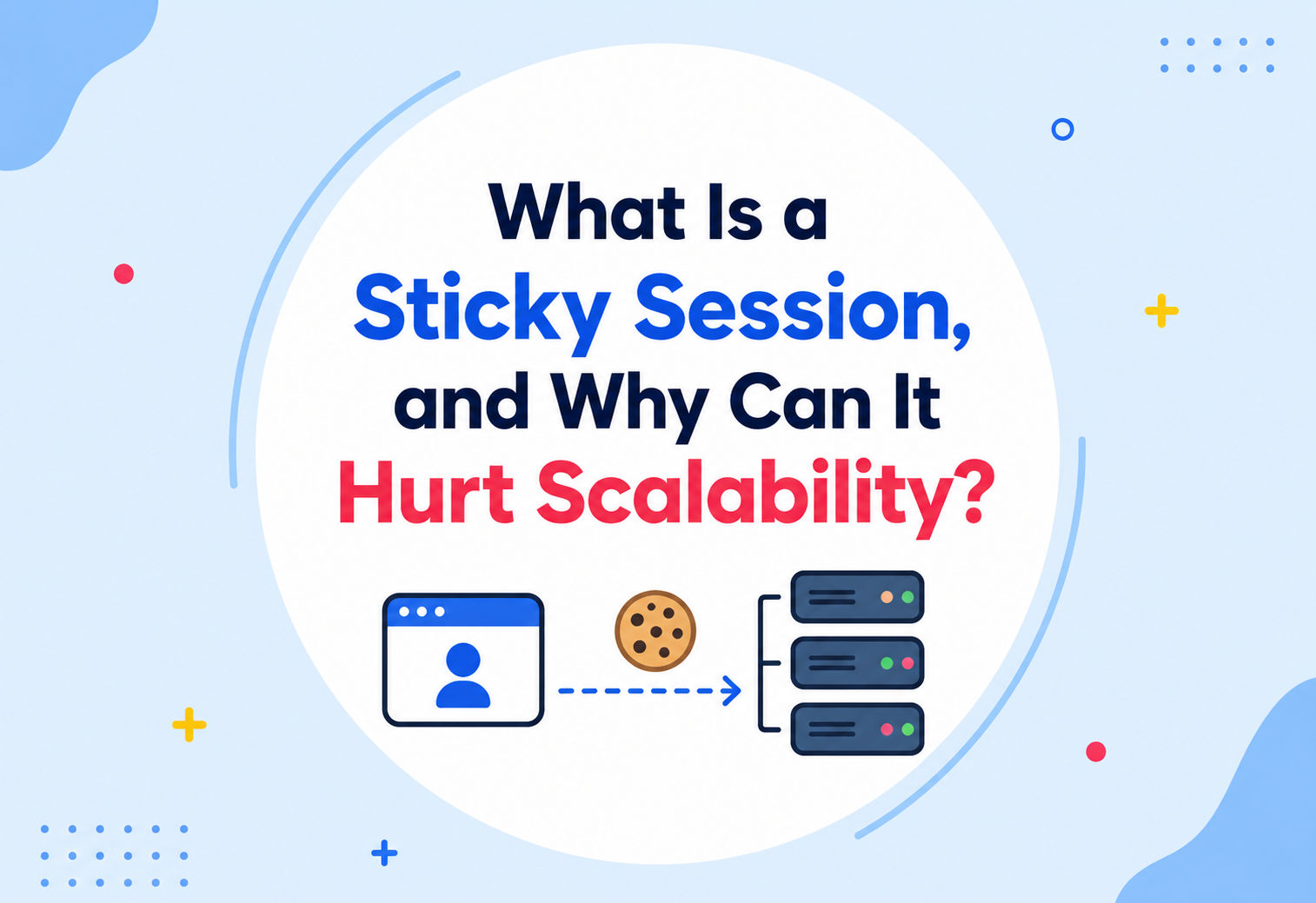
What Is a Sticky Session, and Why Can It Hurt Scalability?
A complete, beginner-to-production guide to sticky sessions — what they are, why they exist, how they work under the hood, and why the very thing that makes them convenient is also the thing that quietly limits how far a system can grow.
Introduction & History
Imagine walking into a large bank where Teller 3 already has your paperwork spread out in front of them. If you had to step away and come back, you would want to return to Teller 3 — not start over with Teller 1. That instinct is exactly what a sticky session does for a web request.
Imagine you walk into a large bank with five teller counters. You start filling out a loan form with Teller 3, who already has your documents, your ID photocopy, and half your paperwork spread out in front of them. If you had to walk away and come back later, would you want to start again from scratch with Teller 1, or would you want to go straight back to Teller 3, who already knows exactly where you left off?
Most people would want to go back to Teller 3. That instinct — “send me back to the same person who already has my context” — is exactly what a sticky session (also called session affinity) does in computer systems. When a website or app has many servers behind it, a sticky session is a rule that says: once a specific user starts talking to Server 3, keep sending that same user back to Server 3 for the rest of their visit, instead of letting a different server handle each of their requests.
This sounds simple and harmless — even helpful. And in many small systems, it is. But as we will see throughout this guide, this one convenient rule creates a hidden dependency that can quietly undermine a system’s ability to grow, recover from failure, and scale smoothly — which is exactly why understanding sticky sessions deeply, not just superficially, matters so much for anyone designing production systems. The rest of this guide walks through exactly where that hidden dependency comes from, how it shows up in real infrastructure, and what the industry has largely settled on as better alternatives.
A sticky session is a load balancer rule that pins every request from a given user to the same backend server for the life of that session, so the user’s in-memory data on that specific server is always waiting for them — instead of letting requests flow freely to whichever server is least busy.
1.1 A Short History
Sticky sessions emerged directly from a much older idea in software: the humble session — a way for a web server to “remember” a user across multiple requests, even though the underlying HTTP protocol itself has no memory at all. HTTP was designed in the early 1990s to be stateless: every request is treated as a brand new, disconnected event, with no built-in concept of “the same user as before.” This was a deliberate and powerful design choice for the web at large, but it created an immediate practical problem for anything that needed to remember a user’s state — like a shopping cart, a login status, or a multi-step form.
Early web application servers solved this by keeping session data — a user’s cart contents, their login token, their in-progress form — in the server’s own local memory, tied to a session identifier stored in a cookie. This worked perfectly as long as a website ran on a single server. But the moment websites started running on multiple servers behind a load balancer, in the mid-to-late 1990s, a new problem appeared: if a user’s session data lived only in Server 1’s memory, and the load balancer sent their next request to Server 2, that server would have no idea who the user was or what was in their cart. Sticky sessions were the load balancer’s answer to this problem: pin each user to whichever server first served them, so their in-memory session would always be there waiting.
This approach was so simple to implement — often just a configuration flag on the load balancer — that it became extremely common in the early era of scaled-out web applications, and many load balancers, from early hardware appliances to modern cloud load balancers, still support it today as a built-in feature. But as internet-scale systems grew larger, more distributed, and more resilient by design through the 2000s and 2010s, engineers increasingly discovered that sticky sessions, while convenient, worked directly against the very properties — even load distribution, easy horizontal scaling, and graceful failure recovery — that large-scale systems depend on most. This tension between short-term convenience and long-term architectural cost is the central theme this entire guide will keep returning to, from very different angles, across the sections that follow.
Early 1990s — The Stateless Web
HTTP is designed as a stateless protocol. Every request is an independent event with no built-in memory of anything that happened before it.
Mid-1990s — The Session Cookie
Web servers begin storing per-user data in local memory keyed by a session cookie, giving stateless HTTP the illusion of continuity.
Late 1990s — Multiple Servers, One Problem
Load-balanced fleets appear and immediately expose in-memory sessions. If Server 2 gets a request meant for Server 1, the user looks logged out.
2000s — Sticky Sessions Become Common
Load balancer vendors add session affinity as a checkbox. Legacy monoliths scale horizontally without touching a single line of application code.
2010s — The Cloud-Native Backlash
Auto-scaling, containers, and multi-region deployments make server-pinning increasingly painful. Externalized session stores and JWT-based auth become the default.
Sticky sessions are the digital equivalent of a hotel that always sends you back to the same room clerk you first checked in with. It works beautifully — until that clerk goes on break, quits, or is simply swamped while another clerk sits idle at the next counter.
The Problem & Motivation
To understand why sticky sessions exist, we first need to understand the problem they were built to solve: where does a user’s session state live when there is more than one server?
2.1 The Core Problem: Statelessness vs Statefulness
HTTP itself carries no memory between requests. Every single request — loading a page, clicking a button, submitting a form — arrives at the server as a completely fresh, self-contained event, with no automatic awareness of anything that happened before it. Yet almost every real application needs to remember something about a user across multiple requests: that they are logged in, what is in their shopping cart, what step of a multi-page form they are on, or what language they have selected.
This “remembered information tied to one user’s visit” is called session state. The classic, simplest way to store it is directly in the memory of whichever application server happens to be handling that user — a Java web application, for example, can use a built-in HttpSession object that lives entirely inside that one server’s memory (its heap).
Imagine a large event with five separate coat check counters, each entirely independent, with no way to communicate with each other. If you hand your coat to Counter 2, and then later try to collect it from Counter 4, Counter 4 has absolutely no record of your coat — it is sitting safely at Counter 2, but you are standing at the wrong desk. The only way this system works smoothly is if you are guaranteed to return to the exact same counter every single time. That guarantee — “always go back to the same counter” — is precisely the role a sticky session plays for a user’s in-memory session data.
2.2 What Happens Without Session Affinity
If session state lives only in one server’s memory, and a load balancer is free to route each request to any server without regard for where the user went before, chaos follows quickly:
- A user logs in on Server A, but their very next request lands on Server B, which has never seen their login — the user appears logged out.
- A user adds three items to their cart while bouncing between Server A and Server C, but only the items added while talking to Server C actually show up at checkout.
- A multi-step signup form loses the user’s progress halfway through, because step 3 landed on a server that never saw steps 1 and 2.
Sticky sessions solve this immediate, visible problem in the simplest possible way: instead of fixing how session state is stored, they fix where requests are routed, ensuring a user’s requests always reach the one server that already has their data. This is exactly why sticky sessions became so popular early on — they required zero changes to the application’s code, just a configuration setting on the load balancer.
2.3 The Deeper Problem This Creates
The trouble is that sticky sessions do not actually remove the underlying statefulness problem — they only hide it, by tying a piece of application logic (routing) to a piece of infrastructure behavior (which server a user happens to land on first). This creates a hidden coupling between a specific user and a specific server that did not exist before, and as we will see across this entire guide, that hidden coupling is precisely what makes scaling, failing over, and deploying updates meaningfully harder as a system grows. It is worth sitting with this idea for a moment, because nearly every downside covered later in this guide — from uneven load, to fragile failover, to complicated deployments — traces back to this one root cause rather than being a collection of unrelated problems.
Sticky sessions trade a small amount of short-term convenience (no code changes needed to remember a user) for a long-term architectural cost (every server must now be treated as a unique, irreplaceable holder of certain users’ data, rather than an interchangeable, disposable worker). This single trade-off is the thread that runs through almost every advantage and disadvantage discussed later in this guide.
Core Concepts
Let’s build a precise, shared vocabulary. These terms show up constantly in load balancer documentation, system-design interviews, and real production incident reports — and using them correctly is often what separates a vague “server memory issue” discussion from an actionable diagnosis.
3.1 Session
What it is: A period of interaction between one user and an application, along with the data associated with that interaction — login status, cart contents, form progress, and similar information.
A single visit to a library, from the moment you walk in to the moment you leave, during which the librarian remembers which books you have already picked out, even before you reach the checkout counter.
3.2 Session State
What it is: The actual data that makes up a session — for example, a user ID, a shopping cart’s contents, or a “currently on step 2 of 4” marker for a form.
Where it can live: In the memory of a single application server (the classic, simplest approach), in a shared external store like Redis, or encoded directly inside a token the client holds, such as a JSON Web Token (JWT).
3.3 Sticky Session / Session Affinity
What it is: A load balancing rule that ensures all requests from a particular user (or more precisely, a particular client session) are routed to the same backend server for as long as that session lasts, rather than being distributed freely across the whole server pool.
A restaurant that always seats you at the same table with the same waiter for the rest of your meal, even if you get up and come back, instead of assigning you a random table each time.
3.4 Stateless Server
What it is: A server that does not keep any user-specific data in its own memory between requests — every request carries (or looks up) everything it needs, so literally any server in the pool could have handled it equally well.
Why it matters: A stateless server is what makes true, free-form load balancing possible — the load balancer can send any request to any server, purely based on which one is least busy, with no regard for history.
3.5 Stateful Server
What it is: A server that does keep user-specific data in its own memory, meaning some requests genuinely can only be correctly handled by that one specific server (unless the data is somehow shared elsewhere).
Sticky sessions are, fundamentally, a workaround that lets an application server remain stateful while still technically running behind a multi-server load-balanced setup.
3.6 Session Identifier (Session ID / Cookie)
What it is: A unique token — typically stored in a browser cookie — that identifies a particular user’s session, so the server (or load balancer) can recognize “this request belongs to the same session as that earlier request.”
How it enables stickiness: Load balancers commonly implement sticky sessions by reading this same cookie and using it to consistently pick the same backend server every time, often by inserting their own additional tracking cookie alongside the application’s own session cookie.

3.7 Load Balancer
What it is: A component that sits in front of a pool of servers and decides, for every incoming request, which server should handle it — typically to spread load evenly and avoid overwhelming any single server.
Sticky sessions are implemented as a special mode or feature of the load balancer, overriding its normal, even-distribution behavior for requests that belong to an existing session.
3.8 Horizontal Scaling
What it is: Growing a system’s capacity by adding more servers of the same kind, rather than making a single server bigger. Horizontal scaling assumes, by default, that any of the servers can handle any incoming request — an assumption that sticky sessions directly complicate, as we will see in Section 8.
3.9 Shared / Distributed Session Store
What it is: An external, centralized place — commonly a fast in-memory data store like Redis or Memcached — where session data is kept outside of any single application server, so that every server in the pool can read and write the same session data. This is the primary architectural alternative to sticky sessions, and is explored in depth in Section 13.
3.10 Consistent Hashing
What it is: A hashing technique used by some load balancers to map clients to servers in a way that minimizes disruption when servers are added or removed — unlike a simple modulo-based hash, where adding or removing even one server can reshuffle almost every client’s assigned server, consistent hashing only reassigns a small fraction of clients when the pool changes size.
Imagine seats arranged in a large circle, with each server owning an arc of that circle. Adding a new server only affects the small arc of seats near where it is inserted, rather than reshuffling every single seat in the room the way a naive numbering scheme would.
Consistent hashing does not eliminate the underlying problems of sticky sessions, but it can reduce how disruptive scaling events are compared to simpler hash-based affinity schemes, which is why some larger-scale systems that still rely on affinity choose it over plain IP-hash or round-robin-then-pin approaches.
3.11 Session Timeout / Idle Timeout
What it is: The maximum period of user inactivity after which a session (and, in a sticky setup, its associated server affinity) is considered expired and discarded. Both the application’s own session timeout and the load balancer’s affinity cookie timeout need to be configured thoughtfully, since a mismatch between the two can create confusing situations where a user is still logged in from the application’s point of view but has already lost their sticky routing, or vice versa.
Session
The full period of one user’s interaction with an app, plus the data attached to it.
Session State
The actual data (login, cart, form progress) tied to that session — local, shared, or client-held.
Session Affinity
The load-balancer rule that keeps a user pinned to one server for the life of the session.
Stateless Server
Any server can handle any request; nothing user-specific lives in local memory.
Stateful Server
Some users’ data lives only here — the server has become uniquely responsible for them.
Consistent Hashing
Circle-of-servers routing that limits reshuffles when the pool grows or shrinks.
Architecture & Components
To see exactly where sticky sessions fit into a system, it helps to look at the full path a request takes, and compare it against the alternative, stateless design.
Compare this to the stateless alternative, where session data lives in a shared store instead of any one server’s memory:
Notice the structural difference: in the sticky design, the load balancer must inspect and remember routing decisions per user, and each app server becomes a unique, irreplaceable custodian of certain users’ data. In the stateless design, the load balancer’s job stays simple (spread load evenly), and any app server can serve any request, because the actual session data lives in one shared place all of them can reach.
4.1 The Load Balancer’s Role
In a sticky session setup, the load balancer takes on extra responsibility beyond simple traffic distribution: it must track which backend server each active session belongs to, and consistently honor that mapping for the lifetime of the session, typically using one of the mechanisms detailed in Section 5.
4.2 The Application Server’s Role
Each application server, in a sticky setup, holds session data in its own local memory (for example, the JVM heap in a Java application). This makes the server itself a stateful component — it is no longer a disposable, interchangeable worker, but a temporary home for specific users’ data.
4.3 The Client’s Role
The client (typically a web browser) usually participates without even realizing it, simply by storing and consistently sending back whatever cookie the load balancer or application uses to identify the session on every subsequent request.
4.4 Where Stickiness Can Be Implemented
Session affinity is not limited to a single layer — it can be implemented at several different points in the architecture, each with slightly different trade-offs:
- Load balancer level — the most common approach, using a cookie the load balancer itself manages.
- Application level — the application sets its own session cookie, and the load balancer is configured to honor that existing cookie for routing decisions.
- DNS or connection level — less common today, relying on IP address or connection-based routing rather than cookies.
4.5 How Stickiness Changes the Load Balancer’s Algorithm Choice
Without stickiness, load balancers typically use algorithms optimized purely for even distribution and responsiveness: round-robin (cycling through servers in order), least-connections (sending each new request to whichever server currently has the fewest active connections), or weighted variants of either that account for servers with different capacities. Once stickiness is introduced, these algorithms only get to run once, for a session’s very first request — every subsequent request from that session bypasses the algorithm entirely and goes straight to the previously recorded server, regardless of how that server’s load has changed since. This is precisely why a server that happened to receive several long, heavy sessions early on can remain overloaded long after a least-connections algorithm would have naturally started favoring its lighter-loaded siblings.
Load Balancer
In a sticky setup it must also track which server each session belongs to and honor that mapping on every request.
App Server
Holds session data in local memory, making it a stateful, uniquely responsible temporary home.
Client (Browser)
Silently participates by storing and echoing back the affinity cookie on every request.
Shared Store (Alt)
Optional Redis/Memcached tier that makes stickiness unnecessary by giving every server the same view of session data.
Internal Working
Let’s look at exactly how a load balancer implements sticky sessions under the hood, and how this compares in practice using real configuration and code.
5.1 Cookie-Based Affinity (Most Common)
The most widely used implementation works like this: on a user’s very first request, the load balancer picks a backend server (often using its normal, even-distribution algorithm), forwards the request, and then — critically — inserts a special cookie into the response, recording which server was chosen. On every subsequent request, the load balancer reads that cookie and routes directly to the recorded server, bypassing its normal load-distribution logic entirely.
# Example: NGINX configuration for cookie-based sticky sessions
upstream backend_pool {
    ip_hash;  # simplest form: hash client IP to a server (see 5.2)
}

# More explicit cookie-based approach using a commercial/plus feature
# or a third-party module:
upstream backend_pool_sticky {
    server app1.internal:8080;
    server app2.internal:8080;
    server app3.internal:8080;
    sticky cookie srv_id expires=1h domain=.example.com path=/;
}

server {
    listen 80;
    location / {
        proxy_pass http://backend_pool_sticky;
    }
}
In this example, NGINX issues a cookie called srv_id the first time a client connects, and uses that cookie’s value to send every future request from that same client back to the exact same upstream server, for up to one hour.

5.2 IP-Hash Based Affinity
A simpler, cookie-free approach hashes the client’s IP address into a fixed number corresponding to one of the backend servers, so the same client IP always maps to the same server. This avoids relying on cookies at all, but has a significant weakness: many real users share IP addresses (for example, an entire office or a mobile carrier’s network address translation), which can cause uneven load distribution — many different real users, sharing one IP, all get pinned to the same single server.
5.3 A Java Example: How Session Affinity Interacts With HttpSession
Here is a simplified Spring Boot controller showing exactly what makes sticky sessions “necessary” in the first place — session data stored directly in server memory via the servlet container’s built-in session object.
import jakarta.servlet.http.HttpSession;
import org.springframework.web.bind.annotation.*;

@RestController
@RequestMapping("/cart")
public class ShoppingCartController {

    @PostMapping("/add")
    public String addItem(@RequestParam String itemId, HttpSession session) {
        // This data lives ONLY in this JVM's memory, tied to this session.
        // If the next request lands on a different server, this data is gone
        // unless sticky sessions (or a shared store) are in place.
        @SuppressWarnings("unchecked")
        var cart = (java.util.List<String>) session.getAttribute("cartItems");
        if (cart == null) {
            cart = new java.util.ArrayList<>();
        }
        cart.add(itemId);
        session.setAttribute("cartItems", cart);

        return "Cart now has " + cart.size() + " item(s) on server: "
                + java.net.InetAddress.getLoopbackAddress().getHostName();
    }

    @GetMapping("/view")
    public Object viewCart(HttpSession session) {
        // This will return an EMPTY cart if this request lands on a
        // different server than the one that handled /add - the classic
        // symptom of missing session affinity.
        return session.getAttribute("cartItems");
    }
}
Notice the comment in the code: this is precisely the failure mode sticky sessions exist to prevent. Without either session affinity or a shared session store, the /view endpoint can silently return an empty cart if it happens to land on a server that never handled the earlier /add calls.
5.4 Session Timeout and Rebalancing
Sticky sessions are not permanent — most implementations attach a timeout (commonly matching or slightly exceeding the application’s own session timeout, often 30 minutes to a few hours). Once a user has been inactive past that window, the “stickiness” expires, and their next request is free to be routed to any server again, starting the mapping over from scratch.
5.5 Application-Managed vs Load-Balancer-Managed Affinity
There are two broad ways to implement the cookie mechanism described above. In load-balancer-managed affinity, the load balancer generates and owns its own separate cookie purely for routing purposes, independent of anything the application itself does. In application-controlled affinity, the application’s own existing session cookie is reused by the load balancer for routing decisions, avoiding the need for a second cookie but tightly coupling the load balancer’s configuration to the specific cookie name and format the application happens to use. Most production setups favor the load-balancer-managed approach specifically because it keeps the two concerns — application session identity and infrastructure routing — cleanly separated, making it easier to change one without breaking the other.
5.6 What Happens on a Cache/Session Miss
If a sticky request arrives carrying an affinity cookie that points to a server which no longer exists — because it crashed, was removed during scale-in, or was replaced during a deployment — the load balancer must fall back to some default behavior, since it cannot honor a mapping to a server that is not there. Most implementations fall back to treating the request as if it were brand new: picking a fresh server using the normal algorithm, and issuing a new affinity cookie. From the user’s perspective, this is exactly the failure mode described in Section 9.1 — whatever session data lived only on the missing server is simply gone, and they effectively start a new session on a new server without being told so explicitly.
Data Flow & Lifecycle
Let’s trace the complete lifecycle of a sticky session from first contact to expiry — six stages that repeat every time a user starts a new session.
- First contact — A new user sends their first request with no sticky cookie present.
- Server selection — The load balancer picks a backend server using its normal algorithm (round-robin, least-connections, etc.), since there is no existing affinity to honor yet.
- Local state creation — The chosen application server creates a session and stores relevant data (login state, cart contents) in its own memory.
- Affinity recorded — The load balancer sets a cookie recording which server handled this session.
- Subsequent routing — Every following request from this user includes that cookie, and the load balancer routes it straight to the same server, bypassing normal load distribution.
- Expiry or invalidation — After a period of inactivity, or when the user’s browser session ends, the sticky mapping expires, and the cycle can begin again — potentially landing the user on a completely different server next time, with a fresh, empty in-memory session.
This lifecycle reveals an important, easily missed detail: sticky sessions do not protect a user’s data forever. The moment that mapping expires — or the specific server the user was pinned to becomes unavailable — any data that lived only in that one server’s memory is gone, unless it was also persisted somewhere durable.
Advantages, Disadvantages & Trade-offs
Sticky sessions solve a real problem cheaply, but almost every property that makes them convenient becomes a constraint later. Here is what they buy you, and what they quietly cost.
7.1 Advantages of Sticky Sessions
- Simplicity. Requires little to no application code changes — often just a load balancer configuration setting.
- Lower latency for session reads. Reading session data from local server memory is extremely fast, with no network round-trip to an external store.
- No extra infrastructure. Avoids the operational cost of running and maintaining a separate shared session store like Redis.
- Works well for legacy applications. Many older applications were built assuming in-memory
HttpSessionobjects, and sticky sessions let them scale to multiple servers with minimal rework.
7.2 Disadvantages of Sticky Sessions
- Uneven load distribution. Some servers can end up handling disproportionately more “heavy” or long-lived sessions than others, defeating the point of load balancing.
- Fragile failover. If the pinned server crashes, every session tied to it loses its in-memory data instantly, with no automatic recovery.
- Complicates deployments. Rolling out new versions of an application becomes riskier, since taking a server out of rotation for an update disrupts every session pinned to it.
- Harder auto-scaling. New servers added by auto-scaling start with zero pinned sessions and can sit underused while existing servers remain overloaded with their pinned users.
- Scaling ceiling. The system’s effective capacity becomes limited by the single most-loaded server holding sticky sessions, not by the total capacity of the whole pool.
Advantages
- Almost zero code change; often a single load-balancer flag
- Local memory is faster than any external store
- No new infrastructure to run or pay for
- Great bridge for older, session-heavy applications
Costs & Limitations
- Load skews unpredictably as heavy users pile up on one server
- Server crash = every pinned session lost, no graceful recovery
- Deployments and rolling upgrades become risky and slow
- Auto-scaling underdelivers because new servers start empty
- Cluster capacity is capped by the single hottest server
7.3 The Core Trade-off
Sticky sessions trade architectural simplicity today for scaling and resilience limitations tomorrow. They are often the fastest path to “make this application work across multiple servers,” but that same convenience becomes an increasingly expensive constraint as a system’s traffic, team size, and reliability requirements grow. Recognizing exactly where that expense shows up — in load distribution, in failover behavior, in deployment risk — is what allows a team to make this trade-off deliberately, rather than discovering its true cost only after it has already become painful.
| Situation | Sticky Sessions Suitable? | Reasoning |
|---|---|---|
| Small internal tool, low traffic, few servers | Often fine | Uneven distribution and failover risk matter less at small scale. |
| High-growth consumer web application | Risky long-term | Scaling ceiling and failover fragility become serious liabilities as traffic grows. |
| Legacy monolith mid-migration | Reasonable interim step | Buys time to scale horizontally while a shared session store is introduced gradually. |
| Modern cloud-native microservices | Generally avoided | Conflicts with elastic auto-scaling, container rescheduling, and stateless design principles. |
Performance & Scalability
This is the heart of the guide’s title question — exactly how and why sticky sessions can hurt a system’s ability to scale.
8.1 Uneven Load Distribution
A load balancer’s core job is to spread work evenly so that no single server becomes a bottleneck. Sticky sessions directly interfere with this goal, because once a user is pinned to a server, they stay there regardless of how busy that server becomes relative to others. If, purely by chance, a disproportionate number of “heavy” users — those who log in for long sessions, upload large files, or run expensive operations — end up pinned to the same server, that server can become overloaded while its siblings sit comparatively idle.
8.2 The Scaling Ceiling Problem
Perhaps the most important scalability issue: with sticky sessions, a system’s real-world maximum capacity is not the sum of all servers’ capacity — it is limited by whichever single server is carrying the heaviest share of pinned sessions. Adding more servers does not necessarily relieve pressure on an already-overloaded server, because existing sticky users keep being routed back to it regardless of how many new, empty servers are sitting nearby.
Imagine five checkout lanes at a supermarket, but a strict rule that once you start at Lane 2, you must always return to Lane 2 for every future visit that day. If Lane 2 happens to attract many big weekly-shop customers, it will be permanently backed up compared to the other four lanes — and opening a sixth lane does absolutely nothing to relieve Lane 2’s queue, because none of Lane 2’s already-committed customers are allowed to move.
8.3 Auto-Scaling Becomes Less Effective
Modern cloud infrastructure relies heavily on auto-scaling — automatically adding new server instances when load rises, and removing them when load falls. Sticky sessions blunt the effectiveness of auto-scaling in two ways: newly added servers start with zero pinned sessions and may remain underused for a while even during a traffic spike, since existing users continue to be routed to their original, already-loaded servers; and removing a server during scale-in requires carefully migrating or expiring its pinned sessions first, since simply terminating it would silently drop all the session data those users were relying on.
8.4 Rolling Deployments Become Riskier
Deploying a new version of an application typically involves taking servers out of rotation one at a time, updating them, and bringing them back — a rolling deployment. With sticky sessions in place, taking a server out of rotation disrupts every user currently pinned to it, either logging them out unexpectedly or losing their in-progress cart or form data, unless the deployment process includes extra logic to gracefully drain sticky sessions first (explored further in Section 9).
8.5 A Java Example: Simulating Uneven Load From Stickiness
import java.util.*;

public class StickySessionLoadSimulator {

    public static void main(String[] args) {
        int numServers = 4;
        int numUsers = 1000;
        Random random = new Random(42);

        int[] serverLoad = new int[numServers];

        // Simulate sticky assignment: each user is pinned once,
        // then all their (varying) request counts go to that one server.
        for (int user = 0; user < numUsers; user++) {
            int assignedServer = random.nextInt(numServers);
            int requestsFromThisUser = 5 + random.nextInt(50); // 5-54 requests
            serverLoad[assignedServer] += requestsFromThisUser;
        }

        System.out.println("Simulated request load per server (sticky sessions):");
        int total = 0;
        for (int i = 0; i < numServers; i++) {
            System.out.printf("Server %d: %d requests%n", i + 1, serverLoad[i]);
            total += serverLoad[i];
        }

        double average = total / (double) numServers;
        System.out.printf("%nAverage load: %.1f requests per server%n", average);
        for (int i = 0; i < numServers; i++) {
            double deviation = ((serverLoad[i] - average) / average) * 100;
            System.out.printf("Server %d deviation from average: %+.1f%%%n", i + 1, deviation);
        }
    }
}
Running this simulation typically reveals significant, purely random imbalance between servers — some ending up 20-40% above or below the average — purely because sticky assignment locks in whatever the initial random distribution happened to be, with no ongoing rebalancing to smooth it out over time. A non-sticky, per-request load balancer would naturally average this out far more evenly.
8.6 The Hidden Cost of Over-Provisioning to Compensate
A common, expensive workaround teams adopt without fully realizing it is to simply over-provision their server fleet to absorb the unpredictability that stickiness introduces — running noticeably more servers than the total traffic would otherwise require, purely as a buffer against whichever server happens to end up holding a disproportionate share of heavy sessions at any given time. This approach can keep a system functioning acceptably, but it quietly inflates infrastructure cost, since the extra capacity exists not to serve genuinely higher total traffic, but to compensate for the load balancer’s inability to redistribute existing sessions once they are pinned. In this sense, sticky sessions can convert what should be a routing efficiency problem into a recurring, ongoing cloud spending problem.
8.7 Interaction With Read Replicas and Downstream Scaling
Uneven load at the application layer, caused by stickiness, often propagates downstream. If one application server is handling a disproportionate share of active sessions, it will typically also generate a disproportionate share of database queries, cache lookups, and calls to downstream services — meaning the imbalance introduced by sticky sessions rarely stays contained to a single layer, and can make capacity planning for the database and caching layers considerably harder to reason about, since load per application server no longer correlates neatly with total user count.
High Availability & Reliability
Sticky sessions have a particularly uncomfortable relationship with high availability, because they create exactly the kind of single point of dependency that HA architecture usually works hard to eliminate.

9.1 Server Failure Means Session Loss
If a server holding pinned sessions crashes or becomes unreachable, every session that lived only in that server’s memory is lost instantly and irrecoverably, unless that data was also being persisted somewhere else. Affected users are typically logged out, or lose their cart or in-progress form data, with no graceful recovery path — the load balancer can route them to a healthy server, but that server has never seen them before and has none of their session state.
A very common real-world pattern: a server hosting many sticky sessions is terminated during a routine auto-scaling scale-in event (the infrastructure team assumed it was safe, since the server “looked” underused on average CPU metrics). Thousands of users are silently logged out or lose in-progress carts within seconds, with no errors or crashes anywhere in the logs — because, from the system’s point of view, nothing actually failed. The server was simply removed, exactly as instructed, along with all the session data that had nowhere else to live.
9.2 Failover and Redundancy Complications
In a stateless architecture, failover is simple: if one server goes down, the load balancer simply routes future requests to any of the remaining healthy servers, and nothing user-visible needs to change, since all servers are interchangeable. In a sticky session architecture, failover requires much more care: either accepting that affected users will lose their session state, or implementing session replication (copying each server’s session data to one or more backup servers in real time) so that a failover has somewhere to recover from — an approach that adds meaningful complexity and overhead.
9.3 Graceful Draining During Planned Maintenance
To avoid disrupting users during planned maintenance or deployments, teams using sticky sessions often implement connection draining (also called graceful shutdown): marking a server as “no longer accepting new sticky assignments” while still allowing its existing pinned users to finish their current sessions naturally, before finally taking it out of rotation. This reduces disruption but adds operational complexity and means deployments cannot happen as quickly or predictably as with a fully stateless fleet.
9.4 Multi-Region and Sticky Sessions
Sticky sessions become especially awkward in multi-region, geographically distributed architectures. If a user’s session is pinned to a specific server in one region, and that region experiences an outage requiring failover to another region entirely, there is often no way to recover that in-memory session data at all, since it never existed anywhere outside the failed region in the first place.
9.5 How Session Replication Attempts to Mitigate This
Some application servers and frameworks support session replication, where each server proactively copies its session data to one or more other servers (or a dedicated backup) in real time, so that if the primary server fails, a replica already has the data ready. This meaningfully reduces the data-loss risk described above, but it comes with real costs: every session write now involves additional network communication to keep replicas in sync, replication itself can lag under heavy load (meaning a failover during a traffic spike might still recover slightly stale data), and the overall system now needs to manage cluster membership and replica coordination — considerable added complexity for a problem that externalizing session state (Section 13) solves more directly and more simply.
9.6 The Availability Zone Consideration
Within a single cloud region, infrastructure is often spread across multiple availability zones for resilience. A sticky session pinned to a server in one availability zone means that if that entire zone experiences a localized outage, every user pinned to servers within it loses their session state simultaneously — a concentrated, zone-wide impact that a properly externalized, cross-zone-replicated session store would avoid, since the shared store itself can be made resilient across zones independently of any single application server’s location.
Silent Data Loss
Scale-in of a pinned server logs users out with no visible error — nothing “failed,” the server just went away.
Graceful Draining
Stop accepting new sessions, let existing ones finish, then remove the server. Slower deployments, fewer angry users.
Session Replication
Copy sessions across peers. Reduces loss risk, but adds latency, complexity, and coordination overhead.
Multi-Zone Risk
Pinning concentrates blast radius inside one AZ — a lost zone is a lost cohort of sessions all at once.
Security Considerations
Sticky sessions do not introduce a wholly new class of vulnerability, but they change the shape of several existing risks — and reward attackers who understand how routing decisions are made.
10.1 Session Hijacking Risk
Because sticky sessions rely on a cookie to identify which server a user belongs to, that cookie becomes an attractive target. If an attacker can steal or guess a valid session identifier (through cross-site scripting, network interception on an unencrypted connection, or a predictable session ID generation algorithm), they can potentially route their own requests to the same server and impersonate the legitimate user’s session — a general session security risk that sticky sessions do not create, but do not reduce either, since the underlying session cookie mechanism is the same attack surface either way.
10.2 Secure Cookie Configuration
Whether using sticky sessions or not, session and affinity cookies should always be configured with the Secure flag (only sent over HTTPS), the HttpOnly flag (inaccessible to JavaScript, reducing cross-site scripting risk), and an appropriate SameSite setting to reduce cross-site request forgery exposure.
10.3 Predictable Server Mapping as Reconnaissance
In some sticky session implementations, the cookie value directly or indirectly reveals which backend server a user is assigned to. In tightly security-conscious environments, this can be considered a minor information disclosure risk, since it gives an external attacker a small amount of insight into backend infrastructure topology that a fully opaque, load-balanced system would not reveal.
10.4 Denial of Service Amplification
Because sticky sessions can already create uneven load distribution under normal conditions (Section 8.1), a targeted attacker who can force many malicious sessions onto a single server — for example, by manipulating or forging the affinity cookie — could deliberately overload one specific backend server while the rest of the pool remains idle, achieving a denial-of-service effect with far less traffic than would be needed against a properly load-balanced, stateless system.
10.5 Cross-Session Data Leakage Risk
In poorly implemented in-memory session handling, bugs that fail to properly isolate one user’s session data from another’s can be made worse, not better, by sticky sessions, since many different users’ sessions end up co-located in the same server process’s memory over time. While proper session isolation is ultimately an application-level coding concern rather than something sticky sessions cause directly, concentrating many active users’ sensitive session data within the memory space of a single, long-running process does increase the potential blast radius of any such isolation bug, compared to a design where each user’s data is stored and accessed independently through a well-isolated external store.
Set Secure, HttpOnly, and SameSite on every affinity cookie. Generate unpredictable session identifiers. Never expose backend server names or indices inside the cookie value. Rate-limit and monitor per-server request patterns so a forced-affinity DoS becomes visible early.
Monitoring, Logging & Metrics
Distribution skew is one of the easiest problems to miss and one of the easiest to catch — if you look at the right metrics. Teams that still rely on sticky sessions have to monitor per-server behaviour, not just cluster averages.
11.1 Key Metrics to Track
- Per-server request distribution — comparing actual load across servers to detect the kind of imbalance described in Section 8.1.
- Session count per server — how many active sticky sessions each server is currently holding, to spot hotspots forming.
- Session duration and idle timeout patterns — helps tune how long stickiness should reasonably persist.
- Failed session lookups — cases where a request arrives with a sticky cookie pointing to a server that is no longer available, which signals failover events happening in real time.
11.2 Detecting Hotspots
Dashboards that show per-server CPU, memory, and request rate side by side make it possible to visually spot when sticky-session-driven imbalance is forming — for example, one server consistently running 40-50% hotter than its siblings over a sustained period, despite receiving what should be a similar share of new users. This pattern is a strong signal that stickiness, rather than raw traffic volume, is the underlying cause of the imbalance.
11.3 Logging Session Affinity Events
Mature deployments often log key affinity-related events explicitly: when a new sticky mapping is created, when an existing one is honored, and especially when a sticky request fails to reach its originally assigned server (due to that server being down or removed), since this last case usually corresponds directly to a user-visible disruption like an unexpected logout.
11.4 Setting Alerts on Distribution Skew
Beyond simple per-server dashboards, teams that continue to rely on sticky sessions often set up dedicated alerts specifically for distribution skew — for example, triggering a warning whenever any single server’s request rate or CPU utilization deviates from the fleet average by more than a defined threshold, such as 30%, for a sustained period. This kind of alert is specifically tuned to catch the stickiness-driven imbalance pattern described earlier, which can otherwise hide behind a perfectly healthy-looking average across the whole fleet, even while one or two individual servers are quietly struggling.
| Metric | What It Reveals |
|---|---|
| Per-server RPS & CPU | Whether stickiness is driving one server hotter than its siblings. |
| Active sessions per server | Direct visibility into how sessions are actually distributed. |
| Sticky-miss events | Signals a pinned server disappeared — usually a user-visible disruption. |
| Session duration histogram | Helps tune affinity timeouts to match real user behaviour. |
| Deviation-from-average alert | Fires when one server drifts >30% off the fleet mean for a sustained window. |
Deployment & Cloud Considerations
Every major cloud gives you sticky sessions as a checkbox. Every major cloud-native runtime also actively fights against the assumptions that checkbox depends on. Both facts are true, and both matter.
12.1 Cloud Load Balancer Support
Most major cloud load balancers offer sticky sessions as a built-in, configurable feature: AWS Application Load Balancer supports duration-based cookies for target group stickiness, Azure Load Balancer and Application Gateway offer session affinity settings, and Google Cloud Load Balancing supports several affinity modes including client IP and generated cookie affinity. This wide native support is part of why sticky sessions remain common — they are genuinely just a checkbox away in most environments.
12.2 Kubernetes and Sticky Sessions
In Kubernetes, session affinity can be configured at the Service level (using sessionAffinity: ClientIP, which is IP-based rather than cookie-based) or, more commonly for HTTP workloads, at the Ingress controller level using cookie-based affinity annotations. However, sticky sessions interact awkwardly with core Kubernetes behaviors: pods are frequently and deliberately rescheduled (moved to different nodes) for reasons unrelated to the application itself, such as node maintenance or cluster autoscaling, and each rescheduling event can silently break existing sticky mappings in exactly the way described in Section 9.1.

# Example: Kubernetes Service with client-IP based session affinity
apiVersion: v1
kind: Service
metadata:
  name: cart-service
spec:
  selector:
    app: cart-service
  sessionAffinity: ClientIP
  sessionAffinityConfig:
    clientIP:
      timeoutSeconds: 3600
  ports:
    - port: 80
      targetPort: 8080
12.3 Container Orchestration Tension
Container orchestration platforms are fundamentally designed around the assumption that individual instances (pods, containers) are disposable and interchangeable — they can be killed and replaced at any moment without anyone noticing. Sticky sessions work directly against this assumption, which is a major reason why modern, cloud-native architectural guidance generally steers teams toward externalizing session state (Section 13) rather than leaning on session affinity as a long-term solution.
12.4 CDN and Edge Layer Interactions
Content Delivery Networks (CDNs) and edge computing platforms typically route each request to whichever edge location is geographically closest to the user, which can change from request to request as network conditions shift, or as a user’s device moves between networks. This behavior is fundamentally at odds with the assumptions behind traditional server-level sticky sessions, since there is no single, stable “closest server” guarantee at the edge layer the way there might be within one data center’s load balancer. Applications that need session continuity while also using a CDN or edge platform for performance almost always rely on an externalized session store or token-based authentication rather than attempting to extend sticky routing all the way out to the edge.
12.5 Blue-Green and Canary Deployments
Two increasingly common deployment strategies — blue-green deployments (running two complete, parallel environments and switching traffic between them all at once) and canary deployments (gradually shifting a small percentage of traffic to a new version before a full rollout) — both become noticeably more complex in the presence of sticky sessions. In a blue-green switch, users pinned to the old environment either need to be drained gracefully before the switch, or their sessions will simply be lost the moment traffic cuts over. In a canary rollout, a user who happens to be routed to the canary version on their first request will, under normal sticky behavior, stay pinned to that (still-being-tested) version for the rest of their session, which can be either desirable (consistent experience during the test) or risky (extended exposure to an unproven version), depending on how the rollout is designed.
Databases, Caching & Load Balancing
The most reliable way to make sticky sessions irrelevant is to put session state somewhere every server can already reach — usually Redis. Here is what that architecture looks like and where the trade-offs actually land.
13.1 The Shared Session Store Alternative
The primary architectural alternative to sticky sessions is to move session state out of individual application servers entirely, into a fast, shared, external store — most commonly Redis or Memcached — that every application server can read from and write to equally. This restores full statelessness at the application server layer: any server can now handle any request, because the actual session data lives centrally, not locally.
13.2 A Java Example: Externalizing Session State to Redis
// Using Spring Session with Redis to remove the need for sticky sessions
// build.gradle: implementation 'org.springframework.session:spring-session-data-redis'

@Configuration
@EnableRedisHttpSession(maxInactiveIntervalInSeconds = 1800)
public class SessionConfig {
    // Spring Session automatically replaces the default in-memory
    // HttpSession implementation with one backed by Redis.
    // No changes needed in controller code below!
}

@RestController
@RequestMapping("/cart")
public class ShoppingCartController {

    @PostMapping("/add")
    public String addItem(@RequestParam String itemId, HttpSession session) {
        // This now transparently reads/writes to Redis instead of
        // this JVM's local memory - ANY server can now serve this user.
        @SuppressWarnings("unchecked")
        var cart = (java.util.List<String>) session.getAttribute("cartItems");
        if (cart == null) {
            cart = new java.util.ArrayList<>();
        }
        cart.add(itemId);
        session.setAttribute("cartItems", cart);
        return "Cart now has " + cart.size() + " item(s), stored in Redis";
    }
}
Notice that the controller code itself barely changes — the entire fix happens at the configuration level. This is a common, low-risk way teams migrate away from sticky sessions: swap the session storage backend, keep the application logic exactly as it was.
13.3 Trade-offs of a Shared Session Store
Externalizing session data removes the scaling and failover problems of stickiness, but it is not free: every session read or write now involves a network round-trip to the shared store, adding a small amount of latency compared to reading directly from local memory. The shared store itself also becomes a new critical dependency that must be made highly available (commonly via Redis replication or clustering), since if it goes down, every server loses access to session data simultaneously — trading one kind of single point of failure for a different, more carefully managed one.
13.4 Load Balancer Behavior Without Stickiness
Once session data is fully externalized, load balancers can return to their simplest, most effective job: distributing every request as evenly as possible across all healthy servers, using algorithms like round-robin or least-connections, with no need to track or honor any per-user routing history at all.
13.5 A Related but Distinct Concern: Database Connection Affinity
It is worth distinguishing sticky sessions from a superficially similar but distinct concept: database connection pooling affinity. Some database drivers and connection pools maintain a degree of “stickiness” between an application server and specific database read replicas, often for consistency reasons — ensuring, for example, that a user’s own recent write is visible on the very next read, which might not be guaranteed if that read landed on a replica that has not yet caught up. While this is conceptually related (both involve a form of pinning to maintain consistency or continuity), it operates at a completely different layer of the architecture than load-balancer-level session affinity, and does not carry the same scaling and failover risks discussed throughout this guide, since it typically only affects a single request’s read path rather than an entire user’s session lifetime.
13.6 Caching Layers Are Not a Substitute for Session Storage
It is a common point of confusion to assume that adding a cache automatically solves the session-state problem. A cache is typically designed to be disposable — if a cache entry is lost or evicted, the system is expected to regenerate it from the source of truth without any lasting harm. Session data, by contrast, is often the source of truth itself for things like an in-progress shopping cart. Using a cache-only mindset for session storage, without appropriate durability or replication guarantees, can silently reintroduce many of the same data-loss risks that sticky sessions carry, just one layer removed.
APIs & Microservices
The moment authentication moves from server-held sessions to signed tokens, the whole reason for sticky routing quietly evaporates — which is why modern API-first services rarely need it in the first place.
14.1 Token-Based Authentication as a Stickiness-Free Alternative
Many modern APIs avoid the entire sticky session problem at the authentication layer by using self-contained tokens, most commonly JSON Web Tokens (JWTs), instead of server-side session objects. A JWT carries the user’s identity and relevant claims directly inside the token itself, cryptographically signed so it cannot be tampered with — meaning any server can verify and use it without needing to look anything up in shared or local session storage at all.
// Simplified example: validating a JWT - no session store or
// sticky routing needed, since all the data travels with the token
import io.jsonwebtoken.Claims;
import io.jsonwebtoken.Jwts;
import io.jsonwebtoken.security.Keys;
import javax.crypto.SecretKey;

public class JwtValidator {

    private final SecretKey key = Keys.hmacShaKeyFor(
            "a-very-long-secret-key-used-for-signing-tokens-here".getBytes());

    public Claims validateAndExtract(String token) {
        // Any server holding the shared signing key can validate this
        // token independently - no sticky session or shared store required.
        return Jwts.parserBuilder()
                .setSigningKey(key)
                .build()
                .parseClaimsJws(token)
                .getBody();
    }

    public static void main(String[] args) {
        JwtValidator validator = new JwtValidator();
        // token would normally come from an incoming Authorization header
        // Claims claims = validator.validateAndExtract(incomingToken);
        // System.out.println("User: " + claims.getSubject());
    }
}
Because the token itself carries everything needed to authenticate the user, this approach removes the original motivation for sticky sessions entirely — there is no server-local state to protect, so the load balancer is free to route every request purely for even load distribution.
14.2 Microservices and Statelessness by Design
Microservices architectures generally treat statelessness as a core design principle for exactly this reason: services that hold no local state can be freely scaled, restarted, and rescheduled without any special coordination, which is essential when dozens or hundreds of independently deployed services are constantly being updated, scaled, and healed automatically.
14.3 API Gateways and Session Affinity
Some API gateways still offer session affinity as an optional feature for specific use cases, such as routing all requests within a single long-lived WebSocket connection to the same backend instance — a legitimate, narrower use of stickiness that is fundamentally different from pinning an entire user’s session state to one server for convenience, since a WebSocket connection is inherently tied to one server for the life of that single connection regardless of session design.
14.4 Service Discovery and Dynamic Backends
Modern microservice environments typically use service discovery — a mechanism by which the set of available backend instances is tracked dynamically and can change at any moment as instances are added, removed, or replaced. Sticky sessions sit awkwardly on top of this dynamism, because the whole premise of stickiness (a stable, long-lived mapping from user to server) assumes a level of backend stability that service discovery is explicitly designed not to guarantee. Teams operating in highly dynamic, auto-scaled microservice environments therefore tend to favor stateless request handling precisely because it requires no coordination at all with how frequently the underlying set of instances changes.
14.5 GraphQL, gRPC, and Session Affinity
Newer API styles like GraphQL and gRPC generally follow the same stateless-by-default philosophy as modern REST APIs, with authentication typically handled via tokens passed on every request rather than server-side sessions. gRPC in particular is often used for internal service-to-service communication, where the very idea of a “user session” tied to a specific backend instance rarely applies in the first place, since these calls are usually short-lived and driven by machine-to-machine logic rather than a human browsing session.
Design Patterns & Anti-patterns
Not every use of stickiness is wrong — some are narrow, deliberate, and healthy. What separates them from the anti-patterns is intent: a specific technical need, a defined scope, and an exit ramp.
15.1 Helpful Patterns
| Pattern | How It Helps |
|---|---|
| Externalized session store (Redis/Memcached) | Removes the need for stickiness entirely by making session data available to every server equally. |
| Token-based authentication (JWT) | Eliminates server-side session state for authentication, removing one of the biggest original reasons for stickiness. |
| Session replication | Copies in-memory session data across multiple servers in real time, reducing (but not eliminating) the failover risk of pure stickiness. |
| Graceful connection draining | Lets existing sticky sessions finish naturally before a server is removed, reducing disruption during deployments and scale-in events. |
| Sticky sessions scoped narrowly (e.g. WebSockets only) | Applies affinity only where a genuine technical requirement exists, rather than as a blanket default for the whole application. |
15.2 Anti-patterns to Avoid
- Using sticky sessions as a permanent scaling strategy — treating it as the long-term answer rather than a stopgap while migrating toward stateless design.
- No session replication or backup — relying purely on stickiness with zero recovery plan for when the pinned server fails.
- Ignoring load imbalance metrics — never actually measuring whether stickiness is causing the uneven distribution described in Section 8.1, and assuming it is fine by default.
- Mixing sticky and non-sticky routing inconsistently — applying affinity to some paths but not others in ways that create confusing, hard-to-debug partial statefulness.
- Overly long sticky timeouts — configuring session affinity to last far longer than the actual application session needs, unnecessarily extending the window during which imbalance and failover risk persist.
Good Patterns
- External session store or JWT — make stickiness unnecessary
- Session replication — when stickiness must remain, reduce loss risk
- Graceful draining — let sessions finish before removing a server
- Scope affinity narrowly — only where technically required (WebSockets)
Anti-patterns
- Stickiness as a permanent, unexamined default
- No plan for what happens when the pinned server dies
- No skew or hotspot metrics being watched
- Inconsistent sticky/non-sticky routing on the same fleet
- Affinity timeouts far longer than actual session need
Best Practices & Common Mistakes
Bringing together everything covered in this guide, here is a practical checklist for teams deciding how to handle session state as their system grows. None of these practices require abandoning sticky sessions overnight — most successful migrations happen gradually, one component or one flow at a time, guided by the specific pain points a team is actually experiencing rather than a wholesale rewrite done purely out of caution.

16.1 Best Practices
- Treat sticky sessions as a short-term convenience, not a permanent architectural decision, especially for systems expected to grow significantly.
- Where possible, design new applications to be stateless from day one, using an external session store or token-based authentication rather than in-memory sessions.
- If sticky sessions are necessary, keep the affinity timeout as short as the application genuinely requires, rather than defaulting to long or indefinite durations.
- Monitor per-server load distribution specifically, not just overall cluster health, to catch stickiness-driven imbalance early.
- Implement graceful connection draining before removing any server that may be holding pinned sessions, whether for deployments or auto-scaling scale-in events.
- Reserve sticky sessions for cases with a genuine technical requirement, such as long-lived WebSocket connections, rather than applying it broadly as a default.
- If migrating away from sticky sessions, do it incrementally — externalizing session storage first often requires no changes to application logic, as shown in Section 13.2.
16.2 Common Mistakes
- Assuming sticky sessions “solve” the statefulness problem, rather than recognizing they merely relocate it into the load balancer’s routing rules.
- Not testing what happens to real users when a sticky server is deliberately terminated, until it happens for the first time in production.
- Enabling auto-scaling without accounting for how sticky sessions will interact with new and removed instances.
- Forgetting that IP-based affinity can pin many unrelated users sharing a single IP address to one server, causing unexpected imbalance.
- Leaving sticky session cookies without proper security flags (Secure, HttpOnly, SameSite), treating them as “just infrastructure” rather than a security-relevant credential.
Measure First
Turn on per-server metrics before deciding what to change. Numbers reveal skew that averages hide.
Externalize Sessions
Move session state to Redis or a similar shared store, ideally without touching application logic.
Loosen the Load Balancer
Switch to plain round-robin or least-connections now that the fleet is genuinely stateless.
Keep Stickiness Only Where Needed
Long-lived WebSockets, specific edge-case flows — scoped and documented, never blanket-applied.
Real-World Examples
Legacy monoliths, e-commerce checkouts, real-time chat, cloud-native migrations — each of these industries has its own version of the sticky-session story, and its own reason for leaving stickiness behind (or keeping it, deliberately, in a narrow slice).
17.1 Legacy Enterprise Applications
Many large, older enterprise web applications — particularly those built on traditional Java application servers in the 2000s and early 2010s — were designed around in-memory HttpSession objects from the start. As these applications were later scaled across multiple servers, sticky sessions were often the fastest, least invasive way to make that possible without a significant rewrite, and many such systems still rely on this approach today, often having outlived several generations of the infrastructure originally built around them.
17.2 E-commerce Checkout Flows
Shopping cart and checkout flows are one of the most common real-world reasons teams reach for sticky sessions, since losing a customer’s in-progress cart partway through checkout has an immediate, visible business cost. Many teams eventually migrate this specific flow to a shared session store precisely because the business cost of a failed sticky server during a high-traffic sale event (losing potentially thousands of in-progress carts at once) outweighs the simplicity sticky sessions originally offered.
17.3 Real-Time and WebSocket-Based Applications
Applications involving live chat, collaborative editing, or real-time multiplayer features often use WebSocket connections, which are inherently tied to a single server for the life of that connection. This is a case where a form of “stickiness” is unavoidable at the connection level, though it is fundamentally different from classic HTTP session stickiness, since the connection itself — not a routing policy — is what ties the client to one server.
17.4 Cloud-Native Migrations
Organizations migrating older, sticky-session-dependent applications into containerized, cloud-native environments frequently cite session state as one of the more difficult parts of the migration, since Kubernetes’ assumption of disposable, interchangeable pods directly conflicts with an application’s assumption of stable, long-lived in-memory session state — a mismatch that often becomes the forcing function for finally externalizing session storage.
17.5 Worked Case Study: An Online Learning Platform’s Growing Pains
Consider a simplified, realistic example: an online learning platform starts with three application servers behind a load balancer configured with sticky sessions, since its course progress and quiz-in-progress data are stored in each server’s local memory. For its first year, with modest traffic, this works fine.
The Growth Problem
As the platform grows and a popular course goes viral, traffic triples within a month. The team adds five new servers via auto-scaling, expecting load to spread out immediately. Instead, existing users — including many mid-course, actively engaged learners — remain pinned to the original three servers, which stay heavily loaded, while the five new servers sit comparatively idle, since only brand-new visitors get assigned to them. The original three servers begin timing out under the strain, and a portion of active learners lose their in-progress quiz answers entirely when one of those three servers is restarted during an emergency scale-up operation.
The Fix
The team migrates session storage to Redis, following an approach similar to Section 13.2 — course progress and quiz state move from each server’s local memory into a shared store that any of the (now eight, later many more) servers can read and write. The load balancer configuration is simplified to plain round-robin, since stickiness is no longer needed. During the platform’s next viral traffic spike, auto-scaling works exactly as intended: new servers immediately begin taking a fair share of load from the very first request they receive, and a server restart during peak traffic causes no user-visible data loss at all, since no meaningful state lived on any single server any longer.
This case study captures the central lesson of this entire guide: sticky sessions solve an immediate, visible problem cheaply, but the same design choice that made early scaling easy becomes the very thing standing in the way of scaling further, later, exactly when the system can least afford the disruption. Teams that recognize this trade-off early, and plan a deliberate path away from it before growth forces the issue, generally navigate their scaling journey with far less drama than teams that discover the problem only after it has already caused an outage.
Legacy Java Monoliths
Built around in-memory HttpSession; sticky affinity is often the shortest bridge to horizontal scaling.
E-commerce Checkout
Losing a cart during a sale hurts revenue directly. Externalising cart state is a very common first fix.
WebSocket Apps
Chat and collaboration lean on connection-level stickiness — a very different beast from HTTP session affinity.
Kubernetes Migration
Disposable pods collide with in-memory sessions; the migration often becomes the reason to externalise.
Frequently Asked Questions
A few quick, direct answers to questions that come up often once teams start seriously weighing whether to keep, limit, or remove sticky sessions from their architecture.
Are sticky sessions the same as caching?
No. Caching stores a copy of data that can be recomputed or re-fetched if lost, and is typically shared or safely duplicated across servers. Sticky session data is often the only copy of that information, stored in one server’s memory, with no fallback if that server disappears — a much more fragile arrangement than a typical cache.
Do sticky sessions break horizontal scaling completely?
Not completely, but they significantly reduce its effectiveness. Horizontal scaling still adds raw capacity, but sticky sessions prevent that capacity from being used evenly, since existing users remain pinned to their original servers rather than being redistributed across newly added ones. In practice, this usually shows up as new servers taking longer than expected to reach a meaningfully utilized state after a scale-out event, since they can only pick up brand-new sessions rather than sharing the burden of existing ones.
Is it ever fine to use sticky sessions in a modern system?
Yes, in narrower, well-understood cases — such as long-lived WebSocket connections, or as a deliberate, temporary bridge while migrating a legacy application toward externalized session storage. The concern in this guide is mainly with using sticky sessions as a permanent, unexamined default for an entire growing application.
How do I know if sticky sessions are hurting my system?
Watch for the specific symptoms covered in Sections 8 and 11: persistent, uneven CPU or request-rate distribution across otherwise identical servers; users losing session data during deployments or scale-in events; and auto-scaling adding new servers without measurably relieving load on existing ones.
What is the easiest first step to reduce reliance on sticky sessions?
Externalizing session storage to a shared store like Redis, as shown in Section 13.2, is usually the lowest-risk first step, since it often requires no changes to application logic — only a configuration change in how the session backend is wired up.
Do sticky sessions affect database load as well as application server load?
Not directly — sticky sessions govern routing between the load balancer and application servers, not between application servers and the database. However, an overloaded sticky server can indirectly increase database contention if it is forced to handle a disproportionate number of concurrent database-backed requests compared to its siblings.
Quick Glossary
A quick reference for the terms used throughout this guide, useful for skimming back through before an interview or a design review.
| Term | Meaning in One Line |
|---|---|
| Session | A period of interaction between a user and an application, along with its associated data. |
| Session State | The actual data tied to a session — login status, cart contents, form progress, and similar information. |
| Sticky Session / Session Affinity | A load balancing rule that routes all of one user’s requests to the same backend server. |
| Stateless Server | A server that keeps no user-specific data locally, so any server can equally handle any request. |
| Stateful Server | A server that keeps user-specific data locally, making it uniquely responsible for certain users. |
| Shared Session Store | An external store (like Redis) holding session data so every application server can access it equally. |
| Session Replication | Copying in-memory session data across multiple servers to reduce failover risk. |
| Connection Draining | Letting a server’s existing sessions finish naturally before removing it from rotation. |
| JWT (JSON Web Token) | A self-contained, signed token that carries user identity data, avoiding the need for server-side sessions. |
| Horizontal Scaling | Adding more servers to increase capacity, which assumes any server can handle any request. |
| Consistent Hashing | A hashing scheme that minimises client reshuffling when the server pool changes size. |
| Session Timeout | The inactivity window after which a session (and its affinity) is discarded. |
Summary & Key Takeaways
If there is one idea worth carrying away from this guide, it is this: sticky sessions solve a real, immediate problem — but they solve it by tying users to specific servers, which quietly works against nearly everything that makes large-scale systems resilient and easy to grow.
The sections above traced this single trade-off across load distribution, auto-scaling, failover, deployments, security, and real production incidents, and the pattern repeats everywhere: convenience today, constraint tomorrow. The goal is not to treat sticky sessions as forbidden, but to use them knowingly, sparingly, and with a clear plan for what happens as the system outgrows them.
Key Takeaways
- A sticky session is a load balancing rule that routes a specific user’s requests consistently to the same backend server, typically implemented via a cookie.
- Sticky sessions exist because HTTP itself is stateless, and many applications historically stored session data directly in a server’s local memory rather than in a shared location.
- They hurt scalability primarily in three ways: uneven load distribution across servers, a scaling ceiling set by the most heavily-pinned server rather than total pool capacity, and reduced effectiveness of auto-scaling since new servers start with zero pinned users.
- They also introduce meaningful reliability risk: if a pinned server fails, every session tied to it is typically lost instantly, with no automatic recovery unless session replication or a shared store is in place.
- The primary architectural alternative is to externalize session state to a shared store (like Redis) or eliminate server-side sessions entirely using token-based authentication (like JWTs), both of which restore true statelessness and let load balancers distribute traffic freely and evenly.
- Sticky sessions remain a reasonable short-term tool for legacy applications or narrow cases like WebSocket connections, but modern, cloud-native, auto-scaled architectures generally treat statelessness as a core design goal precisely because of the scalability and reliability costs sticky sessions introduce as a system grows.
Sticky sessions are the software equivalent of always going back to the same teller at the bank. Delightful when the queue is short. Devastating when your teller goes home — and none of the other tellers know who you are.