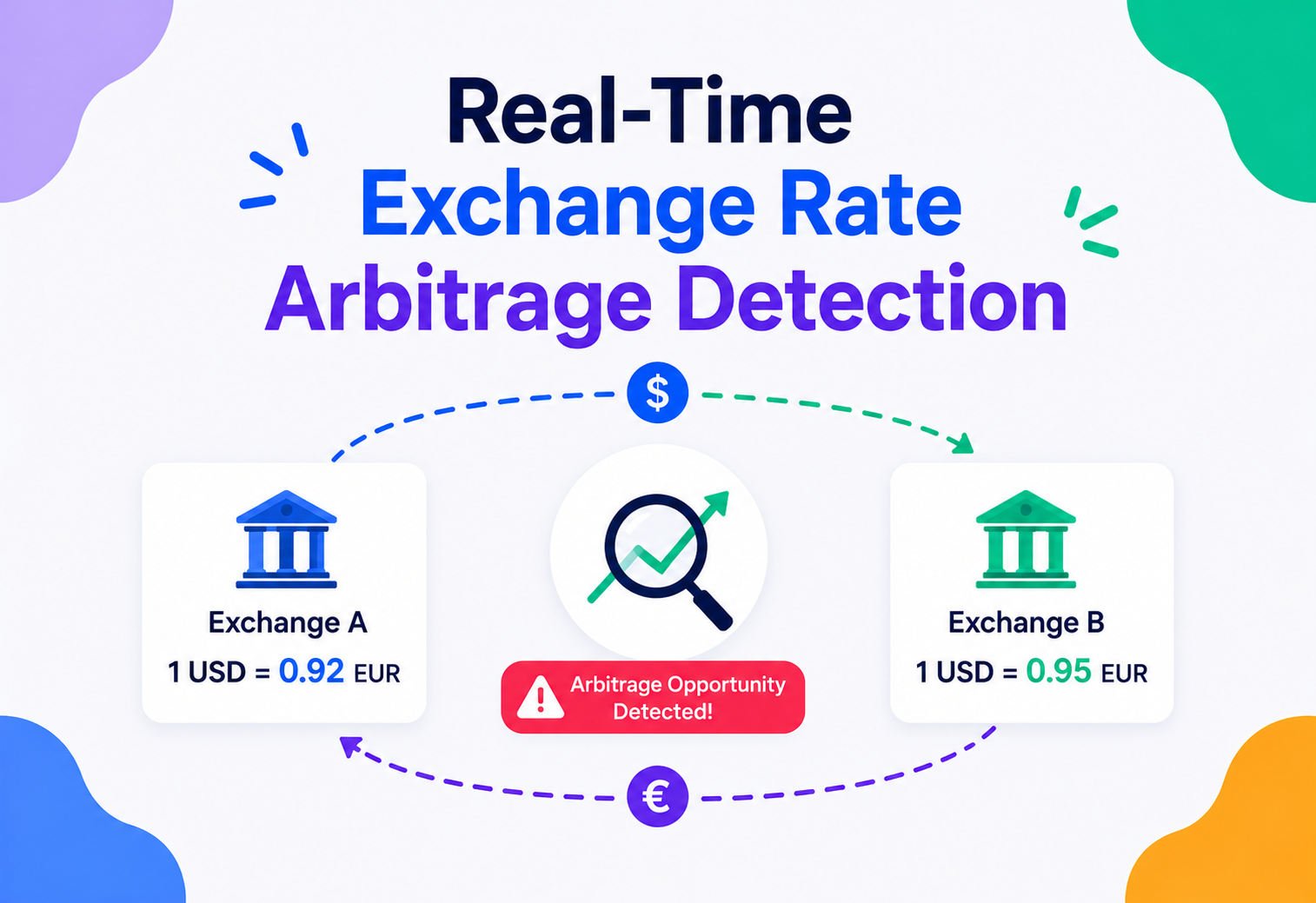
Real-Time FX Arbitrage Detection System Design
Designing a low-latency, safety-critical system for a multi-currency trading desk to detect and capture profitable rate discrepancies across venues before they disappear — ingestion, triangular and cross-venue detection, risk, execution, and everything the desk needs to actually trust it.
Introduction & History
Currency arbitrage is one of the oldest ideas in finance, older than electronic trading itself. Long before computers, traders would notice that a currency could be bought cheaply in one city and sold for more in another, and would move physical gold, silver, or paper drafts between exchanges to lock in a profit. The idea is deceptively simple: if the same asset trades at two different prices in two different places at the same time, buying low in one place and selling high in the other produces a profit with, in theory, no market risk. The challenge has never been understanding the idea — it has always been speed, because as soon as enough traders notice a discrepancy, they trade on it and the discrepancy disappears.
Foreign exchange, or FX, is the largest and most liquid market in the world, with trillions of dollars changing hands every day across a fragmented landscape of banks, electronic communication networks (ECNs), multilateral trading facilities, prime brokers, and non-bank liquidity providers. Because there is no single central exchange for currency the way there is for, say, a listed stock, the same currency pair can genuinely trade at slightly different prices on different venues at the same instant. This fragmentation is the entire reason arbitrage opportunities exist in FX at all, and it is also why arbitrage windows in FX are measured in milliseconds rather than minutes.
Manual, telephone-driven arbitrage desks
Specialist arbitrage desks at large banks worked the phones between venues; opportunity windows were measured in seconds to minutes.
First automated arbitrage systems
Electronic trading platforms arrived. Simple programs polled a handful of venues, computed implied cross rates, and flagged discrepancies for a human to act on.
Colocation & the microsecond arms race
Venues became electronic and colocated in the same data centers. The competitive question shifted from “who notices the opportunity” to “who can react in the fewest microseconds.”
Continuous, kernel-bypass detection
Market data streams continuously from dozens of venues, opportunities open and close within single-digit milliseconds, and the whole value proposition rests on computing, deciding, and routing faster and more reliably than competing desks.
In the pre-electronic era, arbitrage was a manual, telephone-driven activity carried out by specialist arbitrage desks at large banks. The 1990s and 2000s brought electronic trading platforms, and with them, the first generation of automated arbitrage systems: relatively simple programs that polled a handful of venues, computed implied cross rates, and flagged discrepancies for a human trader to act on. As venues themselves became electronic and co-located in the same data centers, the arms race shifted from “who notices the opportunity” to “who can react to the opportunity in the fewest microseconds.” This is the world that today’s real-time exchange rate arbitrage detection system lives in.
This guide walks through the design of such a system for a multi-currency trading desk. We will cover triangular arbitrage within a single venue, cross-venue arbitrage for the same currency pair, statistical and latency arbitrage variants, the ingestion pipeline that makes real-time detection possible, the detection algorithms themselves, the execution and risk layers that turn a detected opportunity into an actual trade, and the operational concerns — monitoring, security, compliance, and scale — that separate a research prototype from a production trading system.

“Why do arbitrage opportunities exist at all in an efficient market?” A strong answer touches on market fragmentation (many venues, no single order book), latency differences between market participants, temporary supply-demand imbalances, and the fact that transaction costs and capital constraints prevent every discrepancy from being instantly closed by every participant.
1.1 Why This Problem Is Different From Ordinary Distributed Systems
Most system design interviews focus on scaling a service so it can handle more users or more requests without falling over. This problem borrows every one of those concerns — throughput, availability, partition tolerance, horizontal scaling — but layers an additional, harder constraint on top: the value of a correct answer decays continuously with time, often to zero within milliseconds. A social media feed that takes an extra fifty milliseconds to load is a mildly worse user experience. An arbitrage detector that takes an extra fifty milliseconds to flag a discrepancy has, in most liquid currency pairs, simply missed the trade entirely, because faster participants have already closed the gap. This changes the engineering culture around the system: correctness under time pressure is not a nice-to-have quality attribute measured in an SLA document — it is the entire product.
A second way this problem differs from a typical web-scale system is the shape of its failure costs. A web service that returns a stale cached value to a user is usually a minor inconvenience. A trading system that acts on a stale or incorrect market data point moves real capital in a way that cannot be undone by simply retrying the request. This asymmetry — the cost of a false positive is a real, realized financial loss, not a degraded user experience — is why the risk and decisioning layer described later in this guide is treated as an equal partner to the detection engine rather than an afterthought bolted on at the end.
A third distinguishing feature is the adversarial nature of the environment. Unlike a typical backend system, where load is largely organic and not actively trying to exploit weaknesses in your design, an arbitrage detection system operates in a market where other, extremely sophisticated participants are simultaneously trying to detect and capture the exact same discrepancies, and in some cases trying to detect and exploit weaknesses in slower participants’ systems — for example by “quote stuffing” or rapidly cancelling and replacing orders in ways that create noise a slower detector might misread as a genuine opportunity. Designing defensively against this kind of environment, not just against ordinary hardware and network failures, is a first-class concern.
Problem Definition & Requirements
Before drawing any boxes and arrows, it helps to state precisely what the system must do, because “arbitrage detection” can mean several different things depending on the desk’s strategy.
2.1 Types of Arbitrage the System Must Detect
| Arbitrage Type | Description | Typical Opportunity Window |
|---|---|---|
| Triangular arbitrage | Within one venue, three currency pairs (e.g. EUR/USD, USD/JPY, EUR/JPY) imply a cross rate; when the implied rate diverges from the quoted rate, a three-leg trade captures the difference. | Single-digit to low double-digit milliseconds |
| Cross-venue (spatial) arbitrage | The same currency pair trades at different prices on two venues at the same instant. | 1–20 milliseconds, often shorter on liquid majors |
| Latency arbitrage | A faster feed or co-located server sees a price move before slower venues update, allowing a trade against stale quotes. | Sub-millisecond to a few milliseconds |
| Statistical arbitrage | Historically correlated currency pairs or baskets temporarily diverge from their statistical relationship; not risk-free, but treated similarly from a detection-and-execution standpoint. | Seconds to minutes |
| Covered interest rate arbitrage | Discrepancy between spot rate, forward rate, and interest rate differential between two currencies. | Minutes to hours; lower frequency, larger notional |
2.2 Functional Requirements
- Ingest real-time market data (top-of-book and, where available, full depth-of-book) from all connected venues and liquidity providers.
- Normalize quotes from heterogeneous feed formats into a single internal representation.
- Continuously recompute triangular and cross-venue implied rates as new quotes arrive.
- Detect discrepancies that exceed a configurable profit threshold after accounting for transaction costs, fees, and estimated slippage.
- Rank and prioritize opportunities by expected profit, confidence, and available capital.
- Perform pre-trade risk checks (position limits, exposure limits, venue credit limits) before any order is sent.
- Route orders to the appropriate venues with minimal added latency, ideally as simultaneous or near-simultaneous multi-leg execution.
- Confirm fills, detect partial fills or leg failures, and unwind or hedge residual exposure quickly.
- Record a complete, timestamped audit trail of every opportunity detected, whether or not it was traded, for compliance and strategy tuning.
2.3 Non-Functional Requirements
Low single-digit µs to low ms
End-to-end detection latency (quote received to opportunity flagged) in the low single-digit microseconds to low milliseconds range, depending on venue and strategy.
Bursty millions of msg/min
Support market data bursts well beyond steady-state averages; during volatile events, quote update rates can spike into the millions of messages per minute across a multi-currency, multi-venue book.
Predictable, low-jitter
Predictable, low-jitter processing so that the system’s behavior under load does not degrade unpredictably.
Minimize false positives
False positives (phantom arbitrage from stale or crossed quotes) must be minimized, since acting on a false signal creates real losses.
Fully reconstructable
Every decision must be reconstructable after the fact for regulatory review.
Graceful degradation
The system must degrade gracefully — losing one venue feed should not take down detection for the rest of the book.
“How would you define ‘real-time’ for this system, and how does that shape your architecture choices?” Be ready to distinguish between hard real-time (deterministic upper bound, common in exchange matching engines) and the “soft real-time, but every microsecond of average and tail latency matters” profile that most buy-side arbitrage desks target, and explain how that distinction pushes you toward kernel-bypass networking, careful memory management, and avoiding garbage-collected hot paths.
2.4 Who Uses This System, and What They Each Need From It
It helps to think through the different stakeholders who touch this system day to day, because each one pulls the design in a slightly different direction. The trading desk itself cares almost exclusively about capturing profitable opportunities and avoiding unintended exposure; their success metric is realized profit and loss, and their tolerance for complexity in service of speed is very high. Risk management cares about the aggregate exposure the system can create across all currency pairs and venues at any moment, and wants hard, provable limits rather than best-effort guardrails. Compliance and legal care about the ability to reconstruct, months later, exactly what data the system saw and why it made each decision, in a form that satisfies a regulator’s questions. Engineering and site reliability care about operability: can a failing component be identified and replaced quickly, can a bad deployment be rolled back safely, and can the system be understood by someone other than the person who wrote it. Finance and the desk head care about cost: colocated hardware, dedicated cross-connects to venues, and premium market data subscriptions are expensive, and every architectural choice that adds cost needs to be justified by a corresponding improvement in captured opportunity.
These competing priorities are not hypothetical; they show up constantly in real design trade-offs. A risk manager might prefer a synchronous, blocking risk check on every single order to guarantee no limit is ever breached even momentarily, while the trading desk wants that same check to add as close to zero latency as possible. The resolution, discussed further in the risk and decisioning layer, is usually a combination of extremely fast, pre-computed limit checks for the common case and slower, more thorough checks reserved for larger or unusual trades, so that both parties’ core concerns are respected without either dominating the design at the other’s expense.
2.5 Scale and Volume Assumptions
To ground the rest of this design, it is worth stating explicit, if illustrative, assumptions about scale. A desk trading the major and a selection of minor and cross currency pairs, connected to somewhere between eight and twenty venues and liquidity providers, can expect steady-state quote update volumes in the hundreds of thousands of messages per minute, with bursts during major economic releases, central bank announcements, and market opens that can push instantaneous rates into the millions of messages per minute across the aggregate book. The vast majority of these updates — often well over ninety-nine percent — will not correspond to a tradeable arbitrage opportunity at any given instant; the system’s steady-state job is mostly to quickly and cheaply confirm “no opportunity here” over and over, with occasional bursts of genuine signal. Designing for this skew, rather than assuming a more even distribution of interesting events, materially shapes decisions later in this guide, particularly around what work happens unconditionally on every update versus what work is deferred until a candidate opportunity is already identified.
Architecture & Components
The system separates cleanly into five stages: market data ingestion, normalization, arbitrage detection, risk and decisioning, and execution. Each stage has different latency and throughput characteristics, so each is designed and, where appropriate, physically deployed differently.
3.1 Market Data Ingestion Layer
This layer owns every connection to the outside world. Venues speak different protocols: many banks and ECNs still use FIX (Financial Information eXchange) for order entry and, increasingly, binary or FAST-encoded FIX for market data because plain-text FIX is too slow for high-frequency quote streams. Others expose WebSocket-based JSON or protobuf feeds, and some high-throughput venues use raw UDP multicast with a proprietary binary format for the lowest possible latency. Each venue therefore gets its own dedicated feed handler, written to squeeze out latency specific to that protocol, rather than a single generic parser trying to handle everything.
Feed handlers are intentionally “dumb and fast”: their only job is to read bytes off the wire, validate a checksum or sequence number, and hand a raw or lightly-parsed message to the normalization layer. Business logic does not belong here, because any branching or allocation on this path adds latency that compounds across millions of messages.
3.2 Normalization and Sequencing
Each venue quotes prices with different conventions: different currency pair orderings, different tick sizes, different treatment of bid/ask versus mid, different timestamp precisions and clock sources. The normalizer converts every incoming quote into one canonical internal representation before anything downstream touches it. This is also where a sequencer assigns a monotonically increasing internal timestamp so that all downstream components can reason about “what did the book look like at time T” consistently, regardless of network jitter on the way in.
3.3 Arbitrage Detection Core
This is the heart of the system. An in-memory order book cache holds the latest best bid/ask (and, where subscribed, deeper levels) for every currency pair on every venue. Two specialized engines run continuously against this cache:
- The triangular arbitrage engine recomputes implied cross rates every time any of the three legs updates, and compares the implied rate to the directly quoted rate.
- The cross-venue arbitrage engine compares the same currency pair’s price across all connected venues and flags divergence beyond the combined transaction cost of trading both legs.
An opportunity scorer then ranks any detected discrepancy by expected profit after fees, confidence (how many consecutive updates confirm the discrepancy is real and not a stale quote), and available capacity at each venue.
3.4 Risk and Decisioning Layer
No opportunity, however profitable it looks, should reach the market without a pre-trade risk check. This layer enforces position limits per currency pair, aggregate desk exposure limits, per-venue credit and settlement limits, and any regulatory constraints (for example, restrictions tied to MiFID II best-execution obligations in relevant jurisdictions). A strategy controller then decides, when multiple opportunities compete for the same capital or the same venue capacity, which to pursue first.
3.5 Execution Layer
The order management system (OMS) is responsible for constructing the multi-leg order set, sending it to the correct venue gateways as close to simultaneously as possible, and tracking fills. Each venue gets its own order gateway, tuned for that venue’s order entry protocol and rate limits.
“Why not build one generic feed handler for all venues instead of one per venue?” Explain the trade-off: a generic handler is easier to maintain and extend, but every added abstraction layer (interface dispatch, generic parsing, dynamic dispatch) adds nanoseconds to microseconds of latency that compound across millions of messages per minute. In latency-sensitive systems, specialization on the hot path is usually worth the added maintenance burden.
Internal Working
4.1 Triangular Arbitrage Mechanics
Consider three currency pairs available on the same venue: EUR/USD, USD/JPY, and EUR/JPY. If you convert EUR to USD, then USD to JPY, the result should match converting EUR directly to JPY, once you account for the bid/ask spread on each leg. When it does not — when going around the triangle produces more JPY than the direct EUR/JPY quote would give you — a triangular arbitrage opportunity exists. The detection engine computes this “implied cross rate” continuously and compares it against the directly quoted rate, and flags the divergence whenever it exceeds the combined transaction cost of executing all three legs.
A subtlety worth calling out: because there are more than three major currencies and even more crosses, a single desk typically monitors many overlapping triangles simultaneously. A common and elegant way to think about this at scale is to model currencies as nodes in a graph and each quoted exchange rate as a directed, weighted edge, where the weight is the negative logarithm of the exchange rate. Under this transformation, a profitable arbitrage cycle corresponds exactly to a negative-weight cycle in the graph, and detecting it becomes a classic graph problem solvable with a variant of the Bellman-Ford algorithm extended for negative cycle detection. This generalizes triangular arbitrage detection to arbitrary cycles across any number of currencies, not just three, at the cost of more computation per update.
4.2 Cross-Venue Arbitrage Mechanics
For a single currency pair, say GBP/USD, the detection engine watches the best bid and ask quoted by every connected venue. If Venue A’s bid exceeds Venue B’s ask by more than the combined transaction cost (spread crossed plus fees plus estimated market impact and settlement cost), buying on Venue B and simultaneously selling on Venue A locks in a profit. This sounds simple, but two practical issues dominate real implementations:
- Quote staleness: a quote that looks stale (has not updated in an unusually long time relative to that venue’s typical update frequency) is far more likely to be an artifact of a disconnected or slow feed than a genuine, tradeable price, so the engine discounts or discards stale quotes rather than trading against them.
- Execution risk: the two legs cannot literally execute at the same instant. Between sending the buy order and the sell order, the price can move, or one leg can fail to fill entirely (a partial fill or a reject). The system must plan for this “leg risk” explicitly, not treat it as a theoretical edge case.
4.3 Opportunity Scoring and Ranking
Every candidate opportunity is scored on estimated net profit (gross price discrepancy minus fees, expected slippage, and financing cost of any capital tied up), confidence (derived from quote freshness, historical reliability of that venue’s quotes, and how many independent updates confirm the discrepancy), and available size (the smaller of the two venues’ quoted depth, since you cannot capture more than the thinner side allows). Opportunities are queued and dispatched to the risk layer in priority order, and the strategy controller enforces fairness and capital allocation rules across competing opportunities that might otherwise all try to consume the same limited capital simultaneously.
“How do you distinguish a genuine arbitrage opportunity from a stale or erroneous quote?” Discuss quote-age thresholds relative to that venue’s typical update cadence, cross-checking against a reference or consolidated feed, requiring a minimum number of confirming updates before acting, and maintaining a per-venue reliability score based on historical fill rates against that venue’s quotes.
4.4 Incremental Recomputation Instead of Full Rescans
A naive implementation of triangular arbitrage detection would, on every single quote update, walk every known triangle involving the updated currency pair and recompute each one from scratch. This works, but it wastes enormous amounts of computation, because a single update to EUR/USD only ever affects the small number of triangles that actually include EUR/USD as one of their three legs; every other triangle in the system is completely unaffected and does not need to be touched. A well-designed detection engine therefore maintains, for every currency pair, a precomputed list of every triangle and every cross-venue comparison that depends on it, so that a single incoming update triggers recomputation of only the small, directly affected set, rather than a full scan of the entire opportunity space. This kind of incremental, dependency-driven recomputation is one of the single highest-leverage performance decisions in the whole system, because it turns an update’s cost from proportional to the total number of monitored relationships into a cost proportional only to the number of relationships that specific currency pair actually participates in.
The same principle extends naturally to the graph-based, Bellman-Ford-style detection discussed above for arbitrary-length cycles. Rather than rerunning a full negative-cycle search over the entire currency graph on every update, production implementations typically maintain incremental state and only re-examine the region of the graph reachable from the currency whose edge weight just changed, falling back to a fuller periodic re-verification pass as a safety net to catch anything the incremental logic might have missed due to an edge case or a bug.
4.5 Handling Multiple Simultaneously Competing Opportunities
During volatile periods, it is common for several genuine arbitrage opportunities to be detected within the same short window, all competing for the same finite capital, the same venue’s available depth, or the same risk budget. The strategy controller has to make an allocation decision, and there are a few common approaches. A purely greedy approach simply takes the highest-scored opportunity first and continues down the ranked list until capital or limits are exhausted; it is simple and usually close to optimal when opportunities do not interact much. A more careful approach recognizes that some opportunities share underlying capacity — for example, two different triangles both wanting to sell the same currency on the same venue at the same moment — and solves a small, fast constrained-optimization problem across the competing candidates rather than treating them independently. In practice, most production systems start with the greedy approach because of its speed and predictability, and only invest in the more sophisticated allocation logic once the desk’s volume and opportunity density genuinely justify the added complexity and latency cost.
Data Flow & Lifecycle
Tracing a single quote from arrival to (possible) execution illustrates how the pieces fit together end to end.
Two aspects of this lifecycle deserve emphasis. First, the vast majority of quote updates never produce a candidate opportunity at all — most updates simply refresh the book and the detection engine’s recomputation confirms there is no discrepancy. The system is therefore optimized heavily for the “no opportunity” fast path, since that is what happens millions of times for every one candidate that reaches the risk layer. Second, the moment an opportunity is approved and orders are sent, the system enters a distinct “in-flight” state where it must track two or more legs independently and be ready to react if one leg fills and another does not, which is discussed further under high availability and reliability.
Advantages, Disadvantages & Trade-offs
| Aspect | Advantage | Disadvantage / Trade-off |
|---|---|---|
| Speed of detection | Faster detection captures more opportunities and reduces leg risk. | Optimizing for raw speed (kernel bypass, custom hardware, colocation) is expensive and operationally complex. |
| Number of venues monitored | More venues means more opportunities and better price discovery. | Each additional venue adds ingestion complexity, connection management overhead, and more surface area for stale or erroneous data. |
| Detection sensitivity (threshold tuning) | A lower profit threshold catches more opportunities. | Too low a threshold generates false positives that lose money once real transaction costs and slippage are included. |
| Graph-based (Bellman-Ford) detection vs. pairwise triangular checks | Catches arbitrary-length arbitrage cycles, not just three-currency triangles. | Higher computational cost per update; harder to reason about and debug under time pressure. |
| Centralized in-memory book vs. per-venue local books | A single consolidated view simplifies cross-venue comparison logic. | Introduces a potential single point of contention and a target for careful concurrency design. |
The overarching trade-off in this domain is between speed and safety. Every design decision that shaves microseconds off the detection or execution path tends to reduce the amount of validation, redundancy, or human oversight in that path. A well-designed system does not eliminate this tension; it manages it deliberately, putting the tightest possible latency budget only on the parts of the pipeline where speed genuinely determines whether an opportunity is captured, while keeping generous safety margins everywhere else, especially around risk checks.
A second, related trade-off worth naming explicitly is the one between build and buy. A desk could, in principle, purchase a fully packaged arbitrage detection and execution platform from a vendor, trading a great deal of engineering effort for faster time to market and a proven, battle-tested codebase. The cost of this path is that the desk’s actual competitive edge — the specific thresholds, the specific venues it prioritizes, the specific handling of edge cases learned from its own trading history — becomes difficult to differentiate from every other desk using the same vendor platform, since a shared, generic detection engine tends to converge toward capturing the same, increasingly thin set of obvious opportunities that everyone else using it is also chasing. Most serious proprietary trading operations therefore build the detection and execution core themselves, even while buying commodity infrastructure like market data connectivity and colocated hosting, precisely because the core logic is where sustainable differentiation actually lives.
Performance & Scalability
A multi-currency desk connected to a dozen or more venues, each streaming full or partial order book depth for dozens of currency pairs, can easily generate quote update volumes in the range of millions of messages per minute during active trading hours, with sharp bursts around economic data releases and market opens. The detection core must sustain this throughput while keeping tail latency low, because an opportunity detected a few milliseconds late is often an opportunity that no longer exists.
7.1 Techniques for Sustaining Millions of Messages per Minute
Kernel-bypass networking
Technologies that let feed handlers read packets directly from the network interface card, avoiding the overhead of the operating system’s networking stack, are standard in this space for the venues where every microsecond matters.
Lock-free data structures
The shared order book cache uses lock-free or wait-free concurrent structures so that reader threads (the detection engines) never block on writer threads (the normalizer), and vice versa.
Pre-allocation & pooling
Avoiding allocation on the hot path prevents unpredictable garbage-collection pauses or heap fragmentation from introducing latency spikes.
Pinning & NUMA awareness
Pinning feed handler and detection threads to specific CPU cores, and being careful about which NUMA node’s memory they access, reduces cache misses and context-switch overhead.
Batching non-critical paths
While the detection hot path processes updates one at a time for lowest latency, downstream logging, audit writes, and time-series storage are batched to avoid overwhelming slower storage systems.
Horizontal partitioning by currency pair
Since a EUR/USD update never affects the USD/CAD book, detection work is naturally shardable by currency pair or by currency-pair cluster, allowing the system to scale out across cores or machines with minimal coordination.
7.2 Latency Budget Example
| Stage | Target Latency Budget |
|---|---|
| Wire to feed handler parse complete | Low single-digit microseconds |
| Normalization and sequencing | Sub-microsecond to a few microseconds |
| Book update and detection recompute | Single-digit microseconds |
| Risk check | Tens of microseconds (deliberately allowed slightly more time for correctness) |
| Order construction and send to gateway | Low single-digit microseconds |
| Network transit to venue | Highly venue-dependent; minimized primarily through colocation |
“How would you scale this system horizontally without introducing cross-shard coordination overhead?” A good answer explains sharding the detection engines by currency or currency cluster (since a JPY-related triangle never needs data from a completely unrelated currency’s book), while keeping cross-venue comparison for the same pair co-located within a single shard so no cross-machine coordination is needed on the hot path.
7.3 Vertical Scaling Still Matters Here
Most modern system design guidance leans heavily toward horizontal scaling as the default answer to a growth problem, and for good reason in most domains: it is usually cheaper and more resilient than continually buying bigger machines. This domain is a partial exception. Because the detection hot path is latency-critical down to the microsecond, and because inter-machine communication over a network, even a fast one, introduces latency that simply does not exist within a single machine’s memory, there is a strong incentive to keep as much of the tightly coupled hot path as possible on a single, extremely powerful machine, and only shard across machines when a single machine’s capacity is genuinely exhausted. This means the team responsible for this system spends real engineering effort on single-machine performance — efficient use of CPU cache lines, minimizing memory copies, choosing data structures with excellent locality — before reaching for horizontal scaling as the next lever, which is closer to how a database engine team or a game engine team thinks about performance than how a typical web backend team does.
7.4 Capacity Planning for Bursty, Event-Driven Load
Average load figures are almost meaningless for capacity planning in this domain, because the load that actually matters arrives in short, extreme bursts around scheduled and unscheduled market events: central bank interest rate decisions, major economic data releases, geopolitical news, and unexpected liquidity shocks. A system provisioned only for average throughput will perform beautifully ninety-five percent of the time and fail exactly when it matters most, during the volatile minutes when the largest and most numerous genuine opportunities actually appear. Capacity planning therefore targets peak burst rates observed during the most volatile historical events the desk has data for, with a healthy additional safety margin, rather than targeting a comfortable multiple of average daily throughput. This is also why load testing for this system deliberately replays recorded market data from genuinely extreme historical sessions rather than relying purely on synthetic, evenly distributed synthetic load generators, since synthetic load rarely captures the specific clustering and correlation patterns real market bursts exhibit.
High Availability & Reliability
A trading system that misses a venue’s feed for even a few seconds does not just lose opportunities during that window; it risks trading on a stale or incomplete view of the market once the feed resumes, which is far more dangerous than simply pausing.
8.1 Feed Redundancy
Where venues offer redundant feeds (primary and backup multicast groups, or primary and disaster-recovery data centers), the system subscribes to both and reconciles sequence numbers, using the backup transparently to fill any gap detected in the primary. A gap-fill or retransmission request mechanism, standard in most FIX and multicast market data protocols, recovers missed messages without requiring a full reconnect.
8.2 Handling Leg Failure in Multi-Leg Trades
The most operationally dangerous failure mode specific to arbitrage is a partial fill: one leg of a two- or three-leg trade executes, and another does not, leaving the desk with unintended directional exposure instead of the risk-free profit it intended to capture. The OMS must detect this immediately (via fill timeouts and reconciliation against expected fills) and automatically trigger a pre-defined unwind or hedge action, rather than waiting for a human to notice.
8.3 Circuit Breakers and Kill Switches
Automated trading systems need automated brakes. A circuit breaker halts trading automatically when realized losses over a rolling window exceed a threshold, when the rate of detected “opportunities” spikes abnormally (often a sign of a bad feed rather than a real market event), or when a venue’s quotes diverge implausibly from a reference price. A manual kill switch, reachable in a single action, must always be available to the desk as the final layer of defense.
8.4 Failover and Deployment Redundancy
Detection and risk services run as active-active or active-passive clusters across at least two independent data centers or availability zones, ideally including at least one colocated presence near the primary venues and a geographically separate site for disaster recovery. State needed for fast failover, such as current positions and open risk limits, is continuously replicated so a failover does not require rebuilding state from scratch under time pressure.
“What happens if one leg of a triangular arbitrage trade fails to fill?” Walk through detection via fill timeout, immediate cancellation of any still-open leg, and an automatic hedge of any resulting exposure, emphasizing that this must be fully automated because human reaction time is far too slow relative to how quickly an unintended FX position can move.
8.5 Proactively Testing Failure Modes Rather Than Waiting for Them
Given how expensive an untested failure mode can be in this domain, mature operations do not wait for a real venue outage or a real leg failure to discover a gap in their reliability logic. Instead, they run regular, deliberately induced failure exercises against a controlled, non-production instance of the system, and in more mature setups, carefully scoped exercises against production itself during low-activity periods: simulating a venue feed disconnecting mid-session, simulating a fill confirmation arriving after the timeout window has already triggered a hedge, simulating a gateway rejecting an order for an unexpected reason, and confirming in each case that the system behaves exactly as designed rather than in some untested, ambiguous middle state. This discipline, sometimes described as chaos engineering when applied to distributed systems generally, is especially valuable here precisely because the cost of discovering a gap for the first time during a real, live incident is measured directly in lost money rather than in a degraded but recoverable user experience.
Automated leg-failure unwind, no human in the loop
Context: A partial multi-leg fill leaves the desk with unintended directional FX exposure. Human reaction times (seconds) are orders of magnitude slower than the rate at which FX positions can move against the desk.
Decision: The OMS treats every multi-leg opportunity as a saga with pre-defined compensating actions (cancel-and-hedge). Fill timeouts trigger these actions automatically; a human is only paged after the position is flat.
Consequences: Occasionally the system will hedge a leg that would have filled a millisecond later, at a small cost. This is deliberately preferred over leaving open exposure while waiting for a human, which is uncapped downside.

Security
A trading system is a high-value target: it moves real money, and its internal logic (thresholds, venue relationships, strategy parameters) is valuable intellectual property.
Network segmentation
Market data ingestion, detection, risk, and execution run in tightly controlled network segments, with the execution layer’s outbound connectivity restricted to only the specific venue gateways it needs.
Mutual TLS & API auth
Every internal service-to-service call, and every external venue connection that supports it, uses mutual TLS or equivalent strong authentication, avoiding shared static credentials wherever possible.
Least privilege
The detection engines have no ability to place orders; only the OMS, authenticated and authorized specifically, can talk to venue order gateways. This separation limits the blast radius of any single compromised component.
Secrets management
Venue API keys and credentials are stored in a dedicated secrets manager with automatic rotation, never in configuration files or source control.
Immutable audit logging
Every order, fill, rejection, and risk decision is written to an append-only, tamper-evident log, both for security forensics and regulatory obligations.
Input validation on market data
Even though market data comes from trusted venues, the ingestion layer validates message structure and bounds-checks prices to prevent a corrupted or malicious feed from crashing downstream services or triggering nonsensical trades.
“Why does the detection engine specifically not have order-placement privileges?” This is a least-privilege and defense-in-depth question: separating “can compute an opportunity” from “can move money” means a bug or compromise in the detection logic cannot directly cause a trade; it can only produce a candidate that still has to pass through an independently secured risk and execution layer.
9.1 Protecting Against Malicious or Manipulative Market Participants
Beyond conventional infrastructure security, this system faces a category of threat that a typical web application never has to consider: other market participants deliberately trying to manipulate what the system perceives. A sophisticated counterparty might attempt to “spoof” the book by placing and rapidly cancelling large orders to create a false impression of depth or direction, or might deliberately quote a brief, implausible price specifically to bait slower arbitrage systems into trading against it before withdrawing the quote. Defending against this requires the detection logic itself to incorporate a degree of healthy skepticism: sanity-bounding any quote against a reasonable range derived from a reference price or recent trading history, requiring a minimum quote lifetime before treating it as tradeable where the venue’s protocol allows this to be observed, and tracking a running reliability score per venue and per counterparty that down-weights sources with a history of quotes that do not lead to real fills.
9.2 Change Management and Deployment Security
Because a single bad deployment can move real money, the deployment pipeline itself is a security-relevant surface. Every artifact deployed to the hot path is built through a controlled, auditable pipeline, signed, and verified before deployment, so that the running binary can always be traced back to a specific, reviewed source code change. Access to trigger a production deployment or to modify a live risk limit is restricted to a small, named set of individuals, with every such action itself logged to the same immutable audit trail used for trading activity, since a compromised or careless deployment credential is functionally equivalent to a compromised trading credential in terms of potential impact.
“How would a market participant try to exploit weaknesses in a system like this, and how would you defend against it?” A thoughtful answer goes beyond conventional cybersecurity threats to discuss quote spoofing, deliberately misleading brief price quotes, and other manipulative tactics, and explains defenses like quote-age and reliability scoring, sanity bounds against reference prices, and treating unusually favorable opportunities with extra scrutiny rather than extra eagerness.
Monitoring, Logging & Metrics
Because the system’s entire value depends on latency and correctness that are invisible to the naked eye, comprehensive, high-resolution observability is not optional.
10.1 Key Metrics
| Category | Example Metrics |
|---|---|
| Latency | Wire-to-detection latency (p50, p99, p99.9), risk-check latency, order-send latency, end-to-end quote-to-fill latency |
| Throughput | Quote updates per second per venue, opportunities detected per minute, orders sent per minute |
| Correctness / quality | False-positive rate (opportunities flagged but not filled profitably), fill ratio per venue, average slippage versus expected price |
| Reliability | Feed uptime per venue, sequence-gap count, failover events, leg-mismatch incidents |
| Business | Realized PnL, capital utilization, opportunities missed due to risk-limit rejection |
10.2 Logging and Tracing
Every quote, decision, and order carries a correlation identifier so the full lifecycle of a single opportunity can be reconstructed end to end, from the triggering quote through the risk decision to the final fill or rejection. High-resolution timestamps (ideally hardware-timestamped at the network interface) are attached at every stage so that latency can be broken down stage by stage rather than only measured end to end.
10.3 Alerting
Alerts are tiered by severity: a single venue’s feed briefly stalling is a warning; a sustained spike in detected-but-unfilled opportunities (often indicating a stale-quote problem) is critical; a leg mismatch resulting in unintended exposure is a page-immediately event, routed to both the trading desk and the on-call engineering team simultaneously.
10.4 Real-Time Dashboards for the Trading Desk
Alongside engineering-facing metrics, the trading desk itself needs a real-time visual dashboard that shows the current state of the book across venues, recent detected and executed opportunities, running realized profit and loss, and current exposure against limits. This dashboard is deliberately kept separate, in terms of infrastructure, from the actual detection and execution hot path, streaming updates asynchronously so that a slow or disconnected dashboard client can never, even in principle, add latency to the trading logic itself. A common design mistake is to let dashboard subscribers pull directly from the same in-memory structures the detection engine uses, which can introduce contention; a cleaner approach publishes a throttled, summarized event stream specifically for human consumption, decoupled entirely from the full-rate internal event stream the detection engines consume.
10.5 Post-Trade Analysis and Continuous Tuning
Monitoring in this domain extends beyond simply confirming the system is up and processing messages; it includes a continuous feedback loop that measures how well the detection logic’s theoretical opportunities translated into real, captured profit. Transaction cost analysis compares the price actually achieved on each fill against the price that was quoted at detection time, quantifying slippage systematically rather than anecdotally. This data feeds back into threshold tuning: if a particular venue or currency pair consistently shows worse-than-expected slippage, its effective transaction cost estimate is adjusted upward, which naturally raises the bar for what counts as a profitable opportunity on that specific venue going forward, without requiring anyone to manually notice and adjust a configuration value.
“How would you detect that your detection engine itself has a bug, as opposed to the market genuinely having no arbitrage opportunities?” A good answer proposes tracking the false-positive rate and fill ratio over time, alerting on sudden drops in detected-opportunity rate relative to historical baselines for similar market conditions, and running a shadow or canary instance of updated detection logic against live data before promoting it to production.
Deployment & Cloud Strategy
Latency-critical trading systems occupy an unusual position in the cloud-versus-on-premises debate. The detection and execution hot path typically runs on dedicated, colocated hardware physically close to the venues’ matching engines, because even the fastest cloud region introduces network hops and virtualization overhead that are unacceptable when microseconds decide whether a trade captures an opportunity.
- Colocation: feed handlers, detection engines, and order gateways for the most latency-sensitive venues run on physical servers inside or adjacent to the venue’s own data center, connected via direct cross-connects rather than the public internet.
- Cloud for everything else: less latency-sensitive components — the risk engine’s slower analytics, historical data storage, compliance reporting, dashboards, and model backtesting infrastructure — run comfortably in the cloud, where elasticity and managed services reduce operational burden.
- Hybrid connectivity: a dedicated, low-jitter private link connects the colocated hot path to the cloud-hosted supporting services, so risk limits and position data can be kept in sync without depending on the public internet for anything time-critical.
- Infrastructure as code: even latency-tuned bare-metal deployments benefit from declarative, version-controlled configuration, so that a failed colocated server can be replaced with an identically configured one quickly and predictably.
- Blue-green and canary rollouts: changes to detection logic or thresholds are deployed to a canary instance that runs in shadow mode against live data (computing but not acting) before being promoted, since a bug in this code path has direct financial consequences.
“Would you run this entire system in a public cloud region?” A strong answer explains why the very latency-sensitive hot path benefits from colocation and dedicated hardware close to venues, while acknowledging that supporting services (analytics, compliance, dashboards, historical storage) are excellent fits for the cloud, describing a deliberately hybrid architecture rather than an all-or-nothing choice.
11.1 Disaster Recovery Site Selection
Choosing a disaster recovery site for the colocated hot path involves a genuine tension that does not exist for most cloud-native systems. A disaster recovery site that is very close, geographically, to the primary site recovers quickly and with minimal added baseline latency once failed over, but is also more likely to be affected by the same regional event, such as a power grid failure or a natural disaster, that took down the primary site in the first place. A disaster recovery site that is geographically distant is more resilient to regional events but permanently trades away some latency advantage even in its normal, non-disaster operating mode, since it is simply farther from the venues. Most serious operations resolve this by maintaining a nearby, low-latency secondary site for routine failover of individual server failures, combined with a genuinely distant tertiary site reserved specifically for regional catastrophic events, accepting that the tertiary site will operate at meaningfully higher latency and therefore reduced competitiveness until the primary region is restored.
11.2 Configuration Management Across Environments
Because the exact same detection and risk logic runs across a shadow-mode canary environment, a staging environment used for pre-production validation, and the live production hot path, careful configuration management ensures that a threshold or limit tested in shadow mode behaves identically when promoted, with no environment-specific code paths that could behave differently under conditions nobody explicitly tested. Configuration values are versioned alongside code changes rather than managed as a separate, independently mutable layer, so that any given deployed binary has one unambiguous, reconstructable configuration state at any point in its history, which is invaluable both for debugging an unexpected production behavior and for satisfying an auditor asking exactly what parameters were active when a specific trade occurred.
Databases, Caching & Load Balancing
12.1 In-Memory Order Book Cache
The live order book itself is not stored in a traditional database at all; it lives entirely in memory as the system’s primary “hot” data structure, because even the fastest embedded database introduces latency the detection engines cannot afford on every single quote update. This in-memory structure is the closest thing this system has to a cache, and it is the single most performance-critical piece of state in the whole design.
12.2 Time-Series Storage for History and Analytics
Every quote, computed implied rate, and detected opportunity is asynchronously persisted to a time-series-optimized store, used for backtesting new detection thresholds, post-trade transaction cost analysis, and regulatory reporting. Because this write path is off the critical hot path, it can batch writes and tolerate slightly higher latency in exchange for durability and compression efficiency.
12.3 Reference and Configuration Data
Static or slow-changing data — venue connection parameters, fee schedules, currency pair metadata, risk limit configuration — lives in a conventional relational store, cached in memory by every service that needs it, with a lightweight pub-sub invalidation mechanism so that a limit change from a risk manager propagates to all detection and risk instances within milliseconds rather than requiring a restart.
12.4 Load Balancing Considerations
Traditional round-robin load balancing is largely inapplicable to the detection hot path, since currency-pair sharding (described in the performance section) is a far more effective way to distribute load without introducing coordination overhead. Where load balancing is genuinely useful is in front of stateless supporting services: the REST and WebSocket APIs used by dashboards, compliance tools, and configuration services benefit from standard load balancing across replicas, since these do not sit on the microsecond-critical path.
“Why not use a standard database, even an in-memory one like a key-value store, for the live order book?” Explain that even the fastest client-server database introduces a network round trip and serialization overhead measured in tens of microseconds, which is simply too slow for a book that must be recomputed on every quote update; the book therefore lives as native in-process memory structures, with persistence handled asynchronously and out of the hot path.
12.5 Data Retention and Regulatory Storage Requirements
Financial regulators in most major jurisdictions require firms to retain detailed records of trading activity, and in many cases the underlying market data considered at the time of each decision, for a period that commonly spans several years. This creates a storage volume and cost problem distinct from the performance problem the hot path solves: years of tick-level market data across dozens of venues and currency pairs, even after compression, represents a genuinely large dataset. Production systems typically apply a tiered storage strategy, keeping the most recent weeks or months of data in fast, easily queryable storage for active analytics and backtesting, while older data moves to cheaper, colder storage that is still retrievable within a reasonable time window if a regulator or internal audit requests it, but is not optimized for fast interactive queries.
12.6 Consistency Model for the Order Book Cache
It is worth being explicit about what consistency guarantee the in-memory order book cache actually offers, because “real-time” does not mean “instantaneous” and different readers can legitimately see slightly different snapshots of the book at the same wall-clock instant if they are pinned to different CPU cores with different cache states. The design deliberately favors an eventually-consistent, extremely low-latency model over a strongly consistent but slower one: every detection engine is guaranteed to see updates in the correct order for any single currency pair, but two different detection engines are not guaranteed to be looking at the exact same global snapshot of the entire book at the exact same nanosecond. This is an acceptable trade-off because the detection logic for any given opportunity only ever depends on a small, well-defined set of currency pairs, and strict global consistency across the entire book is never actually required for a single decision to be correct.
APIs & Microservices
Although the detection hot path is tightly coupled for latency reasons, the system as a whole is organized as a set of loosely coupled services around that hot path, communicating through well-defined interfaces.
| Service | Responsibility | Typical Interface |
|---|---|---|
| Feed Handler Services | Venue-specific connectivity and parsing | Internal binary message bus (hot path) |
| Detection Core | Triangular and cross-venue arbitrage computation | Internal binary message bus (hot path) |
| Risk Engine | Pre-trade limit checks | Internal low-latency RPC |
| Order Management System | Multi-leg order construction, routing, fill reconciliation | Internal low-latency RPC to gateways; FIX to venues |
| Configuration Service | Venue parameters, thresholds, limits | REST API with pub-sub change notifications |
| Analytics and Backtesting Service | Historical replay, threshold tuning, transaction cost analysis | REST/GraphQL API over the time-series store |
| Compliance and Reporting Service | Audit trail queries, regulatory report generation | REST API, batch export jobs |
| Dashboard and Monitoring Service | Real-time visualization of book, opportunities, and PnL | WebSocket push to UI clients |
The dividing line is deliberate: anything on the microsecond-critical hot path uses a purpose-built, low-overhead internal messaging mechanism rather than general-purpose network protocols like HTTP or gRPC, while everything off that path uses conventional, well-understood API styles because their added latency and richer tooling ecosystem are a good trade there.
“Would you use REST or gRPC between the detection engine and the risk engine?” This tests whether the candidate recognizes that even gRPC’s overhead is too much for a true hot path; the expected answer is a specialized low-latency internal transport (shared memory, custom binary protocol, or an in-process call if co-located in the same process), reserving REST or gRPC for genuinely non-latency-critical services.
Design Patterns & Anti-Patterns
14.1 Useful Design Patterns
Publish-Subscribe
Quote updates propagate as events to any interested detection engine, decoupling producers (feed handlers) from consumers (detection engines) and allowing new consumers, like an analytics pipeline, to subscribe without touching the hot path’s core logic.
Circuit Breaker
As discussed under reliability, automatically halting trading when anomalous conditions are detected protects the desk from cascading losses.
Saga for multi-leg trades
A multi-leg arbitrage trade is a distributed transaction across independent venues that cannot offer atomic two-phase commit; treating it as a saga, with well-defined compensating actions (cancel-and-hedge) for partial failure, is the correct mental model.
Command Query Responsibility Segregation
The path that updates the live book (commands) is kept entirely separate from the paths that read historical data for analytics or dashboards (queries), so heavy analytical queries can never contend with or slow down the hot write path.
Sharding by partition key
Partitioning detection work by currency or currency cluster, as discussed earlier, is a straightforward and effective scaling pattern here.
14.2 Common Anti-Patterns to Avoid
Making a network round trip to a separate risk service for every single quote update (rather than only for actual candidate opportunities) turns a microsecond-scale operation into a millisecond-scale one and destroys the system’s competitiveness.
Treating a multi-leg arbitrage trade as if it executes atomically, without an explicit plan for partial fills, is one of the most common and costly mistakes; it converts a supposedly risk-free strategy into one with real, uncontrolled directional exposure.
A threshold that looks profitable on historical data but does not account for real-world slippage, partial fills, and venue latency will generate a stream of theoretical opportunities that lose money once transaction costs are included.
Protecting the in-memory book with a single coarse-grained lock forces every detection engine to serialize behind every update, defeating the purpose of an in-memory design; fine-grained or lock-free structures are essential.
Deploying a change to detection thresholds or algorithms directly into a live-trading configuration without first running it in shadow mode against live data risks real financial loss from an untested edge case.
“Why is the saga pattern a better mental model for multi-leg execution than a traditional distributed transaction?” Explain that venues are independent systems with no shared transaction coordinator, so true atomic commit across them is not achievable; the saga pattern accepts this and instead defines compensating actions for every possible partial-failure state, which is both realistic and auditable.
14.3 Why Some Popular Patterns Are Deliberately Avoided Here
It is worth being explicit about a few generally excellent design patterns that are deliberately not used, or used only in limited form, on this system’s hot path, because understanding why a pattern is wrong for a given context is as valuable as knowing when it is right. Dependency injection frameworks and heavy object-oriented abstraction layers, both very common and beneficial in typical enterprise software, are largely avoided on the hot path because the indirection they introduce, however small individually, accumulates into measurable latency when it happens millions of times per minute. Similarly, general-purpose message queues with rich delivery guarantees, while excellent for the supporting services described in the API and microservices section, are too slow for the hot path itself; the hot path instead uses a purpose-built, minimal-overhead internal transport specifically because it does not need most of the durability and flexibility features a general message queue provides, and paying for those features in latency would be wasteful.
Best Practices & Common Mistakes
Best Practices
- Always compute expected profit net of realistic transaction costs, fees, and estimated slippage, never on the raw quoted price discrepancy alone.
- Treat every detected opportunity as provisional until confirmed by a minimum number of consistent updates, to avoid trading on transient or erroneous quotes.
- Build automatic, tested unwind logic for partial fills before going live with any new venue or currency pair, not after the first incident.
- Keep a continuous shadow-mode instance running any proposed change to thresholds or algorithms against live data before promoting it.
- Maintain per-venue reliability scores based on historical fill quality, and weight opportunity confidence accordingly.
- Separate the hot path’s performance-critical code from configuration, so that a threshold or limit change never requires a hot-path service restart.
- Invest as much engineering effort in the audit trail as in the detection logic itself; regulators and internal risk committees will ask for it eventually.
Common Mistakes
- Underestimating how quickly a genuine opportunity disappears once multiple desks are watching the same discrepancy, leading to unrealistic capacity assumptions.
- Failing to account for venue-specific settlement and financing costs, which can silently erode what looks like a profitable spread.
- Testing detection logic exclusively against historical replay data without ever validating behavior under live, bursty, real-world conditions.
- Allowing risk limit configuration changes to bypass the same rigorous change-management process applied to code changes.
- Neglecting clock synchronization across feed handlers and venues, which corrupts the very timestamp comparisons the detection logic depends on.
“What’s the most common way teams underestimate the cost of an arbitrage strategy?” A strong answer highlights that raw price discrepancy is only the starting point; venue fees, financing/settlement costs, expected slippage from moving the market, and the opportunity cost of capital tied up in the trade all erode the apparent profit, and teams that backtest only on gross discrepancy routinely overestimate real-world returns.
15.3 Organizational and Process Best Practices
Beyond the purely technical practices already covered, the organizational discipline around this system matters just as much as its code. Every change to detection thresholds, risk limits, or execution logic should go through the same rigorous code review, testing, and staged rollout process as any other production financial system, regardless of how urgently the trading desk wants a new threshold live. It is tempting, especially on a desk under pressure to capture a newly identified opportunity type, to push a change directly to production “just this once,” and this temptation is precisely the moment when the most costly incidents tend to occur. A well-run desk builds a fast, well-tooled path from idea to shadow-mode validation to production, so that speed and safety are not actually in tension in practice, even though they can feel that way under pressure.
It is also worth building a regular, scheduled review of near-miss incidents — cases where a leg failed to fill, where a risk limit narrowly prevented a loss, or where a detected opportunity turned out to be a false positive — even when no actual financial loss occurred. These near misses are the cheapest possible source of information about weaknesses in the system, precisely because they did not cost real money, and teams that only review actual losses miss the majority of the useful signal available to them.
Real-World & Industry Examples
Electronic market makers & prop firms
Firms such as Citadel Securities, Jump Trading, and XTX Markets run sophisticated real-time arbitrage and market-making infrastructure across FX, equities, and futures, investing heavily in colocation, custom hardware, and kernel-bypass networking specifically because microseconds translate directly into captured or missed opportunities. Their systems generally follow the same conceptual pipeline described in this guide.
Multi-currency dealing banks
Large banks running multi-currency trading desks operate internal arbitrage and cross-rate consistency checks, both as a profit-generating strategy and as a defensive mechanism to ensure their own quoted prices across different desks and regions stay internally consistent, since an internally inconsistent quote is itself an arbitrage opportunity for a counterparty to exploit against the bank.
Market data & connectivity providers
Providers offering consolidated FX feeds and low-latency cross-connects into major financial data centers exist because building and maintaining direct connections to every relevant venue is a substantial undertaking; many trading desks buy this connectivity rather than building it entirely in-house, while still building their own proprietary detection and execution logic on top.
Adjacent domains
The pattern generalizes: e-commerce platforms run real-time price comparison and dynamic repricing engines that share the same conceptual bones (many data sources, continuous recomputation, a scoring and decisioning layer, and an execution layer with its own risk checks), and cloud cost arbitrage tools that shift workloads between providers based on real-time spot pricing follow a strikingly similar architecture, just with compute capacity instead of currency as the underlying asset.
Specific latency figures, message-rate figures, and vendor practices described in this guide are illustrative and drawn from general, publicly discussed industry patterns rather than any single firm’s disclosed internals; exact numbers vary by firm, venue, and market conditions and should be verified independently for any real design or investment decision.
“Why do banks care about internal arbitrage consistency even when it’s not their primary profit strategy?” Explain that if a bank’s own desks quote inconsistent cross rates internally, a sophisticated counterparty can arbitrage the bank itself, so consistency checking is as much a defensive risk-management function as an offensive trading strategy.
Frequently Asked Questions
Is exchange rate arbitrage risk-free in practice?
In theory, “pure” arbitrage is risk-free because it does not depend on the future direction of any price. In practice, execution risk (partial fills, leg failure), latency risk (the opportunity closing before both legs execute), and operational risk (feed errors, connectivity failures) mean real-world arbitrage strategies carry meaningful risk that must be actively managed, not assumed away.
How is triangular arbitrage different from cross-venue arbitrage architecturally?
Triangular arbitrage only needs data from a single venue and compares three related prices against each other, so its detection latency is dominated purely by internal computation. Cross-venue arbitrage depends on the relative timing and reliability of feeds from two or more independent venues, adding network and clock-synchronization considerations that triangular arbitrage does not have.
Why is quote staleness such a persistent problem?
A venue’s feed can lag for many mundane reasons: network congestion, a slow internal matching engine update, or a temporary disconnect that has not yet been detected. A stale quote looks, superficially, exactly like a real discrepancy, which is why confidence scoring and quote-age tracking are treated as first-class parts of the detection logic rather than an afterthought.
Could this system be built entirely using off-the-shelf cloud messaging and database services?
Supporting services, yes, and doing so is generally a good idea. The genuinely latency-critical hot path, however, needs latency and jitter characteristics that most general-purpose managed cloud services are not designed to guarantee, which is why the hot path typically remains custom-built and colocated even in an otherwise cloud-forward organization.
How do regulatory obligations like best execution affect this system’s design?
Best-execution obligations generally require firms to demonstrate that client or proprietary orders were routed and executed in a manner consistent with getting the best available outcome. This means the audit trail is not optional tooling bolted on afterward; it needs to capture, for every decision, what venues and prices were considered and why the chosen action was taken, in a form that can be reconstructed and defended to a regulator.
What is the single biggest factor that determines whether an arbitrage desk is competitive?
Consistently low, predictable latency across the entire pipeline, from feed ingestion through execution, matters more than any single clever detection algorithm, because even a mediocre algorithm running faster than competitors captures opportunities that a brilliant algorithm running slower will simply never see in time.
Does adding more currency pairs or venues always increase profitability?
Not necessarily, and this is a common misconception among teams new to the domain. Each additional venue or currency pair adds ingestion complexity, additional connections and credentials to secure and maintain, additional edge cases in the normalization layer, and additional load on the detection core, all of which carry real engineering and operational cost. A desk generally sees the best return on investment by first becoming excellent at detecting and capturing opportunities across a smaller, well-understood set of highly liquid pairs and venues, and only expanding coverage once the marginal opportunity volume from a new venue clearly justifies the marginal cost of supporting it well.
How does this system’s design change for less liquid, exotic currency pairs compared to major pairs like EUR/USD?
Exotic and less liquid pairs tend to have wider natural spreads, less frequent quote updates, and thinner available depth, which changes several assumptions baked into the design for major pairs. Discrepancies can persist longer, sometimes for whole seconds rather than milliseconds, simply because fewer participants are watching closely, which reduces the raw speed pressure somewhat. At the same time, the wider natural spread makes it harder to distinguish a genuine, profitable discrepancy from ordinary market noise, so the detection logic typically needs more conservative confidence thresholds and a greater reliance on confirming updates before treating a discrepancy as tradeable, trading some speed advantage for a meaningfully higher bar on correctness.
How would this design change if the desk wanted to trade cryptocurrency arbitrage instead of, or in addition to, traditional FX?
The overall architecture translates remarkably well, since cryptocurrency markets are, if anything, even more fragmented across venues than traditional FX, and triangular arbitrage across crypto trading pairs is a direct conceptual analog to triangular FX arbitrage. The most significant differences show up in settlement and execution: traditional FX settlement typically follows well-established, standardized timelines and mechanisms between regulated counterparties, while cryptocurrency settlement finality, withdrawal times, and counterparty risk vary enormously by venue, which meaningfully changes how the risk and decisioning layer models the true cost and risk of holding a position across the time it takes both legs of a trade to genuinely settle.
17.1 A Note on How to Approach This Problem in an Interview Setting
When this problem, or one shaped like it, comes up in a system design interview, the strongest candidates tend to spend real time up front clarifying which type of arbitrage the interviewer actually cares about, since triangular, cross-venue, and statistical arbitrage lead to meaningfully different designs, before jumping to draw boxes and arrows. From there, walking through the data path in the order data actually flows — ingestion, normalization, detection, risk, execution — while explicitly calling out the latency budget at each stage tends to land better than presenting a fully finished architecture diagram immediately, because it demonstrates the reasoning process rather than just a memorized answer. Interviewers in this space are usually listening for whether a candidate instinctively separates the ultra-latency-critical hot path from the everything-else that can comfortably use conventional, well-understood technology, since that separation is the single most important architectural decision in the entire system, and getting it right, or wrong, shapes almost every other choice that follows.
Summary & Key Takeaways
Key Takeaways
- Real-time exchange rate arbitrage detection exists because FX markets are fragmented across many venues with no single central order book, creating genuine, if fleeting, price discrepancies.
- The system separates naturally into ingestion, normalization, detection, risk and decisioning, and execution, with dramatically different latency requirements at each stage.
- Triangular arbitrage compares implied versus quoted cross rates within one venue; cross-venue arbitrage compares the same pair’s price across multiple venues; both can be generalized using graph-based negative-cycle detection.
- Quote staleness and leg risk are the two most persistent practical challenges, and both must be handled by explicit, automated logic rather than assumed away.
- Performance at scale relies on kernel-bypass networking, lock-free in-memory structures, careful memory management, and sharding by currency pair rather than generic horizontal scaling techniques.
- High availability depends on redundant feeds, automated leg-failure handling, circuit breakers, and geographically distributed failover, because human reaction time is far too slow for this domain.
- Security follows least-privilege and defense-in-depth principles, with a hard separation between components that can compute opportunities and components that can actually place orders.
- Deployment is deliberately hybrid: colocated, specialized hardware for the latency-critical hot path, and conventional cloud infrastructure for analytics, compliance, and dashboards.
- The saga pattern, event-driven architecture, and CQRS are natural fits for this domain; chatty synchronous calls on the hot path and untested partial-fill handling are the most damaging anti-patterns.
- Ultimately, sustained low and predictable latency across the whole pipeline, combined with rigorous, automated risk management, is what separates a system that is theoretically correct from one that is competitive and safe in live markets.