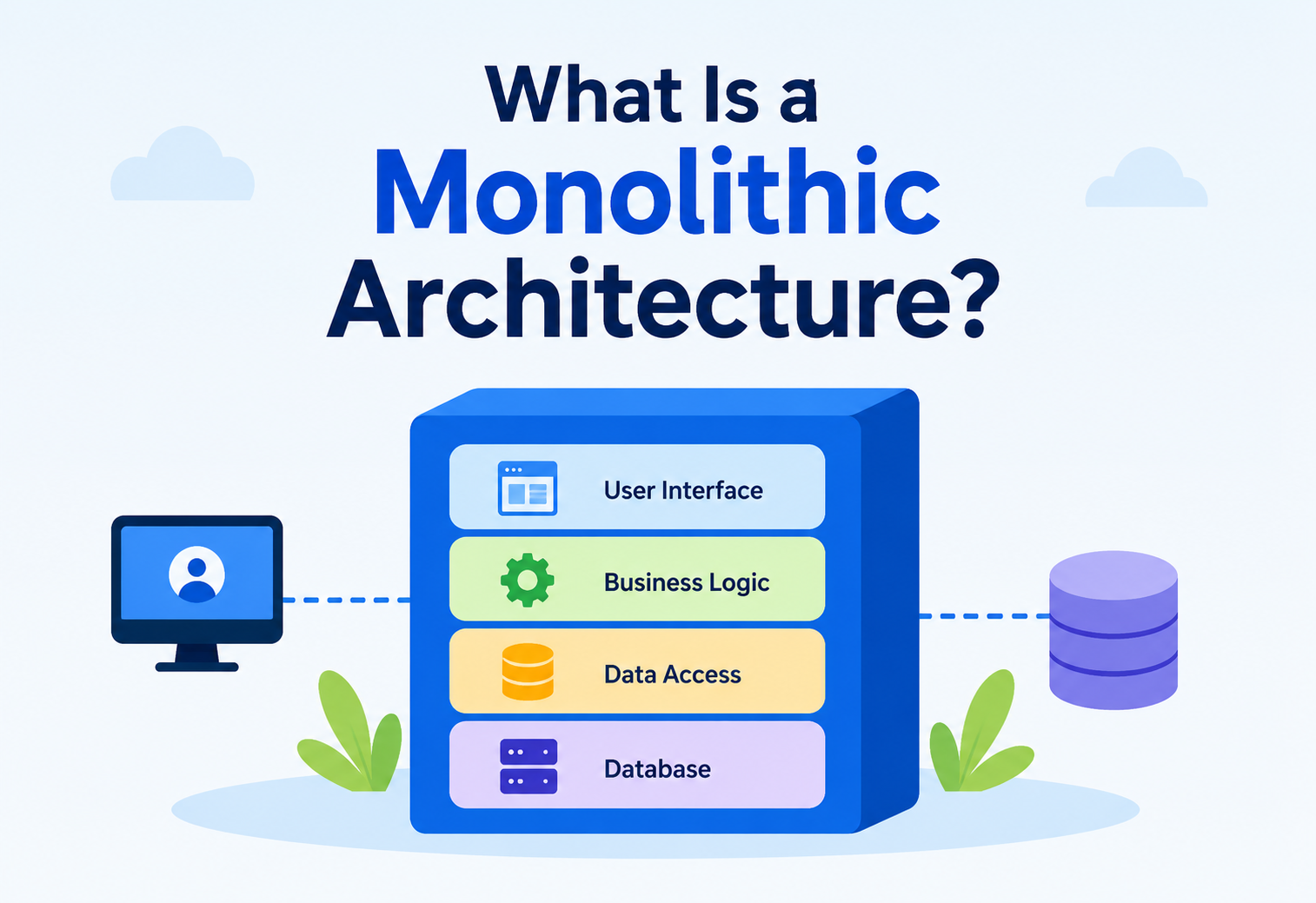
What Is a Monolithic Architecture?
Long before “microservices” became the buzzword everyone reaches for, almost every piece of software ever built was a monolith — one single, unified program doing everything at once. It’s still one of the most common, most practical, and most misunderstood ways to build software today. Here’s what it really is, why it still matters, and when it’s the smartest choice on the table.
The Big Idea, in One Breath
A monolithic application is one program that does everything — built, tested, and shipped as a single unit. It has been the default way of building software for most of computing history, and for most new projects it still is the sensible starting point.
Picture a Swiss Army knife. One single handle holds a knife, scissors, a bottle opener, and a tiny screwdriver, all folded neatly into one compact tool. Everything travels together, opens together, and if you drop it in a river, you lose all of it at once — but for most everyday jobs, having one tool that does everything is wonderfully simple. You don’t need to carry six separate gadgets in six separate pockets.
A monolithic software application works the same way. Instead of splitting a program into many small, independent pieces, everything — the part users see, the rules that decide what happens behind the scenes, and the part that talks to the database — lives inside one single program. It’s built together, tested together, and shipped together as one complete package. This has been the default way software was built for most of computing history, and even today, it’s still one of the most common and most sensible starting points for a huge number of real projects.
Think of a food truck versus a big shopping mall. A food truck is one small, self-contained unit — the grill, the cash register, and the menu all live in the same little space, run by the same small crew. A shopping mall, on the other hand, is dozens of separate stores, each with its own staff, its own opening hours, and its own systems, all loosely connected under one roof. A monolith is the food truck. Microservices are the mall.
Despite years of headlines proclaiming microservices as the future, monoliths never actually went away — and for good reason. Some of the most widely used software in the world, from early versions of massive e-commerce platforms to countless internal business tools running quietly inside companies today, are monoliths. Understanding how they work, where they genuinely shine, and where they start to strain isn’t a history lesson. It’s a practical skill that every software architect still reaches for on a regular basis, often on the very first day of a brand-new project.

What Monolithic Architecture Really Is
A monolithic architecture is a software design where every part of an application — its user interface, its business logic, and its data-handling code — is built as a single, unified codebase and shipped as one deployable unit. There’s no splitting the program into separate independently-running pieces; everything lives, runs, and gets updated together, inside the same process, on the same server.
The word “monolith” originally describes a massive single block of stone — think of an ancient standing stone carved from one solid piece of rock, rather than stacked together from many smaller bricks. That image captures the idea nicely: a monolithic application really is one solid block of software, rather than an assembly of separate, independently moving parts.
If someone says “our app is a monolith,” they’re really saying: “everything our application does lives in one program, and when we release an update, the whole thing gets rebuilt and redeployed together — not just the one piece that changed.”
It’s worth being clear about something that trips a lot of people up: being monolithic doesn’t automatically mean being badly built. A monolith can be beautifully organized internally, with clean, well-separated sections that are a pleasure to work in — or it can be a tangled mess where every piece of code touches every other piece. “Monolithic” describes how the application is deployed, not automatically how well it’s designed on the inside.
This style of building software goes back to the earliest days of computing. Long before cloud servers and internet connections were part of the picture, large mainframe computers ran single, self-contained programs that handled everything a business needed — from payroll to inventory — because there simply wasn’t a practical alternative at the time. That history is part of why monolithic thinking still feels so natural today: it isn’t a shortcut invented to skip good design, it’s the original, foundational way software was built, refined over decades into a genuinely mature and well-understood approach.
Anatomy of a Monolith
Even though everything in a monolith lives in one codebase, well-built ones are still organized internally, usually into three broad layers stacked on top of each other.
Presentation Layer
This is the part users actually interact with — the screens, buttons, and forms of a website or app. It’s responsible for showing information clearly and collecting what the user types or taps.

Business Logic Layer
This is the “brain” of the application — the rules that decide what should actually happen. Should this discount apply? Is this password correct? Can this user place an order? All of that decision-making lives here.
Data Access Layer
This is the part that actually talks to the database — saving new information, and fetching it back out again whenever the other layers need it. In a monolith, this layer almost always talks to just one single, shared database.
What makes this arrangement genuinely “monolithic” isn’t the layers themselves — plenty of microservice-based systems use similar layers internally, too. It’s that all three layers are compiled into a single running program, share the same memory space, and get deployed as one indivisible package, every single time.
Some monoliths add a fourth, thinner layer worth knowing about: a shared set of cross-cutting utilities that every other layer relies on, such as logging, authentication, and error handling. Keeping this shared layer small and genuinely generic — rather than letting it slowly accumulate feature-specific logic — is one of the quieter habits that separates a monolith that stays pleasant to work in for years from one that gradually turns into a tangle nobody wants to touch.
Where Monoliths Shine
Monolithic architecture earned its long-running popularity honestly — for a huge number of real projects, it genuinely is the simpler, faster, and more sensible choice.
It’s worth pausing on why this matters so much in practice. Every hour a small team spends wiring up infrastructure, coordinating deployments across services, or debugging a problem that spans multiple systems is an hour not spent building the actual product a customer will use. A monolith trades away some long-term flexibility in exchange for getting that time back right now, when it usually matters most — early in a product’s life, when nobody yet knows for certain which features will matter, or how many users will show up.
One thing to build and run
There’s only one codebase to learn, one project to open, and one thing to start up when you want to test your changes.
Get moving quickly
Small teams can start writing real features almost immediately, without first designing a whole network of separate services and APIs.
No network in the way
Because everything runs inside the same program, different parts can call each other directly and instantly, without waiting on a network request.
One source of truth
A single shared database makes it far easier to keep information accurate and consistent everywhere in the application, all the time.
Deployment is simpler too. Shipping an update means building one package and putting it on a server — no coordinating a dozen separate teams releasing a dozen separate services in the right order. Debugging is often easier as well, since a developer can follow a problem’s trail through a single, unified codebase rather than jumping across several independent systems to piece together what went wrong.
Testing benefits from this simplicity too, in a way that’s easy to overlook. Confirming that a whole feature works correctly, end to end, is usually a matter of running one test suite against one running application. In a distributed system, the same confirmation often means carefully coordinating several separate services just to simulate one realistic user journey — a meaningfully bigger lift, especially for a small team without dedicated infrastructure support.

Where Monoliths Struggle
None of this means monoliths are free of trade-offs. As an application and its team both grow, some very real friction tends to show up.
Growing Pains
- A tiny change anywhere still requires rebuilding and redeploying the whole application
- You can’t scale just the busy part — the entire program scales together, or not at all
- Large teams working in the same codebase start bumping into each other constantly
- Switching to a new technology usually means an all-or-nothing rewrite
Still True, Even So
- These problems mostly appear at real scale, not on day one
- Good internal organization can delay or soften most of them
- Plenty of large, successful products never hit this ceiling at all
- A monolith can be split up later, once the pain is real and specific
The single biggest risk is what’s sometimes called tight coupling — when different parts of the application become so intertwined that nobody can change one piece without accidentally breaking three others. Over time, if nobody actively guards against this, a monolith can slide into what engineers half-jokingly call a “big ball of mud”: technically one working program, but so tangled inside that even simple changes become slow, risky, and stressful.
A single tiny bug in one obscure corner of a monolith can, in the worst case, crash the entire application — because everything shares the same running process. There’s no natural wall keeping one broken part from taking the rest down with it.
Scaling is another place where the trade-off becomes concrete rather than theoretical. Imagine an online store where the checkout process gets far busier than the customer support pages during a big holiday sale. In a monolith, there’s no way to give checkout extra computing power without also duplicating the entire application, customer support pages and all — because the whole program can only be scaled as one indivisible unit. It works, but it’s an inefficient use of resources compared to scaling only the part that’s actually under pressure.
Monolith vs. Microservices
The natural comparison point for monoliths is microservices — an approach that breaks an application into many small, independently deployable services instead of one big program. Neither one is universally “better”; they simply make different trade-offs.
A useful way to frame the difference is to ask where each approach chooses to place its complexity. A monolith keeps complexity concentrated inside one codebase, where a single team can see and reason about all of it at once. Microservices spread that same complexity out across a network of independent services and the connections between them — which can make each individual piece simpler, but adds an entirely new layer of complexity in coordinating how all those pieces work together reliably.
| Dimension | Monolith | Microservices |
|---|---|---|
| Codebase | One, shared by everyone | Many, one per service |
| Deployment | Whole app deployed together | Each service deployed on its own |
| Scaling | Scale the entire application | Scale only the busy service |
| Team structure | Works well for one team | Suits many independent teams |
| Operational complexity | Low — one thing to run | Higher — many moving parts to monitor |
It’s tempting to treat this as a straightforward upgrade path — start with a monolith, “graduate” to microservices once you’re successful. Reality is messier. Splitting an application too early, before the team or the product truly needs it, tends to slow everyone down rather than speed them up, trading a single simple problem for a dozen smaller, more complicated ones.
There’s also a cost dimension worth naming plainly. Running many small services usually means running many small servers, many separate monitoring dashboards, and often a dedicated platform team just to keep the whole distributed system healthy. None of that is free, and for a product that isn’t yet operating at a scale where those costs pay for themselves, a monolith frequently ends up being the more financially sensible choice too — not just the simpler one.

The Modular Monolith: A Middle Ground
Between a tangled, all-in-one monolith and a fully distributed microservices system sits a popular middle option: the modular monolith. It’s still deployed as one single unit — but internally, it’s organized into clearly separated modules with well-defined boundaries between them, almost as if each module were a mini-service living inside the same house.
The appeal is straightforward: a modular monolith gives a team much of the mental clarity and organizational discipline that microservices are famous for — clear ownership, clear boundaries, code that doesn’t casually reach into another module’s business — without taking on the operational overhead of running, monitoring, and coordinating dozens of separately deployed services. It’s a great fit for teams who want the tidiness of microservices but aren’t yet big enough, or don’t yet have the specific scaling problem, to justify the extra complexity of a fully distributed system.
Many teams treat a well-built modular monolith as a stepping stone: if a specific module eventually does need to scale independently, its clear boundaries make it far easier to lift out into its own service later — precisely because the seams were designed in from the start, rather than untangled after the fact.
Think of a well-organized toolbox with labeled compartments for screws, wrenches, and tape, all inside one case you carry as a single unit. Compare that to a toolbox where everything is thrown in loose together. Both are “one toolbox,” but only one of them lets you find what you need quickly, and only one of them could be neatly split into separate labeled boxes later without a frustrating afternoon of sorting.
Real-World Examples
The monolith-versus-microservices story isn’t purely theoretical — some of the biggest names in tech have lived through it in both directions.
Amazon Prime Video
A monitoring tool built with microservices was rebuilt as a monolith, reportedly cutting its infrastructure costs by more than 90 percent for that specific workload.
Netflix
Famously moved from a monolith to microservices as it scaled to a massive global streaming audience, becoming one of the most cited microservices success stories in the industry.
Shopify & Basecamp
Both built substantial, highly successful platforms on well-organized monoliths, proving that a thoughtfully structured monolith can scale much further than most teams ever actually need.
Atlassian
Migrated Jira and Confluence off a single-tenant monolithic setup as customer scale grew, a multi-year effort that shows just how significant this kind of transition really is.
The lesson isn’t “microservices win” or “monoliths win.” It’s that both of these companies made the choice that matched their actual situation at the time — their team size, their traffic patterns, their operational maturity — rather than following whichever architecture happened to be fashionable that year.
It’s also worth noticing what these stories have in common beneath the surface: none of these companies made the switch casually. Each transition — in either direction — followed a period of careful measurement, where a real, specific bottleneck was identified before any code was rewritten. That pattern is worth borrowing regardless of company size: change the architecture because a concrete problem demands it, not because a conference talk made the other approach sound exciting.

When to Choose a Monolith
A senior architect weighing this decision usually looks at a handful of practical signals rather than picking an architecture out of habit or hype.
- Team size. A small team of a handful of engineers can usually move faster inside one shared codebase than across several separately owned services.
- Product maturity. Early on, requirements change constantly. A monolith is far easier to reshape quickly while the product is still finding its footing.
- Traffic patterns. If different parts of the application don’t have wildly different scaling needs, there’s little benefit to scaling them separately.
- Operational maturity. Running microservices well requires solid monitoring, automated deployment pipelines, and experience with distributed systems — capabilities that take real time to build.
- Regulatory needs. Centralized, monolithic systems can make certain compliance and audit requirements simpler to satisfy, since there’s one system to secure and review rather than many.
Start with a well-organized monolith unless you have a specific, concrete reason not to. Complexity should be earned by a real, demonstrated need — not assumed on day one because a bigger company down the road uses microservices.
It also helps to separate the question “should we use a monolith?” from the question “should this monolith be modular?” The first is mostly about scale, team size, and operational readiness. The second is almost always yes, regardless of the answer to the first — a disciplined internal structure costs very little to maintain early on, and it’s exactly what makes any future decision to split the system, if that day ever comes, dramatically less painful.
Keeping a Monolith Healthy
A monolith doesn’t automatically turn into a tangled mess over time — that only happens when nobody actively protects its internal structure. A few disciplined habits keep a monolith pleasant to work in even as it grows.
Draw Real Module Boundaries
Organize the codebase into clear, purpose-based sections early, and enforce rules about which sections are allowed to depend on which others.
Avoid Shortcuts Across Boundaries
Resist the temptation to let one module quietly reach into another module’s internal details just because it’s convenient in the moment.
Invest in Automated Tests
A strong test suite lets a team confidently change one part of a monolith without accidentally breaking something unrelated elsewhere in the same program.
Review the Structure Regularly
Periodically step back and check whether the original module boundaries still make sense, adjusting them as the product’s real shape becomes clearer over time.
None of these habits are exclusive to monoliths — they’re simply good architectural discipline. But they matter especially here, because a monolith offers fewer natural walls than a distributed system does. Without deliberate boundaries, it’s easy for convenience to quietly win out over structure, one small shortcut at a time, until the whole codebase feels harder to change than it should.
A simple habit many architects use to keep this discipline honest is a periodic “dependency check” — a quick automated scan confirming that no module has quietly started importing directly from another module’s private internals. Catching this kind of drift within days, rather than discovering it years later during a major refactor, is often the single cheapest investment a team can make in a monolith’s long-term health.
Common Pitfalls
Most of the real trouble with monoliths doesn’t come from the architecture itself — it comes from a handful of predictable mistakes teams make while building and maintaining one. Knowing these patterns in advance makes them far easier to avoid.

The “Big Ball of Mud”
This is the classic monolith horror story: a codebase with no real internal boundaries left, where every part quietly depends on every other part. Changing anything feels like pulling one thread and watching the whole sweater unravel.
Splitting Too Early
Breaking a monolith into microservices before the team or the traffic actually demands it often backfires, trading one manageable problem for several smaller, harder-to-coordinate ones, without any of the scaling benefit that was supposed to justify the switch.
Splitting Too Late
The opposite mistake is just as real: waiting so long that the monolith becomes so tangled internally that pulling anything out of it safely feels nearly impossible, forcing a far riskier, more expensive rewrite than an earlier, more gradual split would have required.
Treating Deployment Risk as Normal
In a poorly maintained monolith, every release can start to feel like a nerve-wracking event, because one small change might ripple out and break something completely unrelated. Healthy teams treat that anxiety as a warning sign, not a fact of life to simply get used to.
Getting Locked Into One Technology Stack
Because every part of a monolith shares the same runtime and the same dependencies, swapping out an aging piece of technology for a newer one usually means touching the entire application at once, rather than upgrading one small corner in isolation. Teams that never plan for this can find themselves stuck maintaining an outdated stack far longer than they’d like, simply because the cost of upgrading has grown too large to tackle comfortably.
A monolith where nobody feels confident deploying on a Friday afternoon. That discomfort is usually a sign the internal structure has quietly eroded, not evidence that monoliths are inherently risky.
Key Takeaways
So, is a monolithic architecture the “wrong” choice, a relic from a simpler era of computing? Not at all. It’s simply one tool among several, and for a huge share of real projects — especially early on, or in situations where simplicity and consistency matter more than independent scaling — it remains the most sensible tool in the box.
Remember This
- A monolithic architecture bundles the user interface, business logic, and data access into a single codebase, built and deployed together as one unit.
- Monoliths offer real strengths — simplicity, speed, strong consistency, and easier debugging — that make them the right starting point for most new projects.
- Their main weaknesses show up at scale: harder team coordination, all-or-nothing deployment, and the risk of becoming a tangled “big ball of mud” without discipline.
- A modular monolith offers a practical middle ground — the internal clarity of microservices, without the operational overhead of running many separate services.
- Real companies have moved in both directions — some from monolith to microservices, some the other way — because the right choice always depends on team size, traffic, and operational maturity, not fashion.
- Choosing a monolith isn’t settling for less. For a large share of real-world software, it’s simply the most sensible architecture on the table.