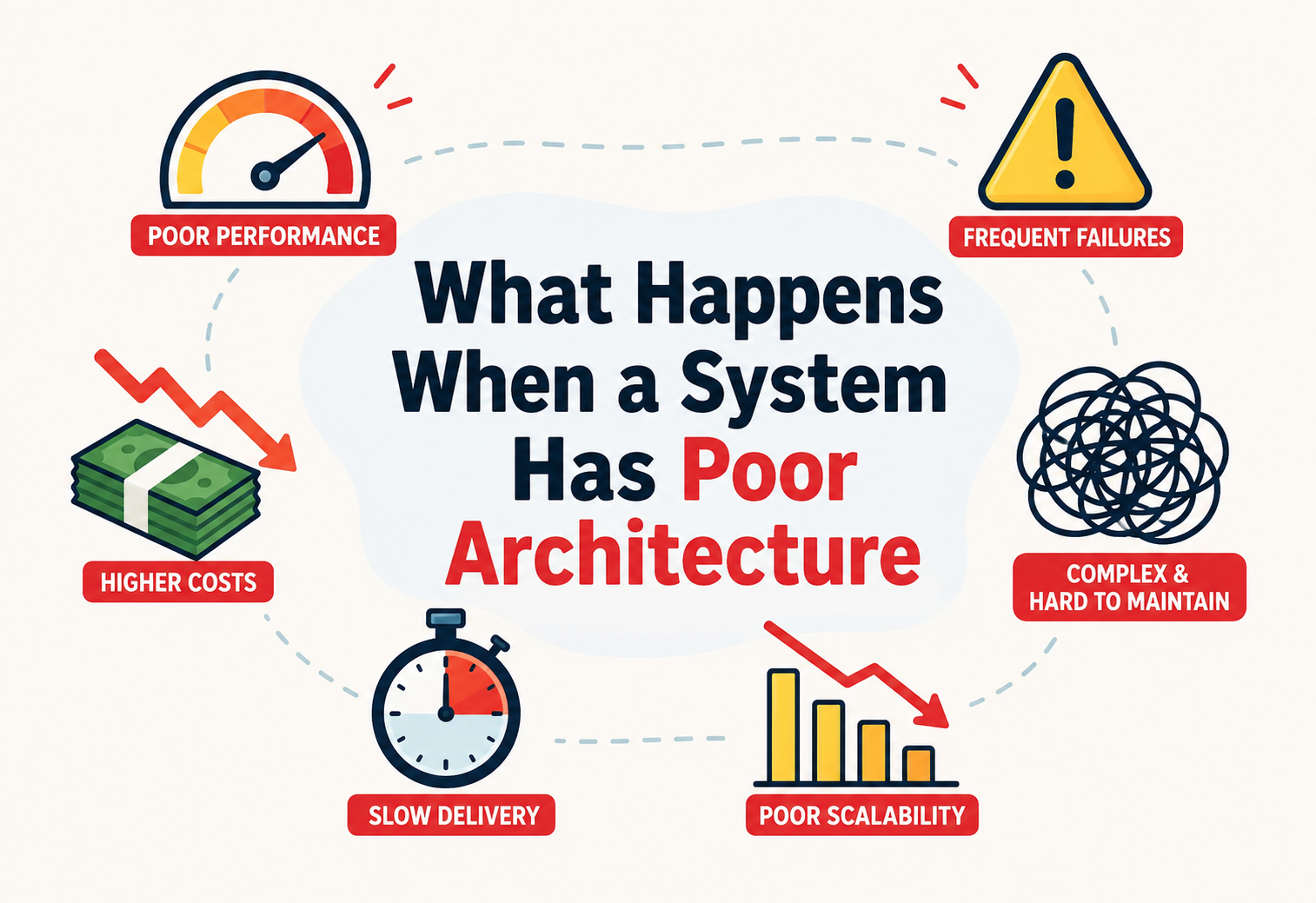
What Happens When a System Has Poor Architecture?
Nothing dramatic at first. Just a slow, quiet accumulation of small pains — until one day the roadmap slips a quarter, senior engineers start disappearing, and nobody remembers when it stopped being fun.
The Big Idea, in One Breath
Poor architecture rarely announces itself. It arrives as a slow accumulation of small pains that eventually reshape the whole day.
The most striking thing about a system with poor architecture is how ordinary it feels from the inside. Nothing explodes. The demo still runs. Individual features still ship. The team is still competent. What changes is quieter: every task takes a little longer, every incident spreads a little wider, every new hire needs a little more onboarding, every estimate carries a little more shrug.
Multiply those small tolls by a year or two and you get a very different situation than the one you started with — often without a single dramatic moment anyone can point to.
Think of an old family car that has been in service for fifteen years. It still starts. Most of the time. The passenger door only opens from outside now. The fuel gauge lies by about an eighth of a tank. There is a specific angle to hold the key at because the ignition wore. Only Dad knows how to reset the trip meter. You do not lend it to your kids because you cannot really explain how to drive it safely. It works, and it exhausts everyone who touches it.
That is a system with poor architecture. It runs. People even care about it. But every improvement takes twice as long as it should, and everyone who inherits it inherits a small collection of tribal knowledge along with it.
What “Poor Architecture” Actually Means
It is not the same as bad code. It is the shape underneath, and the boundaries that were never drawn.
People use “poor architecture” and “bad code” interchangeably, and they should not. Bad code is a local problem: one messy function, one confused module. You fix it and it stays fixed. Poor architecture is a global property: even beautiful code in every file cannot save you if the boundaries between the files are wrong.
No clear boundaries
Business logic, UI, data access, and integration code all mixed into the same layer. Changing one thing forces reading everything.
Hidden coupling
Modules that look independent share state through a database column, a shared cache, or an implicit ordering nobody wrote down.
Duplicated concepts
The same idea — customer, order, price — implemented in five places, each subtly different, each maintained by a different team.
No explicit contracts
Services call each other via whatever fields happen to work today. A rename in one place quietly breaks three others.
No quality attributes decided
Nobody chose to prioritise availability over cost, or performance over flexibility. So every code review re-litigates the trade-off from scratch.
No path for change
The system was not designed to bend anywhere. Every request for a new capability lands as either “impossible” or “a project”.
Bad code is a mess in one place. Poor architecture is a shape that makes messes inevitable everywhere.
The Five Early Whispers
Long before anyone uses the word “architecture”, the team is already hearing these five things around the coffee machine.
“I’m afraid to touch that.”
There is a file, a service, or a module that everyone routes around. It is where bugs go to die and hopes go to expire.
“It’s complicated.”
Every estimate becomes qualified with three or four caveats. Nobody wants to promise anything about a system nobody quite understands.
“Only Priya knows how that works.”
Critical knowledge lives in one person’s head. When they take a week off, so does progress on anything downstream.
“Just be careful with the deploy.”
Deploys have a rhythm and a set of unwritten steps. New engineers get a walkthrough before their first one, and it is not in the docs.
“We’ll clean that up next quarter.”
The cleanup never happens, because “next quarter” is always full of features that were promised on top of exactly the thing that needs cleaning.
Any one of these is normal. Two or three, chronically, is the shape of an architecture that is already costing more than the team has admitted to itself.

Ten Ways It Shows Up in Practice
The daily experience of working inside a system with poor architecture. If half of these are familiar, you are not imagining it.
Estimates keep doubling
A one-line change turns into a five-day investigation, because the “one line” touches four unrelated concerns.
Bugs keep coming back
The same defect reappears in a new place. The idea lives in five files; the fix only touched one.
Every incident is bigger than expected
One service degrades. Half the platform notices. The blast radius is never what it says on the diagram.
Onboarding takes months
A senior engineer takes a full quarter to become productive. They spend the first six weeks reading and asking.
Nobody wants to be on call
On-call rotations are unpopular because the pager can go off for reasons that require deep tribal knowledge to understand.
Small changes need big releases
A one-day fix has to be coordinated with four other teams and shipped in a monthly window because of hidden coupling.
Tests are slow, brittle, or absent
The suite takes forty minutes to run, flakes on Thursdays, and passes green while production burns.
The cloud bill keeps rising
Everyone knows costs are up. Nobody can explain which change caused it. Nobody knows how to bring it down.
Documentation is stale or missing
The wiki was accurate two years ago. Everyone knows to ask on Slack instead. Half the answers still start with “check with Priya”.
The team talks about a rewrite
Every retrospective circles back to it. Nobody quite proposes it. Everyone quietly believes it is coming.
These do not appear all at once. They accumulate. Six months in, a couple show up. A year in, half of them. Two years in, the team is having a very different conversation than the one they had at launch, and the roadmap is proof.
The Business Consequences
Poor architecture is not just an engineering complaint. It shows up as line items on the P&L, on the customer NPS, and on the hiring plan.
| Area | What poor architecture does to it |
|---|---|
| Time to market | Features that competitors ship in weeks take you quarters. You stop being the fast one in the market. |
| Reliability & reputation | Incidents become bigger and more visible. Enterprise customers start asking specific questions in renewals. |
| Operating cost | Cloud bills grow faster than usage. Engineering hours grow faster than features. Support tickets grow faster than customers. |
| Security posture | Fixes are slow because the system is opaque. Audits become fire drills because nobody can trace data flow end-to-end. |
| Talent & hiring | Senior engineers leave. New senior engineers turn down the offer after two interview loops. You end up hiring more juniors than you can mentor. |
| Strategic options | Acquisitions, expansions, pivots, new markets — each blocked by “we’d have to rebuild”. The business quietly loses room to manoeuvre. |
The Big Ball of Mud
The most common shape of a system with poor architecture has a name, and it is depressingly accurate.
Software people have a phrase for the shape a poorly-architected system tends to grow into: the Big Ball of Mud. Not a slur — a technical description. A haphazardly-structured, sprawling, expedient system: layers that leak, boundaries that shift, concepts that repeat, dependencies that curl back on themselves. The label was coined in the mid-1990s and it has stayed in the vocabulary because it keeps being accurate.

What it looks like on the inside
- Business logic reaches into the database. The database reaches back into business logic through triggers and stored procedures nobody dares touch.
- The user-interface code and the reporting code have their own copies of the same rules, and they gently disagree.
- Any change requires reading three unrelated files. Any refactor risks breaking something in a fourth.
- There is no shared story about the shape of the system, because there is no shape.
Why it is common
The Big Ball of Mud is not what people build. It is what systems become when nobody is actively holding them to a shape. Every reasonable shortcut, every deadline-driven “we’ll fix it later”, every quick integration adds one more strand to the tangle. Nobody is villainous. The tangle is emergent.
Most production systems are, in some part, Big Ball of Mud. The health of a system is not whether it contains mud; it is whether the mud is contained, understood, and actively receding rather than spreading.
The Human Cost
The system may not care. The people working on it very much do.
The consequences of poor architecture that get discussed in blogs are the technical ones. The ones that actually cause companies to fail are the human ones. When a system is exhausting to work on, the exhaustion is not evenly distributed — it lands hardest on the people who care the most.
Quiet burnout
Engineers do not always burn out with a dramatic quit. Sometimes they just start caring less, doing minimum-viable work, and updating LinkedIn on lunch breaks.
Learned helplessness
“That’s just how it is” becomes a common phrase. People stop suggesting improvements because previous suggestions all quietly died.
Blame culture
When incidents are unpredictable and spread widely, teams start pointing at each other. Retrospectives turn defensive. Trust erodes.
Talent bleed
The best engineers have the easiest time getting another job. They are also the ones most acutely aware of how bad the situation is. This is not a coincidence.
The unglamorous hero
One or two people become the “fixers”. They are on every incident. They are irreplaceable. They are also being quietly punished for competence.
Onboarding despair
New engineers arrive optimistic, spend six weeks trying to understand the system, and slowly realise how much of what they knew does not apply here.
None of this shows up on the executive dashboard. All of it shows up eighteen months later, when the roadmap is missing, the tenured engineers are gone, and the replacement plan is a rebuild.
How One Shortcut Snowballs
Poor architecture is rarely one bad decision. It is one deferred decision fanning out into a hundred accommodations.
The mechanism is quiet and depressingly consistent. Somebody, under a deadline, makes a call: “we’ll do it this way for now, and clean it up later.” The call is reasonable in isolation. The problem is what happens next.
The shortcut lands
A quick hack, a hardcoded value, a bypassed layer, a duplicated concept. Ships on time. Everyone breathes.
The next feature accommodates it
A month later, someone builds on top of that shortcut, because it is already there. They add a workaround. Now there are two.
The workaround becomes a pattern
Third and fourth uses cement it. Any new hire concludes “this is how we do it here”.
Removing it requires touching everything
The original shortcut is now load-bearing. Undoing it would mean rewriting five features that unknowingly depend on it.
It becomes part of the platform
Two years later nobody calls it a shortcut. It is just “how the system works”.
Common Root Causes
Poor architecture is almost never one person’s fault. It is a set of organisational conditions that make it hard for good architecture to survive.
Ship-at-all-costs pressure
The organisation rewards visible delivery and punishes visible investment in the platform. Architecture debt is invisible; feature velocity is not.
No architectural ownership
Nobody has the job of saying “this decision affects three other teams and should be reconsidered”. So nobody says it.
Wrong shape for the stage
Startup shape for an enterprise-scale product, or enterprise shape for a scrappy startup. The shape stopped fitting the business and nobody adjusted it.
High attrition, low continuity
Everyone who knew why a decision was made has already left. The remaining team defers to the code rather than reconsiders it.
Cargo-culted patterns
Microservices because Netflix does. Kubernetes because everyone else has. Event sourcing because it looked good in a talk. Right pattern, wrong problem.
Fear of pushback
Engineers who see the problem do not raise it, because raising it is not culturally safe. So it stays unraised and gets worse.
Systems reflect the organisation that built them. Fixing the architecture without addressing the organisation is like repainting a house on shifting foundations.
Can It Be Fixed?
Yes — but almost never by the strategy the team is fantasising about. The rewrite is rarely the answer. Strangulation is.
The temptation, when a system is unpleasant to work on, is to declare bankruptcy and rewrite it from scratch. This is nearly always a mistake. Every large rewrite in history has cost more, taken longer, and delivered less than the plan called for, because the old system quietly encodes years of hard-won knowledge about edge cases nobody remembers.

What works instead
Draw the map first
Before changing anything, spend a real amount of time understanding what you actually have. Every component. Every integration. Every quiet dependency. The map alone changes the conversation.
Choose the target shape
Not a perfect architecture — a next architecture. One achievable within twelve to eighteen months, that fixes the two or three constraints hurting the business most.
Strangle, do not rebuild
Wrap the old system with a clean interface. Replace one capability at a time, behind that interface, keeping the rest untouched. Users see nothing. Engineers see a slow, safe migration.
Set explicit boundaries
Every replaced piece gets a real contract. No more implicit coupling. New capabilities land on top of the boundaries, not through them.
Retire the old parts, on a schedule
Old code stays only until its replacement is proven. Then it is deleted — with prejudice — so the codebase gets smaller, not larger.
A recovery plan that takes three years is a recovery plan. A recovery plan that takes six months is a fantasy. Budget the reality.
Common Myths, Cleared Up
Every organisation with poor architecture tells itself the same three stories. All of them are wrong.
“It’s fine as long as it hasn’t crashed yet.”
The visible incident is the last symptom, not the first. Long before the crash, the business is already paying — in slipped features, longer onboarding, higher operating costs, quieter attrition. “It hasn’t crashed” is not evidence of health; it is evidence that the failure mode is not yet acute. The chronic version is more expensive than the acute one, and much harder to see.
“We just need to hire better developers.”
Individually excellent developers cannot outrun a bad shape. Put five staff-plus engineers into a system with hidden coupling and duplicated concepts and their velocity will still be worse than one competent engineer working in a well-architected system. The problem is not the people; it is the shape they are asked to work inside.
“A full rewrite is always the answer.”
Full rewrites are the graveyard of software companies. They almost always cost more than planned, take longer than planned, and deliver less than the old system on the day they launch — and they lose all the accumulated edge-case knowledge along the way. The right answer is almost always incremental strangulation: replace one capability at a time, behind stable interfaces, with the old system running throughout.

“It’s the developers’ problem, not leadership’s.”
Poor architecture is a leadership problem dressed up as an engineering one. Every organisational choice about time, priorities, and rewards shows up in the shape of the system a year later. If leadership does not treat architectural health as a first-class concern, no engineering team can carry it alone.
Key Takeaways
The whole guide, compressed into a handful of lines you can bring into your next honest conversation about the platform.
Remember This
- Poor architecture is quiet. It arrives as slippage, not as a crash. By the time it is loud, it has already reshaped the roadmap.
- It is not the same as bad code. Bad code is local. Poor architecture is the shape underneath — boundaries, contracts, coupling.
- Symptoms compound. Slower estimates, spreading incidents, longer onboarding, and disappearing seniors are the same problem viewed from different angles.
- The bill is paid in options. The business loses the ability to enter markets, absorb acquisitions, and pivot — long before it loses the ability to ship features.
- The Big Ball of Mud is emergent. Systems become tangled without anyone deciding to tangle them. Every reasonable shortcut adds one strand.
- The human cost is the real cost. Quiet burnout, learned helplessness, and talent bleed do more damage than any incident.
- Rewrites almost never work. Strangulation does. Replace one capability at a time, behind stable interfaces, and delete the old parts on a schedule.
- It is a leadership problem. Systems reflect the organisations that build them. Fixing the shape without fixing the incentives is repainting on shifting foundations.