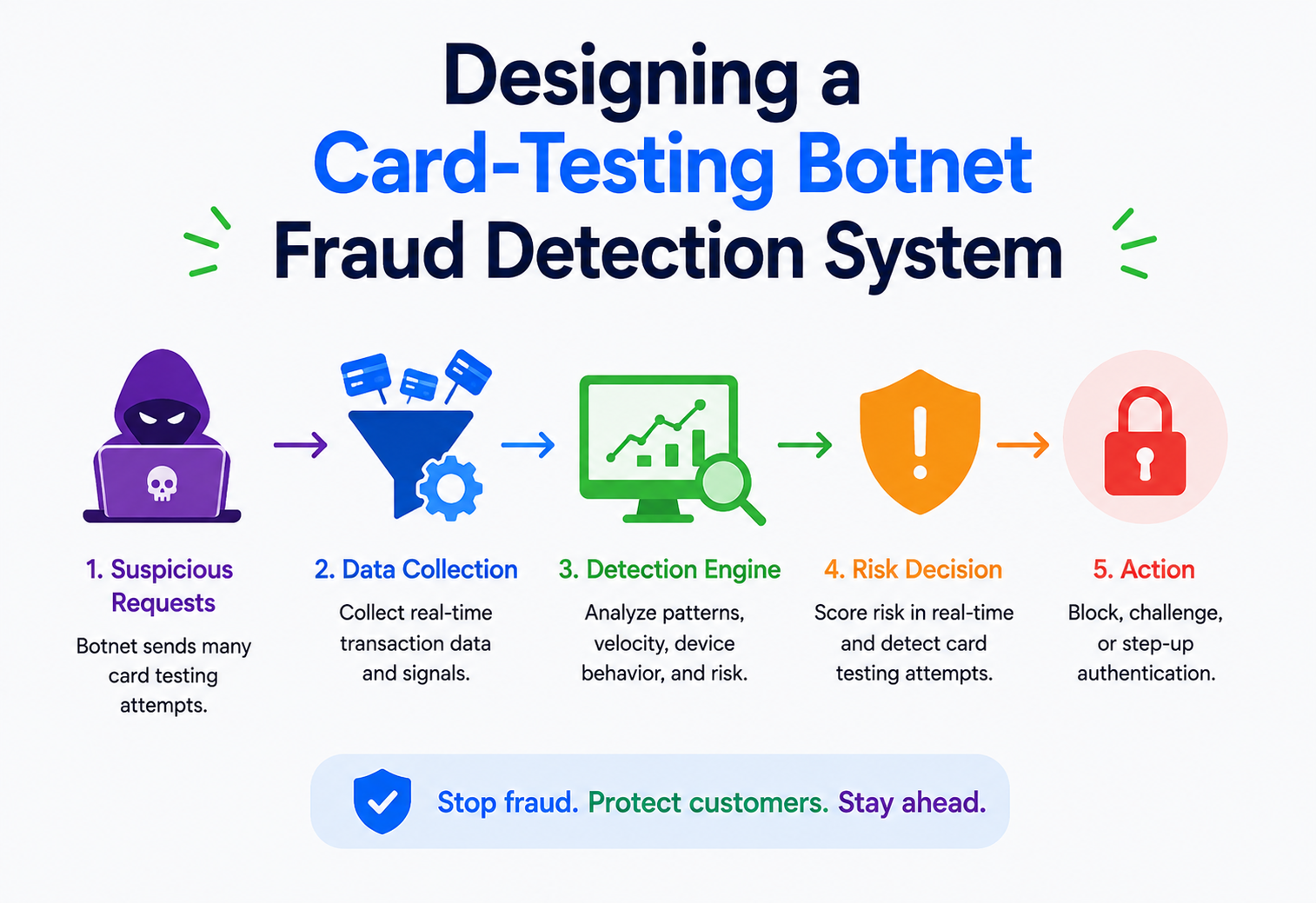
Designing a Card-Testing Botnet Fraud Detection System
A production-grade, interview-ready deep dive into stopping card-not-present (CNP) fraud where a botnet hammers your payment gateway with thousands of stolen card numbers simultaneously — while staying fast, fair to legitimate customers, and resilient at a million requests per minute.
Introduction & History
Somewhere on the internet right now, a criminal has a spreadsheet — or more realistically, a database dump bought on a dark-web marketplace — containing tens of thousands of stolen credit card numbers. Most of those numbers are useless to the criminal until one thing happens: they are validated. A stolen card number with an expired date, a closed account, or insufficient funds is worthless. A validated, live card number is worth real money, either used directly for fraudulent purchases or resold at a premium as “verified” inventory on criminal marketplaces.
Card testing (also called “carding”) is the automated process of validating stolen card numbers by attempting many small transactions — often $0.50 to $2.00, sometimes $0 authorization-only checks — against real payment gateways. A single criminal rarely does this by hand. Instead, they rent or build a botnet: thousands of compromised devices, cloud instances, or proxy IPs, each submitting a handful of card-testing transactions, so no single IP address, device, or account looks suspicious in isolation. Multiply that by thousands of stolen card numbers being tested simultaneously, and a payment gateway can face a sudden, coordinated flood of authorization requests that looks statistically like a distributed denial-of-service attack wearing a legitimate-checkout costume.
This is not a hypothetical threat — card testing attacks are one of the most common and costly fraud patterns any payment platform faces, because the attacker’s cost is nearly zero (compute and stolen data are cheap) while the merchant absorbs real costs: card network fines for high decline ratios, processing fees on declined transactions, fraud chargebacks on the cards that do validate, and — if the attack is severe enough — a merchant account suspension by the acquiring bank for looking like a fraud-enabling business.
Historically, fraud detection was a slow, rules-based, largely manual review process: a small team of analysts looking at flagged transactions hours or days after the fact. That model breaks down completely against a botnet that can test 50,000 cards in the time it takes a human analyst to review a single case. Modern card-testing defense has to happen in milliseconds, at the moment of the authorization request, using signals that do not rely on any single IP or account looking obviously malicious — because by design, none of them do.
By the end of this tutorial, you will be able to whiteboard the full system end to end: draw the component diagram with every box correctly labeled (API Gateway, Load Balancer, Risk Decision Gateway, Feature Assembly, Rules Engine, ML Scorer, streaming anomaly detection, Adaptive Policy Controller), explain precisely why each piece exists and what breaks without it, and defend the design against the kinds of follow-up questions a senior interviewer throws at exactly this class of problem — “what if the attacker adapts,” “what if your ML service goes down mid-attack,” “how do you avoid blocking real customers.” Those follow-ups are woven throughout as dedicated interviewer callouts, so you can treat this as both a design reference and interview preparation in one pass, whether you are preparing for a security-focused system design round or building this system for a real payments platform.
It forces you to reason about real-time anomaly detection under adversarial pressure (the attacker actively adapts to evade your defenses), extremely tight latency budgets (a legitimate checkout cannot be delayed noticeably), massive request-rate scalability (a botnet attack can dwarf normal peak traffic), and the hard trade-off between blocking fraud aggressively and never blocking a real customer’s legitimate purchase. Very few problems combine security, real-time systems, and machine learning infrastructure this tightly.
Problem & Motivation
2.1 Functional Requirements
- Real-time risk scoring: Every authorization request must receive a fraud risk score and an allow/challenge/block decision within the payment flow’s latency budget, before the request reaches the card network.
- Velocity and pattern detection: Detect abnormal bursts of authorization attempts across dimensions that do not rely on a single IP or account — card BIN ranges, device fingerprints, IP subnets, geographic dispersion, timing patterns.
- Adaptive blocking: Automatically tighten defenses (e.g., require additional verification, or block outright) when an attack is detected in progress, and loosen back to normal thresholds once it subsides.
- Low false-positive rate: Legitimate customers — including those on shared IPs (corporate networks, mobile carrier NAT, VPNs), using new devices, or making a first purchase — must not be routinely blocked.
- Explainability and case management: Every block/challenge decision must be traceable to the signals that triggered it, both for fraud analyst review and for dispute resolution with card networks.
- Feedback loop: Confirmed fraud and confirmed false positives must feed back into the model and rules to continuously improve detection accuracy.
2.2 Non-Functional Requirements
| Requirement | Target |
|---|---|
| Peak sustained authorization volume | Up to 1,000,000 requests/minute during an active large-scale attack, on top of normal traffic |
| Decision latency | p99 < 80ms added to the authorization path (must not visibly slow legitimate checkout) |
| Detection latency for a new attack wave | Under 5 seconds from attack onset to automated mitigation kicking in |
| False positive rate | < 0.5% of legitimate transactions incorrectly challenged or blocked |
| Availability | 99.99% — the fraud system must never become the reason legitimate payments fail platform-wide |
| Data retention for audit/dispute | Full decision trail retained for chargeback dispute windows (typically 13+ months) |
A card-testing botnet is, structurally, indistinguishable at the single-request level from a burst of legitimate holiday-season checkouts. The system cannot simply say “block anything fast” — it has to detect a coordinated pattern across thousands of individually unremarkable requests, decide in milliseconds, and do so without becoming a second point of failure that is easier to trigger accidentally than the fraud it is meant to stop.
2.3 Why “Just Rate-Limit by IP” Does Not Work
The obvious first instinct — rate-limit each IP address — fails against a real botnet, because the entire point of a botnet is IP diversity. An attacker distributing 50,000 card-test attempts across 20,000 residential proxy IPs means each IP sends 2-3 requests, comfortably under any reasonable per-IP rate limit. Effective detection has to look at the aggregate pattern across the whole request population — the shape and rhythm of the traffic as a whole, not any single source in isolation — which is exactly why this system needs streaming analytics and anomaly detection, not just a simple rate limiter.
2.4 The Business Cost Beyond Direct Fraud Losses
It is tempting to frame this purely as “stop stolen cards from being validated,” but the business impact runs deeper. Card networks monitor a merchant’s authorization decline ratio as a proxy for how much fraud-adjacent traffic a merchant is generating, regardless of whether any individual transaction was later disputed. A sustained card-testing attack that is not caught before reaching the card network can push a merchant’s decline ratio into a monitoring program, or in severe cases, jeopardize the merchant account entirely — meaning a slow or absent fraud defense does not just cost money on the fraud line item, it threatens the platform’s fundamental ability to process any card payments at all. This is why the inline decisioning path in this design sits before the card network is ever contacted, not just before the transaction is captured.
2.5 Adversarial and Adaptive, Not Static
Unlike most system design problems, the “input” here is actively hostile and adaptive. An attacker who notices their attack is being blocked does not give up — they change their approach: slower pacing, more diverse proxy sources, mimicking legitimate browser behavior more closely, or targeting a different, less-monitored endpoint. This means the system can never be considered “finished” the way a typical CRUD service might be; the detection layer, rules, and models require continuous retraining and adjustment as attacker behavior evolves, and the architecture must make that continuous adaptation cheap and fast rather than a rare, disruptive re-engineering effort. In practice, this is why the fraud engineering team’s ongoing operating rhythm looks less like typical feature development and more like an ongoing security research function — studying the latest attack samples, updating signals, and validating changes continuously, with the architecture designed from the outset to support that pace of iteration rather than fight it.
Core Domain Concepts (Explained Simply)
3.1 Card Testing / Carding
What: Automated, repeated attempts to authorize transactions using stolen card numbers, purely to find out which ones are still valid and usable.
Imagine a thief with a giant ring of keys found on the street, walking down a row of parked cars trying each key on each car door — not to steal the car yet, just to find out which keys actually work. Card testing is the same idea: cheap, fast trial-and-error to sort “working” from “dead” before committing to the real crime.
Where the stolen numbers come from: Typically large-scale data breaches, phishing campaigns, or point-of-sale skimming operations, aggregated and sold in bulk on criminal marketplaces. The buyer of a bulk list has no way to know which numbers are still live — cards get cancelled, limits change, accounts close — so testing is the necessary first step in monetizing the list at all, which is exactly why disrupting this specific step has an outsized effect on the broader fraud economy, not just on the immediate transaction.
3.2 Botnet
What: A large network of compromised or rented devices/servers/proxy endpoints controlled by an attacker, used to distribute malicious traffic so it does not concentrate on any single identifiable source.
Why it matters for architecture: Any defense keyed on a single dimension (one IP, one device, one account) is trivially evaded by a botnet. Detection must correlate signals across the whole distributed swarm to see the pattern that no individual node reveals.
Practical example: A botnet renting residential proxy IP addresses (IPs belonging to real home internet connections, often via compromised routers or IoT devices) is significantly harder to distinguish from legitimate traffic than one using easily-flagged datacenter IP ranges, because residential IPs carry the same general reputation as any ordinary customer’s home connection — this is precisely why IP reputation alone, however well-maintained, is an insufficient defense on its own. Some botnets even rotate through thousands of such residential exit points automatically, cycling a fresh IP for nearly every single request, which is why the architecture in this tutorial treats IP address as just one weak signal among many rather than a primary defense.
3.3 Authorization vs. Capture
What: In card payments, “authorization” is the step where the issuing bank confirms a card is valid and has available funds/credit — it is a yes/no check, often for the exact purchase amount or a small placeholder amount, and does not move money yet. “Capture” is the actual funds transfer, done later (sometimes immediately, sometimes after shipment). Card testers overwhelmingly stop at authorization — they do not need to capture funds, they just need the “approved” signal.
Why it matters: The fraud system’s primary battlefield is the authorization request, not the settlement pipeline — decisions must happen before an authorization is even sent to the card network, or immediately as the response comes back, because a high volume of authorization attempts (approved or declined) itself damages the merchant’s standing with card networks.

3.4 Velocity Signals
What: Metrics that count “how many times has X happened in the last Y seconds/minutes,” where X can be attempts per card, per BIN (bank identification number — the first 6-8 digits of a card, identifying the issuing bank), per device fingerprint, per IP, per email domain, or combinations thereof.
A single loud knock on one door is not suspicious. A thousand quiet knocks on a thousand different doors on the same street within the same minute absolutely is — velocity signals are what let the system “hear” that citywide pattern instead of judging each knock alone.
3.5 Device and Network Fingerprinting
What: Techniques for identifying a recurring “identity” behind a request beyond just its IP address — browser/device characteristics, TLS handshake fingerprint, HTTP header ordering, behavioral biometrics (typing cadence, mouse movement) on web checkouts, or SDK-level device attestation on mobile apps.
Why it matters: Botnets can rotate IPs trivially but rotating every other fingerprintable characteristic simultaneously and consistently is much harder, so fingerprinting raises the attacker’s cost even when IP-based defenses are fully evaded.
3.6 BIN Attack
What: A specific card-testing pattern where an attacker does not have full stolen card numbers, only a valid BIN range (issuer prefix), and brute-forces the remaining digits plus expiry/CVV combinations — meaning the “stolen data” itself is partly synthetic, generated algorithmically rather than leaked.
Why it matters: This pattern is detectable by looking at the distribution of card numbers attempted — a wave of sequential or algorithmically-related card numbers within one BIN is a strong, distinct signal from randomly-distributed stolen numbers.
3.7 Credential Stuffing vs. Card Testing (A Common Point of Confusion)
What: Credential stuffing is attackers trying stolen username/password pairs against login forms, hoping for account takeover. Card testing is a distinct attack targeting the payment authorization path directly, often without any account login involved at all — many card-testing attacks hit guest checkout or donation forms specifically because they require no account, and therefore bypass any login-focused defenses entirely.
Why the distinction matters architecturally: A platform that only hardens its login flow against automated abuse leaves its payment authorization endpoint, which can be reached without ever logging in, completely undefended against exactly this class of attack. The fraud detection pipeline in this tutorial must sit at the authorization layer itself, not rely on upstream authentication defenses to filter traffic first.
3.8 Chargeback and Its Downstream Cost
What: A chargeback is a forced reversal of a transaction initiated by the cardholder’s bank, typically because the legitimate cardholder disputes a charge they never made — exactly what happens once a stolen card validated through testing gets used for a real fraudulent purchase later. Each chargeback carries a fee for the merchant, counts against the merchant’s chargeback ratio (a metric card networks monitor closely), and if that ratio crosses a threshold, the merchant can be placed into a card network monitoring program or lose payment processing privileges entirely.
Why it matters for architecture: The fraud detection system is not just protecting against the immediate cost of declined-transaction processing fees during a testing wave — it is protecting the merchant’s fundamental ability to keep accepting card payments at all, which is why false negatives (missed fraud) carry business-existential weight, not just a line-item loss.
3.9 Step-Up Authentication
What: An additional verification challenge inserted into the payment flow for transactions judged medium-risk — commonly 3-D Secure (where the cardholder confirms the transaction via their bank’s app or an SMS code), a CVV re-entry prompt, or a short delay with a CAPTCHA-style human-verification step.
Think of step-up authentication as a bouncer who does not turn away every unfamiliar face at the door, but asks a subset of them for ID first. Most legitimate patrons show ID and walk right in with minor friction; automated bots attempting to enter thousands of times per minute cannot produce valid ID at that scale, so the friction disproportionately stops exactly the traffic it should.
Why this matters more here than in most fraud contexts: Card testing is fundamentally a volume game for the attacker — the economics only work if thousands of attempts can be made cheaply and quickly. Step-up authentication does not need to stop every single fraudulent attempt to be effective; it only needs to raise the per-attempt cost and time enough that testing thousands of cards stops being economically worthwhile, which is a meaningfully lower bar than achieving perfect detection accuracy on every individual transaction.
Architecture & Components
The system has two tightly coupled halves: an ultra-low-latency inline decisioning path that scores every authorization request in real time, and a streaming detection and adaptation layer that watches the aggregate traffic pattern and dynamically tightens or loosens the inline path’s thresholds as an attack is detected or subsides.
4.1 Component Responsibilities
API Gateway
Entry point for all merchant traffic. Authenticates merchants/partners, enforces coarse global rate limits, validates request schema, and routes authorization requests toward the Risk Decision Gateway before they ever reach the Payment Gateway Core.
Load Balancer
L7 load balancer distributing traffic across API Gateway and Risk Decision Gateway fleets, with active health checks pulling unhealthy nodes out of rotation instantly so a single bad instance never adds latency to the authorization path.
Risk Decision Gateway
The synchronous, latency-critical service sitting directly in the authorization path. Orchestrates feature lookup, rules evaluation, and ML scoring within a tight timeout budget, and returns an allow/challenge/block decision.
Feature Assembly Service
Gathers the real-time signals a decision needs — velocity counters, device fingerprint history, BIN-level statistics — from fast caches, assembling a feature vector in single-digit milliseconds.
Stream Processing Layer
Consumes every authorization event in near real time and computes rolling aggregate statistics (attempts per BIN per minute, decline-rate spikes, IP-subnet dispersion) far too expensive to compute synchronously per request.
Adaptive Policy Controller
Watches the Anomaly Detection Service’s output and automatically tightens velocity thresholds, rule sensitivity, or challenge requirements platform-wide or per-merchant when an attack is detected — and relaxes them back down once the pattern subsides.
“Why split the ML scoring and the anomaly detection into two separate services instead of one unified fraud model?” Answer: they operate on fundamentally different time horizons and data shapes. The ML Scorer makes a per-request decision using features available in milliseconds, informed by patterns learned offline. The Anomaly Detection Service looks at the aggregate shape of traffic over a sliding window (seconds to minutes) to catch coordinated attacks that no single request’s features would reveal — a botnet attack is a property of the traffic population, not of any one transaction.
4.2 Why the Risk Decision Gateway Sits Before the Payment Gateway Core, Not After
An easy architectural mistake is to let every authorization request reach the card network first, then evaluate fraud risk on the result. This is backwards for card testing specifically: the entire attack is built on sending authorization requests, so routing them to the actual card network before scoring them means the platform absorbs full card-network processing costs and decline-rate damage for every single test attempt, defeating the purpose of the defense. The Risk Decision Gateway must sit inline, before the Payment Gateway Core, so a blocked or challenged request never reaches the card network at all.
4.3 Why Feature Assembly Is a Separate Service from the Risk Decision Gateway
Feature assembly (gathering velocity counters, device history, and BIN statistics) and the actual decisioning logic (rules plus ML) are split into separate services so each can evolve and scale independently — feature sources tend to grow over time as new signals are discovered valuable, while the decisioning logic changes on a different cadence tied to model retraining and rule tuning. Coupling them into a single monolith would mean every new feature source requires redeploying the latency-critical decision path itself, increasing risk on the single most sensitive component in the system.
Internal Working
5.1 The Inline Decision Path, Step by Step
- An authorization request arrives at the API Gateway and is routed to the Risk Decision Gateway before the Payment Gateway Core ever sees it.
- The Feature Assembly Service pulls velocity counters (attempts for this card/BIN/device/IP in the last N seconds) from the Redis feature cache — a set of pre-aggregated counters maintained by the stream processing layer, not computed from scratch per request.
- The Rules Engine evaluates deterministic, explainable rules (e.g., “more than 5 distinct cards attempted from this device fingerprint in 60 seconds → hard block”) in parallel with the ML Scoring Service, which returns a continuous risk score from a model trained on historical fraud patterns.
- The Decision Aggregator combines the rules verdict and ML score using a configurable policy (e.g., any hard rule triggers an immediate block regardless of ML score; otherwise, ML score above a threshold triggers a step-up challenge like a CVV re-entry or 3-D Secure).
- The decision returns to the Risk Decision Gateway, which either forwards the request to the Payment Gateway Core (allow), returns a challenge response to the merchant (step-up), or rejects outright (block) — all within the latency budget.
- Every decision, with its contributing features and scores, is written asynchronously to the immutable audit log and published to the event stream for downstream analytics — this write happens off the critical path so it never adds latency to the response.
5.2 Streaming Anomaly Detection
In parallel, every authorization event (approved or declined) flows into Kafka and is consumed by a stream processing layer (conceptually Flink-style windowed aggregation) that continuously computes rolling statistics: attempts per BIN per 10-second window, decline-rate spikes across a merchant, geographic dispersion of IPs attempting the same card, and the rate of new never-seen-before device fingerprints. The Anomaly Detection Service compares these live statistics against learned baselines and statistical control limits — when a metric crosses several standard deviations from its rolling baseline, it flags an active attack pattern, not just an elevated-but-normal traffic day.
A key design detail worth calling out: the baseline itself is not a single static number. Legitimate traffic naturally varies by time of day, day of week, and season (a retailer’s checkout volume on a major sale day looks nothing like a random Tuesday), so the rolling baseline is computed with awareness of these cyclical patterns — comparing “right now” against “this same time slot in recent comparable periods” rather than against a flat historical average. Without this, either the system would falsely flag every legitimate high-traffic event as an attack, or it would set thresholds so loose during peak periods that a real attack hiding inside genuine peak traffic would slip through undetected.
// Velocity counter update - Java, using Redis for sub-millisecond increments
public class VelocityCounterService {

    private final RedisTemplate<String, Long> redis;
    private static final int WINDOW_SECONDS = 60;

    public VelocityResult recordAndCheck(String dimensionKey, long limit) {
        // dimensionKey examples: "bin:411111:60s", "device:abc123:60s", "ip-subnet:1.2.3.0/24:60s"
        String bucketKey = dimensionKey + ":" + currentBucket();

        Long count = redis.opsForValue().increment(bucketKey);
        if (count != null && count == 1L) {
            redis.expire(bucketKey, Duration.ofSeconds(WINDOW_SECONDS * 2));
        }

        boolean exceeded = count != null && count > limit;
        return new VelocityResult(dimensionKey, count == null ? 0 : count, limit, exceeded);
    }

    private long currentBucket() {
        return Instant.now().getEpochSecond() / WINDOW_SECONDS;
    }
}// Decision aggregation combining rules and ML score - Java
public class DecisionAggregator {
private static final double CHALLENGE_THRESHOLD = 0.55;
private static final double BLOCK_THRESHOLD = 0.85;
public RiskDecision decide(RulesVerdict rulesVerdict, double mlScore, PolicyConfig policy) {
if (rulesVerdict.hasHardBlock()) {
return RiskDecision.block(rulesVerdict.getTriggeredRuleIds(), "hard_rule");
}
double effectiveBlockThreshold = policy.getBlockThreshold() != null
? policy.getBlockThreshold() : BLOCK_THRESHOLD;
double effectiveChallengeThreshold = policy.getChallengeThreshold() != null
? policy.getChallengeThreshold() : CHALLENGE_THRESHOLD;
if (mlScore >= effectiveBlockThreshold) {
return RiskDecision.block(List.of("ml_high_score"), "ml_model");
}
if (mlScore >= effectiveChallengeThreshold || rulesVerdict.hasSoftSignal()) {
return RiskDecision.challenge(mlScore, rulesVerdict.getSoftSignalIds());
}
return RiskDecision.allow(mlScore);
}
}5.3 Adaptive Threshold Tightening During an Active Attack
When the Anomaly Detection Service confirms an active attack (for example, a BIN seeing 200x its normal attempt rate combined with a decline rate above 90%), it does not page a human and wait — it immediately publishes a policy update to the Adaptive Policy Controller, which lowers the relevant velocity thresholds and challenge thresholds for the affected dimension (that specific BIN, or that IP subnet range) within seconds. This is scoped narrowly wherever possible — tightening globally would risk collateral damage to legitimate traffic — and automatically decays back toward normal thresholds once the anomalous pattern subsides, verified continuously rather than reverted on a fixed timer.
A system that detects an attack but waits for a fraud analyst to manually approve a threshold change loses the single most valuable property of automated defense: speed. A botnet can complete a 50,000-card testing run in minutes. The Adaptive Policy Controller must act automatically and immediately, with human review happening after the fact to validate and fine-tune — not as a gate blocking the initial response.
5.4 Designing Rules to Resist Trivial Evasion
A naive rule like “block if more than 5 attempts from the same card in 60 seconds” is easy for an attacker to route around simply by testing each card only once or twice. Effective rules instead look at aggregate, cross-cutting patterns: the ratio of distinct cards to distinct devices seen from a given IP subnet, the concentration of attempts within a single BIN relative to that BIN’s historical baseline traffic, or the correlation between “this device fingerprint has never been seen before” and “this device is attempting a payment within seconds of first page load” (a pattern consistent with a scripted bot skipping normal browsing behavior entirely). These composite signals are far harder to evade because defeating one typically means triggering another.
5.5 Handling the “Low and Slow” Evasion Strategy
Sophisticated attackers, aware that high-velocity bursts get caught, sometimes deliberately pace their card-testing attempts slowly across a longer window — a few attempts per minute per proxy, sustained over hours, to stay under any short-window velocity threshold. The stream processing layer addresses this by maintaining multiple overlapping window sizes (60 seconds, 10 minutes, 1 hour) for the same dimensions, so a pattern invisible in a 60-second window because it is deliberately paced can still surface clearly in the hour-long aggregate — the attacker’s total footprint across a BIN or IP range remains anomalous even when no single short window looks alarming.
// Multi-window velocity check - Java
public class MultiWindowVelocityChecker {

    private final VelocityCounterService counterService;

    private static final Map<Duration, Long> WINDOW_LIMITS = Map.of(
            Duration.ofSeconds(60), 5L,
            Duration.ofMinutes(10), 20L,
            Duration.ofHours(1), 60L
    );

    public boolean anyWindowExceeded(String dimensionKey) {
        for (Map.Entry<Duration, Long> entry : WINDOW_LIMITS.entrySet()) {
            String windowedKey = dimensionKey + ":" + entry.getKey().toSeconds() + "s";
            VelocityResult result = counterService.recordAndCheck(windowedKey, entry.getValue());
            if (result.isExceeded()) {
                return true; // any single window tripping is enough to flag
            }
        }
        return false;
    }
}Data Flow & Lifecycle
6.1 Feedback Loop Lifecycle
Confirmed outcomes — a chargeback confirming true fraud, or a customer dispute confirming a false positive — flow back through the Case Management Store into the Data Warehouse, where they become labeled training examples for the next offline ML Training Pipeline run. This closes the loop: today’s attack pattern, once confirmed, directly improves tomorrow’s model rather than remaining a one-off manual fix.
This feedback loop has an inherent, unavoidable lag: a chargeback confirming fraud can take weeks to arrive after the original transaction, meaning the model always trains on somewhat stale ground truth relative to the very latest attacker behavior. The architecture compensates for this lag in two ways — the Rules Engine can be updated far faster than the ML model (rules changes ship in hours, not weeks, since they do not require a full retraining and validation cycle), and the streaming Anomaly Detection Service does not wait for confirmed labels at all, relying instead on statistical deviation from baseline, which is available immediately rather than weeks later. The combination means the system has both a fast, label-independent reflex (streaming anomaly detection) and a slower, more precise learning process (ML retraining on confirmed outcomes) working together rather than depending on either alone.
Databases, Caching & Storage
7.1 Why Redis for Velocity Counters
Velocity counters need sub-millisecond read/write latency at extremely high throughput (a single card-testing wave can generate hundreds of thousands of counter increments per minute across many dimensions) with automatic expiry (a 60-second sliding window counter should vanish on its own). Redis’s atomic increment and native TTL support make it the natural fit; a relational database would add latency the inline decision path cannot afford, and would need manual cleanup jobs for expired windows.
7.2 Sharding the Feature Cache
The Redis feature cache is sharded by dimension key (card/BIN/device/IP hash) across a cluster, so no single node becomes a hotspot when one BIN or IP range suddenly receives a disproportionate share of traffic during an attack — exactly the scenario where a single unsharded cache would fail at the worst possible moment.
7.3 Long-Term Storage: Data Warehouse and Audit Log
The immutable decision audit log stores every risk decision with its full contributing feature snapshot, retained for the chargeback dispute window and beyond for regulatory and model-governance purposes — this is what lets an analyst or auditor answer “why was this specific transaction blocked” months later. The data warehouse holds the same events in a format optimized for the offline ML training pipeline and for business reporting (decline rates, attack frequency trends, false-positive audits).
APIs & Microservices
POST /v1/risk/evaluate
{
  "merchantId": "MER-4471",
  "cardBin": "411111",
  "cardTokenHash": "sha256:...",
  "amount": "1.00",
  "currency": "USD",
  "deviceFingerprint": "df_9f2a...",
  "ipAddress": "203.0.113.44",
  "requestTimestamp": "2026-08-04T10:03:21Z"
}

200 OK
{
  "decision": "CHALLENGE",
  "riskScore": 0.63,
  "triggeredSignals": ["bin_velocity_elevated", "new_device_fingerprint"],
  "policyVersion": "v128-tightened",
  "decisionId": "dec_7f31ac9d",
  "latencyMs": 42
}
Note policyVersion — every decision records exactly which policy configuration (including any attack-driven threshold tightening) was active at the moment of the decision, which is essential for later explaining “why was this transaction treated differently from one made an hour earlier.”
8.1 Microservice Boundaries
The Risk Decision Gateway never talks to the Data Warehouse or the ML Training Pipeline directly — those are entirely offline concerns fed via the Kafka event stream, keeping the synchronous decision path free of any dependency that could add unpredictable latency. The Adaptive Policy Controller is the only service allowed to write threshold changes into the Feature Cache’s policy namespace, preventing uncoordinated changes from multiple sources.
This strict separation also simplifies the on-call story considerably: an engineer paged for a Risk Decision Gateway latency spike knows the problem lives in a small, well-bounded set of synchronous dependencies (Feature Assembly, Redis, Rules Engine, ML Scoring), not anywhere in the much larger offline analytics or training surface area — a direct, practical payoff of keeping the synchronous and asynchronous halves of the system cleanly separated rather than allowing convenient but latency-risky shortcuts to creep in over time.
Advantages, Disadvantages & Trade-offs
| Decision | Advantage | Trade-off |
|---|---|---|
| Inline rules + ML hybrid scoring | Rules give explainable, instant hard blocks; ML catches subtler patterns rules miss | Two systems to maintain and keep consistent; rules can go stale if not reviewed |
| Streaming anomaly detection separate from per-request scoring | Detects population-level botnet patterns invisible at the single-request level | Detection has an inherent few-second lag versus instant per-request rules |
| Automatic adaptive threshold tightening | Attack mitigation in seconds without waiting on humans | Risk of over-tightening and blocking legitimate traffic if detection has false positives |
| Step-up challenge (e.g., 3-D Secure) instead of hard block for medium risk | Preserves legitimate customer conversion while still stopping automated testing | Adds friction and a small drop-off even for genuine customers |
| Sharded Redis velocity cache | No single hotspot node during a concentrated attack on one BIN/IP range | Cross-shard aggregate queries (global attack view) need the stream layer, not the cache directly |
| Multiple overlapping velocity windows (60s, 10m, 1h) | Catches both fast bursts and deliberately slow-paced evasion attempts | More counters to maintain and more cache operations per request than a single window |
| Latency-optimized (smaller) ML models over larger ensembles | Keeps inline scoring comfortably within the millisecond budget | Some accuracy ceiling given up compared to what a heavier offline model could achieve |
Stepping back, the recurring pattern across these trade-offs is a consistent bias toward availability and speed at the inline layer, paired with deeper, slower analysis happening in parallel rather than blocking the critical path. That is a deliberate design philosophy, not an accident: in a system defending against an adaptive, fast-moving adversary, a slow correct answer is often worse than a fast, slightly-conservative one, because the attacker will have completed their attack and moved on before the slow answer even arrives.
Performance & Scalability at a Million Requests per Minute
A million requests per minute is roughly 16,700 requests per second sustained — and during an active card-testing attack, this can arrive as a sharp, sudden spike layered on top of normal traffic, not a gradual ramp.
10.1 Inline Path Capacity Math
Target: 1,000,000 requests/min = 16,667 req/sec sustained, bursts to 25,000+ req/sec

Risk Decision Gateway budget per request: under 80ms p99
If each instance handles 800 req/sec at that latency with headroom:
Instances needed ≈ 16,667 / 800 ≈ 21 minimum
Provision 3x headroom for burst absorption -> ~65 auto-scaled instances

Redis velocity cache: single well-provisioned cluster handles
well over 1M ops/sec, comfortably above required read/write volume
even with 5-8 dimension lookups per request (card, BIN, device, IP, IP subnet)
10.2 Stream Processing Scalability
The Kafka event stream and Flink-style aggregation jobs scale by partition count, exactly as in other high-throughput event pipelines — partitioning by BIN or merchant ensures related events land on the same partition for accurate windowed aggregation without needing a cross-partition join at query time.
10.3 Graceful Load Shedding Under Extreme Attack Volume
If an attack is severe enough to threaten the Risk Decision Gateway’s own capacity, the system prioritizes a fail-safe posture: rather than let the decision path degrade into high latency for everyone (including legitimate customers), pre-computed conservative defaults (e.g., “any BIN currently flagged as under active attack gets an automatic challenge without a full ML inference call”) let the system shed the most expensive part of the computation exactly where it is least needed — on traffic already known to be part of an attack.
“What happens if the ML Scoring Service is slow or down — does checkout stop working for everyone?” Answer: no. The Risk Decision Gateway enforces a strict timeout on the ML call; if it does not return in time, the decision falls back to the Rules Engine verdict alone (fail-open to rules-based decisioning, not fail-open to “always allow,” and not fail-closed to “block everything”). This trade-off — degraded but functional risk assessment instead of a hard dependency — is what keeps a single component’s outage from becoming a platform-wide checkout outage.
10.4 Horizontal Scaling Levers, Summarized
| Tier | Scaling Lever | Practical Ceiling |
|---|---|---|
| API Gateway / Load Balancer | Add nodes behind auto-scaling group | Effectively unbounded; network egress rarely the true constraint here |
| Risk Decision Gateway | Kubernetes HPA on request latency and queue depth | Bounded by downstream Redis and ML inference capacity |
| Redis velocity cache | Add shards, use consistent hashing on dimension key | Very high per-node throughput; sized well above required volume with headroom |
| Kafka event stream | Increase partition count, partitioned by BIN/merchant | Partition count sets max consumer parallelism for stream aggregation |
| ML Scoring Service | Add inference replicas; use lightweight models optimized for low-latency serving | Model complexity trades off directly against achievable p99 latency at scale |
10.5 Why the ML Model Must Be Latency-Optimized, Not Just Accuracy-Optimized
A highly accurate but slow model (say, a large ensemble taking 200ms to score) is not a valid choice here — it would blow the entire latency budget for the inline decision path on its own. Fraud ML models in this context are deliberately built and selected for low-latency inference (gradient-boosted trees or small, well-optimized neural networks rather than large ensembles), accepting a small accuracy trade-off in exchange for staying comfortably within the millisecond-scale budget the checkout flow demands. Where a heavier model would genuinely add value, it runs asynchronously post-decision to inform the next retraining cycle, not synchronously in the request path.
High Availability & Reliability
11.1 Multi-Region and Failover
The Risk Decision Gateway and Feature Cache run active-active across multiple regions with geo-aware routing, so a single region’s outage does not halt payment authorization globally. Velocity counters replicate cross-region with low-latency propagation; a brief cross-region inconsistency window is an acceptable trade-off given the alternative (a full authorization outage) is far worse.
11.2 Backup and Recovery
The immutable audit log and data warehouse are backed up continuously with cross-region replication, since regulatory and dispute-resolution requirements make this data as critical to preserve as any financial ledger, even though it is not itself the money-moving system.
11.3 Graceful Degradation Ladder
Rather than a binary “fraud protection is up or down,” the platform defines a ladder of degraded states, always prioritizing checkout availability over marginal fraud-detection sophistication:
Full protection
Rules, ML scoring, and streaming anomaly detection all active and feeding the Adaptive Policy Controller.
Rules-only mode
If the ML Scoring Service is degraded, decisions fall back to deterministic rules alone — less nuanced, but still functional and still catching the most obvious attack patterns.
Static policy mode
If the Adaptive Policy Controller or streaming layer is impaired, thresholds freeze at their last known-good configuration rather than adapting further, avoiding erratic behavior from a partially-failed feedback loop.
Conservative default mode
In a severe, multi-component outage, the system falls back to a pre-approved conservative policy (moderately elevated challenge rate across the board) agreed upon in advance with the fraud and business teams, rather than either fully open or fully blocked.
Security
- AuthN/AuthZ: Mutual TLS and scoped API credentials for merchant integrations at the API Gateway; internal service-to-service calls use short-lived tokens.
- PCI DSS scope minimization: Full card numbers are tokenized at the earliest possible point; the fraud detection pipeline operates on tokens and BINs, never raw PANs, narrowing the systems that fall under strict card-data compliance scope.
- Encryption: TLS in transit everywhere; encryption at rest for the audit log, case management store, and data warehouse.
- Adversarial robustness: The ML model and rules are periodically red-teamed by an internal fraud research team simulating evolving botnet behavior, since attackers actively adapt once they notice a defense pattern working against them.
- Rate limiting at the gateway: A coarse, global first line of defense that catches the crudest, least sophisticated attacks before they even reach the more expensive risk-scoring path.
- Least privilege for policy changes: Only the Adaptive Policy Controller service identity can write threshold changes; manual analyst overrides require a separate, audited approval workflow.
“How do you stop an attacker from probing your system to learn its thresholds and evade them?” Answer: decision responses to merchants/clients never reveal specific threshold values or which signal triggered a block — only a generic decline. Internally, thresholds and rules are rotated and randomized within safe bounds periodically, and the streaming anomaly detection layer is specifically designed to catch pattern shifts (an attacker adapting their behavior) as a signal in itself, not just the original pattern.
12.1 Segregation of Duties for Policy Changes
Automated threshold tightening by the Adaptive Policy Controller is trusted precisely because its scope and bounds are pre-approved and code-reviewed in advance — it can only move thresholds within a defined safe range, never arbitrarily. Any manual override beyond those bounds (for example, a fraud analyst wanting to fully block an entire BIN range) requires a second approver, mirroring the maker-checker discipline used for sensitive financial system changes generally.
This bounded-autonomy model is a deliberate middle ground between two failure modes: giving the automated controller unlimited authority (risking a severe over-block during a false-positive-heavy anomaly detection event, potentially shutting out large swaths of legitimate traffic) and requiring human approval for every adjustment (losing the speed advantage that makes automation valuable against a fast-moving botnet in the first place). The pre-approved bounds are themselves periodically reviewed and tuned based on observed real-world incidents, so the safe range itself improves over time rather than remaining a fixed, never-revisited guess.
12.2 Protecting the Feature and Training Data Pipeline
The offline ML training pipeline is itself a potential attack surface: an adversary who could inject poisoned training data (for example, by generating a flood of transactions deliberately mislabeled through disputes) could gradually corrupt the model’s understanding of what “normal” looks like. Training data ingestion includes anomaly checks on the label distribution itself, and significant shifts in labeled outcome ratios trigger a review before a new model version is promoted to production.
Monitoring, Logging & Metrics
| Signal | Tooling | Why It Matters |
|---|---|---|
| Decline rate by BIN/merchant, real time | Prometheus + Grafana dashboards fed by stream aggregation | A sudden decline-rate spike is one of the earliest, clearest card-testing signals |
| Inline decision latency (p50/p95/p99) | OpenTelemetry tracing across Gateway → Risk path → ML | Ensures fraud defense never becomes the reason checkout feels slow |
| False positive rate (from disputes/appeals) | Case management analytics, weekly review | Confirms the system is not quietly turning away legitimate customers |
| Active attack count and duration | Anomaly Detection Service dashboard | Tracks how often and how long the platform is under active attack, informing capacity planning |
| ML model score distribution drift | Offline monitoring job comparing live scores to training distribution | Flags when the model needs retraining because attacker behavior has shifted |
13.1 The Attack Dashboard: What the Fraud Operations Team Actually Watches
During an active attack, the single most useful screen is a live view answering three questions: which dimension is under attack (a specific BIN, IP range, or device cluster), how the Adaptive Policy Controller has already responded, and what the resulting impact on legitimate traffic looks like alongside it. This is deliberately built as a business-facing view, not a raw infrastructure dashboard — it lets a fraud operations analyst confirm within seconds that the automated response is proportionate, and manually intervene only if something looks off, rather than needing to interpret raw metrics under time pressure.

13.2 Alerting Philosophy
Alerts are tiered by both severity and confidence. A high-confidence, high-volume attack pattern triggers an immediate page, since the automated response is already acting and a human needs to verify quickly that it is proportionate. A lower-confidence anomaly (a metric drifting outside normal bounds but not yet a clear attack signature) generates a lower-urgency notification for review during business hours, avoiding alert fatigue that would otherwise cause genuinely urgent pages to be missed or ignored.
Deployment & Cloud Considerations
The Risk Decision Gateway, Feature Assembly Service, Rules Engine, and ML Scoring Service run as containerized workloads on Kubernetes, auto-scaled on request rate and latency rather than CPU alone, since a card-testing attack can spike request volume faster than CPU metrics react. Canary deployments are mandatory for any change to the Rules Engine or ML model — a bad rule change could either let an active attack through or, worse, start blocking legitimate traffic platform-wide, so new rules and model versions are shadow-tested against live traffic (scored but not acted upon) before being promoted to affect real decisions.
14.1 Cost Optimization
Because attack volume is spiky rather than constant, the inline scoring fleet is provisioned with aggressive auto-scaling and burst headroom rather than a large always-on fleet sized for worst-case attack volume around the clock — the stream processing and ML training layers, which run more predictably, are sized closer to steady-state and scaled more conservatively.
14.2 Environment Parity for Realistic Testing
Staging environments replay sanitized, realistic historical attack traffic patterns (with actual card numbers replaced by synthetic tokens) rather than relying solely on synthetic test cases invented by engineers, since real attacker behavior tends to be subtler and more varied than what engineers typically imagine when writing test scenarios by hand — many of the most valuable rules in production fraud systems originated from studying exactly how a specific real attack slipped past earlier defenses.
Design Patterns & Anti-patterns
15.1 Patterns That Work Here
CQRS-style split (inline decision vs. streaming analytics)
Keeps the latency-critical decision path lean while still enabling deep aggregate pattern detection off the critical path.
Circuit breaker with rules-only fallback
A slow or failing ML dependency degrades gracefully instead of taking down checkout entirely.
Sliding window velocity counters
Cheap, fast, self-expiring counters are the workhorse signal for catching bursty, coordinated behavior.
Adaptive, self-tightening policy
Automated response closes the gap between detection and mitigation from hours to seconds.
15.2 Anti-Patterns to Avoid
Trivially evaded by any botnet with more than a handful of source IPs.
Calling the data warehouse or training pipeline inline would introduce unacceptable latency and a fragile dependency.
Waiting for a human to approve a threshold change during an active attack cedes the speed advantage to the attacker.
Forces an all-or-nothing choice that either lets attacks through or needlessly turns away real customers; a challenge tier gives a middle path.
Best Practices & Common Mistakes
- Correlate across many dimensions, not one. BIN, device fingerprint, IP subnet, email domain, and timing patterns together are far harder for an attacker to evade simultaneously than any single signal.
- Prefer step-up challenges over hard blocks for ambiguous risk. Preserves legitimate conversion while still defeating fully automated card testing, which typically cannot solve interactive challenges at scale.
- Never let a fraud decision block platform-wide checkout availability. Fail-open to a conservative fallback (rules-only) rather than fail-closed to “reject everything” when a dependency is unavailable.
- Common mistake: tuning thresholds purely to minimize fraud losses without tracking false-positive impact on legitimate customers — both numbers must be visible on the same dashboard, or the system will silently drift toward over-blocking.
- Common mistake: treating a detected attack as a one-time event rather than feeding it back into training data, missing the chance to catch the next variant of the same pattern automatically.
- Best practice: keep decision explainability (which signals triggered a block) even when using an ML model, since chargeback disputes and regulatory inquiries require a human-understandable justification, not just a black-box score.
- Best practice: apply the same risk-scoring pipeline to every card-validating endpoint uniformly (checkout, free trials, donations, gift cards), not just the highest-value flow, since attackers specifically seek out the least-defended endpoint rather than the most obvious one.
- Best practice: maintain multiple overlapping time windows for velocity signals rather than a single window, so both fast bursts and deliberately slow-paced attacks surface.
- Common mistake: hardcoding thresholds and rule logic without a fast, reviewed deployment path, so responding to a novel attack pattern takes days instead of minutes — the Adaptive Policy Controller exists specifically to close this gap for the most common adjustments, but the underlying rules and models must also be quick to iterate on.
- Common mistake: assuming a single merchant’s own traffic data is enough to detect an attack, when cross-merchant or cross-platform signal sharing (where legally and contractually possible) often reveals a coordinated campaign far earlier than any single merchant’s isolated view would.
Testing & Validation Strategy
17.1 Attack Simulation / Red Teaming
An internal fraud research function periodically simulates realistic botnet card-testing patterns — distributed IPs, rotating device fingerprints, low-and-slow attack pacing designed to stay under naive velocity thresholds — against a staging environment to validate that detection triggers correctly and within the target latency budget, rather than relying solely on real attacks as the test suite.
17.2 Shadow Mode for New Rules and Models
Every new rule or ML model version runs in shadow mode against live production traffic — scoring every request but not affecting real decisions — for a defined validation period, so its precision and recall on real traffic are measured before it is allowed to actually block anything.
17.3 False-Positive Regression Suite
A curated set of known-legitimate transaction patterns (shared corporate IPs, common VPN usage, first-time large purchases from established customers) is run against every rule and model change to catch regressions that would start blocking legitimate customer segments.
17.4 Chaos Testing the Fallback Paths
Because the entire design depends on graceful degradation working correctly under stress, chaos engineering exercises deliberately kill the ML Scoring Service, inject latency into the Redis feature cache, and partition the stream processing layer in staging (and periodically, carefully, in production) to verify the Risk Decision Gateway actually falls back to rules-only decisioning smoothly rather than timing out and returning errors to merchants — a fallback path that has never actually been tested under real failure conditions is not a fallback path that can be trusted during an actual incident.
Real-World / Industry Examples
Major payment processors & card networks
Run exactly this kind of layered, real-time fraud detection at the authorization level, and card networks themselves publish decline-rate thresholds above which a merchant risks fines or account review — making the inline decisioning path described here not just good engineering practice but a direct financial and compliance necessity for any platform processing card-not-present transactions at scale.
Marketplaces & e-commerce platforms
E-commerce platforms that have faced large card-testing waves typically report that the attacks cluster around low-friction endpoints — free trial signups, small-amount donation forms, or gift card purchases — precisely because these flows historically had lighter fraud controls than full checkout, which is why comprehensive platforms apply the same risk-scoring pipeline uniformly across every money-movement or card-validation endpoint, not just the primary checkout flow.
Fraud-as-a-service vendors
Serving smaller merchants who cannot build this infrastructure in-house offer essentially a hosted version of this same architecture — real-time scoring APIs, adaptive velocity rules, and shared threat intelligence across their merchant base, since a botnet testing cards against one merchant is very often simultaneously testing the same stolen card list against many others, making cross-merchant signal sharing a meaningfully more powerful detection signal than any single merchant’s data alone.
Subscription and SaaS platforms
Subscription and SaaS platforms offering free trials are a particularly common card-testing target, because a free trial signup often requires only card validation (a $0 or $1 authorization), not an actual charge — giving attackers a validation oracle with essentially zero cost to the merchant per attempt unless fraud controls are specifically built into that flow. Platforms that treat their trial-signup endpoint as lower-risk than checkout, and therefore apply lighter fraud controls there, consistently become disproportionate targets, reinforcing why uniform signal coverage across every card-validating endpoint matters more than defending the “obvious” high-value endpoints alone.
Frequently Asked Questions
Why not just block every transaction under $2, since that is the classic card-testing amount?
Attackers adapt the moment a naive threshold like this becomes known — testing at $5 or $10 instead costs them almost nothing extra. Amount alone is a weak, easily-evaded signal; it is useful as one input among many velocity and pattern signals, never as a standalone rule.
How do you avoid punishing legitimate customers on shared IPs, like large corporate networks or mobile carriers?
IP-based signals are always combined with device fingerprinting and behavioral signals rather than used alone, and velocity thresholds are calibrated per-dimension with awareness of known high-legitimate-traffic IP ranges (e.g., major mobile carrier NAT gateways), so a shared IP alone never triggers a block without corroborating signals.
What is the difference between this system and a general DDoS protection layer?
DDoS protection cares about request volume threatening infrastructure availability. This system cares about the semantic pattern of the requests — are they testing many different stolen card numbers — even at a volume far below what would trigger DDoS protection. A card-testing attack can be architecturally “polite” (very low volume per individual source, no infrastructure strain) while still being a serious, costly fraud attack, which is exactly why a dedicated fraud detection layer is needed alongside, not instead of, standard DDoS protection.
How quickly does the adaptive policy revert to normal after an attack subsides?
Rather than a fixed timer, the Adaptive Policy Controller continuously re-evaluates the live anomaly signal and relaxes thresholds gradually as the attack pattern’s statistical signature fades back toward baseline, avoiding both a premature reversion mid-attack and an unnecessarily prolonged lockdown after the threat has passed.
Could a smaller merchant reasonably build a simplified version of this system?
Yes — a smaller platform can start with velocity-based rules alone (no ML scoring yet), a single-region deployment, and a simpler synchronous rules evaluation instead of the full streaming anomaly detection layer, while keeping the core principles (multi-dimensional signals, step-up challenges instead of only hard blocks, and an audit trail) from day one, growing into the full streaming and ML layers as attack sophistication and traffic scale actually demand it.
How do you handle an attack that specifically targets the free-trial or donation flow instead of checkout?
By design, the Risk Decision Gateway sits in front of every endpoint that validates or authorizes a card, not just the primary checkout flow — a $0 or $1 trial-signup authorization goes through the identical feature assembly, rules, and ML scoring path as a full purchase, so there is no lower-friction side door for an attacker to exploit.
What prevents the Adaptive Policy Controller itself from becoming a single point of failure?
It runs as a horizontally-scaled, stateless service reading anomaly signals and writing policy updates to a replicated cache — if it becomes unavailable, thresholds simply freeze at their last known-good values (part of the graceful degradation ladder) rather than the entire risk decision path failing; the system degrades to a static, still-functional policy rather than an outage.
How is this system different from a traditional web application firewall?
A WAF operates on request-level patterns (malformed input, known exploit signatures, basic rate limits) largely blind to payment-domain semantics. This system understands card BINs, authorization amounts, and payment-specific velocity patterns, and makes business-risk decisions (allow/challenge/block a payment), not just security-pattern decisions (block/allow a request) — the two operate at different layers and complement rather than replace each other, which is why the WAF sits earlier in the architecture as a coarse first filter, not as the fraud decision-maker itself.
Why not simply require CAPTCHA on every single checkout to eliminate bots entirely?
Blanket CAPTCHA on every transaction would meaningfully hurt legitimate customer conversion for the vast majority of traffic that is not fraudulent, and sophisticated bots increasingly use CAPTCHA-solving services anyway, blunting its effectiveness against well-resourced attackers. Risk-based step-up (only challenging the subset of traffic that scores as medium-risk) targets friction where it is actually useful instead of applying it uniformly and indiscriminately.
Does this system need to be different for mobile app traffic versus web checkout?
The core architecture is the same, but the feature set differs: mobile apps typically offer stronger device attestation (via platform-level SDKs confirming the request comes from a genuine, unmodified app installation) than a web browser can provide, giving the Feature Assembly Service a higher-trust signal to weight more heavily. Web checkout, lacking that attestation, leans more heavily on browser fingerprinting and behavioral signals — both feed into the same Rules Engine and ML Scoring Service, just with different relative signal strength per channel.
Summary & Key Takeaways
Defending against a botnet card-testing attack is fundamentally a real-time, adversarial pattern-detection problem layered on top of an extremely latency-sensitive payment path. The architecture succeeds by:
Key Takeaways
- Separating the ultra-low-latency inline decision path from the streaming aggregate anomaly detection layer, since a botnet attack is a property of the traffic population, not any single request.
- Combining explainable deterministic rules with an ML risk score, so both known attack patterns and subtler, learned patterns are caught.
- Correlating signals across many dimensions — BIN, device fingerprint, IP subnet, timing — because any single dimension is trivially evaded by a distributed botnet.
- Automating threshold tightening the moment an attack is detected, closing the gap between detection and mitigation from hours to seconds.
- Preferring step-up challenges over hard blocks wherever risk is ambiguous, protecting legitimate customer conversion alongside fraud losses.
- Failing gracefully — a slow or unavailable ML dependency degrades to rules-only decisioning rather than ever taking down checkout for legitimate customers.
Master this design and you have internalized patterns — real-time feature stores, streaming anomaly detection, adaptive policy control, and graceful degradation under adversarial load — that apply far beyond payments fraud, to any system defending against coordinated, distributed, adaptive attackers at internet scale. The same building blocks show up in bot detection for ticketing and retail drops, account takeover prevention, API abuse defense, and any domain where the adversary is actively trying to look like normal traffic rather than obviously malicious traffic — which is, increasingly, nearly every serious abuse problem a large-scale internet platform faces.
Individual requests can be perfectly innocent-looking while the population of requests tells an unmistakable story — and a defense system that only ever looks at one request at a time, no matter how sophisticated its per-request logic, will always be blind to exactly the kind of coordinated attack a botnet is built to disguise. Detecting the population-level pattern, and acting on it fast enough to matter before the attacker moves on to the next target, is the entire game.